PART 2: My Daughter Found Our Missing Dog in a Nursing Home After 2 Years and 9 Months—Then He Had to Choose Between Us and the Man He Saved
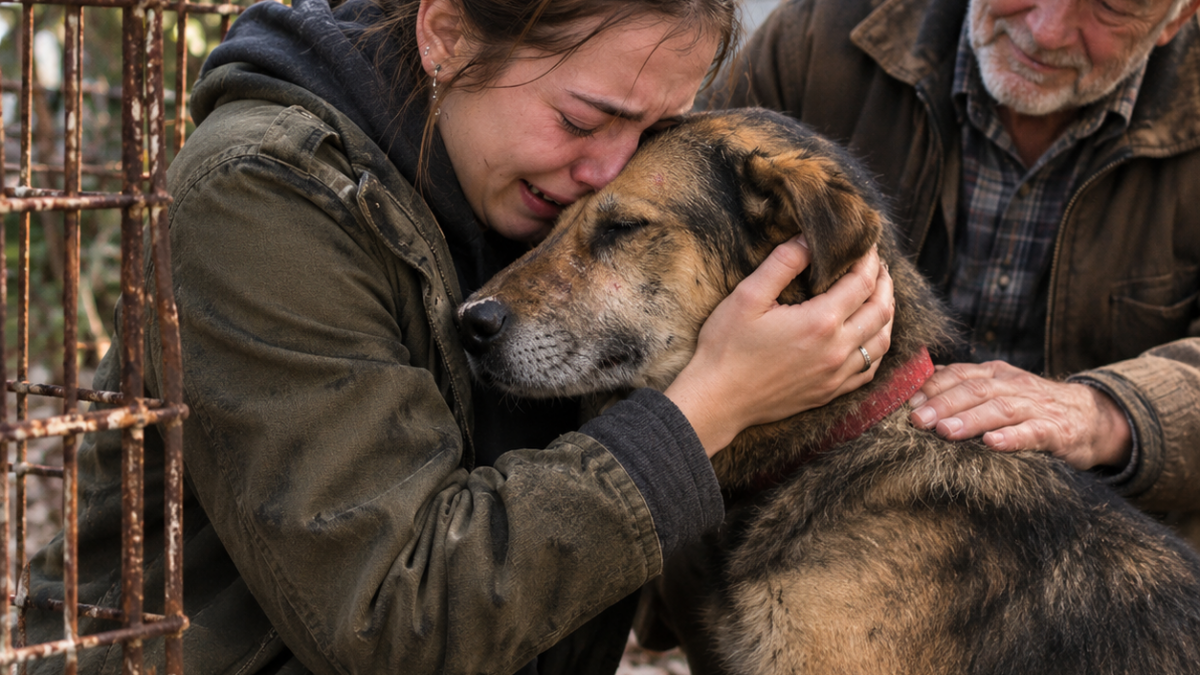
The video lasted less than two minutes, but by the time it ended, my twelve-year-old daughter was crying beside me because the dog we had searched for through flooded roads, shelters, veterinary clinics, Facebook groups, and nearly three years of false sightings was suddenly alive on her phone screen—resting his white paw on the knee of a seventy-nine-year-old man who called him by another name.
I had promised Léna the night Nino disappeared that I would bring him home, and for two years and nine months that promise followed me through every unanswered call, every useless drive to identify another black-and-tan dog, and every moment when my daughter refused to let us adopt again because, as she kept reminding me, nobody had ever proved Nino was dead.
But when we finally stood only a few yards away from him again and Léna whistled the three little notes he had always recognized, Nino did something that should have made our reunion simple—and instead forced all of us to face a question I had never imagined asking: after everything that had happened, did loving him still give us the right to take him back?
In January 2024, we lived in a small house near Saint-Omer in northern France. My wife, Élise, worked in a bakery, I worked in a warehouse, and we did not have much money, but we had our home, our daughter and Nino.
Nino was a shepherd mix we had adopted five years earlier. One ear folded slightly at the tip, one front paw was white, and he had one ridiculous habit that belonged entirely to Léna. She would whistle three short notes, and no matter where he was, Nino came running.
Then the floods arrived.
Brown water pushed through our street while neighbors carried bags toward higher ground. Someone shouted that we needed to leave. Our car was parked farther uphill, and I was trying to help Léna across a section where the current had begun crossing the road.
I held her arm with one hand.
Nino’s leash was in the other.
A wooden pallet crashed into a fence behind us.
Nino panicked.
The leash ripped through my fingers.
“Nino!”
He ran between two houses.
I started after him, but Léna slipped.
I caught her before she fell into the moving water.
When I looked up again, Nino was gone.
That night Léna asked me over and over if he would come back.
“Yes,” I told her.
I believed it because I needed her to believe it.
The next morning, we started searching. We called shelters and veterinarians, posted photographs online, drove to nearby towns and followed every possible sighting. For months, hope kept becoming another dog—a shepherd near a supermarket, a stray photographed at a gas station, an animal picked up by an association.
Eventually Léna stopped coming.
“It’s always another dog, Dad.”
Our flood-damaged house became too expensive to repair, so we moved to an apartment in Béthune. Furniture changed, schools changed, our routines changed, but Léna kept Nino’s old red rope toy and refused every suggestion of another dog.
“Nino isn’t dead,” she said. “You don’t know that.”
She was right.
Then, one Friday evening in the fall of 2026, she ran into the kitchen holding her phone.
“Dad. Look.”
The video came from a nearby senior residence. An elderly man named Marcel sat near a window while a black-and-tan dog rested against his leg.
The staff called the dog Pacha.
Léna enlarged the picture.
Folded ear.
White paw.
Then the dog stood, turned twice before lying down, exactly as Nino always had.
Marcel stroked him and said, “When my wife died, I stopped wanting to leave my room. This dog came every morning with his leash and waited until I got up. Without him, I don’t think I’d still be here.”
Two days later, Marcel called us.
When I said we had lost Nino during the 2024 floods, he went silent.
Then he said, “That’s when he arrived at the shelter where I adopted him.”
We arranged to meet.
Léna packed the old red rope toy.
“If he doesn’t remember us, he’ll remember this.”
At the residence garden, Marcel waited on a bench with Nino at his feet.
Léna stepped forward and whistled those three notes.
Nino shot upright.
He ran toward her.
Léna began crying.
But Marcel tried to stand at that same moment, lost his balance and grabbed the bench.
Nino stopped.
He stood between my daughter and the old man who said this dog had saved his life.
And then he turned.
PART 2
Nino turned toward Marcel.
For half a second, I felt something inside me break.
It was irrational, selfish, immediate.
After two years and nine months of searching, after hundreds of photographs, phone calls and wrong dogs, after waking from dreams in which I heard his tags moving somewhere downstairs, I had imagined this moment so many times that I thought I knew exactly how it would happen.
Nino would see us.
He would run.
He would remember.
We would take him home.
That was the story I had carried inside me.
But Nino did not know the story I had written for him.
He only knew the old man behind him had begun to fall.
He ran back to Marcel and pressed his shoulder against the man’s legs while Marcel lowered himself onto the bench.
“Easy, Pacha,” Marcel whispered.
Pacha.
The name hurt.
Léna remained frozen several yards away.
Tears ran down her face.
“Nino.”
The dog looked toward her.
His entire body trembled.
Marcel’s hand rested against his back.
Léna whistled again.
Three notes.
Nino spun around.
This time he ran all the way to her.
Léna dropped to her knees before he reached her.
He crashed into her chest.
There was no graceful reunion.
He whined.
She sobbed.
His tail struck the ground.
He climbed halfway into her lap even though he was far too large.
“Nino.”
She buried both hands in the fur around his neck.
“Nino, Nino, Nino.”
Élise covered her mouth.
I could not move.
The dog I had spent almost three years imagining dead, injured, starving, hit by a car or alone somewhere in the countryside was twenty feet away licking my daughter’s face.
Léna pulled the red rope toy from her bag.
The moment Nino smelled it, he stopped.
His head moved slowly.
She held it out.
“Remember?”
Nino sniffed once.
Then again.
He took it from her hand.
Not roughly.
Slowly.
He stood with the toy hanging from his mouth.
For several seconds, he looked almost confused.
Then his tail began moving again.
Élise made a sound behind me that was half sob, half laugh.
“That’s him.”
I finally stepped forward.
“Nino.”
His head turned.
He stared at me.
I wish I could tell you recognition was immediate.
It wasn’t.
That hurt more than I expected.
He sniffed the air.
I crouched.
“Nino.”
One step.
Then another.
He came close enough to smell my hands.
I did not reach.
I had no idea whether he remembered me as his family or simply as a stranger who smelled vaguely familiar.
Then Nino pushed his nose into my jacket.
He sniffed my chest.
My arm.
My face.
And suddenly his ears changed.
His body softened.
He made the same low whining sound he had made with Léna.
I broke.
“I’m sorry.”
Those were the first words I said.
Not hello.
Not we found you.
I’m sorry.
I put my arms around him and pressed my face into his neck.
“I’m sorry I let go.”
For almost three years I had told everyone the same version.
Nino panicked.
The leash slipped.
Léna fell.
I had no choice.
All true.
But guilt does not care about facts.
In my mind, I had dropped the leash.
I had failed.
I had broken my promise.
Nino licked my cheek.
Then pulled away.
Not because he rejected me.
Because Marcel spoke.
“Pacha.”
Nino turned immediately.
There it was again.
Two names.
Two lives.
Two families.
Marcel sat quietly on the bench watching us.
His face was pale after losing his balance.
But there was something else in his expression.
Fear.
I recognized it because I felt the same thing.
He was looking at us as if we had arrived to take his dog away.
And legally, perhaps, that was exactly what we could try to do.
Léna seemed to realize it too.
She held Nino’s old rope toy against her chest.
Marcel looked at her.
“I think he remembers.”
Léna nodded.
No one knew what to say next.
Finally Marcel whispered, “You should sit.”
We gathered around the bench.
Nino stood in the center of us.
He moved first toward Léna.
Then Marcel.
Then Élise.
Then back to Marcel.
He sniffed everyone.
Checked everything.
His tail continued moving, but his eyes looked uncertain.
It was almost as if he understood that two parts of his life had collided in the same garden and nobody had told him what he was supposed to do about it.
Marcel broke the silence.
“I didn’t steal him.”
“I know.”
My answer came too quickly.
Marcel looked at me.
“I need you to know that.”
“We do.”
Élise sat beside him.
“We know.”
Marcel nodded.
His hands shook slightly.
“He was called Pacha at the shelter.”
“When?”
“March 2024.”
My heart jumped.
“March?”
“Yes.”
“That’s almost two months after the flood.”
“I know.”
“What happened before that?”
Marcel looked toward the residence building.
“I only know what the shelter told me.”
“Which was?”
“He was found near Aire-sur-la-Lys. Muddy. Very thin. No collar. His paws were damaged.”
Léna pressed one hand over her mouth.
Nino continued holding the rope toy.
Marcel said, “He was afraid of water.”
Élise looked at me.
Of course.
The flood.
“They said he’d been wandering.”
“Did they post him anywhere?”
“I don’t know.”
“How did no one find our notices?”
My voice became sharper than I intended.
Marcel flinched.
“I don’t know.”
I immediately felt ashamed.
“I’m sorry.”
“It’s all right.”
“No. It isn’t your fault.”
Marcel stroked Nino’s back.
“I adopted him in April.”
I calculated automatically.
Three months after we lost him.
“He’d already been in the shelter several weeks?”
“Yes.”
“Did they scan for a chip?”
“He didn’t have one registered to anyone.”
I closed my eyes.
Nino had been chipped once through the small rescue where we first adopted him, but after moving houses several years earlier, I had never checked whether our current address and phone number had been updated correctly.
I remembered putting the paperwork in a drawer.
I remembered thinking I would do it later.
Later.
The word cut deeper than I expected.
Marcel continued.
“My wife had died the previous year. My daughter thought a dog might help me. I told her I didn’t want one.”
A faint smile crossed his face.
“Then I met him.”
Nino looked toward Marcel’s voice.
“He didn’t want me either.”
Léna wiped her face.
“What do you mean?”
“He sat at the far end of the visiting room and ignored me.”
Despite everything, she laughed.
Marcel smiled.
“I sat there for forty minutes.”
“What happened?”
“He came over and stole my glove.”
Léna laughed harder.
“That’s Nino.”
“He still steals gloves.”
“He used to steal Dad’s socks.”
“I remember.”
Marcel looked at me.
Of course he did not remember our version.
But he understood.
For the first time, I saw Nino’s missing years not as a black hole but as a life.
A shelter.
A glove.
An old man grieving his wife.
Morning walks.
A residence.
A new name.
People who knew him.
People who had loved him when we could not find him.
That should have comforted me.
Instead, it terrified me.
Because if Nino had been miserable, the decision would have been easy.
Take him home.
But he wasn’t miserable.
He had a home.
Just not ours.
Léna seemed to reach the same conclusion.
She looked at Marcel.
“Do you love him?”
Marcel’s face changed.
“Yes.”
She looked down at Nino.
“Does he sleep with you?”
Marcel smiled.
“He is not supposed to.”
“So yes.”
“Yes.”
“Does he still scratch at the door when he wants breakfast?”
“Every morning.”
“What time?”
“Six twenty.”
Léna gave a wet laugh.
“He used to do six fifteen.”
“He has matured.”
For the first time, the tension eased.
Then Marcel said quietly, “If he is yours, I will give him back.”
Everything stopped.
Nino sat beside his knee.
Marcel’s hand rested on the dog’s shoulders.
I looked at that hand.
Thin.
Veins raised beneath aged skin.
I remembered the video.
Without this dog, I would not be here.
I had spent nearly three years angry at myself for losing Nino.
Now I was being offered the chance to keep my promise.
All I had to do was break someone else.
Léna whispered, “No.”
Marcel looked at her.
“What?”
“You can’t just give him back.”
“He belonged to you.”
“He belongs to you too.”
No one spoke.
She was twelve when Nino disappeared.
Almost fifteen now.
Somewhere during those years, the child who slept with his rope toy beneath her pillow had become someone capable of seeing an old man’s pain while drowning in her own.
Marcel shook his head.
“You searched for him.”
“Yes.”
“You were his family.”
“We still are.”
Léna looked at Nino.
“But so are you.”
I will never forget Marcel’s face.
His eyes filled.
He looked away quickly.
Nino leaned against his leg.
Léna moved closer.
“Can we visit him?”
Marcel laughed once through his tears.
“Of course.”
That should have solved everything.
It didn’t.
Because loving people are often capable of making simple situations complicated.
The legal question appeared almost immediately.
The shelter had transferred ownership to Marcel properly after the required process. Almost three years had passed. Our old photographs and veterinary records clearly proved Nino had once been ours, but Marcel had not taken him knowingly from us. He had adopted an unidentified lost dog through a legitimate shelter.
I could have fought.
A lawyer told us we might have arguments based on prior ownership and the circumstances of the flood.
Might.
That word returned.
A fight could take months.
It could cost money we didn’t have.
It could place Marcel under enormous stress.
And most importantly, nobody could explain to me what the fight would do to Nino.
Élise and I argued for the first time about him that night.
Not loudly.
That made it worse.
“He was ours,” I said.
“He still is ours.”
“Then why are we acting like visitors?”
“Because someone else cared for him for almost three years.”
“That doesn’t erase five years with us.”
“I didn’t say it did.”
“I promised Léna.”
Élise looked at me.
“This is not about your promise anymore.”
The words hit hard.
“What is that supposed to mean?”
“It means I know you blame yourself.”
“I lost him.”
“You saved our daughter.”
“I let go of the leash.”
“Because Léna was falling into floodwater.”
“I could have—”
“No.”
Her voice sharpened.
“You don’t get to rewrite that day so you can punish yourself forever.”
I turned away.
Élise continued.
“You had one hand on our child and one hand on our dog. Something crashed. Nino panicked. Léna slipped. You caught her.”
“I lost him.”
“Yes.”
Her eyes filled.
“And I grieved him too. But I never wanted you to choose the dog instead of our daughter.”
That silenced me.
From the hallway, Léna spoke.
“Neither did I.”
We turned.
She stood near her bedroom door.
I had not known she was listening.
“Léna—”
“You think I blamed you?”
I couldn’t answer.
She came closer.
“I was twelve.”
“I know.”
“I was angry at everything.”
“I know.”
“I asked you to promise.”
“Yes.”
Her eyes filled.
“You shouldn’t have.”
That hurt.
She took my hand.
“Dad, you couldn’t promise that.”
“I wanted to.”
“I know.”
She squeezed my fingers.
“But you didn’t leave him.”
I looked away.
She said, “The flood took him.”
I had no defense against my daughter forgiving me for something I had spent almost three years refusing to forgive myself for.
I cried in the kitchen.
Not dramatically.
Quietly.
Élise held me.
Léna did too.
The next day, we called Marcel.
“We don’t want to take Nino from you.”
Silence.
Then Marcel asked, “Are you sure?”
“No.”
I laughed sadly.
“I don’t think any of us are sure of anything.”
He understood.
“But we want to find a way.”
That was how our strange arrangement began.
At first, we visited the residence twice a week.
Nino learned the days faster than we did.
Every Wednesday, Léna finished school, grabbed the red rope toy and rushed us out of the apartment.
By the third week, staff at the residence told us Nino began waiting near the main entrance around the time we usually arrived.
“He knows,” one nurse said.
“How?”
She smiled.
“Dogs know.”
Maybe.
The first few visits were difficult for Marcel.
He tried to hide it.
Whenever Nino spent too much time beside Léna, Marcel grew quieter.
Whenever Marcel called “Pacha” and Nino ran back to him, I felt an ache I was ashamed of.
We were all jealous.
Of a dog.
Of years.
Of a name.
One afternoon, Léna was throwing the rope toy in the garden.
“Nino!”
He returned it.
Marcel smiled.
Then called:
“Pacha.”
The dog looked at him.
Léna’s face changed.
She stopped playing.
On the drive home she said, “I hate that name.”
I knew.
“It feels like he became someone else.”
“Yes.”
“He’s Nino.”
“To you.”
“To us.”
“Yes.”
She stared out the window.
“What if he likes Pacha better?”
“That isn’t how names work.”
“How do you know?”
I didn’t.
The next visit, Marcel surprised her.
He called:
“Nino.”
The dog looked up.
Léna stared.
Marcel smiled.
“I’m learning.”
She sat beside him.
“You don’t have to.”
“He has two names.”
“That’s weird.”
“He has two families.”
She smiled.
“That’s also weird.”
“Life is badly organized.”
From then on, Marcel used both names.
Nino-Pacha.
Pacha-Nino.
Sometimes simply “you old thief.”
The dog answered to all of them if food was involved.
Two months after our reunion, we tried our first weekend visit.
Nino would stay at our apartment from Saturday morning until Sunday evening.
Marcel agreed.
Then changed his mind.
Then agreed again.
At the residence entrance, his hand stayed on Nino’s collar longer than necessary.
“You’ll bring him back Sunday?”
“Yes.”
“What time?”
“Six.”
“Six exactly?”
“Marcel.”
He looked embarrassed.
“I’m sorry.”
I suddenly understood.
He was afraid.
The same fear we had lived with for almost three years.
What if the dog left and never returned?
I put my hand on his shoulder.
“Six.”
He nodded.
Nino jumped into our car.
For the first few minutes, he stood anxiously in the back seat.
Then Léna whistled.
Three notes.
Nino sat beside her.
At our apartment, everything was new.
This was not the house he remembered.
The floods had taken that from us too.
He sniffed the hallway.
Kitchen.
Bedrooms.
Balcony door.
Then he entered Léna’s room.
On the bed sat the old red rope toy.
He froze.
Walked toward it.
Sniffed.
Then lay down beside her bed.
Léna sat on the floor.
“You remember something, don’t you?”
Maybe.
We will never know.
Memory in animals is not a movie they can explain to us.
But that night, when Léna went to bed, Nino slept beside her door exactly as he had when she was a child.
I stood in the hallway for a long time watching.
Élise whispered:
“Come to bed.”
“In a minute.”
The promise had not been fulfilled the way I imagined.
Nino was in our home.
But not ours alone.
Still, I felt something inside me loosen.
Saturday was wonderful.
Sunday afternoon was terrible.
Not because Nino wanted to leave.
Because we didn’t want to return him.
At five thirty, Léna sat beside him on the couch.
“Can’t he stay one more night?”
“We promised.”
“Marcel would understand.”
“Yes.”
“Then?”
I looked at her.
“What did it feel like when Nino disappeared?”
She knew immediately.
“That’s not fair.”
“No.”
“But Marcel knows where he is.”
“He also needs to know we mean what we say.”
Léna looked at Nino.
Then nodded.
At exactly six, we walked into the residence.
Marcel was waiting by the entrance.
The moment Nino saw him, his tail exploded.
He ran.
Marcel laughed.
A sound I had not heard from him before.
Full.
Young.
Relieved.
Nino pressed himself against the old man’s legs.
Léna watched.
I expected sadness.
Instead, she smiled.
“He missed you.”
Marcel looked at her.
“He missed you too.”
That was the first weekend.
Then another.
Then another.
The arrangement developed naturally.
Weekdays with Marcel.
Some afternoons with us.
Every other weekend in our apartment.
Sometimes Nino stayed longer if Marcel had medical appointments.
Sometimes Léna visited him at the residence instead.
We did not call it shared custody because that sounded absurd.
But that was what it became.
Marcel’s daughter, Sophie, was less enthusiastic.
She lived in Lille and visited twice a month.
The first time we met, she pulled me aside.
“My father is seventy-nine.”
“I know.”
“He falls.”
“I saw.”
“He has heart problems.”
“I didn’t know that.”
“And Pacha is a large dog.”
“Nino.”
She frowned.
“Pacha.”
There it was.
Two families.
Two names.
Same problem.
Sophie crossed her arms.
“I’m not trying to be rude.”
“You’re succeeding accidentally.”
She almost smiled.
Then her expression softened.
“I’m worried about my father.”
“So are we.”
“If he falls while walking the dog—”
“We can help.”
“You have your own lives.”
“We’re fifteen minutes away.”
She looked toward the garden where Léna and Marcel were sitting together while Nino lay between them.
“My father was terrible after my mother died.”
Marcel had told us some of it.
Sophie told me more.
He stopped eating properly.
Ignored friends.
Refused family dinners.
Would not leave his room some mornings.
Then came Pacha.
“He started walking because the dog needed walking.”
She swallowed.
“Then he started talking to people again.”
I nodded.
“That’s what he said in the video.”
“He doesn’t exaggerate.”
She looked at me.
“I’m sorry you lost him.”
“Thank you.”
“But I’m terrified my father will lose him now.”
For the first time, Sophie stopped feeling like an obstacle.
She was me.
Different version.
Same fear.
“We don’t want that.”
“Promise?”
The word hit me.
Promise.
I had learned to fear it.
“I can promise we won’t take Nino away without thinking about what he needs.”
Sophie studied me.
“That’s not what I asked.”
“It’s the promise I can actually keep.”
She nodded slowly.
“Fair.”
Three months after the reunion, Nino changed all our lives again.
It happened on a Tuesday morning.
I was at work when my phone rang.
Sophie.
I almost ignored it because I was moving inventory.
Something made me answer.
“Hello?”
“My father collapsed.”
Everything inside me tightened.
“Where?”
“At the residence.”
“Is he alive?”
“Yes. Ambulance is taking him to the hospital.”
“Nino?”
Silence.
Then:
“He’s the reason they found him.”
I leaned against a shelf.
“What happened?”
Marcel had gone back to his room after breakfast.
Later, Nino appeared alone in the corridor.
No leash.
He went to the nurses’ station.
Barked.
Walked toward Marcel’s hallway.
Returned.
Barked again.
A staff member followed.
Marcel was on the floor beside his bed.
Conscious but confused.
His blood pressure had dropped sharply.
If he had remained there much longer, the situation could have been far worse.
The staff called emergency services.
Nino tried to follow the stretcher.
They had to hold him back.
I left work.
By the time I reached the residence, Nino was sitting outside Marcel’s closed bedroom door.
He looked at me.
Then at the door.
“Nino.”
He stood.
Walked toward me.
Then returned to the door.
I crouched.
“Marcel isn’t there.”
He whined.
My heart broke.
For years, I had imagined Nino as the one needing rescue.
Now he had rescued someone else.
Again.
Sophie arrived thirty minutes later.
She was crying.
“They’re admitting him.”
“How bad?”
“Heart rhythm problem. Dehydration. They’re running tests.”
She looked at Nino.
“I can’t take him.”
“What?”
“My apartment doesn’t allow large dogs, and I need to be at the hospital.”
I understood immediately.
“We’ll take him.”
Her eyes filled.
“Please.”
That night, Nino slept in Léna’s room.
But this time the experience felt different.
He did not settle.
He walked to the apartment door repeatedly.
Whined.
Returned to Léna.
Then door.
At two in the morning, she came into our bedroom.
“He thinks Marcel is missing.”
I sat up.
Of course.
Nino had lost a family before.
Now an old man had disappeared into an ambulance.
We could not explain hospitals.
We could not tell him three days.
Or five.
Or he’s coming back.
We could only show him patterns.
So the next morning, we took Nino to the hospital parking area with Sophie.
Marcel could not receive the dog inside, but Sophie came out with one of his sweaters.
Nino smelled it intensely.
Then carried it into our car.
He slept on that sweater for three nights.
On the fourth day, Marcel called by video.
Léna placed the phone near Nino.
“Pacha.”
Nino’s ears shot up.
“Hey, old boy.”
He began searching behind the phone.
Léna cried.
Marcel cried.
I almost ended the call because it seemed cruel.
Then Nino lay down beside the phone.
Marcel kept talking.
He told him about the hospital food.
Complained about nurses.
Promised walks.
Nino listened.
Or perhaps simply recognized the voice.
For twenty minutes, nobody cared which explanation was scientifically correct.
Marcel returned to the residence ten days later using a walker.
We brought Nino back ourselves.
The reunion happened in the same garden where our first reunion had occurred.
This time Marcel sat before Nino arrived.
Good.
No falling.
We opened the gate.
Nino saw him.
Ran.
No hesitation.
He pressed his entire body against Marcel’s knees.
Marcel bent over him.
“My boy.”
Léna stood beside me.
She was crying.
Then she whispered:
“Dad?”
“Yes?”
“I’m glad we gave him back.”
I looked at her.
Not because the words hurt.
Because I understood what she meant.
We had not lost Nino again.
We had returned him to someone he loved.
That was different.
Marcel stroked the dog’s scarred collar area.
“I thought you were going to keep him.”
Léna walked forward.
“We said we’d bring him back.”
Marcel looked at me.
I nodded.
This promise I had kept.
After that health scare, the residence changed its rules around Marcel and Nino.
Staff helped with longer walks.
We handled veterinary appointments.
Léna came after school twice a week.
Sophie handled medical logistics.
Our two families stopped orbiting around the question of ownership and started solving ordinary problems together.
Who buys food?
We do this month.
Who takes him to the vet?
I will.
Who keeps him when Marcel has cardiology?
Us.
Who walks him on rainy mornings?
Apparently nobody wants to.
Nino hated rain.
We discovered that had not changed.
One rainy Saturday, Léna stood at the residence door holding his leash.
“Come on.”
Nino looked outside.
Rain.
He backed up.
Marcel laughed from his chair.
“Pacha has standards.”
“Nino used to love puddles.”
“Pacha does not.”
Léna stared at the dog.
“You became spoiled.”
Marcel said:
“That is what retirement is for.”
Nino went back to his bed.
Both names.
Both lives.
One dog.
A year passed.
Then another.
Nino grew gray around the muzzle.
Léna turned sixteen.
Marcel turned eighty-one.
I stopped counting the exact number of months since the flood.
That surprised me.
For years I knew the number automatically.
Eight months.
Fourteen.
Twenty-one.
Thirty.
Time since Nino disappeared.
Then one day the count no longer mattered.
We had found him.
Not in the way I expected.
But found.
The red rope toy stayed at Marcel’s room.
Léna had given it to Nino permanently.
I asked once if she wanted to bring it home.
“No.”
“Why?”
“That’s his.”
“You kept it for almost three years.”
“I was keeping it until he came back.”
I looked at her.
“He did.”
She smiled.
“Yes.”
There was wisdom in that I still struggle to explain.
She had not kept the toy because she wanted possession.
She had kept a place open.
Once Nino returned to her life, the object had finished its job.
Marcel kept the toy beside Nino’s bed.
Sometimes staff found the dog sleeping with one paw on it.
That photograph became my favorite.
The old rope from our first family.
The bed in his second home.
No conflict.
Just both.
Sophie eventually apologized to me for the first conversation we had.
“You thought I was trying to keep him from Marcel.”
“You were.”
“I thought you were trying to steal him.”
“I was considering it.”
She laughed.
“At least we were both terrible.”
“Fear does that.”
She grew serious.
“My father talks about you like family now.”
“He is.”
That answer surprised me only after I said it.
But it was true.
We began spending Christmas Eve together at the residence.
Marcel came to our apartment for Léna’s seventeenth birthday.
Sophie joined us.
Nino moved between everyone.
No longer checking nervously.
Just collecting food opportunities.
At dinner, Marcel tried to give him sausage under the table.
I caught him.
“No.”
Marcel looked innocent.
“I did nothing.”
Nino chewed.
“You absolutely did.”
“He is old.”
“So are you.”
“Exactly. We deserve sausage.”
Léna nearly choked laughing.
That was our life.
The dramatic question that had terrified us—who gets the dog?—slowly became irrelevant.
Nino got all of us.
Maybe that was the answer from the beginning.
Then came Marcel’s eighty-second winter.
His health had declined.
Not one crisis.
Several smaller ones.
Fatigue.
Shortness of breath.
Another fall.
Longer recovery.
His doctor eventually recommended more supervision.
The residence could provide it.
But Marcel’s walks with Nino became shorter.
Then some days they did not happen at all.
We walked Nino.
He always returned to Marcel’s room afterward.
One afternoon, I found Marcel sitting by the window while Nino slept beside his feet.
The same arrangement as the video Léna had discovered years earlier.
Marcel said:
“I need to ask you something.”
I sat.
“What?”
“If something happens to me…”
I knew.
“Nino comes to us.”
“Immediately.”
“Yes.”
“No shelter.”
“Never.”
“No confusion.”
“No.”
“He goes with Léna?”
“If that’s still what she wants.”
Marcel smiled.
“It is.”
“How do you know?”
“He sleeps outside her room every weekend.”
Fair.
Marcel looked at Nino.
“He lost one family once.”
I swallowed.
“He won’t lose another.”
“Promise?”
There it was.
The word.
I looked at Marcel.
For years I had carried one promise I could not keep.
Maybe that had made me afraid to promise anything beyond my control.
But this was different.
This was something I could choose.
“Yes.”
Marcel nodded.
“Good.”
I hesitated.
“Can I ask you something?”
“Of course.”
“Did you ever resent us?”
His face showed surprise.
“For finding him?”
“For coming back.”
Marcel thought for a long time.
“The first day?”
“Yes.”
I appreciated the honesty.
“I thought you were going to take away the only reason I still got up in the morning.”
“I thought you had the dog I failed to bring home.”
“We were both afraid.”
“Yes.”
He smiled.
“Then Léna was smarter than us.”
Also yes.
“She usually is.”
Marcel touched Nino’s back with his shoe.
“You know, when I adopted him, I thought I was rescuing a lost dog.”
I waited.
“It took me years to realize he had simply found another person who was lost.”
I looked toward the window.
The old man from the video.
The dog from the flood.
Two creatures displaced by different kinds of disaster.
Maybe that was why they understood each other.
Marcel’s final hospitalization happened the following spring.
This time there was no dramatic bark at the nurses’ station.
Staff noticed his condition worsening.
He went to the hospital.
Nino came to our apartment.
For the first few days, he waited by the door again.
But now he knew our home too.
He ate.
Slept beside Léna.
Went to the park.
Returned.
He was worried.
Not lost.
That distinction mattered.
Marcel came home to the residence after twelve days.
Palliative care.
Sophie told us before Léna.
Cancer.
Late.
Complicated by his heart.
There would be no aggressive treatment.
Léna listened silently.
Then asked:
“How long?”
Nobody knew.
Weeks.
Maybe months.
She went to Marcel’s room that evening.
Nino was already there.
Marcel looked small in the bed.
Léna sat beside him.
“You’re not allowed to die before my graduation.”
Marcel laughed weakly.
“When is it?”
“June.”
“I’ll check my schedule.”
She cried.
He reached for her hand.
“You know he’s yours when I’m gone.”
Léna shook her head.
“No.”
“Léna.”
“He’s ours.”
Marcel smiled.
“Still correcting old men.”
“You taught me.”
Nino rested his chin on the bed.
Marcel touched the white paw.
“I want you to promise something.”
Léna looked at me.
I felt the word again.
But this promise belonged to her.
“What?”
“Don’t stop bringing him here.”
She frowned.
“After?”
“Yes.”
“Why?”
Marcel looked toward the hallway.
“There are people here who wait for him too.”
That was true.
Nino had become part of the residence.
He visited residents who never had family.
Sat beside wheelchairs.
Waited outside the dining room.
Accepted biscuits from people who absolutely were not supposed to give them.
He had saved Marcel first.
But not only Marcel.
Léna nodded.
“I promise.”
Marcel lived until June.
Barely.
Léna graduated on a Friday.
We brought photographs to his room.
She wore her graduation clothes.
Marcel cried.
“You made it,” she told him.
“So did you.”
Nino lay beside the bed.
The red rope toy rested near his paws.
Marcel reached down.
Could barely touch him.
Nino stood and placed his white paw on the mattress.
Exactly like the video.
Sophie covered her face.
I had to leave the room for a minute.
Marcel died four days later.
We were there.
Not at the exact second.
Sophie was.
Nino had been at our apartment that night because the residence knew Marcel was very weak and the room was crowded with medical equipment.
At 5:40 the next morning, Sophie called.
I answered before the second ring.
“He’s gone.”
I sat in the dark.
Nino lifted his head from beside the couch.
I looked at him.
How do you tell a dog the person he waits for will never come back?
You don’t.
You show him the new shape of life.
We took Nino to the residence later that morning.
Some people advised us not to.
I disagreed.
Marcel’s room was empty of medical staff now.
Sophie sat inside.
Nino entered slowly.
He sniffed the doorway.
Bed.
Chair.
Marcel’s sweater.
He searched.
Once.
Twice.
Then stood beside the bed.
The red rope toy remained where it had been.
Nino picked it up.
Carried it to Marcel’s chair.
Lay down.
Nobody spoke.
I do not know what he understood.
I refuse to pretend.
But he knew something had changed.
We stayed an hour.
When it was time to leave, Léna picked up the leash.
“Nino.”
He looked toward her.
She whistled.
Three notes.
He stood.
For one second he looked back toward Marcel’s chair.
Then walked to Léna.
Not forgetting.
Moving.
There is a difference.
Nino came home with us permanently that day.
The first night, he slept outside Léna’s bedroom.
Just as he had years earlier.
The next morning, at six twenty, he barked.
Léna shouted from her room:
“Marcel ruined you!”
I laughed so suddenly that I cried.
Nino barked again.
Life did that.
Grief and breakfast occupying the same minute.
We kept our promise to Marcel.
Every Wednesday, Léna took Nino to the residence.
At first, he went directly to Marcel’s old room.
The new resident had not yet moved in.
Nino sniffed.
Waited.
Then eventually wandered toward the common room.
An elderly woman named Madame Fournier sat alone near the window.
Nino approached.
Placed his white paw on her knee.
Léna stopped.
The staff member beside her whispered:
“He used to do that with Marcel.”
I knew.
Madame Fournier looked down.
“Well, hello.”
Nino sat beside her.
That became his new routine.
Not replacing Marcel.
There is no replacement.
But continuing.
Marcel had asked that Nino keep coming.
He did.
A month later, Madame Fournier began waiting for Wednesday.
Then another resident.
Then another.
Nino became unofficially everybody’s dog for one afternoon each week.
He had spent years belonging to one family.
Then another.
Then somehow both.
Eventually, he belonged a little to an entire building.
The flood had taken him away from us.
But the life created afterward was larger than anything I could have planned.
That realization took me years.
For a long time, I thought the story was about my failure.
I let go.
I lost him.
I broke a promise.
Then I thought it was about finding him.
The video.
The white paw.
The whistle.
The reunion.
Then I thought it was about choosing.
Us or Marcel.
Nino or Pacha.
Old family or new.
I was wrong every time.
The story was about refusing to make love smaller just because loss had made us afraid.
If we had taken Nino away from Marcel that first afternoon, we could have called it justice.
He had been our dog first.
We had photographs.
Records.
Years of memories.
A child who waited almost three years.
People would have understood.
Maybe even applauded.
But Nino would have lost another home.
Marcel would have lost the creature who pulled him out of grief.
And we would have taught Léna that loving something means possessing it.
Instead, our family became strange.
Complicated.
Bigger.
Nino kept two names.
Two beds.
Two routines.
Two sets of people who worried when he coughed.
And somehow his heart managed what ours struggled to understand.
It made room.
There was no betrayal in the way he ran to Marcel.
No rejection in the way he came back to Léna.
Dogs do not divide love the way humans divide property.
Nino did not ask who had the stronger legal claim.
He remembered the girl who whistled.
He loved the old man who got up every morning because of him.
Both were true.
Years later, when people heard the story, they often asked the same question.
“So who was the real owner?”
I stopped answering it.
Owner was the wrong word.
Who was his family?
Léna.
Élise.
Me.
Marcel.
Sophie.
In different ways, at different times.
The shelter that kept him safe after the flood was part of his story too.
So were the residence employees.
So was Madame Fournier.
Nino’s life had not been stolen from us for two years and nine months.
That was how I had experienced it.
But from his side, something else had happened.
He survived a flood.
He wandered.
He reached a shelter.
He met a grieving man.
He got another home.
Then one day, his first family walked back into his garden.
His life did not restart.
It expanded.
Nino grew older with us.
His black muzzle became gray.
The folded ear remained folded.
His white paw remained the easiest way for strangers to recognize him.
He still turned twice before lying down.
And Léna could still whistle those three notes from almost anywhere.
Even when his hearing began fading, he usually noticed.
One afternoon, several years after Marcel died, we were at the senior residence.
Nino was lying beside Madame Fournier’s chair.
Léna stood near the door.
She was an adult now.
University applications on her phone.
Keys in her pocket.
The child who once kept a rope toy beneath her pillow had almost disappeared.
She whistled.
Three notes.
Nino lifted his gray head.
For a moment, he stayed beside the old woman.
Then Madame Fournier patted his shoulder.
“Go on.”
Nino stood.
Walked slowly across the room.
Léna crouched.
He pressed his forehead against her.
I watched from the doorway.
And suddenly I was back in floodwater.
The leash sliding through my hand.
“Nino!”
Gone.
For years, that had been the memory I could not escape.
But this time another memory came over it.
Nino in Marcel’s garden.
Running toward Léna.
Stopping when Marcel stumbled.
Turning back.
Then returning to her.
I finally understood what I had seen that afternoon.
I had thought Nino could not choose.
That wasn’t it.
He refused the choice we were trying to force onto him.
He had not returned to Marcel because he loved Léna less.
He had not run to Léna because Marcel mattered less.
One person needed him in that second.
Then the other.
So he went where he was needed.
Simple.
We were the ones who made it complicated.
When Nino eventually became too old for weekly visits, the residence staff came to see him at our apartment.
Madame Fournier sent a blanket.
Sophie brought Marcel’s old photograph.
Léna kept the red rope toy in a basket beside Nino’s bed.
Not under her pillow anymore.
No need.
Nino was home.
One winter evening, I sat beside him while he slept.
He was an old dog then.
Very old.
His breathing slow.
His paws twitching occasionally in dreams.
The white one rested against my leg.
I touched it gently.
“I’m sorry I let go.”
The sentence came automatically.
After all those years.
Léna was standing behind me.
She heard.
“Dad.”
I looked at her.
She shook her head.
“Still?”
I smiled sadly.
“Sometimes.”
She sat beside me.
“You know what Marcel told me once?”
“What?”
“He said if you hadn’t let go of Nino, maybe you would have let go of me.”
I stared.
“He said that?”
“Yes.”
“When?”
“Before he died.”
She stroked Nino’s ear.
“He said you made the right choice before you even knew you were making one.”
My eyes burned.
“I never chose.”
“Exactly.”
She leaned against me.
“It happened.”
Nino opened one eye.
Then closed it.
Léna smiled.
“And look what happened after.”
I did.
The apartment.
Photographs.
A gray old dog.
A red rope toy.
One picture showed our original house before the flood.
Another showed Marcel by his residence window, Nino’s white paw on his knee.
Another showed Léna at graduation with Marcel and Nino.
The story was all around us.
Nothing had happened the way I promised.
Yet somehow we had reached something better than the ending I imagined.
If I had kept my promise exactly as I made it that first night, I would have brought Nino home immediately and erased everything between.
But those missing years mattered.
Marcel mattered.
The life Nino lived when we could not find him mattered.
Love does not become less real simply because it began after loss.
That was the hardest lesson.
And the most beautiful.
Nino did not spend the rest of his life as the dog who disappeared in a flood.
He became the dog who found a lonely man.
The dog who got him out of bed.
The dog who alerted staff when he collapsed.
The dog who reunited a grieving family with another grieving family.
The dog who taught my daughter that getting someone back does not always mean taking them away from somebody else.
And he taught me something about promises.
For years, I believed a broken promise defined me.
I told my daughter I would find her dog.
I couldn’t.
Then, much later, Marcel asked me for another promise.
Do not let him lose another home.
That one I kept.
When Marcel died, Nino came with us.
When the residence waited for him, we brought him back.
When he grew old, we stayed.
When he could no longer walk far, we carried him.
There are promises based on hope.
And promises based on choice.
I finally learned the difference.
The last red rope toy Nino ever played with was the same one Léna carried into Marcel’s garden.
The color had faded.
One end was frayed.
The knots were loose.
We should have thrown it away years earlier.
We never did.
It had survived the flood because it happened to be at home.
It survived the move.
The searches.
The false sightings.
Marcel.
The residence.
Everything.
Near the end of Nino’s life, he barely chewed it anymore.
He simply slept with one paw touching it.
The old past beside him.
The new life around him.
That is the photograph I keep.
Not the flood.
Not the missing poster.
Not even the reunion video.
Nino asleep.
Gray face.
White paw.
Red rope.
Safe.
If you asked me now whether we ever truly got our dog back, I would say the question is wrong.
We found him.
That is different.
We found the dog he had been.
And the dog he had become.
We found the part of him that still remembered Léna’s whistle.
We found the part that answered to Pacha when Marcel called.
We found the old habit of turning twice before lying down.
We found new habits Marcel had taught him.
We found that memory can survive without erasing what comes afterward.
Most importantly, we found that home is sometimes not one place.
Sometimes it is a chain of people who refuse to let you become lost again.
For two years and nine months, I thought the cruelest thing that could happen was discovering Nino was dead.
I was wrong.
The harder possibility was finding him alive and realizing that getting what I wanted could hurt someone else.
That was the choice.
That was the real test.
And in the end, Nino showed us the answer before any of us were brave enough to say it.
The day Léna whistled and he ran toward her, Marcel stumbled.
Nino turned back.
He made sure Marcel was safe.
Then he came to my daughter.
For years, I thought he had been caught between two families.
Now I know better.
He was holding them together.








