PART 2: My 82-Year-Old Mother Lay on a Freezing Kitchen Floor for 9 Hours—Her Cat Never Left Her Side
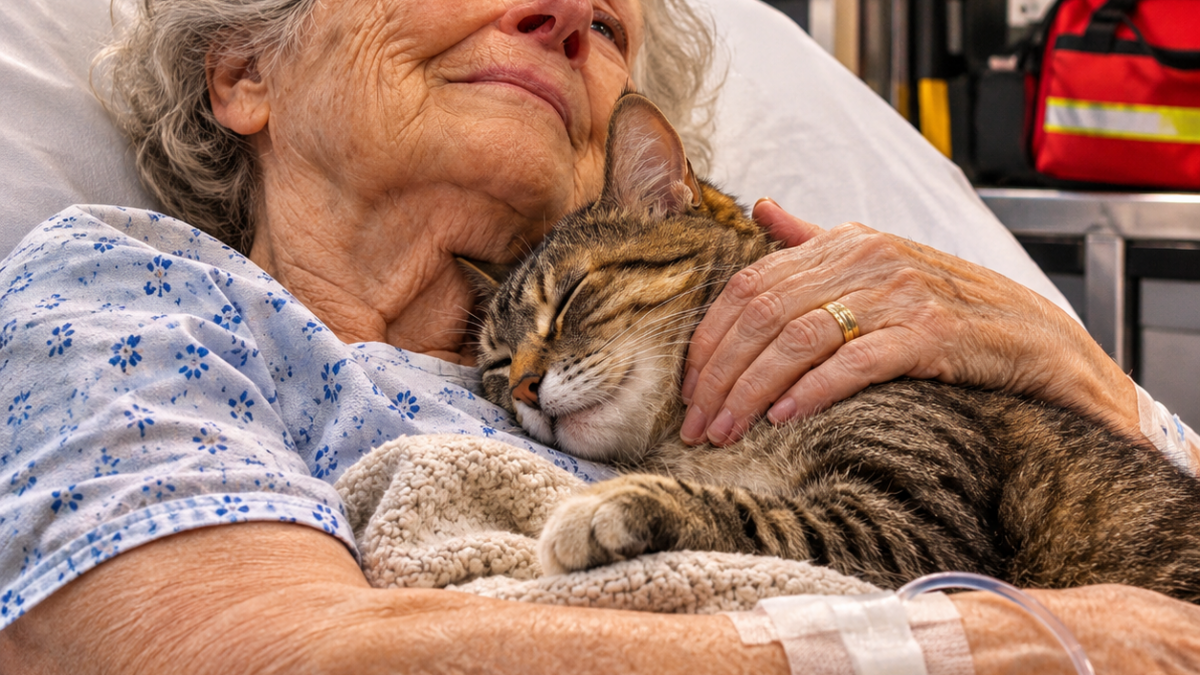
My 82-year-old mother lay alone on a freezing kitchen floor for nine hours with a broken hip, unable to reach her phone or even pull herself toward the counter.
By the time my brother finally found her at four in the morning, her body temperature had fallen dangerously low—and the emergency-room doctor said one small thing may have kept it from dropping even further.
It wasn’t a heating blanket, a space heater, or another person. It was the twelve-pound cat my father had brought home shortly before he died.
The photograph on my phone doesn’t look dramatic at first.
You see my mother’s hand.
Wrinkled skin.
Thin fingers.
The wedding ring she has worn for decades.
Then beneath the emergency blanket, there’s a tabby cat pressed against her chest, his round little face peeking out.
That cat is Biscuit.
And according to the doctor who treated my mother last Thursday, Biscuit may be one of the reasons she arrived at the hospital in better condition than she otherwise would have.
My mother has lived alone for eight years.
My father died after more than fifty years of marriage, and ever since then, we’ve had the same conversation with her at least a dozen times.
“Mom, you could move closer.”
“No.”
“You’d have family nearby.”
“I have family nearby enough.”
“We worry.”
“I know.”
“Wouldn’t an apartment be easier?”
“No.”
That answer has never changed.
Her house is small.
Single story.
Nothing luxurious.
It sits in a quiet neighborhood just outside a little town in southern Ohio.
But she and my father raised us there.
Birthday cakes happened in that kitchen.
Christmas mornings happened in that living room.
Our heights are still marked in pencil inside a closet door.
My father planted the maple tree out front.
My mother has always said:
“I’m not leaving the house where my life happened just because I got old.”
And then there is Biscuit.
Twelve years old.
Brown tabby.
Slightly overweight.
Lazy in the way only a cat who has never worried about rent can be lazy.
My father chose him from an animal shelter a few months before he died.
Nobody expected Dad to pick that cat.
There were kittens.
Young cats.
Beautiful cats that practically climbed the cage doors begging to be chosen.
Biscuit sat in the back looking mildly inconvenienced by the entire adoption process.
Dad pointed at him.
“That one.”
My mother still laughs when she tells the story.
After Dad died, Biscuit stopped being just a pet.
He became the last living thing my father had brought home.
Mom calls him:
“Your father’s last present to me.”
Last Wednesday evening, she was making tea.
Around seven.
She had put water on.
Reached for a cup.
Then one foot slipped.
She hit the tile hard.
Left hip first.
She told me later that before the pain even fully registered, she knew something was wrong.
She tried to move.
Couldn’t.
Tried to sit.
The pain was unbearable.
The kitchen counter was maybe three feet away.
Might as well have been thirty.
Her phone was in the living room.
She shouted once.
Then again.
No one heard.
And somewhere in that kitchen, Biscuit walked toward her.
Mom remembers him sniffing her face.
Then her shoulder.
Then circling once.
Finally, he lowered himself beside her right side and pressed his entire body against her ribs.
Mom thought he would leave after a few minutes.
Go eat.
Go sleep in his bed.
Go do what cats do.
He didn’t.
For the next nine hours, my mother lay on that tile floor.
And Biscuit stayed.
By midnight, the house was cold.
Mom had no socks.
Only a lightweight housecoat.
Her hip felt like it was on fire.
Everything else felt colder and colder.
Still Biscuit stayed against her side.
At one point, Mom put her hand over his back.
She could feel him breathing.
In.
Out.
In.
Out.
She told me later:
“That was how I knew I wasn’t completely alone.”
At four the next morning, my brother pulled into her driveway.
He still can’t explain exactly why.
He was headed to work.
Something made him turn.
He unlocked the door.
Called:
“Mom?”
No answer.
Then he saw the kitchen light.
And Biscuit.
Still pressed against her.
PART 2
My brother told me later that the first thing he noticed was how quiet the house felt.
Not peaceful.
Wrong.
There is a kind of silence you recognize immediately when you grew up somewhere.
Every house has its normal sounds.
A refrigerator humming.
Heat coming through vents.
Floorboards.
A television left too low.
Biscuit sometimes knocking something off a table because apparently twelve years of life had taught him nothing about gravity.
But that morning, my brother said the house felt still.
He had not planned to stop.
His shift started early.
Usually he drove past Mom’s neighborhood at around 3:45 in the morning.
Sometimes he would bring her groceries after work.
Sometimes stop for coffee on weekends.
That Wednesday night—technically Thursday morning—he told us later that he had driven almost a mile past the turn toward her house when something bothered him.
No dream.
No dramatic premonition.
Just a feeling.
He tried explaining it to me.
“I thought about Mom.”
“That’s it?”
“That’s it.”
“Why?”
“I don’t know.”
He had turned the truck around.
When he pulled into her driveway, he expected the house to be dark.
Instead, the kitchen light was still on.
That made him nervous.
Mom was obsessive about electricity.
She would walk across a room to switch off a lamp while lecturing us about utility bills from 1987.
A kitchen light at four in the morning wasn’t normal.
He unlocked the front door with the spare key we had finally convinced her to give him years earlier.
“Mom?”
Nothing.
Then:
“Mom?”
He stepped into the living room.
Her phone was sitting on the couch.
That was the next thing.
Mom almost always kept it near her.
Not because she loved technology.
She hated it.
But because we had nagged her so relentlessly about emergencies that she had reluctantly developed the habit.
My brother saw it.
Then the kitchen.
And there she was.
Mom was on her left side.
One arm bent awkwardly.
Her housecoat pulled slightly up around her knees.
Bare feet.
And Biscuit tucked tight against her torso.
My brother dropped everything.
“Mom!”
She opened her eyes.
That was the first relief.
Then she tried to speak.
Her voice barely came out.
“Don’t move me.”
He knelt.
“I’m not moving you.”
“My hip.”
“I know.”
“No, you don’t.”
Even lying on a floor for nine hours with a fractured hip, my mother could still correct somebody.
That was reassuring.
Biscuit raised his head.
My brother reached toward Mom.
The cat didn’t hiss.
Didn’t swat.
He just watched.
“He looked exhausted,” my brother said.
“That sounds ridiculous, but he did.”
Biscuit hadn’t slept in his bed.
His food bowl still had dinner in it.
His water barely touched.
The cat had simply stayed.
My brother called 911.
The dispatcher told him not to move her.
He found blankets.
Covered her.
Then sat on the floor with both of them until the paramedics arrived.
My brother says Mom kept asking:
“What time is it?”
He told her.
“Four.”
“In the morning?”
“Yes.”
She closed her eyes.
“Oh, Lord.”
Nine hours.
She had fallen around seven.
Nine hours on tile.
Nine hours in pain.
Nine hours waiting for a door to open.
I have tried imagining it.
I can’t.
Ten minutes in severe pain feels endless.
An hour?
Nine?
There are pieces of that night Mom still doesn’t like discussing.
At some point, she tried dragging herself toward the counter.
She moved maybe a few inches.
Pain stopped her.
She called for help until her throat hurt.
Then she stopped because she understood no one could hear.
She considered crawling to the living room.
The distance was maybe fifteen feet.
Impossible.
She remembers staring at the bottom kitchen cabinet.
The tiny scratch my father made years ago moving a refrigerator.
She remembers the clock.
She stopped looking at it after midnight because watching minutes pass made her panic.
She remembers Biscuit.
Mostly Biscuit.
“He kept touching me with his back,” she said.
“What do you mean?”
“If I moved, he moved.”
“He stayed pressed against you?”
“Yes.”
I asked:
“Did you try to get him to leave?”
“Why would I?”
“For food.”
She looked offended.
“He has enough stored on him.”
Classic Mom.
The paramedics arrived quickly after my brother called.
Two entered first.
Then another carrying equipment.
They assessed her without moving her unnecessarily.
Blood pressure.
Pulse.
Oxygen.
Temperature.
One of them looked at the reading.
Checked again.
My brother noticed.
“What?”
The paramedic said:
“She’s cold.”
“How cold?”
“95.8.”
My brother knew normal was 98-something.
He didn’t yet understand what 95.8 meant for an eighty-two-year-old person lying injured for hours.
They added warming blankets.
Started preparing to move her.
Biscuit remained against her.
One paramedic reached toward him.
Mom tightened her arm.
“No.”
The paramedic stopped.
“Ma’am, we may need to move the cat.”
“No.”
“Your son can keep him safe.”
“He stays.”
My brother almost laughed.
“She was barely able to talk and still giving orders.”
The paramedic looked at Biscuit.
Then at Mom.
Apparently he decided that separating an elderly woman with a broken hip from the cat she had spent nine hours holding was not the hill he wanted to die on.
“We’ll see what we can do.”
They carefully positioned Mom onto the stretcher.
Biscuit became restless for the first time.
He stood.
Meowed.
Tried to follow.
Mom reached for him.
My brother picked him up.
The cat immediately tried to climb back toward her.
“Okay,” my brother said.
“Okay.”
He placed Biscuit against Mom’s chest.
She put one arm around him.
Emergency blanket over both.
The photograph happened a few minutes later.
My brother was riding with her.
The ambulance lights reflected faintly against the windows.
Mom lay beneath blankets.
Her face looked exhausted.
Eyes toward the ceiling.
Biscuit was tucked under the blanket with only his head visible.
And my mother’s hand rested across his back.
Wedding ring visible.
My brother took the picture without thinking.
He told me:
“I wanted you to see she was okay.”
That picture became something else later.
But at that moment it was only evidence.
Mom was alive.
Biscuit was with her.
They were on their way.
I woke to my phone ringing.
My brother.
Calls at that hour do something to your body before you even answer.
I sat upright.
“What happened?”
“Mom fell.”
Everything inside me dropped.
“Is she alive?”
“Yes.”
“Where?”
“Ambulance. We’re heading to the hospital.”
“What happened?”
“Hip. I think it’s broken.”
“How long was she there?”
Silence.
That silence told me the answer would be bad.
“About nine hours.”
“What?”
“I found her on the kitchen floor.”
“Nine hours?”
“I know.”
“Why didn’t she call?”
“Phone was in the living room.”
I was already getting dressed.
Then my brother said something that made me stop.
“Biscuit stayed with her.”
“What?”
“The whole time.”
I didn’t understand.
“He was lying against her when I found them.”
I grabbed my keys.
“I’m coming.”
The drive to the hospital is a blur.
I remember traffic lights.
A gas station.
My hands shaking.
And anger.
Not at Mom.
Not really.
But fear often dresses itself like anger.
We had told her.
Move closer.
Wear an emergency button.
Keep the phone on you.
Install more grab bars.
Use the walker when you’re tired.
She had answers for all of it.
“I’m not helpless.”
“I’m fine.”
“I know my own house.”
“I’m not moving into some little apartment where I can hear the neighbor sneeze.”
Now my mother had spent nine hours on a freezing floor.
Part of me wanted to walk into that emergency room and say:
See?
See what we were afraid of?
But fear also makes you cruel if you let it.
By the time I reached the hospital, I had decided not to say any of it.
She already knew.
The emergency department was bright in that aggressive hospital way.
My brother met me outside the room.
His clothes were dusty from her kitchen floor.
“You okay?”
He laughed once.
“No.”
“How is she?”
“They’re doing imaging.”
“Biscuit?”
“With me.”
I looked down.
He had the cat carrier.
Biscuit was inside now.
Not happy.
His face pressed against the little metal door.
The hospital obviously could not have a cat wandering through the emergency department.
My brother had convinced a nurse to let him keep Biscuit temporarily while they figured out arrangements.
I crouched.
“Hey, buddy.”
Biscuit meowed.
That sound nearly broke me.
I put one finger through the bars.
He rubbed his face against it.
My brother showed me the ambulance photo.
I stared at Mom’s hand.
Her ring.
The cat’s face.
“How cold was she?”
“95.8.”
“That bad?”
“The doctor said it’s concerning.”
The physician came out later.
Fractured left hip.
She would need surgery.
But first they needed to stabilize her.
Warm her.
Fluids.
Pain management.
More bloodwork.
I asked:
“Was she hypothermic?”
He was careful.
“She was approaching clinically significant hypothermia.”
“What does 95.8 mean?”
“In an older patient who has been immobilized on a cold surface for nine hours, it is concerning.”
“Could it have gotten lower?”
“Yes.”
Then my brother told him about Biscuit.
The doctor looked toward the carrier.
“He stayed against her the whole time?”
“Nine hours.”
“Approximately twelve pounds,” I added, because apparently fear had turned me into someone supplying cat specifications.
The doctor smiled faintly.
“That may actually have mattered.”
I stared.
“The cat?”
“Body-to-body warmth can slow heat loss.”
He was careful not to make some magical claim.
No one said Biscuit single-handedly prevented hypothermia.
But he explained that Mom had been losing heat into the tile and the surrounding air.
A warm animal pressed against part of her torso could have reduced heat loss in that area.
Especially continuously.
“Can you say he saved her?”
The doctor shook his head.
“Medicine doesn’t work like that.”
Then he looked at Biscuit.
“But could that cat have helped keep her warmer than she otherwise would have been?”
He nodded.
“Yes.”
Then he said the sentence my brother and I have repeated ever since.
“The cat probably kept her warm enough to help.”
Warm enough.
Two words that suddenly made twelve pounds of lazy tabby feel enormous.
Surgery happened Thursday.
A pin was inserted to stabilize her hip.
The morning before surgery, I sat beside Mom.
She looked smaller than usual.
Hospitals do that to people.
Her gray hair spread against the pillow.
IV line.
Hospital gown.
Oxygen monitor clipped to one finger.
But her wedding ring was still there.
She refused to take it off until a nurse explained surgery policy.
Then she made me hold it.
“Don’t lose that.”
“I won’t.”
“Your father paid twenty-eight dollars for it.”
I smiled.
“You’ve told me.”
“Twenty-eight dollars was a lot then.”
“I know.”
“You don’t, actually.”
There she was.
I put the ring into a small zipper pocket in my bag and checked it three times.
Then she asked:
“Where’s Biscuit?”
“With my brother.”
“He eating?”
“Yes.”
“Did he use the litter box?”
“Yes.”
“Is he upset?”
“Yes.”
She looked worried.
I wanted to laugh.
“You’re about to have hip surgery.”
“I know.”
“And you’re worried Biscuit is emotionally distressed?”
“He had a difficult night.”
“So did you.”
“That doesn’t mean his night wasn’t difficult.”
That sentence explained my mother better than almost anything.
She was frightened.
I knew she was.
But she had spent a lifetime caring for everyone else.
My father.
Children.
Grandchildren.
Neighbors.
Church friends.
Animals.
If she could ask about Biscuit, then for a few seconds she didn’t have to think about the surgical consent form beside her.
I squeezed her hand.
“He’s safe.”
She nodded.
“Good.”
Then, quietly:
“He was a good boy.”
That was when her voice cracked.
Not talking about surgery.
Talking about Biscuit.
“He stayed.”
“I know.”
“I kept thinking he would get hungry.”
I smiled through tears.
“He probably was.”
“He didn’t leave.”
“No.”
She looked toward the window.
“I don’t know why.”
I did not say loyalty.
Love.
Instinct.
Cats are complicated.
We like turning their behavior into human stories because it helps us understand.
Maybe Biscuit knew she was hurt.
Maybe he was frightened.
Maybe lying against her felt safe for him too.
Maybe animals simply recognize vulnerability better than we think.
I didn’t need a scientific explanation.
“He knew you needed him.”
Mom nodded.
“That’s what I think.”
Then they took her to surgery.
Waiting is its own kind of helplessness.
My brother and I sat beside each other.
Coffee neither of us wanted.
Phones in our hands.
Neither talking much.
At one point, he said:
“I keep thinking what if I hadn’t stopped.”
I had been thinking the same thing.
“Don’t.”
“But why did I?”
“You felt like checking.”
“That’s not an answer.”
“It’s the only one.”
“What if I’d kept driving?”
“Stop.”
He rubbed both hands over his face.
“Another hour?”
I didn’t answer.
We knew.
Another three hours?
Five?
Would she have survived until morning?
Probably.
Maybe.
But older bodies don’t tolerate prolonged cold and immobility well.
The fracture itself created risk.
Dehydration.
Pressure injury.
Blood clots.
Hypothermia.
Shock.
Every additional hour mattered.
My brother had stopped.
That was the fact.
Sometimes gratitude means refusing to torture yourself with the alternate timeline.
Surgery took longer than I expected.
Then finally the surgeon came out.
“It went well.”
My brother’s shoulders collapsed.
I realized mine had been tight for hours.
“Can she walk again?”
“That’s the goal.”
“When?”
“Not immediately.”
He explained rehabilitation.
Physical therapy.
Pain.
Risk.
Patience.
Mom was eighty-two.
Recovery would not look like a twenty-year-old athlete bouncing out of bed.
But the surgery was successful.
That was enough for Thursday.
One day at a time.
When she woke fully, her first complaint was:
“This place makes terrible tea.”
The nurse laughed.
My brother texted me from the room:
**She’s going to survive. She hates the beverages.**
Good sign.
The next challenge was rehabilitation.
Mom hated the word.
“I don’t need rehab.”
“You fractured your hip.”
“I know.”
“You can barely stand.”
“I can stand.”
“With two people holding you.”
“Still standing.”
There was no winning.
Eventually the physical therapist became the only person Mom feared more than being moved out of her house.
Her name was Angela.
Small woman.
Cheerful voice.
Ruthless.
“Okay, Mrs. —, we’re going to stand.”
“I already stood this morning.”
“We’re going to do it again.”
“No.”
“Yes.”
“I’m eighty-two.”
“I saw the chart.”
“My hip is broken.”
“Repaired.”
“You’re very annoying.”
“I hear that a lot.”
Mom loved her by the end of the week.
Would never admit it.
The first time she managed several steps with a walker, my brother filmed.
Mom noticed.
“Turn that thing off.”
He didn’t.
She took another step.
Then another.
Stopped.
Her face tightened.
Pain.
Angela said:
“Breathe.”
Mom closed her eyes.
“I am breathing.”
“Good.”
“Don’t patronize me.”
Another step.
That was recovery.
Not inspirational music.
Not miraculous leaps.
Pain.
Anger.
Sweat.
Fear.
Tiny distances becoming victories.
Meanwhile Biscuit lived at my brother’s house.
That went poorly at first.
He ate.
Used the litter box.
Technically fine.
Emotionally?
No.
Every morning, Biscuit sat beside the front door.
My brother would come downstairs at six.
The cat was there.
Facing the door.
Sometimes sleeping.
Sometimes awake.
At feeding time, Biscuit ate, then returned.
My brother sent us photographs.
Same cat.
Same spot.
Waiting.
When Mom saw the first one, she cried.
“Bring him here.”
“You’re in rehab.”
“So?”
“They don’t allow cats.”
“They make exceptions.”
“For what?”
“People who almost froze to death because their cat was useful.”
I laughed.
“They are not going to create the Biscuit exemption.”
Mom was not amused.
We asked anyway.
No.
Health rules.
Allergies.
Infection control.
Understandable.
Mom pouted for an entire afternoon.
Then my brother started video calling Biscuit.
This was ridiculous.
Cats do not understand FaceTime.
At least Biscuit didn’t.
We would put my mother on screen.
“Biscuit!”
He looked behind the phone.
“Biscuit, it’s me.”
He sniffed the speaker.
Then walked away.
Mom laughed so hard once that she grabbed her hip and regretted it.
“Don’t make me laugh.”
“You’re the one talking to a cat through a phone.”
“He knows my voice.”
Probably.
Maybe.
One afternoon, my brother put the phone near Biscuit while Mom spoke.
The cat stopped.
Ears forward.
Then meowed.
Mom went silent.
“See?”
Her eyes filled.
“He knows.”
My brother swallowed.
“Yeah.”
Biscuit walked toward the phone.
Rubbed his face against it.
The screen became mostly fur.
Mom cried.
So did my brother.
So did I when they sent me the recording.
We became a family emotionally destroyed by a tabby pressing his face into an iPhone.
Healing does strange things.
The longer Mom stayed in rehab, the more we had to confront the conversation none of us wanted.
Could she really go home alone?
Before the fall, the answer had always been hers.
Yes.
Now?
I sat beside her bed one afternoon.
Sunlight through the window.
She had just finished therapy.
Exhausted.
“Mom.”
“No.”
“I haven’t said anything.”
“I know your face.”
“We need to talk about home.”
“I’m going home.”
“We know.”
“Then there is nothing to discuss.”
“You were on the floor nine hours.”
Her mouth tightened.
“I know.”
“What if my brother hadn’t stopped?”
“I know.”
“What if it happens again?”
“I know.”
“Then help us.”
She looked at me.
“How?”
“Emergency alert pendant.”
“No.”
“Mom.”
“I’m not wearing one of those things around my neck like I’m a hundred.”
“You’re eighty-two.”
“Exactly.”
I laughed despite myself.
“Smartwatch?”
“I don’t want a computer watching me.”
“You own a phone.”
“That’s different.”
“How?”
“I can turn the phone off.”
“You also leave it on the couch.”
That landed.
She looked away.
I felt guilty immediately.
“Mom.”
“No. You’re right.”
Those words almost frightened me more than anything.
My mother rarely surrendered an argument voluntarily.
She stared at her hands.
“My phone was fifteen feet away.”
“I know.”
“I thought fifteen feet was nothing.”
Before the fall, it was.
Afterward, impossible.
“That scared me.”
Finally.
Not Biscuit.
Not the surgery.
Not the ambulance.
The phone.
The distance.
She continued:
“I could see it.”
I imagined that.
A glowing phone on a couch.
Help inside it.
Unreachable.
“I kept thinking maybe I could get there.”
She swallowed.
“I couldn’t move.”
I put my hand over hers.
“We don’t want to take your house.”
“I know.”
“We don’t want to take your independence.”
“I know.”
“We just want another way for you to call us.”
She was quiet for a long time.
Then:
“Not around my neck.”
I smiled.
“Wrist?”
“Maybe.”
Victory.
We installed a fall-detection system.
A smart speaker in the kitchen.
Another near the bedroom.
Grab bars.
Better lighting.
Non-slip mats.
My brother moved furniture to create wider walking space.
Mom approved approximately forty percent of these changes and complained about one hundred percent.
Good.
She was still herself.
The house also needed Biscuit-proofing less than Mom-proofing.
The cat had aged too.
Twelve is not ancient, but Biscuit had become slower.
My brother took him to the veterinarian during Mom’s rehab.
The vet said:
“Overweight.”
We knew.
“How overweight?”
“Enough.”
My brother texted Mom.
She called immediately.
“He is not overweight.”
“Mom.”
“He’s solid.”
“The vet says twelve pounds.”
“Cats weigh twelve pounds.”
“Some do.”
“He went nine hours without dinner.”
“That does not compensate for twelve years.”
She insisted Biscuit had lost weight from stress.
He had not.
Still, my brother bought measured feeding bowls.
Mom accused him of starving her hero.
Biscuit survived.
The photograph from the ambulance spread farther than we expected.
Initially, I shared it with family.
Then one relative posted it after Mom gave permission.
The story traveled.
People responded to the image.
Not because it was visually perfect.
It wasn’t.
Ambulance light.
Emergency blanket.
My brother’s shaky phone.
But you could see Mom’s hand.
And Biscuit looking at her.
People wrote:
“He knew.”
“Animals understand.”
“That cat saved her.”
“My cat did something similar when I was sick.”
“My mother lives alone too.”
“My father’s dog never left him during hospice.”
Thousands of strangers turned one private frightening night into a conversation about aging, loneliness, and animals.
Mom did not understand why.
“People have never seen a cat?”
“It’s the story.”
“What story?”
“You were on the floor for nine hours.”
“Yes.”
“And Biscuit stayed.”
“He lives there.”
“That’s not the point.”
“It is if you’re Biscuit.”
I gave up.
Then she asked:
“Did you tell them your brother found me looking terrible?”
“You were in an ambulance.”
“I don’t want people thinking that was my normal hair.”
There are some things age does not change.
The emergency-room doctor never claimed Biscuit performed a miracle.
We were careful about that.
He didn’t medically certify a cat as a heating device.
He simply explained that Mom’s temperature had dropped dangerously close to the hypothermia threshold and that continuous warmth against her torso may have slowed further heat loss.
That was enough.
Biscuit didn’t need to be magical.
He needed to stay.
And he did.
Nine hours.
That became the number.
At first, I hated it.
Nine hours.
Nine hours alone.
Then Mom corrected me.
“I wasn’t alone.”
“You know what I mean.”
“No.”
She looked serious.
“I really wasn’t.”
I stopped.
She continued.
“It was dark.”
Her voice changed.
“I hurt so badly I thought I might pass out.”
I listened.
“I was cold.”
She rubbed her hands together remembering.
“I kept thinking about your father.”
That surprised me.
“What about him?”
“I wished he was there.”
Of course.
Fifty years of marriage teaches your body to expect a person.
Even eight years after death.
She said:
“I thought, if he were alive, he would’ve found me immediately.”
Tears filled her eyes.
“Then Biscuit came over.”
She smiled.
“Your father picked that ridiculous cat.”
I laughed softly.
“He did.”
“So I thought maybe part of him had found me after all.”
That broke me.
Mom reached for my hand.
“You don’t have to cry.”
“Yes, I do.”
“He stayed against me.”
She looked toward the window.
“I kept one hand on his back.”
“Were you scared?”
She thought.
“Not after a while.”
“How?”
“I could feel him breathe.”
In.
Out.
“He was warm.”
She paused.
“And I thought if he wasn’t frightened enough to leave me, maybe I didn’t need to be frightened either.”
Cats do not understand mortality the way we do.
Probably.
But Mom wasn’t claiming Biscuit understood medicine.
She was saying his presence gave her something to hold onto.
The body understands companionship before the mind can explain it.
A heartbeat.
Breathing.
Warmth.
Someone beside you.
That can be enough.
Physical therapy continued.
By the second week, Mom could walk farther with the walker.
By the third, stairs were not relevant because her house had none.
For once, she admitted the single-story house was useful.
“I planned ahead.”
“You bought it fifty years ago.”
“Still counts.”
Doctors expected good recovery.
Not perfect.
She might use a cane.
Maybe a walker for longer distances.
She didn’t like that.
But she wanted home more than she hated assistive devices.
So she worked.
Every morning.
Therapy.
Rest.
Repeat.
Angela pushed her.
“Ten more feet.”
“Five.”
“Ten.”
“Seven.”
“Eight.”
“Deal.”
Mom later told me:
“I should have been a lawyer.”
“You would have terrified judges.”
“Good.”
The day before discharge was finally discussed, Mom barely slept.
Not from fear.
Excitement.
“Biscuit will think I died.”
“He has seen you on video.”
“He doesn’t understand video.”
“You were the one saying he did.”
“That was different.”
“How?”
“I needed it to be true then.”
That honesty made me smile.
We planned the homecoming carefully.
My brother cleaned the house.
I stocked food.
Moved rugs.
Installed the alert system.
Mom inspected everything when we showed her photographs.
“You moved Dad’s chair.”
“Two feet.”
“Put it back.”
“It blocks your walker path.”
“I walked around it for fifty years.”
“You didn’t have a walker.”
She glared.
Chair stayed moved.
I won.
Temporary victory.
The question of Biscuit’s reaction became a family obsession.
Would he recognize her immediately?
Would he hide?
Would he be angry?
Cats can punish you emotionally for going to the grocery store.
What would six weeks do?
Mom insisted:
“He’ll know me.”
The discharge morning came cold and clear.
My brother brought her home.
I arrived first.
Biscuit was sitting near the front door.
Of course.
He had developed a routine.
Morning meal.
Door.
Nap.
Door.
Food.
Door.
He had no idea that morning was different.
We heard the car.
Biscuit raised his head.
My brother opened the front door first.
Then went back to help Mom.
The walker appeared.
Then Mom.
Slow.
Careful.
She stepped inside.
Biscuit froze.
Mom stopped too.
For several seconds, nobody moved.
I had my phone out.
Then put it down.
Some moments do not need filming.
“Biscuit?”
His ears went forward.
“Biscuit, baby.”
He stood.
Walked toward her.
Not ran.
Biscuit had never run for anything except canned food.
But he moved quickly.
He reached the walker.
Sniffed.
Then her shoe.
Then the edge of her pants.
Mom started crying.
“Oh, sweetheart.”
She couldn’t bend safely.
So we helped her sit in Dad’s chair.
The chair we had moved.
Yes, we put it back temporarily.
Biscuit jumped onto the ottoman.
Then the chair.
Then very carefully climbed across Mom’s lap.
My brother whispered:
“Watch her hip.”
Mom said:
“Leave him.”
Biscuit pressed his head into her chest.
Then curled against her right side.
Same side as the kitchen floor.
Mom put one hand across his back.
Exactly like the ambulance photograph.
I turned away.
My brother didn’t.
He was openly crying.
Mom looked at us.
“What is wrong with both of you?”
Nothing.
Everything.
Biscuit began purring.
Loud.
Mom closed her eyes.
“There.”
One word.
There.
Home.
That first week was hard.
We rotated visits.
Mom hated it.
“You people are treating me like I’m ninety.”
“Give it eight years.”
“Very funny.”
She needed help showering at first.
Meals.
Medication schedule.
Transportation to therapy.
Biscuit became another obstacle because he insisted on walking directly in front of the walker.
“We’re going to survive a broken hip and then the cat will kill you.”
“He’s helping.”
“He is trying to trip you.”
“He is supervising.”
We put a bell on his collar.
He hated us.
Necessary.
Every time Mom sat, Biscuit appeared.
Lap.
Side.
Nearby chair.
He had always been affectionate.
Now he seemed unwilling to let her leave his awareness.
If she walked to the kitchen, he followed.
Bathroom.
Followed.
Bedroom.
Followed.
Mom said:
“He’s worried.”
Maybe.
Maybe the absence had disrupted him.
Maybe cats remember events differently than we do.
Whatever the reason, the two of them moved through the house like a mismatched pair.
Eighty-two-year-old woman with walker.
Overweight tabby with bell.
My father would have loved it.
That thought came often.
Dad would have laughed at Biscuit’s sudden reputation.
When he adopted him, Dad had called him:
“The least ambitious animal I’ve ever met.”
Biscuit’s favorite activities were sleeping, eating, and relocating himself between sleeping locations.
Nobody would have predicted heroism.
But maybe heroism is the wrong word.
Biscuit did not run into a burning building.
He didn’t summon help.
He didn’t open a door.
He stayed.
That was all.
Staying sounds small until you are the person lying on the floor.
After Mom came home, she told us the full story in pieces.
Not all at once.
Trauma doesn’t arrive as a clean narrative.
One afternoon, I sat with her while Biscuit slept between us.
She said:
“The worst part was around one.”
“How do you know?”
“I looked at the clock.”
“What happened?”
“I thought nobody would come until morning.”
Her voice was steady.
“I knew your brother usually stopped later in the week, not that day.”
She had no reason to expect rescue before daylight.
“I thought I had five or six more hours.”
I felt sick.
“What did you do?”
“Nothing.”
“What could I do?”
She stroked Biscuit.
“I talked to him.”
“What did you say?”
“Everything.”
“Like what?”
She smiled.
“I told him your father picked him because he looked lazy.”
I laughed.
“I told him he was getting too fat.”
Biscuit opened one eye.
“Then I told him I was cold.”
Her smile disappeared.
“I asked him not to go.”
That was the part.
Mom had never mentioned that.
“You asked him?”
“Yes.”
“What did he do?”
“Nothing.”
Then she looked down at him.
“He stayed.”
I swallowed.
“Maybe he understood.”
“Maybe.”
She touched his ear.
“Doesn’t matter.”
No.
It didn’t.
People asked why Mom didn’t have a medical alert system before.
Fair question.
Because independence changes slowly.
A person does not wake on their eightieth birthday and suddenly feel elderly.
Inside, Mom still felt like the woman who raised four children.
Who shoveled snow.
Who painted bedrooms.
Who took care of Dad through illness.
Who drove herself everywhere.
She knew she was older.
But knowing something intellectually and rearranging your identity around it are different.
The fall forced a conversation age had been trying to have gently.
Mom finally listened.
Not happily.
She wore the fall-detection watch.
Eventually.
At first it sat on the dresser.
I noticed.
“Mom.”
“It needs charging.”
“It has eighty percent.”
“I don’t like it.”
“Why?”
“It makes me feel old.”
I sat beside her.
“You are old.”
She stared at me.
“I’m leaving you nothing in the will.”
“Worth it.”
Then I softened.
“Does the walker make you feel old?”
“Yes.”
“Does Biscuit?”
“No.”
“He’s twelve.”
“That’s different.”
“Why?”
“He doesn’t know he’s old.”
There it was.
Maybe that’s the problem with humans.
We know.
I held up the watch.
“This doesn’t mean you can’t live alone.”
She looked at it.
“It’s what helps you keep living alone.”
That worked.
She put it on.
Sometimes independence is not refusing help.
It is choosing the help that allows you to keep choosing everything else.
Mom eventually accepted that.
Mostly.
The doctors were right.
She walked again.
First with a walker.
Then a cane inside the house.
The first time she crossed the kitchen without the walker, my brother nearly had a heart attack.
“Mom!”
“What?”
“Use the cane.”
“I was going four feet.”
“You fell in that kitchen.”
Her face changed.
She reached for the cane.
That told us fear remained.
Not visible all the time.
But there.
Mom stopped making tea for a while.
Not intentionally.
She just drank coffee instead.
One afternoon I noticed.
“You haven’t used the kettle.”
“I don’t feel like tea.”
For thirty years, Mom drank tea every evening.
That kitchen had become dangerous in her mind.
I understood.
So one evening I came over.
Put water on.
Set out two cups.
She watched.
“What are you doing?”
“Tea.”
“I can see that.”
“Come help.”
“I’m sitting.”
“Mom.”
She gave me the look.
Eventually she stood.
Cane.
Slow.
I put a non-slip mat down.
She came to the counter.
Touched it.
For a second, I could see that night in her face.
Then Biscuit entered.
Bell ringing.
He sat beside her feet.
Mom looked down.
“You again.”
He meowed.
She laughed.
We made tea.
Nothing happened.
That mattered.
Trauma shrinks when ordinary moments safely repeat over it.
The kitchen became a kitchen again.
Not immediately.
Eventually.
Biscuit still slept there occasionally.
Usually in the exact patch where Mom had fallen.
My brother hated that.
“Why does he do that?”
Mom said:
“Good memories.”
“What good memory happened there?”
“He got nine uninterrupted hours of cuddling.”
My brother stared.
Mom smiled.
Dark humor is apparently hereditary.
Months passed.
Her hip strengthened.
She walked farther.
The doctor eventually told her:
“You’re doing very well.”
Mom said:
“I know.”
He laughed.
“You’re not supposed to say that.”
“Why?”
“Most patients say thank you.”
“I can say both.”
“Thank you, doctor. I know.”
He gave up.
The photograph remained.
I had printed a copy.
Mom refused to display it.
“I look terrible.”
“You can’t even see your whole face.”
“I know what I looked like.”
So I kept it.
For me, the picture isn’t about the ambulance anymore.
It’s about three kinds of love.
My mother’s hand.
My father’s ring.
My father’s cat.
All in one frame.
Dad had been gone eight years.
But the cat he chose was there when Mom needed another living body beside her most.
I am not saying Dad somehow sent Biscuit.
Mom occasionally does.
That belongs to her.
What I know is simpler.
A man chose a shelter cat.
Months later that man died.
The cat stayed with his widow for twelve years.
One night she fell.
And the cat did not leave.
Sometimes facts are beautiful enough without explanation.
The first anniversary of Dad’s death after the fall was different.
We gathered at Mom’s house.
Usually we tried not to make it a formal memorial.
Dad would have hated solemnity.
We ate his favorite food.
Told stories.
My brother brought pie.
Biscuit spent most of the afternoon beneath the dining table hoping grief caused people to drop chicken.
At one point Mom said:
“Your father knew.”
We knew where this was going.
“Knew what?”
“That Biscuit was special.”
My brother said:
“Dad picked him because he was too lazy to walk to the front of the kennel.”
Mom ignored him.
“He knew.”
I asked:
“Did Dad ever say why he chose him?”
Mom thought.
Then smiled.
“He said, ‘That cat looks like he needs somebody.’”
I looked down at Biscuit.
Maybe Dad had it backward.
Or maybe that is how love works.
You think you are choosing who needs you.
Then life rearranges the roles.
Mom needed Biscuit.
Biscuit needed Mom.
Dad needed both before he died.
We needed Mom.
Everyone takes turns.
That is family.
Not always human.
People still occasionally recognize Biscuit’s story online.
My mother thinks this is absurd.
A neighbor once stopped her.
“Is that the famous cat?”
Mom looked at Biscuit sitting in the window.
“He hasn’t done anything famous since.”
Biscuit had gained half a pound.
The vet was not impressed.
Mom blamed my brother’s feeding habits.
My brother blamed Mom.
Biscuit refused comment.
The emergency-room doctor’s statement continued to be quoted.
“The cat probably kept her warm enough.”
That phrase bothered me at first because people interpreted it as:
Cat medically saved woman from hypothermia.
We don’t know that.
What we know:
Mom’s temperature was 95.8.
She had spent nine hours on cold tile.
Biscuit stayed pressed against her torso.
Body warmth may have slowed heat loss.
The doctor believed it may have helped.
That is enough.
We don’t need to turn animals into supernatural creatures to value what they do.
Sometimes warmth is just warmth.
Presence is just presence.
And both can matter enormously.
Mom said something to me recently.
We were sitting on her porch.
Biscuit asleep in a patch of sun.
She said:
“Everybody talks about him keeping me warm.”
“Yes.”
“But that wasn’t the biggest thing he did.”
“What was?”
“He kept me from feeling abandoned.”
I looked at her.
She continued.
“When your father died, that was the thing I hated most.”
“Being alone?”
“No.”
She thought.
“Feeling left.”
There is a difference.
Dad did not choose to die.
Mom knew that.
Emotion does not always care about logic.
For fifty years, another person was there.
Then suddenly he wasn’t.
Eight years later, on a dark kitchen floor, that old feeling came back.
Helpless.
Alone.
Left.
Then Biscuit pressed against her.
“I thought,” she said, “‘At least one of us is staying.’”
Tears came to my eyes.
Mom smiled.
“You cry too easily.”
“Apparently.”
“Your father was worse.”
“I know.”
She looked toward Biscuit.
“He would cry over commercials.”
“Also true.”
We sat quietly.
Then she said the sentence that became the ending for me.
The one I will always remember.
“He stayed, so I knew morning would come.”
I asked her what she meant.
She shrugged.
Exactly like Mom.
As though it were obvious.
“I don’t know.”
Then:
“I could feel him breathing.”
She watched Biscuit’s side rise and fall in the sun.
“And if something beside you is breathing calmly, it’s hard to believe the whole world is ending.”
That was it.
No miracle.
No heroic music.
No complicated explanation.
A small old cat.
An elderly woman.
A cold floor.
One warm body pressed against another.
Morning came.
My brother opened the door.
Paramedics arrived.
Doctors repaired the hip.
Physical therapists got Mom standing again.
We made the house safer.
Biscuit waited.
Mom came home.
Life continued.
That last part matters.
Stories like this often end at the ambulance.
Or surgery.
Or the dramatic reunion.
Real life keeps going.
Mom still complains about grocery prices.
She still refuses to let anyone reorganize her kitchen.
She still thinks weather forecasts are less accurate than looking out the window.
She still calls my brother too early on Sundays.
She still tells me I worry too much.
Biscuit still sleeps most of the day.
He still begs for food even when food is sitting in his bowl.
He still occasionally plants himself directly in the path of Mom’s cane.
We tell him:
“You saved her once. You don’t get to kill her now.”
He doesn’t care.
The wedding ring is back on Mom’s hand.
The same hand in the ambulance photograph.
The same hand that rested on Biscuit for nine hours.
The same hand that held ours when we were children.
Age changes hands.
Skin thins.
Veins rise.
Strength leaves.
But I look at that hand differently now.
It survived.
So did she.
Mom is not invincible.
We understand that now more clearly than before.
Another fall could happen.
Another emergency.
Independence carries risk.
We have done what we can.
Alert system.
Check-ins.
Safety changes.
Phones in better places.
My brother stops more often.
I call more often.
Mom occasionally complains.
Then accepts it.
She is still in her house.
That was the bargain.
Her independence did not have to disappear because her body changed.
It simply needed support.
And every evening, Biscuit settles somewhere near her.
Sometimes couch.
Sometimes bed.
Sometimes chair.
He no longer needs to lie on a cold floor.
Good.
He has done enough.
One winter morning, Mom sent me a photograph.
Biscuit sleeping under a blanket.
Caption:
**YOUR HERO IS SNORING.**
I replied:
**He earned retirement.**
She wrote:
**HE WAS ALREADY RETIRED.**
True.
Maybe that is why the story touches people.
Biscuit was not trained.
Not a service animal.
Not young.
Not athletic.
Not especially smart, if we’re being honest.
He did not know first aid.
Did not call 911.
Did not understand body temperature.
He simply recognized that the person he belonged with was on the floor.
So he went to her.
Then stayed.
Sometimes the most meaningful thing another living creature can do is not solve your problem.
Not fix the broken hip.
Not bring the phone.
Not change the temperature enough to guarantee safety.
Just refuse to leave you alone inside it.
We spend so much of life believing love has to be useful.
It has to solve.
Provide.
Rescue.
Answer.
Maybe not.
Sometimes love is twelve pounds of warm fur beside your ribs.
Sometimes it is a brother turning his truck around at four in the morning because something feels wrong.
Sometimes it is children arguing with an eighty-two-year-old woman until she finally wears a fall-detection watch.
Sometimes it is a dead husband’s wedding ring still on her hand.
And sometimes it is the cat he chose from a shelter years earlier, staying beside her through the longest night of her life.
A few weeks after Mom returned home, I visited one evening.
The kitchen smelled like tea.
That alone made me smile.
She was standing at the counter with her cane beside her.
Biscuit sat near her feet.
“Careful.”
Mom rolled her eyes.
“I am careful.”
“You said that before.”
She gave me a look.
Then picked up the tea.
Walked slowly toward the living room.
Biscuit followed.
At the couch, Mom sat.
Biscuit jumped up.
Turned twice.
Curled against her side.
She placed one hand over him automatically.
I stood in the doorway watching.
Same two bodies.
Different night.
Warm house.
No ambulance.
No tile.
No fear.
Mom noticed.
“What?”
“Nothing.”
“You’re staring.”
“I know.”
“Stop.”
I smiled.
“Okay.”
Before I left, I looked back.
Mom had fallen asleep.
Biscuit beside her.
Her hand resting on his back.
I thought about the night of the fall.
Seven p.m.
Eight.
Nine.
Midnight.
One.
Two.
Three.
Four.
All those hours my mother had no idea when someone would come.
Maybe that is the cruelest part of waiting for rescue.
Not the time.
Not knowing the time.
If someone tells you:
Help comes in nine hours.
You can count.
Endure.
Hold on.
Mom did not know.
Every minute could have been the beginning of five more hours.
Then Biscuit gave her something a clock couldn’t.
Rhythm.
Breath.
Warmth.
Presence.
One heartbeat beside another.
And somehow that divided the darkness into manageable pieces.
She told me:
“I didn’t think about nine hours.”
“What did you think about?”
“I thought about the next few minutes.”
“How?”
“I’d pet Biscuit.”
Then:
“Rest.”
“Then pet him again.”
Maybe that is how humans survive more things than we realize.
Not by holding the whole night.
By holding the next breath.
Then the next.
One morning eventually becomes another.
Mom is eighty-two.
She knows there are fewer mornings ahead than behind.
She talks about death more openly now.
Not morbidly.
Practically.
She has instructions.
Documents.
Funeral preferences.
Who gets what furniture.
Nobody wants the china.
This offends her deeply.
She once said:
“When I go, Biscuit goes to your brother.”
My brother immediately protested.
“Why me?”
“Because he likes your house.”
“He waits at my door because he wants you.”
“That proves he knows where the door is.”
No argument.
Then Mom looked at Biscuit.
“If he goes before me…”
She stopped.
We all knew.
Biscuit is twelve.
Mom is eighty-two.
Neither comes with guarantees.
She stroked his back.
“I don’t want another cat.”
I said:
“You might change your mind.”
“No.”
“Why?”
She smiled sadly.
“Because Biscuit is tied to your father.”
That made sense.
Some animals become part of a chapter too specific to repeat.
Not better than another animal.
Not replaceable either.
Biscuit is my father choosing a shelter cat.
My mother becoming a widow.
Eight years of quiet companionship.
One kitchen floor.
Nine hours.
An ambulance photograph.
A return home.
That is a lot for one cat to carry.
He doesn’t know.
He is probably thinking about dinner.
Good.
Animals don’t need to understand their symbolic weight.
We carry that for them.
Last week, I visited Mom again.
Her walking is better.
Not what it was.
Better.
She uses the cane outside.
Sometimes forgets it inside and then gets angry when we point that out.
The doctor says recovery is progressing well.
She told him:
“I’m trying.”
He answered:
“I know.”
That made her happy.
Biscuit has resumed his usual schedule.
Breakfast.
Nap.
Window.
Nap.
Follow Mom.
Nap.
Complain.
Nap.
Heroic life.
We sat in the kitchen.
The kitchen.
Not avoided anymore.
Mom poured tea.
I watched her hand.
Wedding ring.
I remembered the photo.
She noticed.
“You’re doing it again.”
“What?”
“Looking at me like I almost died.”
I laughed softly.
“You scared us.”
“I scared myself.”
Then she sat.
Biscuit jumped into the chair beside her.
Mom looked down.
“You scared me too.”
He purred.
“Wouldn’t leave.”
Purr.
“Stubborn thing.”
Purr.
I asked:
“Would you have been more afraid without him?”
Mom didn’t answer immediately.
Then:
“Yes.”
“How much?”
She looked at me.
“I don’t know how to measure that.”
Fair.
“But I remember thinking something.”
“What?”
She put her hand on Biscuit.
“He stayed, so I knew morning would come.”
There it was again.
She didn’t mean she knew my brother would arrive at four.
She didn’t know.
She meant as long as Biscuit was warm beside her, the night still felt survivable.
That is different.
The doctor can measure temperature.
95.8.
The surgeon can measure the fracture.
Physical therapy can measure distance walked.
Nobody can measure what companionship does to fear.
Maybe we don’t need to.
Some things are real before they become numbers.
I think about my father often now when I look at Biscuit.
Dad never knew the role that cat would eventually play.
He simply went to a shelter.
Saw a chubby tabby.
Said:
“That one.”
A small decision.
Years later, that cat was lying on a freezing kitchen floor beside the woman Dad had loved for half a century.
There is something almost unbearable about that.
Not supernatural.
Just beautiful.
We cannot know what our small acts become after we are gone.
A cat adopted.
A spare key given to a son.
A habit of stopping by before work.
A phone call.
A safety watch.
A hand resting on fur.
Small things.
Then one night, they become everything.
I used to think stories about animals saving people had to involve dramatic action.
A barking dog waking a family during a fire.
A cat alerting somebody to danger.
An animal running for help.
Biscuit did none of that.
He stayed.
That is his whole story.
And maybe that is why it affects me so deeply.
Most of us will never perform some spectacular rescue.
But we can stay.
When someone is afraid.
Stay.
When someone is grieving.
Stay.
When you cannot fix what hurts.
Stay.
When the night is longer than anyone expected.
Stay.
Biscuit didn’t know when morning would come.
Neither did Mom.
They simply waited together.
Nine hours later, the door opened.
Morning came.
And when Mom finally returned home weeks after surgery, Biscuit was waiting again.
Of course he was.
That is just what he does.
He stays.








