PART 2: MILO WAS FOUND SOAKED, STARVING, AND TIED TO A RUSTED SHELTER—BUT THE BLUE ROPE AROUND HIS NECK WAS ONLY THE BEGINNING
PART 2
The man started toward us.
Ben stepped between him and the shelter.
“Stop right there.”
The man stopped, but only because Ben raised one hand.
Rain dripped from the brim of his baseball cap.
“This is private property,” he said.
“And you are?”
“Wade Mercer.”
“You live here?”
“I own it.”
Ben glanced toward the dark house.
“Does anybody currently reside here?”
Wade’s mouth tightened.
“What difference does that make?”
“It makes a difference because we received a welfare complaint about an animal left outside without adequate food, water, or shelter.”
“He has shelter.”
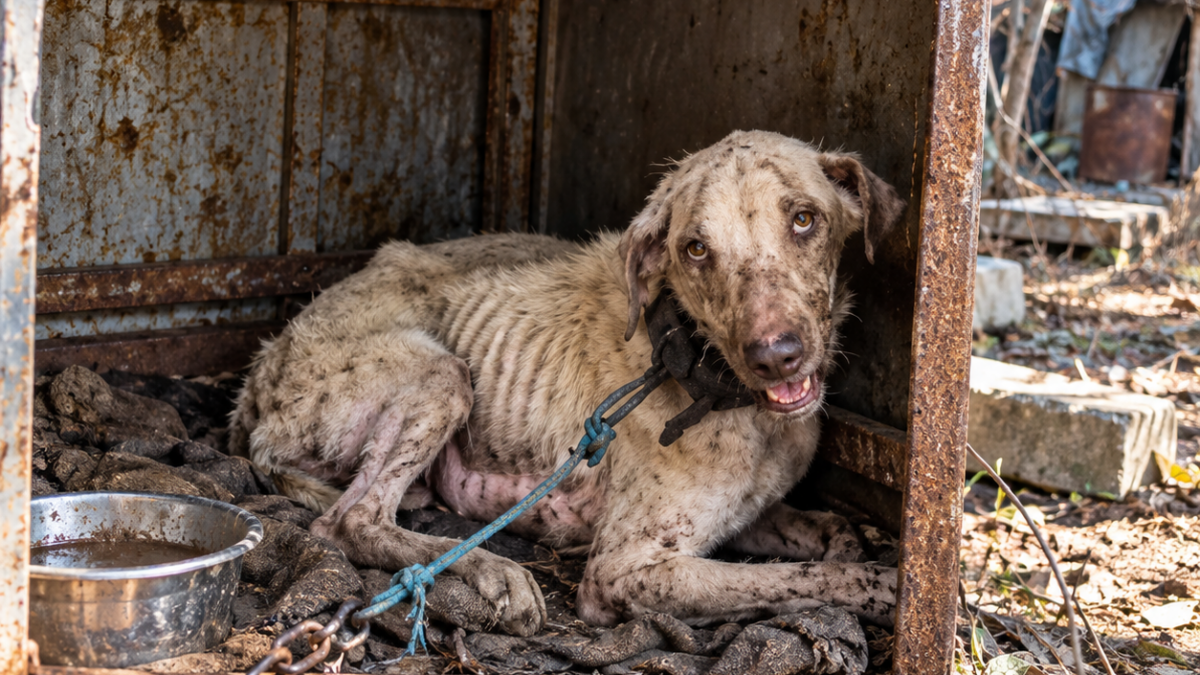
I looked behind me at the rusted box Milo was lying inside.
Water was dripping through two holes in the roof.
“That?”
Wade finally looked at me.
“Who the hell are you?”
“Volunteer rescue.”
“I didn’t invite a rescue.”
“No,” I said. “You didn’t.”
Ben gave me a warning glance.
Not because I was wrong.
Because he could hear the anger in my voice.
Wade walked two steps closer.
Milo flattened himself so hard against the metal wall that I heard his nails scrape across the floor.
That told me more than anything Wade could have said.
Ben heard it too.
“Mr. Mercer, stay where you are.”
Wade laughed.
“That mutt always acts scared when strangers come around.”
“I’m not sure I’m the stranger he’s afraid of,” I said.
Ben looked at me again.
This time I stopped talking.
He turned back toward Wade.
“How long has the dog been tied here?”
“A while.”
“How long is a while?”
“I don’t keep a calendar for the damn dog.”
I felt Milo trembling beneath my fingertips.
The blue rope was so wet it looked almost black.
Ben pulled a small notebook from his pocket.
“What’s his name?”
Wade shrugged.
“Dog.”
I stared at him.
Ben did too.
“You don’t have a name for him?”
Wade shifted his weight.
“My nephew called him Milo.”
At the sound of the name, the dog’s left ear moved.
That tiny reaction settled it for me.
Milo.
Ben wrote it down.
“When was Milo last fed?”
“This morning.”
The answer came too quickly.
Ben pointed toward the empty bowl.
“What did you feed him?”
“Kibble.”
“How much?”
“Enough.”
“What brand?”
Wade’s jaw tightened.
“What is this, an interrogation?”
“No. Right now it’s an animal-welfare investigation.”
“You got a warrant?”
“I don’t need a warrant to respond to an active welfare complaint when the owner has identified himself and the animal is visible from an accessible area of the property.”
Wade looked toward the road.
Then toward Milo.
Then back to Ben.
“I’ll take care of him.”
Ben’s expression did not change.
“You had that opportunity before we arrived.”
That was the first moment I saw real concern cross Wade’s face.
Not concern for Milo.
Concern for himself.
Ben returned to his truck for the bolt cutters.
Wade stepped forward.
“I said he stays here.”
Ben turned around.
“No, sir.”
Wade laughed again, but there was no humor in it.
“You can’t steal my property.”
“Milo is being placed under emergency protective custody pending veterinary evaluation.”
“He’s skinny. So what? He’s old.”
I looked down at Milo.
His teeth were surprisingly white.
His eyes were clear beneath the exhaustion.
He did not look old.
Ben apparently had the same thought.
“We’ll let the veterinarian determine that.”
Wade pointed at Milo.
“He doesn’t like cars.”
Milo flinched at the movement.
“He doesn’t like you pointing at him either,” I said.
“Claire.”
Ben’s voice was calm.
I shut my mouth.
He crouched beside the post.
The blue rope had been tied through an old steel eyelet and cinched into a knot hardened by rain and dirt.
Ben placed the jaws of the cutters around it.
The first squeeze did not go through.
Milo lifted his head.
“It’s okay,” I whispered.
Ben repositioned the cutters.
The rope snapped.
The sound was small.
Almost disappointingly small.
After everything that rope had represented, I expected thunder.
Instead there was only a soft crack.
One end fell into the mud.
Milo stared at it.
For several seconds, he did not move.
He did not seem to understand.
I loosened the remaining rope carefully.
His skin beneath it was irritated and bare in places, but I could finally slide two fingers between the rope and his neck.
When the last loop came free, I set it on the ground.
Milo looked at the post.
Then at me.
Then back at the post.
“You’re not tied anymore,” I told him.
He tried to stand.
His legs shook.
This time I supported his chest while Ben steadied his hips.
Wade shouted from behind us.
“He’ll bite!”
Milo froze.
I could feel his heart hammering.
“No, he won’t,” I said.
“You don’t know that dog.”
I turned enough to look over my shoulder.
“I know he’s terrified of your voice.”
Wade’s expression hardened.
Ben stood up.
“Mr. Mercer, go back to your truck.”
“This is my property.”
“And I am giving you a lawful instruction during an active investigation. Go back to your truck.”
For a moment I thought Wade would argue.
Then Ben rested one hand near his radio.
Wade backed away.
Slowly.
Muttering.
Milo could not walk to the county vehicle.
We used a blanket as a sling beneath his stomach and moved one painful step at a time.
Every few feet, he stopped.
Not because he resisted us.
Because he needed to rest.
The distance from the shelter to the truck was less than fifty yards.
It took eleven minutes.
When we reached the vehicle, Milo looked at the open rear door and tried to step backward.
Wade had been right about one thing.
Milo was afraid of cars.
I sat on the edge of the cargo area.
“Okay,” I whispered. “Then I go first.”
I climbed inside.
I sat on the rubber floor.
Milo watched me.
Ben waited without pulling.
After several seconds, Milo placed one front paw on the bumper.
Then the other.
His back legs failed.
Ben lifted from behind while I supported his chest.
Together we got him inside.
Milo immediately turned toward me and pressed his entire body against my knees.
I wrapped the blanket around him.
Wade watched from his truck.
Our eyes met through the rain.
He pointed at me.
“This isn’t over.”
I should have been frightened.
Instead I looked down at the blue rope Ben had sealed inside an evidence bag.
“No,” I said quietly.
“It isn’t.”
Dr. Allison Price met us at Cedar Ridge Veterinary Hospital at 7:36.
She took one look at Milo and cleared the treatment room.
“How long was he outside?”
“Unknown,” Ben said.
“Owner claims he fed him this morning.”
Allison ran her hand carefully along Milo’s spine.
She did not respond.
She did not need to.
Milo weighed forty-one pounds.
Based on his frame, Allison estimated his healthy weight should have been somewhere between sixty and sixty-five.
His temperature was low.
He was dehydrated.
His paws were softened and irritated from standing in wet ground.
The rope had rubbed the fur from much of his neck.
But the worst thing was not what we could see.
It was how Milo responded to ordinary human movement.
When Allison lifted a stainless-steel bowl, he ducked.
When Ben removed his belt to adjust his equipment, Milo dropped flat against the floor.
When someone laughed loudly in the hallway, Milo tried to squeeze beneath my chair.
Allison looked at me.
“Those reactions aren’t from one bad afternoon.”
I swallowed.
“No.”
She examined his teeth.
“Three, maybe four years old.”
I stared at her.
Wade had called him old.
Milo had barely lived.
We stayed until almost midnight.
He received warmed fluids.
Small amounts of food.
Medication.
A clean bed.
Nobody forced him to do anything.
At 11:18, Allison placed a bowl containing a small portion of soft food six feet from him.
Milo smelled it.
He did not move.
I sat on the floor beside him.
“Hungry?”
His eyes followed the bowl.
I moved it closer.
Still nothing.
Then I picked up one piece of food and placed it in my palm.
Milo stared at my hand.
I waited.
Nearly a minute passed.
He leaned forward.
Sniffed.
Took the food so gently I barely felt his mouth.
I gave him another.
Then another.
After the fifth piece, I placed my hand beside the bowl.
Milo stood.
His legs shook, but he made it.
He ate.
Slowly.
Allison leaned against the counter.
“He trusts you.”
“No,” I said. “He’s trying to.”
There was a difference.
I learned that difference over the next three weeks.
Trust is not something a frightened animal gives you once.
It is something you earn over and over again.
Milo was transferred the next afternoon to our rescue’s medical foster room.
I volunteered to take the overnight shifts.
I told myself it was because we were short-staffed.
Nobody believed me.
Especially Ben.
“You’re going to adopt this dog,” he said on the fourth night.
“No.”
“You bought him a pillow.”
“It was on sale.”
“You bought him a blue blanket.”
“He likes blue.”
Ben looked at me.
I looked at Milo.
Milo was asleep with his nose buried beneath the blanket.
“Okay,” I said. “Bad choice of color.”
Ben smiled.
For the first six days, Milo would not sleep unless someone sat within sight of him.
If I left the room, he woke up.
If I closed the door, he stood.
If I returned, he lay down.
On the seventh night I stretched out on a folding cot beside his enclosure and woke at 3:11 in the morning with Milo’s nose pressed against my fingers.
His tail tapped once.
Then twice.
It was the first time I had seen him wag it while fully awake.
“Hi,” I whispered.
He licked my knuckle.
That was our first victory.
The second came with stairs.
The third with a squeaky toy.
The fourth with a leash.
The leash took time.
The first time he saw one, he backed into the wall.
We did not try again that day.
The next morning I left a soft red leash on the floor ten feet away while I read a book.
Milo stared at it.
After twenty minutes, he walked toward it.
Sniffed it.
Walked away.
I did not react.
The following day I placed treats beside it.
The day after that, I touched it while he watched.
By the end of the week, he let me clip it to a padded harness.
He froze.
I sat beside him.
“We’re not tying you to anything.”
His eyes searched my face.
“This comes with me.”
I held up the handle.
“You come with me too.”
We walked eight feet down the hallway.
Then back.
I cried in the supply room afterward.
Not because eight feet was impressive.
Because Milo had chosen to take them.
Wade Mercer called animal control seventeen times during those same three weeks.
He demanded Milo back.
He claimed we had exaggerated his condition.
He claimed Milo had stopped eating by choice.
He claimed the dog had always been thin.
He claimed the rope had been used for only two days because Milo kept escaping.
Then he hired an attorney.
That changed everything.
Until then, I had assumed the case was simple.
Neglected dog.
Photographs.
Veterinary findings.
Emergency seizure.
Done.
It was not done.
Wade’s attorney filed a petition challenging the seizure and requesting Milo’s immediate return.
The hearing was scheduled for Monday morning.
I read the paperwork three times.
Then a fourth.
The phrase “return of property” made me sick.
Property.
Milo was sleeping beside my feet when Ben called.
“We have a problem.”
“I just read it.”
“His attorney says the property was vacant only temporarily because Mercer was renovating it.”
“There was no renovation.”
“I know.”
“The porch was collapsing.”
“I know.”
“There wasn’t even electricity.”
“I know, Claire.”
I lowered my voice.
“What happens if the judge believes him?”
Silence.
That was the answer I did not want.
“Ben?”
“If the seizure is ruled improper, there is a chance Milo could be returned pending the criminal investigation.”
I looked at Milo.
He had gained four pounds.
The irritated skin around his neck was healing.
He had started carrying a yellow tennis ball everywhere, though he had no idea what to do with it.
When I threw it, he watched it bounce and then looked at me as if I had made a terrible mistake.
The thought of loading him into a truck and returning him to Wade Mercer made my stomach turn.
“I won’t do it.”
“Claire.”
“I mean it.”
“Then you hurt the rescue, yourself, and possibly the criminal case.”
“I am not putting that rope back around his neck.”
“No one said you would.”
“That’s where this ends if we lose.”
Ben took a breath.
“Then we don’t walk into court angry. We walk in prepared.”
That sentence changed the next seventy-two hours.
I stopped thinking like Milo’s foster volunteer.
I started thinking like a witness.
Every photograph was dated.
Every treatment record was copied.
Every weight measurement was documented.
Every photograph of the yard was printed.
Ben retrieved weather records showing five straight days of heavy rain before Milo’s rescue.
Allison prepared a medical statement.
The delivery driver gave a sworn statement saying Milo had been tied in the same location forty-eight hours apart.
Then something happened that none of us expected.
A woman named Hannah Pike called the rescue.
“I saw your post about the seized dog,” she said.
We had never identified Wade publicly, but the photograph showed Milo from the shoulders up.
Hannah’s voice shook.
“I think I know him.”
My heart accelerated.
“What makes you think that?”
“The mark over his left eye.”
Milo had a thin white crescent of fur above his left eye.
“He was my brother’s dog.”
I sat down.
“Your brother?”
“Yes.”
“What’s his name?”
“Milo.”
My hand tightened around the phone.
“Can you tell me how Wade Mercer got him?”
There was silence.
Then Hannah began crying.
“My brother is dead.”
I did not speak.
“I’m sorry.”
“He died two years ago. Car accident. Milo was with him almost every day.”
She took a breath.
“My mother couldn’t keep the dog after the funeral. She was seventy-eight. Wade was a friend of my brother’s. He said he would take Milo temporarily until we found a permanent home.”
My skin went cold.
“Temporarily?”
“Two weeks.”
“How long ago was that?”
“Twenty-two months.”
I looked across the foster room.
Milo was lying on his blanket with the yellow tennis ball between his paws.
“Hannah, why didn’t your family get him back?”
“We tried.”
“What happened?”
“Wade said Milo ran away.”
I stopped breathing.
“What?”
“He told us Milo slipped out of his truck at a gas station outside Oak Ridge. My mother blamed herself for months because she had given him to Wade.”
I closed my eyes.
“Do you have anything showing Milo belonged to your brother?”
“Yes.”
“What?”
“Vet records. Photos. Adoption papers. And…”
She stopped.
“And what?”
“He was microchipped.”
I looked at Milo.
We had scanned him the first night.
The scanner had registered a chip.
But the registry information had been outdated and linked only to an old disconnected phone number.
“Hannah, what was your brother’s name?”
“Daniel Pike.”
I wrote it down.
“Can you come to the rescue tomorrow?”
“I can be there tonight.”
She arrived forty-six minutes later carrying a blue plastic folder and an old photograph.
The woman who stepped through our door was about forty, with red hair pulled into a loose ponytail.
Milo was asleep in the back room.
I asked Hannah to wait while I took the photograph.
It showed a younger, healthier Milo sitting beside a man on the tailgate of a pickup truck.
Same white crescent above the eye.
Same black patch near the right shoulder.
The man had one arm around him.
Milo was wearing a red collar.
On the back of the photograph someone had written:
Daniel + Milo, Norris Lake, May 2023.
I looked at Hannah.
“That’s him.”
She covered her mouth.
I led her toward the foster room.
“Please don’t rush him.”
“I won’t.”
“He’s frightened by sudden movement.”
Her eyes filled again.
“What did that man do to him?”
“We’re still documenting everything.”
I opened the door.
Milo raised his head.
Hannah stopped.
For a second, neither moved.
Then she whispered one word.
“Milo?”
The dog stood so quickly that his blanket slid backward.
I had never seen him move like that.
His ears lifted.
His tail rose.
Hannah began crying openly.
“Oh, sweetheart.”
Milo took one step.
Then another.
He sniffed the air.
Hannah knelt.
She did not call again.
She simply opened her hands.
Milo crossed the room.
His whole body changed.
His tail began moving.
Not the tiny uncertain wag I had seen before.
A full sweep.
Left.
Right.
Left.
Right.
He reached Hannah and pressed his face against her chest.
She folded around him.
I turned away.
I had witnessed animals recognize former handlers, old homes, familiar objects.
But this was different.
Milo was not remembering a command.
He was remembering being loved.
Hannah buried her face against his head.
“I’m sorry,” she whispered. “I’m so sorry. We thought you were gone.”
Milo licked her cheek.
She laughed through tears.
“You remember me?”
He pawed her knee.
Apparently he did.
That night, our case stopped being only about neglect.
It became a story about deception.
Ben contacted Hannah.
Then the district attorney’s office.
The microchip registry was traced.
Daniel Pike had registered Milo four years earlier.
After Daniel’s death, no transfer of ownership had ever been filed.
There was no record that Wade Mercer had legally obtained Milo.
More importantly, Hannah had text messages.
Twenty-two months earlier, Wade had written:
Don’t worry. I’ll keep him until we find somebody decent.
Fourteen days later, Hannah had asked:
Can Mom see Milo Sunday?
Wade responded:
Bad news. He bolted when I stopped for gas. Been looking all night.
There were more messages.
I’m sorry.
I feel terrible.
I’ll keep checking shelters.
He never found him.
Because Milo had never been lost.
We still did not know where Milo had spent those twenty-two months.
But we knew where he had ended up.
Monday morning, I sat in the county courthouse wearing the only blazer I owned.
Ben sat beside me.
Hannah sat behind us.
Wade Mercer sat across the aisle with his attorney.
He looked cleaner than the night we found Milo.
Pressed shirt.
Trimmed beard.
Polished boots.
If I had passed him at a grocery store, I would never have guessed what his backyard looked like.
That realization bothered me.
Cruelty does not always announce itself.
Sometimes it shakes your hand.
Sometimes it smiles at neighbors.
Sometimes it hires an attorney and calls neglect a misunderstanding.
Wade looked at me before the hearing began.
He smiled.
Not warmly.
Confidently.
I looked away.
The judge entered.
Everyone stood.
The hearing began at 9:04.
Wade’s attorney spoke first.
He described the seizure as “an overreaction based on temporary conditions caused by severe weather.”
Temporary.
That word appeared repeatedly.
Temporary mud.
Temporary weight loss.
Temporary tethering.
Temporary vacancy.
According to him, Milo had recently developed digestive problems and Wade had planned to schedule a veterinary appointment.
The dog had been tied only because repairs to the property fence were underway.
The empty food bowl proved nothing because dogs finish meals.
The rainwater in the second bowl proved fresh water had been available.
The shelter, while old, provided adequate protection.
I gripped my hands beneath the table.
Ben leaned toward me.
“Don’t react.”
I nodded.
Wade’s attorney continued.
“My client acknowledges that conditions were not ideal, Your Honor, but imperfect animal care is not abandonment.”
Then Ben testified.
He described Milo’s condition.
The rope.
The mud.
The absence of usable food.
The abandoned appearance of the house.
The empty interior visible through an unsecured doorway.
The lack of power.
The smell.
The dog’s inability to walk unassisted.
Wade’s attorney asked whether Ben had personally witnessed Wade fail to feed Milo.
“No.”
“Did you personally observe the dog on any day before the seizure?”
“No.”
“So you cannot testify that the animal had not been fed that morning.”
“I can testify to his condition when I arrived.”
“But not what occurred earlier.”
“No.”
The attorney seemed pleased.
Then Allison testified.
That changed the room.
She explained Milo’s weight.
Body condition.
Dehydration.
Muscle loss.
Skin irritation.
Fear responses.
She spoke calmly, clinically.
Wade’s attorney asked whether weight loss could occur because of illness.
“Yes.”
“Could gastrointestinal disease cause it?”
“Yes.”
“Cancer?”
“Yes.”
“Parasites?”
“Yes.”
“So you cannot say neglect caused Milo’s condition.”
Allison looked at him.
“I can say his condition was consistent with prolonged inadequate nutrition and care.”
“But you cannot rule out every possible medical cause.”
“I ran bloodwork, fecal screening, radiographs, and additional tests.”
“And?”
“We found no underlying condition sufficient to explain his degree of weight loss.”
The attorney looked at his notes.
Allison continued.
“His most significant medical problem was not mysterious. He had not received enough appropriate food for a prolonged period.”
The courtroom went silent.
I saw Wade’s jaw tighten.
Then Hannah testified.
She described Daniel.
Milo.
The temporary arrangement after the funeral.
Wade’s claim that Milo had escaped.
The text messages were entered into evidence.
For the first time all morning, Wade stopped looking confident.
His attorney whispered to him.
The judge read the messages.
Then she looked over her glasses.
“Mr. Mercer, did you report the dog missing?”
Wade’s attorney stood.
“Your Honor, I would advise my client—”
“I’m asking whether any missing-animal report was filed.”
Ben had already checked.
None existed.
The attorney knew it.
“No formal report was located,” he said.
“Did he contact local shelters?”
“No documentation has been identified.”
The judge looked at Wade.
Then at Hannah.
Then at the photograph of Daniel and Milo.
Wade’s attorney tried one final argument.
“Ownership and welfare are separate legal issues, Your Honor. Even if there was confusion regarding transfer—”
“Confusion?”
The judge held up the printed text message.
“He told the family the animal had escaped.”
The attorney paused.
“Yes, Your Honor.”
“Yet twenty-two months later, the animal was found restrained on his property.”
“Yes.”
“Underweight.”
“Yes.”
“Without adequate documented veterinary care.”
“Yes.”
The attorney sat down.
The judge ruled Milo would remain in protective custody.
I heard Hannah exhale behind me.
I had not realized I had been holding my own breath until that moment.
The judge was not finished.
She referred the ownership issue and evidence of possible deception to the district attorney.
She also authorized the county to inspect other properties associated with Wade Mercer if legally supported by the investigation.
That sentence mattered.
Because Milo was not the only secret Wade had kept.
Two days later, Ben called me at 5:52 in the morning.
“Are you awake?”
“No.”
“You are now.”
I sat up.
Milo lifted his head from the dog bed beside mine.
“What happened?”
“We found another property.”
My feet hit the floor.
“What property?”
“Mercer leases land outside Clinton.”
I stopped.
“What’s there?”
“Kennels.”
My stomach dropped.
“How many?”
“We don’t know yet.”
“Dogs?”
“Yes.”
“How many?”
“Claire.”
The way he said my name scared me.
“Ben.”
“We’re executing the inspection order at seven.”
“I’m coming.”
“You’re not law enforcement.”
“I’m rescue support.”
“You’re emotionally involved.”
“So are you.”
“No, I’m professionally irritated.”
“Ben.”
He sighed.
“Be at the rescue at six-thirty. Bring crates, blankets, water, and every slip lead you have.”
I was there at 6:12.
The property stood behind a row of pine trees half a mile from the road.
From the entrance, it looked like an equipment yard.
Rusting trailers.
Scrap lumber.
A storage building.
Then we heard barking.
Not one dog.
Many.
The sound came from behind the storage building.
Ben went ahead with two deputies.
I waited beside the rescue van until he waved.
When I rounded the building, I stopped walking.
There were nine outdoor kennels.
Some were empty.
Six were not.
Each occupied kennel held one dog.
Two hounds.
A shepherd mix.
A brindle pit bull.
A small white terrier.
And an elderly black Labrador.
Their conditions varied.
None looked as thin as Milo had.
But none looked well.
Water bowls were dirty.
Several kennel floors were covered with waste.
One shelter had no bedding.
Another had a cracked plastic barrel turned on its side.
A seventh kennel contained chains, collars, ropes, and feeding bowls.
On a nail beside the door hung three coils of blue nylon rope.
The same type that had been around Milo’s neck.
I stared at them.
Ben stepped beside me.
“Don’t touch anything.”
“I wasn’t going to.”
“You have that look.”
“What look?”
“The one where I worry about my paperwork.”
I wanted to laugh.
I could not.
A deputy opened the storage building.
Inside were bags of dog food, some torn open.
Old veterinary records.
Plastic crates.
A folding table.
And a whiteboard.
Names had been written in rows.
Beside each name was a number.
Some numbers were crossed out.
Ben photographed everything.
I moved closer without touching the board.
One name stopped me.
MILO — 450.
I read it twice.
“Ben.”
He came over.
I pointed.
His expression changed.
Below Milo’s name were others.
DAISY — 300.
RANGER — 600.
LUCY — 350.
TANK — 500.
“What are the numbers?” I asked.
“I don’t know.”
But we both suspected.
We found out three hours later.
They were prices.
Wade had been selling dogs.
Not as a licensed breeder.
Not as a rescue.
Privately.
Cash whenever possible.
Some dogs had been given to him by families who believed he was rehoming them.
Others had apparently been acquired through online listings.
Several names on the whiteboard matched old social-media posts.
Free to good home.
Emergency rehome.
Must find loving family.
Wade had answered them.
Sometimes he kept the dogs for weeks.
Sometimes months.
Then he resold them.
Milo had apparently been assigned a price too.
But nobody bought him.
Why, we never learned.
Maybe he was too frightened.
Maybe too large.
Maybe Wade expected more money.
Maybe Milo kept waiting for Daniel to come back.
Whatever the reason, Milo went from a temporary promise to a commodity.
And when he became inconvenient, Wade moved him to the vacant property and tied him behind the house.
That discovery changed the criminal case.
Investigators identified four former owners.
One was a college student who had surrendered her dog believing Wade worked with a private rescue network.
Another was an elderly couple who had given him their beagle after moving into assisted living.
They had asked Wade to send updates.
He sent photographs for three months.
Then stopped.
The photographs, investigators discovered, had all been taken during the first two weeks.
The dog had been sold shortly afterward.
The couple had believed he was still living with Wade.
Every new statement revealed another lie.
But Wade continued to deny wrongdoing.
Through his attorney, he claimed he had been helping people rehome animals and occasionally accepted “voluntary compensation.”
He claimed conditions at the kennel property had deteriorated because an employee stopped showing up.
There was no employee.
He claimed Milo had been moved to the vacant house for “behavioral decompression.”
There was no behavioral program.
He claimed the rope was temporary.
The soil around the post told a different story.
A shallow circular path had been worn into the dirt at the full length of the tether.
Even after days of rain, you could see it.
Milo had walked that circle again and again.
As the case grew, so did Milo.
Forty-one pounds became forty-six.
Then fifty-two.
Then fifty-seven.
His coat changed.
That surprised me most.
The dull, rough fur began to soften.
Gold appeared along his shoulders.
Deep brown returned around his ears.
The white patch on his chest became bright.
People who saw his original intake photograph barely recognized him.
But recovery was not linear.
One afternoon, a maintenance worker arrived at the rescue carrying a coil of blue extension cord.
Milo saw it.
He dropped to the floor.
His body went rigid.
I knelt beside him.
“Milo.”
He would not look at me.
The worker froze.
“Oh, God. I’m sorry.”
“You didn’t know.”
He slowly placed the cord outside.
I sat beside Milo for twenty minutes.
His breathing gradually slowed.
I did not pet him until he leaned against me first.
That evening I removed every unnecessary blue rope, leash, cord, and strap from the foster room.
Ben noticed.
“You know he’ll eventually have to see things that remind him of before.”
“I know.”
“You can’t remove every blue rope from the world.”
“I know.”
He paused.
“You’re keeping him.”
I looked at Milo.
He was standing beside the toy basket trying to fit two tennis balls in his mouth at once.
“I don’t legally own him.”
“That wasn’t my question.”
I smiled.
“No.”
Ben laughed.
“You’re a terrible liar.”
Maybe I was.
But Hannah’s family still had a claim to Milo.
That mattered.
I had become attached to him, but love did not give me ownership.
Hannah came to visit every Sunday.
Sometimes she brought her mother, Ruth.
The first time Ruth saw Milo, she sat on a folding chair because her knees were weak.
Milo approached slowly.
She touched his face.
“Oh, Danny,” she whispered.
For one frightening second, I thought she had mistaken the dog for her son.
Then she shook her head.
“No. Sorry. Milo.”
He placed his head in her lap.
Ruth cried silently.
Afterward she told me Daniel had adopted Milo from a county shelter when Milo was ten months old.
“Daniel said they picked each other,” she said.
“I believe it.”
“My son had trouble after he came home from overseas.”
She looked toward Milo.
“He never talked much about it. But that dog could get him out of bed on days none of us could.”
I listened.
“When Daniel died, I thought keeping Milo would help.”
“What happened?”
“I lasted six weeks.”
Her voice was full of shame.
“I was seventy-six. He was young and strong. He pulled me twice. I fell once. Wade said he would help.”
“You were trying to protect both of you.”
“I handed him to the wrong man.”
“You didn’t know.”
“I should have.”
There are moments when people want forgiveness but do not know how to ask for it.
Ruth was asking.
Not from me.
From Milo.
I watched him sleeping with his head on her shoe.
“I don’t think he blames you.”
She smiled sadly.
“That would make one of us.”
The criminal case took six months.
During that time, Milo learned to live.
Not survive.
Live.
There is a difference.
Survival meant eating because food existed.
Living meant stealing half a peanut-butter sandwich from my plate and running through the hallway while I chased him.
Survival meant sleeping lightly enough to wake at every door.
Living meant snoring upside down on my couch with all four paws in the air.
Survival meant shrinking when a hand moved quickly.
Living meant shoving his head under my hand if I stopped scratching his ears too soon.
He discovered sprinklers.
He hated them.
He discovered snow.
He loved it.
He discovered my neighbor’s orange cat, Winston.
Winston hated him.
Milo remained convinced they were close friends.
Every morning he stood at the fence wagging hopefully while Winston stared at him with the contempt of an unpaid supervisor.
Milo learned car rides were not always bad.
At first he would tremble.
Then he learned cars led to parks.
Hiking trails.
Ruth’s house.
Ice cream.
The first time a drive-through employee handed him a small cup of whipped cream, Milo looked at me as though I had hidden the greatest secret of civilization.
He ate it in six seconds.
Then sneezed whipped cream across my dashboard.
I laughed so hard I had to pull into a parking space.
Milo stared at me.
Then licked the steering wheel.
That dog cost me three upholstery cleanings.
He was worth all of them.
But certain things remained difficult.
Men in brown jackets.
Raised voices.
Metal bowls dropped on concrete.
Blue rope.
And Wade Mercer.
Milo saw him one more time before trial.
It happened by accident.
We were leaving the veterinary hospital after a routine checkup.
Milo had reached sixty-three pounds.
Allison had officially declared him medically recovered.
“Recovered,” however, did not mean unchanged.
We walked through the parking lot.
A truck turned in.
I recognized it immediately.
Brown Ford.
Dent above the rear wheel.
My hand tightened around Milo’s leash.
Wade stepped out.
He had apparently brought one of his remaining personal animals for a court-ordered health examination.
A deputy was with him.
Wade saw me.
Then Milo.
He smiled.
“Well, look at that.”
Milo stopped.
His body lowered.
I stepped between them.
Wade laughed softly.
“Still remembers me.”
I felt a surge of anger so powerful I could taste it.
Before I could speak, the deputy said, “Mr. Mercer, keep moving.”
Wade ignored him.
“That dog always was dramatic.”
Milo moved behind my legs.
Something inside me changed.
For months I had imagined what I would say if I ever had Wade in front of me.
I had imagined shouting.
Calling him cruel.
Telling him exactly what I thought of him.
Instead I looked at the man who had once controlled Milo’s entire world.
Then I looked at Milo hiding behind me.
And I realized Wade did not deserve my anger.
He deserved irrelevance.
So I knelt.
“Milo.”
He looked at me.
I held out my hand.
“Come on.”
He stepped forward.
Wade said something behind us.
I never knew what.
I did not turn around.
Neither did Milo.
We walked to my car.
For the first time since I had met him, Milo passed within twenty feet of Wade Mercer and chose to leave.
That mattered more than anything I could have shouted.
Trial began in March.
By then, prosecutors had consolidated several charges related to animal neglect, false statements in the disposition of animals, and unlawful commercial activity.
I was subpoenaed.
So were Ben, Allison, Hannah, Ruth, the delivery driver, two former dog owners, and investigators from the county.
The prosecutor warned us beforehand.
“Trials are not stories,” she said.
“They don’t always unfold cleanly. The defense will challenge details. Don’t argue. Answer what is asked.”
I understood.
Still, sitting in that courtroom and seeing the blue rope sealed inside a clear evidence bag made my hands shake.
The prosecutor showed the first photograph.
Milo inside the metal shelter.
A murmur moved through the room.
Wade stared straight ahead.
Then she showed a photograph taken three months later.
Milo standing in my backyard.
Healthy weight.
Bright coat.
Head lifted.
Same dog.
Different life.
The prosecutor did not need dramatic language.
The contrast spoke for itself.
When I testified, Wade’s attorney tried to portray me as emotionally biased.
“You developed an attachment to Milo almost immediately, correct?”
“Yes.”
“You eventually intended to adopt him.”
“If legally permitted.”
“So you had a personal interest in preventing his return.”
“I had a personal interest in keeping him safe.”
“Which is not the same as remaining objective.”
“No.”
The attorney looked briefly surprised.
Maybe he expected me to argue.
He continued.
“You described my client as frightening to Milo.”
“I described Milo’s behavior when your client approached.”
“But you cannot know what Milo was thinking.”
“No.”
“You cannot testify that he was afraid specifically because of Mr. Mercer.”
“I can testify that Milo was lying quietly until Mr. Mercer spoke.”
“And then?”
“He pressed himself against the metal wall, shook, and attempted to move farther away despite having nowhere to go.”
The jury watched me.
The attorney changed direction.
“You are not a veterinary behaviorist.”
“No.”
“Not a veterinarian.”
“No.”
“Not an animal-control officer.”
“No.”
“So many of your conclusions are simply personal interpretations.”
I looked at him.
“The photographs aren’t.”
He paused.
The prosecutor objected before he could respond.
“Nonresponsive.”
“Sustained.”
But the jury had heard it.
Then Allison testified.
Then Ben.
Then Hannah.
Then Ruth.
Ruth walked slowly to the witness stand carrying her purse with both hands.
She looked smaller than I remembered.
The prosecutor asked about Wade’s promise to help.
Ruth explained.
Her voice stayed steady until the prosecutor asked what Wade told her after two weeks.
“He said Milo escaped.”
“What did you do?”
“I drove around for three days.”
I looked at Wade.
He did not look back.
Ruth continued.
“I put signs at gas stations. I called shelters. My daughter posted online. I kept Milo’s bed beside my kitchen door for three months in case somebody found him.”
The prosecutor handed her a tissue.
“Did Mr. Mercer ever tell you Milo had been recovered?”
“No.”
“Did he ever tell you Milo was still in his possession?”
“No.”
“When did you learn the truth?”
“When Claire’s rescue found him.”
Ruth looked toward me.
Then toward the jury.
“I’m old enough to understand people lie. What I don’t understand is why he let me search for a dog he knew was never missing.”
No one spoke.
Wade’s attorney declined to cross-examine her.
The most damaging witness, however, was someone I had never met.
His name was Caleb Morris.
He had worked with Wade repairing fences and hauling equipment.
Caleb testified under subpoena.
He said Milo had lived at the kennel property for months.
According to Caleb, Milo initially slept inside the storage building.
Then Wade began complaining that Milo “wasn’t worth feeding.”
I closed my eyes.
The prosecutor asked, “Did you ever see Mr. Mercer physically strike Milo?”
“No.”
“Did you see him deprive the dog of food?”
Caleb hesitated.
“I saw him skip him.”
“Explain.”
“When he fed the dogs, sometimes Milo got food, sometimes not.”
“Why?”
“He said Milo needed to learn.”
“Learn what?”
“I don’t know.”
“Did you ever ask?”
Caleb looked toward Wade.
“Once.”
“And what did he say?”
“He said hungry dogs stop being stubborn.”
My fingers dug into my palms.
Ben shifted beside me.
The prosecutor continued.
“Did you see Milo moved to the vacant property?”
“Yes.”
“Why was he moved?”
“Wade said he had a buyer coming to look at the other dogs and Milo looked bad.”
A stillness moved through the courtroom.
“What do you mean by looked bad?”
“He was already skinny.”
“So Mr. Mercer moved him?”
“Yes.”
“To where?”
“The old house.”
“With what provisions?”
“Metal shelter. Bowl. Rope.”
“What color was the rope?”
Caleb looked at the evidence table.
“Blue.”
The defense attacked Caleb’s credibility.
Caleb had argued with Wade over unpaid wages.
He had once threatened to sue him.
He admitted he disliked him.
But photographs from Caleb’s phone matched his timeline.
One photograph taken accidentally while documenting damaged equipment showed Milo in the background.
Thin.
Tied beside the kennel building.
Three months before we found him.
The defense’s “temporary” explanation collapsed.
Wade eventually testified.
His attorney advised against it.
We learned that later.
But Wade insisted.
He said he wanted the jury to hear his side.
He described himself as an animal lover who had become overwhelmed.
He said people constantly asked him to take dogs.
He claimed he had intended to build a legitimate rescue.
He said finances became difficult.
He said he made mistakes.
The prosecutor stood for cross-examination.
“Mr. Mercer, did you tell Ruth Pike that Milo escaped?”
“Yes.”
“Had he escaped?”
Wade paused.
“No.”
“So that was a lie.”
“I was trying to avoid upsetting her.”
The prosecutor looked at him.
“You told an elderly woman her deceased son’s dog was missing to avoid upsetting her?”
Wade shifted.
“I planned to find him a home.”
“Why not tell her that?”
“She was emotional.”
“Did she authorize you to sell Milo?”
“No.”
“Did she authorize you to keep him permanently?”
“She gave him to me.”
“That was not my question.”
Wade’s face reddened.
“No.”
“Did you advertise Milo for sale?”
“I may have.”
“For four hundred fifty dollars?”
“I don’t remember.”
The prosecutor displayed the whiteboard photograph.
“Does that refresh your memory?”
Wade looked at it.
“It could mean anything.”
“Was Milo’s name written there?”
“Yes.”
“Was the number four hundred fifty beside it?”
“Yes.”
“Were other dogs on that board later sold?”
“Some.”
“For amounts matching the numbers?”
“Sometimes.”
“So what did four hundred fifty mean?”
Wade stared at the prosecutor.
“I don’t remember.”
She moved on.
“Why was Milo at the vacant property?”
“He was destructive.”
“What did he destroy?”
“Things.”
“What things?”
“Fencing.”
“There was no intact fence at that property.”
“He would dig.”
“What did he dig?”
Wade glanced at his attorney.
The prosecutor waited.
Finally he said, “I don’t remember.”
She picked up the evidence bag containing the rope.
“Why was this tied directly around his neck?”
“He slipped collars.”
“Did you try a properly fitted escape-resistant harness?”
“No.”
“Did you consult a trainer?”
“No.”
“Veterinarian?”
“No.”
“Behaviorist?”
“No.”
“Did you provide routine veterinary care during the twenty-two months you possessed him?”
“He didn’t need it.”
“He lost approximately one-third of his healthy body weight.”
“I didn’t notice.”
That answer landed harder than anything else.
The prosecutor paused.
“You fed him.”
“Yes.”
“You handled him.”
“Yes.”
“You moved him between properties.”
“Yes.”
“But you did not notice that a sixty-pound dog had become a forty-one-pound dog.”
“I don’t weigh dogs every day.”
“No further questions.”
The jury deliberated for four hours.
I spent most of that time outside the courthouse with Hannah.
Ben paced.
Allison answered emails.
Ruth knitted something that looked like the beginning of a scarf.
I could not sit still.
“What if they believe him?” I asked.
Hannah looked at me.
“They saw Milo.”
“They saw photographs.”
“They saw what he did.”
“They saw evidence.”
She reached for my hand.
“Claire.”
I stopped.
“My brother used to say Milo hated thunder.”
I looked at her, confused by the sudden change.
“Okay.”
“Every storm, he would crawl into Daniel’s bathtub.”
I smiled slightly.
“He still hates thunder.”
“I know. You told me.”
She looked through the courthouse window.
“After Daniel died, I thought the saddest thing that could happen to Milo was losing him.”
Her eyes filled.
“I was wrong.”
Neither of us spoke for a moment.
“Whatever the jury decides, you gave him something back.”
“What?”
“A person who comes when he’s scared.”
That broke me.
I looked away and wiped my face.
Twenty minutes later, the bailiff opened the courthouse door.
“We have a verdict.”
We went inside.
Wade stood beside his attorney.
The jury returned.
I watched the foreperson hand the paper to the clerk.
The judge read it.
Guilty on the primary animal-cruelty charge.
Guilty on multiple related neglect counts.
Guilty on two of the fraudulent-disposition charges connected to dogs entrusted to him under false pretenses.
Not guilty on one minor record-keeping count.
I barely heard that last part.
Hannah covered her mouth.
Ben stared at the floor.
Ruth closed her eyes.
Wade showed no reaction until the judge revoked his right to possess animals pending sentencing.
Then he whispered something to his attorney.
Sentencing occurred three weeks later.
The courtroom was less crowded.
The judge spoke directly to Wade.
She said the case was not about “imperfect pet ownership.”
It was about prolonged neglect, deception, and the repeated treatment of living animals as disposable inventory.
Wade received a combination of incarceration, probation, restitution, fines, and a long-term prohibition on owning, breeding, selling, or keeping animals except as later permitted by court order.
The surviving animals from the kennel property were permanently forfeited.
Several were already in foster homes.
The older black Labrador went to the college student whose former dog Wade had sold.
She had come to the rescue intending only to donate supplies.
She met him.
He leaned against her.
That was that.
The little terrier went to Ben’s sister.
Ben denied orchestrating it.
Nobody believed him.
The brindle pit bull became a certified therapy dog two years later.
And Milo?
Milo still legally belonged to Daniel’s estate.
Hannah and Ruth asked me to meet them at the rescue one Sunday afternoon.
I arrived expecting a routine visit.
Hannah had paperwork.
Ruth had a gift bag.
Milo had absolutely no interest in either because someone had left a box of treats on the counter.
Hannah sat across from me.
“We made a decision.”
My stomach tightened.
I had always known this day could come.
Milo had been theirs first.
If they wanted him back, I would have to let him go.
I had rehearsed that possibility more than once.
I would smile.
Help pack his toys.
Explain his feeding schedule.
Tell them about his fear of thunder.
Tell them he liked the left side of the couch.
Tell them he would pretend not to hear you if you called him indoors after snow.
Then I would drive home and probably cry for a month.
Hannah slid the papers toward me.
“We’re transferring Daniel’s estate claim.”
I stared at the page.
“To who?”
She smiled.
“You.”
I did not move.
Ruth reached across the table.
“Claire, Milo loved my son.”
Her voice trembled.
“And I think part of him always will.”
I swallowed.
“But Daniel is gone.”
She looked at Milo.
“He needs somebody who is here.”
My eyes filled.
“Hannah visits him. You visit him. I can bring him to you anytime.”
“We know.”
“You don’t have to—”
“Yes,” Hannah said gently. “We do.”
She turned the papers around.
Daniel’s photograph was attached to a copy of Milo’s original adoption record.
Hannah had written something on a sticky note.
He chose Daniel once.
Now he chose you.
I covered my face.
Milo immediately came over because crying, in his experience, usually meant a person required supervision.
He pushed his head beneath my arm.
I laughed.
Then cried harder.
“This is embarrassing.”
Hannah was crying too.
“So stop.”
“You stop.”
Ruth handed me a pen.
“Both of you stop and sign the papers before I start.”
We all started.
That afternoon Milo officially became mine.
I changed only one thing on his paperwork.
Not his name.
Never his name.
I updated his microchip.
Owner:
Claire Morgan.
Emergency contact:
Hannah Pike.
Second emergency contact:
Ruth Pike.
Family did not have to mean replacing the people who came before.
Sometimes it meant making the circle bigger.
The final part of Milo’s story happened almost one year after the night we found him.
I did not plan it.
Ben did.
He called me on a Saturday morning.
“Busy?”
“Yes.”
“What are you doing?”
“Drinking coffee.”
“That is not busy.”
“It is emotionally demanding.”
“Bring Milo to the rescue at ten.”
“Why?”
“Just do it.”
“I hate surprises.”
“No, you hate not controlling surprises.”
“Same thing.”
At 9:58, Milo and I arrived.
There were cars everywhere.
I assumed an adoption event was starting.
Then I saw the sign.
No dramatic slogan.
No giant photograph.
Just a small wooden plaque beside a newly built outdoor recovery yard.
THE MILO GARDEN
For dogs learning to trust again.
I stopped.
Ben stood beside the gate.
“You did this?”
“Not alone.”
Allison was there.
Hannah.
Ruth.
The delivery driver who made the original call.
Several rescue volunteers.
Even the college student who had testified.
Milo pulled me toward them.
The recovery yard had soft grass.
Shade trees.
Low platforms.
A small pool.
Covered resting areas.
Quiet fencing.
No chains.
No tether posts.
No blue rope.
I touched the wooden sign.
“You named it after him?”
Ben shrugged.
“He has a compelling brand.”
I laughed.
Then I saw something hanging beside the entrance.
A shadow box.
Inside it was Milo’s original red collar from Daniel’s photograph.
Hannah had found it in Ruth’s garage.
Beneath it was a small metal plate.
It read:
FIRST LOVED BY DANIEL.
FOUND AGAIN BY PEOPLE WHO REFUSED TO LOOK AWAY.
I could not speak.
Hannah hugged me.
Milo walked into the grass.
He sniffed every corner.
Then he found the small pool.
He stepped into it.
Stood there for several seconds.
And apparently decided water had personally insulted him.
He jumped out and shook himself directly beside Ben.
Ben stared at his soaked uniform.
I started laughing.
“Compelling brand.”
“Take your dog home.”
“You invited him.”
“I regret it.”
Milo sneezed.
Everyone laughed.
Later, after the others left, I stayed behind.
The afternoon was warm.
Milo lay in the grass beside me.
He was sixty-four pounds now.
His coat shone in the sun.
The white crescent above his left eye had become more noticeable with age.
I scratched behind his ear.
“You know something?”
His tail moved.
“The first night I met you, I thought I was rescuing a dog.”
He rolled onto his side.
“I didn’t understand yet.”
He rested one paw across my shoe.
“You were going to change a lot more than one life.”
A year earlier, Milo’s entire world had been the length of a blue rope.
He could walk forward until it tightened.
Backward until the shelter stopped him.
Left.
Right.
The same muddy circle.
Again.
Again.
Again.
That was all the world allowed him.
Now he had a house with three dog beds and slept on my couch instead.
He had Ruth, who baked dog biscuits that were usually too hard.
He had Hannah, who took him to the lake every May on Daniel’s birthday.
He had Allison, whom he still distrusted because she owned thermometers.
He had Ben, who claimed not to like being licked but somehow always knelt within licking distance.
He had Winston the orange cat, who continued refusing to acknowledge their friendship.
And he had me.
The revenge people sometimes imagine for animals like Milo is dramatic.
They imagine the person responsible suffering exactly what the animal suffered.
They imagine fear being repaid with fear.
Hunger repaid with hunger.
A chain answered by another chain.
But that was never the revenge Milo needed.
Wade lost the ability to own animals.
He lost the business he had built on lies.
He paid restitution.
He answered in court for what he had done.
People he had deceived learned the truth.
Dogs he had treated like merchandise found homes.
That was justice.
Milo’s revenge was something quieter.
He survived.
He grew strong.
He learned to play.
He learned that food came every morning and every night.
He learned that doors opening did not mean punishment.
He learned that cars could lead somewhere good.
He learned that thunder meant he could climb into my bathtub and find me sitting there beside him at two in the morning.
He learned that hands could touch him without hurting.
He learned that a leash could connect him to someone instead of imprisoning him.
Most importantly, he learned that when a person said, “I’m coming back,” sometimes they actually did.
Three years have passed since the night I walked behind that abandoned house in the rain.
Milo is seven now.
There is gray beginning around his muzzle.
He sleeps beside my bed.
Not because I ask him to.
Because that is where he wants to be.
Every evening at approximately nine, he carries one of his tennis balls into my bedroom.
He drops it beside his bed.
Turns around three times.
Lies down.
Then watches me until I turn off the light.
Last Thursday, a storm rolled across Tennessee.
Thunder shook the windows.
The power flickered.
Milo lifted his head.
For years, storms sent him running for the bathroom.
This time he remained beside the bed.
I reached down.
He placed his chin in my hand.
Thunder rolled again.
His ears moved.
But he stayed.
“You’re okay,” I whispered.
His eyes closed.
For a while, I sat there listening to the rain.
I remembered the metal shelter.
The dirty ground.
The empty bowl.
The blue rope disappearing into the darkness.
I remembered how little Milo had moved when we first saw him.
I remembered thinking he had given up.
I had been wrong.
Milo had not given up.
He had been waiting.
Waiting for the rope to break.
Waiting for someone to notice.
Waiting for one person to walk into the mud and decide that leaving him there was no longer an option.
I leaned down and kissed the white mark above his eye.
“You made it, buddy.”
His tail thumped once against the floor.
Outside, rain struck the roof.
Inside, Milo slept.
No rope around his neck.
No post behind him.
No empty bowl waiting in the mud.
And for the first time since I had known him, the sound of the storm did not make him run.
He knew exactly where he was.
He was home.








