PART 2: Karen Seized My Drone as a “Spy Device”—She Didn’t Know the Flight Was Federally Licensed
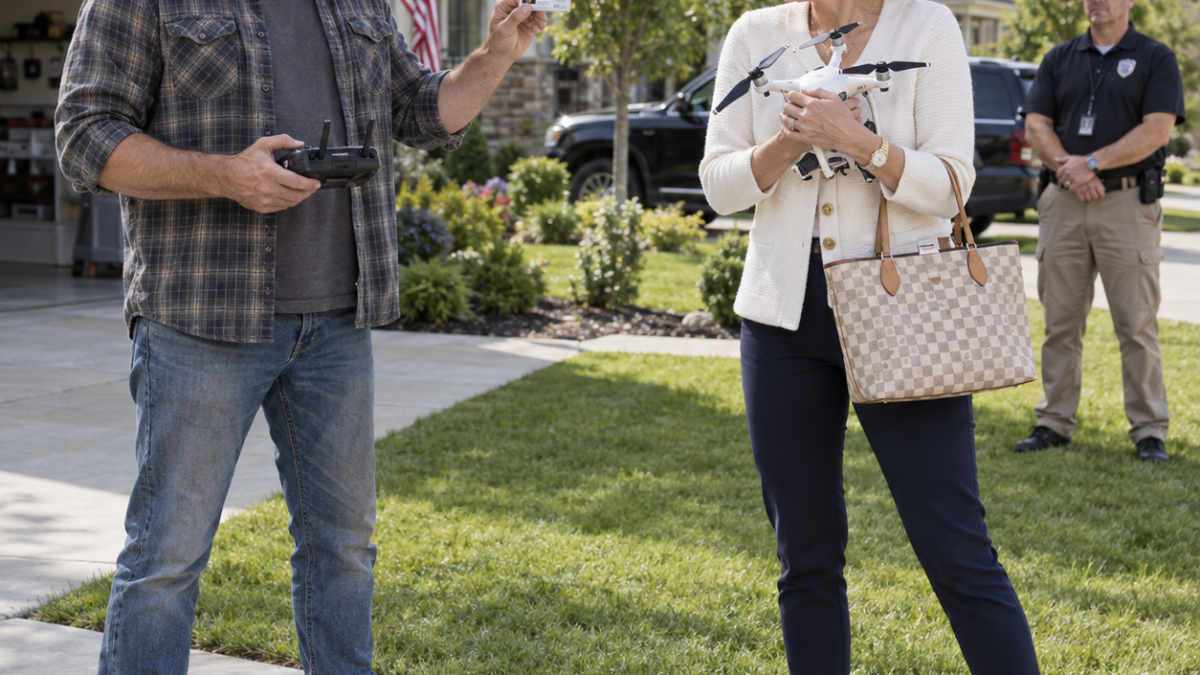
PART 2
Wade carried the drone toward the rear of his SUV.
“Stop.”
He turned.
Karen folded her arms.
“You have been told repeatedly that aerial surveillance is prohibited within Ridgeline’s community safety zone.”
“There is no community safety zone in federal airspace.”
“It was adopted by our board.”
“Your board cannot create an airspace restriction.”
She smiled in that patient way people do when they think they’re explaining something to a child.
“Our attorneys disagree.”
“Which attorneys?”
“That’s privileged.”
“Then give me the rule.”
She held out a sheet of paper.
It was titled EMERGENCY AERIAL PRIVACY DIRECTIVE.
There was an association logo.
A fake-looking seal.
Several paragraphs of legal-sounding language.
No statute.
No court order.
No FAA reference.
At the bottom was Karen’s signature.
I photographed it.
“What are you doing?”
“Preserving the document.”
“You don’t have permission.”
“I’m holding a document you handed me.”
She snatched it back.
Then she pointed at the drone.
“We’ll return the equipment after a tribunal determines whether you violated our privacy regulations.”
“What tribunal?”
“The board.”
“You’re going to judge whether I violated a rule you wrote?”
“That is how community enforcement works.”
“You are not my community.”
Her expression hardened.
“That attitude is why this situation has escalated.”
No.
This situation had escalated because Karen needed my land.
And because I had refused to sell it.
Fourteen months earlier, Ridgeline Estates had been preparing to double in size.
The original development sat east of my station.
Large houses.
Artificial ponds.
Stone entrance columns.
A clubhouse that looked like a small hotel.
The next phase was supposed to add nearly two hundred homes on land south of the ridge.
The developer had a problem.
There was no cheap construction access.
The public road on the eastern side would have required widening, bridge reinforcement, and utility work.
The cheapest route crossed my property.
The first offer was $850,000 for a permanent easement.
I rejected it.
Karen personally visited a week later.
She sat across from me in the operations trailer, placing a glossy rendering on my desk.
“You’d barely notice the road.”
The rendering showed two perfect lanes bordered by ornamental trees.
I knew construction drawings.
“What width?”
“Approximately forty feet.”
“That rendering shows twenty-two.”
She ignored that.
“The easement would only affect eleven acres.”
“It cuts through our operating corridor.”
“You could move the drone launch zone.”
“Where?”
She gestured vaguely toward the western fields.
“We’ll compensate you.”
“Our telemetry towers are fixed.”
“Everything can be moved.”
“For money?”
She smiled.
“Usually.”
That was our first mistake with each other.
She thought my refusal was negotiation.
I thought her persistence was arrogance.
Neither of us yet understood how much money was behind the project.
The second offer reached $1.4 million.
I still refused.
Then Karen stopped offering.
Three weeks later, the first Ridgeline violation notice appeared on my gate.
UNAPPROVED INDUSTRIAL ACTIVITY.
I called the association office.
A receptionist transferred me to Karen.
“Your agricultural facility affects the visual character of our southern corridor,” she said.
“My property predates Ridgeline by thirty-one years.”
“That doesn’t exempt you from regional compatibility.”
“It exempts me from your HOA.”
“We’ll let counsel determine that.”
Their counsel apparently determined nothing, because the next notice concerned my perimeter fence.
Then equipment noise.
Then outdoor lighting.
Then the “visual clutter” of my telemetry mast.
I ignored the fines.
I did not ignore the pattern.
Part of my professional work involved commercial aviation.
Another part of my life was far less visible.
I had spent sixteen years with the United States Marshals Service.
At the time Karen first contacted me, I was a supervisory deputy assigned primarily to complex fugitive and organized-crime operations.
The agricultural station was legitimate.
The company was legitimate.
So were the crop-survey contracts.
I had built the operation with my brother after years of flying drones recreationally and then commercially.
Some of our equipment had also been used in federally funded research involving advanced mapping and telemetry.
None of that made the station a secret spy base.
And I was not running around using federal authority to settle neighborhood disputes.
In fact, when Karen began harassing the station, I immediately notified my chain of command.
That decision later saved me from a serious conflict-of-interest argument.
My supervisor, Deputy Chief Sandra Keene, listened to my first report.
“So your neighbor wants your land.”
“Yes.”
“You won’t sell.”
“No.”
“And now you’re getting HOA fines even though you’re outside the HOA.”
“Yes.”
“Civil problem.”
“For now.”
Sandra knew me well enough to hear the second half of that sentence.
“What else?”
“Boundary markers moved twice.”
“Proof?”
“Not yet.”
“Get proof. And stay in your lane unless it crosses into ours.”
I installed cameras.
Two weeks later, one captured Ridgeline security personnel entering after midnight and shifting a wooden survey stake.
Another camera recorded a maintenance truck damaging a gate chain.
I turned the evidence over to county authorities.
Then another piece appeared.
A property filing.
Ridgeline submitted a map to the county claiming a narrow southern strip of my station fell within a “community development influence zone.”
There was no legal category by that name.
Attached to the filing was a survey certification.
The surveyor listed on the form denied signing it.
That moved the situation beyond HOA theater.
The county referred the matter for investigation.
Then Ridgeline’s own attorney, Michael Tran, contacted federal authorities through outside counsel.
Michael had been general counsel to the association for three years.
He had discovered contracts and board resolutions carrying his approval that he had never seen.
He provided copies.
The financial story emerged slowly.
Association reserve funds had been paid to consulting companies tied to people connected with the Ridgeline expansion.
Invoices described “environmental review,” “regional access mitigation,” and “community aviation assessment.”
Some companies had almost no actual operations.
One existed only as a mailbox and bank account.
Payments moved across state lines.
Property documents supporting the expansion appeared altered.
A federal investigation opened independent of me.
I became a witness.
Not the case agent.
That distinction mattered.
The FBI assigned Special Agent Lena Ortiz, a forensic-accounting specialist, as lead.
She met me in a conference room thirty miles away.
“You understand that because this involves your property, you don’t direct this investigation.”
“Absolutely.”
“You preserve what comes to you naturally.”
“Yes.”
“You don’t bait them.”
“Yes.”
“You don’t manufacture encounters.”
“Yes.”
“You don’t use your marshal credentials unless safety or duty requires it.”
“Yes.”
She leaned back.
“You answered that one slower.”
“I like my badge.”
She almost smiled.
“I’m serious.”
“So am I.”
For fourteen months, I followed those instructions.
Karen kept producing evidence without any help from me.
Fake penalties.
Threatening letters.
Trespassing security patrols.
Boundary tampering.
Messages demanding access.
Then she discovered the drones.
The first complaint came after a Ridgeline resident saw one of our aircraft turning over the soybean field.
Karen accused us of surveillance.
I provided the FAA registration, flight map, and contract.
She ignored them.
The second complaint claimed our drone was “capable of facial recognition.”
It wasn’t.
The third alleged we had recorded a resident swimming pool.
We produced the flight imagery.
Nothing but crops.
That should have ended it.
Instead, Karen created the Emergency Aerial Privacy Directive.
The document she handed me the morning she seized the aircraft.
And the upload-complete symbol on my tablet was not some secret trap I had personally set for her.
Our drones automatically synchronized flight data, imagery, telemetry, and incident logs to redundant servers whenever they returned to the launch zone.
It was standard commercial practice.
If an aircraft crashed, disappeared, or was stolen, we still had its data.
That mattered because Karen’s entire justification for taking the drone was that it contained illicit photographs.
It didn’t.
The server already proved what the camera had recorded.
Rows of soybeans.
Drainage swales.
Irrigation lines.
No backyards.
No bedrooms.
No residents.
The seizure turned her accusation into a problem.
But still not the biggest one.
I called Lena as soon as Karen’s convoy disappeared.
“She took one.”
“One what?”
“Matrice survey platform. Full sensor package.”
“She physically seized it?”
“Wade Mercer carried it into a Ridgeline security SUV.”
“Force?”
“No physical assault. Armed presence. Refused to return it.”
“Value?”
“About thirty-eight thousand with payload.”
“Registered?”
“Yes.”
“Commercial operation?”
“Yes.”
“Data?”
“Already synchronized.”
Lena paused.
“Good.”
“What do you want me to do?”
“Nothing.”
I hated that answer.
“Nothing?”
“You make a police report regarding the theft or unlawful seizure. You notify your insurer and FAA counsel. You do not go get it.”
“They have my aircraft.”
“Yes.”
“It’s probably sitting in their security office.”
“Then it will still be sitting there when a warrant tells us we can take it.”
I walked outside.
My site manager, Ray Dawson, was waiting.
Ray was forty-eight, six foot four, and built like a man who had spent twenty years believing forklifts were optional.
“What’d the feds say?”
“Do nothing.”
He laughed.
“Your favorite.”
“I hate professional restraint.”
“No, you hate other people’s professional restraint.”
Fair.
We filed the report.
The association responded through counsel—though, notably, not Michael Tran, who had quietly stopped representing them.
Their new attorney claimed the drone had been “temporarily secured” because it presented an immediate privacy threat.
My attorney demanded its return.
Karen refused.
Then she did something useful.
She issued a neighborhood newsletter.
The headline:
PROTECTING RIDGELINE FROM ILLEGAL AERIAL SURVEILLANCE.
She described my station as an “industrial drone compound.”
Claimed residents had been photographed without consent.
Claimed the board possessed evidence of repeated illegal flights.
Claimed federal authorities had been “notified.”
That last part was technically true.
Federal authorities were very interested.
Just not in me.
Several Ridgeline residents contacted the station.
Most were angry.
One man yelled through the gate that I was a pervert.
A woman called asking whether I had filmed her children.
That one hit me.
I could tolerate Karen attacking me.
Accusations involving children were different.
I sent Lena the newsletter.
“Can I issue a statement?”
“What do you want to say?”
“That the imagery contains only agricultural data.”
“Your lawyer can issue something factual. No mention of investigation.”
We released a short statement through counsel.
All flights were commercially licensed and logged.
The seized flight followed its authorized route.
The sensor data contained agricultural imagery.
No Ridgeline homes had been intentionally photographed.
We offered to allow an independent aviation expert to review the flight record.
Karen called that an admission.
Of what, I never understood.
Then residents started questioning her.
One of them was Dr. Maya Patel, an emergency physician who lived near Ridgeline’s southern edge.
She emailed me directly.
“I’m not asking to see imagery of anyone’s property,” she wrote. “I just want to know whether the drone crossed our parcel.”
I checked the logged route.
“No. Closest point to your lot was approximately 1,140 feet.”
“Can you prove that?”
“Yes.”
She came to the station with her husband.
I showed them the flight path.
Maya stared at the screen.
“This is all GPS logged?”
“Every second.”
“And the camera angle?”
“Also recorded.”
Her husband, Neil, worked in software.
He understood telemetry immediately.
“So if someone changed this after the flight—”
“They’d have to alter synchronized logs across multiple servers.”
Maya folded her arms.
“Karen told us you refused to show records.”
“She never asked to inspect them. She confiscated the aircraft.”
Maya’s expression changed.
“What?”
“You didn’t know?”
“She said you surrendered it during an investigation.”
I laughed once.
“Absolutely not.”
That was when Ridgeline’s internal support for Karen began cracking.
Maya requested board minutes relating to the drone directive.
Nothing.
Neil requested the legal opinion authorizing seizure of aircraft.
Nothing.
Other residents requested financial records.
The association stalled.
Karen blamed “ongoing litigation.”
One homeowner forwarded me an email in which Karen wrote:
COLE’S DRONE BUSINESS WILL FOLD ONCE WE APPLY ENOUGH REGULATORY PRESSURE. THE SOUTH ACCESS MATTER SHOULD RESOLVE SHORTLY AFTER.
That email went directly to Lena Ortiz.
“Now we’re talking,” she said.
The drone dispute wasn’t separate from the road.
It was another pressure tactic.
Investigators obtained additional subpoenas.
Financial records connected association money to expansion consultants.
The developers were under pressure because financing deadlines were approaching.
Without the access route, the project’s economics deteriorated badly.
One internal message later showed an executive telling Karen:
WE NEED SOUTH ACCESS BEFORE QUARTER CLOSE OR CAPITAL PARTNER WALKS.
Her response:
LEAVE COLE TO ME.
The case reached a point where prosecutors sought warrants.
A federal grand jury heard evidence.
Arrest and search warrants were approved.
The operation was scheduled for a Wednesday morning.
The night before, I slept about two hours.
At 5:00 a.m., I left home.
My wife, Rachel, met me in the kitchen.
“You carrying today?”
“Yes.”
“Work?”
“Yes.”
“Karen?”
I hesitated.
Rachel closed her eyes.
“Daniel.”
“There’s an operation.”
“When were you going to tell me?”
“I couldn’t.”
“You could’ve told me enough.”
“I’m telling you now.”
She stared at my jacket.
“Are you going to her house?”
“No.”
“Her office?”
“No.”
“Where?”
“Staging area.”
“Are you making the arrest?”
“No.”
She relaxed slightly.
“Good.”
“I’m there as property owner, witness, and marshal support if needed.”
“That sounds suspiciously broad.”
“It is.”
Rachel stepped close.
“Do not turn this into something personal.”
“I won’t.”
“You’ve been angry for fourteen months.”
“I know.”
“She called you a criminal in front of half the valley.”
“I know.”
“She took your drone.”
“I know.”
“Then remember you’re not the judge.”
That stayed with me.
The task-force staging site was twelve miles south.
FBI.
Marshals Service.
State police.
Aviation investigators.
Local deputies who had been cleared of involvement.
Warrants were reviewed.
Roles assigned.
My primary role was identification and property access at the station.
The plan called for teams to hit Ridgeline’s administrative office, several business addresses, and Karen’s residence almost simultaneously.
Then the station alarm activated.
5:58 a.m.
Front gate breach.
Ray called.
His voice was low.
“They’re here.”
“How many?”
“A lot.”
“Stay inside if you can.”
“Too late.”
The line went dead.
Security cameras loaded on the command monitor.
Nine black SUVs.
Two front-end loaders.
Private security personnel.
Karen.
I stared at the screen.
“She picked today.”
Lena looked at me.
“Apparently.”
The commander redirected our team.
Within minutes we were moving.
Back at the station, Karen’s men were ordering technicians away from equipment.
One camera showed Ray confronting her.
He held out his hand.
“Court order.”
Karen handed him something.
Ray read it.
Then laughed.
Even without audio, I recognized that laugh.
I leaned toward the screen.
“Oh, Ray.”
Karen’s face changed instantly.
She ordered Wade to restrain him.
Two men pushed Ray against the trailer.
Zip ties.
Other workers were forced toward the fence.
One security contractor began lifting our telemetry equipment into a truck.
Another picked up the seized drone’s replacement unit from a staging table.
Lena looked at me.
“This is becoming a lot worse for them.”
“Can we move?”
“We are moving.”
The convoy accelerated.
Security video showed loaders tearing up part of the gravel entrance, apparently trying to make vehicle access difficult.
Then Karen entered the operations trailer.
“What is she doing?” Lena asked.
“Looking for something.”
Inside the manager’s office was a folder.
Not a magic trap.
Not the only copy of anything.
Just working material Ray had been reviewing.
Grant documents.
Copies of financial records obtained through legal channels.
Correspondence with aviation counsel.
And several printed items tied to the investigation.
Karen opened it.
Read.
Then stuffed it into her leather bag.
Lena exhaled slowly.
“She just created a whole new problem.”
We reached the ridge.
The lead vehicle entered through the damaged gate.
Our convoy spread across the yard.
Agents exited.
Commands echoed.
“SECURITY PERSONNEL, KEEP YOUR HANDS VISIBLE!”
“DO NOT TOUCH YOUR WEAPONS!”
“STEP AWAY FROM THE DETAINEES!”
The private security contractors froze.
One man reached toward his belt.
Three agents shouted simultaneously.
His hands went straight up.
Wade Mercer looked around.
Then at Karen.
Then at the badges approaching him.
Everything about his posture changed.
I stepped out wearing my marshal vest.
Karen saw me.
She stopped breathing for what seemed like a full second.
Her eyes went to the word MARSHAL.
Then my face.
Then back to the vest.
“No.”
That was all she said.
Ray was still zip-tied against the trailer.
I went to him.
“You hurt?”
“Pride.”
“Same as always.”
“They took the new aircraft.”
“We’ll find it.”
An agent cut him loose.
Karen pushed forward.
“What is the meaning of this?”
Lena Ortiz approached holding a warrant packet.
“Karen Whitmore?”
“Yes.”
“I’m Special Agent Ortiz, FBI.”
Karen’s expression changed again.
“This property is under lawful community receivership.”
“Show me the court order.”
Karen held out her gold-seal document.
Lena read the first page.
Then handed it to another agent.
“Who signed this?”
“The board.”
“I asked for a judge.”
“Our association has emergency powers.”
“Not to detain people.”
“They were interfering.”
“Not to seize aircraft.”
“They were spy devices.”
“Not to destroy private access roads.”
Karen looked at me.
“This is his doing.”
I said nothing.
Rachel’s words came back.
You’re not the judge.
Wade Mercer began talking.
“We were told this was authorized.”
Karen spun.
“Wade.”
Lena looked at him.
“Authorized by whom?”
“The association.”
“Which court?”
He swallowed.
“I don’t know.”
“Which agency?”
No answer.
“What probable-cause determination authorized detention?”
Wade looked sick.
“We were acting under Ms. Whitmore’s direction.”
Karen’s face went crimson.
“You coward.”
That did it.
Whatever loyalty he still had disappeared.
“She told us the owners had federal clearance for the seizure.”
Karen shouted, “Stop talking.”
Lena calmly said, “Mr. Mercer, you should consider requesting counsel before answering further questions.”
Real procedure.
Not theater.
Agents cut the other workers free.
Medical staff checked their wrists.
Other teams secured weapons.
The loaders were shut down.
Then Lena looked toward Karen’s leather bag.
“Set the bag down.”
“No.”
“Ma’am.”
“It contains attorney-client privileged material.”
“Set it down.”
Karen clutched it.
An agent stepped closer.
Finally she lowered it to the hood of an SUV.
The warrant covered records relating to the fraud scheme and property takeover.
The bag was searched accordingly.
The folder from our trailer came out.
Karen’s face changed.
“That was planted.”
Lena looked at her.
“Where did you get it?”
“I found it.”
“Where?”
Karen hesitated.
“In their office.”
“You entered the office?”
“I was conducting an inspection.”
“Under what authority?”
No answer.
Then she made it worse.
“Those are Ridgeline documents. He stole them from us.”
Lena looked down at the folder.
“You recognize the contents?”
Karen realized the trap she had built for herself.
“I recognize the format.”
“You just said they were yours.”
“My attorney will explain.”
“That is probably wise.”
The folder did not single-handedly prove a massive conspiracy.
Reality rarely works that neatly.
But the security footage showed Karen entering a locked office without permission.
It showed her taking documents.
Her statements connected her to records she had previously denied knowing about.
And multiple body cameras captured the exchange.
It was one more strong piece in an already large case.
Then agents recovered my seized drone.
It was sitting in one of Ridgeline’s security vehicles.
The evidence tag on it read:
UNAUTHORIZED SURVEILLANCE DEVICE—HOLD FOR BOARD REVIEW.
Lena showed me the tag.
“You want this back eventually?”
“Very much.”
“Not today.”
“Of course not.”
“You look sad.”
“Thirty-eight thousand dollars.”
She almost smiled.
Then she walked toward Karen.
The formal arrest came minutes later.
Fraud-related charges.
Conspiracy.
Extortion allegations.
Property-document offenses.
Additional charges connected to that morning’s unlawful detentions, seizure, and destruction would be evaluated separately.
Karen stared at me while the cuffs were secured.
“You did all this over a drone.”
“No.”
“Don’t pretend.”
“You know this started before the drone.”
“You could have sold the access.”
There it was.
Even then.
“This was never about privacy.”
“Residents deserve privacy.”
“They do.”
“You flew cameras near their homes.”
“Commercially licensed agricultural flights that didn’t photograph their homes.”
“You expect them to trust you?”
“No.”
I nodded toward the data servers.
“That’s why there are records.”
She looked away.
The raids across Ridgeline’s offices produced more.
Financial ledgers.
Altered maps.
Shell-company records.
Communications with expansion developers.
Invoices for environmental studies that appeared never to have occurred.
A locked cabinet contained versions of the fake aerial directive.
One draft included a note:
USE DRONE ISSUE TO FORCE SHUTDOWN / NEGOTIATE SOUTH ACCESS.
When prosecutors showed me that later, I felt no satisfaction.
Mostly exhaustion.
For weeks, half the valley had believed I was spying on them.
Some people apologized.
Others didn’t.
Maya Patel came to the station.
“I owe you one.”
“No, you asked questions.”
“I believed her at first.”
“Most people did.”
“She sounded so certain.”
“That was one of her skills.”
Maya looked at a drone on the launch pad.
“Can I ask something stupid?”
“Please.”
“Can those things actually see into windows?”
“Not the way she described.”
“So why did it scare everyone?”
“Because nobody likes being watched.”
She nodded.
“That part was real.”
She was right.
Karen weaponized a reasonable fear.
That was why the accusation worked.
The proper response wasn’t mocking residents for privacy concerns.
It was transparency.
We started publishing simplified commercial flight maps for nearby property owners whenever surveys brought us close to residential boundaries.
Not because the law required every detail.
Because trust mattered.
The new Ridgeline board eventually adopted its own drone policy.
No pretending to regulate federal airspace.
No confiscations.
Just guidelines for HOA-operated drones and privacy rules for contractors.
Reasonable rules.
Imagine that.
Karen’s criminal case lasted more than a year.
Wade Mercer cooperated.
He admitted he knew private security lacked broad detention authority but claimed Karen had repeatedly assured him legal counsel approved their actions.
His messages showed he had raised concerns.
They also showed he went along anyway.
Consequences followed.
Ridgeline’s former attorney, Michael Tran, became a critical witness.
Financial experts traced association money into related entities.
Several board members resigned.
Not all were charged.
Some had been negligent.
Some had been intimidated.
A few had asked questions too late.
One board member, Helen Brooks, later told residents at an open meeting:
“I kept telling myself Karen understood the legal side better than I did.”
That sentence explained a lot.
People surrender authority gradually.
Not always because they are weak.
Sometimes because someone else sounds more certain.
Ridgeline installed a temporary independent administrator.
Then residents held elections.
Maya joined the new board.
I teased her about it.
“You complained about Karen and somehow ended up with her job.”
“Don’t say that.”
“You’re president.”
“Interim president.”
“Sure.”
She glared at me.
“You want the position?”
“Absolutely not.”
The new board formally acknowledged that our station was outside Ridgeline jurisdiction.
All fake fines were voided.
The claimed access rights disappeared.
The expansion developers had to redesign their route.
It cost millions more.
Construction slowed.
Investors were furious.
That was their problem.
My drone came back after forensic processing.
The aircraft itself survived.
One landing leg was scratched.
The multispectral sensor had been mishandled and needed recalibration.
Ridgeline’s insurer eventually paid the documented damage.
Ray watched me unpack it.
“You going to frame it?”
“The drone?”
“The evidence tag.”
I looked at the tag.
UNAUTHORIZED SURVEILLANCE DEVICE.
“I might.”
“You framed your first Part 107 certificate.”
“That was different.”
“No, it wasn’t.”
I kept the tag anyway.
The court proceedings were far less cinematic than the raid.
That mattered.
Karen had lawyers.
They challenged evidence.
They argued she relied on counsel.
They argued association records were misunderstood.
They argued some financial transactions were legitimate.
Some were.
The prosecution narrowed its case around provable conduct.
Eventually, Karen entered a plea agreement on serious fraud and conspiracy charges.
Additional state matters arising from the armed station seizure were resolved separately.
She received years in custody, restitution obligations, forfeiture, and restrictions on future fiduciary positions.
I attended sentencing.
Rachel came with me.
“You don’t have to speak,” she said.
“I know.”
“You don’t owe anyone a performance.”
“I know.”
When my name was called, I walked forward.
I had drafted four pages.
I spoke for less than three minutes.
“This case began for me as a property disagreement,” I said. “Someone wanted access through land I owned. I said no.”
Karen sat beside her attorneys.
“Everything after that became an attempt to make my no too expensive to maintain.”
I mentioned the fake fines.
The forged property documents.
The accusations.
Then the drone.
“For several weeks, neighbors believed my crew was photographing their families. That accusation harmed people who had done nothing wrong except go to work.”
I looked toward the judge.
“The worst part wasn’t losing equipment. Equipment can be replaced. The worst part was watching fear become a tool.”
Karen kept her eyes down.
“I don’t ask the court for humiliation. I ask for accountability that makes clear that private power does not become public authority simply because someone prints a seal, hires armed security, or says the word ‘emergency.’”
I sat down.
Karen spoke later.
She apologized.
Not perfectly.
Maybe not completely.
But more honestly than I expected.
She admitted the expansion project had become tied to her reputation.
She had promised developers.
Promised homeowners.
Promised investors.
Every delay made her look weaker.
Every refusal became personal.
“The more control I lost,” she said, “the more I tried to control.”
That sounded true.
It didn’t excuse anything.
But understanding and excusing are different.
Months after sentencing, Rachel and I walked the southern boundary.
The damaged entrance had been repaired.
The station looked normal again.
A drone lifted from the launch field, climbed to four hundred feet, and headed west over corn.
Rachel watched it.
“You nervous?”
“About what?”
“Karen climbing out of the bushes with a clipboard.”
I laughed.
“Little.”
“Liar.”
“Fine. Not at all.”
The aircraft turned.
Sunlight flashed on the fuselage.
I remembered the morning Karen confiscated the other one.
How angry I had been.
How badly I wanted to show her the marshal badge and end the entire performance right there.
Instead, I waited.
That had been harder.
And smarter.
If I had flashed federal credentials during the first months simply to frighten her away, maybe she would have stopped.
Maybe she would have hidden the financial records.
Changed companies.
Destroyed documents.
Found another route.
Instead she kept believing quiet meant weak.
That mistake exposed everything.
Ray retired the following year.
At his retirement cookout, I gave him a small display case.
Inside was one of the plastic zip ties investigators had released back after the case.
Beneath it was a brass plate.
PROPERTY OF RIDGELINE COMMUNITY TRIBUNAL.
Ray stared at it.
“You are deeply unwell.”
“You laughed at Karen’s fake court order.”
“I was trying to de-escalate.”
“You laughed in her face.”
“She deserved it.”
“Exactly.”
He hung the case in his garage.
The station changed too.
My brother took over most commercial operations.
I reduced my federal workload.
Years of chasing fugitives had taught me something I resisted for too long:
Eventually you have to stop defining usefulness by emergencies.
I spent more time actually flying.
Not tactical surveillance.
Not federal operations.
Corn.
Soybeans.
Drainage.
Boring was wonderful.
One Saturday, Ridgeline invited our company to demonstrate agricultural drone mapping during a community technology day.
Ray called just to laugh.
“You going?”
“No.”
“You have to.”
“No.”
“They seized your drone and now they want a drone demonstration.”
“I understand irony.”
“Apparently not enough.”
Rachel made me go.
Maya introduced me to about forty residents.
“This is Daniel Cole from Cole Agricultural Imaging.”
A teenager raised his hand.
“Are you the guy Karen said was spying on us?”
Maya closed her eyes.
I laughed.
“Yep.”
The boy looked thrilled.
“Were you?”
“Nope.”
“Can the drone see my house?”
“If I deliberately point a camera at your house from the right place, it can photograph your house. So can a helicopter. Or a satellite. Or someone standing across the street with a camera.”
His mother looked uncomfortable.
I continued.
“That’s why responsible operators follow flight rules, privacy laws, contracts, and data policies.”
“What were you actually photographing?”
I pulled up an image.
A field appeared in shades of green and red.
“This.”
The kid frowned.
“Looks like Minecraft.”
“It tells farmers where plants are stressed.”
“That’s kind of boring.”
“Most legal work is.”
People laughed.
Then an older man approached me after the demonstration.
His name was Frank.
He had been one of the loudest voices accusing me of spying during Karen’s campaign.
“I said some things about you.”
“I remember.”
“I was angry.”
“I remember that too.”
“My wife was sick then. We were afraid someone had filmed her sitting outside.”
“I understand.”
“You could’ve sued us.”
“For being wrong?”
“For spreading it.”
“I had enough lawyers.”
Frank looked at the drone.
“Still hate those things.”
“That’s allowed.”
He smiled.
We shook hands.
That mattered more to me than I expected.
The station’s relationship with Ridgeline never became perfect.
Good.
Perfect communities usually exist only in sales brochures.
Residents complained about morning equipment noise.
We adjusted launch times when we could.
We complained about construction trucks cutting through our shoulder.
Their board fixed it.
One resident flew his own drone too close to our operation.
We called him.
He apologized.
No tactical teams required.
Three years after the seizure, I finally retired from full-time federal service.
My last day with the Marshals Service was strangely ordinary.
Paperwork.
Equipment turn-in.
Photographs.
Bad cake.
Sandra Keene shook my hand.
“Try not to uncover any conspiracies in retirement.”
“I’ll do my best.”
“That concerns me.”
I kept the agricultural company.
That was enough.
On my first Monday as a civilian retiree, I launched a mapping flight at sunrise.
Same southern field.
Same corridor where Karen had claimed we were spying.
I checked weather.
Airspace.
Aircraft status.
NOTAMs.
Battery.
Remote ID.
Flight authorization.
Routine.
Legal.
Boring.
Beautiful.
The drone rose.
One hundred feet.
Two hundred.
Three hundred.
Then turned onto the programmed grid.
Rachel came out carrying coffee.
“You realize normal retired people sleep later.”
“I’m transitioning.”
“You’ve been awake since five.”
“Gradual transition.”
She handed me a cup.
We watched the aircraft cross the field.
At the far edge of the valley, Ridgeline’s rooftops caught the morning light.
The expansion eventually happened.
Just not through my property.
The developers built the more expensive eastern access road.
No special treatment.
No fake easement.
No intimidation.
Just permits, engineering, and money.
Exactly what should have happened the first time.
The drone finished its route.
I brought it home.
It settled onto the pad.
The tablet chimed.
UPLOAD COMPLETE.
Same words I had seen the morning Karen seized my aircraft.
For a moment, I remembered everything.
Wade lifting the drone.
Karen waving her fake order.
Residents calling me a spy.
Ray tied against the trailer.
The federal convoy entering through the broken gate.
Then Rachel nudged my shoulder.
“You zoning out?”
“Memory.”
“Good one?”
“Eventually.”
I shut down the aircraft.
Inside the operations trailer, one old item still hung on the wall.
Not my marshal badge.
Not Karen’s indictment.
Not a news clipping.
The confiscation tag from my drone.
UNAUTHORIZED SURVEILLANCE DEVICE.
Below it, Ray had added a handwritten note before retiring:
LICENSED COMMERCIAL FLIGHT. CHECK THE PAPERWORK NEXT TIME.
I had left it there because it made me laugh.
It also reminded me how the whole thing started.
Karen thought authority meant getting the last word.
She thought if she called my aircraft a spy device loudly enough, then it became a spy device.
If she called a private board directive an emergency order, then it became law.
If she called my property community land, then eventually someone would believe her.
Reality does not work that way.
A license is real because an actual authority issues it.
A warrant is real because a judge signs it under law.
A property line is real because it can be established by legitimate records and surveys.
And leadership is real only when the people being led are allowed to question it.
I looked at the tag one last time.
Then shut off the office lights.
Outside, the morning flight data had already uploaded.
The fields were mapped.
The station was quiet.
And the drone Karen once called a spy device was back in the air doing the same unremarkable job it had been licensed to do from the beginning.
[TITLE]
Karen Seized My Drone as a “Spy Device”—She Didn’t Know the Flight Was Federally Licensed
[FACEBOOK OPENING — 700–800 WORDS]
Karen Whitmore marched onto my agricultural survey station with four private-security officers, pointed at the $38,000 mapping drone I had just landed, and announced that she was confiscating it as an illegal “spy device” because it had flown near the edge of her luxury development.
When I showed her the FAA registration number, my commercial pilot credentials, and the survey contract proving the aircraft had spent the entire morning mapping soybeans instead of photographing anyone’s backyard, she barely looked at them before ordering one of her men to take the drone anyway—and warning me that my property would be placed under “community receivership” if I interfered.
What Karen didn’t know was that the flight she had just interrupted was only one small piece of a much larger operation, and the instant her security chief carried my aircraft toward their SUV, a green symbol appeared on my tablet confirming that every second of flight data had already gone somewhere she could never seize it.
“Turn it off.”
Karen pointed toward the controller in my hands.
“It’s already landed.”
“Then disable the camera.”
“It isn’t recording.”
“I said disable it.”
I looked toward the drone sitting twenty feet away on its landing gear.
Six rotors.
Survey-grade GPS.
Multispectral agricultural sensor.
Federal registration number clearly marked on the fuselage.
Nothing hidden.
Nothing illegal.
My name is Daniel Cole. Most people in the valley knew me as an agricultural consultant who operated a remote-sensing station on 430 acres west of Ridgeline Estates.
That description was true.
It simply wasn’t complete.
My crew used commercial drones to map irrigation problems, erosion, crop stress, and soil conditions for farms across three counties. Every pilot on my team held the proper FAA remote-pilot certification. Every aircraft was registered. Every mission was logged.
That morning we were mapping a soybean field.
The programmed route never entered Ridgeline property.
Karen didn’t care.
She arrived in a white SUV followed by two black security vehicles.
Her security chief, Wade Mercer, stepped out in a tactical vest designed to look official until you noticed there was no agency name anywhere on it.
Karen walked directly toward me.
“You have been spying on our residents.”
“No.”
“Our security team observed your drone over the community.”
“They observed it from the community.”
Her mouth tightened.
“You photographed private homes.”
“The sensor was pointed at farmland.”
“You expect me to believe that?”
I held out the tablet.
“You can look at the flight log.”
“I don’t need to.”
That told me everything.
Karen didn’t want an explanation.
She wanted submission.
For four years she had been president of the Ridgeline Property Association, and somewhere along the way she had started treating that title as though it made her mayor, judge, zoning department, and police chief all at once.
Our conflict had started fourteen months earlier.
Developers behind Ridgeline’s planned expansion wanted to buy a narrow strip across my station for a construction-access road.
That road would cut through our primary launch corridor and telemetry field.
I refused.
They increased the offer.
I refused again.
Then came HOA fines from an HOA I didn’t belong to.
Noise violations.
Fence violations.
“Visual blight.”
Complaints about agricultural trucks.
Anonymous reports to county inspectors.
Every inspection ended the same way.
No violation.
Karen never stopped.
Now she pointed at my drone.
“Confiscate it.”
Wade hesitated.
“Ms. Whitmore, this is private property.”
“It’s evidence.”
“Evidence of what?” I asked.
“Illegal surveillance.”
I opened my equipment case.
“FAA registration. Part 107 certificate. Commercial contract. Flight plan. Here.”
Karen pushed the folder aside without reading it.
“Anyone can print paperwork.”
I stared at her.
“You drove onto my land holding something called an Emergency Aerial Privacy Directive with a gold seal from your own board, and you’re questioning my paperwork?”
One technician behind me coughed to hide a laugh.
Karen’s cheeks darkened.
“Take the drone.”
Wade moved toward it.
I stepped between him and the aircraft.
“Touch it, and you accept responsibility for what happens next.”
Karen smiled.
“Is that a threat?”
“No.”
I looked at Wade.
“It’s a warning.”
He lifted the drone anyway.
My tablet vibrated.
A small green symbol appeared in the corner.
UPLOAD COMPLETE.
Karen never noticed.
But I did.
And while she stood there congratulating herself for confiscating what she called a “spy device,” I realized she had just created exactly the kind of evidence we had been waiting more than a year to obtain.
[END OF FACEBOOK OPENING]
[FULL STORY CONTINUATION]
Wade carried the drone toward the rear of the black SUV.
“Stop.”
He turned.
Karen folded her arms.
“You have been warned repeatedly about unauthorized aerial surveillance.”
“There has been no unauthorized surveillance.”
“Our residents have a right to privacy.”
“I agree.”
“Then why are you flying cameras over our neighborhood?”
“I’m not.”
She took a document from her leather portfolio and held it out.
EMERGENCY AERIAL PRIVACY DIRECTIVE.
I scanned it.
Ridgeline logo.
Heavy cream paper.
Gold embossed seal.
Paragraph after paragraph of language designed to sound as though a team of constitutional scholars had written it after consuming too much coffee.
There was one problem.
No statute.
No FAA regulation.
No court order.
No agency signature.
Just Karen.
“This was adopted yesterday,” she said.
“By your HOA board?”
“Yes.”
“And you believe this allows you to seize registered aircraft outside HOA property?”
“We have emergency jurisdiction where resident privacy is threatened.”
“No, you don’t.”
She snatched the document back.
“Your arrogance is astonishing.”
I almost laughed.
Wade opened the SUV.
I stepped close enough that only he could hear me.
“That aircraft costs thirty-eight thousand dollars with the sensor package.”
His eyes flicked toward me.
“If it is damaged, document exactly who instructed you to take it.”
Karen heard.
“I instructed him.”
“Good.”
Her confidence returned.
She loved putting her name on things when she believed her name carried power.
That habit would become important later.
The SUVs disappeared down the dirt road.
My operations manager, Ray Dawson, came up behind me.
Ray was a large man with graying hair, a permanent squint, and a talent for saying exactly what everyone else was trying not to say.
“Well.”
I looked at him.
“Well what?”
“She stole a federally registered commercial drone in broad daylight.”
“Technically she claims she seized it.”
“That makes it sound smarter.”
“It won’t in court.”
Ray looked at my tablet.
“Did the flight upload?”
I turned the screen toward him.
UPLOAD COMPLETE.
Every telemetry point.
Every image.
Every GPS coordinate.
Every sensor angle.
Every control input.
The aircraft itself was gone.
Its evidence wasn’t.
Ray let out a low whistle.
“She thinks the files are on the drone.”
“Probably.”
“She’s going to open the memory card.”
“Probably.”
“And find mostly redundant data.”
“Yes.”
Ray smiled.
“I almost feel sorry for her.”
“Don’t.”
I called our attorney first.
Then our insurer.
Then the sheriff’s office.
And finally Special Agent Lena Ortiz.
Lena answered on the second ring.
“What happened?”
“Karen confiscated one of our aircraft.”
Silence.
“Explain ‘confiscated.’”
“She arrived with private security, accused us of spying, ignored FAA documents, and ordered Wade Mercer to physically remove the aircraft.”
“Force?”
“Armed presence. No weapon displayed at me.”
“Value?”
“About thirty-eight thousand.”
“Commercial operation?”
“Yes.”
“Licensed?”
“Yes.”
“Flight data preserved?”
“Automatically.”
Another pause.
“Good.”
“I’m assuming I shouldn’t drive to Ridgeline and take it back.”
“Correct.”
“I knew you were going to say that.”
“Daniel.”
“I’m joking.”
“Your jokes make me nervous.”
Lena had good reason to be careful.
What Karen believed was a private dispute between an HOA president and a stubborn agricultural consultant had already become part of a federal investigation.
Fourteen months earlier, none of us knew it would go that far.
The beginning had been almost boring.
A property offer.
Ridgeline Estates sat east of my station, an expensive gated community built along a wooded ridge overlooking the valley.
The first phase included eighty-six homes.
The second phase was supposed to add nearly two hundred more.
Their problem was access.
The existing eastern road could technically support the expansion, but not cheaply.
It needed widening.
A bridge required reinforcement.
Utilities had to be relocated.
The southern route was shorter.
And it crossed my land.
Karen first came to see me on a Tuesday afternoon.
She wore a navy suit and carried a glossy presentation folder.
She sat across from my desk and opened to an architectural rendering.
Tree-lined boulevard.
Decorative lamps.
Stone entrance.
Happy digital people walking golden retrievers.
“You would barely know it’s there.”
I studied the plan.
“How wide?”
“Approximately forty feet.”
“The rendering shows half that.”
“It’s conceptual.”
“Construction traffic?”
“Temporary.”
“How many homes?”
She smiled.
“One hundred eighty-two.”
“And every construction truck comes through here?”
“Initially.”
I closed the folder.
“No.”
Karen blinked.
“We haven’t discussed compensation.”
“We don’t need to.”
“Our opening offer is eight hundred fifty thousand dollars.”
“No.”
“You haven’t considered it.”
“I have.”
“You considered almost a million dollars in six seconds?”
“I considered giving up the launch corridor before you arrived.”
Her smile thinned.
“You can relocate the drone field.”
“Our telemetry antennas are fixed. Our contracts depend on this layout.”
“Everything can be moved.”
“For enough money?”
She smiled again.
“That’s generally how property works.”
“No.”
That was the moment Karen stopped seeing me as a neighbor and started seeing me as an obstacle.
The second offer reached $1.4 million.
I refused that too.
Three weeks later, an envelope appeared on our gate.
UNAPPROVED COMMERCIAL AVIATION ACTIVITY.
I called Ridgeline.
Karen answered.
“My property is not part of your association.”
“Your activity impacts association residents.”
“That does not give you regulatory authority.”
“Our counsel is reviewing regional nuisance provisions.”
“Your counsel should review a map.”
She hung up.
Then came more notices.
Fence appearance.
Vehicle noise.
Outdoor lighting.
Telemetry mast height.
Dust.
Equipment storage.
The funniest one claimed our north field created “visual agricultural blight.”
I framed that letter in the office.
Ray wrote beneath it:
FARM DETECTED ON FARM.
The humor stopped when boundary stakes began moving.
The first time, I thought a contractor had made a mistake.
The second time, I installed cameras.
Three nights later, a Ridgeline maintenance truck stopped near our southern line.
Two men got out.
One pulled a wooden stake.
The other measured toward our property.
They moved it eleven feet.
Then photographed their work.
I saved the footage.
A county surveyor later confirmed the legitimate line.
I notified my federal chain of command because of my job.
That was the other fact Karen never knew.
Cole Agricultural Imaging was real.
The commercial flights were real.
My work with farmers was real.
But agriculture wasn’t my only profession.
I had spent sixteen years with the United States Marshals Service.
At the time, I supervised a small operational team handling fugitive investigations and assisting multi-agency organized-crime cases.
I didn’t advertise that at the station.
There was no reason to.
I liked being Daniel the drone guy.
Not Deputy Cole.
Karen interpreted privacy as weakness.
My supervisor, Deputy Chief Sandra Keene, did not.
When I reported the boundary incident, she listened carefully.
“So far, this sounds like local property misconduct.”
“It is.”
“But?”
“They’re generating documents.”
“What kind?”
“HOA fines against property they don’t govern. Boundary claims. Threats of liens.”
“Fraudulent?”
“Some look fabricated.”
Sandra leaned back.
“You are too personally involved to investigate your own neighbor.”
“I know.”
“If it crosses federal jurisdiction, we assign someone else.”
“I know.”
“You preserve evidence. You do not bait them.”
“I know.”
“Do not show your credentials just to win an argument.”
“That takes all the fun out of federal service.”
She didn’t smile.
“Daniel.”
“Understood.”
A month later, things crossed the line.
Ridgeline filed a revised property map with the county.
The filing claimed a narrow strip of our southern property belonged inside something called the Ridgeline Community Development Influence Area.
The phrase had no recognized legal meaning.
Attached was a survey certification.
The listed surveyor denied signing it.
Then Ridgeline’s own attorney, Michael Tran, quietly contacted authorities.
Michael had served as general counsel for three years.
He found board resolutions containing his electronic signature that he had never approved.
Vendor agreements he had never reviewed.
Environmental reports from consulting firms that appeared not to exist.
He made copies.
Then hired his own attorney and contacted federal investigators.
The FBI opened a financial case.
Special Agent Lena Ortiz became lead.
Lena was patient in a way that made impatient people confess things simply to fill the silence.
She reviewed my evidence.
Then gave me strict instructions.
“You are a witness.”
“Yes.”
“You are also a federal officer.”
“Yes.”
“And the dispute involves your land.”
“Yes.”
“That combination is a defense attorney’s dream.”
“I know.”
“So we keep you away from investigative decisions.”
“Fine.”
“You document what comes to you naturally.”
“Fine.”
“You do not engineer confrontations.”
“Fine.”
“You’re saying fine like you hate me.”
“I respect you deeply.”
“Good.”
The financial investigation uncovered a network of consulting firms receiving HOA money.
Some companies were real.
Some barely existed.
Several had connections to people involved in the expansion.
Association reserve funds intended for roads, drainage, and maintenance had been redirected through questionable consulting contracts.
Interstate transfers raised federal interest.
Then investigators found investor documents representing that the southern access route was “substantially secured.”
It wasn’t.
Without my land, the project cost rose dramatically.
That explained Karen’s desperation.
But the drone accusation gave her something emotionally powerful.
Privacy.
People are understandably nervous about cameras in the sky.
Karen used that fear perfectly.
She claimed our drones photographed bedrooms.
Backyards.
Children.
Swimming pools.
None of it was true.
But it sounded plausible to people who didn’t understand agricultural mapping.
After the seizure, her newsletter hit every Ridgeline mailbox.
PROTECTING OUR FAMILIES FROM ILLEGAL AERIAL SURVEILLANCE.
She described my company as an “industrial drone operation.”
She accused me of refusing transparency.
She claimed the confiscated aircraft contained evidence of repeated privacy violations.
The article spread online.
By evening my office phone was ringing nonstop.
One man called me a predator.
Another threatened to shoot down any aircraft crossing “his airspace.”
A woman called near midnight.
“Did you photograph my daughter?”
That one hurt.
“No.”
“How do I know?”
“I can show your attorney the flight logs.”
“Karen says you refused.”
“She never asked to review them.”
“She said you erased the evidence.”
“The data is preserved.”
The woman hung up.
I sat at the kitchen table long after midnight.
My wife Rachel found me there.
“You can’t answer every call.”
“They think we filmed children.”
“They’re scared.”
“I know.”
“Karen gave them something scary to believe.”
Rachel sat across from me.
“That doesn’t make them your enemy.”
I rubbed my face.
“I know.”
“Do you?”
That question stopped me.
She knew me.
She knew when anger started simplifying people.
I called Lena the next morning.
“Can my attorney release part of the flight data?”
“Factual only.”
“We can show route, altitude, sensor orientation, commercial contract.”
“That should be fine. No reference to investigation.”
Our lawyer issued a statement.
Every seized flight had been federally compliant.
The aircraft was registered.
The pilot certified.
The route documented.
The sensor imagery contained crops, drainage features, and field boundaries.
No Ridgeline homes had been intentionally surveyed.
We offered independent technical review.
Karen called the statement “an attempt to hide behind federal bureaucracy.”
Then something unexpected happened.
A Ridgeline resident named Dr. Maya Patel contacted me.
She was an emergency physician.
Direct.
Impatient.
“I don’t care about Karen,” she said. “I want to know whether your drone crossed my parcel.”
“What’s your address?”
She told me.
I checked.
“Closest point was 1,140 feet.”
“Can you prove that?”
“Yes.”
Maya and her husband Neil came to the station.
Neil worked in cybersecurity.
I opened the telemetry log.
He immediately understood what he was seeing.
GPS coordinates.
Altitude.
Camera orientation.
Timestamps.
Battery status.
Remote identification data.
Sensor sweeps.
“So the aircraft logs all this automatically?”
“Yes.”
“And it syncs?”
“Yes.”
“When?”
“During and after flight.”
Maya looked at the screen.
“Karen said the evidence was only stored on the drone.”
“It isn’t.”
“She said you refused inspection.”
“She never requested an independent technical inspection.”
Maya folded her arms.
“Then why take it?”
“That’s a good question.”
Neil zoomed out on the route.
The drone never crossed Ridgeline.
Not once.
Maya stared at the map.
“She lied.”
“About this, yes.”
“Why?”
I could have told her everything I suspected.
I didn’t.
“I don’t know what she believed.”
That answer mattered.
I was angry, but I refused to invent motives we couldn’t prove.
Maya went home and requested HOA records.
Board minutes concerning the drone directive.
Legal opinions.
Security reports.
Financial statements.
Karen delayed.
Neil filed his own request.
Other residents joined.
Then one homeowner forwarded an internal email.
Karen had written:
COLE’S DRONE OPERATION WILL FOLD ONCE WE APPLY ENOUGH REGULATORY PRESSURE. SOUTH ACCESS SHOULD BECOME NEGOTIABLE AFTER THAT.
I sent it to Lena.
She called five minutes later.
“Now the drone issue connects directly to access.”
“Looks that way.”
“Do nothing.”
“I hate that phrase.”
“I know.”
Another internal message surfaced through subpoena.
A developer executive wrote:
NEED SOUTH ROUTE BEFORE QUARTER CLOSE OR CAPITAL PARTNER WALKS.
Karen replied:
LEAVE COLE TO ME.
That was when prosecutors began moving toward warrants.
The financial evidence was already substantial.
Now coercive pressure over the property tied pieces together.
A federal grand jury reviewed records.
Search warrants were approved.
Arrest warrants followed for several people.
The operation was scheduled for Wednesday morning.
Tuesday night I barely slept.
Rachel knew something was happening.
She found me checking my vest at five in the morning.
“You’re going somewhere.”
“Yes.”
“Karen?”
“There’s an operation.”
Rachel’s jaw tightened.
“You waited until now?”
“I couldn’t discuss it earlier.”
“You could have told me enough to stop me imagining every possible disaster.”
I knew she was right.
“I’m sorry.”
She looked at the vest.
“Are you arresting her?”
“No.”
“Promise?”
“The case belongs to FBI. I’m there because the station is mine and I may assist with site access.”
Rachel came closer.
“You’ve wanted to prove she was wrong for fourteen months.”
“Yes.”
“Today is not about proving anything.”
“I know.”
“No personal speeches.”
I smiled.
“You know me too well.”
“Exactly why I’m saying it.”
The staging site was twelve miles south.
Federal agents.
Marshals.
State police.
Aviation investigators.
Local deputies cleared through the case.
The plan was straightforward.
Teams would hit Ridgeline’s administrative office, several associated businesses, and Karen’s residence nearly simultaneously.
Then my station alarm triggered.
5:58 a.m.
GATE BREACH.
I pulled up cameras.
Nine black SUVs entered.
Two yellow loaders followed.
“Lena.”
She came over.
Karen’s private security flooded onto the property.
Technicians backed away.
Ray came out of the operations trailer.
He walked toward Karen.
The camera audio picked up his voice.
“Show me the court order.”
Karen handed him a page.
Ray read it.
Then laughed.
I covered my eyes.
“Ray, don’t.”
Lena almost smiled.
Karen did not.
“Restrain him.”
Two security officers grabbed Ray.
They forced him against the trailer.
Plastic zip ties closed around his wrists.
My anger surged.
“Move now.”
The commander nodded.
“We’re already rolling.”
More workers were forced toward the fence.
One guard started loading equipment into a truck.
Another disconnected telemetry antennas.
A loader dug into the gravel access road, tearing up part of the entrance.
Then Karen entered the office.
Our internal security camera followed her.
She opened drawers.
Cabinets.
Files.
At the bottom of Ray’s desk sat a working folder containing copies of grant records and financial correspondence already preserved elsewhere.
Karen opened it.
Read.
Then slid the folder into her leather bag.
Lena watched beside me.
“That’s burglary on video.”
“Depending on state elements.”
She looked at me.
“Thank you, lawyer Daniel.”
“You taught me.”
Our convoy came over the ridge minutes later.
Federal vehicles spread across the compound.
Agents exited.
Commands exploded through the morning air.
“HANDS VISIBLE!”
“STEP AWAY FROM THE DETAINEES!”
“DO NOT TOUCH YOUR WEAPONS!”
The private security team froze.
A few looked toward Wade.
Wade looked toward Karen.
Then at thirty-plus federal and state officers.
Hands went up.
Fast.
I stepped out wearing my Marshals Service vest.
Karen saw me.
Every expression left her face.
She stared at the word MARSHAL across my chest.
Then at me.
Then back at the vest.
“No.”
Ray was still tied.
I went to him first.
“You okay?”
“My wrists hurt.”
An agent cut the ties.
Ray rotated his hands.
“I told her she picked a bad morning.”
“You antagonized her.”
“She deserved it.”
“You laughed at her fake order.”
“It was objectively funny.”
Even then, Ray could make me smile.
Lena approached Karen.
“Karen Whitmore?”
“Yes.”
“Special Agent Lena Ortiz, FBI.”
Karen looked around.
“This is a private community matter.”
“Show me your authority to detain workers.”
Karen held up the gold-seal order.
Lena read it.
“Which judge signed this?”
“The association has emergency powers.”
“Which court issued it?”
“It doesn’t require a court.”
“For detention?”
“They interfered with an authorized receiver action.”
“Who appointed the receiver?”
“The board.”
Lena handed the document to an evidence technician.
“Your board cannot appoint itself receiver of somebody else’s property.”
Karen looked at me.
“This is his revenge.”
I said nothing.
Rachel had told me not to make speeches.
She had been right.
Wade Mercer started talking.
“We were told there was legal authority.”
Karen turned.
“Wade.”
Lena looked at him.
“Who told you?”
“Ms. Whitmore.”
“You had a warrant?”
“No.”
“Court order?”
“The document she gave us.”
“Did counsel review it?”
Wade hesitated.
Karen snapped, “Stop answering.”
Lena calmly said, “Mr. Mercer, you may request counsel.”
That contrast mattered.
Karen demanded silence because it protected her.
Lena explained rights because law required it.
Agents released the technicians.
Medical staff checked them.
Security weapons were secured.
Equipment photographed.
Then Lena looked at Karen’s leather bag.
“Place the bag on the vehicle.”
“It contains privileged material.”
“Place it down.”
Karen hesitated.
Then obeyed.
The applicable warrant allowed agents to search for records connected to the property and financial schemes.
Inside was the folder from Ray’s office.
Karen immediately said, “That was planted.”
Lena looked at her.
“Where did you find it?”
Karen realized too late that answering created another problem.
“It was in their office.”
“You entered the office?”
“I had inspection authority.”
“Under what law?”
Silence.
Then she pointed toward me.
“He stole those records from Ridgeline.”
Lena looked at the folder.
“You recognize them?”
Karen’s face changed.
“I recognize the format.”
A body camera captured everything.
No dramatic confession.
No instant conviction.
But another piece of evidence.
Then agents found my seized drone.
It was inside a Ridgeline security vehicle parked near the operations building.
A paper evidence tag had been attached to the case.
UNAUTHORIZED SURVEILLANCE DEVICE.
HOLD FOR BOARD REVIEW.
Lena showed me.
“Yours?”
“Serial number matches.”
“Congratulations.”
“Can I have it?”
“No.”
“You enjoy this.”
“A little.”
The formal arrests followed.
Karen.
Two people connected to the financial scheme.
Wade detained for questioning and later charged in connection with the morning’s actions.
Other teams executed warrants at Ridgeline’s administrative office.
The search uncovered computers, altered maps, financial ledgers, and documents tying multiple companies to expansion expenditures.
One draft of the aerial directive included a note:
USE DRONE ISSUE TO FORCE SHUTDOWN / NEGOTIATE SOUTH ACCESS.
When prosecutors showed me that document months later, I felt something strange.
Relief.
Not triumph.
For weeks I had wondered whether Karen genuinely believed our drones threatened privacy.
Apparently, at least partly, she had known the accusation was useful leverage.
But that didn’t mean residents’ privacy concerns were fake.
Maya reminded me.
“People were scared because drones actually can be invasive.”
“Yes.”
“So don’t treat everyone who believed her like an idiot.”
“I don’t.”
“You did for about two weeks.”
She was right.
Again.
After Karen’s arrest, I held a public information meeting at the station.
No federal case details.
Just aviation.
We showed residents how commercial flight logs worked.
Explained altitude.
Remote ID.
Camera fields of view.
Privacy policies.
Data retention.
One older woman raised her hand.
“What stops you from just pointing the camera at my house?”
“Mostly law, company policy, professional ethics, and the fact that I’m interested in your soybeans only if you own soybeans.”
People laughed.
She didn’t.
“So you could.”
“Yes.”
That honesty seemed to relax her more than pretending technology was harmless.
“Any camera can be abused,” I said. “The answer isn’t pretending capability doesn’t exist. It’s accountability.”
She nodded.
Ridgeline’s new interim board later adopted a drone policy covering association-owned aircraft.
No fantasy airspace control.
No confiscations.
Just restrictions on HOA contractors photographing private yards without a legitimate maintenance purpose.
Reasonable.
The criminal case moved slowly.
Months became a year.
Karen hired experienced counsel.
Her attorneys challenged search procedures.
Questioned intent.
Argued that some financial arrangements were legitimate development expenses.
Some were.
The government narrowed its case around what it could actually prove.
That made the eventual result stronger.
Wade cooperated.
He admitted he understood private security had limited authority.
He also produced text messages showing Karen pressuring him.
One said:
IF COLE RESISTS, DETAIN THE CREW UNTIL I ARRIVE. NO LOCAL DEPUTIES.
Another:
WE NEED THE SITE CONTROLLED BEFORE 7.
Wade did not escape consequences.
He had chosen to obey.
But his cooperation mattered.
Michael Tran, Ridgeline’s former attorney, became a key witness.
He described discovering documents using his approval without permission.
Several board members resigned.
Some claimed ignorance.
Investigators found no evidence that every director participated in criminal activity.
That distinction mattered.
One former board member, Helen Brooks, said something at a public meeting that I never forgot.
“I kept assuming Karen knew the rules better than I did.”
That was how power grew.
Not always because everyone agreed.
Sometimes because one person sounded more certain than everyone else.
Ridgeline elected a new board.
Maya became interim president.
I teased her relentlessly.
“You became Karen.”
“Say that again and I’ll confiscate another drone.”
“Under what authority?”
“Personal irritation.”
“At least that’s honest.”
The new board formally acknowledged that my station lay outside association jurisdiction.
Every fake fine was voided.
The claimed southern access right disappeared.
The developers had to redesign their project around the eastern route.
It cost them millions more.
Construction slowed by nearly a year.
Some investors pulled out.
That was business.
Not revenge.
If the legal road was more expensive, then the legal road was more expensive.
My confiscated drone eventually returned after evidence processing.
The case was scratched.
One landing leg had been damaged.
The multispectral sensor required recalibration.
Ridgeline’s insurer paid the repair bill.
Ray stood beside me when I unpacked it.
“You going to kiss it?”
“No.”
“You look emotional.”
“Thirty-eight thousand dollars.”
He held up the confiscation tag.
“Frame this.”
I took it.
UNAUTHORIZED SURVEILLANCE DEVICE.
“I might.”
“You absolutely will.”
He was right.
Karen eventually entered a plea agreement on serious fraud and conspiracy-related charges.
Additional state charges from the station raid were resolved separately.
She received a substantial custodial sentence.
Restitution.
Forfeiture.
Restrictions on future fiduciary positions.
Not the impossible hundred-year sentence people online predicted.
Real courts are not comment sections.
I attended sentencing with Rachel.
Before we entered, she touched my arm.
“You don’t have to enjoy this.”
“I don’t.”
“I know.”
When I spoke, I kept it brief.
“This began because I said no to a property deal.”
Karen looked down.
“Everything after that was designed to make that no more expensive than surrender.”
I described the false fines.
The accusations of spying.
The damage to my employees’ reputations.
Ray and the technicians being restrained.
Then I said what mattered most.
“Private power is not public authority. A board letterhead is not a warrant. Security uniforms are not police commissions. And fear does not become evidence simply because someone repeats it often enough.”
I sat down.
Karen spoke later.
Her statement surprised me.
She admitted the expansion had become tied to her identity.
She had promised residents new amenities.
Promised investors progress.
Promised developers access.
Each delay felt like humiliation.
Every refusal became personal.
“The more control I lost,” she said, “the harder I tried to control everything.”
That sentence was probably the most honest thing I ever heard her say.
Understanding it did not erase what she did.
But it made her human again.
That mattered to me more than I expected.
After sentencing, Rachel and I drove home in silence.
Halfway back, she asked, “Feel better?”
“No.”
“Worse?”
“No.”
“What then?”
“Finished.”
She nodded.
That was the word.
Finished.
Ray retired the next year.
At his retirement cookout, I gave him a shadow box.
Inside was one of the heavy zip ties investigators had eventually released after the case.
Below it was a brass plate.
RIDGELINE COMMUNITY DETENTION DEVICE.
Ray stared.
“You need professional help.”
“You laughed at the emergency order.”
“It had a gold sticker.”
“Seal.”
“It was definitely a sticker.”
He hung the shadow box in his garage.
The station settled into routine again.
Drones launched.
Farmers complained about pricing.
Batteries died at inconvenient times.
Weather forecasts lied.
Normal problems.
Beautiful problems.
Ridgeline residents slowly became neighbors instead of suspicious faces behind a gate.
We adjusted launch times when early flights created noise near the southern homes.
The board repaired a drainage culvert after runoff affected our access road.
Nobody called a lawyer.
Nobody brought armed security.
One afternoon Maya called.
“We have a technology day.”
“Congratulations.”
“We want you to demonstrate agricultural drones.”
“No.”
“You have to.”
“No.”
“Half the neighborhood still thinks they can see through walls.”
“They cannot.”
“Exactly why you’re coming.”
Rachel made me do it.
About forty residents gathered around our launch pad.
A teenage boy raised his hand.
“Are you the spy guy?”
Maya closed her eyes.
I laughed.
“Apparently.”
“Did you spy on us?”
“No.”
“Can that drone see my backyard?”
“If I deliberately fly and point an appropriate camera at your backyard from a lawful position, a camera can photograph visible things. That’s why operators have rules.”
He looked disappointed.
“So it’s not like military night vision?”
“No.”
“What does it do?”
I pulled up a crop-stress map.
Red, yellow, and green patterns filled the screen.
The boy stared.
“That’s it?”
“That’s it.”
“That’s boring.”
“Commercial agriculture is devastatingly boring.”
People laughed.
An older man approached me afterward.
Frank Delgado.
He had been one of the residents who accused me publicly of photographing families.
He shifted awkwardly.
“I said some things.”
“I remember.”
“I believed Karen.”
“I know.”
“My wife was sick. She spent a lot of time sitting on our patio. The idea somebody was filming her…”
He stopped.
I understood.
“Privacy matters.”
“I called you a predator.”
“Yes.”
“I’m sorry.”
I could have made him work harder for forgiveness.
Part of me wanted to.
Then I remembered Rachel telling me not to turn frightened neighbors into enemies.
“We’re good.”
Frank looked surprised.
“That’s it?”
“I had enough court hearings.”
He laughed.
We shook hands.
Three years after Karen seized the drone, I retired from full-time federal service.
My last day at the Marshals Service involved more paperwork than gunfire.
Exactly one bad sheet cake.
Sandra Keene shook my hand.
“Please try to have a boring retirement.”
“I run a drone company next to an HOA.”
She sighed.
“Fair point.”
My first Monday as a civilian retiree, I woke at 4:52 a.m.
Rachel opened one eye.
“You understand retirement means you are allowed to sleep.”
“I have a six-thirty flight.”
“You own the company.”
“Exactly.”
“You can change the schedule.”
“Then the crops win.”
She threw a pillow at me.
I launched from the same southern field where Karen had first accused us of spying.
Weather check.
Battery.
Remote ID.
Flight plan.
Commercial authorization.
Sensor calibration.
Routine.
The drone rose.
One hundred feet.
Two hundred.
Three hundred.
Then turned onto its programmed grid.
Rachel came out carrying coffee.
“You’re smiling.”
“Am I?”
“Yes.”
The aircraft crossed the field.
Beyond it, Ridgeline’s rooftops caught the sunrise.
The expansion eventually happened.
Just not through my station.
The developer built the eastern route.
Bridge improvements.
Utility relocation.
More money.
More time.
Exactly what should have happened from the beginning.
The drone finished its final pass.
I brought it home.
The rotors slowed.
My tablet vibrated.
UPLOAD COMPLETE.
Same symbol.
Same words.
For a few seconds I was back on that first morning.
Wade carrying away the drone.
Karen smiling.
Her fake directive.
The anger in my chest.
Then Rachel handed me coffee.
“Where’d you go?”
“Old memory.”
“Bad?”
I looked at the aircraft.
“Not anymore.”
Inside the operations trailer, one piece of the case still hung on the wall.
The original confiscation tag.
UNAUTHORIZED SURVEILLANCE DEVICE.
Ray had added a handwritten note underneath:
LICENSED COMMERCIAL FLIGHT. CHECK THE PAPERWORK NEXT TIME.
I left it there.
Not because Karen lost.
Because I needed the reminder too.
Karen’s central mistake had been believing confidence created truth.
If she called an aircraft a spy device, it became a spy device.
If she called an HOA memo an emergency directive, it became law.
If she called my property community land, then surely enough pressure could make that real.
But there was another mistake I could have made.
Believing my badge made me automatically right.
It didn’t.
Real authority mattered precisely because it had limits.
A commercial license mattered because a real regulator issued it.
A warrant mattered because a judge reviewed probable cause.
Property rights mattered because law recognized them.
Evidence mattered because it could be examined, challenged, and tested.
And a federal badge mattered only because the person carrying it was accountable to rules stronger than himself.
That was the difference Karen never understood.
The drone on the launch pad didn’t care about any of it.
It was just equipment.
A machine doing exactly what its flight plan told it to do.
I shut down the controller.
Outside, another crew arrived.
Ray’s replacement, Emma, called through the doorway.
“Daniel, farmer in Hart County says his corn is dying in weird stripes.”
“Fungus?”
“Maybe irrigation.”
“Upload field boundaries.”
“I thought you were retired.”
“So did I.”
Rachel laughed from the parking lot.
Emma shook her head.
I took one last look at the confiscation tag.
Then turned off the office light.
The fields were waiting.
The next flight was legal.
Licensed.
Logged.
Ordinary.
And after everything Karen Whitmore had done trying to make ordinary work look criminal, ordinary felt like the best ending I could have asked for.
[END OF STORY]








