PART 2: Karen Ordered Me Off My Own Family Land — She Had No Idea Who Was Working in My Backyard
PART 2
Dex did not answer that question immediately.
That was one of the things I trusted about him.
He never filled silence just because silence made other people uncomfortable.
Instead, he said, “Keep the binder.”
“I was planning to.”
“Add every complaint.”
“I have.”
“Every letter.”
“Yes.”
“Every photograph.”
“Yes.”
“And from now on, Garrett, don’t assume any of this is random.”
I stood at the kitchen window.
Renata was watering a potted hydrangea.
Nothing about the scene looked dangerous.
That was the problem.
“Random would be easier,” I said.
“Usually is.”
—
The city inspection should have embarrassed her.
It didn’t.
Renata had a way of treating every failure as proof that she simply needed a different channel.
By the next morning, an emergency public hearing had been scheduled concerning my garden.
Diane’s garden.
That changed how I felt.
I could tolerate the workshop complaint.
I could tolerate the driveway nonsense.
I could tolerate Renata photographing my fence and pretending a seventy-year-old property line was a neighborhood emergency.
The garden was different.
The black-eyed Susans along the fence were Diane’s.
She had chosen the columbine herself.
Near the gate stood a trellis she ordered online after spending three days comparing wood species because, as she told me, “If I’m going to make you build it, I’m at least going to make you build the right one.”
She had been sick by then.
Not bedridden.
Not yet.
But tired.
That spring was the last time we both pretended the future might still be generous.
Renata called it a weed lot.
That made my hands shake.
Not fear.
Something worse.
—
The Mil Haven Beautification Committee met in a municipal conference room that looked designed to make everyone regret showing up.
Beige walls.
Fluorescent lights.
Old carpet.
Twelve plastic chairs.
Coffee machine that had probably survived three mayors.
Dex came with me.
I wore a clean flannel shirt.
He wore a blazer that looked older than some of the clerks.
Renata had brought photographs.
Color prints.
Zoomed-in angles.
Diane’s native plants cropped so tightly they looked wild instead of intentional.
Renata sat behind the committee after dramatically recusing herself.
“Out of fairness,” she said.
Then she spent half the hearing whispering to the chair.
I wrote one word in my notebook.
**Theatrical.**
Underlined it twice.
Her witness was Foster Crane, a retired accountant who lived three streets away.
He testified that my garden was an eyesore and could depress neighborhood property values.
Dex asked:
“Mr. Crane, how often do you pass Mr. Wolson’s property?”
Foster blinked.
“Well, I’m familiar with the area.”
“That wasn’t my question.”
“I’ve seen photographs.”
“Have you been on Sycamore Bluff Road in the past six months?”
Foster looked toward Renata.
She stared at the table.
“I don’t recall.”
Dex nodded.
“No further questions.”
Then he stood and produced a letter from Dr. Loretta Finch, a Virginia Tech extension horticulturist who had inspected my property.
Twenty-three native species.
Documented habitat value.
Maintained planting plan.
No unmanaged growth.
No obstruction.
No invasive species.
The committee members started reading.
Renata stopped smiling.
Dex then challenged the ordinance Renata had cited and explained why the documented native landscaping did not fit the category she was trying to force it into.
Then he picked up one of her photographs.
“Mr. Wolson, where was this taken?”
I looked.
“Inside my side fence.”
“Public sidewalk?”
“No.”
“Public easement?”
“No.”
He turned toward the committee.
“I’ll leave the origin of the evidence for the city attorney to consider.”
Renata sat straighter.
He did not accuse her of trespassing.
He didn’t need to.
The photograph did it for him.
—
The committee recessed.
Fifteen minutes later, they returned.
Three to one.
Matter tabled pending legal review.
No remediation order.
No citation.
Outside, Dex and I stood beside my truck.
“She’s going to come harder,” he said.
“I know.”
“You don’t have to engage every time.”
“She attacked Diane’s garden.”
“I know.”
I looked at him.
“She wants me gone.”
“That is what I’m starting to think.”
“Then I’m not giving her that.”
Dex sighed.
“Document. Don’t perform.”
“I know.”
“Good.”
Behind us, Renata remained in her vehicle.
Engine off.
Hands on the steering wheel.
Hattie Broom, my seventy-two-year-old neighbor, walked past with her little terrier and later texted:
**She is sitting there stewing like bad soup.**
Hattie had a gift for concise analysis.
—
Within a week, a Facebook group appeared.
**Concerned Sycamore Bluff Residents.**
Thirty-four members.
Most had never spoken to me.
Photographs of my workshop appeared.
Posts asked whether “industrial activity” belonged in a residential neighborhood.
Someone mentioned fumes.
Another person raised “safety concerns.”
Nobody accused me of anything concrete enough for Dex to attack legally.
That was the clever part.
Questions.
Implications.
Concern.
Just enough to make me feel watched.
Every time I walked to the mailbox, I wondered who had read what.
I hated that.
I had worked overseas.
I had stood in places where people shot at one another over land.
I understood physical danger.
This was smaller.
But relentless.
Being turned into a stranger on your own street works on you differently.
You wake up already tired.
—
My daughter, Belle, came from Richmond that Friday.
She was thirty-one.
Federal procurement.
Contracts.
Regulations.
A job so dull-sounding that people stopped asking follow-up questions at parties, which amused her because she spent her days hunting for hidden clauses that could move millions of dollars.
She had Diane’s eyes.
And Diane’s habit of letting you finish talking before taking your argument apart.
We sat on the porch.
I told her everything.
HOA.
Code enforcement.
Garden hearing.
Facebook group.
Belle listened.
Then asked:
“Dad, has Renata done this before?”
“What?”
“This.”
“Complained?”
“No. Targeted somebody until they left.”
I frowned.
“I don’t know.”
“Any recent sales near her old properties?”
“I don’t even know where she lived.”
Belle pulled out her laptop.
“Name?”
“Renata Colbrook.”
“Previous address?”
“No idea.”
“Give me fifteen minutes.”
I went inside to make coffee.
When I came back, her face had changed.
That face used to mean somebody had hidden a fee inside a contract.
“Dad.”
“What?”
“This isn’t normal.”
She turned the laptop.
Property records.
Business filings.
Deeds.
Renata’s previous neighborhood in Rowan Oak.
Two properties sold within eighteen months of her arrival.
Both homeowners had faced extended complaint campaigns.
Both sold below market.
Buyer:
**Sycamore Partners LLC.**
Registered agent:
**Thaddius R. Colbrook.**
Renata’s ex-husband.
I stared.
“They’re divorced.”
“2019.”
“So?”
“They’re still business partners.”
Belle opened another window.
Six properties.
Four counties.
Same LLC.
Same pattern.
Pressure.
Complaints.
Below-market purchase.
Resale.
I sat back.
“She moves in.”
“Sometimes.”
“Starts complaints.”
“According to what I can reconstruct.”
“People sell.”
“Then the LLC buys.”
“Her ex-husband’s LLC.”
“Yes.”
I looked toward Renata’s house.
The entire street felt different.
Not hostile.
Staged.
“I’m not her neighbor.”
Belle’s voice became quiet.
“No.”
“I’m inventory.”
She closed the laptop halfway.
“That’s what it looks like.”
—
Dex read Belle’s research the next morning.
One sitting.
Then he called a colleague connected to the Virginia Attorney General’s consumer protection work.
He did not promise me anything.
Neither did they.
They asked for documents.
We gave them documents.
They asked us to stay quiet.
I could do quiet.
What I did not tell Belle that night was that Renata was already closer to federal attention than she understood.
Six weeks earlier, I had received a phone call from a man named Briggs.
I knew the name because Diane had mentioned him.
Not often.
DHS people learn early not to bring every part of work home.
But I remembered him.
Briggs told me he had worked with Diane before transferring to another federal assignment.
He needed a short-term staging property in central Virginia.
Corner lot.
Private workshop.
Good lines of sight.
Residential environment.
Two weeks.
Government rate.
Discretion.
He asked if my property was available.
I said yes.
Partly because of Diane.
Partly because the money covered several months of property taxes.
Mostly because I liked the idea that the workshop could still be useful for something beyond keeping me sane.
—
The team arrived quietly.
Plain cargo van.
Equipment cases.
Laptops.
Sealed boxes.
No uniforms.
No fanfare.
Briggs stood in the workshop doorway with coffee and looked at my John Deere.
“Your wife talked about this.”
“The tractor?”
“You.”
That caught me.
He ran one hand over the fender without touching the fresh paint.
“She said you fixed things people had already given up on.”
I looked away.
Diane had been dead two years.
There were still moments when somebody said her name and I had to remind myself how breathing worked.
Briggs gave me space.
That told me more about him than any badge could have.
At the time, he did not explain the full purpose of his operation.
Later I understood.
Secret Service.
Financial crimes.
Most people hear “Secret Service” and think presidential protection.
The agency’s older mission is financial crime.
Counterfeiting.
Fraud.
Financial schemes.
Deed and wire-fraud investigations can overlap with larger federal cases when the facts support it.
What I did not know when Briggs first arrived was that Renata Colbrook and Sycamore Partners were already names inside an investigation.
My property was convenient.
Diane’s connection made it easier.
Its location made it useful.
And the subject next door made it extremely interesting.
—
Once Belle’s discovery surfaced, I told Briggs the entire story.
Workshop door closed.
Coffee.
Renata’s complaints.
The LLC.
AG referral.
Facebook campaign.
He listened.
Then asked:
“She knows we’re here?”
“No.”
“You’ve told nobody?”
“You told me not to.”
He nodded.
“Keep it that way.”
I did not ask him to confront her.
Did not ask him to use his authority.
Did not ask what his case contained.
That boundary mattered.
I did not want federal agents as props in a neighborhood feud.
I wanted Renata away from my property.
The rest belonged to whatever investigation already existed.
—
Dex built three parallel tracks.
His phrase, not mine.
Track one:
Court.
Temporary restraining order based on documented trespass, false allegations, interference, and escalating harassment.
Track two:
Neighbors.
Statements.
Timeline.
Witnesses.
Track three:
The larger investigation.
That stayed with authorities.
I focused on what I could control.
I installed one visible security camera on the porch.
Posted the required notice.
Started a daily incident log.
Date.
Time.
Action.
Witness.
No adjectives.
Hattie saw the camera.
Then appeared that afternoon with a lawn chair and thermos.
She planted herself just inside my fence.
“What are you doing?”
“Being a witness.”
“Hattie.”
“I have watched that woman bother people for two years.”
“This could take days.”
“I’m retired.”
She sat.
“I have nowhere better to be.”
I brought her coffee.
She already had sweet tea.
She kept both.
—
Six households provided written statements.
Not because they hated Renata.
Because they were exhausted.
Noise complaints.
Anonymous photographs.
Facebook comments.
Calls to committees.
Subtle warnings.
Nobody had seen the whole pattern until we put it together.
The thing about harassment is that it works best in isolation.
One family thinks it is uniquely unlucky.
Another thinks they must have offended someone.
Another pays a fine just to end the conversation.
The pattern becomes visible only when people compare notes.
Renata depended on those notes remaining separate.
They didn’t.
—
Then she learned about the restraining-order application.
Dex suspected somebody around the courthouse mentioned it carelessly.
We never proved that.
Thursday afternoon, Renata’s silver SUV sat running in her driveway for forty minutes.
Hattie texted:
**She is making a very unhappy phone call.**
Two days later, someone knocked on my door.
Middle-aged.
Soft shoes.
Polished handshake.
“Mr. Wolson?”
“Yes.”
“My name is Thaddius Colbrook.”
I knew immediately.
I did not show it.
He gave me a business card.
**Strategic Property Consultants LLC.**
“I represent investors interested in your property.”
“Mine?”
“Sycamore Bluff has become a desirable redevelopment corridor.”
“Interesting.”
“We understand you may be considering a transition.”
“I’m not.”
“Sometimes circumstances change.”
He smiled.
“Community disputes. Maintenance costs. Legal expenses.”
There it was.
He named a price.
Seventeen percent below current market value.
He described it as generous because of the “ongoing neighborhood concerns.”
I invited him inside.
Not because I wanted to sell.
Because I wanted him to talk.
Coffee?
Yes.
He spoke for twenty minutes.
Flexible closing.
Cash-qualified buyer.
No need to resolve municipal disputes first.
Investor would take property “as is.”
When he finished, I asked for the card.
He handed it over.
I photographed it after he left.
Timestamp.
Sent it to Dex.
One word:
**Bingo.**
Dex called the AG contact.
The visit mattered.
Public filings showed business relationships.
A man walking into my house and making an offer tied directly to the pressure campaign showed intent in a far more human way.
—
Renata escalated again.
She went on Mil Haven’s main public Facebook group.
Thousands of members.
She claimed my address was being used for unauthorized commercial operations.
Then suggested there might be government-contract irregularities.
She said mysterious people were coming and going.
She described herself as frightened.
Did not use my name.
Used my address.
For four hours, comments accumulated.
Then the street pushed back.
Maren Tactuk, a retired teacher with the social authority of someone who never talks unless she has something worth saying, posted a timeline.
Dates.
Complaint numbers.
Dismissals.
Inspections.
Hattie posted photographs of six signed neighbor statements.
Dex served a cease-and-desist regarding defamatory statements at 11:47 that night.
Renata deleted her post before midnight.
Too late.
Screenshots existed.
Three separate copies.
I posted nothing.
Not one sentence.
That was hard.
But every time I wanted to defend myself publicly, I remembered Diane.
She had once told me:
“People who abuse systems count on you becoming emotional enough to make yourself easier to dismiss.”
So I stayed quiet.
—
Then, at eleven o’clock on a Tuesday night, my porch camera alerted.
I opened the feed from bed.
Figure walking up the driveway.
Dark clothing.
Moving along the side of the house.
Toward Diane’s garden.
The figure reached the exterior spigot.
Opened it fully.
Water began pouring into the foundation bed.
If left running all night, it could saturate the soil against the crawl space.
Potentially reach structural wood.
Potentially create thousands in damage.
The motion light came on.
The person turned.
Sun visor.
At eleven at night.
Renata.
I sat upright.
She saw the camera.
Backed away.
Too late.
Clean profile.
Face.
Clothing.
Visor.
I was outside by 11:03.
Closed the water.
Called Dex at 11:09.
Police report before midnight.
Video attached.
Criminal complaint documented.
The next morning, I showed Briggs.
He watched once.
No visible reaction.
Then made a call.
Mostly listened.
Hung up.
“The team is all here Thursday and Friday for the after-action review.”
I nodded.
“Standard protocol includes a perimeter walk.”
“Understood.”
He looked at the tractor.
“How close?”
“One afternoon.”
“Finish it.”
So I did.
—
Wednesday brought two more pieces.
The restraining-order hearing moved up to Thursday afternoon.
And the Attorney General’s office issued formal civil investigative demands connected to Sycamore Partners and Renata.
That was not an arrest.
Not a criminal charge.
It meant the government wanted records.
Contracts.
Acquisitions.
Communications.
Financial information.
Renata received hers Thursday morning.
Her hearing happened that afternoon.
I stayed home.
Dex handled it.
The judge reviewed the complaint history.
The trespass-related evidence.
The Facebook posts.
The spigot video.
The pattern of contact.
Twenty-three minutes later, Dex called.
“Granted.”
“What exactly?”
“She is prohibited from entering your property, interfering with the property, contacting neighbors about you in ways covered by the order, and using code complaints as a harassment mechanism outside the legal process.”
I had the final John Deere bolt in my hand.
“Anything else?”
“You sound distracted.”
“Tractor.”
“Of course.”
I hung up.
Installed the bolt.
Turned the key.
The 1950 John Deere Model B coughed once.
Then roared.
The sound filled my father’s workshop.
Eight months.
Rust.
Frozen hardware.
Grief.
Grease.
And suddenly the machine lived.
I sat there behind the wheel with both hands on it.
Diane would have loved that sound.
I shut the engine off.
Then waited for Friday.
—
Friday morning came clear.
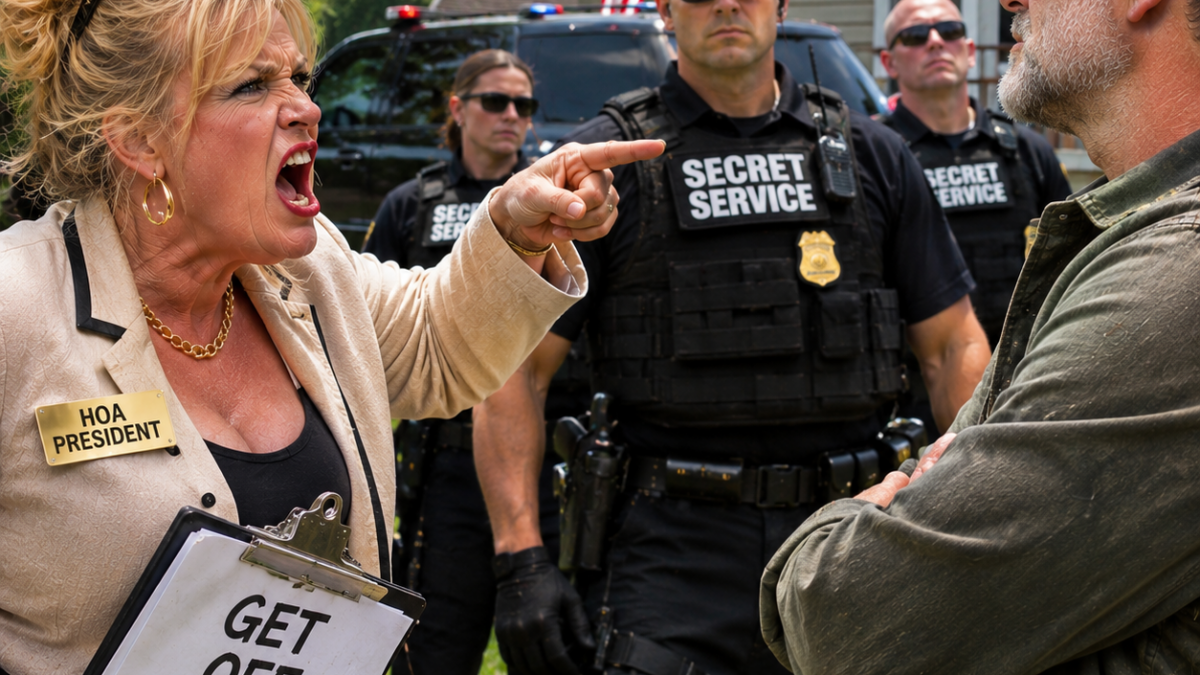
By nine, two black federal SUVs were in my driveway.
Government plates.
Briggs and four agents moved around the property.
Plain clothes.
Clipboards.
Equipment checks.
Nothing dramatic.
Hattie was in her lawn chair at 9:15.
Good cardigan.
Sweet tea.
Reading glasses.
Maren across the street became very interested in a window box that had not required attention in months.
Three other neighbors found reasons to be outside.
I parked the restored John Deere in the workshop doorway.
Fresh green paint.
Yellow wheels.
Sunlight catching the hood.
Not because it was tactical.
Because I was proud of it.
And because Diane would have laughed at the absurdity of an antique tractor sitting there like a guard dog.
At 11:17, Renata’s silver SUV turned onto Sycamore Bluff.
She was allowed to drive on the public road.
What she was not allowed to do under the order was approach my property and continue the conduct that had been restricted.
She stopped.
Got out.
Walked to the sidewalk.
Raised her phone.
And started filming.
Loudly.
She narrated.
Unauthorized federal use.
Residential zoning.
Dangerous activity.
Concerned citizen.
Property rights.
She still believed she was the person defining the situation.
Briggs’s people continued working.
Two agents walked toward the property line.
One woman in a gray jacket stopped on my side of the fence.
She opened a credential wallet.
Gold badge.
Photo ID.
Renata’s voice stopped.
Not softened.
Stopped.
The phone remained raised.
Her mouth was open.
No sound.
The agent said:
“Ma’am, please lower the phone.”
Renata blinked.
“I’m on a public sidewalk.”
“You are.”
“I have a right to record.”
“There is an active federal operation being conducted from private property, and you are currently subject to a court order involving this address. We are asking you not to interfere.”
“I’m not interfering.”
Briggs appeared behind them.
He stood in the workshop doorway beside the tractor.
“Ms. Colbrook?”
Renata looked at him.
He said:
“Are you the individual who has been filing repeated complaints involving this property?”
“I—this is a neighborhood matter.”
“Understood.”
His tone was calm.
That made it worse.
“Please comply with the agent’s direction and remain off Mr. Wolson’s property.”
Renata looked toward me.
For the first time since she moved next door, I saw her searching for control and finding none.
Hattie made one small sound from her chair.
“Mhm.”
I almost laughed.
—
Then Dex arrived.
Perfect timing.
Not planned.
Just timing.
He parked behind Renata’s SUV.
Got out with a manila envelope.
Walked toward the sidewalk.
Renata looked from him to the agents.
“You cannot keep harassing me.”
Dex stopped.
“Ms. Colbrook, I am serving you with copies of the court’s temporary restraining order, notice related to the pending civil claims, and documents connected to the state inquiry that your counsel should review immediately.”
He handed her the envelope.
She took it automatically.
“You’ve been served.”
His tone was professional.
Not triumphant.
That was the best part.
“Have a good day.”
The federal team returned to work.
The tractor gleamed behind them.
Neighbors watched.
I stood on concrete my grandfather poured.
Behind me:
My father’s workshop.
Diane’s roses.
My house.
Renata had once told me I needed to leave.
Now she stood on the public sidewalk holding a court order telling her where the boundary actually was.
She looked at me.
I said nothing.
She got into the SUV.
Drove away.
Down the street, Pretzel the beagle started barking at absolutely nothing.
It was perfect.
—
Six weeks later, the Attorney General’s office publicly confirmed a civil investigation into Sycamore Partners and affiliated activity.
The findings were uglier than Belle and I had known.
Seven properties.
Four Virginia counties.
Repeated use of complaint campaigns.
Regulatory pressure.
Neighborhood disputes.
Owners pushed toward exhaustion.
Properties acquired under favorable terms by connected entities.
Three former owners were located and interviewed.
One was a retired schoolteacher.
Another was a widower.
Another family had left after two years of escalating complaints.
Their stories sounded like mine.
Except they had sold.
That was the part I could not stop thinking about.
I had Dex.
Belle.
Hattie.
The deed.
The workshop permit.
Briggs’s federal operation happening practically next door.
I had advantages.
Those families had mostly been alone.
Renata’s strategy depended on that.
Isolation.
—
She eventually entered a civil consent agreement with the state.
Restitution obligations.
Restrictions.
A long-term bar from participating in HOA and certain municipal board activities in Virginia.
Sycamore Partners was dissolved.
Thaddius paid a substantial civil penalty.
Dex would never tell me the number.
“Significant,” he said.
“That means nothing.”
“It means I enjoyed reading the settlement.”
“That means even less.”
He smiled.
That told me enough.
—
My civil case settled too.
Confidential terms.
Legal fees covered.
Property-related damages addressed.
Additional compensation.
More importantly, the restraining order became unnecessary after Renata sold her house five months later.
Moving day was quiet.
No confrontation.
No last words.
She left.
That was enough.
The new owners arrived in February.
Retired firefighter named Mark and his husband, Aaron.
They brought me peach pie before I could decide whether I liked them.
Hattie adopted them within forty-eight hours.
She started advising them about roses.
They listened politely.
Smart men.
—
The Facebook group disappeared.
The beautification committee reviewed its complaint procedures.
The HOA learned, after several expensive conversations with counsel, that my property was still not inside its jurisdiction.
Nothing miraculous.
Just records finally respected.
The binder went back into my fireproof box.
Original deed.
1981 workshop permit.
Survey.
Inspection reports.
Court papers.
Diane’s horticultural letter.
I kept everything.
That was my nature.
—
In October, Mil Haven held Founders Day.
Somebody talked me into driving the restored John Deere in the parade.
I resisted.
Then Belle said:
“Mom would have made you.”
Unfair.
True.
So I did it.
Green tractor.
Fresh paint.
Engine running perfectly.
Flatbed behind me.
Hand-painted sign:
**WOLSON FAMILY — MIL HAVEN SINCE 1941**
Hattie rode on the flatbed.
Her idea.
She waved as though she were mayor.
People cheered.
Some knew the story.
Some just liked tractors.
I preferred the second group.
Old machinery does not ask how you voted.
It only asks whether you maintained the oil.
—
But the part that mattered came afterward.
I had money left from the settlement.
Enough to do something useful.
Dex and I created a fund through the local community foundation.
I insisted it carry Diane’s name, not mine.
**The Diane Wolson Property Rights Education Fund.**
Its purpose was simple.
Free initial legal consultations for Mil Haven residents facing:
Code-enforcement pressure.
HOA disputes.
Questionable property complaints.
Predatory development pressure.
Nobody should have to sell because they cannot afford the first conversation with a lawyer.
The first year, twenty-three families used it.
Most needed nothing dramatic.
A letter.
A records request.
A deed review.
A lawyer telling a city inspector:
No, this ordinance does not apply that way.
Three families avoided displacement.
One was a young couple on the east side of town.
They had received repeated complaints.
Then a below-market purchase offer.
Same pattern.
Not Sycamore Partners.
Different people.
Same idea.
Dex called me after their matter settled.
“They’re staying.”
I was in the workshop.
Different tractor now.
1948 Ford 8N.
Seized solid.
Rust everywhere.
“Staying where?”
“The young couple.”
I set down the wrench.
“The ones with the baby coming?”
“Yep.”
“Good.”
“Your fund paid for the title review and first two letters.”
I looked around the workshop.
Oil smell.
Metal.
Coffee going cold.
Diane’s photograph on the shelf.
“That’s good.”
Dex waited.
“You okay?”
“Yeah.”
I ended the call.
Then stood there longer than necessary.
That one mattered more than Renata leaving.
—
Belle visited a few weeks later.
She found me working on the Ford.
“You heard about the east-side couple?”
“Yes.”
“Mom would love that.”
“I know.”
Belle picked up a shop rag.
Then put it down immediately.
“Why is everything in here oily?”
“It’s a workshop.”
“I work in an office.”
“Tragic.”
She looked at the John Deere.
“You still think all this happened because of the garden?”
“No.”
“What do you think now?”
I tightened a bolt.
“She saw land.”
“Meaning?”
“She saw an owner alone after his wife died. Old house. Large lot. Workshop. Property worth more redeveloped than sentimental.”
Belle became quiet.
“I hate that.”
“So do I.”
“You know what I hate more?”
“What?”
“That it probably worked before.”
I stopped.
“Yeah.”
That was the truth.
Renata was not frightening because she was unusual.
She was frightening because the strategy had worked often enough for her to trust it.
That is what systems of quiet abuse feed on.
Successful repetition.
—
Hattie remained Hattie.
She considered the entire outcome confirmation that she should involve herself in everything.
When Mark and Aaron replaced their front shrubs, she supervised without being asked.
When I told her to leave them alone, she said:
“They like me.”
“They’re afraid of you.”
“Same result.”
At seventy-three, Hattie discovered neighborhood email.
This was unfortunate.
Her first message to the entire street read:
**IF YOU HAVE A PROPERTY PROBLEM, CALL GARRETT BEFORE YOU PANIC.**
I replied:
**DO NOT CALL GARRETT.**
She replied-all:
**HE’S MODEST.**
Dex thought this was hilarious.
—
The garden recovered from the spigot incident.
No structural damage.
We caught it quickly.
The black-eyed Susans returned the next season.
Diane’s roses bloomed too.
For a long time, I had avoided pruning them properly.
It felt like altering something she left behind.
Eventually Dr. Finch—the horticulturist who helped with the hearing—came by for coffee.
She looked at the roses.
“Garrett.”
“What?”
“You’re strangling them with sentiment.”
I stared at her.
“She would hate that sentence.”
“She would hate what you’re doing to these roses.”
“That’s worse.”
Dr. Finch showed me where to cut.
I did it.
The next year, the blooms were better.
That taught me something grief had hidden from me.
Preserving is not the same as refusing change.
Sometimes you prune something because you want it to keep living.
—
The federal team stopped using my workshop when their exercise ended.
Briggs left quietly.
Before going, he stood beside the tractor.
“You did good work.”
“On the Deere?”
“On everything.”
I looked at him.
“What did Diane say about me?”
He smiled slightly.
“That you were patient until patience stopped being useful.”
“That sounds like her.”
“She also said you made terrible coffee.”
“That is false.”
Briggs looked at my mug.
“Government team consensus disagrees.”
I laughed.
Then he shook my hand.
No dramatic thank-you.
No secret revelations.
He never told me everything about the federal case.
He shouldn’t have.
But before he left, he said:
“Your property was useful.”
I looked at the workshop.
“Good.”
Then he added:
“Diane would’ve liked that.”
He got into the SUV.
I stood there until it disappeared.
—
Months later, the Secret Service investigation became clearer through public filings and the state case.
Renata and Sycamore Partners had not simply annoyed homeowners.
The pressure campaigns served acquisition.
Complaints lowered morale.
Legal uncertainty reduced buyer confidence.
Owners became tired.
Properties sold.
Connected buyers stepped in.
Then value was recovered through resale or redevelopment.
It was not sophisticated in the way movie fraud looks sophisticated.
No hacking.
No offshore accounts.
No coded messages.
Just bureaucracy used repeatedly against people who did not know each other.
That was what made it effective.
Every victim thought the problem was local.
A garden.
A fence.
A permit.
A shed.
A code complaint.
The scheme survived because the pattern was larger than any one homeowner’s view.
Belle found the pattern because procurement work had trained her to compare transactions.
Dex knew where to send it.
Authorities had already been looking.
And Renata had finally targeted a property where too many records existed to manufacture uncertainty.
—
One of the displaced families eventually contacted me.
Margaret Lang.
Sixty-six.
She had sold her home in Rowan Oak two years before Renata moved next door to me.
We met for coffee.
She held the cup with both hands.
“I thought I was losing my mind.”
That sentence stayed with me.
“What happened?”
“First, hedges.”
She smiled sadly.
“Then a shed permit.”
“Then noise?”
Her eyes lifted.
“How did you know?”
“Pattern.”
She nodded.
“Then parking. Then they said my back deck affected drainage. Every week something.”
“Did you have a lawyer?”
“No.”
“Family?”
“My daughter was in Arizona.”
She looked down.
“I got tired.”
That was Renata’s business model in three words.
I got tired.
Margaret sold.
Sycamore Partners bought.
Below market.
She learned the buyer connection only after the investigation.
“I thought I failed,” she said.
“You didn’t.”
She shook her head.
“I left.”
“Because somebody designed the pressure to make leaving feel easier than staying.”
“That’s still leaving.”
I did not argue.
Sometimes telling someone how they should interpret their own pain is another form of control.
So I said:
“I’m sorry.”
Margaret nodded.
Then:
“I’m glad you stayed.”
That hurt more than I expected.
—
The Diane Fund helped Margaret review her restitution paperwork.
Small thing.
But she later volunteered.
She became the person who answered the phone twice a month when residents called nervous about official-looking letters.
That was beautiful to me.
A woman who once believed she was alone became the first voice telling someone else:
“You have options.”
—
Renata’s former house changed fast under Mark and Aaron.
They painted the front door blue.
A real blue.
The kind the old beautification committee would have discussed for an hour.
No one complained.
They installed a Little Free Library near the sidewalk.
Hattie stocked it with murder mysteries.
Pretzel the beagle urinated on the post during the opening week.
Life returned.
Normal life.
Messy.
Unregulated.
Good.
—
One afternoon, Mark found me near the fence.
“You ever get tired of people telling us what happened here?”
“Yes.”
“Sorry.”
“It’s fine.”
He looked toward my yard.
“Renata really told you to leave?”
“Basically.”
“Your own property?”
“Yes.”
He shook his head.
“I would’ve lost it.”
“I almost did.”
“What stopped you?”
I looked toward Diane’s roses.
“Experience.”
“Army?”
“Marriage.”
He laughed.
“That’s the answer my husband gives.”
Smart man.
—
The temporary restraining order eventually expired because there was no longer a reason for it.
Renata gone.
Civil case settled.
State agreement in place.
No contact.
No harassment.
Dex called.
“Want to renew anything?”
“No.”
“You sure?”
“Yes.”
“Good.”
“Why good?”
“Because court orders are tools, not trophies.”
I appreciated that.
We closed the file.
At least the active one.
Dex kept a copy.
I kept everything.
—
The binder grew old.
Tabs bent.
Some plastic sleeves clouded.
One day I pulled it from the fireproof box looking for my father’s workshop permit.
The original HOA notice slipped out.
Diane’s garden.
Section 4.2B.
Thirty days.
Remediate.
I sat at the kitchen table.
Read it.
I remembered how enormous that letter had felt.
Now it looked ridiculous.
One page.
Printer toner.
Signature.
The power had never been in the paper.
It had been in my uncertainty about the paper.
Once Dex showed me the deed, the letter became what it always had been:
A claim.
Not truth.
That distinction became the lesson behind almost everything the Diane Fund did.
—
The fund added workshops.
Property records.
How to read a deed.
What an easement is.
Difference between a warning letter and an order.
How to request public records.
When to call a lawyer.
When not to argue online.
That last session was Dex’s idea.
Attendance was excellent.
Hattie attended despite being the person most likely to violate the principle.
Dex opened with:
“Do not litigate on Facebook.”
Hattie raised her hand.
“What if the other person started it?”
“No.”
“What if they’re lying?”
“No.”
“What if—”
“Hattie.”
She sat back.
“I don’t like this workshop.”
Everyone laughed.
—
My daughter eventually joined the fund board.
Of course she did.
Belle reviewed vendor agreements.
Conflict policies.
Insurance.
She became the person who asked:
“Where is that written?”
Diane used to ask the same thing.
The first time Belle said it in a board meeting, I nearly turned around because for half a second I heard her mother.
Grief does that.
It hides inside familiar sentences.
—
I continued restoring tractors.
The Ford 8N took nine months.
Harder than the John Deere.
One seized piston refused to move for three weeks.
I nearly gave up.
Then remembered Briggs repeating what Diane had said:
You fix things other people give up on.
That annoyed me enough to keep going.
The Ford eventually started.
Not first try.
Fourth.
Still counted.
—
Founders Day became tradition.
I drove the Deere again.
This time, no banner about the family.
The Diane Fund had a small booth downtown.
Free pamphlets.
No dramatic slogans.
Just:
**PROPERTY QUESTIONS? START WITH THE DOCUMENTS.**
Margaret volunteered.
Hattie bullied people into taking brochures.
Dex pretended not to enjoy himself.
Belle handled signup sheets.
I looked at all of them and realized Renata had accidentally built something.
Not intentionally.
Not deserving credit.
But consequence does not ask permission.
She tried to isolate people.
Her actions connected us.
—
A few years later, Hattie died.
Eighty.
At home.
Her daughter called.
I went next door and sat on the porch where Hattie had spent half her life monitoring the world.
Her lawn chair was still there.
Thermos gone.
For the first time in decades, the porch looked empty.
At the funeral, Mark told the story about her sitting at my fence during the Renata mess.
Belle laughed.
Margaret cried.
Dex said:
“She was the most aggressive witness I never put on the stand.”
That was accurate.
The Diane Fund created a small annual volunteer award in Hattie’s name.
Belle insisted.
I agreed.
Hattie would have complained that the plaque font was too small.
—
Mil Haven changed.
New houses.
Old ones renovated.
Pretzel eventually stopped barking because Pretzel eventually became too old to care.
The beautification committee became less powerful and more boring.
Which was healthy.
The old Facebook group disappeared.
Another neighborhood group formed.
Mostly lost dogs and yard-sale notices.
No one discussed me.
I loved that.
—
One spring morning, I was trimming Diane’s roses when a young couple stopped at the sidewalk.
They were holding a folder.
“Mr. Wolson?”
I sighed.
“That depends.”
The woman smiled nervously.
“We were told you help with property problems.”
“Who told you?”
“Margaret Lang.”
That changed my tone.
“What happened?”
They lived east of town.
Received repeated code complaints.
Then a purchase offer from someone who referenced the unresolved complaints.
Not Sycamore Partners.
Different investor.
Could have been coincidence.
Could have been something else.
I did not speculate.
“Don’t sign anything,” I said.
“We haven’t.”
“Good.”
“Can you help?”
“I can call someone.”
Dex was mostly retired by then.
Mostly.
He answered.
“Wolson.”
“I have a couple.”
“No.”
“You don’t know anything yet.”
“I know you.”
“Property complaints followed by purchase offer.”
Pause.
“How old are they?”
“Thirties.”
“Kids?”
“Baby on the way.”
Longer pause.
“Send them over.”
I smiled.
“You’re retired.”
“I hate you.”
“Still?”
“More every year.”
—
They kept their house.
The purchase offer disappeared after counsel asked for written explanations and city records showed most complaints lacked basis.
No federal case.
No conspiracy.
No Secret Service.
Just a young family who needed somebody to slow the process down enough for facts to catch up.
That was more common.
More useful.
—
Years after Renata left, I found myself standing in the same front yard where she once told me to vacate.
Coffee in hand.
Grandfather’s concrete under my boots.
Diane’s roses beside the gate.
The workshop behind me.
The Deere parked inside.
Everything familiar.
Belle pulled into the driveway.
She had brought a box of documents for the fund.
“Morning.”
“Too early.”
“It’s ten.”
“Exactly.”
She looked toward the roses.
“You finally learned to prune them.”
“Dr. Finch threatened me.”
“Mom would approve.”
“I know.”
Belle stood beside me.
For a minute, neither of us spoke.
Then she asked:
“Do you ever think about that Friday?”
“What Friday?”
“The agents. Renata freezing. Dex showing up.”
“Sometimes.”
“That was pretty satisfying.”
“Yeah.”
“Come on, Dad.”
“What?”
“You enjoyed it.”
I smiled.
“A little.”
“A lot.”
“Fine.”
She laughed.
“But it isn’t what I remember most.”
“What is?”
I looked toward the workshop.
“Briggs telling me your mother talked about me.”
Belle’s expression softened.
“Yeah.”
“That mattered more.”
She nodded.
Then looked toward the house.
“She’s still everywhere here.”
“Yes.”
Not haunting.
Anchoring.
Different thing.
—
That afternoon, I opened the fireproof box.
Original 1941 deed.
Father’s 1981 workshop permit.
Court order.
Settlement papers.
HOA letter.
Diane’s horticultural report.
I added one new item.
The annual report from the Diane Wolson Property Rights Education Fund.
First page:
Families served since inception.
More than a hundred.
Some cases small.
Some serious.
Several homeowners stayed in properties they might otherwise have abandoned.
I placed it beside the deed.
Closed the box.
Locked it.
Then went to the workshop.
—
The new project was a Farmall Cub.
Red paint nearly gone.
Engine seized.
Owner said it had not run in twenty years.
I liked those.
Things other people called finished.
I poured coffee.
Put on gloves.
Started loosening bolts.
Outside, the roses moved in the wind.
The street was quiet.
A real quiet.
No complaint campaign.
No camera alerts.
No SUV idling next door.
Just birds.
A mower somewhere.
The scrape of a wrench.
I thought of Diane’s favorite line about people who abuse small power.
They eventually run out of runway.
She had been right.
But she had missed one part.
When they do, what matters isn’t watching them fall.
It’s deciding what to build on the ground they no longer control.
I tightened the wrench.
The old bolt moved.
Just a little.
Enough.
I smiled.
Then kept working.
[END OF STORY]








