PART 2: Karen Fined Me for Livestock—So I Put a Legal Bison Herd Along Her Fence
PART 2
Ray didn’t ask what I meant.
That was one of the reasons I trusted him.
“Understood,” he said.
“And Ray?”
“Yeah?”
“Stay away from the office.”
There was a pause.
“Why?”
“Just do it.”
I ended the call.
The lead federal SUV behind me moved closer.
Through my side mirror, I could see the familiar outline of Deputy Marshal Owen Briggs behind the wheel.
He raised two fingers from the steering wheel.
I acknowledged him.
Then I looked back at the road ahead.
Silver Ridge Estates lay less than twenty minutes away.
Fourteen months of patience were about to collide with one morning of Karen Whitmore’s arrogance.
And the truth was, the bison had only been the most visible part of our argument.
The real fight had started long before I ever moved one animal toward her fence.
It started with an envelope.
A very expensive envelope.
Fourteen months earlier, I was sitting at my kitchen table sorting ranch invoices when Ray dropped a certified letter beside my coffee.
“Fan mail.”
I opened it.
The letterhead read:
SILVER RIDGE PROPERTY OWNERS ASSOCIATION.
NOTICE OF ENVIRONMENTAL NUISANCE.
I read it twice.
Then I looked at Ray.
“You know we don’t live in Silver Ridge.”
“I was hoping you remembered.”
The notice accused my ranch of creating airborne dust, objectionable livestock odor, excessive agricultural noise, and “visual degradation inconsistent with community character.”
The fine was $2,500.
Failure to correct the violations within ten days would result in additional penalties.
I laughed.
Ray didn’t.
“What?”
“That’s the third complaint this month.”
“From who?”
“County environmental office got one. Health department got another.”
“For cattle?”
“For manure runoff.”
“We don’t have runoff.”
“I know.”
Our retention pond and drainage channels were inspected twice a year.
The last report had been clean.
The ranch had been in my family for three generations.
My grandfather bought the first section when there was nothing west of us but scrub grass and open sky.
My father expanded it.
I bought the remaining adjoining acreage after leaving full-time field operations.
Silver Ridge arrived later.
Much later.
It began as eighty luxury homes with stone entrances, decorative ponds, and more architectural restrictions than I thought human beings were capable of inventing.
At first, the development didn’t bother us.
The residents waved when our trucks passed.
Kids stood near the fence to watch calves in spring.
A few homeowners even bought beef from us.
Then Karen Whitmore became president.
Within a year, Silver Ridge stopped acting like our neighbor and started acting like an invading country.
Karen’s first visit to my ranch came four days after the certified fine.
A black Mercedes pulled up outside the gate.
Karen stepped out in white pants and a camel-colored coat that probably cost more than one of my saddles.
She was in her late fifties, perfectly styled, perfectly composed, and wearing an expression that suggested the world had spent decades disappointing her by refusing to arrange itself properly.
“Mr. Mercer?”
“Daniel is fine.”
“I prefer to keep this professional.”
“That works too.”
She removed a folder.
“I assume you received our notice.”
“I did.”
“And?”
“And your HOA has no jurisdiction over my property.”
Her smile didn’t move.
“Our legal counsel disagrees.”
“Then your legal counsel should reread the county map.”
“This isn’t solely a jurisdictional matter.”
“It is if you’re fining me.”
“Our residents are suffering.”
I looked toward Silver Ridge.
The nearest home sat almost three hundred yards from the property line.
“Suffering from what?”
“Odor.”
“It’s a ranch.”
“Dust.”
“It’s Colorado.”
“Noise.”
“We farm.”
Karen’s jaw tightened.
“This dismissive attitude is exactly why the board felt formal enforcement was necessary.”
“Karen, your board can fine your residents for painting their garage doors the wrong shade of beige. You cannot fine me for raising livestock on agricultural property outside your subdivision.”
She slowly closed the folder.
“You’re making this unnecessarily difficult.”
“No. I’m saying no.”
Her eyes changed.
That was the first time I noticed it.
Some people hear no and treat it like information.
Karen heard it as rebellion.
She stepped closer.
“Silver Ridge is expanding.”
“My condolences.”
“We’re trying to create a unified community.”
“I already have a community.”
“You know what I mean.”
Actually, I did.
She wanted the ranch to disappear aesthetically before she figured out how to make it disappear physically.
But I didn’t understand the reason yet.
That came two weeks later.
A development representative named Stephen Voss called and asked to meet.
He arrived in a spotless Range Rover and spent twenty minutes complimenting my land before explaining why he wanted part of it.
Northgate Commercial Development had secured an option on nearly six hundred acres beyond Silver Ridge.
Their plan included retail space, medical offices, restaurants, and high-density residential construction.
They needed a secondary access corridor.
My western ranch road was the cleanest route.
“We’d be prepared to make you a very generous offer,” Voss said.
“I’m not selling.”
“You haven’t heard the number.”
“Doesn’t matter.”
“It may.”
“It won’t.”
He opened a leather portfolio anyway.
“Two point eight million for a permanent access easement and thirty-four acres.”
“No.”
His eyebrows rose.
“Mr. Mercer, with respect, that is significantly above agricultural value.”
“You’re not buying agricultural value. You’re buying the ability to put thousands of cars and construction vehicles through the center of a working ranch.”
“We can design mitigation.”
“No.”
“The corridor would only affect the western edge.”
“It crosses our winter water route.”
“We can relocate infrastructure.”
“It separates two grazing sections.”
“We can build underpasses.”
“It puts public traffic beside livestock.”
“We can fence it.”
I leaned back.
“Stephen, you keep solving problems I don’t want to create.”
He was quiet.
Then he smiled politely.
“I understand.”
He didn’t.
Three days later, Karen sent another fine.
Five thousand dollars.
“Chronic agricultural nuisance.”
That was when I began paying attention.
Not reacting.
Paying attention.
There is a difference.
Most people knew I worked in federal law enforcement.
Very few people in Silver Ridge knew exactly what I did.
I preferred it that way.
After the Army, I joined the United States Marshals Service.
By the time Karen appeared in my life, I had spent more than two decades handling fugitive operations, judicial-security matters, organized-crime investigations, witness protection support, and multi-agency task forces.
My work had taught me something Karen had apparently never learned.
People reveal themselves when they believe nobody important is watching.
So I let her talk.
I let her send letters.
I let her threaten.
I preserved everything.
Every envelope went into an evidence box.
Every email was archived.
Every voicemail was saved.
When survey stakes began moving, I installed cameras.
At first the changes were subtle.
Four inches.
Then eight.
One marker shifted nearly three feet.
Ray noticed immediately.
“Somebody’s moving the western line.”
“I know.”
“You want me to reset them?”
“Not yet.”
He frowned.
“Why?”
“Because I want to see who moves the next one.”
Two nights later, one of Karen’s maintenance trucks appeared on camera.
Two employees climbed out.
They carried flashlights and tools.
One removed a survey stake.
The other measured toward my ranch.
They drove the marker into a new position.
Ray watched the footage beside me.
“Well, that seems bad.”
“Very.”
“Call the sheriff?”
“Eventually.”
“Eventually?”
I copied the video.
Created a written log.
Photographed both stake positions.
Then contacted a licensed surveyor and had the entire boundary professionally verified.
That report went into the file too.
Karen was creating evidence faster than I could organize it.
Still, I didn’t know how far the problem went.
Then something happened inside Silver Ridge.
Their HOA attorney started asking questions.
His name was Elliot Crane.
I didn’t know Elliot at the time.
Karen hired him years earlier to advise the board.
He wasn’t a crusader.
He wasn’t trying to save my ranch.
He was a careful corporate attorney who realized his client was doing things that could destroy his career.
Karen asked him to review proposed annexation documents regarding my access road.
The documents claimed Silver Ridge had acquired historical maintenance rights over the road.
That was nonsense.
Then Elliot examined the attached deeds.
Something bothered him.
One county notary stamp belonged to a woman who had retired six years earlier.
Another purported county certification referenced a parcel number that didn’t exist.
Several signatures were inconsistent.
The financial documents attached to the proposed acquisition were worse.
Association funds had been routed through consulting companies Elliot had never heard of.
Payments disappeared into LLCs.
Those LLCs connected to other companies.
And those companies connected to Northgate Development.
Elliot quietly copied everything.
Then he made the decision that eventually saved more people than he understood at the time.
He contacted federal authorities.
Not me.
That distinction mattered.
I didn’t initiate the criminal investigation into Karen.
I didn’t direct it.
I couldn’t.
The moment I learned the investigation touched my own property dispute, I formally disclosed my interest and removed myself from the financial side of the case.
I became, in many respects, a witness.
That made Karen’s later claim—that I had created a federal vendetta against her—much harder to sell.
The FBI and federal prosecutors followed the money.
What they found had very little to do with bison.
Northgate had allegedly promised Karen a substantial hidden payment if she could deliver my western corridor.
Money moved through shell companies.
HOA funds were diverted.
Documents were forged.
Boundary evidence was manipulated.
Complaints were weaponized to create a record suggesting my ranch was an ongoing nuisance.
The goal was simple.
Make my life expensive.
Create disputes around the property line.
Wear me down.
Then acquire the road cheaply enough for Northgate to build.
Karen had one major problem.
I didn’t need to sell.
And I was unusually comfortable with paperwork.
Her campaign intensified.
Noise complaint.
Dust complaint.
Fence-material complaint.
Tractor-light complaint.
Manure-storage complaint.
Livestock-visibility complaint.
That last one was my favorite.
The letter accused us of keeping “large grazing animals within prominent visual exposure of premium residential lots.”
I read it aloud to Ray.
He stared at me.
“Visual exposure?”
“Apparently cows have become offensive scenery.”
“What do they want?”
“They want livestock moved away from the western pasture.”
Ray looked through the window toward that pasture.
It was underused that year because I had been rotating our cattle farther north.
“You know what would grow well there?”
I looked at him.
He smiled.
I smiled back.
Three years earlier, I had added a small American bison herd to the ranch.
Not as a tourist attraction.
Not as some dramatic statement.
We had the acreage.
We had the fencing.
We had the handling equipment.
And bison fit into a long-term grazing and land-restoration plan I had developed with an agricultural specialist.
The animals were legal.
Inspected.
Permitted.
Properly contained.
So when our next grazing rotation came due, we moved twenty-four bison into the western pasture.
The pasture bordered Silver Ridge.
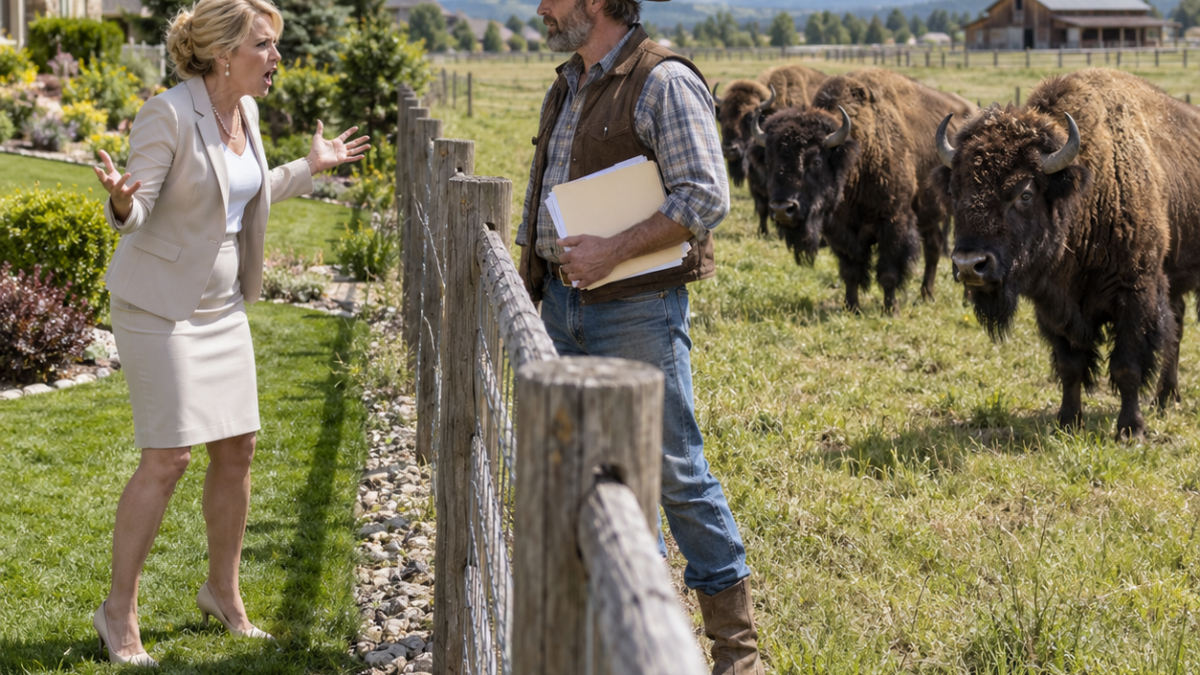
By noon, Karen was at the fence.
I found her standing on the HOA side with both hands gripping the decorative steel bars.
A mature bull grazed fifty yards behind me.
“Move them.”
“Good morning, Karen.”
“I said move them.”
“I heard you.”
“They’re dangerous.”
“They’re behind agricultural fencing rated for them.”
“Our residents have children.”
“So do thousands of ranch families.”
“They’re disgusting.”
“That’s subjective.”
“You did this intentionally.”
“I intentionally rotated livestock into a permitted grazing pasture.”
“Because of my letter.”
“Your letter reminded me we hadn’t used this section recently.”
Her face flushed.
One of the bison rolled in a dusty patch.
A cloud drifted toward the subdivision.
Karen recoiled.
“This is harassment.”
I stared at her.
“You sent me a fine for looking at livestock from your subdivision.”
“That’s not what it said.”
“Pretty close.”
“You’re going to regret humiliating me.”
That sentence mattered.
I wrote it down when I got home.
Date.
Time.
Location.
Exact words.
Ray saw me making the note.
“You really record everything.”
“When people threaten me? Yes.”
Karen’s complaints multiplied.
She demanded animal-control inspections.
County inspectors came.
We passed.
She complained about fencing.
Agricultural inspectors came.
We passed.
She alleged water contamination.
Samples were tested.
Clean.
Every complaint she filed produced another independent document proving we were operating legally.
She thought she was burying me in bureaucracy.
Instead, she was building my defense.
Then came the access-road offer again.
This time Karen delivered it personally.
She met me at the ranch office with a folder.
“Northgate has increased its offer.”
“I already said no.”
“Three point six million.”
“No.”
“You’re being irrational.”
“No, I’m being clear.”
“You could retire.”
“I like working.”
“This ranch isn’t worth protecting at this cost.”
“To you.”
She tapped the map.
“This road serves no purpose that couldn’t be relocated.”
“It serves me.”
“You are standing in the way of economic growth.”
“That sounds like Northgate’s problem.”
She leaned over the desk.
“You think being stubborn makes you powerful.”
“No.”
“What does?”
“Having the right to say no.”
She stared at me for several seconds.
Then she gathered the documents.
“You won’t enjoy what comes next.”
“Another livestock fine?”
She didn’t smile.
“No.”
After she left, I called Elliot Crane.
By then federal investigators had authorized limited coordination with me regarding threats to the property.
“Karen was here.”
“What did she say?”
I repeated it.
Elliot was quiet.
“Document it.”
“Already did.”
“Daniel?”
“Yeah?”
“They’re getting close.”
“To indictments?”
“I didn’t say that.”
“You didn’t need to.”
Over the following weeks, the atmosphere changed.
Karen stopped pretending the issue was environmental.
Her letters became aggressive claims about roadway rights and historical community access.
She circulated maps showing portions of my ranch shaded as “future Silver Ridge common-use corridor.”
Ray brought one to me.
“She’s showing residents land she doesn’t own.”
“I see that.”
“She’s either insane or confident.”
“Those aren’t mutually exclusive.”
Meanwhile, investigators found more.
Bank transfers.
Encrypted messages recovered from devices.
Communications between Karen and Northgate executives.
Discussions about “creating sufficient enforcement pressure.”
One message reportedly referred to me as “the ranch holdout.”
Another discussed having the HOA “establish physical possession” of the road before litigation could stop them.
That phrase concerned everyone.
Physical possession.
It suggested Karen was moving beyond paper.
So I increased camera coverage.
We documented every access point.
I instructed Ray that if anyone entered under claimed HOA authority, nobody was to physically resist.
Call me.
Call law enforcement.
Film everything.
Stay safe.
Then, late one Thursday, a federal grand jury returned indictments.
I wasn’t told every charge immediately.
But I knew warrants had been signed.
Search warrants.
Asset warrants.
Arrest warrants.
Execution was scheduled for Friday morning.
I barely slept Thursday night.
Not because I was excited.
People imagine arrests as a satisfying climax.
When you’ve spent years in law enforcement, they don’t feel that way.
An arrest means something has already gone terribly wrong.
Lives have already been damaged.
Families are already involved.
There is paperwork afterward.
Court.
Victims.
Consequences.
Sometimes violence.
You want operations boring.
Controlled.
Predictable.
Friday morning, I left before dawn.
My task was limited.
Because the arrest location might involve my ranch, another supervisor had operational control.
I was present because of the property layout and because a second federal matter required my participation later that morning.
The convoy met outside town.
Nine dark vehicles.
Agents from multiple units.
FBI personnel.
Evidence technicians.
Deputy marshals.
Owen Briggs walked up to me.
“You good?”
“I’d rather she be arrested somewhere else.”
“Wouldn’t we all.”
“You think she’ll cooperate?”
“Her attorney has probably told her to.”
“That assumes she listens to attorneys.”
Owen gave me a look.
“Fair.”
We were still fifteen miles away when Ray called.
“They’re here.”
That was where the opening began.
Nine private security vehicles.
Two bulldozers.
Seven ranch workers.
Zip ties.
Confiscated phones.
Karen Whitmore standing in the middle of my road like she had conquered a nation.
While I drove toward the ranch, Ray did exactly what I told him.
He didn’t resist.
He observed.
Later, he told me every detail.
Karen arrived at dawn.
The bison were grazing in the lower pasture, breath rising in pale clouds.
The first black SUV turned onto our access road without permission.
Then another.
Then seven more.
Their tires carved deep tracks through the gravel.
Ray stepped out of the management office.
A security commander approached.
“Are you the manager?”
“Depends who’s asking.”
“Silver Ridge enforcement.”
Ray looked at his uniform.
“Silver Ridge has police now?”
“Private compliance security.”
“That’s not an answer.”
The commander handed him a document.
Ray read it.
It had an official-looking header.
Silver Ridge Emergency Community Protection Order.
It accused the ranch of chronic environmental violations, obstruction of community access, livestock hazards, and encroachment.
At the bottom were signatures from Karen and several board members.
Ray handed it back.
“Where’s the judge’s signature?”
“We don’t require one.”
“Then you don’t have an order.”
Karen stepped forward.
“This is an emergency board action.”
“On HOA property?”
“On land subject to Silver Ridge community protection authority.”
Ray laughed.
He shouldn’t have.
Not because he was wrong.
Because Karen hated being laughed at.
“This is private agricultural property,” Ray said. “You have no authority here.”
Karen turned to the security chief.
“Detain him.”
The chief hesitated.
Ray noticed.
“So you know this is illegal.”
Karen snapped, “Do your job.”
Two guards grabbed Ray.
The ranch hands moved toward him.
More guards surrounded them.
Ray shouted, “Nobody fight! Hands down!”
Seven workers were pushed toward the fence.
Plastic zip ties went around wrists.
One young hand named Cody shouted that they couldn’t do this.
A guard took his phone.
Karen pointed toward the others.
“Confiscate every device. I don’t want them coordinating interference.”
Ray looked at her.
“That sentence is going to age poorly.”
“What did you say?”
“You heard me.”
Then the bulldozers arrived.
Their diesel engines rolled across the pasture like thunder.
Karen instructed them to begin removing the western fencing.
Ray stepped in front of the lead machine.
“You touch that fence and you’re destroying private agricultural infrastructure.”
Karen waved her paper.
“You’ve been notified.”
“You have nothing.”
“I have authority.”
“You have stationery.”
That made one of the restrained ranch hands laugh.
Karen’s face went red.
“Move him.”
The security men pulled Ray aside.
He looked at his watch.
Then at Karen.
“You picked the wrong morning.”
She smiled.
“You’ve been saying things like that for months.”
“No. Daniel has.”
Her smile faded slightly.
“Where is Mr. Mercer?”
“Coming.”
“Good.”
She turned toward the office.
“I’ll deal with him when he arrives.”
Ray remembered my instruction.
Stay away from the office.
He suddenly understood why.
“Karen.”
She stopped.
“Don’t go in there.”
She smiled over her shoulder.
“Why? Something you don’t want me to see?”
Ray said nothing.
That was enough.
Karen walked up the steps.
The ranch office was simple.
Desk.
Maps.
Radio equipment.
Old photographs.
Coffee maker.
File cabinet.
On the desk sat a thick manila folder.
I had placed it there the previous evening.
Not as a trap.
At least not originally.
It contained duplicates of documents tied to my property dispute.
Emails.
Financial charts Elliot had legally shared through counsel.
Copies of questionable development proposals.
Shell-company names.
Survey records.
I planned to take the folder to my attorney after the federal operation.
Karen opened it.
And recognized the names.
Northgate Holdings.
Ridgeview Consulting.
Pioneer Municipal Solutions.
Accounts investigators suspected were connected to money routed for her benefit.
She saw transaction figures.
She saw excerpts from emails.
According to the office camera, Karen stopped breathing for several seconds.
Then she looked toward the door.
Closed the folder.
And shoved it into her leather tote.
That decision transformed an already terrible morning into something prosecutors would later describe as astonishing.
She walked outside carrying evidence taken from my office.
At almost the exact moment she reached the bottom step, Ray heard engines.
Not bulldozers.
Vehicles approaching fast from the north road.
Karen smiled.
“Finally.”
She apparently believed the county sheriff had arrived.
The first federal SUV came over the rise.
Then the second.
Then the rest.
Nine dark vehicles spread across the access road.
They boxed in Karen’s private security convoy.
Agents stepped out.
Not shouting.
Not running wildly.
Moving with controlled purpose.
The security chief’s posture changed immediately.
He saw federal markings.
He saw credentials.
He saw tactical vests.
He raised his hands away from his belt.
Karen did not.
She stepped forward angrily.
“This is an HOA enforcement action.”
Nobody answered her.
Then my vehicle stopped.
I stepped out.
I had put my vest on several miles earlier.
Large yellow letters across the front.
U.S. MARSHAL.
Karen stared.
There are moments when a human face reveals an entire internal collapse.
That was one.
Her eyes moved from the vest to my face.
Back to the vest.
Then toward the convoy.
“You…”
I walked toward Ray first.
“Anybody hurt?”
“Wrists mostly.”
I looked at Cody.
Red plastic had cut into his skin.
“Medical’s coming.”
Karen found her voice.
“This is outrageous.”
I ignored her.
“Owen.”
Owen stepped forward.
“Cut them loose.”
Agents moved toward the fence.
Trauma shears snapped through the ties.
One.
Two.
Three.
Seven workers walked free.
Cody rubbed his wrists.
“Boss, I think I’m going to like this part.”
“Stay quiet.”
“Yes, sir.”
The security chief approached carefully.
“Marshal, we were told this was legally authorized.”
“By whom?”
He looked at Karen.
She stared back at him.
“By President Whitmore and the association.”
I extended my hand.
“Show me your court order.”
He handed me Karen’s document.
I read the first page.
Then gave it back.
“This is an HOA resolution.”
“Yes.”
“Where is your warrant?”
He said nothing.
“Where is your commission authorizing detention?”
Nothing.
“Who told you that you could restrain workers?”
He looked toward Karen again.
“President Whitmore.”
Karen exploded.
“They were obstructing an authorized environmental abatement!”
Owen glanced toward the bison.
One animal lifted its head.
Chewed.
Went back to grazing.
I said, “Environmental abatement with bulldozers?”
Karen pointed at the western fence.
“That road belongs to Silver Ridge.”
“No, it doesn’t.”
“We have deeds.”
“No, you have documents currently under federal investigation.”
That stopped her.
Only briefly.
Then she tried another approach.
“This is an obvious conflict of interest.”
“You’re correct.”
She looked surprised.
I continued.
“Which is why I am not the case agent on your financial investigation.”
Her face changed again.
“What financial investigation?”
Owen almost smiled.
An FBI supervisory agent named Marissa Cole stepped from behind me.
“Karen Whitmore?”
Karen looked at her.
Marissa displayed credentials.
“Yes?”
“Federal Bureau of Investigation.”
Karen took one small step backward.
Marissa continued.
“A federal grand jury returned an indictment last night. We have a warrant for your arrest.”
For the first time in fourteen months, Karen Whitmore had no response.
The bison grazed behind her.
Dust hung in the morning light.
Her bulldozers idled.
Seven workers stood free.
Nine private security vehicles were boxed in.
And Karen looked at me as if I had personally changed the laws of physics.
“You did this.”
“No.”
“You planned this.”
“No.”
“You used your position.”
“I disclosed this conflict more than a year ago.”
“Liar.”
Marissa stepped between us.
“Mrs. Whitmore, turn around and place your hands behind your back.”
Karen backed away.
“You can’t arrest me here.”
Marissa’s expression did not change.
“We can.”
“I’m president of Silver Ridge.”
Ray muttered, “Not a country.”
Karen glared at him.
Then Marissa repeated the command.
“Turn around.”
Karen clutched her tote against her body.
An agent reached for it.
She jerked away.
“No.”
Marissa said, “The bag will be inventoried with your property.”
“It contains privileged HOA documents.”
“Hand it over.”
“You need a subpoena.”
“We have a lawful arrest warrant.”
Karen’s breathing became shallow.
Her hands tightened on the leather straps.
That reaction drew everyone’s attention.
Marissa noticed.
So did I.
Karen finally surrendered the bag.
An evidence technician placed it on the hood of an SUV.
Karen was handcuffed.
Her eyes never left the bag.
The technician began a standard inventory.
Wallet.
Keys.
Cosmetics.
Two phones.
Planner.
Then he removed the manila folder.
Ray looked at me.
I looked at Ray.
Marissa asked, “Daniel?”
“That came from my office.”
Karen shouted immediately.
“No, it didn’t!”
Everyone turned toward her.
She continued before her attorney—or common sense—could stop her.
“Those documents were stolen from my private files. I was recovering my own property.”
Silence.
Ray’s eyebrows lifted.
Owen looked toward the ground.
I suspected he was trying not to react.
Marissa stared at Karen.
“You’re saying the documents inside that folder came from your files?”
Karen froze.
Her face changed.
She finally understood what she had said.
“I…”
Marissa did not help her.
Karen swallowed.
“They were fabricated.”
“But you just identified them as documents from your private files.”
“They were copies.”
“Copies of what?”
Karen looked at me.
Hatred replaced fear.
“You planted this.”
I said nothing.
The office had cameras.
The evidence was already secured elsewhere.
That folder was never the only copy.
But Karen had believed it was.
And in trying to steal it, she had connected herself to its contents in front of federal witnesses.
Marissa instructed the evidence technician to bag the folder separately.
Karen watched the clear evidence sleeve seal around it.
She looked physically sick.
The security chief stepped toward another agent.
“My name is Mason Cole.”
The agent took out a notebook.
Mason spoke quickly.
“I want an attorney.”
“That’s your right.”
“I also want to cooperate.”
Karen twisted toward him.
“Mason.”
He ignored her.
“She told us the ranch had been declared an emergency environmental hazard. She told us there was a county authorization.”
“I gave you documentation!” Karen shouted.
“You gave me HOA paperwork.”
“You knew the plan.”
“No. I knew the job.”
“Mason!”
He looked at her.
“You told us to take their phones.”
Karen’s mouth opened.
“You told us to restrain everyone before the bulldozers entered.”
“Stop talking.”
“You told us the goal was to have the fence gone before anyone could get an injunction.”
“Mason, shut your mouth!”
Every agent within hearing distance heard it.
Marissa turned to Karen.
“That advice should probably apply to you.”
An agent placed Karen in the rear of a federal vehicle.
She kicked once at the door frame.
Then stopped.
The woman who had spent more than a year threatening to take my road was driven away on it in federal custody.
But the arrest was only one piece of that morning.
At the same time, FBI teams executed a search warrant at Silver Ridge’s HOA headquarters.
Elliot Crane met them there.
Agents seized computers.
Servers.
Financial ledgers.
Phones.
Contracts.
Boxes of property records.
Inside Karen’s office they found forged notary tools investigators had already suspected existed.
They found draft deeds.
Maps.
Payment schedules.
And then they found something so unnecessary that even her own defense attorney would later struggle to explain it.
A binder.
Karen had labeled it:
NORTHGATE ACCESS PROJECT.
Inside was a step-by-step strategy.
The fines against my ranch.
Environmental complaints.
Boundary disputes.
Legal-cost projections.
Annexation plans.
A timeline for “physical corridor establishment.”
The entire campaign had been written down.
Karen hadn’t just committed alleged crimes.
She had organized them.
Tabulated them.
And put them in a binder.
When Marissa called me that afternoon, she sounded almost offended by it.
“She made a project manual.”
“I heard.”
“Who makes a manual?”
“Karen likes organization.”
Marissa laughed for the first time all day.
Then her voice turned serious.
“Daniel, Northgate is bigger than we expected.”
“How big?”
“Executives.”
I stared out my office window.
The bison had moved uphill.
“You have the money trail?”
“We have enough to keep working.”
“What about my road?”
“Your road isn’t going anywhere.”
For the first time in months, I believed it.
The story broke publicly two days later.
Federal charges.
HOA corruption.
Development kickbacks.
Fraudulent land records.
The unlawful detention at my ranch.
Silver Ridge residents were stunned.
Some called me.
Some came to the gate.
One older man named Arthur Benson stood there with a folder in his hands.
“I owe you an apology.”
“You don’t owe me anything.”
“I voted for her.”
“Lots of people did.”
“I defended her.”
“So did lots of people.”
He looked toward the western pasture.
A cow bison was standing near the fence with her calf.
“I thought you were the problem.”
“I know.”
“She told us you were refusing reasonable compromises.”
“I refused to sell.”
“She said you threatened the community.”
“No.”
“She said the bison were retaliation.”
I smiled slightly.
“That one’s complicated.”
Arthur looked at me.
“You put them there because of her.”
“I rotated them there because the pasture was legal, useful, and available.”
“And because it annoyed her.”
“I didn’t consider that a disadvantage.”
He laughed.
Then he looked embarrassed for laughing.
“Can I ask you something?”
“Sure.”
“Why didn’t you tell everyone you were a marshal?”
“Why would I?”
“It would’ve scared her off.”
“Maybe.”
“Wouldn’t that have been easier?”
I looked at the calf.
“Authority shouldn’t matter only when the person being bullied has a badge.”
Arthur became quiet.
“If Karen had stopped because I flashed federal credentials, she wouldn’t have learned that she was wrong. She would’ve learned she picked the wrong victim.”
He nodded slowly.
“And you wanted the system to stop her.”
“I wanted the law to apply whether I was Daniel Mercer the rancher or Daniel Mercer the deputy marshal.”
Arthur held out the folder.
“What’s that?”
“Fines.”
“How many?”
“Forty-three.”
“For what?”
He smiled bitterly.
“My granddaughter’s basketball hoop. My wife’s garden border. Christmas lights. A pickup parked overnight. A tree Karen didn’t like.”
I took the folder.
“You should give this to the new board.”
“What new board?”
“You’ll have one soon.”
I was right.
Within four days, the entire Silver Ridge executive board resigned.
Some members claimed they knew nothing about Karen’s financial dealings.
Investigators sorted that out separately.
The community held an emergency meeting.
For the first time, I attended.
Not as a resident.
As the owner of the ranch next door.
The clubhouse was packed.
No one sat at Karen’s usual chair.
A temporary chairman stood.
Before nominations began, residents were allowed to speak.
Arthur went first.
Then a young mother described being fined because her child left chalk drawings on a driveway.
A retired teacher talked about spending $6,000 fighting a lien over landscaping.
A widow described receiving enforcement letters days after her husband died because the garbage cans remained visible.
Karen’s scheme had been about money.
But her reign had created something else.
Fear.
People were embarrassed by their fines.
They thought they were alone.
That was how Karen stayed powerful.
One by one, they discovered they weren’t.
Elliot Crane attended too.
When he stood, the room became silent.
He looked exhausted.
“I served as counsel to this association.”
Several people stared at him coldly.
He accepted it.
“I should have spoken sooner.”
Nobody argued.
“I challenged Mrs. Whitmore privately for months. I believed I could control the risk from inside.”
He looked around the room.
“I was wrong.”
A woman near the front said, “You knew?”
“Not everything.”
“But enough?”
Elliot lowered his eyes.
“Yes.”
The woman crossed her arms.
“Then why should we trust you?”
“You shouldn’t automatically.”
That answer surprised everyone.
“You should review my work. You should review every board decision. You should demand records. You should stop treating transparency as disrespect.”
He took a breath.
“I did eventually report the suspected crimes. But courage delayed is still delay. Some of you suffered during that delay.”
The room stayed quiet.
Then Arthur began clapping.
Slowly.
Others joined.
Not because Elliot was a hero.
Because he admitted what he had done wrong.
Karen never could.
The new board was elected that night.
Their first official act was rescinding every outstanding ranch-related fine Karen had issued against me.
Their second was requesting an independent audit.
Their third was asking to meet.
Two weeks later, five new board members sat across from me in the same clubhouse where Karen once threatened liens and litigation.
The new president was a pediatric nurse named Helen Park.
She opened a county map.
“Mr. Mercer—”
“Daniel.”
She smiled.
“Daniel. I think the first thing we should say is that Silver Ridge recognizes the legal property boundary exactly as surveyed.”
“Good start.”
“We also recognize your agricultural zoning.”
“Even better.”
“And your livestock.”
Ray, sitting beside me, leaned forward.
“Including bison?”
Helen looked at him.
“Including bison.”
Ray nodded.
“I just wanted that on record.”
Everyone laughed.
Helen continued.
“We’d like to establish a formal neighbor agreement regarding emergency access, wildfire coordination, and fence maintenance.”
“That’s reasonable.”
“No land transfer.”
“Very reasonable.”
“No development easement.”
“I’m liking this meeting.”
Helen looked toward the windows.
Several bison were visible on the slope.
“Can I admit something?”
“Sure.”
“I actually like them.”
Ray whispered, “Don’t tell them. They’ll demand appearance fees.”
For the first time since Karen’s first letter, the relationship between the ranch and Silver Ridge became normal.
Not friendly immediately.
Trust doesn’t repair that quickly.
But normal.
Professional.
Respectful.
Then the federal cases moved forward.
Northgate executives were indicted.
Financial investigators traced payments through consulting companies and offshore accounts.
The commercial development project collapsed.
The option agreements were terminated.
Lenders withdrew.
County planners suspended every related application.
Karen’s attorneys initially tried to blame me.
They issued a public statement claiming I had used my federal position to punish a political and property opponent.
That accusation lasted less than forty-eight hours.
The government produced my ethics disclosures.
My recusal documents.
The assignment records showing independent agents controlled the financial investigation.
And the timeline proving the investigation had begun after Elliot Crane contacted federal authorities—not after any request from me.
Then came the ranch footage.
Karen’s private force entering without judicial authorization.
Seven workers restrained.
Phones taken.
Bulldozers brought onto private property.
Karen walking into my office.
Karen leaving with the folder.
Her spontaneous statement linking herself to those documents.
The public-relations strategy collapsed.
Her criminal defense became the real problem.
Mason Cole, the security chief, entered a cooperation agreement.
He admitted he should have verified the authority Karen claimed to possess.
He admitted his team unlawfully detained my workers.
He testified that Karen had specifically instructed them to establish physical control of the road before legal resistance could form.
He handed prosecutors text messages.
One from Karen read:
BY THE TIME MERCER GETS A LAWYER INVOLVED THE FENCE MUST BE DOWN AND THE ROAD MUST LOOK LIKE OURS.
Another said:
TAKE PHONES FIRST. NO CALLS UNTIL GRADING STARTS.
Cody read that message months later.
He looked at me.
“She actually wrote that?”
“Apparently.”
“She needs a hobby.”
“She had one.”
“What?”
“Crime.”
Cody laughed so hard he almost spilled his coffee.
The seven workers pursued their own legal remedies.
I stayed out of those decisions.
They had been the people zip-tied against a fence.
They deserved agency over what came next.
Some accepted settlements from the security company.
Others continued claims individually.
The company terminated Mason and several supervisors, then underwent major restructuring.
Mason’s cooperation reduced his exposure, but it did not erase what he had done.
That mattered to me.
Cooperation should count.
So should accountability.
Karen eventually faced a superseding federal indictment alleging a broad collection of financial and fraud-related offenses tied to the development scheme.
Her lawyers understood the evidence problem.
Bank records.
Emails.
Witness testimony.
Forgeries.
The Northgate binder.
The office video.
The stolen folder.
Her own words.
There are cases built from inference.
Karen’s case looked like she had spent a year mailing prosecutors gift-wrapped exhibits.
She eventually accepted a plea agreement.
I attended sentencing only because prosecutors notified me that I could provide a statement concerning the ranch.
For days, I struggled with what to say.
Ray found me sitting outside the barn one evening.
“You writing the statement?”
“Trying.”
“What’s hard about it?”
“I don’t want revenge to sound like justice.”
Ray sat beside me.
“Aren’t they different?”
“They should be.”
“Then say that.”
So I did.
When I stood in federal court, Karen sat at the defense table.
She looked smaller.
Not physically.
The confidence was gone.
The title was gone.
The entourage was gone.
I read from one page.
“Your Honor, I am not asking the court to punish Ms. Whitmore because she annoyed me, insulted me, fined my ranch, or disliked my animals.
“I am asking the court to consider the people whose trust she exploited.
“My employees were restrained on land where they had every legal right to work.
“Residents of Silver Ridge were told their money was being used for community purposes when portions of it were allegedly redirected into a corrupt development scheme.
“Property records were manipulated.
“Public processes were abused.
“And private power was repeatedly presented as if it were lawful government authority.
“I have spent much of my professional life serving court orders.
“That experience taught me that lawful authority has limits.
“Those limits protect all of us.
“The most troubling thing Ms. Whitmore did was not simply break rules.
“She convinced herself she had become the rule.”
I stopped.
Looked toward Karen.
Then finished.
“I do not hate her.
“I do not want her destroyed.
“I want the consequences to be strong enough that the people she harmed understand that what happened to them was real, it was wrong, and their refusal to surrender was not the wrongdoing.”
I sat down.
Karen never looked at me.
The judge imposed a substantial federal sentence consistent with the plea agreement and ordered restitution tied to the financial offenses.
Other defendants in the Northgate scheme received their own sentences and penalties.
I won’t pretend I felt joy hearing the numbers.
Relief?
Yes.
Vindication?
Absolutely.
But joy?
No.
Prison is not entertainment when you’ve seen what it does to families.
Justice can be necessary without being cheerful.
What satisfied me happened later.
On a Saturday in October.
Silver Ridge held its first fall community day under the new board.
Helen invited ranch families.
Ray insisted we go.
“I hate HOA events.”
“You’re the one who spent fourteen months complaining they weren’t neighborly.”
“That doesn’t mean I want potato salad.”
“Get in the truck.”
We drove over.
Kids were painting pumpkins.
Somebody had a bluegrass band.
Tables were covered with food.
Arthur Benson waved me over.
His granddaughter stood beside him.
She pointed toward the ranch.
“Are those your buffalo?”
“Bison.”
“What’s the difference?”
I crouched slightly.
“That answer takes longer than this party.”
“Can I see them?”
“From outside the fence.”
Her mother looked nervous.
“They’re safe?”
“If you respect the fence and stay where you’re supposed to.”
Arthur laughed.
“Sounds like a lesson our old board could have used.”
Later that afternoon, about twenty residents followed Ray and me to the western boundary.
The bison were scattered across the pasture.
Autumn grass moved in the wind.
The mountains behind them had fresh snow near the peaks.
Karen had once called that sight visual degradation.
A little girl stood beside the fence in complete awe.
One of the bulls lifted his massive head.
The girl whispered, “He’s beautiful.”
I looked at Helen.
She smiled.
“Premium view.”
I laughed.
“Yes, ma’am.”
That winter, the first heavy storm hit in January.
Nearly eighteen inches of snow fell overnight.
Silver Ridge’s main road became impassable after a delivery truck slid sideways near the entrance.
For several hours, the subdivision had no practical route out.
Helen called me.
“Daniel, I hate asking.”
“What do you need?”
“Emergency access.”
My western ranch road connected to a county route on the north side.
The same road Karen had tried to steal.
I looked at Ray.
He already knew.
“We’ll open the gate.”
Our tractor cleared the first section.
Residents with four-wheel-drive vehicles escorted nurses and essential workers through.
An ambulance used the ranch road to reach an elderly resident experiencing chest pain.
That road worked exactly the way good neighbors should use private access.
With permission.
For a legitimate reason.
Without theft.
Without forged deeds.
Without bulldozers.
That night Helen called again.
“The ambulance made it.”
“I heard.”
“The man is stable.”
“Good.”
She became quiet.
“You know what Karen never understood?”
“What?”
“You probably would have helped us if she had just asked.”
I looked out the window at snow falling beneath the yard light.
“Yes.”
That was the tragedy of people like Karen.
They often destroy relationships trying to force concessions they might have received through respect.
Spring came slowly.
The tire ruts from the raid disappeared beneath snowmelt and repair work.
We replaced two damaged fence sections.
The bulldozers had barely begun before federal vehicles arrived, so permanent destruction was limited.
One corner post still carried a deep scrape.
Ray wanted to replace it.
I told him to leave it.
“Why?”
“Reminder.”
“Of Karen?”
“No.”
“Then what?”
“That fences work only when people agree boundaries matter.”
He stared at me.
“That was unusually philosophical.”
“Don’t spread it around.”
Our bison herd grew that spring.
Several calves were born.
One arrived during a cold rain.
Ray called me before sunrise.
By the time I reached the pasture, the calf was already struggling onto shaky legs.
Its mother stood over it.
Silver Ridge was visible beyond the fence.
Lights slowly appeared in bedroom windows.
For years that fence line had represented conflict.
That morning, it was simply a boundary between neighbors.
Nothing more.
Nothing less.
Helen later asked whether the HOA could build a small viewing area on their side.
I told her yes, provided residents understood that bison were wild livestock and nobody fed or approached them.
The board installed a simple wooden overlook set safely back from our agricultural fence.
They paid for it from transparent community funds.
No secret contracts.
No shell companies.
No Karen.
A sign explained the history of ranching in the area and basic bison safety.
No mention of the scandal.
I appreciated that.
Children came to watch calves.
Older residents brought binoculars.
One Saturday, I found Arthur sitting alone on a bench.
“You okay?”
“Fine.”
I sat beside him.
We watched the herd.
After a while, he said, “My wife died six years ago.”
“I’m sorry.”
“She loved animals.”
He smiled.
“She would’ve hated Karen.”
I laughed.
Arthur continued.
“You know why I defended her for so long?”
“No.”
“Because admitting she was wrong meant admitting I’d helped her.”
I turned toward him.
He rubbed both hands together.
“I voted for her. Told neighbors to stop complaining. Said rules were rules.”
“You didn’t know everything.”
“I knew enough to notice people were scared.”
That was the sort of guilt that lingers even after the person responsible is gone.
I thought about Elliot Crane.
About Bobbing heads in HOA meetings.
About the guards who followed Karen’s commands.
About people who convinced themselves discomfort was none of their business.
“Arthur, you eventually changed sides.”
“Late.”
“Late still counts.”
He looked at me.
“You believe that?”
“I have to.”
“Why?”
“Because if only perfect people get to correct mistakes, nothing ever gets corrected.”
He smiled.
“That sounds philosophical again.”
“Ray says I’m developing a problem.”
By summer, the Northgate acreage was sold to a conservation-oriented agricultural investment group.
The high-density commercial plan disappeared.
Much of the land remained open.
A smaller development proposal eventually emerged farther south where proper road access already existed.
No fraud.
No stolen easements.
No fake environmental crisis.
Economic development still happened.
Just not through my ranch.
That mattered.
Karen had always framed the argument as progress versus stubbornness.
It never was.
It was consent versus coercion.
Northgate could build where it had lawful access.
Silver Ridge could enforce rules on property actually subject to its covenants.
I could raise livestock on agricultural land.
Boundaries didn’t prevent community.
They made honest community possible.
Nearly two years after the raid, I received a letter.
Not certified.
No HOA logo.
Just a plain white envelope forwarded through my attorney.
Karen had written it from federal custody.
It was four pages.
I almost threw it away unopened.
Instead, I read it alone.
The first page was mostly excuses.
She said Northgate manipulated her.
She said Silver Ridge residents expected perfection.
She said the board pressured her.
She said once the financial arrangements began, she couldn’t see a way out.
I nearly stopped reading.
Then the tone changed.
She wrote:
I hated that you could say no and still sleep at night.
I read that sentence twice.
She continued.
Everyone always negotiated eventually. Everyone wanted something. Money. Approval. Relief from fines. A compromise.
You did not.
And I began to treat your refusal as something being done to me rather than a decision you had the right to make.
That was the first honest thing I had ever heard from Karen.
She admitted the bison drove her crazy.
Not because they harmed anyone.
Because every morning when she looked out from Silver Ridge, she saw them grazing beside the fence.
They were proof that her orders stopped at the property line.
I smiled when I read that.
Not because she suffered.
Because she finally understood the symbol.
Near the end, she wrote about the morning of the arrest.
She said when I stepped out wearing the marshal vest, she felt humiliated.
For months she believed I had concealed my profession to trap her.
Then her attorney showed her my ethics filings.
The independent investigation records.
The timeline.
She realized something worse.
I hadn’t trapped her.
I had simply refused to rescue her from the consequences of her own choices.
The final paragraph was short.
I do not expect forgiveness.
I am not asking for it.
But I understand now that I kept calling your refusal disrespect because admitting you had a right to refuse would have meant admitting I had no right to keep pushing.
I folded the letter.
That evening, Ray found me near the western pasture.
“What’s that?”
“Letter from Karen.”
He stopped walking.
“Really?”
“Yeah.”
“What does she want?”
“Nothing.”
“That doesn’t sound like her.”
“No.”
“Did she apologize?”
“In a way.”
“Are you going to answer?”
I looked through the fence.
A bison calf ran a tight circle around its mother, kicked once, then stopped as if embarrassed by its own excitement.
“I don’t know.”
Ray waited.
“Do you forgive her?”
That was harder.
Forgiveness is a word people use as if it means erasing a debt.
I don’t believe that.
You can release hatred without pretending harm never happened.
You can understand someone without trusting them.
You can accept an apology without restoring a relationship.
“I don’t hate her,” I said.
“That wasn’t my question.”
“I know.”
He waited.
Finally, I said, “Maybe forgiveness is not needing her punishment to make me feel whole anymore.”
Ray nodded.
“And?”
“I think I’m there.”
I did answer Karen.
One page.
I told her I had read the letter.
I told her the ranch was doing well.
I told her Silver Ridge had changed.
I told her the workers she ordered detained had recovered and moved on with their lives.
And I told her one thing I thought she needed to understand.
The worst damage she caused was never to my road.
It was making ordinary people doubt their right to say no.
I ended with:
I hope wherever your life goes from here, you learn to hear that word without treating it as war.
I never received another letter.
That was fine.
Some stories don’t need reconciliation.
They need closure.
On the third anniversary of the raid, I woke before dawn.
Old habit.
I made coffee and drove down to the western pasture.
Mist lay low over the grass.
The herd moved slowly in the half-light.
Massive silhouettes.
Quiet.
Ancient-looking.
A bull walked beside the Silver Ridge fence.
On the other side, the small viewing area was empty.
No security vehicles.
No bulldozers.
No Karen.
Just wooden benches covered in dew.
Ray arrived ten minutes later.
“You know what day it is?”
“Unfortunately.”
He handed me another coffee.
“Three years.”
“Yep.”
He leaned against the truck.
“Still think putting bison next to her fence was a good idea?”
“I maintain that it was a legitimate grazing rotation.”
“You maintained it with a huge smile.”
“Coincidence.”
Ray laughed.
A pickup approached from the Silver Ridge side.
Helen Park climbed out.
Arthur was with her.
Helen carried an envelope.
I groaned.
“If that’s another livestock fine, I’m selling.”
“Worse,” she said.
She handed it to me.
Silver Ridge had passed a resolution.
Not a fine.
Not an enforcement notice.
A formal acknowledgment of the ranch as a protected agricultural neighbor and a permanent recognition of our established property line and access rights.
At the bottom were signatures from the current board.
Helen pointed toward the bison.
“Residents voted on another issue too.”
I looked at her suspiciously.
“What?”
“They want to sponsor the viewing area expansion.”
“That sounds dangerous.”
“With your approval.”
“Better.”
“And they want to name it.”
Ray started smiling.
“No.”
I looked at him.
“What?”
Helen tried not to laugh.
“The proposed name is the Whitmore Bison Overlook.”
I stared at her.
Arthur burst out laughing.
“You cannot be serious.”
“It was Arthur’s suggestion.”
“Absolutely not.”
Arthur wiped his eyes.
“Come on, Daniel. History matters.”
“I am not naming anything after Karen.”
“Then we have a second choice.”
“What?”
Helen handed me another sheet.
MERCER–SILVER RIDGE AGRICULTURAL OVERLOOK.
I exhaled.
“That’s less terrible.”
Ray nodded thoughtfully.
“I still prefer the first one.”
“Nobody asked you.”
Helen smiled.
“We’re trying something new.”
“What?”
“Asking.”
That single word got me.
Because that was the entire difference.
Karen demanded.
Helen asked.
Karen threatened.
Helen negotiated.
Karen treated boundaries as insults.
Helen treated them as the beginning of a conversation.
“You have my approval,” I said.
Helen held out her hand.
We shook.
Behind us, one of the bulls moved closer to the ranch fence.
Arthur looked at him.
“Think he approves?”
Ray said, “He’s waiting to see the budget.”
The overlook was expanded that fall.
Local schools began scheduling agricultural education visits.
We hosted small groups and taught children the difference between bison and buffalo, why grazing rotations mattered, how native grasslands recovered, and why fences were there for both human and animal safety.
The same animals Karen once described as a community threat became one of Silver Ridge’s favorite features.
Sarah, my sister, visited that Thanksgiving with her two kids.
My nephew stared at the overlook crowded with families.
“You told me those people used to hate the bison.”
“One person did.”
“Why?”
“Long story.”
“Was she scared of them?”
I considered it.
“Not exactly.”
“What was she scared of?”
I looked toward the fence.
“She didn’t like things she couldn’t control.”
He nodded with the serious expression only a ten-year-old can give a complicated adult answer.
Then he said, “That sounds exhausting.”
I laughed.
“It probably was.”
That evening, after everyone left, I took one last drive along the property line.
Sunset turned the mountains orange.
The bison were dark shapes against the grass.
The repaired road stretched behind me.
No part of it belonged to Silver Ridge.
No commercial corridor cut through our pasture.
The ranch remained intact.
But so did the community next door.
That mattered too.
Winning did not require Silver Ridge to fail.
Karen had believed every conflict needed one owner and one loser.
She had been wrong about that too.
Her corruption was exposed.
The developers who bribed her were prosecuted.
The fraudulent commercial plan died.
The HOA was rebuilt.
Residents got their neighborhood back.
My workers got justice.
My ranch kept its land.
And the bison kept grazing exactly where the law said they could.
People sometimes ask whether I moved the herd beside Karen’s fence as revenge.
I usually tell them no.
Revenge would have meant hurting my own operation just to hurt her.
I never did that.
The pasture needed grazing.
The animals belonged there.
The law protected the ranch.
The fact that Karen had to look at twenty-four completely legal bison every morning was simply an agricultural coincidence I never felt obligated to correct.
But if I’m being precise, the best revenge came later.
It wasn’t the federal convoy.
It wasn’t the handcuffs.
It wasn’t watching her private security chief abandon her the moment real authority arrived.
It wasn’t the stolen folder she accidentally carried directly into federal evidence.
And it wasn’t even seeing her entire land-grab scheme collapse.
The best revenge was quieter.
It was watching Silver Ridge children stand at the overlook and point excitedly toward newborn calves.
It was seeing my ranch hands work the same fence without fear.
It was neighbors calling before they needed emergency access.
It was a new HOA board asking instead of demanding.
It was Arthur admitting he had been wrong.
Elliot admitting he had waited too long.
Karen eventually admitting that my refusal had never been an attack on her.
And it was waking each morning knowing I had never surrendered an inch of land simply because someone powerful demanded it.
That final evening, I stopped my truck beside the western fence.
The largest bull in the herd stood maybe sixty yards away.
He lifted his head.
The wind pushed dust across the pasture.
Years earlier, Karen had called that dust an environmental violation.
Now golden sunlight caught every particle.
From the overlook, a little boy waved at me.
I waved back.
Then he pointed at the bull and shouted something I couldn’t hear.
His father laughed.
The bull turned and walked slowly toward the rest of the herd.
I thought about that first certified letter.
The threats.
The moved survey stakes.
The fines.
The development maps.
Karen standing at my fence ordering me to move my animals.
Then the black SUVs.
The zip-tied wrists.
The bulldozers.
The federal convoy rising over the ridge.
Her face when she saw my vest.
The evidence folder in her bag.
All of it had begun because she believed the word no was something money, pressure, paperwork, and intimidation could eventually erase.
She was wrong.
Some boundaries are drawn on maps.
Some are built from fence posts and wire.
And some exist inside a person.
That last kind is the most important.
Karen tried to fine me into submission.
Then she tried to pressure me into selling.
Then she tried to fabricate ownership.
Finally, she tried to physically take what I had refused to give her.
In the end, she lost her title, her scheme, her freedom, and the illusion that authority meant ownership.
I kept the ranch.
I kept the road.
I kept my herd.
And the bison Karen wanted gone became the living symbol of the one lesson she had refused to learn until it was too late:
You can stand on your side of the fence and demand whatever you want.
But the moment you cross that boundary without the law behind you, you had better be prepared to discover exactly where your power ends.








