PART 2: Karen Called My 80 Acres an “Eyesore”—So I Let 75 Legal Goats Handle It, and She Walked Straight Into Her Own Trap
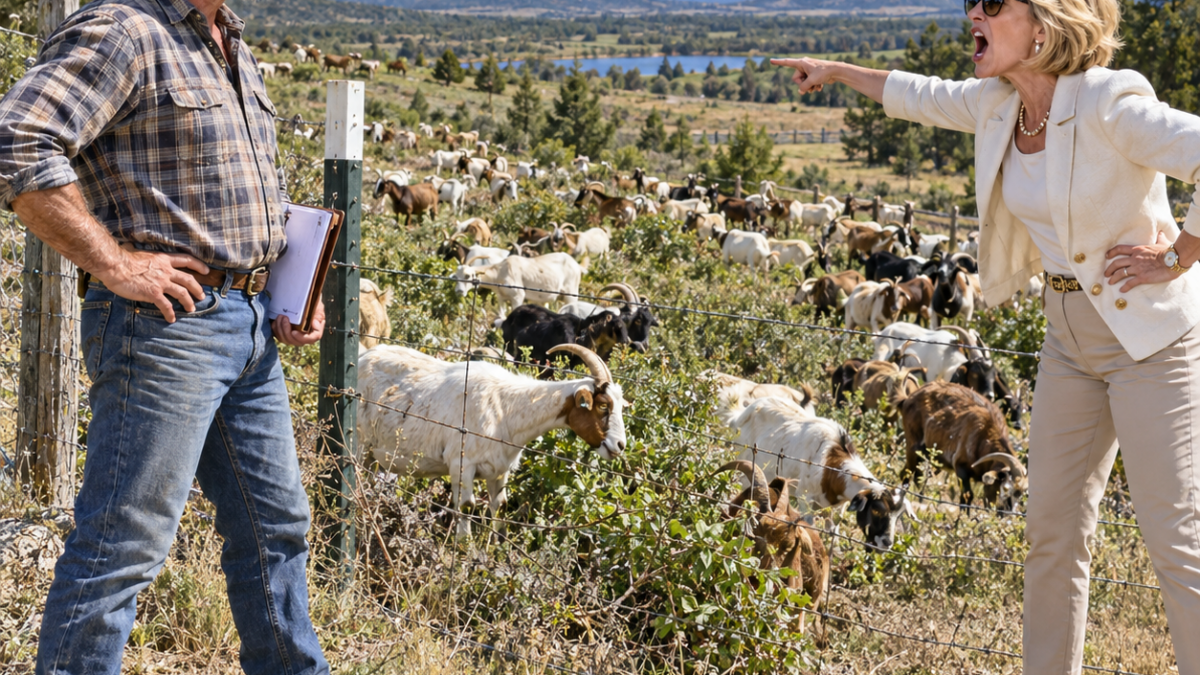
PART 2
Her eyes followed Ray’s glance.
Not toward the road.
Not toward the workers.
Toward my field office.
I watched it happen on the screen mounted between the front seats of the SUV.
Karen went completely still.
Then she looked at Ray again.
“What’s in there?”
Ray shrugged.
“Feed records. Veterinary records. Things you wouldn’t understand.”
One of the guards laughed.
Karen didn’t.
For fourteen months, she had interpreted every calm response from me as weakness. Every time I refused to argue, she believed I was afraid. Every letter I returned unanswered convinced her that she had pushed me a little closer to surrender.
That morning, for the first time, something else entered her expression.
Fear.
Ray had looked at his watch.
He had looked at the camera.
And Karen suddenly understood that maybe the quiet rancher she had been bullying wasn’t as helpless as she had assumed.
She pointed at the office.
“Search it.”
Ray’s expression changed.
“You have no authority to enter that building.”
“I have authority to secure evidence connected to an ongoing community enforcement action.”
“That sentence doesn’t mean anything.”
“It means get out of my way.”
“I’m sitting in the dirt with my hands tied.”
Karen stared at him.
Ray smiled.
“I’d say I’m doing a pretty good job of staying out of your way.”
Even through the monitor, I could see her jaw tighten.
Ray had worked with me for nine years.
He was fifty-eight, built like somebody who had spent his whole adult life lifting things more sensible people used machinery for, and he possessed a sense of humor that appeared most often when circumstances were at their worst.
He also knew exactly what was happening.
Not every detail.
I would never have endangered him by giving him information he didn’t need.
But he knew enough.
Three days earlier, I had taken him aside beside the equipment shed.
“If she escalates,” I told him, “you don’t resist.”
Ray leaned against the tractor.
“How far is ‘escalates’?”
“If they trespass, record it.”
“You’ve got cameras.”
“Still record it.”
“If they touch the goats?”
“Record it.”
“If they touch us?”
I hesitated.
“Don’t fight them.”
That wiped the smile off his face.
“You expecting something?”
“I’m expecting Karen to eventually believe her own paperwork.”
He studied me for several seconds.
Ray knew my profession.
Most people in the valley didn’t.
I had never hidden it deliberately, but I didn’t advertise it either.
My work and my land were two separate worlds.
During the week, I supervised fugitive operations for the United States Marshals Service. I spent my career dealing with people who had ignored court orders, crossed state lines, assumed different names, and convinced themselves that consequences were things that happened to other people.
On my land, I wanted none of that.
I wanted dirt under my boots.
I wanted fence repairs that stayed repaired.
I wanted to hear wind in the cottonwoods instead of radio traffic.
And when wildfire risk became worse every summer, I wanted the brush controlled without covering the hillside in chemicals or sending heavy machinery over fragile soil.
That was how the goats came into the picture.
I didn’t even own most of them.
The herd belonged to a small commercial grazing company run by Ray and two brothers, Luis and Mateo Alvarez. They moved goats from vineyards to utility corridors to ranches, clearing invasive vegetation faster than crews with trimmers could manage.
Karen called them filthy.
I called them efficient.
The county called them legal agricultural vegetation management.
And the goats themselves seemed completely indifferent to all three opinions.
The day Karen called my property an eyesore at a public meeting, Ray had been sitting beside me.
She stood behind a polished walnut podium in the Ridgeline clubhouse and projected a photograph of my western pasture onto a screen.
Yellow grass.
Brush.
A few old cottonwoods.
A wire fence.
“This,” she announced, “is what residents and prospective buyers see when they enter our community.”
I looked around the room.
People were staring at the photograph as though she had shown them a toxic waste dump.
Karen clicked to another slide.
My equipment barn.
“This kind of visual blight affects every homeowner.”
A woman in the third row raised her hand.
“I thought his land was outside the HOA.”
Karen’s mouth tightened.
“Visual impacts do not respect arbitrary legal boundaries.”
The woman frowned.
“But HOA rules do.”
I liked her immediately.
Karen ignored the comment.
After the meeting, Ray caught up with me in the parking lot.
“You know what you need?”
“I’m afraid to ask.”
“Goats.”
I stared at him.
“A lot of goats.”
“You’re enjoying this already.”
He grinned.
“Seventy-five should do it.”
Two weeks later, they arrived.
Alpine goats.
Boer goats.
White ones.
Brown ones.
Black ones.
One ridiculous little animal with a white blaze on his forehead who Ray had named Franklin because, according to him, the goat behaved like he had strong opinions about taxation.
They cleared brush beautifully.
Then Karen planted the roses.
Not ordinary hedge roses.
Imported climbing varieties.
Expensive.
Fragile.
And planted exactly eighteen inches from the property line.
The landscapers installed trellises angled toward my fence.
I watched them through binoculars one afternoon.
Ray stood beside me.
“She’s feeding the goats now?”
“She’s building a lawsuit.”
A month later, the vines reached through the mesh.
The goats discovered them approximately seven minutes after entering that section of pasture.
Franklin ate a flower worth more than the boots I was wearing.
Then he ate another.
By sunset, thirty feet of roses had been trimmed precisely back to the property line.
The next morning, I received photographs.
A demand for $18,700.
Then $42,000.
Then a notice threatening a lien against my property.
There was only one problem.
Karen had no ability to lien my property.
But she wasn’t really trying to collect the money.
She was creating paper.
Paper suggesting violations.
Paper suggesting debt.
Paper that might eventually be used to persuade a lender, developer, judge, or county employee that there was a genuine dispute over my land.
So I preserved everything.
And I contacted an attorney.
Not the Marshals Service.
Not the FBI.
My own attorney.
I disclosed the situation through my chain of command because I didn’t want anyone later claiming I had used federal authority to win a private property dispute.
Then I kept doing exactly what I had been doing.
Documenting.
Waiting.
What I didn’t know was that somebody else had begun documenting Karen too.
His name was Daniel Mercer.
Daniel was Ridgeline Estates’ retained attorney.
He was the kind of lawyer people overlooked because he spoke quietly, dressed conservatively, and never tried to dominate a room.
Karen considered him useful.
She did not consider him dangerous.
That was her second major mistake.
Daniel began noticing payments that made no sense.
A landscaping company billing Ridgeline $96,000 for drainage improvements no resident could locate.
A consulting firm receiving monthly transfers despite having no employees.
Legal retainers supposedly paid to firms Daniel had never heard of.
Special assessments for road repairs that had never happened.
At first he assumed the accounting was sloppy.
Then he searched the state corporate registry.
Several vendors did not exist.
Others had been incorporated using addresses connected to Karen’s relatives or board members.
Then Daniel found the document that frightened him enough to stop asking questions internally.
It was connected to the Ridgeline Expansion.
A parcel transfer had been notarized by a man named Walter Mills.
Daniel knew that name.
Walter had notarized documents around the county for forty years.
He had also been dead for three.
Daniel checked a second document.
Same stamp.
A third.
Same.
He didn’t confront Karen.
He copied everything.
Then he contacted federal authorities through a former colleague.
The FBI opened a preliminary financial investigation.
Bank subpoenas followed.
Shell companies emerged.
Then offshore transfers.
Then emails.
Then the pattern surrounding my property.
One afternoon, I was called into a secure conference room at my office.
My supervisor was already there.
So were two people I had never met.
Special Agent Lena Ortiz from the FBI.
Assistant U.S. Attorney Rebecca Shaw.
Ortiz placed a photograph of my property on the table.
“Do you know Karen Whitmore?”
I almost laughed.
“Yes.”
“How well?”
“She’s mailed me approximately thirty-seven pounds of nonsense.”
Shaw didn’t smile.
“We need you to take this seriously.”
“I do.”
Ortiz opened a folder.
Inside were copies of HOA payment records.
Corporate registrations.
Wire transfers.
Ridgeline Expansion documents.
Then she placed one of Karen’s violation notices beside them.
“We think your property dispute is part of something larger.”
That was the moment everything changed.
I had assumed Karen was using the HOA to help a developer force an easement.
I had not understood the scale.
According to the records, she had spent almost five years steering association contracts toward shell companies.
Residents paid assessments.
The money moved.
Fake vendors invoiced the HOA.
Funds disappeared into accounts controlled by people connected to Karen.
The proposed expansion wasn’t just another development project.
It was supposed to be the largest payday yet.
The developer needed my access road.
Karen needed me gone or broken.
And every fake fine she sent me was part of a pressure campaign.
I sat back in the chair.
“How much?”
Ortiz closed the folder.
“Enough that I’m not giving you a number until the forensic accountants finish.”
Shaw folded her hands.
“There’s something else. Because you’re personally involved, you will not make investigative decisions in this case.”
“Agreed.”
“You will not use agency databases for your property dispute.”
“Never have.”
“We know.”
“You will provide anything you collected privately through counsel and proper evidence channels.”
“I already have originals secured.”
Ortiz looked at me.
“How much?”
I thought about the fireproof cabinet in my field office.
“Fourteen months.”
For the first time, she smiled.
“That’ll help.”
I gave them everything.
The fake fines.
The letters.
Videos.
Photographs of the roses being deliberately trained through my fence.
Security footage of patrol vehicles shining lights into my windows at 2:00 a.m.
Emails from Karen threatening to “exercise emergency community powers.”
A recording from a meeting in which she claimed the HOA had the authority to “take corrective possession” of land that wasn’t even within its boundaries.
Ortiz listened to that one twice.
“Corrective possession?”
“She likes inventing phrases.”
“She seems to.”
From that point forward, I stopped being the man building the case.
I became a witness in it.
That distinction mattered to me.
I wanted Karen stopped.
But I wanted it done correctly.
There is a difference between justice and revenge.
Revenge asks what you can do to someone.
Justice asks what you can prove.
I knew which one would survive in court.
Over the next four months, the investigation widened.
Daniel Mercer supplied financial records.
Homeowners gave statements.
Subpoenas uncovered transfers.
Investigators mapped companies that existed only on paper.
Three Ridgeline board members retained criminal attorneys.
One began cooperating.
And still Karen had no idea.
If anything, her behavior toward me became worse.
She interpreted my refusal to react as evidence that her campaign was working.
One Tuesday morning, I found orange survey stakes inside my fence.
I pulled the camera footage.
Ridgeline contractors had installed them at 4:17 a.m.
The stakes outlined a temporary construction route directly across my pasture.
I called my attorney.
He called the county.
The county removed them.
Karen sent me a $12,000 “administrative interference fee.”
I added it to the file.
A week later, one of her security vehicles blocked Ray’s livestock trailer for forty minutes.
We documented it.
Then somebody cut a section of fence.
Documented.
Then a contractor dumped gravel across one of my drainage swales.
Documented.
Karen was becoming impatient.
And impatient people make expensive mistakes.
The final trigger came when she delivered a document titled:
EMERGENCY COMMUNITY PROTECTION AND ASSET FORFEITURE ORDER.
I read the first page at my kitchen table.
Then the second.
Then I called my attorney.
“You’re going to enjoy this.”
“That sentence worries me.”
I sent him a copy.
Thirty seconds later he called back.
“This is fake.”
“I know.”
“It cites a municipal code that doesn’t exist.”
“I know.”
“It claims an HOA can conduct asset forfeiture.”
“I know.”
There was silence.
Then he said, “Please tell me she isn’t planning to act on this.”
I looked through my kitchen window toward the western pasture.
“I think she is.”
By then, Ortiz’s team already had enough evidence to seek warrants.
The fake order became another piece.
But Karen accelerated the schedule herself.
Two nights later, one of my cameras recorded her security chief meeting with a livestock transport company near the Ridgeline maintenance building.
The next morning, Ray received a strange call asking whether his entire herd would be present on Friday.
That was when we knew.
Friday morning.
The same morning the task force planned to execute search warrants across multiple locations.
I asked Ortiz whether the operation should be postponed.
She shook her head.
“We don’t change a lawful warrant operation because Whitmore might create another offense.”
“My people could be there.”
“Then we coordinate for safety.”
“I want them warned.”
“And risk tipping her off?”
I knew the answer before she finished.
I hated it anyway.
So I told Ray only what he needed.
No resistance.
Cameras running.
Protect the workers.
Protect yourselves.
Let them make their own decisions.
Now, as I watched Karen turn toward my office on that Friday morning, I understood exactly what she was about to do.
“Ortiz,” I said.
Agent Ortiz was riding in the vehicle behind us.
Her voice came through my earpiece.
“I see her.”
“She’s going inside.”
“Let her.”
That was hard.
People imagine law enforcement is about action.
Sometimes it is.
Sometimes the hardest part is knowing that acting thirty seconds too early can destroy six months of work.
Karen walked past the NO TRESPASSING sign.
She crossed my yard.
She climbed the office steps.
She tried the door.
Locked.
One of her security men came over with a pry bar.
Ray shouted from the fence.
“Karen! Don’t!”
She looked back.
And smiled.
Then she ordered the guard to force the door.
The wood split beside the lock.
I heard it through the camera microphone.
Something inside me went cold.
That office mattered to me.
Not because it was expensive.
It wasn’t.
The paneling was old.
The desk had scratches.
One window stuck every winter.
But I had built most of it with my own hands.
It was where Ray and I drank coffee before sunrise.
Where we planned grazing sections.
Where I kept photographs from years of work on the land.
Karen walked through the broken door as though she owned it.
She opened my filing cabinets.
Pulled folders out.
Dropped them on the floor.
Feed receipts.
Veterinary records.
Insurance papers.
Maintenance logs.
Then she saw the manila folder on the desk.
I looked at Ortiz’s vehicle in the mirror.
“Tell me that’s the copy.”
“It’s the copy.”
The investigators had prepared it.
Nothing classified.
Nothing that would compromise witnesses.
Just duplicate records already lawfully obtained elsewhere—records linking shell companies, payments, and Ridgeline accounts.
The folder existed because the warrant team anticipated that Karen might try to destroy or remove evidence if she discovered what we knew.
I never expected her to make it this easy.
She opened it.
For ten seconds, she didn’t move.
Then she flipped faster.
Page after page.
I could practically see the blood leave her face.
She understood those numbers.
She understood the company names.
She understood the account transfers.
Because they were hers.
Karen looked toward the office door.
Then toward the window.
Then she shoved the entire folder into her designer handbag.
Ortiz came over the radio.
“Confirmed.”
My driver glanced at me.
I said nothing.
Ahead of us, the valley opened.
And my property came into view.
“Two minutes,” someone called.
Back at the fence, Karen emerged from my office almost running.
She clutched the handbag against her ribs.
Ray saw it.
“What’d you steal?”
“Nothing.”
“You broke into the building.”
“This property is subject to enforcement.”
Ray laughed.
Karen rounded on him.
“You think this is funny?”
“No.”
He looked at the goats.
Franklin had his front hooves against the fence and was chewing the last bloom from one of her roses.
“That’s funny.”
Karen followed his gaze.
Something inside her snapped.
“Get those disgusting animals into the truck!”
A guard started opening the temporary livestock chute.
Another pulled Luis Alvarez to his feet by the arm.
Luis stumbled.
His brother Mateo shouted.
Ray rose instinctively.
A security man shoved him back down.
And that was when the first federal vehicle appeared.
No siren.
No dramatic screeching tires.
Just a black SUV rolling through the morning dust.
Then another.
Then another.
Nine in all.
Karen stared.
Her security chief stared.
The livestock driver climbed down from his cab and took three steps backward.
The vehicles moved with rehearsed precision.
One blocked the road.
Two covered the exit.
Others spread along the gravel staging area.
Doors opened.
Agents stepped out.
FBI.
U.S. Marshals.
Federal task-force personnel.
Weapons remained pointed safely down unless a threat required otherwise.
Commands were clear.
“Hands visible.”
“Do not reach for weapons.”
“Step away from the detained workers.”
The private security guards froze.
Most complied immediately.
One man slowly placed his baton on the ground.
Another raised both hands.
The security chief looked at Karen.
“Ma’am?”
That single word told me everything about their relationship.
He wasn’t asking the law what to do.
He was asking Karen.
Then my door opened.
I stepped out.
Jeans were gone.
Work shirt gone.
I wore the same protective gear I had worn on countless operations.
Badge visible.
Service identification visible.
The expression on Karen’s face is something I will never forget.
It wasn’t merely fear.
It was recalculation.
Fourteen months of assumptions collapsing simultaneously.
She looked at me.
At the badge.
At the agents.
Back at me.
“You?”
I walked toward the fence.
“You need to release my workers.”
Her security chief immediately began fumbling with the plastic restraints.
An agent stopped him.
“We’ll do it.”
Wire cutters snapped through the first zip tie.
Then another.
Luis stood, rubbing his wrists.
Mateo put an arm around him.
Ray was released last.
He stretched his shoulders, looked at me, then looked at the convoy.
“You could’ve mentioned the cavalry.”
“Would’ve ruined your acting.”
“I wasn’t acting.”
“I know.”
Karen finally found her voice.
“This is outrageous.”
Nobody answered.
“These men were lawfully detained.”
Agent Ortiz walked forward.
She wore a dark field jacket with her credentials displayed.
“Karen Whitmore?”
Karen ignored her.
She pointed at me.
“He has abused federal authority to intimidate a homeowners association over a zoning dispute.”
Ortiz stepped between us.
“Ms. Whitmore, look at me.”
Karen did.
“I’m Special Agent Lena Ortiz with the Federal Bureau of Investigation. This operation is being conducted pursuant to warrants signed by a federal magistrate judge. Deputy Marshal Hale is a witness and property owner in the investigation. He is not the case agent, and he did not authorize your arrest.”
For the first time that morning, Karen had nothing to say.
Ortiz held out her hand.
“Your handbag.”
Karen hugged it against her chest.
“No.”
“We have a warrant.”
“This is private property.”
Ortiz glanced around.
“You’re standing on his private property.”
Karen’s mouth opened.
Closed.
Then she tried another direction.
“The documents in this bag belong to me. They are private HOA financial records. He had no right to possess them.”
Nobody moved.
Nobody needed to.
Karen had just said exactly what investigators hoped she would say.
Ortiz’s face remained neutral.
“The documents belong to you?”
“Yes.”
“They are authentic Ridgeline records?”
Karen hesitated.
Too late.
Two body cameras.
Multiple microphones.
More than a dozen witnesses.
She looked at the bag.
Then at Ortiz.
“I want my lawyer.”
“That is your right.”
Ortiz took possession of the handbag pursuant to the warrant.
Inside was the manila folder.
Karen watched her remove it.
Her shoulders dropped.
That was the exact second her confidence disappeared.
Not when the SUVs arrived.
Not when she saw my badge.
Not when agents surrounded her security team.
When Ortiz pulled those papers out of Karen’s own handbag.
Because Karen understood what she had done.
She had entered a building without permission.
She had taken records.
She had carried them directly to investigators.
And in trying to explain why she had a right to them, she had acknowledged what they were.
Her security chief understood too.
His name was Wade Mercer—no relation to Daniel—and until that morning he had strutted around Ridgeline like he commanded a police department.
Now his face was gray.
He looked at Ortiz.
“She told us it was legal.”
Karen spun toward him.
“Be quiet.”
Wade pointed at her.
“She told me that order was valid.”
“Shut your mouth.”
“She said county officials approved it.”
“Wade!”
“She offered us ten thousand cash if we cleared the workers before noon.”
Every agent nearby heard him.
Karen stared at him with pure hatred.
Wade kept talking.
“She said we were authorized to take their phones.”
Karen stepped toward him.
An agent moved between them.
“She said the goats were collateral. She said the property was basically ours once the fines exceeded some threshold.”
“You idiot!”
Wade laughed nervously.
“Lady, I’m not going to prison for you.”
Ray, standing beside me, murmured, “Little late for career planning.”
I almost told him to stop.
Almost.
Then one of the goats bleated.
The absurdity of the whole scene hit me.
Agents.
Arrest teams.
Black vehicles.
Seventy-five goats.
And Karen Whitmore in a dusty designer suit watching her private army surrender while Franklin ate the landscaping she had planted as part of the scheme.
An FBI agent read her the arrest warrant.
Karen did not scream.
Not immediately.
She looked around.
At the residents gathering behind Ridgeline’s fence.
At her own guards.
At me.
“You planned this.”
I shook my head.
“No.”
“You set me up.”
“No, Karen.”
“You put those papers there because you knew I would take them.”
“Yes.”
Her eyes widened.
I stepped closer, stopping several feet away.
“But nobody made you enter my office.”
She said nothing.
“Nobody made you break the lock.”
Nothing.
“Nobody made you take the folder.”
Her face twisted.
“And nobody made you put six innocent men in restraints because I wouldn’t sell you a road.”
That landed.
Not because she suddenly developed remorse.
Because there was no answer.
Agents placed her hands behind her back.
The cuffs closed.
For fourteen months, Karen had sent me documents covered in seals, bold lettering, invented authority, and threats.
Now the first document that truly mattered was an arrest warrant bearing the signature of an actual federal judge.
And she couldn’t send it back marked NO JURISDICTION.
Across the valley, another operation was already underway.
Ridgeline’s administrative headquarters occupied a glass-and-stone building beside the clubhouse.
Karen loved that building.
She had personally approved a renovation that cost the homeowners nearly $600,000.
According to the invoices, anyway.
Investigators later determined the work should have cost less than half that.
At 8:17 that morning, federal agents entered the building with a search warrant.
Daniel Mercer was waiting in the lobby.
He had a banker’s box at his feet.
Inside were copies of invoices, contracts, correspondence, and corporate records.
He also carried an encrypted drive.
One of Karen’s assistants began crying when she saw agents.
Another asked whether she was under arrest.
Most were not.
Several had simply worked for the wrong woman.
Investigators separated employees and began securing computers.
They imaged servers.
Collected accounting records.
Opened locked cabinets.
Then they reached Karen’s office.
Her desk was enormous.
Dark mahogany.
Brass handles.
A nameplate reading:
KAREN WHITMORE
PRESIDENT
One agent later told me the room looked less like an HOA office than the headquarters of someone who wanted visitors to understand rank before conversation began.
In the bottom drawer, they found notary stamps.
One belonged to Walter Mills.
The dead notary.
In a locked cabinet, they found corporate seals for two companies Karen had repeatedly insisted she had no connection to.
Then they found the binder.
RIDGELINE EXPANSION—OPERATIONAL STRATEGY.
Karen had documented everything.
That still amazes me.
People ask why someone committing fraud would keep written records.
The answer is simple.
Power makes careful people careless.
When everyone around you says yes long enough, you stop imagining a day when somebody might say, “Show me the evidence.”
The binder contained calendars.
Payment schedules.
Draft violation notices.
Instructions for landscapers.
Proposed legal pressure points.
Notes about my property.
One page had my name at the top.
Underneath:
OBJECTIVE: SECURE ACCESS CORRIDOR.
Then:
PHASE ONE: VOLUNTARY EASEMENT.
PHASE TWO: COMPLIANCE PRESSURE.
PHASE THREE: FINANCIAL ENCUMBRANCE.
PHASE FOUR: ENFORCEMENT / POSSESSION.
She had converted harassment into a project plan.
There were even projected costs.
Private security.
Legal mailings.
Landscaping.
Survey crews.
And beside the line for “vegetation nuisance mitigation,” someone had handwritten:
GOATS?
I saw that page months later.
I stared at that single word longer than anything else in the binder.
Goats.
Karen’s obsession with appearances had become so extreme that seventy-five animals legally eating brush on land she did not own somehow became part of a multimillion-dollar fraud strategy.
The goats were never the real problem.
Neither were the fences.
Or dust.
Or roses.
Or community standards.
My “ugly” land stood between Karen and money.
Everything else was theater.
By noon on the day of the raid, three Ridgeline board members had been contacted by investigators.
By that evening, two had lawyers.
By Monday, one was cooperating.
Wade cooperated before he even reached the federal building.
He provided messages from Karen.
Payment records.
Voice mails.
One recording was particularly damaging.
Karen’s voice was perfectly clear.
“I don’t care what the rancher says. By Friday I want the animals removed, the road secured, and his people off the property. Once we control physical access, he’ll negotiate.”
Wade asked, “What if police show up?”
Karen laughed.
“They know better than to interfere in a civil matter.”
That recording circulated among the prosecution team.
Ray heard about it later.
He shook his head.
“She really thought kidnapping six guys was a civil matter?”
“Apparently.”
“I’ve had fence disputes more legally organized than that.”
The developer behind Ridgeline Expansion was named Preston Vale.
Preston was the kind of man who never appeared in Karen’s public speeches.
His company appeared on brochures.
His architects attended planning sessions.
But Preston himself preferred private rooms.
Investigators believed he had promised Karen substantial money if she secured my access corridor.
When agents went to arrest him, he wasn’t home.
His attorney claimed not to know where he was.
His phone had been switched off.
His private aircraft remained in its hangar.
For several hours, investigators thought he might have gone to ground.
Then airport authorities flagged his passport.
Preston was at the international terminal with two suitcases and a ticket out of the country.
He was taken into custody before boarding.
News reached Ridgeline before dinner.
That was when the neighborhood really began to unravel.
For years, Karen had maintained control partly through fear and partly through information.
She ran meetings.
She controlled notices.
She controlled which homeowners received fines.
She decided whose landscaping was acceptable.
Whose fence required replacement.
Whose children’s basketball hoop violated appearance standards.
Whose contractor could enter through the gate.
Some people supported her.
Some disliked her.
Most simply wanted to live their lives without becoming her next project.
Now federal vehicles were outside the HOA office.
Karen was under arrest.
Board members were resigning.
And homeowners began comparing paperwork.
That comparison destroyed what remained of her reputation.
A retired couple named Bill and Alice Carter discovered they had been charged $7,400 over three years for “private drainage improvements.”
Their street had received no drainage work.
A widow named Marjorie Ellis had paid repeated legal assessments because Karen warned that failure to pay could jeopardize her home.
A young family had delayed replacing their failing air conditioner because of a surprise $3,800 “infrastructure stabilization assessment.”
That money had disappeared.
Suddenly the story was no longer about me.
That mattered.
Because if the whole thing had ended as “federal marshal defeats annoying HOA president,” Karen could have turned herself into a victim.
She tried.
Her crisis-management team released a statement describing her as a dedicated volunteer who had been “caught in an escalating personal dispute with a politically connected neighboring landowner.”
The statement said the events at my ranch were a misunderstanding.
Karen had allegedly entered the office “in pursuit of peaceful documentation.”
Ray read that line aloud in my kitchen.
He almost choked on his coffee.
“Peaceful documentation?”
“That’s what it says.”
“She broke the door with a pry bar.”
“Apparently peacefully.”
“And stole the folder.”
“Peacefully.”
“And had us tied up.”
I looked at him.
“That part didn’t make the statement.”
He laughed.
The statement lasted approximately six hours.
Then the first video aired.
My cameras had captured everything.
The security trucks entering.
The guards restraining the crew.
Karen giving orders.
Karen crossing the property line.
The office door being forced.
Karen opening the folder.
Karen stuffing it into her handbag.
The footage was provided through legal channels and eventually became public in connection with court proceedings.
Local television stations replayed the sequence.
Then another video appeared.
A Ridgeline resident had filmed part of the confrontation from the road.
The audio was shaky, but Karen’s voice could be heard shouting:
“Get those goats under control!”
Franklin was standing with his front feet on the fence.
Chewing.
Karen pointed at him.
“That one! Remove that one right now!”
Somebody behind the camera said, “Is she trying to arrest a goat?”
The clip spread everywhere.
I didn’t enjoy that part as much as Ray did.
He sent it to me twice.
Then three times.
Then printed a screenshot and taped it inside the field office after we repaired the door.
I removed it.
He put it back.
Eventually we compromised.
It stayed inside his locker.
But beneath the humor was real damage.
People had lost money.
Workers had been frightened.
Luis had bruising around his wrists for more than a week.
One of the younger crew members, Evan, was twenty-three and had never been detained in his life.
For several days afterward, he kept replaying the moment a guard took his phone.
“What if they’d driven us somewhere?” he asked me.
“They didn’t.”
“But what if they had?”
I didn’t give him an easy answer.
Because his fear was reasonable.
Karen had stopped seeing people as people.
We were obstacles.
Ray’s crew.
The homeowners.
Even her own security personnel.
Everyone existed only as a tool or a problem.
I paid for the crew to take several days off.
Ray refused.
“We’ve got brush.”
“You were zip-tied two days ago.”
“My wrists still work.”
“Take Monday.”
He frowned.
“Paid?”
“Yes.”
“Tuesday too?”
“If you stop negotiating.”
He grinned.
“See you Wednesday.”
That Wednesday, I arrived before sunrise.
The goats were already moving through the northern section.
Mist sat low over the field.
Ray handed me coffee.
For a while, neither of us spoke.
Then he said, “You know the weird part?”
“There are several.”
“I thought I’d feel better.”
I looked at him.
“With her arrested.”
“You don’t?”
“I’m glad she can’t do it again.”
He watched the goats.
“But watching somebody destroy herself isn’t as satisfying as you think it’ll be.”
I understood.
For fourteen months, I had imagined the day Karen would finally face consequences.
I expected relief.
Maybe satisfaction.
Instead, mostly I felt tired.
Justice does not rewind anything.
It doesn’t give Luis back the morning he spent face-down against a fence.
It doesn’t refund homeowners instantly.
It doesn’t repair trust because somebody gets handcuffed.
Consequences matter.
But afterward, somebody still has to rebuild.
That became the next fight.
The federal investigation placed portions of Ridgeline’s finances under court-supervised control.
The remaining board scheduled an emergency community meeting.
More than two hundred residents attended.
I almost didn’t go.
Then Marjorie Ellis called me.
I had met her only once.
She was seventy-two, lived alone, and had been paying Karen’s assessments out of savings left by her husband.
“I need you to come,” she said.
“Why?”
“Because half these people still think this happened because of a feud between you two.”
“It didn’t.”
“I know.”
“Then tell them.”
“I’m trying. But they saw her bully you for a year and you never explained anything. They need to hear somebody say what actually happened.”
So I went.
The Ridgeline clubhouse was packed.
People stood along the walls.
News crews waited outside.
Daniel Mercer sat near the front.
He looked exhausted.
The acting board president began with an apology.
Not to me.
To the residents.
That impressed me.
He explained that records indicated years of financial misconduct.
Independent accountants would review every assessment.
The association would cooperate fully with the receiver and investigators.
Then questions began.
They came angry.
“How much is missing?”
“Who approved the contracts?”
“Are our homes at risk?”
“Why didn’t anybody stop her?”
“Which board members knew?”
Daniel eventually stood.
The room quieted.
He explained what he had discovered.
The dead notary.
The shell companies.
The irregular payments.
He didn’t call himself brave.
He didn’t pretend he had recognized everything immediately.
“I should have asked harder questions earlier,” he said. “When I finally understood what I was seeing, I reported it. I’m sorry I didn’t see it sooner.”
That honesty changed the room.
Then somebody asked about me.
“Why was she after the ranch?”
The acting president looked my way.
I stood.
I’m more comfortable briefing a warrant team than speaking to two hundred angry homeowners.
But I told them.
About the easement offer.
My refusal.
The fines.
The patrol vehicles.
The roses.
The pressure campaign.
I kept it simple.
Then a man in the back called out, “So you brought in the goats to get revenge?”
A few people laughed.
I shook my head.
“No.”
“Come on.”
“I brought in goats because I had eighty acres of brush and wildfire season was approaching.”
More laughter.
“But did I enjoy the fact that they kept eating every rose that grew through my fence?”
The room went quiet.
I allowed myself a small smile.
“Yes.”
That broke the tension.
Even Daniel laughed.
I continued.
“Karen wanted this community to believe my land was the problem. It wasn’t. My land existed long before Ridgeline. I never asked any of you to like the way I manage it. I only asked that my property line mean the same thing yours does.”
Marjorie nodded.
Several others did too.
“And I want to say something else. Most of you didn’t do this. You paid dues. You trusted people elected to manage them. That trust was abused. Don’t replace one kind of collective blame with another.”
That mattered more than I expected.
Because anger was spreading through the community.
Some residents wanted every former board member sued.
Others wanted the HOA dissolved immediately.
Still others blamed neighbors who had supported Karen.
Ridgeline could have torn itself apart.
Instead, over the next two months, something better happened.
Residents started attending meetings.
Actually attending.
Budgets were published.
Contracts were reviewed publicly.
Competitive bids became mandatory.
Meeting minutes went online.
Financial reports were distributed.
People who had never spoken at HOA meetings volunteered for committees.
Marjorie joined the finance committee.
At seventy-two.
When someone asked whether she had accounting experience, she said, “No, but I know when seven thousand dollars disappears from my checking account.”
She won the room.
The new board president was Helen Brooks, a retired high-school history teacher.
She came to my ranch one afternoon carrying a folder.
No entourage.
No security guards.
No photographer.
Just Helen.
I met her at the gate.
“I’m not here to fine the goats,” she said.
“Good opening.”
“I practiced.”
We walked toward the office.
The repaired door was still a slightly different shade from the original frame.
Helen noticed.
“That’s where she broke in?”
“Yes.”
She winced.
Inside, she placed the folder on my desk.
It contained a formal resolution.
Every fine Karen had issued against my property was voided.
Ridgeline acknowledged that my land was outside HOA jurisdiction.
The association recognized the agricultural boundary.
And the board agreed that vegetation extending from Ridgeline property through my fence could be trimmed or grazed back to the boundary.
I read it.
Then I looked up.
“You didn’t need six pages to say you’ll stay on your side of the fence.”
Helen smiled.
“We’re an HOA. We have traditions.”
I signed the acknowledgment.
Then she surprised me.
“I owe you an apology.”
“You personally didn’t do anything.”
“I voted for Karen twice.”
I leaned back.
“So did a lot of people.”
“I liked that she got things done.”
Helen looked toward the window.
“I didn’t ask how.”
That sentence stayed with me.
Because it explained Karen better than anything prosecutors later said.
She had not taken control overnight.
People tolerated small abuses because she was efficient.
Then bigger ones because challenging her was exhausting.
Then serious ones because everyone assumed someone else would stop her.
Power rarely arrives announcing what it intends to become.
Sometimes it shows up offering to handle the landscaping.
The financial case took months.
Forensic accountants traced millions through companies and accounts.
Not every dollar came directly from homeowners.
Some involved development funds, kickbacks, inflated contracts, and fraudulent professional fees.
Assets were frozen.
Properties were subjected to forfeiture proceedings.
The developer’s cooperation opened another branch of the investigation involving local officials who had accepted improper payments connected to zoning and permit approvals.
Karen’s attorneys fought aggressively.
They challenged searches.
They challenged statements.
They argued she believed she possessed emergency authority.
That argument suffered from two problems.
First, she didn’t.
Second, investigators had recovered messages showing she knew she didn’t.
One email to Preston Vale read:
The rancher keeps insisting we lack jurisdiction. Technically he is correct, but if we create enough administrative pressure he will not be able to afford the distinction.
I read that sentence twice when prosecutors showed it to me before trial.
Technically he is correct.
Four words.
Fourteen months of harassment reduced to four words proving she had known from the beginning.
She knew.
Every fine.
Every threat.
Every fake order.
Every guard at my fence.
She knew.
That bothered me more than if she had simply misunderstood the law.
Ignorance can be corrected.
What Karen did was deliberate.
Her case eventually moved toward trial.
Several co-defendants entered plea agreements.
Wade pleaded guilty to charges arising from the unlawful detention and agreed to testify.
Two former board members admitted their roles in routing contracts.
Preston Vale negotiated his own deal and provided financial records showing promised payments tied to securing the access corridor.
Karen refused.
She maintained that everyone else was lying.
Her former allies.
Her lawyer.
Her security chief.
The developer.
The residents.
The investigators.
Me.
According to Karen, every person who contradicted her belonged to a conspiracy.
Ray heard that and said, “That’s a crowded conspiracy.”
When the trial began, I testified.
Walking into a courtroom as a witness feels different when the person at the defense table spent more than a year targeting your home.
I took the oath.
Sat down.
Answered questions.
The prosecutor started with the property.
How long had I owned it?
Was it part of Ridgeline Estates?
No.
Had it ever been subject to Ridgeline covenants?
No.
Did I grant Karen authority over it?
No.
Had she asked for an easement?
Yes.
Did I refuse?
Yes.
What happened afterward?
I told the story.
Not dramatically.
Courtrooms punish exaggeration.
Dates.
Letters.
Videos.
Documents.
The prosecutor displayed the first violation notice.
Then the second.
Then the roses.
Then the so-called Emergency Community Protection and Asset Forfeiture Order.
Some jurors visibly reacted to that title.
Then came the video.
Ray sitting in the dirt.
Luis restrained.
Karen ordering phones confiscated.
The office door being forced.
Karen taking the folder.
The courtroom was completely silent.
Then the prosecutor asked me the question Karen’s lawyers had been waiting for.
“Deputy Hale, did you put that folder on your desk because you believed Ms. Whitmore might take it?”
“Yes.”
Her attorney stood.
“Objection.”
The judge looked at him.
“Basis?”
He paused.
Then sat down.
The prosecutor continued.
“Did you force her to enter the building?”
“No.”
“Did you invite her inside?”
“No.”
“Did you instruct anyone to tell her the folder was there?”
“No.”
“Did you ask her to remove it?”
“No.”
“Was the door locked?”
“Yes.”
“How did she enter?”
“One of her security personnel forced it at her direction.”
“And after she took the folder, what did she say when agents asked about it?”
The recording played.
Karen’s own voice filled the courtroom.
Those documents are mine. They are private association records.
The prosecutor turned toward the jury.
“No further questions.”
Karen’s attorney attacked my motives.
He suggested I had resented Ridgeline development.
I told him I opposed only the use of my property without permission.
He suggested I had intentionally embarrassed Karen.
I said I had repeatedly declined to engage publicly.
He suggested the goats had been chosen to antagonize the HOA.
That one almost got Ray removed from the courtroom because he laughed.
The judge looked over his glasses.
Ray lowered his head.
Karen’s lawyer approached me.
“Isn’t it true that you knew these animals would consume landscaping extending through the fence?”
“Yes.”
“And you allowed that?”
“Yes.”
“Why?”
“Because vegetation growing onto my agricultural land was within the permitted grazing area.”
“So you wanted the roses destroyed?”
“No.”
“Yet you did nothing to prevent it.”
“I maintained my side of the boundary. Ms. Whitmore was free to maintain hers.”
He frowned.
“You could have moved the goats.”
“She could have moved the roses.”
The prosecutor objected.
The judge sustained it.
But the jury had heard the answer.
Daniel testified next.
His testimony hurt Karen more than mine.
He had no property feud.
No goats.
No easement dispute.
He had been her own attorney.
He walked jurors through invoices.
Corporate records.
Notary stamps.
Transfers.
Emails.
Then the Ridgeline Expansion binder.
When prosecutors placed it on the evidence table, Karen finally looked away.
The trial lasted weeks.
The jury deliberated less than two days.
I did not attend when the verdict was read.
People found that strange.
Ray asked why.
I was standing beside the goat trailer when he asked.
“After everything, you don’t want to hear it?”
“I know what the evidence says.”
“That’s not what I asked.”
I closed the latch.
“No.”
Ray waited.
I finally said, “I’ve already given Karen enough days of my life.”
He nodded.
We went back to work.
An hour later, Agent Ortiz called.
Guilty.
Multiple counts.
Fraud.
Conspiracy.
Money laundering.
Extortion-related offenses.
Obstruction tied to evidence and the scheme.
Additional charges arising from the illegal raid had been handled through the appropriate state and federal cases against those involved.
Karen was remanded into custody.
I thanked Ortiz.
Then I put my phone away.
Franklin had escaped into the wrong paddock.
Justice is important.
So are fences.
Sentencing came later.
By then, several seized assets had been approved for restitution.
The court heard from homeowners.
Marjorie spoke.
I attended that day.
She walked slowly to the podium carrying three sheets of paper.
Then she set them down without reading them.
“My husband and I bought our house because we thought Ridgeline would be where we grew old,” she said.
Karen sat at the defense table.
Marjorie continued.
“My husband died four years ago. After he died, I was afraid of losing the house. Every time the association sent another assessment, I paid it because the letters said my home could be affected if I didn’t.”
Her voice trembled.
“I stopped visiting my daughter in Oregon because I told her plane tickets were too expensive.”
She looked directly at Karen.
“They weren’t too expensive. I was giving the money to you.”
Nobody moved.
“That’s what you stole from me. Not just money. Time.”
Karen lowered her eyes.
For the first time since I had known her, I saw no anger in her face.
Only the reality of being unable to command the room.
Marjorie returned to her seat.
I squeezed her shoulder.
The judge eventually imposed a sentence that would keep Karen in federal prison for years.
Substantial restitution was ordered.
Forfeiture stripped away much of the wealth connected to the scheme.
Her luxury home was sold.
Accounts were seized.
The money would never repair everything.
But a meaningful portion was returned.
Bill and Alice received reimbursement.
The young family replaced their air conditioner.
Marjorie booked a flight to Oregon.
She mailed Helen Brooks a photograph from the airport.
Helen printed it and pinned it to the HOA office bulletin board.
Underneath, she wrote:
THIS IS WHAT ACCOUNTABILITY IS FOR.
The Ridgeline Expansion died.
Without the fraudulent permits, hidden payments, and access through my property, the original project was financially impossible.
Another developer later purchased portions of the land and proposed a smaller project using legitimate access from the state road.
They asked to meet with me.
I agreed.
The new developer unfolded a map across my desk.
“We don’t need your road.”
“Good start.”
“We do want to coordinate drainage because one channel crosses near your northern boundary.”
“Also a good start.”
He smiled.
“I’ve heard you’re difficult.”
“Only if you bring fake asset-forfeiture orders.”
He laughed.
We reached an agreement in forty minutes.
That was the irony Karen never understood.
I wasn’t anti-development.
I wasn’t anti-neighbor.
I wasn’t anti-HOA.
I was against being bullied off my own land.
There is a difference.
A year after the raid, Ridgeline invited me to its annual community picnic.
I initially declined.
Ray saw the invitation on my desk.
“You should go.”
“Why?”
“Free food.”
“I own food.”
“Not free food.”
I gave him a look.
He pointed toward the pasture.
“Bring Franklin.”
“No.”
“Coward.”
I went.
Without Franklin.
The clubhouse lawn looked different.
Not physically.
Socially.
Children ran between tables.
Residents stood talking with board members who no longer occupied a separate roped-off seating area.
Budget summaries were posted on a public board.
Helen Brooks was serving lemonade.
Marjorie saw me first.
She waved.
“How’s the eyesore?”
“Growing.”
“Good.”
She had just returned from her second trip to Oregon.
Her granddaughter was getting married.
She intended to be there.
Ray filled his plate as if the HOA owed him fourteen months of food.
Then Helen stepped onto the small stage.
“I promise this isn’t a three-hour meeting.”
Applause.
She waited.
“A year ago, this community learned an expensive lesson about what happens when people stop asking questions.”
The lawn became quiet.
“We also learned something about neighbors.”
She looked toward me.
I immediately regretted attending.
“There’s a man here who had every reason to hate this neighborhood.”
I shook my head.
Helen smiled.
“He’s going to hate this speech too.”
People laughed.
“But when our former leadership attacked his property, he did not retaliate against our residents. And after the truth came out, he reminded us that the people who live here were victims too.”
I stared at the grass.
Public praise makes me uncomfortable.
Ray loved every second.
“So today,” Helen continued, “Ridgeline Estates is formally dedicating five acres of association-owned open space along the western perimeter as permanent wildfire mitigation habitat. And because we have finally learned to hire professionals instead of inventing laws—”
People were already laughing.
“—vegetation management will be performed by Ray Alvarez and his commercial grazing crew.”
Ray stopped chewing.
I looked at him.
Helen raised a hand.
“And yes, that means goats.”
The applause was louder than it had any right to be.
Ray turned toward me.
“We’re expanding.”
“You’re impossible.”
“Franklin’s going corporate.”
The first grazing day became a neighborhood event.
That part wasn’t my idea.
Families came to watch.
Kids lined the safe side of the temporary fencing.
Ray explained how targeted grazing reduced dry fuel while allowing the soil to remain largely undisturbed.
The goats moved through brush.
Franklin found a cardboard sign someone had left too close to the fence and ate the corner.
A little boy laughed so hard he fell backward onto the grass.
I stood with Helen near the old boundary.
The roses were gone.
Karen’s imported vines had never recovered.
The new board had replaced them with native shrubs planted several feet back from the fence.
Helen looked along the property line.
“A lot quieter.”
“Yes.”
“You ever think about selling?”
“No.”
“Had to ask.”
I looked at her.
She grinned.
“Relax. No easement paperwork.”
The sun was dropping behind the hills.
Ray’s crew began moving the goats toward the trailer.
For years, I had seen property lines mainly as legal things.
Coordinates.
Surveys.
Deeds.
Rights.
That experience taught me they are something else too.
They are agreements about respect.
This side is yours.
That side is mine.
Neither of us has to become the other.
We only have to understand where our authority ends.
Karen could never accept that.
To her, a boundary was an insult.
A refusal was a challenge.
A person who said no was an enemy.
That belief cost her everything.
The last time I saw her was not at trial.
It was years later through a letter.
Federal inmates can write letters.
Karen wrote to me.
The envelope arrived at my attorney’s office first.
He called.
“You want this?”
“From her?”
“Yes.”
I thought for a moment.
“Send it.”
The letter was four pages.
The first page blamed Preston.
The second blamed Wade.
The third blamed Daniel.
Then, near the end, Karen wrote something different.
She said prison had given her more time than she wanted to replay the morning at my ranch.
She kept thinking about the folder.
Why had she taken it?
She knew investigators could have copies.
She knew stealing it was irrational.
But she had spent so many years believing that possession meant control that when she saw evidence she couldn’t control, her first instinct was to grab it.
She wrote:
I thought if I could hold it, I could still decide what was true.
That was the first honest sentence I had ever heard from her.
She did not ask forgiveness.
I was glad.
I wasn’t sure I could give it.
She ended the letter by asking whether the goats were still there.
I folded the pages.
Walked outside.
Franklin had died the previous winter.
Old age.
Ray buried him near the southern pasture beneath a cottonwood.
But the herd remained.
Different goats.
Same job.
They moved slowly through golden afternoon light, pulling weeds and brush from the hillside.
I sat on the office steps.
For a while, I considered answering Karen.
Then I took out a sheet of paper.
I wrote one sentence.
The goats are still here.
I mailed it the next morning.
Nothing more.
Because there was nothing more to say.
Karen had once called my land an eyesore.
She had threatened it.
Fined it.
Surveyed it.
Tried to force a road through it.
Planted roses against it.
Sent armed security onto it.
Ordered men restrained on it.
Broken into my office on it.
And finally walked away from it in handcuffs.
The land survived all of her.
That may have been the part she never understood.
Land does not care about titles.
Goats do not care about designer suits.
A fence does not care how important somebody believes they are.
And the law, when people have the courage and patience to make it work properly, is not supposed to care either.
Years later, the road through my eighty acres is still private.
Ridgeline is still next door.
The new HOA sends me one letter every December.
Not a violation.
Not a fine.
A grazing schedule.
Ray circles the dates he likes.
Helen signs the bottom.
I sign beside her.
And every spring, a herd of goats walks along the same fence where Karen once stood ordering men to seize my property.
Residents bring coffee.
Children watch from behind the barriers.
The animals eat brush.
The hills stay safer from fire.
Nobody screams.
Nobody threatens anyone.
Nobody pretends a gold seal on a piece of paper creates power that the law never granted.
Sometimes Marjorie comes by.
She always brings apples for Ray.
She is not allowed to feed them to the goats without permission because, as Ray reminds her, “This is a professional agricultural operation.”
She tells him to stop being ridiculous.
He never does.
One evening after the herd had been moved, Ray and I stood beside Franklin’s cottonwood.
The sun was turning the western ridge orange.
“You ever miss the excitement?” he asked.
“No.”
“Not even a little?”
“No.”
He nodded toward Ridgeline.
“Karen probably does.”
I looked at him.
“That’s your idea of a joke?”
“Still working on it.”
We stood there quietly.
Then Ray looked toward the fence.
“Funny thing.”
“What?”
“She spent all that money trying to make your land prettier.”
I waited.
He grinned.
“And in the end, the goats actually did.”
I laughed.
A real laugh.
The kind that comes only after enough time has passed for something painful to stop owning you.
Then we walked back toward the barn.
Behind us, eighty acres of grass, brush, trees, fence lines, and stubbornly ordinary dirt stretched beneath the evening sky.
Karen had once believed that if she issued enough fines, hired enough guards, wrote enough threatening letters, and shouted loudly enough, reality would eventually surrender to her.
It didn’t.
She wanted my road.
She lost her project.
She wanted my land under her control.
She lost control of her own empire.
She wanted seventy-five perfectly legal goats removed because they offended her idea of what the valley should look like.
Instead, those goats exposed exactly how far she was willing to go when somebody finally told her no.
And in the end, after the warrants, the trial, the restitution, the rebuilt community, and all the noise had finally faded, the most satisfying part wasn’t seeing Karen in handcuffs.
It was standing on the same land she had called an eyesore and realizing that nothing important had been taken from me.
The road was still mine.
The workers were safe.
The homeowners had their community back.
The fence still marked the same honest boundary.
And on the other side of it, under a quiet American sunset, another perfectly legal herd lowered their heads and kept eating.








