PART 2: Karen Called 911 Over My Own Driveway—She Didn’t Know She Was Reporting the Police Chief
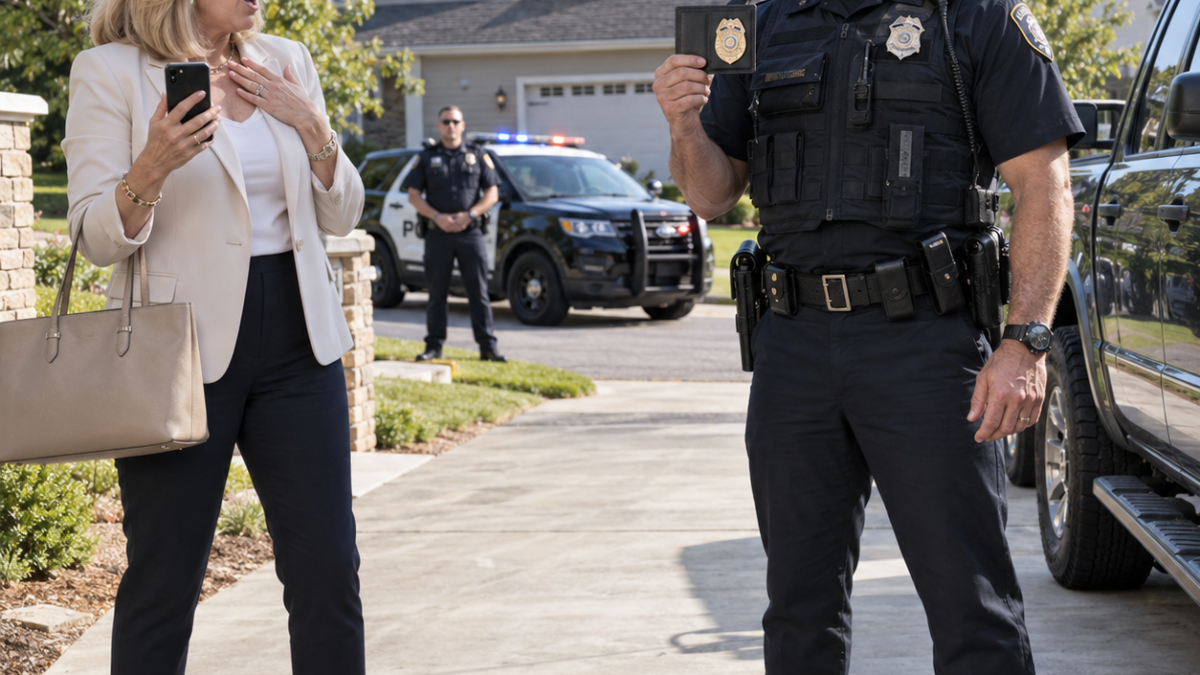
PART 2
Officer Reyes saw the smile too.
I knew because his eyes shifted toward the window for half a second.
Then he looked back at me.
“Chief, I’m going to take a couple pictures of the driveway.”
“Please do.”
He photographed my truck.
The property line.
Cassidy’s driveway.
The street.
Then he asked me the same basic questions he would have asked any citizen.
“Did you threaten Ms. Whitmore?”
“No.”
“Did you prevent her vehicle from leaving?”
“No.”
“Did you approach her property?”
“No.”
“Have you had previous disputes?”
“She’s asked me to move my truck farther from the edge and not start it early. I moved it. I told her I couldn’t guarantee I would never leave before seven.”
Reyes wrote everything down.
His partner stood near the cruiser looking as though he wanted to disappear.
I understood.
There is no academy scenario called Responding to a Suspicious-Person Complaint When the Suspicious Person Is Your Boss.
Before they left, I stopped Reyes.
“One thing.”
“Yes, sir?”
“You don’t write that I’m the chief unless it’s necessary context.”
He looked surprised.
“Why?”
“Because the report should stand without the title influencing anything.”
He nodded.
“Yes, sir.”
“And thank you.”
That surprised him more.
“For what?”
“For doing your job when it was uncomfortable.”
After they drove away, I went inside.
I printed the incident number and put it in the folder with Cassidy’s notes.
The folder was already thick enough to annoy me.
I assumed the 911 call would embarrass her.
Maybe she had overreacted.
Maybe once officers found nothing, she would realize where this was heading and stop.
That assumption lasted four days.
Sunday afternoon, I was watering hydrangeas.
They had belonged to my wife, Ellen.
She planted them years before cancer took her, and I kept caring for them even though I had no idea what I was doing.
Ellen used to say they survived despite me rather than because of me.
I heard a cruiser before I saw it.
Officer Reyes again.
He parked at the curb.
His shoulders dropped when he realized where dispatch had sent him.
“No.”
He walked toward me.
“Chief.”
“What happened now?”
“Ms. Whitmore says you sprayed water toward her property in an aggressive manner.”
I looked at the garden hose in my hand.
Then at the hydrangeas.
Then at Reyes.
He pressed his lips together.
I knew he was trying not to smile.
“Don’t.”
“I’m not.”
“Do your job.”
He did.
Cassidy claimed I deliberately swung the hose toward her driveway while staring at her.
The camera above my garage showed me watering flowers with my back toward her house for most of the relevant time.
Reyes documented it.
No citation.
No offense.
No confrontation.
I added the report to the file.
Three days later came another call.
My sprinkler was supposedly flooding her lawn.
It wasn’t.
Then she reported that my garbage cans obstructed visibility.
Then that I stood near the road watching her vehicle.
Then that I had followed her.
That one changed things.
Following a person is not a joke.
Stalking allegations deserve to be taken seriously.
The responding officers were from a neighboring patrol district because I had already told dispatch that I did not want the same deputies repeatedly assigned just because they knew me.
They arrived at the station later to take my statement.
Cassidy claimed I followed her from a pharmacy downtown to a grocery store and then back toward Marold Lane.
“What time?”
Officer Donnelly checked his notes.
“Approximately nine-fifteen until nine-forty-five.”
I looked at him.
“What?”
“You want to check my department vehicle.”
He frowned.
Then understood.
Command vehicles in our department had GPS tracking.
At 9:15 that morning, my truck was parked eleven miles away beside the county courthouse.
I had been testifying in a budget hearing.
Dozens of witnesses.
Security-camera footage.
A transcript.
GPS logs.
My first reaction was anger.
Not the explosive kind.
The cold kind.
Because Cassidy was no longer exaggerating a disagreement happening in front of her.
This allegation required invention.
I called the county manager.
“Henry, I need a wall between me and anything involving my neighbor.”
He sighed.
“Another complaint?”
“Yes.”
“What now?”
“Stalking.”
A long silence.
“You were at the courthouse all morning.”
“I know.”
“What do you want?”
“Every future call involving Cassidy Whitmore and me documented normally. No special treatment. But supervisors notify you and our legal counsel. If anything becomes an allegation of criminal conduct by me, it goes outside the department.”
“That seems extreme.”
“It won’t if she keeps escalating.”
I wish I had been wrong.
By the end of two months, Cassidy had called 911 eleven times.
Eleven.
Blocking access.
Harassment.
Threatening gestures.
Following her.
Watching her home.
Photographing her.
Aggressive sprinkler use.
A suspicious vehicle.
One call involved me walking my Labrador, Duke, past the end of her property on a public street.
According to Cassidy, I was “patrolling her home in an intimidating manner.”
Duke was carrying a tennis ball.
By the eighth call, every dispatcher recognized her voice.
They still had to treat each report seriously.
That mattered.
If someone has made seven false allegations, the eighth could still be a genuine emergency.
No competent dispatcher says, “She cried wolf before, ignore her.”
Cassidy understood that.
The safety system could not afford to dismiss a claim simply because the caller had lost credibility.
That safeguard was exactly what she weaponized.
Each time a police vehicle came down Marold Lane, Cassidy gained another photograph.
Another clip.
Another image she could show people without context.
Look.
Police at his house again.
Look.
Officers talking to him again.
Look how often this happens.
She was manufacturing both the emergency and the evidence that an emergency existed.
I had seen similar patterns professionally.
Knowing what was happening did not make it painless.
The young officers suffered too.
One evening Reyes came into my office after shift change.
He closed the door.
“Can I speak freely?”
“That question never leads anywhere pleasant.”
He sat.
“I hate going to your house.”
“I know.”
“It feels like we’re helping her.”
“You’re not.”
“She calls, we come. She takes pictures of us coming. Then she posts that police had to respond again.”
“You still come.”
He stared at me.
“What if eventually somebody responds who doesn’t know you?”
“That’s why you write good reports.”
“Chief—”
“No.”
I leaned forward.
“That is exactly why you write them. Not to protect me. To protect the next officer from walking into a manufactured situation blind.”
Reyes looked down.
“What she’s doing is dangerous.”
“Yes.”
A false emergency call is not simply wasted time.
Every police response brings armed people into uncertain circumstances.
A caller who falsely tells officers that a man is dangerous creates an expectation before they arrive.
If that man is angry when officers approach, if somebody makes a sudden movement, if the call contains a fabricated allegation about weapons—
Bad things can happen.
I had seen it.
That was why I refused to go next door.
No knocking on Cassidy’s door.
No angry speeches.
No “we need to settle this.”
Nothing.
My silence infuriated her.
One afternoon I was trimming the hydrangeas when she walked across the strip between our properties.
I saw her coming.
Duke stood beside me.
“Thomas.”
“Cassidy.”
She held up her phone.
“Are you recording?”
“Yes.”
“Good.”
That answer threw her.
She expected outrage.
“Why are you constantly watching me?”
“I’m trimming flowers.”
“You know what I mean.”
“No, I don’t.”
“You’ve turned the neighborhood against me.”
“I haven’t spoken to the neighborhood about you.”
She stepped closer.
“You have police cars coming here constantly.”
“You call them.”
Her jaw tightened.
“That is exactly the kind of intimidation I mean.”
“What is?”
“The way you say things.”
I almost smiled.
“What way?”
“Like I’m stupid.”
“I didn’t say that.”
“But you imply it.”
“I’m going inside.”
She moved slightly, not blocking me, but enough to force me to walk around her.
“You don’t get to walk away every time.”
“Yes, I do.”
I went inside.
My hands were shaking.
That part never appeared in her videos.
The calm man closing his front door looked controlled.
Inside, I put both hands on the kitchen counter and stood there breathing.
Ellen’s photograph sat near the coffee maker.
I stared at it.
She would have hated this.
Not just Cassidy.
What it was doing to me.
After Ellen died, the house became the last physical place where our life still existed unchanged.
Her hydrangeas.
The pencil marks inside the pantry showing our daughter’s height as she grew.
A crack in the kitchen tile Ellen had been meaning to replace for twelve years.
I could have moved.
I could certainly afford something quieter.
But leaving Marold Lane because a stranger decided to make my home unbearable felt like losing Ellen twice.
That was when Dale Foster came over.
Dale had served under me for years before becoming a captain.
He brought a six-pack even though he knew I rarely drank more than one.
We sat at the kitchen table.
“You ever consider leaving?”
I looked at him.
“The department?”
“The house.”
That hurt more.
He saw it.
“I’m not telling you she’s right.”
“I know.”
“I’m saying maybe you’re too invested in proving you can outlast her.”
“I shouldn’t have to leave my own home.”
“No.”
“But?”
“But sometimes you can win a fight and still lose too much.”
I looked toward the dark window above the sink.
“What would Ellen say?”
“Ellen would tell me to stop being stubborn.”
Dale smiled.
“That woman always was smarter than you.”
“She married me.”
“Her one mistake.”
I laughed for the first time in days.
Then Dale became serious.
“She’s building a public narrative, Tom.”
“I know.”
“People are starting to believe it.”
“I know.”
“You can’t respond because every response looks like the powerful police chief attacking a woman who says she’s afraid.”
“I know.”
“You’ve got the worst optics imaginable.”
That was the cleverest part of Cassidy’s plan.
Take the facts away.
Reduce the story to a sentence.
A woman says she is terrified of the large male police chief living next door.
Who should a decent person instinctively worry about?
Her.
And decent people should.
Powerful officials sometimes do abuse citizens.
Women do get ignored when they report harassment.
Police departments do protect their own.
The public was right to take those possibilities seriously.
Cassidy did not invent those fears.
She borrowed their credibility.
Then she went online.
Her first video reached maybe two thousand views.
The second reached fifteen thousand.
By the fourth, local reporters were calling me.
Cassidy sat in her living room speaking softly into a phone camera.
She described moving to Cedar Hollow for a fresh start.
She said the local police chief immediately became controlling.
She showed pictures of my truck.
Photographs of patrol cars at my house.
A clip of me closing my front door while she spoke to me from the yard.
She cried.
Not theatrically.
That would have been easier to spot.
Quiet tears.
Shaking breath.
She was very good.
People shared it.
Comments exploded.
WHY ARE HIS OWN COPS RESPONDING?
THIS NEEDS AN OUTSIDE INVESTIGATION.
SHE’S CLEARLY TERRIFIED.
Another commenter wrote:
Imagine being afraid to call police because your harasser runs them.
That one stayed with me.
Because I understood why a person seeing only Cassidy’s version would think exactly that.
I refused media interviews.
Our department issued one short statement:
Any allegations involving Chief Riley would be reviewed outside his supervisory authority.
That fueled Cassidy further.
She called it “institutional stonewalling.”
Then she filed a formal complaint.
Harassment.
Intimidation.
Misuse of office.
Retaliatory police presence.
Abuse of authority.
She demanded my suspension pending an independent investigation.
The complaint went to the county manager on a Thursday afternoon.
Henry called me.
“You need to read this.”
“I already did.”
“What do you want to do?”
“Recuse.”
“Completely?”
“Completely.”
He leaned back.
“You realize the optics of stepping aside may make people assume there’s something to investigate.”
“There is something to investigate.”
He looked at me.
“You know what I mean.”
“Yes.”
I signed a formal recusal memorandum.
Every issue involving Cassidy and me would go to outside agencies.
State police took lead on the conduct complaint.
The sheriff’s office handled future local calls at our addresses where possible.
My department turned over dispatch recordings, GPS logs, body-camera footage, incident reports, and my own file.
All of it.
I gave state investigators access to my work calendar.
Vehicle tracking.
Department email.
Telephone records relevant to Cassidy’s allegations.
Then I waited.
That might have been the hardest part.
When you are chief, people come to you for answers.
Now I wasn’t allowed to seek them.
I went to work under a cloud.
Some officers defended me too loudly.
I shut that down.
“No hallway campaigns.”
“But Chief—”
“No. The investigation gets space.”
Others became careful around me.
That hurt worse.
Not because I blamed them.
Because I had taught them to take misconduct allegations seriously.
Now they were doing exactly that.
At the grocery store, conversations changed when I entered aisles.
One woman who had known me twenty years nodded but didn’t stop.
A young father pulled his child closer.
Maybe coincidence.
Maybe not.
Cassidy’s videos kept appearing.
Dale’s suggestion returned to me.
Sell.
Leave.
Make the nightmare stop.
One night I opened a real-estate website.
I looked at houses thirty miles away.
A small place on five acres.
Quiet.
No close neighbors.
I imagined leaving Ellen’s hydrangeas.
Then I shut the laptop.
I wasn’t staying out of pride anymore.
I stayed because surrender would become another data point in Cassidy’s narrative.
Chief quietly leaves neighborhood after harassment accusations.
I could already see the headline.
So I waited.
State investigators began with me.
They interviewed me twice.
Hours.
Detailed questions.
Did I ever identify myself as chief to Cassidy during arguments?
No.
Did I order officers to treat her differently?
No.
Did I access police databases regarding her?
No.
Did any employee run her information at my request?
No.
Had I ever threatened arrest?
No.
Followed her?
No.
Photographed her?
Only security-camera footage on my own property and photographs documenting notes or incidents.
The investigators checked.
My statements matched records.
Then they interviewed deputies.
Dispatchers.
Neighbors.
Dale.
County employees.
Cassidy.
That was where things started changing.
Her timelines did not align.
One threatening encounter supposedly occurred while I was chairing a public safety budget meeting.
Another supposedly happened while my truck GPS showed it parked at the courthouse.
Her claim that officers repeatedly “circled” her house on my orders conflicted with dispatch logs showing those cruisers had been sent because she called.
The responding officers’ body cameras showed professional interactions.
No threats.
No instructions from me.
No retaliation.
Just Cassidy making allegations and officers documenting them.
My story was boring.
Same dates.
Same version.
Same evidence.
Cassidy’s moved.
The state investigators began asking a different question.
Who was Cassidy Whitmore?
Not because I asked.
I was not part of that work.
But an independent investigation has two sides.
Investigators verify the accused.
They also evaluate the credibility and history of the complainant when legally relevant.
Cassidy had told Cedar Hollow residents she moved from another state after a difficult divorce.
Parts of that were true.
What she omitted was more interesting.
There had been another neighbor dispute.
A retired widower named Raymond Ellis.
Raymond owned a small house free and clear.
Cassidy moved next door.
At first, she was charming.
Then came parking complaints.
Noise complaints.
Claims of staring.
Claims of intimidation.
Calls to police.
A civil harassment petition.
Raymond had no cameras.
No professional habit of documentation.
No understanding of what was happening.
He became frightened.
Then Cassidy’s attorney offered a settlement.
Pay a substantial amount.
Mutual non-disparagement.
She would dismiss claims and move.
Raymond paid.
He wanted peace.
The investigators discovered Cassidy had received another settlement from a workplace dispute in a different state.
Then another property conflict.
Different details.
Same architecture.
Charm.
Conflict.
Escalation.
Fear claim.
Documentation.
Pressure.
Settlement.
Move.
Repeat.
A former coworker told investigators Cassidy once joked that “institutions pay when they’re scared of bad publicity.”
Then financial records started lining up.
Settlements.
Transfers.
New addresses.
Slight variations of her name.
What had looked like a personal dispute began to resemble a pattern designed to extract money.
Because the activity crossed state lines and involved interstate communications and financial transactions, federal investigators eventually became interested.
Not because Cassidy called 911.
Repeated false reports remained primarily state and local matters.
The federal issue came from the alleged multi-state fraud scheme.
I learned almost none of this while it happened.
That was maddening.
I had intentionally removed myself.
Now the investigation could not keep me informed simply because I was curious.
Months passed.
Cassidy thought the silence meant she was winning.
She became bolder.
She appeared on a regional podcast.
She described herself as “trapped beside a powerful official.”
She said I had “weaponized silence.”
That phrase almost impressed me.
Apparently even not speaking could now be abusive.
Then my attorney called.
“The state investigation into you is concluding.”
My stomach tightened.
“And?”
“No evidence of misconduct.”
I closed my eyes.
“You’re sure?”
“The formal report still needs processing. But yes.”
I sat alone in my office for several minutes after the call.
Thirty years.
For the first time since I was twenty-one, I had genuinely imagined leaving law enforcement under a cloud I did not create.
The relief was physical.
Then my attorney added something.
“There are other investigations.”
“Into her?”
“I’m not discussing details I don’t officially have.”
That meant yes.
Cassidy had no idea.
Instead, she announced her biggest move yet.
The Cedar Hollow Town Council held monthly public-comment sessions.
Cassidy signed up to speak.
Then promoted it online.
JUSTICE FOR CEDAR HOLLOW.
HOLD THE CHIEF ACCOUNTABLE.
Reporters confirmed attendance.
Her followers shared the announcement.
She was going to demand my resignation publicly.
I debated whether to attend.
Dale said no.
“Why give her your face in the room?”
“Because it’s a public meeting.”
“You’re not speaking.”
“No.”
“Then stay home.”
I thought about it.
Then I pictured Cassidy pointing toward an empty seat.
He’s too cowardly to face me.
I went.
Plain clothes.
No badge visible.
No reserved seat.
Back row.
The municipal chamber was packed.
Old church pews filled the room.
People lined the walls.
Camera tripods stood near the side aisle.
Cassidy entered ten minutes early.
She worked the room beautifully.
Hand on Brenda Alcott’s arm.
A hug for a young mother.
Soft voice with reporters.
She carried notes.
She looked nervous enough to seem genuine and confident enough to command attention.
I watched her and realized something uncomfortable.
I think Cassidy had begun believing parts of her own story.
Repeat something long enough and identity wraps around it.
The meeting began.
Budget amendment.
Drainage contract.
Rezoning item.
Everybody endured twenty minutes of ordinary government waiting for the real event.
Then the chair opened public comment.
Cassidy stood.
She walked to the podium.
Adjusted the microphone.
“My name is Cassidy Whitmore.”
Her voice trembled.
“I moved to Cedar Hollow because I thought this was a safe community.”
Silence.
“I was wrong.”
She talked about my truck.
My size.
My position.
Police cars arriving.
How powerless she felt living beside the man who controlled the department she was supposed to call for help.
If you ignored the facts, it was devastating.
She pointed toward me.
“There he is.”
Every head turned.
I stayed seated.
“This man has watched me, intimidated me, followed me, and used the presence of his officers to remind me that there is nowhere I can turn.”
A woman in the front whispered something.
Cassidy’s eyes filled.
“How can any woman feel safe when the person she fears controls the people who respond to her call?”
That was the strongest thing she ever said.
Because the principle underneath it was valid.
Nobody should have to fear that.
Cassidy just happened to be lying about who was causing the fear.
She lifted her papers.
“I am asking this council tonight to demand Chief Thomas Riley surrender his badge pending—”
The rear doors opened.
The entire room turned.
Two state police investigators entered.
I recognized both.
Behind them were a man and woman I didn’t know.
Plain dark jackets.
Federal credentials clipped near their belts.
Cassidy saw them.
For half a second, relief crossed her face.
She thought they had come for me.
Of course she did.
One federal agent walked past my pew.
Then another.
Neither looked at me.
Cassidy stopped speaking.
The agents continued toward the podium.
Her face changed.
The female agent stepped beside her.
“Cassidy Anne Whitmore?”
Cassidy looked around the room.
“Yes?”
The agent displayed credentials.
“Federal Bureau of Investigation.”
Nobody breathed.
“Ms. Whitmore, you are under arrest pursuant to a federal indictment.”
Cassidy stared at her.
“For what?”
“Wire fraud and related offenses. You’ll receive a copy of the warrant and indictment.”
“No.”
Her voice was barely audible.
Then louder.
“No. You’re supposed to be investigating him.”
The agent remained calm.
“Ma’am, turn around.”
Cassidy looked directly at me.
I stayed seated.
That seemed to anger her more than anything I could have said.
“This is you!”
I shook my head once.
Nothing more.
The agent repeated the instruction.
Cassidy’s hands began trembling.
Reporters raised cameras.
The room remained completely silent.
“Thomas!”
I did not answer.
“You did this!”
The male agent stepped closer.
“Ms. Whitmore.”
She finally turned.
The cuffs closed behind her back.
Ten seconds earlier, she had been demanding my badge.
Now federal agents were collecting the notes she left on the podium as evidence associated with her arrest.
Cassidy walked down the center aisle.
Past Brenda.
Past neighbors who had believed her.
Past cameras she invited.
Past me.
She turned her face away.
I did not feel triumph.
That surprised me.
Mostly I felt tired.
After the doors closed, nobody knew what to do.
The council chairman eventually cleared his throat.
“I think we should recess.”
People began talking all at once.
Reporters surrounded the state investigators.
Others came toward me.
I stood.
Dale intercepted them.
“Not tonight.”
I looked at him.
“Thank you.”
“You okay?”
“I don’t know.”
Outside, the air was cold.
I walked two blocks before realizing I had left my truck behind.
Dale caught up.
“You planning to walk home?”
“Maybe.”
“It’s four miles.”
“Fine.”
He stood beside me.
“So.”
“So.”
“She got arrested at the microphone.”
“Yes.”
“You have no idea how badly I want to make a joke.”
“Don’t.”
He waited three seconds.
“Talk about bad timing.”
I laughed.
I couldn’t help it.
Then I cried.
Not dramatically.
Just suddenly.
Months of tension let go at once.
Dale put a hand on my shoulder.
Neither of us spoke.
The federal case was bigger than anything I had imagined.
Cassidy’s earlier settlements were examined.
Investigators found multiple alleged victims across several states.
Financial transactions.
Emails.
Settlement agreements.
Messages to attorneys.
Records showing she researched targets.
One message to a former associate referred to a man as “another easy retirement-property situation.”
Raymond was not unique.
There had been others.
Some cases could not support criminal charges.
A settlement does not automatically prove fraud.
Complaining about a neighbor is not criminal simply because the complaint later proves false.
Prosecutors had to separate ugly behavior from provable federal offenses.
That took time.
The final case focused on a smaller set of transactions where investigators believed the evidence demonstrated deliberate deception intended to obtain money using interstate communications.
The state separately reviewed Cassidy’s repeated emergency calls and false reports involving me.
Her defense attorneys fought hard.
They argued she genuinely felt unsafe.
They attacked my credibility.
They suggested my position had influenced the entire prosecution.
Federal prosecutors responded with something I was grateful for.
They did not build the case around me.
My dispute was evidence of pattern and conduct.
But the core financial case stood on records from other states, independent witnesses, bank transactions, communications, and Cassidy’s own documents.
That distinction protected the case.
And me.
I testified.
Cassidy’s attorney stood.
“Chief Riley, you have enormous influence in Cedar Hollow, correct?”
“I hold public authority subject to law.”
“That wasn’t my question.”
“Yes. The position carries influence.”
“And after my client complained about you, federal agents arrested her publicly?”
“Yes.”
“In your town?”
“Yes.”
“At a meeting you attended?”
“Yes.”
“Convenient.”
“Not for me.”
“Did you know they were coming?”
“No.”
“You expect this jury to believe the police chief had no idea federal agents intended to arrest the woman accusing him?”
“Yes.”
“Why?”
“Because I was not part of their investigation.”
He paced.
“You created a dossier on my client.”
“I documented a neighbor dispute.”
“You photographed her communications.”
“Notes she taped to my door.”
“You collected reports from officers under your command.”
“After they were created in the normal course of responding to her calls.”
“And turned all that over to investigators.”
“Yes.”
He looked at the jury.
“So you built the case.”
“No.”
“What would you call it?”
“Preserving evidence.”
He smiled.
“Thirty years in policing taught you how to build evidence against someone, correct?”
“Yes.”
“And you used those skills on my client.”
“Yes.”
There was no point pretending otherwise.
He seemed surprised by the answer.
“You admit that?”
“I used the same documentation habits I would recommend to any citizen facing repeated allegations.”
“Any citizen doesn’t run the police.”
“That is why I recused myself.”
Silence.
He tried another direction.
“Did you ever order an officer to investigate Cassidy Whitmore?”
“No.”
“Run her license plate?”
“No.”
“Search police databases?”
“No.”
“Contact her employer?”
“No.”
“Contact prior neighbors?”
“No.”
“Call the FBI?”
“No.”
“Ask state police to investigate her?”
“No.”
He looked annoyed.
“Yet somehow they did.”
“Yes.”
“Remarkable coincidence.”
“The investigators can explain how their case began.”
He stopped.
That was the trap he had created for himself.
If he called those investigators, they would testify under oath that the inquiry expanded through independent evidence.
He moved on.
Cassidy testified too.
That was risky.
She was polished.
She cried at the right moments.
She described genuine fear.
But prosecutors had timelines.
When she said she remembered seeing my truck following her, they showed GPS.
When she said officers came to my home because neighbors were independently concerned, they showed the dispatch origins.
Her calls.
Over and over.
When she described never seeking money from earlier targets, prosecutors presented settlement communications.
When she said each prior incident was unrelated, they showed strikingly similar messages.
A prosecutor asked:
“Ms. Whitmore, did you write to your former coworker, ‘Old men with paid-off houses settle faster than companies’?”
Cassidy’s face changed.
“I don’t remember.”
The email appeared.
“Is that your address?”
“Yes.”
“Your message?”
“I would need context.”
They gave her context.
It did not help.
The jury convicted her on multiple federal fraud counts.
State proceedings followed.
At sentencing, several victims spoke.
Raymond came.
I met him for the first time outside the courtroom.
He was seventy-six by then.
Thin.
Gray-haired.
He held my hand with both of his.
“You’re the chief.”
“Tom.”
“You’re younger than I expected.”
“I’m taking that as a compliment.”
He smiled weakly.
Then he said, “I thought I was crazy.”
That erased my smile.
“For years.”
“You weren’t.”
“I paid her.”
“You wanted it to stop.”
“I should’ve fought.”
“No.”
His eyes filled.
“I gave her almost everything I had saved.”
“You survived what you knew how to survive.”
Raymond looked down.
“She told people I was dangerous.”
“I know.”
“My own daughter wondered.”
That was the wound.
Money could be repaid.
Reputation inside a family is different.
I put my hand on his shoulder.
“You did not cause what happened to you.”
He stared at me.
“I know that now.”
During sentencing, Cassidy sat between attorneys.
No performance at first.
Then her lawyer spoke about trauma, instability, and the circumstances of her life.
Some of it may have been true.
People do not become who they become from nowhere.
But explanations do not erase victims.
Raymond spoke.
His voice shook.
“I spent three years apologizing for something I didn’t do.”
He looked at Cassidy.
“I’m not asking you to apologize now. I just want to stop apologizing to myself.”
Several people in the courtroom cried.
So did I.
When my turn came, I did not talk much about myself.
I had kept my career.
My home.
My savings.
Others hadn’t.
“I knew how to document what she was doing,” I said. “Raymond didn’t. That should not determine who gets justice.”
The judge later imposed a substantial federal prison sentence.
Restitution was ordered for qualifying victims.
State penalties addressed false reporting and related conduct within its jurisdiction.
It was not some fantasy life sentence.
But it was real prison.
Years.
Cassidy would not move to another quiet street next month and start again.
After sentencing, she looked back once.
Not at me.
At Raymond.
He looked down at his hands.
I wondered what she thought.
I never learned.
Cedar Hollow had to heal too.
Brenda Alcott knocked on my door one Sunday carrying a casserole.
“You don’t have to feed me.”
“I know.”
“Then what’s this?”
“An apology disguised as carbohydrates.”
I let her in.
We sat at the kitchen table.
“I believed her,” Brenda said.
“A lot of people did.”
“I told Martha Edwards I thought maybe Ellen’s death had made you… angry.”
That hurt.
Brenda started crying.
“I’m so sorry.”
I took a breath.
“Cassidy was convincing.”
“That doesn’t excuse me.”
“No.”
She looked surprised.
I continued.
“But you didn’t owe me blind loyalty either.”
“You’ve lived here twenty years.”
“And powerful people sometimes do terrible things despite knowing neighbors twenty years.”
Brenda wiped her face.
“I don’t know how you aren’t furious.”
“I was.”
“At us?”
“At everyone.”
I looked at Ellen’s hydrangeas through the window.
“Then I realized Cassidy’s whole scheme depended on decent people taking fear seriously.”
Brenda listened.
“I don’t want people learning from this that the correct response when someone says they’re afraid is to laugh at them.”
“No.”
“The lesson is verify.”
She nodded.
“Listen. Protect. Then verify.”
“Exactly.”
That conversation helped both of us.
The street gradually became normal.
Children rode bikes.
Neighbors waved again.
Some apologized.
Some avoided the subject.
A few never spoke to me the same way again.
That was okay.
Vindication does not rewind time.
The younger families who had kept their distance returned slowly.
One father came over while I was washing my truck.
“My wife didn’t want the kids near your house.”
“I know.”
“I feel awful.”
“Don’t.”
“I should have known.”
“How?”
He couldn’t answer.
“If you had actually known only the facts Cassidy posted, caution around me would’ve been reasonable.”
He nodded.
“Still feels wrong.”
“Then teach your kids something useful from it.”
“What?”
“Don’t confuse an accusation with proof. And don’t confuse doubt with cruelty.”
He smiled.
“I can do that.”
I stayed chief.
The state investigative report publicly concluded there was no evidence I had misused authority and specifically noted my early recusal and cooperation.
That finding meant more to me than I expected.
Not because it told me I was innocent.
I knew what I had done.
Because the badge survived scrutiny.
I had always told younger officers that integrity isn’t proven when nobody checks you.
It is proven when somebody checks and the work still stands.
The first day I returned to a full command meeting after the report became public, Officer Reyes waited outside my office.
“Chief?”
“Come in.”
He carried a folder.
I recognized it.
Cassidy reports.
“Why do you have that?”
“Training asked if we could build a scenario around false repetitive calls.”
“Good.”
“I wanted your permission because…”
He stopped.
“Because it’s personal.”
“Yes.”
“Remove names.”
“Already did.”
“And don’t make the lesson ‘complainants lie.’”
He nodded immediately.
“What’s the lesson?”
“Two lessons.”
I held up one finger.
“Take safety claims seriously every time.”
Second finger.
“Document objectively enough that patterns reveal themselves without officers deciding the answer in advance.”
Reyes smiled.
“Boring truth.”
“Exactly.”
Months later, I called Raymond.
The first phone call lasted forty minutes.
Mostly silence.
He told me about his late wife.
I told him about Ellen.
He told me how Cassidy arrived with cookies.
I told him about banana bread.
We laughed at the absurd similarity.
Then he said:
“I still check the window when a police car goes past.”
“I still look at my phone when my neighbor’s porch light comes on.”
“She doesn’t live there anymore.”
“I know.”
“Me either.”
Trauma does not always care about current addresses.
We kept talking.
Once a month became twice.
The restitution check Raymond eventually received did not return everything.
But something else happened.
His daughter apologized.
He called me afterward.
“She said she believes me.”
His voice broke.
“That’s good.”
“She said she’s sorry.”
“Better.”
“I wish my wife had been alive to hear it.”
I had no answer to that.
Some losses arrive before justice.
No court can fix them.
I retired two years later.
Not because of Cassidy.
At least I don’t think so.
Thirty-two years was enough.
My final day, the department held an embarrassing ceremony I had explicitly asked them not to hold.
Dale ignored me.
Reyes spoke.
He told the room about the day he got dispatched to investigate his own chief for watering hydrangeas aggressively.
Everyone laughed.
Then he became serious.
“I learned more watching Chief Riley get investigated than I learned watching him investigate anyone else.”
I looked down.
“He could have made our lives easy. He could have told us how to write things. He could have made calls disappear.”
Reyes paused.
“He made us document him instead.”
That nearly got me.
Dale finished the job.
He presented me with my old Cassidy file.
The actual folder had grown into three boxes, so he gave me the original first folder.
Inside was the first note.
DOCUMENTING A PATTERN OF HOSTILE BEHAVIOR.
I stared at Cassidy’s handwriting.
“You kept this?”
“Evidence retention released it.”
“I don’t want it.”
“Yes, you do.”
He was right.
I took it home.
For several months it sat in my study.
Then one morning a young officer from a neighboring town called.
He had been accused by a citizen of retaliation after a traffic stop.
He sounded angry.
“They’re lying, Chief.”
“Former chief.”
“Sorry.”
“What have you done?”
“Nothing.”
“Good.”
“I want to confront him.”
“No.”
“But he’s telling everyone—”
“Do not.”
Silence.
Then I told him about the folder.
Not Cassidy’s name.
Not details.
Just the lesson.
“The reaction is the trap.”
I heard him breathe.
“What do I do?”
“Write down facts.”
“That’s it?”
“Facts. Dates. Records. Tell your supervisor. Let somebody independent handle whatever needs handling.”
“It feels weak.”
“I know.”
“Does it work?”
“Better than rage.”
After the call, I finally understood why Dale insisted I keep the folder.
Not as a trophy.
As a teaching tool.
One spring morning, Brenda knocked on my door again.
No casserole this time.
She pointed toward the driveway.
“You still park that ridiculous truck in exactly the same spot.”
“I’m consistent.”
“It blocks my view from across the street.”
“Call 911.”
Her face froze.
Then she realized I was joking.
She slapped my arm.
“That isn’t funny.”
“It’s a little funny.”
We both laughed.
The hydrangeas bloomed that year better than they had in years.
Pink and blue against the house.
I sat outside one Sunday with coffee.
Duke was older now.
Gray around the muzzle.
He slept beside my chair.
A car slowed near the driveway.
For an instant, my body tightened.
Then it continued.
Old habits.
My phone rang.
Raymond.
“You busy?”
“Watching a dog sleep.”
“Hard life.”
“How are you?”
“Good.”
And he sounded good.
Really good.
We talked about nothing important.
Weather.
His daughter.
My retirement.
The price of groceries.
After twenty minutes, Raymond said, “Tom?”
“Yeah?”
“You ever think about how close she came?”
All the time.
“Sometimes.”
“I do.”
I looked at the hydrangeas.
“You know what bothers me?”
“What?”
“That the thing that saved me wasn’t being chief.”
“No?”
“It almost made it worse.”
Cassidy’s story had been more convincing because of my title.
The badge gave her allegations weight.
If I abused power, everyone needed to know.
And everyone was right to look closely.
“What saved me was records,” I said.
Raymond was quiet.
“And patience.”
“Mostly luck too.”
“Maybe.”
Another silence.
Then he said, “Wish I’d known you back then.”
“So do I.”
After we hung up, I walked to the driveway.
The same driveway that started everything.
Nothing special.
Concrete.
A few cracks.
Oil stain near the garage.
My truck parked inside the line.
Cassidy had turned that ordinary patch of concrete into a stage.
Then a crime scene.
Then an internet symbol.
Now it was just a driveway again.
That might have been the best thing about the ending.
Not seeing Cassidy arrested.
Not the conviction.
Not clearing my name.
Ordinary life returning.
I stood there a moment.
Duke wandered out and looked at me as if I had lost my mind.
“You’re right.”
He wagged his tail.
I went inside.
The original Cassidy file sat on a shelf in my study.
I still kept it.
Every now and then, a young officer sat across from my desk—or later my kitchen table—frustrated because someone had made a false accusation, challenged their authority, or insulted them publicly.
I would pull out that folder.
The first note still sat on top.
Careful handwriting.
Cold legal language.
A lie beginning to build itself.
Then I would tell them the thing that took me thirty years to understand:
A badge does not make you stronger than an accusation.
It makes your obligation to respond correctly greater.
Cassidy thought calling 911 would give her power over me.
For a while, it did.
Every call forced a response.
Every allegation demanded attention.
Every photograph damaged something.
The system worked exactly as it had been designed to work—it listened when someone said she was afraid.
And that nearly destroyed me.
But the same system also preserved recordings.
Dispatch logs.
GPS records.
Body cameras.
Statements.
Dates.
Financial transactions.
Prior cases.
Evidence.
Cassidy trusted the system only when she could point it at someone else.
She never imagined it could examine her too.
In the end, that was the part she could not escape.
Not my rank.
Not my department.
Not revenge.
The record.
The last time I visited headquarters before moving fully into retirement, Reyes caught me by the elevator.
“You heading out?”
“Trying.”
He smiled.
Then handed me a copy of a training memo.
FALSE REPORTS AND HIGH-CONFLICT COMPLAINANTS: EVIDENCE-FIRST RESPONSE.
“You wrote this?”
“Committee did.”
I read the first line.
Every allegation deserves a professional response; no allegation deserves a predetermined conclusion.
I handed it back.
“That’s good.”
“You taught us.”
“No.”
I pressed the elevator button.
“Cassidy did.”
The doors opened.
Reyes laughed.
I stepped inside.
Before they closed, he said, “Chief?”
“What?”
“Thanks for never making us choose between doing our jobs and protecting you.”
That hit me harder than any award.
I nodded.
The doors closed.
That evening I went home, parked my truck in my own driveway, watered Ellen’s hydrangeas, and watched the sun fall behind the roofs of Marold Lane.
Nobody called 911.
Nobody filmed me.
Nobody asked me to move.
For the first time in a long time, the street was quiet enough that I could hear the sprinkler tapping against the grass.
And that was all I had ever wanted from the beginning.
[TITLE]
Karen Called 911 Over My Own Driveway—She Didn’t Know She Was Reporting the Police Chief
[FACEBOOK OPENING — 700–800 WORDS]
The first time Cassidy Whitmore called 911 on me, she told the dispatcher a dangerous man was blocking her access, refusing to move his truck, and becoming increasingly threatening every time she asked him to stop.
The dispatcher pulled up the address, went quiet, and asked Cassidy to repeat it, because the truck she was reporting was sitting completely inside my own driveway—and the “dangerous man” standing beside it was the police chief whose officers were about to be sent to investigate him.
Cassidy didn’t know who I was yet, but when two patrol cars rolled onto Marold Lane and I saw the satisfied little smile she tried to hide behind her front curtain, I understood that the driveway had never really been the problem.
My name is Thomas Riley.
I had spent thirty years in law enforcement and the last nine as chief of police in Cedar Hollow County, a quiet place where most calls involved property disputes, traffic accidents, barking dogs, and neighbors who had forgotten how to talk to each other.
Cassidy moved into the house beside mine on a Saturday.
At first, everybody loved her.
She brought banana bread to Brenda Alcott across the street. She remembered children’s names after hearing them once. She complimented gardens, laughed easily, and seemed genuinely grateful to have found a peaceful neighborhood.
I liked her too.
That matters.
Cassidy never entered your life looking dangerous.
Two weeks after moving in, she knocked on my door.
“Tom, can I ask you a tiny favor?”
“Sure.”
She pointed toward my full-size work truck.
“Would you mind parking a little farther over? When I back out, it feels like it blocks my view.”
The truck was entirely on my property, but the request seemed reasonable.
“No problem.”
I moved it.
A week later she asked if I could stop starting the truck before seven in the morning.
“I leave around five-thirty sometimes.”
She smiled.
“I understand. It’s just very loud.”
“I won’t let it idle.”
That should have been enough.
It wasn’t.
Soon notes began appearing on my front door.
The first ones were polite.
Then the little hearts disappeared.
Then the language changed.
One said she was “documenting a continuing pattern of hostile behavior” and “reserving all available legal remedies.”
Hostile behavior.
For parking a truck.
I remember standing on my porch reading that sentence twice.
Not because it frightened me.
Because I recognized it.
I had spent too many years watching people build narratives before they built cases.
So I opened a file.
Every note got photographed before I touched it.
Date.
Time.
Exact wording.
I saved texts.
Logged conversations.
And made one decision that would become more important than anything else I did.
I would never use my badge against her.
No database searches.
No favors from patrol.
No calls to dispatch.
No quiet pressure from the chief’s office.
If this ever became official, I wanted my hands completely clean.
Then came Tuesday.
I returned home around noon to grab a folder I had forgotten.
My truck was parked where it had been parked for years.
Ten minutes later, two cruisers turned onto Marold Lane.
I recognized both officers.
Officer Reyes got out first.
His partner followed.
Neither looked comfortable.
“Chief.”
“Officer.”
Reyes swallowed.
“We received a 911 call.”
“From next door?”
He glanced toward Cassidy’s house.
“Yes, sir.”
“What’s the complaint?”
“She says a man is blocking her driveway and behaving in a threatening manner.”
I looked at my truck.
Almost four feet of grass separated my driveway from hers.
“Do your job.”
“Sir?”
“Take her statement. Take mine. Photograph whatever needs photographing. Write the report exactly as if I were anybody else.”
He nodded.
Across the street, a curtain moved.
Cassidy was watching.
Reyes came back after speaking with her.
“She says you refused to move when she asked you.”
“She never asked me today.”
“She says she felt intimidated by your posture.”
“What posture?”
He looked miserable.
“Standing beside the truck.”
I nearly laughed.
I didn’t.
Because behind Cassidy’s window I saw her watching the officers, and then I saw the smallest smile cross her face.
She had not called 911 because she believed she was trapped.
She called because she wanted police cars in front of my house.
And suddenly I understood that what she was building would need something far more dangerous than anger to stop it.
It would need patience.
[END OF FACEBOOK OPENING]
[FULL STORY CONTINUATION]
Officer Reyes photographed both driveways, the truck, the curb, and the property line.
Then he took my statement exactly as I had instructed.
“Did you threaten Ms. Whitmore?”
“No.”
“Did you block her vehicle?”
“No.”
“Did you approach her property?”
“No.”
“Any prior disputes?”
“She asked me to park farther from her side. I did. She asked me not to leave before seven. I told her I couldn’t promise that.”
He wrote everything down.
Before he left, I stopped him.
“Reyes.”
“Yes, Chief?”
“Thank you.”
He looked confused.
“For what?”
“For doing the uncomfortable version of your job.”
That report went into my folder.
I believed the embarrassment of having officers find nothing would make Cassidy stop.
Instead, it taught her something.
The system responded when she called.
Four days later, I was watering the hydrangeas my late wife, Ellen, had planted when another cruiser pulled up.
Reyes climbed out and looked at the garden hose in my hand.
“No.”
“What now?”
He checked his notebook.
“Ms. Whitmore says you sprayed water toward her property in an aggressive manner.”
I looked at the flowers.
Then at him.
“Try to say that again with a straight face.”
He failed.
But he still investigated.
My security camera showed me watering flowers the entire time.
No threat.
No confrontation.
The next call involved my sprinkler.
Then my trash cans.
Then Duke, my Labrador, and me walking along a public street.
Cassidy told dispatch I was “patrolling her residence.”
By the end of two months, she had called 911 eleven times.
The fifth call frightened me most.
She claimed I had followed her car through town.
That allegation could trigger a genuine stalking investigation.
Two outside patrol officers interviewed me.
“What time does she say this happened?”
“Between nine-fifteen and nine-forty-five.”
I almost relaxed.
My department vehicle was equipped with GPS tracking.
At 9:15, it was parked eleven miles away beside the county courthouse.
I had been inside giving testimony before a county committee.
There were cameras.
Witnesses.
A written transcript.
The accusation didn’t merely fail.
It left evidence showing it was false.
I called County Manager Henry Collins immediately.
“I want every future allegation involving Cassidy and me kept outside my chain of command whenever practical.”
“Tom, these are neighbor calls.”
“Not anymore.”
“You think she’s building something?”
“I know she is.”
What troubled me wasn’t only what Cassidy was doing to me.
It was what she was forcing my officers to do.
Every time she told 911 that a dangerous man was threatening her, armed police responded.
That is how emergency systems are supposed to work.
If someone says she is frightened, dispatch cannot gamble that she is exaggerating.
Cassidy understood that.
A false call like hers placed everybody in danger.
The responding officer.
The accused person.
Even Cassidy.
One misunderstanding during a manufactured confrontation could turn a lie into a tragedy.
So I stayed calm.
Every single time.
I never walked next door to confront her.
Never shouted across the lawn.
Never sent officers to warn her.
Never threatened arrest.
I documented.
And that drove her crazy.
One afternoon she walked over while I trimmed Ellen’s hydrangeas.
She was holding her phone up.
“Are you recording me?” I asked.
“Yes.”
“Good.”
That stopped her for a moment.
“You’ve turned this entire street against me.”
“I haven’t discussed you with the street.”
“You have police cars at your house constantly.”
“You call them.”
Her jaw tightened.
“That tone. That’s exactly the intimidation I’m talking about.”
“What tone?”
“You make me feel stupid.”
“I didn’t say you were stupid.”
“You imply it.”
“I’m going inside.”
“You don’t get to walk away whenever I’m speaking.”
“Yes, Cassidy. I do.”
I walked inside.
Then I closed the door and stood in my kitchen with both hands against the counter because they were shaking.
That was the part nobody saw.
Cassidy’s videos showed a large older man calmly ending conversations.
They didn’t show what it cost me to remain that man.
Ellen’s photograph sat beside the coffee maker.
She had died five years earlier.
That house was where we raised our daughter.
Where Ellen planted the hydrangeas.
Where she marked our daughter’s height inside the pantry door.
Leaving would have been financially easy.
Emotionally, it felt impossible.
Then Captain Dale Foster came over one night with beer and an uncomfortable suggestion.
“Sell the house.”
I stared at him.
“I’m serious.”
“She wins.”
“This isn’t a football game.”
“I shouldn’t have to leave.”
“No.”
He leaned forward.
“But ask yourself whether staying is about Ellen or about refusing to let Cassidy move you.”
I hated the question because I didn’t know the answer.
Then Cassidy changed tactics.
She went public.
Her first online video showed patrol cars outside my house.
No explanation that she had called them.
Another showed my truck.
Another showed me walking inside while she spoke from my yard.
She cried quietly into the camera.
“I moved here believing I would be safe,” she said. “Instead, I live beside the man who controls the police department.”
That sentence spread.
And I understood why.
If you knew nothing else, it sounded terrible.
A woman says the police chief is intimidating her.
His officers keep arriving at his house.
He refuses to publicly answer her accusations.
People were right to be concerned.
Police chiefs have abused power before.
Departments have protected leaders before.
Women have had real complaints ignored before.
Cassidy wrapped herself inside those legitimate fears.
Soon reporters were calling.
People at the grocery store looked at me differently.
A few families on Marold Lane stopped letting their children wander near my yard.
That hurt.
But I blamed Cassidy, not them.
If I had known only what she showed online, I might have worried too.
Then she filed a formal complaint against me.
Harassment.
Intimidation.
Stalking.
Misuse of department resources.
Abuse of authority.
She demanded an independent investigation.
The morning the complaint arrived, I went straight to the county manager.
“I’m recusing myself.”
“Entirely?”
“Yes.”
“You know how that looks.”
“I know.”
I requested state police review my conduct.
The sheriff’s office handled future calls involving our two addresses when practical.
I gave investigators everything.
My file.
Dispatch recordings.
GPS records.
Work calendars.
Emails.
Security video.
Body-camera footage.
Access to every officer who had responded.
Standing in that office asking strangers to investigate a thirty-year career was one of the hardest things I have ever done.
There was no guarantee that truth would arrive before public opinion destroyed me.
That night, I went home and opened a real estate website.
I looked at houses thirty miles away.
Quiet properties.
No close neighbors.
I came close.
Then I saw Ellen’s hydrangeas through the window.
I closed the laptop.
The investigation continued for weeks.
State investigators interviewed me repeatedly.
Then the deputies.
Dispatchers.
Neighbors.
County employees.
And Cassidy.
That was where her story began to crack.
She claimed I made a threatening gesture at a time my vehicle GPS placed me across town.
She said I followed her during a period when I was testifying in court.
She claimed officers circled her house on my orders.
Dispatch records showed those officers were responding to calls she herself made.
My notes never changed.
Her timeline did.
Then investigators began looking into her history.
Not because I asked.
I had deliberately removed myself from the process.
They found Raymond Ellis.
Seventy-three.
Widowed.
Living two states away.
Cassidy had once moved next door to him.
At first she was charming.
Then came parking complaints.
Noise complaints.
Claims that he frightened her.
Police reports.
Civil accusations.
Finally, an attorney offered Raymond a way out.
Pay Cassidy money.
Sign an agreement.
She would drop her claims and move.
Raymond paid.
Then investigators found another dispute in another state.
Then a workplace settlement.
Different locations.
Same pattern.
Charm.
Conflict.
Fear.
Documentation.
Pressure.
Money.
Departure.
One former coworker turned over messages suggesting Cassidy viewed complaints as leverage.
Financial investigators traced settlements moving through accounts across state lines.
That was when the case became something larger than false 911 calls.
The federal government wasn’t interested because Cassidy had reported her neighbor.
They became interested because investigators suspected a recurring scheme to obtain money through deception using interstate communications and banking systems.
The FBI entered the case.
I barely knew any of it.
That was the strange part.
I had insisted on independence.
Now independence meant nobody owed me updates.
I kept working under a cloud.
Then my attorney called.
“The state investigation is closing.”
My chest tightened.
“And?”
“No misconduct.”
I sat down.
“You’re certain?”
“They found no evidence you used your authority against her. The report specifically notes your recusal.”
I closed my eyes.
Relief should have felt like victory.
Instead, I felt exhausted.
Cassidy, meanwhile, believed she was still winning.
She announced she would speak at the next Cedar Hollow Town Council meeting.
Public comment.
Reporters invited.
Online followers notified.
She intended to demand my resignation in front of the entire town.
I almost stayed home.
Then I decided I had spent months refusing to hide.
I wasn’t starting now.
The council chamber was packed.
I sat in the last row in plain clothes.
Cassidy arrived carrying notes.
She hugged neighbors.
Spoke softly with reporters.
Looked nervous enough to seem vulnerable.
When public comment began, she walked to the microphone.
“My name is Cassidy Whitmore.”
The room went silent.
“I moved to Cedar Hollow because I believed this was a safe community.”
She described me as controlling.
Powerful.
Untouchable.
She pointed toward the back.
“There he is.”
Every head turned.
I stayed still.
“How can any woman trust the police when the man she fears controls the department?”
It was the strongest argument she ever made.
Because as a principle, it was true.
Then the rear doors opened.
Two state investigators walked in.
Behind them were two federal agents.
Cassidy saw them.
For a split second, relief crossed her face.
She thought they had come for me.
The agents passed my row.
Never looked at me.
Continued toward her.
Cassidy stopped speaking.
The female agent reached the podium.
“Cassidy Anne Whitmore?”
“Yes.”
She displayed credentials.
“Federal Bureau of Investigation. You are under arrest pursuant to a federal indictment.”
Cassidy’s face emptied.
“For what?”
“Wire fraud and related charges.”
“No.”
She looked toward me.
“No. You’re supposed to be investigating him.”
The agent calmly instructed her to turn around.
Cassidy’s voice rose.
“Thomas!”
I said nothing.
“You did this!”
I shook my head once.
That was all.
The cuffs closed.
Her prepared speech remained on the podium.
The cameras she invited kept recording.
The room she had filled to witness my humiliation watched federal agents escort her down the center aisle.
She passed within feet of me.
She did not look over.
I didn’t feel joy.
Mostly I felt something releasing from my chest after months of holding it there.
Outside, Dale found me walking away from the building.
“You left your truck.”
“I know.”
“You okay?”
“No idea.”
He stood beside me.
Then I laughed.
Then, embarrassingly, I cried.
Dale said nothing.
That was why he was my friend.
The federal case eventually revealed multiple victims.
Raymond was one.
There were others.
Prosecutors did not claim every complaint Cassidy had ever made was fraudulent.
That would have been irresponsible.
They focused on transactions they believed they could prove involved deliberate deception for financial gain.
State authorities separately handled the repeated false reporting allegations in Cedar Hollow.
I testified at trial.
Cassidy’s attorney tried to frame me as a powerful police chief using federal machinery against a neighbor.
“Chief Riley, you created a file on my client, correct?”
“Yes.”
“You photographed her communications?”
“Notes she left on my door.”
“You used law-enforcement training to document her.”
“Yes.”
He seemed surprised I admitted it.
“You built a case against her.”
“No.”
“What did you build?”
“A record of what happened to me.”
“You contacted the FBI?”
“No.”
“State investigators?”
“I requested that they investigate me.”
That quieted the courtroom.
The evidence did the rest.
GPS data.
911 recordings.
Body cameras.
Prior settlements.
Emails.
Financial records.
Former victims.
Cassidy testified.
She was convincing until dates appeared.
A person can argue with another person’s memory.
It is harder to argue with timestamped GPS records.
She was convicted on multiple federal fraud counts.
State consequences followed for false reporting.
At sentencing, I met Raymond.
He was seventy-six.
Thin.
Soft-spoken.
He shook my hand with both of his.
“I thought I was crazy,” he said.
“You weren’t.”
“I paid her.”
“You wanted peace.”
“I should have fought.”
“No.”
He looked at me.
“No?”
“You did what you knew how to do.”
His eyes filled.
“My daughter believed her.”
That hurt more than the money.
When Raymond spoke in court, his voice trembled.
“I spent years apologizing for something I never did. I’m not asking Cassidy to apologize to me anymore. I just want to stop apologizing to myself.”
I had to look down.
When my turn came, I spoke briefly.
“I knew how to document what was happening. Raymond didn’t. That should not determine which victim gets believed.”
Cassidy received a substantial federal prison sentence and restitution obligations.
Not some fictional lifetime punishment.
Real years.
Real consequences.
More important, she could no longer simply move to another street and repeat the pattern.
Afterward, Cedar Hollow had its own healing to do.
Brenda Alcott knocked on my door one Sunday carrying a casserole.
“An apology disguised as food?” I asked.
She started crying.
“I believed her.”
“I know.”
“I told people maybe losing Ellen had made you angry.”
That one landed.
“I’m sorry, Tom.”
I took a breath.
“Cassidy was convincing.”
“That doesn’t excuse me.”
“No.”
She looked surprised.
“But you also didn’t owe the police chief blind faith.”
Brenda wiped her face.
“What do we learn from this then?”
“Not that scared people should be ignored.”
“Then what?”
“Listen. Protect. Verify.”
That became the lesson I carried back into the department.
Officer Reyes helped develop training based on the case.
Every safety allegation deserved a professional response.
Every officer also had a duty to document objectively instead of deciding too early who was telling the truth.
I stayed chief for two more years.
When I finally retired, Reyes spoke at the ceremony.
“I learned more watching Chief Riley be investigated than I learned watching him investigate anyone else.”
I looked down.
“He could have told us what to write. He could have made calls disappear. Instead he made us document him.”
Dale handed me the first folder I had opened months earlier.
Cassidy’s earliest note sat inside.
DOCUMENTING A PATTERN OF HOSTILE BEHAVIOR.
I kept it.
Not as a trophy.
As a reminder.
Raymond and I became friends.
We spoke about once a month.
The restitution money mattered to him.
But the day his daughter told him she finally understood he had been targeted mattered more.
“She apologized,” he told me.
“That’s good.”
“I wish my wife had lived long enough to hear it.”
Some losses happen before justice arrives.
Courts cannot fix everything.
One spring morning, Brenda walked across the street while I washed my truck.
“You still park that ridiculous thing in the exact same spot.”
“I’m consistent.”
“It blocks my view from all the way over here.”
I looked at her.
“Call 911.”
She stared at me in horror.
Then realized I was joking.
“You are awful.”
We laughed.
The hydrangeas bloomed beautifully that year.
One Sunday I sat beside them with coffee while Duke slept near my chair.
A car slowed near my driveway.
My body tightened automatically.
Then it continued down the street.
Old habits.
I looked at the driveway.
Ordinary concrete.
A few cracks.
An oil stain.
My truck.
Cassidy had turned that small piece of property into evidence, accusation, and public theater.
Now it was just a driveway again.
That was the ending I valued most.
Not her arrest.
Not the conviction.
Not even clearing my name.
Ordinary life returning.
Inside my study, the original folder remained on a shelf.
Sometimes a young officer would call me angry because someone had filed a complaint he believed was false.
“I want to confront him,” one officer told me.
“No.”
“But he’s lying.”
“Then give the truth records.”
“That feels weak.”
“I know.”
“What if people believe him?”
“Some will.”
“What do I do?”
“Facts. Dates. Reports. Tell your supervisor. Let independent people handle what needs to be handled.”
Silence.
Then he asked, “Does that actually work?”
I looked toward Cassidy’s old folder.
“Better than giving a liar the reaction they’re waiting for.”
A few months later I visited headquarters.
Reyes met me near the elevator and handed me a training memorandum.
The first line read:
Every allegation deserves a professional response; no allegation deserves a predetermined conclusion.
I nodded.
“That’s good.”
“You taught us.”
“No.”
The elevator doors opened.
“Cassidy did.”
That evening, I drove home.
I parked my truck in my own driveway.
Watered Ellen’s hydrangeas.
Watched the sun disappear behind Marold Lane.
No cruiser arrived.
No curtains moved.
No camera pointed through a window.
The sprinkler clicked quietly across the grass.
For years I had believed strength in police work meant knowing when to act.
Cassidy taught me something harder.
Sometimes strength is knowing when not to.
Not to shout.
Not to retaliate.
Not to reach for the badge simply because you have one.
Not to make truth louder than a lie.
Just clearer.
I shut off the water.
Duke followed me toward the porch.
Behind me, my truck remained exactly where it had been parked the day Cassidy first called 911.
Inside my own driveway.
On my own property.
And finally, it was nothing more than a truck again.
[END OF STORY]








