PART 2: Karen Burned My Records Shed to Destroy the Evidence—The Fire Report Exposed What She Tried to Hide
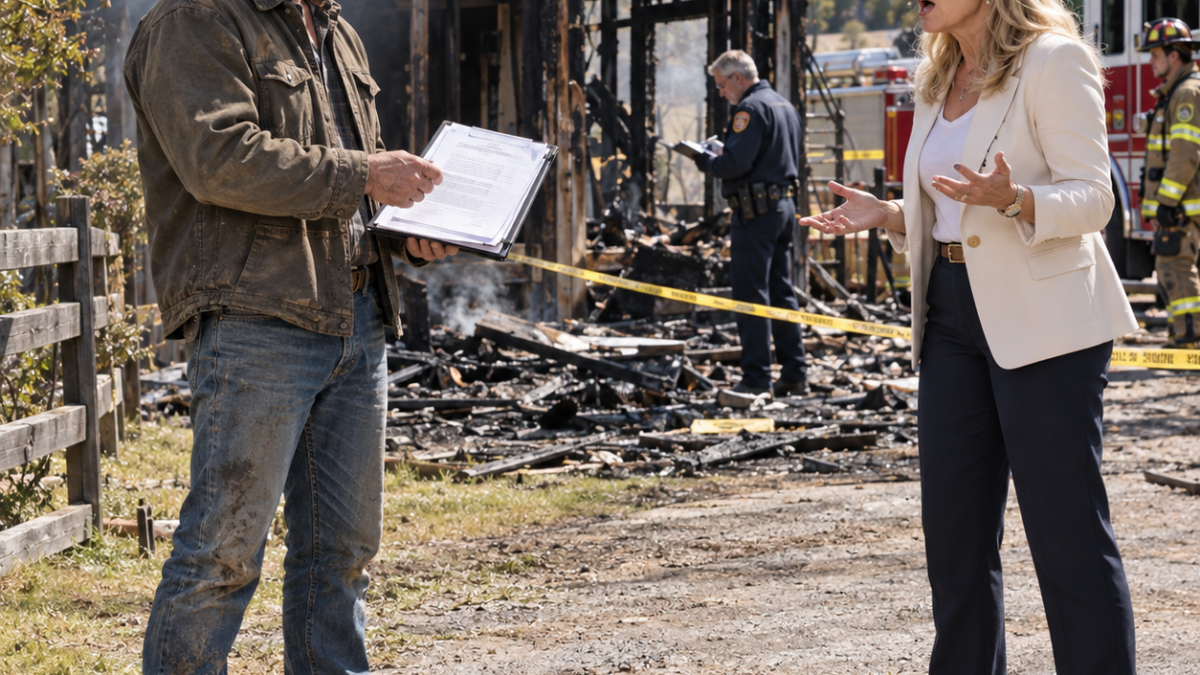
PART 2
The convoy rolled before the sentence was finished.
I climbed into the passenger seat of the lead SUV.
Special Agent Lena Ortiz sat behind me with a warrant packet on her lap.
“You stay in your lane when we arrive,” she said.
“I know.”
“I mean it, Mason.”
“So do I.”
Lena had been telling me the same thing for months.
The dispute started on my land.
The first threats came to me.
The cameras were mine.
The workers Karen had restrained were working for me.
And I was still a federal law-enforcement officer.
That combination was exactly why I could not be the man directing the case.
If Karen was arrested, somebody independent needed to make that arrest.
If searches occurred, somebody else needed to control them.
If charges were presented, prosecutors needed evidence that did not depend on my anger.
So I sat in the passenger seat and watched the live feed on a tablet.
The records shed was burning harder now.
My stomach twisted.
That building was nothing impressive.
Twenty-four feet by thirty.
Wood frame.
Metal roof.
Two windows.
A concrete pad my father and I poured ourselves almost twenty years earlier.
Dad called it the archives.
My son Luke called it the paper prison.
Old property records lived there.
Fence agreements.
Survey plats.
Equipment files.
Tax documents.
Family ledgers.
Copies of correspondence from Karen.
Most critical records had been digitized or stored elsewhere because once the investigation became serious, I was not stupid enough to keep the only copies inside a wooden building.
Karen didn’t know that.
She apparently believed burning the shed would burn the case.
The camera feed showed six workers sitting near the fence with their hands bound behind them.
My site manager, Ray Dawson, stood beside the equipment barn with a security guard watching him.
Unlike the others, Ray wasn’t on the ground.
Probably because at six foot four and nearly 250 pounds, putting him there would require more enthusiasm than Karen’s hired men possessed.
The backhoe had already ripped several newly set fence posts from the ground.
Lena leaned forward.
“They still armed?”
“Several sidearms visible.”
“Any rifles?”
“Not on camera.”
The task-force commander spoke from the driver’s seat.
“Three minutes.”
I looked again at the burning shed.
The western wall disappeared behind smoke.
For fourteen months I had thought I understood Karen.
I understood ambition.
I understood financial pressure.
I understood someone manufacturing authority because real authority wouldn’t give her what she wanted.
But burning the shed was different.
That wasn’t paperwork.
That wasn’t a fake fine.
That wasn’t moving a property stake eleven feet in darkness.
Fire was irreversible.
I thought about my father’s handwriting in the old land ledgers.
Then I stopped.
That kind of thinking makes law enforcement personal.
Personal makes people careless.
I closed the tablet.
Lena noticed.
“You okay?”
“No.”
“Good answer.”
We came over the ridge.
The first thing I saw was smoke.
The second was Karen.
She stood in the middle of the yard wearing dark slacks and an expensive tan jacket entirely inappropriate for a dusty property raid.
Her private security people turned toward us.
The convoy entered fast enough to make them understand immediately that this was not another neighborhood argument.
Federal vehicles spread across the gravel yard.
Doors opened.
Agents moved.
“KEEP YOUR HANDS VISIBLE!”
“STEP AWAY FROM YOUR WEAPONS!”
“DO NOT REACH!”
The difference between authority and theater was visible in seconds.
Karen’s guards had looked intimidating while surrounding fence workers.
Now they were standing in front of sworn officers operating under federal warrants.
Hands went up.
Wade Barron, Karen’s security chief, looked toward her.
Then toward us.
I knew Wade by reputation.
Private debt collection.
Executive protection.
No sworn police commission.
No authority to arrest my workers simply because an HOA president told him to.
Ray caught sight of me.
For the first time all morning, his expression changed.
Not relief.
Annoyance.
That was Ray.
“Took you long enough,” he called.
One agent almost laughed.
Lena didn’t.
“Everybody quiet.”
She walked toward Karen.
I went to the workers.
A deputy marshal used trauma shears to cut the first zip tie.
“Anybody injured?”
“Wrists,” one man said.
“Security guy shoved Danny into the fence.”
Danny had blood on one cheek from a scrape.
Nothing severe.
Still enough to make my jaw tighten.
Ray held out his wrists.
“Mine too?”
“You weren’t tied.”
“I’m emotionally restrained.”
“Ray.”
“Bad morning.”
An agent moved him behind the federal line.
I turned toward Karen.
She was arguing with Lena.
“This is association property.”
Lena held up the warrant.
“No, ma’am.”
“We have legal possession pursuant to an emergency protection action.”
“Show me the court order.”
Karen produced a paper from her folder.
Lena read it.
Her expression did not change.
“Who signed this?”
“I did.”
“In what capacity?”
“President of the Blackridge Property Association.”
“Which court approved it?”
“The association possesses independent enforcement authority.”
“Over Mr. Reed’s property?”
“This parcel is subject to accumulated association liens.”
“No recorded lien gives you possession today.”
Karen looked toward me.
“This is his doing.”
I said nothing.
She raised her voice.
“Mason has been obstructing lawful development for over a year.”
Still nothing.
Lena glanced at me.
It was almost a warning.
I nodded.
Karen hated silence.
She always had.
She needed resistance because resistance allowed her to turn herself into the victim.
So Lena gave her none.
“Ms. Vale, where did you obtain authority to detain six workers?”
“They were trespassing.”
“On whose land?”
“Association-controlled property.”
“Who owns the deeded parcel?”
Karen hesitated.
“It is disputed.”
Lena looked toward Wade.
“Mr. Barron, did you verify ownership before your personnel restrained those men?”
Wade swallowed.
“We were advised Ms. Vale had legal possession.”
“By a court?”
“By the association.”
“Did you personally review a judicial order?”
“No.”
“Were any of those workers armed?”
“No.”
“Did any attack your personnel?”
“No.”
Karen turned on him.
“Wade.”
He looked at her.
Something passed between them.
Fear replacing loyalty.
Then an agent shouted from the shed.
“FIRE’S STILL ACTIVE!”
Two agents retrieved extinguishers.
A county engine was already coming down the road, dispatched after our operations team called the fire in.
White suppressant disappeared into the doorway.
Steam and smoke rolled out.
The fire department arrived minutes later.
Captain Joel Haines took command of suppression.
I knew Joel.
Not well.
Enough to trust him.
“What’s inside?” he asked.
“Paper records, filing cabinets, wood shelving.”
“Fuel?”
“Small lawn equipment in a separate rear section. No gasoline stored inside the records room.”
“Electrical?”
“Standard service.”
“Anybody see ignition?”
I looked toward Karen.
“No direct eyewitness yet.”
That was technically true.
The security cameras showed entry and smoke timing.
They did not show the flame itself.
I wasn’t going to overstate evidence just because I suspected the answer.
Joel nodded.
“Stay out until we clear it.”
Karen was still talking.
“I demand that fire crews preserve my association documents.”
Lena actually looked confused.
“Your documents?”
“In that building.”
My attention sharpened.
Lena caught it too.
“How did association documents get inside Mr. Reed’s shed?”
Karen realized what she had said.
“They were stolen.”
“By whom?”
“Mason.”
I nearly smiled.
Not because it was funny.
Because the red accordion folder was visibly sticking out of Karen’s leather tote.
The same folder she was now calling stolen property.
Lena looked at the bag.
“Ma’am, set your tote on the hood of that vehicle.”
“No.”
“We are executing a warrant that authorizes seizure of documents relating to the Blackridge financial investigation.”
“These are privileged association materials.”
“Set it down.”
Karen gripped the handle.
For one strange second, I thought she might run.
Where, I have no idea.
The entire yard was secured.
She finally lowered the bag.
An evidence agent photographed it in place.
Gloves.
Documentation.
Search under warrant.
The red folder came out.
Karen’s face went white.
Lena held it without opening it.
“Mr. Reed, can you identify this?”
“Yes.”
“How?”
“My evidence copy. Red expanding folder. Label inside front flap reads BVE-2.”
The agent opened the flap.
BVE-2.
Blackridge Vale Evidence, copy two.
Every critical page inside had a digital counterpart stored with investigators.
Karen had stolen the physical copy.
“What was it doing in her bag?” Wade whispered.
Nobody answered him.
Karen did.
“He stole those documents from the association.”
Lena looked at her.
“Which documents?”
Karen stopped.
She had not yet been told what the folder contained.
I watched the realization hit.
There are moments when a person understands that speaking has become more dangerous than silence.
Karen finally found one.
“I want counsel.”
Lena nodded.
“That is your right.”
No gloating.
No clever line.
Real investigations become stronger when officers stop talking after someone invokes counsel.
The fire was contained before the building collapsed.
The roof survived.
Two interior walls were heavily damaged.
The main filing area looked black and wet.
At 7:43 a.m., State Fire Marshal investigator Daniel Price arrived with an ATF-certified fire investigator assigned because the building was part of a business operation and the scene was already connected to an active federal investigation.
Daniel and I had worked together years earlier on a fugitive case involving a warehouse fire.
He gave me one nod.
“Your place?”
“Yes.”
“You going inside?”
“No.”
“Good.”
He knew exactly why.
Conflict again.
I did not participate.
They photographed everything.
Electrical panel.
Outlets.
Windows.
Door.
Filing cabinets.
Floor.
Burn patterns.
Debris.
Potential ignition sources.
The process took hours.
Not twenty theatrical minutes.
By late morning, Daniel came out carrying evidence containers.
His coveralls were streaked black.
“What can you tell us?” Lena asked.
“Preliminary only.”
“Understood.”
“Fire originated in the records side, near the lower portion of the metal filing cabinet.”
“Electrical?”
“Nothing yet suggests an electrical origin. Breaker condition and damage pattern don’t fit that as the obvious explanation, but I’m not ruling anything until examination is complete.”
“Accelerant?”
“We have indicators consistent with an ignitable liquid. Samples are going to the lab.”
Karen was standing nearby with an agent.
She had not yet been transported because investigators were still processing arrests and warrants.
Her face changed.
Daniel noticed.
He looked at Lena.
“Who had access immediately before ignition?”
“We have video of Ms. Vale entering the shed after her security personnel forced the door. Smoke becomes visible shortly after she exits.”
Daniel turned toward the shed.
Then back to Lena.
“Preserve the footage.”
Karen said, “The fire was already starting when I went inside.”
Every investigator near her went still.
Lena looked at Karen.
“You have requested counsel.”
Karen realized she had spoken voluntarily.
Lena did not ask a follow-up.
That discipline mattered.
Karen tried again.
“I smelled something burning.”
Lena raised one hand.
“We are not questioning you.”
Silence.
Karen closed her mouth.
The arrest paperwork already included financial offenses supported by months of investigation.
The morning had added an entirely new group of potential state and federal charges.
Unlawful detention.
Burglary.
Property damage.
Evidence destruction.
Possibly arson, depending on forensic results and prosecutorial review.
Wade and several guards were also taken into custody or detained for questioning based on their conduct.
The crew received medical checks.
Danny needed two stitches.
The others had bruising around their wrists.
Ray refused treatment until a paramedic threatened to document that he was being “stubborn in an official medical capacity.”
That worked.
By noon, the property was quieter.
Karen was gone.
The black SUVs were being inventoried.
The backhoe sat useless near the ruined fence.
The shed still smelled like wet charcoal.
I stood behind the fire line staring at it.
Ray came beside me with gauze around one wrist.
“Your dad’s files?”
“I don’t know yet.”
“Most of it backed up?”
“The legal records, yes.”
“Family stuff?”
I didn’t answer.
Ray understood.
Dad had been a surveyor before arthritis forced him to stop.
He loved paper.
Hated computers.
Every property purchase.
Every fence agreement.
Every handwritten field measurement.
He kept notebooks.
Yellow legal pads.
Graph paper.
Old Polaroids with dates written on the back.
When I was twelve, he made me walk boundary lines with him carrying stakes.
At seventeen, I hated it.
At fifty-four, I would have paid almost anything to hear him argue about bearings again.
The records shed contained several boxes I had never digitized because they weren’t legally important.
They were important to me.
Ray put a hand on my shoulder.
“I’m sorry.”
“That’s the part she can’t pay back.”
He nodded.
The investigation moved rapidly after the raid, but not magically.
Search warrants at Blackridge’s administrative office produced servers, accounting files, contracts, and several storage drives.
Investigators found a locked cabinet containing physical corporate records for businesses that had received large payments from the association.
Some were legitimate vendors.
Others appeared connected to Karen and people close to the development consortium.
The story became clearer.
Karen had promised the developers she could secure my corridor.
In exchange, she was positioned to receive consulting compensation through entities that did not make that relationship obvious to residents.
The expansion deal promised millions.
If the corridor failed, the entire project became less attractive.
She had therefore turned the HOA into a pressure machine.
Invent fines.
Create debt.
Claim liens.
Alter maps.
Make possession appear disputed.
Wear me down.
Then obtain the road cheaply.
The records shed was supposed to be the end of my resistance.
Instead, the fire became another investigation.
The lab report returned six weeks later.
Daniel called Lena, not me.
I received the result only later through proper channels.
The samples contained residues consistent with a commercially available petroleum-based lighter fluid.
Investigators also established several facts that mattered.
The electrical circuit feeding the cabinet area showed no evidence supporting an electrical malfunction as the source.
The fire originated low.
Burn patterns indicated liquid had been distributed in more than one spot near the filing cabinet and floor.
A plastic bottle recovered near the shed tested consistently with the same type of product.
The strongest evidence, however, wasn’t chemistry.
It was timing.
Camera one showed Karen entering the building.
Camera two showed the security chief at the door.
Camera three, mounted on a pole farther away, captured Karen walking out carrying the red folder.
Forty-two seconds later, the first visible smoke emerged.
No one else entered during that interval.
Wade eventually cooperated.
His lawyer negotiated a proffer session.
Wade admitted Karen ordered the door forced.
He said she entered alone.
He said she came out carrying the folder.
He also told investigators something we hadn’t known.
Minutes before entering, Karen had told him:
“If they have paper copies in there, this ends today.”
That sentence changed the arson theory from possible panic to potential intent.
Wade insisted he did not know she planned to start a fire.
Prosecutors would have to decide how much of his testimony to believe.
He had participated in illegal detentions.
He had an incentive to minimize himself.
That was why corroboration mattered.
The fire report corroborated him.
The video corroborated him.
Karen’s stolen folder corroborated motive.
And the financial case supplied context.
The defense attacked all of it.
Karen hired Alan Crews, one of the most aggressive white-collar defense attorneys in the state.
His first public statement said:
“My client was the victim of a federal officer using government power to settle a private property dispute.”
I expected that.
It was the reason I had spent fourteen months avoiding the case operationally.
The prosecution later produced documentation showing I had disclosed the dispute from the beginning.
I had not issued subpoenas.
Had not interviewed Karen.
Had not requested her bank records.
Had not participated in grand-jury presentations.
The financial investigation was run through the FBI and U.S. Attorney’s Office.
The fire investigation was independent.
Even my own cameras had been collected and imaged by investigators under evidence procedures.
Alan Crews then attacked the fire.
Accidental ignition.
Electrical fault.
Contaminated samples.
Firefighters introducing chemicals.
Lighter fluid used for a grill nearby.
All reasonable possibilities to test.
Daniel Price tested them.
That was his job.
His final report was 117 pages.
The sentence everyone remembered was much shorter:
**The fire originated inside the records-storage area and was intentionally ignited after the application of an ignitable liquid.**
Karen had told reporters through counsel that the shed caught fire because I had “dangerously maintained an old electrical structure.”
The report told a different story.
The structure’s wiring had been inspected eight months before the fire.
The relevant breaker had not failed.
The burn pattern did not originate at an outlet or junction.
The lab findings and scene characteristics supported deliberate ignition.
That did not automatically tell investigators who started it.
The video and witness evidence addressed that part.
Meanwhile, Blackridge residents began discovering what Karen had been doing with their money.
That was when I stopped seeing the case as mine.
I had lost a shed.
They had lost trust in an institution they funded.
An elderly couple named George and Marianne Lewis discovered they had paid thousands in “special legal assessments” supposedly tied to drainage litigation.
There had been no drainage lawsuit.
A young mother named Alicia Perez had been threatened with a lien over landscaping penalties while association funds were being transferred into consulting arrangements connected to the development deal.
Several homeowners had questioned the spending months earlier.
Karen branded them disruptive.
One had been removed from a committee.
Another received three violations within two weeks of requesting invoices.
The new picture was ugly.
Not every board member had participated.
That mattered.
One board member, Helen Brooks, had voted for spending packages because Karen presented them as attorney-approved.
Helen cried when agents interviewed her.
“I should’ve asked to see more.”
She had been careless.
Careless was not the same as criminal.
The association attorney, Evan Pierce, became one of the most important witnesses.
He had noticed documents bearing his name that he never approved.
He had preserved emails.
He had warned Karen.
One email became particularly damaging.
Evan wrote:
**The Reed parcel is not subject to Blackridge covenants. We cannot impose association fines, create a lien without legal basis, or enter the property without lawful authority. Stop sending enforcement notices until title issues are reviewed.**
Karen replied:
**Your job is to create options, not tell me what can’t be done.**
Three weeks later, the fake penalties continued.
When I read that exchange, I sat in silence.
Not because it surprised me.
Because it confirmed something I had wondered for months.
Karen had known.
This wasn’t a woman confused about jurisdiction.
She had been warned.
She chose pressure anyway.
My son Luke struggled with that more than I did.
Luke was twenty-nine and ran a grading company.
He had helped Dad build the records shed when he was a teenager.
After the fire scene was released, Luke came with me to inspect what remained.
The inside was black.
Metal file cabinets warped.
Plastic bins melted.
Wet paper had fused into heavy blocks.
Luke stood where the old desk had been.
“She did this because you wouldn’t sell?”
“Partly.”
He kicked a charred piece of lumber.
“Don’t.”
He looked at me.
“Don’t what?”
“Break anything.”
“It’s burned.”
“It’s still evidence until we know what’s released.”
He laughed without humor.
“You sound like a marshal.”
“I am a marshal.”
“You’re also his son.”
That stopped me.
Luke crouched beside a collapsed shelf.
“My grandfather spent half his life writing this stuff down.”
“I know.”
“You going to stand there pretending this is just a case?”
“No.”
“Sure looks like it.”
He walked outside.
I stayed.
He wasn’t wrong.
My discipline protected the investigation.
It also allowed me to hide.
Anger is easier to manage when you rename it procedure.
Grief too.
That evening, Luke came back to my house.
“I’m sorry.”
“You don’t owe me that.”
“Yes, I do.”
We sat on the back porch.
He looked toward the dark field.
“I found one of Grandpa’s notebooks.”
My head turned.
“What?”
He took a plastic evidence-release bag from his backpack.
The fire investigator had released a small batch of non-evidentiary personal items after photographing them.
Inside was Dad’s 1987 boundary notebook.
The cover was blackened.
Edges burned.
Half the pages damaged by water.
But his handwriting survived in the middle.
I opened carefully.
Page 42.
North creek fence.
Dad’s pencil notes.
Distances.
Bearings.
A small joke in the margin:
**Mason complained entire walk. Future owner already lazy.**
I laughed.
Then I cried.
Luke pretended not to notice until I handed him the notebook.
“He was right,” Luke said.
“About what?”
“You are lazy.”
I hit his shoulder.
That scorched notebook became more important to me than the entire criminal file.
Months later, the federal grand jury returned an indictment.
Not the absurd seventy-count fantasy rumors predicted.
The charges reflected what prosecutors believed they could prove.
Wire fraud.
Mail fraud.
Conspiracy.
Extortion-related conduct.
Fraud involving property documents.
Charges connected to obstruction and evidence destruction.
Karen also faced serious arson-related allegations based on the shed fire.
State charges covered the unlawful detention and property offenses from the raid.
Wade entered a plea agreement and agreed to testify.
Two development executives cooperated.
Another fought the case.
The Blackridge board dissolved.
A temporary administrator took over association finances.
Residents demanded elections.
The civil litigation multiplied.
Insurance carriers became involved.
Developers blamed Karen.
Karen blamed developers.
Everybody blamed Wade.
Wade blamed the contracts.
Contracts, unfortunately for all of them, could talk.
Emails.
Transfers.
Invoices.
Messages.
The expansion company had paid consulting fees into an LLC controlled by Karen’s cousin.
That LLC paid another entity connected to Karen.
Prosecutors argued the arrangement concealed her personal financial interest.
Defense attorneys argued the payments were legitimate project consulting.
Some were.
Some weren’t.
The case took almost eighteen months to reach trial.
During that time, Alan Crews repeatedly challenged the fire evidence.
He hired his own expert.
The expert agreed the fire started in the records area but questioned whether investigators could exclude every accidental source.
That was fair.
Experts disagree.
The prosecution did not rely on the fire report alone.
They had video.
Wade.
Timing.
The stolen folder.
Karen’s statements.
And the financial motive.
I was called as a witness.
Before I testified, Lena met me in the courthouse hallway.
“You know the rule.”
“Answer the question asked.”
“Don’t argue.”
“I never argue.”
She stared at me.
“Your entire relationship with Ray Dawson disproves that.”
“That’s friendship.”
“Whatever helps.”
Alan Crews began politely.
“Mr. Reed, you are a United States marshal?”
“Deputy U.S. marshal. Supervisory.”
“And you have extensive experience gathering evidence?”
“Yes.”
“You installed hidden cameras around your property.”
“Visible and concealed cameras on my own property, yes.”
“Before my client allegedly committed any crime?”
“After repeated trespasses and moved survey markers.”
“You maintained a file on her.”
“I maintained records regarding the dispute.”
“You called it an evidence file.”
“Yes.”
“BVE.”
“Yes.”
“Blackridge Vale Evidence?”
“Yes.”
He turned slightly toward the jury.
“So you had already decided Karen Vale was a criminal.”
“No.”
“Then why call it evidence?”
“Because letters, photographs, and videos can be evidence whether they prove a crime, a civil violation, or nothing at all.”
“You are trained to build cases.”
“Yes.”
“You left a red evidence folder in the shed the morning federal agents were coming to arrest my client.”
“Yes.”
“Convenient.”
“It was a working duplicate.”
“You expected her to find it.”
“No.”
“Really?”
“I expected her to stay off my property.”
A few jurors reacted.
Alan paused.
“You had cameras positioned to record entry.”
“They had been installed months earlier.”
“You knew a raid was scheduled.”
“I knew law enforcement activity was scheduled. I was not told every operational detail until briefing.”
“You left documents where my client could supposedly steal them.”
“They were inside a locked building on my property.”
“Was the shed locked?”
“Yes.”
“Yet you call her taking the folder theft.”
“Yes.”
He frowned.
“You were hoping she would incriminate herself.”
“No.”
“You weren’t?”
“I was hoping she would obey the law.”
That ended that line.
Then came the fire.
“Mr. Reed, did you see my client ignite a fire?”
“No.”
“Did any camera record her applying lighter fluid?”
“No.”
“Did you personally witness ignition?”
“No.”
“So when you tell this jury Karen Vale burned your shed, you are relying on inference.”
“I have not told the jury she burned it. I testified to what I personally observed and what my cameras recorded.”
He did not like that answer.
“Your own shed contained charcoal lighter fluid.”
“Yes.”
“So the presence of lighter fluid was not unusual.”
“There was a grill outside.”
“Meaning anyone could have accessed it.”
“Potentially.”
“Your building had electricity.”
“Yes.”
“Old electricity.”
“Wiring replaced eight years earlier.”
“Still capable of failure.”
“Yes.”
“Thank you.”
He sat down.
The prosecutor stood.
“One question, Mr. Reed. Why did you refuse to say the defendant set the fire?”
“Because I did not personally see her strike the ignition source.”
“And who determines cause and origin?”
“Fire investigators.”
“Thank you.”
That was the difference Karen never understood.
Real authority does not become stronger by claiming more than the evidence supports.
It becomes stronger by knowing where the evidence ends.
Daniel Price testified next.
He explained the scene.
Not dramatically.
Professionally.
He walked the jury through photographs.
The deepest burning.
The fire’s origin area.
Laboratory analysis.
Electrical examination.
The multiple indicators that led investigators to classify the fire as intentionally set.
Alan attacked hard.
“You cannot tell this jury exactly what device ignited the fire, can you?”
“No.”
“You did not recover a usable lighter with fingerprints?”
“No.”
“You cannot testify that you personally watched Ms. Vale set the fire.”
“No.”
“So your opinion has limits.”
“Every forensic opinion has limits.”
“Then you cannot say she did it.”
“I determine origin and cause. Identity is for the broader investigation and ultimately the jury.”
Daniel remained calm.
Alan tried another approach.
“The shed contained lighter fluid before the fire.”
“Yes.”
“So your chemical finding proves nothing.”
“It proves an ignitable liquid consistent with that product was present in locations and patterns relevant to the fire’s origin.”
“But not who poured it.”
“Correct.”
Again.
No overreach.
Then prosecutors played the security video.
Karen entering.
The forced door.
Karen leaving with the red folder.
Smoke appearing less than a minute later.
Wade testified after that.
His credibility took a beating.
It should have.
He had broken the law.
He had taken a plea.
He wanted a reduced sentence.
The jury deserved to hear every reason he might lie.
Then prosecutors showed text messages between Wade and Karen.
The night before the raid:
**Need crew locked down. No calls out until we control the parcel.**
Wade:
**Need actual court paperwork if we’re detaining anyone.**
Karen:
**You have the emergency order. Stop overthinking.**
Another:
**Tomorrow ends Reed’s resistance.**
Wade testified that Karen gave the detention order.
That he followed it.
That she ordered the shed door forced.
Then he described what she said before entering.
“If they have paper copies in there, this ends today.”
Alan attacked.
“You are facing prison.”
“Yes.”
“You want less prison.”
“Yes.”
“And prosecutors told you cooperation helps.”
“Yes.”
“So you will say anything.”
“No.”
“Convenient answer.”
Wade looked toward the jury.
“I was stupid enough to follow her orders. I’m not asking anyone to pretend otherwise.”
That honesty probably saved part of his credibility.
The biggest courtroom moment came from Evan Pierce.
Karen’s former attorney.
He authenticated the email warning her Blackridge had no authority over my land.
The prosecutor asked:
“Did you advise Ms. Vale that she could impose HOA fines on Mr. Reed?”
“No.”
“Did you tell her she could seize his property?”
“No.”
“Detain his workers?”
“Absolutely not.”
“Did you authorize an emergency community protection order?”
“No.”
“What did you tell her?”
“To stop.”
The courtroom went still.
“Did she?”
“No.”
The financial testimony lasted days.
Banking analysts.
Forensic accountants.
Developers.
Association residents.
Not dramatic.
Devastating.
Numbers are like that.
Money entered.
Money moved.
Money reappeared somewhere it was not supposed to be.
Karen eventually testified.
Her lawyers had reasons.
She was persuasive.
She presented herself as a determined association president trying to protect residents from a hostile landowner.
She insisted the expansion would have improved property values.
She said my refusal threatened millions in community investment.
She claimed the fines were based on legal advice.
Evan Pierce’s emails made that difficult.
Then she addressed the fire.
“I didn’t start it.”
Her attorney asked, “Why did you enter the records shed?”
“To preserve association documents Mason Reed had taken.”
“Did you use lighter fluid?”
“No.”
“Did you ignite paper?”
“No.”
“Why was the red folder in your bag?”
“Because it contained stolen association records.”
“Were you attempting to destroy evidence?”
“Absolutely not.”
On cross-examination, the prosecutor displayed one photograph from the red folder.
Two of Karen’s contractors moving my boundary marker.
“Is this your association property?”
“No.”
“Your contractor?”
“I can’t tell.”
An employment record followed.
Same man.
The prosecutor displayed a fraudulent fine.
“Your signature?”
“Yes.”
“Mr. Pierce told you in writing Blackridge lacked jurisdiction.”
“He was overly cautious.”
“Is that a legal term?”
“No.”
A few people smiled.
Then came the internal development email.
**If Reed corridor isn’t secured by June, expansion financing fails.**
Karen had replied:
**I’ll have control before then.**
The prosecutor asked:
“What did ‘control’ mean?”
“Access agreement.”
“Voluntary?”
“That was the goal.”
“Is zip-tying workers voluntary?”
“I did not personally tie anyone.”
“Did you order them detained?”
“I ordered the property secured.”
“Did you order Mr. Barron to prevent workers from leaving?”
“I don’t recall.”
The body-camera audio from the raid played.
Karen’s voice:
**Nobody leaves until I say this matter is resolved.**
She stopped looking at the jury.
Then the prosecutor moved to the fire.
“You entered the shed?”
“Yes.”
“Without permission?”
“I believed I had authority.”
“You took the red folder?”
“Yes.”
“Smoke appeared forty-two seconds after you left?”
“If that’s what the video says.”
“You told investigators the fire was already starting while you were inside.”
“I smelled something.”
“Yet security footage shows you never warning any worker outside that a building was burning.”
Silence.
“I was under stress.”
“You walked out carrying records.”
“Yes.”
“You did not call 911.”
“No.”
“You did not tell your own security chief there was a fire.”
“I assumed someone would see it.”
“You did not move workers away from the structure.”
“I—”
She stopped.
The prosecutor waited.
Silence does work in court.
Eventually the prosecutor said:
“No further questions.”
The jury deliberated for two and a half days.
Not fifteen minutes.
Not one dramatic hour.
Real jurors understand what conviction means.
They asked to review several emails.
Requested clarification on one conspiracy instruction.
Watched portions of the security footage again.
I spent those days at the ranch.
I did not sit outside the courthouse refreshing my phone.
Luke and I rebuilt fence.
Ray supervised us despite having no legitimate authority to supervise anything.
On the second afternoon, Ray pointed at a post I had set.
“Crooked.”
“It is not.”
“It’s leaning.”
“You’re leaning.”
Luke stepped back.
“It is crooked.”
“Traitor.”
My phone rang.
Lena.
I pulled off one glove.
“Verdict?”
“Yes.”
I walked away from them.
“Tell me.”
Karen was convicted on the core fraud and conspiracy counts.
Convicted on obstruction-related charges.
Convicted on the arson count prosecutors had taken to trial.
Acquitted on two lesser counts where the jury apparently concluded the government had not met its burden.
That mattered to me.
A jury willing to acquit on some allegations was a jury doing its job, not simply punishing a person it disliked.
I ended the call.
Ray watched me.
“Well?”
“Convicted.”
Luke lowered the post driver.
“On the fire?”
“Yes.”
He closed his eyes.
Ray said nothing for a while.
Then:
“Fence is still crooked.”
I laughed.
That night I went into the house, took Dad’s burned notebook from a drawer, and placed it on the kitchen table.
Conviction didn’t restore the shed.
It didn’t unburn paper.
It didn’t erase the image of Danny bleeding against my fence.
It didn’t return stolen HOA funds by magic.
Justice is not time travel.
It is only accountability moving forward.
Sentencing came months later.
Residents submitted statements.
Some asked for the maximum.
Others described how Karen had once helped them.
That complexity mattered.
Karen had organized food drives.
Helped an elderly resident after a hurricane.
Negotiated legitimate landscaping contracts.
People are capable of decent acts and serious crimes in the same lifetime.
Pretending otherwise makes stories simpler than people.
Evan Pierce spoke about professional betrayal.
George and Marianne Lewis spoke about money they lost.
Danny described being forced into the dirt while doing fence work.
Ray declined to speak.
“Why?” I asked.
“I’ll say something sarcastic.”
“For once, self-awareness.”
Luke wanted to speak about Grandpa’s records.
Instead, he asked me to.
So I did.
I stood before the judge with one sheet of paper.
“I have spent my career executing warrants,” I said. “I know what lawful force looks like, and I know how carefully government authority is supposed to be limited.”
Karen sat at the defense table.
“What happened on my property was the opposite. Private people created their own authority, wrote their own orders, and decided that enough confidence could substitute for law.”
I paused.
“The financial losses can be calculated. The destroyed property can be valued. But there were also things in that shed that had no market price.”
I held up a photograph of Dad’s burned notebook.
“My father wrote this before most of the people in this courtroom knew Blackridge Estates would ever exist.”
My voice tightened.
“I’m fortunate this survived.”
I put the photograph down.
“I do not ask the court for revenge. I have arrested enough people to know that revenge is a poor foundation for justice. I ask for a sentence that recognizes the difference between making a mistake and repeatedly choosing to cross another line because the previous one did not produce the result you wanted.”
Then I sat.
Karen spoke too.
Her statement was quieter than I expected.
She apologized to Blackridge residents.
To her family.
To people who lost money.
She stopped short of admitting every disputed act, as defendants sometimes do when appeals or related matters remain possible.
But she said something that stayed with me.
“I started believing the project failing meant I was failing.”
She looked at the judge.
“Then every person who said no became somebody I had to defeat.”
That sounded true.
Maybe it was the first honest explanation she had given.
The judge imposed a substantial federal sentence.
Years in prison.
Restitution.
Forfeiture.
Supervised release afterward.
Restrictions affecting future fiduciary roles.
State sentences and resolutions addressed the morning’s unlawful detention and related offenses.
Wade received less because of cooperation, but not nothing.
Several developers paid enormous financial penalties.
One executive served prison time.
Other board members were not charged where investigators could not prove criminal intent.
The distinction mattered.
The HOA itself entered receivership temporarily.
Then Blackridge residents elected a new board.
Their new president was Helen Brooks.
The same Helen who had spent months blaming herself for not challenging Karen sooner.
She came to my property carrying an actual survey.
No security.
No fake order.
No gold seal.
“Mason.”
“Helen.”
“I’d like to talk.”
“Okay.”
She looked toward the rebuilt fence.
“We need access to the old community water parcel.”
“That access predates the development.”
“We found it.”
“Good.”
“The current route crosses a corner near your north gate.”
“It does.”
“We’d like to formalize it properly.”
“Now we’re speaking the same language.”
We sat at the picnic table.
Attorneys prepared a narrow easement limited to maintenance access for the water parcel.
No construction road.
No expansion corridor.
No hidden development rights.
Clear width.
Clear hours.
Emergency provisions.
Insurance.
Everything written plainly.
I signed after my attorney reviewed it.
Helen stared at my signature.
“I expected you to refuse anything involving Blackridge.”
“Why?”
“Because of what happened.”
“Your residents didn’t burn my shed.”
“Karen was our president.”
“She was one person.”
“Other people enabled her.”
“Yes.”
Helen looked down.
“Including me.”
“You trusted someone who presented herself as knowing more than you.”
“That sounds like an excuse.”
“It can be an explanation without being an excuse.”
She nodded.
“Thank you.”
The community slowly recovered.
Auditors reconstructed finances.
Insurance covered some losses.
Court-ordered restitution addressed others.
Some money was gone forever.
The development expansion died.
Not because I demanded it.
The financing collapsed under the criminal investigation, litigation, and additional legitimate access costs.
The northern field stayed mine.
The repaired fence stayed where the legal survey said it belonged.
And the old records shed?
Luke wanted to bulldoze it and build completely new.
I didn’t.
The structural engineer said two charred wall studs near the far corner could be preserved if reinforced.
So we did.
We rebuilt around them.
New slab coating.
Fire-resistant interior.
Steel cabinets.
Automatic suppression system.
Digital backups stored off-site.
Ray called it Fort Paperwork.
Above the door, Luke mounted one cleaned piece of the original charred oak framing.
Under it he placed a small brass plaque.
I expected something sentimental.
It read:
**MASON COMPLAINED ENTIRE REBUILD. STILL LAZY.**
Dad’s notebook line.
I stood underneath it laughing until I had tears in my eyes.
“You’re an idiot,” I told Luke.
“Family tradition.”
A year after sentencing, Daniel Price stopped by.
The fire investigator.
He wanted to see the rebuilt shed.
“You upgraded.”
“Apparently burning it once was enough.”
He ran his hand along the steel cabinet.
“Good choice.”
I made coffee.
We sat outside.
“I never thanked you.”
“For what?”
“The report.”
He frowned.
“I wrote what the scene said.”
“Exactly.”
That was why I thanked him.
The title people later gave the case was dramatic.
Karen Burned the Records Shed.
The Fire Report Exposed Her.
But the real report did not contain drama.
It contained measurements.
Photographs.
Samples.
Electrical examination.
Laboratory results.
Timelines.
Limitations.
It never said:
Karen is evil.
It never said:
Mason is right.
It said:
This is where the fire started.
This is what was present.
This is what evidence supports.
This is what it does not.
That was enough.
Truth often is.
My retirement from the Marshals Service came three years later.
Not because of Karen.
Twenty-seven years plus was enough.
At my retirement dinner, Lena Ortiz gave me a small box.
Inside was a red accordion folder.
New.
Empty.
I looked at her.
“You’re hilarious.”
“I thought you might miss the old one.”
“Evidence still has it.”
“Exactly.”
Ray yelled from another table:
“Burn it!”
Everyone laughed.
I kept it.
The next morning, I woke before sunrise anyway.
Old habits.
I walked down to the northern fence.
Mist sat low over the grass.
The rebuilt records shed stood in the distance.
No smoke.
No black SUVs.
No private security.
A Blackridge maintenance truck came through the legal water easement around eight.
The driver stopped at my gate.
“Morning, Mr. Reed.”
“Morning.”
“Board sent notice. We’ll be out by noon.”
“I got it.”
That was it.
Lawful access.
Advance notice.
A person doing a job.
Ordinary.
I had spent years thinking the satisfying ending would be seeing Karen lose everything she tried to take from others.
It wasn’t.
The satisfying part was discovering that life after her became boring.
Fences needed repair.
Taxes arrived.
Cattle escaped.
Ray complained.
Luke argued about equipment.
Blackridge residents waved from trucks.
Nobody invented laws.
Nobody moved boundary markers.
Nobody arrived with armed men.
One evening Luke and I went through the surviving boxes.
A metal cabinet near the back wall had protected more than expected.
Some pages were useless.
Some smelled permanently of smoke.
Then we found an old photograph.
Dad.
Me at fifteen.
Both of us standing beside the northern boundary.
I was skinny, sunburned, and clearly furious about being forced to work.
Dad was smiling.
On the back he had written:
**North fence, June 1985. Mason says someday he’ll own land without fences.**
Luke laughed.
“How’d that work out?”
“Shut up.”
“You own approximately fourteen miles of fence.”
“I know.”
“Grandpa wins again.”
I slipped the photograph into the burned notebook.
Then I looked around the shed.
Karen had entered that building believing records were power because records could be destroyed.
She misunderstood.
A record matters because it connects one fact to another.
And once enough people hold those facts—lawyers, banks, cameras, servers, courts, witnesses—you cannot erase reality with a match.
You only add fire to the evidence.
That was her final mistake.
Not refusing my no.
Not the fake fines.
Not even stealing the folder.
It was believing destruction would restore control.
Instead, the burn pattern became another record.
The lab report became another record.
The video became another record.
Wade’s statement became another record.
Her own words became another record.
The fire she lit to make the evidence disappear created the one piece of evidence everybody could smell from half a mile away.
Years after the case, people still occasionally ask whether I knew she would burn the shed.
No.
I didn’t.
I would never have left irreplaceable records there if I had believed that was coming.
The red folder was a duplicate.
The family history was not.
I would trade every satisfying courtroom moment to have Dad’s undamaged notebooks back.
That is the piece revenge stories usually leave out.
Justice can punish someone.
It cannot always restore what their actions destroyed.
That is why I stopped thinking of the outcome as revenge.
Revenge would have been enjoying her loss because I had lost something.
What happened was different.
She faced the consequences of documented choices.
I rebuilt.
Those are not the same thing.
One autumn afternoon, Helen Brooks came over from Blackridge.
She carried a small cardboard box.
“Found something during archive cleanup.”
Inside were several old county plats Karen’s administration had copied while trying to construct its boundary claim.
One was dated 1963.
My grandfather’s name appeared along the northern line.
Correct boundary.
Original survey reference.
Untouched.
“You probably already have this,” Helen said.
“I do.”
She looked disappointed.
“But mine’s smoke damaged.”
I took the clean copy.
“So this matters.”
She smiled.
“Good.”
Before leaving, she stood near the rebuilt records shed.
“Do you hate Blackridge?”
“No.”
“Really?”
“I hated what your old leadership did.”
“That’s diplomatic.”
“I’m retired. I don’t have to be diplomatic anymore.”
She laughed.
Then became serious.
“I think a lot of residents still feel guilty.”
“For what?”
“Letting her become that powerful.”
I looked toward the ridge.
“Then build rules that don’t depend on good people always being in charge.”
She nodded slowly.
That became one of Blackridge’s reforms.
Competitive bids over certain amounts.
Related-party disclosures.
Independent annual audits.
Resident access to records.
Board-term limits.
Outside legal review before liens or major enforcement actions.
Clear appeals.
Boring governance.
Exactly what governance should be.
Ray hated the phrase.
“Boring governance sounds like a disease.”
“It prevents exciting federal raids.”
“Fair.”
He had one lingering scar from the zip ties.
Barely visible.
Sometimes I noticed him rubbing his wrist.
“You okay?”
“Old people have joints.”
“That’s not your joint.”
“Stop observing me.”
He never talked much about being detained.
Then one night, after too much coffee around a burn barrel, he admitted something.
“I thought one of those idiots might shoot me.”
I looked at him.
“You never said that.”
“What was I supposed to say?”
“The truth.”
He laughed.
“Listen to Marshal Honesty.”
Then his expression changed.
“When they forced Danny down and one guard put his hand on his pistol, I thought, this is how stupid things kill people.”
I knew exactly what he meant.
“Me too.”
“You were twelve miles away.”
“I was watching.”
Ray stared at the fire.
“Worst part?”
“What?”
“They believed they were allowed to do it.”
That stayed with me.
Karen’s crimes mattered.
But so did the people who accepted her invented authority because she spoke with certainty.
The guards wore tactical gear.
Karen carried a sealed document.
The backhoe made the occupation look official.
Workers complied because getting shot over a fence was not worth proving a point.
That was rational.
The danger came from somebody intentionally confusing the appearance of authority with authority itself.
I had spent my career wearing a badge.
Karen taught me more about the importance of its limits than most fugitives ever did.
The last official item connected to the case arrived almost five years after the fire.
A restitution notice.
The government had recovered additional forfeited assets.
Another distribution would go to qualifying victims.
My attorney called.
“You have a claim for property loss not fully covered.”
“How much?”
He told me.
It was significant.
I accepted reimbursement for documented damage.
Then I donated part of it to the county volunteer fire-service training fund.
Luke found out.
“You know you could have bought a new tractor.”
“I have a tractor.”
“It’s older than me.”
“It starts.”
“Sometimes.”
“The fire department saved the structure.”
“So buy them gear and buy us a tractor.”
“No.”
He shook his head.
“Grandpa was right.”
“Lazy?”
“Terrible with money.”
Maybe.
The county fire service used part of the donation for investigation training and updated protective equipment.
Daniel sent me a photo of the first class.
He wrote:
**No gold seals. Actual certification.**
I laughed.
That evening I went to the shed.
The charred beam above the door had darkened with age.
Dad’s joke on the plaque still made me smile.
Inside, every file cabinet was labeled.
Digital backup status lights blinked on the wall.
The burned notebook sat inside a fire-rated safe now.
Maybe excessive.
I didn’t care.
I took it out.
Opened to page 42.
Dad’s handwriting.
North creek fence.
Measurements.
Then the note about me complaining.
I heard Luke outside.
“You hiding?”
“Working.”
“You’re reading Grandpa’s notebook again.”
“That is work.”
“No, that’s nostalgia.”
He entered carrying two coffees.
We stood by the open cabinet.
“You ever think about selling?” he asked.
“The ranch?”
“Someday.”
“Why?”
“You’re retired.”
“I noticed.”
“I’ll take over if you want.”
I looked at him.
“You asking?”
“No.”
“Good.”
“Just saying.”
I closed the notebook.
“Your grandfather didn’t keep all those records so the land could become a museum.”
Luke waited.
“It changes eventually.”
“Yeah.”
“Just not because somebody burns enough paper.”
He smiled.
“That sounds like something you rehearsed.”
“Get out of my shed.”
“Our shed.”
“Absolutely not.”
He laughed and walked outside.
I followed.
Sunset stretched across the north field.
The legal boundary stakes stood exactly where they belonged.
Beyond them, Blackridge’s rooftops caught the last orange light.
The development survived.
That was important too.
Hundreds of ordinary families lived there.
They were not responsible for Karen.
They deserved a community that functioned.
Helen’s board had become almost painfully dull.
Budgets published.
Meetings announced.
Minutes available.
People argued about pool hours instead of fraudulent land seizures.
Progress.
Ray drove past in his truck and shouted through the window:
“Fence looks crooked!”
I raised one finger.
Not the polite one.
Luke nearly dropped his coffee laughing.
Then the field went quiet again.
I looked back toward the records shed.
For a long time after the fire, I saw only what had been destroyed.
Now I saw what had been rebuilt.
New lumber around old charred framing.
Modern cabinets protecting damaged history.
A ridiculous brass plaque carrying my father’s joke.
Evidence of loss.
Evidence of survival.
Both could exist in the same structure.
Maybe that was why I kept the burned beam.
Not as a monument to Karen.
She had occupied enough space in our lives.
It was a reminder of something simpler.
Fire changes wood.
It does not automatically erase it.
Pressure changes people.
It does not automatically break them.
And evidence does not have to shout.
Sometimes it is a camera timestamp.
Sometimes a bank transfer.
Sometimes a lawyer’s email.
Sometimes a blackened floor that quietly tells an investigator where the flames really began.
Karen tried to burn a story out of existence.
Instead, the fire wrote the final page for her.
I closed the shed door.
Locked it.
Then walked home with my son while the last light disappeared behind the ridge.
Nothing was burning.
Nobody was coming down the road.
And for the first time in years, there was nothing left on that land that needed defending.
[END OF STORY]








