PART 2: **I Went to the Shelter Looking for a Happy Dog—Then I Found a 13-Year-Old Pit Bull Who Had Been Mourning in the Same Corner for Two Years**
PART 2
I turned toward Claire.
“What about his family?”
She hesitated long enough that I knew this wasn’t going to be another warning about arthritis or veterinary bills.
“Walter had a son.”
I looked back at Henry.
“You said no relative kept him.”
“They didn’t.”
“That isn’t the same thing as not having relatives.”
“No.”
Claire pulled a folding chair from beside the supply cabinet and sat down.
I stayed standing.
Something about the way she lowered her voice made me feel as though Henry’s story had suddenly become less simple.
“Walter’s son is named Curtis Bennett. He lives about forty minutes from here.”
“Why didn’t he take Henry?”
Claire’s expression tightened.
“The official surrender form says his housing situation didn’t permit dogs.”
“And unofficially?”
She glanced down the corridor.
“Unofficially, Curtis didn’t want him.”
The words landed harder than I expected.
Maybe because Henry was thirteen.
Maybe because I was seventy-one.
There is something especially cruel about being discarded after spending your best years belonging to someone.
“What happened?”
“Walter died without a current will. Curtis was his closest surviving relative. There were legal issues involving the farm. The dog became part of everything that needed to be dealt with.”
“Part of everything?”
“I don’t mean legally. I mean emotionally.”
She sighed.
“Curtis came here once after Henry arrived. Henry recognized him immediately.”
My eyes went to the kennel.
“What did he do?”
“He stood for the first time in days. Went straight to the gate. Tail moving.”
“And?”
“Curtis left without him.”
I felt my jaw tighten.
“Did he even go inside?”
“Yes.”
Claire’s voice dropped.
“Henry followed him to the visitation-room door.”
I didn’t say anything.
“He cried for almost six hours after Curtis left.”
“Dogs cry?”
“Not like people. But you’ll know it if you ever hear it.”
I looked at Henry again.
“So that was two years ago?”
“Almost.”
“And Curtis never came back?”
“Not for Henry.”
That last part caught me.
“What does that mean?”
Claire looked uncomfortable.
“The shelter later received a request for copies of Henry’s intake records.”
“Why?”
“He was disputing some estate paperwork connected to his father. Apparently there were questions about Walter’s condition before his death.”
“What does that have to do with Henry?”
“I don’t know.”
That answer bothered me.
But I had come to adopt a dog, not investigate a dead man’s family.
At least that was what I told myself.
I sat down again beside Henry’s kennel.
“Can I go in?”
Claire studied me.
“You understand he may move farther away?”
“I understand.”
She unlocked the kennel.
I stepped inside and sat on the concrete floor.
Henry remained in his corner.
I didn’t call him.
Didn’t reach.
Didn’t make kissing noises or tell him what a good boy he was.
I simply sat.
After a minute, I said, “My wife’s name was Margaret.”
Henry’s ear moved.
“She hated dogs on furniture.”
Nothing.
“Which means she’d probably be furious with what I’m planning.”
One eye turned toward me.
I smiled.
“There you are.”
I told him about Margaret’s roses.
Our children.
My old job repairing agricultural equipment.
The stupid arguments you have after forty-six years of marriage.
Whether the dishwasher should be loaded from the back.
Whether the thermostat belonged at sixty-eight or seventy.
Why she kept every plastic grocery bag ever manufactured.
Henry didn’t move.
But he listened.
I know people say you can’t know what an animal understands.
Maybe that’s true.
But listening isn’t always about words.
Sometimes it’s about whether another living thing feels safe enough not to leave.
After twenty minutes, Claire opened the kennel door.
“Ready?”
I stood slowly.
Henry still hadn’t approached me.
“Yeah.”
Claire looked surprised.
“You still want him?”
“I haven’t changed my mind.”
The adoption process took nearly two hours.
They reviewed his medical history.
Arthritis.
Several benign fatty tumors.
Mild hearing loss.
Dental work likely needed within the year.
A heart murmur they were monitoring.
“You’re sure?” Claire asked again.
“Yes.”
“He could become expensive.”
“So can being seventy-one.”
She laughed.
It was the first time the tension broke.
At the bottom of the adoption agreement was a line about ownership disputes.
“If a prior owner or legally authorized representative presents valid documentation before transfer is finalized…”
I stopped.
“What does this mean?”
“Standard language.”
“Could Curtis come back?”
“After today’s transfer is complete, not without a valid legal basis.”
“Does he have one?”
“To my knowledge, no. Henry was surrendered legally.”
“By Curtis?”
“Yes.”
I signed.
George Harvington.
The signature looked shakier than I wanted it to.
Claire stamped the paperwork.
Then she looked at me.
“Congratulations.”
I stared through the glass toward Henry.
“Think he knows?”
“Probably more than we do.”
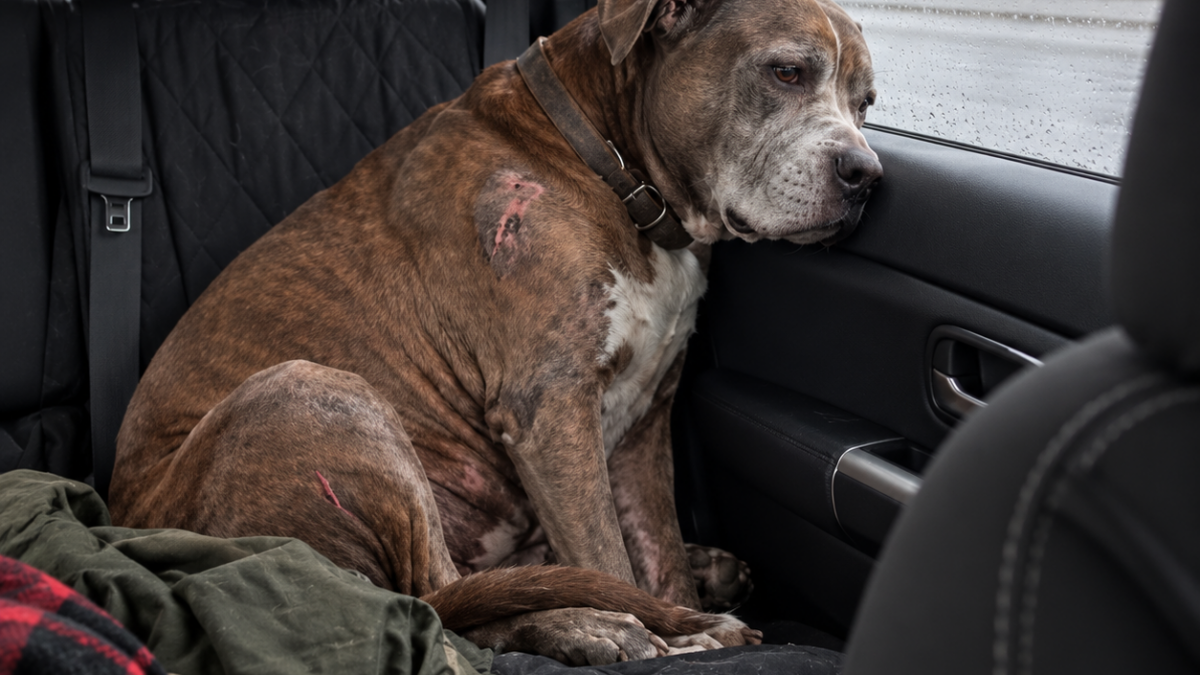
Getting him into my car required no struggle.
That surprised me.
Claire clipped a leash to his collar, and Henry walked beside her with the resigned obedience of an animal who had stopped believing destinations mattered.
At my car, I opened the back door.
He looked inside.
Then at Claire.
For the first time, I saw fear.
Not panic.
Something quieter.
A dog asking whether this was another temporary room.
I crouched.
“You can come with me.”
Henry looked past me toward the shelter.
Maybe toward his corner.
Maybe toward the only predictable thing left in his life.
“I have a corner too,” I told him.
Claire wiped at one eye.
“Don’t make me cry at work.”
“I haven’t done anything.”
“You’re talking to him like he’s a retired farmer.”
“He’s older than most people I respect.”
Henry stepped into the car.
Slowly.
Carefully.
He lay across the back seat.
Claire closed the door.
Before I got into the driver’s seat, she stopped me.
“George.”
“Yes?”
“If it doesn’t work…”
“It will.”
“You don’t know that.”
“No.”
I looked through the window at Henry.
“But neither does he.”
The ride home took twenty-eight minutes.
For the first ten, I drove in silence.
Then silence began feeling too familiar.
So I turned on the radio.
An old country station.
Johnny Cash.
Margaret used to tease me because I could listen to the same songs for forty years and still behave as if I’d discovered them yesterday.
I sang badly.
Henry stared out the window.
“You’ll have to get used to this.”
No response.
“My wife couldn’t.”
Still nothing.
“I assume that’s why she died first.”
The joke came out before I could stop it.
Then I froze.
For two years, I had treated Margaret’s death as sacred territory.
No jokes.
No lightness.
No careless sentences.
Suddenly I had made one to a dog.
And instead of guilt, I felt something strange.
Warm.
Like Margaret rolling her eyes somewhere.
I kept singing.
When we reached my house, Henry climbed out.
He stood in the driveway.
The property was modest.
White siding.
A detached garage.
A maple tree Margaret and I had planted thirty-four years earlier.
A fenced backyard I hadn’t used for much since the children left.
Henry looked around.
Then walked toward the side of the porch.
There was a sheltered corner between the steps and the brick chimney.
He sat down.
I stared.
Of course.
Another corner.
I had bought him a bed.
Memory foam.
Washable cover.
More expensive than my first mattress after the Army.
Henry ignored it.
That first evening, he stayed beside the porch.
I carried his water out.
Then food.
He ate only after I went inside.
At sunset, I opened the back door.
“Come in whenever you want.”
He didn’t.
I left the door open until the house got cold.
Finally, around nine, Henry crossed the threshold.
He walked through the living room.
Stopped beside Margaret’s old chair.
Sniffed it.
Then chose a corner near the front window.
He lay down.
I sat in my recliner.
Neither of us looked at the other.
The clock ticked.
I realized Claire had been right.
I had wanted a dog to break the silence.
Instead, I had adopted one who understood it.
That night I carried his bed beside my bedroom door.
Henry remained in the living room.
At two in the morning, I woke and went to check him.
He was awake.
Eyes open.
Watching the front door.
“Waiting?”
His ears shifted.
“I did that too.”
I sat on the floor.
“My wife spent three weeks in hospice.”
Henry watched me.
“Every morning, I woke up thinking maybe today she’d be better. Stupid, isn’t it?”
He blinked.
“I knew.”
I looked at my hands.
“I knew exactly what was happening. Still waited.”
Henry lowered his head.
“So I’m not going to tell you to stop.”
I got up.
“Good night.”
For the first week, our lives existed beside each other rather than together.
I woke.
Made coffee.
Fed Henry.
He waited until I left the room before eating.
I walked him.
He followed the leash but never pulled.
Never sniffed much.
Never showed interest in other dogs.
Back home, he returned to his corner.
I talked constantly.
Not baby talk.
I told him everything.
Mortgage rates.
Weather.
The neighbor’s terrible new mailbox.
How Margaret once drove thirty miles in the wrong direction because she refused to admit she’d missed an exit.
How my son Thomas called every Sunday and pretended not to worry about me.
How my daughter Emily asked whether I was “socializing,” which is apparently what adult children call nagging their widowed father.
Henry listened.
On the eighth morning, something changed.
I was making coffee when I heard nails against hardwood.
Slow.
Scrape.
Pause.
Scrape.
I turned.
Henry stood in the kitchen doorway.
I didn’t move.
“Morning.”
He stared.
Then walked toward me.
He stopped beside the table.
Sat.
Not touching.
Not asking.
Just present.
I poured coffee.
“That’s your seat now?”
His ears moved.
I sat.
Henry stayed.
We spent forty minutes like that.
The next morning, he came again.
And the next.
By the end of the second week, Henry followed me from the kitchen to the living room.
Not closely.
Always six or seven feet behind.
Like a man attending a funeral procession.
I started calling it progress.
My daughter did not.
“You sound tired, Dad.”
“I’m seventy-one.”
“You know what I mean.”
We were on video chat.
Henry was visible behind me.
Emily squinted.
“Is that him?”
“Yes.”
“He looks sad.”
“He is.”
“Are you sure this is healthy for you?”
The question irritated me.
“What does that mean?”
“You adopted a dog who’s grieving because you’re grieving.”
“So?”
“So maybe you need something that pulls you out, not something that keeps you there.”
Henry lifted his head.
I lowered my voice.
“He doesn’t keep me anywhere.”
“Dad—”
“You haven’t met him.”
“I know.”
“Then don’t diagnose us.”
Emily went silent.
Immediately, I regretted it.
She was trying to protect me.
But grief makes you defensive about strange things.
“Sorry.”
“No, you’re right.”
She smiled weakly.
“I just worry.”
“I know.”
Henry got up and walked toward me.
He stopped beside my chair.
Emily’s expression changed.
“Dad.”
“What?”
“He’s touching you.”
I looked down.
Henry’s shoulder rested against my knee.
It was the first time he had chosen physical contact.
I didn’t move.
“Yeah.”
Emily’s eyes filled.
“Oh.”
Henry stayed there until the call ended.
Three weeks after the adoption, Claire came to visit.
She brought a bag of treats and a squeaky rubber pig.
Henry ignored both.
“That feels personal,” she said.
“He has standards.”
She sat on the floor.
Henry watched her from beside my chair.
Claire smiled.
“He’s never sat that close to anyone.”
“Maybe he thinks I’m dying.”
“George.”
“What?”
She laughed.
Then her expression turned serious.
“I wanted to tell you something.”
There it was again.
The tone.
“Curtis Bennett called.”
I felt Henry’s body stiffen before mine did.
“When?”
“Yesterday.”
“What did he want?”
“He asked whether Henry had been adopted.”
My hand settled on Henry’s back.
“Why?”
“He wouldn’t say.”
“You told him?”
“I said Henry was no longer available.”
“Did you give him my information?”
“Absolutely not.”
“Can he get it?”
“Not from us.”
I looked at Henry.
“What do you think he wants?”
“I don’t know.”
I hated how often those words were appearing in Henry’s story.
Then Claire said, “There’s something else.”
“Of course there is.”
“When Curtis surrendered Henry, he also surrendered a box of belongings that had been with the dog.”
“What belongings?”
“An old leather collar. A blanket. Some veterinary papers. And a metal identification tube attached to the collar.”
“Identification tube?”
“Like the little capsules people used before microchips became common. Name and address inside.”
“So?”
“It was empty when Henry came in.”
I frowned.
“And?”
“Last week one of our former volunteers called. She remembered the intake. She said she was almost certain there had been a folded paper inside.”
“What paper?”
“She doesn’t know. Curtis was in the room when she processed the dog. He took the capsule off the collar and opened it.”
“You think he removed something?”
Claire lifted her hands.
“I don’t know.”
I looked down at Henry.
“What did Walter do for a living?”
“Farming. Cattle mostly.”
“And the farm?”
“Sold after his death.”
“To Curtis?”
“Eventually, yes.”
Something didn’t fit.
“Why would he suddenly care that Henry was adopted?”
Claire looked toward the dog.
“Maybe he doesn’t care about Henry.”
That was the moment I began wondering whether Henry had carried more than grief out of Walter Bennett’s pasture.
But for the next several weeks, nothing happened.
Henry kept healing.
That is the only word for it.
Healing.
Slowly.
Unimpressively.
Beautifully.
He began eating while I was in the room.
That mattered.
Then he began drinking without watching me.
Then he followed me onto the porch.
One Saturday, I was raking leaves when a squirrel crossed the fence.
Henry stood.
His ears went forward.
The squirrel froze.
Henry took three quick steps.
Then stopped, apparently remembering that he was thirteen and had dignity.
I laughed so hard I had to lean on the rake.
Henry looked offended.
“Don’t blame me. You started it.”
His tail moved.
Just once.
I stopped laughing.
“Do that again.”
Nothing.
“Henry.”
No reaction.
“You wagged your tail.”
He sat.
“You absolutely did.”
The next morning, I told Claire.
She reacted like someone had announced a successful heart transplant.
Two months after I adopted Henry, I drove him to a small property outside town that belonged to an old friend of mine.
Sam Miller had twenty-two acres and six retired horses.
It wasn’t Walter’s farm.
I had no intention of taking Henry back there without knowing what it might do to him.
But I wanted to know whether open land still meant something.
The moment I turned onto Sam’s gravel road, Henry lifted his head.
His entire posture changed.
At the gate, he stood in the back seat.
“Easy.”
He whined.
The sound shocked me.
I parked beside the barn.
Henry climbed out.
He smelled the air.
Then froze.
Fields stretched beyond the fence.
Brown winter grass.
Wooden posts.
A tractor in the distance.
For nearly a minute, Henry simply stared.
Then he started walking.
I followed.
His pace increased.
Thirty yards.
Fifty.
Then he ran.
Not fast.
His hips wouldn’t allow it.
But he ran.
I stood in the field, unable to move.
Henry ran toward the far fence as though thirteen years had fallen away from him.
He stopped after perhaps a hundred yards.
Turned.
Looked at me.
I started walking toward him.
He remained there.
Waiting.
When I reached him, I knelt.
Henry came forward.
No hesitation.
He pressed his head against my chest.
I put both arms around him.
He trembled.
So did I.
“You miss him.”
His body leaned harder into mine.
“I know.”
I closed my eyes.
“So do I.”
I had not meant Margaret.
Not entirely.
I meant Walter too.
A man I had never met.
Because in that field, I understood something I should have understood from the beginning.
Henry did not need to forget Walter to love me.
And I did not need to stop loving Margaret to live again.
Grief was not a room with one chair.
There was space for memory and something new.
When we returned home that afternoon, Henry followed me into the kitchen.
I opened the pantry.
“Dinner?”
His tail moved.
Twice.
I laughed.
“That settles it.”
Three days later, Curtis Bennett knocked on my door.
I knew who he was before he introduced himself.
He was in his late forties.
Heavy work jacket.
Expensive boots that had never seen much mud.
A silver pickup idled in my driveway.
Henry was asleep in the living room.
“Mr. Harvington?”
“Yes.”
“Curtis Bennett.”
I didn’t invite him inside.
“How did you find me?”
“That doesn’t matter.”
“It matters to me.”
“I’ve been asking around.”
“That matters even more.”
His jaw tightened.
“I understand you adopted my father’s dog.”
“Your father had a dog. You surrendered him.”
His eyes hardened.
“I made the best decision I could at the time.”
“Two years ago.”
“I wasn’t able to keep him.”
“You didn’t visit him either.”
“I didn’t come here to discuss my personal life.”
“Then why are you here?”
Curtis looked past me toward the house.
“I need to see Henry.”
“No.”
His eyebrows rose.
“No?”
“He’s my dog.”
“He was my father’s.”
“And you signed him away.”
Curtis lowered his voice.
“There are circumstances you don’t understand.”
“Then explain them from my porch.”
Henry appeared behind me.
He stood in the hallway.
The moment he saw Curtis, his body changed.
His ears lifted.
His eyes widened.
Then, astonishingly, his tail moved.
Not much.
But enough.
Curtis saw it.
For half a second, something human passed across his face.
“Hey, Hank.”
Henry took one step toward the door.
Curtis smiled.
“There he is.”
Then Henry stopped.
He looked at Curtis.
Then at me.
And walked to my side.
Curtis’s smile vanished.
I put my hand on Henry’s shoulder.
“He remembers you.”
“He should. I grew up with him around.”
“Then why leave him there?”
Curtis ignored the question.
“I need something that belonged to my father.”
“What?”
“Did the shelter give you his old collar?”
“No.”
“A blanket?”
“No.”
“A metal tag holder?”
“No.”
He studied my face.
“You’re sure?”
“Yes.”
Curtis looked angry now.
“What exactly are you looking for?”
“Nothing that concerns you.”
“Then get off my property.”
His gaze moved to Henry.
“I may need him back.”
I actually laughed.
“Absolutely not.”
“You don’t understand the legal situation.”
“He’s legally adopted.”
“My attorney can deal with that.”
“Good. Have your attorney call the shelter.”
Curtis stepped closer.
“You think because you’re some lonely old man who decided to rescue a dog—”
I opened the storm door.
Henry moved in front of me.
Not aggressively.
Simply between us.
Curtis stopped.
His eyes met Henry’s.
Something shifted.
I said quietly, “Get off my porch.”
Curtis left.
That evening I called Claire.
She cursed.
I had never heard her curse before.
“What did he want?”
“The old collar.”
There was silence.
“The capsule?”
“Apparently.”
Claire exhaled.
“George, I’m going into the storage archive tomorrow.”
“For what?”
“Sometimes surrendered property gets photographed even if it doesn’t stay with the animal.”
“Find it.”
The next afternoon, Claire called.
“I found the intake pictures.”
“And?”
“The capsule is visible.”
“Anything else?”
“Yes.”
My grip tightened around the phone.
“In one photograph, it’s open.”
“And?”
“There is definitely paper inside.”
My heartbeat accelerated.
“What happened to it?”
“I checked the inventory notes. One item says: handwritten document returned to family representative.”
“Curtis.”
“Yes.”
“So he already got it.”
“Apparently.”
“Then why is he looking for something?”
Claire was silent.
I understood before she said it.
“Because maybe he didn’t get all of it.”
That evening, I searched Henry’s belongings.
There weren’t many.
The shelter had given me his current collar.
Medical documents.
A worn blue blanket donated months after arrival.
Nothing from Walter.
I examined everything anyway.
Nothing.
For the first time since adopting Henry, I felt genuinely frightened.
Not because of paperwork.
Because Curtis had looked at Henry as if the old dog were a container somebody had forgotten to empty.
I called my son.
Thomas listened quietly.
“You need to document everything,” he said.
“I know.”
“And don’t meet Curtis alone.”
“I’m seventy-one, not twelve.”
“Dad.”
“Fine.”
“Call the police if he returns.”
“He hasn’t threatened me.”
“He said he might take your dog.”
“That is a threat.”
Thomas sighed.
“For once, we’re agreeing.”
The next morning, I found my back gate open.
I knew I had latched it.
Henry was inside.
Thank God.
He slept beside my bed now.
But muddy footprints crossed the backyard.
Human.
They stopped near the porch.
Then continued toward the garage.
Nothing appeared missing.
I called the police.
The officer took a report.
“No cameras?”
“No.”
“Get some.”
I did.
That afternoon.
Two cameras.
One doorbell camera.
One facing the backyard.
Then I called Claire.
“This is no longer about adoption paperwork.”
“What happened?”
I told her.
She went quiet.
“I’m calling our director.”
“Why?”
“Because if Curtis accessed confidential adopter information somehow, I want to know how.”
The answer arrived faster than expected.
A former shelter employee named Travis had accessed Henry’s adoption file three days after Curtis called.
Travis no longer worked there.
But he had been fired months earlier for improperly sharing information about animals in a custody dispute.
Claire sounded furious.
“We think Curtis paid him.”
“Can you prove that?”
“Not yet.”
The shelter reported the suspected privacy breach.
Two days later, Curtis’s attorney sent me a letter.
It claimed Walter Bennett had intended Henry to remain with the Bennett family and that Curtis was “reviewing irregularities” in the surrender.
I hired a lawyer.
At seventy-one years old, with a thirteen-year-old pit bull asleep beside my desk, I found myself paying three hundred dollars an hour to defend a dog somebody had abandoned for two years.
Margaret would have called me insane.
Then she would have written the check.
My attorney, Sarah Whitman, read the adoption papers.
“This claim is weak.”
“Weak isn’t zero.”
“No.”
“Can he take Henry?”
“Not based on anything I’ve seen.”
“Then why is he doing this?”
Sarah looked at the letter.
“That’s the more interesting question.”
The answer came from someone I had never met.
Her name was Ruth Bennett.
Walter’s younger sister.
She was seventy-eight and lived in Kentucky.
She called me one evening.
“Is this George Harvington?”
“Yes.”
“My name is Ruth. Walter Bennett was my brother.”
I sat straighter.
“How did you get my number?”
“Claire.”
That surprised me.
“She asked permission first?”
“She gave me yours with your attorney’s approval.”
Right.
I remembered signing something earlier that day.
Age does not improve paperwork.
“I understand you have Henry.”
“He’s right here.”
At the sound of his name, Henry raised his head.
Ruth began crying.
“Oh, Lord.”
“Ma’am?”
“I haven’t heard that name spoken in so long.”
She composed herself.
“Mr. Harvington, my brother loved that dog more than almost anything.”
“I know.”
“Maybe more than Curtis.”
I said nothing.
“Walter and Curtis had been fighting for years.”
“About what?”
“The farm.”
There it was.
Walter owned nearly two hundred acres.
Not enormous by modern farming standards, but enough to be valuable because the eastern side bordered a rapidly developing highway corridor.
A developer had made offers.
Walter refused.
Curtis wanted him to sell.
“Walter kept saying that land was all that remained of our parents,” Ruth explained. “He wanted it farmed.”
“What changed after he died?”
“Curtis sold most of it within eight months.”
“For how much?”
“Almost three million dollars.”
I sat back.
“And Henry?”
“Walter worried Curtis might do exactly that.”
“How do you know?”
“He told me.”
“Was there a will?”
“An old one.”
“To Curtis?”
“Mostly.”
“Then what was on the paper in Henry’s collar?”
Ruth became silent.
“I think it was part of a letter Walter wrote.”
My heart thudded.
“Part?”
“He called me a week before he died. Said he had written instructions and put one copy somewhere Curtis wouldn’t look.”
“On Henry?”
“I didn’t know until later.”
“What instructions?”
“Walter wanted fifteen acres around the original farmhouse preserved. He wanted it transferred to a local agricultural education trust.”
“Could that be legally binding?”
“I don’t know. I’m not a lawyer.”
“But Curtis found the paper.”
“Some of it.”
“Why only some?”
Ruth exhaled.
“Because Walter had a habit.”
“What habit?”
“He split important instructions.”
I stared at Henry.
“Why?”
“Our father taught us never to keep everything important in one place after a barn fire destroyed their records when we were children.”
“So where’s the other part?”
“I was hoping you knew.”
I almost laughed.
“No.”
“Then perhaps Henry does.”
I looked at the old dog.
Henry was licking one paw.
He did not look like an archivist guarding a multimillion-dollar land secret.
“Ruth, he’s been through enough.”
“I agree.”
“I won’t let people use him.”
“I didn’t call to ask you to.”
“Then what do you want?”
Her answer surprised me.
“To thank you.”
“For what?”
“For choosing him when Curtis didn’t.”
I looked away.
“I didn’t do anything extraordinary.”
“You took home an old dog who wouldn’t look at you.”
“He looked eventually.”
Ruth laughed through tears.
“That sounds like Walter.”
After we hung up, I sat beside Henry.
“So apparently you may know where buried treasure is.”
Henry sneezed.
“That’s helpful.”
I did not search him.
Did not drag him back to Walter’s property.
Did not turn our lives into a scavenger hunt.
I told Sarah what Ruth had said.
She contacted the attorney handling Walter’s estate records.
Then something unexpected surfaced.
Before Walter died, he had visited a veterinarian with Henry.
The clinic still had archived records.
One notation read:
OWNER REQUESTED DUPLICATE STORAGE OF PERSONAL DOCUMENT IN SEALED PET MEDICAL ENVELOPE.
Sarah stared at me across her desk.
“You’re kidding.”
“I wish.”
The veterinarian searched old archives.
Nothing.
The clinic had changed ownership.
Records had moved.
Boxes had been destroyed after retention periods expired.
Then a retired veterinary technician remembered Walter.
“He brought in a sealed envelope,” she told Sarah. “Said if anything happened, it should go with Henry.”
“Did it?”
“I put it in his paper file.”
“And after Walter died?”
“The son requested the file.”
Curtis again.
“But,” she added, “our records were digitized before originals were released.”
Sarah leaned forward.
“Was the envelope scanned?”
“I don’t know.”
It took another week.
Then the clinic found it.
Not the envelope.
A scan.
Three pages.
Walter Bennett had written a dated statement explaining that he intended to place fifteen acres, including the farmhouse and burial plot where his wife was buried, into an agricultural education trust.
The document alone was not enough to automatically overturn the estate.
But it supported other evidence.
Most importantly, it referenced a signed trust instrument prepared by a local attorney.
An attorney who had retired.
An attorney nobody handling the estate had contacted because Curtis claimed Walter had abandoned the plan.
Sarah found him.
And he still had the executed trust document in archived storage.
Curtis had sold land he might not have had the unrestricted right to sell.
Suddenly his interest in Henry made perfect sense.
He believed the dog had carried evidence.
And when he learned Henry had been adopted, he panicked because he did not know what else might have been passed along.
The legal fight that followed lasted months.
I was not directly part of most of it.
Ruth was.
The agricultural trust was.
The buyers and title companies were.
Curtis’s lawyers.
Estate lawyers.
Insurance companies.
It became exactly the sort of complicated mess I had spent my entire life avoiding.
But Curtis did one final stupid thing.
He came back to my house.
It was after ten at night.
My doorbell camera alerted my phone.
I looked.
Curtis stood on the porch.
I did not open the door.
“What do you want?”
His voice came through the speaker.
“We need to talk.”
“Call my lawyer.”
“This isn’t about lawyers.”
“Then there’s nothing to discuss.”
“George, please.”
That word stopped me.
Please.
Not anger.
Not arrogance.
Fear.
I kept the door locked.
“What?”
Curtis looked toward the camera.
“You don’t understand what my father did.”
“I understand he loved his dog.”
“I’m not talking about Henry.”
“I am.”
Curtis rubbed his face.
“He spent his last years trying to control everybody from the grave before he was even dead.”
“That’s one interpretation.”
“You think I’m some monster.”
“I think you left a grieving thirteen-year-old dog in a shelter for two years.”
“I couldn’t look at him.”
That answer surprised me.
Curtis looked away.
“He was there when Dad died.”
Silence.
“Every time I saw Henry, I saw that field.”
His voice broke.
For the first time, I did not see the villain I had built in my head.
I saw a son who had handled grief terribly.
That didn’t excuse him.
But it explained something.
“You could have visited.”
“I know.”
“You could have found him a home yourself.”
“I know.”
“You could have told the shelter the truth.”
“I know.”
His voice became bitter.
“But nobody wanted my truth. Dad was Saint Walter to everyone.”
“So why are you here?”
Curtis looked directly into the camera.
“Because the trust case is going to ruin me.”
“That isn’t Henry’s fault.”
“No.”
“Or mine.”
“No.”
“Then what do you want?”
He swallowed.
“To see him.”
I almost refused.
Then I looked behind me.
Henry stood in the hallway.
Awake.
Watching the door.
I clipped on his leash.
Then called my neighbor, who came over and stood inside with me.
I stepped onto the porch.
Henry came beside me.
Curtis froze.
“Hey, Hank.”
Henry stared.
Curtis knelt.
He did not reach.
For almost thirty seconds, nobody moved.
Then Henry walked forward.
He sniffed Curtis’s hands.
Curtis began crying.
Not gracefully.
Not quietly.
He covered his face.
“I’m sorry.”
Henry stood there.
Curtis looked at him.
“I should’ve come back.”
Henry moved closer.
Curtis touched his head.
I watched.
Part of me wanted Henry to turn away.
That is the ugly part of justice people don’t like to admit.
Sometimes we want pain to balance pain.
We want the abandoned dog to reject the man who abandoned him.
We want a perfect punishment.
Henry didn’t care what I wanted.
He licked Curtis’s hand.
Once.
Curtis sobbed.
And then Henry turned.
Walked back to me.
Sat against my leg.
That was his answer.
Not hatred.
Not revenge.
Recognition.
Forgiveness, perhaps.
But choice.
He remembered Curtis.
And he chose home.
Curtis stood.
“I guess that’s fair.”
“Henry doesn’t keep score.”
“Maybe that’s worse.”
He wiped his face.
“I’m leaving.”
I stopped him.
“Curtis.”
He turned.
“If you want to make anything right, stop fighting the trust.”
His face tightened.
“You have no idea how much money—”
“I don’t care.”
“You would if it were yours.”
“Maybe.”
I looked down at Henry.
“But some things your father wanted weren’t about money.”
Curtis left.
Three weeks later, Ruth called.
Curtis had agreed to a settlement.
Fifteen acres surrounding Walter’s farmhouse would be restored to the agricultural trust.
The developer kept the larger parcel.
Curtis retained part of the sale proceeds but paid a substantial settlement related to the disputed transfer.
Nobody went to prison.
Nobody stood in a courtroom cheering.
Real life rarely gives you the revenge people imagine.
But Walter’s farmhouse survived.
The fields around it survived.
And the trust created a youth agricultural program there the following spring.
They named it Bennett Farm Learning Center.
Not after Curtis.
Not after Walter alone.
After the family.
Ruth invited me to the opening.
I wasn’t going to attend.
Then she said, “Bring Henry.”
So I did.
The moment our car turned onto the old road, Henry stood.
My hands tightened around the steering wheel.
I realized before anyone told me.
This was Walter’s farm.
The original one.
I pulled over.
“Henry.”
He was breathing rapidly.
Looking through the windshield.
The farmhouse stood beyond a line of old maples.
The barn roof had been replaced.
Fences repaired.
Beyond them stretched the pasture.
His pasture.
I opened the door.
Henry climbed out.
He stood perfectly still.
Then he began walking.
No leash tension.
No hesitation.
Just memory.
People at the opening noticed us.
Ruth covered her mouth.
“Oh, my God.”
Henry walked toward the field.
I followed.
At the gate, he stopped.
I opened it.
He entered.
The old dog moved across the grass.
Slow at first.
Then faster.
And then, for perhaps the last time in his life, Henry ran.
He ran through the field where Walter Bennett had once worked beside him.
He ran past the place where tractors had crossed.
Past the fence posts.
Past a watering trough.
His old legs stretched farther than I thought possible.
People behind me went silent.
I started crying.
“Go on, boy.”
Henry kept running.
Then he reached a slight rise in the field.
He stopped.
Stared at one patch of ground.
And sat.
Ruth came beside me.
Her face had gone pale.
“That’s where they found Walter.”
I looked at her.
“You’re sure?”
She nodded.
Henry lowered his head.
For several minutes, nobody approached him.
Then I walked across the field.
My knees hurt.
My chest hurt more.
When I reached him, I sat in the grass.
Henry looked at me.
I touched his back.
“You found him.”
His eyes remained on the empty field.
“I know you still miss him.”
I looked toward the farmhouse.
Children were arriving for the opening.
Families.
Young people who would learn to grow vegetables, care for animals, repair fences, understand soil.
Walter’s land had not become another row of identical houses.
Not all of it.
The part he loved most was still here.
Henry leaned against me.
“You did good, old man.”
His tail touched the grass.
Once.
Then twice.
I whispered, “Ready to go home?”
Henry stood.
He looked across the field one final time.
Then turned away from the place where Walter died.
And followed me.
That was when I knew something inside him had changed.
Not disappeared.
Changed.
There is a difference.
For the first time, Henry had visited the place where his old life ended and still chosen to leave it.
With me.
After that day, he stopped sleeping near the front door.
I noticed about a week later.
He had begun sleeping beside my bed.
Not at the bedroom entrance.
Beside me.
I bought him another orthopedic bed.
He used it.
Occasionally.
Mostly he slept on the rug.
Three months later, he climbed onto my couch for the first time.
Margaret would have objected.
I looked at her photograph.
“Don’t start.”
Henry rested his head on my lap.
And I realized my house was no longer silent.
There were nails on hardwood.
A water bowl sliding across kitchen tile.
Heavy breathing at night.
The jingle of a collar.
A bark when the delivery driver came too close.
And my own voice.
I talked more.
I called my children more.
I accepted invitations again.
I started tending Margaret’s roses.
I even went to lunch with a widow named Helen from church, though when Emily found out she became so excited that I nearly canceled out of spite.
Henry changed too.
He wagged his tail when I came home.
Then one afternoon, he actually met me at the door.
I had gone grocery shopping.
I turned the key.
The door opened.
Henry stood there.
Tail moving.
I froze.
“Well, look at you.”
He took two steps forward.
I dropped the grocery bag.
Oranges rolled across the floor.
I didn’t care.
I knelt.
Henry leaned into me.
“You waited.”
His tail kept moving.
“But this time you knew I was coming back.”
That mattered more than I can explain.
Two lonely creatures had made a strange bargain.
I would show Henry that leaving the house did not always mean leaving forever.
And Henry would show me that loving someone new did not betray the dead.
We both kept our side.
By the time Henry turned fifteen, his body was slowing dramatically.
The veterinarian warned me.
Arthritis.
Kidney values drifting in the wrong direction.
Heart murmur worsening.
“Could be months,” she said.
“How many?”
“George, I can’t give you that.”
“You people charge enough. You should at least come with dates.”
She smiled sadly.
“I wish I could.”
I drove home with Henry sleeping beside me.
For the first time since adopting him, I was angry with him.
Not really.
Angry at time.
“You waited thirteen years to meet me and now you’re going to rush off?”
Henry slept.
“You have terrible manners.”
That night he climbed onto the couch with great difficulty.
I helped his back legs.
He placed his head on my lap.
I touched his silver muzzle.
“I’m not ready.”
His eyes opened.
Margaret had never let me say that.
Near the end, whenever I told her I couldn’t imagine the house without her, she’d squeeze my hand.
Nobody is ready, George.
That isn’t the same thing as being unable.
I heard those words again.
I bent down.
“Your first person left before you were ready too.”
Henry sighed.
“I know.”
Winter came.
Henry made it through Christmas.
Thomas flew home from Germany.
Emily came with her husband and two children.
For the first time in years, my house was full.
Too full.
Shoes everywhere.
Children yelling.
Food covering every surface.
My son complaining that I still owned the same toaster from 1998.
Margaret would have loved every second.
Henry lay near the fireplace while my granddaughter Lily brushed him with ridiculous seriousness.
“Grandpa?”
“Yes?”
“Was Henry always old?”
I smiled.
“No.”
“What was he like when he was a puppy?”
“I don’t know.”
She looked confused.
“Didn’t you have him?”
“Someone else did.”
“Who?”
“A farmer named Walter.”
“Where’s Walter now?”
I hesitated.
“He died.”
Lily looked at Henry.
“Was Henry sad?”
“Very.”
“For how long?”
“A long time.”
She kept brushing.
“Then you fixed him.”
I shook my head.
“No, sweetheart.”
She looked up.
“He fixed himself. I just sat beside him while he did it.”
Lily considered that.
Then said, “Maybe you fixed each other.”
Children have an irritating way of solving in ten seconds what adults spend years trying to explain.
“Maybe.”
That Christmas became Henry’s best.
He received six toys.
Ignored four.
Destroyed one.
Slept with the last one beneath his chin.
He ate turkey he was not supposed to have.
And when everyone left, the house became quiet again.
But it did not feel empty.
There is another difference.
Quiet is a sound.
Empty is a feeling.
I had finally learned not to confuse them.
In early March, Henry stopped eating breakfast.
I tried chicken.
He turned away.
Cheese.
Nothing.
I sat beside him.
“You never refuse cheese.”
His breathing was shallow.
I called the veterinarian.
Tests confirmed what I already knew.
His kidneys were failing.
We could treat symptoms.
Buy a little time.
Days.
Possibly weeks.
Not years.
I drove home.
Henry lay across the back seat exactly as he had on the day I adopted him.
I remembered Claire’s warning.
He may never become the dog you’re imagining.
She had been right.
Henry had never become the dog I imagined.
He became something better.
That evening I called my children.
Then Claire.
She came immediately.
When she entered, Henry was lying beside my chair.
Claire knelt.
“Hey, handsome.”
Henry’s tail moved.
Claire cried.
“You finally learned that.”
“What?”
“To wag.”
She pressed her forehead against his.
“I knew you had it in you.”
We sat together.
Eventually Claire asked, “Do you remember the day you adopted him?”
“Every second.”
“I thought you’d bring him back.”
I looked at her.
“You did?”
“Not because of you.”
“Because of him.”
She nodded.
“People want gratitude from rescue dogs. Especially sad ones.”
“What do you mean?”
“They imagine bringing a dog home and having this movie moment. Dog realizes he’s saved. Dog jumps into their arms. Everybody heals immediately.”
She looked at Henry.
“But real grief doesn’t perform.”
“No.”
“You let him be sad.”
I thought about that.
Maybe that had been the whole thing.
I had not demanded Henry make me happy.
Henry had not demanded I stop missing Margaret.
We had simply stayed.
Two weeks later, Henry could no longer climb the porch steps without help.
I built a ramp.
Then another because the first was too steep.
My neighbor helped.
Henry hated both.
I told him he was ungrateful.
He ignored me.
One Sunday morning, he woke before dawn and walked toward the back door.
I opened it.
He stepped into the yard.
The sky was turning pale.
Henry walked to the corner beside the porch.
His original corner.
The place he had chosen the first day.
He sat.
My heart stopped.
I went outside.
“Henry?”
He looked at me.
I sat beside him.
For nearly twenty minutes, we watched the sunrise.
Then Henry stood.
He walked toward me.
And placed his head against my chest.
I knew.
Maybe not logically.
But I knew.
The veterinarian came that afternoon.
At home.
I refused to take Henry anywhere unfamiliar.
Claire came.
My children joined by video because flights could not get them there in time.
Ruth called.
Even Curtis sent a message through her.
Tell Henry I’m sorry.
I read it aloud.
Henry didn’t care.
Dogs are wiser than people about final accounting.
I laid Walter’s old photograph beside him.
The trust had eventually found a photograph of Walter sitting on a tractor with Henry as a young dog beside him.
I had framed a copy.
Margaret’s photograph stood on the table nearby.
It seemed right.
Both our first people were in the room.
Henry lay on his bed.
His head in my lap.
I scratched the white patch on his chest.
“You know what I thought when I first saw you?”
His eyes moved toward mine.
“I thought you were the saddest thing I’d ever seen.”
Claire smiled through tears.
“I was wrong.”
My throat closed.
“You were waiting for your life to start again.”
Henry breathed.
Slow.
Heavy.
“I guess I was too.”
I bent down.
“You don’t have to wait anymore.”
Those words nearly broke me.
Because somewhere in the beginning, all Henry had done was wait.
Wait for Walter.
Wait at the shelter.
Wait in corners.
Wait while strangers passed him.
Wait for somebody to understand that his silence was not emptiness.
I pressed my forehead against his.
“If you see Margaret before I do, don’t get on her couch.”
Claire laughed through her tears.
I did too.
Henry’s tail moved once.
I chose to believe he understood the joke.
Then I whispered, “And if you see Walter…”
My voice disappeared.
I tried again.
“Tell him you found your way home.”
Henry’s breathing slowed.
I kept my hand on him.
The veterinarian quietly told me when it was over.
I didn’t move.
For a long time, neither did Claire.
The house was silent again.
But this time the silence did not frighten me.
It hurt.
God, it hurt.
But pain is not the same thing as emptiness either.
Henry had taught me that too.
A week later, I drove to Bennett Farm Learning Center.
Ruth met me.
We walked into the pasture.
The same rise where Henry had stopped months earlier was covered with early spring grass.
I carried a small wooden box.
Not all of Henry’s ashes.
Most remained with me.
But I had decided part of him belonged here.
Where Walter had loved him first.
Ruth stood several yards away while I opened the box.
The wind carried the ashes across the field.
I cried.
Then I laughed because some blew back onto my jacket.
“Typical.”
Ruth smiled.
“What?”
“Even now, he follows me.”
We placed a small stone near the fence.
Not a grave marker.
Just a stone.
The trust eventually attached a simple plaque:
HENRY
HE WAITED.
HE LOVED AGAIN.
Below it, smaller:
GOOD DOG.
Curtis came to see it once.
I happened to be there.
We stood beside the stone.
He looked older.
So did I.
“I was terrible to him,” he said.
“You were grieving.”
“That isn’t an excuse.”
“No.”
“Thank you for not giving me one.”
We stood quietly.
Then Curtis said, “My father would’ve liked you.”
“I doubt it.”
“He hated everybody.”
That made me laugh.
Curtis smiled.
For the first time, there was no fight between us.
He had lost money.
Lost control of part of the farm.
Lost the argument he had spent years trying to win.
But the most important punishment had never been legal.
It was living with the knowledge that when Henry had been given a choice between the man who abandoned him and the old stranger who sat patiently beside him, Henry had chosen the stranger.
I never reminded Curtis of that.
I didn’t need to.
He knew.
As for me, I went home to a house without Henry.
The first morning was unbearable.
I poured water into his bowl before remembering.
The second morning, I reached for his leash.
The third, I heard what sounded like nails on the kitchen floor and turned around.
Nothing.
For a while, I returned to my own corner.
But this time I recognized it.
That was Henry’s final gift.
I knew what isolation looked like before it could swallow me.
So when Emily called, I answered.
When Thomas invited me to Germany, I went.
When Helen from church asked whether I wanted coffee, I said yes.
When Claire invited me to volunteer at the shelter, I almost refused.
Then I remembered a thirteen-year-old dog facing a concrete wall.
I started the following Tuesday.
My job was simple.
Sit with the dogs who didn’t come to the gate.
I became very good at it.
Young volunteers would sometimes say, “George, that one doesn’t like people.”
I’d pull up a chair.
“Maybe.”
“He won’t even look at you.”
“That’s all right.”
“What do you do?”
“Nothing.”
They thought I was joking.
I wasn’t.
I sat.
Sometimes for ten minutes.
Sometimes forty.
Sometimes longer.
I spoke quietly.
Or didn’t.
Eventually, most of them looked.
One afternoon, almost a year after Henry died, Claire came running down the hallway.
“George.”
“What?”
“You need to see someone.”
She led me to the last kennel.
Inside was an old brown pit bull mix.
White face.
Cloudy eyes.
He stood in the corner.
Not looking at us.
I stopped.
“No.”
Claire smiled.
“I didn’t say anything.”
“You’re thinking it.”
“Maybe.”
“How old?”
“Twelve.”
“How long?”
“Eight months.”
“Owner died?”
“Went into long-term care.”
I stared at the dog.
Claire said, “His name is Arthur.”
I sat outside the kennel.
Arthur did not move.
“I’m not adopting him.”
“I didn’t ask.”
“I mean it.”
“Of course.”
“I am eighty percent serious.”
Claire walked away laughing.
I sat there.
Arthur stared at the wall.
I put my hand against the bars.
Nothing.
“Just so we’re clear,” I told him, “I have already done this once.”
His ear moved.
“I know your trick.”
One eye shifted toward me.
My chest tightened.
“Oh, no.”
Three weeks later, Arthur was sleeping on Henry’s old orthopedic bed.
I told everyone it was temporary.
Nobody believed me.
I suppose that is how life works.
Not replacing.
Continuing.
Henry never replaced Walter.
I never replaced Margaret.
Arthur never replaced Henry.
Love is not a chair somebody else occupies after the first person leaves.
It expands.
That is what I had misunderstood when I walked into the shelter at seventy-one years old looking for a cheerful dog to fill my empty house.
I thought I needed noise.
I thought I needed enthusiasm.
I thought healing would look like a wagging tail racing toward me.
Instead, healing was an old pit bull in a concrete corner who refused to pretend he wasn’t broken.
I sat beside him.
He sat beside me.
And eventually we both stood up.
Today, when people ask why I keep choosing older dogs, I tell them the truth.
Young dogs will usually find somebody.
The dog jumping at the kennel door gets noticed.
The puppy with bright eyes gets photographed.
The playful one gets shared.
But somewhere behind all that noise there is often another dog.
Gray muzzle.
Still body.
Eyes turned toward a wall.
Not because he has nothing left to give.
Because once, he gave everything.
And it hurt when the person he gave it to disappeared.
Those are the dogs I understand.
I do not ask them to perform.
I don’t ask them to be grateful.
I don’t promise they will forget.
I simply sit down.
Sometimes I tell them about Margaret.
Sometimes I tell them about Henry.
Sometimes I say nothing at all.
And when one finally turns his head toward me, even slightly, I remember the first day Henry looked away from that concrete wall.
One tiny movement.
That was where our whole life together began.
I had entered the shelter hoping to find a dog who would save me from silence.
Instead, I found a dog who taught me silence was not something to escape.
Sometimes silence is where two broken hearts recognize each other.
Sometimes healing does not announce itself.
It walks slowly into a kitchen one morning and sits beside your chair.
It leans against your knee during a phone call.
It wags once at a squirrel.
It runs across a field toward a memory.
It turns away from the place where somebody died and follows you home.
And years later, when the house becomes quiet again, you discover the miracle was never that the dog filled the silence.
The miracle was that because he had been there, the silence no longer meant you were alone.
My name is George Harvington.
I was seventy-one years old when I walked into a shelter looking for a happy dog.
Instead, I found a thirteen-year-old pit bull who had spent two years sitting in the same corner after losing the farmer he loved.
Everyone warned me Henry might never come out of that corner.
They were wrong.
But so was I.
I thought I was taking Henry home.
The truth is that Henry spent the rest of his life bringing me back to mine.








