PART 2: I Went to Donate My Dead Dog’s Things—Then an Unwanted Senior Gave His Only Blanket to a Shivering Puppy, and Three Days Later His Former Owner Found Me
PART 2
The volunteer did not answer immediately.
She was younger than me, maybe in her thirties, with dark hair tied into a loose knot and a sweatshirt covered in paw prints that looked permanent.
She crouched to pick up my keys.
“Here.”
“Thank you.”
I took them, but I was still looking at Marcel.
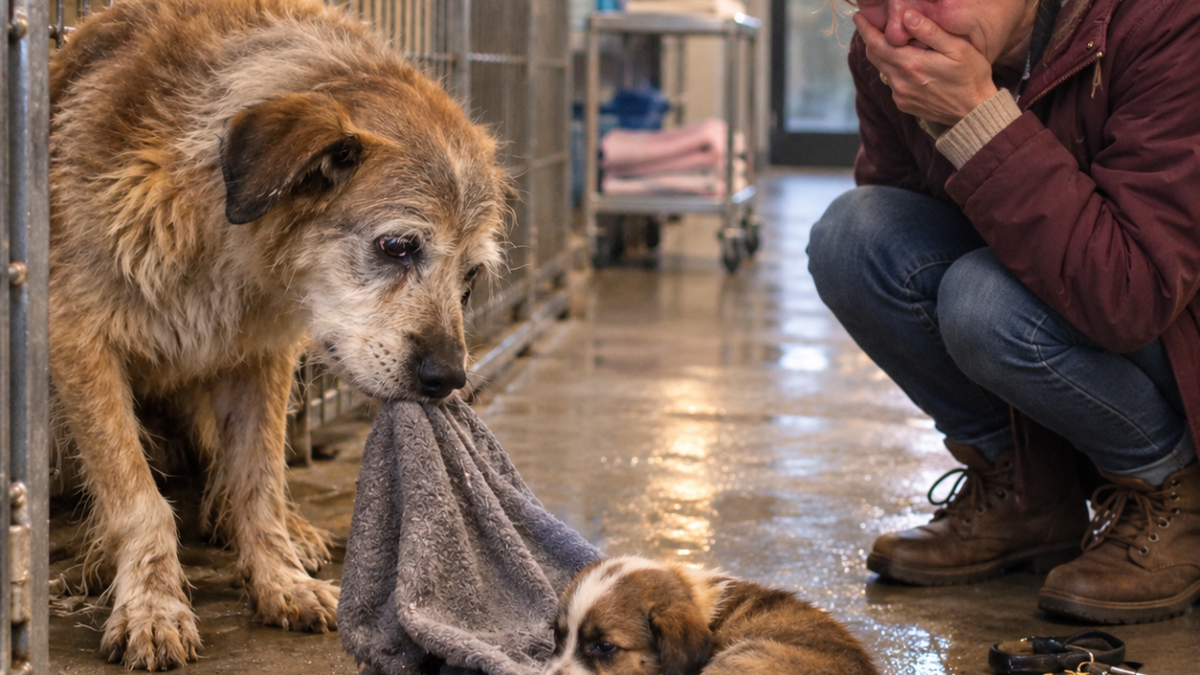
The puppy had curled itself tightly into the blanket.
Marcel lay beside the partition on bare concrete.
“Why?” I asked again.
The volunteer glanced at the laminated card.
“Family surrender.”
“That doesn’t answer my question.”
“No.”
“What happened?”
She hesitated.
“I don’t know the whole story.”
“Who does?”
“Our director probably knows more.”
I looked at Marcel.
His head had gone back down.
He was no longer interested in me.
The puppy was.
Its enormous dark eyes peeked over the edge of Marcel’s blanket.
“What’s the puppy’s name?”
“Pico.”
“What happened to him?”
“Found under a parked car two days ago. No chip. Terrified of people. He’s medically okay, but stress is bad.”
“And Marcel just gave him his blanket?”
“Yes.”
“Does he know him?”
“No.”
That made no sense to me.
I pointed.
“You said he’s done this before.”
The volunteer smiled faintly.
“The first week he was here, a young shepherd mix came in after a traffic accident. Marcel pushed his bedding toward that kennel too.”
“And the third?”
“Small beagle. Owner died. Wouldn’t stop crying.”
I looked back at Marcel.
“What did he do?”
“Lay against the partition until the beagle slept.”
Something tightened in my chest.
I hated that feeling.
That was exactly why I had not wanted to look.
“What’s your name?”
“Lucie.”
“I’m Anne.”
She nodded toward the donation bin.
“Were those your dog’s things?”
“Yes.”
“I’m sorry.”
I gave the automatic answer people use when they do not want sympathy.
“Thank you.”
Lucie looked at Marcel.
Then at me.
“Do you want to meet him?”
“No.”
She blinked.
That answer had come out too fast.
“No,” I repeated. “Absolutely not.”
“Okay.”
“I came here to donate things.”
“I understand.”
“I am not adopting another dog.”
“I didn’t ask you to.”
“I know.”
Lucie was trying not to smile.
“That is a very irritating expression.”
“Sorry.”
“You’re not.”
“No.”
I should have left.
Instead, I stood there another five minutes.
Then ten.
Pico fell asleep.
Marcel remained beside him.
Eventually he shifted, and I saw the floor underneath him.
Cold gray concrete.
My eyes went toward the donation bin.
Plume’s blankets.
I swallowed.
“Can he have one of those?”
Lucie followed my gaze.
“Yes.”
“The blue one.”
“Okay.”
“Not the red one.”
“Why?”
I stopped.
Because the red one still smelled like Plume.
Or maybe I only imagined it did.
“I don’t know.”
Lucie did not ask again.
She pulled out the blue fleece blanket.
I watched her open Marcel’s kennel.
He stood.
His tail did not wag.
He moved back politely, giving her room.
She placed the blanket down.
Marcel sniffed it.
Then looked at Pico.
“No,” I whispered.
Marcel grabbed the edge.
Lucie laughed.
“He’s going to do it again.”
The blue blanket started moving toward the divider.
I stepped closer without thinking.
“Marcel.”
His ear lifted.
He stopped.
I had no idea why I had said his name.
The dog looked at me.
“Keep that one.”
Lucie laughed.
“He doesn’t understand.”
“I know.”
Marcel stared another second.
Then, instead of pushing the whole blanket through, he lay on half and nudged the other half beneath the divider.
Pico crawled onto his side.
Marcel rested against his.
One blanket.
Two kennels.
I felt my throat close.
“That’s not fair.”
Lucie looked at me.
“What?”
“Nothing.”
I turned away.
I reached the double doors.
My hand touched the push bar.
Then I stopped.
Plume had known me for twelve years.
She had lived through my divorce.
My daughter Camille leaving for university.
My mother’s cancer.
The year I almost lost my job.
The endless Sundays when I told everyone I enjoyed living alone and then ate dinner in front of the television because setting a table for one felt absurd.
When Plume died, I had held her on the living-room rug.
Her breathing had become slower.
Then irregular.
Then almost absent.
I kept saying, “I’m here.”
As though presence could bargain with death.
Her last deliberate movement had been to lick two of my fingers.
Then she was gone.
For months afterward, I had convinced myself that loving her had been a mistake because losing her hurt so badly.
Standing at those shelter doors, I suddenly heard my own logic for what it was.
Cowardice dressed as wisdom.
I turned.
“Lucie.”
“Yes?”
“How long has Marcel been here?”
“Four months.”
I felt something drop inside me.
“Four?”
“Yes.”
“Why?”
She glanced down the hall.
“Age. Appearance. People want younger dogs.”
“Is he sick?”
“Not seriously.”
“Behavior problems?”
“He can be stubborn. He doesn’t like being handled roughly. He has some arthritis. He gets nervous in cars.”
“Bites?”
“No bite history here.”
“Before?”
“None in the paperwork.”
I looked at the card again.
FAMILY SURRENDER.
“Who surrendered him?”
“I really don’t know the details.”
“Can I speak to the director?”
Lucie smiled.
“I thought you weren’t adopting.”
“I’m not.”
“Of course.”
Her name was Sophie Bernard.
The shelter director, not my daughter.
She invited me into a cramped office containing three computers, six stacks of files and a sleeping orange cat occupying most of one chair.
“I hear Marcel has recruited you.”
“He has done nothing of the kind.”
Sophie looked at Lucie.
Lucie shrugged.
“I told her nothing.”
Traitor.
Sophie opened Marcel’s file.
“What do you want to know?”
“Why he’s here.”
“Family surrendered him four months ago.”
“I can read.”
“Fair.”
She removed a form.
“A woman brought him in. Said he belonged to her father.”
“Why couldn’t she keep him?”
“She said her father could no longer care for him and nobody else in the family could take him.”
“Where was the father?”
“Medical facility.”
“Dead?”
“No idea.”
I frowned.
“No idea?”
“The surrender form lists him as incapacitated.”
“That’s vague.”
“Privacy laws and incomplete paperwork are a wonderful combination.”
“Did the owner consent?”
Sophie paused.
“That part bothered us too.”
My stomach tightened.
“What does that mean?”
“The daughter signed as family representative.”
“Did she have legal authority?”
“She showed documentation that she was handling her father’s affairs.”
“So yes.”
“For practical purposes.”
“You sound unconvinced.”
Sophie leaned back.
“Mrs.—”
“Anne.”
“Anne, families surrender animals for difficult reasons every day. Dementia. Hospitalization. Eviction. Death. Domestic violence. Money. We don’t automatically assume cruelty because someone cries while signing a surrender form.”
“Did she cry?”
“Yes.”
That shut me up.
Sophie continued.
“She brought Marcel’s food, medical records and his favorite blanket.”
“The gray one?”
“Yes.”
“The one he gave away.”
“Apparently.”
I looked toward the office door.
“Does he always do that?”
“Give things to anxious dogs?”
“Yes.”
“Do you know why?”
“No.”
“Was he around other dogs before?”
“His medical records mention no second dog.”
I crossed my arms.
“Can I see them?”
“Not without a reason.”
“I’m curious.”
“That is not a legal reason.”
“What if I were considering adoption?”
Sophie smiled.
I hated everyone in that shelter.
“Hypothetically.”
“Hypothetically, we could review relevant health and behavior history with you.”
I sat.
“Hypothetically.”
For the next forty minutes I learned everything they knew.
Marcel was eight years and four months old.
Mixed breed.
Twenty-two kilograms.
Mild arthritis in one hip.
Several missing teeth.
An old scar along his left flank.
Fully vaccinated.
Neutered.
House-trained, according to the family.
Comfortable with cats.
Calm around children.
Afraid of thunderstorms.
Likes cheese.
Hates baths.
I stopped Sophie.
“Likes cheese?”
“It’s in his file.”
“Who puts that in a medical file?”
“Someone who knows their dog.”
That line stayed with me.
Someone who knows their dog.
Not someone who didn’t care.
Someone who had noticed cheese.
Thunderstorms.
Which side he favored when arthritis hurt.
Someone who had loved Marcel enough to know the small things.
“So how did he end up here?”
Sophie closed the folder.
“That’s the part I can’t answer.”
I looked at the clock.
I had been at the shelter nearly two hours.
My plan had been ten minutes.
“I should leave.”
“Probably.”
I stood.
Then stopped.
“Can I walk him?”
Sophie’s expression did not change.
Lucie, standing in the doorway, failed completely to hide hers.
“I am not adopting him.”
“Of course,” Sophie said.
Marcel came out of his kennel on a red shelter leash.
Not Plume’s.
I made sure of that.
The first thing he did was walk toward Pico’s gate.
The puppy was awake.
Marcel sniffed the bars.
Pico approached.
Then Marcel turned toward me.
“Your friend is staying.”
His tail moved once.
That was it.
One wag.
I felt absurdly rewarded.
Outside, Marcel did not pull.
He walked beside me at the slow, steady pace of an older dog who had no interest in impressing anyone.
The air was cold.
November gray.
The industrial buildings behind the shelter looked even uglier from the walking path.
Marcel stopped at a patch of grass.
Sniffed for what felt like a week.
“Are we planning to write a report?”
He continued.
“I have a life.”
No response.
“That may be an exaggeration.”
He finally moved.
We walked ten more minutes.
Then Marcel did something that undid me.
He leaned his shoulder against my leg.
Not dramatically.
Not seeking attention.
Just contact.
Plume used to do that.
When she was tired on walks, she leaned.
When my mother died, she had spent nearly an entire evening pressed against my calf.
My body remembered before my mind could defend itself.
I stopped.
Marcel stopped.
“No.”
He looked up.
“This is unfair.”
His crooked ear covered part of one eye.
“You are not her.”
Of course he wasn’t.
That was the point.
I crouched.
He smelled my hands.
Then sat.
I touched his head.
One stroke.
Two.
No lightning.
No betrayal of Plume.
Just fur.
Warmth.
A dog.
When I returned him to his kennel, he walked straight to the divider.
Pico came forward.
They settled together.
I drove home without adopting anyone.
I considered that a victory.
The apartment disagreed.
For the first time, Plume’s absence did not feel like a wall.
It felt like a question.
I made dinner.
Did not eat much.
At nine, I found myself looking at the shelter’s website.
Marcel’s photograph was terrible.
He looked half asleep and mildly offended.
Description:
CALM SENIOR SEEKING A QUIET HOME.
I stared.
Then closed the page.
Reopened it.
Closed it.
At ten-thirty, Camille called.
My daughter was twenty-four and had inherited my ability to detect lies while remaining completely blind to her own.
“How did the donation go?”
“Fine.”
“You sound strange.”
“I always sound strange.”
“Did you cry?”
“No.”
That was technically true.
“Did you look at dogs?”
I hesitated.
Camille gasped.
“Mom.”
“Stop.”
“You looked.”
“One.”
“Oh my God.”
“I am not adopting him.”
“Him?”
I closed my eyes.
“Good night.”
“Send me the link.”
“No.”
“Mom.”
“No.”
Thirty seconds after we hung up, I sent the link.
She replied almost instantly.
HE LOOKS LIKE A DISGRUNTLED HISTORY TEACHER.
I laughed.
Then another message:
I love him.
I put my phone down.
“You haven’t met him,” I said to nobody.
The next morning I woke at six.
My hand moved toward the edge of the bed.
Still.
Even after six months.
Plume.
I closed my eyes.
Then, absurdly, I pictured Marcel on cold concrete.
I got up.
At eight-fifteen I called the shelter.
Lucie answered.
“Hi.”
“This is Anne.”
A pause.
Then, far too cheerfully, “Good morning, Anne.”
“I have one question.”
“Of course.”
“Did Marcel keep his blanket last night?”
Lucie laughed.
“What?”
“The blue one.”
“He and Pico shared it.”
“That isn’t what I asked.”
“Marcel slept on his half.”
“Good.”
“Anything else?”
“No.”
“See you later.”
“I’m not coming.”
“Of course.”
I arrived at two.
This time I brought cheese.
Sophie confiscated it.
“He’s on a controlled diet.”
“He likes cheese.”
“He also has arthritis. Extra weight won’t help.”
I glared.
“You gave me that information.”
“Not as tactical guidance.”
Marcel recognized me.
Two tail wags.
Progress.
Pico was being transferred to a foster home that afternoon.
I was there when the foster volunteer arrived.
The puppy became terrified when someone opened his kennel.
He retreated.
Shook.
Marcel stood immediately.
He moved to the divider.
Pico pressed against it.
Lucie said, “Give them a second.”
Everyone waited.
The foster volunteer crouched.
No grabbing.
No rushing.
Marcel pushed his nose against the bars.
Pico sniffed him.
Then walked toward the woman.
She slipped the leash on.
Marcel watched as the puppy left.
He did not bark.
Did not cry.
He sat.
For perhaps thirty seconds, he stared down the empty corridor.
Then went back into his kennel.
The blue blanket remained half through the divider.
My throat tightened.
“He thinks Pico is coming back.”
Lucie shook her head.
“I don’t know.”
I picked up the blanket and pushed Marcel’s half completely back into his kennel.
He looked at me.
“It’s yours again.”
He sniffed.
Then lay on it.
I stayed until closing.
That was the day I completed an adoption application.
I filled it out angrily.
Name.
Address.
Employment.
Hours away from home.
Veterinary contact.
Previous pets.
Under:
WHY DO YOU WANT TO ADOPT MARCEL?
I wrote:
I don’t know yet.
Sophie read it.
“That is not our strongest application response.”
“It’s honest.”
She smiled.
“Actually, it might be.”
There was a home check.
A veterinary reference from Plume’s clinic.
A conversation about finances.
Arthritis.
Senior care.
End-of-life reality.
That last conversation almost made me withdraw.
Sophie did not soften it.
“Marcel is eight. He may live six more years. He may develop serious disease next year. We cannot promise.”
“I know.”
“You lost a dog recently.”
“Yes.”
“You need to understand that adopting another senior can bring you back into caregiving sooner than adopting a puppy.”
“I know.”
“Do you?”
That irritated me.
“Yes.”
She leaned forward.
“Then tell me why you’re still here.”
I looked through the office window.
Marcel was asleep.
His nose tucked beneath his crooked ear.
“Because the fact that something ends isn’t proof I shouldn’t start it.”
The words came out before I could stop them.
Sophie nodded.
“That’s a better answer.”
Marcel came home with me two days later.
I took back Plume’s orthopedic bed from the donation pile.
That sounds selfish.
Maybe it was.
The shelter hadn’t distributed it yet.
I asked.
They said yes.
I put the bed in my living room.
Marcel entered the apartment.
Sniffed the hallway.
Kitchen.
Bathroom.
Bedroom.
Then returned to the living room.
He approached Plume’s bed.
Stopped.
Smelled it for a long time.
I held my breath.
He stepped onto it.
Turned three times.
Lay down.
I cried.
Quietly.
Not because he had replaced her.
Because he hadn’t.
The bed still belonged to Plume in my memory.
The dog lying on it was Marcel.
Both truths fit.
That night he slept in the living room.
I slept badly.
At six, I reached toward the edge of my bed.
Empty.
Then I heard a noise.
Claws.
Slow steps.
Marcel appeared in the doorway.
He looked at me.
“Morning.”
He walked over.
Placed his chin on the mattress.
I touched his head.
Different fur.
Different shape.
Different dog.
My chest hurt.
But I did not pull away.
Three days later, the message arrived.
It came through the shelter’s adoption page.
Sophie forwarded it because the sender had asked to contact “the woman who took Marcel home.”
Subject:
PLEASE DON’T THINK I ABANDONED HIM.
I stared at the words.
Then opened it.
My name is Jean Delorme.
Marcel was my dog.
I don’t know what you were told, but I need you to know that I did not choose to give him away.
I stopped reading.
Marcel was asleep on the rug.
I looked at him.
Then continued.
Four months ago I had a stroke.
My daughter found me at home.
Marcel was beside the bed when the ambulance arrived.
I spent almost seven weeks in hospital and rehabilitation.
When it became clear that I could not return to my apartment alone, my family moved me into assisted living.
My daughter tried to keep Marcel temporarily, but her landlord would not allow him, and my son lives abroad.
They surrendered him because they believed they had no alternative.
I did not know which shelter.
By the time I was well enough to ask clearly, nobody could tell me where he had gone.
My daughter was ashamed and avoided telling me.
Yesterday, a nurse at my facility showed me a photo from the shelter’s page saying Marcel had been adopted.
Please understand: I am not asking you to give him back.
I cannot care for him now.
I only need to know he is safe.
And there is something you should know about what Marcel did with that puppy.
I sat down.
My hands had begun shaking.
The email continued.
Marcel has been giving his blankets away for years.
My wife, Sylvie, used to foster frightened dogs.
Marcel was younger then.
Whenever a new dog arrived terrified, he would push his bed or blanket toward them and sleep beside the door.
Sylvie used to call him “the night nurse.”
After she died, Marcel stopped doing it because there were no more foster dogs.
I thought that part of him had disappeared.
If he did it again, then perhaps he finally felt useful.
I covered my mouth.
Marcel lifted his head.
I looked at him.
“The night nurse?”
His tail moved once.
The email ended:
Thank you for seeing him.
Please don’t tell him I forgot him.
I didn’t.
Jean
I read the last four lines again.
Then again.
I called Sophie.
She answered immediately.
“You got it.”
“You knew?”
“He contacted us yesterday.”
“Why didn’t anyone tell me?”
“We needed his permission to pass information.”
“Is he really Marcel’s owner?”
“Yes. We verified the records.”
“The surrender form said family.”
“It was his daughter.”
“Did she have authority?”
“Yes.”
I stood and started pacing.
“That card made it sound like they just dumped him.”
“I know.”
“You wrote ‘family surrender.’”
“Because that was legally accurate.”
“Not emotionally.”
“Shelter kennel cards are not biographies.”
I hated that she was right.
“Where is Jean?”
“Care facility near Villefranche.”
“Can he have Marcel back?”
“Anne.”
“I’m asking.”
“He says he cannot care for him.”
“But if he wants him—”
“He signed the post-adoption contact form confirming he is not contesting the surrender.”
“That isn’t what I asked.”
Sophie became gentler.
“He cannot live independently. The facility does not allow resident pets except certified assistance animals. Even if they made an exception, Jean cannot safely walk Marcel.”
I looked at the dog.
Marcel had gotten up.
He followed me with his eyes.
“I feel like I stole him.”
“You did not.”
“I adopted a dog whose owner was looking for him.”
“You adopted a legally surrendered animal whose owner loves him but cannot care for him.”
“That’s worse.”
“No.”
“It feels worse.”
“That doesn’t make it worse for Marcel.”
I stopped pacing.
“What do you mean?”
“Marcel needs a home now. Jean needs to know he’s safe. Both things can be true.”
Again.
Two truths.
I was getting tired of life doing that.
“Can they see each other?”
Silence.
Then Sophie said, “That’s up to you.”
I looked at Marcel.
He looked back.
“What do you think?”
Tail wag.
“That is not helpful.”
I wrote Jean that night.
I told him Marcel had eaten dinner.
That he slept on an orthopedic bed.
That he preferred the rug near the radiator in the afternoon.
That he had already learned where I kept his leash.
That he had stolen half a piece of toast from my plate.
I ended with:
If you want to see him, I will bring him.
Jean replied in six minutes.
Yes.
Please.
Then another message.
Only if you think it won’t confuse him.
That line destroyed me.
Even now, Jean was thinking first about what Marcel might feel.
We arranged the visit for Saturday.
I barely slept Friday night.
What if Marcel saw Jean and tried to stay?
What if Jean changed his mind?
What if I discovered I was only temporary?
I hated myself for thinking that.
This was not about ownership.
Yet grief had made me possessive.
I had lost Plume.
Now, after only a few days, I was already afraid of losing Marcel.
Saturday morning, I brushed him.
He hated it.
“Today is important.”
Marcel tried to leave.
“Your old dad is going to see you.”
His ear lifted at the word dad.
Coincidence.
Probably.
I put on his leash.
The drive took forty minutes.
Marcel whined for the first fifteen.
Then slept.
The care facility was warm, bright and smelled faintly of coffee and disinfectant.
A nurse met us in the lobby.
“Mr. Delorme has been waiting since breakfast.”
My stomach tightened.
We walked down a corridor.
Marcel’s pace changed.
Slower.
His nose lifted.
He began sniffing.
Then pulling.
Not hard.
Just enough.
The nurse smiled.
“He may smell him.”
I could hear voices around a corner.
Marcel stopped.
One voice.
Older.
Weak.
“Is that him?”
Marcel exploded.
There is no better word.
The quiet senior dog I had known for a week vanished.
His tail hit walls.
He pulled so hard I almost dropped the leash.
“Marcel?”
A wheelchair appeared.
Jean was thin.
Late sixties, perhaps early seventies.
His left hand rested stiffly in his lap.
His face showed the asymmetry of someone recovering from a stroke.
The moment Marcel saw him, he made a sound I had never heard from a dog.
High.
Broken.
Almost a scream.
Jean began crying.
“Mon garçon.”
My boy.
I released the leash.
Marcel ran.
He jumped halfway onto Jean’s lap, then seemed to remember himself and put both front paws gently against the chair instead.
Jean buried his face in Marcel’s neck.
“I’m sorry.”
Marcel’s whole body shook.
“So sorry.”
I stood there like an intruder.
A nurse touched my arm.
“Give them a minute.”
I stepped back.
Jean cried into Marcel’s fur.
Marcel licked his face.
Again.
Again.
Then Jean said something so quietly I nearly missed it.
“I thought you believed I left you.”
My chest broke open.
I turned away.
There are reunions you do not have the right to watch closely.
After several minutes, Jean looked toward me.
“You must be Anne.”
“Yes.”
“Thank you.”
I shook my head.
“Please don’t.”
“For what?”
“I don’t know.”
I sat in a chair across from him.
Marcel lay between us.
Not choosing.
That mattered.
One paw touched Jean’s shoe.
His back pressed against my leg.
Jean noticed.
He smiled.
“He does that when he feels responsible for everyone.”
“Responsible?”
“My wife said he collected people.”
I looked down.
“That sounds right.”
Jean told me about Marcel.
Not medical facts.
Life facts.
He had been adopted at nine months from another shelter.
Chewed three chair legs during his first week.
Hated thunderstorms.
Loved cheese.
Slept with his paws in the air.
Once carried a live hedgehog into the kitchen and dropped it at Sylvie’s feet.
I laughed.
“Did the hedgehog survive?”
“Better than the kitchen.”
He told me how Sylvie began fostering dogs after retiring from teaching.
Small frightened dogs.
Old dogs.
Dogs recovering from surgery.
Marcel was terrible with energetic confident dogs.
He found them annoying.
But frightened dogs changed him.
“He would give them his bed.”
“His whole bed?”
“If he could move it.”
I thought about Pico.
“Why?”
Jean shrugged.
“Sylvie thought he understood fear.”
“Was he abused before you adopted him?”
“No idea.”
“Then how?”
Jean looked at Marcel.
“Maybe he was simply kind.”
That answer stayed with me.
We always search for trauma to explain kindness.
As though goodness must be compensation for pain.
Maybe sometimes kindness is simply there.
Jean showed me photographs on his tablet.
Marcel younger.
Darker muzzle.
Lying beside a trembling terrier.
Marcel outside a crate with a postoperative spaniel.
Marcel sharing a bed with three puppies.
And Sylvie.
A smiling woman with short white hair.
In one photograph, Marcel lay across her feet.
“She died two years ago,” Jean said.
“I’m sorry.”
“Cancer.”
I knew that room.
Not the specific illness.
The way a life divides into before and after.
Jean looked at me.
“And your dog?”
“Plume.”
“Yes. You mentioned her in your email.”
“Twelve years.”
“Long time.”
“Not enough.”
“No.”
We sat quietly.
Marcel sighed between us.
Jean said, “I want you to keep him.”
I looked up.
“You don’t have to say that.”
“I do.”
“If your situation changes—”
“It won’t enough.”
“You don’t know.”
“Yes, I do.”
His voice was not bitter.
That made it harder.
“I can barely walk ten meters with assistance. My left hand doesn’t work properly. Some days I forget words. Marcel deserves more than waiting beside my wheelchair.”
“He clearly doesn’t mind your wheelchair.”
Jean smiled.
“No. But I mind what I cannot give him.”
“I can bring him here.”
He looked at me.
“Would you?”
“Yes.”
“Not every week.”
“Why not?”
“Because you have a life.”
“So does he.”
Jean’s eyes filled again.
“Maybe once a month.”
“Twice.”
He laughed.
“You negotiate like Sylvie.”
We settled on twice whenever health and schedules allowed.
Before leaving, Jean held Marcel’s face.
“Go with Anne.”
Marcel wagged.
Jean looked at me.
“He’ll test you.”
“How?”
“He pretends he can’t hear when he doesn’t like a command.”
“I already noticed.”
“He can hear cheese packaging from two rooms away.”
“I knew it.”
“And he will sleep on your bed eventually.”
“No.”
Jean smiled.
“You’ll see.”
Marcel slept on my bed that night.
I woke at two in the morning with twenty-two kilograms of dog across my feet.
“You planned this.”
His ear moved.
“Jean told you.”
Nothing.
I touched his back.
For the first time since Plume died, I did not reach into the dark expecting her.
I reached toward the dog who was actually there.
That distinction mattered.
Life with Marcel settled into routine.
Morning walk.
Breakfast.
My work.
Afternoon nap near the radiator.
Evening walk.
Dinner.
Then whichever piece of furniture he had decided belonged to him.
He had opinions.
The sofa was acceptable.
His bed was good.
My bed was best.
The expensive new dog bed Camille bought him was apparently offensive.
He slept beside it.
Camille visited one weekend.
The moment she walked in, Marcel approached.
She crouched.
“Oh my God.”
“Don’t encourage him.”
“He looks exactly like his photo.”
“He looks worse.”
Marcel leaned into her.
Camille laughed.
“You’re jealous.”
“Of my own dog?”
“You called him your dog.”
I froze.
She smiled.
“Interesting.”
“Be quiet.”
Marcel followed her to the kitchen.
“Traitor.”
Jean’s visits became part of our schedule.
Sometimes I brought Marcel to the facility.
Sometimes, once Jean became stronger, a staff driver helped him meet us at a nearby park.
Marcel always recognized him before he saw him.
Nose up.
Tail.
Then the pull.
The reunions became less frantic.
That was good.
It meant Marcel had learned Jean still existed.
He did not have to treat every visit like the last.
Jean told me more about the surrender eventually.
His daughter, Nathalie, had carried the guilt almost alone.
“She thought I would hate her.”
“Did you?”
“For a week.”
I looked at him.
He smiled sadly.
“Maybe two.”
“Did she have another option?”
“She tried.”
Her landlord refused dogs.
She worked twelve-hour hospital shifts.
Her brother lived in Montreal.
Jean’s pension could not cover private boarding indefinitely while his long-term prognosis remained unclear.
Nathalie called several rescues.
Full.
Full.
Waiting list.
The municipal shelter accepted Marcel.
“She visited him twice,” Jean said.
“I didn’t know.”
“She couldn’t keep doing it.”
“Why?”
“She said leaving him each time destroyed her.”
I felt ashamed of how quickly I had judged the words FAMILY SURRENDER.
Jean must have seen it.
“Don’t blame her.”
“I wasn’t.”
“You were.”
I smiled reluctantly.
“Maybe.”
“We all like a villain. Makes pain easier.”
That was true.
There was no villain in Marcel’s surrender.
Only illness.
Housing.
Money.
Timing.
A daughter making an impossible decision while her father could barely speak.
A dog who did not understand any of it.
Sometimes nobody is cruel and someone still gets hurt.
That lesson was harder than anger.
Nathalie eventually asked to meet me.
She arrived at the care facility during one of our visits.
She was around forty.
Exhausted face.
Hospital ID still clipped to her bag.
Marcel recognized her immediately.
Tail wag.
He approached.
Nathalie knelt.
“Hey, old man.”
She pressed her forehead to his.
Then started crying.
“I’m sorry.”
Marcel licked her chin.
She laughed through tears.
“He always does that when someone cries.”
“I’ve noticed.”
She looked at me.
“Thank you for taking him.”
“Your father says I’m not supposed to say thank you back.”
“Sounds like Dad.”
Jean, from his wheelchair, said, “I’m right here.”
“You’re also dramatic.”
He raised one functioning hand.
“Family trait.”
That afternoon, the four of us drank terrible coffee while Marcel slept under the table.
It felt strangely normal.
Not previous owner and new owner.
Not betrayer and rescuer.
Just people orbiting one dog.
That became another gift Marcel gave me.
He complicated categories.
Mine.
Yours.
Abandoned.
Saved.
Good person.
Bad person.
Real life kept refusing clean labels.
Six months after I adopted Marcel, I visited the shelter with him.
Sophie had asked whether he might be suitable for a small fundraiser event.
“Absolutely not.”
“Why?”
“He hates crowds.”
“He likes people.”
“Selected people.”
“Fine.”
We compromised.
I brought him early before the event opened.
Lucie saw him first.
“Marcel!”
His tail went wild.
He remembered.
Of course.
We walked down the kennel corridor.
Different dogs.
Different sounds.
Then we reached the kennel where Pico had been.
Empty.
I asked, “What happened to him?”
Lucie smiled.
“Adopted.”
“Really?”
“His foster family failed.”
“Failed?”
“Foster failure. They kept him.”
I laughed.
“Good.”
She showed me a photograph.
Pico bigger.
Still small, but healthy.
Sleeping upside down on a couch.
I looked at Marcel.
“Your blanket worked.”
He sniffed the floor.
Lucie said, “You know, since he left, I’ve told his story to a lot of adopters.”
“Why?”
“Because people skip senior dogs.”
I knew.
“Does it help?”
“Sometimes.”
She pointed toward a kennel.
An older woman sat on the floor beside a ten-year-old Labrador.
“She came for a puppy.”
I smiled.
“Poor woman.”
Lucie laughed.
“Exactly.”
The shelter had kept Plume’s other donated blankets.
One of them was in the recovery room.
The red one.
I recognized it instantly.
My stomach tightened.
A small dog recovering from surgery slept on it.
For one second, I wanted it back.
That surprised me.
Then the dog shifted.
Pulled the blanket closer.
I let go.
Plume did not need it.
He did.
On the drive home, I cried.
Not with the tearing-open kind of grief from the first months.
Something gentler.
Marcel sat in the back.
I said, “Her blanket is still there.”
His ears moved.
“I thought I gave everything away because I wanted to forget.”
He looked out the window.
“That was stupid.”
I laughed.
“Good talk.”
The first anniversary of Plume’s death arrived quietly.
Camille called.
“You okay?”
“Yes.”
“Real yes?”
I looked at Marcel.
He was asleep on Plume’s orthopedic bed.
“Real enough.”
That evening, I took out the stuffed hedgehog.
I had not donated it.
At the last moment, I had hidden it in my handbag.
For a year it remained in a drawer.
I placed it on the floor.
Marcel approached.
Sniffed.
Then picked it up.
I froze.
He carried it to his bed.
Lay down.
The battered hedgehog between his paws.
My eyes filled.
“Careful.”
He chewed the intact ear.
“No.”
I grabbed it.
He resisted.
“Absolutely not. You are not destroying her hedgehog.”
Marcel looked offended.
I laughed so hard I cried.
That was perhaps the moment I knew grief had changed shape.
I could protect Plume’s memory without freezing every object in place.
The hedgehog returned to the drawer.
Marcel received a new toy.
He destroyed it in eleven minutes.
Jean said, “I warned you.”
“You did not.”
“I thought it.”
“That doesn’t count.”
Our visits continued.
Jean improved physically but never enough to live alone.
He accepted that slowly.
Badly at first.
Better later.
Marcel helped.
At the facility, he became something of an unofficial celebrity.
Residents waited for his visits.
One woman with dementia called him Bernard every single time.
“Hello, Bernard.”
Marcel wagged.
Jean once corrected her.
She became furious.
“His name is Bernard.”
After that, Jean stopped.
To her, Marcel was Bernard.
He did not care.
Another resident kept biscuits in her drawer despite staff telling her not to feed him.
Marcel learned her room number within two visits.
“Traitor,” I said.
Jean laughed.
“Cheese.”
He was right.
One afternoon, a new resident sat alone in the common room.
A man in his eighties.
He looked frightened.
His family had just left.
Marcel walked toward him.
The man did not reach.
Marcel stood there.
Then nudged his head under the man’s hand.
The hand began petting automatically.
Jean and I watched.
“He’s doing it again,” I whispered.
“What?”
“Night nurse.”
Jean smiled.
“He never stopped.”
That became Marcel’s role during visits.
Not formal therapy.
No vest.
No certificate.
Just an old dog who had an uncanny ability to identify people sitting too quietly.
He would approach.
Lean.
Stay.
Sometimes kindness does not need training.
Two years after adoption, Jean’s health declined.
A second stroke.
Smaller than the first, but enough.
Speech became harder.
He tired quickly.
Nathalie called me.
“Dad keeps asking for Marcel.”
“I’ll come.”
The nurse warned us Jean might not respond much.
Marcel did not care.
He entered the room.
Jean’s eyes opened.
Marcel walked to the bed.
Put his chin beside Jean’s hand.
The fingers moved.
Barely.
Touched fur.
Jean smiled.
“Mar…cel.”
One word.
That was enough.
I sat in the corner.
They stayed like that for almost an hour.
Before we left, Jean looked at me.
He struggled with the sentence.
“Good…home.”
I leaned closer.
“Yes.”
He squeezed my hand with his stronger fingers.
“Thank…you.”
I wanted to correct him.
Tell him Marcel had helped me too.
That he had returned something I thought died with Plume.
But Jean was tired.
So I said, “Always.”
Jean died eleven days later.
Nathalie called before sunrise.
I sat on the edge of my bed.
Marcel’s head lifted.
I started crying.
He came closer.
Leaned against my knees.
The same old pattern.
Someone hurts.
Marcel goes closer.
At the funeral, Nathalie gave me a small box.
“Dad wanted you to have this.”
Inside was a photograph.
Sylvie sitting in a garden.
Jean beside her.
Marcel between them.
Three foster puppies asleep on Marcel’s back and legs.
On the back, Jean had written:
HE ALWAYS MAKES ROOM.
I stared at it.
Nathalie said, “That was Dad’s favorite.”
“I know where I’m putting it.”
The photograph went on my living-room shelf beside one of Plume.
Not competing.
Not replacing.
One life beside another.
Marcel seemed to change after Jean died.
Not dramatically.
He still ate.
Walked.
Slept.
But during the first several weeks, he paused whenever we drove near the care facility.
He looked toward the entrance.
Once he whined.
I touched his shoulder.
“I know.”
There was nothing else to say.
Loss revisited him.
His original home.
Sylvie.
Jean.
Shelter.
Now Jean again.
And still Marcel remained willing to attach.
That humbled me.
I had lost Plume once and decided love itself was too dangerous.
Marcel had lost almost everything and kept pushing blankets toward frightened strangers.
Which of us was supposed to be wiser?
His arthritis worsened around age eleven.
Walks shortened.
I bought rugs because he slipped on tile.
Steps for the sofa.
A ramp for the car.
He hated the ramp.
I bribed him with cheese.
That worked.
“Jean was right about you.”
Tail wag.
Camille visited often.
She eventually had a baby.
My granddaughter, Lila.
I was terrified the first time Marcel met her.
Not because he had ever been aggressive.
Because babies are unpredictable.
Marcel smelled the blanket.
Then moved away.
Perfect.
As Lila grew, we taught her boundaries.
No grabbing.
No lying on the dog.
No touching while he ate.
At three, she asked why Marcel walked slowly.
“He’s old.”
“Like you?”
Camille almost choked.
I stared at my granddaughter.
“Yes.”
Lila considered this.
Then walked slowly beside Marcel for the rest of the afternoon.
Tiny steps.
Marcel’s slow steps.
I took a photograph.
It became another favorite.
When Lila cried after falling in the garden, Marcel reached her before I did.
He stood beside her.
Then lay down.
She put one hand on his back.
Stopped crying.
There it was again.
Night nurse.
Even old.
Even sore.
Still making room.
At twelve, Marcel developed heart disease.
Medication helped.
Then kidney issues.
Nothing catastrophic at first.
Senior problems accumulating.
I had known this would happen.
Sophie warned me before adoption.
Senior dogs move faster toward the part everyone fears.
I thought I was ready.
I wasn’t.
No one is.
But something had changed.
With Plume, I spent her final year fighting time.
Every gray hair frightened me.
Every slower walk felt like a warning.
With Marcel, I tried not to do that.
Not because I loved him less.
Because I had finally understood that anticipatory grief can steal the days you’re trying to protect.
So when he wanted to sniff the same tree for five minutes, we waited.
When he slept through half a Sunday, I did not stare at his breathing.
When he refused a walk because it rained, I believed him.
We lived the day we had.
One day at a time.
Around then, the shelter asked if they could feature Marcel in a campaign for senior adoption.
I agreed on one condition.
“No sad music.”
Sophie laughed.
“We’re making posters.”
“Good.”
The photograph showed Marcel at twelve.
White muzzle.
Crooked ear.
Slightly ridiculous expression.
Caption:
MARCEL WAS EIGHT WHEN HE WAS ADOPTED.
FOUR YEARS LATER, HE IS STILL MAKING ROOM.
Below it:
SENIOR DOES NOT MEAN FINISHED.
I cried when I saw it.
Then complained that the photograph made him look fat.
Sophie ignored me.
The campaign worked.
Not miracles.
But older dogs received more inquiries.
A ten-year-old spaniel found a home.
A twelve-year-old terrier.
Two bonded senior dogs together.
Lucie sent updates.
Every time, I showed Marcel.
“You have a career.”
He slept.
“Very humble.”
Plume’s old orthopedic bed eventually wore out.
The foam collapsed.
The cover tore.
I stood over it with a garbage bag.
Could not move.
That bed had held Plume.
Then Marcel.
Twelve years of one dog.
Four of another.
Camille found me.
“Mom.”
“I know.”
“It’s a bed.”
“I know.”
“We can keep the cover.”
“That is how hoarding begins.”
She laughed.
We cut a square from the least damaged part.
I washed it.
Folded it.
Placed it in Marcel’s new bed.
He sniffed.
Lay down.
Done.
Humans make ceremonies.
Dogs make decisions.
Maybe that is healthier.
Marcel turned thirteen.
Then fourteen.
He was older than anyone expected when I adopted him.
Sophie reminded me of the first conversation.
“You worried he might only have a year.”
“I did not.”
“You did.”
“I worried privately.”
“You asked me three times about life expectancy.”
“That proves nothing.”
She smiled.
“How many years now?”
“Six.”
“Would you still adopt an eight-year-old?”
I looked at Marcel asleep beside us.
“Yes.”
No hesitation.
That mattered.
His final winter was cold.
Marcel disliked it.
Short walks.
Coat.
Yes, I became the person who put a coat on a dog I once mocked other people for dressing.
Camille photographed me.
“Delete that.”
“Never.”
The coat was blue.
Lila chose it.
Marcel tolerated humiliation because cheese followed.
In February, he stopped finishing breakfast.
I noticed immediately.
The veterinarian ran tests.
Kidneys worse.
Heart stable.
Mild anemia.
We adjusted medications.
He improved.
For a month.
Then declined again.
One morning he did not get out of bed when I picked up the leash.
That frightened me.
“Marcel?”
His head lifted.
Tail.
One small movement.
I sat beside him.
“Not today?”
He put his head down.
“Okay.”
We skipped the walk.
By afternoon, he seemed better.
The next morning worse.
The pattern began.
Good.
Bad.
Good enough to hope.
Bad enough to fear.
The veterinarian spoke gently.
“We should start discussing quality of life.”
“I know.”
“How is he eating?”
“Less.”
“Comfort?”
“Mostly.”
“Breathing?”
“Fine.”
“Still interested in you?”
I almost laughed.
“He watches me go to the bathroom.”
“That counts.”
We continued.
No heroics.
No endless procedures just because I could not let go.
That had been my private promise.
Marcel had spent his life giving comfort.
I would not make his ending frightening to postpone mine.
Then came the day he stopped taking cheese.
That was it.
Anyone who knew Marcel would understand.
I offered a piece.
He smelled it.
Turned away.
My chest collapsed.
“No.”
He looked at me.
“Not cheese.”
Nothing.
I sat on the kitchen floor.
Marcel came toward me.
Slow.
Painful.
He leaned.
His shoulder against my leg.
Same as our first walk.
I cried.
“You’re impossible.”
He stayed.
I called Camille.
Then the veterinarian.
We arranged a home visit for the next morning unless Marcel worsened.
That night, I slept on the living-room floor beside him.
Not because he needed me.
Because I needed him.
I had the old photograph from Jean beside the bed.
HE ALWAYS MAKES ROOM.
At three in the morning, Marcel stirred.
I woke.
He tried to stand.
I helped support him.
We walked to the water bowl.
He drank.
Then instead of returning to his bed, he walked toward the closet.
“What?”
He stared at the door.
I opened it.
Inside was a small box of dog things I had never sorted.
Old leashes.
A toy.
The square of Plume’s bed cover.
And the gray shelter blanket.
I had kept it.
I had forgotten.
Marcel smelled the blanket.
Then pulled at it.
I laughed through tears.
“Seriously?”
I put it on the floor.
He lay down.
The same blanket.
The one he had pushed toward Pico years earlier.
I sat beside him.
“You finally kept it.”
His eye closed.
I stroked the crooked ear.
The next morning, Camille arrived before the veterinarian.
Lila came too.
Now seven.
She sat beside Marcel.
“Is he dying?”
Children ask what adults avoid.
“Yes.”
“Does it hurt?”
“A little. We’re going to make sure it doesn’t.”
She touched his back gently.
“Will he see Plume?”
My throat tightened.
“I don’t know.”
“And Jean?”
“I don’t know.”
She considered this.
“Maybe.”
“Maybe.”
The veterinarian arrived.
Marcel lifted his head.
Recognized her.
Tail once.
She examined him.
Then looked at me.
“It’s time if you’re ready.”
Ready.
No.
I would never be ready.
But Marcel was tired.
There is a difference.
I nodded.
We put him on the gray blanket.
Camille sat to one side.
Lila held my hand.
The veterinarian gave the sedative.
Marcel relaxed.
I leaned closer.
“You know, I only went to the shelter to get rid of things.”
His breathing slowed.
“You were not supposed to be there.”
His ear twitched.
“You were definitely not supposed to come home.”
Camille cried quietly.
I touched his face.
“And you were never supposed to matter this much.”
Marcel’s head rested against my thigh.
The veterinarian waited.
I looked at the old dog.
Then at the blanket.
I remembered Pico trembling on cold concrete.
Marcel giving away the only warm thing he owned.
Jean’s message.
Please don’t tell him I forgot him.
I remembered Jean crying into his fur.
The care-home residents.
Lila walking slowly beside him.
The dogs adopted because of his photograph.
Plume’s bed.
The hedgehog.
Six years.
I whispered, “You made room for everybody.”
My voice broke.
“So we’ll make room for this.”
The veterinarian gave the final injection.
I held him.
Marcel breathed out.
Did not breathe in again.
I had been afraid of that moment for eighteen years.
Twelve with Plume.
Six with Marcel.
The exact moment a dog’s breathing stops while you are touching them.
I had built an entire wall around my life trying never to feel it again.
And yes.
It hurt.
It hurt horribly.
But something else existed beside the pain this time.
Six years.
Six years that would not have happened in my life if fear had won.
I sat with Marcel long after he died.
Lila touched the blanket.
“Grandma?”
“Yes?”
“Can he keep it?”
I looked at her.
The blanket.
His only blanket once.
The one he always gave away.
“Yes.”
We cremated Marcel with it.
I kept no piece.
That surprised Camille.
“You don’t want the blanket?”
“No.”
“Are you sure?”
“Yes.”
“It was important.”
“Exactly.”
Marcel had spent his life giving his comfort away.
The blanket could go with him.
His ashes came home two weeks later.
I placed them beside Plume’s.
Not equal.
Not competing.
Two dogs.
Two different lives.
Two griefs.
Both worth having.
A month after Marcel died, the shelter invited me to a small event.
I almost refused.
Then went.
Sophie had aged.
So had I.
Lucie still worked there part-time.
They showed me a new room near the back.
Larger kennels.
Warm flooring.
Sound-dampening panels.
A quiet section for seniors and frightened dogs.
On one wall hung Jean’s photograph of Marcel with the foster puppies.
HE ALWAYS MAKES ROOM.
Below it was a small plaque:
THE MARCEL ROOM
I covered my mouth.
“You did not.”
Sophie smiled.
“Donations did.”
“Whose?”
“Yours. Jean’s estate left a small gift too.”
I stared.
“Jean did?”
“Nathalie contacted us after Marcel died.”
I started crying.
Again.
Apparently this was simply my personality now.
Inside the room, an old dog lay beside a trembling younger one.
Not touching.
Close.
I laughed through tears.
“Of course.”
Lucie handed me a folded blanket.
“Want to put this in?”
I held it.
New.
Clean.
Soft.
For a second I remembered my first Tuesday.
Cardboard box.
Head down.
Do not look.
Then Marcel.
Pushing.
Nose.
Paw.
Again.
Again.
Giving away the only warm thing he had.
I opened the kennel.
Placed the blanket between the two dogs.
The older dog sniffed it.
Then pushed one corner toward the younger one.
Lucie looked at me.
I stared.
“No.”
She laughed.
“What?”
“Apparently Marcel started a religion.”
The younger dog crawled onto the blanket.
The older dog lay beside him.
I sat on the floor.
For a while, I did nothing.
That used to frighten me.
Doing nothing.
Sitting with grief.
Sitting with an animal who might leave one day.
Now I understood that staying was enough.
My friends eventually began sending me dog photographs again.
For years after Plume, I deleted them.
After Marcel, I didn’t.
I still did not adopt immediately.
Grief deserves time.
But I started volunteering once a week.
Mostly seniors.
The ignored ones.
Crooked ears.
Cloudy eyes.
Bad hips.
Dogs whose cards said things like:
10 YEARS.
MEDICAL NEEDS.
OWNER DIED.
NEEDS QUIET HOME.
I stopped reading those lines as warnings.
They were information.
Not verdicts.
One afternoon, nearly a year after Marcel died, a shelter dog named Rosie leaned against my leg.
Twelve years old.
Half deaf.
Terrible teeth.
Sophie walked past.
“Absolutely not,” I said.
She had not spoken.
“Anne.”
“No.”
“I said nothing.”
“You were thinking.”
“Always.”
Rosie stayed against my leg.
I looked down.
“You’re very old.”
Tail wag.
“You are medically expensive.”
Wag.
“I have learned this trick.”
Wag.
I visited Rosie four times.
On the fifth, I completed an application.
Camille laughed when I told her.
“You said never again.”
“I’ve said that before.”
“What changed?”
I looked through the shelter window.
Rosie was sleeping.
“Nothing.”
That was the answer.
Nothing had changed about death.
Dogs still age.
Bodies still fail.
Goodbyes still hurt.
Plume had not become less important.
Marcel had not become replaceable.
I had simply stopped confusing pain with proof that love had been a mistake.
The ending had never been the whole story.
That was what Marcel taught me.
He knew things ended.
Maybe not philosophically.
But his life had been full of disappearances.
Foster dogs leaving.
Sylvie dying.
Jean vanishing into a hospital.
Nathalie taking him to a shelter.
Pico going to foster care.
Jean dying.
And still, whenever someone frightened appeared beside him, Marcel pushed whatever warmth he had toward them.
He never seemed to say:
I loved before, so I’m done.
He said:
You’re cold.
Here.
That simple.
I spent six months after Plume protecting myself from another goodbye.
Marcel spent his life preparing for the next creature that might need him.
When I think of him now, I do not picture the day he died.
I picture the first day.
The shelter corridor.
Cold concrete.
Pico trembling.
Marcel’s one thin blanket.
He could have kept it.
No one would have blamed him.
He was old.
Abandoned.
Probably frightened himself.
Instead, he took the corner between his teeth.
Pulled.
Pushed.
Nose.
Paw.
Again.
Until someone else was warm.
Then he lay down on the floor.
Three days after I brought him home, Jean wrote:
Please don’t tell him I forgot him.
I never did.
But if I could answer Jean now, years after both of them were gone, I would tell him something I did not understand then.
Marcel had never believed love was measured by who got to keep whom forever.
He loved Jean even when they could no longer live together.
He loved Sylvie after she was gone.
He protected Pico knowing nothing about him.
He loved me without asking whether I had room for another grief.
And when his own body finally gave out, he left behind more warmth than any blanket could hold.
The last thing I gave away after Marcel died was not his bed.
Not his leash.
Not his bowls.
It was the idea that keeping my heart closed could protect me.
That had never been protection.
It had only been emptiness.
Marcel understood something I had taken years to learn.
Warmth matters because the night is cold.
Not because it lasts forever.
So now, whenever I walk through the senior wing and see an old dog lying alone, I no longer tell myself not to look.
I look.
Sometimes I sit.
Sometimes I offer a hand.
Sometimes I bring a blanket.
And whenever I see one animal move closer to another who is afraid, I think of Marcel.
The unwanted old dog.
The dog whose family surrender card told only half the truth.
The dog who had belonged to a grieving widower, a dead woman who fostered frightened animals, a shelter corridor, a lonely woman who swore she was finished loving dogs, and eventually an entire room built in his name.
Most of all, I remember what he did when he had almost nothing left.
He shared it.
And somehow, that was enough to teach me how to live again.
[END OF STORY]








