PART 2: I Was Ten Minutes From Returning Cooper to the Shelter—Then He Put His Last Piece of Food in My Lap
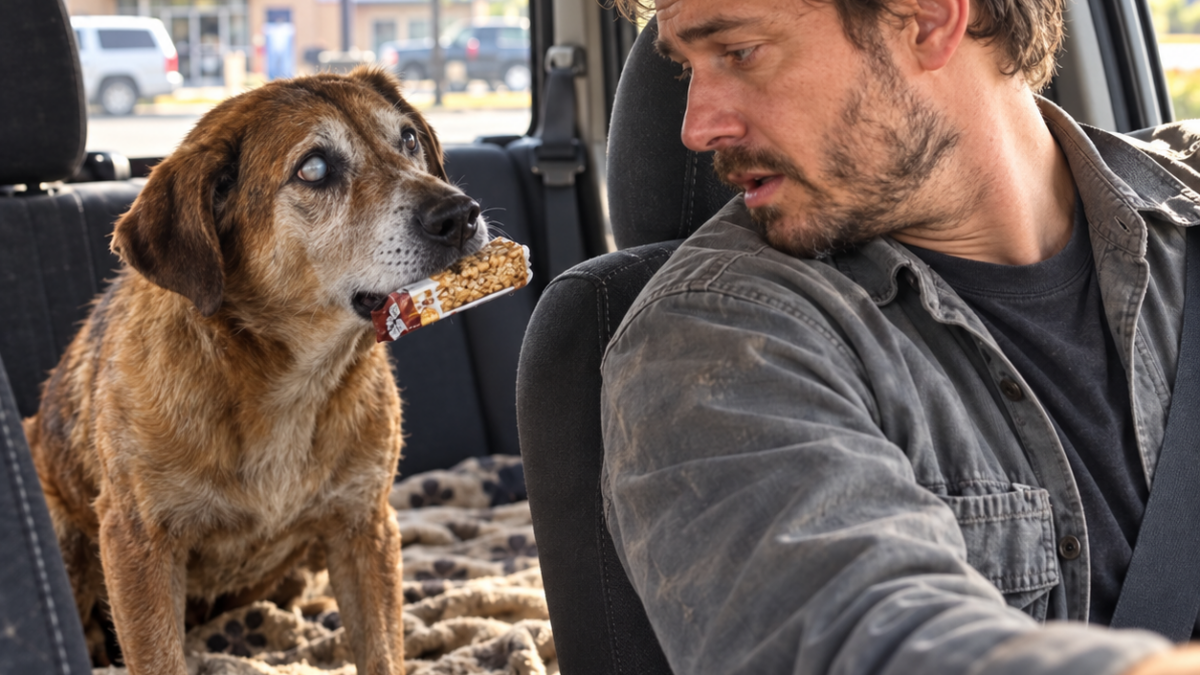
I was ten minutes from returning Cooper to the shelter when he placed my last granola bar in my lap and refused to eat it.
For weeks, I had believed my rescue dog was stealing food because he was impossible to manage, and that morning I had finally decided I couldn’t keep him anymore.
Then I looked beneath the blanket beside him and realized Cooper had understood something about my life that I had been desperately trying to hide from everyone.
I hadn’t planned on adopting a dog.
I had gone to the shelter because my apartment had become unbearably quiet after my divorce.
That was the explanation I gave myself, anyway.
The truth was that I had started finding excuses not to go home.
I worked long shifts at a warehouse, drove around after work, bought the cheapest dinner I could find, then sat in my car until I was tired enough to fall asleep quickly.
There was nobody waiting inside.
No conversation.
No footsteps.
Nothing.
Then I saw Cooper.
Most of the dogs barked when I walked past.
Cooper didn’t.
He was a skinny brown mutt with gray around his muzzle and one cloudy eye. He sat against the back wall of his kennel and watched me like he was trying to decide whether trusting another person was worth the risk.
A shelter worker named Emma stopped beside me.
“He’s around six,” she said.
“What happened to his eye?”
“Old injury.”
I crouched.
Cooper didn’t move.
“He friendly?”
“Very.”
She hesitated.
“But he has some issues around food.”
I looked at his ribs.
“I can handle a dog eating too fast.”
“That’s not exactly what I mean.”
Then she told me Cooper had already been adopted once and returned.
I should have asked more questions.
Instead, I opened my hand.
Cooper slowly crossed the kennel and pressed his nose against my fingers.
Two hours later, he was in my car.
The first few days were almost perfect.
He followed me everywhere.
He slept beside the front door while I worked.
And when I came home, Cooper greeted me like I had accomplished something heroic simply by returning.
Then food started disappearing.
Half a loaf of bread vanished.
I found it underneath the couch.
Two granola bars disappeared from the counter.
One was behind the toilet.
The other was under my pillow.
Then I discovered pieces of dog food arranged beside the front door.
He wasn’t eating them.
He was hiding them.
I started locking food away.
Cooper learned to open cabinets.
I put bread on top of the refrigerator.
He knocked over a chair trying to reach it.
I found crackers inside my work boot.
“Buddy,” I said one morning, holding the crackers. “What are you doing?”
Cooper lowered his head.
I knew dogs sometimes hoarded food after experiencing hunger.
I tried to be patient.
But my own life was getting worse.
My hours at the warehouse were cut.
Rent went up.
My car needed repairs.
I started making deliveries after work just to keep my bills paid.
Some nights my dinner was coffee.
Other nights it was whatever fries customers hadn’t wanted and the restaurant let drivers take home.
Whenever Cooper watched me, I smiled.
“I’m fine.”
He always tilted his head.
Then he started howling when I left.
My apartment manager gave me a warning.
One more complaint and Cooper had to go.
I bought toys.
Left the television running.
Walked him until both of us were exhausted.
Nothing worked.
Then Thursday night broke me.
I came home after fourteen hours away and found a kitchen cabinet open.
A blue plate lay shattered across the floor.
It had belonged to my mother.
One of the few things of hers I still owned.
Cooper stood in the hallway holding my lunch sandwich in his mouth.
I snapped.
“I CAN’T KEEP DOING THIS!”
Cooper flinched.
“I can barely feed myself, man!”
He stared at me.
Then slowly walked forward.
And pushed the sandwich against my knee.
I thought he was surrendering stolen food.
I was wrong.
The next morning, I called Emma.
“I’m bringing him back.”
Cooper climbed quietly into my back seat.
When I parked outside the shelter, he picked up a granola bar he had hidden beneath his blanket.
My last one.
He placed it in my lap.
Then he turned away without taking a bite.
And when I lifted his blanket to see where he had gotten it, I found something underneath that made me shut off the engine and stare at him.
Because Cooper hadn’t been stealing food from me.
He had been saving it for me.
PART 2
For several seconds, I just sat there.
The shelter entrance was less than fifty feet away.
People moved through the glass doors.
Someone walked a Labrador toward a car.
A volunteer carried a bag of donated food inside.
Everything around me continued normally.
But inside my car, something had shifted.
Under Cooper’s blanket were three things.
A wrapped cracker packet.
A handful of kibble.
And half of the sandwich I had shouted at him for stealing the night before.
He had not eaten it.
Not even a bite.
I picked up the sandwich.
Cooper watched me from the corner of the back seat.
His ears were down.
“Why didn’t you eat this?”
He looked away.
I knew that was a ridiculous question.
He was a dog.
He couldn’t answer.
But suddenly I remembered every hiding place.
The bread beneath the couch.
The granola bar beneath my pillow.
Crackers inside my work boot.
Kibble beside the front door.
Those were not random places.
The couch was where I slept when I was too tired to make it to bed.
My pillow.
My work boots.
The front door I walked through every night.
Places that smelled like me.
I looked at Cooper.
“No.”
His tail moved once against the seat.
I thought about the previous night.
Cooper standing with the sandwich.
Me shouting.
Then Cooper bringing it toward me.
Not running away.
Not guarding it.
Giving it back.
No.
Offering it.
I suddenly remembered something else.
Three nights earlier, I had come home around eleven thirty.
I had skipped dinner.
Cooper sat near his bowl while I poured his food.
I remember saying, “At least one of us eats good around here.”
Then I drank water from the sink and went to bed.
The next morning, I had found kibble lined up beside the front door.
At the time, I had been furious.
Now my hands began shaking.
“Oh, Cooper.”
He lowered himself against the seat.
I reached back.
He flinched slightly.
That broke me.
Not dramatically.
I didn’t scream or pound the steering wheel.
I just put my forehead against the seat and started crying.
The kind of crying that leaves you embarrassed even when nobody is watching.
“I’m sorry.”
Cooper cautiously lifted his head.
“I’m so sorry.”
He moved toward me.
Then stopped.
I picked up the granola bar.
“You were saving this?”
His cloudy eye looked almost silver in the morning light.
His good eye stayed fixed on my face.
I unwrapped the bar.
Broke off a small piece.
Held it toward him.
Cooper sniffed.
Then turned his face away.
I laughed through tears.
“You’ve been stealing these for weeks and now you don’t want one?”
Nothing.
I put the piece in my own mouth.
Cooper immediately looked at me.
His tail moved.
Once.
Then twice.
I froze.
I took another bite.
His tail wagged faster.
And something inside me collapsed.
The dog I was about to return because I thought he was taking food from me had been worried I wasn’t eating.
I don’t know exactly how much dogs understand about money.
Probably none of it.
Cooper did not know what rent was.
He didn’t know my warehouse hours had been cut.
He didn’t understand overdraft fees, car repairs, divorce papers, or the envelopes I had stopped opening because I couldn’t afford whatever was inside them.
But he knew routines.
He knew bowls.
He knew hunger.
And apparently, he knew what an empty human looked like.
I had been telling him every night that I was fine.
He had not believed me.
A knock against the window startled me.
Emma stood outside.
She had seen my car.
I wiped my face quickly.
Too late.
She opened the passenger door slightly.
“You okay?”
I held up the sandwich.
“This was under his blanket.”
She looked from me to Cooper.
“So?”
“He stole it last night.”
Emma waited.
“He didn’t eat it.”
Her expression changed.
I showed her the crackers.
The kibble.
Then the granola bar.
“I think…”
I stopped.
The words sounded stupid.
“I think he’s been saving food for me.”
Emma didn’t laugh.
Instead, she looked at Cooper for a long time.
Then she sighed.
“Come inside.”
I shook my head.
“I’m not surrendering him.”
“I know.”
That was the first thing anyone had said all morning that made sense.
I got Cooper out of the car.
He hesitated when he saw the shelter entrance.
His body changed immediately.
His tail stopped.
His head lowered.
He leaned backward against the leash.
I had seen him do that only once before.
The day I adopted him.
“No,” I said quickly. “We’re not leaving you.”
His eye stayed on the building.
I crouched.
“Cooper.”
He looked at me.
“You’re coming home.”
He didn’t understand the words.
But he understood when I turned away from the intake doors.
His tail started moving again.
Emma led us around the side into a small staff room rather than the main kennel area.
There was an old couch, a coffee machine, donated blankets, and a refrigerator covered in magnets.
Cooper climbed under the table.
Emma poured coffee.
“You said he had food issues when I adopted him.”
“Yes.”
“What happened to him?”
She leaned against the counter.
“We don’t know everything.”
“Tell me what you do know.”
Emma looked toward Cooper.
“He was picked up behind a grocery store about eight months ago.”
“Stray?”
“That’s what we thought.”
“Thought?”
“He had a collar mark. No collar when animal control found him. No chip.”
She paused.
“He was underweight. Very underweight.”
I looked at his ribs.
He had gained some since adoption, but I could still see their outline.
“How bad?”
Emma opened a folder.
Not because she needed it.
I think she wanted something to do with her hands.
“Forty-two pounds when he came in. He should’ve been closer to sixty.”
I swallowed.
“Jesus.”
“He had sores on his paws and an old injury to the eye. Vet said he’d probably been roaming or living rough for a while.”
“What about the food?”
Emma sat across from me.
“The first week, he ate everything we gave him immediately. Then something changed.”
“What?”
“He started saving it.”
I leaned forward.
“Here too?”
She nodded.
“Kibble under bedding. Biscuits in corners. Sometimes he wouldn’t eat until another bowl appeared.”
“Why?”
“We guessed food insecurity.”
I stared at Cooper.
“He had to know there was more coming before he trusted himself to eat.”
“Probably.”
“What happened with the first adoption?”
Emma’s mouth tightened.
“A couple took him.”
“For how long?”
“Twelve days.”
“And?”
“They brought him back because he stole food.”
My stomach turned.
“Same thing?”
“Bread. Snacks. Dog food. Apparently he hid some in their laundry room.”
“Did anyone explain why?”
“We tried.”
“What did they say?”
“That they didn’t want a dog they had to ‘manage around food.’”
I looked under the table.
Cooper was watching us.
Twelve days.
Then returned.
I pictured him getting into someone else’s car.
Walking into another home.
Learning where the bowls were.
Learning voices.
Maybe starting to believe he had finally found a place.
Then riding back to the same shelter.
No wonder he had curled quietly into my back seat that morning.
He knew the route even if he didn’t know the destination.
He knew what a human changing their mind felt like.
I rubbed both hands over my face.
“I yelled at him.”
Emma stayed quiet.
“I yelled at him for trying to feed me.”
“You didn’t know.”
“I should have.”
“No. You should’ve known he had a trauma behavior. You didn’t know what it meant.”
I looked at her.
“He’s been howling too.”
“When you leave?”
“Yeah.”
“That’s probably related.”
“How?”
Emma folded her arms.
“Dogs who’ve been abandoned can develop separation anxiety. Cooper may not be panicking because he’s bored.”
“He thinks I’m not coming back.”
“Maybe.”
The sentence landed harder than I expected.
Every morning, I walked out of the apartment.
Every morning, Cooper watched the door close.
Maybe he had no way to know whether that was simply work.
Maybe to him, doors closing meant people disappearing.
I thought about how he slept against the front door while I was gone.
Not the couch.
Not the rug.
The door.
Waiting at the exact place where I vanished.
“He’s terrified I’m leaving him.”
Emma nodded.
“And I almost did.”
Neither of us said anything for a while.
Then my phone buzzed.
My apartment manager.
I stared at the name.
Emma noticed.
“Trouble?”
“Probably.”
I answered.
“Hello?”
“Daniel?”
It was Mr. Patterson, the manager.
“Yeah.”
“We had another complaint this morning.”
I closed my eyes.
“I wasn’t home.”
“Exactly. Your dog started howling after you left.”
My hand tightened around the phone.
“I know.”
“We talked about this.”
“I know.”
“You need to deal with it.”
“I’m trying.”
“There are other tenants, Daniel.”
“I understand.”
“I’m giving you until Monday.”
Three days.
“To do what?”
“Show me there’s a plan. Otherwise the dog can’t remain in the unit.”
I looked at Cooper.
He was still under the table.
“I’ll have a plan.”
When I hung up, Emma asked, “How bad?”
“Monday.”
She nodded slowly.
“I know a trainer.”
“I can’t afford a trainer.”
“She volunteers with us.”
That stopped me.
“She works with separation cases?”
“Yes.”
“Can she fix him in three days?”
Emma almost smiled.
“No.”
“Great.”
“But she can help you show your landlord you’re addressing it.”
That was something.
Maybe not enough.
Something.
Her name was Rachel.
She met us at my apartment that afternoon.
I almost apologized when she walked in.
The place looked exactly like a man trying not to collapse financially.
Laundry on a chair.
Unopened mail.
A nearly empty refrigerator.
One lamp because I had stopped replacing bulbs.
Rachel was in her forties, compact, calm, and apparently impossible to embarrass.
She ignored the mess.
Cooper approached her cautiously.
She turned sideways rather than reaching toward him.
Good sign, apparently.
Within five minutes, he was sniffing her hand.
Within ten, he sat beside her.
She asked me questions.
When did the howling start?
How long after I left?
Did Cooper destroy doors?
Urinate?
Scratch windows?
Refuse food?
I explained everything.
Then I told her about the granola bar.
Rachel looked at Cooper.
“That actually fits.”
“With separation anxiety?”
“With his whole history.”
She stood.
“Show me where he hides things.”
I felt ridiculous.
We walked through my apartment like detectives.
Under the couch.
Behind the toilet.
My bedroom.
The front door.
My boots.
Rachel crouched near the shoe rack.
“You said you wear these to work?”
“Every day.”
“So they smell strongly like you.”
“Unfortunately.”
She smiled.
“The food may be functioning almost like a safety object.”
“What does that mean?”
“He may be associating food with security and placing it near places that represent you or your return.”
I looked at the boots.
“So he’s not saving all of it for me?”
“I wouldn’t claim we can know exactly what he intends.”
That was fair.
“But?”
“But animals repeat patterns that reduce anxiety. If food means survival to him and you mean safety, those two things may be linked.”
I looked at Cooper.
He was sitting in the hallway.
Watching me.
Rachel continued.
“What matters is not whether he is consciously planning meals for you like a person would. What matters is that the behavior is connected to fear, attachment, and past hunger.”
I nodded.
“So how do we stop it?”
“We don’t start by stopping the behavior.”
I frowned.
“Then what do we do?”
“We make him feel safe enough that he no longer needs it.”
That sounded expensive.
Or impossible.
Or both.
Rachel gave me a plan.
Short departures.
Thirty seconds.
One minute.
Three minutes.
Return before Cooper escalated.
No dramatic goodbyes.
No dramatic reunions.
Food toys that remained available only during departures.
A predictable routine.
Exercise.
A camera if I could borrow one.
And most importantly, she told me to stop punishing hoarding.
“Trade for it.”
“For my own food?”
“Yes.”
“He steals my sandwich and I reward him?”
“You remove access to human food. But if he gets something, you don’t turn it into a conflict. Conflict increases anxiety.”
I rubbed my face.
“This sounds like a lot.”
“It is.”
“I work two jobs.”
“I know.”
“I may lose my apartment.”
“I know.”
“My car sounds like it’s about to explode.”
“I can’t help with that one.”
I laughed despite myself.
Then Rachel looked at me directly.
“You don’t have to keep him.”
I felt my chest tighten.
“I know.”
“If keeping Cooper means both of you end up homeless, that isn’t rescue.”
“I know.”
“But if you want to try, there are things we can do.”
I looked at him.
Cooper’s head tilted.
“I want to try.”
That night, I ate the granola bar.
The whole thing.
I made Cooper watch.
Not because Rachel told me to.
Because somehow it felt important.
I sat on the floor.
Cooper lay across from me.
“See?”
I took another bite.
“Human eating.”
Tail wag.
“You eat your food. I eat mine.”
I pointed to his bowl.
He looked at it.
Then at me.
“Come on.”
Cooper stood.
Walked to the bowl.
Ate a few pieces.
Stopped.
Looked at me.
I took another bite.
He ate more.
That became our first strange little ritual.
For several days, I made sure Cooper saw me eat.
Even when dinner was pathetic.
A banana.
Toast.
A cup of noodles.
I stopped pretending around him.
“I’m broke,” I told him one night while eating eggs.
Cooper rested his head on my knee.
“My marriage failed.”
Tail thump.
“My car is garbage.”
Another thump.
“I hate my second job.”
He sighed.
“Exactly.”
Talking to a dog is dangerous.
Eventually you tell him things you have not told anybody else.
I had spent the year since my divorce insisting I was fine.
To coworkers.
My sister.
My ex-wife.
Myself.
But Cooper already knew I wasn’t.
Maybe he didn’t know why.
He knew the shape of it.
He knew I sat too long in the dark.
Knew sometimes I didn’t eat.
Knew I came home exhausted.
Knew I stared at unopened bills.
Knew I was lonely enough to adopt a dog I had not planned on having.
And somehow, instead of deciding I was too much trouble, Cooper followed me from room to room.
Monday came.
Mr. Patterson knocked at six thirty.
Cooper barked twice.
Then stood behind me.
I had paperwork ready.
Rachel had written a short training plan.
Emma had provided proof that Cooper was enrolled in a shelter-supported behavior program.
I had bought a cheap used camera from someone at work.
I showed Mr. Patterson everything.
He read silently.
“How long will this take?”
“I don’t know.”
He frowned.
“That’s not very reassuring.”
“I know.”
“He kept Mrs. Greene awake yesterday.”
“I apologized.”
“She works nights.”
“I know.”
Mr. Patterson looked past me at Cooper.
“I like dogs, Daniel. But I manage twenty-six units.”
“I understand.”
“I can’t have one tenant’s pet making everyone miserable.”
“I’m asking for thirty days.”
“That’s a lot.”
“Two weeks.”
He looked at me.
“Two weeks.”
“If there’s no improvement, I’ll figure something else out.”
That sentence hurt.
Cooper nudged my leg.
Mr. Patterson noticed.
Then sighed.
“Two weeks.”
After he left, I sat on the floor.
Cooper immediately climbed against me.
“We have fourteen days, buddy.”
He licked my jaw.
“No pressure.”
The first training session was humiliating.
I stepped outside.
Thirty seconds later, Cooper began whining.
At forty-five seconds, he scratched the door.
At one minute, the howl started.
I went back in.
Rachel watched from a video call.
“Too long.”
“One minute?”
“For him, yes.”
So we started at ten seconds.
Door closes.
Wait.
Door opens.
Cooper still there.
Repeat.
Ten seconds.
Fifteen.
Twenty.
By the end of the first evening, I had walked in and out of my apartment more than fifty times.
My neighbor across the hall opened her door.
“You moving?”
“No.”
She looked at Cooper.
“Training.”
She stared.
“You look ridiculous.”
“I feel ridiculous.”
She shut the door.
Day two, we reached forty seconds without whining.
Day three, ninety seconds.
Then Cooper regressed.
I left for two minutes.
He howled.
I came back frustrated.
“We did this yesterday!”
Cooper lowered his head.
I immediately hated myself.
Rachel’s voice came through the phone.
“He isn’t failing.”
“I know.”
“You sound like you don’t.”
I sat down.
“I’m tired.”
“So is he.”
That shut me up.
Progress with fear is not a staircase.
It is weather.
Some days clear.
Some days everything returns.
By the end of the first week, Cooper could handle five minutes.
Five.
That was it.
I needed hours.
I started believing this would never work.
Then my warehouse supervisor called me into his office.
His name was Mike.
He rarely called anyone in unless something was wrong.
“Sit down.”
I sat.
He slid a paper toward me.
My stomach dropped.
“What is this?”
“Schedule change.”
I looked.
More hours.
Not full-time.
But close.
I stared at him.
“Why?”
“Ramirez quit.”
That was bad for Ramirez.
Life-changing for me.
“Can you take his Saturday?”
“Yes.”
“Nights twice a week?”
“Yes.”
Mike nodded.
“Then they’re yours.”
I nearly cried in front of him.
Instead, I said, “Thanks.”
On the drive home, I bought groceries.
Not much.
Chicken thighs.
Rice.
Eggs.
Bread.
Peanut butter.
Bananas.
Dog treats.
At checkout, I almost put half back.
Then I checked my bank balance.
I could do it.
For once.
When I carried the bags into the apartment, Cooper went insane.
He sniffed every bag.
Followed me into the kitchen.
Stared while I put food away.
I took out the bread.
Held it up.
“This stays here.”
Cooper watched.
I placed it in the cabinet.
Then I filled his bowl.
He ate.
Not all of it.
But most.
Later that night, I found six pieces of kibble under my pillow.
I laughed.
“Still working on it, huh?”
I did not remove them immediately.
I slept beside them.
Maybe that sounds disgusting.
At that point, I did not care.
In the morning, Cooper watched me pick them up.
I put them back in his bowl.
“Emergency reserves.”
He ate two.
The rest stayed.
The howling slowly improved.
Not quickly enough for me.
But enough for Mr. Patterson.
The camera showed something interesting.
Cooper’s worst panic happened in the first ten minutes.
He paced.
Whined.
Went to the door.
Returned to my bedroom.
Sometimes grabbed kibble and carried it toward my boots.
Then, if he could settle, he slept.
That gave us something to work with.
Rachel taught me to create departure routines that made those ten minutes easier.
A frozen food toy.
My worn T-shirt near his bed.
Low music.
No goodbye speech.
I hated the no goodbye speech.
Every instinct in me wanted to kneel and say, “I’ll be back.”
Rachel told me the emotional performance was for me, not Cooper.
So I stopped.
Shoes.
Keys.
Food toy.
Door.
Return.
Every return taught him the same lesson.
People can leave and still come back.
I did not realize until months later that I was learning the same thing.
My divorce had broken something in me too.
I had taken one person leaving and turned it into a theory about everyone.
Friends eventually move on.
Partners leave.
Family dies.
Jobs cut hours.
Everything goes.
So do not need too much.
Do not ask.
Do not depend.
Then Cooper arrived with essentially the same philosophy.
Food disappears.
People disappear.
Save what matters.
Guard against tomorrow.
The difference was that Cooper was not embarrassed by his fear.
He showed it.
He hid bread.
I hid bills.
He howled at doors.
I stayed at work because going home hurt.
He put emergency kibble beside my boots.
I kept an emergency suitcase half-packed for months after my divorce.
Maybe we were not as different as I thought.
One night, I found that suitcase in the closet.
I sat on the floor and stared at it.
Cooper came in.
Sniffed it.
Then sat beside me.
“You know what this is?”
Head tilt.
“It’s stupid.”
I unpacked it.
Three shirts.
Jeans.
Documents.
Toiletries.
Cash.
The things I believed I needed if my life collapsed again.
I put everything away.
Then I folded the suitcase and pushed it onto the top shelf.
Cooper watched.
“There.”
Tail thump.
“Your turn.”
He did not stop hoarding.
Of course he didn’t.
But over time, the piles became smaller.
That first month, I found food hidden almost every day.
By the third month, maybe twice a week.
By six months, occasionally.
Sometimes I found an old biscuit and had no idea whether it had been there for a day or six weeks.
The separation anxiety improved too.
Five minutes became fifteen.
Fifteen became thirty.
Thirty became an hour.
Eventually, Cooper could handle most of my warehouse shift because a neighbor came by halfway through.
Her name was Mrs. Greene.
Yes.
The same woman whose complaints had nearly gotten Cooper removed.
She lived downstairs and worked overnight as a nurse.
One afternoon, she knocked.
I expected another complaint.
Instead she said, “I heard he’s doing better.”
“Yeah.”
“How long is he alone?”
“Too long some days.”
She looked past me.
Cooper was standing in the hallway.
“I’m home afternoons.”
I waited.
“So?”
“So I could take him out.”
I stared at her.
“You complained about him.”
“He was howling for three hours.”
“Fair.”
“I didn’t say I hated him.”
Cooper approached.
Mrs. Greene held out her hand.
He sniffed.
“Brown dogs aren’t really my thing.”
I almost laughed.
“What is your thing?”
“Quiet.”
Cooper licked her fingers.
She sighed.
“Fine.”
Mrs. Greene became Cooper’s favorite person after me.
Possibly ahead of me.
She brought treats.
Took him on slow walks.
Let him sleep near her couch while she watched television.
The first afternoon I came home and couldn’t find Cooper, I panicked.
Then Mrs. Greene opened her door.
“Looking for this traitor?”
Cooper walked out carrying half a biscuit.
“You feeding him?”
“No.”
She looked away.
“Mrs. Greene.”
“He looked hungry.”
“He always looks hungry.”
“That sounds like your problem.”
Cooper followed me upstairs.
Halfway there, he turned around and looked toward her door.
“Unbelievable.”
Mrs. Greene laughed.
That became another part of our life.
People appeared.
Not dramatically.
One by one.
Rachel.
Emma.
Mrs. Greene.
Mike giving me extra hours.
A coworker named Luis who knew cars and replaced a belt for the price of parts and pizza.
My sister calling more often after I finally admitted I was struggling.
For months, I had believed I was keeping Cooper afloat.
The truth was Cooper had accidentally pulled me into a network of people I had been too proud to ask for.
One Saturday, my sister, Megan, came over.
She had not seen me in nearly a year.
We had spoken.
We just had not been close since Mom died.
Grief makes families strange.
Sometimes it brings people together.
Sometimes everybody retreats to separate corners because seeing each other means seeing what is missing.
Megan walked into the apartment and Cooper greeted her cautiously.
“That him?”
“Yep.”
“The food thief?”
“Former food redistribution specialist.”
She laughed.
Cooper immediately liked her.
Of course he did.
Megan looked around.
“You have groceries.”
I stared at her.
“Thanks?”
“You didn’t last time I came.”
That was more than a year earlier.
“I had food.”
“You had mustard.”
“And noodles.”
“Three packs.”
“I survived.”
Her eyes softened.
“Daniel.”
I hated the way she said my name.
Like an intervention.
“I’m fine.”
Cooper, lying between us, lifted his head.
Megan looked at him.
Then at me.
“He doesn’t believe you either.”
I laughed.
That broke something open.
We talked.
Really talked.
About the divorce.
About Mom.
About money.
About how ashamed I had been when my marriage ended because everybody had thought we were solid.
About the way my ex-wife, Laura, had said, “You disappear when things get hard.”
At the time, I thought she meant I physically left.
She meant something else.
I shut down.
Stopped speaking.
Worked more.
Answered every question with “I’m fine.”
Even when nothing was.
Megan listened.
Then she said, “Mom used to do that.”
I looked at her.
“What?”
“Hide when she was scared.”
“No, she didn’t.”
“Yes, she did.”
I almost argued.
Then I remembered the blue plate.
Mom cooking dinner after Dad lost his job.
Smiling.
Saying everything was fine.
Eating almost nothing.
Sending us to school with full lunches.
Hiding the overdue notices in a drawer.
My chest tightened.
Maybe Cooper had not invented anything.
Maybe I had grown up around the same behavior.
Save food.
Pretend you do not need it.
Feed everyone else first.
Hide the fear.
Megan noticed my face.
“You okay?”
I laughed bitterly.
“Apparently nobody in this family knows how to be okay normally.”
She reached across the table.
“That’s why you learn.”
Cooper put his nose on my knee.
“Great. Group therapy with a mutt.”
Megan smiled.
“He seems qualified.”
Months passed.
Life did not become perfect.
I want to be clear about that.
There was no montage where I suddenly got rich, Cooper became completely cured, and my apartment turned into a magazine photo.
My car still broke.
The warehouse still cut overtime occasionally.
Rent still hurt.
Cooper still stole food if I was careless.
One Thanksgiving, he managed to hide an entire dinner roll inside the laundry basket.
Megan found it when she reached for a towel.
“Daniel!”
I walked in.
She held up the roll.
Cooper left the room.
“Not mine.”
She stared.
“He’s your dog.”
“Allegedly.”
But the fear underneath everything slowly loosened.
Cooper gained weight.
His coat improved.
The cloudy eye never changed, but the rest of him did.
He stood taller.
He played.
Actually played.
The first toy he loved was a cheap stuffed raccoon.
He carried it everywhere.
One night, I found it tucked beside my work boots.
I laughed.
“At least this isn’t food.”
Eventually, Cooper began sleeping in my bedroom instead of by the front door.
That was a bigger milestone than I realized.
The first time it happened, I woke around two in the morning and saw him curled near the bed.
I almost woke him.
Then I stopped.
The front door was thirty feet away.
For months, Cooper had believed he needed to guard it.
Wait at it.
Monitor whether I returned.
Now he could sleep somewhere else.
He trusted that the door did not require constant supervision.
I lay awake watching him breathe.
There are victories nobody else understands.
That was one.
The anniversary of the morning I almost returned him came and went without me noticing.
Emma remembered.
She texted.
“Guess who was nearly back in Kennel 14 one year ago today?”
I looked at Cooper.
He was on the couch.
Technically against the rules.
We had abandoned many early rules.
I called Emma.
“You remember the date?”
“I remember every dog who almost comes back.”
“That sounds depressing.”
“It is.”
Cooper rolled onto his back.
I rubbed his chest.
“Come see him.”
Emma visited the following weekend.
When she walked in, Cooper froze.
Then recognized her.
His tail exploded.
Emma sat on the floor.
“Oh my God, look at you.”
Cooper pushed against her.
“You got fat.”
“He got healthy.”
“He got spoiled.”
“That too.”
She touched the gray around his muzzle.
“Do you still hide food?”
I answered for him.
“Sometimes.”
Emma looked at me.
“And you?”
“What?”
“Do you still skip dinner?”
I rolled my eyes.
“Everyone thinks they’re my mother now.”
“That wasn’t an answer.”
I opened the refrigerator.
Food.
Not fancy.
But food.
Emma nodded.
“Good.”
She sat back down.
Cooper went into the bedroom.
Returned with something in his mouth.
A granola bar.
Emma stared.
I stared.
“You have got to be kidding me.”
The wrapper was dusty.
I checked the date.
Expired.
Probably from the original box.
I laughed so hard I sat down.
“Where did you find that?”
Cooper placed it in front of Emma.
She looked at me.
“Is this the famous granola bar?”
“Not the one. But same batch, apparently.”
Emma held it up.
“He kept this for a year?”
“Looks like it.”
Cooper stared.
Emma opened the wrapper.
I stopped her.
“You’re not eating that.”
“I wasn’t going to.”
She broke off the tiniest corner and offered it to Cooper.
He sniffed.
Turned away.
Emma slowly looked at me.
“No way.”
I took the piece.
Put it in my mouth.
“Daniel!”
“It’s probably fine.”
Cooper’s tail started wagging.
Emma covered her mouth.
“Oh my God.”
I chewed.
“Still tastes awful.”
Cooper wagged harder.
We both laughed.
That old granola bar became ridiculous evidence of where we had started.
I saved the wrapper.
Not the food.
Even I have standards.
I put it inside a drawer with Cooper’s adoption papers.
Over time, I stopped thinking about returning him at all.
He became part of the architecture of my life.
Morning walk.
Coffee.
Cooper eats.
I eat.
Work.
Mrs. Greene afternoon visit.
Home.
Evening walk.
Dinner.
Television.
Sometimes Rachel checked in.
Sometimes Emma sent pictures of shelter dogs.
Sometimes Megan came over.
My apartment stopped feeling like a place I was temporarily surviving inside.
It became home again.
Then something happened I had not expected.
Laura called.
My ex-wife.
We had not spoken in eight months except about paperwork.
Her name on my phone made my stomach tighten.
I considered not answering.
Cooper watched me.
“Don’t start.”
He tilted his head.
I answered.
“Hello?”
“Hi.”
“Hi.”
Awkward silence.
Then Laura said, “Megan told me about your dog.”
I almost laughed.
“Why are you talking to Megan?”
“She messaged me about some of your mom’s things.”
“Oh.”
Pause.
“She said you’re doing better.”
I hated how exposed I felt.
“I’m okay.”
Cooper immediately looked up.
I pointed at him.
“Not you.”
Laura heard.
“Is that him?”
“Yeah.”
Another silence.
Then she laughed softly.
“You have a dog.”
“I do.”
“You never wanted one when we were married.”
“That was different.”
“How?”
I looked at Cooper.
“I don’t know.”
Laura did not push.
Then she said something that surprised me.
“I’m glad.”
“For what?”
“That you have someone.”
I almost said, “I’m fine alone.”
The old answer.
Instead, I said, “Me too.”
That was it.
No reconciliation.
No grand speech.
No blame.
We talked for ten minutes.
Then hung up.
I sat on the couch.
Cooper climbed beside me.
“You realize you just survived a conversation with my ex-wife.”
He licked my hand.
“Brave.”
The real change came later.
My warehouse opened a lead position.
Nothing glamorous.
Two dollars more an hour.
Steadier schedule.
Health insurance if I maintained enough hours.
Mike told me to apply.
I laughed.
“I’m not management.”
“It’s not management.”
“Sounds management-adjacent.”
“You’ve been here seven years.”
“So?”
“So apply.”
I almost didn’t.
That was another habit.
Do not reach for something you might lose.
Cooper had the opposite problem.
He reached for everything.
Bread.
Granola bars.
My pillow.
People.
Eventually life.
I applied.
Two weeks later, I got it.
I brought home a rotisserie chicken.
Cooper knew immediately.
“No.”
Tail wag.
“This is celebratory chicken.”
More wagging.
“Mine first.”
His ears dropped.
“Okay, ours.”
I ate half.
He got some plain pieces with dinner.
That evening, I put the leftovers in the refrigerator.
Not hidden.
Just stored.
Cooper watched.
Then walked away.
He did not try to open the cabinet.
Did not drag a chair.
Did not pace.
That was when I realized the food hoarding had changed almost completely.
Not vanished.
But changed.
Cooper no longer seemed to believe every meal might be the last.
His bowl could sit partly full for an hour.
Sometimes overnight.
Food could exist without becoming an emergency.
That broke my heart in a completely different way.
Safety is strange.
When you do not have it, you imagine safety will feel dramatic.
It usually does not.
It feels boring.
Bread stays in the cabinet.
A dog leaves kibble in a bowl because he knows breakfast will still happen tomorrow.
A man pays rent on time and does not check his bank account twelve times before sleeping.
Nobody applauds.
That is why safety is beautiful.
Two years after Cooper came home, Mrs. Greene retired.
Her daughter wanted her to move closer.
Before leaving, she knocked on my door.
Cooper rushed toward her.
She sat in the hallway and hugged him.
“I’m gonna miss this ugly dog.”
“He’s handsome.”
“One eye.”
“Character.”
“Gray hair.”
“Distinguished.”
She handed me a key.
Her apartment key.
“I’m moving Friday.”
“I know.”
“I found something under my couch.”
She reached into her bag.
A sealed packet of crackers.
I stared.
“Cooper.”
Mrs. Greene nodded.
“He hasn’t been in my apartment in three weeks.”
I laughed.
“Emergency supply.”
She looked at Cooper.
“You were worried about me too?”
He wagged.
Her eyes filled.
“Oh, hell.”
She hugged him again.
“I hate dogs.”
“Sure.”
After she moved, Cooper waited outside her empty apartment for several days.
That was hard.
Every walk, he paused at her door.
Sniffed.
Waited.
Then followed me upstairs.
People do leave.
That lesson had never been false.
The new lesson was that leaving did not erase what happened before.
Mrs. Greene still called.
Sometimes video-chatted.
The first time Cooper heard her voice through my phone, he searched the apartment for her.
I cried laughing.
Three months later, she visited.
Cooper nearly knocked her over.
“You remember me?”
Of course he did.
Love does not require permanence to be real.
That was something both Cooper and I had needed to learn.
Year three brought another change.
Megan had a baby.
A girl named Lily.
I was terrified to bring Cooper around her.
Not because he had ever shown aggression.
Because babies are unpredictable.
We introduced them slowly.
Cooper sniffed the blanket first.
Then Lily’s feet.
Then sat down beside Megan.
“You like her?”
Tail wag.
For the next year, Cooper treated Lily like a strangely shaped human who frequently dropped food.
That made them natural allies.
When she learned to walk, Cooper stayed nearby.
When she fell, he approached.
When she ate crackers, Cooper positioned himself beneath her chair.
“This relationship is unethical,” I told Megan.
“She’s feeding him.”
“She’s one.”
“Exactly.”
One afternoon, Lily dropped a cracker.
Cooper picked it up.
I expected him to eat it.
Instead, he carried it three feet and placed it beside her little shoe.
Megan froze.
I froze.
Cooper walked away.
Megan looked at me.
“Did he just…”
“Yeah.”
She knew the story.
Everybody did by then.
Lily picked up the cracker.
I took it from her before she ate floor food.
Megan’s eyes filled.
“He still does it.”
“Sometimes.”
“For people?”
“Apparently.”
We sat there looking at Cooper.
He had no idea he had just reopened a three-year-old wound.
Or maybe healed it again.
His food behavior had never been simple theft.
It was a language built during hunger.
Save.
Protect.
Share with your person.
Make sure nobody you love goes without.
That behavior may have been maladaptive.
Messy.
Inconvenient.
But somewhere inside it was care.
Not human care.
Not a moral decision the way we would make one.
But attachment expressed through the only currency Cooper had ever learned to fear losing.
Food.
By year four, his muzzle had gone mostly gray.
The vet estimated he was closer to ten than nine.
His cloudy eye developed more opacity.
His joints became stiff in winter.
We started supplements.
Then medication on bad days.
He still walked.
Still ate.
Still greeted me at the door.
But slower.
One evening, I came home and Cooper did not get up.
My stomach dropped.
“Cooper?”
His head lifted.
Tail moved.
He tried to stand.
His back legs slipped.
I rushed over.
“Easy.”
He regained footing.
The vet diagnosed arthritis.
Nothing catastrophic.
Age.
Time.
The two things I once prayed Cooper would have were now arriving with their price.
I hated that.
Dr. Patel, his veterinarian, looked at me.
“He’s doing well for his age.”
“He fell.”
“He slipped.”
“What’s the difference?”
“One is a moment. The other is a pattern.”
I nodded.
“What do I do?”
“Rugs. Weight management. Medication. Shorter walks. Keep him moving.”
I bought cheap runners for the hallway.
Cooper hated them.
Walked around them.
Slipped again.
I pointed.
“That is literally why those exist.”
He ignored me.
Eventually, he used them.
Mostly.
Age made Cooper softer.
More affectionate.
Less anxious.
He stopped sleeping at the door entirely.
His favorite place became the couch.
Technically still against the original rules.
I stopped pretending we had rules.
I bought steps so he could climb up without jumping.
The first night, he refused to use them.
I lifted him.
He groaned like I had insulted him.
“You’re old.”
Tail thump.
“So am I.”
Another thump.
I was thirty-nine.
He did not care.
Financially, things improved.
Not dramatically.
But enough.
I paid off the worst credit card.
Got the car repaired properly.
Started saving again.
One morning I opened my bank app and saw a number I had not seen in years.
Not huge.
But positive enough that an emergency would not immediately destroy me.
I sat at the kitchen table.
Cooper looked up from his bed.
“We did it.”
Head tilt.
“We have an emergency fund.”
Tail wag.
“Your emergency food was cheaper.”
He sighed.
I laughed.
Then I cried a little.
Not because of the money.
Because I remembered the man who had once skipped dinner and shouted at a dog over a sandwich.
That man had believed failure meant he should get rid of anything that depended on him.
He had almost returned the one creature trying hardest to stay.
I wished I could go back to that shelter parking lot and knock on the window.
Tell him not to open the door.
Tell him the dog in the back seat was not another problem.
He was going to become a reason to solve some of them.
But maybe that version of me needed the granola bar.
Maybe nothing else would have reached him.
On Cooper’s estimated eleventh birthday, Emma came over.
Rachel too.
Megan brought Lily.
Mrs. Greene drove two hours from her daughter’s house.
I bought a dog-safe cake.
Cooper looked deeply unimpressed until he smelled it.
Emma laughed.
“This is the dog nobody wanted because he hid food.”
“Twice unwanted,” I said.
“Once stray. Once returned.”
Mrs. Greene corrected us.
“Then selected by an idiot.”
“Thank you.”
She smiled.
Cooper ate his cake.
Then, predictably, carried part of a biscuit away.
Everyone laughed.
“Still saving for winter,” Rachel said.
I followed him.
Cooper walked into my bedroom.
He put the biscuit beside my pillow.
Then returned to the party.
I stood there alone.
Looking at it.
Four years earlier, that would have annoyed me.
Now I sat on the bed.
I picked up the biscuit.
Held it in my palm.
Maybe old habits never disappear completely.
Maybe they do not need to.
Sometimes healing is not erasure.
Sometimes healing is an old fear becoming harmless because the world around it has changed.
Cooper still saved food.
But he was no longer starving.
I still worried about money.
But I was no longer drowning.
He still watched the door when I left.
But he no longer howled.
I still felt the ache of divorce.
But I no longer believed it meant I was unlovable.
Scars remained.
They simply stopped running our lives.
That night, after everyone went home, Cooper lay beside me on the couch.
I held the old biscuit.
“You know they all came here because of you.”
Cooper slept.
“Emma. Rachel. Mrs. Greene. Megan more often. Even Lily.”
His breathing was slow.
“You made my life crowded.”
One ear moved.
“I was trying very hard to keep it empty.”
He sighed.
I scratched his chest.
“Terrible dog.”
Tail thump.
The following year was harder.
Cooper’s arthritis progressed.
His cloudy eye lost most of its vision.
His hearing dulled.
He slept more.
But he still knew the refrigerator opening.
Age apparently does not affect that frequency.
He also still knew the exact time I came home.
If I was late, Megan said he waited in the hallway.
Not panicking.
Just waiting.
There is a difference.
One winter evening, a storm delayed traffic.
My normal thirty-minute drive took almost two hours.
When I opened the door, Cooper was lying on the rug.
He struggled to stand.
I dropped my bag.
“No, stay.”
He stood anyway.
Walked toward me.
Slowly.
I knelt.
He pressed his head against my chest.
For a moment, I remembered our first month.
The howling.
The door scratching.
The belief I might never return.
“You knew.”
His tail moved.
“You knew I was coming back.”
That might have been the proudest I ever felt.
Not that Cooper trusted people generally.
He trusted me specifically.
He had enough evidence now.
Thousands of departures.
Thousands of returns.
Trust is often just accumulated proof.
One day.
Then another.
Then another.
Until fear is outnumbered.
Cooper’s last year began quietly.
There was no obvious line.
He simply became older.
Shorter walks.
More naps.
Less interest in toys.
More interest in sunlight.
I moved his bed near the window.
He spent afternoons there.
Lily, now old enough to understand gentleness, would sit beside him and read picture books aloud.
Cooper slept through most of them.
“He likes my stories,” she insisted.
“He has excellent taste.”
Sometimes she brought him crackers.
Megan supervised.
“No feeding Grandpa Cooper.”
“Why Grandpa?”
“Because he’s old.”
I pointed at Megan.
“Careful.”
She laughed.
Cooper did not care about titles.
He cared about crumbs.
Then, one morning, Cooper refused breakfast.
That scared me.
Not immediately.
Dogs skip meals.
But Cooper did not.
Not really.
I sat beside his bowl.
“Come on.”
He sniffed.
Turned away.
I opened a can of wet food.
Nothing.
Chicken.
He took one tiny piece.
Then lay down.
I called Dr. Patel.
Tests showed kidney disease.
Not catastrophic yet.
Manageable.
For a while.
Medication.
Diet.
Fluids if necessary.
Monitoring.
I listened.
Asked questions.
Took notes.
Then drove home with Cooper asleep in the back seat.
Not curled against the door anymore.
Stretched comfortably across a blanket.
The same place he had sat years earlier with the granola bar.
I kept looking at him in the mirror.
“Not yet.”
He slept.
The disease progressed slowly.
Good days outnumbered bad ones.
Then balanced.
Then eventually did not.
That is the arithmetic nobody wants to do.
How many meals eaten willingly?
How many walks enjoyed?
How many times does he seek affection?
How often is he uncomfortable?
Does he still want his life?
Dr. Patel never made the decision for me.
She helped me see it.
One Friday, Cooper ate almost nothing.
Saturday, he drank little.
Sunday morning, he walked toward the door, then stopped halfway and lay down.
I carried him outside.
He had not been carried since the shelter years.
He seemed lighter than I remembered.
Not skinny.
Just old.
I sat in the courtyard with him.
Sunlight reached the concrete.
Cooper rested his head on my thigh.
Mrs. Greene was visiting that weekend.
She sat beside us.
“He looks tired.”
“I know.”
She rubbed his ear.
Cooper’s tail moved.
Slowly.
“Still ugly,” she whispered.
I laughed and cried at once.
“He loves you too.”
Emma came later.
Then Megan and Lily.
I had not planned a gathering.
People just came.
That is what Cooper had done to my life.
He collected people.
Emma sat on the floor beside him.
“You remember me, old man?”
Cooper sniffed her hand.
Tail thump.
“You were supposed to be Kennel 14’s problem forever.”
I looked at her.
“Great adoption pitch.”
“I’m serious.”
She wiped her eyes.
“Older brown mutt. One cloudy eye. Food issues. Returned once.”
Cooper breathed slowly.
“You were statistically terrible.”
“Emma.”
“What?”
She smiled through tears.
“He knows I’m kidding.”
Megan sat beside me.
“When?”
I knew what she meant.
“Tomorrow.”
She squeezed my shoulder.
Lily was quiet.
She understood enough to be sad.
She brought Cooper a cracker.
I almost stopped her.
Then didn’t.
She placed it near his nose.
Cooper sniffed.
He did not eat it.
Instead, after several seconds, he nudged it with his nose.
Toward Lily.
She looked at me.
“Uncle Daniel?”
I covered my mouth.
Megan started crying.
Lily picked up the cracker.
“He doesn’t want it.”
I whispered, “I think he wants you to have it.”
She looked at Cooper.
Then broke it in half.
She pretended to eat one piece.
Cooper watched.
His tail moved once.
Exactly once.
That night, I slept on the floor beside him.
Around two in the morning, I woke because Cooper was moving.
He had dragged himself maybe a foot toward the side table.
I turned on the lamp.
“What are you doing?”
There was something under the table.
A small packet.
I reached for it.
A granola bar.
Not old.
I had bought a box that week because I still ate them at work.
Cooper must have taken one earlier.
I stared.
“No.”
He looked at me.
I laughed softly.
“You have got to be kidding.”
I put it beside him.
“You want this?”
He turned his head away.
Of course.
I opened it.
Broke off a piece.
Held it toward him.
Nothing.
Then I ate it.
Cooper watched.
His tail moved.
Tap.
I could barely swallow.
“You still checking on me?”
Tap.
“I’m okay.”
He stared.
I laughed through tears.
“No, really.”
I took another bite.
“I eat now.”
His eye softened.
At least, that is how I remember it.
I finished the bar.
Every bite.
Then I lay beside him.
“You can stop saving food for me.”
His breathing slowed.
“I have enough.”
I looked around the apartment.
There was food in the kitchen.
Money in savings.
Pictures of Megan and Lily.
Mrs. Greene’s ridiculous Christmas card on the refrigerator.
Messages from Emma and Rachel.
A job waiting Monday.
A home that no longer felt temporary.
“I have enough because of you.”
Cooper rested his nose against my wrist.
“I’m fine.”
He did not tilt his head this time.
Maybe, finally, he believed me.
The next morning, we went to the veterinary clinic.
Megan drove because I could not trust myself.
Cooper lay across my lap in the back seat.
The position felt strangely reversed.
Years earlier, he had sat behind me believing I was taking him back to the shelter.
Now I was the one afraid of where the drive ended.
Dr. Patel had prepared a quiet room.
A blanket.
Soft lights.
No steel table.
I carried Cooper inside.
Emma was waiting.
I had not asked her to come.
Megan had.
I was grateful.
Cooper rested on the blanket.
Dr. Patel examined him gently.
Then looked at me.
“You’re making the kind decision.”
I hated that phrase.
Kind decision.
There was nothing kind about losing him.
But I knew what she meant.
Love was no longer asking Cooper to keep going because I was afraid to be alone.
That would have been for me.
I had promised him safety.
Safety included not forcing him to suffer so I could postpone grief.
I lay beside him.
Emma sat near his back.
Megan held my shoulder.
I placed one hand under Cooper’s chin.
“Hey, buddy.”
His eye opened.
“You remember when I tried to return you?”
Emma cried quietly.
“That was a terrible idea.”
Cooper breathed.
“I thought you were stealing from me.”
My voice broke.
“You were trying to feed me.”
His tail moved slightly beneath the blanket.
“I’m sorry it took me so long to understand.”
I kissed his forehead.
“You saved every stupid cracker.”
Another shallow breath.
“Every granola bar.”
I put my forehead against his.
“But you don’t have to save anything anymore.”
My tears fell into his fur.
“There’s enough.”
Dr. Patel waited.
I nodded.
Cooper left quietly.
No fear.
No shelter door.
No person changing their mind.
No hunger.
He left with my hand against his face.
The same hand he had once tried to feed.
For several minutes after, nobody moved.
Then Emma noticed something beneath the edge of the blanket.
“What’s that?”
I looked.
A single piece of kibble.
I laughed.
Actually laughed.
Hard.
Through tears.
“Of course.”
Emma picked it up.
“He brought emergency supplies.”
Megan laughed too.
That ridiculous piece of dog food saved me from collapsing.
I took it home.
People might think that is disgusting.
I put it in a tiny glass jar.
It sits beside Cooper’s adoption papers and the wrapper from the ancient granola bar.
For weeks afterward, my apartment felt wrong.
Too quiet.
Exactly the way it had before Cooper.
But not the same.
Before Cooper, quiet meant emptiness.
After Cooper, quiet meant absence.
Absence hurts because something good occupied the space.
That distinction mattered.
His bed stayed near the window.
His leash remained by the door.
For months I found his hair in places that made no sense.
One day, I put on an old work boot and felt something under my toes.
I pulled it off.
Turned it over.
Three pieces of kibble fell onto the floor.
I sat down laughing.
Then crying.
“Seriously?”
I kept those too.
Eventually, life moved forward.
Not away.
Forward.
There is a difference.
Mrs. Greene called.
Megan visited.
Lily asked about Cooper constantly.
Emma invited me to the shelter.
I refused for six months.
Then one Saturday, I went.
Not to adopt.
Absolutely not.
I had learned nothing.
Emma smiled when I said it.
“Just looking?”
“Do not start.”
We walked through the kennels.
Dogs barked.
Jumped.
Spun.
At the very end sat an older black dog.
Gray muzzle.
One ear bent.
He did not bark.
He just watched me.
I stopped.
Emma said nothing.
“Don’t.”
“I didn’t say anything.”
“You’re thinking loudly.”
She smiled.
The dog came toward the gate.
Pressed his nose through.
I held out my hand.
He sniffed.
My chest hurt.
Not because he was Cooper.
He wasn’t.
No dog ever would be.
That was exactly why I stayed.
Not to replace Cooper.
To use what Cooper had taught me.
Love is not a limited supply you preserve by refusing to spend it again.
That was another form of hoarding.
I laughed at the thought.
Of course Cooper would leave me with that lesson too.
I did not take the black dog home that day.
I volunteered instead.
Once a week.
Then twice a month when work was busy.
I walked dogs.
Cleaned kennels.
Talked to nervous adopters.
Sometimes Emma asked me to meet people considering dogs with food insecurity.
I told them Cooper’s story.
Not as a guarantee.
Not every food-hoarding dog is trying to feed a human.
Not every anxious dog heals the same way.
But behavior has history.
Before calling a dog stubborn, manipulative, bad, impossible, ask what the behavior may have once accomplished.
Maybe stealing food kept him alive.
Maybe howling made someone return once.
Maybe hiding beneath furniture prevented pain.
Survival habits outlive the danger that created them.
That does not make them permanent.
It makes them understandable.
One afternoon, a man came to return a dog.
Young shepherd mix.
Food guarding.
The man was angry.
“He growled at my daughter near his bowl.”
Emma handled the safety conversation carefully.
This was different from Cooper.
A child was involved.
Management mattered.
Training mattered.
Risk mattered.
I did not tell him, “Keep the dog no matter what.”
That would have been irresponsible.
Instead, Emma arranged an evaluation.
The shelter took the dog back temporarily.
A foster with experience worked with him.
Months later, he went to an adult-only home.
That taught me something else.
Compassion does not mean ignoring danger.
Understanding history is not the same as pretending behavior has no consequences.
Cooper had taught me patience.
Life taught me judgment.
Both matter.
Years passed.
I moved out of the apartment eventually.
Not because I was forced.
Because I wanted more space.
A small duplex.
Tiny yard.
Nothing impressive.
The first thing I unpacked was Cooper’s jar.
The kibble piece.
The granola wrapper.
His tag.
His photo.
I placed them on a shelf near the kitchen.
Megan saw them.
“You made a shrine.”
“It’s three objects.”
“It’s absolutely a shrine.”
Lily, older now, pointed at the granola wrapper.
“Why do you keep garbage?”
“Because your mother refuses to teach you respect.”
Megan laughed.
I told Lily the story again.
She had heard it dozens of times.
When I finished, she said, “Cooper thought you were hungry.”
“Yeah.”
“And you almost gave him away.”
“Yeah.”
“That was dumb.”
Megan nearly fell off the chair laughing.
“Thank you, Lily.”
She shrugged.
“It was.”
She was right.
I looked at Cooper’s photo.
Not the shelter photo.
One taken years later.
He was standing in my old apartment kitchen.
Healthy.
Gray muzzle.
One cloudy eye.
There was a piece of bread on the counter behind him.
Untouched.
That detail mattered more than anyone looking at the photo would ever know.
I had almost returned Cooper because he hid food.
Years later, food could sit beside him without fear.
I had almost returned him because his howling threatened my apartment.
Years later, he slept through my departures.
I had almost returned him because I thought I did not have enough to care for him.
In the end, he helped teach me that enough is not always money.
Sometimes enough is one person returning.
One meal that arrives when expected.
One safe place repeated until it becomes home.
One relationship that survives your worst habits long enough for them to soften.
Cooper never stopped being the dog who had known hunger.
I never stopped being the man whose life fell apart.
We simply became more than those things.
That is what healing was.
Not erasing what happened.
Expanding until the old story was no longer the whole story.
I still eat granola bars.
For years after Cooper died, I could not finish one without thinking of him.
Sometimes I smiled.
Sometimes it hurt.
Eventually both happened at once.
That is grief too.
Pain and gratitude learning to share the same room.
One cold morning, almost three years after losing him, I arrived early at the shelter.
Emma was already there.
She handed me a leash.
“Walk Murphy.”
“Which one?”
“Black dog. Bent ear.”
I stared.
The same dog I had noticed months after Cooper died was still there.
He had been adopted once.
Returned.
My stomach tightened.
“For what?”
Emma shrugged sadly.
“Too quiet. Didn’t bond quickly.”
I looked at her.
“They returned a dog for being quiet?”
“People are inventive.”
Murphy walked slowly beside me.
No pulling.
No excitement.
At the park, I sat on a bench.
Murphy stood several feet away.
I did not call him.
I had learned patience.
Five minutes passed.
Then ten.
Murphy moved closer.
Sat near my shoe.
Not touching.
Just near.
I looked down.
“Take your time.”
His ear twitched.
Something about that moment reminded me of Cooper’s kennel.
Not because the dogs were alike.
Because I was different.
Years earlier, I had needed Cooper to meet my loneliness immediately.
Now I understood that trust did not exist for my convenience.
We sat for another twenty minutes.
When we returned to the shelter, Murphy paused before the kennel.
Looked at me.
Then stepped inside.
I closed the gate.
He sat.
Watched.
Exactly as Cooper once had.
I went home.
Could not sleep.
The next morning, I drove back.
Emma looked at my face.
“No.”
“Yes.”
“You said never again.”
“I lied.”
“You said you were only volunteering.”
“Still technically true.”
She smiled.
“Murphy?”
I nodded.
The adoption took less time because the shelter already knew me.
When Murphy climbed into my car, I had a granola bar in the cup holder.
I stared at it.
Then laughed.
“No pressure.”
Murphy ignored me.
Perfect.
At home, he explored slowly.
No dramatic connection.
No instant bond.
He slept in the hallway.
Would not enter my bedroom for weeks.
I let him choose.
One month later, Murphy climbed onto the rug beside my bed.
I turned off the light.
Did not make a big deal of it.
But in the darkness, I whispered, “Good choice.”
He sighed.
Years later, I understood Cooper’s greatest gift had never been the food.
It was what that granola bar forced me to notice.
I had spent most of my adult life believing love was measured by how little trouble you caused someone.
Do not need too much.
Do not complain.
Do not ask for help.
Do not break the blue plate.
Do not howl.
Do not steal bread.
Do not become inconvenient.
Then Cooper arrived.
Anxious.
Hungry.
Cloudy-eyed.
Returned.
Complicated.
He needed patience I did not think I had.
And somehow loving him taught me I was allowed to need patience too.
The morning I nearly returned him, I believed the shelter would be the end of our story.
Instead, the shelter parking lot became the place where both of us stopped being abandoned.
Cooper because I turned the car around.
Me because, for the first time in years, I stopped abandoning myself.
I asked for help.
I ate.
I talked.
I let people in.
I came home.
And Cooper kept checking.
For years, he checked.
A biscuit beside my pillow.
Kibble near my boots.
A cracker beside Lily.
A final granola bar when his own body was failing.
Was he consciously trying to feed us?
I cannot prove that.
I no longer need to.
What I know is simpler.
Cooper had once been hungry.
Food became his language of safety.
Then he loved us.
And somehow the things he feared losing most kept appearing near the people he did not want to lose.
That is enough for me.
I keep one photograph on my desk now.
Cooper is standing beside the front door of my old apartment.
Gray-faced.
Healthy.
Tail blurred from wagging.
Behind him is the spot where he once lined up pieces of kibble waiting for me.
The floor is empty.
He no longer needed the pile.
He had learned dinner would come.
He had learned I would come home.
And eventually, because of him, I learned the same thing in my own way.
Not everybody stays.
Not every job lasts.
Not every marriage survives.
Not every dog gets as many years as we want.
But loss is not proof that love was a mistake.
Sometimes what leaves you still changes everything that comes afterward.
Cooper did.
He came into my life carrying fear in his mouth and hiding survival under my pillow.
I almost sent him away because I mistook that fear for bad behavior.
Then one granola bar changed the way I looked at him.
And once I understood what he was trying to tell me, I finally started understanding myself.
He had been saving food because some part of him still remembered what it meant to have nothing.
I had been saving pieces of myself for exactly the same reason.
Cooper eventually learned that food would keep coming.
I eventually learned that life could too.
And whenever I open a granola bar now, I still think of the skinny brown dog in the back seat who refused to eat the last one.
The dog I thought I was rescuing.
The dog who had quietly been trying to rescue me back.