PART 2: I Waited Until Every Homeowner Was Watching—Then I Read the Ledger That Exposed Their HOA President*
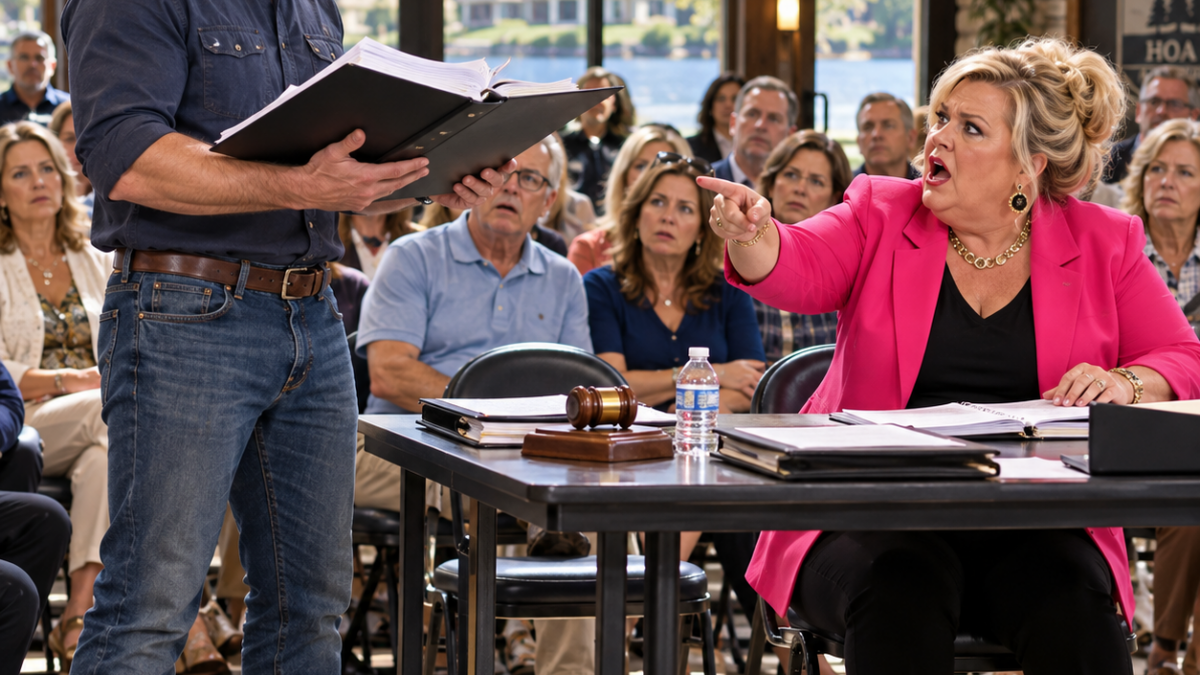
The room went silent when I set the black ledger on the folding table and told three hundred homeowners that every missing dollar had a name beside it.
Six months earlier, the woman whose signature filled those pages had sent armed men onto my ranch, zip-tied my workers, and tried to take a road she had no legal right to touch.
By the time I reached the first page, even the people who had defended her were staring at the exits like they finally understood what kind of meeting this was.
I had not planned to enjoy that moment.
For thirty years, my work as a deputy U.S. marshal taught me that anger is expensive. It makes you talk too soon, move too fast, and show your hand before the evidence is ready.
So when Ridgeline Estates HOA president Vivian Mercer began mailing me fines for a ranch that had never belonged to her association, I did the one thing she could not understand.
I stayed quiet.
At first the letters were almost funny.
“Unapproved agricultural fencing.”
“Excessive dust generation.”
“Commercial vehicle traffic inconsistent with neighborhood character.”
My ranch had existed decades before the subdivision on the ridge. The county plat was clear. The deed was clear. The access road was mine.
Vivian knew it.
She also knew a luxury resort developer wanted that road.
The first time she came to my porch, she wore a cream blazer, expensive sunglasses, and the expression of someone who had never heard the word no without treating it as a temporary inconvenience.
“We’re prepared to make you a generous offer,” she said, sliding a folder across my outdoor table.
I looked at the number.
It was less than half of what the road alone was worth to the developer.
“No.”
Her smile stayed in place, but something behind it hardened.
“You should think carefully.”
“I already did.”
That was the beginning.
Over the next year, survey stakes moved in the night. Fake liens appeared at the county clerk’s office. Contractors I had never hired sent invoices for “association remediation.” Men with clipboards photographed my barns from the fence line.
I saved everything.
Every envelope.
Every email.
Every security-camera file.
My ranch manager, Ray Collins, kept asking why I did not hit back publicly.
“Because she wants a fight,” I told him. “I want a record.”
What I did not know then was that someone inside Vivian’s own operation had started keeping a record too.
The HOA attorney had found transfers that made no sense—reserve money routed through consulting companies, land purchases hidden behind relatives’ names, maintenance funds disappearing into accounts that had nothing to do with maintenance.
That information eventually reached federal financial investigators.
By then, I had formally disclosed my personal dispute and stepped away from any decision that could touch the case.
I was a witness.
A property owner.
And, increasingly, a target.
Then came the Tuesday morning that changed everything.
I was forty minutes away when Ray called.
His voice was lower than usual.
“Dan, we’ve got nine black SUVs inside the gate.”
I straightened behind the wheel.
“What kind of SUVs?”
“Private security. Armed.”
My stomach tightened.
Then I heard shouting through the phone.
Ray turned away from the receiver, and his voice suddenly rose.
“Do not put your hands on him!”
A second voice barked an order.
Something metal crashed.
Then Ray came back.
“They zip-tied the irrigation crew.”
For the first time in fourteen months, I felt my control slip.
“How many?”
“Six workers. Vivian’s here. She says she’s seizing the ranch under an emergency HOA order.”
I almost laughed, but there was nothing funny in Ray’s breathing.
“Anybody hurt?”
“Not yet.”
Not yet.
Those two words stayed with me.
What Vivian could not have known was that federal warrants connected to the financial investigation had been signed that same morning.
Agents had gone to her house.
She was not there.
She was on my land.
And while every homeowner in that annual meeting now watched me place my hand on the ledger, I looked toward the empty chair where Vivian Mercer used to sit and remembered the last thing Ray told me before the line went dead:
“She just ordered them to lock the buildings.”
I opened the ledger to the first marked page and said, “Before I read the numbers, you need to know what she did next…”
PART 2
What Vivian did next was walk into my office.
At the time, I did not know that.
All I knew was that Ray’s phone had gone dead and six men who worked for me were being held by armed private security on land where those guards had no lawful authority to detain anyone.
I was driving south on County Road 14 when the call from Special Agent Rebecca Sloan came through my vehicle’s hands-free system.
Sloan was with the federal financial crimes task force that had been digging into Ridgeline Estates for months.
“We missed Mercer at the residence,” she said.
“I know where she is.”
There was a pause.
“Where?”
“My ranch.”
Another pause, longer this time.
“What is she doing there?”
“Occupying it.”
“Define occupying.”
“Nine private security vehicles. Armed personnel. Six ranch workers restrained. Heavy equipment inside the gate.”
The silence disappeared.
Her voice changed immediately.
“How do you know?”
“My ranch manager called me from the property.”
“Are you armed?”
“Yes.”
“Do not enter alone.”
“I wasn’t planning to.”
That was not entirely true.
A younger version of me would have turned off the county road, put my foot down, and reached the ranch before anybody could stop me.
But thirty years carrying a badge teaches you what adrenaline tries to make you forget.
Being right does not make you bulletproof.
Neither does being angry.
Especially not when frightened men with weapons have been told they are acting under legitimate authority.
I pulled onto the shoulder.
Five minutes later, Sloan called again.
“We have the warrant team moving your direction.”
“How long?”
“Twenty minutes.”
“They’ve got people restrained.”
“I understand.”
I gripped the steering wheel.
Sloan knew exactly what that silence meant.
“Dan.”
“I’m here.”
“You disclosed this conflict for a reason. You are not running this.”
“I know.”
“You are a victim and witness at this location.”
“I know.”
“And if those people are armed, we approach it like an armed detention.”
“I know.”
She softened slightly.
“Then act like you know.”
I looked toward the mountains.
The ridge that gave Ridgeline Estates its name rose above the cottonwoods, expensive roofs catching the morning light.
From that distance, the neighborhood looked peaceful.
It always had.
That was part of Vivian’s power.
She had learned that control did not need to look ugly if you wrapped it in landscaping and called it community standards.
I put the truck back in gear.
But instead of turning toward the ranch, I drove to an old maintenance pullout three miles away where Sloan’s convoy was assembling.
By the time I arrived, the first tactical vehicles were already there.
I stepped out wearing jeans, boots, and the blue work shirt I had put on that morning.
Sloan climbed from an SUV.
She was small, calm, and had the unnerving habit of looking more relaxed as situations got worse.
“What exactly did Ray say?”
I told her.
She wrote nothing down.
She never did when a situation was moving.
She just remembered.
“Any idea how many weapons?”
“No.”
“Any children on the property?”
“No.”
“Livestock?”
“Cattle in the west pasture. Horses in the south paddock.”
“Explosives, chemicals?”
“Diesel tank. Welding gas in the equipment barn. Standard ranch stuff.”
Then I pointed toward the map spread across the hood.
“Main gate here. Office here. Irrigation trench here. If Ray said the crew was pushed against the north fence, they’ll be approximately here.”
Sloan looked at the tactical commander.
He began assigning teams.
I stared at the map.
That was my home reduced to squares and approach routes.
My barn.
My porch.
The cottonwood my father had planted.
The workshop where Ray had taught his grandson to weld.
The kitchen window where my wife used to stand before cancer took her twelve years earlier.
Vivian had never understood any of that.
To her, land was leverage.
A number.
An obstacle between a developer and a profitable deal.
To me, the ranch was the one place in my life that had never asked me to be anything except present.
And armed strangers were standing on it.
Sloan touched my shoulder.
“You all right?”
“No.”
“Good answer.”
I looked at her.
“If somebody hurts those men—”
“We handle what is in front of us.”
I nodded.
That was another law enforcement lesson.
Do not prosecute the crime that has not happened.
Do not mourn the casualty who is still alive.
Deal with the next thirty seconds.
Then the next.
We moved.
What I learned later from Ray and the camera recordings filled in the twenty minutes I had missed.
After his phone call ended, one of the guards had taken Ray’s cell phone.
Vivian stood beside the ranch office with a leather binder held against her chest.
She was dressed as though she were headed to a luncheon instead of an armed property seizure.
Cream blazer.
White blouse.
Gray slacks.
Low heels entirely inappropriate for ranch dirt.
Behind her, a front-end loader idled near the gate.
The operator had already dumped one load of rock across the entrance.
Ray walked toward Vivian.
“Where is your court order?”
“I’ve shown you the order.”
“You showed me something printed on HOA letterhead.”
“It is an emergency community protection directive.”
Ray laughed.
He told me later he genuinely could not help himself.
“You can’t write yourself a court order.”
Vivian’s expression changed.
She did not like laughter.
People like Vivian can survive argument.
Argument recognizes them as equals.
Laughter tells them their authority is imaginary.
“You are interfering with an official enforcement action,” she told him.
“Lady, the only official thing happening here is breakfast getting cold.”
One of the restrained workers snorted.
That made things worse.
Vivian turned toward the security chief.
His name was Nolan Briggs.
Former military police, later private security, mid-forties, broad shoulders, shaved head.
Not a stupid man.
That became important later.
He had been shown paperwork that morning and told a county judge had authorized a civil property action.
The paperwork was false.
He should have checked.
He did not.
That failure would cost him years of his life.
But it was Vivian who looked at him and said, “Confiscate every phone.”
Briggs hesitated.
“All of them?”
“Every device on the property.”
Ray raised his eyebrows.
“That sounds legal.”
Vivian ignored him.
Then she pointed at the office.
“Secure that building.”
“You don’t have permission to enter.”
“The association has temporary custodial authority.”
“No, it doesn’t.”
“Mr. Collins, I am finished debating with an employee.”
Ray stepped closer.
“And I’m finished pretending you’re confused.”
That stopped her.
Ray pointed toward the road.
“You know this ranch isn’t in your HOA. You know that road is privately owned. You know those men have done nothing wrong.”
Vivian’s mouth tightened.
“You have no idea what I know.”
“Maybe.”
Ray glanced toward one of the security cameras mounted under the barn eave.
“But I’m guessing somebody will.”
She followed his eyes.
For the first time that morning, she seemed to notice the cameras.
“Take those down,” she ordered.
Briggs looked at her.
“What?”
“The cameras.”
“That wasn’t in the operations plan.”
“It is now.”
Ray smiled.
“Better keep smiling for them.”
Vivian stepped close enough that Ray could smell her perfume.
“You think your employer is going to save you?”
“No.”
“Good.”
“I think you’re going to save him the trouble.”
She stared at him for a few seconds.
Then she turned away.
“Lock the buildings.”
Two guards forced open the equipment shed.
Another moved toward the stable.
And Vivian walked toward my office.
The door was unlocked.
It often was when Ray and the crew were working.
She entered.
She was inside for three minutes and forty-two seconds.
Camera footage showed every second.
I had a small camera mounted high in the corner above the bookshelves, installed years earlier after a burglary.
Vivian walked directly to the desk.
There was a manila folder on it.
That folder had not been planted for her.
Despite what her lawyers later claimed, nobody had known she would raid the ranch that morning.
I had brought copies of several documents home because I was scheduled to meet with an inspector general representative later that week.
They were not classified.
They were copies of records that had already been lawfully obtained by investigators and released to me as part of preparing my victim statement and property records.
Bank transfers.
Company registrations.
Emails.
Survey documents.
Enough, in other words, to terrify Vivian Mercer.
The camera caught her opening the folder.
At first she looked curious.
Then still.
Then frightened.
She read the first page twice.
She flipped to another.
Then another.
Her breathing changed.
The audio caught her whispering one word.
“No.”
She opened her leather bag.
And put the folder inside.
That decision lasted perhaps four seconds.
It added years to what came afterward.
Outside, Ray was still facing the fence when he heard engines.
Not one engine.
Many.
The workers heard them too.
One of the security guards turned toward the ridge.
Briggs picked up his radio.
Then the first federal vehicle appeared.
Then another.
Then another.
Twelve in all.
The loader operator stopped working.
The last bucket of rock hung suspended above the road.
Vivian emerged from my office carrying her bag.
She looked toward the convoy.
Ray watched her face.
“You expecting company?” he asked.
For once, she did not answer.
The convoy descended quickly.
Red and blue emergency lights came alive behind dark windshields.
Briggs began shouting into his radio.
“Everybody hold positions. Hold positions.”
The federal loudspeaker answered him.
“ARMED SECURITY PERSONNEL, DO NOT MOVE. KEEP YOUR HANDS VISIBLE.”
That was when Briggs understood.
Not everything.
But enough.
His men looked at him.
He looked at Vivian.
“What is this?”
She whispered, “County enforcement.”
Briggs stared at the vehicles.
“Those aren’t county.”
The first tactical team exited.
Then the second.
Rifles low but ready.
Clear commands.
Defined fields of fire.
No shouting for effect.
No confusion.
Real authority rarely needs theatrics.
It is organized.
Predictable.
Documented.
Briggs turned toward Vivian.
“You said we had an order.”
“We do.”
“From what judge?”
“I gave you the directive.”
“That isn’t what I asked.”
She pointed toward the agents.
“Do your job.”
Briggs looked at the six ranch workers his men had tied against the fence.
Then at the federal agents surrounding them.
Something in his expression collapsed.
He finally understood what his job had become.
I rode in the third vehicle.
When the doors opened, Sloan stopped me with one hand.
“Stay until the perimeter is secure.”
Every instinct in my body objected.
But I stayed.
Agents spread toward the workers.
Another team covered the security guards.
Briggs made the smartest decision he had made all morning.
He placed his handgun on the dirt.
Then he raised both hands.
“Men!” he shouted. “Weapons down! Weapons down!”
A younger guard looked confused.
“But—”
“Put it down!”
One by one, rifles and pistols went to the ground.
Vivian stood on my porch.
She did not move.
The cream blazer that had looked so crisp earlier was streaked with dust.
Her leather bag hung from one shoulder.
The tactical commander approached Briggs.
“Are you in command of these personnel?”
Briggs swallowed.
“Yes.”
“Do you have a judicial warrant authorizing detention of these individuals?”
Briggs looked at Vivian.
She said nothing.
“Sir?”
“No.”
“Do you possess law-enforcement authority in this jurisdiction?”
“No.”
“Have your personnel restrained individuals against their will?”
Briggs closed his eyes for half a second.
“Yes.”
“Step forward.”
He did.
Agents cuffed him.
Other teams moved along the fence.
The sound of zip ties being cut reached me before I was allowed forward.
Luis Mendoza was the first worker I saw.
He had been repairing irrigation lines for me for eight years.
His wrists were red and swollen.
There was blood along his right thumb where the plastic restraint had cut him.
“You okay?”
He looked at me.
Then he smiled.
“Depends. We getting paid for today?”
I laughed despite myself.
“You’re getting paid.”
“Overtime?”
“Don’t push it.”
His smile disappeared.
“They scared Mateo pretty bad.”
Mateo Alvarez was twenty-two.
His first month on the ranch.
He stood several yards away rubbing his wrists.
I walked toward him.
“You hurt?”
“No, sir.”
“You sure?”
He nodded.
Then his face tightened.
“They told us we were being arrested.”
“You weren’t.”
“I know that now.”
That sentence stayed with me too.
I know that now.
Fear does not disappear merely because somebody later tells you the threat was fake.
A gun pointed at you does not become imaginary after the person holding it loses authority.
I turned toward Vivian.
Sloan was already walking to her.
I followed at a distance.
Vivian found her voice.
“This is a civil property dispute.”
Sloan stopped below the porch.
“Vivian Mercer?”
“You know who I am.”
“I need you to keep your hands where I can see them.”
“This is outrageous.”
“Hands visible.”
Vivian raised both hands slightly.
“I am president of Ridgeline Estates Property Owners Association. We are acting under emergency authority to prevent ongoing environmental damage and unlawful commercial traffic.”
Sloan glanced at the barricaded road.
“Who authorized you to detain the workers?”
“I did not detain anyone.”
From behind us, Luis said, “Lady, I still got your zip tie marks on me.”
Vivian ignored him.
Sloan continued.
“Who authorized your security personnel to restrain them?”
“They were preventing interference with a lawful civil enforcement action.”
“Which court issued the enforcement order?”
“Our board—”
“I asked which court.”
Vivian’s jaw tightened.
“This is harassment.”
I stepped into her sightline.
That was when she truly froze.
Not when she saw the federal vehicles.
Not when Briggs surrendered.
When she saw me.
I was wearing my agency vest by then.
My badge was visible.
She stared at it.
Then at my face.
For more than a year, Vivian had spoken to me like I was a confused old rancher who had failed to understand how much power she possessed.
Now she looked at the badge.
“You’re a marshal?”
I said nothing.
“You never told me.”
“You never asked.”
Her eyes flicked toward Sloan.
“This is his doing.”
Sloan answered before I could.
“No, Ms. Mercer. It isn’t.”
“He has been threatening this association for months.”
I almost smiled.
I had spoken to Vivian personally four times in fourteen months.
Never once had I threatened her.
That restraint had driven her crazy.
Sloan removed a folded document from a carrier pouch.
“Vivian Mercer, a federal judge signed a warrant for your arrest at 6:42 this morning in connection with an ongoing financial crimes investigation.”
Vivian stepped backward.
“No.”
Sloan continued.
“You are being taken into federal custody.”
“This is absurd.”
“Turn around.”
“I want my attorney.”
“You will have access to counsel.”
“My attorney will destroy you.”
“Turn around.”
Vivian looked at me again.
“You did this because I fined you.”
“No.”
“Because I challenged you.”
“No.”
“Then why?”
I looked toward Luis and Mateo.
“Because you kept going.”
That was the truth.
I had not made her forge signatures.
I had not made her move survey markers.
I had not made her siphon reserve funds.
I had not made her send armed men through my gate.
And I certainly had not made her walk into my office and steal a folder.
Sloan noticed the bag.
“Is that yours?”
Vivian clutched it.
“Yes.”
“Place it on the porch.”
“No.”
Sloan’s voice remained level.
“Ms. Mercer, place the bag down.”
“I said I want my attorney.”
“You have been arrested. We will secure your property pursuant to the warrant.”
Vivian held the bag tighter.
That reaction interested Sloan.
It interested me too.
Two agents stepped forward.
Vivian finally let go.
Sloan opened the bag only after confirming the search authority with the case agent.
She removed Vivian’s wallet.
Phone.
Keys.
Cosmetics pouch.
A small notebook.
Then the manila folder.
I recognized it immediately.
Sloan looked at me.
“Yours?”
“It was on my office desk.”
Vivian spoke too quickly.
“That belongs to me.”
Every head near the porch turned.
Sloan looked at her.
“What?”
“The documents. They’re association records. He took them.”
I watched Rebecca Sloan’s face.
Nothing changed.
But I knew her well enough to see that the entire case had just shifted.
She opened the folder.
The top page showed one of the transfer schedules.
An account controlled by a shell company investigators had connected to Vivian’s brother-in-law.
Below it was an email discussing access to my road.
Sloan lifted her eyes.
“You’re stating these documents belong to you?”
Vivian realized the trap approximately two seconds too late.
“I’m saying some of that information was stolen.”
“From where?”
“I’m not answering.”
“That is your right.”
Sloan closed the folder.
Vivian looked at me.
“You set this up.”
“No.”
“You left that folder there.”
“In my office.”
“You knew I would find it.”
“I didn’t know you were coming.”
“You expect anyone to believe that?”
I looked around.
At my broken gate.
At the pile of rock blocking my driveway.
At six workers rubbing restraint marks from their wrists.
At her armed guards kneeling in ranch dust.
Then back at Vivian.
“Yes.”
Her face went pale.
That was the moment she finally understood the worst part.
She had not walked into a trap.
Nobody had needed to trap her.
We had simply left enough room for her to make choices.
She had made every one herself.
The agents handcuffed her.
Ray walked over as they led her from the porch.
He held up his confiscated phone, which an agent had recovered.
“Ms. Mercer?”
She turned.
Ray gave her the same calm smile she had been giving everybody else all morning.
“Your emergency order expired.”
I should not have laughed.
I did.
Even Sloan did.
Then they put Vivian in the rear of a federal vehicle.
I thought that would feel like victory.
It did not.
Not then.
I looked at Luis’s wrists.
At the bent gate.
At Mateo sitting on an overturned bucket trying to stop his hands from shaking.
Justice and victory are not always the same feeling.
Sometimes justice arrives after the damage.
Sometimes all it can do is stop the damage from continuing.
The ranch became a crime scene for the rest of the day.
Investigators photographed the barricades.
The broken gate.
The restraints.
The loader.
The vehicles.
The office.
Every weapon.
Every piece of paper Briggs had been given.
That last part mattered.
Inside his SUV, agents found what Vivian had described as the legal basis for the operation.
It was a seven-page “Emergency Community Protection and Access Preservation Order.”
The title sounded official.
The document was not.
There was no judge.
No court seal.
No case number.
No statutory authority.
At the bottom were signatures from Vivian and two board members.
One signature, we later learned, had been electronically copied from an unrelated document.
Briggs sat on the tailgate of an agent’s truck while investigators questioned him.
He looked twenty years older than he had that morning.
Eventually he asked to speak to Sloan.
“I want to cooperate.”
She studied him.
“You have counsel?”
“I can get counsel.”
“Then get counsel.”
“I was lied to.”
“That may be relevant.”
“She told me a judge had approved this.”
“Then your attorney can provide the documentation supporting that statement.”
Briggs glanced toward the workers.
“I wouldn’t have restrained them if I knew.”
Luis heard him.
“You still did.”
Briggs lowered his eyes.
That was the problem with excuses.
Sometimes they explain.
They rarely erase.
By late afternoon, the last crime-scene unit left.
Ray and I stood at the damaged gate.
The sun had dropped behind the western ridge.
“You want me to get a crew out tomorrow?” he asked.
“For the gate?”
“Yeah.”
I looked at the bent hinges.
“No.”
He raised an eyebrow.
“Leave it tonight.”
“Why?”
“I want to remember it.”
Ray understood.
He always did.
We sat on the porch with two cups of coffee as darkness settled over the ranch.
For the first time in more than a year, there were no HOA letters waiting on my desk.
No surveyors creeping along the fence.
No threats.
Still, I felt no relief.
Ray rubbed his wrists even though nobody had restrained him.
“You knew something was happening with her finances?”
“Some.”
“How much?”
“Not enough to talk about.”
“You could’ve told me.”
“No.”
He looked offended.
“Why?”
“Because then when she showed up, you might’ve behaved differently.”
“I behaved perfectly.”
“You told an armed security contractor his paperwork came from a printer at Office Depot.”
“It did look cheap.”
I smiled.
Then Ray grew serious.
“She could’ve gotten somebody killed.”
“I know.”
“You going to the house tonight?”
“No.”
“Why not?”
“Because somebody has to stay here.”
“I’m staying.”
I shook my head.
“You have a wife.”
“You used to have one.”
That hit harder than he intended.
His face changed immediately.
“Dan, I—”
“It’s okay.”
“No.”
“It is.”
I looked toward the dark pasture.
My wife, Carol, had loved that view.
When she was sick, we put a chair near the kitchen window because she did not have the strength to walk to the barn anymore.
She told me once that land remembers who cares for it.
I had laughed and said dirt did not have a memory.
She said, “Then why do you still know exactly where your father planted every tree?”
Carol usually won arguments eventually.
Even after she was gone.
Vivian saw the ranch as undeveloped acreage.
Carol had seen a home.
Maybe that was why Vivian’s campaign had gotten under my skin more than I admitted.
It was not the fines.
It was the assumption that anything could be taken if the price or pressure was high enough.
Ray interrupted my thoughts.
“You know what she never understood?”
“What?”
“You weren’t fighting for the road.”
I looked at him.
“You were fighting because she thought she could decide it was hers.”
He was right.
And I would eventually learn that hundreds of people inside Ridgeline Estates had been fighting the same battle without realizing it.
The next morning, federal agents entered the HOA headquarters.
The building sat beside Ridgeline’s clubhouse, a stone-and-glass structure with landscaping that probably cost more each year than some families’ mortgages.
Vivian had called it the “administrative center.”
Residents called it the palace.
Agents seized the servers.
Desktop computers.
Accounting records.
File cabinets.
Phones.
Backup drives.
A locked fireproof safe.
One investigator found a false panel behind a row of storage cabinets.
Behind it were four boxes of property records.
Deeds.
Notary stamps.
Blank lien forms.
Pre-signed board authorizations.
Copies of signatures.
It was not sloppy corruption.
It was organized.
That was what frightened people most when the details became public.
Vivian had not stolen impulsively.
She had built machinery.
The black binder was found inside the safe.
“RIDGELINE EXPANSION.”
Those two words were embossed on the cover.
Inside was the future Vivian had been quietly designing for everyone around her.
Maps divided the valley into acquisition zones.
Parcels were marked in red, yellow, and green.
Green meant cooperative owner.
Yellow meant “pressure viable.”
Red meant litigation risk.
My ranch was outlined in red.
Beside it, someone had written:
PRIMARY ACCESS OBSTACLE.
Under that:
Escalation may be required.
Investigators found the original resort proposal farther into the binder.
Aster Peak Development wanted unrestricted access over my road.
Without it, construction vehicles would have to take an alternate route through steep terrain.
That alternative added millions to the project.
My road was not merely convenient.
It was the difference between a profitable development and one investors might abandon.
Vivian knew that.
She had negotiated a payment arrangement with the developer.
Officially, the HOA would receive money for “community infrastructure mitigation.”
Unofficially, consulting payments would go to companies controlled by people close to Vivian.
The more land she could secure, the more money moved.
And residents’ dues were funding part of the operation.
That was the detail that eventually shattered Ridgeline.
They had paid her to steal from them.
At first, the missing money looked like ordinary mismanagement.
A landscaping contract twenty percent too high.
Road resurfacing that cost twice what neighboring communities paid.
Pool maintenance fees that increased every year.
Legal bills with vague descriptions.
Then forensic accountants began tracing payments.
A company called Western Community Solutions received $184,000 for “infrastructure consulting.”
Its registered address was a mailbox store.
The beneficial owner was Vivian’s cousin.
Northstar Land Services received $327,000.
It had no employees.
No equipment.
No office.
Its account paid the down payment on a parcel the resort developer wanted.
Another company billed the HOA $96,400 for drainage improvements.
The improvements did not exist.
Residents had complained about flooding that same year.
Vivian blamed unusually heavy rain.
One payment led to another.
Then another.
Over five years, millions had moved.
Not every dollar went directly into Vivian’s pocket.
That distinction mattered legally.
It did not matter emotionally to the homeowners.
Their reserve account was nearly empty.
Their roads needed repair.
The clubhouse roof leaked.
The pool pumps were failing.
Several retaining walls required engineering work.
And families had been told every year that dues needed to rise.
One woman later showed me five letters Vivian had sent her threatening a lien because she was three months behind on assessments after her husband died.
The amount she owed was $1,740.
That same month, the HOA had paid $48,000 to a shell contractor for work investigators could not verify.
That was when the story stopped being about my ranch.
I had property.
Savings.
A pension.
A legal background.
A network.
Most residents did not.
Vivian’s greatest advantage had never been her intelligence.
It had been the fact that every victim believed he or she was alone.
The retired teacher thought the fine on her mailbox was only about her.
The young couple threatened over their fence thought it was only about them.
The widower fighting a lien thought he had personally failed.
The family whose landscaping deposit disappeared thought it was an accounting mistake.
Divide people long enough and they begin mistaking a pattern for bad luck.
The investigation put the pieces on one table.
Three days after the raid, Ridgeline’s remaining board members held an emergency meeting.
Vivian’s chair was empty.
So were two others.
One board member had resigned by email.
Another had retained a criminal lawyer.
The vice president, Walter Keene, tried to run the meeting.
Residents packed the clubhouse beyond capacity.
Some stood outside by open windows.
I did not attend.
I watched a recording later.
Walter looked as though he had not slept.
“We are cooperating fully with authorities,” he began.
A man in the front shouted, “Where is our money?”
Applause exploded.
Walter raised both hands.
“We do not yet have complete information.”
A woman held up a dues statement.
“You had enough information to raise assessments!”
Another voice shouted, “How much is left in reserves?”
Walter hesitated.
That hesitation did more damage than any answer.
“How much?”
“I cannot provide an audited figure tonight.”
“Then give us the unaudited one.”
The crowd turned.
Someone shouted, “Thirty thousand!”
Another yelled, “It was supposed to be two million!”
Walter hit the gavel.
Nobody cared.
For years, Vivian had controlled meetings with procedure.
Three-minute speaking limits.
Written questions.
Closed executive sessions.
Selective enforcement.
Threats of removal.
Now procedure had no power because trust was gone.
The meeting ended without answers.
By the next morning, every remaining board member had resigned.
Ridgeline Estates had no functioning board.
For thirty-six hours, residents did not even know who had legal authority to pay the landscaping company.
Then the court appointed temporary oversight while homeowners organized an interim election.
That was when I first met Helen Dawson.
Helen was sixty-eight, a retired school principal who lived in Ridgeline’s oldest section.
She drove an eleven-year-old Subaru, wore practical shoes, and had the kind of voice that could probably silence a cafeteria without a microphone.
She came to my ranch unannounced.
Ray found her at the repaired gate.
“Woman here to see you.”
“Who?”
“Says she’s from Ridgeline.”
I groaned.
Ray grinned.
“Want me to zip-tie her?”
“Not funny.”
“A little funny.”
Helen walked to the porch carrying a cardboard box.
“I brought back your mail.”
I looked inside.
Dozens of envelopes.
Fines.
Violation notices.
Legal threats.
Copies of letters Vivian’s office had apparently stored.
“Where did you get these?”
“The court-appointed administrator invited residents to help sort non-evidentiary records.”
She pointed toward one envelope.
“I recognize that one.”
“How?”
“Same language she used on me.”
I looked up.
Helen smiled without humor.
“Different property. Same intimidation.”
I invited her inside.
She sat at my kitchen table.
For an hour, she told me what Ridgeline had become.
It had not started that way.
When Helen and her husband moved there eighteen years earlier, the association handled basic maintenance.
Snow removal.
Road repairs.
Common landscaping.
Pool access.
Nothing dramatic.
Then Vivian joined the board.
She was organized.
Energetic.
Persuasive.
She volunteered for committees nobody wanted.
Within three years she was president.
At first, people liked her.
“She got things done,” Helen said.
“What changed?”
Helen thought.
“Maybe she did.”
“That simple?”
“No. Maybe we changed too.”
“How?”
“We got comfortable letting one person do everything.”
That answer stayed with me.
Power often grows inside inconvenience.
Nobody wants to attend the Tuesday meeting.
Nobody wants to read the 84-page budget.
Nobody wants to ask why the contractor changed.
Nobody wants to challenge the person who volunteers to do all the boring work.
Eventually the volunteer learns something dangerous.
Everyone else is looking away.
Helen folded her hands.
“I’m running for the interim board.”
“Congratulations.”
“That sounded like condolences.”
“It was.”
She smiled.
“I need something from you.”
“No.”
“I haven’t asked yet.”
“You came from an HOA carrying a box. Experience suggests no is efficient.”
“I want the records.”
“You’ll get whatever the court releases.”
“I mean yours.”
I stopped smiling.
“The letters. The fake liens. The survey footage. Everything she did to you.”
“For what?”
“For the homeowners.”
“That belongs with investigators right now.”
“After they’re finished.”
I leaned back.
“Why?”
Helen’s expression changed.
“Because people are ashamed.”
“Of what?”
“Of being fooled.”
I said nothing.
“They’re angry at Vivian,” she continued. “But they’re also angry at themselves. Some defended her. Some voted for her. Some repeated things she said about you.”
“I know.”
“She told us you were trying to destroy property values.”
“I know.”
“She said you were blocking emergency access.”
“I know.”
“She said you were running an illegal commercial operation.”
“I know.”
Helen looked toward the window.
“And people believed her.”
“Yes.”
“I believed some of it.”
That surprised me.
She met my eyes.
“I came here because if I’m going to ask people to rebuild this association, I need to start by telling the truth about my own mistake.”
I respected that.
More than she probably knew.
“What did you believe?”
“That you were difficult.”
Ray, listening from the doorway, burst out laughing.
I gave him a look.
He disappeared.
Helen smiled.
“I still haven’t ruled that part out.”
“Fair.”
“But I thought Vivian was dealing with a stubborn neighbor who refused reasonable compromise.”
“She made me several offers.”
“Were they reasonable?”
“No.”
“I know that now.”
There it was again.
I know that now.
Helen looked at the box.
“I don’t want revenge.”
Neither did I.
At least that was what I told myself.
“What do you want?”
“I want everybody to understand how this happened.”
That was the beginning of the annual meeting.
Not vengeance.
Not humiliation.
A record.
The criminal case kept growing.
Vivian’s attorney went on television two weeks after the arrest.
His name was Grant Holloway.
Expensive suit.
Silver hair.
Perfect television voice.
He described Vivian as “a dedicated community leader caught in an escalating property dispute with a powerful federal officer.”
That phrase appeared everywhere.
Powerful federal officer.
Holloway claimed I had used federal resources to settle a personal grudge.
He said evidence had been “manufactured, manipulated, and strategically placed.”
He questioned the timing of the raid.
He questioned the folder.
He questioned my role.
He even questioned whether Vivian understood the supposed emergency HOA order was invalid.
I watched the interview from my kitchen.
Ray watched beside me.
When it ended, he said, “You going to answer?”
“No.”
“Why?”
“Court.”
“You could release the gate video.”
“No.”
“The Office Depot line was good.”
“Ray.”
“I’m just saying.”
I turned off the television.
Silence had frustrated Vivian before her arrest.
Now it frustrated her attorney.
They needed a public fight.
I refused to provide one.
Instead, the inspector general’s office released a short factual statement confirming that I had disclosed the property dispute months before the financial case became active and that I had not supervised the financial investigation.
That mattered.
Then court filings became public.
Bank records.
Emails.
Warrants.
Corporate registrations.
No speech I could give would compete with her own paperwork.
One email was particularly damaging.
It was from Vivian to the resort developer.
The subject line read:
ACCESS RESOLUTION.
The message said:
“Owner remains resistant. Pressure campaign continuing. Expect material movement before quarter close.”
Another email referred to “administrative encumbrances.”
That was apparently what she called fraudulent liens.
A later message stated:
“Security option available if voluntary access cannot be obtained.”
That email had been sent nine days before armed guards entered my ranch.
Holloway stopped calling the raid a misunderstanding.
Instead, he argued Vivian had relied on legal advice.
That created another problem.
The HOA’s former attorney, Michael Trent, was the man who had first alerted investigators.
He had not authorized the raid.
He had warned against it.
And he had emails proving it.
Michael eventually agreed to meet me.
We sat in a federal building conference room because neither of us wanted reporters seeing us together.
He looked exhausted.
“You hate me?” he asked.
“No.”
“You should.”
“I don’t have enough energy to hate everybody who deserves criticism.”
He almost smiled.
“I approved some of those early letters.”
“I know.”
“I thought it was aggressive negotiation.”
“I know.”
“I should have stopped it.”
“Yes.”
He looked down.
That was the first thing I liked about him.
No excuse.
No “but.”
Just yes.
“I kept telling myself she was difficult, not criminal,” he said. “Every time something crossed a line, she had an explanation.”
“People usually do.”
“She said the shell companies were normal vendor structures.”
“You believed that?”
“For too long.”
“Why?”
Michael rubbed his face.
“Because believing her was easier than admitting I had helped her.”
There was the center of it.
Not greed.
Not at first.
Cowardice.
Once you help someone cross one small line, exposing the next line means admitting what you did at the first one.
So you rationalize.
Then rationalize again.
By the time Michael understood how deep the fraud ran, telling the truth meant risking his law license and possibly his freedom.
He told it anyway.
“Why did you finally call investigators?” I asked.
He was quiet for a long time.
Then he said, “Mrs. Patterson.”
“Who?”
“Resident. Seventy-four. Husband died two years ago.”
I remembered the woman with the lien.
“She came into my office crying because the HOA was threatening foreclosure.”
Michael nodded.
“She owed less than two thousand dollars. Vivian wanted fees added. Legal fees. Collection fees. Administrative penalties.”
“How much total?”
“Almost nine thousand.”
“For a seventeen-hundred-dollar delinquency?”
“Yes.”
Michael looked sick.
“I had just reviewed a payment for forty-eight thousand dollars to one of the shell contractors. Same week.”
He swallowed.
“I sat there looking at this widow while knowing something was wrong with forty-eight thousand dollars, and I was supposed to threaten her house over seventeen hundred.”
“What did you do?”
“I told Vivian I wouldn’t file.”
“And?”
“She told me she would find a lawyer who would.”
Michael stared at his hands.
“That night I copied the accounting records.”
That was the act that eventually exposed everything.
Not a dramatic arrest.
Not an undercover operation.
A tired lawyer looking at a crying widow and finally deciding he could no longer explain himself to himself.
Mrs. Patterson never knew.
Not until much later.
The federal grand jury returned an expanded indictment.
Wire fraud.
Conspiracy.
Bank fraud-related charges.
Obstruction allegations.
Forgery-related offenses referred to state authorities.
Additional counts involving fraudulent filings.
The exact number became less important than the pattern.
Vivian was denied release pending trial after prosecutors presented evidence of substantial overseas funds and concerns that records might be destroyed.
Briggs, the security chief, entered negotiations.
Three of his guards had already told investigators Vivian personally represented the raid as court authorized.
Briggs eventually pleaded guilty to charges arising from the unlawful detention and his role in the operation.
He agreed to testify.
I received a letter from him months later.
I almost threw it away.
Then I read it.
Mr. Hart,
I do not expect forgiveness.
I have spent my professional life telling employees that “I was following orders” is not enough when an order is clearly wrong.
On your property, I failed my own standard.
I should have verified the order.
I should have stopped when your manager challenged it.
I should never have allowed my men to restrain your workers.
I am sorry.
Especially to them.
Nolan Briggs
I showed it to Luis.
He read it twice.
“What do you think?” I asked.
Luis shrugged.
“He’s still going to prison?”
“For a while.”
“Then I think he finally wrote one thing that wasn’t fake.”
“Want me to answer?”
“No.”
He handed the letter back.
Then stopped.
“Actually.”
“What?”
“Tell him Mateo quit.”
I frowned.
“He did?”
“Last week.”
“Why didn’t anybody tell me?”
“He didn’t want you blaming yourself.”
My stomach dropped.
“Why did he quit?”
Luis looked toward the north fence.
“He gets nervous when black SUVs come down the road.”
That hurt more than any damage Vivian had done to the gate.
Mateo had moved back to New Mexico to work with his uncle.
I called him that evening.
He answered on the third ring.
“Mr. Hart?”
“Luis told me.”
Silence.
“I’m sorry,” I said.
“You didn’t do anything.”
“It happened on my property.”
“That doesn’t make it your fault.”
“I still wish I could’ve prevented it.”
“So do I.”
I appreciated that he did not offer me an easy absolution.
Life rarely gives one.
“You doing okay?”
“Better.”
“You working?”
“Concrete crew.”
“Good people?”
“My uncle yells a lot.”
“Family business.”
He laughed.
Then he became quiet.
“Mr. Hart?”
“Yeah?”
“Did they really arrest her?”
“Yes.”
“She’s not coming back?”
“Not to the ranch.”
Another pause.
“Okay.”
Sometimes justice is that small.
Not a courtroom.
Not a sentence.
Just a twenty-two-year-old man asking whether the person who frightened him can come back.
And being able to say no.
By month four, Ridgeline had an interim board.
Helen Dawson became president.
She hated the title.
“Call me Helen.”
“President Helen?”
“No.”
“Madam President?”
“I will fine your ranch.”
“You people never learn.”
For the first time, talking to an HOA president made me laugh.
Helen’s board did something Vivian’s had rarely done.
They opened the books.
Every invoice over five thousand dollars was posted for homeowners.
Contracts went through competitive bids.
Meeting minutes appeared online within a week.
Executive sessions were limited.
A forensic accounting firm was retained.
The findings were ugly.
The reserve fund had once held just over $2.4 million.
After legitimate obligations were separated from suspicious payments and unrecoverable transactions, the immediately available reserve balance was a fraction of what residents had been told to expect.
Several projects had been postponed because there was no money.
Insurance costs were rising.
Legal expenses were enormous.
Residents wanted someone to fix it.
Helen kept telling them the truth.
“There is no fast fix.”
That made her unpopular.
Which was one reason I trusted her.
Honest leadership often sounds worse than dishonest leadership in the short term.
Vivian had promised beautiful roads without explaining costs.
Helen explained costs.
Vivian had promised property values.
Helen explained reserves.
Vivian had promised control.
Helen promised transparency.
Transparency is less glamorous.
It also survives audits.
Four weeks before the annual meeting, Helen returned to my ranch.
This time she carried no box.
She carried a black three-ring ledger.
“What’s that?”
“The forensic accountant’s summary.”
She set it on my kitchen table.
I did not touch it.
“Why are you bringing it here?”
“Because I want you to present part of it.”
“No.”
“You say no too quickly.”
“It saves time.”
“Dan.”
“No.”
“People need to hear it.”
“From you.”
“They’ve heard from me.”
“Then from the accountant.”
“They’ve heard from her.”
“Then they’ve heard enough.”
Helen leaned forward.
“No. They’ve heard numbers.”
“That’s what an audit is.”
“They haven’t heard what the numbers mean.”
I looked at the ledger.
She opened it.
Tabs divided the years.
Vendor names.
Invoices.
Transfers.
Properties.
Associated companies.
Notes.
Cross-references.
A financial anatomy of betrayal.
Helen turned to a page.
“This payment.”
Western Community Solutions.
$64,000.
“What about it?”
“That same month, homeowners were assessed for emergency road work.”
I remembered.
Vivian had cited “unexpected deterioration caused partly by agricultural traffic.”
My traffic.
Helen turned another page.
“This legal invoice.”
I recognized the firm.
“They handled one of the fake lien notices against me.”
“Paid by us.”
“Your dues funded harassment against my ranch.”
“Yes.”
She turned another page.
Northstar Land Services.
Payment.
Property acquisition.
Developer reimbursement.
Another.
Another.
Then Helen reached the section connected to the raid.
Security consulting.
Equipment rental.
Administrative enforcement.
The HOA had paid for the vehicles that entered my ranch.
The residents in that room had unknowingly financed the operation used to intimidate my workers.
I closed the binder.
“You want me to tell them that.”
“I want you to tell them everything you legally can.”
“Why me?”
“Because she made you the enemy.”
I looked at Helen.
“For fourteen months, Vivian told this neighborhood that you were costing them money. Every time dues increased, she blamed outside pressures. Every time legal bills went up, she talked about hostile property owners. She turned you into a story.”
“And?”
“Stories don’t disappear because an accountant publishes a spreadsheet.”
I understood.
Helen continued.
“You don’t need to attack her.”
“I wouldn’t.”
“You don’t need to tell people how to feel.”
“I won’t.”
“You just need to read.”
I looked at the binder again.
Read.
That simple.
That dangerous.
For my entire career, I had understood the power of reading evidence aloud.
A suspect can argue with your opinion.
A defendant can attack your motive.
A politician can attack your character.
A ledger has no feelings.
A bank transfer does not get offended.
A timestamp does not care who wins.
“Has the prosecutor approved what can be discussed?”
“Yes.”
“You asked them before me?”
“I was a school principal for thirty-two years.”
“That means?”
“I learned never to ask a child’s parents for permission until I knew the fire code allowed the field trip.”
I laughed.
“I’ll think about it.”
“That means yes.”
“No, it means I’ll think about it.”
Helen stood.
“Annual meeting. Thursday. Seven.”
“You are very confident.”
“I have your wife’s casserole dish.”
I stared at her.
“What?”
“Ray’s wife lent it to me after the volunteer lunch. If you don’t come, I’m keeping it.”
“That dish belonged to Carol.”
“I know.”
“You’re extorting a federal marshal with bakeware.”
“I’m an HOA president. Apparently we have a reputation to maintain.”
She left before I could answer.
Thursday night, I went.
The meeting was held in the middle school gym because the clubhouse was too small.
Every parking space was full.
Cars lined both sides of the road.
Television trucks waited near the entrance.
Helen had banned cameras from inside except for the HOA’s official recording system, but reporters crowded the sidewalk.
I nearly turned around.
Then I saw Mrs. Patterson.
Michael Trent had told me about her, but we had never met.
She was walking slowly from the far end of the parking lot with a cane.
A younger woman held her arm.
I parked and went toward them.
“Mrs. Patterson?”
She looked up.
“Yes?”
“My name is Daniel Hart.”
Recognition crossed her face.
“Oh.”
For a moment, I expected anger.
Instead she reached for my hand.
“I owe you an apology.”
“No, ma’am.”
“Yes.”
“You don’t.”
“I believed some terrible things about you.”
“Most people had no reason not to.”
“That is not the same thing.”
I looked at her.
She had tears in her eyes.
“Vivian told us you were trying to bankrupt the association.”
“I know.”
“She said all those legal bills were because you refused to obey simple rules.”
“I know.”
“I complained about you at a meeting.”
“That’s allowed.”
“I said you thought you were better than everyone.”
“I probably do on Tuesdays.”
She laughed unexpectedly.
Then covered her mouth.
“Sorry.”
“Don’t be.”
She squeezed my hand.
“My husband used to say if you can still laugh, nobody has taken everything.”
“Sounds like a smart man.”
“He was.”
The doors opened.
People began entering.
Inside the gym, folding chairs covered the basketball court.
The Ridgeline board sat behind a row of tables beneath one basket.
On the opposite wall hung a banner from a school fundraiser.
BUILD SOMETHING GOOD.
I stared at it longer than necessary.
Helen saw me.
“You came.”
“I want my casserole dish.”
“After the meeting.”
“Criminal.”
“Sit down.”
She had placed me near the end of the board table.
The black ledger waited in front of my chair.
I looked around.
Three hundred homeowners.
Maybe more.
Faces I recognized from television coverage.
Faces I had seen in security footage at earlier HOA meetings.
Some people looked ashamed when our eyes met.
Others looked angry.
A few looked suspicious.
That was fine.
They did not owe me trust.
Trust was the very thing this community had given too cheaply before.
At seven exactly, Helen called the meeting to order.
No gavel.
Just a microphone.
“For the record,” she said, “this is the annual membership meeting of Ridgeline Estates Property Owners Association.”
The room quieted.
She reviewed quorum.
Election procedures.
Financial status.
Insurance.
Pending litigation.
Necessary repairs.
For nearly forty minutes, the meeting was painfully normal.
That mattered.
Normal process was part of the repair.
Then Helen reached the forensic audit.
“The complete report has been provided to owners electronically and will remain available,” she said. “Tonight we are going to explain certain transactions in context.”
A man raised his hand.
“When do we get the money back?”
Helen did not soften the answer.
“We may not recover all of it.”
Voices rose.
She waited.
“When do we know?”
“Some assets are frozen. Some may become available through restitution if there are convictions or negotiated resolutions. Civil recovery is being evaluated. But I will not promise money we do not have.”
Someone shouted, “So we’re paying twice?”
“In some cases, yes.”
Anger rolled through the gym.
Helen let it.
Then she said, “You deserve to be angry. But I will not lie to make tonight easier.”
The room slowly quieted.
That sentence earned her more authority than Vivian had built in years.
Helen looked at me.
“Mr. Hart.”
My turn.
I stood.
Three hundred faces.
I had testified in federal courtrooms.
Briefed tactical teams.
Spoken to families after arrests.
Nothing felt quite like that gym.
Maybe because my badge meant nothing there.
I was not speaking as a marshal.
I was the neighbor they had been taught to hate.
I carried the ledger to the folding table in front of the board.
Set it down.
The sound was small.
But the room went silent.
“The first thing I need to make clear,” I said, “is that I am not here representing the United States Marshals Service, the Department of Justice, or the prosecution.”
I looked around.
“I’m here because my property appears repeatedly in records your association paid for.”
Nobody moved.
“And because some of you deserve to know what was done in your name.”
I opened the ledger.
That was the moment from the beginning.
The one I had imagined for weeks.
I looked toward Vivian’s former chair.
Empty.
Then I looked at Mrs. Patterson.
At Helen.
At families who had spent years paying assessments they believed maintained their neighborhood.
“Before I read the numbers,” I said, “you need to know what she did next.”
I told them about the morning of the raid.
Not dramatically.
I did not need drama.
I told them the time.
The number of vehicles.
The security company.
The six workers.
The plastic restraints.
The front-end loader.
The false emergency order.
I described Ray asking for a judicial warrant.
I described Vivian ordering the phones confiscated.
I described her entering my office.
Then I stopped.
A man halfway back raised his hand.
“Why are you telling us this?”
“Because you paid for it.”
The room changed.
Not loudly.
Physically.
People leaned forward.
I turned the ledger around.
“Page 214.”
Paper rustled as residents with printed audit copies searched.
“Ridgeline Estates Association payment to Frontier Protective Services. Twenty-eight thousand six hundred dollars.”
Someone whispered, “Oh my God.”
“Page 217. Equipment and transportation payment through Community Infrastructure Management. Eleven thousand four hundred dollars.”
A woman said, “That was the loader?”
“The forensic accountant linked part of that invoice to the equipment used on my property.”
Voices started.
I waited.
Then I read another payment.
And another.
“Your money paid attorneys to pursue claims against land that was never part of this association.”
I turned a page.
“Your money paid surveyors connected to attempts to move boundaries.”
Another.
“Your money paid shell vendors connected to land purchases benefiting a private development plan.”
Another.
“Your money paid consultants who produced no documented work.”
Someone in the back shouted, “How much?”
I looked toward Helen.
She nodded.
I gave the aggregate figure approved for release.
The gym erupted.
People stood.
One man cursed.
A woman began crying.
An elderly resident simply put his face in both hands.
Helen did not call for order immediately.
She let them react.
They had been controlled for too long.
Eventually I raised the microphone.
“There’s more.”
That quieted them.
I turned to the road assessment.
“Three years ago, your board imposed a special assessment for pavement deterioration.”
Several people nodded.
“Vivian publicly attributed part of that deterioration to commercial traffic from my ranch.”
More nods.
A man near the aisle called out, “I remember.”
“So do I.”
I read the engineering report.
The original one.
Not the summary Vivian had presented.
The engineer had identified drainage failure and improper base preparation as the primary causes.
My ranch traffic was not identified as the cause.
Someone yelled, “She lied.”
I did not answer.
I read the date.
Then the invoice for the report.
Then the board presentation where the finding changed.
Facts first.
Conclusions belonged to the room.
The room reached them without my help.
Next came landscaping.
Then legal fees.
Then Northstar Land Services.
Then Western Community Solutions.
Each payment seemed dry on paper.
Read aloud, they became personal.
$31,200.
$48,750.
$96,400.
$184,000.
$327,000.
Numbers that had once hidden inside budgets now represented roof repairs postponed, dues increased, retirement checks stretched, families threatened with liens.
A man named Samuel Ortiz stood.
He was perhaps fifty.
Construction worker, judging by his hands.
“My daughter couldn’t use the pool last summer because we were behind on dues.”
Helen looked at him.
“I’m sorry.”
“No.”
His voice shook.
“They locked our access cards over six hundred dollars.”
He pointed toward the ledger.
“You’re telling me they were moving hundreds of thousands while they locked my kid out over six hundred?”
I did not know what to say.
Helen did.
“Yes.”
Samuel sat down.
His wife put her arm around him.
I turned another page.
Then I saw Michael Trent standing near the rear wall.
The former HOA attorney.
He had not told me he would attend.
People recognized him.
Murmurs spread.
One resident shouted, “He helped her!”
Michael did not leave.
Helen looked at him.
“Mr. Trent, do you want to speak?”
He walked slowly toward the microphone.
Every step looked painful.
He stood beside me.
“My name is Michael Trent.”
Someone yelled, “We know.”
He nodded.
“You should.”
Another shout.
“You sent those letters!”
“Yes.”
That answer stopped the room.
Michael gripped the lectern.
“I approved enforcement letters I should not have approved. I accepted explanations I should have challenged. I allowed my legal judgment to become dependent on information provided by one person.”
A woman shouted, “You were her lawyer!”
“Yes.”
“You protected her!”
“For too long.”
No excuse.
Again.
Michael continued.
“When I discovered transactions I believed might be fraudulent, I contacted federal investigators.”
Someone laughed bitterly.
“So you saved yourself.”
Michael looked toward the voice.
“Yes.”
The honesty stunned everybody.
“I was afraid,” he said. “Afraid of losing my license. Afraid I had waited too long. Afraid that admitting what I knew would expose what I should have known earlier.”
He looked around the gym.
“Those fears influenced me. I am not going to insult you by pretending otherwise.”
Mrs. Patterson stared at him.
Michael saw her.
His voice broke.
“But there was another reason.”
He looked directly at her.
“Margaret Patterson came into my office.”
Her hand went to her mouth.
Michael explained the delinquency.
The threatened foreclosure.
The added fees.
Then the forty-eight-thousand-dollar shell-company payment.
“I understood that day,” he said, “that I was helping an organization threaten a widow over less than two thousand dollars while ignoring tens of thousands I could not explain.”
Nobody interrupted him now.
“I copied the records that night.”
Mrs. Patterson began crying.
Michael stepped away from the microphone.
She called his name.
He stopped.
Everyone watched.
She struggled to her feet.
The younger woman beside her tried to help.
Mrs. Patterson waved her away.
“I hated you.”
Michael lowered his eyes.
“I understand.”
“I still might.”
A few people laughed through tears.
Mrs. Patterson gripped her cane.
“But thank you for finally telling somebody.”
Michael nodded.
It was not forgiveness.
It was better than false forgiveness.
It was truth complicated enough to be real.
He returned to the back wall.
I looked at the ledger.
There was one section left.
The expansion plan.
I had asked prosecutors twice whether I could discuss it.
The portions connected to public filings and released exhibits had been cleared.
I placed a map on the projector.
The valley appeared behind me.
Ridgeline on one side.
My ranch below.
The proposed resort on the ridge.
And the access road running through my property.
“This,” I said, “is why my ranch became important.”
I explained the alternate construction route.
The cost difference.
The developer’s demand.
The purchase offer.
My refusal.
Then the harassment.
One resident raised her hand.
“Why didn’t you sell?”
The question was not hostile.
I looked at the map.
“Because I didn’t want to.”
She waited.
I smiled slightly.
“That’s the whole answer.”
A few people laughed.
Then I became serious.
“Ownership means no has legal weight.”
The room fell quiet.
“You do not have to justify keeping your home because somebody else has a profitable plan for it.”
I looked at Mrs. Patterson.
“You do not have to justify keeping a house because an association thinks collecting from you would be easier than examining its own spending.”
Then at Samuel Ortiz.
“You do not have to earn the right to ask where your dues went.”
Then across the room.
“And you do not have to accept intimidation just because it arrives on letterhead.”
Nobody clapped.
Not yet.
I was glad.
This was not supposed to be a rally.
I returned to the ledger.
“The harassment against my ranch was documented under multiple expense categories.”
I read them.
Legal review.
Boundary research.
Community protection.
Road preservation.
Security consultation.
Each phrase sounded respectable.
Together they described coercion.
That was Vivian’s gift.
She knew how to rename things.
Pressure became compliance.
Threats became enforcement.
Secrecy became executive privilege.
Fraud became consulting.
Taking became protecting.
I closed the ledger.
“You asked what happened to your money.”
I rested my hand on the cover.
“This book cannot answer every question yet. Courts will decide criminal responsibility. Civil cases will decide recovery. Auditors will continue tracing transactions.”
I looked around.
“But one question can be answered tonight.”
Nobody moved.
“You were told your financial problems came from difficult residents, hostile neighbors, unexpected maintenance, and people who refused to cooperate.”
I tapped the ledger once.
“The records show something else.”
Silence.
“The records show your association had enough money to intimidate people.”
I paused.
“It did not have enough honesty to tell you what that intimidation cost.”
That was when the applause began.
I did not expect it.
It started somewhere behind Mrs. Patterson.
Then spread.
People stood.
Not everybody.
That mattered too.
Some remained seated.
Some cried.
Some simply stared at the floor.
But most stood.
I looked at Helen.
She was clapping too.
For one dangerous second, satisfaction rose in me.
A sharp, hot feeling.
After fourteen months of letters.
Threats.
Moved survey stakes.
Lies.
After seeing Luis’s bleeding wrist.
After hearing Mateo ask whether Vivian could come back.
After watching her attorney call me vindictive on television.
Part of me wanted to enjoy every second.
I wanted Vivian sitting there.
I wanted her to hear her neighbors say the numbers aloud.
I wanted her to understand that the thing she valued most—control—was gone.
That was the revenge I had imagined in private.
Not violence.
Not humiliation for its own sake.
Exposure.
Every lie stripped of its respectable wording.
Every hidden payment spoken into a microphone.
Every person she had isolated finally sitting in the same room.
Then I saw Mrs. Patterson crying.
And revenge stopped feeling important.
This was their money.
Their homes.
Their embarrassment.
Their fear.
My ranch had survived.
Their community had to live with what remained.
I raised one hand.
The applause slowly faded.
“I want to say one more thing.”
People sat.
“For a long time, I thought staying quiet was strength.”
I looked at Ray, who stood along the side wall.
“Sometimes it was.”
Then at the homeowners.
“Sometimes it probably helped Vivian.”
That surprised them.
“She depended on isolation. She told you one story about me. She told me another story about you.”
I paused.
“I preserved evidence because that was what I knew how to do. But evidence stored in a drawer does not build a community.”
Helen watched me closely.
“Talk to each other.”
I pointed toward the ledger.
“Read your own records.”
Then toward the board.
“Question them.”
Helen nodded.
“If they get offended, question them twice.”
That got a laugh.
Helen leaned into her microphone.
“I regret inviting him.”
More laughter.
For the first time that night, the room breathed.
Then a woman in the third row raised her hand.
“What happens to the resort?”
I looked toward Helen.
She gestured for me to answer.
“The developer has withdrawn the project.”
Applause.
I continued.
“Several parcels involved remain tied up in litigation and asset proceedings. As for my land…”
I stopped.
This part had not been announced.
Even Helen looked curious.
“I filed a conservation easement this morning covering the ridge frontage and the section of the ranch that includes the disputed access corridor.”
The room went very still.
A man asked, “What does that mean?”
“It means no resort road will cross it.”
Someone gasped.
I continued.
“The easement will remain even if I sell the ranch.”
Now the applause came harder.
Helen stared at me.
“You didn’t tell me.”
“You would’ve put it on the agenda.”
“I absolutely would have.”
“That’s why.”
She shook her head.
I looked at the map one last time.
For fourteen months, Vivian believed the road was the prize.
It never occurred to her that some things become more valuable when you make them impossible to buy.
After the meeting, people formed a line.
I hated lines.
Especially when I was at the destination.
But I stayed.
Samuel Ortiz shook my hand.
Mrs. Patterson hugged me without asking.
A young couple apologized for signing a petition against my ranch.
I told them I had signed worse paperwork in my life.
An older man named Frank admitted he had once suggested Vivian tow my trucks.
“I was an idiot.”
“I’ve met worse.”
“Her?”
“Much worse.”
He laughed.
Michael Trent waited until almost everyone was gone.
“You did not mention my cooperation beyond what I said.”
“That was yours to tell.”
“Thank you.”
“You still have things to answer for.”
“I know.”
He looked tired but lighter.
“Good night, Dan.”
“Good night.”
Helen approached carrying Carol’s casserole dish.
She handed it over.
“You kept your word.”
“I’m trying something new.”
I took the dish.
“You did good tonight.”
“We did adequate.”
“That is the most federal answer possible.”
She looked toward the empty chairs.
“Think they’ll trust us?”
“No.”
She frowned.
“Helpful.”
“They shouldn’t.”
That surprised her.
“Not yet.”
I nodded toward the ledger.
“Make them verify you.”
Helen smiled.
“Maybe you should join the board.”
“I would rather be zip-tied to my own fence.”
“Too soon.”
“Probably.”
Outside, the parking lot had emptied.
Ray waited beside my truck.
“You made her look pretty bad.”
“She made herself look bad.”
“You always say that.”
“Because it’s usually true.”
He opened the passenger door.
“You hungry?”
“Yeah.”
“Diner?”
“Sure.”
As we drove toward town, we passed the ranch road.
The new gate stood straight.
For the first time in months, there were no reporters nearby.
No security vehicles.
No surveyors.
Just fence posts catching moonlight.
Ray looked over.
“You really put the easement on the road?”
“Yep.”
“You know that lowers some development value.”
“Yep.”
“You hate money now?”
“Only other people’s.”
He laughed.
Then he grew quiet.
“Carol would’ve liked that.”
I kept my eyes on the road.
“Yeah.”
“She always hated that resort idea.”
“She hated resorts generally.”
“She hated paying fourteen dollars for eggs.”
“She had principles.”
We drove in silence.
The criminal case continued.
Real justice moves slower than stories.
There was no magical morning when everyone walked into court and everything ended before lunch.
Motions were filed.
Hearings were postponed.
Attorneys argued about records.
Experts traced money.
Defendants negotiated.
More people cooperated.
Some charges changed.
Civil lawsuits overlapped with criminal proceedings.
Frozen assets became subjects of separate disputes.
Residents grew impatient.
Helen kept sending updates.
Not dramatic updates.
Accurate ones.
That became Ridgeline’s new culture.
If nothing happened, the update said nothing had happened.
People complained those emails were boring.
Helen considered that a compliment.
Seven months after the annual meeting, the resort developer reached a cooperation agreement and civil resolution involving several properties.
Aster Peak’s executives turned over additional communications.
Those records showed Vivian had pushed the ranch-access scheme even more aggressively than investigators first realized.
She had promised the developer she could “neutralize local resistance.”
That phrase appeared in three separate emails.
I printed one.
Ray found it on my desk.
“Neutralize.”
“Apparently.”
“You sound like a hostile nation.”
“I’ve been called worse.”
“You keeping that?”
“No.”
I put it in the shred box.
Ray looked surprised.
A year earlier, I would have preserved it.
Now investigators had the original.
The courts had it.
I did not need another copy.
There is a difference between preserving evidence and preserving anger.
It had taken me longer to learn that one.
Mateo visited the ranch the following spring.
He arrived in a red pickup.
For half a second, when tires crunched on the gravel, I saw him tense.
Then he got out smiling.
“You hiring?”
“Thought concrete paid better.”
“My uncle still yells.”
“He family?”
“Yes.”
“Then he’ll yell for free. Come back here and at least get benefits.”
Mateo laughed.
He returned the next Monday.
The first morning, I watched him when a black SUV drove past on the county road.
He looked.
Then went back to work.
That tiny movement meant more to me than Vivian’s eventual conviction.
Her trial began that summer.
I attended portions because I was a witness.
I did not attend every day.
I had a ranch.
Cattle do not postpone problems because federal court is in session.
The prosecution’s case was methodical.
Bank transfers.
Emails.
Witnesses.
Corporate documents.
Forged filings.
Vendor records.
The expansion binder.
Briggs testified.
Michael testified.
Accountants testified.
Investigators testified.
Then the ranch footage played.
I had seen it countless times.
The jury had not.
They watched Vivian arrive.
Watched the workers restrained.
Watched her enter my office.
Watched her open the folder.
Watched her place it into her bag.
The courtroom was silent.
Holloway attacked the footage.
Asked whether the folder had been placed deliberately.
Asked why sensitive documents were in an unlocked office.
Asked whether I had anticipated Vivian’s arrival.
“No.”
“You expect this jury to believe that on the exact morning federal agents were seeking Ms. Mercer, a folder containing incriminating documents happened to be sitting on your desk?”
“Yes.”
“Convenient.”
“For the prosecution?”
“Yes.”
“No.”
He looked surprised.
“No?”
“It created additional evidence because she chose to steal it. I would have preferred she never entered my property.”
Holloway walked closer.
“You disliked Ms. Mercer.”
“Yes.”
“You were angry with her.”
“Yes.”
“You wanted her stopped.”
“Yes.”
“You wanted her punished.”
I thought.
“At some point, yes.”
He turned toward the jury as if he had found what he wanted.
“So you admit you wanted revenge.”
The prosecutor objected.
The judge allowed me to answer within limits.
I looked at Holloway.
“I wanted consequences.”
“Isn’t that revenge?”
“No.”
“What is the difference?”
The judge warned him that he was drifting into argument.
But the question hung there.
I answered anyway.
“Revenge depends on me.”
Holloway waited.
“Consequences depend on what she did.”
The courtroom went very still.
He changed subjects.
Vivian testified in her own defense.
That surprised many people.
Not me.
She had spent years controlling rooms by speaking.
Silence would have felt like surrender.
She described herself as a committed community volunteer.
She said financial arrangements had been approved by others.
She said she trusted advisors.
She said she believed the ranch presented legitimate access and safety issues.
She said the security operation had been badly implemented by contractors.
She said she entered my office believing she had authority.
Then the prosecutor asked about the folder.
Vivian said she believed it contained association property.
The prosecutor displayed the footage.
“When you saw these bank records, why did you place them in your personal bag?”
“I believed they had been unlawfully obtained.”
“Why not photograph them?”
“I wasn’t thinking clearly.”
“Why not call your attorney?”
“I intended to.”
“Why not call police?”
“I was trying to preserve association property.”
“By placing it in your handbag?”
“Yes.”
Then came the statement she had made on my porch.
The recording played.
“That belongs to me.”
The prosecutor paused the video.
“What did you mean?”
Vivian stared at the screen.
“Some of the documents were association documents.”
“Which?”
“I don’t recall.”
“Did the offshore transfer schedule belong to you?”
“No.”
“The shell-company ownership chart?”
“No.”
“The email discussing Mr. Hart’s access road?”
“That was taken out of context.”
“So that email was yours?”
“My communications had been compromised.”
The prosecutor looked toward the jury.
“And the payment ledger?”
Vivian hesitated.
Holloway shifted in his chair.
That was the ledger later summarized in the black binder I read at the annual meeting.
Her own bookkeeping.
Dates.
Amounts.
Recipients.
Codes.
Too detailed for ignorance.
Too consistent for accident.
“I would need to see the complete document.”
The prosecutor put it on the screen.
Vivian read the first page.
Then the second.
Her face changed almost imperceptibly.
I recognized the expression.
It was the same one the office camera captured when she first opened my folder.
Fear disguised as offense.
The prosecutor asked one final question.
“Ms. Mercer, if none of these transactions were under your control, why does this ledger contain your handwritten initials beside forty-three of them?”
Holloway objected.
The judge overruled.
Vivian looked at the screen.
Then toward the jury.
“I approved many legitimate expenditures.”
“That was not my question.”
The prosecutor repeated it.
Vivian never gave a direct answer.
Three days later, the jury returned its verdicts.
Guilty on the central conspiracy and fraud counts submitted to them, along with other offenses.
Not every count.
Real juries do not exist to create perfect endings.
But enough.
More than enough.
I sat in the back.
When the first guilty verdict was read, Vivian did not move.
Second.
No movement.
Third.
Her shoulders lowered slightly.
By the time the clerk finished, she was staring at the defense table.
I expected triumph.
Again, I felt something quieter.
Finality.
Holloway put a hand on her shoulder.
She whispered to him.
Then she turned.
For one moment our eyes met.
No cream blazer.
No sunglasses.
No leather binder.
No guards.
No board title.
Just Vivian Mercer.
A woman facing the consequences of decisions nobody had forced her to make.
She looked away first.
Outside the courthouse, reporters surrounded me.
“Mr. Hart, do you feel vindicated?”
“Yes.”
“Do you forgive her?”
“That’s not a legal question.”
“Do you think the sentence should be severe?”
“That is for the judge.”
“Was this personal?”
I considered that one.
“Yes.”
Cameras moved closer.
I continued before they could misunderstand.
“It became personal when workers were restrained on my property. It became personal for residents whose money was taken. It became personal for people threatened with liens while funds disappeared.”
I looked toward the courthouse.
“But the verdict wasn’t personal.”
Then I left.
Sentencing came months later.
Victims submitted statements.
Some wanted maximum punishment.
Some wanted restitution.
Some wanted Vivian to hear exactly what she had done.
Mrs. Patterson wrote three pages.
Samuel Ortiz wrote one paragraph.
Mateo chose not to submit anything.
“That okay?” he asked me.
“Of course.”
“I don’t want to talk about her anymore.”
That might have been the healthiest decision any of us made.
I wrote a statement.
Then rewrote it.
The first version was angry.
I deleted half.
The second was colder.
I deleted more.
Finally I wrote about Luis.
Mateo.
Ray.
Carol.
The gate.
The road.
And the cost of making ordinary people afraid of institutions meant to serve them.
At sentencing, I sat beside Helen.
She had become officially elected board president.
Unopposed.
“Still hate the title?” I whispered.
“More every day.”
“Healthy.”
The judge spoke for a long time.
He discussed the scale of the fraud.
The duration.
The abuse of trust.
The planning.
The attempts to obstruct and manipulate.
The impact on residents.
The ranch incident.
He also discussed Vivian’s age, personal history, lack of earlier criminal record, and every factor the law required him to consider.
It was not a revenge speech.
It was better.
It was measured.
When he imposed a substantial federal prison sentence and restitution obligations, nobody cheered.
The judge would not have tolerated it.
Neither would I.
Vivian stood with her attorneys.
For the first time since I had known her, she looked small.
Not physically.
Humanly.
Power had magnified her for years.
Without it, she was simply one person.
After court adjourned, Helen and I walked outside.
Reporters waited again.
We went the other direction.
Halfway down the courthouse steps, Helen stopped.
“You all right?”
“Yeah.”
“That’s convincing.”
“I’m tired.”
“Feel finished?”
I looked at the traffic.
“No.”
“Why?”
“Sentences end cases. They don’t repair communities.”
Helen nodded.
“You coming to the budget meeting Tuesday?”
I stared at her.
“Absolutely not.”
“Then we’re healed.”
Ridgeline slowly recovered money from insurance, settlements, asset forfeiture-related proceedings where legally available, and civil claims.
Not everything.
That was important.
People wanted the ending where every stolen dollar magically returned.
Reality does not usually provide that.
Some money was gone.
Spent.
Moved.
Consumed by fees and transactions impossible to unwind fully.
Homeowners still faced higher assessments for deferred repairs.
But this time, they saw the invoices.
They voted on major expenditures.
They asked questions.
Lots of questions.
Helen complained to me once that meetings now took three hours because residents questioned everything.
I smiled.
“What?”
“You wanted engagement.”
“I wanted reasonable engagement.”
“You created a democracy.”
“I regret everything.”
The old clubhouse roof was replaced.
The retaining wall was repaired.
The pool reopened without an assessment increase because the new board renegotiated several contracts.
The road project took another year.
Samuel Ortiz volunteered for the infrastructure committee.
The man who once could not get his daughter into the pool because of six hundred dollars in overdue dues now reviewed six-figure contracts.
He was relentless.
Contractors hated him.
Helen adored him.
Mrs. Patterson joined the finance committee.
At seventy-five.
She brought a calculator, yellow legal pads, and absolutely no patience for vague expense descriptions.
Any invoice labeled “consulting services” received what residents started calling the Patterson interrogation.
“What did they consult?”
“For how long?”
Where is the work product?”
“Who approved it?”
“Why?”
The first time I witnessed it, I almost felt sorry for the vendor.
Almost.
Michael Trent surrendered his role as association counsel and faced professional consequences related to his earlier conduct, though his cooperation was considered.
He moved out of Ridgeline.
Before leaving, he stopped by the ranch.
Ray saw him first.
“Lawyer.”
“Which one?”
“The guilty-looking one.”
Michael stood at the gate holding an envelope.
“I wanted to say goodbye.”
“You moving?”
“Yes.”
“Where?”
“Colorado.”
“Why Colorado?”
“My sister lives there.”
He handed me the envelope.
Inside was a copy of the very first letter his office had sent threatening action over my road.
Across the bottom, in red ink, Michael had written:
I should have asked one more question.
I looked at him.
“Why give me this?”
“So I remember what happens when lawyers stop asking.”
“You could keep it.”
“I have a copy.”
“Of course you do.”
He smiled.
Then looked across the ranch.
“Beautiful place.”
“That’s what Vivian never understood.”
“No.”
Michael shook his head.
“I think she understood.”
I waited.
“She just thought beautiful things mattered less than profitable things.”
That was probably closer to the truth.
We shook hands.
I never saw him again.
Two years after the raid, the ridge above my ranch was formally incorporated into a protected conservation corridor through a combination of private easements and county-approved preservation agreements.
No resort.
No construction convoy.
No luxury entrance monument.
Just grass, cedar, rock, deer, and the same sunset Carol used to watch from our kitchen.
I built a bench near the cottonwood.
Nothing elaborate.
Ray complained it leaned.
“It’s handmade.”
“It’s crooked.”
“That proves it’s handmade.”
“You were a federal employee too long. You think poor craftsmanship becomes official if you explain it.”
I left it crooked.
One evening, Helen came by.
She was carrying another cardboard box.
I pointed at it.
“No.”
“You don’t even know what’s inside.”
“I’ve learned.”
“Relax.”
She set it on the porch table.
Inside were copies of the new association records retention policy, vendor bidding rules, whistleblower protections, and an updated conflict-of-interest policy.
I stared at her.
“This is your idea of a gift?”
“There’s something underneath.”
At the bottom was the black ledger.
The copy I had read from during the annual meeting.
“I don’t want that.”
“It belongs to the association archive.”
“Then why is it here?”
“We made a certified digital copy and preserved the official one.”
“So?”
“This copy was prepared for your presentation.”
“Helen.”
“Open the front.”
I did.
Someone had added a page.
Not financial figures.
Signatures.
Hundreds of them.
Homeowners.
Below the signatures was one sentence.
WE WILL READ BEFORE WE TRUST.
I ran my thumb over the page.
Helen watched me.
“That was Mrs. Patterson’s idea.”
“Of course it was.”
“She wanted you to have it.”
I closed the binder.
For years, I had kept every threatening letter Vivian sent me.
Boxes of them.
Evidence.
Warnings.
Proof.
A month after Helen gave me the ledger, I called the prosecutor’s office and confirmed everything necessary had been preserved.
Then I carried my duplicate boxes to the burn barrel behind the equipment shed.
Ray watched.
“You sure?”
“Yeah.”
I fed the papers into the fire.
Fake fines.
Threatening notices.
Copies of fraudulent liens.
Photographs of moved survey stakes.
Letters declaring my fences unacceptable.
Letters telling me when trucks could use my own road.
Letters warning of legal consequences that had never existed.
Flames curled the pages.
Ink blackened.
Paper folded inward.
Ray looked at the ledger under my arm.
“Keeping that?”
“For now.”
“Sentimental.”
“Don’t tell anyone.”
“Retired marshal develops feelings. Huge scandal.”
“I’m not retired yet.”
“Close enough.”
We watched the last letter burn.
Then Ray went home.
I carried the ledger inside.
The ranch was quiet.
Through the kitchen window, the ridge was dark against the orange sky.
No construction lights.
No resort.
No armed security.
No one deciding that my silence meant surrender.
I set the black ledger on the same oak desk where Vivian had found that manila folder years earlier.
For a long time, I stood there looking at it.
The strangest part of the whole story was that Vivian had spent years believing power meant being the person nobody dared question.
She was wrong.
Power was Luis going back to work after armed men tied his hands.
Power was Mateo returning to the ranch after fear made him leave.
Power was Michael Trent admitting he had helped before he finally exposed what he found.
Power was Mrs. Patterson sitting with a calculator and demanding to know what every dollar purchased.
Power was Samuel Ortiz examining contracts because he never again wanted his daughter punished for six hundred dollars while executives moved hundreds of thousands.
Power was Helen telling three hundred furious homeowners, “I will not promise money we do not have.”
And maybe power was me learning that silence has limits.
I had spent my career building cases.
Waiting.
Documenting.
Letting evidence mature.
That discipline saved me when Vivian tried to provoke a fight.
But communities cannot live forever like investigations.
At some point, somebody has to open the file.
Somebody has to say the names.
Somebody has to read the numbers aloud.
That was what Vivian feared most in the end.
Not me.
Not my badge.
Not federal agents.
Not even prison.
She feared the moment everybody she had kept separated could finally see the same page.
The annual meeting gave them that page.
And once they saw it, she could never make them unsee it.
The following spring, Ridgeline held another annual meeting.
Helen invited me.
I declined.
Then she threatened the casserole dish again.
I told her extortion had already ruined one HOA president.
She said she was willing to risk it.
So I went.
No television trucks.
No overflowing parking lot.
No black ledger.
Just homeowners arguing about whether the playground needed new shade structures and whether the landscaping contract should include native plants.
I sat in the back beside Ray.
Thirty minutes in, he leaned toward me.
“This is boring.”
I smiled.
“Beautiful, isn’t it?”
A resident questioned a $7,800 tree-maintenance line.
The treasurer pulled up the contract.
Another homeowner asked why one vendor bid had been rejected.
Helen explained the insurance requirements.
Mrs. Patterson demanded the rejected bid be attached to the minutes anyway.
Samuel Ortiz wanted a second engineering opinion on drainage.
People disagreed.
Nobody was threatened.
Nobody was removed.
Nobody had their microphone cut off.
At 9:18 p.m., Helen asked whether there was any further business.
An elderly man stood.
“I have one.”
Everybody groaned.
Helen closed her eyes.
“What is it, Frank?”
“I move that we stop calling this place Ridgeline Estates Property Owners Association.”
People laughed.
Helen stared at him.
“That is not a motion we can casually—”
“I know.”
“Then why?”
Frank looked around.
“Because every time I hear ‘Ridgeline Estates,’ I think of Vivian.”
Silence followed.
Then Mrs. Patterson spoke from the finance table.
“Good.”
Frank smiled.
“I was thinking Ridgeline Valley Community Association.”
Someone objected to “Valley.”
Someone else hated “Community.”
A woman wanted “Neighbors” in the name.
For twenty minutes they argued over words.
Ray leaned over.
“Want to escape?”
“No.”
“You feeling okay?”
I looked around the gym.
At three hundred people arguing openly about something completely ordinary.
“Yeah.”
I really was.
Eventually Helen tabled the naming discussion because nobody could agree.
The meeting adjourned at 9:43.
People stacked chairs.
Kids chased each other across the basketball court.
Mrs. Patterson cornered the treasurer over a seventy-dollar printing charge.
Samuel and another resident debated asphalt.
Helen walked toward me.
“Well?”
“Well what?”
“Better than the last annual meeting?”
“No federal crimes revealed.”
“Disappointing?”
“A little.”
She smiled.
Then she handed me a folded paper.
“What’s this?”
“Current reserve statement.”
I looked at her.
“Why?”
“So you can check.”
I unfolded it.
The reserve fund was rebuilding.
Slowly.
Honestly.
Not where it had once been.
But real.
Every account reconciled.
Every major transfer documented.
I handed it back.
“Looks good.”
“You barely read it.”
“I trust you.”
Helen did not smile.
“Read it again.”
I stared at her.
Then I laughed.
And read every line.
When Ray and I finally drove home, we passed the entrance to the ranch.
The iron gate stood open.
I had stopped locking it during the day.
Not because gates no longer mattered.
Because fear no longer decided when it closed.
Ray looked toward the ridge.
“Funny.”
“What?”
“All that trouble over a road.”
I slowed before turning in.
“It was never really about the road.”
“I know.”
I looked at the gravel stretching toward the barn.
Vivian thought owning the road meant controlling what came next.
She was wrong about that too.
The road was only a road.
What mattered was who got to decide where it led.
That night, I sat on the crooked bench beneath my father’s cottonwood.
The valley was quiet.
Lights glowed from Ridgeline homes across the distance.
Behind those windows were people who had fought, blamed, apologized, rebuilt, argued, voted, questioned, and learned.
Not perfectly.
Nothing human rebuilds perfectly.
The wind moved through the branches above me.
For a moment I thought about Carol.
About what she had said years earlier.
Land remembers who cares for it.
I finally understood what she meant.
The ranch remembered through the gate we repaired instead of abandoned.
Through the workers who returned.
Through the road that would remain pasture access instead of becoming a resort highway.
Through a cottonwood planted by my father and a crooked bench built by me.
And Ridgeline would remember too.
Not because Vivian’s name stayed on a court docket.
Not because a judge sentenced her.
Not because I once stood in a crowded gym with a ledger.
It would remember because people had changed what they did afterward.
They read.
They questioned.
They showed up.
They stopped mistaking authority for honesty.
That was the ending Vivian never imagined.
She had tried to make an entire community dependent on her version of the truth.
Instead, she taught them never to accept one person’s version again.
I went inside before dark.
The black ledger still sat on the shelf above my desk.
I did not open it.
I did not need to.
Every number had already been read.
Every lie that mattered had finally been spoken into daylight.
And the road she had tried so hard to steal was still exactly where it had always been—running through my land, beneath an open gate, toward a home she had never possessed and a community she could no longer control.








