PART 2: I Took a Shortcut Behind an Abandoned Warehouse—Then I Found a Dog Chained to the Same Wall He’d Known for Years
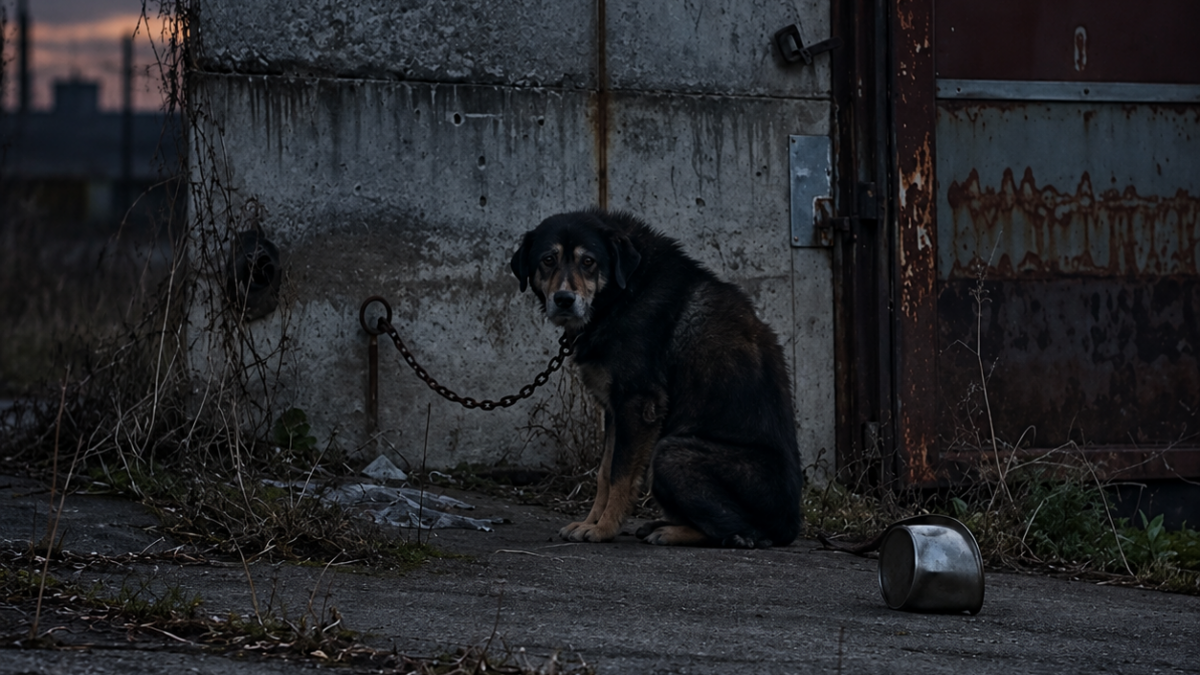
PART 2
I stared at that metal tag for several seconds before reaching for it.
It wasn’t attached to the dog.
It lay partly beneath a patch of weeds, close enough to the wall that it could have been there for years.
The metal was orange with rust, but the stamped numbers were still visible.
There was a company name across the top.
**WESTERN MERIDIAN STORAGE**
Underneath was an inventory number.
Then a date.
Eight years earlier.
At first, I assumed it had nothing to do with the dog.
It was an abandoned warehouse. Old tags and scraps of equipment were everywhere.
Still, something made me photograph it.
The dog watched me.
“You know what this is?”
No response.
“You’re right. Probably nothing.”
I placed the tag where I had found it.
Then I heard tires.
A white rescue van turned around the far end of the building.
The dog stood immediately.
His entire body changed.
Head low.
Legs stiff.
Tail tucked beneath him.
I lifted one hand.
“It’s okay.”
The van stopped perhaps thirty feet away.
Two people stepped out.
A woman in her forties wearing khaki work pants and a dark rescue shirt, followed by a younger man carrying a crate of equipment.
They didn’t approach immediately.
Good.
The woman looked at me.
“You Owen?”
“Yes.”
“I’m Marissa. This is Ben.”
She glanced toward the dog.
“That the only animal you’ve seen?”
“Yeah.”
“Anyone around when you found him?”
“No.”
“You touch the chain?”
“No.”
“Good.”
She studied the dog for a moment.
“How close have you been?”
“About four feet.”
“Did he growl?”
“No.”
“Bare teeth?”
“No.”
“Try to lunge?”
“No.”
“He drank?”
“Two containers.”
Marissa nodded.
“That’s good.”
Ben opened the back of the van.
The sound of the door sliding made the dog jerk backward so hard the chain snapped tight.
I heard the metal hit the wall.
He pressed himself into the corner.
Marissa froze.
“Okay.”
She motioned for Ben to stop.
“No crate yet.”
The dog’s eyes were wide now.
His breathing had changed.
Fast.
Shallow.
Marissa crouched but didn’t go closer.
“Poor guy.”
“He was calmer before the van.”
“That’s normal. New people, equipment, different sounds.”
She looked at the chain.
“How is that attached?”
“Ring in the wall.”
“We may need bolt cutters.”
The younger man reached into the van.
The dog saw the movement and flattened himself farther.
Marissa looked at me.
“Would you mind staying where you are?”
“No.”
“He seems to be using you as his reference point.”
I looked at the dog.
“That’s a terrifying amount of responsibility for somebody who met him forty minutes ago.”
Marissa almost smiled.
“Animals don’t care about résumés.”
A second vehicle arrived.
This one belonged to a mobile veterinarian who worked with the rescue.
Dr. Patel was a quiet man in his fifties.
He stepped out, looked at the dog and stopped.
“Malnourished.”
Marissa nodded.
“Significantly.”
“Any vomiting after water?”
“No.”
“Good.”
Dr. Patel moved one step closer.
The dog immediately backed into the wall.
He began trembling.
Dr. Patel stopped.
“No more.”
He turned toward me.
“He let you near him?”
“Eventually.”
“How near?”
“About four feet.”
“Would you be comfortable approaching again?”
I looked at the dog.
“I think so.”
“We won’t force anything. Sit the way you were sitting before.”
So I did.
Slowly.
No direct eye contact.
No reaching.
I moved to the same place on the concrete and sat.
The dog watched me.
Behind me, everyone became quiet.
One minute.
Two.
Three.
His breathing slowed.
I moved a little closer.
Nothing.
Another few inches.
His head lowered.
When I was finally within arm’s reach, I stopped.
“I’m still here.”
The dog stared at my hand.
I lifted it slowly.
Halfway.
Stopped.
He could decide.
For several seconds, nothing happened.
Then his nose moved forward.
He smelled my fingers.
I held my breath.
His nose touched my hand.
That was it.
But it felt enormous.
I moved my hand carefully to the side of his face.
My fingertips touched his fur.
The dog closed his eyes.
Behind me, someone inhaled sharply.
I didn’t look back.
I stroked his head once.
Then again.
His body was still tense, but he didn’t move away.
Dr. Patel spoke softly.
“Keep doing exactly that.”
I smiled.
“That was the plan.”
Marissa slowly approached from the other side.
The dog opened his eyes.
I kept my hand against his head.
“It’s okay.”
She came close enough to inspect the collar.
“This is bad.”
“What?”
“The skin underneath.”
I couldn’t see clearly.
“Embedded?”
“Not completely. But there’s chronic irritation.”
Dr. Patel moved closer.
The dog tensed but stayed.
“We need that chain off before anything else.”
Ben brought bolt cutters slowly.
I thought the metallic sound would send the dog into panic.
Instead, he pressed his head harder against my hand.
I kept talking.
Nothing important.
Just words.
“My car is probably costing me five hundred dollars right now.”
His ears moved.
“That’s your fault somehow.”
Another tiny movement.
“I was supposed to spend today doing laundry.”
Marissa positioned the cutters.
“One more second.”
A hard snap.
The chain fell.
For the first time since I had seen him, there was nothing connecting that dog to the wall.
The broken length of metal hit the concrete.
He jumped.
Then froze.
Nobody touched him.
Nobody pulled.
Nobody moved.
The chain lay beside him.
He stared at it.
Then at me.
Marissa whispered, “Let him decide.”
The dog stood.
For a few seconds, he did nothing.
He could walk.
He had spent however long tied to that wall, and now there was no resistance when he stepped forward.
But instead of running, he moved one step toward me.
Then another.
He stopped beside my shoulder.
I felt his body touch mine.
Not much.
Just the side of his leg.
My vision blurred.
“Oh, buddy.”
I didn’t hug him.
Didn’t grab him.
I simply stayed there while a dog who had finally been given the ability to leave chose not to run.
Dr. Patel examined him beside the wall rather than forcing him into the van immediately.
Severe malnutrition.
Dehydration.
Skin infection.
Pressure wounds around his neck.
Overgrown nails.
An old injury in one rear leg.
But his heart sounded steady.
No obvious emergency trauma.
“He’s been underfed for a long time,” Dr. Patel said.
“How long?”
“Impossible to determine here.”
“Months?”
“Could be.”
“Years?”
“The neglect may have lasted years. Starvation at this level is more recent.”
That made more sense.
No dog could survive eight years without food and water.
Someone, at some point, had kept him alive.
The question was who.
And why.
Marissa looked around the building.
“There’s an old bowl.”
I nodded.
“And another one over there.”
I hadn’t seen it.
Behind a stack of rotted pallets was a second metal bowl.
There were also food wrappers.
Not fresh.
But not eight years old either.
Dr. Patel said, “Somebody may have been feeding him intermittently.”
“Who?”
Marissa looked toward the empty warehouse.
“We’ll find out.”
They loaded the dog into the rescue van using a ramp.
He refused at first.
Then I walked beside him.
He followed.
The moment he entered the crate area, he turned around and stared at me.
Marissa closed the barrier.
“You can follow us to the clinic if you want.”
I looked at my phone.
Three missed calls from the tow company.
I should have dealt with my car.
I should have gone home.
I should have returned to my normal day.
“I’m coming.”
Marissa smiled.
“Thought so.”
The tow driver was deeply confused when I explained why I was leaving my car another hour.
“Dog?”
“Yes.”
“Behind that warehouse?”
“Yes.”
He looked over my shoulder.
“That place has been empty forever.”
“How long?”
“Ten years, maybe.”
I stopped.
“Did anyone work there after it closed?”
“Security sometimes. Scrap crews. Homeless folks. Why?”
I thought about the tag.
“No reason.”
But I photographed the warehouse one more time before leaving.
At the clinic, the dog went into a quiet treatment room.
No kennels near barking dogs.
No loud equipment.
Dr. Patel gave fluids slowly and started bloodwork.
They cleaned the wounds around his neck.
Once the filthy collar was removed, everyone in the room became quiet.
There was a permanent indentation in the fur and skin.
The kind caused by pressure repeated for a very long time.
Marissa held the collar.
“No tag.”
“Microchip?”
“Checking now.”
A scanner passed over his shoulders.
Nothing.
Again.
Nothing.
His entire body.
No chip.
“So we don’t know who he belongs to.”
Marissa looked at me.
“Not yet.”
“What happens now?”
“Mandatory stray hold while we investigate, even though this obviously isn’t a normal stray case.”
“And after?”
“If no legal owner claims him, he enters rescue custody.”
I looked at him.
He was lying on a blanket.
Eyes open.
Still watching me.
“What are you calling him?”
“We usually wait until intake.”
“He needs a name.”
Marissa smiled.
“You found him.”
“That doesn’t make me qualified.”
“Name him.”
I thought about the warehouse.
The chain.
The years stamped onto the rusted tag.
The dog who had somehow remained alive long enough for my car to break down on the right afternoon.
“Hope.”
Marissa repeated it.
“Hope.”
The dog’s ear moved.
Dr. Patel smiled.
“Looks like he accepts.”
I stayed for three hours.
Hope didn’t eat while I was in the room.
He didn’t eat after I left either.
That first night, Marissa texted me at eleven.
**Still refusing food. Drinking some water. Stable.**
I replied immediately.
**Can I come tomorrow?**
Her answer arrived:
**I assumed you would.**
I showed up at seven-thirty.
Hope was curled in the far corner.
When I entered, his eyes opened.
His head lifted.
That was all.
I sat on the floor.
Same distance.
Same position.
I had coffee.
“You look terrible.”
His ears moved.
“I look worse.”
Nothing.
“I slept about three hours.”
Hope lowered his head.
“Excellent conversation.”
For almost an hour, I sat.
A technician brought breakfast.
Soft food.
Chicken.
Rice.
Hope didn’t touch it.
She left.
I kept talking.
Eventually I stopped.
Silence settled.
Then Hope stood.
He approached the bowl.
Looked at me.
I turned my head away.
He ate.
Slowly.
Not much.
But he ate.
The technician watched through the window.
When Hope stopped, she came in.
“He wouldn’t eat for us.”
“He didn’t eat for me either.”
“He ate because you stayed.”
I looked at the dog.
“Maybe he ate because I shut up.”
That became my job.
Not officially.
I worked in logistics for a building-supply company.
I knew nothing about animal rehabilitation.
But every day after work, I went to the rescue.
Some days I stayed thirty minutes.
Some days two hours.
I sat.
I talked.
Or didn’t.
Hope learned my footsteps.
By the fourth day, his head lifted when I entered.
By the sixth, he ate with me in the room.
By the ninth, he came close enough to smell my jeans.
On day twelve, he touched his nose to my hand without being invited.
I celebrated privately.
I had learned that loud excitement made him retreat.
So I only whispered, “Good choice.”
His tail moved.
Barely.
I wasn’t sure I had seen it.
The investigation into the warehouse continued.
Animal control photographed the scene.
Police checked ownership records.
Western Meridian Storage had shut down nine years earlier after bankruptcy.
The property had passed through two holding companies and eventually into a tax dispute.
Nobody had legally operated there for years.
But records showed one thing that interested investigators.
A man named Curtis Vane had worked as a night security guard during the warehouse’s final year.
After closure, he had been contracted occasionally by the property owner to check for trespassing.
His employment file listed a dog.
Breed: mixed shepherd.
Color: dark brindle.
Name: unknown.
The old description was vague enough to prove nothing.
But the timing matched.
The stamped equipment tag I had photographed led investigators to an inventory log.
It had been attached to a section of outdoor security equipment removed eight years earlier.
A photograph from that inventory showed part of the rear wall.
The same metal ring.
And beside it, barely visible, was a dog.
Dark coat.
Large body.
Chained.
When Marissa showed me the photograph, I felt sick.
“You’re telling me that’s Hope?”
“We can’t prove it from this picture alone.”
“But look.”
“I know.”
The dog in the old photograph looked healthier.
Younger.
Standing.
But the markings on his chest looked familiar.
If it was Hope, then he had been attached to that wall—or at least kept at that warehouse—for most of eight years.
“How could nobody do anything?”
Marissa’s expression tightened.
“The property was private. The image was part of a contractor inventory, not an animal-welfare inspection. Whoever took it probably saw a security dog and moved on.”
“Eight years.”
“I know.”
“How did he survive after the warehouse closed?”
“That’s what animal control is trying to establish.”
Answers came from people in the neighborhood.
Not all at once.
A mechanic two streets over remembered the dog.
“Yeah, there was always some mutt back there.”
“Always?”
“For years.”
“Did anyone feed him?”
The mechanic shrugged.
“Sometimes Curtis did.”
“When Curtis stopped coming?”
“People left scraps.”
“Why didn’t anyone call?”
The man looked uncomfortable.
“I thought somebody owned him.”
That sentence became the theme of Hope’s past.
Everyone thought somebody else was responsible.
A delivery driver said he had occasionally thrown food over the fence.
A woman who lived nearby said her teenage son used to carry water there during summer.
A homeless man who had slept inside the warehouse for several months said the dog had already been chained there when he arrived.
“I fed him when I had something.”
“Why didn’t you free him?”
The man looked at the chain.
“Curtis said he’d kill anybody who touched his dog.”
That was the first time the name became more than a piece of paper.
Animal control located Curtis two counties away.
He was fifty-eight.
Worked maintenance at an equipment yard.
When officers asked about the dog, he initially claimed he didn’t remember.
Then investigators showed him the old warehouse photograph.
His story changed.
Yes, he had owned a dog.
Yes, the dog had guarded the warehouse.
Yes, he had sometimes kept him chained.
But according to Curtis, when the contract ended, the dog “became the property of the building.”
Animals do not become property of buildings.
There had been no transfer.
No adoption.
No shelter surrender.
Nothing.
Curtis claimed he continued feeding the dog for “a while.”
Then he stopped visiting.
“Why didn’t you take him?” the officer asked.
Curtis reportedly answered, “Couldn’t have him where I moved.”
“Why didn’t you surrender him?”
“No shelter wanted a big guard dog.”
Investigators checked.
No record existed that he had contacted any shelter.
Then he said something worse.
“I figured somebody around there would deal with it.”
Deal with it.
Those words followed me for days.
Hope had spent years chained beside an abandoned building because a man figured somebody would deal with it.
A person threw scraps.
Someone refilled water.
Another person looked through a fence and assumed there was an owner.
People kept him alive just enough for the neglect to continue.
No one made the situation end.
Until my car broke down.
That realization unsettled me.
Not because I thought I was special.
Because I wasn’t.
I had taken a shortcut.
That was all.
A random mechanical failure changed Hope’s life more than years of humans noticing and moving on.
It made me wonder how many suffering animals existed just outside the routes we normally traveled.
Hope’s medical recovery improved.
His bloodwork showed anemia and malnutrition but no catastrophic organ failure.
His old rear-leg injury appeared to be a poorly healed fracture.
It caused stiffness but not constant severe pain.
His neck wounds healed.
Weight returned slowly.
His coat changed.
Under dirt and thinning patches was a beautiful dark brindle pattern.
But the emotional recovery remained harder.
Hope hated closed doors.
If a door clicked shut behind him, he froze.
Metal sounds were worse.
The sound of a chain being dropped in another room once sent him scrambling beneath a table.
He refused to walk through narrow gates unless I went first.
Rain terrified him.
That surprised me until Marissa explained.
“If he was chained outside through storms, he may associate weather with being unable to escape.”
The first thunderstorm after his rescue proved her right.
I was at the center visiting when thunder cracked outside.
Hope hit the floor.
His body flattened.
Another boom.
He tried to wedge himself behind a cabinet.
I sat beside him.
Didn’t touch.
Didn’t trap him.
“I know.”
He shook.
“I’m here.”
For almost forty minutes, I sat there.
Eventually his side pressed against my leg.
That was the first time he had deliberately leaned on me.
I didn’t breathe normally for several minutes.
Progress.
Tiny.
Quiet.
But real.
Then came the tennis ball.
It was a faded green ball one of the volunteers had placed in his room.
Hope ignored toys.
Always.
He didn’t know what they were for.
One Tuesday morning, I arrived before work.
I was tired.
Frustrated.
My car repair had drained most of my savings.
My boss had warned me I was arriving late too often because of Hope.
My younger brother had called the night before asking why I never visited anymore.
Life outside the rescue was beginning to push back.
I sat on the floor.
“Today has to be quick.”
Hope looked at me.
“I know. I hate it too.”
He stood.
Walked away.
Then went toward the tennis ball.
He smelled it.
Picked it up.
I stopped talking.
Hope carried it toward me.
Slowly.
Then dropped it between my shoes.
I stared.
He stared.
“What?”
Tail movement.
I picked up the ball.
“Do you know what this is?”
He watched.
I rolled it three feet.
Hope flinched at the movement.
Then followed it with his eyes.
He walked over.
Picked it up.
Returned.
Dropped it again.
My throat closed.
“No.”
Hope tilted his head.
I rolled it again.
This time faster.
He went after it.
Not running.
But moving with intention.
He brought it back.
I started crying.
A twenty-nine-year-old man sitting on a rescue-room floor crying over a filthy tennis ball.
Hope looked concerned.
“I’m fine.”
He dropped the ball onto my knee.
That made it worse.
Marissa found us ten minutes later.
“What happened?”
I pointed.
Hope had the ball.
Her expression changed immediately.
“Oh.”
“He brought it to me.”
She covered her mouth.
“He’s never played.”
“He does now.”
Hope dropped it.
Marissa whispered, “Throw it.”
I did.
Hope trotted after it.
That afternoon, I went to work late.
I didn’t care.
Hope had invited the world back in.
The case against Curtis moved forward.
Animal-control laws in our county were not as severe as I wanted them to be.
Years of neglect could not be reconstructed perfectly.
Witness memories were inconsistent.
Records were old.
The exact duration of Hope’s chaining could not be proven beyond every doubt.
But the recent condition could.
The chain.
The wounds.
The lack of food.
The abandoned property.
Curtis’s own statement admitting he had left the dog there and assumed others would handle him.
He was charged with animal abandonment and neglect.
People online wanted harsher consequences.
So did I.
I wanted him to see Hope’s neck.
I wanted him to sit on that concrete for one August afternoon with a chain around his own existence.
I wanted him to understand the years he had reduced to waiting.
But law is not revenge.
Curtis eventually entered a plea.
He received probation, fines, restitution toward veterinary care and a prohibition on owning animals during the probation period.
It felt small.
Until Marissa reminded me what mattered.
“He can’t take Hope.”
That stopped me.
“Could he have?”
“Before surrender or adjudication, ownership questions get messy. Now they aren’t.”
Hope was legally released to the rescue.
Curtis had no claim.
That was the first consequence I could appreciate.
The man who had left Hope chained to a wall no longer got to decide anything about his life.
Not where he slept.
Not whether he ate.
Not whether he was useful.
Not whether he was wanted.
Hope was free.
The rescue began preparing him for adoption.
I hated that phrase.
Preparing him for adoption.
It was the entire purpose of rescue.
I knew that.
Still, every time someone said it, my stomach tightened.
Marissa noticed.
“You’re doing the thing.”
“What thing?”
“The thing where you pretend you’re not already planning where his bed would go.”
“I live in an apartment.”
“So?”
“It’s small.”
“He doesn’t care.”
“I work full-time.”
“He sleeps half the day.”
“I’ve never owned a dog.”
“You’ve spent two months reorganizing your entire life around one.”
I looked through the window.
Hope was asleep.
“You’re very annoying.”
“I’m excellent at my job.”
“I’m not adopting him.”
“Of course not.”
The center scheduled his first official adoption viewing three weeks later.
A couple in their forties.
Nice people.
Experienced with large dogs.
Fenced yard.
No children.
Good veterinary references.
Exactly the kind of home Hope needed.
I hated them immediately.
Not because they did anything wrong.
Because they seemed perfect.
I arrived “by coincidence” during their meeting.
Marissa saw me.
“Really?”
“I forgot something.”
“What?”
“My dignity.”
“You lost that when you cried over a tennis ball.”
The couple sat in the visiting room.
Hope remained near the wall.
They were patient.
Didn’t reach.
Didn’t call repeatedly.
After twenty minutes, Hope approached the woman.
He sniffed her hand.
She smiled.
My stomach hurt.
“That’s good,” Marissa whispered.
“I know.”
“He needs options.”
“I know.”
“You want him happy.”
“I know.”
Then Hope looked through the glass.
Saw me.
Everything changed.
His head lifted.
He walked to the door.
The volunteer opened it.
Hope came into the hallway.
Stopped.
Then ran.
I had never seen him run toward anything.
His paws slipped on the polished floor.
He recovered.
Kept coming.
I dropped to one knee.
Hope reached me and pushed his entire head beneath my arm.
His tail began moving so hard his hips moved with it.
I laughed.
Then cried.
Again.
The woman who had been meeting him stepped into the hallway.
“Oh.”
I looked up.
“I’m sorry.”
She smiled.
“No, you’re not.”
I laughed through tears.
“No.”
She looked at Marissa.
“I think we just got rejected.”
Marissa smiled.
“Possibly.”
The woman crouched several feet away.
Hope remained pressed against me.
“He has his person.”
Her husband nodded.
“Yeah.”
I started protesting.
“I’m not—”
Marissa held up one hand.
“Do not finish that sentence.”
The couple ended up adopting another dog that afternoon.
A goofy black Lab named Pepper who loved them instantly.
I filled out Hope’s adoption application before going home.
The following week, I signed the papers.
The center director sat across from me.
“You understand that animals with Hope’s history can regress?”
“Yes.”
“He may develop separation anxiety.”
“I know.”
“Fear behaviors.”
“I know.”
“Medical expenses from old injuries.”
“I know.”
“Adjustment can take months.”
“I know.”
She smiled.
“You’ve already been adjusting for months.”
I looked at Hope.
He was lying beneath the table with one paw on my shoe.
“Yeah.”
The director slid the contract toward me.
“Then take your dog home.”
My dog.
Those two words felt heavier than I expected.
I had no childhood dream of owning a dog.
No long-term plan.
No carefully researched breed preference.
I had a broken car.
A shortcut.
A bottle of water.
And now I had Hope.
Bringing him into my apartment was harder than getting him out of the warehouse.
The first challenge was the stairs.
He stood at the bottom.
Looked up.
Refused.
I climbed three steps.
“Come on.”
Nothing.
I returned.
Tried treats.
Nothing.
Hope had probably never encountered indoor stairs.
So I sat on the second step.
Waited.
Ten minutes.
Eventually he placed one paw onto the first stair.
Then removed it.
“Brave.”
Another attempt.
One paw.
Then two.
He froze.
I didn’t pull.
Didn’t push.
Twenty minutes later, Hope reached the top.
I celebrated quietly.
Inside the apartment, he stopped again.
The room was small.
Living area.
Kitchen.
Short hallway.
Bedroom.
I had bought a dog bed.
Two bowls.
Three toys.
A ridiculous amount of treats.
Hope stood in the doorway like he was waiting for somebody to tell him he had entered the wrong place.
I unclipped the leash.
“Okay.”
He looked at me.
“You live here.”
No movement.
“I live here too.”
Nothing.
“I pay too much money to live here.”
His ear moved.
“I’m glad one of us understands.”
He stepped inside.
Sniffed.
One foot at a time.
He inspected the water.
The bed.
The couch.
The hallway.
Then returned to me.
He sat.
His expression asked a question I couldn’t hear.
I crouched.
“You’re not visiting.”
Hope blinked.
“This is home.”
He didn’t believe me.
That became clear the first night.
He refused the dog bed.
Refused the couch.
Refused the bedroom.
He chose a place on the living-room floor with his back pressed against the wall and his face toward the front door.
I lay in bed for twenty minutes.
Then got up.
Hope watched me.
I brought a pillow and blanket.
“You’re not getting my whole apartment on night one.”
I lay on the floor about six feet away.
He stared.
“I’m not sleeping on concrete. This is my limit.”
Eventually I fell asleep.
At three in the morning, I woke.
Something warm touched my hand.
Hope had moved closer.
Not beside me.
But close enough that one paw rested near my fingers.
I smiled in the dark.
“Good night.”
The first month was about routine.
Same wake-up time.
Same breakfast.
Same morning walk.
Same route when possible.
Same voice when I left.
Same words when I returned.
“I told you I’d come back.”
At first, Hope waited beside the door.
Always.
Whether I left for ten minutes or four hours.
When I returned, he was there.
Not excited.
Just waiting.
It made me feel guilty enough that I considered quitting my job.
Marissa laughed when I told her.
“You need income to buy dog food.”
“Technical detail.”
“Give him time.”
So I did.
One day, three months after adoption, I returned from work.
Hope was not at the door.
My heart stopped.
“Hope?”
Nothing.
I rushed inside.
He was asleep on my bed.
Head on my pillow.
I stood in the doorway.
He opened one eye.
Tail tap.
Then went back to sleep.
I laughed so loudly he jumped.
“Sorry.”
He stared at me.
“That’s huge.”
Hope yawned.
“You have no idea.”
For the first time, he had trusted that he did not need to wait for my return.
He could sleep.
Because I always came back.
The changes continued.
The vacuum cleaner remained an enemy.
Metal clanging remained difficult.
He hated construction sites.
Understandable.
But he began walking with his head higher.
His coat filled in.
He gained twenty pounds.
The scarred area around his neck softened beneath new fur, though the mark never disappeared completely.
He learned the couch.
Then conquered the couch.
I lost approximately seventy percent of my own couch.
He learned toys.
Tennis balls first.
Then a stuffed frog.
He carried that frog everywhere.
Bedroom.
Kitchen.
Sometimes bathroom.
If a visitor arrived, Hope hid at first.
Then watched.
Then eventually approached.
One evening my mother visited.
We had not been close for several years.
There was no giant family betrayal.
Life had simply created distance.
My parents divorced when I was twenty-two.
My brother moved away.
I buried myself in work.
Phone calls became occasional.
Visits rarer.
Hope changed that too.
My mother sat on my couch.
Hope watched her from the hallway.
“He’s beautiful.”
“He didn’t used to look like this.”
“You showed me the pictures.”
“He was thirty pounds lighter.”
She shook her head.
“How does anybody do that?”
“I don’t know.”
Hope approached.
My mother kept her hands in her lap.
He smelled her shoes.
Then her knees.
Finally her hand.
She waited.
Hope nudged her fingers.
My mother smiled.
“May I?”
“Looks like yes.”
She stroked his face.
Hope closed his eyes.
My mother looked at me.
“You always found broken things.”
“That sounds healthy.”
“I didn’t say you fixed them.”
“Better.”
She smiled sadly.
“When you were little, you brought home birds, turtles, one possum…”
“It was not a possum.”
“It was absolutely a possum.”
“It was small.”
“It had fifty teeth.”
Hope opened his eyes at our laughter.
My mother continued.
“You always noticed what everybody else walked past.”
I thought about the warehouse.
“I almost walked past him.”
“But you didn’t.”
That night, after she left, Hope put his head on my knee.
I called my brother.
No special reason.
Just did.
We talked for an hour.
Hope had spent years learning to trust people.
Somehow he was forcing me to relearn it too.
Then came the setback.
Six months after adoption, road crews began repairing utilities outside my apartment.
Metal plates.
Drills.
Heavy equipment.
The first morning, a worker dropped a chain from the back of a truck.
The sound cracked through the street.
Hope collapsed.
Not literally unconscious.
Emotionally.
His legs buckled.
He dragged backward.
The leash tightened.
I released the pressure immediately.
“Hope.”
He shook violently.
People passed.
A truck backed up with a warning beep.
Hope tried to flee.
I knelt on the sidewalk.
Someone said, “You okay?”
“Yeah.”
I sat.
Hope pressed himself against my legs.
The worker apologized.
I barely heard him.
For twenty minutes, I sat on concrete while traffic moved around us.
The same way I had sat beside the warehouse.
Eventually Hope’s breathing slowed.
I touched his head.
“We’ve done this before.”
He looked at me.
“We’ll do it again.”
That evening he refused dinner.
Slept against the wall.
For three days, he regressed.
No couch.
No toys.
No relaxed sleep.
I was devastated.
I called Marissa.
“I ruined him.”
“No.”
“You didn’t see him.”
“I’ve seen trauma recovery.”
“He was doing so well.”
“And he still is.”
“This doesn’t look well.”
“Recovery isn’t a straight line, Owen.”
“I hate that sentence.”
“Everyone does.”
“What do I do?”
“What worked before?”
“Time.”
“Then give him time.”
So I sat.
Again.
No demanding.
No forcing.
Same routines.
Fourth day, he ate normally.
Fifth, he brought the frog to the living room.
Seventh, he slept on the couch.
Tenth, he stole my sandwich.
I celebrated the theft.
“That is mine.”
Hope swallowed.
“Excellent. You’re emotionally healed.”
Tail wag.
I laughed.
The warehouse case ended around the same time.
Curtis appeared in court for sentencing under the plea agreement.
I did not have to attend.
I went anyway.
Not because I wanted confrontation.
That is what I told myself.
Truth?
Part of me wanted him to see me.
I wanted him to know the dog he had left had somebody now.
Curtis looked ordinary.
That disappointed me.
In my imagination, people who caused suffering had visible darkness around them.
Reality is less convenient.
He wore work boots.
A gray shirt.
Glasses.
He could have been anybody buying groceries beside me.
The judge reviewed the plea.
Neglect.
Abandonment.
Restitution.
Animal ownership restriction.
Then she asked whether the rescue wished to provide a statement.
Marissa stood.
She described Hope’s condition clinically.
Weight.
Wounds.
Malnutrition.
Behavioral trauma.
Medical expenses.
No dramatic language.
Facts were enough.
Then Curtis’s attorney said something I had not expected.
“My client maintains that he believed others were feeding and caring for the animal after he left the property.”
My jaw tightened.
The judge looked at Curtis.
“You believed unidentified people would assume responsibility for a dog you owned?”
Curtis shifted.
“I saw bowls there.”
“When?”
“Sometimes.”
“So you knew the dog was still chained there?”
Silence.
“Yes.”
“And you did not remove him?”
“No.”
“You did not surrender him?”
“No.”
“You did not contact animal services?”
“No.”
The judge leaned back.
“Then the fact that strangers occasionally prevented the dog from dying does not transfer your responsibility to them.”
That sentence was the closest thing to revenge I needed.
Curtis looked down.
The judge imposed the agreed sentence but added the maximum period of animal-ownership restriction available under the plea terms.
Still not enough, part of me thought.
Then I remembered Hope asleep on my pillow.
Curtis had lost something no fine could measure.
He had once possessed absolute control over that dog’s world.
Now he had none.
Afterward I waited outside the courtroom while Marissa spoke to the prosecutor.
Curtis exited.
He saw me.
Stopped.
For several seconds, we looked at each other.
“You’re the guy who found him.”
“Yes.”
He rubbed one hand over his jaw.
“How is he?”
The question made me furious.
I almost walked away.
Instead I said, “Healthy.”
“Good.”
No.
He didn’t get good that easily.
“He wakes up terrified when he hears chains.”
Curtis looked down.
“He was always nervous.”
I felt something cold move through me.
“No.”
He looked back up.
“He learned to be nervous.”
Curtis said nothing.
“He sleeps against walls because that’s how he stayed safe.”
His face tightened.
“I fed him.”
“Sometimes.”
“I didn’t starve him.”
“You left him.”
“I couldn’t take him.”
“There were shelters.”
“They wouldn’t have wanted him.”
“You didn’t ask.”
He looked away.
I took one step closer.
Not threatening.
Just unwilling to let him hide behind distance.
“Do you know what happened when they cut that chain?”
Curtis said nothing.
“He didn’t run.”
His eyes returned to mine.
“He could finally leave, and he didn’t know what freedom was supposed to look like.”
For the first time, Curtis’s face changed.
Maybe shame.
Maybe discomfort.
I didn’t care enough to identify it.
“You want to know how he is?”
Curtis nodded.
“He has a name.”
That seemed to confuse him.
“What?”
“Hope.”
He swallowed.
“He has a bed. He has toys. He has a veterinarian. He eats twice a day and acts like he hasn’t eaten in a month.”
A tiny part of my mouth almost smiled.
“He sleeps on my pillow even though I bought him a bed that cost more than mine.”
Curtis looked down.
“And he isn’t yours.”
That was the part I needed to say.
“You don’t get him back. You don’t get to decide anything about him ever again.”
Curtis nodded.
“I know.”
“No. I don’t think you do.”
The courthouse doors opened behind us.
Marissa emerged.
I stepped away.
Curtis said quietly, “I’m sorry.”
For years, I thought if the person who hurt Hope ever apologized, I would feel something.
Vindication.
Closure.
Instead the words felt almost weightless.
Because the dog who deserved the apology wasn’t there.
And Hope didn’t need it.
I looked at Curtis.
“Be sorry enough not to do it again.”
Then I walked away.
Marissa caught up.
“What did he say?”
“Sorry.”
“And?”
“Nothing.”
“You okay?”
I thought about it.
“Yeah.”
“Feel better?”
“No.”
“Worse?”
“No.”
“What then?”
I looked toward the parking lot.
“Done.”
That was the word.
Done.
Curtis belonged to Hope’s past.
My responsibility lived in the present.
A year passed.
Hope learned ordinary life.
That sounds boring.
It wasn’t.
Ordinary life was the miracle.
He learned that refrigerators contain cheese.
Mail carriers are not invading armies.
Squirrels are impossible to negotiate with.
Rain can be watched from inside.
Beds are soft.
Couches are softer.
Humans sometimes leave and return.
Water bowls refill before they become empty.
Food appears tomorrow.
And the day after.
And the day after that.
He learned the word walk.
Then completely abused it.
If I accidentally said “walk” during a phone conversation, Hope appeared beside me immediately.
I started spelling it.
He learned the spelling.
W-A-L-K.
His head popped up.
“Unbelievable.”
Tail wag.
“You can’t possibly understand spelling.”
More wagging.
I began saying “outside excursion.”
He eventually learned that too.
Hope was smarter than I deserved.
The rescue held an anniversary event one year after he came in.
Marissa asked me to bring him.
I wasn’t sure.
Crowds still made him uncomfortable.
We agreed on thirty minutes.
The center looked different than when Hope had lived there.
Not physically.
Emotionally.
The first time, I had entered worried about a half-dead dog.
Now Hope walked beside me wearing a red harness.
Healthy weight.
Shiny coat.
Tail neutral but relaxed.
A volunteer saw him.
“No way.”
Hope recognized her voice.
Tail wag.
She knelt.
“Look at you.”
He approached.
Accepted affection.
Another worker came.
Then Dr. Patel.
Hope liked him now, particularly because the doctor had learned to carry chicken.
“You’re bribing my dog.”
“Medical best practice.”
“Convenient.”
The center displayed before-and-after photographs.
I avoided the first one for most of the event.
Eventually I looked.
Hope beneath the warehouse wall.
Thin.
Chain visible.
Eyes empty.
I looked down.
The dog beside me was trying to steal a treat from Marissa’s pocket.
Same animal.
Different world.
A young couple stood near the display.
The woman said, “Is that really him?”
“Yes.”
“How long was he there?”
“We don’t know the exact continuous duration. Evidence suggested he had been kept around that property for years.”
She looked horrified.
“How did he survive?”
“People sometimes left food and water. Not enough. Not consistently.”
“Why didn’t anyone save him?”
That question used to make me angry.
Now I answered differently.
“Because every person thought somebody else was responsible.”
The couple became quiet.
The man looked at Hope.
“What finally changed?”
“My car broke down.”
He laughed because he thought I was joking.
I wasn’t.
Sometimes life turns on ridiculous details.
A bad alternator.
A shortcut.
A water bottle.
One more person deciding not to keep walking.
That afternoon, the rescue director asked if I would say a few words.
I refused.
Then Marissa handed me the microphone anyway.
“I hate you.”
“I know.”
I stood in front of maybe sixty people.
Hope beside me.
I had nothing prepared.
So I told the truth.
“I used to think rescuing an animal meant doing something dramatic.”
Hope sat.
“Cutting a chain. Carrying a dog out. Calling somebody.”
I looked at him.
“The dramatic part took less than an hour.”
The room was quiet.
“The harder part was everything after.”
I told them about sitting on floors.
Waiting for him to eat.
Teaching him stairs.
Sleeping in the living room.
Storms.
Metal sounds.
The sidewalk regression.
The first tennis ball.
“Anybody can say a dog deserves another chance.”
Hope looked at me.
“The challenge is giving them enough ordinary days to believe you.”
That was all.
I returned the microphone.
Later, a woman approached.
She was maybe sixty.
“I needed to hear that.”
“Why?”
“We adopted a dog six months ago.”
“Trouble?”
“She still hides.”
“How long was she in rescue?”
“Two years.”
“And before that?”
“They think she was in a breeding situation.”
I nodded.
“We keep thinking she should be better by now.”
I looked at Hope.
“He didn’t know your calendar existed.”
She smiled sadly.
“Neither does ours.”
“Then stop giving her deadlines.”
The woman nodded.
A year later, she sent the rescue a photograph.
Her dog asleep on their couch.
Belly exposed.
Caption:
**No deadlines. You were right.**
Hope had helped another dog without meeting her.
That became a pattern.
His story circulated locally.
Not viral in some giant internet sense.
But enough.
People began donating long lines, orthopedic beds and enrichment toys.
The county established a small outreach partnership to inspect abandoned industrial properties after a separate dog was discovered at another site.
A volunteer group created a hotline for workers who saw animals chained on unused property.
The mechanic who had admitted seeing Hope for years became one of the first people to call when he noticed another neglected dog nearby.
I didn’t know how to feel about him at first.
Then I decided changing later is better than never changing.
He came to one fundraiser.
He found me.
“I should’ve called years ago.”
“Yes.”
He accepted that.
“I thought Curtis still owned him.”
“He did.”
“I thought it wasn’t my business.”
I looked at Hope.
“That’s how suffering becomes everybody’s business and nobody’s responsibility.”
The mechanic nodded.
“I know now.”
He handed Marissa a donation.
Not huge.
But something.
Then he left.
People wanted me to frame Hope’s story as proof that humanity was terrible.
I couldn’t.
One human abandoned him.
Others ignored too much.
But other humans also slipped food through a fence.
A teenager carried water.
A rescue worker cut the chain.
A veterinarian treated him.
Volunteers sat quietly.
A judge restricted the person who neglected him from owning animals.
People donated.
People learned.
Humanity was not one thing.
Neither was Hope’s story.
Then came the moment I had avoided for nearly two years.
I went back to the warehouse.
Not because I wanted to.
The property was scheduled for demolition.
Marissa called me.
“You want the chain ring?”
“What?”
“The wall fixture.”
“No.”
“Okay.”
An hour later, I called back.
“Maybe.”
So I drove out.
Hope came with me.
I wasn’t sure if that was wise.
I had discussed it with Dr. Patel and a behavior specialist.
Their advice was simple.
Let Hope decide.
If he showed distress, leave.
The warehouse looked smaller than I remembered.
Maybe because memory had made it enormous.
The weeds were taller.
Graffiti covered one side.
Demolition fencing surrounded the front.
We approached from the rear.
Hope walked beside me.
Normal.
Then we turned the corner.
The wall appeared.
His body stopped.
I felt the leash change.
Not tight.
Just still.
I stopped too.
“Okay.”
Hope stared toward the metal door.
His nose worked.
His ears went back.
I crouched.
“We can leave.”
He looked at me.
Then at the wall.
I waited.
Hope took one step.
Then another.
Slow.
He approached the place where the chain had been attached.
The ring remained.
Rusty.
Small.
It shocked me how small it was.
Something that had controlled an entire life could fit inside my hand.
Hope smelled the concrete.
His body trembled once.
I almost turned us around.
Then he did something unexpected.
He lifted his leg.
And peed directly on the wall.
I laughed so hard I nearly fell over.
Hope looked at me.
“Oh, buddy.”
He finished.
Scratched the dirt twice with his back feet.
Then turned away.
That was his revenge.
Not mine.
Simple.
Unceremonious.
Perfect.
The demolition worker removed the ring for me.
I took it home.
For months it sat in a drawer.
Eventually I gave it to the rescue center.
They mounted it inside a shadow box beside a photograph of Hope running across a park.
No dramatic slogan.
Just two words:
**THEN / NOW**
The chain ring.
The running dog.
That was enough.
Hope became obsessed with parks.
Open space confused him at first.
He stayed near me.
Then gradually explored farther.
Always checking.
Ten feet.
Look back.
Twenty feet.
Look back.
Thirty.
Eventually he could run on a long training line without panicking.
The first time he reached full speed, I understood why freedom mattered physically.
His stride stretched.
Muscles moved under his coat.
Ears flew backward.
He didn’t run away.
He ran because he could.
Then curved in a wide circle and came back.
He nearly knocked me over.
I grabbed his harness.
“You know I’m not athletic.”
Hope panted.
Tail everywhere.
“Have some respect.”
He didn’t.
My life changed too.
Not dramatically.
I still worked the same job.
Still worried about rent.
Still drove an unreliable car until it finally died completely.
But I stopped feeling like my days were interchangeable.
Hope needed morning walks.
So I saw sunrises.
Hope needed routine.
So I built one.
Hope needed me home.
So I stopped spending every evening pretending I was too busy to call family.
My brother visited.
Then I visited him.
My mother and I started having dinner twice a month.
Hope came when restaurants had patios.
He became part of every repair in my family I hadn’t known I wanted to make.
Not because a dog magically fixes people.
He didn’t.
He simply made disappearing harder.
When someone depended on me returning, I became better at returning.
Three years after adoption, Hope developed stiffness in his old injured leg.
Dr. Patel examined him.
“Arthritis.”
“Bad?”
“Manageable.”
Hope received medication.
Joint supplements.
A softer bed.
Then refused the expensive bed in favor of my couch.
Naturally.
He slowed somewhat.
But emotionally, he became bolder.
Strangers could now greet him if they were calm.
He loved my mother.
Tolerated my brother.
Adored children who knew how to be gentle.
He even stopped hiding from thunderstorms.
One night rain hammered the windows.
Thunder rolled.
I woke at two.
Hope was asleep beside my bed.
Deep sleep.
One paw twitching.
He did not lift his head.
I lay there watching him.
Years earlier, rain had meant exposure.
No shelter.
Chain.
Now rain was simply weather happening outside a locked apartment where nothing could reach him.
That ordinary fact felt enormous.
When Hope was around eleven—or what we believed was eleven—Dr. Patel discovered a heart murmur.
Mild.
We monitored it.
At twelve, kidney numbers changed.
Early stage.
Diet.
Medication.
More monitoring.
Age was coming.
I hated it.
It felt unfair.
“How long did he lose?” I asked Dr. Patel once.
“What do you mean?”
“At the warehouse.”
He understood.
“Owen.”
“How many years?”
“We don’t know.”
“Six? Eight?”
“We know evidence placed a chained dog matching him there over many years. We don’t know every day of his life.”
I looked at Hope.
“He had so much stolen.”
Dr. Patel leaned against the exam table.
“Don’t let the years before you reduce the years with you.”
I looked at him.
“That sounds like something you practiced.”
“No. I’m very wise spontaneously.”
I laughed.
He became serious.
“Hope doesn’t measure his life the way you do.”
“How do you know?”
“I don’t.”
Hope took a treat from his hand.
“But right now he wants chicken.”
That was true.
So I tried to learn from the dog.
Not warehouse.
Not years.
Today.
Breakfast.
Walk.
Sunlight.
Nap.
Dinner.
Me.
Hope.
Enough.
At thirteen, stairs became harder.
I moved.
That sounds extreme.
It wasn’t only for Hope.
My lease was increasing.
But when choosing a new apartment, I rejected every building with stairs.
The realtor thought I was ridiculous.
“You could carry him.”
“He weighs seventy pounds.”
“Elevator?”
“What if it breaks?”
She stared at me.
“You are choosing an apartment based on a dog.”
“Yes.”
We found a first-floor unit with a small fenced patio.
Hope loved it.
My mother said, “You realize he’s completely reorganized your life.”
“He’s very controlling.”
Hope slept in sunlight.
At fourteen, his hearing faded.
I learned to touch the floor before approaching from behind.
He learned hand signals.
He still knew the refrigerator opening from three rooms away.
Selective deafness.
At fourteen and a half, he stopped fetching the tennis ball more than twice.
Then once.
Eventually he would pick it up and carry it to his bed instead.
I kept the original faded ball from the rescue.
The one he first brought me.
It lived on a shelf.
Too worn to use.
Too important to throw away.
One morning, I found Hope standing in the kitchen unable to remember why he had entered.
Maybe that’s unfair.
Dogs pause.
People project.
But his eyes looked different.
We visited Dr. Patel.
Age-related cognitive changes were possible.
Nothing severe.
Not yet.
We adjusted routines.
Night lights.
Predictable paths.
More frequent bathroom breaks.
Hope remained happy.
That mattered more than perfect cognition.
Then one winter, he had his first collapse.
We were walking slowly around the block.
Hope stopped.
His legs folded.
I caught part of him but not enough.
He went down.
“Hope.”
His eyes were open.
Breathing fast.
I called Dr. Patel from the sidewalk.
Emergency clinic.
Tests.
Heart disease had progressed.
Medication started.
Hope recovered.
We got nine more months.
Nine ordinary, priceless months.
He spent spring on the patio.
Summer sleeping in front of a fan.
Fall stealing pieces of apple.
By then, I was thirty-six.
Seven years had passed since the warehouse.
Seven years.
Nearly as long as the period investigators believed Hope had been tied to that abandoned property.
The symmetry haunted me.
Half a life waiting.
Half a life home.
Maybe more.
Maybe less.
Dogs don’t keep calendars.
One October evening, I sat on the floor beside him.
Hope’s head rested across my leg.
My mother sat on the couch.
She looked at us.
“You know what I remember?”
“What?”
“The first picture you sent.”
I knew.
Hope against the wall.
“I hate that picture.”
“I know.”
“He looks dead.”
“He doesn’t.”
“Close.”
She looked at him now.
White around the face.
Comfortable.
“He looks like a dog waiting.”
I stared.
“That’s what I used to call him.”
“What?”
“The dog who waited.”
My mother smiled.
“What do you call him now?”
I looked down.
Hope opened his eyes.
“Mine.”
She laughed softly.
“No.”
I corrected myself.
“Home.”
Hope sighed.
That winter was hard.
Cold made his joints worse.
His heart medication helped until it didn’t.
His kidneys worsened.
Appetite became unpredictable.
I started cooking chicken.
Then eggs.
Then rice.
Then pretending not to notice when he rejected food that once would have started a small war.
I knew.
I just didn’t want to know.
Dr. Patel never rushed me.
But he did something I appreciated.
He made me track good days and bad days.
Eating.
Drinking.
Mobility.
Breathing.
Interest.
Comfort.
Connection.
For several weeks, good outnumbered bad.
Then they became equal.
Then the balance shifted.
One Sunday, Hope did not want to walk.
Not even to the patio.
I sat beside him.
“You sure?”
His eyes lifted.
Tail moved.
He wanted me.
Not the outside.
That was enough.
I called Dr. Patel Monday morning.
He came to the apartment.
Hope was on his blanket.
The stuffed frog beside him.
Yes, we still had it.
Replaced twice over the years.
Same concept.
Dr. Patel examined him quietly.
His heart.
Lungs.
Gums.
Abdomen.
Then we went into the kitchen.
“What would you do?”
The question everyone asks.
He hated it.
“I’d look at Hope, not the test results.”
“I am.”
“What do you see?”
I swallowed.
“A tired dog.”
“Is he still enjoying food?”
“Sometimes.”
“Walks?”
“No.”
“Interaction?”
“Yes.”
“Comfort?”
“Less.”
I looked toward the living room.
“What am I waiting for?”
Dr. Patel did not answer immediately.
“Permission.”
I hated him for saying it.
Because he was right.
“From who?”
“Hope.”
“How do I get that?”
“You already have.”
My eyes filled.
“No.”
“Owen.”
“No.”
He placed one hand on my shoulder.
“You promised him he wouldn’t have to survive alone anymore.”
I looked at Hope.
“He’s not alone.”
“I know.”
“That promise includes this part.”
I sat at the kitchen table.
For seven years, I had imagined myself as the person who saved Hope from dying.
Now I had to understand that loving him could mean refusing to make him fight simply because I couldn’t imagine the apartment without him.
“I need a day.”
“Take the day.”
“What if something happens tonight?”
“Call me.”
“I don’t want him in an emergency clinic.”
“Then call me.”
He left medication for comfort.
My mother came over.
My brother drove in from out of state that night.
Marissa came.
Hope recognized her.
Tail movement.
Small.
She sat beside him.
“There he is.”
Hope smelled her hand.
She cried.
“You gave us trouble, you know.”
I smiled.
“He still does.”
“Good.”
She looked at me.
“You okay?”
“No.”
“Good answer.”
Dr. Patel came the next afternoon.
Home.
No clinic.
No metal table.
No fluorescent lights.
No cage.
Hope lay near the patio door where sunlight fell across his blanket.
His tennis ball was beside him.
My mother sat on the floor.
My brother leaned against the wall.
Marissa knelt near Hope’s back.
I sat closest to his head.
I thought about the first day.
Concrete.
Wall.
Chain.
Water.
Distance.
Now there was no distance.
Hope’s head rested on my lap.
I touched the scar around his neck.
Faint beneath old gray fur.
“I’m still here.”
His eyes opened.
I laughed through tears.
“Remember?”
Tail movement.
Maybe.
Maybe not.
“I said I wasn’t in a hurry.”
My voice broke.
“Turns out I was lying.”
Hope breathed.
I stroked his face.
“I wanted more time.”
Dr. Patel waited.
Nobody rushed.
That mattered.
Everything about Hope’s early life had been decided for him.
Where he stayed.
How far he could move.
Whether water appeared.
Whether food came.
Whether someone noticed.
His final moment would contain choice where possible.
Peace.
People he trusted.
Home.
I looked at Dr. Patel.
He gave the sedative.
Hope relaxed slowly.
His breathing softened.
The tension left his muscles.
His head became heavier on my legs.
My mother covered her mouth.
My brother cried openly.
Marissa whispered, “Good boy.”
I bent over Hope.
“You waited long enough.”
His eyes were almost closed.
“You don’t have to wait anymore.”
That was the sentence.
The one I didn’t know I had been carrying for seven years.
No more warehouse.
No more footsteps passing.
No more empty bowl.
No more chain.
No more wondering whether somebody was coming.
I was there.
Everyone he needed was there.
“You found me.”
I pressed my forehead against his.
“I know people say I found you.”
My voice barely worked.
“But you found me too.”
Dr. Patel waited until I nodded.
The final medication entered slowly.
Hope took one breath.
Then another.
Then one long, soft exhale.
His body became completely still.
I kept my hand against his chest.
Dr. Patel listened.
Waited.
Then removed the stethoscope.
“He’s gone.”
No.
Not gone.
That was what my brain said.
He’s right here.
Warm.
Fur beneath my hand.
Ball beside his paw.
How can right here become gone?
But it does.
That is death’s cruelty.
The body remains long enough for your mind to keep expecting one more movement.
I sat there for almost an hour.
Nobody made me stand.
Eventually Marissa touched the old scar around Hope’s neck.
“He never had to wear another chain.”
“No.”
“He never had to go back.”
“No.”
“He knew home.”
I swallowed.
“Yes.”
That mattered.
More than anything.
The apartment was unbearable afterward.
His bowl.
His leash.
The bed he barely used.
Hair everywhere.
I refused to vacuum for two weeks because removing the fur felt like erasing evidence.
Then one morning, I found myself holding the vacuum and crying.
My mother came over.
She didn’t stop me.
We cleaned.
Grief is partly learning that cleaning a room does not clean someone out of your life.
The rescue made a small memorial for Hope.
I almost refused.
Then Marissa showed me the design.
No photograph of him starving.
I was grateful.
The picture showed Hope running.
Full stride.
Ears back.
Grass beneath his feet.
Underneath:
**HOPE — HE WAITED. THEN HE LIVED.**
I approved.
The old chain ring remained beside it.
People asked about him.
New volunteers heard the story.
The county’s abandoned-property animal checks continued.
Over the following years, several animals were found earlier because workers, utility crews and neighbors understood that “somebody probably owns him” was not enough.
If an animal was chained on an apparently vacant property, someone checked.
That was Hope’s legacy.
Not suffering.
Attention.
The mechanic who had once ignored him became a regular donor.
The teenager who had carried him water years earlier grew up and volunteered with animal control.
He found me once at an event.
“You’re Owen?”
“Yes.”
“I used to give Hope water.”
I stared.
He was maybe twenty-two now.
“You?”
“I was fourteen.”
He looked ashamed.
“I wanted to cut the chain.”
“Why didn’t you?”
“My dad told me it was private property.”
I nodded.
“Curtis scared people.”
“He told us the dog would bite.”
Hope had never bitten anyone.
The young man’s eyes filled.
“I’m sorry.”
“You kept him alive.”
“That isn’t enough.”
“No.”
I wasn’t going to lie.
“But you were fourteen.”
He looked at the memorial photograph.
“I work for county animal services now.”
That surprised me.
“Because of him?”
“Mostly.”
There it was again.
Hope reaching animals he would never meet.
Maybe that is how survival becomes bigger than one life.
Not because suffering happens for a reason.
I hate that idea.
Hope did not need to suffer so others could learn.
His suffering was unnecessary.
What mattered was what people chose to do after discovering it.
We could let the story end at the warehouse.
Or use what it taught us.
Years later, I still carry water in my car.
Always.
Even after buying a reliable vehicle.
Especially then.
People who ride with me sometimes ask why I have three bottles.
Habit.
Memory.
Insurance against another roadside pair of eyes.
I also take shortcuts differently.
I look.
Behind buildings.
Along fences.
Under overpasses.
Not obsessively.
Just enough.
Hope taught me that the edge of someone else’s routine can contain an entire hidden life.
I eventually adopted another dog.
Not immediately.
Two years passed.
I thought I couldn’t.
Every dog seemed wrong because none was Hope.
Marissa never pushed.
Then one afternoon, I visited the rescue to deliver supplies.
A small brown dog sat in a kennel.
Young.
Terrified.
Not chained.
Not starved.
Just surrendered after her owner died.
She wouldn’t come forward.
I sat on the floor outside.
Marissa walked past.
Stopped.
Smiled.
“Don’t.”
“I didn’t say anything.”
“You’re thinking.”
“I am always thinking.”
The dog looked at me.
I waited.
Five minutes.
Ten.
She moved one step closer.
I laughed quietly.
Marissa said, “Familiar?”
“Shut up.”
The dog eventually came home with me.
Her name is June.
She is nothing like Hope.
She barks at delivery trucks.
Steals socks.
Hates bananas.
Sleeps upside down.
Loves everyone after approximately twelve seconds.
That difference saved me.
I didn’t need another Hope.
There could never be another Hope.
I needed another relationship.
Another life.
Another promise.
On the wall above June’s bed hangs one photograph.
Hope.
Not chained.
Not sick.
Running through grass.
Sometimes June stares toward it because light reflects off the frame.
I tell her, “That’s your brother.”
She doesn’t care.
Appropriate.
But I do.
Every now and then, I return to the place where the warehouse stood.
The building is gone now.
A distribution center replaced it.
Bright.
Busy.
Landscaped.
Nothing remains of the cracked wall.
The metal door.
The weeds.
The place where I poured water between us.
The first time I visited after redevelopment, I felt angry.
How could a place erase itself so completely?
Then I realized that was exactly what I had wanted for Hope.
The wall gone.
The ring gone.
The chain gone.
Nothing there powerful enough to hold him.
I stood near the parking lot.
Cars moved around me.
Workers came and went.
Nobody knew why one man was standing there staring at an ordinary patch of pavement.
I closed my eyes.
And for a moment I could hear the chain drag across concrete.
Then another memory replaced it.
Paws running through grass.
That is the one I choose.
I am thirty-eight now.
Hope has been gone for years.
I still miss him.
Not constantly.
Grief changes.
At first it is a room you cannot leave.
Later it becomes a room inside a house you have learned to live in.
Sometimes you open the door.
Sometimes the door opens itself.
A tennis ball.
Rain.
A rusted piece of metal.
A dog resting with his back against a wall.
Then I am twenty-nine again.
Car broken.
Walking behind a warehouse.
Seeing movement.
Sitting down.
Pouring water.
Saying, “I’m not in a hurry.”
If I could go back, I would not change the words.
I would only understand them better.
Because saving Hope was never about rushing him out of that place.
It was about giving him enough time afterward to become something other than what had happened to him.
He was not the chained dog.
He was not the warehouse dog.
He was not the neglected dog.
Those things happened to him.
They were not him.
Hope was the dog who learned tennis balls.
The dog who stole sandwiches.
The dog who slept on my pillow.
The dog who turned my mother back into someone I called twice a week.
The dog who made my brother drive three states to say goodbye.
The dog who learned rain could stay outside.
The dog who returned to the wall that once controlled his entire world, lifted his leg on it and walked away.
The dog who taught me that patience can be an action.
The dog who spent years waiting because humans failed to act—and then spent the rest of his life never having to wonder whether someone would come back.
People sometimes ask whether I think Curtis got what he deserved.
I no longer spend much time answering that.
He paid fines.
Lost the right to own animals for years.
Had his neglect documented publicly.
Lost any claim to Hope.
Perhaps some people would want more.
I once did.
But the longer I lived with Hope, the less interested I became in making Curtis the center of the story.
That would give him too much.
Hope’s story belonged to Hope.
The best consequence was not what happened to the man who left him.
It was what happened to the dog he left behind.
Hope became healthy.
He became safe.
He became demanding.
He became funny.
He became old.
That last one matters.
He was allowed to become old.
The warehouse did not get to be his ending.
Neglect did not get to decide the length of his life.
A chain did not determine the radius of his world forever.
His world eventually included parks.
Car rides.
My mother’s house.
My brother’s backyard.
The beach once, though he hated the water.
Three apartments.
Seven Christmases.
Countless walks.
A hundred stolen pieces of food.
Thousands of ordinary nights.
That is the revenge I can live with.
The person who treated Hope like an object left behind at a dead building had to live knowing the dog survived long enough to become irreplaceable to somebody else.
Hope did not disappear.
He mattered.
He was documented.
Photographed.
Loved.
Remembered.
And when his life finally ended, it ended not because someone had stopped caring whether he lived, but because everybody who loved him cared too much to make him suffer for one more day.
I still have his first tennis ball.
Faded almost gray.
Cracked.
Useless.
June once tried to steal it.
I reacted so dramatically that she looked offended for an hour.
The ball stays on a shelf beside Hope’s ashes.
No chain.
I never kept the chain.
I had the rescue keep the ring for the memorial because I did not want metal associated with him inside my home.
My home had enough evidence that Hope existed.
Scratches on the old coffee table.
Photographs.
A stain on the corner of a rug I never completely removed.
A dent in a bedroom door from the day he discovered his tail could knock things over.
And me.
I am evidence too.
The man who walked behind the warehouse was not the man who eventually said goodbye to Hope.
That afternoon, I thought I was stopping because a dog needed water.
I didn’t know I was about to learn how to stay.
How to wait.
How to call people back.
How to be needed without feeling trapped by it.
How to let an animal recover on his schedule rather than mine.
How to accept love that does not arrive with words.
How to grieve without wishing I had never loved.
Hope learned humans could return.
I learned the same thing.
Tomorrow morning, June will wake me before my alarm.
She will demand breakfast.
I’ll complain.
She’ll ignore me.
We’ll walk around the block.
Maybe rain.
Maybe sunlight.
Then we’ll come home.
And before leaving for work, I will do what I have done ever since Hope taught me the importance of it.
I will touch her head.
Look at her.
And say the same words.
“I’ll come back.”
I know dogs don’t understand every sentence we say.
But I think they understand patterns.
Doors open.
Doors close.
Footsteps disappear.
Then return.
Bowls empty.
Then fill.
Night comes.
Morning comes.
The person is still there.
Again.
Again.
Again.
Until waiting stops feeling like fear.
Until expectation becomes trust.
Until home is no longer a place where you are tied.
It is a place where you are free enough to leave a room and still believe love will be there when you come back.
That was what Hope finally learned.
And it was what he taught me.
I did not find a broken dog behind an abandoned warehouse.
I found a living animal who had been forced to survive inside a life far smaller than he deserved.
The chain was broken in one afternoon.
The rest took years.
And every one of those years mattered.
Because in the end, when I remember Hope, I no longer see the dog lying beneath the shadow of a rusted metal door.
I see him running.
Full speed.
Across an open field.
Nothing around his neck except a soft red collar.
No wall behind him.
No chain dragging.
No empty bowl waiting.
Just grass beneath his paws, sunlight across his back, and enough open space in front of him to keep going as far as he wanted.
Then he turns.
Looks for me.
And comes running home.








