PART 2: I Thought the Dog Was Playing With a Rope by the Highway—Six Hours Later, I Learned Why He Refused to Let Go
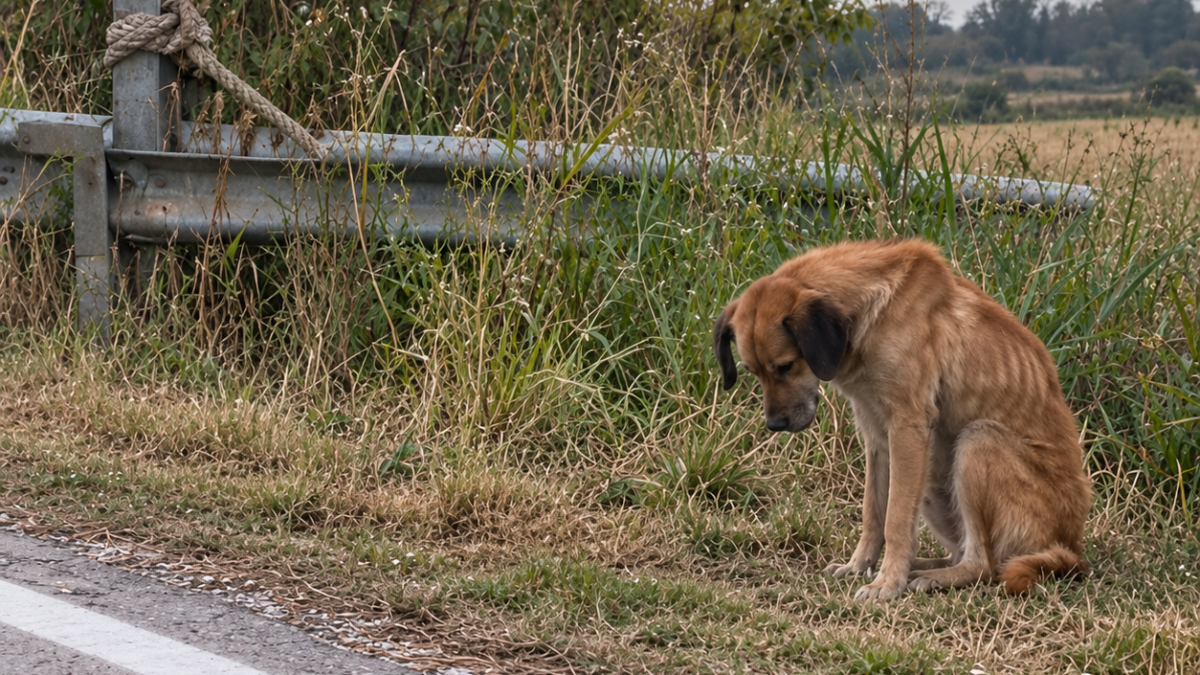
PART 2
For several seconds, I couldn’t move.
The evening traffic continued behind me.
Cars rushed past.
Tires hummed against the pavement.
Somewhere farther down the road, a horn sounded.
But all I could hear was my own breathing.
I looked down at the golden dog beneath the tree.
She tried to raise her head.
It came only a few inches off the ground before dropping again.
“Oh, sweetheart.”
I crouched.
“I’m so sorry.”
I held out my hand instead of touching her immediately.
Her nose moved.
Barely.
She sniffed my fingers.
Then her tongue touched them once.
That tiny lick destroyed me.
This dog had been left beside a highway, tied beneath a tree without water, and after everything that had happened to her, she still had enough trust left to lick the hand of a stranger.
I pulled out my phone.
My fingers were shaking so badly that I entered the wrong number twice before I managed to call the local animal rescue listed online.
A woman answered.
I must have sounded frantic because she interrupted almost immediately.
“Ma’am, slow down. Tell me where you are.”
I gave her the highway number and described the guardrail.
“There are two dogs,” I said. “One is tied up. The other one’s been trying to pull the rope loose. I saw him this morning. He’s been doing it all day.”
“All day?”
“Yes.”
There was a pause.
“Are either of them aggressive?”
“No. They’re exhausted.”
“Do you have water?”
“In my car.”
“Don’t force them to drink quickly. Offer small amounts if they’ll take it. We’re sending a team. Can you stay with them?”
I looked toward the road.
The brown dog was trying to stand again.
“Yes.”
There was no question anymore.
“I’ll stay.”
I went back to the car and found the half-full water bottle I’d been carrying around all day.
It wasn’t much.
I poured some into the lid of a plastic food container from my lunch bag.
When I carried it back, the brown dog watched every movement.
I set the container several feet away from him and stepped back.
He didn’t approach.
His eyes shifted toward the grass instead.
Toward the other dog.
That was when something else struck me.
He was thirsty.
He had to be.
His mouth was dry and injured.
His tongue hung slightly to one side.
Yet he was watching her.
“She’s still here,” I told him.
I don’t know why I thought he needed to hear that.
“I’m not leaving her.”
His ears moved.
I carried the water to the golden dog first.
She couldn’t stand, so I placed it near her muzzle.
She sniffed.
Then she drank.
Three small laps.
She stopped.
Then three more.
When I came back to the brown dog, he finally lowered his mouth to the container.
He drank slowly.
Afterward, he collapsed onto his side.
I sat in the grass between them.
For the first time all day, I wasn’t thinking about work.
Not one email.
Not one deadline.
Not one unfinished report.
I stared at the rope.
It was thick, weathered nylon.
There were teeth marks all over it.
Hundreds of them.
Some sections were wet with saliva.
Others were stained with dirt.
The brown dog’s mouth had become raw from biting it.
His front paws were scraped where he had braced himself against the ground.
He hadn’t tried once.
He hadn’t tried for ten minutes.
He had kept pulling until his body had almost nothing left.
And the worst part was that I had witnessed it.
I had watched the beginning.
I just hadn’t understood what I was seeing.
“I should’ve stopped,” I whispered.
The brown dog looked at me.
“I should’ve stopped this morning.”
He rested his chin on the grass.
There was no accusation in his eyes.
That somehow made the guilt worse.
Twenty-five minutes later, headlights slowed beside my car.
A white rescue van pulled onto the shoulder.
Two women and a man got out carrying leashes, blankets, water, and a medical kit.
One of the women introduced herself as Sarah.
“Show us.”
I led them into the grass.
The moment Sarah saw the golden dog, her face changed.
“How long has she been here?”
“I don’t know.”
“And you saw the other dog around eight-thirty?”
“Yes.”
“Pulling this rope?”
I nodded.
“All day?”
“I came back a little after six. He was still doing it.”
Sarah looked toward the brown dog.
“That’s one determined little guy.”
The male rescuer crouched beside the rope.
“It’s wrapped twice.”
He carefully moved the grass.
The rope had wound around a low branch and then around the trunk.
The golden dog couldn’t have moved more than a few feet.
Sarah examined her gums.
“Dehydrated.”
She ran her hands carefully over the dog’s sides.
“Thin, too.”
“Is she going to be okay?”
“We need a vet to answer that.”
The brown dog tried to stand when they began working around her.
His legs gave out.
“Easy,” Sarah said.
She looked at me.
“Is he yours?”
“No.”
“He’s acting like he thinks she’s his responsibility.”
That sentence stayed with me.
They cut the rope instead of trying to untie it from the golden dog’s neck.
The instant the tension disappeared, the brown dog lifted his head.
Sarah noticed.
“Look at him.”
I did.
For the first time since I had stopped, something in his face softened.
Not happiness.
He didn’t have the strength for that.
Relief.
The rescuers lifted the golden dog onto a blanket.
The brown dog tried again to get up.
“Hey,” I whispered. “She’s not leaving you.”
He staggered two steps toward them.
Sarah looked at me.
“They’re going in the same van.”
“Good.”
“We wouldn’t separate them unless medically necessary.”
When they loaded the golden dog, the brown dog refused to move toward the second crate.
He kept looking toward her.
Sarah tried coaxing him.
Nothing.
Finally, she opened the divider between the secured sections so he could see her.
He climbed in.
The moment he saw the golden dog lying on the blanket, he stopped resisting.
He lowered himself beside the barrier separating them.
His nose pressed toward her.
Her tail moved once.
Just once.
Sarah closed the door.
I stood beside the van.
“Where are you taking them?”
She named an emergency veterinary clinic connected with their rescue.
“Can I follow?”
Sarah studied me for a moment.
“You don’t have to.”
“I know.”
“It’s probably going to be a long night.”
“I know.”
She smiled gently.
“Then follow us.”
I did.
At the clinic, everything happened quickly.
Technicians carried the dogs through double doors.
I stood in the lobby holding my purse and feeling strangely useless.
A receptionist handed me a form.
“Are you the finder?”
“I guess.”
“Your name and phone number, please.”
Finder.
It sounded too generous.
I hadn’t found them that morning.
I’d passed them.
Six hours.
That number wouldn’t leave me.
Six hours of heat.
Six hours of pulling.
Six hours during which I sat in an air-conditioned office complaining that my coffee had gone cold.
I filled out the form.
Sarah sat beside me.
“You okay?”
“No.”
“That’s a fair answer.”
“I saw him this morning.”
“You told me.”
“I thought he was playing.”
“You couldn’t see the other dog.”
“I could’ve stopped.”
She didn’t argue.
I appreciated that.
Sometimes when you feel guilty, people rush to erase it for you.
Sarah didn’t.
She simply said, “You stopped when you understood something was wrong.”
“Six hours later.”
“Yes.”
I looked at her.
“What if I hadn’t come back this way?”
“But you did.”
“What if I hadn’t looked?”
“But you did.”
I stared at the closed treatment-room door.
Sarah leaned back in her chair.
“You can’t change eight-thirty this morning. You can decide what you do at six-thirty tonight.”
That was the first thing anyone said that made my breathing feel normal again.
About an hour later, a veterinarian came into the lobby.
Her name was Dr. Patel.
She carried a tablet.
“The good news is both dogs are stable.”
I closed my eyes.
I hadn’t realized I’d been holding my breath.
“The golden female is more dehydrated,” she continued. “She’s also underweight and has irritation around her neck from the rope. I don’t see evidence of a catastrophic injury, but we’re running bloodwork.”
“And the brown one?”
“Male. Similar dehydration, less severe. But he overexerted himself badly. His paw pads are torn in several places, and he has abrasions around his mouth.”
“From the rope?”
“Most likely.”
I swallowed.
“Was he really pulling long enough to do that?”
Dr. Patel looked at Sarah.
Sarah explained what I’d seen.
The veterinarian looked back at me.
“If he was doing what you described for hours, yes.”
“Why?”
It was a ridiculous question.
She couldn’t know.
But Dr. Patel answered anyway.
“Dogs form social bonds. If these two were living together before they were abandoned, he may have been distressed because she couldn’t move.”
Sarah said softly, “He was trying to get her out.”
Dr. Patel nodded.
“That would be my interpretation too.”
My eyes filled.
The veterinarian continued.
“We’re keeping both overnight. Possibly several days, depending on the lab results.”
“Can they see each other?”
“As soon as they’re medically settled.”
“Please.”
Dr. Patel smiled.
“We noticed they calm down when they’re close.”
I finally went home after ten.
My apartment had never felt so quiet.
I put my keys on the counter.
Then I saw the lunch container I’d used for their water.
There was dirt around the rim.
I stood there staring at it.
Then I cried.
Not graceful tears.
Not the kind where one tear rolls down your cheek and you look thoughtful.
I sat on my kitchen floor and sobbed.
I cried because of the dogs.
I cried because of the rope.
I cried because of those six hours.
And, if I’m being truthful, I cried because something about that brown dog had exposed a part of me I didn’t like.
I had become very good at moving quickly.
Past people.
Past problems.
Past anything that wasn’t directly mine.
I donated occasionally.
I cared in theory.
I told myself I was a good person because I felt bad when bad things happened.
But that morning, suffering had been ten yards from my car.
And I’d made it into a cute little story because that interpretation was easier.
A funny dog playing with a rope.
Nothing required from me.
No delay.
No inconvenience.
No decision.
That night, I barely slept.
At 6:45 the next morning, I called the rescue.
Sarah answered.
“They made it through the night.”
I sat upright.
“Both?”
“Both.”
“How are they?”
“Why don’t you come see?”
I was at the clinic forty minutes later.
Sarah led me into a quieter recovery area.
There were kennels along both walls.
Then I saw them.
The brown dog was lying on a blanket.
The golden dog was beside him.
Not in another kennel.
Beside him.
Their bodies touched from shoulder to hip.
The brown dog’s head rested across her back.
Her eyes were closed.
His were open.
When he saw me, he lifted his head.
His tail struck the blanket.
Once.
Then again.
I stopped walking.
“Did he just…”
Sarah smiled.
“Yep.”
I crouched outside the kennel.
“Hi.”
The tail moved again.
The golden dog opened her eyes.
She looked at me.
Then she rested her chin against the brown dog’s front leg.
Something in my chest broke open.
Sarah handed me two paper cups.
“Breakfast.”
The brown dog ate cautiously from my hand.
The golden dog needed more encouragement.
I sat there almost an hour.
Before I left, Sarah asked, “Have you thought about names?”
“Me?”
“You found them.”
“I don’t think I get naming rights.”
“Technically, the rescue does. But we’re taking suggestions.”
I looked at the brown dog.
He had fought for hours.
Stubborn.
Loyal.
Exhausted and still refusing to walk away from his companion.
“Peter.”
Sarah tilted her head.
“Peter?”
“I don’t know. It just feels like Peter.”
She wrote it down.
“And her?”
I looked at the golden dog.
Her face was softer.
Even after everything, she had licked my fingers when I first approached.
“Rosie.”
Sarah smiled.
“Peter and Rosie.”
That was the moment they stopped being “the brown dog” and “the golden one.”
They had names.
And once they had names, I couldn’t convince myself they were temporary strangers in my life anymore.
For the next two weeks, I visited every day.
At first, I told myself it was because I wanted to make sure they recovered.
Then I stopped pretending.
I wanted them to know me.
Every afternoon after work, I drove to the rescue.
I sat on the floor.
I talked.
Mostly nonsense.
“You would not believe what happened in my meeting today.”
Peter would stare at me.
“My boss used the phrase ‘circle back’ seven times. Seven, Peter.”
His tail would move.
Rosie preferred to lie with her chin on my leg.
I learned their differences quickly.
Peter watched everything.
Doors.
Footsteps.
New people.
Rosie watched Peter.
If Peter relaxed, Rosie relaxed.
If Peter became alert, she lifted her head.
Their bond wasn’t dramatic in the way people imagine.
They didn’t constantly lick each other’s faces or play.
It was quieter.
If Rosie walked to the water bowl, Peter watched until she returned.
If Peter went outside for his paws to be checked, Rosie stood at the kennel gate until he came back.
When they slept, they touched.
Always.
One afternoon Dr. Patel sat beside me.
“They’ve probably been together for a while.”
“You can tell?”
“Not exactly. But their behavior suggests an established bond.”
“Do you think they’re siblings?”
“No way to know.”
“Mother and son?”
“Possible. Friends. Housemates. Dogs don’t need our labels for relationships.”
I looked at Peter.
“What happens when they’re ready for adoption?”
Dr. Patel was quiet.
“We’ll try to place them together.”
“Try?”
“Bonded pairs are harder.”
The word harder made something tighten inside me.
“How much harder?”
“Two dogs cost more. Two dogs require more space. Some landlords have limits. Some people come looking for a puppy and don’t want adults.”
I stared through the kennel door.
Peter had placed one paw over Rosie’s front leg.
“What if nobody takes both?”
“We’ll wait.”
“And if you can’t?”
Dr. Patel didn’t answer immediately.
“We do everything we can not to separate bonded dogs.”
That wasn’t a promise.
I heard that clearly.
I went home thinking about it.
I lived alone.
I had never owned a dog as an adult.
I worked full-time.
My apartment allowed pets, but two dogs?
That sounded insane.
I spent the evening making lists.
Food.
Veterinary care.
Walks.
Training.
Pet deposits.
Emergency expenses.
Then another list.
Reasons not to.
It filled a page.
At the bottom, almost without thinking, I wrote one sentence.
**I already love them.**
I stared at it.
Then I laughed at myself.
“You’ve known them two weeks.”
But the sentence remained true.
The next afternoon, I walked into the rescue and found Sarah cleaning a kennel.
“I have a question.”
She looked at my face and smiled before I said anything.
“Oh, no.”
“What?”
“I know that face.”
“You do not know my face.”
“I’ve worked rescue for eleven years. That’s an adoption face.”
I folded my arms.
“What if I wanted both?”
Sarah stopped smiling.
Not because she was unhappy.
Because she realized I was serious.
“Both?”
“I won’t split them.”
She put down the towel.
“Have you owned dogs before?”
“Growing up. Not on my own.”
“Apartment or house?”
“Apartment. Ground floor. There’s a fenced courtyard, and there’s a park three blocks away.”
“Work schedule?”
“Usually eight hours.”
“Support system?”
“I have a neighbor who works from home.”
Sarah leaned against the wall.
“Two rescue dogs can be a lot.”
“I know.”
“You don’t know yet.”
That irritated me.
“I’ve been here every day.”
“And that’s wonderful. But visiting isn’t living with them.”
I looked toward Peter and Rosie.
“Are you telling me not to apply?”
“No. I’m telling you to apply with open eyes.”
So I did.
Home check.
References.
Landlord verification.
A conversation with the trainer.
Another with Dr. Patel.
The rescue made me work for it.
At one point, I became offended.
“I’m trying to give them a home.”
Sarah said, “And we’re trying to make sure it’s the last home they ever need.”
That shut me up.
She was right.
Two weeks after I first stopped on the highway, Sarah called.
“They’re medically cleared.”
My heart jumped.
“And?”
“And your adoption is approved.”
I sat down.
“Both?”
She laughed.
“Do you think we’re giving you half the package?”
I cried.
I actually cried at my desk.
My coworker leaned over the divider.
“Are you okay?”
“I got dogs.”
“What?”
“I got two dogs.”
She stared at me.
“You didn’t have dogs yesterday.”
“I know.”
That evening I bought more dog supplies than any reasonable human could need.
Two beds.
Four bowls because apparently I thought bowls reproduced overnight.
Leashes.
Harnesses.
Blankets.
Toys.
Treats.
A brush.
A first-aid kit.
A ridiculous wooden container labeled DOG STUFF.
Then I saw a rope toy hanging on a rack.
My hand stopped.
For a second, all I could see was Peter beside the highway.
Teeth clamped around nylon.
Blood around his mouth.
Pulling.
I left the rope toy there.
The next morning, I brought them home.
Peter entered first.
He moved slowly through the apartment, sniffing corners.
Rosie stayed so close to him that her shoulder brushed his hip.
When the refrigerator motor kicked on, Peter jumped.
Rosie jumped because Peter jumped.
“It’s okay.”
They stared at me.
“Apparently refrigerators are terrifying. Good to know.”
I showed them the beds.
They ignored them.
I showed them the toys.
They ignored those too.
I opened the patio door.
Peter stepped outside.
Rosie followed.
They sniffed every inch of the small fenced courtyard.
Then Rosie lay in a patch of sunlight.
Peter sat beside her.
I stood at the door watching.
For the first time since I’d found them, there was no kennel.
No rope.
No traffic.
No clinic.
Just sunlight.
That night, I tried to sleep in my bedroom.
For twenty minutes.
Then I heard movement in the living room.
I went out.
Peter and Rosie were lying together on the rug.
Both lifted their heads.
“I’m being ridiculous, aren’t I?”
Peter stared.
“Yes. Thank you for your honesty.”
I brought a pillow and blanket and lay on the floor beside them.
Peter moved first.
He came close enough that his back touched my shoulder.
Rosie settled near my knees.
I listened to their breathing.
A month earlier, I would have considered sleeping on a living room floor uncomfortable.
That night, it felt like the safest place in the world.
At some point before dawn, Peter put his head on my pillow.
When I woke, his nose was three inches from mine.
“Morning.”
His tail thumped.
Rosie was still asleep against my legs.
I stayed there until my alarm rang.
The first few weeks weren’t perfect.
I want to be clear about that.
Love didn’t erase what they had experienced.
Peter hated being left alone.
Rosie panicked when a leash tightened around her neck.
The first time I tried clipping a lead onto her collar, she flattened herself to the floor.
I removed it immediately.
“Okay. Harness.”
Peter paced whenever Rosie went into another room.
Once, while she was at the veterinarian for a follow-up examination, he stood at my front door for forty-five minutes.
“You know she’s coming back.”
He looked at me.
“I know. I wouldn’t believe me either.”
When Rosie returned, Peter practically climbed into the veterinarian’s car.
The technician laughed.
“I think he missed her.”
“You were gone fifty-eight minutes,” I told Rosie.
Peter didn’t care.
He sniffed her face, ears, shoulders, and paws.
Only when he was satisfied she was truly back did he relax.
I began to understand why the rope had mattered so much.
Peter’s world was organized around one rule.
Rosie did not get left behind.
Whatever had happened before I found them had made that rule sacred.
I couldn’t ask them what they’d survived.
So I focused on what I could change.
Meals came at the same times.
Walks followed the same route.
Nobody pulled them by the collar.
Nobody yelled.
Nobody disappeared without coming back.
I learned that safety is often boring.
Predictable mornings.
Predictable food.
Predictable footsteps.
Predictable kindness.
Peter loved routine.
Rosie loved blankets.
She collected them.
If I left one on the couch, she’d drag it to her bed.
If I put it back, she’d steal it again.
Eventually I surrendered.
“You’ve won.”
Peter discovered the couch.
That was a problem.
Not because dogs weren’t allowed.
Because Peter believed he was a twelve-pound lapdog.
He was not.
The first time he climbed on top of me while I was reading, I couldn’t breathe.
“Peter.”
He settled harder.
“You weigh fifty pounds.”
His eyes closed.
“Apparently we’re ignoring physics.”
Rosie watched from her stolen blanket.
Within three months, they looked different.
Their coats shone.
Rosie gained weight.
Peter’s paw pads healed.
The abrasions around his mouth disappeared.
The rope marks around Rosie’s neck faded beneath new fur.
But sometimes I’d run my fingers across the slight ridge where the irritation had been and remember that tree.
I would remember Peter pulling.
And guilt would return.
One night, Sarah came over for dinner.
The dogs adored her.
Peter greeted her at the door with a stuffed duck in his mouth.
Sarah stared.
“Is that the same dog?”
“No. I exchanged him.”
Peter shoved the duck against her leg.
She laughed.
“Look at you.”
Rosie came behind him, wagging.
Sarah sat on the floor.
Both dogs crowded her.
I leaned against the kitchen counter.
“I still think about that morning.”
Sarah knew immediately what I meant.
“You probably always will.”
“I could’ve stopped.”
“Yes.”
I looked at her, surprised.
Again, she refused to give me the easy answer.
“You could have,” she said. “And next time, maybe you will.”
I swallowed.
“That’s it?”
“What do you want me to say? That you had no responsibility because you didn’t understand?”
“I don’t know.”
“You made a mistake.”
The words hurt.
Then Sarah pointed at Peter.
“He doesn’t need you to punish yourself forever for it.”
Peter dropped the duck.
“Dogs are remarkably present-tense creatures,” Sarah continued. “You humans could learn something from that.”
“You humans?”
“I work in rescue. I’m no longer sure what species I belong to.”
I laughed.
Then she became serious.
“Guilt is useful if it changes what you do next. After that, it can become another way of making the story about yourself.”
That stayed with me.
So I changed what I did next.
I started keeping water, slip leads, towels, and dog treats in my trunk.
I saved the numbers for animal control and three local rescues in my phone.
I paid attention to shoulders of roads.
I slowed down.
Not because every loose dog was in danger.
But because I had learned how badly you could misunderstand something when you only looked for three seconds.
About four months after the adoption, I received a call from an animal-control investigator named Officer Morales.
“Are you the person who found two dogs off Route 17?”
My stomach tightened.
“Yes.”
“Peter and Rosie?”
“Yes.”
“I wanted to ask you some questions about the morning you first saw them.”
“Why?”
“We may have located video.”
I sat down.
“What video?”
“A business about half a mile from where they were found has an exterior camera pointed toward the access road.”
I stopped breathing.
“Did it show who left them?”
“It may.”
I looked across the room.
Peter and Rosie were asleep together.
“What do you need from me?”
He asked what time I’d first seen Peter.
Approximately where he stood.
Whether I’d noticed a vehicle.
Any person.
Anything unusual.
I told him the truth.
“I wasn’t paying attention.”
“Anything helps.”
“I saw Peter. I saw the rope. That’s it.”
“Did you see the second dog?”
“No.”
“Did you see anyone walking away?”
“No.”
“I understand.”
Before hanging up, I asked, “Were they dumped?”
Officer Morales paused.
“We’re investigating that possibility.”
I didn’t tell anyone at work.
I barely told Sarah.
For the next week, anger returned.
It felt different from guilt.
Guilt pointed inward.
Anger wanted somewhere else to go.
Someone had tied Rosie beneath that tree.
Someone had left Peter beside her.
Someone had driven away.
I imagined them closing a car door.
Starting an engine.
Driving home.
Eating dinner.
Sleeping.
While Peter pulled until his paws tore open.
I hated a person I had never seen.
Then Officer Morales called again.
“We identified the vehicle.”
My hand tightened around the phone.
“Who?”
“I can’t give you all the details while the investigation is active.”
“Are Peter and Rosie safe?”
“Yes.”
“Could this person try to get them back?”
“No.”
The speed of his answer calmed me.
“Absolutely not?”
“The rescue followed the legal hold and transfer procedures. Their adoption is secure.”
I looked at Peter.
“Good.”
Officer Morales explained that the video showed a pickup entering the access road before sunrise.
It stopped near the area where I’d found them.
A person got out.
Two dogs were visible.
Several minutes later, the truck left without them.
Another camera had captured the license plate.
My stomach turned.
“So they were left there on purpose.”
“That appears to be the evidence.”
“Why was Rosie tied?”
“We’re still investigating.”
“And Peter?”
“He may not have been secured properly, or he may have slipped loose.”
I looked toward him.
Peter had escaped.
Rosie hadn’t.
And instead of running, he’d stayed.
Suddenly the story became even clearer.
Peter had been free enough to leave.
The road was right there.
Fields stretched beyond it.
He could have followed scents, found shade, searched for food, approached another house.
Instead, he had spent his freedom trying to give Rosie hers.
I sat on the floor beside him.
He opened one eye.
“You could’ve left.”
His tail moved.
Rosie lifted her head.
Peter licked her ear.
I cried again.
Not because of what someone had done to them.
Because of what Peter had chosen to do afterward.
The investigation took months.
I learned not to ask for updates every week.
There were interviews.
Records.
Ownership questions.
Veterinary records.
Officer Morales was careful never to promise an outcome.
Then one afternoon he called.
“The former owner has been charged.”
My pulse jumped.
“With what?”
He described animal abandonment and cruelty-related charges under the applicable local statutes, along with additional citations tied to the conditions investigators documented.
“Will I have to testify?”
“Possibly. Your observation that morning helps establish timing.”
I looked at the clock on my desk.
8:36.
I remembered that number because guilt had burned it into me.
“I’ll testify.”
The case did not become the dramatic courtroom showdown my imagination had created.
Reality was slower.
Less cinematic.
More frustrating.
Dates changed.
Attorneys filed paperwork.
Hearings were postponed.
At one point, I told Sarah, “Nothing is happening.”
She said, “Something is happening. It just isn’t happening at television speed.”
Eventually, I was asked to give a statement.
I described seeing Peter in the morning.
The rope in his mouth.
His energy.
Then returning six hours later.
His condition.
The hidden path through the grass.
Rosie beneath the tree.
I tried to keep my voice steady.
An attorney asked, “Did you personally witness my client abandon these animals?”
“No.”
“So you cannot testify that my client tied the golden dog to that tree?”
“No.”
My hands trembled.
“But I can tell you what I saw when I found them.”
The judge looked toward me.
I continued.
“I saw a dog who had injured his mouth and paws trying to get another dog loose. I saw the second dog too weak to stand. I saw the rope around her neck. And I saw what six hours did to both of them.”
Nobody interrupted.
I didn’t look toward the defendant again.
I didn’t need to.
Peter and Rosie were what mattered.
Ultimately, the case ended with a negotiated plea.
There were penalties.
Restitution toward veterinary and rescue expenses.
Restrictions on future animal ownership.
Court supervision.
No punishment could give Peter those six hours back.
No order could erase Rosie’s fear of pressure around her neck.
I had imagined feeling victorious.
Instead, when Officer Morales called to say the case was resolved, I felt strangely quiet.
“Is that it?” I asked.
“Legally? Yes.”
I looked outside.
Peter was lying in the grass.
Rosie was stretched beside him.
“What happens now?”
“To them?”
“Yes.”
Officer Morales sounded almost amused.
“They live with you.”
That simple answer changed something in me.
They live with you.
The legal story was over.
Their real story wasn’t.
That evening, I took them to the park.
Peter trotted ahead.
Rosie stopped to sniff every third blade of grass.
The sun was low and warm.
At one point Peter turned around, realized Rosie had fallen behind, and walked back to her.
He waited until she finished investigating whatever smell had captured her attention.
Then they continued side by side.
I thought about revenge.
For months, I had wanted whoever abandoned them to feel something equal to what I had felt beside that highway.
Fear.
Helplessness.
Regret.
But watching Peter and Rosie walk through the park, I realized the most satisfying answer wasn’t suffering.
It was this.
They had been left beside a road as though their lives had no value.
Now two orthopedic dog beds occupied my living room even though both dogs preferred my couch.
They had been left without water.
Now I owned three water bowls because Rosie refused to drink from Peter’s favorite one.
They had been abandoned before sunrise.
Now I planned my weekends around places they enjoyed.
Someone had discarded them.
They had become my family.
Cruelty had not received the final word.
That mattered more to me than revenge ever could.
By the time they’d been with me six months, Peter had become almost unrecognizable from the exhausted dog beside the highway.
He loved tennis balls.
He loved car rides.
He hated the vacuum cleaner.
He believed every grocery bag contained something specifically purchased for him.
Rosie had changed too.
She still disliked anything around her neck, so I used a soft harness.
She loved quiet places.
If I sat down to read, she would position herself against my feet.
She snored.
Loudly.
The first time I heard it, I thought something was wrong.
I called the veterinarian.
Dr. Patel listened over the phone.
Then she started laughing.
“She’s sleeping.”
“She sounds like a lawn mower.”
“Congratulations. You adopted a lawn mower.”
Peter heard Rosie’s snoring every night and slept straight through it.
Of course he did.
After what he’d tolerated for her, snoring wasn’t going to end the relationship.
Their first winter with me brought another surprise.
Snow.
Not much.
Maybe three inches.
Peter stepped onto the patio and froze.
He looked at the ground.
Then at me.
Then back at the ground.
“It’s snow.”
He touched it with one paw.
Jumped backward.
Rosie walked past him without hesitation.
Peter stared at her.
She pushed her nose into the snow.
Then Peter copied her.
Within five minutes, both dogs were running through the courtyard.
Peter tried to catch snowflakes.
Rosie rolled onto her back.
I stood in the doorway wearing slippers and laughing so hard my stomach hurt.
That was the thing about them.
Their past was painful.
But their lives with me weren’t a permanent tragedy.
They were funny.
Messy.
Annoying.
Expensive.
Ridiculous.
Peter once stole an entire sandwich from my hand.
Rosie discovered that bathroom trash cans were treasure chests.
They barked at a cardboard cutout outside a grocery store.
Peter became convinced one particular neighborhood cat was his lifelong enemy.
Normal problems.
I treasured every one of them.
Because normal meant safe.
A year after I found them, Sarah called.
“Do you know what today is?”
I did.
Of course I did.
8:36 had never disappeared from my memory.
“The highway day.”
“Rescue anniversary,” she corrected.
I liked her version better.
She came over that evening carrying dog-safe cupcakes.
Officer Morales stopped by after work.
Dr. Patel came later.
My living room filled with people who had once known Peter and Rosie as two nameless emergency intakes.
Peter greeted everyone.
Rosie accepted snacks like royalty.
At one point, Sarah pulled out her phone.
“I have something.”
She showed me a photograph.
I recognized the rescue clinic.
Peter and Rosie lay on their first blanket together.
Peter’s mouth was raw.
Rosie’s coat was dull.
Their bodies looked thin.
Peter’s head rested across her back.
I stared for a long time.
Then Sarah swiped to another picture she’d taken ten minutes earlier.
Same dogs.
Same position.
But now Peter’s coat gleamed.
Rosie was healthy.
They were lying on my couch.
For a moment, nobody spoke.
Officer Morales finally said, “That’s quite a before and after.”
I shook my head.
“No.”
They looked at me.
“The first one isn’t before.”
“What do you mean?”
“Peter was already saving her before any of us arrived.”
Sarah smiled.
I looked at the photograph again.
“We were just late to the story.”
A few months later, something happened that I had not expected.
I was in a pet-supply store with Peter.
Rosie was at home because busy stores made her nervous.
We passed the toy aisle.
Peter stopped.
I followed his gaze.
Rope toys.
My body reacted before my mind did.
For me, rope still meant that highway.
Peter stepped closer.
“No.”
The word came out automatically.
He looked at me.
I realized what I’d done.
I had turned my memory into his restriction.
The rope toy in front of him wasn’t tied around anyone’s neck.
It wasn’t weathered highway rope.
It was blue and white cotton with knots on both ends.
Peter sniffed it.
Then looked at me.
I picked it up.
“You want this?”
His tail wagged.
I stood there holding it, suddenly close to tears in the middle of aisle six.
A store employee walked past.
“You okay?”
“Yes.”
I laughed.
“It’s a long story.”
I bought the rope.
At home, I placed it on the floor.
Peter sniffed.
Rosie approached.
She sniffed too.
Peter picked up one end.
My chest tightened.
For a second, I saw that morning again.
His jaws clenched.
His body leaning backward.
Then Rosie grabbed the other end.
Peter pulled.
Rosie pulled back.
Peter growled playfully.
Rosie’s tail whipped from side to side.
They tugged.
Then Peter let go.
Rosie fell backward onto a blanket.
I laughed so hard I cried.
Peter pounced.
Rosie grabbed the rope again.
And suddenly the object that had represented one of the worst days of their lives became exactly what I had mistakenly believed it was the first time I saw Peter.
A toy.
They were playing.
For real this time.
I sat on the floor.
Peter brought me one end.
I held it.
He pulled.
Not desperately.
Not until his paws bled.
Not because someone he loved was trapped.
Just enough to make me laugh.
I let him win.
He carried the rope around the apartment like a trophy.
That toy lasted eleven days.
Peter destroyed it.
I bought another.
Over the next several years, life settled into rhythms I once couldn’t have imagined.
Morning walks.
Breakfast.
Work.
Evening walks.
Weekend trips.
Veterinary appointments.
Dog hair on every piece of black clothing I owned.
Peter remained protective of Rosie, but the desperate edge faded.
He learned that if she left with me, she came back.
He learned closed doors opened again.
He learned separation wasn’t abandonment.
Rosie became braver too.
At first, loud trucks made her flatten herself against the ground.
We worked slowly.
Distance.
Treats.
Patience.
Eventually, she could watch one pass without trembling.
Neither became a completely different dog.
I didn’t want them to.
Healing wasn’t turning them into animals with no memory.
It was helping them live lives bigger than those memories.
I learned that distinction because of them.
Three years after the highway, I moved into a small house with a fenced backyard.
The first day, Peter ran from one fence line to the other.
Rosie chose the sunniest spot and lay down.
“You approve?”
Peter raced past me.
Rosie rolled onto her side.
“I’ll take that as yes.”
The house wasn’t fancy.
Two bedrooms.
An old kitchen.
A porch that needed paint.
But the yard belonged to them.
I planted a tree near the back fence.
Not because of the tree where I’d found Rosie.
At least, that’s what I told myself.
But when the young maple went into the ground, I stood beside it longer than necessary.
Then I placed a bench nearby.
Years later, that tree gave enough shade for two dogs to sleep beneath it.
Peter always chose the side closer to the gate.
Rosie always chose the side closer to Peter.
Some things never changed.
Neither did my habit of watching roadsides.
There were other animals over the years.
A beagle wandering near an intersection.
A kitten beneath a parked truck.
An elderly dog with a phone number on his collar who had escaped through an open gate.
Most situations ended easily.
Owners found.
Animals returned.
No dramatic rescues.
That was fine.
I no longer needed drama to justify stopping.
One rainy afternoon, I saw a dog standing near a drainage ditch.
Cars were passing.
For a split second, the old version of me thought:
Someone else will stop.
Then I pulled over.
The dog belonged to a family two streets away.
Their eight-year-old daughter cried when I brought him back.
“Thank you,” her mother kept saying.
Driving home, I thought about Peter.
Guilt had finally transformed into something useful.
I couldn’t change the morning I passed him.
But I could refuse to be the person who kept passing.
Peter and Rosie aged.
Slowly at first.
Then all at once, the way dogs do.
Gray appeared around Peter’s muzzle.
Rosie took longer to stand after naps.
Our walks shortened.
The rope toys remained in a basket.
Peter still pulled them out occasionally.
Rosie would play for thirty seconds, then decide sleeping was more sophisticated.
One evening, I sat beneath the maple tree while both dogs rested nearby.
Peter was watching the gate.
Rosie slept.
I thought about the first rope.
I had kept a small cut section of it.
Sarah had given it to me after the legal case ended.
For years it stayed in a box in the back of a closet.
I never displayed it.
I wasn’t sure why I kept it.
Evidence?
Punishment?
A reminder?
That evening, I went inside and found the box.
I carried the rope outside.
Peter sniffed it.
Then walked away.
That shocked me.
I had spent years attaching meaning to that object.
Peter didn’t.
To him, apparently, it was just an old smell from another life.
Rosie sniffed once.
Then she lay back down.
I laughed quietly.
“You two are smarter than I am.”
The next morning, I threw it away.
Not because the day hadn’t mattered.
Because I didn’t need the rope to remember.
I had Peter.
I had Rosie.
Years later, when people asked how I ended up with two dogs, I would tell them the short version.
“I saw Peter beside the highway pulling on a rope.”
People always smiled at first.
Exactly as I had.
Then I’d say, “Rosie was on the other end.”
Their faces changed.
Some called Peter a hero.
Maybe he was.
But living with him taught me something.
Peter didn’t know he was heroic.
He wasn’t trying to inspire anyone.
He wasn’t proving a point about loyalty.
He saw someone he loved in trouble.
So he stayed.
He pulled.
When he became tired, he pulled again.
When his mouth hurt, he continued.
When his paws hurt, he continued.
And when he could have left, he didn’t.
Years after that day, I woke one Saturday morning to silence.
That immediately worried me.
A house with Peter in it was rarely completely quiet.
I went downstairs.
He was lying beside Rosie’s bed.
Rosie wasn’t getting up.
My heart sank.
She looked at me.
Her tail moved weakly.
Peter licked her face.
“Rosie?”
I crouched.
She tried to rise.
Her legs failed.
Within minutes, we were in the car.
Peter came with us.
There was no question.
At the veterinary hospital, tests showed that Rosie had an internal problem requiring immediate treatment.
The veterinarian explained options.
I barely heard half of them.
“Can you help her?”
“We’re going to try.”
Peter paced in the waiting room.
Years earlier, he had stood beside a highway unable to free Rosie.
Now he was experiencing the same helplessness again.
I sat on the floor.
He leaned against me.
“They’re helping her.”
He stared at the treatment-room door.
“She isn’t alone.”
Hours passed.
Finally, the veterinarian came out.
Rosie had responded.
She would stay overnight.
I was relieved.
Peter wasn’t.
When I tried taking him home, he refused to walk toward the exit.
He planted his paws.
“Peter.”
Nothing.
“Buddy, she’s staying here.”
He turned toward the treatment area.
A technician who knew their history approached.
“Want me to ask?”
“Ask what?”
“If he can see her before you go.”
A few minutes later, they brought Rosie into a quiet room.
She was groggy.
Peter went straight to her.
He sniffed every inch of her.
Then he lay down.
Rosie rested her chin against him.
We stayed fifteen minutes.
When I finally said, “Home,” Peter stood.
He looked at Rosie.
Then followed me.
That was progress.
He had learned that leaving did not always mean abandoning.
Rosie came home two days later.
Peter greeted her at the door.
He circled her once.
Then, as if satisfied the universe had corrected itself, he went to drink water.
I laughed.
“You’re getting emotionally mature.”
He ignored me.
Rosie recovered.
We got another good year.
Then another.
Time became precious without becoming tragic.
I stopped counting how old they might be.
Their exact ages had always been guesses anyway.
Instead, I counted seasons.
One more spring beneath the maple.
One more summer evening on the porch.
One more autumn walk through fallen leaves.
One more ridiculous Christmas photograph where neither dog looked at the camera.
Peter slowed first.
His old paw injuries sometimes bothered him after long walks.
I wondered whether those hours beside the highway had left more damage than we’d known.
Dr. Patel couldn’t say.
We managed his pain.
Bought softer beds.
Added rugs.
Rosie refused to use the expensive orthopedic bed unless Peter was in it.
So they squeezed together.
One winter evening, I sat beside them.
Peter’s head rested on Rosie’s back exactly as it had at the rescue center.
I took a photograph.
Then I compared it to Sarah’s old one.
The difference wasn’t their position.
The difference was everything around them.
In the first picture: clinic walls.
In the new one: home.
Family photos on the shelf.
Their toy basket.
Blankets.
A half-chewed rope toy.
My slippers.
Ordinary evidence of belonging.
Rosie lived long enough to see another spring.
Then one morning she stopped eating.
The veterinarian found cancer.
Advanced.
I felt as though the highway had opened beneath my feet again.
“What do we do?”
“We keep her comfortable.”
“For how long?”
“I can’t answer that.”
I cried in the parking lot.
Peter sat in the back seat beside Rosie.
When I opened the door, he licked my hand.
We had several weeks.
Good weeks.
Not perfect.
But good.
Rosie still wanted sunshine.
Still wanted chicken.
Still wanted Peter beside her.
One afternoon, she walked beneath the maple tree and lay down.
Peter joined her.
I sat on the bench.
The three of us stayed there until sunset.
When the final day came, I knew before the veterinarian told me.
Rosie looked tired.
Not ordinary tired.
Done.
I called Sarah.
She came.
Dr. Patel arranged for us to stay in a quiet room.
Peter came too.
Rosie lay on a thick blanket.
I kept one hand on her chest.
Peter lay against her back.
“Remember the first day?” I whispered.
Of course she didn’t understand the words.
Maybe I wasn’t really talking to her.
“You licked my fingers.”
My voice broke.
“You were barely able to move, and you still trusted me.”
Rosie’s eyes were half closed.
Peter’s head rested on her shoulder.
“You never have to wait beside a road again.”
I kissed her forehead.
“You’re home.”
When Rosie died, Peter did not move.
He remained beside her.
The veterinarian gave him time.
Eventually, he stood.
He sniffed her face.
Then he looked at me.
I had spent years interpreting Peter’s expressions.
That one needed no interpretation.
I wrapped my arms around him.
“We’re going home.”
For the first time in his life with me, Peter walked out of a building without checking whether Rosie followed.
I think he understood.
The weeks afterward were quiet.
Painfully quiet.
Peter searched the house at first.
He checked Rosie’s bed.
He stood beneath the maple tree.
At mealtime, he sometimes looked toward the place where her bowl had been.
I left the bowl there for months.
I couldn’t move it.
Peter became closer to me.
Maybe because we were the two creatures in the house who understood exactly what was missing.
At night, he slept beside my bed.
Then one night, he climbed onto the bed and placed his head across my legs.
Rosie used to sleep there.
I cried into his fur.
“You did it,” I whispered.
“You stayed with her all the way.”
From the highway.
To the rescue.
To my apartment.
To our house.
To the maple tree.
To the final room.
Peter had kept his promise.
He had never left her.
Another year passed.
Peter grew very old.
His hearing faded.
His eyes clouded.
He still recognized the sound of a treat bag from impossible distances, which convinced me selective hearing existed in dogs too.
He spent warm afternoons beneath the maple tree.
Sometimes I’d sit beside him.
I wondered whether he remembered Rosie.
I believed he did.
Not as a human would.
Not in stories and dates.
But in habits.
In smells.
In the shape of a missing body beside him.
One day I brought out the newest rope toy.
Peter looked at it.
I held one end.
“Come on, old man.”
He took the other.
Pulled once.
Weakly.
I exaggerated my defeat.
“Oh, no.”
Peter’s tail wagged.
He pulled again.
I fell backward onto the grass.
He stood over me holding the rope.
For one second, I saw the young dog from the highway.
Strong.
Determined.
Refusing to let go.
But this time, nobody needed saving.
This time, there was only play.
A month later, Peter stopped eating.
The veterinarian found what I already feared.
His body was failing.
I took him home.
I gave him everything he wanted.
Chicken.
Eggs.
Small pieces of steak.
Sunlight.
The couch.
My bed.
Every door open.
Every choice his.
On his final morning, Peter walked slowly into the backyard.
He went to the maple tree.
Rosie’s tree.
He lowered himself into the grass.
I sat beside him.
The rope toy was lying on the porch.
I almost went to get it.
Then I didn’t.
We didn’t need symbols.
Peter rested his head in my lap.
I stroked the dark ears that had first caught my eye beside the highway so many years earlier.
“You know,” I whispered, “I thought you were playing.”
His eyes opened slightly.
“I thought you were just some goofy dog pulling on a rope.”
His tail moved once.
“I was so wrong about you.”
I remembered 8:36.
For years, that number had represented my failure.
Now something else occurred to me.
If I had stopped that morning, maybe things would have been different.
Maybe Peter would have suffered fewer hours.
I would always wish I had.
But I also knew what happened afterward.
I stopped in the evening.
I followed the rope.
I found Rosie.
And Peter, in his own stubborn way, had changed how I looked at the world for the rest of my life.
“You taught me to stop,” I whispered.
Peter breathed slowly.
“You taught me to look twice.”
I pressed my forehead against his.
“And you taught me something about love I don’t think any person ever could.”
The veterinarian came to the house later that afternoon.
Sarah came too.
Peter remained beneath the tree.
I didn’t move him.
His final minutes were peaceful.
My hand rested against his chest.
The breeze moved through the maple leaves.
“You don’t have to pull anymore,” I whispered.
“You got her free.”
My voice broke.
“You did it, Peter.”
He exhaled.
And I lost the dog I had once mistaken for a roadside curiosity.
For weeks afterward, I avoided the route where I’d found them.
Then one morning, I deliberately drove it.
I slowed near the guardrail.
The grass had been cut.
The old tree still stood beyond it.
There was no rope.
No dog.
No desperate pulling.
Cars passed behind me.
I sat there for a minute.
Then I got out.
I walked through the grass to the tree.
I didn’t leave flowers.
I didn’t leave a sign.
I didn’t need the world to know what had happened there.
I simply placed my hand against the trunk.
Years earlier, Rosie had lain beneath those branches unable to stand.
Peter had been yards away, fighting to reach her.
Someone had abandoned them there.
But that was not where their story ended.
Rosie had slept on my bed.
Peter had destroyed six rope toys.
They had seen snow.
They had moved into a house.
They had grown old beneath another tree.
They had been loved.
Completely.
Fiercely.
Ordinarily.
That was the ending.
I returned to the car.
Before pulling onto the highway, I looked once more at the shoulder where I’d seen Peter that morning.
I could almost picture him there.
Light brown coat.
Dark ears.
Rope clenched between his teeth.
Pulling with everything inside him.
For years, I thought the lesson of that day was that I had almost missed something important because I was too busy.
That was part of it.
But Peter taught me something bigger.
Love is not always soft.
Sometimes love is exhausted.
Sometimes it has torn paws and an injured mouth.
Sometimes it looks ridiculous from a distance because you don’t understand what someone is fighting for.
Sometimes love has every opportunity to run away and chooses to stay.
Peter had been free enough to leave Rosie behind.
He didn’t.
He stayed beside that highway until his strength was nearly gone.
Then, years later, when Rosie became sick, he stayed again.
At the beginning of their life with me, Peter rested his head across Rosie because she was frightened and weak.
At the end of hers, he did exactly the same thing.
That was who he was.
Not because someone trained him.
Not because anyone rewarded him.
Because loyalty was simply the language he understood best.
People sometimes describe rescue as a person saving an animal.
My experience never felt that simple.
Yes, I stopped the car.
Yes, I called for help.
Yes, I signed the adoption papers.
But Peter changed the direction of my life before I ever knew his name.
He made me notice things.
He made me less willing to assume.
Less willing to keep driving.
Less willing to believe that someone else would handle whatever was happening beyond my window.
Rosie taught me something different.
Trust can survive terrible things.
She had every reason to fear my hand beneath that tree.
Instead, she licked my fingers.
That single gesture began our entire life together.
I still volunteer with the rescue that saved them.
Sometimes a frightened dog arrives and won’t come forward.
New volunteers occasionally say, “He doesn’t want us.”
I always correct them gently.
“You don’t know that yet.”
Then I sit down.
I wait.
I let the dog decide.
On a shelf in my house, there are two framed photographs.
One shows Rosie lying beneath the maple tree with sunlight across her golden face.
The other shows Peter carrying a blue-and-white rope toy through my living room.
His eyes are bright.
His tail is blurred because it was moving too fast for the camera.
People who see that photograph have no idea why it means so much.
They see a dog with a toy.
That’s fine.
Because that’s exactly what I want them to see.
A dog playing with a rope.
Nothing hidden at the other end.
Nobody trapped.
Nobody waiting to be rescued.
Just Peter.
Safe.
Loved.
Home.
And every time I look at that photograph, I remember the morning I saw him beside the highway and thought I understood what was happening.
I didn’t.
Six hours later, I finally stopped long enough to see the truth.
A dog had spent an entire day fighting for someone he refused to abandon.
Years later, when both of them were gone, I understood that Peter had succeeded long before I arrived.
He didn’t break the rope that morning.
But he did something more important.
He kept Rosie from being alone until help came.
And after I followed that rope into the grass, neither of them was ever alone again.








