PART 2: I Stopped My Empty Bus for a Starving Dog on the Highway—Then She Led Me Into the Dark
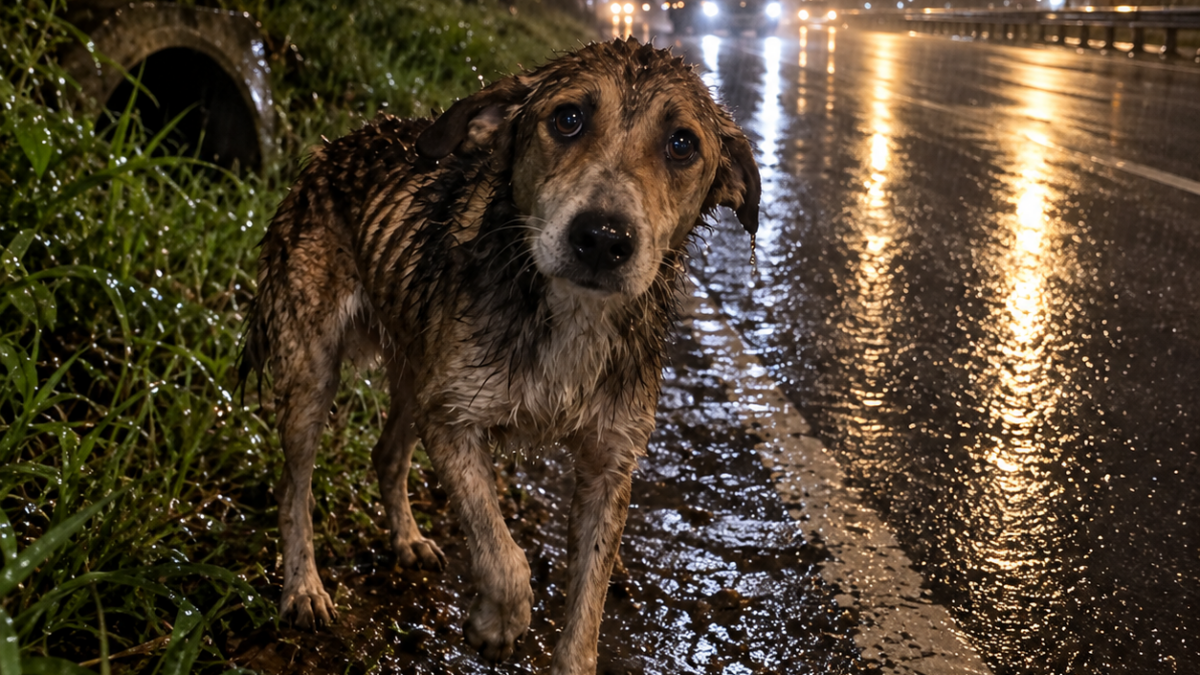
PART 2
At first, all I could see was water.
Rainwater trickled along the bottom of the concrete pipe, catching the beam from my phone before disappearing into darkness.
Then I heard the sound again.
A tiny cry.
I leaned closer.
“Hello?”
Obviously, I wasn’t expecting an answer.
But the dog pushed past my shoulder and shoved her nose toward the opening.
She whined.
That was when the light caught something pale about six feet inside.
A paw.
A very small paw.
“Oh, God.”
I lowered myself until my cheek was nearly against the wet concrete.
There were puppies inside.
Not one.
Several.
They were piled against one another as far from the flowing water as they could get, trembling so violently I could see their bodies shake even from several feet away.
The mother dog stood over my shoulder.
I counted.
One.
Two.
Three.
Four.
Then something moved behind them.
Five.
Five puppies.
“Okay.”
I don’t know who I was talking to.
The dog.
The puppies.
Myself.
“Okay. We’ve got you.”
The mother gave a low whine.
The culvert wasn’t particularly narrow for drainage, but it was too small for me to crawl into comfortably. Worse, the bottom was slick with algae and rainwater.
The nearest puppy was perhaps four feet away.
The farthest was almost twice that.
I stretched one arm inside.
Couldn’t reach.
“Stay here.”
The mother watched me run back toward the bus.
I grabbed my work gloves, a flashlight, an old emergency blanket, and the rain shell I kept behind my seat.
My dispatcher came over the radio again.
“Unit 417, status?”
I picked it up.
“I need animal control or rescue out here.”
“Are you injured?”
“No. There are puppies in a drainage pipe.”
Silence.
Then, “You found puppies?”
“Five. Maybe a few weeks old. They’re soaked and weak.”
“Location confirmed at mile marker thirty-eight?”
“About a hundred yards east, down the embankment.”
“I’ll contact county dispatch.”
“Tell them to hurry.”
I didn’t wait for an answer.
When I got back, the mother was exactly where I’d left her.
She hadn’t climbed into the pipe.
She could have.
She was small enough.
But she seemed to understand that if she blocked the entrance, I couldn’t help.
I spread the emergency blanket across the mud.
Then I lay flat on my stomach and reached inside.
The nearest puppy tried to crawl away.
“Hey, little guy.”
My fingertips touched wet fur.
He was freezing.
I got one hand gently under his chest and pulled him toward me.
He barely resisted.
When I brought him out, the mother rushed forward.
“Easy.”
She sniffed him frantically.
Then she began licking his head and face.
The puppy made a tiny squeaking noise.
“He’s alive.”
The dog looked at me.
I swear she understood.
I placed him in the emergency blanket.
Then I reached again.
The second puppy was a little deeper.
I managed to hook my hand beneath his body and slide him across the smooth concrete.
Two.
The mother checked him.
Three came next.
A small female with a white patch beneath her chin.
Her eyes appeared barely open.
I tucked her beside her siblings.
The fourth puppy was weak enough that he didn’t even crawl away from my hand.
His body felt colder than the others.
For several terrifying seconds, I couldn’t tell whether he was breathing.
Then his chest moved.
“Come on.”
I rubbed him through the blanket.
“Come on, buddy.”
His mouth opened.
A tiny sound emerged.
The mother licked him immediately.
Four.
I took a breath.
“One more.”
The fifth puppy was farthest inside.
Much farther.
My arm disappeared into the pipe almost to my shoulder.
Nothing.
I shifted.
Mud soaked through my uniform.
The mother began pacing.
“I know.”
I stretched farther.
My fingers scraped concrete.
No puppy.
Then rainwater surged suddenly through the pipe.
Not much.
But enough to frighten me.
I pulled my arm back.
The mother barked.
“I know!”
I looked around.
The drainage pipe entered beneath the highway embankment and probably exited somewhere on the other side.
Going around could take several minutes.
I tried again.
I flattened myself even harder against the ground.
My shoulder went into the opening.
My fingertips searched.
Nothing.
Then—
Fur.
“Got you.”
The puppy shifted away.
“No, no, no.”
I reached farther.
Pain shot through my shoulder.
My fingertips touched him again.
This time I caught the loose skin gently behind his shoulder and dragged him close enough to slide my palm underneath.
When I pulled him out, my stomach dropped.
He wasn’t moving.
The mother rushed forward.
She sniffed him.
Licked him.
Pushed him with her nose.
Nothing.
“Damn it.”
I wrapped the puppy in my jacket and rubbed his chest.
“Come on.”
The mother whimpered.
I rubbed harder.
“I didn’t come all the way down here for you to quit.”
Nothing.
The rain seemed louder.
I had no idea whether I was doing the right thing.
I knew enough not to shake him.
Enough to keep him warm.
Enough to clear his nose and mouth.
But that’s about it.
“Come on, little man.”
Then he coughed.
A tiny, wet cough.
The mother jumped.
So did I.
The puppy’s mouth opened.
He squeaked.
I laughed.
I actually laughed while lying in mud at one-thirty in the morning.
“That’s it.”
The mother licked his face so fast I almost couldn’t keep hold of him.
“Yeah. He’s here.”
She pressed her nose against mine.
For one strange second, we were face to face.
Rain running off both of us.
And I saw it.
Relief.
Not the way people project emotions onto animals because we want them to feel human.
This was unmistakable.
The tension went out of her body.
Her ears lowered.
Her eyes softened.
She sat.
Then she nearly collapsed.
I caught her by the shoulders.
“Whoa.”
She was weaker than I’d realized.
Until that moment, adrenaline had been holding her together.
Now that all five puppies were out, she had nothing left.
I pulled the emergency blanket around the litter and laid my rain shell over the mother.
She tried to stand.
“No.”
She stared toward the puppies.
“They’re right here.”
I slid them closer.
One by one, they crawled toward her.
She curled around them.
And for the first time since I’d seen her on the highway, she stopped moving.
No barking.
No pacing.
No frantic glances toward the road.
She simply closed her eyes.
I sat beside her in the rain.
That’s when I noticed her paws.
The pads were torn.
Not one.
All four.
Raw in places.
There was dried blood between two toes.
She hadn’t been running along the highway for ten minutes.
She’d been doing it for hours.
Maybe longer.
Trying to stop someone.
Trying to make someone notice.
Cars must have passed her.
Trucks.
Delivery vans.
Night commuters.
Maybe people slowed.
Maybe people swerved.
Maybe some cursed at the dog running near traffic.
But she kept going.
Until a bus stopped.
I looked toward the highway lights.
“How long were you out there?”
She didn’t open her eyes.
A few minutes later, emergency lights appeared along the shoulder.
A county deputy came down the embankment first.
Behind him was a woman wearing a raincoat over blue medical scrubs.
“James?”
“Here.”
She shone a flashlight toward us.
“Oh my God.”
Her name was Rachel Moreno.
She worked with the county’s contracted overnight animal emergency team.
She knelt beside the mother immediately.
“How many?”
“Five.”
“All breathing?”
“Yes. The smallest stopped for a minute.”
Rachel examined him.
“You got him breathing again?”
“I rubbed him.”
“Good instinct.”
She looked at the mother.
Her expression changed.
“This dog is severely underweight.”
“I noticed.”
“No. I mean severely.”
She ran her fingers carefully along the dog’s ribs.
“She’s nursing five puppies and there’s almost nothing left on her.”
The deputy crouched nearby.
“Could she be feral?”
Rachel looked at the dog’s neck.
There was no collar.
“No way to know yet.”
The mother opened her eyes when Rachel touched the puppies.
Her body became tense.
“It’s okay,” Rachel whispered.
The dog looked at me.
Then back at Rachel.
I put my hand on her neck.
“She’s helping.”
The mother stayed still.
Rachel looked at me.
“She trusts you.”
“I think she’s too tired to object.”
“No.”
Rachel smiled slightly.
“That’s not it.”
We carried them toward the highway in plastic animal transport crates lined with towels.
The mother refused to enter hers until every puppy was inside.
Rachel eventually placed all five into a larger crate with her.
The moment the door closed, the mother curled around them.
At the top of the embankment, my supervisor’s truck was parked behind the bus.
Great.
Tom Bradley was standing with his arms folded.
Tom had been my supervisor for seven years.
He was a decent guy.
He also worshiped schedules.
He looked at my mud-covered uniform.
Then at the animal transport vehicle.
Then at the bus.
“James.”
“Tom.”
“You’ve been stopped forty-three minutes.”
“Five puppies.”
“I heard.”
“And their mother.”
“I heard that too.”
I waited.
He sighed.
“Bus okay?”
“Yes.”
“You okay?”
“Yes.”
“Then take it back to the depot.”
“That’s it?”
“What do you want me to do, fire you for rescuing puppies?”
I smiled.
“Wouldn’t be great publicity.”
“Get in the bus, Carter.”
I did.
But before I left, I walked to Rachel’s vehicle.
“Where are you taking them?”
“County Animal Care tonight. They’ll probably transfer to Hope Ridge Rescue in the morning.”
“Can I check on them?”
Rachel wrote a number on the back of a card.
“Call after nine.”
I looked through the crate.
The mother had her eyes open again.
She was watching me.
“You’re safe now.”
Her tail moved.
Not quite a wag.
Just once.
Enough.
I returned the bus to the depot at 2:17 a.m.
I was supposed to go home.
Instead, I sat in my car.
Mud drying on my pants.
Hands still smelling like wet dog.
I couldn’t stop thinking about the mother running back and forth beneath the streetlights.
I kept imagining what would have happened if I hadn’t stopped.
More rain.
More water entering the culvert.
The smallest puppy already barely breathing.
And that dog running herself until there was nothing left.
I drove home at almost three.
I slept for two hours.
At 8:56, I called the number Rachel had given me.
A woman answered.
“Hope Ridge Animal Rescue.”
“I’m calling about a dog and five puppies brought in overnight.”
“Highway dogs?”
“Yeah.”
“Are you the bus driver?”
Apparently I had already become “the bus driver.”
“Yes.”
“Hold on.”
A minute later, Rachel came on.
“You couldn’t wait until nine?”
“It’s four minutes.”
“Technically three.”
“How are they?”
She laughed.
“The puppies are stable.”
I exhaled.
“And the mother?”
There was a pause.
“She’s not as good.”
My stomach tightened.
“What’s wrong?”
“Several things. Severe malnutrition. Dehydration. Parasites. Her paws are badly damaged. And her bloodwork suggests she’s been underfed for quite a while.”
“Is she going to make it?”
“We think so.”
“Think?”
“James, she’s exhausted. Her body has been producing milk while she was starving. That takes a toll.”
I sat on the edge of my bed.
“Can I come?”
“You’re not scheduled to drive?”
“Tonight.”
“Then yes.”
Hope Ridge was in an old veterinary building near the edge of town.
I arrived twenty minutes later.
Rachel met me at the front desk.
“You look terrible.”
“Thanks.”
“You sleep?”
“Barely.”
She led me toward the back.
“Before you see her, I need you to understand something.”
“What?”
“She may react differently here.”
“Why?”
“She was in survival mode when you found her. Animals can appear extremely bonded to the person helping them in a crisis and then become more guarded once they’re safe.”
“Okay.”
“I’m saying don’t take it personally if she doesn’t respond.”
“I won’t.”
Rachel opened a door.
The room was warm and quiet.
A large padded enclosure occupied one wall.
The mother dog was lying on several blankets.
Her puppies were nursing.
She looked cleaner.
Someone had wiped most of the mud from her face and legs.
She seemed smaller somehow.
More fragile.
I stopped several feet away.
Her eyes opened.
For half a second, she stared.
Then her tail hit the blanket.
Once.
Twice.
Three times.
Rachel smiled.
“Well.”
I moved closer.
“Hey, girl.”
She tried to stand.
Her legs shook.
“Don’t.”
I knelt.
She walked the short distance anyway.
Then pushed her head against my chest.
I wrapped both arms around her.
Her tail kept moving.
Rachel turned away for a moment.
I pretended not to notice her wipe her eyes.
“She needs a name,” she said.
I looked down.
“Doesn’t she have a chip?”
“We checked.”
“No.”
“What about a collar mark?”
“Nothing.”
I thought about that highway.
The rain.
The way she’d refused to stop until I followed.
“Hope.”
Rachel nodded.
“Hope.”
That’s what we called her.
Over the next week, I visited every day.
Sometimes before work.
Sometimes after.
Hope gained almost four pounds.
The puppies gained weight too.
Rachel named them temporarily for paperwork.
Storm.
Milo.
Penny.
Scout.
And Tiny, the smallest one I had pulled from the deepest part of the pipe.
I told her Tiny deserved a better name.
She told me if I wanted naming rights, I could volunteer.
So I did.
Hope became something of a local story after one of the deputies mentioned the rescue to a reporter.
I hated being photographed.
Hope didn’t care.
The headline was something like:
BUS DRIVER FOLLOWS STRAY DOG, FINDS FIVE PUPPIES TRAPPED IN DRAINAGE PIPE.
People donated food.
Blankets.
Money.
One elementary-school class mailed drawings.
Hope’s photograph was everywhere for about a week.
Then, as these stories do, the world moved on.
But something didn’t make sense to Rachel.
One afternoon, about two weeks after the rescue, she called me into the exam room.
“Look at this.”
She showed me Hope’s abdomen.
“What?”
“This scar.”
There was a faint mark along one side.
“I noticed it.”
“She’s had a previous surgery.”
“Spayed?”
“Clearly not.”
Rachel smiled.
“No. Something else.”
She moved Hope’s fur.
“And look here.”
There were tiny marks inside one ear.
Almost invisible.
“What are those?”
“Old tattoo ink.”
“Meaning?”
“Possibly a breeder ID.”
I stared at her.
“Hope came from a breeder?”
“Maybe.”
Rachel had already photographed the markings.
She sent them to several veterinary clinics and breed organizations.
Two days later, she called me while I was preparing to start my route.
“We got something.”
I stepped off the bus.
“What?”
“One clinic recognized the tattoo format.”
“Where?”
“North Valley Veterinary Center.”
“That’s forty miles away.”
“I know.”
“Do they know Hope?”
“Not by that name.”
“What name?”
Rachel hesitated.
“Daisy.”
I looked through the depot window.
“Daisy.”
“She was treated there about fourteen months ago.”
“For what?”
“Emergency C-section.”
My stomach tightened.
“She’d had puppies before.”
“At least once.”
“What else?”
“The account belonged to a man named Travis Boone.”
“Who’s Travis Boone?”
“A breeder.”
I didn’t like the way she said it.
“Legal?”
“Technically.”
That word never makes anything sound better.
Rachel continued.
“He runs something called Boone Family Shepherds.”
“Hope isn’t a purebred shepherd.”
“Exactly.”
“What does he breed?”
“German shepherd mixes advertised as ‘family protection dogs.'”
I felt sick.
“Can we prove she’s his?”
“The clinic record lists the tattoo and matches her approximate age, coloring, prior scar, everything.”
“Then he abandoned her.”
“We don’t know that.”
“She was forty miles from his place, starving with puppies in a drainage pipe.”
“I agree it looks bad.”
“So call the police.”
“I already contacted animal control.”
That investigation changed everything.
At first, Travis Boone denied Hope had ever been his dog.
Then Rachel provided the veterinary record.
His story changed.
He claimed he’d sold Hope—Daisy—to a private buyer months earlier.
“Who?”
He couldn’t remember.
“Receipt?”
None.
“Phone number?”
Lost.
“Name?”
He thought it might have been “Mike.”
That alone wasn’t enough.
People sell dogs all the time.
Records can be terrible.
And Hope couldn’t tell anyone what happened.
For a while, I thought that would be the end of it.
Then Rachel found the box.
It was near the drainage culvert.
I’d never noticed it that night because it was farther down the embankment, partly hidden beneath weeds.
Someone from the highway maintenance department found it while clearing debris.
A large cardboard produce box.
Wet.
Collapsed.
Inside were two old towels.
And a torn piece of plastic feed sack.
On one side of that feed sack was part of a logo.
BOONE FAMILY SHEPH—
Rachel called county investigators.
The box was photographed and collected.
Still not enough.
Boone could argue someone reused his feed bag.
Then a transportation camera changed the case.
The highway department maintained a traffic camera about half a mile west of where I’d stopped.
It didn’t capture the culvert.
But it recorded vehicles.
Investigators reviewed footage from the night I found Hope.
At 10:42 p.m., a white pickup with a distinctive damaged tailgate stopped along the shoulder.
For six minutes.
Then drove away.
The license plate was readable.
Registered owner:
Travis Boone.
I was sitting at Hope Ridge when Rachel showed me the still image.
I stared at it.
“He dumped them.”
“It appears so.”
“She’d been out there more than two hours.”
“At least.”
I thought of Hope’s torn paws.
Running.
Back and forth.
Trying to stop traffic.
“He put those puppies in that pipe?”
“We don’t know exactly how they got inside.”
“He left them there.”
“Yes.”
Hope was sleeping near my chair.
I looked down at her.
The rage I felt surprised me.
I wanted to drive forty miles north and ask Travis Boone what kind of person leaves a nursing mother and five puppies beside a highway in a storm.
Rachel must have seen something in my face.
“Don’t.”
“I didn’t say anything.”
“You didn’t have to.”
“He deserves—”
“He deserves charges that stick.”
I looked at her.
“Not some argument on his property that lets him pretend he’s the victim.”
She was right.
I hated that she was right.
Investigators executed a welfare inspection at Boone’s property three days later.
What they found made Hope’s condition suddenly make sense.
Twenty-three dogs.
Several kept in outdoor runs.
Inadequate shelter.
Dirty water.
Two underweight females.
One dog with an untreated ear infection.
A male shepherd limping badly.
Boone insisted every animal was cared for.
The county disagreed.
Animal control removed nine dogs immediately and placed restrictions on the rest while the investigation continued.
Boone was furious.
Not ashamed.
Not worried.
Furious.
He posted online claiming a “radical rescue group” was trying to destroy his business.
He called the highway footage misleading.
He said he’d stopped because Hope had escaped from his truck and he’d searched for her.
That claim lasted approximately one day.
Investigators found messages on his phone after obtaining a warrant.
One message had been sent to an acquaintance the afternoon before I found Hope.
Daisy had another useless litter. Mixed pups won’t sell. I’m done feeding them.
Another:
Taking care of it tonight.
I read those words sitting in Rachel’s office.
My hands shook.
“Useless.”
Rachel didn’t speak.
“He called them useless.”
Hope walked toward me.
She had gained enough weight that her ribs no longer looked like bars beneath her skin.
I touched her head.
“He starved her because the puppies wouldn’t make him money.”
Rachel nodded slowly.
“That’s what investigators believe.”
There were more messages.
Discussions about breeding females too frequently.
Complaints about veterinary costs.
References to dogs as “inventory.”
The man whose website showed smiling children hugging puppies beside phrases like Raised With Love appeared to see them as products that became inconvenient when they stopped paying.
The county filed animal cruelty and abandonment charges.
Boone’s attorney called them exaggerated.
His supporters said he was being targeted because of social-media pressure.
Then something happened Boone probably never expected.
Former buyers started calling.
One family said their puppy had arrived severely ill.
Another said Boone refused to provide promised medical records.
A former employee described dogs being kept in poor conditions behind buildings customers weren’t allowed to enter.
A woman named Hannah Price contacted the investigators and said she’d worked for Boone for six months.
Her statement was devastating.
She remembered Hope.
Daisy, to her.
“She was the best mother he had,” Hannah told investigators.
I wasn’t present for the interview, but Rachel later told me what she’d said.
Hope had produced a profitable litter the year before.
Boone bred her again far too quickly.
The second litter wasn’t what he wanted.
The puppies had mixed markings and weren’t marketable as the expensive “protection shepherds” he advertised.
Hope also developed weight problems because Boone hadn’t increased her food enough while she was nursing.
Hannah had argued with him.
He told her, “If a dog can’t pay for its bowl, it doesn’t get a bowl.”
She quit two weeks later.
The case grew.
Boone didn’t just face charges for abandoning Hope and the puppies.
The county moved to revoke his breeding license.
Civil penalties followed.
Veterinary expenses for seized dogs were assessed against him.
His website disappeared.
His social-media pages went private.
Customers demanded refunds.
The business collapsed.
I’m not going to pretend I felt sorry for him.
I didn’t.
But what satisfied me wasn’t watching his business fail.
It was watching the dogs leave.
One by one.
The limping shepherd went to an experienced foster family.
The underweight females received medical care.
An elderly dog named Duke, who had spent most of his life in one of Boone’s outdoor runs, was adopted by a retired schoolteacher who let him sleep in her bed.
Rachel showed me a photograph.
Duke was lying on a quilt with his head on a pillow.
“That’s revenge,” she said.
I smiled.
“What?”
“That.”
She pointed at the photograph.
“Not Boone losing money. Not the charges. That dog sleeping on a pillow when somebody treated him like inventory.”
I looked down at Hope.
“You’re getting philosophical.”
“I work in rescue. It happens.”
Hope’s puppies kept growing.
By eight weeks, they had transformed from trembling little shapes into chaos.
Milo chewed everything.
Penny screamed if breakfast was six seconds late.
Scout learned how to climb over a baby gate.
Storm followed Rachel everywhere.
And Tiny—
Tiny wasn’t tiny anymore.
He was still the smallest, but he had become fearless.
I couldn’t look at him without remembering his motionless body in my hands.
One afternoon, he attacked my shoelace and dragged it across the room like he’d killed a snake.
“You almost died,” I told him.
He growled at the shoelace.
“No respect for history.”
The adoption applications poured in.
Rachel screened them obsessively.
“You know you can’t interview people like they’re applying for national security clearance.”
“Watch me.”
The first puppy adopted was Penny.
A young couple named Mark and Jenna had recently lost their older dog.
They visited three times before Rachel approved them.
When they carried Penny toward the door, Hope followed.
I held my breath.
She sniffed Jenna’s hands.
Then Penny’s face.
Then stepped back.
No panic.
No barking.
No desperate attempt to follow.
It was as if Hope understood.
This wasn’t someone taking her puppy into darkness.
This was someone taking her home.
Penny left.
Then Scout.
Then Milo.
Every departure hurt more than I expected.
Hope would search the room afterward.
But within a few hours, she settled beside the remaining puppies.
Storm went to a firefighter with two children.
The children had written a letter explaining why they wanted him.
Rachel pretended she didn’t cry.
I absolutely saw her cry.
Then only Tiny remained.
His application came from an older couple named Susan and Ray Collins.
They lived on six fenced acres.
Susan worked from home.
Ray had recently retired.
They’d had dogs for thirty years.
Perfect.
I hated them instantly.
Not really.
But watching Tiny leave felt different.
He was the puppy I had almost lost.
Susan knelt beside me.
“We can come back another day if this is hard.”
I shook my head.
“No.”
Tiny climbed into my lap.
I rubbed his ears.
“You’re supposed to be dead.”
Susan’s eyes filled.
“But you’re not.”
He licked my chin.
“Don’t eat anything stupid.”
Ray laughed.
“I’ll do my best to enforce that.”
“He’s not bright.”
Tiny wagged.
“I didn’t say you weren’t handsome.”
Hope walked over.
She sniffed Tiny slowly.
Then Susan.
Then Ray.
Finally, she turned and pressed against my leg.
Rachel opened the door.
Tiny looked back once as they carried him outside.
Then he saw a leaf blowing across the parking lot and forgot all about us.
I laughed through tears.
“Traitor.”
Hope watched the car leave.
Then she looked at me.
For the first time since I’d met her, she had no puppies.
She climbed onto the chair beside me.
Put her head in my lap.
And slept.
Her job was finished.
Mine, apparently, wasn’t.
Hope was now healthy enough for adoption.
Rachel asked me about it so casually that I knew she’d been planning the conversation.
“Applications open Monday.”
I looked at her.
“For Hope?”
“Yes.”
“Already?”
“She’s healthy. She’s spayed now. Bloodwork is good. Paws healed.”
“She just lost her last puppy.”
“They weren’t lost.”
“You know what I mean.”
Rachel leaned against the counter.
“Do you want to apply?”
“No.”
The answer came too fast.
Rachel smiled.
“No?”
“I drive ten-hour shifts.”
“So?”
“I live alone.”
“So?”
“My apartment is small.”
“She sleeps in a four-foot kennel half the night.”
“That doesn’t mean—”
“You’ve visited her thirty-one times.”
“You’re counting?”
“Yes.”
“That’s weird.”
“You named her.”
“She needed a name.”
“She waits by the front window around the time your bus gets back to town.”
I stared at her.
“What?”
Rachel shouldn’t have told me that.
The next night after my shift, I drove to Hope Ridge.
It was almost midnight.
Rachel had gone home, but Martin, the overnight technician, let me inside.
“She’s asleep.”
“I know. I just…”
He smiled.
“Go ahead.”
Hope was curled on her blanket.
I sat outside the enclosure.
She opened one eye.
Then stood.
Her tail started moving.
“Hey.”
She came toward the gate.
I opened it.
She stepped out and leaned against me.
For several minutes, I said nothing.
Then I looked around.
“I can’t believe I’m doing this.”
Hope licked my wrist.
“I’m a bus driver.”
Tail wag.
“I work nights.”
Tail wag.
“My couch is terrible.”
More tail wagging.
“You don’t know what you’re agreeing to.”
She placed one paw on my knee.
I sighed.
“Fine.”
The next morning, I submitted an adoption application.
Rachel made me complete every page.
“I’m the one who found her.”
“Doesn’t matter.”
“I’ve been here every day.”
“Doesn’t matter.”
“You know my address.”
“Form.”
“You know my employer.”
“Form.”
“This feels personal.”
“It is.”
I filled out the form.
Three days later, Rachel did a home inspection.
She criticized my loose screen door.
I fixed it.
She criticized the cleaning supplies beneath the kitchen sink.
I moved them.
She suggested a better dog bed.
I bought one.
Then another because I wasn’t sure.
“Anything else, Your Majesty?”
Rachel looked around.
“Food bowls.”
“They’re right there.”
“Raised bowls might be more comfortable.”
I stared at her.
“Leave.”
She laughed.
Hope officially became mine the following Friday.
I brought a new collar.
Blue.
No writing except a simple ID tag.
When Rachel clipped off the temporary rescue collar, I felt strangely emotional.
Hope sat between us.
Rachel handed me the leash.
“She’s yours.”
I shook my head.
“No.”
Rachel frowned.
“What?”
“I’m hers.”
Rachel smiled.
“That’s probably more accurate.”
We walked outside.
Hope stopped in the parking lot.
For a moment, she looked uncertain.
Then she saw my car.
I’d put a blanket across the back seat.
“Come on.”
She climbed in.
The first night at my apartment, Hope inspected every room.
Kitchen.
Bedroom.
Bathroom.
Hallway.
Then she stood near the front door.
Waiting.
I sat on the floor beside her.
“You don’t have to leave.”
She looked at me.
“This is it.”
I tapped the floor.
“Home.”
She stayed near the door for almost an hour.
Then slowly walked into the living room.
I had bought an expensive orthopedic bed.
She ignored it.
She climbed onto the couch.
Turned around twice.
Collapsed.
Within five minutes, she was snoring.
“Great.”
I looked at the unused bed.
“Good investment.”
Life with Hope settled into a rhythm.
I slept late because of my night schedule.
She adapted immediately.
When I woke in the afternoon, we walked.
Before my shift, she ate.
My neighbor, Mrs. Greene, came over around ten each night to let her outside and usually stayed far too long feeding her treats.
When I returned after midnight, Hope waited by the door.
Every single night.
Sometimes I wondered what she heard when my car pulled into the lot.
Maybe my engine.
Maybe my footsteps.
But by the time my key touched the lock, her tail was already thumping against the wall.
On rainy nights, she behaved differently.
She didn’t like heavy rain.
The first thunderstorm after I adopted her, she stood by the window panting.
I sat beside her.
“You’re not out there.”
She paced.
“Hope.”
I pulled the curtains closed.
She looked toward the door.
I realized then what she might be remembering.
Rain.
A highway.
Five puppies somewhere in the dark.
Being driven away from the only place she knew.
I sat on the floor.
She eventually came to me.
I wrapped a blanket around her.
“They’re safe.”
Obviously, she couldn’t understand the words.
But I said them anyway.
“Penny is safe.”
Her breathing slowed.
“Scout is safe.”
She lowered herself.
“Milo is safe.”
Her head rested on my thigh.
“Storm is safe.”
I touched her ear.
“And Tiny is driving an elderly couple insane on six acres.”
Her eyes closed.
“Everyone made it.”
From then on, whenever it stormed, I told her where they were.
Maybe it was for me as much as her.
We received photographs from every family.
Penny asleep beside Jenna’s baby months later.
Scout hiking.
Milo wearing an embarrassing Christmas sweater.
Storm sitting beside the firefighter’s youngest daughter.
Tiny—
Tiny became enormous.
At one year old, Susan sent me a picture of him stretched across their couch.
I called Rachel immediately.
“You said he was the runt.”
“He was.”
“He weighs seventy pounds.”
“Growth happens.”
“You named him Tiny.”
“You agreed.”
“He looks like a horse.”
We laughed until my stomach hurt.
Hope stayed around fifty pounds.
Healthy.
Strong.
Her coat changed completely once she was properly fed.
What had looked dull brown became rich tan and black.
People occasionally stopped us and asked what breed she was.
“No idea,” I said.
“Professional bus stopper.”
Boone’s case went to court nearly a year after the night I found her.
I didn’t expect to testify.
Then the prosecutor called.
My testimony was straightforward.
What time I saw Hope.
Her physical condition.
Her behavior.
Where she led me.
The puppies.
The weather.
Her torn paws.
Boone sat across the courtroom.
It was the first time I’d seen him in person.
He looked ordinary.
That’s what bothered me.
Part of me had expected someone who visibly looked cruel.
Cruel people rarely do.
He wore a clean shirt.
Neat hair.
Glasses.
He could have been an accountant.
When I described finding the smallest puppy barely responsive, Boone looked down.
His attorney asked whether I had personally seen Boone place the dogs there.
“No.”
“Then you cannot testify that my client abandoned them.”
“I didn’t say I saw him.”
“You’ve spoken publicly about this case.”
“I’ve answered questions about finding the dogs.”
“You became emotionally attached to the mother dog, correct?”
“Yes.”
“In fact, you adopted her.”
“Yes.”
“So you have a personal interest in portraying her previous owner negatively.”
I looked toward Boone.
“No.”
The attorney paused.
“No?”
“I didn’t know who her owner was when I found her.”
“That’s not what I—”
“I watched her run on bleeding paws trying to get someone to help her puppies.”
The prosecutor started to stand.
The judge watched me.
I continued.
“I don’t need to make whoever left her there look bad.”
The courtroom became very quiet.
“The condition she was in did that already.”
“Objection.”
“Sustained.”
But the jury had heard it.
Hannah Price testified after me.
Then the veterinarian.
Then the highway investigator.
Then digital-forensics evidence showing Boone’s messages.
His own words did more damage than anything I could have said.
Useless litter.
Done feeding them.
Taking care of it tonight.
The jury found him guilty on multiple animal cruelty and abandonment counts.
His breeding operation was permanently shut down under the settlement of related civil proceedings.
He was prohibited from commercial breeding for years and placed under animal ownership restrictions.
Financial penalties went partly toward veterinary care for the seized dogs.
I expected to feel victorious.
Instead, when the verdict was read, I mostly felt tired.
Rachel was sitting beside me.
“Not what you expected?”
“I don’t know what I expected.”
“Fireworks?”
“Maybe.”
She nodded toward the exit.
“Come on.”
“Where?”
“I want to show you something.”
She drove me to a house twenty minutes outside town.
A woman opened the door.
Behind her was Duke.
The elderly shepherd from Boone’s property.
He recognized Rachel immediately.
He came waddling over.
His limp was much better.
His coat was thick.
His body had filled out.
And around his neck was a ridiculous red bandana covered in tiny yellow ducks.
His owner, Mrs. Patterson, smiled.
“He chose it.”
“I don’t believe that,” I said.
Duke leaned against her leg.
She scratched his neck.
“He sleeps on my bed.”
Rachel looked at me.
“Remember what I told you?”
I did.
This was the revenge.
Not Boone sitting in a courtroom.
Not money.
Not humiliation.
This.
A dog he’d treated like inventory living long enough to discover pillows.
Hope waiting for me at home.
Five puppies growing up knowing nothing about drainage pipes.
That was better.
That night, I took Hope for a drive.
Not because she loved the car.
She tolerated it.
But there was somewhere I wanted to go.
I drove to mile marker thirty-eight.
It hadn’t rained in days.
The shoulder was dry.
I parked safely off the roadway.
Hope became alert immediately.
Her ears lifted.
I clipped on her leash.
We walked beyond the guardrail.
She knew.
I could tell from the moment her paws touched the grass.
Her nose went down.
She pulled gently ahead.
Same direction.
Same drainage embankment.
The concrete pipe was still there.
Of course it was.
Ordinary infrastructure beside an ordinary highway.
No one driving past would ever know what happened there.
Hope stopped near the entrance.
She sniffed.
Then looked inside.
I wondered what she remembered.
Did dogs store places the way we did?
Could she see those puppies in darkness?
Feel the rain?
Remember running toward headlights over and over?
I crouched beside her.
“Nobody’s in there.”
She looked at me.
“Not tonight.”
I sat on the grass.
Hope sat beside me.
For a while we watched cars pass.
Headlights appeared.
Then disappeared.
A year earlier, she’d been starving on that shoulder trying to make one person stop.
Now she wore a collar.
Her ribs were hidden beneath healthy muscle.
Her paws had healed.
Five puppies had homes.
I touched her neck.
“You did it.”
Hope leaned against me.
“You saved them.”
She looked toward the highway.
I smiled.
“I just happened to have the biggest car.”
Her tail moved.
Life kept moving after that.
I continued driving buses.
People sometimes asked why I didn’t leave transportation and work in animal rescue.
My answer was simple.
I liked driving buses.
Not every life-changing event means you have to become someone completely different.
Sometimes it just makes you pay more attention.
I started keeping a leash, towels, bottled water, and dog treats on the bus—with company approval, eventually.
Other drivers did too.
Tom jokingly called it the Carter Animal Emergency Kit.
Then one of our drivers used it to secure an injured dog until animal control arrived.
The joke became official.
Our transit agency partnered with Hope Ridge for a small program teaching night drivers what to do if they encountered animals on highways or rural roads.
Rachel gave the training.
She terrified everyone with quizzes.
I told them she was worse with adoption paperwork.
Hope became the unofficial mascot.
She visited the depot twice.
The first time, she climbed onto my bus and refused to get off.
Tom stood in the aisle.
“She can’t drive.”
“Have you seen some of our new hires?”
“James.”
“I’m joking.”
Hope walked directly to the seat behind mine and lay down.
The same bus I’d been driving the night I found her.
Unit 417.
I sat in the driver’s seat.
For a second, the depot disappeared.
I saw rain.
Dark highway.
A skeletal dog crossing my headlights.
One decision.
Brake or keep driving.
I reached back and touched Hope’s head.
There are moments you don’t recognize as turning points until years later.
That one I recognized immediately.
If I had looked down at my radio.
If I had been driving slightly faster.
If Hope had given up ten minutes earlier.
If the smallest puppy had been another foot deeper inside the pipe.
Stories like ours depend on terrifyingly small margins.
That thought could have haunted me.
Instead, I chose another one.
We made it.
All of us.
Three years after the rescue, Hope Ridge invited every puppy family to a reunion.
Rachel had wanted to do it sooner, but organizing five families was apparently harder than rescuing five puppies from a drain.
The event took place in a fenced field behind the rescue.
Hope arrived with me.
She was older.
A little gray around the muzzle.
Still healthy.
The first dog through the gate was Penny.
Hope froze.
Penny froze.
I held my breath.
Then Penny ran.
Straight toward Hope.
They collided in a storm of tails.
Jenna started crying.
Then Scout arrived.
Then Milo.
Then Storm.
Finally Susan and Ray opened their SUV.
A giant dog jumped out.
I stared.
“No.”
Susan laughed.
Tiny ran across the grass.
Seventy-five pounds of former near-dead puppy.
He crashed into Hope.
Then into me.
I landed on my backside.
Everyone laughed.
“Tiny!”
He licked my entire face.
“You almost died in my hand and this is the thanks I get?”
His tail nearly knocked over a folding chair.
Hope stood in the center of her grown puppies.
For several minutes, there was chaos.
Sniffing.
Running.
Barking.
Hope tried to keep track of everyone.
Old habits.
Eventually they settled in the grass.
Five grown dogs around their mother.
Rachel stood beside me.
“You realize this is your fault.”
“My fault?”
“If you hadn’t stopped—”
“Hope stopped me.”
Rachel nodded.
“Fair.”
We took a photograph.
Hope in the middle.
Her five puppies around her.
Me kneeling behind them.
Rachel beside me.
Every family gathered around.
I keep that photograph near my front door.
Years passed.
Hope slowed down.
Her favorite activity became sleeping near the window while afternoon sun warmed the floor.
She still hated thunderstorms, though less intensely.
I still named the puppies for her whenever it rained.
“Penny’s safe.”
Tail tap.
“Scout’s safe.”
Eyes closing.
“Milo’s safe.”
Deep sigh.
“Storm’s safe.”
Head lowering.
“Tiny is still enormous and stupid.”
Tail wag.
Then she slept.
When Hope turned about eleven—our best estimate—her arthritis started.
Nothing serious at first.
A little stiffness after sleeping.
Then difficulty jumping onto the couch.
I bought steps.
She refused them.
I built a ramp.
She stared at it like I’d insulted her.
Eventually, I lowered my mattress and bought a lower couch.
Rachel visited.
“You redesigned your entire living room for the dog.”
“No.”
She looked around.
“You own three ramps.”
“They’re temporary.”
“You removed a coffee table.”
“It was dangerous.”
“For whom?”
“Hope.”
Rachel smiled.
“Exactly.”
Hope gave us more good years.
Quiet years.
That’s what mattered.
She didn’t need to save anyone.
She didn’t need to produce puppies.
She didn’t need to earn food.
She didn’t need to run until her paws bled to make someone notice her.
She only had to wake up.
Eat.
Walk.
Sleep.
Be loved.
People underestimate the beauty of ordinary life when you’ve seen an animal denied it.
One evening, several years after the rescue, I came home from work and Hope didn’t meet me at the door.
That had never happened.
“Hope?”
No movement.
I found her beside her bed.
She lifted her head.
Tried to stand.
Couldn’t.
My stomach dropped.
I sat beside her.
“Hey.”
She licked my hand.
Her gums looked pale.
I called Rachel before I called anyone else.
She answered on the second ring.
“What’s wrong?”
She knew from my voice.
An hour later, we were at the emergency vet.
Tests showed internal bleeding from a mass near her spleen.
The veterinarian was kind.
Too kind.
You learn to recognize that tone.
They could operate.
Maybe.
At her age, with the location of the mass and what the scan suggested, surgery might buy time.
Or she might die during it.
I sat on the floor beside Hope.
Rachel sat across from me.
“What would you do?”
I asked.
Rachel shook her head.
“I’m not making this decision for you.”
“I don’t know what to do.”
“Then don’t think about what you want.”
That hurt.
She continued.
“Think about what Hope needs.”
I looked at her.
Hope’s head rested in my lap.
She was tired.
Not scared.
Just tired.
I thought about the first night.
How she’d refused to quit.
How she’d kept running because five lives depended on her.
Hope had fought enough.
More than enough.
I asked if we could take her outside.
The veterinary clinic had a small fenced garden.
It had rained earlier.
The grass smelled wet.
Rachel carried blankets.
I carried Hope.
She was lighter than I remembered.
We laid her beneath a tree.
The clouds had begun to clear.
Cars moved somewhere beyond the fence.
Hope lifted her nose.
Rain.
Traffic.
Night air.
The smells that had defined the worst night of her life.
But now she was wrapped in blankets.
My hands around her.
Rachel nearby.
No puppies crying.
No highway shoulder.
No one leaving her.
I rested my forehead against hers.
“You remember that bus?”
Her eyes moved toward me.
“You scared ten years off my life.”
Rachel laughed quietly through tears.
“You could’ve just sat there.”
Hope breathed.
“But no.”
I rubbed her ear.
“You had to make me follow you into a drainage ditch at one in the morning.”
Her tail moved once.
“Best stupid decision I ever made.”
I reached into my pocket.
There was something I carried everywhere.
The old ID tag from her first blue collar.
HOPE.
I held it in my hand.
“Your babies made it.”
Her breathing slowed.
“Penny has a family.”
I stroked her cheek.
“Scout has a family.”
Another breath.
“Milo has a family.”
Her eyes stayed on mine.
“Storm has a family.”
I swallowed.
“And Tiny got so big I’m still mad about the name.”
Rachel covered her mouth.
I smiled through tears.
“You did that.”
Hope’s head relaxed into my lap.
“You got them out.”
No.
That wasn’t quite true.
“I got them out of the pipe.”
I leaned closer.
“You saved them.”
The veterinarian waited until I nodded.
I kept talking.
“Nobody needs you to run tonight.”
The medication entered the IV.
“No cars to stop.”
Hope’s eyes grew heavier.
“No puppies waiting.”
Her breathing softened.
“No more rain.”
One slow breath.
“You’re home.”
Then she was gone.
For a long time, I sat beneath that tree.
The rain started again.
Lightly.
I didn’t move.
Rachel sat beside me.
Neither of us spoke.
Eventually she said, “You know what I think?”
“What?”
“I think she knew exactly which vehicle to stop.”
I laughed despite myself.
“A city bus?”
“Big target.”
“Very strategic.”
“She was smart.”
“She was desperate.”
“Both can be true.”
We stayed there until the rain stopped.
Hope’s ashes came home two weeks later.
I placed them beneath the photograph of her with all five puppies.
Beside them, I put the blue ID tag.
For months afterward, I still opened the apartment door expecting to hear her tail against the wall.
I still looked toward the couch.
Still woke during thunderstorms and thought I needed to tell her everyone was safe.
The first big storm after she died, I sat alone in the living room.
Rain struck the windows.
Thunder rolled.
And without thinking, I said aloud:
“Penny’s safe.”
Silence.
“Scout’s safe.”
Rain.
“Milo’s safe.”
Another roll of thunder.
“Storm’s safe.”
My throat tightened.
“Tiny is safe.”
I looked at Hope’s photograph.
“And so are you.”
That was the first night I understood something.
The rescue hadn’t ended at the drainage pipe.
It hadn’t ended when the puppies were adopted.
It hadn’t ended when Boone was convicted.
It hadn’t even ended when Hope came home with me.
Rescue isn’t always one moment.
Sometimes it’s years.
It’s food every morning.
Medicine when joints hurt.
A warm room during thunderstorms.
A familiar hand at the end.
A promise kept over and over until the animal no longer has to wonder whether safety will disappear.
Hope had spent one terrible night begging strangers to notice her.
For the rest of her life, she never had to beg again.
About a year after she died, the transit authority retired Bus 417.
Tom called me.
“You want something weird?”
“Depends.”
“They’re scrapping your old rescue bus next month.”
I was quiet.
“Can I see it?”
“Figured you’d ask.”
I drove to the depot on my day off.
Unit 417 sat near the maintenance garage.
Faded paint.
High mileage.
Different mirrors than before.
But still the same bus.
I climbed into the driver’s seat.
My hands rested on the wheel.
I could almost hear the rain.
I could almost see Hope running through the headlights.
Tom stood near the front door.
“You know we can’t give you a bus.”
“I don’t want a bus.”
“Good.”
“I want the number plate.”
He rolled his eyes.
“I already removed it.”
He handed me the small metal fleet plate.
417.
I held it.
“Thanks.”
“You’re sentimental for a guy who complains about birthday cards.”
“Don’t tell anyone.”
The plate hangs in my hallway now beneath Hope’s photograph.
People ask why.
Most expect some heroic explanation about saving dogs.
I tell them the truth.
It’s there to remind me to stop.
Not literally every time I see something on a highway.
Please don’t do that.
But in life.
Stop.
Notice.
Pay attention.
We spend so much time getting somewhere.
Home.
Work.
Bed.
The next appointment.
The next paycheck.
The next problem.
That night I wanted nothing except a shower and sleep.
If I’d decided my schedule mattered more than one frightened dog on a shoulder, my life would have continued.
I would have gone to work the next day.
Driven my routes.
Paid my bills.
Probably never known what I’d passed.
That’s the part that stays with me.
We usually don’t know what happens when we don’t stop.
We only know the stories where someone does.
Every September, on the anniversary of the rescue, I receive photographs.
Penny was the first of the puppies to pass away many years later.
She died in her sleep beside Jenna.
Scout lived to thirteen.
Milo became the gentle old dog who followed Mark and Jenna’s little boy around their house.
Storm spent his life with the firefighter’s family and developed an obsession with sprinklers.
Tiny outlived nearly everyone.
Of course he did.
The puppy I thought was dead in a drainage pipe became a massive old dog who refused to surrender the center of Susan and Ray’s bed.
When he finally died, Susan called me.
“He made it fourteen years.”
I sat down.
“Fourteen?”
“Fourteen.”
I laughed and cried at the same time.
“The little liar.”
Susan was crying too.
“He had a good life, James.”
“I know.”
“He had a really good life.”
After we hung up, I drove to mile marker thirty-eight.
I hadn’t been there in several years.
Highway work had changed part of the shoulder.
The culvert remained.
I parked where it was safe and walked down.
The grass was high.
The concrete had weathered.
I sat near the entrance.
Five puppies had once been trapped inside.
A starving mother had run toward traffic because she had no other way to ask for help.
Every one of those puppies had now lived an entire life.
Think about that.
Not one extra day.
Not one extra week.
Lives.
Birthdays.
Christmas mornings.
Children growing up beside them.
Family photographs.
Veterinary appointments.
Stolen sandwiches.
Chewed shoes.
Gray muzzles.
Final goodbyes.
All of it existed on the other side of one exhausted dog refusing to give up.
I placed something beside the culvert.
A small stone.
Nothing fancy.
I’d had a simple line engraved into it.
SHE KEPT RUNNING UNTIL SOMEONE STOPPED.
No names.
No dates.
People passing on the highway would never see it.
That wasn’t the point.
I sat there until sunset.
Then I got up.
As I walked toward my car, I looked back once.
For a second, memory did what memory sometimes does.
I saw her.
Skinny.
Soaked.
Standing beneath the highway lights.
Looking over her shoulder.
Waiting to see whether I would follow.
I was younger.
Tired.
Confused.
Completely unaware that the animal in front of me was about to divide my life into before and after.
People used to tell me I saved Hope that night.
I never agreed.
A dog who had almost nothing left ran herself bloody because five little lives were depending on her.
She searched a dark highway until she found someone willing to stop.
Then she showed me exactly where to go.
Hope was the rescuer.
I was transportation.
And maybe that’s why, after all these years, the memory that stays with me isn’t the court case.
It isn’t Boone losing his business.
It isn’t the newspaper photograph.
It isn’t even pulling Tiny from the pipe.
It’s the moment before all of that.
An empty bus.
A wet highway.
One starving dog standing inside my headlights.
She could barely stay on her feet.
But she looked directly at me.
Then she turned toward the darkness.
Took several steps.
Stopped.
And looked back.
She trusted a complete stranger with everything she had left.
I followed.
And because I did, five puppies got to grow old.
A mother who had been treated like disposable inventory discovered couches, warm blankets, ridiculous treats, and what it felt like to hear someone unlock the front door every night and know they were coming home to her.
Other dogs escaped the same man who had failed her.
A breeding operation built on neglect disappeared.
A rescue program changed.
A transit company learned that even night drivers could become part of an emergency response.
And one ordinary bus driver learned that sometimes the most important destination isn’t printed anywhere on your route sheet.
Sometimes it waits beyond the guardrail.
In the rain.
In the dark.
Hoping somebody will finally stop.








