PART 2: I Spent My Horse-Supply Money on a Dying Hound at the Market—Then I Learned Why He Had Been Chained There
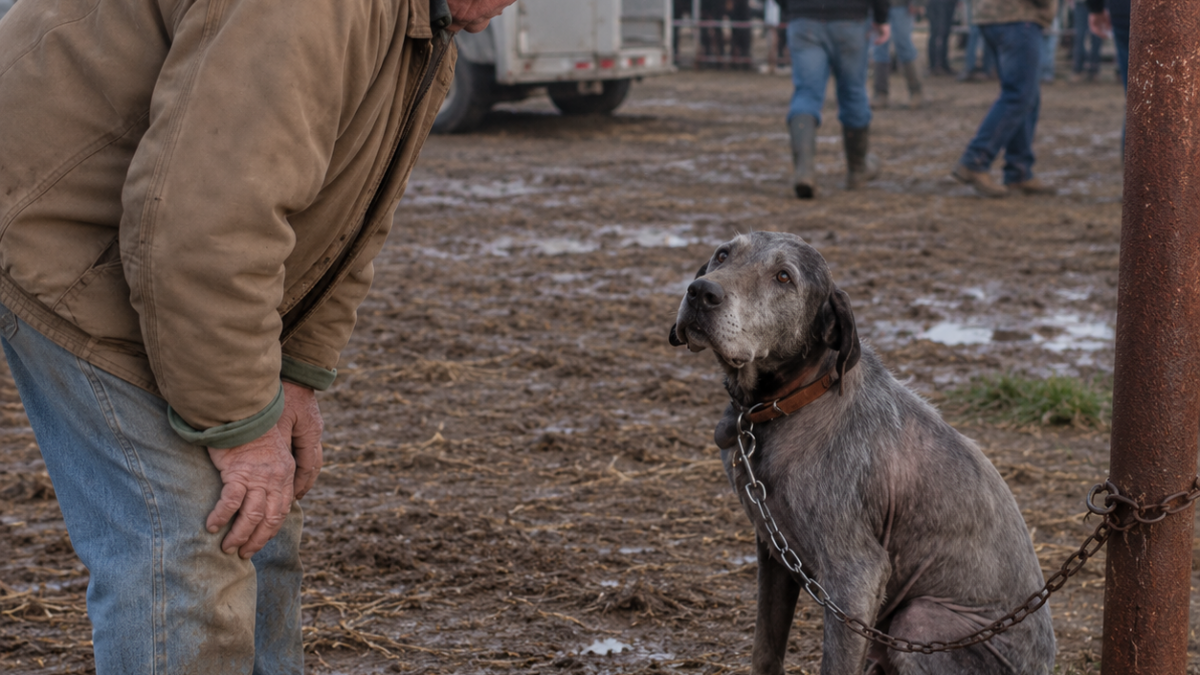
PART 2
The ride back to my farm took forty-two minutes.
I know because I looked at the dashboard clock when I pulled away from the market, and I looked again when I turned through my gate.
For most of those forty-two minutes, the old hound lay curled awkwardly on the passenger seat with his head resting against my right thigh.
He never slept.
At first I thought he had.
His eyes would close for a few seconds, but every time the truck hit a bump or I moved my hand toward the gearshift, they opened again.
Watching.
Checking.
Waiting for something bad to happen.
I rested my hand on the top of his head.
He flinched.
Not much.
Just enough that I felt it.
“Easy.”
His eyes turned toward me.
“I’m not going to hurt you.”
There are sentences you say to animals even though you know language is not what convinces them.
Tone matters.
Hands matter.
What happens next matters most.
I drove slower than usual.
When we reached the farm, Bell and Amos were standing near the fence waiting for breakfast like I had personally betrayed them by being twenty minutes late.
“I know,” I called through the windshield. “I know.”
The dog lifted his head at the sound of my voice.
“Those two complainers are your new neighbors.”
His ears moved faintly.
That was the first reaction I had gotten from him.
I parked near the house and opened the passenger door.
“Think you can walk?”
He tried.
One front paw reached toward the running board.
Then his rear legs folded beneath him.
I caught him before he fell.
“All right. Bad question.”
I lifted him.
He was lighter than a sack of feed.
That frightened me more than the ribs had.
A dog his size should have had weight to him.
Muscle.
Substance.
Instead, I felt bone beneath loose skin.
I carried him into the living room and lowered him onto the old braided rug Elsie had bought twenty-three years earlier.
I still kept it because throwing away things had become harder after she died.
Her blue coffee cup was still in the back of the cabinet.
Her gardening gloves still hung in the mudroom.
Her handwriting still labeled jars in the pantry.
A person can spend years claiming he has accepted a death while carefully arranging his life so that nothing proves the person is truly gone.
The dog lay exactly where I put him.
I brought water.
He stared at the bowl.
“Go ahead.”
Nothing.
I dipped two fingers into the water and let a few drops fall near his mouth.
He licked them from the floor.
Then he raised his head.
Slowly, he began drinking.
Not gulping.
He drank as if experience had taught him water could be taken away at any moment.
A few swallows.
Stop.
Look at me.
A few more.
Stop.
Look at the doorway.
I sat on the floor beside him.
“Nobody is taking it.”
He finished almost half the bowl.
Food was harder.
I opened canned dog food I kept for the farm dogs that occasionally wandered through.
He smelled it.
Turned away.
I warmed some chicken.
Nothing.
I tore off a piece and held it in my palm.
He looked at the meat.
Then at me.
“Take it.”
He didn’t.
“Fine.”
I placed it on the floor and moved back.
Five minutes later, it was still there.
Ten minutes.
Twenty.
I made coffee and sat in my chair.
When I looked again, the chicken was gone.
The dog’s head rested on his paws.
I smiled.
“You’re sneaky.”
One eye opened.
That evening, I called Dr. Lena Harper.
She had been treating my animals for close to twenty years and had the rare ability to tell me I was wrong without making me feel stupid until much later.
“What did you buy at the market?” she asked.
“A dog.”
Silence.
“Samson.”
“I know.”
“You went for horse supplies.”
“I know.”
“What kind of dog?”
“Old hound.”
“How old?”
“No idea.”
“Healthy?”
“No.”
Another silence.
This one longer.
“I’ll come at seven.”
“You don’t have to—”
“Yes, I do.”
She hung up.
The hound slept near the fireplace that night.
I brought down an old quilt and covered him.
Around midnight, I woke in my chair.
He had not moved.
For one panicked second I thought he had died.
Then his chest rose.
I sat there watching him breathe until almost two.
At three seventeen, I woke again.
The quilt was empty.
I stood.
“Hey?”
A shape moved near the hallway.
The old hound was standing beside my bedroom door.
Barely standing.
His legs trembled, but he had crossed the room on his own.
“What are you doing?”
He looked at me.
Then lowered himself to the floor.
Not inside my bedroom.
Just near the doorway.
Close enough to see me.
That was when the name came.
“Finn.”
His ear twitched.
I smiled.
“Finn.”
Elsie had liked old Irish names.
Finn meant fair or bright, depending on who translated it.
This dog was neither.
His coat was dark and dusty. His eyes were exhausted.
Maybe that was why I chose it.
A name does not have to describe what someone is.
Sometimes it describes what you hope they become.
“Finn,” I repeated.
His eyes closed.
The next morning, Dr. Harper arrived carrying two bags and wearing the expression she usually reserved for people who ignored medical advice.
She crouched beside Finn.
He tensed.
“Easy, sweetheart.”
She let him smell the back of her hand.
He did.
Then withdrew.
For the next forty-five minutes, she examined him with the patience of someone dismantling a bomb.
Weight.
Gums.
Teeth.
Eyes.
Heart.
Joints.
Skin.
Paws.
Neck.
When she moved the collar, her face changed.
“What?”
She parted the fur.
A deep band of irritated skin circled Finn’s neck.
Some sections had healed into thick scar tissue.
Others were newer.
“Chain pressure,” she said.
I stared.
“How long?”
“You can’t date scars perfectly.”
“How long, Lena?”
“Months. Maybe longer.”
My jaw tightened.
She continued the examination.
Finn had severe dehydration.
Malnutrition.
Parasites.
An ear infection.
Inflamed joints.
Old scars across one hind leg.
His nails were overgrown.
Several teeth were damaged.
Dr. Harper sat back.
“He’s lucky you brought him home.”
“That bad?”
She looked at me.
“Samson, this dog has been neglected for a long time.”
I looked toward the window.
The market sat less than forty miles away.
Anger arrived quietly.
That was always the dangerous kind with me.
I rarely shouted.
Elsie used to say when I stopped talking, somebody had better worry.
“Can he recover?”
“Yes.”
That one word pulled me back.
“How much?”
“I don’t know.”
She scratched Finn gently beneath the chin.
“His body can improve. His joints will always bother him. Nutrition, medication, treatment—we can work on those.”
“And the rest?”
She looked at Finn’s eyes.
“The rest takes time.”
“He’s scared.”
“Not exactly.”
“What does that mean?”
Dr. Harper leaned against the sofa.
“He watches every good thing like he expects it to disappear. Food. Water. Touch. Rest.”
She paused.
“I’ve seen animals get like that after long neglect. Fear can make an animal run. This is different.”
“What is it?”
“He’s afraid of trusting hope.”
I looked at her.
“That sounds dramatic for you.”
“Maybe.”
She closed her bag.
“But watch him.”
I did.
Finn had been given water all night.
A blanket.
Food.
Warmth.
Yet every few minutes, his eyes opened to check whether the world had changed.
Dr. Harper touched my shoulder.
“Don’t overwhelm him.”
“I won’t.”
“Don’t force affection.”
“I know.”
“And don’t expect gratitude.”
I frowned.
“I don’t.”
“Good. You didn’t buy a grateful dog.”
She stood.
“You took responsibility for a damaged one.”
That sentence stayed with me.
Not rescued.
Not saved.
Took responsibility.
There is a difference.
Rescue is a moment.
Responsibility is what happens at six the next morning.
And the next.
And the next.
The first week was almost entirely routine.
Medication.
Small meals.
Water.
Short trips into the yard.
Rest.
Dr. Harper visited twice more.
Finn tolerated her better each time.
For three days, he would only eat if I left the room.
On the fourth, he ate while I sat ten feet away.
On the sixth, he took chicken from my hand.
I almost called Lena to tell her.
Then I realized how ridiculous that sounded.
I called anyway.
“He ate from my hand.”
“You called me at nine at night to tell me that?”
“Yes.”
A pause.
“That’s good, Samson.”
“I know.”
“Go to bed.”
By the second week, Finn had learned the shape of the house.
He knew where his water was.
He knew the back door led to grass.
He knew I sat at the kitchen table at five thirty every morning.
But he did not know what to do with freedom.
That surprised me.
When I opened the back door, Finn stood at the threshold.
He looked outside.
Then at me.
“Go ahead.”
Nothing.
The yard was fenced.
Sunlight spread across the grass.
Bell and Amos grazed beyond the inner pasture fence.
Finn could have walked anywhere.
He stayed in the doorway.
I stepped outside.
Finn followed one pace.
Stopped.
Another.
Stopped.
He looked back at the house.
I sat on the porch steps.
“I’m staying here.”
Finn walked five feet.
Then ten.
When he reached the grass, he lowered his nose.
For almost a full minute, he simply smelled the ground.
Then he lowered himself into the sunlight.
Not collapsed.
Chose.
That difference mattered.
He stretched one front leg.
Then the other.
Closed his eyes.
I stayed on the porch for nearly an hour.
So did he.
That was the first time I realized Finn was not the only one changing.
Before him, my mornings had become mechanical.
Feed the horses.
Fix what needed fixing.
Coffee.
Work.
Dinner.
Television I did not actually watch.
Sleep.
Repeat.
After Elsie died, people told me grief would soften.
They were right.
What they did not say was that sometimes grief softens into habit.
You stop crying every day.
You also stop expecting much.
Finn and I understood each other there.
Dr. Harper had said he was afraid of hope.
I had simply stopped making room for it.
During the third week, I drove back to the market.
I told myself I needed the horse supplies I had failed to buy.
That was true.
It was not the whole truth.
I wanted to see the post.
I wanted to see the man.
Mostly, I wanted to know whether Finn had been the only dog.
The market was busier that morning.
I parked farther away.
Bought the hoof pick.
Bought two brushes because apparently guilt can make a man extravagant.
Then I walked toward the horse section.
The rusted post was still there.
No dog.
The chain was gone.
The man was standing near a trailer.
He recognized me.
“How’s the mutt?”
Mutt.
I stopped.
“His name is Finn.”
He shrugged.
“I called him Hunter.”
“You call every hound Hunter?”
He looked annoyed.
“What do you want?”
“How long did you have him?”
“Years.”
“How many?”
“Don’t know.”
“Where did you get him?”
His expression tightened.
“What difference does it make?”
“It makes a difference to me.”
He looked around.
People were moving past us.
“Old hunting dog. Came from a guy who owed me money.”
“For what?”
“None of your business.”
I stepped closer.
“He has scars from the chain.”
The man smiled slightly.
“You a vet now?”
“No.”
“Then maybe stop talking like one.”
I felt my hands tighten.
I pictured Elsie.
Do the useful thing, Samson.
Not the satisfying thing.
I took a breath.
“What’s your name?”
He laughed.
“You bought the dog. Deal’s done.”
Then he walked away.
I looked at the stall sign.
Dawson Livestock Services.
The man’s name, I later learned, was Randall Dawson.
I did not confront him again that day.
Instead, I started asking questions.
Not accusations.
Questions.
A feed vendor remembered Finn.
“He’s been there forever.”
“How long is forever?”
“Couple years maybe.”
“Always chained?”
“Most times.”
“Food?”
The man looked uncomfortable.
“Sometimes.”
A woman selling tack whispered that Finn had once been a hunting dog but “got too slow.”
“Dawson used him for breeding after that.”
That made me stop.
“Breeding?”
“Probably.”
“You know that or you’re guessing?”
She thought.
“Guessing. I saw puppies around a few times.”
I wrote nothing down.
I did not want people to feel like they were giving statements.
Not yet.
Then an older farrier named Pete told me something that changed the situation.
“Dog nearly died last winter.”
“How?”
“Cold snap.”
My stomach tightened.
“He was outside?”
“Chained right there.”
“Overnight?”
Pete looked at me.
“Samson, I’m not trying to get mixed up in this.”
“You already answered.”
He exhaled.
“Somebody put straw around him.”
“Dawson?”
“I didn’t see who.”
“Was there shelter?”
“A plywood box sometimes.”
Sometimes.
“What happened to it?”
“Broke apart.”
“And nobody reported this?”
Pete’s face hardened.
“You think everybody wants Dawson as an enemy? He leases half those pens. Knows the market board. Buys livestock from half the county.”
That answer made me angrier than anything Randall had said.
Not because Pete was a coward.
Because fear had become part of Finn’s environment.
People had seen.
People had disliked it.
And everyone had found a reason it belonged to someone else.
I left.
On the drive home, I realized I had become one of those people too.
I had taken Finn away.
Wasn’t that enough?
Maybe.
Except the chain scars were still healing.
And Randall still had animals.
I called Dr. Harper.
“I need copies of Finn’s records.”
“All of them?”
“Yes.”
“For what?”
“I’m figuring that out.”
She was silent.
Then said, “Come by tomorrow.”
When I reached home, Finn met me at the porch.
He did not run.
Finn did nothing quickly yet.
But he stood before the truck stopped completely.
His tail moved once.
Then again.
I stepped out.
“You missed me?”
He came close enough for my hand to reach his head.
That had never happened before.
I touched him.
He stayed.
“Good day?”
His tail moved.
Behind him, Bell pushed her nose over the fence.
Finn glanced back.
At first, he had been afraid of the horses.
By then, he could stand within twenty feet without retreating.
Bell was the gentlest horse I had ever owned.
Elsie had picked her as a four-year-old mare and announced, after thirty seconds, “She’s smarter than you.”
I had replied, “Low bar.”
Finn and Bell became friends slowly.
The first time Bell approached the fence while Finn was nearby, he froze.
She lowered her head.
Finn backed away.
Bell waited.
The next day, same thing.
By the end of the week, Finn could sniff her nose through the rails.
Two weeks later, I watched him lick her muzzle.
I had to turn away.
Not because it was sad.
Because it was ordinary.
Ordinary trust had become so beautiful to me that it hurt.
That evening, I sat on the porch with Finn’s head near my boot.
I told him about Elsie.
I had not intended to.
“Your name probably would’ve been different if she were here.”
His ears moved.
“She named everything.”
Finn sighed.
“Had a barn cat named Congressman because he showed up every day, ate somebody else’s food and contributed nothing.”
Finn opened one eye.
“She would’ve liked you.”
I swallowed.
“Too much.”
The porch became quiet.
“I think that’s why I brought you home.”
Finn raised his head.
“Not because I’m some saint.”
I scratched behind his ear.
“I remembered what she sounded like when she thought I was pretending not to care.”
Finn placed his chin on my boot.
Something inside my chest loosened.
Two days later, I met an animal-control officer named Marla Ruiz.
I showed her Dr. Harper’s report.
She read slowly.
“Severe malnutrition.”
“Yes.”
“Dehydration.”
“Yes.”
“Chronic restraint injuries.”
“Yes.”
“Parasites.”
“Yes.”
“Did you photograph him at the market?”
My stomach sank.
“No.”
“Any photos before treatment?”
“A couple at home.”
“Good.”
She looked at me.
“Do you have proof Dawson owned him?”
“I paid cash.”
“Receipt?”
“No.”
“Witness?”
“Probably fifty.”
“That’s not the same thing.”
I leaned back.
“So nothing happens.”
“I didn’t say that.”
“It sounds like that.”
Marla folded her hands.
“Mr. Cole, if I walk onto somebody’s property accusing him of criminal neglect because one man says a dog looked bad, the case goes nowhere.”
“I have a veterinarian.”
“That helps.”
“He admitted the dog was his.”
“To you.”
“Yes.”
“Can you prove it?”
I said nothing.
Marla tapped the report.
“This gets us started. Not finished.”
“What do you need?”
“Current animals.”
“What?”
“If he has animals in neglect now, that gives us lawful grounds to investigate.”
I thought about Pete.
Fear.
Market board.
Dawson’s connections.
“How?”
“You don’t.”
I frowned.
“You let us.”
That annoyed me.
But she was right.
She stood.
“Send me everything. Don’t confront him. Don’t go onto private property. Don’t start a social-media war.”
“I don’t use social media.”
“That may be the healthiest thing I’ve heard today.”
I almost smiled.
The following three weeks were quiet.
For the case.
Not for Finn.
Finn began eating full meals.
His coat slowly lost its dry, brittle texture.
The infection in his ear cleared.
He gained nine pounds.
His legs remained stiff in the morning, but medication helped.
Then one morning, I fell.
I was repairing a lower pasture fence when my boot caught beneath a loose strand of wire.
At sixty-seven, falling is less of an event and more of a negotiation with gravity that gravity eventually wins.
I landed on my left side.
“Damn.”
Finn had been sleeping beneath the truck.
Suddenly he was beside me.
Fast.
Faster than I had seen him move since I brought him home.
He sniffed my face.
Pushed his nose against my shoulder.
“I’m fine.”
Finn barked.
I froze.
It was the first bark I had heard from him.
Deep.
Sharp.
One bark.
Then another.
“Finn.”
More barking.
“Boy, I’m all right.”
He stepped closer.
I started laughing.
Not polite laughter.
Real laughter.
The kind that surprises you because you have forgotten what your own laugh sounds like.
Finn stopped.
He stared.
I sat in the grass laughing like an idiot with dirt on my shirt.
“You found your voice.”
His tail moved.
Then he licked my cheek.
I laughed harder.
That night, I realized I had gone an entire day without thinking about the market.
That was progress too.
Then Marla called.
“Do you know a horse trader named Clyde Emerson?”
“Yes.”
“He contacted us.”
“About Dawson?”
“Yes.”
I sat straighter.
“What did he say?”
“That he bought two hounds from Dawson last year.”
My stomach tightened.
“Condition?”
“One died.”
I stopped breathing for a second.
“From what?”
“Unknown. No veterinary records.”
“And the other?”
“Alive. Thin. Chronic skin disease.”
“Where is it?”
“With Emerson.”
“Is he cooperating?”
“Yes.”
“Why now?”
“He heard somebody had finally reported Dawson.”
That word.
Finally.
Marla continued.
“There’s more.”
I waited.
“Emerson says Dawson told him older dogs weren’t worth feeding once they stopped producing.”
My hand tightened around the phone.
“Producing puppies?”
“Yes.”
Finn had been bred.
The tack seller’s guess was probably right.
A dog once used for hunting.
Then breeding.
Then chained as a “guard.”
Useful until each job disappeared.
Marla must have heard my breathing change.
“Samson.”
“I’m here.”
“Do not go down there.”
“I know.”
“I mean it.”
“I know.”
I looked across the room.
Finn slept beside the fireplace.
His paws twitched.
“Just make it matter.”
“We’re trying.”
Another week passed.
Animal control visited the market.
Officially, it was a routine welfare inspection.
Randall Dawson had three dogs on site.
Two were healthy enough.
One wasn’t.
A young female hound was kept in a wire enclosure behind a trailer.
Underweight.
Untreated skin infection.
No clean water when officers arrived.
That was enough to open a formal investigation.
The market suddenly cared.
Not about Finn.
About liability.
A board member called me.
“Mr. Cole?”
“Yes.”
“This is Warren Gibbs from the County Agricultural Market Association.”
“All right.”
“We understand you purchased an animal from one of our vendors.”
“I took a neglected dog off a chain.”
Silence.
“We’re reviewing what happened.”
“Good.”
“Would you be willing to provide information?”
“Yes.”
I did.
Dr. Harper did.
Pete eventually did.
So did the tack seller.
Then something unexpected happened.
People who had been silent began talking.
Not publicly.
To Marla.
A former market worker described Finn being chained overnight.
Another remembered Dawson kicking his food bowl away because the dog had “made a mess.”
One man had photographs from a winter morning showing Finn curled against the post with frost on the ground.
The images made me sick.
You could see Finn’s ribs even then.
One photo showed the plywood box Pete had mentioned.
It was tilted on one side, barely large enough for him to enter.
I printed that photograph.
Then immediately regretted it.
That night, I sat on the kitchen floor holding it.
Finn approached.
He sniffed the paper.
I turned it face down.
“You don’t need to see that.”
Of course he did not understand.
He lowered himself beside me.
I rested my hand on his ribs.
No longer sharp.
Still thinner than I wanted.
“Why didn’t anybody help you?”
Finn sighed.
I knew the answer.
Because responsibility becomes strangely invisible when everyone assumes somebody else will carry it.
I had done that in other parts of my life.
After Elsie died, friends called.
Neighbors invited me to dinner.
My sister begged me to visit Tennessee.
I refused.
Then quietly resented the silence when invitations stopped.
People gave up because I trained them to.
Finn had been quieter than I was.
He had not pushed anyone away.
He simply had no language people were required to understand.
The case against Dawson grew.
There was no dramatic midnight raid.
No line of police cars.
Real animal-welfare enforcement moves slower than anger.
Reports.
Inspections.
Statements.
Veterinary evaluations.
Ownership records.
County attorneys.
The young female hound was removed under emergency authority after Dr. Harper, acting as a consulting veterinarian, documented her condition.
Two other dogs remained temporarily because their conditions did not meet the legal threshold for immediate seizure.
I hated that.
Marla reminded me the law had thresholds.
“Morally unpleasant isn’t always legally actionable.”
“It should be.”
“Maybe.”
Then she added, “But evidence wins more than outrage.”
So I waited.
Finn did not care.
His world had become much smaller and much better.
Breakfast.
Porch.
Barn.
Bell.
My truck.
Fireplace.
Me.
During his fourth month on the farm, he began meeting me at the bedroom door every morning.
Not sitting outside because he was afraid to enter.
Meeting me.
The first time he wagged hard enough for his tail to strike the wall, I stood there grinning.
“Who are you?”
Finn sneezed.
By spring, his coat had changed completely.
The dull brown had deepened into a glossy red and black pattern.
His weight stabilized.
His eyes looked clearer.
Dr. Harper stood him on the clinic scale.
“Thirty-seven pounds.”
“What was he?”
“Twenty-four when I first saw him.”
I whistled.
She examined his joints.
“He’ll always be arthritic.”
“I’m arthritic.”
“He’s also probably smarter about resting.”
“That was unnecessary.”
She smiled.
Then her expression softened.
“Look at him.”
Finn stood beside my leg.
Tail moving.
“You saved this dog.”
I shook my head.
“No.”
She raised an eyebrow.
“I bought him.”
“You did more than that.”
“He did the hard part.”
Dr. Harper considered that.
“Fair.”
I looked down.
Finn was staring up at me.
“He decided to believe us.”
That felt more accurate.
Several days later, the market board suspended Dawson’s vendor privileges pending the investigation.
That was the first consequence he seemed to care about.
He called me.
I almost did not answer because I didn’t recognize the number.
“Cole.”
I knew the voice immediately.
“Randall.”
“You happy?”
I sat on the porch.
Finn was asleep in the grass.
“About what?”
“Don’t play stupid.”
“I’m not playing.”
“You got me kicked out.”
“No.”
“The hell I didn’t.”
“You did.”
Silence.
“What?”
“You chained an underfed old dog to a post until somebody finally looked closely.”
“You think you know everything?”
“No.”
“You bought him.”
“Yes.”
“Then he was your problem.”
“And the other dogs?”
Another silence.
“Mind your business.”
“I did.”
I looked at Finn.
“He became my business.”
Randall swore.
Then said something that made my blood cold.
“You want him back? I’ll give you your money.”
I laughed once.
Not because it was funny.
“Back?”
“Yeah.”
“You think I’d bring Finn back to you?”
“He’s my property originally.”
“Not anymore.”
“You don’t know what papers I got.”
That was probably a bluff.
But anger sharpened my voice.
“You come onto my property for that dog, you’ll be dealing with the sheriff.”
“I ain’t scared of you.”
“You don’t have to be.”
I kept my voice low.
“Just stay away from my farm.”
I hung up.
My hands were shaking.
Not from fear.
From rage.
Finn lifted his head.
I immediately regretted letting any of that energy reach him.
“Sorry.”
He stood and came to me.
I sat on the step.
Finn pressed his shoulder against my knee.
“He’s not getting you.”
My voice broke unexpectedly.
“He’s never getting you.”
Finn looked toward the pasture.
Bell grazed in the distance.
The sun was low.
And suddenly I understood something important.
I had been waiting for punishment to make me feel better.
Dawson losing his market spot.
Charges.
Fines.
Maybe that would feel satisfying.
But Finn was already free.
Dawson’s power over him had ended the moment that chain unclipped.
Everything after that was about protecting the next dog.
That changed how I thought about revenge.
I no longer wanted Randall Dawson to feel what Finn had felt.
I wanted him unable to do it again.
A month later, the county filed charges related to neglect of the female hound and violations tied to inadequate care.
Finn’s condition was included as supporting historical evidence, though some conduct involving him was harder to charge because I had paid cash and removed him before officials documented the original site.
I was disappointed.
Marla was not.
“We build what we can prove.”
“He gets away with Finn.”
“No.”
She looked at me.
“Finn got out.”
I said nothing.
“That matters more.”
She was right.
Still, Dawson fought everything.
He claimed the dogs were naturally thin.
Claimed parasites came from the environment.
Claimed market witnesses were competitors.
Claimed I was a lonely old man who had become “obsessed.”
That one almost made me laugh.
Almost.
Then his attorney subpoenaed Dr. Harper’s records.
Lena came to my farm furious.
“Obsessed?”
She dropped a folder on my kitchen table.
“He weighed twenty-four pounds.”
“I know.”
“His hydration values were terrible.”
“I know.”
“He had a pressure lesion around his entire neck.”
“I know.”
“Obsessed.”
She said the word like it tasted bad.
I poured coffee.
“You’re taking this worse than me.”
“He was suffering.”
“I know.”
She sat.
Finn entered the kitchen.
Dr. Harper’s expression changed immediately.
“Hello, handsome.”
Finn wagged.
She crouched.
“Look at you.”
He went directly to her.
That may have been the best evidence of recovery I ever saw.
Months earlier, Lena’s hands terrified him.
Now he pushed his nose beneath them.
She scratched his neck.
The scar was still there.
The fur covered most of it.
But not all.
Some histories remain visible.
The hearing took place in a county courtroom so small the ceiling fan squeaked every thirty seconds.
I had never testified in court.
The attorney asked why I went to the market.
“For a hoof pick and brush.”
A few people smiled.
“What happened instead?”
“I saw Finn.”
“What condition was he in?”
I described it.
“Did Mr. Dawson represent himself as the owner?”
“Yes.”
“Did he accept money for the dog?”
“Yes.”
“Why did you pay rather than call animal control?”
That question bothered me.
I answered honestly.
“Because the dog looked like he might not have time for paperwork.”
The room became quiet.
Dawson’s attorney stood during cross-examination.
“You’re not a veterinarian, correct?”
“No.”
“Not an animal-control officer?”
“No.”
“You paid Mr. Dawson voluntarily?”
“Yes.”
“Meaning you considered the dog to have value.”
I frowned.
“He had value before I paid.”
A few people shifted.
The attorney continued.
“My point is that you purchased an animal.”
“My point is I got him off the chain.”
“You’re emotional about this dog.”
“Yes.”
“So your recollection could be influenced by emotion.”
“No.”
“You just admitted you’re emotional.”
“Being angry doesn’t make my eyes stop working.”
The judge looked down to hide what might have been a smile.
The attorney changed direction.
“Did you see Mr. Dawson starve the dog?”
“No.”
“Beat him?”
“No.”
“Refuse him water?”
“No.”
“So much of your conclusion is assumption.”
I took a breath.
“I saw the result.”
“No further questions.”
Dr. Harper testified after me.
She did not get angry.
That made her far more dangerous.
She explained Finn’s body condition.
Dehydration.
Parasites.
Chronic restraint injuries.
Joint inflammation.
The difference between ordinary aging and prolonged inadequate care.
When Dawson’s attorney suggested Finn’s condition could have developed rapidly, Lena replied, “Not the scar tissue.”
“What do you mean?”
“The pressure scarring around the neck represented repeated or prolonged friction. That develops over time.”
“Could a chain cause that?”
“Yes.”
“Could a collar?”
“Yes.”
“Could it happen in a few days?”
“No.”
Simple.
Calm.
Devastating.
Then came the photographs.
Finn in winter.
Curled near the post.
The broken shelter.
The frost.
The visible ribs.
I looked at Dawson.
For the first time, he was not smirking.
The court found enough evidence to uphold the county’s restrictions and penalties involving the current animals.
The young hound removed from the market was surrendered permanently.
Dawson was ordered to pay veterinary and boarding costs.
His market vendor suspension became long-term under the association’s rules.
Additional conditions restricted how he could keep dogs during probation.
It was not prison.
It was not a dramatic sentence.
Some people would have called it too little.
Maybe it was.
But when we walked outside, Marla handed me a folder.
“What’s this?”
“Disposition paperwork.”
I opened it.
The young female hound had been transferred to a rescue.
“She got adopted?”
“Not yet.”
“Where?”
Marla smiled.
“Ask Dr. Harper.”
I turned.
Lena was standing behind me.
“You took her?”
“Temporary foster.”
“You hate fostering.”
“I know.”
“You said foster homes always turn permanent.”
“I know.”
“What’s her name?”
Lena sighed.
“June.”
I laughed.
“You adopted her.”
“I did not say that.”
“You named her June.”
“She needed a name.”
“You adopted her.”
“Go home, Samson.”
That was the first moment the entire ordeal felt worth something.
Not because Dawson lost.
Because June got out.
Back at the farm, Finn met me near the truck.
He walked faster than usual.
I knelt.
“It’s done.”
He sniffed my jacket.
“You don’t care.”
Tail wag.
“I testified about you.”
Finn sneezed.
“You’re welcome.”
He turned toward the barn.
“All right. Apparently we have chores.”
Life became ordinary again.
Thank God.
Finn had been on the farm almost nine months when the strangest thing happened.
I bought a grooming brush.
I had forgotten the original one entirely.
The old brush remained in the tack room, barely usable.
One morning I was fighting with it while cleaning Bell.
The wooden back split in my hand.
I stared at it.
Then started laughing.
I drove to town.
Not the livestock market.
A feed store.
I bought the best brush they had.
And a new hoof pick.
Then, on impulse, I bought Finn a leather collar.
Soft brown leather.
Brass buckle.
Nothing heavy.
At home, I removed the simple nylon collar he had been wearing for veterinary tags.
Finn stiffened when he saw the leather.
I stopped.
Of course.
His old collar had been part of the chain.
I placed the new one on the floor.
“Your choice.”
Finn sniffed it.
Walked away.
I left it there.
For three days.
On the fourth morning, Finn brought it to me.
Not in his mouth.
He nudged it with his nose.
I picked it up.
“You sure?”
His tail moved.
I fastened it loosely around his neck.
Finn shook.
The tag jingled.
He looked at me.
Then walked toward the porch.
That small moment meant more than I could explain to anybody who had not watched him arrive.
A collar did not always mean captivity now.
Sometimes it meant belonging.
Winter came again.
His first winter with me.
I had prepared too much.
Heated bed.
Extra blankets.
Joint supplements.
A ridiculous insulated coat Lena said made him look like a retired sheriff.
Finn hated the coat.
Bell tried to bite it.
I took a picture.
At night, Finn slept near my bed.
Not at the doorway anymore.
Inside.
Eventually, beside the bed.
Then one cold January night, I woke to pressure against my legs.
Finn had somehow climbed onto the mattress.
I looked down.
“Absolutely not.”
He closed his eyes.
“You have a bed.”
No response.
“An expensive bed.”
Nothing.
“You’re dirty.”
One eye opened.
I sighed.
“Elsie would have allowed this immediately.”
Finn’s tail thumped once.
“You win.”
He slept there every night afterward.
By the first anniversary of the market, Finn had become part of the farm so completely that visitors assumed I had owned him for years.
He knew feeding time.
He knew which barn cat tolerated dogs.
He knew Bell was gentle and Amos was not.
He knew the sound of Dr. Harper’s truck.
He knew Pete the farrier carried biscuits.
He knew exactly when my coffee was ready because that meant porch time.
The morning of the anniversary, I drove toward the market.
Finn was in the passenger seat.
I had not planned to take him.
At the highway turn, I almost changed my mind.
Maybe seeing the market would frighten him.
Maybe smell would carry memory.
I pulled onto the shoulder.
“What do you think?”
Finn looked ahead.
Useful conversation.
I continued.
The market had changed.
Dawson’s old section belonged to another vendor.
The rusted post was gone.
In its place stood a wooden water station for working dogs.
Large bowls.
Shade canopy.
A sign listed market rules requiring water, shelter and safe restraint.
I parked.
Finn did not tremble.
He stepped down slowly.
Sniffed.
Several people recognized him.
“Is that the old Dawson dog?”
“That’s Finn.”
Pete approached.
He crouched.
“Damn.”
Finn sniffed him.
Pete’s eyes grew wet.
“He looks like a different dog.”
“He is.”
Pete reached out, then stopped.
Finn closed the distance himself.
Pete touched his head.
“I should’ve done something sooner.”
I looked at him.
He kept his eyes on Finn.
“I saw him.”
“I know.”
“I hated it.”
“I know.”
“I told myself Dawson fed him when nobody was watching.”
I said nothing.
Pete swallowed.
“I knew better.”
Finn leaned into his hand.
Pete laughed painfully.
“Dog forgives easier than people.”
“Finn doesn’t know what you’re apologizing for.”
“Maybe that’s worse.”
I put a hand on Pete’s shoulder.
“Do better next time.”
He looked at me.
“That easy?”
“No.”
“But simple.”
He nodded.
That became another consequence of Finn’s story.
The market board adopted clearer animal-welfare rules.
Inspections became routine.
Vendors complained.
Most complied.
Some stopped bringing animals.
Good.
I did not think Finn had transformed the county.
That would make too much of one dog.
But he changed one market enough that another animal might not spend a winter chained to a broken box while everybody walked past.
That was enough.
We stayed fifteen minutes.
Finn sniffed the ground near where the post had been.
I watched closely.
His tail remained neutral.
His breathing steady.
Then he turned away.
Walked toward my truck.
Waited.
I opened the door.
He climbed in using the small ramp I had built.
No drama.
No breakdown.
He simply left.
On his own feet this time.
I stood beside the truck longer than necessary.
“Good boy.”
Finn rested his head against the window.
We went home.
That evening, we sat on the porch.
Sunset spread orange across the pasture.
Bell stood near the fence.
Amos grazed farther back.
Finn’s head rested across my boot.
I thought about the first time I had seen him.
Same eyes.
Completely different gaze.
Dr. Harper had been right.
The greatest injury was not starvation.
It was the lesson that hope caused pain.
Finn had relearned hope one bowl at a time.
One doorway.
One touch.
One morning.
So had I.
Five years after Elsie died, I had believed the best part of my life was behind me.
I never said it aloud.
Men my age learn to disguise surrender as realism.
You tell yourself you are being practical.
You say, “I’ve had my life.”
You stop making plans far ahead.
Stop buying things that take years to grow.
Stop letting anything depend on you emotionally because loss becomes more frightening than loneliness.
Finn ruined that arrangement.
Suddenly I worried if I came home late.
I bought better groceries because he needed chicken for medication.
I repaired the porch gate.
I began walking every evening.
I spoke to neighbors again.
When my sister invited me to Tennessee, I actually went.
Finn came.
He spent six hours in the truck and stole half a sandwich at a gas station.
My sister hugged him before she hugged me.
“You look better,” she said.
“Finn gained weight.”
“I meant you.”
I ignored her.
She smiled.
“Elsie would be happy.”
That sentence nearly ended the conversation.
I looked away.
“Probably.”
My sister touched my arm.
“No. Not probably.”
Finn nudged my knee.
I spent the rest of that weekend thinking about it.
Elsie had loved animals.
Loved noisy kitchens.
Loved people showing up without calling.
Loved making life larger than necessary.
After she died, I made mine smaller because small things are easier to protect.
Finn expanded it again.
Not much.
Enough.
In the second year, his age became harder to ignore.
He had always been old.
Now he looked old.
Getting up took time.
Stairs became difficult.
Cold mornings stiffened him.
Dr. Harper increased his arthritis medication.
I built ramps.
Added rugs so he wouldn’t slip.
Moved his bed closer to the fireplace.
“Don’t start panicking,” Lena told me.
“I’m not.”
“You bought an orthopedic wagon.”
“For farm work.”
“For a dog.”
“He supervises.”
She stared.
“You’re panicking.”
Maybe I was.
Because once you teach yourself to hope again, you remember hope has a price.
Finn was never going to give me ten years.
I knew that the day I bought him.
Knowing does not make the clock quieter.
One spring morning, he did not follow me to the barn.
That scared me.
I found him lying beneath the maple tree near Elsie’s old flower bed.
“You okay?”
He raised his head.
Tail moved.
I sat beside him.
His breathing was normal.
He simply did not feel like walking.
Age.
That was all.
I stayed.
For nearly forty minutes, I did nothing.
A younger version of me would have called it wasted time.
At sixty-nine, with an old dog beside me and my wife’s daffodils blooming nearby, I understood better.
Finn placed his head across my leg.
I ran my hand along his back.
“Your whole life people wanted something from you.”
His ear moved.
“Hunt.”
I touched one paw.
“Breed.”
Then his neck.
“Guard.”
I looked across the farm.
“You know what your job is now?”
Finn opened one eye.
“Nothing.”
I smiled.
“You don’t owe anybody a damn thing.”
His eye closed.
I sat there until he was ready to move.
That became our routine.
If Finn wanted the barn, we went.
If he wanted the porch, we stayed.
If he wanted to lie in the sun for an hour, the world could survive without me.
The second anniversary of his rescue came and went.
By then, June—the female hound removed from Dawson—had officially become Dr. Harper’s dog.
I never let her forget I had predicted it.
Finn liked June.
She was younger and more energetic.
At first, she irritated him.
She would bounce around him, trying to play.
Finn would turn his head with the expression of an elderly man whose neighbor had started leaf-blowing at six in the morning.
Eventually, he tolerated her.
Then one afternoon, I watched them lying together outside Lena’s clinic.
June’s head rested on Finn’s back.
I took a photograph.
Lena saw me.
“Don’t.”
“What?”
“Don’t make that face.”
“What face?”
“The sentimental old-man face.”
“I don’t have one.”
“You absolutely do.”
Finn sighed.
June slept.
I took another photograph.
Dawson disappeared from our lives completely.
I heard he moved part of his livestock business to another county.
His probation restrictions followed him.
So did the record.
People sometimes asked whether I wished the punishment had been harsher.
My answer changed over time.
At first, yes.
I wanted him humiliated.
Ruined.
Forced to look at Finn’s first photographs every morning.
That was anger speaking.
Later, I wanted something simpler.
I wanted the chain to end.
For Finn, it did.
For June, it did.
For the market, the rules changed.
For the people who had stayed silent, maybe discomfort would make them speak sooner next time.
That was enough.
Revenge is a poor word for what I wanted in the end.
Accountability fits better.
A man who believed an old dog had no value once he stopped being useful learned that other people disagreed.
Not with speeches.
With veterinary records.
Testimony.
Rules.
Money he had to pay.
Business he lost.
Animals he no longer controlled.
And every morning, Finn walked beside me to the barn.
That was the part that mattered.
During our third winter, Finn’s heart began to fail.
Dr. Harper heard the murmur first.
Then came tests.
Medication.
Another test.
She sat beside me in the clinic.
“He’s old, Samson.”
“I know.”
“We can manage symptoms.”
“How long?”
“You know I hate that question.”
“How long?”
She looked through the window at Finn.
He was asleep on a blanket.
“Months, maybe more.”
I nodded.
I did not cry there.
I made it to the truck.
Finn climbed in slowly.
I sat behind the wheel without starting the engine.
He looked at me.
“Don’t.”
His tail moved once.
“I’m serious.”
Finn shifted closer.
His head rested against my arm.
I cried.
Not dramatically.
Just quietly.
“Damn dog.”
He licked my sleeve.
“You’re supposed to make me less lonely.”
Tail thump.
“Terrible job.”
That evening, I sat beside Elsie’s photograph.
For years, grief had made me afraid of repeating itself.
Finn had proved the alternative was worse.
You can avoid grief only by avoiding attachment.
That is not protection.
That is absence.
So we kept living.
Medication with breakfast.
Short walks.
Porch mornings.
Truck rides with no destination.
Finn loved riding with the window cracked just enough to smell the road.
On good days, we went to the creek.
On bad days, we sat under the maple.
I stopped counting how many months Dr. Harper had predicted.
Finn did too.
That final spring, the daffodils came early.
Finn lay among them one morning.
I laughed because Elsie would have yelled at him for flattening half the flower bed.
Then I stopped laughing.
He looked peaceful.
I took a photograph.
Not because I thought it would be the last.
Because I had finally learned to photograph ordinary days.
Two weeks later, Finn stopped eating breakfast.
Chicken included.
That was when I knew.
Dr. Harper came to the farm.
She examined him beneath the maple tree.
Her eyes told me before her mouth did.
“Samson.”
I looked away.
“Can you fix this?”
She was quiet.
“Can you fix this, Lena?”
“No.”
The word did not feel real.
Finn rested with his head near my knee.
“What happens if I do nothing?”
“His breathing will get harder.”
“Pain?”
“Discomfort. Anxiety. Possibly pain.”
I swallowed.
“How much time?”
“Maybe a day. Maybe several.”
I looked at Finn.
He raised his eyes toward me.
I thought about the market.
Rusty post.
Heavy chain.
No choice.
Every decision made for him because of what someone wanted from his body.
I had promised him, without saying it, that his life with me would be different.
“What would you do?”
Lena did not answer immediately.
Then she said, “I would let him leave on a good day.”
My chest collapsed inward.
“He deserves one last good day.”
“Yes.”
So we gave him one.
I cooked chicken even though he ate only two pieces.
Bell came to the fence.
Finn stood long enough to touch noses with her.
I put his bed on the porch.
Pete visited.
My sister called.
Dr. Harper brought June.
June approached slowly, as if she somehow understood.
Finn sniffed her.
She lay beside him.
For an hour, the two hounds slept in the sun.
In the afternoon, everyone left.
I wanted the evening to belong to us.
I carried Finn to the pasture edge.
He had walked that path hundreds of times.
That day, his legs could not do it.
I sat with him overlooking the fields.
The sky turned gold.
“You know,” I said, “I never bought that brush that day.”
Finn breathed softly.
“I did eventually.”
Nothing.
“Good brush too.”
His ear moved.
I smiled through tears.
“I went there for something worth twenty dollars.”
My hand moved over his head.
“Spent everything I had on you.”
Finn’s eyes opened.
“Best deal I ever made.”
The sun dropped lower.
I thought about the first car ride.
His head on my leg.
His eyes refusing to sleep because sleep required trust.
Now his eyes closed easily.
He trusted me enough to be tired.
That broke my heart in the gentlest way possible.
At dusk, Dr. Harper returned.
She carried one small bag.
No white coat.
No clinic table.
She sat beside us in the grass.
“You ready?”
“No.”
She waited.
I breathed.
Finn’s head rested in my lap.
I touched the scar around his neck.
Nearly invisible now.
Then his ears.
His muzzle.
His paws.
Every part of him that had once told a story of neglect had become part of another story too.
Healing.
Not erasure.
Healing.
I leaned close.
“Finn.”
His eyes opened.
“You don’t have to guard anything anymore.”
My voice failed.
I tried again.
“No post.”
I touched his collar.
“No chain.”
His breathing was slow.
“No job.”
Tears fell onto his fur.
“Just rest.”
Dr. Harper placed one hand on my shoulder.
I nodded.
Finn never looked afraid.
That matters to me.
He looked tired.
Safe.
Maybe those are the best conditions any living creature can hope for at the end.
I held him.
I felt his breathing slow.
Then stop.
No struggle.
No metal chain.
No market noise.
Just evening wind moving across the pasture.
Bell standing near the fence.
Crickets beginning in the grass.
And my hand on the head of the old hound who had once looked at me as if everything depended on what I chose to do next.
I stayed there after Lena left.
Long after dark.
Finn’s body grew still beneath the blanket.
I talked to him anyway.
About Elsie.
About Bell.
About the first chicken he stole.
About the time he barked because I fell.
About Tennessee.
About June.
About every ordinary morning.
When I finally carried him toward the house one last time, he was still light.
But not the terrible lightness of starvation.
Old age.
Time.
A body finished with its work.
I buried Finn beneath the maple tree beside the flower bed Elsie loved.
Not because I believed he belonged to the ground.
Because that was where he had chosen to lie when the sun was warm.
Pete helped me dig.
Dr. Harper came.
June sat nearby.
Bell watched from the fence.
I put Finn’s soft leather collar in the grave.
Not the tag.
I kept that.
I also kept the first receipt Dr. Harper had written.
Twenty-four pounds.
Severe malnutrition.
Dehydration.
Chronic restraint injury.
Sometimes people ask why I keep painful things.
Because memory is easily edited by grief.
Years later, you begin wondering whether it was really that bad.
Whether you exaggerated.
Whether you imagined the transformation.
I did not want to forget.
Finn had been twenty-four pounds.
He became thirty-seven.
He had been silent.
He found his bark.
He had been afraid to cross an open doorway.
He learned to sleep on my bed.
He had looked at food as if it might disappear.
He eventually stole sandwiches.
He had been chained to a post because somebody believed an old dog was useful only as long as he could hunt, breed or guard.
He died with no job at all.
Loved simply for existing.
Three days after Finn died, I woke at five thirty.
I made coffee.
Then automatically reached for his bowl.
My hand stopped.
The house became enormous.
I sat on the kitchen floor.
For the first time since Elsie died, grief felt new again.
Sharp.
Unpracticed.
I hated Finn for that for maybe five seconds.
Then I laughed through tears.
“Still causing trouble.”
The silence did not answer.
A week passed.
Then two.
I stopped going to the barn through the front door because I kept expecting Finn beside it.
Bell looked toward the porch every morning.
That hurt worst.
Animals notice absence without explaining it.
One Saturday, Dr. Harper called.
“I need help.”
“With what?”
“June won’t load into my truck.”
“You’re a veterinarian.”
“She respects none of my credentials.”
I went.
June loaded immediately.
Lena glared.
“I hate you.”
“Dogs have judgment.”
“She lives with me.”
“Questionable judgment.”
It was the first time I laughed after Finn died.
Then I noticed another dog behind the clinic.
Old.
Black and tan.
Gray face.
He was sleeping inside a rescue crate.
“Who’s that?”
Lena looked at me carefully.
“Transfer.”
“From where?”
“County shelter.”
“How old?”
“Eleven.”
“Problem?”
“Owner died.”
I felt my chest tighten.
“No.”
“I didn’t ask.”
“I know that look.”
“What look?”
“I’m not taking him.”
“Samson.”
“No.”
She smiled.
“I didn’t say anything.”
I walked to the crate.
The dog opened one eye.
That was all.
No magical connection.
No instant destiny.
Just an old dog looking at an old man.
I crouched.
“What’s his name?”
“Otis.”
“Terrible name.”
“His owner named him.”
“Fine.”
Otis stood.
Walked to the door.
Sniffed my fingers.
I went home alone.
For three nights.
On the fourth morning, I drove back.
Dr. Harper saw my truck and smiled before I entered.
“Not one word.”
“I said nothing.”
“Temporary.”
“Of course.”
“Two weeks.”
“Obviously.”
Otis came home with me that afternoon.
He was not Finn.
Thank God.
He hated chicken.
Loved carrots.
Barked constantly.
Was terrified of Bell.
Refused the porch bed.
Slept in the kitchen.
Finn had taught me something essential.
Love does not honor the dead by demanding the next animal become them.
Otis did not replace Finn.
He inherited the space Finn had opened inside me.
That was different.
The following year, the market association invited me to attend the opening of a small shaded animal-rest area near the horse section.
I almost declined.
Then I saw the proposed name.
FINN’S SHADE.
I called Warren Gibbs.
“Absolutely not.”
He laughed.
“Why?”
“Sounds like a bar.”
“It’s a water-and-rest station.”
“Still sounds like a bar.”
“What do you want us to call it?”
I thought.
“Just put up the rules.”
“No name?”
“No.”
Pause.
“Samson, people remember stories.”
I looked at Finn’s tag hanging beside my back door.
“Fine.”
So they called it Finn’s Corner.
I complained about that too.
Nobody listened.
There is a small plaque there now.
Nothing sentimental.
It says animals offered for sale, work or display must have clean water, safe shelter and appropriate restraint, and suspected neglect should be reported immediately.
Finn’s name appears at the bottom.
That matters more to me than a statue ever would.
The rusty post is gone.
The chain is gone.
Dawson never returned.
And every time I visit, there are bowls filled with clean water beneath a permanent shade roof.
I once watched a teenager refill one before anyone asked him.
Maybe that is how change actually happens.
Not through one heroic moment.
Through a new expectation becoming ordinary.
Today, I am older than I was when I found Finn.
Bell is gone now too.
Amos is retired to a neighbor’s pasture.
Otis sleeps in my kitchen and snores loud enough to rattle the cabinet doors.
June still lives with Dr. Harper.
She is gray around the muzzle.
The farm is quieter than it once was.
But not empty.
There is a photograph above my desk.
Finn is lying beneath the maple tree.
His coat shines.
His eyes are half closed.
Bell stands behind the fence.
I am sitting beside him with one hand on his back.
Nobody looking at that photograph would know what he had once looked like.
That is what I love about it.
Finn was not born to be a sad story.
Neglect was something done to him.
It was never his identity.
The most important part of his life was not the chain.
It was everything after somebody opened it.
People have asked me over the years why I spent all the money in my pocket on an old dog who looked close to dying.
I usually give them a joke.
I say I was too stubborn to walk away.
Or that I had poor financial discipline.
The real answer is harder.
I recognized him.
Not his face.
His loneliness.
Five years after Elsie died, I had food.
Shelter.
A farm.
Two horses.
Neighbors.
Family.
Everything a person is supposed to need.
And still, some mornings, I woke feeling chained to the same place grief had left me.
Finn’s chain was made of metal.
Mine wasn’t.
That does not mean they were the same.
It means I understood what it looked like when something stopped believing life could change.
So I spent the money.
I carried him home.
I gave him water.
He learned to trust.
Then, without asking permission, he made me learn the same thing.
I once thought I saved Finn at the market.
I don’t say that anymore.
I made a choice.
One choice.
Then Finn made hundreds.
He chose to drink.
To eat.
To step through the doorway.
To trust Dr. Harper’s hands.
To approach Bell.
To lie in sunlight.
To bark.
To put his head on my knee.
To sleep beside me.
To climb into the truck.
To return to the market and walk away from the place where he had once been chained.
Those were his choices.
That is why, when I remember him, I do not picture the old hound unable to raise his head.
I picture the dog who eventually raised it because he expected to see me.
And I was there.
If you had told me that morning that the best thing I would bring home from the livestock market would not be a hoof pick, a brush or anything intended for my horses, I would have laughed at you.
If you had told me the old dog beside the horse pens would make me speak to people again, travel again, laugh again, fight for animals I did not know, change rules at a market and finally stop treating my own loneliness like a permanent sentence, I would have called you foolish.
But that is exactly what happened.
I went to buy tools for my horses.
I came home carrying a dog who weighed almost nothing.
And somehow, over the next few years, Finn gave weight back to my life.
The last thing I ever said to him was, “Just rest.”
I sometimes think those were the words he had needed from the beginning.
Not work.
Not guard.
Not hunt.
Not produce.
Not earn your food.
Not prove your usefulness.
Just rest.
You’re home.
You’re wanted.
That is where Finn’s story ended.
Not at a rusted post.
Not beneath a chain.
Not with the man who decided an old dog no longer deserved care.
It ended under a maple tree on a farm where two horses knew his scent, a veterinarian knew his medical history by heart, an old farmer knew every expression on his face, and the evening air carried no sound of metal dragging behind him.
Years later, when I walk through the market and pass Finn’s Corner, I always slow down.
Sometimes I touch the wooden post that replaced the rusted one.
Then I keep walking.
Because Finn taught me one final lesson.
You do not honor what was rescued by standing forever at the place where it suffered.
You honor it by making sure the road forward stays open.
And every time an old dog lies safely in the shade there with a full bowl of water beside him, I know that somewhere, in the only way that matters now, Finn is still walking that road with me.








