PART 2: I Saw a Bleeding Cat Carrying a Kitten Along the Highway—Then I Realized She Was Going Back for the Others
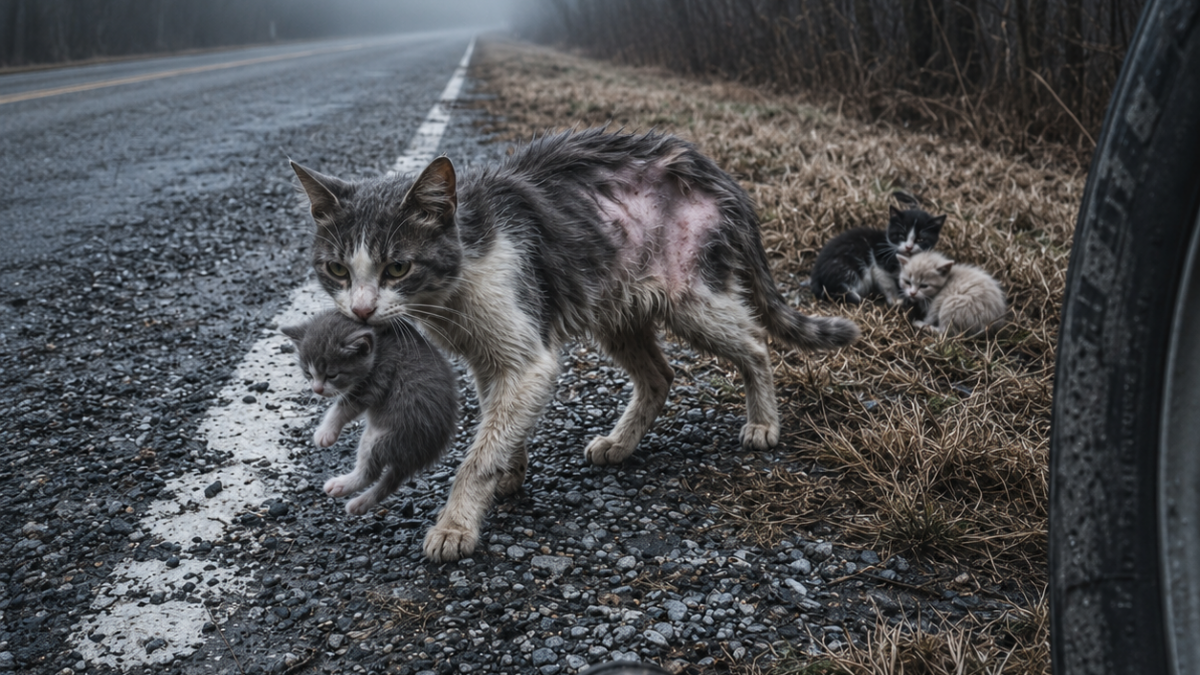
PART 2
I stayed well behind her.
Maybe fifty feet at first.
Sometimes more.
Whenever I got too close, she stopped and looked back at me.
“I’m not taking them,” I kept telling her.
She obviously didn’t understand the words.
But eventually she seemed to understand the distance.
As long as I stayed back, she kept moving.
The sun had not fully risen yet.
The shoulder was wet from the cold night, and the grass beside the highway bent beneath a thin layer of dew.
Every time a vehicle approached, I felt my stomach tighten.
The mother cat was walking close to the road because the grass and ditch were harder for her injured leg.
Headlights appeared.
She kept walking.
I stepped closer to the pavement and waved the vehicle away from the shoulder.
“Come on, girl,” I muttered. “Get farther over.”
She didn’t.
Her focus never changed.
Whatever she was searching for mattered more than the trucks.
That realization bothered me.
I had already seen three kittens.
Most stray cats would have stayed near them.
She was injured.
Exhausted.
Clearly cold.
Yet she was leaving those three behind and returning toward whatever had hurt her.
There could only be one reason.
There were more.
After maybe a hundred yards, she stopped.
She sniffed the grass.
Then continued.
Another fifty.
Another hundred.
Every step looked painful now.
Her back left leg barely touched the ground.
I wanted to grab her.
I wanted to put her in my truck.
I wanted to get the three kittens off the side of that road.
But something told me not to interrupt her yet.
She knew what she was doing.
I didn’t.
So I kept following.
Nearly three hundred yards farther down the road, she suddenly turned toward the ditch.
The slope was steep enough that she almost fell.
She disappeared into the tall grass.
“Hey!”
I hurried forward.
For a few seconds, I couldn’t see her.
Then the grass moved.
Her orange head appeared first.
Something was in her mouth.
Another kitten.
I stopped.
“You’ve got to be kidding me.”
She climbed out of the ditch.
The kitten was tiny.
Its legs dangled beneath its mother’s jaw.
She stood there for a moment, catching her breath.
Then she started walking back the way we had come.
Three legs carrying her.
One kitten hanging gently from her mouth.
I looked toward the distant patch of grass where the other babies waited.
Then back toward the road ahead.
How many more?
That was when fear replaced curiosity.
Because I suddenly understood something.
This cat was not going to stop.
Not when she was tired.
Not when she was bleeding.
Not when her leg stopped working.
Not when the trucks came dangerously close.
If there was another kitten somewhere along that road, she was going to keep walking until she found it.
Even if the road killed her before she succeeded.
I pulled out my phone.
I started searching for animal rescues in the area.
The closest small rescue I could find was about twelve miles away.
I called.
A woman answered.
I probably sounded crazy.
“I’m on the highway with a cat.”
There was a pause.
“Is she injured?”
“Yes.”
“How badly?”
I looked down at her as she limped past me with the fourth kitten.
“Bad.”
“Can you contain her?”
“I don’t think so.”
“Is she aggressive?”
“No. That’s not the problem.”
“What’s the problem?”
I watched her carrying that kitten.
“She keeps going back.”
“Going back where?”
“I don’t know.”
I explained what I had seen.
Three kittens together.
Then a fourth several hundred yards away.
The mother making trip after trip.
The woman stopped asking questions for a moment.
Then she said, “Stay there.”
“I’m supposed to be making a delivery.”
“Do you want me to come?”
I looked at the cat.
“Yes.”
“Then stay there.”
She arrived less than an hour later in an older SUV packed with carriers, towels, traps, gloves, food, and everything else people who rescue animals seem to keep permanently inside their vehicles.
She climbed out before the engine had completely stopped.
“Where is she?”
I pointed.
The mother had delivered the fourth kitten to the other three.
She was standing near them, panting.
Four tiny kittens huddled together.
The rescue volunteer walked toward them carefully.
The mother stepped in front again.
“Easy,” the woman whispered.
The cat growled.
Not loudly.
She barely had enough energy.
But she did it.
The woman stopped.
“She’s protecting them.”
“I figured that out the hard way.”
“You didn’t try to pick one up, did you?”
“No.”
“Good.”
She crouched.
For a while, we simply watched.
The mother’s breathing was too fast.
Up close, the injuries looked even worse.
The woman examined her without touching her.
“Road rash.”
“That’s what I thought.”
“Her leg might be broken.”
I looked at the cat’s paw.
“She’s been walking on it.”
“I know.”
The woman’s expression changed.
That was the first time I saw someone who dealt with injured animals every day look genuinely disturbed.
“How far did you see her go?”
I pointed down the road.
“Fourth kitten was maybe three hundred yards that way.”
She looked at the four babies.
Then at the mother.
“Was she going back again?”
Right on cue, the cat turned.
She started walking.
I almost laughed.
Not because anything was funny.
Because it was unbelievable.
“There’s your answer.”
The rescuer stood.
“All right.”
We followed.
This time there were two of us.
We tried moving along the grass to keep the cat farther from traffic.
She ignored us.
She limped along the shoulder.
Every few steps, she stopped and sniffed.
I began noticing things I had missed earlier.
Tiny disturbances in the gravel.
Flattened patches of grass.
A piece of newspaper.
Then another.
The volunteer picked one up.
It was dirty.
She looked at it.
Her face changed.
“What?”
She didn’t answer immediately.
She walked farther.
Then she pointed toward the edge of the shoulder.
Dark tire marks.
Not normal ones.
Brake marks.
They curved slightly toward the roadside.
The woman looked into the ditch.
“There.”
Something pale caught in the weeds.
We climbed down.
It was a torn plastic bag.
Inside were pieces of dirty newspaper.
The woman stared at it for several seconds.
I knew what she was thinking before she said it.
“No.”
She looked at me.
“I’ve seen this before.”
I didn’t want the answer.
“What?”
“Somebody may have put them in this.”
I looked from the bag to the roadway.
“No.”
“Cat and kittens.”
She pointed toward the skid marks.
“Then tossed them.”
I stared at her.
“From a car?”
“Looks like it.”
“While it was moving?”
She didn’t answer.
She didn’t have to.
I turned away.
For twenty-two years, I had driven roads like that.
Thousands and thousands of miles.
I had seen crashes.
I had seen people do careless things.
Cruel things too.
But the image forming in my head was different.
Someone placing a mother cat and newborn kittens into a plastic bag.
Newspaper stuffed around them.
A vehicle moving down a dark country road.
A window.
A door.
Then the bag flying out.
Hitting the pavement.
Tearing open.
Small bodies scattering into the grass.
I clenched my jaw.
The woman said quietly, “Don’t think about it right now.”
“How am I supposed not to?”
“Because she isn’t.”
I looked toward the mother cat.
She was already farther ahead.
Still searching.
The rescuer nodded toward her.
“She only cares about finding the next one.”
That shut me up.
We followed.
Another hundred yards.
Two hundred.
The distance from the first group of kittens grew larger.
I began calculating.
She had already traveled this road several times.
From one kitten back to the others.
Then out again.
Back again.
If the babies had been scattered over this much distance, how many miles had she already walked?
The rescuer must have been thinking the same thing.
“She’s been doing this all night.”
“You think?”
“Look at her paws.”
I had.
The pads were raw.
“She didn’t get that from one trip.”
We continued.
The mother became slower.
Sometimes she stopped completely.
Her head lowered.
For a moment, I thought she might collapse.
Then she would lift it again.
Walk another ten feet.
Another twenty.
I kept talking to her.
“Come on.”
Step.
“You’re almost there.”
Step.
“I don’t know where there is, but you do.”
The rescuer glanced at me.
“You know she can’t understand you.”
“I know.”
“Keep talking.”
So I did.
At some point, the distance from where I had first seen the three kittens reached almost a mile and a half.
Nearly two and a half kilometers.
That number has never left me.
A mile and a half.
For an animal that weighed barely five pounds.
On an injured leg.
With skin torn off one side of her body.
After being thrown onto a road.
And she hadn’t simply walked that distance once.
She had been going back and forth.
Carrying kittens.
The mother stopped suddenly.
Her ears rose.
She turned toward the tall grass.
The volunteer held out one hand.
“Wait.”
We stopped.
A sound.
Very faint.
I heard it again.
“Mew.”
The mother heard it too.
Everything changed.
She moved faster.
Not fast by any normal standard.
But faster than she had been moving.
She entered the grass.
We followed at a distance.
Ten feet in.
Fifteen.
Near the edge of the road, almost invisible beneath the weeds, was a kitten.
The fifth.
It was lying on its side.
For one horrible second, I thought it was dead.
Then its tiny head moved.
The mother reached it.
She sniffed it from nose to tail.
Licked its face.
The kitten squeaked.
The mother closed her eyes for a second.
I know animals do not smile the way people do.
I know we sometimes put our emotions onto them.
But if relief has a shape, I saw it in that cat.
Her entire body seemed to loosen.
Just for a moment.
Then she opened her mouth and took the kitten gently by the scruff.
She turned toward the road.
She was going back.
Again.
The rescuer whispered, “She’s going to carry it all the way.”
I said, “Not this time.”
We moved carefully.
The mother backed away.
Even in that condition, she would not surrender the kitten.
The volunteer lowered herself to the ground.
“Okay, Mama.”
The cat growled.
“You won.”
Growl.
“We’re not taking them away.”
The mother stared.
The woman slowly placed a carrier on the grass.
She opened the door.
Then she backed away.
We waited.
The kitten remained in the mother’s mouth.
Her legs shook.
Minutes passed.
The rescue woman tried another approach.
She put food near the carrier.
The cat smelled it.
She had probably eaten nothing all night.
She didn’t touch it.
The kitten came first.
Always.
Eventually, we managed to bring the other four kittens closer in a secure carrier.
The moment the mother heard them crying, her whole body changed.
She moved toward the sound.
The volunteer placed the carrier on the ground.
Four small faces pressed near the door.
The mother put the fifth kitten down.
She sniffed the carrier.
Then looked at us.
“Open it,” I said.
“We need her inside too.”
“You think she’ll go?”
“Maybe.”
The volunteer opened the larger carrier.
We stepped away.
The mother picked up the fifth kitten.
She walked inside.
The rescuer closed the door.
That was the first moment the cat stopped walking.
I remember the silence after the latch clicked.
It felt strange.
All morning, she had been moving.
Searching.
Returning.
Searching again.
Now all five kittens were together.
The mother stood over them.
She sniffed one.
Then another.
Then another.
Counting them in whatever way mothers count.
One kitten crawled beneath her chest.
Another pressed against her belly.
The fifth, the one from the tall grass, climbed over its siblings.
The mother slowly lowered herself.
Her injured side touched the blanket.
She flinched.
Then she lay down anyway.
Five kittens moved toward her.
The rescuer watched.
“So that’s all of them?”
I looked down the highway.
“I hope.”
She examined the bag and the area again.
There was no sign of another kitten.
Five seemed to be the whole litter.
The woman finally let out the breath she had been holding.
“We need to move.”
The mother needed a veterinarian immediately.
I followed the rescue vehicle to the clinic.
I should have gone back to work.
I knew that.
My delivery was already late.
My dispatcher had called twice.
I ignored the first call.
Answered the second.
“Where are you?”
“Side of the road.”
“You break down?”
“No.”
“What happened?”
I looked at the rescue SUV ahead.
“It’s complicated.”
“How complicated?”
“There’s a cat.”
Silence.
“A cat.”
“Yeah.”
“You’re late because of a cat?”
I almost said yes.
Instead I said, “Five kittens too.”
Another silence.
Then, “Are you serious?”
“Unfortunately.”
“What exactly are you doing?”
I looked through the windshield.
“Following them to a vet.”
“You know we’ve got a schedule.”
“I know.”
There are moments when you make choices without calculating the consequences.
That was one.
“I’ll deal with it.”
I hung up.
I had never done anything like that.
I had driven sick.
Tired.
Through snow.
Through storms.
I had rearranged meals around delivery windows.
I had spent birthdays hundreds of miles from home.
Trucking teaches you to keep moving.
Schedules matter.
Miles matter.
Time matters.
That morning, for the first time in a long time, something mattered more.
At the veterinary clinic, they took the mother straight back.
The five kittens were examined too.
I sat in the waiting area with the rescue volunteer.
Neither of us spoke much.
My coffee from earlier sat untouched.
It had gone cold.
Finally, the veterinarian came out.
“You’re with the orange cat?”
The rescue woman stood.
“Yes.”
I stood too.
“How are the kittens?”
“Remarkably, they’re fine.”
“All five?”
“All five.”
I shook my head.
“Nothing wrong?”
“No significant injuries. Not even obvious abrasions.”
The rescue woman exhaled.
“And Mom?”
The veterinarian’s expression became serious.
“She’s in rough shape.”
She had extensive abrasions and friction burns along her right side.
Roughly a quarter of her body had been affected.
Her left rear leg had a nondisplaced fracture.
The bone was cracked but had not shifted out of position.
Her paw pads were badly damaged.
She was dehydrated.
Hypothermic.
Exhausted.
The vet said the injuries were consistent with a hard impact against pavement followed by prolonged walking.
“How long?” I asked.
“Walking?”
“Yes.”
She looked at the cat’s paws.
“Several hours at least.”
The rescue woman told her how far apart the kittens had been.
The repeated trips.
The distance.
The veterinarian thought for a moment.
“Five to seven hours wouldn’t surprise me.”
Five to seven hours.
I imagined midnight.
One in the morning.
Two.
A torn bag on a dark road.
A mother cat crawling upright after hitting asphalt.
One leg injured.
Skin gone.
Kittens scattered somewhere in the darkness.
She could have hidden.
She could have dragged herself into the ditch.
She could have stayed where she landed.
Instead, she started looking.
The veterinarian continued talking.
“We need to keep her here.”
“How long?”
“Hard to say.”
“She’ll live?”
“We’re going to do everything we can.”
I hated answers like that.
Truck drivers live on clear information.
Mileage.
Hours.
Weight.
Fuel.
Arrival times.
Everything measured.
Everything calculated.
“We’re going to do everything we can” meant no guarantee.
I looked through the clinic door.
“Can I see her?”
The veterinarian glanced at the rescue woman.
Then nodded.
Only for a minute.
The mother was wrapped in warm blankets.
Her kittens were nearby.
She looked smaller than she had on the road.
That surprised me.
Out there, standing between me and those kittens, she had seemed like a mountain lion.
In the clinic she looked like what she actually was.
A five-pound cat.
Thin.
Injured.
Terrified.
One kitten was pressed beneath her chin.
Her eyes opened when I approached.
She recognized me.
At least I believe she did.
Her body tensed.
I stopped.
“Okay.”
Her eyes stayed on me.
“They’re all here.”
Her ears moved.
“All five.”
I pointed even though she could not understand.
“You did it.”
She slowly lowered her head.
That nearly got me.
I turned away before anyone could see.
I left the clinic later that morning.
My truck still sat where I had parked it.
My schedule was ruined.
My coffee was cold.
I had dirt on my jeans from sitting on the highway shoulder.
There were cat hairs on my jacket even though I had never touched her.
I drove away.
And I thought that was the end of it.
I was wrong.
For the next four days, I could not get her out of my head.
I slept badly.
Every time I closed my eyes, I saw my headlights illuminating that white line.
Then an orange cat walking toward me.
A kitten in her mouth.
I saw her damaged side.
I saw her leg buckle.
I saw her leave three babies behind and turn around again.
I saw the fifth kitten in the tall grass.
I saw the torn plastic bag.
Mostly, I saw her walking.
Always walking.
I would wake up at two or three in the morning and think about something the rescuer had said.
“She only cares about finding the next one.”
That sentence stayed with me.
I had spent twenty-two years on the road.
Thirty-eight states.
Millions of highway miles.
I had seen deer injured beside the interstate.
Dogs running loose.
Cats crossing rural roads.
Birds.
Coyotes.
Once a goat standing in the median in Missouri.
I had never stopped my truck for an animal.
Not once.
There are reasons.
A loaded truck cannot simply stop anywhere.
Stopping itself can create danger.
You see things and keep moving.
That is the job.
But that morning I had stopped.
Why her?
I couldn’t answer.
On the fourth day, I called the rescue.
The same woman answered.
“This is the truck driver.”
She laughed softly.
“I know who you are.”
“How is she?”
“Still here.”
“That good or bad?”
“Good.”
I felt my shoulders loosen.
“The kittens?”
“Perfectly fine.”
“And her?”
“Eating a little. Still on fluids. Leg needs rest.”
“Can I come see her?”
There was a pause.
“Of course.”
I was between loads.
I drove over.
The rescue smelled like disinfectant, blankets, cat food, and dogs.
I heard barking before I entered.
The woman led me to a quiet room.
“There she is.”
The cat was inside a large recovery enclosure.
Her right side was shaved around the worst injuries.
Without the fur, I could see exactly how much damage the road had done.
From near her shoulder almost to her hip, the skin was red and healing.
Her injured rear leg was supported.
All five kittens were piled near her.
The moment I walked closer, her eyes opened.
“Hey.”
She stared.
I crouched.
“Remember me?”
The rescue woman smiled.
“I think she does.”
“You say that to everybody?”
“No.”
I put my fingers near the enclosure.
The cat sniffed toward me.
No growl this time.
“That’s progress.”
The rescue volunteer leaned against the wall.
“What are you going to call her?”
I looked over.
“Me?”
“You found her.”
“I’m not naming her.”
“Why not?”
“She’s not my cat.”
The woman said nothing.
I should have recognized the setup.
Instead I looked back at the cat.
She was watching me.
“What names have you tried?”
“None that stuck.”
I thought about the road.
About her walking through the darkness.
About the way she kept trying to get back to each kitten.
About home.
Then a name came into my head.
“Dorothy.”
The woman smiled immediately.
“Wizard of Oz?”
I nodded.
“She spent the whole night trying to find her way home.”
The name stayed.
Dorothy.
I visited again.
And again.
Each time, I told myself I was only checking on her recovery.
That was true at first.
Then it wasn’t.
By the end of the first week, Dorothy stopped tensing when I entered.
By the second, she allowed me to touch the top of her head.
The first time she leaned into my hand, I froze.
The rescue woman laughed.
“You can breathe.”
“I am breathing.”
“Not much.”
Dorothy rubbed her face against my fingers.
I had owned dogs when I was younger.
Never a cat.
Truck drivers and pets can be complicated.
Long hours.
Different routes.
Small living space.
I certainly had never imagined myself living in a cab with an orange tabby.
I still didn’t.
Not yet.
Dorothy spent eighteen days receiving treatment and observation.
Her fractured leg healed with rest.
Her paw pads began closing.
The raw skin along her side repaired itself.
The veterinarian warned that the fur might never return normally.
She was right.
When it grew back, it came in thinner.
Paler.
A lighter streak running from Dorothy’s shoulder toward her hip.
The rescue woman called it her scar.
I thought it looked like a sash.
A mark she had earned.
Meanwhile, the five kittens grew stronger.
Watching them was almost insulting.
They behaved as though nothing had happened.
They wrestled.
Climbed over one another.
Attacked blankets.
Bit tails.
Chased anything that moved.
Five little idiots with no idea their mother had walked herself nearly to death bringing them together.
That was probably for the best.
One afternoon, I was sitting beside Dorothy when the rescue woman said, “We found a home for the kittens.”
I looked toward their enclosure.
“All of them?”
“Yes.”
“Together?”
She smiled.
“All five.”
That mattered to me more than I expected.
“Where?”
“A family with a small farm.”
“They know what they’re getting into?”
“They have other animals. Plenty of space. They specifically offered to take the entire litter.”
I looked at Dorothy.
“Good.”
Then the woman said, “Now we need one for her.”
I kept my eyes on Dorothy.
“Yeah.”
Silence.
The kind of silence people use when they are trying to make you say something first.
I knew exactly what she was doing.
“No.”
“I didn’t say anything.”
“You were about to.”
“I was standing here.”
“You were standing here loudly.”
She laughed.
Dorothy stretched her front paws.
“She likes you.”
“She tolerates me.”
“That’s basically a marriage proposal from some cats.”
“I live in a truck.”
“So?”
“I drive for a living.”
“I gathered that.”
“She can’t live in a truck.”
The rescue woman looked at Dorothy.
“Why not?”
That question followed me home.
Why not?
I started noticing the passenger seat in my cab.
Usually it held paperwork.
A jacket.
Sometimes a bag of food.
Plenty of room.
I thought about where a litter box could fit.
Then I got irritated at myself for thinking about it.
“No.”
I said it aloud while driving.
The empty passenger seat offered no argument.
“I’m not adopting a cat.”
I drove another twenty miles.
“She doesn’t even like trucks.”
Then I remembered the first time I saw her.
Walking straight toward them.
“Terrible reason.”
I shook my head.
This was ridiculous.
That evening, I looked up traveling with cats in semi-trucks.
That was when I knew I was finished.
A week later, I returned to the rescue.
Dorothy was scheduled to be available for adoption soon.
I walked into the room.
She lifted her head.
Then she stood.
Still limping slightly.
She came toward the front of the enclosure.
The rescue woman appeared behind me.
“Interesting.”
“Don’t start.”
“I said nothing.”
Dorothy rubbed against the door.
I stared at her.
“You really want to live in a truck?”
She meowed.
The rescue woman crossed her arms.
“Sounds like yes.”
I looked over.
“You planned this.”
“I did not throw the cat in front of your truck.”
The words hit harder than she intended.
Her smile disappeared.
“Sorry.”
I shook my head.
“No. You’re right.”
I looked at Dorothy.
Somebody else had put her on that road.
That choice had nearly killed her.
But that wasn’t going to be the final decision anyone made about her life.
I opened the adoption paperwork.
The rescue woman grinned.
“I knew it.”
“Don’t make me change my mind.”
“You won’t.”
She was right.
Dorothy came home with me.
Although “home” was complicated.
I had a place to stay when I wasn’t working.
But most of my life happened inside that truck.
So that was where Dorothy had to learn to live.
The first time I carried her into the cab, she froze.
I wondered whether the engine sound would terrify her.
Whether trucks themselves had become associated with pain.
She crouched low.
I gave her space.
“You don’t have to like it.”
Her eyes followed everything.
The dashboard.
Windshield.
Seats.
Sleeper.
Then she moved.
Slowly.
She sniffed the passenger seat.
Climbed onto it.
Turned around twice.
Sat down.
And looked through the windshield.
I laughed.
“All right.”
She looked at me.
“You’ve done this before?”
Nothing.
“Of course you have.”
The first short drive was ten minutes.
I expected panic.
Dorothy stayed on the passenger seat.
Eyes on the road.
The second trip was longer.
Same thing.
No hiding.
No crying.
No clawing at the door.
She simply watched.
That became her place.
Passenger seat.
Right side.
Facing forward.
Sometimes curled up.
Sometimes upright.
Always watching.
Drivers at truck stops began noticing her.
“Is that a cat?”
“Yep.”
“She ride with you?”
“Yep.”
“She like it?”
I would look toward Dorothy.
She would be sitting there like she owned the company.
“I think she tolerates me.”
People asked about the pale stripe along her side.
At first I gave short answers.
“Old injury.”
Sometimes that was enough.
Sometimes someone asked again.
“What happened?”
Then I told them.
Not every detail.
I didn’t always have the energy.
“She was thrown out of a moving vehicle with her kittens.”
The reaction was always the same.
Disbelief.
Then anger.
“They catch whoever did it?”
“No.”
That question bothered me most.
No.
We never knew who had put Dorothy and her kittens into that bag.
No license plate.
No witness.
No confession.
No dramatic arrest.
No courtroom.
No punishment I could point to and say, “There. Justice.”
For a while, that ate at me.
I wanted someone to answer for it.
I would drive the same kind of dark country roads and think about the person responsible.
What kind of human being puts six living animals into a bag?
What kind of person throws them from a moving vehicle?
Did they look back?
Did they think about what happened after the bag hit the pavement?
Did they assume the problem had simply disappeared?
That last question stayed with me.
Because if that was what they wanted, they failed.
Completely.
Dorothy did not disappear.
Her kittens did not disappear.
All five lived.
All five went together to a farm where they had space, shelter, food, and people who wanted them.
Dorothy survived too.
The road left a pale scar along her side.
It changed the way she walked for a while.
But it did not get the ending.
The person who threw her away didn’t get the ending either.
Dorothy did.
That became the closest thing to revenge I ever needed.
Somebody treated her like garbage.
She answered by surviving.
Somebody tried to separate her from everything she loved.
She walked back and gathered every single piece of her family.
Somebody left her on a road expecting her story to end there.
Instead, that road led her straight into my truck.
There is something satisfying about that.
Not because pain should happen.
Not because what was done to her can ever be justified.
But because cruelty wanted the final word.
It didn’t get it.
Dorothy did.
Months later, I visited the farm where the kittens had been adopted.
I took Dorothy.
I wasn’t sure whether she would recognize them.
The farm family met us near the house.
Five young cats appeared from different directions.
They were bigger now.
Long-legged.
Healthy.
One chased another beneath a fence.
Another sat on a wooden railing.
They looked nothing like the helpless kittens I remembered from the grass.
I opened Dorothy’s carrier.
She stepped out carefully.
The kittens noticed her.
For a few seconds, everybody froze.
Then one came closer.
Another followed.
They sniffed.
Dorothy sniffed back.
I won’t pretend there was some movie moment where all six animals embraced and understood exactly what had happened months earlier.
Cats are not people.
But they knew something.
That much I believe.
One of the young cats rubbed its head beneath Dorothy’s chin.
She stood still.
Then licked the top of its head once.
The farm owner looked at me.
“That their mother?”
“Yeah.”
“All five?”
“Every one.”
He shook his head.
“She did all that?”
I looked at Dorothy’s side.
The pale stripe caught the sunlight.
“Yeah.”
He crouched and held out a hand.
Dorothy sniffed it.
“She’s something.”
“That’s one word for her.”
We stayed for a while.
The kittens ran around the yard.
Dorothy eventually sat beside me.
She didn’t try to follow them.
She didn’t need to.
That part of her job was finished.
Maybe that was the moment the story finally settled inside me.
For months, I had thought about Dorothy as the cat walking down the highway.
The injured mother.
The animal refusing to stop.
But seeing her there made me understand something else.
She had reached the destination she had been trying to reach all along.
Not a physical place.
Safety.
All five babies safe.
Her safe.
That was home.
When we left, Dorothy climbed onto the passenger seat.
I started the engine.
“You okay?”
She looked through the windshield.
I smiled.
“Yeah. Me too.”
We pulled onto the road.
She watched the lane lines slide beneath us.
The irony is not lost on me.
The road almost killed her.
Now she spends more time on the road than most animals ever will.
But she is never outside alone anymore.
Never in a bag.
Never lying in a ditch.
Never searching the darkness for her babies.
She sits beside me.
Warm.
Fed.
Safe.
Sometimes when we pass the place where I first saw her, I slow down.
Not much.
Just enough to look.
The road itself looks ordinary.
That might be the strangest part.
People expect important places to look different.
They don’t.
There is still grass.
Gravel.
A ditch.
A white line.
Cars pass without knowing anything happened there.
But I know.
I know that before dawn one March morning, a five-pound orange cat walked along that line carrying a kitten.
I know two others waited behind her.
I know she had already been hit hard enough to scrape away the skin from nearly a quarter of her body.
I know her rear leg was fractured.
Her paw pads were raw.
Her claws were worn.
She was dehydrated.
Cold.
Shaking.
And she still turned around.
Again.
And again.
And again.
The veterinarian believed she had been walking for five to seven hours before my headlights found her.
Try to imagine that.
Five to seven hours when every step hurts.
Five to seven hours without understanding whether the next kitten is alive.
Five to seven hours listening for tiny cries beneath wind and traffic.
Find one.
Carry it back.
Put it down.
Turn around.
Walk again.
Find another.
Carry it back.
Turn around.
Again.
The distance between the first safe spot and the last kitten was almost a mile and a half.
But Dorothy’s total distance had to be much greater because she traveled portions of it over and over.
She was not trying to save herself.
If she had been, she would have stayed with the first kittens she found.
She would have hidden.
Rested.
Protected the injured leg.
Instead, she kept walking toward the place where the danger had come from.
That is the part I still think about on long drives.
People like to talk about courage as if courage means not being afraid.
I don’t believe that anymore.
Dorothy was terrified of me.
I saw it in her eyes.
She shook.
She could barely stand.
Still, she stepped between me and those kittens.
Courage was not the absence of fear.
It was deciding something else mattered more.
Her babies mattered more.
I also learned something about strength.
Strong does not always look strong.
Sometimes it weighs five pounds.
Sometimes it has one useless leg.
Sometimes its skin is torn open.
Sometimes it is so cold that its entire body shakes.
And sometimes it still refuses to stop walking.
Dorothy taught me that.
Not intentionally.
She was just being a mother.
Maybe that makes it even more powerful.
People ask whether I think she knew what had happened to her.
Whether she remembers being thrown.
I don’t know.
She does something interesting whenever a vehicle passes close on the right side.
Her head turns.
Her body becomes alert.
For a second, she watches it.
Then she relaxes.
Maybe that means something.
Maybe it doesn’t.
I try not to invent pain for her.
She has already had enough.
What I know is what she does now.
Every morning when I climb into the truck, Dorothy gets onto the passenger seat.
Sometimes she curls up before we even move.
Sometimes she watches me start the engine.
Sometimes she places one paw on the dashboard.
And once we are moving, she looks forward.
Always forward.
The rescue volunteer called me a few months after the adoption.
“How’s Dorothy?”
“Bossy.”
“Good.”
“She stole half my breakfast.”
“Even better.”
“She sleeps in my seat when I get out.”
“Her seat.”
“Apparently.”
The woman laughed.
Then she asked, “You regret it?”
I looked across the cab.
Dorothy was sleeping with her head against the passenger-side door.
The pale stripe along her body was still visible.
“No.”
I thought about it.
“Not even a little.”
After we hung up, I sat there for a while.
Twenty-two years.
Thirty-eight states.
I had passed countless animals.
Then Dorothy appeared.
Sometimes I wonder what would have happened if I had been five minutes earlier.
Or five minutes later.
If I had been looking at the radio.
If another truck had blocked my view.
If I had told myself what drivers tell themselves all the time.
Not my problem.
Keep moving.
She might still have found the fifth kitten.
I believe she would have tried.
But would she have survived the return trip?
I don’t know.
That question bothers me.
Because I know exactly what she would have done.
She would have tried anyway.
That was why I called the rescue.
Not because Dorothy had given up.
Because she hadn’t.
She was going to keep walking until there was nothing left of her.
Sometimes the animals most desperately in need of rescue are not the ones lying still.
They are the ones who refuse to stop.
The ones who keep doing the job long after their bodies should have quit.
Dorothy was like that.
She did not ask me for help.
She did not approach my truck.
She did not collapse in front of me.
She looked me in the eye and told me, in every way a cat can tell a man anything:
Stay away from my babies.
Then she turned around and went back for another.
Maybe that is why I stopped.
I respected her before I loved her.
Love came later.
First came disbelief.
Then admiration.
Then the strange realization that I wanted to know whether she was okay tomorrow.
And the next day.
And the day after that.
That is how some bonds begin.
Not with a decision.
With one more day.
Four days after I first saw Dorothy in my headlights, I went back because I could not sleep.
A few weeks later, I took her home because I could not imagine someone else doing it.
Now I sometimes wake in the sleeper section of my truck and find her sitting near the windshield before dawn.
She watches the road before I am even ready to drive.
“Looking for somebody?” I ask.
She flicks her tail.
The tail healed normally.
Her leg did too.
The fur on her right side never fully returned to its original color.
I am glad.
That may sound strange.
I do not like what caused the scar.
I hate that.
But I like that the mark is visible.
Not because she needs to prove anything.
Because when people ask, I get to tell them what happened next.
Not only what was done to her.
That distinction matters.
If I only said, “Someone threw this cat from a moving vehicle,” then the cruel person would still own most of the story.
So I tell the rest.
I tell them she got up.
I tell them she searched.
I tell them she found the first kitten.
Then the second.
Then the third.
Then she went back.
Found the fourth.
Then went back again.
Found the fifth almost a mile and a half away.
I tell them every kitten survived without a scratch.
I tell them Dorothy survived eighteen days of treatment.
I tell them all five kittens were adopted together.
Then I point toward the passenger seat.
“And she adopted me.”
That usually gets a laugh.
It is also true.
I did not choose that morning.
Dorothy chose the direction.
I just followed.
The person who threw her away probably never knew any of this.
Maybe they assumed she died.
Maybe they never thought about her again.
I used to wish they could see her now.
I still do sometimes.
Not because I want confrontation.
Not because I want Dorothy anywhere near them.
I want them to see the result.
I want them to know that the thing they tried to erase refused to disappear.
I want them to picture five healthy cats running around a farm.
I want them to see Dorothy asleep on a clean seat beneath a warm blanket.
I want them to understand that every cruel intention they had failed.
That is enough revenge for me.
They tried to make her unwanted.
She became loved.
They tried to leave her with nothing.
She built her family back one kitten at a time.
They threw her onto a road.
Now she crosses the country in the safest seat I can give her.
They left her behind.
She never gets left behind again.
That is the ending.
Not the plastic bag.
Not the blood.
Not the broken leg.
Not the five-to-seven-hour walk.
Those things happened.
They matter.
But they do not get the last sentence.
Dorothy does.
There are mornings now when the interstate is quiet and sunrise begins spreading across the horizon.
The sky turns orange.
Dorothy sits beside me.
Sometimes the color matches her fur.
She watches everything.
Every truck.
Every exit.
Every passing field.
Her scar catches the light.
I think about the first morning.
Same cat.
Different seat.
Back then, she was outside my windshield.
Walking toward traffic.
Now she is behind the glass.
Warm air blowing from the vents.
A bowl of water nearby.
A blanket folded behind her.
A man beside her who would pull over for her every single time.
I once told the rescue woman that Dorothy spent that night trying to find her way home.
That was why I named her.
But I think I was slightly wrong.
She was not trying to find home.
She was creating it.
Every time she picked up another kitten, she rebuilt one more piece.
One kitten.
Then another.
Then another.
Until all five were together.
Home was not a farmhouse.
Not a rescue.
Not my truck.
Home was wherever her family was safe.
Maybe that is why she adapted to the road so easily.
She had already learned something most of us take much longer to understand.
Home is not always a place.
Sometimes it is the living thing beside you that refuses to leave.
When I found Dorothy, I thought I was watching an injured stray cat carrying a kitten.
I had no idea I was looking at the strongest mother I would ever meet.
She weighed barely five pounds.
She had a broken leg.
A quarter of her body was scraped raw.
Her paws were bleeding.
She was dehydrated and dangerously cold.
And still, she walked.
Nearly a mile and a half along that road to find the farthest kitten.
Then turned around to bring it back.
That is the image I carry with me.
Not Dorothy being thrown away.
Dorothy returning.
Again and again.
Because somebody else made one cruel decision that night.
Dorothy made hundreds of small decisions afterward.
Stand up.
Walk.
Listen.
Search.
Find one.
Carry it.
Go back.
Search again.
Keep moving.
Do not quit.
Those decisions won.
Five kittens lived.
Dorothy lived.
And one truck driver who had never stopped for an animal in twenty-two years stopped his truck.
Sometimes I think she rescued me a little too.
Life on the road can make you hard without realizing it.
You learn to pass things.
Towns.
Accidents.
Storms.
People.
You are always going somewhere else.
Always watching the clock.
Dorothy forced me to stop.
Literally.
Then she reminded me that not everything important fits into a delivery schedule.
Some things are worth being late for.
Some things are worth sitting on the side of a highway for twenty minutes.
Some things are worth following into a ditch.
And once in a while, what looks like an interruption turns out to be the reason you were on that road in the first place.
I still have the same job.
Still drive long routes.
Still watch mileage.
Still hate traffic.
Still complain about fuel prices.
But now there is orange fur on the passenger seat.
Sometimes Dorothy sleeps through entire stretches.
Sometimes she watches every mile.
When I stop for fuel, drivers occasionally come over to the window.
“There’s a cat in your truck.”
“I know.”
“She yours?”
I look at Dorothy.
“Yes.”
That answer still makes me smile.
Because the first time I saw her, nobody seemed to want her.
Somebody had literally thrown her away.
Now when anyone asks whether she belongs to me, I think about the difference between ownership and belonging.
Dorothy is mine, I suppose.
Her paperwork says so.
But more importantly, she belongs somewhere.
She has a place.
A seat.
A routine.
People who know her.
Five grown kittens living together on a farm.
A rescue volunteer who still asks about her.
A veterinarian who remembers her.
And one driver who looks over at the passenger seat every morning to make sure she is there.
She is.
Almost always watching the road.
Maybe she always will.
I cannot change what happened to Dorothy before I found her.
I cannot make the pavement softer.
Cannot erase the fracture.
Cannot put the fur back exactly the way it was.
Cannot identify the person who threw her away.
Cannot give her those hours back.
But I can make sure of one thing.
She never has to walk that road alone again.
So she rides beside me.
The little orange cat who once limped toward headlights carrying a kitten.
The mother who walked until her paws were raw.
The animal who returned to danger five times because somewhere out there, one of her babies was still waiting.
Dorothy.
Five pounds of stubbornness.
A pale scar from shoulder to hip.
A story somebody tried to end on the side of a country highway.
They failed.
Completely.
Because Dorothy got up.
She found every one of her babies.
And then, somehow, she found her way home too.
I had been driving trucks for twenty-two years, and in all that time, I had learned how to keep moving.
You see things on the road.
Broken-down cars.
Animals in ditches.
Accidents.
People standing beside highways with their hands on their heads.
You learn quickly that if you stop for everything, you never reach where you are supposed to go.
That morning in March, I was already behind schedule.
It was still dark when I pulled off onto a rural stretch of road to refuel and stretch my legs. The air had that wet, biting cold that comes just before dawn. My headlights cut across the shoulder, the white line, the shallow ditch, and the fields beyond.
That was when I saw her.
At first, I thought she was just another stray cat wandering too close to traffic.
Then I noticed what she had in her mouth.
A kitten.
The little cat was walking along the edge of the road toward oncoming vehicles, carrying that kitten by the scruff as carefully as if she were walking through a quiet living room instead of beside speeding traffic.
I slowed down.
Something about her movement bothered me.
She was limping.
Badly.
I passed her, then checked my mirror.
That was when I saw two more kittens sitting together in the grass about a hundred feet behind her.
They were huddled against each other.
Tiny.
Still.
I hit the brakes.
For a few seconds, I just sat there listening to my engine idle.
The mother cat kept moving.
One kitten in her mouth.
Two waiting behind.
I looked at the road ahead, then back at her.
“She’s moving them,” I said aloud.
I pulled onto the shoulder and climbed out.
The cold hit me immediately.
“Hey, girl.”
The cat stopped.
She lowered the kitten gently onto the ground.
Then she stepped in front of it.
Between me and the baby.
That was when I saw the injuries.
Her entire right side looked as though someone had dragged her over sandpaper.
Large patches of fur were missing from her shoulder down toward her hip. Her skin was raw, red, and scraped. Blood had dried along parts of her side.
Her left rear leg was swollen.
She barely put weight on it.
Even her paws looked damaged. The pads were torn and rubbed raw, and her claws appeared worn down almost completely.
She was shaking.
Not a little.
Her whole body trembled.
But she did not move away from me.
Instead, she stood there, injured and exhausted, guarding that kitten.
I remember thinking she looked too small to be that brave.
Later, I learned she weighed barely five pounds.
At that moment, though, she looked like she would have fought me if I had taken one more step.
I held up both hands.
“Okay. Easy.”
Her ears flattened.
“I’m not taking your baby.”
I backed away.
Then I sat down on the shoulder.
I did not know why.
Maybe because standing made me look threatening.
Maybe because something told me this was not a moment to rush.
So I sat.
Five minutes passed.
Then ten.
Cars went by.
The wind pushed at my jacket.
The cat never stopped watching me.
After maybe twenty minutes, she finally turned around.
She picked up the kitten again.
Then she limped back toward the other two.
Every few steps, her injured leg gave slightly.
Still, she never dropped the kitten.
She reached the grass, placed the baby beside the others, and sniffed all three.
I thought she would collapse.
I thought she would curl around them and rest.
She didn’t.
She turned around.
Then she started walking back in the direction she had come from.
Toward traffic.
Toward the darker stretch of road.
I stood.
“Where are you going?”
She kept walking.
That was the moment I understood.
There were more.
I followed her.
At first, I stayed fifty feet back.
Whenever I moved closer, she stopped and looked over her shoulder.
So I learned her rule.
Keep your distance.
Do not interfere.
I obeyed.
The road was beginning to brighten with the first hint of morning, but it was still hard to see beyond the sweep of headlights.
The cat moved slowly.
Painfully.
Sometimes she stopped and sniffed the grass.
Other times, she looked toward the ditch.
I started noticing how carefully she listened.
Every sound seemed to matter to her.
A bird.
A passing tire.
The wind through dead weeds.
Maybe she was waiting for a cry.
After several hundred feet, she suddenly left the shoulder and went down into the ditch.
I hurried forward.
For a moment, she disappeared completely.
Then the grass moved.
Her head appeared.
And she had another kitten in her mouth.
I stopped.
“You’ve got to be kidding me.”
She climbed back toward the road.
The kitten dangled beneath her jaw, safe and quiet.
She looked ready to collapse.
But she turned around and started the long trip back.
That was when I realized just how serious this was.
She was not wandering.
She was not confused.
She was searching.
One by one.
She had found three.
Now four.
And if another kitten was still out there, she would keep going.
No matter how much she was bleeding.
No matter how badly her leg hurt.
No matter how cold she was.
She was going to keep walking until she found every last one.
I pulled out my phone.
I searched for rescues near me and found a small animal organization about twelve miles away.
A woman answered.
“I’m on the side of the highway with an injured cat.”
“Can you contain her?”
“No.”
“Is she aggressive?”
“No. That’s not the problem.”
“What’s the problem?”
I looked at her carrying the fourth kitten back toward the others.
“She keeps going back.”
There was a pause.
“What do you mean?”
I explained.
The kittens.
The distance.
The injuries.
The repeated trips.
The woman’s voice changed.
“Stay where you are.”
“I’m working.”
“Do you want help?”
I looked at the cat.
“Yes.”
“Then stay there.”
She arrived less than an hour later.
Her SUV was full of carriers, blankets, gloves, food, towels, and the kind of supplies people keep when saving animals is not a hobby but a way of life.
The moment she stepped out, she saw the mother cat.
“She’s hurt.”
“That’s what I’ve been saying.”
We approached slowly.
The cat had just placed the fourth kitten beside the other three.
All four were now pressed together in the grass.
The mother stood over them.
The rescuer crouched.
“Hey, sweetheart.”
The cat growled.
It was not much of a growl.
More of a warning whispered through exhaustion.
The woman stopped.
“She’s guarding them.”
“She’s been doing that all morning.”
We studied her injuries from several feet away.
The rescuer looked at the swollen leg.
“That could be fractured.”
“She’s been walking on it.”
“I know.”
She looked at the cat’s paws.
Her expression darkened.
“How long has she been out here?”
“No idea.”
Then the mother turned again.
Without hesitation, she started walking back down the road.
The rescuer stared.
“She’s going again?”
I nodded.
“Apparently.”
We followed.
This time there were two of us.
The sky was brighter now.
Enough to see details that had been hidden before.
A piece of dirty newspaper in the grass.
Then another.
Farther down, tire marks near the shoulder.
The rescuer picked up one piece of paper.
Her face changed.
“What?”
She walked toward the ditch.
A torn plastic bag was caught in weeds.
Inside were more pieces of dirty newspaper.
She stared at it.
“I’ve seen this before.”
“What are you saying?”
She looked at the road.
“Someone may have put her and the kittens in that bag.”
I felt something cold move through me that had nothing to do with the weather.
“And?”
She pointed toward the skid marks.
“Thrown them out.”
I looked at her.
“From a car?”
She did not answer.
She did not need to.
The picture formed on its own.
A bag.
A moving vehicle.
A mother cat trapped inside with her babies.
Then the bag thrown onto pavement.
The impact.
The plastic tearing.
Kittens scattering into the grass and ditch.
I felt sick.
“She took the worst of it,” the rescuer said.
“What?”
“Look at her injuries. Adult cat. Heavier body. She hit hard.”
I looked at the mother.
She was already several yards ahead.
Still walking.
Still searching.
My hands curled into fists.
“What kind of person does that?”
The rescuer gave me a tired look.
“The kind I stopped trying to understand.”
I looked toward the cat.
The woman said quietly, “She doesn’t care who did it right now.”
I said nothing.
“She cares about the next kitten.”
That was true.
So we kept following.
The distance grew.
A quarter mile.
Half a mile.
More.
The cat became slower.
Her steps shortened.
Every few minutes she stopped completely.
Once, she lowered herself almost to the ground.
I thought that was it.
I thought her body had finally won.
Then she stood again.
Three legs.
One damaged one barely touching.
Still moving.
I found myself talking to her.
“You’re almost there.”
I had no idea where “there” was.
“Keep going.”
The rescuer glanced at me.
“She can’t understand you.”
“I know.”
“Keep talking anyway.”
So I did.
The distance from the first group of kittens eventually reached nearly a mile and a half.
That number still bothers me.
A mile and a half between where she had chosen safety and where the last kitten lay.
And that was not the total distance she had walked.
Not even close.
She had already made repeated trips.
Out.
Back.
Out again.
Carrying kittens each time.
Her total mileage must have been much greater.
The rescuer looked at her paws again.
“She’s been doing this for hours.”
“How many?”
“Five. Maybe seven.”
I shook my head.
“That’s impossible.”
“It’s not. Look at her.”
The mother suddenly stopped.
Her ears lifted.
We stopped too.
At first, I heard nothing.
Then a sound came from the grass.
Small.
Weak.
A tiny mew.
The mother moved faster.
Not fast by normal standards.
But compared to how she had been walking, she almost ran.
She went into the tall grass.
We stayed back.
Then we saw it.
The fifth kitten.
It lay just inside the weeds near the edge of the road.
For one terrible second, it did not move.
Then its head lifted.
The mother reached it.
She sniffed it.
Licked its face.
The kitten squeaked.
The mother closed her eyes.
Just for a second.
Then she picked it up.
She turned back toward the road.
Toward the other four.
Another mile and a half.
I looked at the rescuer.
“She’s going to carry it all the way.”
The woman nodded.
“If we let her.”
I stepped forward.
The cat backed away.
Even then.
Even half broken.
She would not give us the kitten.
We spent the next several minutes trying to convince her without frightening her.
The rescuer placed an open carrier nearby.
Food went inside.
The cat ignored it.
She was starving.
I knew she had to be.
Still, food meant nothing to her.
The kitten came first.
Finally, we brought the other four kittens closer in another carrier.
The moment their cries reached her, the mother froze.
She turned toward the sound.
Her entire expression changed.
The rescuer placed the carrier down.
All four kittens pressed toward the door.
The mother carried the fifth closer.
The rescuer opened the larger carrier.
Then we stepped away.
The mother stared at us.
Then at her babies.
Slowly, she entered.
The fifth kitten still in her mouth.
The moment she was inside, the rescuer closed the door.
That was the first time all morning that the cat stopped moving.
She stood over the kittens.
Sniffing each one.
One.
Two.
Three.
Four.
Five.
Then she lowered herself.
The kittens crawled toward her.
One pressed beneath her chin.
Another tucked against her belly.
The mother’s whole body shook.
Then, finally, she rested.
The rescuer let out a long breath.
“She did it.”
I looked at the five kittens.
Every single one alive.
“She actually did.”
We drove straight to a veterinary clinic.
I followed behind in my truck.
My dispatcher called.
I ignored the first call.
The second time, I answered.
“Where are you?”
“On the road.”
“You’re late.”
“I know.”
“Problem with the truck?”
“No.”
“What’s going on?”
I looked at the rescue SUV ahead.
“There’s a cat.”
Silence.
“A cat?”
“And five kittens.”
Another silence.
“You’re telling me you’re late because of cats?”
I stared through the windshield.
“Yeah.”
“You serious?”
“Very.”
I could almost hear him trying to decide whether to yell.
Finally, he said, “You better have a good explanation.”
“I do.”
“What is it?”
I looked at the little SUV carrying that injured mother.
“I’ll tell you later.”
Then I hung up.
At the clinic, the kittens were examined first.
I waited in the lobby with the rescuer.
Eventually, the veterinarian came out.
“The kittens are fine.”
“All five?”
“Yes.”
“Not injured?”
“Nothing significant.”
That made no sense to me.
Five babies thrown from a moving vehicle.
Scattered along a road.
Not a scratch.
“And the mother?”
The veterinarian’s face changed.
“She’s in much worse shape.”
She had abrasions and friction burns covering nearly a quarter of her body.
A nondisplaced fracture in the left rear leg.
Raw paw pads.
Worn claws.
Dehydration.
Hypothermia.
Extreme exhaustion.
The vet said the injuries fit the story we had reconstructed.
Hard impact.
Then hours of movement.
“How long could she have been walking?”
The vet looked at her paws.
“Five to seven hours, maybe.”
I leaned back in the chair.
Five to seven hours.
Walking in the dark.
Bleeding.
Searching.
Carrying one baby at a time.
I tried to imagine it.
I could not.
“Will she live?”
The vet paused.
“We’re treating her aggressively.”
“That’s not what I asked.”
“I know.”
I hated that answer.
But later that afternoon, we got better news.
She was stable.
Still critical.
But stable.
The rescue kept her under care.
I should have returned to my life.
I tried.
For four days, I drove.
Delivered.
Fueled.
Slept.
Or tried to sleep.
Every time I closed my eyes, I saw her.
The orange cat in my headlights.
A kitten in her mouth.
Then turning around.
Walking back.
Again.
Again.
Again.
On the fourth day, I called the rescue.
“How is she?”
The woman knew who I was immediately.
“She’s improving.”
I felt relief I had not expected.
“The kittens?”
“Fine.”
“And her leg?”
“Rest should take care of it.”
“Can I come see her?”
“Of course.”
I went.
The mother cat was in a large recovery enclosure.
The damaged side of her body had been shaved around the wounds.
Seeing it clean somehow made it worse.
I could see just how much skin had been torn.
Five kittens slept nearby.
The cat opened her eyes when I approached.
“Hey.”
She stared.
I crouched.
“You remember me?”
The rescue woman smiled.
“I think she does.”
I put my hand near the enclosure.
The cat sniffed my fingers.
No growl.
That felt like an accomplishment.
“What are you calling her?” the woman asked.
“Me?”
“You found her.”
“I’m not naming her.”
“Why?”
“She’s not mine.”
The woman smiled in a way I did not trust.
I looked at the cat.
She had spent that entire night trying to find her babies.
Trying to bring them back together.
Trying to get home, in a way.
The name came to me before I could stop it.
“Dorothy.”
The rescuer laughed softly.
“Because of the yellow brick road?”
“No.”
I looked at the cat.
“Because she spent all night trying to find her way home.”
The name stayed.
Dorothy.
I visited again.
Then again.
I told myself I was only checking on her.
That was a lie.
By the second week, she let me touch her head.
The first time she leaned into my hand, I nearly stopped breathing.
The rescue woman laughed.
“You know, most people just pet the cat.”
“She hated me four days ago.”
“She was protecting babies four days ago.”
“Still.”
Dorothy stayed under care for eighteen days.
Her leg healed with rest.
Her paws recovered.
The wounds along her right side closed.
The fur grew back, but not the same.
It came in thinner and lighter.
A pale band stretching from her shoulder toward her hip.
The road left its mark.
The kittens grew fast.
Healthy.
Loud.
Wild.
They climbed over one another as though nothing bad had ever happened.
Eventually, a family with a small farm offered to adopt all five together.
I was relieved.
“All five?”
“All five,” the rescuer said.
“Good.”
Then she looked at me.
“What?”
“Nothing.”
“You’re doing that thing again.”
“What thing?”
“That silent thing where you want me to say something.”
She smiled.
“Dorothy still needs a home.”
“No.”
“I didn’t ask.”
“I drive a truck.”
“So?”
“She can’t live in a truck.”
The rescue woman looked toward Dorothy.
“Has anyone told her that?”
I laughed.
“No.”
But the question followed me.
A few days later, I found myself looking at the passenger seat in my cab.
Usually, it held paperwork.
A jacket.
Food.
I started thinking about where a litter box could go.
Where a water bowl could fit.
I caught myself.
“This is ridiculous.”
The empty cab did not disagree.
Then I looked up information about traveling with cats in trucks.
That was when I knew.
I went back to the rescue.
Dorothy stood when she saw me.
Still a little stiff.
Still healing.
But she walked toward the front of the enclosure.
The rescuer folded her arms.
“Interesting.”
“Don’t.”
“I didn’t say anything.”
Dorothy rubbed against the gate.
I looked at her.
“You really want to spend your life in a truck?”
She meowed.
The woman smiled.
“Sounds like yes.”
I signed the papers.
Dorothy came with me.
The first time I put her in the cab, I was nervous.
I wondered if the engine noise would scare her.
Maybe trucks reminded her of the road.
Of the bag.
Of the impact.
She crouched low at first.
I gave her time.
Then she climbed onto the passenger seat.
Turned around twice.
Sat.
And looked through the windshield.
I laughed.
“That your seat now?”
She stared ahead.
Apparently it was.
Our first drive was short.
Ten minutes.
She did not panic.
Did not cry.
Did not hide.
She just watched the road.
The second drive was longer.
Same thing.
Soon, the passenger seat became hers.
At truck stops, drivers noticed.
“That your cat?”
“Yeah.”
“She ride with you?”
“Everywhere.”
People often asked about the pale stripe along her side.
“What happened?”
At first, I gave short answers.
“Old injury.”
Then sometimes I told the truth.
“She was thrown from a moving vehicle with her kittens.”
The reaction was always the same.
Anger.
Then the question.
“They catch whoever did it?”
“No.”
For a long time, that bothered me.
I wanted somebody punished.
I wanted to know who had put six animals into a plastic bag.
Who had thrown them onto a road and kept driving.
I wanted a face.
A name.
A consequence.
But we never got one.
No witness.
No plate.
No camera.
Nothing.
Eventually, I realized something.
The person who threw Dorothy away probably believed they had ended her story.
They were wrong.
Completely.
All five kittens lived.
All five were adopted together.
Dorothy survived.
She got a new home.
A new life.
A permanent place in my truck.
Whoever tried to erase her failed.
That became enough.
Not justice in the legal sense.
But something close to it.
They tried to leave her with nothing.
She rebuilt her family.
One kitten at a time.
They tried to make her disappear.
Now people all over the country notice her sitting in my passenger seat.
They tried to end her life on a roadside.
Now she watches thousands of miles pass safely behind glass.
Months after the adoption, I visited the farm where the kittens lived.
I brought Dorothy.
The five young cats were bigger now.
Healthy.
Fast.
Running between fence posts and barns.
Dorothy stepped out of her carrier.
The kittens noticed her.
They approached slowly.
One rubbed against her.
Dorothy sniffed it.
Then licked the top of its head.
Just once.
I stood there watching.
No dramatic movie moment.
No big reunion.
Just something quiet.
Something right.
The farm owner asked, “That their mom?”
“Yeah.”
“All five?”
“Every one.”
He looked at the scar along Dorothy’s side.
“She really walked that far?”
“Farther than I’ll probably ever know.”
When we left, Dorothy climbed back into the truck.
Passenger seat.
Same as always.
I started the engine.
“You okay?”
She looked out the windshield.
“Yeah,” I said. “Me too.”
I still think about that morning.
Twenty-two years of driving.
Thirty-eight states.
Millions of miles.
I had never stopped for an animal before.
Not once.
Then Dorothy appeared.
Sometimes I wonder what would have happened if I had been five minutes earlier.
Or later.
If I had looked down at the radio.
If another truck had blocked my view.
Would she have found the fifth kitten?
Probably.
Would she have survived the walk back?
I do not know.
What I do know is that she would have tried.
That was the terrifying part.
She had no intention of stopping.
Her body could have quit before she did.
That is why I called for help.
Not because Dorothy gave up.
Because she refused to.
Sometimes the ones who need saving most do not look helpless.
Sometimes they are still moving.
Still fighting.
Still doing the job.
Even when there is almost nothing left in them.
Dorothy taught me that.
Today, she still rides with me.
She sleeps on the passenger seat when she gets tired.
Sometimes she sits upright for hours, watching the road.
If a vehicle passes close on her side, her head follows it for a second.
Then she relaxes.
I do not know what she remembers.
I do not ask her to remember.
She has already carried enough.
The pale stripe along her side is still there.
Thin fur.
Lighter than the rest.
A permanent mark from shoulder to hip.
People ask about it.
And now I always tell the full story.
Not just what someone did to her.
That part is important.
But it is not the ending.
I tell them she got back up.
I tell them she searched in the dark.
I tell them she found one kitten.
Then another.
Then another.
I tell them she carried each one while limping on a fractured leg.
I tell them she walked for hours on raw paws.
I tell them the farthest kitten was almost a mile and a half away.
I tell them every kitten survived.
I tell them Dorothy survived too.
Then I point to the passenger seat.
“And she ended up with me.”
People laugh.
I usually do too.
Because somehow the road that nearly killed her became the road that led her somewhere better.
Somebody tried to throw Dorothy away.
That is how the story started.
But it is not how I remember her.
I remember the mother cat walking into headlights.
I remember the kitten in her mouth.
I remember the way she stood between me and her babies even when she could barely stand.
I remember watching her turn around after dropping off the fourth kitten.
No hesitation.
Back into danger.
Because somewhere ahead, one baby was still alone.
That is Dorothy to me.
Not the victim.
The one who went back.
Again.
Again.
Again.
Until every last one was safe.
And now, when dawn comes across the windshield and the highway stretches out in front of us, she sits beside me and watches the road.
Warm.
Fed.
Safe.
No bag.
No ditch.
No broken pavement under her paws.
Just the steady sound of the engine and a seat that belongs to her.
Sometimes I look over and think about the person who wanted her gone.
They failed.
She lived.
Her babies lived.
And the little orange cat they threw away ended up with more miles ahead of her than they could ever have imagined.
That is the ending I choose.
Not the impact.
Not the blood.
Not the broken leg.
Not the road.
Dorothy walking back is the part that matters.
Dorothy finding every one of her babies.
Dorothy surviving.
Dorothy coming home.








