PART 2: I Refused to Join the HOA—Then Karen Tried to Evict Me From Land That Was Never Theirs
PART 2
His name was Emmett Cross.
Twenty years in real-estate litigation.
Title disputes.
Restrictive covenants.
Easements.
Bad plats.
Old declarations.
The kind of cases normal lawyers often tried to avoid because one missing page from thirty years ago could change everything.
He read my closing package without speaking.
Then he leaned back.
“You did something most buyers don’t.”
“What?”
“You actually read your documents.”
“I thought everybody did.”
He laughed.
“No.”
Then he pulled Ridgehaven’s original declaration from the county records.
The document was enormous.
Dozens of pages.
Every subdivision phase described.
Every lot.
Every common area.
Every easement.
Emmett ran his finger down one legal description.
Then stopped.
“There you are.”
My stomach tightened.
“What does it say?”
He rotated the document.
Beside my property was a label.
EXCLUDED TRACT 7A.
I read it twice.
“So that’s it?”
“It’s important.”
“But?”
“But Jocelyn is claiming later annexation.”
He flipped forward.
The declaration contained a specific procedure.
Any excluded tract could join Ridgehaven only if the owner voluntarily executed and recorded a supplemental declaration of annexation.
“Did you sign one?”
“No.”
“Previous owner?”
“I don’t know.”
“Then that’s what we find out.”
Emmett sent Ridgehaven a formal demand.
Produce the recorded annexation instrument for Tract 7A.
Two days later, Jocelyn replied personally.
One line.
One recording number.
I called Emmett.
“She has something.”
“Maybe.”
“It’s recorded.”
“That doesn’t make it valid.”
The number was real.
The county index listed:
SUPPLEMENTAL DECLARATION OF ANNEXATION — TRACT 7A.
Date:
2019.
My uneasiness grew.
“What if the title company missed this?”
“Then we deal with it.”
“Could I really be in the HOA?”
“If the prior owner lawfully annexed the tract, possibly.”
That was the first night I genuinely worried.
I walked around the farmhouse looking at things differently.
The old gate.
The pasture.
The fence.
The workshop I’d planned to restore.
If Ridgehaven had actually been attached to the property before I bought it, the whole fight changed.
Emmett refused to rely on the copy Jocelyn emailed.
“Never trust the opponent’s scan when the county has the original.”
He ordered a certified copy.
Then told me:
“Do nothing.”
That was harder than it sounds.
Jocelyn kept sending notices.
More fines.
More threats.
She started telling neighbors I was refusing to pay my “fair share.”
I heard it from a man walking his dog near the county road.
“You’re the guy fighting the HOA?”
“I’m the guy who isn’t in the HOA.”
He looked confused.
“Jocelyn says you are.”
“Jocelyn can show me the valid documents.”
He shrugged.
“I don’t want any trouble.”
Neither did I.
That was the strange part.
I had bought the farmhouse specifically to avoid neighborhood politics.
Now the most powerful person in Ridgehaven was using my address as a cautionary tale.
Emmett told me not to respond publicly.
So I sent Jocelyn one sentence.
Please preserve all records relating to the alleged annexation of Tract 7A.
Emmett smiled when he read it.
“Good.”
“What does that accomplish?”
“It tells her she may need every document later.”
“And if she destroys them?”
He looked at me.
“Then she creates a different problem.”
Monday morning, I got into my pickup.
Started the engine.
Drove down the gravel lane.
Then stopped.
A new steel chain was wrapped through both halves of my gate.
Heavy padlock.
Ridgehaven logo.
A laminated sign hung from it.
ACCESS SUSPENDED BY RIDGEHAVEN HOA.
For a few seconds, I just stared.
Then I shut off the truck.
My first instinct was bolt cutters.
That would have felt wonderful.
It also would have been stupid.
Instead, I pulled out my phone.
Video.
Wide shot.
Close shot.
Padlock.
Chain.
Sign.
Survey pin.
Driveway.
Road.
My gate sat entirely within my property.
No common road.
No Ridgehaven easement.
No shared access.
I called the sheriff.
Sergeant Malcolm Reeves arrived with another deputy.
Broad shoulders.
Gray at the temples.
Calm voice.
The kind of lawman who had probably stood between angry property owners a thousand times.
I handed him my deed and survey.
Twenty minutes later, Jocelyn’s white SUV appeared.
She stepped out carrying a folder.
“Sergeant.”
She sounded like she knew him.
Maybe she did.
“This homeowner is obstructing HOA-controlled access.”
Malcolm looked toward me.
Then the gate.
“His access?”
“Our access rights.”
Jocelyn handed him the 2019 supplemental declaration.
I gave him my deed.
He read both.
Then said:
“I’m not deciding a covenant case beside the road.”
Jocelyn nodded.
Satisfied.
Then Malcolm continued.
“But I don’t see a writ.”
Her smile faded.
“A what?”
“A court order.”
“This isn’t an eviction.”
“You’ve chained his gate.”
“We suspended privileges.”
I finally spoke.
“Since when is access to my front door an HOA privilege?”
Jocelyn looked at me.
Malcolm looked back at her.
“Until this gets resolved, remove the chain.”
“We have enforcement authority.”
“Show me an order authorizing you to lock him out.”
She couldn’t.
A maintenance worker eventually arrived.
Unlocked the gate.
As Jocelyn walked back toward her SUV, she stopped beside me.
Quietly.
“You can make this easy.”
I looked at her.
“Or?”
“You can make it expensive.”
“Put that in writing.”
She stared at me.
Then walked away.
The next morning brought a notice of intent to lien.
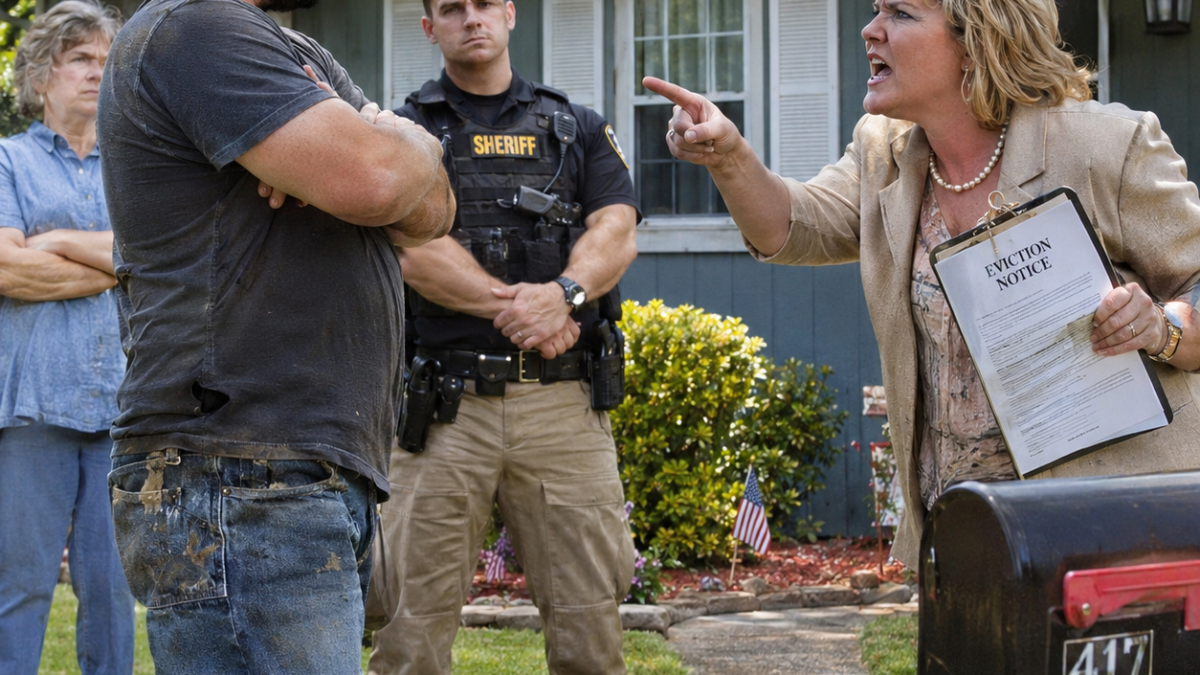
The day after that, I found a sheet of red paper taped to my porch post.
NOTICE TO VACATE
CONTINUING HOA DEFAULT.
I called Emmett.
He came over.
Looked at it.
Then actually laughed.
“What?”
“This isn’t an eviction.”
“Looks like one.”
“It looks like somebody typed the word eviction.”
He pointed at the bottom.
“No court.”
I looked at the page again.
“No judge.”
“No case number.”
“No writ.”
“Then why do it?”
Emmett stopped smiling.
“That’s a better question.”
I already knew.
Jocelyn wasn’t necessarily trying to convince a judge.
She was trying to create the appearance of authority.
Tow company sees HOA paperwork?
Maybe they assume it’s legal.
Security contractor?
Same.
New deputy?
Maybe.
Lender?
Title company?
Potential buyer?
If enough third parties believed Ridgehaven controlled my property, I could spend months undoing the damage.
Even if I eventually won.
That realization changed my attitude.
I stopped thinking only about defending myself.
Every claim Jocelyn made would now need to be tied to a document.
And every document would need a name.
A date.
A recording number.
A signature.
Then the certified 2019 annexation arrived.
Emmett called.
“Come in.”
His voice was different.
I drove straight to his office.
The document sat on his desk.
SUPPLEMENTAL DECLARATION OF ANNEXATION — TRACT 7A.
Signature:
Walter Grady.
The man who owned the farmhouse before me.
Notary seal.
2019.
I stared.
“That looks real.”
“It looks recorded.”
“Difference?”
“Big difference.”
He pointed at the legal description.
“See this?”
Parcel identification number.
Long string of digits.
“Yeah.”
“Something bothers me.”
“What?”
“I’ve seen newer county parcel numbers formatted this way.”
He called Celeste Avery at the land records office.
She spent more than an hour tracing parcel history.
Then called back.
Emmett put her on speaker.
“The parcel ID shown on the 2019 declaration didn’t exist in 2019.”
I stopped breathing for a second.
“What?”
Celeste explained.
The identification number was created after a lot-line correction recorded in 2021.
Two years later.
Meaning a document supposedly signed in 2019 contained a parcel number the county had not yet created.
Emmett looked at me.
“Time travel.”
I almost laughed.
“So it’s fake?”
“Something is seriously wrong.”
“I want to take this straight to Jocelyn.”
“No.”
“Why?”
“Because she’ll say clerical error.”
“She signed enforcement using it.”
“Not enough.”
He leaned forward.
“If we confront her now, she gets time to build a new explanation.”
“What do we do?”
“Ask boring questions.”
We sent a certified letter.
Please confirm that the 2019 supplemental declaration is the instrument upon which Ridgehaven relies.
Please confirm Ridgehaven considers it valid and binding.
Please provide supporting records.
Please identify the custodian of the original.
No accusation.
No mention of the impossible parcel number.
Jocelyn had an exit.
She could have paused enforcement.
Asked counsel to review.
Admitted there might be a records problem.
She did none of that.
Instead, she signed an affidavit.
As president of Ridgehaven Estates, she swore the supplemental declaration was authentic, valid, and enforceable.
Then added:
Ridgehaven will enforce this document without further discussion.
Emmett handed it to me.
“Keep this.”
“She just doubled down.”
“She did more than that.”
“How?”
“She has formally vouched for the document.”
That mattered.
Whatever explanation Jocelyn used later, she couldn’t say she had never looked at it.
She had been asked directly.
She had sworn directly.
Now we needed Walter Grady.
Finding him took days.
A neighbor still exchanged Christmas cards with him.
Retirement community in Arizona.
I called.
“Mr. Grady?”
“Yes.”
“My name is Barrett Quinn. I bought your old farmhouse.”
Silence.
“Oh.”
“I need to ask you about Ridgehaven.”
Longer silence.
“Figures.”
I read the title of the 2019 annexation document.
Walter didn’t answer for several seconds.
Then:
“I never joined that HOA.”
I closed my eyes.
“Are you certain?”
“I told them no.”
“Did you ever sign a supplemental annexation?”
“No.”
“Notarized document?”
“No.”
“Any agreement giving Ridgehaven authority?”
“Never.”
Then he gave us something even better.
He still had his old email account.
In 2019, Ridgehaven formally invited him to annex Tract 7A.
He replied with one word.
No.
That email proved two things.
Walter refused.
And Ridgehaven knew he refused.
Walter signed a sworn affidavit.
Emmett didn’t show Jocelyn immediately.
He wanted to see what she did next.
We found out quickly.
Jocelyn emailed me.
Friday morning, Ridgehaven would “take possession” of the property pending enforcement.
Locksmith.
Security team.
Tow trucks.
I read it twice.
Then she called.
First direct phone call she’d made since the dispute began.
Emmett was sitting across my kitchen table.
I put her on speaker.
“Barrett.”
Her voice was almost warm.
“I’d like to end this.”
“Okay.”
“Sign the membership acknowledgment.”
Silence.
“Pay the outstanding dues.”
Silence.
“Withdraw the complaints.”
“And?”
“The board will forgive a significant portion of your fines.”
I looked at Emmett.
He said nothing.
“What happens if I decline?”
Jocelyn answered instantly.
“Friday, you won’t be living there anymore.”
I felt something cold move through me.
“Do you have a court order?”
The call ended.
Emmett looked at my phone.
“Did that record?”
“No.”
“I heard it.”
“Yes.”
“Good.”
I didn’t feel good.
The next few hours showed exactly how serious she was.
A tow company called to confirm three vehicles.
A locksmith contacted me about “restoring HOA access.”
A private security contractor had been booked.
Jocelyn was manufacturing an eviction.
Not legally.
Visually.
Tow trucks.
Uniforms.
Clipboard.
Locksmith.
Official-looking notices.
If she showed up with enough people, maybe she believed I’d leave voluntarily.
Emmett filed an emergency petition that night.
Temporary restraining order.
He worked until after midnight.
The evidence package was simple.
My deed.
Original Ridgehaven declaration.
EXCLUDED TRACT 7A.
County plat.
Parcel history.
2019 document containing a future parcel number.
Walter’s affidavit.
Walter’s email refusing annexation.
Jocelyn’s sworn affidavit declaring the questionable annexation authentic.
Judge Rosalie Fenwick reviewed it Thursday morning.
By noon, she signed the order.
Ridgehaven and its officers, agents, and contractors were prohibited from:
Entering my property.
Changing locks.
Towing vehicles.
Blocking access.
Acting on the disputed lien.
The order was served that afternoon.
I thought Friday was canceled.
At 9:00 Thursday night, one of my cameras triggered.
Jocelyn stood outside my gate with a man in a work jacket.
Audio weak.
But clear.
“The order is against the association.”
Then:
“You’re an independent company.”
I sent the clip to Emmett.
He called.
“What do I do tomorrow?”
“Nothing stupid.”
“Helpful.”
“Do not touch anyone.”
“I won’t.”
“Do not block vehicles physically.”
“Okay.”
“Keep every camera running.”
“And if they come?”
“Let her choose.”
Friday.
7:08 a.m.
First tow truck.
Second.
Locksmith van.
Three dark SUVs.
Jocelyn’s white SUV leading them.
I watched from just inside my gate.
My phone was mounted behind me.
Two security cameras covered the drive.
Jocelyn got out holding a clipboard.
“Mr. Quinn is occupying HOA property after formal notice.”
She said it loudly.
For the contractors.
For the cameras.
For herself.
I asked one question.
“Did you receive Judge Fenwick’s order?”
She smiled.
“My attorney reviewed the situation.”
“Did you receive the order?”
Pause.
“Yes.”
One word.
Caught on three cameras.
The locksmith started toward the gate.
I handed him a copy.
He read page one.
Then page two.
His face changed.
“I’m not touching this.”
Jocelyn snapped:
“You were hired to perform a service.”
“Not in violation of a court order.”
He closed the toolbox.
Walked back to his van.
The first tow driver had overheard.
He reversed.
Jocelyn pointed at him.
“You’ll never work for Ridgehaven again.”
He shrugged.
“Fine.”
Then one security contractor began unscrewing my private-property sign.
I called Malcolm Reeves.
Twenty minutes later, his cruiser arrived.
He got out.
Looked at the gate.
Looked at me.
Then Jocelyn.
Again.
“Mrs. Harrow.”
“Sergeant.”
“Why are you here?”
“We’re enforcing association rights.”
He held up the order.
“You were served?”
She crossed her arms.
“This order was obtained through fraudulent title evidence.”
“That isn’t my question.”
“Yes.”
Malcolm looked at me.
I gave him Emmett’s phone number.
Certified parcel history.
Nothing else.
He went to his cruiser.
Made calls.
While he was speaking with Emmett, Jocelyn motioned toward the security contractor.
“Keep going.”
The man reached for the sign again.
Malcolm returned.
“Stop.”
Jocelyn turned.
“You have no authority to interfere with HOA enforcement.”
“I’m not enforcing HOA rules.”
He held up the paper.
“I’m looking at a judge’s order.”
Nobody got arrested that morning.
Real life isn’t always cinematic.
But Malcolm documented everything.
Who was there.
What they attempted.
What Jocelyn said.
The fact she admitted receiving the order.
Then he ordered the contractors off my property.
He told Jocelyn to leave.
She stopped beside her SUV.
“This isn’t over.”
I looked at her.
“No.”
Then I said:
“Now it starts.”
That afternoon, Emmett notified Judge Fenwick.
Then Celeste called.
She had looked deeper into the 2019 annexation.
The notary page and legal-description page appeared to have been produced using different software versions.
The scan metadata indicated the file itself had been created years after the date printed on its face.
Emmett forwarded the material through the proper channels.
The case reached Investigator Patrick Delaney.
Financial crimes.
Quiet man.
Record-focused.
The first time he called me, he asked:
“Are you sure you’re the only property they did this to?”
I hadn’t considered that.
Patrick had.
He wasn’t interested in wrong mailbox colors.
Or fines.
What bothered him was the possibility that somebody had placed a false real-estate instrument into official county records.
Public records are supposed to be trusted.
Buyers rely on them.
Banks.
Courts.
Title insurers.
If somebody could manufacture property rights once, Patrick wanted to know whether they’d done it before.
Celeste widened the search.
Ridgehaven had been built around several old outparcels.
Land that existed before the development.
Excluded tracts.
Like mine.
Over the previous few years, several had suddenly acquired supplemental annexations.
Fourteen parcels required review.
Fourteen.
One widow had been paying Ridgehaven dues for six years on pasture her late husband always said was independent.
A farmer had taken out a loan to settle HOA fines.
Across the questioned properties, dues, assessments, and fines exceeded $180,000.
I remember sitting at my kitchen table after Patrick told me.
I had thought Jocelyn hated me because I said no.
Maybe she did.
But this was bigger.
Then Lacey Bingham called.
Ridgehaven vice president.
She had supported enforcement against me.
Not because she hated me.
Because Jocelyn told the board lawyers had reviewed everything.
Lacey believed her.
After the gate incident, she started reading old emails.
Late at night.
One by one.
She called me Sunday.
“Did Walter Grady really deny signing the annexation?”
“Yes.”
“Sworn affidavit?”
“Yes.”
Silence.
Then:
“I found something.”
I told her not to send anything directly to me.
Talk to her own lawyer.
Preserve the records properly.
She did.
Then handed them to Patrick.
One email from Jocelyn stood out.
We need the holdout parcels cleaned up before the refinancing package goes to the bank.
There it was.
Motive.
Ridgehaven wanted a major loan.
Clubhouse renovation.
Pool upgrades.
Common facilities.
Outparcels scattered through the development complicated the collateral map.
Independent properties.
No HOA dues.
No covenants.
No control.
If those holdouts became HOA parcels on paper, the refinancing package became cleaner.
Then Lacey found an older email.
The HOA’s own lawyer had warned Jocelyn:
Excluded tracts could not be annexed without valid owner consent.
Clear.
Unambiguous.
Jocelyn knew.
After that warning, “supplemental declarations” began appearing.
I sat with Emmett.
“So this was never really about my mailbox.”
“No.”
“Or my truck.”
“No.”
“She needed the land attached to Ridgehaven.”
“Looks that way.”
“For financing.”
“That’s what the email suggests.”
My refusal wasn’t just annoying.
It stood in front of a larger financial plan.
Jocelyn needed my no to become yes.
If not in reality—
Then on paper.
Patrick obtained authority to inspect portions of Ridgehaven’s electronic records.
Then something predictable happened.
Files started disappearing.
Folders opened.
Documents renamed.
Files moved.
Others deleted.
Jocelyn apparently believed deletion meant disappearance.
It didn’t.
The management software had cloud backups.
Activity logs.
Username.
Timestamp.
Every action.
President’s account.
Again and again.
I stayed out of that investigation.
That was deliberate.
I wasn’t Patrick.
I wasn’t Celeste.
I wasn’t a prosecutor.
I wanted three things.
Lien removed.
Title cleared.
Written acknowledgment that Tract 7A had never been subject to Ridgehaven.
Everything else could follow evidence.
Inside Ridgehaven, the board began breaking apart.
Lacey called an emergency meeting.
Jocelyn tried to cancel it.
The remaining board members actually read the bylaws.
Held it anyway.
Jocelyn arrived late.
Walked to the head of the table.
According to the recording, she said:
“This entire controversy is Barrett Quinn’s attempt to destroy Ridgehaven from the outside.”
Some residents nodded.
Then Lacey opened a folder.
First page.
Old attorney email.
Valid owner consent required for annexation.
Jocelyn said:
“I don’t remember receiving that.”
Second page.
Jocelyn’s affidavit.
Swearing the 2019 annexation was valid.
She said:
“I relied on staff.”
Third page.
Holdout parcels cleaned up before refinancing.
Jocelyn opened her mouth.
Stopped.
Lacey asked:
“What exactly does cleaned up mean?”
No answer.
Another board member asked:
“Did the bank know these parcels were disputed?”
No answer.
Then someone asked:
“Did you know Barrett’s tract was excluded?”
Jocelyn said:
“It had been annexed.”
Lacey answered:
“By a man who swears he never signed the document.”
Silence.
The board voted.
Jocelyn’s executive authority suspended pending investigation.
She grabbed her binder.
Threatened to sue Ridgehaven.
Then came the insurance letter.
Reservation of rights.
Ordinary negligence might be covered.
Intentional fraud?
Forgery?
Knowing violation of court orders?
Possibly not.
For the first time, Jocelyn faced the possibility that residents’ insurance wouldn’t pay for decisions tied directly to her.
Then the lender froze refinancing.
No bank wanted to lend against a property map under active investigation.
Clubhouse upgrades stopped.
Pool improvements stopped.
The glossy plan Jocelyn had been trying to protect collapsed.
Irony.
She wanted to force outparcels into Ridgehaven to make the financing cleaner.
Her methods made the financing impossible.
Lacey told me later:
“I thought she was just controlling.”
“That’s bad enough.”
“No.”
She shook her head.
“I defended her.”
“You trusted your president.”
“I repeated things without checking.”
“Lots of people did.”
“That doesn’t make me feel better.”
She looked down.
“She never needed the whole board to lie.”
I waited.
“She only needed us to stop asking questions.”
That was probably the most important sentence anyone said in the whole dispute.
Systems don’t always fail because everyone is corrupt.
Sometimes one person is aggressive and everyone else gets tired.
Or busy.
Or afraid of conflict.
Good people stop checking.
Then authority expands into the empty space.
Shortly before the final hearing, Ridgehaven offered settlement.
Erase every fine.
Cancel assessments.
Release lien.
In exchange, one condition.
Confidentiality.
I couldn’t speak publicly.
I read it.
Then handed it back to Emmett.
“No.”
“You’re sure?”
“Yes.”
“They’ll clear everything.”
“They have to clear it anyway.”
“Probably.”
“I don’t want silence bought.”
Emmett nodded.
“Then court.”
The hearing room was full.
Ridgehaven homeowners.
Board members.
People from the questioned outparcels.
I sat beside Emmett.
My side was simple.
Deed.
Original declaration.
County plat.
EXCLUDED TRACT 7A.
Certified parcel history.
Walter’s affidavit.
Walter’s 2019 email.
NO.
The annexation document.
Future parcel number.
Jocelyn’s affidavit.
The restraining order.
Gate video.
Old lawyer warning.
Jocelyn testified.
Her strategy had changed.
Now she was distancing herself.
“The management company prepared the documents.”
“You signed the affidavit?”
“Yes.”
“I relied on staff.”
“You declared the annexation authentic?”
“I believed it was.”
“After being asked specifically to verify it?”
“Yes.”
“Did Walter Grady consent?”
“I was told he had.”
Emmett didn’t need to prove the entire criminal investigation.
This was civil court.
He needed one thing.
Is Tract 7A legally bound to Ridgehaven?
He played the gate video.
My voice:
“Did you receive Judge Fenwick’s order?”
Jocelyn:
“My attorney reviewed everything.”
Me again:
“Did you receive it?”
Pause.
“Yes.”
Judge Fenwick removed her glasses.
Looked at Jocelyn.
Long silence.
No speech required.
Then came the ruling.
Tract 7A was not part of Ridgehaven Estates.
Never lawfully annexed.
Every HOA fine void.
Every assessment void.
The lien had to be released.
Ridgehaven had no authority over my gate.
Driveway.
Fence.
Mailbox.
Truck.
Farmhouse.
Nothing.
The association was ordered to pay most of the legal fees caused by its wrongful enforcement.
Further damages would be handled separately.
I sat still.
No fist pump.
No smile toward Jocelyn.
Just relief.
Months of tension left my shoulders at once.
Emmett leaned over.
“Breathe.”
I hadn’t realized I was holding my breath.
The later proceedings dealt with damages.
Loss of property use.
Title impairment.
Lien removal costs.
Attorney fees.
Knowing violation of the temporary order.
Part of the liability was assigned personally to Jocelyn.
Because certain conduct was intentional, the insurance carrier refused to fully cover her portion.
A judgment lien was placed against an investment property she owned elsewhere.
But money wasn’t her biggest loss.
Ridgehaven held a formal vote.
Removal of President Jocelyn Harrow.
She had ruled the HOA for nine years.
People were used to her controlling meetings.
Calling votes.
Closing discussions.
Interpreting rules.
Now those same board members raised their hands.
Lacey’s hand went up first.
Jocelyn was removed.
Patrick’s investigation continued.
Eventually, evidence was referred to the county prosecutor.
She wasn’t handcuffed dramatically inside court.
Real investigations don’t usually provide cinematic timing.
Later, through proper process, a warrant was served.
She was booked on charges involving allegedly forged and falsely recorded real-estate documents and related conduct uncovered during the investigation.
I didn’t celebrate.
That surprised some people.
One Ridgehaven resident asked:
“After everything she did, you don’t want to see her punished?”
“I want the case handled correctly.”
“She tried to throw you out of your own house.”
“Yes.”
“She forged your property into the HOA.”
“That’s what investigators are examining.”
“You’re calmer than I’d be.”
Maybe.
Or maybe by then I was tired of letting Jocelyn occupy space in my head.
The county also reviewed the other thirteen parcels.
Not all fourteen were invalid.
That mattered.
Some owners really had signed annexation agreements.
Proper consent.
Proper notarization.
Those remained.
Others had serious problems.
Each file was reviewed individually.
The new Ridgehaven board hired an outside firm.
Dues collected without legal authority were refunded where appropriate.
Fines returned.
Invalid liens released.
One afternoon, the widow from the northern pasture called me.
Her voice shook.
“Mr. Quinn?”
“Barrett.”
“I got a letter from Ridgehaven.”
I waited.
“They’re releasing the lien.”
“Good.”
“And there’s a check.”
She started crying.
I didn’t know what to say.
“My husband used to tell me that pasture wasn’t in the HOA.”
“I believe you.”
“I thought maybe he was confused.”
Silence.
“He died thinking I didn’t believe him.”
That hurt more than anything Jocelyn ever said to me.
“I think he’d understand.”
She cried quietly.
Then:
“Thank you.”
“I didn’t do this.”
“Yes, you did.”
“No.”
“All you had to do was sign.”
I was silent.
“And you didn’t.”
That stayed with me.
Sometimes resistance isn’t dramatic.
You don’t need to storm a building.
Or threaten anyone.
Or win an argument in public.
Sometimes resistance is just:
No.
Show me the document.
Prove your authority.
I had done exactly that.
Ridgehaven eventually mailed me its official acknowledgment.
Association letterhead.
Short.
Direct.
Tract 7A is not and has never been subject to mandatory membership in Ridgehaven Estates HOA.
I framed it.
Not because I needed the HOA to confirm my deed.
The county records already did.
I framed it because months earlier, Jocelyn had stood beside my truck and said:
“You bought inside our community. That’s all you need to know.”
Now her own association was forced to say the opposite.
The chain disappeared.
Ridgehaven signs near my frontage were removed.
My title company updated its records.
My lender confirmed the title was clear.
I repaired the scratches where the chain had rubbed against the gate.
Then I did something wonderfully ordinary.
I painted the gate.
Not Ridgehaven-approved brown.
Just the color I wanted.
Dark green.
A neighbor walking by stopped.
“Is that allowed?”
I laughed.
“By me?”
He smiled.
“I guess.”
“Then yes.”
That was freedom in its smallest form.
Not needing to ask Jocelyn Harrow what color my gate could be.
I didn’t join Ridgehaven afterward.
Some residents assumed I hated the HOA.
I didn’t.
Associations aren’t inherently evil.
Lots of residents liked the pool.
The landscaping.
The community events.
They wanted common standards.
Fine.
Their property.
Their agreement.
Their choice.
The problem begins when voluntary authority forgets where it ends.
Ridgehaven had authority over people who lawfully agreed to its governing documents.
It didn’t have authority over me.
No amount of neighborhood neatness changed that.
No binder could.
No laminated sign.
No red eviction notice.
No tow truck.
A title doesn’t create power.
A logo doesn’t create power.
A recorded document based on a signature that never existed doesn’t create legitimate power.
The law still asks the same question.
Where did this authority come from?
Jocelyn never had a real answer.
Months after the case, Malcolm Reeves stopped at the farmhouse.
Not officially.
He was driving past.
I offered coffee.
He leaned against the porch rail.
“That gate gave us a lot of paperwork.”
“Sorry.”
“You weren’t the problem.”
“Still.”
He smiled.
“I remember the first day.”
“When she chained it?”
“You were calmer than I expected.”
“I wanted bolt cutters.”
“I could tell.”
“What stopped me?”
“You tell me.”
“I thought about how she’d use it.”
Malcolm nodded.
“Smart.”
“She wanted me to look unreasonable.”
“Most civil disputes get worse when somebody decides they need a dramatic moment.”
“I gave her plenty.”
He laughed.
“Fair.”
Then he became serious.
“The second morning was different.”
“Tow trucks?”
“Court order.”
He shook his head.
“I’ve seen people misunderstand court orders.”
“Jocelyn didn’t.”
“No.”
“You heard her?”
“I saw the video.”
“She admitted receiving it.”
“That’s what made it simple.”
He took a sip.
“People think officers enjoy gray areas.”
“You don’t?”
“Not when somebody hands you a signed order.”
I laughed.
Before leaving, Malcolm walked toward the gate.
“No chain.”
“No chain.”
“Keep it that way.”
“Planning to.”
The new Ridgehaven board changed rules.
Any annexation required independent legal verification.
Recorded consent.
Owner confirmation.
Outside review.
Board members received complete source documents instead of summaries.
The management company contract was reevaluated.
Lacey became interim president.
She didn’t want it.
That probably helped.
She invited me to a meeting once.
“No.”
“You haven’t heard why.”
“Still no.”
She laughed.
“We’re discussing outparcels.”
“Definitely no.”
“Barrett.”
I sighed.
“What?”
“We want affected owners present.”
That was different.
I went.
Eight outparcel owners attended.
Some actually belonged to Ridgehaven.
Some did not.
One farmer crossed his arms.
“I don’t trust any of you.”
Lacey nodded.
“Reasonable.”
That surprised him.
She continued.
“You don’t need to trust us. We’re going to put the documents on the screen.”
That was how the meeting started.
No speeches.
No “community harmony.”
No threats.
Just documents.
Parcel by parcel.
Valid annexation?
Show it.
Consent?
Show it.
Recording?
Show it.
If they couldn’t, Ridgehaven didn’t claim authority.
Simple.
It took hours.
Boring.
Beautifully boring.
That was what legitimate governance should look like.
Slow enough to be checked.
One farmer discovered his annexation was valid.
His father had signed decades earlier.
He wasn’t happy.
But he accepted it.
“That’s his signature.”
Lacey nodded.
“Then your property remains subject.”
He sighed.
“At least somebody showed me.”
That sentence was the difference.
Authority can survive scrutiny when it’s real.
Fake authority hates scrutiny.
Years passed.
The farmhouse changed slowly.
I rebuilt the workshop roof.
Cleared some pasture.
Repaired the stone wall.
Put in fruit trees.
The Ridgehaven homes around me remained manicured.
I remained different.
That no longer bothered anyone.
In fact, one family started buying eggs from me.
Another brought their children to see my goats.
The same subdivision Jocelyn said I was “attacking” eventually became my neighbors.
That was important.
Jocelyn had always tried to frame the fight as:
Barrett versus Ridgehaven.
It wasn’t.
It was:
Jocelyn’s claimed authority versus my recorded rights.
Those are different.
Once she was gone, there was no reason for me to hate 118 families.
Most of them never knew the truth until late.
Some apologized.
Some didn’t.
Some were embarrassed.
Some moved on.
So did I.
One autumn afternoon, Walter Grady visited.
He was traveling east to see family.
He called first.
“Mind if an old man sees what you did to the place?”
“Come by.”
He arrived with his daughter.
Slower than I imagined.
White hair.
Strong handshake.
He stood in front of the farmhouse for a long time.
“Looks good.”
“Thanks.”
“That porch always leaned.”
“Still does.”
He laughed.
I showed him the framed Ridgehaven letter.
He read it.
Then shook his head.
“They tried that with me.”
“How hard?”
“Not like they did with you.”
“What happened?”
“They sent forms.”
“And you wrote no.”
“One word.”
“You kept the email.”
“I keep everything.”
I smiled.
“Good habit.”
We sat on the porch.
I asked:
“Did Jocelyn ever approach you personally?”
“Once.”
“What did she say?”
“That joining would make the property more valuable.”
“What did you say?”
“That I wasn’t selling.”
“She mention refinancing?”
“No.”
“Any pressure?”
“Nothing serious.”
He looked toward Ridgehaven.
“I figured they’d eventually forget.”
“They didn’t.”
“No.”
Walter’s daughter asked:
“Dad, why didn’t you join?”
He thought.
“Because I didn’t want to.”
That was the entire principle.
No dramatic philosophical statement.
No hatred of HOAs.
No conspiracy.
He owned the land.
The declaration excluded it.
Joining required his consent.
He didn’t consent.
That should have ended the matter.
Consent only means something if no remains valid.
Jocelyn’s entire strategy depended on treating refusal as temporary.
If Walter said no?
Create yes later.
If I said no?
Fine me until I changed my mind.
Chain the gate.
Threaten lien.
Threaten eviction.
Bring trucks.
Make resistance expensive.
That isn’t consent.
That’s coercion wearing paperwork.
Walter stayed for dinner.
Before leaving, he stood at my gate.
“That’s the one?”
“The famous gate.”
He touched the metal.
“She chained this?”
“Yes.”
“You didn’t cut it?”
“No.”
“I would’ve.”
I laughed.
“Emmett would’ve killed me.”
Walter smiled.
“Probably why you won.”
Maybe.
Restraint was one of the hardest parts.
Every stage gave me an opportunity to do something emotionally satisfying and legally stupid.
Cut the chain.
Throw HOA signs into the road.
Block security trucks.
Confront Jocelyn at the clubhouse.
Post accusations online before proof.
Threaten contractors.
I did none of it.
Not because I’m naturally calm.
I’m not.
I did it because Jocelyn was waiting for me to become the man she was describing.
Delinquent.
Hostile.
Unreasonable.
Dangerous.
She needed one photograph of me losing control.
One video.
One angry threat.
I refused.
If she wanted evidence, I would give her evidence.
Just not the kind she expected.
My cameras recorded her.
My letters recorded her.
Her affidavit recorded her.
Her email recorded her.
The TRO video recorded her.
Eventually, her own system logs recorded her.
That became the most satisfying irony.
Jocelyn tried to defeat me with paperwork.
Paperwork defeated her.
Several years later, I saw her once.
County courthouse parking lot.
She looked older.
So did I.
We recognized each other.
She almost kept walking.
Then stopped.
“Barrett.”
“Jocelyn.”
Silence.
I didn’t know what to say.
She did.
“You ruined my life.”
I felt the old anger rise.
Then settle.
“No.”
Her eyes hardened.
“You think you’re innocent?”
“I think you tried to evict me from my house without a court order.”
“You destroyed Ridgehaven.”
“Ridgehaven still exists.”
“You turned everyone against me.”
“I didn’t create your emails.”
“You went after every document.”
“Yes.”
“You wouldn’t let anything go.”
“No.”
She laughed bitterly.
“Exactly.”
I looked at her.
“What did you expect?”
“You could have joined.”
There it was.
Years later.
Still.
“You still think that was the answer?”
“You were surrounded by Ridgehaven. You used roads near it. You benefited from property values.”
“My land was excluded.”
“You benefited.”
“That doesn’t create consent.”
She looked away.
I asked:
“Did Walter ever sign?”
No answer.
“Did I?”
Nothing.
“That was the whole case.”
She looked back.
“You don’t understand what it was like running that association.”
“Probably not.”
“Everyone wanted something.”
“I believe that.”
“Every resident thought their issue was urgent.”
“Probably.”
“We were trying to refinance. Improve the clubhouse. Fix the pool.”
“I know.”
“The outparcels made everything harder.”
“I know.”
She stared.
“For once, just admit you understand why I did it.”
I thought carefully.
“I understand what you wanted.”
Her expression softened slightly.
“But?”
“I don’t accept what you did.”
It hardened again.
“You think you’re better than me?”
“No.”
“I think my deed didn’t need your permission.”
She shook her head and walked away.
I watched her go.
No satisfaction.
Just sadness.
Because I realized she still thought good intentions could justify counterfeit authority.
Maybe she’d never understand.
That was no longer my responsibility.
The widow from the north parcel later sold her pasture.
Before closing, she called.
“Can I ask you something?”
“Sure.”
“They found an old Ridgehaven notation in the title file.”
My stomach tightened.
“Get a lawyer.”
“I did.”
“Good.”
“They say it’s released.”
“Then let the title company confirm.”
She laughed.
“You really don’t trust paper.”
“Opposite.”
“What?”
“I trust verified paper.”
That became another lesson.
The problem wasn’t paperwork.
Paperwork saved me.
My deed.
Survey.
Original declaration.
Walter’s email.
County parcel history.
Judge’s order.
The problem was bad paper used to imitate legitimate authority.
The answer to false documents isn’t ignoring documents.
It’s better verification.
Her sale closed cleanly.
She sent me a photograph of the check.
I replied:
Congratulations.
She wrote:
My husband would finally believe me.
That made me smile.
Ridgehaven’s lender eventually approved a smaller refinancing package.
After the disputed outparcels were removed from the collateral assumptions.
Clubhouse work continued later.
More modest.
Transparent.
No pretending independent land belonged to the HOA.
Lacey remained president for two years.
Then stepped down voluntarily.
Before leaving, she mailed me a copy of her final board report.
One paragraph was underlined.
Ridgehaven’s authority derives exclusively from recorded governing documents and lawful owner consent. Proximity, benefit, historic practice, or administrative convenience do not create membership.
I framed that too.
Now I had two Ridgehaven letters on my wall.
One said my land had never been mandatory HOA property.
The other explained the principle Jocelyn spent nine years ignoring.
Visitors sometimes asked why I displayed HOA paperwork.
“Long story.”
They’d laugh.
Usually I didn’t tell it.
I didn’t want my house to become a museum to conflict.
Most days, the papers were just papers.
The farmhouse was home.
That’s what mattered.
A home is more than title, of course.
But title matters because home becomes fragile if someone can invent authority over it.
The red notice Jocelyn taped to my porch had said:
NOTICE TO VACATE.
I kept that too.
Not framed.
Stored.
Sometimes I thought about the psychological cruelty of it.
She knew there was no court order.
Yet she printed red paper and placed it where I’d see it entering my own home.
The message wasn’t legal.
It was emotional.
You are not secure here.
We can remove you.
We decide whether you belong.
That’s what made me angriest.
Not the fines.
Not even the lien.
She tried to make me feel like a guest on land I owned.
Maybe that’s why I refused the confidentiality agreement.
I wanted the final record to say clearly:
She couldn’t.
Years after everything ended, a young couple bought one of the smaller outparcels near the creek.
They stopped by.
“We were told to talk to you.”
“By who?”
“Our closing attorney.”
I laughed.
“That’s concerning.”
They had a thick folder.
The woman said:
“Property is excluded from Ridgehaven.”
“Good.”
“They offered voluntary membership.”
“Okay.”
“We don’t know whether to join.”
“That isn’t my decision.”
The husband looked surprised.
“After what happened to you, I assumed you’d say absolutely not.”
“No.”
“Why?”
“Because voluntary membership is different.”
I pointed at the folder.
“Read the costs.”
They nodded.
“Read the restrictions.”
“Okay.”
“Understand what becomes binding.”
“Yes.”
“Then decide.”
“What would you do?”
“I already decided for my land.”
They eventually joined.
That was fine.
They wanted access to the pool.
Community events.
Trash contract.
They signed voluntarily.
Nobody forged anything.
Nobody threatened them.
That’s how it should work.
Choice.
Years later, I still lived outside Ridgehaven while technically surrounded by it.
Matching mailboxes on three sides.
My old mailbox near the county road.
They repainted their fences.
Mine weathered.
They changed landscaping standards.
I planted whatever survived the deer.
Nobody cared.
The property values did not collapse.
Civilization survived my brown pickup being visible from the road.
That still amused me.
All the disasters Jocelyn warned about—
Chaos.
Reduced property values.
Security risk.
Unfairness.
None occurred because one four-acre tract remained independent.
The only genuine crisis came from her attempt to erase that independence.
Sometimes people create the disaster they claim to be preventing.
One winter night, snow covered the gate.
I walked outside.
No chain.
No red notice.
No tow truck.
Just white snow on dark-green metal.
I stood there remembering Friday morning.
Jocelyn’s convoy.
Tow trucks idling.
Locksmith.
Security.
Clipboard.
Her certainty.
A theatrical eviction.
She thought enough uniforms would make unlawful authority look lawful.
She almost succeeded.
If I had panicked?
Signed the membership form?
Paid the fines?
Maybe nobody would ever have examined the annexation.
The widow might still be paying.
The farmer might still carry debt.
The lender might have refinanced against a distorted property map.
Thirteen other parcels might never have been reviewed.
That is the strange thing about individual resistance.
You rarely know what else is hiding behind your own problem.
I thought I was defending four acres.
The investigation found a pattern.
I didn’t expose it because I was heroic.
I exposed it because Jocelyn pushed too far against someone who had kept his closing folder.
That still makes me laugh.
Her entire system encountered one homeowner who asked:
Show me where I agreed.
She couldn’t.
So she manufactured a better answer.
That became the end of her presidency.
If she had simply left me alone?
Most of the rest might never have surfaced.
That’s why I sometimes think the chain was the beginning of her defeat.
The physical chain.
Cold steel.
Heavy lock.
A sign saying my access was suspended.
It was so outrageous that it forced everyone else to look.
Sheriff.
Lawyer.
Judge.
County records.
Investigator.
Board.
Residents.
Lender.
Insurance carrier.
The more people looked, the less Jocelyn’s story survived.
Authority built on secrecy fears attention.
She got attention.
One afternoon, Emmett retired.
I attended his small office reception.
He handed me a cardboard archive box.
“What’s this?”
“Copies from your case.”
“You’re giving me more paperwork?”
“You like paperwork.”
“Fair.”
We sat for a while.
I asked:
“When did you know we’d win?”
He smiled.
“Define win.”
“Tract 7A.”
“When the county parcel history came back.”
“Before Walter?”
“Yes.”
“Why?”
“Because a 2019 instrument using a 2021 parcel number is difficult to explain.”
“Jocelyn tried.”
“She did.”
“When did you know she was in real trouble?”
He didn’t hesitate.
“Affidavit.”
“Not the eviction?”
“No.”
“Gate violation?”
“Bad.”
“Affidavit worse?”
“She had a chance to investigate.”
He looked at me.
“We asked politely.”
“I remember.”
“She could have said, ‘We need to review this.’”
“She swore it was valid.”
“Exactly.”
Emmett lifted his glass.
“Never sign certainty you don’t possess.”
Good rule.
I asked him:
“Did you know she’d come after the TRO?”
“No.”
“Really?”
“I hoped she wouldn’t.”
“I thought lawyers predicted everything.”
“We mostly predict that humans will eventually surprise us.”
He laughed.
Then became serious.
“You did one thing very well.”
“What?”
“You waited.”
“I hated waiting.”
“That’s why most clients don’t.”
“Was that really important?”
“Critical.”
He leaned closer.
“People often ruin strong cases by needing emotional satisfaction before legal resolution.”
I thought about the bolt cutters.
The clubhouse confrontation I never had.
The posts I never ripped down.
The tow trucks I never blocked physically.
Waiting felt passive.
It wasn’t.
It gave Jocelyn room to show exactly what she was willing to do.
That room became evidence.
The criminal case moved through its own process.
Slow.
Procedural.
Less dramatic than rumors claimed.
I stayed out of public commentary.
Charges were charges.
Not convictions.
I let prosecutors and courts do their jobs.
That distinction mattered.
The original source of my conflict was somebody claiming authority without enough legal basis.
I wasn’t going to become a mirror image by claiming legal outcomes before they existed.
People online wanted easy endings.
“Did she go to prison?”
“Did she lose everything?”
“Did you take her house?”
Reality doesn’t always supply those endings.
What I knew was enough.
She lost the HOA presidency.
Faced personal civil liability.
Had property encumbered by judgment.
Had to hire criminal counsel.
Her conduct triggered a wider review.
Several owners got money back.
Invalid liens were cleared.
My home remained mine.
That was real.
Real was enough.
The new board sent one final letter several years later.
Not to me specifically.
All residents and adjoining property owners.
It summarized governance reforms.
Then one sentence caught my eye.
No enforcement action may be initiated against a parcel until staff independently confirms the parcel is legally subject to the association.
I laughed.
My entire nightmare reduced to one sentence.
Check first.
Imagine how much misery that rule could have prevented.
Jocelyn never checked because she didn’t want the answer.
Or perhaps she knew it and wanted a different answer.
Either way, future boards had to verify.
That was lasting change.
One morning, I found an old piece of red paper in the bottom of a drawer.
NOTICE TO VACATE.
The ink had faded slightly.
I carried it outside.
Stood beside the porch post where she’d taped it.
My farmhouse behind me.
Land around me.
Gate open.
Then I tore the paper in half.
Not angrily.
Just because I didn’t need it anymore.
I put it in the trash.
Some evidence doesn’t need to become an heirloom.
The framed acknowledgment stayed.
So did the certified plat.
Those represented truth.
The eviction notice represented fear.
I had enough reminders of fear.
What stayed with me most wasn’t Jocelyn’s threats.
It was the widow’s phone call.
The farmer’s debt.
Walter saying no.
Lacey admitting good people stopped checking.
Those made the story bigger than revenge.
One abusive leader can cause damage.
But systems also allow abuse when nobody asks for source documents.
Jocelyn didn’t control Ridgehaven alone.
She controlled information.
That was enough.
If every board member had demanded:
Show the annexation.
Verify the signature.
Call Walter.
Check the parcel number.
The whole scheme could have collapsed years earlier.
Transparency isn’t glamorous.
Neither is verification.
But they are cheaper than litigation.
I learned that too.
Today, when someone tells me:
“The HOA says…”
My first thought isn’t that the HOA is wrong.
It’s:
What does the recorded document say?
Maybe the HOA is right.
Often it is.
But authority should survive verification.
If somebody gets angry because you asked for proof, ask again.
The last time I spoke with Lacey, she stopped near my gate while walking.
“You ever think about joining now?”
I laughed.
“Absolutely not.”
She laughed too.
“I had to ask.”
“Why?”
“Tradition.”
“Your membership package still nine thousand dollars?”
“Less.”
“Still no.”
She smiled.
“Worth trying.”
Then she looked at the farmhouse.
“You know, Jocelyn was convinced you’d eventually surrender.”
“I know.”
“She used to say everybody had a number.”
“What does that mean?”
“Fine them enough. Threaten enough. Make it expensive enough. Eventually people give in.”
I leaned against the gate.
“She was almost right.”
Lacey looked surprised.
“You thought about it?”
“Of course.”
“When?”
“The week the lien notice came.”
“You almost joined?”
“No.”
“But?”
“I wondered whether peace was worth paying for.”
Lacey nodded.
“And?”
“I realized paying wouldn’t buy peace.”
“How did you know?”
“Because somebody willing to invent authority once will use it again.”
That was it.
If I’d paid $14,000, the next letter would come.
Gate rule.
Truck rule.
Fence rule.
Mailbox rule.
Pasture rule.
Workshop rule.
Once I accepted Jocelyn’s premise, she controlled the future.
The only durable peace was settling the authority question.
Court did.
That was worth the fight.
The farmhouse is quieter now than when I bought it.
Oak trees taller.
Pasture thicker.
Stone walls repaired.
My pickup eventually died and was replaced.
The mailbox is still “wrong.”
Nobody fines it.
The gate is still dark green.
Nobody chains it.
On the kitchen wall hang the framed Ridgehaven acknowledgment and the county plat.
Guests rarely notice them.
That’s good.
I didn’t buy the house to tell this story forever.
I bought it to live there.
And finally, that’s what I do.
Sometimes, though, when I drive through the gate, I remember Jocelyn standing beside my truck on the third morning after I moved in.
Binder open.
$9,000 underlined.
“You bought inside our community. That’s all you need to know.”
She had been wrong in almost every possible way.
I hadn’t bought inside Ridgehaven.
I hadn’t agreed to membership.
Walter hadn’t agreed either.
The fines weren’t valid.
The lien wasn’t valid.
The eviction wasn’t valid.
The chain wasn’t valid.
The annexation document wasn’t valid.
And the court order was very valid.
She spent months trying to create authority through repetition.
Say it enough.
Print it enough.
Fine it enough.
Record it enough.
Eventually everybody will believe it.
But reality has an advantage.
It only needs to be proved once.
My deed didn’t yell.
The plat didn’t threaten.
Walter’s one-word email didn’t have an HOA logo.
The county parcel history didn’t arrive in red ink.
They didn’t need theatrics.
They were true.
That was enough.
Jocelyn Harrow tried to evict me from land her association had never controlled.
She chained my gate.
Threatened liens.
Sent tow trucks.
Brought a locksmith.
Signed an affidavit defending a document that contained information from the future.
Then knowingly arrived after a judge had ordered her not to interfere.
She believed authority came from confidence.
I learned authority comes from lawful consent and actual documents.
In the end, I kept my four acres.
My farmhouse.
My gate.
My title.
And my right to say no.
Ridgehaven kept its legitimate homes and legitimate members.
The other outparcel owners finally got their records reviewed.
Some recovered money.
Some had liens released.
The board learned to check.
And Jocelyn lost the presidency she had treated like a crown.
She once tried to turn my refusal into an eviction.
Instead, her eviction stunt became part of the evidence that destroyed the authority she claimed.
And after everything—the fines, the chain, the red notice, the trucks, the lawyers, the investigators, and the courtroom—the question that finally ended it all was the same question I’d asked her the first morning she stood beside my pickup.
Show me where I agreed to give you power over my land.
She never could.








