PART 2: I Pulled Over at 5:40 A.M. to Check a Tire—Then I Saw a Starving Cat Guarding a Broken Box on the Road
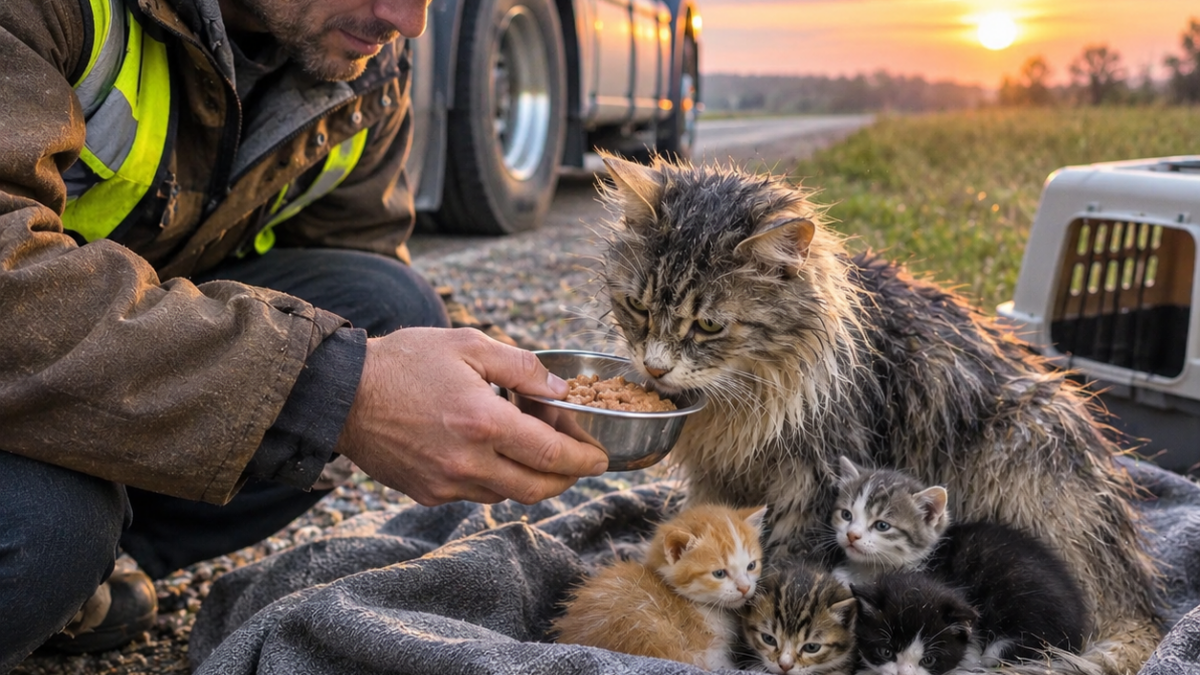
PART 2
I grabbed my phone.
The first call was to my dispatcher.
He answered sounding half asleep.
“You blow a tire?”
“No.”
“Then why are you stopped?”
“I found a cat.”
Silence.
“A cat?”
“And seven kittens.”
Another pause.
Then he sighed.
“You’re kidding.”
“I wish I was.”
I looked down at the kitten inside my shirt.
Still no real movement.
“Somebody dumped them on the shoulder. One kitten’s in bad shape.”
He knew me well enough not to argue immediately.
“How long?”
“I don’t know.”
“No. How long are you going to be stopped?”
“However long it takes.”
“You have a delivery window.”
“I know.”
“The customer is already difficult.”
“I know.”
There was another silence.
Then he asked, “Are you safe where you’re parked?”
That was how I knew I’d won.
“Yeah.”
“Send me your location.”
“Thanks.”
“Don’t thank me yet. If you put eight cats in that truck, I’m pretending I never heard this conversation.”
I almost smiled.
“No promises.”
I hung up.
My second call was to the county non-emergency line.
They transferred me to animal control.
Nobody answered.
I left a message.
Then I searched for nearby veterinary clinics.
The closest one wouldn’t open until seven.
There was an emergency animal hospital forty-three miles away.
I looked at the clock.
5:52.
The kitten against my chest gave the faintest twitch.
That decided it.
I wasn’t waiting until seven.
—
The problem was getting the mother into the truck.
The kittens were too cold to leave outside.
I found a clean plastic storage bin behind my sleeper berth, lined it with my jacket and two towels, and carefully moved the kittens inside.
The mother watched every second.
When I carried the bin toward the passenger side, she followed.
But she stopped at the step.
I opened the door.
“Come on.”
She stared into the cab.
Then at me.
Then back toward the road.
I could almost see the fear competing with instinct.
Her kittens were inside.
She wanted them.
But climbing into a strange truck with a strange man was something else entirely.
I stepped away from the door.
“Your choice.”
She waited maybe ten seconds.
Then jumped onto the first step.
She froze.
I didn’t move.
Another step.
Then she climbed into the cab.
Straight to the box.
I closed the door gently.
“Good girl.”
She ignored me.
Fair enough.
I walked around to the driver’s side, got in, and started the engine.
The mother crouched beside the kittens.
The vibration frightened her at first.
She pressed herself over them protectively.
“It’s okay. We’re going somewhere warm.”
She looked at me.
I don’t know why I kept talking.
Maybe for her.
Maybe for myself.
I pulled onto the road.
—
The emergency hospital told me to bring them inside immediately.
A technician met me with a wheeled cart.
When I opened the passenger door, the mother hissed.
The technician stopped.
“She’s protective?”
“Very.”
“Can you move the kittens?”
“She lets me.”
The woman raised an eyebrow.
“Then congratulations. You’re helping.”
Together we carried the bin inside.
The hospital smelled like disinfectant and coffee.
Another technician took the cold kitten first.
“What happened?”
“Found them in a box on County Road Twelve.”
“How long were they outside?”
“No idea. At least overnight, I think.”
“Mother with them the whole time?”
“Yes.”
“That probably saved them.”
The mother cat seemed to understand something was happening.
She began pacing inside the carrier they’d given us.
One of the kittens cried.
She answered immediately.
“Can she stay with them?” I asked.
“As soon as we stabilize everybody.”
The veterinarian arrived about fifteen minutes later.
Her name was Dr. Patel.
She examined the mother first.
“She’s dehydrated,” she said.
“How bad?”
“Moderate. She’s also underweight.”
She ran her hand gently along the cat’s side.
“Very underweight.”
“What about the kittens?”
“Several are chilled. Two are dehydrated. The smallest one is hypothermic.”
“The one I was holding?”
“Yes.”
“Is it going to make it?”
Dr. Patel didn’t answer immediately.
That scared me.
“We’re warming him gradually. Too much heat too fast can also be dangerous.”
“Him?”
“Male.”
I stared through the glass door toward the treatment room.
A technician was rubbing the kitten gently beneath a warm blanket.
Dr. Patel touched my arm.
“You got him here alive. That’s important.”
“That’s not what I asked.”
“No,” she said quietly. “It isn’t.”
Her honesty hurt.
But I appreciated it.
“We’ll do everything we can.”
—
I sat in the waiting room for nearly two hours.
My dispatcher called twice.
The second time he said the delivery had been reassigned.
“You owe Mike big.”
“I’ll buy him dinner.”
“He wants steak.”
“Of course he does.”
“How are the cats?”
I looked toward the treatment-room doors.
“Still here.”
“That’s something.”
“Yeah.”
Then he surprised me.
“Company owner heard about it.”
I groaned.
“Great.”
“He said don’t worry about the missed route.”
I sat straighter.
“Seriously?”
“Apparently his wife runs some kind of rescue fundraiser.”
I laughed quietly.
“So I’m not fired?”
“Not today.”
“Good.”
“Still can’t turn the truck into a mobile zoo.”
“No promises.”
He hung up.
Around eight, Dr. Patel came back.
She smiled before speaking.
That was enough.
“The little male’s temperature is coming up.”
I leaned back in the chair.
“Oh, thank God.”
“He’s not completely out of danger, but he’s responding.”
“And the others?”
“Stable.”
“The mother?”
“Already eating.”
That made me laugh.
“Good.”
“She was starving.”
The laughter disappeared.
“Can you tell how long?”
“There’s no exact clock for malnutrition. But this isn’t one missed meal.”
“Days?”
“Longer.”
I stared at her.
“Somebody owned her.”
“Probably.”
“Can you scan for a chip?”
“We did.”
I waited.
Dr. Patel nodded.
“She has one.”
My heart jumped.
“So you know the owner?”
“We have registration information.”
“Call them.”
“We already did.”
Something in her expression changed.
“What?”
“The number is disconnected.”
“What about an address?”
“There is one.”
“And?”
“We’ll give it to animal control.”
I crossed my arms.
“I want to know who left them.”
“I understand.”
“No, I mean I really want to know.”
Dr. Patel held my gaze.
“Then do this the right way.”
I didn’t like hearing that.
Mostly because I knew she was right.
“If someone dumped these animals deliberately, you’ll need evidence. Don’t confront anybody yourself.”
I looked through the window again.
The mother cat was eating canned food from a metal bowl.
Seven kittens lay under a warming blanket.
Someone had put them in a box and walked away.
“Fine,” I said.
But inside, I already knew one thing.
I wasn’t going to forget.
—
Animal control finally arrived around nine.
Officer Lena Brooks was younger than I expected.
Maybe early thirties.
She photographed the kittens.
She photographed the mother.
She asked exactly where I had found them.
“Do you still have the box?”
I froze.
“The box?”
“Yes.”
“I left it.”
She sighed.
“Is it still there?”
“Probably.”
“Can you show me?”
“Absolutely.”
We drove back separately.
The sun had fully risen by then.
In daylight, the place looked less frightening.
Almost ordinary.
That somehow made it worse.
The broken box was still on the shoulder.
Brooks put on gloves.
“Don’t touch anything.”
“I wasn’t planning to.”
She photographed it from every angle.
Then she noticed something.
“Interesting.”
“What?”
She crouched beside one torn corner.
A shipping label was stuck beneath a strip of wet tape.
Most of the ink had bled.
But part of a name remained.
And a town.
Brooks leaned closer.
“Don’t get excited.”
“Too late.”
“This may have nothing to do with whoever dumped the cats. Boxes get reused.”
“What’s the name?”
She didn’t answer.
“Seriously?”
“Evidence.”
I stared at her.
She looked up.
“You’re going to make this difficult, aren’t you?”
“Probably.”
For the first time, she smiled.
“Good thing I’m patient.”
Then we heard tires on gravel.
A pickup truck had slowed behind my rig.
Dark green.
Older Ford.
The driver stared at us.
Then accelerated away.
Brooks turned.
“Did you see the plate?”
“Last four.”
She looked at me.
“Seriously?”
“Truck driver.”
She pulled out her notebook.
“Tell me.”
I did.
—
That green pickup bothered me all day.
Maybe it meant nothing.
Maybe the driver was simply curious.
People slow down when they see an animal-control vehicle.
But something about the way he’d looked at the box stayed with me.
My company gave me the rest of the morning off.
I returned to the hospital around noon.
The mother cat was calmer.
Dr. Patel let me into the recovery room.
“Move slowly.”
I crouched beside the kennel.
The cat watched me.
“Hey, girl.”
Her ears shifted forward.
“Remember me?”
She stood.
For one second I thought she’d hide.
Instead, she walked toward the door and pushed her forehead against the bars.
I smiled.
“Well, okay.”
Dr. Patel opened the kennel.
The cat stepped into my lap.
Just like that.
No hesitation.
I felt her ribs through her fur.
She purred.
Not loudly.
But steadily.
Something broke open inside me.
“You trusted me on the road,” I whispered. “You really didn’t have much choice, did you?”
Dr. Patel stood behind me.
“She chose.”
I looked up.
“What?”
“She could’ve run once the kittens were inside your truck. She didn’t.”
The cat kneaded one paw against my jeans.
“You’re going to make me adopt eight cats.”
Dr. Patel laughed.
“Let’s start with getting them healthy.”
—
The smallest kitten survived the night.
Then another.
Then another.
By the third morning, Dr. Patel said she was confident all seven had a real chance.
The smallest male became the loudest.
That seemed appropriate.
A technician named him Peanut.
I objected.
“Why Peanut?”
“Because he was tiny.”
“He deserves something tougher.”
“Like what?”
“Tank.”
She looked down at a kitten smaller than my hand.
“Tank?”
“He fought.”
She laughed.
“Fine. Tank.”
The mother needed a name too.
The hospital had written “Mom Cat” on her chart.
That bothered me.
“She needs something.”
Dr. Patel said, “You’re the one she likes.”
I looked at the cat.
She had gray-brown fur with a white patch beneath her chin.
Her eyes were pale green.
“What about Grace?”
The cat blinked.
Dr. Patel smiled.
“Grace it is.”
—
On the fourth day, Officer Brooks called.
“We found the microchip registrant.”
I sat up in the sleeper berth.
“And?”
“His name is Raymond Keller.”
The name meant nothing to me.
“He owns the cat?”
“The chip was registered to him three years ago.”
“Where?”
“Address outside Millford.”
“That’s what, twelve miles from where I found them?”
“About eleven.”
My jaw tightened.
“So he dumped them.”
“I didn’t say that.”
“Come on.”
“I said the chip is registered to him.”
“What did he say?”
“He says he gave the cat away eight months ago.”
“To who?”
“He claims he doesn’t remember the full name.”
I laughed.
“That’s convenient.”
“It is.”
“You believe him?”
“My job isn’t believing. It’s proving.”
I hated that sentence.
She continued.
“There’s more.”
I waited.
“The box label had a partial business name.”
“And?”
“It matches a feed-and-farm supply store in Millford.”
“So?”
“So we contacted the store.”
My pulse quickened.
“They keep purchase records?”
“Sometimes.”
“Was Keller there?”
“I’m not discussing everything yet.”
“Then why call me?”
“Because I need your dashcam footage.”
I froze.
“My dashcam?”
“Yes.”
I looked toward the windshield.
The camera ran whenever the truck was powered.
“I arrived after they were dumped.”
“Probably.”
“Then what good is it?”
“Remember the green pickup?”
I understood immediately.
“You think it came back.”
“I think I want the footage.”
—
I pulled the memory card.
Our safety department helped retrieve the recording.
There it was.
9:17 a.m.
The dark green Ford slowing behind my truck.
The driver’s face wasn’t clear.
But the plate was.
Every digit.
Brooks called an hour later.
“Registered to Raymond Keller.”
I didn’t say anything.
Neither did she.
Finally:
“Still think I’m making this difficult?”
“That truck doesn’t prove he dumped them.”
“No.”
“But he came back.”
“Yes.”
“Why?”
“That’s what I’d like to know.”
—
Keller answered that question himself two days later.
I was at the veterinary hospital when the receptionist called me to the front.
A man stood at the counter.
Mid-fifties.
Heavy jacket.
Work boots.
Gray beard.
He looked irritated.
Not worried.
Not emotional.
I knew immediately.
Green pickup.
Same driver.
Grace was still in the recovery area.
I stepped closer.
“You Raymond Keller?”
He looked at me.
“Who are you?”
“The guy who found your cat.”
His face changed.
Only slightly.
But enough.
“She ain’t my cat.”
“Microchip says otherwise.”
“I gave her away.”
“To who?”
“None of your business.”
The receptionist moved toward the phone.
I remembered Dr. Patel’s warning.
Do this the right way.
So I backed off.
“Why are you here?”
Keller tapped the counter.
“I heard you’re holding animals that belong to me.”
I stared at him.
“You just said she wasn’t your cat.”
“The kittens.”
Something cold moved through me.
“The kittens?”
“Yeah.”
“How are the kittens yours if their mother isn’t?”
He paused.
Mistake.
A big one.
The receptionist looked at me.
I looked at him.
Keller realized it too late.
“What I mean is—”
“I know exactly what you mean.”
His face reddened.
“Don’t get smart with me.”
“Then explain it.”
“I don’t owe you anything.”
“No. But animal control might be interested.”
Keller stepped closer.
“You stay out of this.”
I didn’t move.
“You left them on the road?”
“I said stay out of it.”
That wasn’t a denial.
The receptionist had already dialed.
Keller noticed.
He pointed at me.
“You don’t know anything.”
Then he left.
I watched through the window as the green Ford tore out of the parking lot.
My hands were shaking.
Not from fear.
From anger.
Dr. Patel came from the hallway.
“What happened?”
I told her.
She closed her eyes.
“Please tell me you didn’t threaten him.”
“I didn’t.”
“Touch him?”
“No.”
“Follow him?”
“No.”
She exhaled.
“Good.”
“I wanted to.”
“I know.”
“So what now?”
“Now you let Brooks use whatever she can from that conversation.”
The receptionist lifted her hand.
“I heard all of it.”
Dr. Patel nodded.
“Even better.”
—
Officer Brooks arrived forty minutes later.
She took statements from all three of us.
When I finished, I asked, “Is that enough?”
“For what?”
“To arrest him.”
“No.”
I cursed under my breath.
“But,” she added, “it’s useful.”
“Useful isn’t good enough.”
She looked at me.
“You want revenge.”
That word hit me.
Maybe because it was true.
“I want him to answer for what he did.”
“Those aren’t always the same thing.”
“He left newborn kittens beside a road.”
“Yes.”
“Grace could’ve been hit by a car.”
“Yes.”
“They could’ve frozen.”
“Yes.”
“And he walks in here talking about ownership?”
Brooks lowered her voice.
“Which is exactly why you don’t ruin this by doing something stupid.”
I stared at her.
She continued.
“People like Keller count on everyone getting emotional. They rely on anger creating confusion.”
“What do you want me to do?”
“Be boring.”
I frowned.
“What?”
“Save your records. Keep your dashcam footage. Write down exactly what he said. Don’t contact him. Don’t post his name.”
“That’s your strategy?”
“Boring evidence wins cases.”
I almost laughed.
“That’s not exactly satisfying.”
“Neither is watching charges disappear because somebody decided Facebook justice mattered more than court.”
She was right.
Again.
I was getting tired of people being right when I wanted to be angry.
“All right.”
“Good.”
She started toward the door.
Then turned back.
“And for what it’s worth?”
“What?”
“I don’t think this is his first time.”
—
That changed everything.
“What do you mean?”
Brooks hesitated.
“I mean we received two older complaints involving abandoned cats in this county.”
My anger disappeared.
Something heavier replaced it.
“How old?”
“One last year. One about eighteen months ago.”
“Same area?”
“Different roads.”
“Boxes?”
She didn’t answer.
I knew.
“Boxes.”
Brooks sighed.
“I’m not confirming details.”
“You basically did.”
“I knew you were going to be difficult.”
“What happened to those cats?”
“One group survived. One adult cat didn’t.”
I felt sick.
“How many?”
“Don’t.”
“How many died?”
“I’m not discussing an open investigation.”
I turned away.
Grace.
Seven kittens.
The wet cardboard.
The little body against my chest.
If I’d driven another road that morning…
If the tire hadn’t vibrated…
If I’d decided I could make it to the next truck stop…
Tank might have died.
Maybe others.
Maybe all of them.
“What do you need?” I asked.
Brooks looked surprised.
“From me?”
“Whatever helps.”
“Right now? Stay available.”
“I can do more.”
“Then help the rescue.”
“What rescue?”
“The hospital can’t keep eight cats forever.”
—
That was how I met Claire Bennett.
Claire ran a small rescue called Second Mile Animal Haven.
The name felt appropriate.
She arrived in an old minivan covered in animal-rescue magnets.
She was around sixty, with silver hair tied behind her head and the kind of energy that made everyone else feel slow.
“You’re the truck driver.”
Apparently that was my identity now.
“I guess.”
“You found Grace.”
“Yes.”
“And you’re paying part of the vet bill.”
I blinked.
“How do you know that?”
“Dr. Patel told me.”
“That seems private.”
“She said you anonymously covered the first thousand.”
“So much for anonymous.”
Claire smiled.
“I like you already.”
“I haven’t done anything.”
“You stopped.”
That word again.
Stopped.
Claire walked into the recovery room.
Grace recognized me immediately.
She walked to the front of the kennel.
Claire noticed.
“Oh.”
“What?”
“She chose you.”
“People keep saying that.”
“Because it’s obvious.”
“I drive four or five days a week.”
“So?”
“I can’t have a cat.”
“Truckers have cats.”
“My company—”
“Allows pets after approval. I checked.”
I stared at her.
“You checked my company?”
“I’ve been doing rescue for twenty-two years. Information is survival.”
“You’re dangerous.”
“Only to people who neglect animals.”
I liked her immediately too.
—
Grace and the kittens moved to Claire’s foster room three days later.
By then, Grace trusted me enough to climb into my lap.
She still watched everyone else.
Especially men.
That detail bothered me.
Claire noticed it too.
“Could mean nothing,” she said.
“Could mean something.”
“Yes.”
Tank was gaining weight.
All seven kittens were nursing well.
Claire weighed them every morning and wrote the numbers on a whiteboard.
Tank remained smallest.
But his personality was becoming enormous.
He screamed whenever anyone picked up another kitten first.
“He’s got opinions,” Claire said.
“He nearly froze to death.”
“That doesn’t stop cats from becoming dramatic.”
Tank bit my thumb.
“See?”
I laughed.
For the first time since finding them, the story felt like it might become simple.
They would heal.
The kittens would grow.
They’d find homes.
Grace would be safe.
I was wrong.
—
The break came from a woman named Melanie.
She saw a photograph Claire posted of Grace and called the rescue.
“I know that cat.”
Claire put the call on speaker with Officer Brooks listening.
Melanie explained she’d bought a kitten from Raymond Keller two years earlier.
“Bought?”
“Yes.”
“What kind of breeder?” Brooks asked.
“He called it a hobby.”
“What was the business name?”
There was a pause.
“Keller Country Cats.”
I searched it on my phone.
Nothing current.
Melanie continued.
“He used to post online. Barn-raised kittens. Maine Coon mixes, mostly. At least that’s what he claimed.”
“Did you ever see Grace?”
“I think so.”
“Why?”
“Because the mother of my kitten had that exact white patch under her chin.”
My skin went cold.
Claire looked at me.
Brooks asked, “Do you have photos?”
“Yes.”
“How old?”
“Two years.”
“Send everything.”
The photos arrived ten minutes later.
There she was.
Grace.
Thinner now, but unmistakable.
Lying in a wooden pen.
Nursing kittens.
The background showed wire cages stacked against a wall.
Claire whispered, “Oh, hell.”
Brooks said nothing.
I zoomed in.
A handwritten sign on the wall showed prices.
$300.
$350.
$400.
Grace hadn’t simply been someone’s pet.
She’d been producing kittens for him.
And when she showed up with another litter he apparently didn’t want…
He threw them away.
—
The investigation moved fast after that.
Former buyers came forward.
Some had saved messages.
One had screenshots of Keller advertising “healthy farm kittens.”
Another had veterinary records showing parasites and untreated respiratory infections.
A third family said their kitten had died ten days after purchase.
Keller had stopped answering their calls.
I heard all this through Claire and Brooks.
Every new detail made me angrier.
But something else happened too.
I became more careful.
I stopped wanting to punch Keller.
I wanted records.
I wanted dates.
I wanted witnesses.
Brooks had been right.
Boring evidence.
It wasn’t dramatic.
It was powerful.
—
Then someone slashed one of my truck tires.
I found it at 4:30 one morning in the company yard.
A six-inch cut across the sidewall.
Clean.
Deliberate.
My dispatcher stood beside me.
“That didn’t happen by accident.”
“No.”
“You got enemies?”
“Apparently.”
He looked at me.
“You think it’s cat guy?”
“I don’t know.”
“Call the police.”
“I already did.”
Our yard cameras showed a figure in a hood entering from the far fence after midnight.
No clear face.
No plate.
Nothing enough to identify.
Officer Brooks wasn’t happy.
“Any threats?”
“No.”
“Messages?”
“No.”
“Contact from Keller?”
“Not since the clinic.”
“Don’t assume it’s him.”
“I didn’t.”
“You’re thinking it.”
“Of course I’m thinking it.”
She sighed.
“Install a camera at home.”
“I already have one.”
“Good.”
“Should I be worried?”
Brooks looked at me for a long moment.
“Be aware.”
That answer bothered me more than yes.
—
Three nights later, someone left a cardboard box on my porch.
Empty.
I stared at it through the security camera before opening the door.
My stomach turned.
There was no note.
Nothing inside.
Just a wet cardboard box.
The message was obvious.
I called Brooks.
This time she came with another deputy.
They bagged the box.
Checked cameras.
A dark pickup had driven past twice around 1:00 a.m.
Plate unreadable.
Not green.
Different vehicle.
“Could be coincidence,” the deputy said.
I looked at him.
“An empty cardboard box on the porch of the guy who found eight cats abandoned in a cardboard box?”
He shifted.
“Probably not.”
Brooks looked furious.
Good.
I wasn’t alone anymore.
—
Claire wanted me to stay away from the rescue for a few days.
“No.”
“Think.”
“I am.”
“Grace and the kittens don’t need someone following you here.”
That stopped me.
I looked through the window into the foster room.
Grace was lying on her side nursing six kittens.
Tank was climbing over her head.
“You think he’d hurt them?”
“I think I don’t underestimate angry people.”
I hated it.
But I stayed away.
Instead, I called every evening.
“How’s Grace?”
“Fine.”
“Tank?”
“Insufferable.”
“The others?”
“Growing.”
“Send pictures.”
“You have forty-seven pictures from today.”
“Send more.”
Claire laughed.
“Now I understand why you don’t have children.”
—
A week later, Keller was arrested.
Not for the cats.
For witness intimidation.
The empty box had carried one thing investigators hadn’t told me about at first.
A fingerprint.
Partial.
Enough to compare.
It belonged to Keller’s adult nephew, Travis.
Travis had prior arrests.
When questioned, he claimed Keller had given him fifty dollars to “scare the trucker.”
Then he told investigators about the tire.
And the porch.
And something far more important.
He had helped Keller dump Grace.
The entire case changed in one afternoon.
—
According to Travis, Keller had been trying to shut down the breeding operation quietly.
Too many complaints.
Too many sick animals.
Too much attention.
Grace had delivered seven kittens.
Keller didn’t think he could sell them quickly.
One was weak.
Veterinary treatment would cost money.
So he decided to “get rid of the whole problem.”
Those were his words.
The whole problem.
Grace.
Tank.
Six other living kittens.
A problem.
Travis said Keller loaded them into an old feed box around four in the morning.
Grace fought him.
Scratched his arm.
He used a towel to force her inside the pickup.
Then they drove to County Road Twelve.
They put the kittens in the box first.
Grace jumped out of the truck.
Keller considered driving away without her.
But Grace kept running around the vehicle, crying.
Finally, he grabbed her and threw her beside the box.
Then they left.
Travis asked, “What if they die?”
Keller supposedly answered:
“Something always eats strays out here.”
When Brooks told me that, I didn’t speak.
I couldn’t.
Something always eats strays out here.
I saw Grace standing in my headlights.
Back arched.
Soaked.
Starving.
Protecting her babies from the world.
She hadn’t left.
Even though she could have.
She stayed.
And Keller had counted on the night finishing what he started.
—
I drove straight to Claire’s rescue.
This time nobody tried to stop me.
Grace was in the playroom.
The kittens were nearly five weeks old.
She saw me and walked over.
I sat on the floor.
She climbed into my lap.
For several minutes, I just held her.
Claire sat beside me.
“You heard?”
I nodded.
“I keep thinking about her staying.”
Claire stroked Grace’s back.
“Mothers do impossible things.”
“He threw her out there knowing what might happen.”
“Yes.”
“And she stayed with them anyway.”
“Yes.”
Grace purred.
Tank attacked my bootlace.
I picked him up.
“You were the one he didn’t want to pay for.”
Tank bit my finger.
Claire smiled.
“Tank appears emotionally devastated by that information.”
I laughed.
Then I started crying.
I didn’t hide it.
Claire didn’t say anything.
Grace pushed her head beneath my chin.
I held her tighter.
—
Keller’s property was searched two days later.
They found twelve more cats.
Twelve.
Four adult females.
Two males.
Six kittens.
Several had untreated infections.
One female had severe dental disease.
Another was pregnant.
Animal control removed all of them.
The local news picked up the story.
Keller Country Cats became a headline.
The photographs destroyed his excuses.
Filthy cages.
Dirty water.
Medication bottles expired by years.
Records of dozens of kitten sales.
A refrigerator containing vaccines he wasn’t licensed to administer.
A notebook listing females by numbers instead of names.
Grace was “F3.”
Female Three.
That one made me angrier than almost anything else.
She had stood in freezing dew guarding seven babies.
To him, she was F3.
To me, she was Grace.
That difference became the whole story.
—
Keller’s attorney released a statement.
The animals had been “working barn cats.”
Conditions were being misrepresented.
The abandonment was supposedly a misunderstanding.
Travis was unreliable.
The box had been intended as temporary shelter.
I read that sentence three times.
Temporary shelter.
On the side of an isolated road.
With no water.
At four in the morning.
I called Brooks.
“Tell me I can’t respond publicly.”
“You can’t respond publicly.”
“Say it again.”
“Do not respond publicly.”
“Thanks.”
“You’re welcome.”
“I hate this.”
“I know.”
“When can I say what I think?”
“In court, maybe.”
That gave me something to look forward to.
—
The kittens reached adoption age while the case was still pending.
Because they were evidence, everything required court approval.
Keller’s attorney initially objected to adopting them out.
He claimed they had financial value.
Financial value.
Claire nearly threw a stapler when she heard.
“He abandoned them!”
“I know.”
“He says they’re his property?”
“I know.”
“He left them to die!”
“I know.”
Grace was sitting on the desk, watching us.
Claire pointed at her.
“You hear this?”
Grace licked one paw.
“She’s handling it better than we are,” I said.
Then the prosecutor filed an emergency motion.
The judge authorized transfer of the kittens to the rescue pending final disposition.
Keller lost control of them.
That was our first real victory.
—
We named the seven kittens properly before adoption.
Tank kept his name.
There was Maple, Juniper, Ash, Ruby, Scout, Oliver, and Tank.
A couple adopted Maple and Juniper together.
A retired nurse took Ruby.
Scout went to a family with two boys.
Oliver went to a quiet home with another young cat.
Ash was adopted by one of the veterinary technicians who had helped warm him.
Tank?
Tank became a problem.
Not medically.
Emotionally.
Mine.
Every time I visited, he climbed onto me.
My company had approved one pet for the truck.
One.
Grace.
That was the plan.
Claire watched Tank asleep inside my jacket one afternoon.
“You know what happens next.”
“No.”
“You adopt two cats.”
“Company says one.”
“You own a house.”
“I’m gone four days a week.”
“Tank could stay with Grace.”
“That’s not how approval works.”
Claire grinned.
“You’re negotiating.”
“I’m explaining.”
“You’re doomed.”
I looked down at Tank.
He opened one eye.
“Don’t make that face.”
He purred.
“Manipulative little criminal.”
—
The company owner eventually called me.
His name was Martin.
I’d met him maybe twice.
“I hear you’ve got a cat problem.”
I sighed.
“Apparently.”
“My wife tells me you’re trying to adopt the mother.”
“Yes.”
“And a kitten.”
“I didn’t say that.”
“She said you didn’t have to.”
Great.
“Policy says one animal.”
“I know.”
“Policy also says exceptions can be approved.”
I sat up.
“Seriously?”
“Vet records?”
“Complete.”
“Vaccinated?”
“When old enough.”
“Carriers?”
“Yes.”
“No animals loose while truck is moving.”
“Understood.”
He sighed.
“My wife is standing next to me.”
I heard a woman in the background say, “Tell him yes.”
Martin continued, “I have been instructed to tell you yes.”
I laughed.
“Thank you.”
“Don’t thank me. If that kitten destroys a seat, it’s coming out of your paycheck.”
“Deal.”
That was how Tank joined Grace.
Or how Grace and Tank adopted me.
Depending on who you asked.
—
The first time Grace entered my truck after officially becoming mine, she paused on the step exactly as she had the morning I found her.
I remembered her fear.
The kittens behind her.
The cold.
I stepped aside.
“Your choice.”
Grace looked inside.
Tank was already in the passenger seat attacking a seatbelt.
She jumped in.
No hesitation.
I smiled.
“Yeah. Different this time.”
I set a bed behind the passenger seat.
Grace ignored it.
She chose the dashboard whenever we were parked.
Tank chose everywhere he wasn’t supposed to be.
They became road cats.
Truck stops loved them.
Drivers who had made fun of me started bringing treats.
One guy named Eddie walked up holding a bag.
“These aren’t for you.”
“I figured.”
He handed me cat treats.
Tank appeared immediately.
Eddie pointed.
“See? He respects me.”
Tank bit the bag.
“That’s respect?”
“For a cat, yes.”
Grace remained quieter.
But she changed.
She gained weight.
Her fur became thick and clean.
She stopped flinching when men approached.
She learned the sound of the truck’s air brakes.
She slept through thunderstorms.
And every night, before I closed the sleeper curtain, she’d climb onto the bunk and curl beside my feet.
Sometimes I looked at her and remembered the number in Keller’s notebook.
F3.
Then I’d look at the engraved tag on her collar.
GRACE.
There was no comparison.
—
Court moved slowly.
Months.
Hearings.
Motions.
Delays.
Keller rejected the first plea offer.
He refused the lifetime ban prosecutors requested on commercial breeding.
His attorney argued that animals were his livelihood.
I couldn’t believe the nerve.
Brooks wasn’t surprised.
“People rarely surrender the thing that made them money.”
“He shouldn’t get a choice.”
“The judge may agree.”
“And if she doesn’t?”
“Then we keep building.”
The evidence kept building.
Travis agreed to testify.
Former customers provided veterinary records.
The feed store confirmed Keller had bought several identical cardboard boxes days before the abandonment.
A traffic camera caught his green pickup entering County Road Twelve at 4:31 a.m.
Another caught it leaving seventeen minutes later.
My dashcam recorded the same truck returning after animal control arrived.
The microchip linked Grace to him.
Photographs linked her to his breeding operation.
His own words at the veterinary clinic contradicted his claim that he didn’t know the kittens.
Then investigators recovered deleted messages from his phone.
One changed the entire case.
Sent to Travis at 4:02 a.m. that morning:
Bring the big box. I’m done feeding cats I can’t sell.
I read it in the prosecutor’s office.
For a long time, I said nothing.
The prosecutor, Dana Morales, sat across from me.
“That’s strong evidence.”
I nodded.
“You okay?”
“No.”
“Take a minute.”
“He knew.”
“Yes.”
“He didn’t dump strays.”
“No.”
“He dumped inventory.”
Dana folded her hands.
“That is one way the state intends to describe the motive.”
I stared at the printed message.
I’m done feeding cats I can’t sell.
Grace had become worthless to him.
So had her babies.
But here’s the thing about value.
Sometimes the person assigning it is the least qualified person in the room.
—
The trial was set for March.
A week before jury selection, Keller requested another plea negotiation.
Dana called me.
“He’ll plead.”
“To what?”
She listed the charges.
Multiple animal cruelty counts.
Abandonment.
Neglect.
Operating violations connected to the breeding activity.
Witness intimidation conspiracy connected to the tire and box incidents.
“Jail?”
“We’re requesting it.”
“Animal ban?”
“Yes.”
“How long?”
“Maximum available under the agreement.”
“Breeding?”
“Prohibited.”
I leaned against the truck.
Grace was asleep on the passenger seat.
Tank was trying to fit inside a cup holder.
“Why now?”
“The deleted messages hurt him.”
“So did being guilty.”
Dana ignored that.
“If the plea is accepted, we avoid trial risk. He gives up all seized animals permanently.”
“What happens to the other twelve?”
“Adoption process can start immediately.”
That mattered.
A lot.
“How soon?”
“Within days.”
I closed my eyes.
The pregnant cat had delivered four kittens in foster care.
The sick adult female was finally healthy.
They had spent months waiting.
“What about Grace?”
“She is already legally transferred under the earlier order. She’s yours.”
I looked at her.
She opened one eye.
“Good.”
“Do you support the plea?”
Part of me wanted trial.
I wanted a jury to see the photographs.
I wanted Keller forced to sit there while every person described what he had done.
I wanted humiliation.
I wanted revenge.
Then I thought about twelve cats waiting for permission to become someone’s family.
“Yes.”
Dana paused.
“Yes?”
“Take the plea.”
“All right.”
“But push for everything.”
“We will.”
“Don’t let him walk out acting like he made a mistake.”
Dana’s voice hardened.
“He didn’t make one mistake.”
That answer satisfied me.
—
Sentencing happened six weeks later.
The courtroom was full.
Claire sat beside me.
Dr. Patel came.
Officer Brooks stood near the prosecutor’s table.
Several former buyers attended.
Even my dispatcher showed up.
“You came?”
He shrugged.
“Mike’s covering your route.”
“I owe him another steak.”
“Two.”
Keller entered wearing a suit.
He looked older.
Smaller.
Angrier.
For months, I’d imagined confronting him.
But when I finally saw him that close, I didn’t feel what I expected.
I didn’t want to hit him.
I didn’t even want him to look at me.
I wanted him to hear Grace’s name.
That was all.
—
Dana presented the evidence summary.
Then Keller’s attorney spoke.
Stress.
Financial hardship.
Overwhelmed.
Poor decisions.
Community ties.
Remorse.
When he said “remorse,” Claire made a tiny sound beside me.
I whispered, “Don’t.”
“I didn’t say anything.”
“You made a noise.”
“It was legal.”
The judge looked toward us.
We became very quiet.
Then it was my turn.
I walked to the front holding one page.
I’d written six versions.
The final one was short.
The judge nodded.
“You may begin.”
I looked at Keller once.
Then I looked at the judge.
“At 5:40 in the morning, I stopped my truck because I thought I had a tire problem.”
My voice sounded strange in the courtroom.
“Instead, I found a cat standing beside a broken cardboard box.”
I described Grace.
Wet fur.
Visible ribs.
Her body blocking the box.
The seven kittens.
The cold.
Then Tank.
“I held one kitten against my chest because I couldn’t tell if he was going to survive.”
Tank was currently at home with Grace, being watched by my neighbor.
I almost smiled thinking about him.
“That kitten survived.”
I looked at Keller.
“His name is Tank.”
Keller looked down.
“The mother survived too. Her name is Grace.”
I paused.
“I learned later that in Mr. Keller’s records, she was called F3.”
The judge looked toward the file.
“Female Three.”
My throat tightened.
“That number tells you almost everything about the difference between how he saw her and how the rest of us came to see her.”
I continued.
“To him, she was something that produced kittens he could sell. When she and her litter stopped being useful, he put them beside a road.”
Keller’s attorney shifted.
I kept going.
“But Grace didn’t know she was supposed to be worthless.”
Claire started crying beside me.
“She stayed with her babies all night.”
My voice broke.
I stopped.
Breathed.
Then continued.
“She had every chance to run. She didn’t. She stood in front of that box starving, cold, and exhausted because seven smaller lives depended on her.”
The courtroom was silent.
“I’ve spent months thinking about punishment.”
I looked at the judge.
“I wanted revenge.”
Dana glanced at me.
I continued before anyone could worry.
“But eventually I realized the best revenge already happened.”
I looked at Keller.
“Every cat he treated like inventory now has a name.”
Keller looked up.
“Grace has a home.”
I thought of the kittens.
“Maple and Juniper sleep together on a woman’s bed every night. Ruby lives with a retired nurse. Scout has two boys who built him a cardboard castle. Oliver has another cat he refuses to leave alone. Ash lives with the technician who helped save him.”
I smiled slightly.
“And Tank rides in a truck with me and has already destroyed one phone charger.”
A few people laughed.
Even the judge smiled.
“The animals he decided had no value became families.”
I lowered the paper.
“I can’t tell the court how much jail time makes that night right. Nothing makes it right.”
Then I looked directly at Keller.
“But I can ask one thing.”
Back to the judge.
“Please don’t let him own another animal he can decide is disposable.”
I sat down.
Claire squeezed my hand.
“You did good,” she whispered.
I couldn’t answer.
—
The judge spoke for nearly twenty minutes.
She rejected Keller’s claim that he had been overwhelmed.
“You continued to breed animals after you knew you lacked the resources or willingness to provide appropriate care.”
She rejected the argument that leaving the cats beside the road gave them a chance to be found.
“Abandoning dependent animals in an isolated location is not rescue by proxy.”
Then she mentioned the intimidation.
The tire.
The empty box.
“You attempted not only to escape responsibility but to frighten a witness whose only involvement began because he stopped to help the animals you abandoned.”
Keller stared forward.
Then came the sentence.
Jail.
Not forever.
But real time.
Probation afterward.
Fines.
Restitution for veterinary and rescue expenses.
Permanent surrender of every seized animal.
A court order prohibiting him from operating an animal breeding business.
And the maximum ownership restriction allowed under the plea.
Claire exhaled beside me.
I didn’t cheer.
Nobody did.
This wasn’t a football game.
But when the judge said the animals were permanently surrendered, Claire whispered:
“They’re free.”
That mattered more than anything else.
—
Within three weeks, every remaining cat had an approved adopter or foster-to-adopt placement.
The older female with dental problems went to a quiet couple who called her Pearl.
The pregnant mother became Bella.
Her four kittens were adopted in pairs.
Two adult males went to a farm where they had heated shelter and veterinary care.
One shy female was adopted by a woman who worked from home.
The last cat to leave was a huge orange male investigators had called Cat Six.
Claire refused to adopt him out under that name.
She named him Winston.
Winston rejected three potential adopters by hiding.
Then an elderly man named George came in.
George sat in the foster room and didn’t call Winston.
Didn’t reach for him.
Didn’t shake toys.
He just read a newspaper.
Twenty minutes later, Winston climbed into his lap.
George looked at Claire.
“I guess that’s that.”
Claire smiled.
“Pretty much.”
When they left, I watched Winston through the window.
He sat in the passenger seat of George’s car like he’d owned it for years.
Another number became a name.
Another cage became a home.
—
Months passed.
Life became ordinary again.
Or my new version of ordinary.
Grace traveled with me three days a week.
Tank came almost everywhere.
Grace liked watching sunrise through the windshield.
Tank liked trying to steal food from truck-stop bags.
One morning in Kansas, I woke up and found Tank sitting on my chest.
“What?”
He screamed.
Grace was beside the food bowl.
Empty.
“You have food.”
Tank screamed again.
“You ate at four.”
Grace looked at me.
Tank screamed.
I checked the clock.
4:13.
“You’re both criminals.”
They got breakfast.
—
The tire that started everything?
There had been nothing seriously wrong with it.
The pressure was a little low.
That’s all.
Sometimes I think about that.
Two or three pounds of pressure.
A vibration through a steering wheel.
A decision to pull over instead of continuing another twenty miles.
If I hadn’t felt it…
I don’t like finishing that thought.
—
One year after I found Grace, Claire invited me to the rescue.
“I need you here Saturday.”
“Why?”
“Just come.”
“I hate surprises.”
“You drive an eighty-thousand-pound truck through thunderstorms.”
“That’s different.”
“Saturday. Ten.”
I arrived at 9:58.
Claire made me wait outside.
At ten, she opened the door.
Inside was a crowd.
Dr. Patel.
Officer Brooks.
Dana.
Several adopters.
My dispatcher.
Even Martin and his wife.
“What is this?”
Claire pointed toward the wall.
There was a framed photograph.
The picture had been taken the morning I found them.
I hadn’t known anyone had captured it.
Officer Brooks apparently took it during her first evidence visit.
Grace was standing beside my boot.
Seven kittens were wrapped in my work jacket.
Below the photograph was a small plaque:
### THE GRACE PROJECT
**Emergency rescue support for abandoned mothers and litters.**
I stared at it.
Claire spoke behind me.
“Donations from the case coverage were more than we needed for Grace’s family.”
“So?”
“So we started a fund.”
“For what?”
“Emergency veterinary treatment, transport, temporary foster supplies. Mothers with kittens. Pregnant strays. Dumped litters.”
I couldn’t speak.
Claire continued.
“And before you complain, no, we’re not naming it after you.”
“Good.”
“Grace is more photogenic.”
“Also true.”
People laughed.
I looked at the photograph again.
Grace wasn’t in the room.
She was in my truck outside.
She hated crowds.
Tank, naturally, had already escaped his carrier and was walking across a table stealing attention.
“Tank!”
He ignored me.
Claire smiled.
“Perfect representative.”
—
Later that afternoon, I took Grace and Tank back to County Road Twelve.
I hadn’t been there since the investigation.
The road looked exactly the same.
Gravel.
Fields.
Weeds.
Nothing dramatic.
I parked where I’d stopped that morning.
Turned off the engine.
Grace stood on the passenger seat.
Tank slept behind us.
For a while, I just looked through the windshield.
“This is it,” I said.
Grace looked at me.
“You probably don’t remember.”
Maybe she did.
Maybe she didn’t.
I opened the passenger door.
Grace didn’t move.
I wasn’t going to put her outside.
I just wanted air.
She walked onto the step.
Stopped.
The sun was warm.
Nothing like that cold morning.
She sniffed.
Then turned around and climbed back inside.
Straight onto my seat.
I laughed.
“Yeah.”
I closed the door.
“No reason to go back.”
—
I thought that would be the ending.
But life rarely stops exactly where a story should.
A few months later, I received a letter.
No return name I recognized.
Inside was one page.
It came from Travis.
Keller’s nephew.
The man who helped dump Grace and later admitted helping intimidate me.
He had received probation and community service after cooperating.
I almost threw it away.
Then I read it.
He didn’t ask forgiveness.
That surprised me.
He wrote:
I don’t expect you to forgive me. I knew leaving those cats was wrong and I went along with it anyway. I told myself they weren’t mine and it wasn’t my problem. I was wrong.
Then:
I volunteered at the county shelter because of my sentence. I hated it at first. Now I go even when I’m not required.
I stopped reading.
Then continued.
There was one final sentence.
Tell the gray cat I’m sorry, even if that sounds stupid.
I sat in the truck holding the paper.
Grace was sleeping beside me.
I looked at her.
“Somebody says he’s sorry.”
She didn’t move.
“I don’t think you care.”
One ear twitched.
“That’s probably healthier.”
I folded the letter.
I never answered.
Not because I wanted Travis to suffer.
Because the apology wasn’t mine to accept.
But I kept the letter.
Change mattered too.
Even when it came late.
—
Years later, Grace’s face turned slightly whiter.
Tank became huge.
Absolutely not the tiny freezing kitten I’d held beneath my shirt.
He grew into a seventeen-pound menace who believed every object inside the truck belonged to him.
One winter, a young driver at a rest stop noticed Grace sitting in the window.
“Nice cat.”
“Thanks.”
“She always ride with you?”
“Most of the time.”
He looked at Tank.
“And him?”
“Unfortunately.”
Tank stared at him.
The driver laughed.
“How’d you end up with two truck cats?”
I looked at Grace.
There was no short answer.
“I stopped to check a tire.”
He waited.
“And?”
I smiled.
“And the tire was fine.”
He looked confused.
I climbed into the cab.
“That’s a long story.”
—
But the truth is, I never believed I rescued Grace by myself.
Grace saved those kittens before I ever arrived.
She kept them warm.
She guarded them.
She refused to leave.
All I did was stop.
Dr. Patel kept them alive.
Claire gave them somewhere safe.
Brooks built the investigation.
Dana made the case.
Former buyers spoke up.
Families adopted them.
A judge gave consequences.
A company owner bent a policy.
Dozens of people carried one small piece of the weight.
Maybe that’s what rescue really is.
Not one hero.
Just enough people deciding something isn’t somebody else’s problem.
—
Grace lived with me for many years.
She eventually stopped traveling full-time when she became older.
Long days on the road tired her.
So she stayed with my sister whenever I hauled longer routes.
But when I came home, Grace always waited by the door.
Tank would run toward me like I had returned from war.
Grace walked.
Slowly.
With dignity.
Then she’d press her forehead into my leg.
Exactly the way she had done at the veterinary hospital.
—
On her tenth birthday—or the date we used as her birthday because nobody knew the real one—I bought her salmon.
Tank tried to steal it.
Grace slapped him.
Some things never changed.
I sat on the kitchen floor beside them.
Above the table was a framed copy of the rescue photograph.
Seven kittens.
My jacket.
Grace.
Whenever people visited, they asked why I kept such an ugly photograph.
The road was muddy.
The light was gray.
The box looked terrible.
I always gave the same answer.
“Because that’s not the picture of where her life ended.”
It was the picture of where it changed.
—
Keller eventually finished his sentence.
I heard about it through Brooks.
He moved out of the county.
As far as we knew, he never operated another breeding business.
I didn’t follow him.
Didn’t search his name.
Didn’t care where he went.
That surprised me.
For months, I had thought justice would mean watching him suffer.
But once Grace was safe, once the kittens had homes, once the other cats were free, he became less important.
That may have been the most complete revenge of all.
He had treated living creatures as disposable.
In the end, he was the disposable part of their story.
Grace mattered.
The kittens mattered.
The families mattered.
He became a paragraph.
—
Tank’s adopter story became a joke at the rescue.
Technically, Tank had never been publicly listed.
Claire claimed this was because I “kidnapped him legally.”
I claimed Tank had forced the situation.
The truth?
I couldn’t imagine separating him from Grace.
Or myself.
The kitten I thought might die in my hands became the loudest animal I’d ever known.
He screamed for breakfast.
For dinner.
For doors.
For no reason.
Every sound was a victory.
The first morning, I had been begging him to make any sound at all.
Years later, at 4:30 a.m., when he stood beside my bed yelling because his bowl was half empty, I’d cover my face with a pillow and say:
“I remember when I wanted you to be louder.”
Tank would yell again.
Grace would open one eye.
And despite myself, I’d smile.
—
One cold fall morning, almost exactly like the morning I found them, I was driving before sunrise.
The road was empty.
Grace was asleep beside me.
Tank occupied the passenger seat like a king.
The dashboard clock changed to 5:40.
I noticed it immediately.
I reached over and touched Grace gently.
She opened her eyes.
“Five forty.”
She blinked.
“That’s when you ruined my schedule.”
Grace stretched.
Tank yawned.
I laughed.
“Best delay I ever had.”
The highway opened ahead of us.
Headlights reached into the dark.
For years, I’d remembered that first morning as something terrible.
Eventually I understood it differently.
Yes, somebody had done something cruel.
But cruelty wasn’t the final thing that happened on that road.
Someone abandoned them.
Then someone stopped.
Fear happened.
Then trust.
Hunger happened.
Then food.
A wet cardboard box happened.
Then warm blankets.
Numbers happened.
Then names.
A man tried to erase eight lives because they were no longer profitable.
Instead, those eight lives exposed him.
That’s why I stopped thinking of Grace’s story as a story about abandonment.
It’s a story about what happened afterward.
The part the person who left that box never planned for.
Grace survived.
Tank survived.
All seven kittens survived.
The other cats on Keller’s property survived.
And one by one, they went somewhere they were wanted.
That’s the ending he never got to choose.
And maybe that’s why, all these years later, when someone asks me what I remember most about that morning, I don’t say the box.
I don’t say the cold.
I don’t even say the anger.
I remember Grace looking at me.
She was terrified.
Starving.
Exhausted.
But when I picked up her babies, she watched my hands and made a decision.
She trusted me.
Just enough.
One kitten.
Then another.
Then another.
Sometimes, that’s all trust needs to be.
Not certainty.
Just one small chance.
And sometimes, one person stopping on an empty road is enough to change everything that comes after.
I pulled over that morning because I thought something was wrong with my truck.
The truck was fine.
It was Grace who needed someone to stop.
And after everything she had already endured, she still believed a stranger might help her.
She was right.








