PART 2: I Pulled Over a Drunk Driver—Then a Faint Cry Came From His Trunk and Changed Five Lives Forever
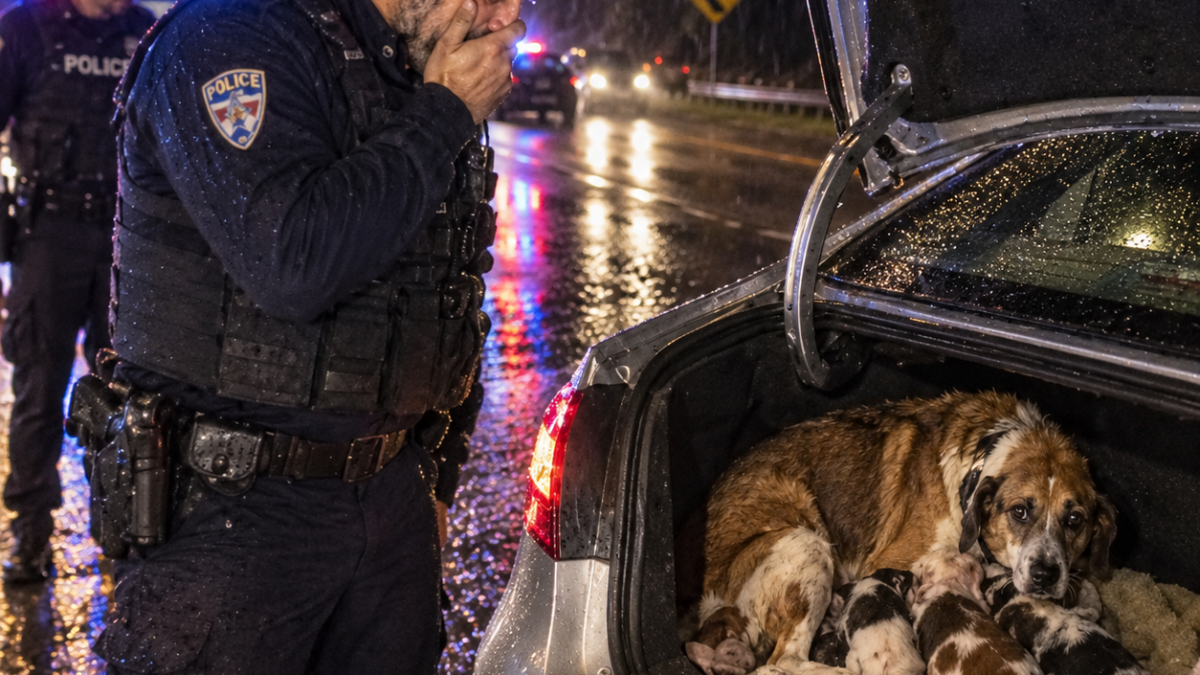
PART 2
The veterinary team arrived nineteen minutes later.
I know because I looked at my watch at least six times.
Nineteen minutes normally meant nothing.
That night it felt like an hour.
The smallest puppy remained still against his mother.
His ribs moved only slightly.
I kept watching his chest.
Up.
Down.
Pause.
Up again.
Every breath felt borrowed.
Damien had become louder behind us.
“You can’t take my dogs.”
Julien kept him several yards from the vehicle.
“You need to stay where you are.”
“They’re mine.”
Julien’s voice hardened.
“Then you’ll have plenty of opportunity to explain their condition.”
Damien laughed.
“You people are unbelievable.”
I looked back once.
“What’s unbelievable?”
His eyes shifted toward me.
“You’re acting like they’re people.”
“No.”
I stood.
“I’m acting like they’re alive.”
The veterinary van pulled onto the shoulder.
A woman in rain gear climbed out first.
Dr. Élodie Martin.
I knew her by reputation but had never worked with her directly.
She moved quickly without looking hurried.
That distinction matters around frightened animals.
Two technicians followed carrying a warming crate, towels, bowls and medical equipment.
Élodie crouched several feet from the trunk.
The mother’s head lifted.
“Good girl,” Élodie said softly.
The dog tightened around the puppies.
“She’s guarding them.”
“She hasn’t growled.”
“Doesn’t mean she won’t if we rush.”
Élodie placed a little wet food near the edge of the trunk.
The mother sniffed.
Did nothing.
Élodie waited.
No reaching.
No staring directly into her eyes.
Rain tapped against the car roof.
Finally, hunger won.
The dog stretched her neck forward and took one bite.
Then another.
Élodie inched closer.
“Easy.”
The mother froze but didn’t retreat.
A few minutes later, Élodie slipped a leash gently around her neck.
The dog’s body went rigid.
“You’re okay.”
The puppies began whining.
The mother turned toward them.
“We’re keeping everyone together.”
The first puppy came out wrapped in a towel.
The black female with the white chin.
Weak, but responsive.
The tan male followed.
Then the brown-and-white female.
When Élodie lifted the black-and-tan puppy, her expression changed.
“His temperature is low.”
“In a closed trunk?”
“A starving puppy can become hypothermic even when the surrounding environment isn’t cold. He doesn’t have reserves.”
She tucked him immediately against warming material.
The mother struggled to follow.
We carefully guided her down.
For a second, she tried to stand.
Her legs shook.
Then folded.
Élodie caught her.
“Easy, mama.”
The dog looked toward the crate.
Her puppies.
Even barely able to support herself, she pulled toward them.
A technician moved the crate close.
The mother pressed her nose against it.
The smallest puppy moved one paw.
That tiny movement released something in me I hadn’t realized I was holding.
I exhaled.
“They’re leaving now,” Élodie said.
“I’ll meet you there.”
She shook her head.
“You have a scene.”
She was right.
I hated that she was right.
Julien caught my expression.
“We finish this properly.”
I nodded.
The veterinary van pulled away.
The mother’s face disappeared behind the rear window.
Damien watched it leave.
Then muttered, “This is ridiculous.”
I turned toward him.
“Do you understand how close that puppy is to dying?”
He shrugged.
That shrug would stay with me longer than almost anything else.
People expect cruelty to look dramatic.
Anger.
Violence.
Screaming.
Sometimes it looks like indifference.
A shrug while a living thing struggles to breathe.
We continued the roadside procedure.
Damien’s breath test confirmed what his driving and behavior had already suggested.
He was well beyond the level at which he should have been operating a vehicle.
His sedan was secured.
The trunk photographed in detail.
Dirty towels.
Urine stains.
No food.
No water.
No ventilation beyond whatever air leaked through the car.
We documented the interior temperature as soon as possible.
Photographed the dents.
Recorded Damien’s statements.
Then the story began changing.
At first, he said he was taking the dogs to a friend.
“What friend?”
“Just someone I know.”
“Name?”
He hesitated.
Then provided one.
Julien wrote it down.
“Address?”
Another pause.
“I don’t know the exact number.”
“You’re driving five dogs to a friend whose address you don’t know?”
Damien became irritated.
“Someone was going to meet me.”
“Where?”
“At a place.”
“What place?”
He swore.
Minutes later, he said he was taking the puppies to people who wanted to buy them.
Then he said he hadn’t sold them yet.
Then the mother supposedly belonged to someone else.
Each explanation contradicted the previous one.
Alcohol does strange things to a person’s ability to maintain a lie.
Still, contradictions were not enough by themselves.
We needed facts.
When the tow truck arrived, I watched the sedan disappear.
For a moment I thought about that trunk closing again.
I knew it was empty.
Still, the sound of the tow operator shutting it made my stomach twist.
Julien noticed.
“You should go to the clinic.”
“We still have paperwork.”
“We have tomorrow.”
“It’s already tomorrow.”
He checked the time.
“Good point.”
I looked toward him.
“You sure?”
“Yes.”
Then he added, “Before you make me listen to you ask about that puppy every five minutes.”
I drove directly to the emergency veterinary clinic.
The rain had weakened by then.
The waiting room was nearly empty.
Élodie met me near a set of double doors.
“How are they?”
“The mother is severely underweight and dehydrated. She has parasites. I suspect chronic nutritional neglect.”
“The puppies?”
“Three are weak but stable.”
“And the smallest?”
She looked toward the treatment room.
“We’re still working.”
“Is he dying?”
“He’s critical.”
My chest tightened.
“What are you doing?”
“Warming him gradually. Fluids. Glucose support. Careful monitoring. We don’t want to overwhelm him.”
“Can I see him?”
“Through the glass.”
I followed her.
The puppy lay inside a heated unit.
Tiny.
Black and tan.
A technician’s hand was larger than his entire torso.
I had seen human beings in conditions that should have prepared me for this.
It didn’t.
Something about an animal that young being so close to death felt indecent.
He hadn’t lived long enough to understand why life hurt.
“Does he have a chance?”
Élodie crossed her arms.
“Yes.”
I looked at her.
“But?”
“I won’t lie to you.”
“Please don’t.”
“He may not make it through the night.”
Behind us, another technician carried the mother past.
She had an IV line.
Her eyes were still searching.
“Can she see the puppies?”
“We’re keeping them close whenever medically safe. It helps everyone.”
The mother looked at me.
I recognized the same expression from the trunk.
Watchful.
Exhausted.
Protective.
“Does she have a name?”
“Nothing came with her.”
I almost said Hope immediately.
Then stopped.
Naming her felt like assuming ownership of a story that wasn’t mine.
Élodie must have read my face.
“You can suggest one.”
“Hope.”
She smiled.
“Subtle.”
“I’m tired.”
“Hope works.”
The black female became Pepper.
The tan male, Milo.
The brown-and-white pup, Rosie.
The smallest became Finn.
I don’t know why Finn.
The technician suggested it.
Everyone agreed.
Finn.
A name is a strange kind of commitment.
Minutes earlier he had been “the smallest puppy.”
Now he was Finn.
It became harder to imagine losing him.
I stayed until nearly four.
Élodie finally told me to go home.
“You’re not helping by staring.”
“I’m supervising.”
“You’re emotionally supervising.”
“That sounds official.”
“It isn’t.”
I drove home.
My wife Sophie was awake.
She knew me too well.
I entered the kitchen.
She took one look at me.
“What happened?”
“Drunk driver.”
“That’s not all.”
I sat.
“There were dogs in his trunk.”
Sophie didn’t interrupt.
I told her everything.
The mother.
Four puppies.
Damien’s shrug.
Finn.
When I finished, she stared at the table.
“Do they think the puppy will live?”
“They don’t know.”
I rubbed my hands together.
“I keep thinking about the sound.”
“What sound?”
“The scratch.”
Sophie looked at me.
“If you hadn’t heard it?”
“I know.”
“You did hear it.”
“What if Julien hadn’t?”
“But you both did.”
“What if Damien hadn’t swerved?”
“Stop.”
I looked at her.
“Stop building endings that didn’t happen.”
She reached across the table.
“You stopped the car.”
I closed my eyes.
“You opened the trunk.”
She squeezed my hand.
“They’re getting care.”
That was what happened.
Not the thousand versions where we arrived too late.
At 7:12 in the morning, my phone rang.
Élodie.
I answered before the second ring.
“Finn?”
“He’s alive.”
I sat up.
Sophie opened her eyes.
“He’s warmer. Blood sugar is better. Still critical.”
“He ate?”
“A very small amount with assistance.”
I covered my face.
“What about Hope?”
“She ate breakfast.”
I laughed.
A tired, ridiculous laugh.
“Good.”
“Get some sleep.”
“I’ll come by later.”
“I knew you would.”
When I returned to the clinic, Hope looked slightly different.
Still painfully thin.
Still weak.
But cleaner.
The veterinary team had removed dirt from her coat.
Beneath the grime, the brown patches looked almost copper-colored.
The puppies lay beside her.
Finn remained under extra monitoring, but he had been stable enough for brief contact with his mother.
Hope licked his face.
Finn squeaked.
That sound almost broke me.
A squeak.
Louder than the whisper from the trunk.
Élodie stood beside me.
“He complains now.”
“Excellent.”
“You have very low standards.”
“My standard yesterday was breathing.”
“Fair.”
The investigation expanded that afternoon.
Damien’s address had been confirmed.
With the appropriate legal authority, animal-welfare investigators and police searched the property.
I was not first through the door.
By the time I arrived, several things had already been photographed.
Old outdoor pens.
Filthy bedding.
Empty food containers.
Bowls with stagnant water.
Feces.
Medication bottles not prescribed for any current animal registered there.
And evidence Hope had not been his first litter.
A neighbor spoke with us.
“Yes, I’ve heard puppies there before.”
“How long?”
“Different times.”
“Did you ever see them?”
“Sometimes.”
“What condition?”
The neighbor hesitated.
“Thin.”
“Did you report it?”
“No.”
“Why?”
Another hesitation.
“I didn’t want trouble.”
That answer stung.
I understood it.
People fear conflict.
They fear being wrong.
Fear retaliation.
Fear becoming involved.
But every neglected animal lives inside the space created by someone else’s reluctance to look.
“Did you see Hope?”
The neighbor looked at the photograph.
“Yes.”
“When?”
“A few weeks ago.”
“Did she look like this?”
He looked away.
“She was thin.”
“How thin?”
“Too thin.”
I wrote it down.
Another neighbor told us Damien had been advertising puppies online.
Investigators obtained the relevant records through proper process.
Messages.
Photos.
Potential buyers.
And one sentence that made my stomach turn.
A buyer had asked why the puppies looked small.
Damien had replied:
“They’ll fill out after you take them. Feeding the mother more just eats the profit.”
I read it twice.
Julien stood beside me.
“You okay?”
“No.”
He read the message.
His jaw tightened.
“Save the anger for later.”
“I know.”
“Document first.”
“I know.”
The messages helped create a timeline.
Hope’s condition had not developed overnight.
The puppies’ poor weight had been noticed.
Concern had been raised.
Veterinary care had not been sought.
Instead, Damien had apparently tried to move the puppies quickly.
The drunk-driving stop had interrupted that plan.
I began to understand something ugly.
We had not rescued five dogs from one reckless car ride.
We had interrupted weeks, maybe months, of neglect.
That made the trunk feel different.
At first, I had imagined it as the worst thing that happened to Hope.
Eventually I realized the trunk was simply where we happened to discover her.
The real suffering had begun long before.
Hope improved more slowly than the puppies.
Finn surprised everybody.
By the fifth day, he was eating on his own.
Not enough.
But voluntarily.
On day seven, I visited after work.
A technician grinned when I entered.
“You need to see your criminal.”
“My what?”
She led me to the puppy area.
Finn was standing.
Actually standing.
His legs trembled slightly.
He saw the technician.
Then tried climbing over another puppy to reach her.
I laughed.
“That’s him?”
“That is Finn.”
“He looks bigger.”
“He gained weight.”
Finn stumbled.
Got up.
Then attacked the corner of a towel.
Élodie appeared behind me.
“Your critical patient has become annoying.”
“Perfect.”
“You say that now.”
“I mean it.”
Finn released the towel and barked.
A tiny, squeaky bark.
I stared.
Élodie laughed.
“You’re going to cry.”
“No.”
“You are.”
“I have allergies.”
“In a veterinary clinic?”
“Extremely specific allergies.”
She walked away smiling.
Hope’s emotional recovery took longer.
When male staff approached too quickly, she sometimes flattened herself.
No growling.
No snapping.
She simply made her body smaller.
That behavior stayed with me.
Fear that learned silence.
I started visiting out of uniform when possible.
I sat several feet from her kennel.
Sometimes I spoke.
Sometimes not.
I never put my hand inside unless she approached.
The first week, Hope mostly ignored me.
The second, she began sniffing in my direction.
One evening I sat beside the kennel eating a terrible vending-machine sandwich.
Hope walked forward.
Her nose twitched.
“You want this?”
Tail movement.
“Absolutely not. You deserve better food than I do.”
She sat.
I offered an approved treat instead.
Hope took it from my palm.
Very gently.
Then backed away.
“Good girl.”
The next visit she came faster.
After that, she let me touch her forehead.
One stroke.
Then two.
No miracle.
No sudden transformation.
Trust arrived in fractions.
I liked it better that way.
Real.
The puppies changed almost daily.
Pepper became bold.
She barked at everything.
Milo discovered sleeping.
Rosie followed technicians like a tiny shadow.
Finn developed an obsession with shoelaces.
Mine especially.
“You almost died,” I told him one afternoon as he attacked my boot.
Finn pulled harder.
“You could show respect.”
Élodie walked past.
“He owes you nothing.”
“I opened the trunk.”
“He doesn’t remember.”
“Convenient.”
Finn growled playfully.
I let him win the lace.
Élodie was right.
Rescued animals do not owe rescuers gratitude.
They do not owe lifelong obedience.
They do not need to remain symbols of suffering.
The goal is to make the rescue so complete they become ordinary animals again.
Finn was becoming very ordinary.
That made me happy.
The legal process was less satisfying.
Slow.
Detailed.
Frustrating.
Damien faced impaired-driving consequences first.
The evidence there was straightforward.
The animal case required additional work.
Who legally owned Hope?
How long had Damien been responsible for her?
Who bred her?
Had anyone else participated?
What exactly did the veterinary evidence establish?
Could malnutrition be blamed on disease?
Élodie documented everything carefully.
Parasites contributed.
Lactation contributed.
But neither explained the total picture without inadequate nutrition and care.
Hope had been feeding four puppies while starving herself.
The puppies also showed signs of insufficient care.
The trunk conditions added another layer of risk.
I wanted everything resolved immediately.
Instead, weeks passed.
Then months.
During that time, the rescue organization obtained temporary legal custody of the dogs.
They moved from emergency hospitalization into foster care.
The puppies stayed together initially.
Hope went with them.
Their foster, Marie, had years of experience with nursing mothers and frightened dogs.
I visited the first weekend.
Her home sat outside town with a fenced yard.
Hope stepped onto grass.
Stopped.
Then smelled everything.
Trees.
Wind.
Wet soil.
The puppies exploded behind her.
Pepper ran left.
Milo fell over.
Rosie chased Pepper.
Finn ran straight into Hope’s back leg.
Hope corrected him with one sharp bark.
Finn froze.
I laughed.
“Mother has returned.”
Marie smiled.
“She’s getting more confident.”
Hope walked toward the edge of the yard.
Sunlight hit her coat.
For a second I remembered the trunk.
Dark metal.
Dirty towels.
No space.
Then Hope stretched out in the grass.
Full body.
Belly down.
Eyes half closed.
Nothing dramatic happened.
That became one of my favorite memories.
Space.
She had space.
The puppies gained weight quickly.
At each follow-up appointment, Finn’s number climbed.
Élodie showed me his chart.
“See?”
“I don’t know what I’m looking at.”
“You ask me for updates constantly.”
“Then interpret it.”
“He’s doing very well.”
“Those are excellent medical words.”
“They are not medical words.”
“They are today.”
She shook her head.
Hope’s bloodwork improved too.
Her parasite treatment worked.
Muscle returned slowly.
The sharpness along her hips softened.
Her coat grew glossy.
People seeing photographs struggled to believe it was the same dog.
That bothered me slightly.
“She’s beautiful now,” someone said.
Now.
As though thin Hope had been less worthy.
I began correcting people.
“She was worth saving before she looked healthy.”
Some understood.
Some looked confused.
Beauty was never the point.
She mattered when she smelled of urine and fear.
She mattered when ribs showed.
She mattered before we gave her a name.
That lesson changed the way I saw many things.
Police work teaches you to make fast judgments.
You have to.
Threat.
No threat.
Cooperative.
Not cooperative.
Safe.
Unsafe.
But worth is different.
Worth cannot be assessed by condition.
Hope had looked broken.
She had never been worthless.
Finn had looked almost dead.
He had already been someone.
The case finally reached a formal hearing months later.
I wore a uniform.
Élodie brought records.
Julien brought the patience I was lacking.
Damien looked healthier than the night we stopped him.
Sober.
Clean shirt.
Hair combed.
That was strangely difficult.
Part of me had expected the outside of him to match the ugliness of what we had found.
It didn’t.
People can look ordinary while doing terrible things.
That is more frightening than monsters.
The impaired-driving case had already moved forward through its own process.
Now animal neglect was addressed separately.
I testified first.
Only what I knew.
The vehicle.
Driving.
Damien’s condition.
The sound.
Opening the trunk.
The dogs.
No water.
No food.
His statements.
“They’re just dogs.”
His lawyer asked, “Was my client violent toward the animals in your presence?”
“No.”
“Did you see him strike any dog?”
“No.”
“Kick one?”
“No.”
“Physically injure one?”
“No.”
“So you did not personally witness abuse.”
I paused.
“I personally witnessed five animals locked in his trunk without appropriate food, water or safe transport conditions. One required urgent veterinary treatment.”
The lawyer nodded.
“But you cannot testify to how they came to be underweight.”
“Correct. That’s for the medical evidence and investigation.”
I refused the trap.
I was angry.
But anger was not my role.
Facts were.
Élodie followed.
She described Hope’s body-condition score.
Dehydration.
Parasites.
Evidence of prolonged inadequate nutrition.
The puppies’ weights.
Finn’s hypothermia.
Why his condition had been urgent.
The lawyer asked, “Could parasites have made them thin?”
“They contributed.”
“So malnutrition does not prove neglect.”
“No single finding proves the entire case.”
“Then you cannot say lack of food caused their condition.”
Élodie remained calm.
“I can say their nutritional condition was inconsistent with adequate feeding and care, and that veterinary intervention was medically necessary.”
“Could the mother’s condition result from nursing four puppies?”
“Lactation increases nutritional demand.”
“So yes?”
“If that increased demand is not met with adequate calories, the mother loses body condition.”
The lawyer stopped.
Élodie added, “That is precisely why adequate feeding matters.”
Julien leaned toward me.
“Remind me never to argue with veterinarians.”
I almost smiled.
The messages became important later.
Feeding the mother more just eats the profit.
The defense argued context.
Maybe Damien was joking.
Maybe someone else had cared for the dogs part of the time.
Maybe the messages were exaggeration.
But the veterinary evidence existed independently.
The trunk existed.
The photographs existed.
Witnesses existed.
The stories began aligning.
The final outcome did not come with dramatic music.
No confession.
No courtroom shouting.
Damien was found responsible under the relevant animal-welfare process and faced penalties and restrictions related to owning or caring for animals for the period ordered.
Combined with the impaired-driving consequences, his choices now existed in official records.
The dogs would not go back to him.
That was the sentence I cared about.
“They’re safe?”
“Yes.”
“Legally?”
“Yes.”
I walked outside.
Rain had started.
Not heavy.
Nothing like that first night.
Julien joined me.
“You wanted more.”
I looked at him.
“What?”
“You have the face.”
“What face?”
“The one that says the universe didn’t punish someone enough for you.”
I laughed once.
Then stopped.
“Maybe.”
He leaned against the wall.
“What would be enough?”
I had no answer.
Making Damien hungry?
Locking him in darkness?
Making him afraid?
That would not feed Hope.
It would not give Finn back the night he nearly died.
Revenge could not undo.
Consequences mattered.
Protection mattered.
Prevention mattered.
Pain returned for pain was smaller.
I looked at Julien.
“I want them to have good lives.”
He nodded.
“That part we can do.”
The puppies became available for adoption first.
Pepper left with a family with two teenage daughters.
She picked them almost immediately.
One daughter sat on the floor.
Pepper climbed into her lap.
Decision made.
Milo went to a retired couple.
He discovered their couch within an hour and apparently never emotionally recovered from being asked to get off it.
Rosie went to a teacher named Camille.
Within days, Rosie followed her everywhere.
Bathroom included.
Camille sent a photograph captioned:
I have lost all privacy.
Finn took longer.
Not because nobody wanted him.
Because everyone wanted the story.
The smallest puppy.
The survivor.
The one who nearly died in the trunk.
People loved that.
The rescue did not.
They wanted someone who wanted Finn.
Actual Finn.
Chews shoes.
Climbs furniture.
Barks at reflections.
High energy.
Needs training.
Will not spend his life looking grateful.
One applicant said, “I think after everything he survived, he’ll understand how lucky he is.”
Marie smiled politely.
After they left, she said, “No.”
“Too much?”
“Way too much.”
Finn needed people prepared to raise a dog, not worship a tragedy.
Then the Laurent family came.
Their teenage son sat on the floor without calling Finn.
Finn approached.
Stole his glove.
Ran.
The boy laughed.
His father chased Finn once.
Finn became more excited.
His mother asked practical questions.
Food.
Vaccinations.
Training.
Insurance.
Neutering.
Exercise.
Fear responses.
Not once did she say “poor baby.”
I liked her immediately.
Finn went home with them.
A month later, they sent a video.
Finn running through a yard.
Full speed.
He tripped over his own feet.
Rolled.
Got up.
Kept running.
I watched it three times.
Then once more.
The puppy who could not lift his head had extra energy to waste.
That was revenge.
Not Damien’s suffering.
Finn’s abundance.
Hope remained.
Adult dogs take longer.
Adult dogs with fear histories sometimes longer still.
She had applications.
Some homes were too chaotic.
Some wanted immediate affection.
One family had several small children who moved loudly.
Hope was not aggressive.
Still, the match felt wrong.
Marie never rushed.
“She waited long enough for people to do right by her.”
So we waited too.
I visited often.
Too often, according to Sophie.
“You’ve seen that dog more this month than your brother.”
“My brother lives three hours away.”
“And the dog?”
“Twenty minutes.”
“Exactly.”
One Saturday, Sophie came with me.
Hope met her in the yard.
At first, she kept distance.
Sophie ignored her.
Sat on a bench.
Talked to Marie.
Ten minutes later, Hope came closer.
Sniffed Sophie’s shoe.
Then hand.
Then knee.
Sophie still didn’t reach.
Hope sat beside her.
I saw the exact moment my life became more complicated.
Sophie looked at me.
“Oh.”
“No.”
“I said nothing.”
“Your face said everything.”
Hope lowered her head onto Sophie’s thigh.
Marie smiled.
“She’s never done that with a first-time visitor.”
“No.”
Sophie stroked Hope once.
Hope stayed.
“No.”
Sophie looked at me.
“We need to talk.”
Three weeks later, Hope came home.
Julien was unbearable.
“I thought you weren’t attached.”
“I wasn’t.”
“You adopted evidence.”
“She is not evidence.”
“Exactly. She’s your dog.”
I hung up on him.
Hope’s first weeks with us were quiet.
We gave her one room as a safe place.
Bed.
Water.
Food.
Door open.
No pressure.
She explored at night more than during the day.
Sophie would wake and find a toy moved.
A blanket shifted.
Hope had walked through the house while we slept.
During daylight, she was cautious.
The first time the doorbell rang, she disappeared into her room.
The first time I came home wearing full duty gear, she froze.
I stopped immediately.
“Hope.”
Her ears went back.
I crouched sideways.
No direct reach.
She watched.
Then moved away.
I changed clothes.
Twenty minutes later, she approached me in the kitchen.
I sat.
Hope touched her nose to my wrist.
Then pushed her head under my hand.
“Okay.”
I stroked her.
“You set the schedule.”
Little by little, the house became hers.
Week one: safe room.
Week two: hallway.
Week three: couch.
Week four: discovered kitchen.
That was dangerous.
Hope developed opinions about food.
Strong opinions.
For a dog who had once been starved, she became remarkably selective.
Sophie served high-quality food.
Hope sniffed.
Looked up.
Walked away.
“You have got to be kidding.”
Sophie added a little chicken.
Hope returned.
“You’re rewarding extortion.”
Sophie glared.
“She deserves it.”
“She is manipulating you.”
Hope ate.
The dog had won.
I secretly loved every second.
A starving dog becoming picky is one of the most beautiful forms of recovery I know.
Hope gained healthy weight.
Her shoulders filled.
Ribs disappeared.
She still had a lean athletic body, but not the hollow one from the trunk.
Her coat shone.
She loved sunlight.
Every morning she found the brightest patch on the floor.
Then moved with it as the sun shifted.
Sophie bought her a bed.
Hope ignored it.
Preferred the rug.
We moved the bed.
Hope moved to another rug.
Dogs are humbling.
Months later, Finn visited.
He was almost adult-sized.
All legs.
No coordination.
The Laurent family brought him into our yard.
Hope stood.
Finn froze.
For a second, nobody moved.
Then Finn ran toward her.
Hope barked sharply.
Finn stopped so fast he nearly fell.
I laughed.
“Mother still has authority.”
Finn approached again.
Slowly.
Hope sniffed him.
His ears.
Face.
Neck.
Then her tail moved.
Finn exploded with excitement.
Hope tolerated perhaps thirty seconds before walking away.
Finn followed.
Of course.
By afternoon, they slept in the grass.
Several feet apart.
I took one photograph.
Hope awake.
Finn on his side.
Sunlight across both.
That photograph replaced the trunk in my mind.
Not completely.
Some images never leave.
But memories compete.
You can choose which ones you feed.
I fed that one.
The legal case ended.
Life continued.
That is another thing stories often skip.
After court, nobody plays music.
You go grocery shopping.
Work shifts.
Pay bills.
Take the dog to the veterinarian.
Hope gets diarrhea because she stole food.
Finn’s family sends a message because he ate half a slipper.
Ordinary life resumes.
That was exactly what I wanted.
One year after the traffic stop, Élodie organized a reunion.
All four puppies.
Hope.
Families.
Julien came because I threatened him.
He claimed he came for free food.
Pepper arrived first.
Confident.
Beautiful.
Milo arrived overweight.
Élodie looked at his owners.
“He needs a diet.”
The retired man looked offended.
“He’s big-boned.”
Milo had no defense.
Rosie arrived attached to Camille’s leg.
Finn came last.
He jumped out of the car before anyone was fully prepared.
The yard became chaos.
Hope stood in the middle.
Four adult-sized children moving around her.
She looked exhausted by motherhood all over again.
Sophie laughed.
“This may be the first time she regrets surviving.”
Hope came and stood behind me.
“Coward.”
She leaned against my leg.
Pictures were taken.
Not staged perfectly.
Nobody lined dogs up in matching collars.
Real pictures.
Finn looking away.
Pepper sniffing grass.
Milo sitting on someone’s foot.
Rosie blinking.
Hope slightly apart.
I loved them.
At one point Julien stood beside me.
“Five.”
I nodded.
“Five.”
He looked at Finn.
“That little one?”
“Yep.”
“Damn.”
Finn ran past carrying a plastic cup he had stolen.
Julien laughed.
“Worth the paperwork.”
“Almost.”
We never forgot Damien entirely.
I wish I could say once the legal outcome came, I never thought of him again.
Not true.
Every drunk-driving stop brought pieces back.
Gray sedan.
Rain.
Trunk.
Sometimes I smelled wet fabric and instantly remembered urine and fear.
One night, two years later, I stopped another impaired driver.
No animals.
No hidden passengers.
Routine.
Afterward I stood beside my patrol car longer than necessary.
Julien called.
“You okay?”
“How do you know?”
“You sound weird.”
“I’m fine.”
“You are a terrible liar.”
I looked at the empty road.
“I remembered.”
He knew.
“You opened that trunk.”
“I know.”
“They lived.”
“I know.”
“Go home to Hope.”
That became my grounding point.
Not what nearly happened.
What did.
I went home.
Hope met me at the door.
Tail wag.
Then she brought me a toy.
A ridiculous stuffed fox.
I sat on the floor.
She placed it in my lap.
“Bad night.”
Hope pushed the toy toward me.
“Your emotional support skills are weak.”
Tail wag.
I threw it.
She ran.
Better.
Hope taught me something else about revenge.
For months after the case, I wanted Damien to understand what he had almost destroyed.
I imagined forcing him to see pictures.
Hope healthy.
Finn running.
Pepper with the girls.
Milo asleep on a couch.
Rosie following her teacher.
I wanted him to feel loss.
Then eventually I stopped caring whether he understood.
That was freedom.
If your healing depends on the person who caused harm finally recognizing the harm, they still control part of the ending.
Hope did not need Damien’s regret.
Finn did not need his apology.
Their lives were already happening without him.
That became the final punishment I could live with.
Irrelevance.
He became a name in an old case file.
They became family.
Years passed.
Pepper grew up beside the teenage girls.
One went to university.
Pepper slept outside her old bedroom for days after she left.
When the girl returned for holidays, Pepper lost her mind with joy.
Milo’s retired owners bought steps so he could climb onto the couch despite arthritis.
Rosie went to school occasionally for supervised reading programs.
Children who struggled with reading aloud sat beside her.
She never corrected pronunciation.
Finn remained Finn.
His family sent annual videos.
Finn chasing leaves.
Finn barking at a vacuum.
Finn stealing an entire baguette from a kitchen counter.
Finn falling asleep upside down.
Hope watched some of the videos with no visible interest.
I watched all of them.
Every ordinary update felt like proof.
The story was no longer about rescue.
It was about years.
That matters.
A dog is not saved for the photograph taken after treatment.
A dog is saved for everything boring afterward.
Vaccinations.
Nail trims.
Rainy walks.
Being annoyed when dinner is ten minutes late.
Sleeping through Sunday afternoon.
Aging.
That is the real ending.
Hope began aging before I was ready.
Gray hairs along her muzzle.
Then more.
Sophie noticed first.
“She’s getting white.”
“No.”
“She is.”
“She’s not old.”
Sophie raised an eyebrow.
“We’ve had her seven years.”
“That seems incorrect.”
Hope yawned.
The puppies aged too.
Finn’s family sent a birthday photograph one year.
Gray around his face.
I stared.
“He’s the baby.”
Sophie laughed.
“He is not.”
“He almost died.”
“That does not stop aging.”
It should have.
Emotionally.
But aging became another victory.
Finn got arthritis.
That was unfair and wonderful.
A puppy who nearly had no future developed old-dog joints.
Pepper needed a dental cleaning.
Milo went on a diet.
Rosie’s hearing faded.
These were problems we had once begged life to allow them enough years to have.
I learned to stop calling age sad automatically.
Age is expensive.
Inconvenient.
Sometimes painful.
But there is privilege in reaching it.
Hope reached ten.
Then eleven.
Maybe older.
Her exact age had always been estimated.
She slowed on walks.
No longer wanted long routes.
We adjusted.
She loved the backyard.
Sun patches.
Kitchen.
Our bed had remained technically forbidden.
Technically.
One winter night, thunder woke her.
Hope stood beside us trembling.
Sophie lifted the blanket.
“Come.”
Hope climbed onto the bed.
I said, “We said no dogs.”
Sophie said, “We said that eight years ago.”
Hope curled between us.
Rules evolve.
By morning, my back hurt.
Hope looked fantastic.
Élodie continued being her veterinarian.
One annual exam, she listened to Hope’s heart.
“You know what I remember?”
“The trunk.”
“Yes.”
Hope stood calmly on the table.
Élodie rubbed her shoulder.
“She wouldn’t let us touch her without watching every movement.”
“Now she lets you put a thermometer—”
“Don’t ruin the moment.”
I laughed.
Bloodwork showed early kidney changes.
Nothing catastrophic.
We changed diet.
Hope objected.
Food became negotiations again.
“Medical diet.”
Hope stared.
“Very expensive.”
No movement.
“Approved by Élodie.”
Hope walked away.
Sophie added chicken.
Hope returned.
“This animal has no respect for science.”
Élodie later said, “Get the calories in while balancing the kidney plan.”
Hope won again.
Finn died first.
Thirteen, according to his family’s best estimate.
Kidney disease and age.
They chose euthanasia after his good days disappeared.
The family called us afterward.
The teenage boy who had let Finn climb onto his back was now a grown man.
His voice broke on the phone.
“He was impossible.”
I smiled through tears.
“From the beginning.”
“He stole my glove the first day.”
“I remember.”
“He stole things until last year.”
“Consistent.”
Silence.
Then he said, “Thank you for opening that trunk.”
I had no answer.
Eventually I said, “Thank you for giving him the years after.”
That mattered more.
After the call, I sat beside Hope.
She was sleeping in sunlight.
I touched her shoulder.
“Finn’s gone.”
Her ear moved.
She could not know.
I remembered him pressed against her belly.
Too weak to lift his head.
Then running.
Stealing.
Aging.
Dying loved.
That arc was almost too much to hold.
I cried.
Hope woke.
Looked at me.
Then placed one paw on my shoe.
Sophie found us like that.
She sat too.
Nothing needed saying.
Hope declined slowly after that.
Kidneys.
Arthritis.
Hearing.
Old-dog things.
She still barked at delivery drivers.
Still demanded chicken.
Still preferred the wrong bed.
Then one day, she stopped barking at a package.
I noticed.
Sophie did too.
“Maybe she didn’t hear.”
“Maybe.”
The next package.
Nothing.
Hearing loss.
We adapted.
Hand signals.
Approach from where she could see us.
Floor vibrations.
Touch.
Hope never minded touch anymore.
That alone would have seemed impossible during the first months.
One evening I came home late.
Hope was sleeping.
I crouched in front of her so she would see me when she woke.
Her eyes opened.
Recognition.
Tail wag.
Slow but certain.
That tail became my measure.
Food.
Comfort.
Interest.
Us.
When those remained, life remained good.
Then kidneys worsened.
Medication for nausea.
Fluids.
Diet adjustments.
Hope rallied.
Several more months.
One spring morning, she walked outside slowly and lay in the grass.
Exactly like that first foster-yard day.
Full body stretched in sunlight.
I sat beside her.
“You remember this?”
Hope closed her eyes.
“Probably not.”
I touched her back.
“I do.”
Dark trunk.
Then grass.
Fear.
Then sunlight.
A whole lifetime between.
The final decline came in autumn.
Hope stopped finishing meals.
Then needed help standing.
She still wanted outside.
Still leaned into us.
Then one morning, chicken failed.
Hope sniffed it.
Turned away.
I looked at Sophie.
We both knew.
Élodie came that afternoon.
Examined Hope at home.
Sat with us.
“She’s tired.”
“Pain?”
“Manageable right now.”
“Can we give her another week?”
Élodie’s expression was gentle.
“Maybe.”
The word hurt.
“But?”
“Ask who the week is for.”
I looked at Hope.
That was the question.
For her?
Or us?
We waited two days.
Both mixed.
Hope ate a little one morning.
Walked into the garden.
Tail wag.
Good hours.
Then the next day, nothing.
No breakfast.
No interest in outside.
She lifted her head when Sophie entered.
Then lowered it.
I called Élodie.
“Today.”
Saying it made my voice break.
We moved Hope’s bed outside.
Late-afternoon sun.
Soft wind.
No rain.
Sophie sat beside her.
I brought the old stuffed fox.
Hope had not played with it in years.
She sniffed.
Nothing.
I placed it nearby anyway.
Élodie arrived with her bag.
No urgency.
That was the gift.
No roadside.
No emergency.
No dark trunk.
Time.
Choice.
Comfort.
I sat beside Hope.
She looked at me.
Cloudy old eyes.
Still the same brown underneath.
I remembered my flashlight catching them for the first time.
Terrified.
Watchful.
Her body curled around puppies.
I touched her forehead.
The place she had first allowed me to stroke years earlier.
“You gave everything to those babies.”
Hope breathed slowly.
“They all got homes.”
Sophie cried.
I continued.
“Pepper had her girls.”
Another breath.
“Milo got his couch.”
Tail barely moved.
“Rosie got her teacher.”
I swallowed.
“Finn got old.”
That broke me.
“Finn got really old.”
Sophie put her hand over mine.
Hope relaxed.
“And you came home with us.”
Élodie prepared the first medication.
I whispered, “You were never just a dog.”
The phrase returned from that night.
Damien’s voice.
Just dogs.
I hated that those words remained.
So I replaced them.
“You were Hope.”
Her eyes softened.
“You were a mother.”
Another breath.
“You were Sophie’s spoiled chicken thief.”
Sophie laughed through tears.
“You were my girl.”
The sedative began working.
Hope’s body loosened.
For once, no vigilance.
No need to protect.
No reason to remain alert.
I pressed my forehead against hers.
“You don’t have to guard anyone anymore.”
Her breathing slowed.
“Everyone made it.”
That mattered.
“Your babies made it.”
I whispered again.
“You did your job.”
Élodie gave the final medication only after we nodded.
Hope died beneath open sky.
Sophie holding one paw.
My hand on her head.
Élodie beside us.
No darkness.
No fear.
No trunk.
Nothing more required of her.
Afterward, I sat there a long time.
The yard became quiet.
I expected to feel rage at Damien.
I didn’t.
That surprised me.
Years earlier, grief might have sent me back to him emotionally.
Not now.
He had become too small.
Hope’s life was too big.
He occupied one chapter.
A terrible one.
But one.
Hope had years after him.
That was the ending.
We had her cremated.
Sophie chose a simple wooden box.
No dramatic inscription.
Just:
HOPE
I placed it beside the photograph of her with Finn in the grass.
Not the trunk.
Never the trunk.
Months later, Pepper died.
Then Milo.
Rosie lived longest.
Almost fifteen.
Camille called when she went.
One by one, the five lives from that trunk ended the way lives eventually do.
Not on the road.
Not sealed in darkness.
Not because someone withheld food.
They ended after years.
Homes.
Families.
Age.
That distinction mattered more than anything.
When Rosie died, I pulled out the old case file.
Not the official evidence, which remained where it belonged.
My personal notes.
The date.
Weather.
Time.
Gray sedan.
Damien.
Scratch from trunk.
I read the first sentence I had written after the stop.
During roadside investigation, officers heard a sound consistent with an animal vocalization from the vehicle’s trunk.
Clinical language.
Correct.
Necessary.
It said nothing about how that sound felt.
How faint it was.
How close we came to ignoring it as road noise.
How everything changed because we checked.
I closed the notebook.
Sophie stood in the doorway.
“Why are you reading that?”
“Rosie died.”
She understood.
“Last one.”
“Yeah.”
She sat beside me.
For a while, we said nothing.
Then Sophie asked, “Do you regret adopting Hope?”
I laughed.
“Do I regret eight years of chicken extortion?”
“Serious.”
“No.”
Not for a second.
Even grief did not create regret.
That is one of love’s strangest truths.
You can know exactly how something ends.
You still choose it.
Because an ending does not erase the middle.
I looked at Hope’s photograph.
“Do you remember when you said she chose you?”
Sophie smiled.
“She did.”
“She ignored me for months.”
“You were scary.”
“I rescued her.”
“You wore a gun and heavy boots.”
“Fair.”
We laughed.
The case changed Julien too.
He never admitted it directly.
But years later, he adopted an elderly dog from a shelter.
A beagle named Oscar.
“You?”
He looked offended.
“What?”
“You mocked me for adopting Hope.”
“I mocked you because you pretended you weren’t going to.”
“Different.”
Oscar lived with him five years.
When the dog died, Julien called.
His voice sounded terrible.
“I understand now.”
“What?”
“Why you kept going to the clinic.”
I smiled sadly.
“Yeah.”
“Dogs are stupid.”
“Oscar?”
“No. Us.”
“Also yes.”
By then I was nearing retirement.
Twelve years on patrol had become much more.
Young officers joined who had heard the trunk story before meeting me.
That was unsettling.
One asked, “Is it true you threatened the guy?”
“No.”
“He said ‘just dogs’ and you didn’t hit him?”
“No.”
The officer looked almost disappointed.
“That’s the point.”
“What?”
“Doing the job correctly.”
I sat beside him.
“You can hate what you see. But if you make the scene about your anger, you risk damaging the case.”
He nodded.
“Evidence first.”
“Always.”
“Then revenge?”
I looked at him.
“No.”
He smiled, thinking I was joking.
I wasn’t.
“Accountability. Protection. Prevention.”
“That sounds less satisfying.”
“It depends what you want.”
“What did you want?”
I thought about Finn running.
Hope sleeping in sunlight.
Pepper’s girls.
Milo’s couch.
Rosie beside children reading.
“I wanted the dogs to win.”
The officer said nothing.
“That’s different from needing the person who hurt them to suffer.”
I pointed toward the report on his desk.
“Your job is to build something strong enough that the system can act.”
“And after?”
“After, you hope somebody gives the victims a better life.”
Years earlier, I would not have spoken that way.
Hope changed me.
Not softer.
More precise.
Anger can be useful.
It gets you moving.
But it is poor long-term fuel.
Care lasts longer.
On my final patrol shift, Julien rode with me.
Neither of us mentioned retirement for most of the night.
Then rain began.
Same kind of rain.
Soft at first.
We drove a rural road outside Tours.
Not the exact road.
Close enough.
A gray car appeared ahead.
My body reacted before my mind.
Then the driver turned normally.
Nothing.
Julien noticed.
“You thought about it.”
“Yes.”
“Me too.”
We drove several minutes.
Then he said, “Want to stop at the place?”
“The place?”
“You know.”
I did.
We eventually reached the shoulder where I believed we had stopped Damien.
Roadwork had changed it slightly.
New markings.
Fresh drainage ditch.
Nothing commemorated the night.
Good.
I parked.
Rain tapped against the windshield.
Julien looked toward the road.
“Crazy.”
“What?”
“Five dogs in one trunk.”
“Yeah.”
“You remember the little one?”
“Finn.”
“Right.”
“He got old.”
Julien nodded.
“That’s the part.”
We sat.
No speech.
Eventually he asked, “Do you think we changed their lives?”
“Obviously.”
“No.”
He looked at me.
“Do you think they changed ours more?”
I laughed.
“That’s too sentimental for you.”
“Retirement has weakened me.”
I looked through the rain.
“Yes.”
“What?”
“Yes. They did.”
Hope changed how I understood responsibility.
Finn changed how I understood recovery.
Damien changed almost nothing by the end.
That realization felt important.
Cruelty often dominates the first chapter because it is shocking.
But it should not own the entire narrative.
The person who harms should become smaller as the lives of the harmed become larger.
That is what happened.
By retirement, if someone said “Damien,” I had to think for a second.
If someone said “Hope,” I saw her immediately.
Sunlight.
Chicken.
Her head under Sophie’s hand.
That was victory.
My retirement gift from Julien was ridiculous.
A framed photograph.
Not Hope.
Finn.
Specifically, Finn as a grown dog with an entire baguette in his mouth.
The caption underneath said:
JUST A DOG.
I stared at it.
Julien smiled.
“Too much?”
I laughed so hard I had to sit down.
“You’re an idiot.”
“You like it.”
I did.
I hung it in my home office.
Hope’s photograph remained beside it.
One dignified.
One absurd.
Perfect.
Years later, my granddaughter asked about the pictures.
“Who’s that?”
“Hope.”
“And that?”
“Her son Finn.”
“Why does he have bread?”
“Crime.”
She laughed.
Then I told her the story.
Not every detail.
Enough.
She became serious.
“Why did the man put them in the trunk?”
“Because he made a series of bad and cruel choices.”
“Did he go to jail?”
“He faced legal consequences.”
“That’s not what I asked.”
Children like simple justice.
I understood.
“The important part is the dogs didn’t go back to him.”
She thought.
“Did they all get families?”
“Yes.”
“Then they won.”
I smiled.
Exactly.
They won.
Not because the world punished Damien perfectly.
The world rarely gives perfect punishment.
They won because five lives that had been treated as disposable became irreplaceable to other people.
They won because Finn grew gray.
Hope became picky.
Pepper watched girls grow into women.
Milo got too fat.
Rosie listened to children read.
Five complete lives.
That is what someone almost threw away.
My granddaughter looked again at Finn’s bread photograph.
“He looks happy.”
“He was.”
“Hope too?”
“Very.”
“Then okay.”
There it was again.
A child finding the core faster than adults.
Then okay.
Years after that rainy stop, I sometimes wake at night and hear the scratch.
Memory does that.
One weak scrape against metal.
In the dream, I always reach the trunk.
Sometimes it opens easily.
Sometimes it won’t.
That version is the nightmare.
I pull.
Nothing.
Finn goes silent.
I wake before it opens.
Then I look across the bedroom.
Sophie asleep.
Hope’s old collar hanging near the photograph.
I remind myself.
The trunk opened.
That is the fact.
The trunk opened.
Five dogs came out.
Every one lived long enough to become someone’s grief.
That may sound strange.
But grief is proof of belonging.
Nobody mourns garbage.
Nobody rearranges their home around something worthless.
Nobody cries years later because “just a dog” is gone unless that dog became part of the structure of their life.
Damien’s sentence had tried to reduce them.
Their lives answered it.
Not just dogs.
Hope.
Pepper.
Milo.
Rosie.
Finn.
Names.
Histories.
Families.
A whole constellation of people who would never have met them if we had driven past.
That is why I keep telling the story.
Not for shock.
Not to make people hate one drunk man.
Hatred is easy.
The more important lesson is attention.
A car swerves.
You stop it.
A sound comes from somewhere it shouldn’t.
You check.
An animal looks too thin.
You ask.
A neighbor’s dog disappears.
You notice.
Someone says they can’t afford food.
You help before neglect becomes emergency.
Someone sees suffering and fears getting involved.
You remind them that silence also has consequences.
Rescue often begins long before a dramatic moment.
It begins when somebody believes discomfort is worth acting on.
I wish Hope’s neighbor had called sooner.
I wish a buyer had reported concern.
I wish Damien had asked for help instead of treating food like lost profit.
I wish Hope never entered that trunk.
But wishes do not rewrite.
Action writes the next page.
That night, ours began with blue lights.
It ended years later in sunlight.
That is the version I keep.
A mother dog pressed around four puppies in darkness.
Then, after thousands of ordinary days, an old dog asleep in a warm yard with nothing left to protect.
No babies depending on her.
No hungry body.
No man deciding whether feeding her was worth the cost.
Just Hope.
Sleeping.
Safe.
When I think about revenge now, that is the image.
Not Damien behind bars.
Not fines.
Not humiliation.
Hope asleep deeply enough that she did not hear me approach.
Because a terrified dog sleeps lightly.
A safe dog sleeps like the world can handle itself for a while.
Hope eventually learned that.
She stopped guarding every sound.
Stopped watching every door.
Stopped shrinking when footsteps came near.
She slept.
That was her revenge against fear.
Finn grew reckless.
That was his revenge against weakness.
Pepper became confident.
Milo became lazy.
Rosie became attached.
Each dog answered neglect differently.
All answers were beautiful.
There is one final memory I rarely tell.
About six months before Hope died, Sophie and I took her on a short drive to the countryside.
She could no longer walk far.
We parked near a quiet field.
Opened the back door.
Hope climbed down slowly with help.
She stood in the grass.
Wind moved through her gray muzzle.
Then she began walking.
Not toward anything.
Just forward.
Slowly.
I followed.
Sophie followed.
Hope reached a patch of wildflowers.
Stopped.
Sniffed.
Then looked back at us.
For one second, I saw the young dog in the trunk.
Same eyes.
Different world.
I crouched.
Hope walked back.
Pressed her head against my chest.
I wrapped my arms around her.
She allowed it completely.
No stiffness.
No hesitation.
Trust perfected by years.
I whispered, “We got out.”
Sophie heard.
She started crying.
Hope licked my chin.
We stayed in that field until she got tired.
Then I carried her to the car.
Not a trunk.
The back seat.
Soft blanket.
Window cracked.
Sophie beside her.
Hope fell asleep before we reached home.
That is the ending I choose.
Not the roadside.
Not court.
Not even death.
A field.
Wind.
An old dog.
A family.
A car ride home.
Because someone once said they were “just dogs.”
He was wrong in a way no punishment could explain better than their lives did.
They were five futures.
Five hearts.
Five sets of habits that would eventually be missed.
Five families waiting to happen.
And on one rainy night, we happened to hear them before silence became permanent.
That is all heroism ever was in that story.
We heard.
We opened.
We acted.
Then love did the rest.








