PART 2: I Paid $87,000 for a Mountain Cabin—Then Karen’s Family Moved In and Told the Sheriff It Was Theirs
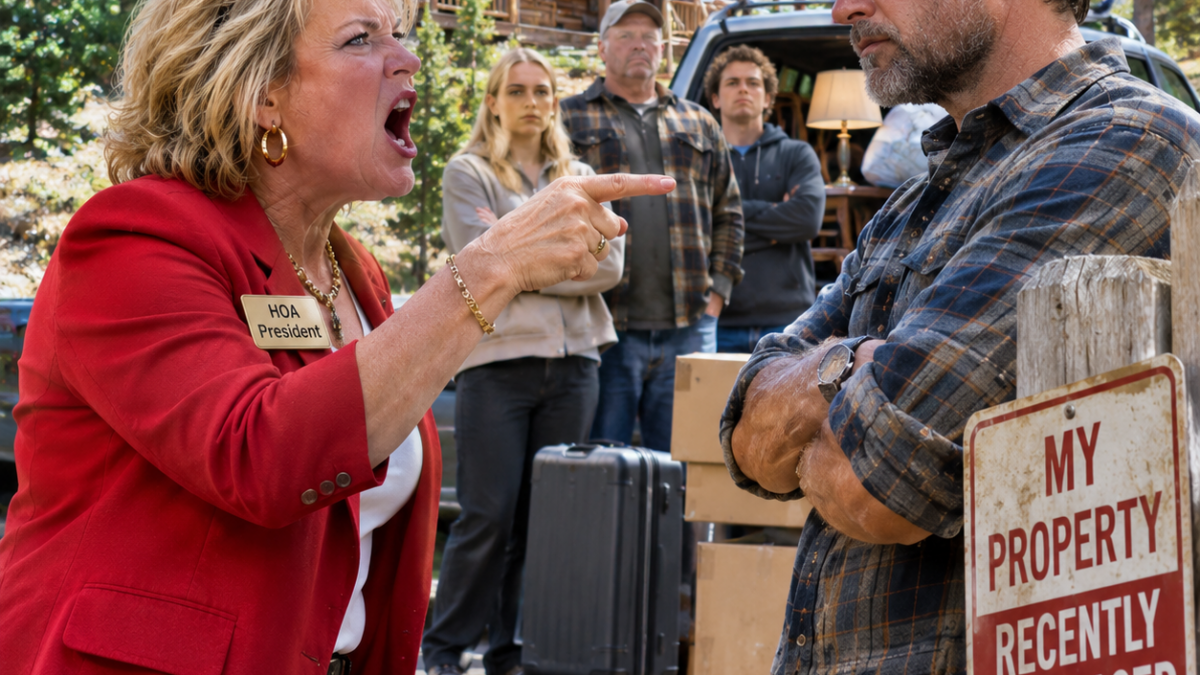
I had spent thirty years climbing frozen utility poles, taking overtime nobody else wanted, and saving every dollar I could so that one day I could buy a quiet place in the mountains, but when I finally drove five hours to see the forty-acre West Virginia property I had legally purchased for $87,000, there were three strange vehicles in my driveway, smoke coming from my chimney, children’s toys scattered across my porch, and somebody else’s curtains hanging in my windows.
Before I could even unfold the recorded deed in my hand, a blonde woman came charging out of my front door with a shotgun and screamed that I was trespassing on her family’s land, and twenty minutes later the local sheriff looked at my paperwork, shook hands with her husband like an old friend, and told me I couldn’t remove them because ownership was now a “civil matter” that would have to be settled in court.
Standing in the gravel outside the house my dead wife’s life-insurance money had helped me buy, smelling dinner cooking inside a kitchen I had never been allowed to enter, I understood that I hadn’t simply purchased a renovation project—I had walked into a trap that someone had been preparing long before they ever knew my name.
My name is Garrett Hayes.
I’m fifty-two years old.
For thirty years, I worked as a union electrician in Pittsburgh.
Not glamorous work.
Cold roofs in January.
Boiler rooms in August.
Emergency calls in the middle of Steelers games.
Ice on utility poles.
Burned panels.
Commercial remodels where somebody always wanted three days of work finished by tomorrow morning.
But the overtime was good.
And I saved.
My wife Helen used to joke that I could squeeze a nickel hard enough to make Jefferson complain.
We weren’t rich.
We were careful.
Then cancer came along and taught us how quickly careful people can become frightened people.
Helen fought for almost three years.
By the end, hospital rooms had become more familiar than our own bedroom.
She got thinner.
Quieter.
Her hands became so fragile that the first time I helped her out of bed and felt the bones in her fingers, I went into the hallway afterward and cried where she couldn’t see me.
A few days before she died, she took my hand.
“Garrett.”
“Yeah, sweetheart?”
“Promise me something.”
“Anything.”
“Don’t spend the rest of your life waiting to die just because I did first.”
I looked away.
She squeezed my fingers.
“Go live your dream.”
“You are my dream.”
“That was a good answer thirty years ago.”
She smiled.
“Now find another one.”
Three years after I buried her, I finally tried.
My daughter Emily, a social worker in Philadelphia, sent me property listings almost every week.
My son Travis ran a construction crew and kept telling me he would help renovate anything I bought.
Then, at two in the morning during another sleepless night, I found the cabin.
1970s A-frame.
Forty acres on a West Virginia ridge.
Peeling siding.
Old stone chimney.
A roof that needed attention.
Electrical service that looked like it had been installed during the Nixon administration.
But the photographs of the mountains stopped me cold.
Trees in every direction.
No neighboring house close enough to hear.
No traffic.
No hospital monitors.
Asking price at foreclosure auction:
$87,000.
I didn’t rush it.
I paid for a remote inspection.
Foundation solid.
Roof repairable.
Electrical outdated but functioning.
Then I spent another $300 on a title search.
Clean.
No liens.
No competing ownership claims.
Bank-owned foreclosure.
The closing happened remotely.
I wired the money.
Helen’s life-insurance proceeds.
Part of our savings.
Three decades of overtime.
The plan was simple.
Six months of renovation.
Then decide whether to retire there permanently or sell it and buy something easier.
Either way, for the first time since Helen died, I was moving toward something instead of merely waking up without her.
A week later, my buddy Dez and I loaded my F-150 with tools.
Dez was six-foot-four and built like somebody had designed a framing contractor out of bridge components.
Five hours later, the GPS sent us up a narrow mountain road.
Then we rounded the final curve.
I saw my cabin for the first time.
And three vehicles were parked outside.
Dez slowly lowered the beef jerky in his hand.
“Garrett?”
“Yeah?”
“I think somebody beat us here.”
Then my front door opened.
And a woman came out carrying a shotgun.
PART 2
She didn’t point it directly at me.
I’ll give her that much.
The barrel stayed angled toward the porch boards.
But when a stranger emerges from your newly purchased house holding a firearm, technical distinctions aren’t especially comforting.
She was somewhere in her early fifties.
Blonde hair.
Heavy makeup.
Expensive outdoor clothes that looked designed more for photographing mountains than climbing them.
“This is private property,” she yelled. “Get out.”
I killed the engine.
Dez leaned toward me.
“Do not do anything stupid.”
“Wasn’t planning to.”
“Your planning face looks stupid.”
I reached slowly for the folder containing my purchase documents.
“Stay here.”
“Absolutely not.”
We got out together.
Gravel cracked beneath my boots.
“Ma’am,” I said, “there’s obviously been some kind of mistake.”
“No mistake.”
“I bought this property.”
She laughed.
Not nervous laughter.
Condescending laughter.
“You got scammed.”
I opened the folder.
“I have the recorded deed.”
“Fake.”
“Title insurance.”
“Don’t care.”
“Bank closing documents.”
“The bank stole this property from my family.”
A man came out behind her.
Fifties.
Heavyset.
Camo sweatshirt.
Red clay on his work boots.
He looked at the papers in my hand and didn’t even pretend to be surprised.
“You’re the auction buyer?”
“Yes.”
He shook his head.
“Sorry, buddy. Fraudulent sale.”
“According to who?”
“My family.”
“That’s not generally how deeds work.”
The woman’s expression sharpened.
“My great-uncle built this cabin.”
I looked at the A-frame.
“Then his name should be in the title history.”
“It is.”
“No, it isn’t.”
“You don’t know what you’re talking about.”
“I paid for a title examination.”
“The county records are wrong.”
That was when I started paying attention differently.
Anyone can be confused.
People inherit bad stories.
A grandfather says land was stolen.
A grandmother says the courthouse lost paperwork.
Forty years later, family mythology becomes fact.
But this woman wasn’t confused.
She was ready.
Too ready.
The man stepped closer.
“I’m Randall Sutherland.”
“Garrett Hayes.”
“This is my wife, Pamela.”
I nodded toward the house.
“How long have you been living here?”
Pamela answered.
“Long enough.”
Not a date.
Interesting.
Children’s scooters sat against the railing.
A propane grill was on the deck.
I could smell pot roast.
Smoke came from my chimney.
“You’re residing here?”
“This is our home.”
“Did the bank give you a lease?”
Pamela’s face hardened.
“The bank never legally owned it.”
“Then show me your deed.”
“You show me yours.”
I held it up.
She laughed again.
“That’s just paper.”
Dez muttered behind me:
“That is quite literally how property ownership works.”
Randall pulled out his phone.
“I’m calling Sheriff Hooper.”
“Please do.”
Pamela smiled.
That should have worried me more than it did.
Twenty minutes later, a sheriff’s cruiser came up the gravel drive.
The deputy who got out was late forties.
Heavy mustache.
Broad middle.
He looked at Randall.
“Wade, appreciate you coming.”
Wade.
Not Deputy.
Not Sheriff.
Wade.
Hooper shook Randall’s hand.
That was my first introduction to the county’s informal organizational chart.
Sheriff Hooper listened.
I showed him my deed.
Title search.
Auction confirmation.
Closing documents.
He barely looked at them.
Pamela talked about family ownership.
Randall said the foreclosure was invalid.
Then Hooper sighed.
“This is civil.”
I stared.
“Excuse me?”
“Both sides claim ownership.”
“No.”
I held up my deed.
“I have recorded ownership.”
“I’m not a judge.”
“They don’t have a deed.”
“Still civil.”
“They’re occupying my house.”
“Court will have to decide.”
“So you’re telling me I can’t enter property I legally own?”
“I’m telling you nobody is removing anybody today.”
Pamela folded her arms.
“Possession is nine-tenths of the law, sweetheart.”
I looked at Hooper.
He said nothing.
That was the moment I understood.
The most dangerous part wasn’t that strangers had moved into my cabin.
It was that they knew I was coming.
And they weren’t afraid of the sheriff.
Dez touched my shoulder.
“Come on.”
I didn’t want to leave.
Every instinct said stay.
But every practical part of me knew that losing my temper in a driveway with a shotgun, a sheriff who knew the occupants personally, and no local attorney would be the fastest way to turn myself from owner into defendant.
So I left.
At the bottom of the mountain, I pulled onto the shoulder.
My hands were shaking.
Dez sat beside me.
Neither of us spoke.
Finally:
“What the hell just happened?”
I stared through the windshield.
“I got robbed.”
He waited.
“And the sheriff just told me to go get a lawyer.”
We found a roadside motel ten miles away.
Buzzing vacancy sign.
Thin walls.
Mildew.
A heater that sounded like it was chewing bolts.
I didn’t sleep.
At two in the morning, I opened my laptop.
If Pamela wanted a paperwork fight, she had chosen the right insomniac.
The first surprise came quickly.
Pamela Sutherland wasn’t some isolated mountain woman defending family property.
She was a real estate agent.
Not merely licensed.
Successful.
One of the county’s top producers.
Her smiling photograph was everywhere.
Sold signs.
Agency website.
Luxury properties.
Land listings.
Which meant she understood foreclosures.
She understood public notices.
She understood titles.
The foreclosure notice for my cabin had been published eighteen months earlier.
Public record.
I stared at the screen.
Pamela had known.
Maybe she hadn’t known I would be the buyer.
But she knew the property was going through foreclosure.
She also knew adverse-possession law well enough to create trouble.
I read until sunrise.
Ten years of continuous possession would be required for the kind of claim she seemed to be suggesting.
They were nowhere close.
But they didn’t necessarily need to win.
They just needed delay.
Court backlog.
Appeals.
Title challenges.
Occupy the house for a year.
Two years.
Maybe longer.
Make my legal fees hurt.
Make me pay motel bills.
Make me afraid.
Eventually offer me a way out.
The next morning, I received a cease-and-desist letter.
Charleston law firm.
Defective title.
Harassment.
Demand that I abandon my ownership claim.
Then one sentence that didn’t belong in a routine title dispute.
It mentioned Randall’s position with county government.
He was a county building inspector.
That wasn’t accidental.
It was a warning.
Fight us, and any renovation you ever attempt will run through Randall or people he knows.
I needed local counsel.
I found Beverly Frost.
Late sixties.
Semi-retired.
Worked from a home office that looked like a courthouse library after an earthquake.
Books everywhere.
Files stacked on chairs.
Three coffee mugs in different stages of abandonment.
She read my deed.
Then the title report.
Then the foreclosure file.
Then she looked over her glasses.
“Honey.”
“Good honey or bad honey?”
“You own the house.”
I exhaled.
“Thank God.”
“That doesn’t mean this will be easy.”
She tapped Pamela’s letter.
“She’s playing time.”
“Why?”
“Because you’re from Pittsburgh.”
“That illegal now?”
“Not yet.”
Beverly smiled.
“You have money invested. You’re staying in a motel. You don’t have roots here. She does.”
“So?”
“So she thinks you’ll quit.”
“I won’t.”
“Everybody says that the first week.”
That irritated me.
Which was probably why she said it.
“What’s next?”
“Emergency possession motion.”
“How fast?”
She winced.
“Six weeks.”
“Six weeks?”
“Rural docket.”
“They live in my house for six more weeks?”
“Unless we find a faster route.”
The Sutherlands didn’t waste the time.
Three days later, I drove near the property.
Not onto it.
Past it.
A construction crew was pouring concrete behind the A-frame.
I stopped down the road.
Zoomed in with my phone.
New addition.
Foundation work.
Framing materials.
They were building on my house.
I called Beverly.
“They’re pouring concrete.”
“Photograph it.”
“I am.”
“Don’t approach.”
“They’re changing the property.”
“I know.”
“Shouldn’t we stop them?”
“Eventually.”
“Eventually?”
She sighed.
“If we file every emergency motion, they learn our strategy and start claiming you interfered with improvements they made in good faith.”
“Good faith?”
“I didn’t say I believe it.”
“What do you want?”
“Evidence.”
I hated that answer.
But she was right.
So I filmed.
The next blow came from Pittsburgh.
My bank called.
An anonymous complaint claimed I had used fraudulent title documents to acquire property.
Pending investigation, my $30,000 credit line was frozen.
I stood in the motel room listening.
“What does West Virginia property have to do with my rental-property credit line?”
“Fraud allegations require review.”
“Who made the allegation?”
“Confidential.”
“When is the hold lifted?”
“After investigation.”
“How long?”
“We can’t estimate.”
I hung up.
Looked around the motel.
Then at Helen’s photograph on my phone.
That was when the scale changed.
They weren’t defending a family misunderstanding.
They were applying pressure.
Court.
Money.
County authority.
Reputation.
Someone knew exactly what they were doing.
I called Dez.
“I need you to research Randall.”
“Define research.”
“Public.”
“Permits?”
“Everything.”
“Businesses?”
“Yes.”
“Court records?”
“Yes.”
“You sure?”
“No.”
I looked at the deed.
“Do it anyway.”
Beverly went on offense.
State Real Estate Commission complaint against Pamela.
County Ethics Board complaint against Randall.
Attorney General request for review.
Conflict-of-interest documentation.
Paper.
Paper.
More paper.
I’d spent thirty years as an electrician.
When a system fails, emotion doesn’t matter.
Voltage doesn’t care that you’re upset.
You isolate.
Test.
Trace.
Document.
The same principle worked here.
Then I met Luann Pritchard.
She overheard me talking to Beverly in a diner.
I was halfway through bad coffee when a woman in her sixties approached my booth.
“You Garrett Hayes?”
“That depends who’s asking.”
“Luann Pritchard.”
She sat without invitation.
“Retired county clerk.”
I waited.
“You’re fighting Pam Sutherland.”
“Apparently.”
She smiled.
“Honey, she’s full of shit.”
That got my attention.
“What do you know?”
“Her family never owned your cabin.”
I leaned forward.
“She says her great-uncle built it.”
“He rented it.”
“You’re sure?”
“I processed records in this county for twenty-eight years.”
“Can you prove it?”
Her smile widened.
“Buy me pie.”
We went to the archives after lunch.
Basement records.
Paper deeds.
Old leases.
Documents nobody had digitized.
The original 1972 deed showed the A-frame sold to an out-of-state investor.
No Sutherland.
Then a 1983 rental agreement.
Pamela’s great-uncle.
Tenant.
Not owner.
Lease termination in 1987.
Nonpayment.
I stared at the document.
“That’s it?”
“For this claim.”
Luann tapped the folder.
“She’s done versions of this before.”
My head came up.
“What?”
“Two foreclosure buyers.”
“When?”
“Different properties.”
“What happened?”
“They paid her to go away.”
That sat heavily.
“How much?”
“Don’t know.”
“So this is a scam.”
“I didn’t say that.”
“You implied it.”
“I said she has a habit.”
I copied everything.
Then made the mistake of taking it to Sheriff Hooper.
He glanced at the records.
“This doesn’t change today.”
“It proves their story is false.”
“Court determines ownership.”
“The recorded deed already determines ownership.”
“Mr. Hayes.”
“Her uncle was a tenant.”
“I’m keeping the peace.”
“No.”
His face hardened.
“No?”
“You’re keeping your friend comfortable.”
“Watch your tone.”
“You know Randall.”
“I know everybody.”
“That’s the problem.”
Dez pulled me away before I said something more expensive.
Two days later, Randall came to the motel.
He leaned against my truck.
“Let’s be adults.”
“Get off my truck.”
He stepped away.
“Eighty thousand.”
“For what?”
“The property.”
I laughed.
“You’re offering me eighty thousand for a place I paid eighty-seven for?”
“No legal fees.”
“No hassle.”
“No.”
“Seventy-five.”
“You just went backward.”
“Final offer.”
I stared.
“Why would I sell at a loss?”
He smiled.
“Because if you don’t, every permit you ever need will become difficult.”
There it was.
Not implied.
Said.
“Foundation inspection.”
He counted on his fingers.
“Electrical permits.”
“Occupancy.”
“Septic.”
“County approvals.”
He stepped closer.
“I’ve got friends everywhere.”
“Are you threatening me in front of a motel security camera?”
His eyes flicked upward.
Camera.
He hadn’t noticed.
I smiled.
“Get out.”
His truck sprayed gravel leaving.
That night, I poured whiskey.
Two fingers.
Rare for me.
Emily called.
“Dad?”
“Hey.”
“Travis showed me what’s online.”
“Don’t read comments.”
“People are threatening you.”
“I know.”
“What if you took their money?”
I stared at the glass.
“Seventy-five grand isn’t nothing.”
“No.”
“You could walk away.”
“I could.”
She waited.
“Your mother and I saved our entire lives.”
My voice tightened.
“The last thing she told me was to go live.”
“I know.”
“I finally tried.”
Silence.
Then Emily said:
“She’d tell you not to be stupid.”
I laughed.
“Yes.”
“But she’d also be proud.”
That one hurt.
“Yeah.”
“She would.”
Beverly filed to expedite.
Illegal construction.
Unpermitted work.
Ongoing damage.
A visiting circuit judge moved the hearing forward and ordered construction stopped.
Then Beverly taught me two words.
**Lis pendens.**
A notice of pending litigation attached to the title.
Nobody could quietly sell or transfer the property while we fought.
I filed it immediately.
Pamela retaliated with a restraining-order petition.
She claimed I stalked her by driving near my own property.
Claimed legal correspondence was harassment.
Claimed threats.
No recordings.
No proof.
A local judge granted a temporary distance order anyway.
Five hundred feet.
I couldn’t go near my own cabin.
The newspaper story came next.
**LOCAL FAMILY FIGHTS TO SAVE GENERATIONAL LAND FROM OUT-OF-STATE BUYER**
I became the villain.
Not retired union electrician.
Not widower.
Not man who bought from a bank with title insurance.
“Foreclosure investor.”
“Pittsburgh outsider.”
Pamela cried on camera.
“My grandchildren’s home is being stolen.”
The video spread.
Forty thousand shares.
People I knew started asking questions.
My niece unfriended me.
Then Dez called.
“I found it.”
“What?”
“Randall.”
He sounded almost excited.
“Before the auction, the bank hired his company.”
“For what?”
“Property preservation.”
I sat up.
“How much?”
“Eight thousand five hundred.”
“What was he supposed to do?”
“Secure the cabin.”
My mouth went dry.
“And?”
“He moved his family in.”
“You sure?”
“Social media.”
Pamela’s daughter had tagged herself at the cabin months before my purchase.
Photos.
Dates.
Children.
Holiday decorations.
Randall had been paid by the bank to secure the foreclosure.
Instead, his family occupied it.
Then when a buyer appeared—
Me—
they claimed ownership.
I drove straight to Beverly.
She read everything.
For the first time, that woman smiled like a shark.
“Now we’re having fun.”
“That’s fun?”
“Fraud is more interesting than adverse possession.”
She amended the complaint.
Fraud.
Conspiracy.
Theft by deception.
Conflict of interest.
Pamela’s Charleston lawyers withdrew days later.
Ethical conflict.
Randall was suspended from his county position pending investigation.
And suddenly Sheriff Hooper discovered investigative enthusiasm.
Amazing what an Attorney General inquiry can do for motivation.
The night before the hearing, somebody destroyed my truck.
Four tires.
Windows smashed.
Red spray paint across the hood.
**LEAVE**
I stood under motel lights at three in the morning.
Glass glittered across the asphalt.
My breath fogged.
My hands shook.
Hooper arrived.
“Probably kids.”
I looked at him.
“You know better.”
He said nothing.
At four in the morning, I sat on the edge of the motel bed.
For the first time, I almost quit.
I calculated.
Original purchase: $87,000.
Legal fees climbing.
Motel.
Lost time.
Truck damage.
Frozen credit.
Could I sell?
Could I walk?
Could I stop?
Then Helen’s face lit my phone.
Old photograph.
Summer before she got sick.
Wind in her hair.
Her last words came back.
**Go live your dream, baby. Don’t just exist.**
I slept for maybe thirty minutes.
Then Beverly called.
Her paralegal had found another record.
A 2009 tax-lien certificate.
Pamela’s great-uncle had actually owned land nearby.
Three acres.
Adjacent.
Not my parcel.
He lost it in a tax sale.
For years, the county maps had blurred two property descriptions.
Pamela was using a real family connection to the mountain—
but the wrong land.
We hired an emergency surveyor.
Five thousand dollars I didn’t have.
Three days of GPS work.
Old plats.
Monuments.
Deeds.
Result:
My cabin plus thirty-seven acres—mine.
Clean title back to 1972.
The Sutherland family’s historic parcel?
Three wooded acres on the edge.
Lost in 2009.
Now owned by an investment trust.
That ended the ownership argument.
At the hearing, the visiting judge read the survey.
Then the original deed.
Then the old lease.
Then looked at Pamela’s lawyer.
“Why are we still here?”
Her attorney requested more time.
“Denied.”
Eviction order.
Forty-eight hours.
Pamela screamed.
“My family built that house!”
Bailiffs approached.
“This is corruption!”
She was removed.
I stayed seated.
Didn’t smile.
Didn’t celebrate.
Randall caught me outside.
He came close enough that I could smell tobacco.
“You think this is over?”
A bailiff moved between us.
“I’ll burn that place before you get it.”
The bailiff turned.
“Mr. Sutherland.”
Randall backed away.
Beverly touched my shoulder.
“We won.”
I wanted to believe her.
Two hours later, the fire marshal called.
Anonymous report.
Hazardous materials stored at the property.
Inspection required before eviction.
I closed my eyes.
Another delay.
Beverly listened.
Then said:
“They’re setting a trap.”
That was the moment I stopped treating the eviction like a private property dispute.
If they wanted darkness, I wanted witnesses.
I called Dez.
Then Travis.
Then Luann.
Then Marla Chen from the Charleston Gazette-Mail.
Investigative reporter.
She answered immediately.
“I’ve been following your case.”
“Good.”
“Why?”
“Because the next forty-eight hours may get ugly.”
We arranged an independent fire inspection.
Reporter present.
Photographer present.
State police for the eviction.
Not only local deputies.
Dez used a drone from legal airspace to photograph the house.
Fresh construction.
New shingles.
New addition.
Evidence.
Beverly prepared claims for restoration costs.
Then the private investigator called.
Pamela’s daughter’s boyfriend had posted in a private gun forum.
Photo holding an AR-15.
Caption about “defending family land.”
State police elevated their response.
I spent the night staring at messages from strangers.
Most I ignored.
One stopped me.
**Please don’t give up. If you win, maybe the rest of us can too.**
I shut the laptop.
This had become something I never wanted.
But it was ending.
At 5:30 the next morning, mountain fog covered the ridge.
Beverly stood beside me.
Marla and her photographer.
State troopers nearby.
Smoke from the chimney.
They knew we were coming.
At six, the fire marshal arrived.
Randall blocked the door.
“You need a warrant.”
The marshal didn’t blink.
“Hazardous-material emergency report was filed.”
“False report.”
“Then this will be quick.”
Randall hesitated.
“Step aside.”
He did.
Twenty minutes later, the fire marshal came out.
His face was different.
Serious.
“Mr. Hayes.”
“Yes?”
“Have you ever stored industrial drums in that basement?”
“I’ve never been inside the building.”
“Five fifty-five-gallon drums.”
My stomach dropped.
“What?”
“Unmarked.”
Pamela stepped onto the porch.
“See?”
Too fast.
Too eager.
The marshal went back inside.
Ran serial numbers.
Returned.
“These containers are registered to Sutherland Construction.”
Randall’s face changed.
“They were reported properly disposed of six months ago.”
Silence.
“What is inside?” Marla asked.
“Used motor oil.”
The marshal looked at Randall.
“Improper storage.”
Pamela pointed at me.
“He planted them!”
Marla spoke.
“He just told you the drums belong to Sutherland Construction.”
Pamela realized the camera was running.
She lunged.
Not metaphorically.
She tried to grab it.
State police intercepted her.
She fought.
Kicked.
Screamed.
Handcuffs.
Assault.
Resisting.
The fire marshal red-tagged the house.
Nobody could remain until remediation.
The delay tactic had succeeded—
except the Sutherlands couldn’t stay either.
Randall stood on the porch.
Broken.
“Please.”
I waited.
“The kids’ clothes are inside.”
His daughter Crystal held two children close.
“Give us a day.”
Every part of me wanted to say no.
They had lived in my house for months.
Threatened me.
Destroyed my truck.
Tried to bankrupt me.
Then I looked at the kids.
They hadn’t chosen any of this.
“Two hours.”
Beverly looked at me.
“Your call.”
“Personal belongings.”
I pointed.
“Nothing built into the property.”
Randall nodded.
Then Crystal snapped.
Maybe stress.
Maybe anger.
Maybe years of family lies crashing into one morning.
She ran back into the house.
A baseball bat hit glass.
Crash.
Another.
Then screaming.
“THIEF!”
Glass.
“LIAR!”
Spray paint.
State troopers ran in.
They pulled her out.
Red letters dripped across my living-room wall.
**BURN IN HELL**
Second arrest.
I entered my house for the first time.
Not like I imagined.
Helen wasn’t beside me.
No celebratory beer with Dez.
No peaceful view.
The smell hit first.
Sewage.
Mildew.
Oil.
Cold air.
Broken windows.
Drywall holes.
Copper plumbing ripped out.
Human waste smeared across bathroom walls.
I stood in the middle of the living room.
Marla stayed behind me.
“Garrett?”
I couldn’t answer.
For months, I’d imagined getting possession.
Thought I’d feel victorious.
Instead I felt violated.
This was where Helen’s money had gone.
Into a building full of smashed glass and hate.
Dez arrived later.
He put a hand on my shoulder.
“Brother.”
I finally spoke.
“I don’t know if I can fix this.”
He looked around.
Then at me.
“You spent thirty years fixing things people thought were dead.”
“This is different.”
“No.”
He kicked a broken cabinet door aside.
“Just bigger.”
Marla’s article went live before noon.
The photographs changed everything.
Randall’s drums.
Pamela arrested.
Crystal vandalizing.
My legal documents.
The old lease.
The fraud evidence.
People who had called me a thief deleted posts.
Some apologized.
Sheriff Hooper issued a statement saying there was no evidence of wrongdoing by me.
Then came the ugliest attack yet.
An audio recording.
My supposed voice threatening Pamela’s grandchildren.
Sent to FBI.
State police.
Media.
Only it wasn’t me.
The cadence was wrong.
Accent wrong.
Robotic.
Deepfake.
Beverly contacted federal cybercrime investigators.
Technical analysis traced the file to Randall’s brother.
Computers seized.
Software recovered.
Evidence preserved.
Travis called.
“Dad.”
“Yeah?”
“It’s over.”
I looked at my destroyed living room.
“No.”
“What do you mean?”
“The fight maybe.”
I touched a hole in the wall.
“But I’ve got a house to rebuild.”
Hazmat cleanup cost twelve thousand dollars.
Specialized disposal.
Testing.
Documentation.
My savings dropped again.
Then Dez and Travis brought a crew from Pittsburgh.
Five union guys.
They didn’t ask for money.
They arrived Saturday morning.
Coffee.
Sledgehammers.
Tool belts.
One of them looked around.
“Smells like death.”
Dez said:
“That’s West Virginia hospitality.”
I laughed for the first time in weeks.
We started demolition.
Behind drywall, we found cavities.
At first I thought old storage.
Then boxes.
Power tools.
Copper wire.
Tile.
Materials with store labels.
Serial numbers.
Receipts.
Police got involved.
Randall had been using the cabin as a warehouse for stolen construction materials.
Other contractors came forward.
Missing tools.
Copper fittings.
Supplies.
Years of losses.
Randall’s charges grew.
Fraud.
Theft.
Environmental violations.
False reports.
Cybercrime involvement.
Pamela went on television.
Crying.
Calling herself the victim.
That didn’t work anymore.
The public had seen documents.
Evidence beats performance eventually.
Not always quickly.
But eventually.
Then Randall filed a mechanic’s lien.
Thirty thousand dollars.
Claimed improvements.
Beverly laughed when she saw it.
“He has nerve.”
“Can he do this?”
“He can file it.”
“Can he win?”
“Work wasn’t authorized.”
She filed to discharge it.
Fraudulent lien.
More paperwork.
More money.
At that point, I was roughly forty-five thousand dollars into the fight beyond purchase price.
Legal fees.
Cleanup.
Repairs.
Motel.
Truck.
Surveys.
Investigator.
Dez handed me a beer one night.
“Sell.”
I looked at him.
“Seriously.”
“Why?”
“You can get out.”
“You sound like Emily.”
“She’s smart.”
“Sometimes.”
“You’ve proven the point.”
“What point?”
“That you own it.”
I looked through the broken wall toward the mountains.
“Then if I sell because they destroyed it?”
Dez waited.
“They still chose what I did with my property.”
He nodded.
“Fair.”
“I’m finishing.”
“Figured.”
Something unexpected happened during the rebuild.
People came.
Not reporters.
Neighbors.
The lumber-yard owner donated framing material.
Randall owed him money.
Local union electricians showed up.
“Brotherhood,” one said.
Luann organized meals.
Church women brought casseroles.
A man who had posted online that I should go back to Pittsburgh arrived with a truckload of insulation.
He wouldn’t look me in the eye.
“I said some things.”
“I saw.”
“Pam lied.”
“Yeah.”
“I should’ve checked.”
“Yes.”
He swallowed.
“Can I help?”
I handed him gloves.
“Start upstairs.”
That became my answer whenever somebody apologized.
Help.
Not performative guilt.
Not speeches.
Help rebuild.
It worked.
Then Randall made one final dangerous move.
A local militia group.
Pamela’s family framed the fight as outside government stealing local land.
Thirty trucks arrived one morning.
Men with rifles.
Most legally carried.
Public road.
Signs.
**LOCAL LAND FOR LOCAL PEOPLE**
**OUTSIDERS GO HOME**
We stopped work.
State police watched.
Couldn’t remove peaceful protesters from public space simply because they were armed.
National media arrived.
My cabin became a political symbol.
I hated every second.
Marla found me sitting on the porch.
“I just wanted to renovate a cabin.”
“I know.”
“How did this become a national argument?”
“People like simple stories.”
“This isn’t simple.”
“No.”
Then fifty veterans arrived.
Organized.
Disciplined.
No screaming.
Their leader was a retired sergeant major.
Gray hair.
Calm eyes.
He walked toward me.
“Mr. Hayes?”
“Yes.”
“We’re here to stand between your workers and the protest.”
“Why?”
“Because you’re doing legal work on property you own.”
“You don’t know me.”
“Don’t need to.”
He looked toward the militia.
“Those guys don’t represent every local veteran.”
The veterans formed a human line.
No threats.
No confrontation.
Just presence.
Within three hours, the militia left.
I stood beside the sergeant major.
“Thank you.”
He shrugged.
“Bullies like crowds.”
“So do you.”
He smiled.
“We brought a better one.”
The next day, federal agents arrested Randall in connection with the deepfake case and the broader investigation.
Under pressure, he broke.
“It was Pamela’s idea.”
Adverse possession.
Delay.
Settlement.
He admitted the plan.
Move in before auction.
Wait for buyer.
Claim family ownership.
Force legal costs.
Get paid to leave.
A scam.
Pamela’s real-estate license was revoked.
Her home went into foreclosure.
Crystal received probation on vandalism charges.
The criminal and civil cases continued.
But my property was finally mine in practice, not just on paper.
Three months after eviction, we finished enough of the cabin to hold an open house.
I invited everyone.
Supporters.
Critics.
Media.
State officials.
Locals.
Two hundred people came.
Barbecue smoke drifted across the lawn.
Children ran between the trees.
The A-frame had new siding.
New electrical.
New windows.
The illegal addition had been rebuilt properly.
The porch was solid.
The chimney repaired.
I stood where Pamela had once held the shotgun.
Marla livestreamed.
I took the microphone.
“I didn’t come to West Virginia to steal anything.”
Quiet.
“I came because my wife died.”
That wasn’t in my prepared notes.
But it was true.
“Helen and I spent thirty years working and saving.”
I looked at the cabin.
“When she was dying, she told me not to spend whatever life I had left just existing.”
My throat tightened.
“This place was supposed to be the first thing I did because I wanted it instead of because somebody needed me to do it.”
People listened.
“I didn’t know anybody here.”
“I didn’t know the history.”
“I didn’t know the politics.”
“But I did the title search.”
A few people laughed.
“I paid the bank.”
“I followed the law.”
“And I came here to build something.”
I looked around.
“Despite everything, I still do.”
Applause started.
Then tires screamed on gravel.
A car shot up the drive.
Pamela.
She stumbled out.
Mascara streaked.
Unsteady.
“LIAR!”
Phones appeared everywhere.
“This is my family’s land!”
The veterans were there.
They moved gently between us.
Not grabbing.
Just blocking.
Pamela tried to push through.
“You stole everything!”
I took the microphone.
“Pamela.”
“You Yankee bastard!”
“I am sorry for what you’ve lost.”
She laughed bitterly.
“You’re sorry?”
“But you didn’t lose this property to me.”
I pointed toward the display board Dez had prepared.
“You never owned it.”
1972 deed.
No Sutherland.
1983 lease.
Tenant.
1987 eviction.
2009 tax sale.
Different parcel.
2024 occupation.
Every document enlarged.
Pamela stared.
The crowd murmured.
“I just wanted my children to have something.”
Her voice cracked.
There it was.
Not the confident real-estate agent.
Not the woman with the shotgun.
Just someone terrified of having nothing.
I understood that fear.
I had lived with it since Helen died.
But fear does not turn theft into ownership.
“You should’ve asked for help.”
She cried harder.
“You don’t understand.”
“Maybe.”
I held out my hand.
“But stealing from somebody else wasn’t going to fix it.”
She slapped my hand away.
Sheriff Hooper approached.
“Pamela.”
She screamed at him too.
He finally did his job.
Removed her.
The humiliation wasn’t satisfying.
Not like I thought it might be.
Watching someone completely collapse rarely is.
Then Carlos stepped forward.
Randall’s former business partner.
He took the microphone.
His hand shook.
“Randall stole fifteen thousand from me three years ago.”
People looked over.
“I never sued.”
“Why?”
Someone asked.
“Because he was county inspector.”
That sentence changed the day.
Three more people spoke.
Permits.
Threats.
Money.
Inspections.
Then a woman from the Attorney General’s office stepped forward.
The broader investigation had identified irregularities connected to multiple properties.
Randall appeared in most of them.
My case had opened a door.
Sheriff Hooper approached me afterward.
Hat in his hands.
“I owe you an apology.”
I looked at him.
“You do.”
He nodded.
“I let personal relationships affect my judgment.”
“Yes.”
“Won’t happen again.”
“I don’t need you to like outsiders.”
He waited.
“I need you to look at the documents before deciding who’s local enough to matter.”
He nodded.
“Fair.”
We shook hands.
No friendship.
No dramatic forgiveness.
Just a boundary.
Marla asked what came next.
“I’m staying.”
“You’re keeping the cabin?”
“This is home.”
“What about everything that happened?”
I looked around.
People eating together.
Local contractors talking with my Pittsburgh crew.
Kids running.
“I think we can make something useful out of it.”
That was how the property-rights clinics started.
Once a month.
Beverly.
Legal Aid.
Coffee.
People brought deeds.
Boundary fights.
Foreclosure notices.
HOA letters.
Title problems.
Most weren’t dramatic.
Some were misunderstandings.
Some were serious.
The biggest thing we taught was simple.
Don’t rely on family stories.
Don’t rely on real-estate advertisements.
Don’t rely on what a neighbor says.
Check the deed.
Check the title.
Check the survey.
Put everything in writing.
The criminal cases eventually resolved.
Randall received federal prison time.
Eight years after everything was combined.
Fraud.
Theft.
Environmental crimes.
Cyber-related offenses.
Pamela received probation, restitution obligations, and mandatory treatment.
I didn’t attend every hearing.
At some point, their consequences stopped being part of my life.
Crystal surprised me.
Months after the open house, she came to the cabin.
No makeup.
No anger.
Envelope in her hand.
“I’m sorry.”
I waited.
“For the windows.”
“And the wall.”
“And the bathroom.”
“Yes.”
She looked ashamed.
“All of it.”
She handed me five hundred dollars.
“First payment.”
I tried to give it back.
“Keep it.”
“No.”
“Crystal.”
“I need to do this.”
She looked at me.
“Please.”
So I accepted.
She paid restitution over two years.
Found work.
Got away from Pamela.
Raised the children.
At some point, she started asking me questions about home repairs.
Then electrical work.
Then budgeting.
We developed something strange.
Not friendship exactly.
Mentorship maybe.
I never forgot what she’d done.
She never asked me to.
That helped.
Helen would have understood.
She believed accountability and grace could occupy the same room.
I always thought that sounded contradictory.
Turns out it isn’t.
County government changed too.
Inspection policies.
Outside oversight.
Conflict rules.
Ethics reviews.
The sheriff’s department adopted written procedures for contested-property cases.
No more deciding possession based on who knew whose cousin.
Luann started helping preserve historical land records.
Marla kept investigating.
Beverly claimed she was retiring again.
Nobody believed her.
We created a property-defense fund with the veteran group.
Small at first.
Then donations grew.
The cabin became a monthly meeting place.
Then an annual barbecue.
The first Mountain Justice BBQ drew maybe a hundred people.
Then two hundred.
Then more.
I hated the name.
Dez loved it.
“Sounds like a TV show.”
“Exactly why I hate it.”
The most important day came the following spring.
I woke before sunrise.
Walked the ridge alone.
No reporters.
No attorneys.
No police.
Just trees.
Cold air.
Birds.
Helen’s ashes were in a small container in my coat pocket.
I had been carrying them between Pittsburgh and my car for months.
I kept waiting for the right place.
Turns out there is no perfect ritual for saying goodbye to someone you never wanted to lose.
I walked beyond the cabin.
Near a rocky overlook.
The mountains rolled away in layers.
Blue.
Gray.
Green.
Morning light started breaking across them.
I opened the container.
“Hey, babe.”
Saying it aloud felt ridiculous.
Then immediately necessary.
“You were right.”
Wind moved through the trees.
“I hate when you’re right.”
My voice cracked.
“I almost gave up.”
I looked back toward the cabin.
Smoke rising from the chimney.
New porch.
Fresh siding.
“You would’ve called me stubborn.”
I smiled.
“You would’ve been right about that too.”
Then I scattered her ashes.
Not all.
I kept a little.
I don’t know why.
Maybe because moving forward doesn’t require abandoning everything behind you.
The ashes caught the wind.
For a moment, they glittered in the sunlight.
Then disappeared into the ridge.
I cried.
Hard.
Not dignified.
Not cinematic.
Just a widower finally letting himself understand that buying the mountain home had never been about escaping Helen.
It had been about honoring what she asked me to do.
Live.
Travis moved closer later that year.
Started a contracting company with Dez.
Emily visited often.
She began bringing social-work clients to the property for quiet retreats.
I started dating again eventually.
Diane.
Local librarian.
We met during a town meeting about property records.
Very romantic.
Our first conversation involved tax maps.
I was cautious.
She was patient.
One evening we sat on the rebuilt porch.
She asked:
“Do you still feel Helen here?”
I worried about the question.
Then answered honestly.
“Yes.”
“Good.”
I looked at her.
“Good?”
“She was thirty years of your life.”
Diane smiled.
“I’d be more worried if you could erase that.”
That was when I knew I liked her.
Not because she competed with the past.
Because she respected it.
The property became more than I planned.
I donated ten acres into conservation protection.
Public trail access.
No development.
The remaining land stayed private.
The Helen Hayes Memorial Scholarship started with a small fund for students entering skilled trades.
Electricians.
Carpenters.
Plumbers.
Welders.
The first recipient was someone I never expected.
Crystal’s younger sister.
When the committee selected her, they called me.
“Conflict?”
I thought.
Then said:
“No.”
She had done nothing to me.
Children don’t inherit guilt.
Helen would’ve insisted on that.
The scholarship stayed.
People started calling me a community leader.
I hated that too.
I was an electrician who bought the wrong cabin at the right time.
But letters started arriving.
Montana.
Kentucky.
Ohio.
People fighting boundary disputes.
Title fraud.
Squatters.
Corrupt boards.
I answered some.
Beverly answered others.
We made a free handbook.
Then workshops.
I even recorded videos explaining how to verify deeds and title histories.
Travis told me I’d become the most boring internet personality in America.
I told him boring paperwork had saved my house.
He couldn’t argue.
One year after the eviction, we held a town hall at the cabin.
Standing room only.
Attorney General representatives.
Legal Aid.
Surveyors.
Title professionals.
Sheriff Hooper spoke about policy changes.
I watched him at the front of the room.
A year earlier, he’d barely looked at my deed.
Now he was explaining why deputies needed to document contested-property evidence carefully.
People can change.
Sometimes because they grow.
Sometimes because the state investigates them.
I’ll take either.
After everyone left, Dez brought coffee onto the porch.
“Remember first day?”
“Unfortunately.”
“Pamela with the shotgun.”
“Yeah.”
“Hooper telling you to leave.”
“Yeah.”
“You look less murderous now.”
“I was never murderous.”
“You stared at a motel vending machine for five minutes like you wanted to interrogate it.”
“It ate my dollar.”
“Fair.”
He handed me coffee.
We looked across the ridge.
“Worth it?”
He’d asked me that before.
During construction.
When everything smelled like sewage and legal bills.
I didn’t answer then.
Now I could.
“Yes.”
He looked surprised.
“All of it?”
“No.”
I thought about smashed windows.
Threats.
Militia.
Court.
Helen.
“I wouldn’t choose the fight.”
I looked at the house.
“But I choose what came after.”
That was the difference.
Pamela and Randall thought ownership was about possession.
Who was inside.
Who controlled the sheriff.
Who could delay court.
Who knew county officials.
Who could make the buyer hurt badly enough to leave.
I used to think ownership was simply a deed.
After everything, I learned both ideas were incomplete.
A deed matters enormously.
But a home becomes yours through responsibility.
Repairing the roof.
Learning where winter wind enters.
Planting trees you’ll never see fully grown.
Knowing which porch board creaks.
Inviting people in.
Protecting what was entrusted to you.
The Sutherlands possessed my cabin.
They never cared for it.
They used it.
Damaged it.
Stored stolen property inside.
Weaponized it.
When losing became inevitable, they tried to destroy it.
That isn’t ownership.
That’s consumption.
I came to restore the cabin.
Then the cabin restored something in me.
I arrived as a widower who thought peace meant isolation.
Forty acres.
No neighbors.
No demands.
Just trees and work.
Instead, trouble forced me into the community.
Luann.
Beverly.
Marla.
The veterans.
Church ladies.
Union workers.
Local contractors.
People who initially distrusted me.
Some who had insulted me.
Some who later apologized.
I wanted a mountain where nobody knew my name.
I ended up in a place where too many people did.
Funny how life ignores plans.
One evening, years after the fight, I was replacing a porch outlet.
Diane sat reading nearby.
A truck came up the drive.
Young couple.
Nervous.
I put down the screwdriver.
“Can I help you?”
The man held a folder.
“Mr. Hayes?”
“That depends.”
Diane looked over her book.
I smiled.
“Yeah.”
“We bought a property about twenty miles east.”
“Congratulations.”
He didn’t smile.
“Somebody’s living in it.”
I closed my eyes.
Of course.
“They say their family owns it.”
Of course.
“We did a title search.”
I looked at the folder.
Then at Diane.
She smiled.
“Go ahead.”
I sighed.
“Coffee?”
The couple nodded.
We sat at the same table where I’d once spread my own documents.
Deed.
Survey.
Purchase contract.
Possession claim.
I listened.
Didn’t tell them to fight.
Didn’t tell them they’d win.
Didn’t give legal advice I wasn’t qualified to give.
I told them what I wished someone had told me on day one.
“First thing.”
They waited.
“Don’t threaten anybody.”
“Okay.”
“Don’t shut off utilities.”
“Okay.”
“Don’t enter if there’s a safety dispute.”
The woman took notes.
“Document everything.”
“Photos?”
“Everything.”
“Then get a local attorney who understands title and possession.”
The man looked frustrated.
“We own it.”
“I know.”
“So why can’t police just remove them?”
I looked toward the mountain.
“Because ownership can be simple on paper and messy in practice.”
He leaned back.
“That isn’t fair.”
“No.”
“What if they know officials?”
“Then records matter more.”
“What if everybody believes them?”
“Records.”
“What if they smear us online?”
“Records.”
“What if they threaten us?”
“Police report.”
“What if the police don’t care?”
“Another record.”
The woman smiled faintly.
“You really like paperwork.”
“No.”
I looked at the cabin around us.
“I learned to respect it.”
They left with Beverly’s number.
Some things never change.
The following morning, I checked the mailbox.
Another letter.
Different state.
Different fight.
I tucked it under my arm.
Dez drove up carrying coffee.
“Another one?”
“Yep.”
“You know normal retirees golf.”
“I hate golf.”
“Fish.”
“I can barely sit still.”
“Watch television.”
“Commercials.”
He sighed.
“So we’re doing this forever?”
I looked at the cabin.
Helen’s dream.
My nightmare.
My home.
“Maybe not forever.”
“Good.”
“Just until people stop stealing houses.”
He laughed.
“We’re never retiring.”
Probably not.
But I no longer minded.
Because this was the part of Helen’s request I hadn’t understood at first.
**Go live your dream.**
I thought she meant buy something.
A cabin.
Land.
A view.
But dreams aren’t real estate.
The $87,000 wasn’t what mattered.
The forty acres weren’t what mattered.
Even winning the house wasn’t the whole thing.
Living meant risking attachment again.
To a place.
To people.
To a future that could still disappoint me.
I had spent three years after Helen’s death protecting myself from another loss.
Then I bought a mountain cabin and nearly lost everything anyway.
And somehow, through that fight, I learned protection wasn’t the same thing as living.
You can lock every door.
Check every title.
Avoid every neighbor.
And life will still find a way to hurt you.
So you build.
You document.
You protect what’s yours.
You help somebody else when you can.
And when the people who hurt you finally face consequences, you don’t let their destruction become the center of your future.
Randall went to prison.
Pamela lost her license and much of the life she’d built around appearances and influence.
Crystal spent years repairing the damage she had caused.
Sheriff Hooper had to publicly admit he had failed.
County systems changed.
All satisfying.
But none of those things are what I see when I look out my window.
I see trees.
Trails.
Smoke from my chimney.
Young people who received Helen’s scholarship.
Neighbors who once called me an outsider bringing food to the annual barbecue.
I see Travis’s truck when he comes up the mountain.
Emily’s car when she visits.
Diane reading on the porch.
I see a home.
The first day I arrived, Pamela stood on that porch and said:
**Get off my property.**
For months, I thought the perfect ending would be standing in the same place while someone dragged her away.
That happened, more or less.
It didn’t satisfy me the way I imagined.
The better ending came later.
Sunset.
No cameras.
No police.
No lawyers.
I was sitting beside Travis on the porch.
The mountains were turning orange.
Fresh-cut lumber still smelled faintly through the railing.
He asked:
“Dad?”
“Yeah?”
“Think Mom would’ve liked this?”
I looked at the ridge.
Then the cabin.
Then the people down below cleaning up after another community event.
“She would’ve complained about the kitchen.”
Travis laughed.
“She hated A-frames.”
“She would’ve redesigned the whole place.”
“Definitely.”
Then he asked again.
“Would she have liked it?”
I swallowed.
“Yeah.”
I looked toward the place where I’d scattered her ashes.
“She would’ve loved what it became.”
Travis nodded.
We sat quietly.
That was when I finally understood.
I hadn’t bought the mountain house because Helen died.
I bought it because she reminded me I was still alive.
Pamela tried to take the house.
Randall tried to use the system.
Their friends tried to frighten me.
Their supporters tried to shame me.
They damaged the property until walking away would have been rational.
Maybe even wise.
But I stayed.
Not because walking away always means losing.
Sometimes walking away is the smartest choice.
I stayed because this time, for me, leaving would have meant giving somebody else control over the future Helen had asked me to choose.
So I rebuilt.
Board by board.
Window by window.
Dollar by painful dollar.
And when everything was finally finished, I realized the house wasn’t the thing I’d saved.
It had saved me.
I came to West Virginia looking for forty acres where nobody could bother me.
I found a community instead.
I arrived carrying grief.
I stayed carrying responsibility.
I thought revenge would be watching the Sutherlands lose everything.
Instead, the best revenge was watching the thing they tried to steal become a place that helped other people keep what belonged to them.
The cabin still stands on that ridge.
Lights glowing at night.
Smoke curling from the chimney.
Helen’s photograph sits on the mantle.
The original deed is framed in my office.
And beside it is a copy of the first newspaper headline that called me an outsider trying to steal a local family’s home.
I kept that one too.
Not because I’m angry.
Because it reminds me how confidently a lie can travel when nobody checks the records.
Underneath it, I framed one more document.
The old 1983 lease.
Pamela’s great-uncle’s name.
One word beside it:
**Tenant.**
Sometimes the difference between losing your future and keeping it is one forgotten piece of paper.
And sometimes the difference between merely owning a house and finally finding a home is everything you have to survive before you get the key.








