PART 2: I Only Went to Donate $300 to the Shelter—Two Days Later They Called: “The 11-Year-Old Doberman Hasn’t Stopped Crying Since You Left”
PART 2
I barely slept that night.
Every time I closed my eyes, I saw Samson standing halfway across his kennel, looking at me as though he had suddenly remembered something he had stopped believing in.
Hope.
At three in the morning, I got out of bed and made tea I never drank.
At four, I stood in the hallway looking at the framed photograph of my husband.
His name was Robert.
He had been gone nine years.
In the picture, he was fifty-eight, sunburned from working in the yard, smiling because I had threatened to throw the camera away if he didn’t stop making faces.
“You would tell me to go get that dog, wouldn’t you?” I whispered.
The photograph, of course, didn’t answer.
But I knew Robert.
He once drove forty miles in a thunderstorm because I had called him from work and said there was a kitten trapped under a grocery store loading dock.
He would have been at the shelter before breakfast.
At eight-thirty, I was already in the parking lot.
Emily saw me through the glass door.
She opened it before I reached the entrance.
“You came.”
“I said I would.”
Her eyes were tired.
“How is he?”
She didn’t answer immediately.
“Come with me.”
The closer we got to the kennel wing, the more I heard it.
A low sound.
Not barking.
Not howling.
Something between a moan and a whimper, repeating slowly from the end of the corridor.
My heart began pounding.
Emily stopped.
“That’s him.”
I walked faster.
When Samson saw me, he went silent.
Not gradually.
Immediately.
His head lifted.
His entire body seemed to freeze.
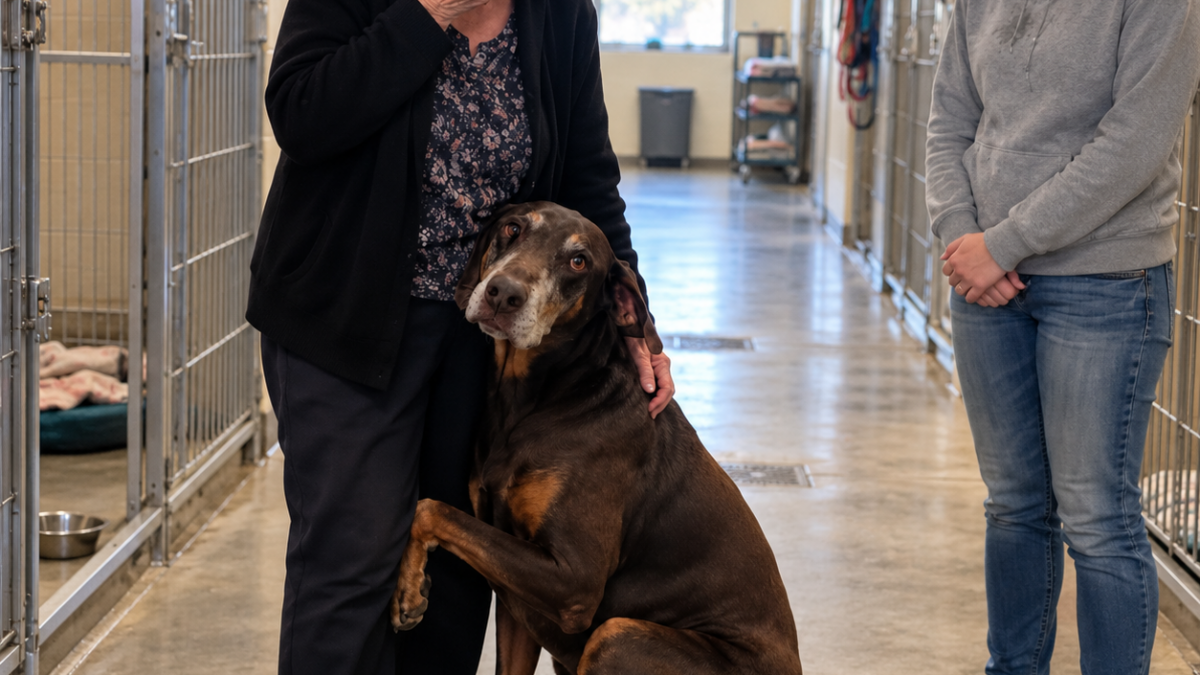
“Hi, sweetheart.”
He stood so quickly that his back feet slipped on the concrete.
He came to the door.
Emily unlocked it.
“Are you comfortable if I let him out?”
I nodded.
The second the latch opened, Samson pushed through.
He didn’t jump on me.
He didn’t bark.
He pressed his entire body against my legs.
Hard.
As though he were making sure I was solid.
I dropped to my knees.
His head came over my shoulder.
Then I felt his body trembling.
“Oh, honey.”
I wrapped both arms around him.
“You thought I wasn’t coming back.”
His face pushed against my neck.
I began crying before I realized it.
Emily turned away.
For nearly a minute, none of us said anything.
Then Samson leaned back and looked directly into my face.
That decided it.
Maybe I had already decided before I arrived.
Maybe I had decided the first morning when he lifted his head.
But that was the moment I finally admitted it.
“I want to adopt him.”
Emily smiled through tears.
“I was hoping you’d say that.”
Then her expression changed.
“There are a few things we need to discuss.”
That frightened me.
“Is he sick?”
“He’s a senior dog. He has arthritis. Mild heart enlargement. Nothing immediately life-threatening, according to our vet, but he’ll need monitoring.”
“I can do that.”
“There’s something else.”
She brought me into a small consultation room.
On the table sat a manila folder.
Emily opened it.
“When Samson was surrendered, his owner told us he was moving and couldn’t take him.”
I looked toward the hallway.
“That’s all?”
“That was the official explanation.”
Her hesitation bothered me.
“What’s the unofficial explanation?”
“Samson was microchipped. When we pulled his records, we discovered he’d been registered to the same family for nearly eleven years.”
“That doesn’t surprise me.”
“But his veterinary history stopped almost two years before he was surrendered.”
I frowned.
“Meaning?”
“He had regular appointments until then. Vaccinations. Dental care. Arthritis treatment. Everything.”
“And then nothing?”
“Nothing.”
She pushed the folder toward me.
“The surrender form says he became ‘withdrawn and difficult’ after the owner’s wife died.”
I felt something cold settle in my stomach.
“How long ago did she die?”
“Almost two years.”
I looked down at the papers.
“So he lost her.”
Emily nodded.
“And apparently he was very attached to her.”
Suddenly Samson’s behavior made sense in a way that hurt.
An older woman.
A quiet voice.
Perhaps the way I smelled.
Perhaps the way I knelt.
Maybe he hadn’t chosen me because I was special.
Maybe I had reminded him of someone he had loved.
Oddly, that didn’t make the connection feel smaller.
It made it more sacred.
“What was her name?”
“Margaret Bell.”
“And her husband?”
“Richard Bell.”
I closed the folder.
“I don’t need to know anything else.”
At the time, I meant it.
I wish that had been the end of Richard Bell.
It wasn’t.
But first, Samson came home.
I signed the adoption agreement.
I paid the senior-dog fee.
Emily gave me his medication, a bag of food, a worn blue blanket that had been in his kennel, and a leash someone at the shelter had donated.
When we reached my car, Samson hesitated.
His body went rigid.
I opened the back door.
He stepped backward.
“Samson?”
He looked from the car to me.
Emily approached carefully.
“He may associate cars with being surrendered.”
That sentence nearly broke me.
I sat sideways on the back seat.
“I’m not putting you in there alone.”
Samson watched me.
“Come on.”
I patted the seat.
“We’ll do this together.”
He took one step.
Then another.
Finally he climbed inside.
Instead of sitting across from me, he pressed against my knees.
Emily closed the door.
I drove home at thirty-five miles per hour.
Samson spent the entire trip watching me in the rearview mirror.
Every time our eyes met, I said the same thing.
“You’re okay.”
At my house, he stood on the sidewalk for a long time.
I opened the front door.
“This is home.”
He didn’t move.
I wondered if that word had become meaningless to him.
So I went inside first.
I left the door open.
Samson followed.
He explored slowly.
Living room.
Kitchen.
Dining room.
Hallway.
He stopped outside my bedroom.
Then he returned to the kitchen and lay beside my feet.
No excitement.
No zooming around.
No frantic sniffing.
Just relief.
That first evening, I placed a dog bed beside my bed.
Samson ignored it.
He slept on the floor with his back against the mattress.
Around midnight, I woke and heard him breathing.
For the first time in years, another living creature was sleeping in my room.
The sound should have bothered me.
Instead, it comforted me.
The next morning, I woke to a nose inches from my face.
I screamed.
Samson jumped backward.
Then I laughed so hard I frightened him again.
“Well,” I said, “I suppose we need to establish some boundaries.”
His tail moved.
Barely.
But it moved.
That became our first victory.
Our second came three days later.
He ate an entire bowl of food without me sitting beside him.
Our third came the following week when he barked at the mailman.
I opened the door and said, “Samuel, absolutely not.”
I had started calling him Samuel whenever he misbehaved.
The mailman laughed.
“New security system?”
“Used model.”
Samson stood behind my leg.
“Works fine, though.”
By November, the house no longer felt like a place where life had stopped.
I began walking every morning.
At first, Samson could manage only two blocks.
Then three.
Neighbors I had barely spoken to in years began stopping us.
Linda from next door brought him homemade dog treats.
Mr. Alvarez across the street built a small wooden ramp for my porch when he noticed Samson struggling with the steps.
Children waited at the corner to pet him.
Samson tolerated everyone.
But he watched me.
Always.
If I went into another room, he followed.
If I worked in the garden, he lay where he could see me.
If I closed the bathroom door, he waited outside it like a bodyguard with boundary issues.
One Sunday, Daniel called.
“You sound different.”
“How?”
“Busy.”
“I am busy.”
“With what?”
“Your brother.”
Silence.
“My what?”
I turned the phone toward Samson.
“Say hello.”
Samson sneezed.
Daniel laughed.
“You adopted him.”
“I did.”
“The Doberman?”
“Yes.”
“The giant eleven-year-old Doberman with arthritis?”
“He objects to your tone.”
“Mom.”
“What?”
“I’m proud of you.”
I looked down at Samson.
“I’m not sure I did anything.”
“You went back.”
That stayed with me.
You went back.
Sometimes the greatest thing we can do for someone is simply return after the world has taught them everybody leaves.
Three weeks after the adoption, Daniel came to visit.
He arrived on a Friday evening carrying groceries, a new orthopedic dog bed that cost more than my first sofa, and enough chew toys for six dogs.
Samson met him at the doorway.
Daniel froze.
“That dog is enormous.”
“He’s thin.”
“Mom, he has shoulders.”
“Be polite.”
Daniel crouched.
Samson studied him.
Then sniffed his hand.
A minute later, Samson leaned into him.
Daniel looked at me.
“Okay.”
“What?”
“I get it.”
That night we ate chili at the kitchen table while Samson slept between us.
Daniel told me about work.
About my grandchildren.
About problems he hadn’t mentioned over the phone.
Then he looked around my kitchen.
“You know what I noticed?”
“What?”
“You don’t have the TV on.”
I glanced toward the living room.
He was right.
For nine years, I had kept the television running simply because silence felt too much like absence.
Now I had Samson’s nails clicking across the floor.
His breathing.
His collar jingling.
The impatient huff he made when dinner was five minutes late.
I didn’t need artificial noise anymore.
“I guess I don’t.”
Daniel smiled.
Then his expression became serious.
“Promise me something.”
“That depends.”
“If Samson gets sick, call me. Don’t try to handle everything alone.”
“I’m capable.”
“I know.”
“Then why—”
“Because capable people need help too.”
I rolled my eyes.
But I promised.
I didn’t realize how soon that promise would matter.
The first snow came early that year.
Nothing dramatic.
Barely two inches.
Samson loved it.
The dog who had spent months barely lifting his head suddenly shoved his nose through powder like a puppy.
I stood on the porch laughing.
“You’re eleven years old. Act appropriately.”
He ignored me.
Then, halfway across the yard, he stopped.
His back legs trembled.
“Samson?”
He tried to walk.
His right rear leg buckled.
I was beside him before he hit the ground.
The veterinarian diagnosed worsening arthritis and a torn ligament that had probably been partially damaged for months.
Surgery at his age carried risks.
Conservative management was possible, but it meant medication, physical therapy, weight control, and reduced activity.
“How much?” I asked.
The veterinarian hesitated.
“Over time?”
“Yes.”
“It could become expensive.”
“I asked how much, not whether you think I can afford him.”
She smiled.
“Fair enough.”
I used part of the money Robert had left me.
Daniel protested.
“You need that for yourself.”
“This is for myself.”
“Mom—”
“You told me capable people need help. You did not say capable people need permission.”
That ended the argument.
Samson began hydrotherapy at a canine rehabilitation center.
Twice a week, I drove him across town.
At first he hated the underwater treadmill.
Then he discovered the technician carried turkey.
His ethical objections disappeared.
By Christmas, he was stronger.
We celebrated with Daniel’s family at my house.
My grandchildren decorated Samson’s collar with a red ribbon.
He wore it for six minutes before removing it and sitting on it.
For the first time since Robert died, every bedroom in my house was occupied.
There were shoes in the hallway.
Dishes in the sink.
Children whispering when they should have been sleeping.
And Samson moving from room to room as if conducting security checks.
Christmas morning, I woke before everyone else.
The tree lights were still on.
Samson was lying beside the couch.
I sat next to him.
“Merry Christmas.”
He placed his head in my lap.
I thought about Margaret Bell.
I wondered whether she had once sat with him exactly like that.
“You were loved before me, weren’t you?”
His eyes closed.
“I’m glad.”
I meant it.
Love is not diminished by the people who came before us.
Sometimes we inherit the proof of it.
January passed quietly.
Then February.
By March, Samson could walk nearly a mile on good days.
That was when Richard Bell appeared.
It happened on a Wednesday afternoon.
I was trimming dead branches from the hydrangeas when a black pickup stopped in front of my house.
A man in his early sixties got out.
Expensive jacket.
Silver hair.
He stood beside the truck staring toward the porch.
Samson had been sleeping in the sun.
The instant he saw the man, his entire body changed.
His head came up.
His ears went back.
Then he stood and moved behind me.
I had never seen Samson do that.
Not once.
The man took two steps toward the yard.
“Samson.”
My hand tightened around the pruning shears.
Samson didn’t move.
The man looked at me.
“You must be the woman who adopted him.”
“Who are you?”
He gave me an uncomfortable smile.
“Richard Bell.”
My stomach dropped.
Samson pressed against the back of my legs.
I set the shears down.
“How did you find my address?”
“I asked around.”
“That isn’t an answer.”
“I went to the shelter.”
“They gave you my information?”
“No. Of course not.”
“Then leave.”
He raised both hands.
“I’m not here to cause trouble.”
“You’re standing outside the home of a woman you don’t know after tracking down a dog you surrendered. That qualifies as trouble.”
His face hardened slightly.
“I’d just like to see him.”
“You are seeing him.”
“Could I pet him?”
I looked down.
Samson had lowered his head.
“No.”
Richard stared at him.
“Samson. Come here, boy.”
Nothing.
He tried again.
Samson moved farther behind me.
Richard’s face changed.
Something between embarrassment and irritation.
“He always was dramatic.”
I felt anger rise so quickly that my hands shook.
“Don’t.”
“Excuse me?”
“Don’t insult him on my property.”
Richard exhaled.
“Look, I know what you think.”
“You have no idea what I think.”
“My wife died. Everything fell apart. I couldn’t manage him.”
“So you surrendered him.”
“Yes.”
“Five months in a shelter.”
His jaw tightened.
“They told me he’d be adopted.”
“He was eleven.”
“I know how old my own dog was.”
“Apparently not well enough to understand what surrendering him would do.”
He looked toward Samson again.
Then said something I didn’t expect.
“I want him back.”
For several seconds, I genuinely thought I had misheard him.
“What?”
“My circumstances have changed.”
I laughed once.
Not because anything was funny.
“No.”
“You don’t understand.”
“I understand perfectly.”
“He belonged to my wife.”
“And then he belonged to you.”
“He was our dog for eleven years.”
“And you left him.”
Richard took another step.
Samson gave a low growl.
I had heard him growl only twice.
Both times at raccoons.
Richard stopped.
“Please.”
“No.”
“I made a mistake.”
“Yes.”
“I’m trying to correct it.”
“Not with him.”
“You can’t decide that.”
“I adopted him legally. Actually, I can.”
His face hardened.
“I could reimburse you.”
I stared at him.
“For what?”
“The adoption fee. Veterinary expenses. Whatever you’ve spent.”
“He isn’t a used appliance.”
“That’s not what I meant.”
“It’s exactly what you meant.”
“I’m willing to pay five thousand dollars.”
I actually stepped backward.
Not because the amount tempted me.
Because it disgusted me.
“Get off my property.”
“Mrs. Carter—”
“How do you know my name?”
He didn’t answer.
That frightened me more than the money.
I pulled out my phone.
“If you are still standing here when I finish dialing 911, you can explain all of this to the police.”
Richard stared at me.
Then at Samson.
“You don’t know the whole story.”
“Then perhaps you should have told it before you abandoned him.”
His eyes flashed.
“I did not abandon him.”
Samson’s growl deepened.
I said quietly, “He disagrees.”
Richard returned to his truck.
Before getting in, he looked back.
“This isn’t finished.”
I held up my phone.
“It is at this address.”
He drove away.
My knees nearly gave out when the truck disappeared.
I sat on the porch step.
Samson immediately came to me.
His head pushed beneath my hand.
“You’re not going anywhere.”
His body trembled.
“Do you understand?”
I wrapped my arms around him.
“No one is taking you anywhere.”
But Richard was right about one thing.
It wasn’t finished.
The following morning, someone had left an envelope in my mailbox.
No stamp.
Inside was a handwritten letter.
Mrs. Carter,
You are making assumptions about circumstances you do not understand. Samson was surrendered during the worst period of my life. I regret it. He was my wife’s dog before he was yours, and I have both moral and financial reasons for wanting him returned.
Please reconsider.
R. Bell
Financial reasons.
Those two words bothered me.
I called Emily.
When I told her Richard had found me, she became quiet.
“He came here last week.”
“What did he want?”
“Your contact information.”
“You didn’t give it to him?”
“Absolutely not.”
“Did he say why?”
“He claimed he regretted surrendering Samson.”
“Anything else?”
Pause.
“Emily?”
“There was something strange.”
“What?”
“He asked whether Samson’s original collar had been surrendered with him.”
I looked toward Samson.
He was asleep beside the refrigerator.
“What collar?”
“He wasn’t wearing one when he came in.”
“Why would Richard care?”
“I don’t know.”
I remembered his letter.
Moral and financial reasons.
“Did Samson arrive with anything?”
“A blanket. Medication. A folder of old veterinary records.”
“Nothing else?”
“Not that I know of.”
After we hung up, I pulled out the shelter bag.
I had never thrown it away.
At the bottom was the faded blue blanket.
I spread it across the kitchen table.
Nothing.
I checked the bag.
Then the medication pouch.
Nothing.
I felt ridiculous.
What was I expecting?
A treasure map?
That afternoon, however, curiosity took me somewhere I hadn’t intended to go.
I searched Margaret Bell’s name online.
The obituary appeared immediately.
Margaret Anne Bell, age sixty-one.
Teacher.
Volunteer.
Animal-rescue supporter.
Survived by her husband, Richard.
No children.
Then another result appeared.
A local newspaper article from twelve years earlier.
WOMAN’S DOG ALERTS FAMILY DURING HOUSE FIRE.
The photograph loaded slowly.
Margaret Bell stood in front of a damaged farmhouse with a much younger Samson beside her.
I enlarged the image.
Same black coat.
Same rust-colored markings.
Same scar on the ear.
According to the article, Samson had awakened Margaret during an electrical fire.
She credited him with saving her life.
At the bottom was one sentence that made me sit back.
“Bell, whose family owns several parcels of farmland north of the county, said Samson would never want for anything after saving her life.”
I kept searching.
Margaret had inherited property from her parents.
Substantial property.
After her death, Richard apparently sold most of it.
One parcel, however, had become the subject of a probate dispute involving a charitable trust Margaret had established.
I didn’t understand the legal language.
So I called someone who did.
My late husband’s friend, Arthur Keene, was a retired attorney.
He was seventy-four, suspicious of everything, and delighted whenever anybody gave him an excuse to examine paperwork.
I showed him the articles.
Arthur adjusted his glasses.
“What exactly are we looking for?”
“I don’t know.”
“Excellent. Those are my favorite investigations.”
I told him about Richard.
The collar.
The financial comment.
Arthur’s expression changed.
“Did he threaten you?”
“Not directly.”
“Keep everything he sends.”
“I already am.”
“Do not meet him alone.”
“I wasn’t planning to.”
He studied Margaret’s obituary.
“Her estate should be public record.”
“Can we look?”
“We can look at anything filed publicly.”
Three days later, Arthur called me.
“You may want to sit down.”
“I am sitting.”
“Margaret Bell created a trust shortly before her death.”
“For Samson?”
“Partly.”
My stomach tightened.
Arthur continued.
“She placed a small rural property and an investment account into what appears to be an animal-care trust.”
“How small?”
“The property is forty-two acres.”
I nearly dropped the phone.
“And the investment account?”
“Originally a little over two hundred thousand dollars.”
I stared at Samson.
He was chewing a rubber toy Daniel had bought him.
“What does that have to do with me?”
“I’m not finished.”
Of course he wasn’t.
Arthur enjoyed suspense far too much.
“The documents name Richard as primary caretaker of Samson and trustee of the funds designated for Samson’s care.”
“That seems normal.”
“It would be.”
“Would be?”
“If the trust didn’t contain a successor clause.”
I waited.
Arthur said, “If Richard became unwilling or unable to care for Samson, responsibility was supposed to pass to a named rescue organization.”
My chest tightened.
“The shelter?”
“No. A Doberman rescue that closed three years ago.”
“So what happens?”
“That’s the interesting part. The clause states that if the named rescue no longer exists, a court can appoint a successor caretaker, and the remaining animal-care funds follow the dog.”
I whispered, “Richard surrendered him.”
“Yes.”
“Then why was Richard still interested in Samson’s collar?”
“Possibly because the trust requires proof that Samson is alive.”
I looked at the old dog beside me.
Arthur’s voice became serious.
“Evelyn, I think you need a lawyer who still practices.”
I laughed nervously.
“Why?”
“Because if Richard has continued controlling money that legally exists for Samson’s care after abandoning him, he may have a problem.”
“How big a problem?”
“That depends on what happened to the money.”
The next call came from Richard before I could even process that.
“I’d like to settle this privately,” he said.
I almost hung up.
“Settle what?”
“I know you’ve been asking questions.”
My skin went cold.
“How do you know that?”
“I still know people in this county.”
“That sounds like another reason to call the police.”
“Listen to me. Margaret created something complicated when she was sick. She wasn’t thinking clearly.”
“Be careful.”
“What?”
“You are speaking about your dead wife.”
Silence.
Then, “The trust was unnecessary.”
“Apparently she disagreed.”
“She wanted Samson protected.”
“Then why did you surrender him?”
He exhaled sharply.
“I told you. I was grieving.”
“For two years?”
“You don’t know grief.”
That angered me in a way he couldn’t have understood.
“My husband died nine years ago.”
Silence.
“I’m sorry.”
“No, you aren’t.”
“I loved Margaret.”
“I believe you.”
That surprised him.
Then I said, “And you still failed her dog.”
He became quiet.
Finally he said, “I’ll give you twenty thousand dollars.”
I thought I had misheard.
“What?”
“You keep Samson. I stop contacting you. You sign a document acknowledging that I have no continuing obligations toward him.”
There it was.
Not love.
Not regret.
Liability.
“No.”
“Thirty thousand.”
“No.”
“Mrs. Carter, you have no idea what you’re getting involved in.”
“Then stop calling me.”
“You’re making a serious mistake.”
“No, Richard. The serious mistake was assuming an old dog couldn’t lead anyone back to what you did.”
I hung up.
My hands were shaking.
Samson walked over and placed his chin on my knee.
“I suppose we’re causing trouble now.”
His tail moved.
The lawyer Arthur recommended was named Monica Reyes.
She reviewed everything.
The adoption paperwork.
Richard’s letters.
The trust documents.
Shelter records.
Then she looked at me across her desk.
“This may be more serious than Arthur realized.”
“How?”
“Richard has filed annual trustee reports.”
“For Samson’s trust?”
“Yes.”
“After surrendering him?”
“For approximately five months afterward.”
My stomach turned.
“What did he report?”
She rotated her computer monitor.
There, on the screen, was a signed document.
Animal beneficiary remains in trustee’s direct care.
I read the sentence twice.
“He lied.”
“That appears to be what happened.”
“Why?”
“Because the trust authorizes expenses for housing, veterinary care, property maintenance, transportation, and caretaker compensation while Samson remains in his care.”
“How much?”
“Last year Richard reimbursed himself forty-eight thousand dollars.”
I stared at her.
“For taking care of a dog he dumped at a shelter?”
Monica’s expression remained professional.
“That is one possible characterization.”
I had another.
The first real surge of anger hit me then.
Not because of the money.
Because I remembered Samson lying with his face toward the concrete wall.
Months of people walking past him.
Months of confusion.
Months of believing the person who drove him there might come back.
Meanwhile, Richard Bell had apparently been signing documents claiming the dog was still under his roof.
“What happens now?”
“We document everything.”
“And Samson?”
“He stays with you unless a court orders otherwise, which seems unlikely given the legal adoption.”
“Could Richard challenge it?”
“He could try.”
That was apparently all the encouragement Richard needed.
Two weeks later, I was served.
Richard Bell had filed a civil petition claiming Samson had been surrendered during a period of “acute emotional incapacity” and asking for return of personal property.
The personal property was Samson.
I sat at my kitchen table reading those words until my vision blurred.
Personal property.
Samson brought me his leash.
He thought we were going for a walk.
I began laughing.
Then crying.
Then laughing again.
“Apparently you’re property.”
Samson stared at me.
“Try acting more like a lamp.”
He sneezed.
Daniel drove down the following day.
He stormed into my kitchen holding the petition.
“This man is suing my sixty-eight-year-old mother over a dog he abandoned?”
“Technically—”
“No technically.”
“Daniel.”
“I want his address.”
“No.”
“I only want to talk.”
“You have my temper. Talking would last four minutes.”
He paced.
“What does your lawyer say?”
“That his case for taking Samson is weak.”
“Weak isn’t zero.”
“No.”
Daniel crouched beside Samson.
“You’re staying here, old man.”
That evening, Monica called.
“We found something.”
Every time a lawyer says those words, your life changes slightly.
She had subpoenaed financial records related to the trust.
Richard had used trust funds for expenses that appeared unrelated to Samson.
Roof repairs.
Property taxes on a rental home.
Vehicle payments.
A vacation.
Nearly ninety thousand dollars in questionable expenditures over two years.
“If those expenditures are improper,” Monica explained, “he could be removed as trustee and ordered to repay the trust.”
I looked at Samson.
“So his lawsuit against me…”
“May have been intended to reestablish physical custody before anyone looked closely.”
For the first time, I understood why Richard had been so desperate.
He didn’t want Samson.
He needed Samson.
Alive.
Accessible.
Under his roof.
Because Samson was evidence.
That realization hurt more than I expected.
I had wanted to believe at least part of Richard’s story.
That grief had made him fail.
That he regretted it.
That perhaps seeing Samson again awakened something decent.
Instead, the old dog appeared to have become a financial instrument.
Monica must have heard something in my silence.
“You okay?”
“No.”
“That’s fair.”
“What do we do?”
“We let him explain himself under oath.”
The hearing was scheduled for May.
Richard’s attorney attempted to negotiate.
First, Richard offered to dismiss his claim if I signed away any involvement with Margaret’s trust.
Then fifty thousand dollars.
Then seventy-five.
I refused every offer.
Daniel worried.
“Mom, that’s more money than—”
“I know how much it is.”
“You could use it.”
“For what?”
“Anything.”
I looked toward Samson sleeping in a patch of sunlight.
“That man thinks everything has a price because he needs everything to have a price.”
Daniel sat down.
“If I sign, he gets away with it.”
“You don’t know that.”
“No. But I know why he’s paying.”
Daniel rubbed both hands over his face.
“I hate when you sound like Grandma.”
“Your grandmother was frequently correct.”
“She was terrifying.”
“Also correct.”
The hearing took place in the county courthouse on a rainy Monday morning.
I wore the navy dress I had worn to Daniel’s wedding.
Monica told me to leave Samson at home.
I hated that.
The case was about him.
Yet he had no idea any of it existed.
Maybe that was a mercy.
Arthur sat behind us.
Daniel sat beside him.
Emily from the shelter came too.
Richard entered with his attorney.
He looked older than he had in my yard.
For one brief second, I felt sorry for him.
Then he glanced at me and looked away.
The judge began with the custody issue.
Richard testified that he surrendered Samson while suffering profound grief following Margaret’s death.
That part, I believed.
He described depression.
Isolation.
Financial confusion.
He said the shelter employee had assured him he could potentially reclaim Samson if circumstances changed.
Emily was called.
“Did you tell Mr. Bell he could reclaim the dog after surrendering ownership?”
“No.”
“Did you suggest the surrender was temporary?”
“No.”
“Did Mr. Bell ask about temporary fostering?”
“No.”
“What did he sign?”
“A permanent owner-surrender agreement.”
Monica displayed it.
Richard’s signature appeared at the bottom.
Then came the question I had been dreading.
“Did Mr. Bell show emotion when surrendering Samson?”
Emily paused.
“Yes.”
Richard’s attorney looked satisfied.
“What kind?”
“He cried.”
My chest tightened.
“Did that influence your impression?”
“Yes.”
“What was your impression?”
“That he loved the dog and couldn’t handle his grief.”
Richard looked down.
For a second, everything became complicated again.
People are rarely monsters every minute of their lives.
Sometimes they love.
Sometimes they fail.
Sometimes they do both.
Then Monica stood.
“Ms. Hayes, did Mr. Bell disclose the existence of an animal-care trust?”
“No.”
“Did he tell you funds were legally available for Samson’s veterinary care, housing, boarding, or placement?”
“No.”
“Had you known such funds existed, would that have affected the shelter’s options?”
“Absolutely.”
“How?”
“We could have contacted a breed rescue, arranged senior foster care, hired behavioral support, or explored placement without putting him through standard intake.”
“Instead?”
“He spent almost five months in the kennel system.”
Richard closed his eyes.
Monica continued.
“During those five months, did Mr. Bell pay the shelter for Samson’s care?”
“No.”
“Visit?”
“No.”
“Call?”
“Once.”
“When?”
Emily looked at the record.
“Four months after surrender.”
“What did he ask?”
My pulse quickened.
Emily swallowed.
“He asked whether Samson still had the leather collar he arrived with.”
The courtroom became completely still.
Richard’s attorney stood.
“Objection. Relevance.”
Monica responded calmly.
“The collar is specifically described in Margaret Bell’s trust attachment as containing an engraved tag identifying the animal beneficiary.”
The judge leaned forward.
“Overruled.”
I looked at Richard.
For the first time, he looked afraid.
Monica called the accountant who had reviewed the trust.
The testimony lasted nearly an hour.
Numbers.
Transfers.
Reimbursements.
Dates.
But one fact cut through everything.
On multiple reports, Richard Bell had certified that Samson remained in his direct care.
On those same reports, he had reimbursed himself thousands of dollars.
Richard’s attorney tried to explain that the filings had been prepared by an accountant based on standing assumptions.
The accountant disagreed.
“I asked Mr. Bell annually whether the animal remained in his custody.”
“And what did he say?”
“Yes.”
“Did he ever disclose surrender?”
“No.”
Then Monica showed a reimbursement issued three weeks after Samson entered the shelter.
“Purpose?”
The accountant read it.
“Senior canine veterinary management.”
Amount: $6,800.
Emily’s shelter records showed Samson had received charity-funded veterinary care during that same period.
The judge removed her glasses.
“Mr. Bell, where did the $6,800 go?”
Richard’s attorney whispered to him.
Richard answered, “General expenses.”
“Related to Samson?”
Silence.
“No.”
The judge’s voice cooled.
“We will return to that.”
By lunch, the custody petition had effectively collapsed.
But the trust issue had grown.
The judge ordered an immediate accounting.
Richard was temporarily suspended as trustee.
And Samson?
The judge looked directly at me.
“The animal remains with the lawful adoptive owner pending any further order.”
My breath left my body.
Daniel squeezed my shoulder.
Emily quietly cried.
Outside the courthouse, reporters were waiting.
I hadn’t expected reporters.
Apparently financial misconduct involving an animal trust was unusual enough to attract local attention.
Monica instructed me to say nothing.
Richard came down the courthouse steps behind us.
One reporter called, “Mr. Bell, did you use money intended for your late wife’s dog?”
Richard kept walking.
Another asked, “Why did you report the dog in your custody after surrendering him?”
He stopped.
Turned.
For half a second, I thought he might answer.
Instead, he looked directly at me.
The expression wasn’t anger.
It was humiliation.
I should have felt victorious.
I didn’t.
I felt tired.
That evening, I went home and sat on the kitchen floor beside Samson.
“You won.”
He licked my wrist.
“Actually, you didn’t know there was a contest.”
His tail thumped once.
“That’s probably better.”
The investigation continued through summer.
Nearly $112,000 was ultimately identified as misused or improperly documented.
Richard’s attorney argued some expenses legitimately related to maintaining the property where Samson had once lived.
Others clearly did not.
The court ordered Richard to repay a substantial portion of the trust and removed him permanently as trustee.
Monica was appointed interim fiduciary until a new arrangement could be approved.
Then came the forty-two acres.
Margaret’s trust provided that the property could be sold if necessary for Samson’s care, but if sufficient liquid funds remained, it could instead pass after Samson’s death to an animal-welfare organization chosen by the successor trustee.
I wanted nothing personally.
Not one dollar.
So Monica proposed something better.
The land could eventually become a senior-dog foster sanctuary.
When the idea became public, donations began arriving.
Small donations.
Twenty dollars.
Fifty.
Ten.
Children mailed allowance money.
A retired contractor offered labor.
A veterinary clinic pledged discounted services.
Emily volunteered to help coordinate placements.
Arthur, despite claiming he was retired, somehow attended every planning meeting and corrected everybody’s legal vocabulary.
Daniel called it “Mom’s accidental empire.”
“I do not have an empire.”
“You have land.”
“I don’t have land. A trust has land.”
“You have lawyers.”
“One.”
“Two if you count Arthur.”
“No one counts Arthur.”
Arthur, standing five feet away, said, “I heard that.”
We laughed.
For the first time, the terrible thing Richard had done began transforming into something useful.
That was the only revenge I wanted.
Not his suffering.
Not humiliation.
Transformation.
Every dollar he had tried to misuse would become medicine, blankets, ramps, food, warm rooms, and second chances for animals people had decided were too old to matter.
But Richard Bell still had one final surprise for me.
In September, almost exactly one year after I first met Samson, Monica called.
“Richard wants to speak with you.”
“No.”
“I expected that.”
“Then why are you calling?”
“Because he’s asking through counsel, and he says it concerns Margaret.”
That changed things.
“Where?”
“My office.”
“Will you be there?”
“Absolutely.”
Richard arrived carrying a small wooden box.
He looked thinner.
Less polished.
He sat across from me but didn’t meet my eyes.
Monica remained beside the window.
“What do you want?” I asked.
Richard placed the box on the table.
“This belonged to Margaret.”
I didn’t touch it.
“What is it?”
“Samson’s things.”
My anger returned.
“You had them?”
“I found the box after the hearing.”
“Convenient.”
He accepted that without arguing.
Inside were photographs.
A puppy with oversized paws.
Margaret kneeling beside him.
Samson beside a Christmas tree.
Samson lying in a hospital room next to Margaret.
Then I found a folded letter.
My name wasn’t on it.
Neither was Richard’s.
Across the front Margaret had written:
FOR THE PERSON WHO LOVES HIM AFTER ME.
I stopped breathing.
Richard looked away.
“I never opened it.”
“You expect me to believe that?”
“I knew what it said.”
“How?”
“She told me.”
My fingers trembled as I opened the envelope.
Margaret’s handwriting was weak.
Dear friend,
If you are reading this, then I am gone and Samson has somehow found his way into your life.
I hope Richard kept his promise and cared for him until the end.
But I also know life does not always honor our plans.
Samson has spent his whole life believing people can be trusted.
Please do not punish him if losing me makes him difficult.
He sleeps beside the bed.
He hates thunderstorms but pretends not to.
He will not eat carrots unless they are cooked.
He loves women with gentle voices.
If he leans his whole weight against your legs, that means he trusts you.
Please understand what a gift that is.
He saved my life once.
Then he saved it many more times simply by being beside me.
If you become his final person, do not feel sad that you came last.
The last home is sometimes the one that matters most.
Tell him I was grateful.
Tell him I did not leave because I wanted to.
And when his time comes, please stay with him.
He will look for the person he loves.
Do not let him look alone.
Margaret
I couldn’t finish without crying.
Richard was crying too.
For several minutes, no one spoke.
Finally I folded the letter.
“You failed her.”
He nodded.
There was no defense this time.
“I know.”
“You lied.”
“I know.”
“You left him in that place.”
“I know.”
“Why?”
Richard stared at his hands.
“When Margaret got sick, Samson stopped leaving her room.”
His voice shook.
“After she died, he kept waiting outside the bedroom.”
I listened.
“For months.”
Richard swallowed.
“I couldn’t stand it.”
“Couldn’t stand what?”
“He reminded me of her.”
There it was.
The selfish truth.
Not cruelty for cruelty’s sake.
Weakness.
He continued.
“I started drinking. I stopped paying bills. I stopped answering people. Every time I looked at him, I saw the hospital bed.”
“That explains surrendering him.”
“Yes.”
“It does not explain stealing from his trust.”
“No.”
“At some point grief stopped being the reason.”
Richard’s eyes closed.
“Yes.”
“What became the reason?”
“Fear.”
“Of what?”
“Losing everything.”
I shook my head.
“So you used what Margaret left for him.”
“Yes.”
“Then when you discovered I had adopted him—”
“I panicked.”
“You tried to buy me.”
“Yes.”
“You sued me.”
His voice became almost inaudible.
“Yes.”
I looked at him for a long time.
“Do you love Samson?”
Richard began crying harder.
“Yes.”
I believed him.
That was the tragedy.
Because love without courage can still destroy something.
“You don’t get him back.”
“I know.”
“You never will.”
“I know.”
“If he lives six more months or three more years, he stays with me.”
Richard nodded.
“I know.”
I looked at the wooden box.
“Why bring this?”
“Because Margaret wanted whoever cared for him to have it.”
He stood.
At the door, he stopped.
“Mrs. Carter?”
“Yes?”
“Is he happy?”
I could have hurt him then.
One sentence would have done it.
I could have said, Happier than he ever was with you.
I could have told him Samson hid behind me when he appeared.
I could have made revenge personal.
Instead I said the truth.
“Yes.”
Richard covered his mouth.
Then nodded.
“Thank you.”
He left.
Monica looked at me.
“You were kinder than I would have been.”
“I wasn’t doing it for him.”
That evening, I showed Samson the photographs.
Of course he didn’t understand.
Or perhaps he understood more than I thought.
When I placed Margaret’s picture on the floor, he sniffed it.
Then stopped.
His entire body became still.
He sniffed it again.
A soft whine escaped him.
I sat down.
“Oh, sweetheart.”
Samson lay beside the photograph.
I read Margaret’s letter aloud.
Every word.
When I reached the line, “Tell him I did not leave because I wanted to,” my voice broke.
Samson lifted his head.
I touched his gray muzzle.
“She loved you.”
His eyes stayed on me.
“And I do too.”
He leaned his full weight against my legs.
Exactly as Margaret had described.
That was when I finally understood why the story had happened the way it did.
I hadn’t replaced Margaret.
I had continued what she started.
And Samson hadn’t mistaken me for her.
He had simply recognized something familiar.
Gentleness.
Safety.
Someone who stayed.
The senior-dog sanctuary opened the following spring.
We called it Margaret’s Promise.
I insisted on the name.
The first residents were a thirteen-year-old beagle named Chester, a blind terrier named Ruthie, and a twelve-year-old German shepherd whose owner had entered hospice.
Samson attended the opening wearing a ridiculous blue bandanna Daniel bought him.
Local reporters came.
Emily gave a speech.
Monica spoke about responsible estate planning for pets.
Arthur spoke for twenty-seven minutes despite being told he had five.
Then they asked me to say something.
I had prepared a speech.
I never used it.
I looked at the small crowd.
At volunteers.
At dogs lying on blankets.
At Samson beside me.
Then I said, “A year ago, I thought old age meant learning how to lose things gracefully.”
People became quiet.
“I was wrong.”
I looked down at Samson.
“Sometimes old age is when we finally become brave enough to find things again.”
That was all.
I stepped away from the microphone.
Samson followed.
Richard did not attend.
But later that week, Monica received a check.
Ten thousand dollars.
No conditions.
No request for recognition.
The note said only:
For Margaret.
Monica asked whether we should accept it.
I thought for a long time.
Then said yes.
Not because the money erased anything.
It didn’t.
Some debts cannot be erased.
They can only be acknowledged.
Samson turned twelve that summer.
His muzzle became almost entirely silver.
His walks grew shorter.
His naps grew longer.
Every morning, however, he still came to my bed and stared at me until I opened my eyes.
Every morning I said, “You again?”
Every morning his tail moved.
Daniel visited more frequently.
My grandchildren learned to walk slowly beside Samson.
Nobody pulled him.
Nobody climbed on him.
Nobody treated him like a toy.
He was simply part of the family.
One evening in late August, I noticed he hadn’t finished dinner.
The next morning, he refused breakfast.
My heart knew before my mind would admit anything.
The veterinarian found a mass near his spleen.
More tests followed.
Cancer.
Advanced.
Surgery might buy time.
Or it might take away the time he had.
I called Daniel from the clinic parking lot.
“I don’t know what to do.”
He was quiet.
Then asked, “What does the vet think?”
“That we can make him comfortable.”
“And surgery?”
“Maybe weeks. Maybe months. Maybe he dies on the table.”
Silence.
“Mom.”
“Yes?”
“What would you want if you were him?”
I looked through the window.
Samson lay on the examination-room floor.
Tired.
Watching the door I had gone through.
Waiting for me.
“I’d want to go home.”
“Then take him home.”
So I did.
For seventeen days, we lived very carefully.
No pretending.
No miracles.
No bargaining.
Just time.
Samson ate roast chicken from my hand.
He slept in the garden.
Daniel came.
The grandchildren came.
Emily came and sat on the floor with him.
Arthur came and claimed he had dust in his eye.
Monica brought flowers for me and a hamburger for Samson.
Even Mr. Alvarez came across the street to say goodbye.
On the sixteenth night, a storm rolled over the county.
Thunder shook the windows.
I remembered Margaret’s letter.
He hates thunderstorms but pretends not to.
Samson lay beside my bed.
I climbed down to the floor.
“You don’t have to pretend.”
He pressed against me.
We stayed that way through the storm.
In the morning, he could no longer stand.
I called the veterinarian.
Then Daniel.
Daniel began driving immediately.
But he lived four hours away.
“Mom, I’m coming.”
“I know.”
“Please wait.”
“I’ll try.”
He understood what I meant.
The veterinarian arrived around noon.
She examined Samson quietly.
Then looked at me.
“It’s time.”
Those two words opened a hole through me.
I had known.
I still wasn’t ready.
Nobody is.
I asked for ten minutes.
She went outside.
I sat beside Samson on his blanket.
Margaret’s letter was in my pocket.
“You know,” I whispered, “this was not the arrangement.”
His breathing was shallow.
“You were supposed to be the lonely one.”
His eyes found mine.
“And somehow you fixed me instead.”
I pressed my forehead against his.
“I need to tell you something from Margaret.”
His ear moved.
“She said she was grateful.”
I swallowed.
“She said she didn’t leave because she wanted to.”
Tears fell onto his fur.
“And she told me that when this day came, I had one job.”
His eyes remained on mine.
“To stay.”
The veterinarian returned.
I stayed.
My hand remained beneath his head.
My face was the last face he saw.
His breathing slowed.
Once.
Again.
Then stopped.
I don’t know how long I remained on the floor.
Eventually, someone knocked at the front door.
Daniel.
He entered.
Saw me.
Saw Samson.
Then dropped to his knees.
“I’m sorry.”
I shook my head.
“He didn’t have to look for me.”
Daniel wrapped his arms around me.
“No.”
“He knew exactly where I was.”
We buried Samson’s ashes beneath a maple tree at Margaret’s Promise.
His original blue blanket went with him.
The wooden box of photographs stayed with me.
So did Margaret’s letter.
On a small stone beneath the tree, we engraved:
SAMSON
HE WAITED.
SOMEONE CAME BACK.
Richard heard about Samson’s death through Monica.
A week later, I received a letter.
I nearly threw it away.
Instead, I opened it.
Evelyn,
Thank you for keeping the promise I failed to keep.
I have spent months wishing I could change what I did.
I cannot.
The only thing I can do is stop pretending regret equals repair.
I loved Margaret.
I loved Samson.
I also hurt both of them through cowardice and selfishness.
You owe me nothing.
But I need you to know that the sanctuary matters to me.
I have amended my own estate plan.
When I die, what remains after my obligations will go to Margaret’s Promise.
No recognition.
No plaque.
Please do not put my name anywhere.
I lost the right to stand beside hers.
Richard
I read it twice.
Then placed it beside Margaret’s letter.
People sometimes ask whether I forgave Richard.
I don’t know.
Forgiveness is a larger word than people realize.
I stopped hating him.
Maybe that is different.
Maybe it is enough.
He faced consequences.
He repaid money.
He lost control of the trust.
He stood publicly inside the truth he had tried to hide.
And the thing he tried to use for himself became something that saved dozens of old dogs.
That felt more satisfying than watching him suffer ever could.
Three years have passed.
Margaret’s Promise now has space for twenty senior dogs at a time.
Some are adopted.
Some stay with us until the end.
Every kennel has a bed.
Every dog has a name.
Nobody is called “too old” in that place.
Nobody is treated as inventory.
We keep a quiet room for dogs who are afraid of noise.
A medical fund for dogs whose owners could no longer afford treatment.
A garden where volunteers sit with animals who have forgotten how to trust.
Above the entrance hangs a simple photograph.
Not of me.
Not of Richard.
Not even of Margaret.
Samson.
Gray muzzle.
Soft eyes.
Standing in my yard beneath the maple tree.
Below it are seven words:
SOMETIMES THE LAST HOME MATTERS MOST.
I still live in my little house.
I still wake early.
Daniel still calls every Sunday, although now he rarely tells me to get out more because I’m usually busier than he is.
One Sunday he asked, “Do you ever regret going to that shelter?”
I looked through my kitchen window.
The maple leaves were turning gold.
For one second, I could almost see Samson lying beneath them.
“No.”
“Even knowing how it ended?”
I thought about that.
Then I said, “Everything we love ends somehow.”
Daniel was quiet.
“That doesn’t mean we shouldn’t begin.”
After the call, I drove to Margaret’s Promise.
Emily was waiting.
She had become the sanctuary director.
“There’s someone you should meet,” she said.
“No.”
She smiled.
“You haven’t even seen him.”
“I know that expression.”
“What expression?”
“The one you had the day you introduced me to Samson.”
“I didn’t have an expression.”
“You absolutely did.”
She led me toward the quiet wing.
“I am not adopting another dog.”
“Of course not.”
“I mean it.”
“I know.”
At the final room, she stopped.
Inside lay an old female Doberman.
Ten years old.
Rust-colored markings faded.
Gray beginning around her muzzle.
She didn’t stand.
She didn’t bark.
She simply watched the wall.
I stared at Emily.
“No.”
Emily shrugged.
“I didn’t say anything.”
“You didn’t have to.”
I stepped closer to the gate.
The Doberman didn’t move.
“What’s her name?”
“Lucy.”
“How long?”
“Three months.”
“Owner surrender?”
Emily nodded.
I closed my eyes.
“This is emotional manipulation.”
“Almost certainly.”
“I’m sixty-nine.”
“Seventy-one.”
“That was rude.”
“You had a birthday.”
I looked at Lucy.
Emily walked away.
“Where are you going?”
“To give you privacy.”
“Emily.”
But she kept walking.
I turned back toward the kennel.
Lucy’s head remained on her paws.
I gripped the metal gate.
I knew grief now.
I knew exactly what love cost.
I knew there would eventually be another veterinarian.
Another final day.
Another empty bed.
I also knew something else.
Fear had once convinced me that avoiding love could protect me from loss.
Samson had taught me the mathematics of that mistake.
Avoiding grief does not create safety.
It creates emptiness.
I crouched.
Lucy’s ear moved.
I smiled.
“Hello, my friend.”
She lifted her head.
I laughed through tears.
“Oh, no.”
Her eyes met mine.
A tiny movement came from her tail.
I sat down outside the kennel.
“I know this trick.”
Lucy stood.
Slowly.
One step.
Then another.
She approached the gate.
I put my fingertips against the metal.
She touched her nose to them.
And suddenly I was back in that old county shelter years earlier, standing before an eleven-year-old Doberman who had forgotten the world could contain anything worth rising for.
I had gone there carrying three hundred dollars.
I thought I was giving something away.
Instead, an old dog gave me back mornings.
Neighbors.
Purpose.
Courage.
Family.
He led me into a courtroom.
Into a fight I never expected.
Into a promise made by a dying woman I had never met.
He turned money taken through betrayal into beds for abandoned dogs.
He forced one grieving man to face what grief could never excuse.
And most of all, he taught an aging widow that being the last person someone loves is not a tragedy.
It is an honor.
Lucy pressed closer to the gate.
I shook my head.
“I’m not making any promises.”
Her tail moved again.
“Absolutely none.”
Emily called from the hallway.
“Should I bring the adoption application?”
“No.”
Pause.
“Foster application?”
I looked at Lucy.
She looked at me.
I sighed.
“Bring a pen.”
Emily laughed.
And for a moment, I could almost hear Robert laughing too.
Almost feel Samson leaning against my legs.
Almost imagine Margaret somewhere beyond all the things we understand, smiling because the promise had continued.
That evening, Lucy rode home in the back seat of my car.
At the front door she hesitated.
I knew that hesitation.
I had seen it before.
So I went inside first.
I left the door open.
I didn’t pull the leash.
I didn’t call repeatedly.
I simply waited.
After several seconds, Lucy stepped across the threshold.
She walked through the living room.
Into the kitchen.
Down the hallway.
Then returned and stood beside me.
I touched her gray muzzle.
“This is home.”
She leaned against my leg.
Full weight.
I closed my eyes.
Somewhere inside me, a wound and a memory touched each other.
And neither one hurt quite as much anymore.
That night, Lucy slept beside my bed.
Before turning off the lamp, I looked at the framed photograph on my nightstand.
Robert.
Next to it stood another photograph.
Samson beneath the maple tree.
“Look what you started,” I whispered.
Lucy sighed in her sleep.
I turned out the light.
The house became quiet.
But never empty.
Not anymore.
Because years ago, I walked into a shelter believing I had only a little money to give.
I stopped in front of an old dog nobody wanted.
I spoke to him.
He lifted his head.
And two days later, someone called and told me he was waiting.
I thought I went back to save him.
The truth was simpler.
We were two old souls who had both become too comfortable with being alone.
He was waiting behind a kennel door.
I was waiting inside a silent house.
Neither of us knew it.
Until we looked at each other.
And went home.
Together.








