PART 2: I Lost My Son Overseas—Then HOA Karen Bulldozed His Memorial, and His Brothers-in-Arms Came Home
The first time the war came to my front door, two uniformed officers told me my twenty-four-year-old son was never coming home.
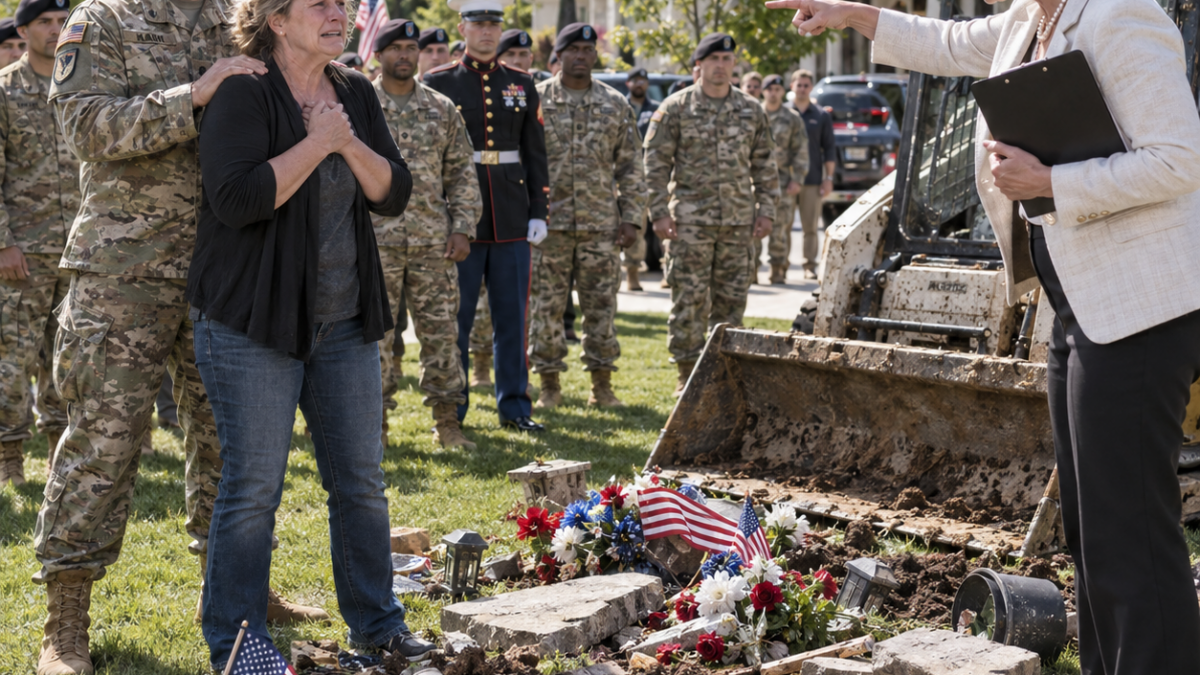
The second time, I came outside and found the memorial garden my wife and I had built for him ripped apart by an HOA landscaping crew.
Then Karen stood in the mud where his name used to be and handed me a bill for destroying it.
I didn’t yell.
That surprised her.
I think she had expected me to.
Karen Peters, president of the Oakwood Estates Homeowners Association, stood on the edge of my torn-up lawn with a clipboard pressed against her chest, watching me stare at the place where my son David’s garden had been.
The Veteran’s Honor rosebush was lying on its side with the roots exposed.
Blue forget-me-nots had been crushed beneath tire tracks.
The rosemary Sarah and I planted for remembrance was gone.
Twenty-four river stones—one for every year David had been alive—were scattered across the yard.
And the plaque I had carved by hand was missing.
That plaque had taken me three days.
Not because it was complicated.
Because my hands kept shaking.
SERGEANT DAVID MILLER
ALWAYS HOME. ALWAYS REMEMBERED.
Those words had been in the center of the garden since the first anniversary of his death.
Now there was only mud.
Karen looked at the damage and said, “It was an unapproved landscape modification.”
I slowly turned toward her.
“What?”
She tapped her clipboard.
“Section seven, subsection C. Decorative alterations visible from the street require prior architectural approval.”
“My son’s memorial?”
“It was landscaping.”
For a few seconds, I couldn’t speak.
David had been killed in Afghanistan by an improvised explosive device.
He had been twenty-four.
A squad leader.
Quiet.
Steady.
The kind of man who could calm other people simply by lowering his own voice.
At his funeral, I had been handed a folded flag while rifle volleys echoed across the cemetery.
I had survived my own years in uniform.
Nothing in my military career had prepared me for receiving that flag.
Afterward, Sarah and I couldn’t figure out where to put our grief.
So we put it into the ground.
We chose a corner of the front yard where morning sunlight reached first.
We planted roses for sacrifice.
Forget-me-nots because we had promised never to let his name disappear.
Rosemary because Sarah had read somewhere that it symbolized remembrance.
We laid down twenty-four stones.
And when the nightmares kept me awake, I carved the plaque in my garage.
David’s friends came to that garden when they were home.
Sometimes they stood there for five minutes without speaking.
Sometimes they left unit coins beneath the rosebush.
One young soldier once sat on the grass and cried until midnight.
Nobody called it landscaping.
Nobody except Karen.
“Where’s the plaque?” I asked.
She shrugged.
“The crew removed everything.”
“Where is it?”
“I assume it was disposed of.”
Disposed of.
Like yard waste.
Like trash.
Something inside me went absolutely still.
Karen mistook that stillness for surrender.
“You’ll also be receiving a two-hundred-fifty-dollar fine for the original violation,” she continued, “plus the cost of removal.”
“You’re billing me?”
“Yes.”
“For destroying my son’s memorial?”
She sighed.
“Mr. Miller, emotional attachment does not exempt homeowners from community standards.”
I looked down at my hands.
They were clenched.
Years earlier, an old drill sergeant had taught me a lesson that had probably kept me alive more than once.
Control first.
React second.
I opened my hands.
Then I looked Karen directly in the eyes.
“You had my son’s memorial destroyed.”
“I had a noncompliant feature removed.”
“You knew what it was.”
Her expression shifted slightly.
Not guilt.
Irritation.
“You put military memorabilia in the front yard without approval.”
I nodded once.
“All right.”
That seemed to confuse her.
“All right?”
“I understand.”
She smiled.
I think she believed she’d won.
Then I asked one final question.
“Who authorized the crew?”
“The board.”
“Entire board?”
“I am authorized to act on behalf of the board.”
I stored that answer away.
Karen raised her clipboard.
“Thirty days to pay.”
I turned away.
Behind me, she said, “Mr. Miller, we’re not finished.”
I knelt beside the uprooted rosebush.
One thorn caught my finger.
A bead of blood appeared.
I stared at it.
Then at the muddy hole where David’s name had been.
“No,” I said quietly.
“We’re just getting started.”
That evening, when Sarah came home and saw the garden, she dropped her purse in the driveway.
Then she covered her mouth.
I held her while she cried.
When she finally asked what I was going to do, I took her into the garage.
On my workbench sat the HOA covenants.
Beside them were photographs of every inch of damage.
I had already started labeling the evidence.
Sarah wiped her eyes.
“You’re fighting them?”
I opened the rulebook.
“No.”
She looked at me.
“I’m going to make them follow every rule they used against us.”
And before Karen understood what she’d awakened, I found the first mistake that could bring her entire little kingdom down.
PART 2
The mistake was on page forty-seven.
Sarah found it first.
She had spent thirty years as a librarian, which meant she possessed a particular kind of patience that made my military paperwork habits look almost sloppy.
We sat side by side at the folding table in my garage.
The ruined garden remained outside exactly as Karen’s crew had left it.
I refused to clean it.
Not yet.
That torn ground was evidence.
Sarah had three colored highlighters lined up beside her.
Yellow for board authority.
Blue for homeowner rights.
Red for enforcement procedures.
At eleven seventeen that night, she touched my arm.
“John.”
I looked over.
Her finger rested beneath a paragraph in the enforcement section.
“What?”
“Read this.”
I did.
Any enforcement action regarding an exterior modification had to be initiated within ninety days after the board became aware—or reasonably should have become aware—of the condition.
I read it again.
“How long was David’s garden there?”
“Fourteen months.”
“And visible from the street?”
“Every day.”
Sarah looked at me.
“So either they didn’t notice it for fourteen months…”
“Impossible.”
“…or they waited too long.”
I felt the first small piece of the battlefield shift.
Karen had cited section seven.
But she had ignored the procedural section governing section seven.
That mattered.
People like Karen loved rules when rules pointed outward.
They were often much less familiar with rules that limited their own power.
I put a red tab on the page.
“One.”
Sarah nodded.
“One.”
We kept reading.
By one in the morning, we had found three more problems.
The HOA could fine residents only after written notice and an opportunity for a hearing.
We’d received neither.
Any contractor entering privately owned portions of a homeowner’s lot for nonemergency work required written authorization unless the association had obtained an enforcement order.
Karen had none.
And association records—including contracts, meeting minutes, and expenditures—were available for member inspection upon written request.
I leaned back.
Sarah rubbed her tired eyes.
“What are you thinking?”
“That Karen likes paper.”
“She loves paper.”
“So we’ll give her paper.”
The next afternoon, a certified envelope arrived.
Karen had moved faster than I expected.
The letter contained three charges.
Two hundred fifty dollars for the “unauthorized memorial landscaping installation.”
One hundred dollars for “failure to maintain exterior appearance.”
Four hundred dollars for “corrective landscaping services.”
Total:
$750.
I read the second item twice.
She had fined me because the yard was damaged.
After she had ordered the damage.
Sarah was standing beside me.
“You’re kidding.”
“No.”
“She tore it apart and now we’re being fined because it’s torn apart?”
“Yes.”
Sarah took the letter.
Her grief had changed over the previous twenty-four hours.
It hadn’t diminished.
But anger had given it structure.
“She really believes no one will stop her.”
“That is exactly what she believes.”
I slid the letter into a clear evidence sleeve.
Exhibit A.
Then I wrote our response.
No insults.
No accusations.
Just facts.
I addressed it to every HOA director individually.
Karen Peters, president.
Arthur Bell, secretary.
Linda Mercer, vice president.
Robert Cain, at-large member.
I stated that the garden had existed visibly for fourteen months, making enforcement untimely under the HOA’s own ninety-day rule.
I noted that the association’s contractor had entered our property without written authorization.
I challenged the fines because no hearing had occurred.
I rejected the $400 contractor charge because we had neither requested nor authorized the work.
Then I requested records.
Board minutes approving the so-called beautification initiative.
The landscaping contract.
Payment authorization.
Communications concerning our property.
Any written complaint regarding David’s memorial.
The list of other homes supposedly included in the initiative.
And the vote authorizing Karen to order the removal.
Sarah read my draft.
“You forgot one thing.”
“What?”
She took the keyboard.
At the end, she added:
Please preserve all emails, text messages, photographs, work orders, invoices, and internal communications relating to this matter.
I looked at her.
“Librarian?”
“Thirty years dealing with people who claimed they never received overdue notices.”
I smiled for the first time since seeing the garden destroyed.
“Remind me never to fight you.”
“You married me.”
“Too late.”
We sent the letter certified.
I also hand-delivered a copy to Arthur Bell.
Arthur lived three streets over in a small brick house with two perfectly shaped ornamental trees out front.
He opened his door halfway.
“Mr. Miller.”
“Arthur.”
He looked at the envelope.
“What is this?”
“A records request and formal dispute.”
His shoulders lowered.
“Karen said you’d probably send something.”
“Then she’s prepared.”
I held out the envelope.
Arthur didn’t immediately take it.
“Mr. Miller, I am very sorry about your son.”
That stopped me.
“Thank you.”
“I didn’t know she was sending the landscapers to your house.”
“You’re secretary.”
“I know.”
“Did the board vote?”
He looked toward the street.
“I’m not comfortable discussing that.”
“That tells me plenty.”
He finally took the envelope.
I kept my voice calm.
“Read it, Arthur.”
“I will.”
“All of it.”
His eyes met mine.
“Why?”
“Because Karen told me the board authorized what happened.”
Arthur’s face lost color.
“And if that’s not true, you need to know what she’s putting your name behind.”
I walked away.
That afternoon, I photographed the garden again.
Then I found the landscaping company.
One of our neighbors had a doorbell camera pointing toward the street.
The camera had captured the crew truck the morning David’s memorial was destroyed.
A partial company name was visible on the door.
GREYSTONE LANDSCAPE SERVICES.
I called.
The owner, a man named Carl Mason, answered.
“Greystone.”
“My name is John Miller. Your crew worked at my home Tuesday.”
“Address?”
I gave it.
Keyboard clicking.
“Yeah. Oakwood HOA cleanup.”
“Who hired you?”
Pause.
“HOA president.”
“Karen Peters?”
“That’s the name.”
“What exactly were you instructed to remove?”
Another pause.
“Sir, is there a problem?”
“You removed a memorial garden for my son, who was killed overseas.”
Silence.
A long one.
Finally Carl said, “Wait.”
I heard papers moving.
Then his voice changed.
“Our work order says remove unauthorized plantings, decorative object, stone border, restore lawn.”
“Did your crew know it was a memorial?”
“I don’t know.”
“There was a plaque with his rank and name.”
Carl swore softly.
“I’m sorry.”
“I need a copy of the work order.”
“I’d need legal approval.”
“I understand.”
“And Mr. Miller?”
“Yes?”
“If I had known what that was, we wouldn’t have touched it.”
I believed him.
That didn’t absolve his company entirely.
But it mattered.
“Preserve the work order.”
“I will.”
“And any messages from Karen.”
Another pause.
“I’ll do that.”
Karen’s version of events had already started developing cracks.
The next few days were quiet.
Too quiet.
I began walking Oakwood Estates in the evenings.
Not campaigning.
Not yet.
Listening.
George Harlan lived at the corner.
Retired Air Force colonel.
Seventy-three.
Still stood straight enough that you could imagine him wearing a uniform.
He was adjusting his flagpole rope when I stopped.
“Miller.”
“Colonel.”
“Retired.”
“Still sounds better than George.”
He snorted.
“Heard about David’s garden.”
The sympathy in his voice was blunt, almost uncomfortable.
Military men of our generation were often better at carrying grief than describing it.
“Karen called it an eyesore.”
George’s jaw tightened.
“That woman fined me seventy-five dollars because my flag made too much noise.”
I thought I’d heard him wrong.
“Your American flag?”
“Windy week.”
“What regulation covers patriotic noise?”
“Excessive repetitive sound.”
Despite everything, I laughed.
George didn’t.
“My wife had just come home from surgery. I paid it because I didn’t have the energy.”
I nodded.
That sentence stayed with me.
I didn’t have the energy.
That’s how petty tyrants survive.
Not because they’re invincible.
Because normal people have jobs.
Families.
Illnesses.
Children.
Grief.
Nobody wants to spend Wednesday night arguing about bird feeders or flowerpots in a clubhouse.
Karen understood that.
George pointed toward our house.
“You fighting?”
“Yes.”
“You know what you’re doing?”
“Not entirely.”
“Good.”
I raised an eyebrow.
“Why good?”
“Man who thinks he knows everything is dangerous.”
He tied off the rope.
“What do you need?”
“For now? Nothing.”
“Wrong answer.”
I studied him.
“What are you offering?”
“Air support.”
That earned another laugh.
“I’ll remember that.”
The next ally found me.
Maria Garcia was scrubbing her garage door when I walked past.
She was maybe thirty.
Two young children.
Her little boy sat on the driveway beside a red tricycle.
Maria looked close to tears.
“Everything okay?”
She startled.
“Oh. Mr. Miller. Yes.”
The answer was obviously no.
I saw the faint gray mark on the lower panel.
“What happened?”
“My son hit the door.”
The boy looked guilty.
“He’s four.”
“I gathered.”
She gave me a tired smile.
“We got a violation.”
“For that?”
She nodded.
“Exterior defacement.”
“How much?”
“Fifty dollars a day after Friday.”
I looked at the mark.
You had to know it was there to see it.
“Can I read the notice?”
Maria hesitated.
Then went inside.
She returned with a cream-colored HOA letter.
Same letterhead.
Same threatening cadence.
Correct immediately.
Accruing fines.
Potential collection action.
Karen’s signature.
I photographed it with Maria’s permission.
“Don’t ignore it.”
She looked worried.
“I can’t afford fifty dollars every day.”
“Write back.”
“What do I say?”
“Ask the board to identify the approved repair method because you’ve already attempted to clean it.”
“Will that help?”
“It forces them to stop issuing vague demands and explain what compliance means.”
She stared at me.
“You sound like a lawyer.”
“Worse. Logistics.”
She laughed.
Then her expression softened.
“I heard what happened to your son’s garden.”
I nodded.
“I’m sorry.”
“Thank you.”
“It was beautiful.”
“You noticed it?”
“Everyone did.”
That mattered.
If everyone had noticed the garden for fourteen months, Karen couldn’t plausibly claim it had only recently become an actionable violation.
“Would you be willing to write that down?”
“What?”
“That you remember the garden being there.”
Maria understood immediately.
“Yes.”
“One more thing.”
“What?”
“Write down what’s happening with your garage. Dates. Notices. Attempts to comply.”
She looked toward Karen’s house.
Fear appeared.
I didn’t push.
“You don’t have to.”
Maria looked at her little boy.
Then at the nearly invisible mark.
“Yes,” she said.
“I do.”
Stories came after that.
Mrs. Gable, seventy-eight, had been forced to remove a bird feeder because Karen claimed it encouraged “undesirable wildlife congregation.”
The undesirable wildlife consisted mostly of cardinals.
A man named Robert Ellis had received repeated warnings because his work truck remained in his driveway overnight.
A widower had been fined because his lawn service cut one day late while he was hospitalized.
George had his flag.
Maria had the garage.
Individual incidents.
Taken separately, almost absurd.
Together, they became a pattern.
Karen didn’t maintain standards.
She maintained fear.
The deadline for our records request passed.
No response.
On business day sixteen, Sarah placed the calendar on the table.
“Today.”
“I know.”
“What now?”
“Second letter.”
This one was stronger.
I cited our original request.
The missed deadline.
And the state statute requiring associations to make specified records available to members.
I did not invent penalties.
I asked our attorney—because by then I had spoken with one—to verify the statute and the remedies available.
His name was Daniel Ross.
Former Army JAG.
Property litigation.
When I showed him the paperwork, his first advice had been simple.
“Do not turn this into a revenge fantasy.”
“That’s not what I want.”
“Good.”
He tapped the photographs of the destroyed garden.
“You have property damage.”
He tapped the letters.
“Potential improper enforcement.”
The board records request.
“Potential governance violations.”
Then he looked at me.
“But we prove what we can prove.”
That sentence kept me steady.
Our second records demand quoted the actual statute Daniel had identified.
It warned the association that continued refusal could expose it to statutory consequences and attorney fees.
No bluff.
No invented threat.
Just law.
I delivered Arthur’s copy personally again.
This time he stepped outside and closed the door behind him.
“John.”
The use of my first name told me something had changed.
“She is furious.”
“I assumed.”
“She says you’re trying to overthrow the board.”
“I’m asking for invoices.”
“I know.”
“Did you vote to bulldoze David’s garden?”
Arthur stared at the ground.
“No.”
There it was.
“Did Linda?”
“No.”
“Robert?”
“I don’t think so.”
“Then Karen lied.”
Arthur looked sick.
“She said she had authority under the beautification program.”
“What beautification program?”
“That was my question.”
“And?”
“She told me not to worry about it.”
I lowered my voice.
“Arthur, you need your own copy of every record.”
“Why?”
“Because if she acted alone and then claimed the board approved it, the board needs proof.”
He nodded slowly.
“I’m trying.”
“Try faster.”
Three days later, a thick manila envelope appeared on my porch.
Some records.
Not all.
The landscaping contract had been heavily redacted.
No meeting minutes.
No recorded board vote.
No list of properties.
No written complaint about our garden.
There was, however, a one-page internal memo claiming the president possessed authority to remedy obvious aesthetic violations without prior board approval.
It had been dated two days before our garden was destroyed.
Sarah studied it.
“This wasn’t in the bylaws.”
“No.”
“And it’s unsigned.”
“Yes.”
“And no meeting minutes support it.”
“Correct.”
She looked at me.
“Someone wrote this later.”
“Maybe.”
“John.”
“I know what it looks like.”
Daniel was more careful.
“Don’t call it fabricated yet.”
“It is.”
“Probably isn’t the same as provably.”
I hated when lawyers were right.
“What can we say?”
“That it is unsupported by the records produced.”
“Less satisfying.”
“More useful.”
The envelope also contained a new letter from Karen.
The fines had doubled.
$1,500.
She accused me of harassment.
She accused Sarah and me of intentionally maintaining a “hostile landscape condition.”
And she threatened lien proceedings.
That was the moment Daniel’s demeanor changed.
He read the letter twice.
“She threatened foreclosure?”
“She threatened a lien.”
“Same direction, different stage.”
“Can she?”
“HOAs can have lien rights in some circumstances. Whether these fines are valid is another issue.”
“She’s using my house.”
“Yes.”
“To make me stop asking questions.”
“That’s how it reads.”
Daniel sat back.
“Now we stop treating this as a neighborhood disagreement.”
“What does that mean?”
“Formal representation.”
He sent a preservation letter to the HOA.
Not angry.
Not theatrical.
It required preservation of emails, texts, board communications, contractor records, payment records, enforcement files, and documents relating to the memorial.
He also demanded suspension of fines while the dispute was reviewed.
Karen responded through HOA counsel.
Cease and desist.
They accused me of harassing board members.
They accused me of spreading defamatory allegations.
They demanded I stop discussing HOA business with neighbors.
And they repeated the threat of collection against my property.
Daniel read it in silence.
Then he smiled.
“What?”
“This is badly drafted.”
“How badly?”
“They’re trying to tell a homeowner he can’t speak to other homeowners about governance.”
“Can they?”
“They can ask you not to harass anyone. They can’t create a private gag order because criticism is inconvenient.”
He placed the letter down.
“Also, this letter confirms the association is now officially involved.”
Karen had done what I feared.
She had converted her own conduct into a community liability problem.
But the thing that changed everything wasn’t legal.
It was an email.
To David’s squad.
For days I resisted sending it.
Those men had their own memories of him.
Their own nightmares.
Their own lives.
I didn’t want to drag them into mine.
Sarah finally said, “John, they loved him too.”
“I know.”
“They visit his garden.”
“I know.”
“So don’t decide for them whether this matters.”
That night, I sat at my computer.
Frank Rizzo was the first name.
Staff Sergeant Frank Rizzo.
David’s squad leader.
Best friend.
At the funeral, Frank had barely spoken.
He had hugged Sarah.
Then me.
Then stood beside David’s casket for nearly fifteen minutes with his right hand resting on the wood.
I wrote:
Frank,
This is David’s dad.
Something happened here that I believe you and the guys deserve to know about.
Then I told him.
No dramatics.
No demands.
Just facts.
Photographs attached.
Destroyed garden.
Broken roses.
Missing plaque.
I clicked send at 8:43 p.m.
At 9:19, my phone rang.
“Mr. Miller?”
“Frank.”
His breathing was heavy.
I heard voices behind him.
“Sir, we saw the pictures.”
“I figured.”
“What the hell happened?”
I explained.
When I mentioned the plaque being thrown away, someone in the background cursed loudly.
Frank went quiet.
“Sir.”
“Yes?”
“That garden wasn’t just yours.”
I closed my eyes.
“I know.”
“David was our brother.”
His voice broke.
Then hardened.
“We’re coming.”
“Frank—”
“We have a three-day pass next weekend.”
“You don’t have to.”
“All eight of us are coming.”
The number hit me.
Eight.
The surviving men who had served closest to David.
Some still active.
Some transitioning out.
One medically retired.
I sat down.
“Frank.”
“Yes, sir?”
“I need you to understand something.”
“Anything.”
“We do this disciplined.”
Silence.
“No threats.”
“Yes, sir.”
“No intimidation.”
“Yes, sir.”
“No standing on Karen’s lawn.”
Someone in the background said, “Damn.”
Frank barked, “Shut up.”
Despite myself, I laughed.
Frank laughed too.
“Understood.”
“We’re rebuilding the garden.”
“Done.”
“And before that, we’re having a barbecue.”
“A barbecue?”
“Sarah’s idea.”
I heard Sarah behind me say, “A very good idea.”
Frank said, “Ma’am?”
Sarah leaned toward the phone.
“You boys come hungry.”
“Roger that, Mrs. Miller.”
The following week changed Oakwood Estates.
Sarah created simple invitations.
No accusations.
No Karen.
No HOA dispute.
Just:
IN LOVING MEMORY OF SERGEANT DAVID MILLER
PLEASE JOIN US FOR FOOD, STORIES, AND COMMUNITY.
Saturday afternoon.
Our front yard.
We included a photograph of David.
Not his formal military portrait.
One Sarah loved.
David was laughing in a T-shirt beside an old pickup truck.
Twenty-three years old.
Alive.
We delivered invitations house to house.
People who had avoided discussing the conflict now stopped us.
Maria hugged Sarah.
George announced he was bringing potato salad.
Mrs. Gable promised lemon pie.
Arthur took an invitation with shaking hands.
“You coming?”
“I don’t know if I should.”
“Why?”
“Board member.”
“You knew David.”
“Not well.”
“You don’t have to know a man well to remember him.”
Arthur looked toward Karen’s house.
Then back at me.
“I’ll come.”
Karen received no invitation.
That decision bothered Sarah.
“Maybe we should.”
“No.”
“Because you’re angry?”
“Yes.”
“At least you’re honest.”
“She destroyed it.”
“I know.”
“I don’t want her there.”
Sarah nodded.
“Then don’t invite her.”
Friday evening, two pickup trucks turned into our driveway.
Eight men climbed out.
No uniforms.
Jeans.
Boots.
T-shirts.
Coolers.
Toolboxes.
One carried a long cardboard box.
Frank walked toward me.
Older than I remembered.
Not old.
Just aged in a way combat sometimes ages people.
He held out his hand.
I ignored it and hugged him.
For a second, he froze.
Then his arms came around me.
“We’re here, sir.”
“Stop calling me sir.”
“No chance.”
Sarah came down the steps.
The moment she saw them, she covered her mouth.
Frank went to her first.
“Ma’am.”
She hugged every one.
Frank.
Luis Ortega.
Calvin Brooks.
Nate Harper.
Sam Lee.
Derrick Coleman.
Ty Walker.
Evan Price.
Names David had spoken hundreds of times.
Men whose faces I knew from photographs.
Men who had known parts of my son I never would.
That night, my house sounded different.
Laughter.
Real laughter.
They told stories.
David once put so much hot sauce on powdered eggs that Frank claimed the fumes qualified as chemical warfare.
He couldn’t sing.
He cheated at cards but was terrible at hiding it.
He carried a tiny bottle of maple syrup because he hated military pancake syrup.
Sarah laughed until she cried.
Then cried until she laughed again.
At midnight, Frank and I sat on the back porch.
He looked toward the front yard.
“Where’d they throw the plaque?”
“Landfill, probably.”
His jaw tightened.
“We brought something.”
“The box?”
“Tomorrow.”
“What is it?”
“Tomorrow.”
Saturday’s barbecue started at three.
By four, our yard was full.
Dozens of neighbors.
Folding chairs.
Coolers.
Children.
Covered dishes.
George’s potato salad was aggressively over-seasoned, which he insisted was intentional.
Mrs. Gable brought two pies.
Maria’s son rode the infamous tricycle down our driveway.
Nobody fined him.
David’s squad didn’t arrive like warriors.
They arrived like family.
They grilled.
Played catch.
Helped elderly neighbors carry chairs.
And told stories.
That was the most powerful part.
They made David real.
Frank told George how David once crawled across exposed ground to pull a wounded man behind cover.
Luis described him staying up all night with a soldier who had received bad news from home.
Calvin described David refusing promotion paperwork until everyone else’s evaluations were finished.
Sam told Sarah that David carried a photograph of her and me folded behind his identification card.
I had never known that.
Sarah turned away and cried quietly.
The neighborhood watched.
The memorial Karen had reduced to an “unapproved landscape modification” suddenly had a face.
A voice.
Friends.
History.
As sunset approached, I stood on the porch.
“Can I have a minute?”
Conversation faded.
Sarah stood beside me.
David’s squad gathered near the ruined garden.
“I want to thank you for coming.”
I looked at the faces.
Some sympathetic.
Some angry.
Some ashamed they had been silent.
“This garden was where Sarah and I remembered our son.”
I pointed toward the churned ground.
“The HOA president ordered it removed.”
No one moved.
“She then fined us for having created it.”
Murmurs.
“And fined us again because the removal damaged our lawn.”
The murmurs grew.
“After we challenged those actions, the fines increased.”
I held up the attorney letter.
“We have now been threatened with collection against our home.”
Maria said, “That’s insane.”
I nodded.
“But this isn’t just about us.”
I held up copies of notices neighbors had willingly shared.
“George was fined over his flag.”
George raised one hand.
“The Garcias received daily-fine threats over a child’s tricycle mark.”
Maria nodded.
“Mrs. Gable lost her bird feeder.”
The elderly woman called, “The cardinals have lawyers now.”
Laughter broke the tension.
Then I became serious.
“No one incident brought us here.”
I looked toward Karen’s darkened house.
“It was the belief that everybody would stay isolated.”
George stepped forward.
“That ends now.”
His voice still carried command without effort.
“This association has removal procedures.”
Heads turned.
“I’ve read them.”
Of course he had.
“If the president has abused authority, misused funds, acted without board approval, and exposed the association to liability, homeowners may petition for a special meeting.”
“How many signatures?” someone asked.
“Thirty percent to compel the meeting.”
Maria said, “We’ll get them.”
Someone else said, “Tonight.”
George shook his head.
“Tomorrow.”
He pointed toward the garden.
“Tonight is about David.”
That was exactly right.
The barbecue continued.
Not as a rebellion.
As a memorial.
Sunday morning began at eight.
I walked outside and stopped.
Thirty people were already there.
Shovels.
Rakes.
Wheelbarrows.
Flowers.
Bags of compost.
Fresh soil.
Stone.
George’s truck backed up with a load of heavy pavers.
Maria brought water.
Mrs. Gable brought donuts.
Arthur arrived alone.
No clipboard.
No board badge.
Just work gloves.
“You’re helping?”
He nodded.
“I should have stopped her.”
“We can talk later.”
“I need to say it.”
I waited.
“There was no vote.”
I knew.
“But I should’ve challenged her the minute I found out.”
“Yes.”
His eyes dropped.
“I didn’t.”
“No.”
He swallowed.
“I was scared of her.”
“So were a lot of people.”
“That doesn’t excuse it.”
“No.”
He looked toward the work.
“Can I help?”
I handed him a shovel.
“Yes.”
Frank opened the long cardboard box.
Inside was a granite plaque.
Dark gray.
Polished.
David’s name.
Rank.
Unit insignia.
Dates.
Below that:
ALWAYS HOME. ALWAYS REMEMBERED.
And beneath those words:
REBUILT BY HIS BROTHERS-IN-ARMS AND A COMMUNITY THAT REMEMBERS.
I couldn’t speak.
Sarah ran her fingers over the letters.
Frank looked nervous for the first time all weekend.
“Too much?”
Sarah hugged him.
“No.”
She whispered it into his shoulder.
“No. It’s perfect.”
We worked.
Not fast.
Carefully.
The squad cleared the damaged soil.
Neighbors laid a stronger stone border.
Sarah directed plants.
Veteran’s Honor roses.
Forget-me-nots.
Rosemary.
Twenty-four river stones.
The same symbolism.
New roots.
Around ten, a local news van arrived.
I hadn’t called them.
George claimed innocence too quickly.
Later, Maria admitted her sister worked at the station.
Jessica Chen stepped out with a cameraman.
“I heard a Gold Star family’s memorial was removed by an HOA and the soldier’s former unit came to rebuild it.”
I looked at George.
He studied the sky.
Jessica continued.
“Would you talk to us?”
I looked at Sarah.
She nodded.
“Yes.”
“But this isn’t just about our family.”
Jessica glanced at the volunteers.
“I can see that.”
Daniel had already warned me about public statements.
Facts only.
Documents only.
No exaggeration.
I followed that advice.
I showed Jessica the destroyed garden photographs.
The HOA fine letters.
The records request.
The unsupported memo.
The increased fines.
The collection threat.
George spoke about governance.
Maria spoke about fear.
Mrs. Gable spoke about cardinals.
Frank spoke about David.
“He wasn’t a symbol,” Frank said into the camera.
“He was our friend.”
He looked toward the new plaque.
“When he died, his parents gave us somewhere to come remember him.”
His jaw tightened.
“Somebody threw that away.”
Jessica lowered her microphone slightly.
“Why did all of you come?”
Frank looked at the seven men behind him.
“Because he would’ve come for us.”
That sentence broke me.
I turned away.
Sarah took my hand.
Then Karen appeared.
She walked out of her house with her clipboard.
Of course she did.
“What is going on?”
Nobody stopped working.
Karen marched closer.
“This is an unauthorized gathering.”
George kept setting stone.
Karen raised her voice.
“You are violating community noise restrictions.”
A shovel scraped.
Someone opened another bag of soil.
Nothing else.
Karen wasn’t accustomed to being ignored.
Her face reddened.
She spotted Jessica.
Everything changed.
Karen hurried toward the camera.
“This man is conducting a harassment campaign against the board.”
Jessica lifted the microphone.
“Are you Karen Peters?”
“I am the HOA president.”
“Did you authorize removal of Sergeant David Miller’s memorial garden?”
Karen hesitated.
“It was an unapproved landscaping installation.”
Frank stopped working.
The other soldiers did too.
Not threatening.
Just listening.
Jessica said, “Did you know it was a memorial to the Millers’ son?”
“It contained military-themed decorative elements.”
I saw George’s jaw tighten.
Jessica continued.
“Did the full board vote to remove it?”
Karen’s eyes shifted toward Arthur.
Arthur stood beside a wheelbarrow.
For the first time, he didn’t look away.
“No,” he said.
Everyone heard him.
Karen snapped, “Arthur.”
“There was no vote.”
“You authorized—”
“No.”
His voice shook.
But he repeated it.
“No, I didn’t.”
Jessica turned toward Karen.
“Mrs. Peters?”
Karen pointed toward me.
“He is manipulating people.”
I said nothing.
She kept going.
“He has been spreading lies about me for weeks.”
Jessica held up a copy of the fine notice.
“Did you issue this?”
Karen stopped.
The camera remained on her.
“HOA correspondence is confidential.”
“Is this document authentic?”
Karen’s voice rose.
“I said this is a private matter.”
Then two patrol cars arrived.
No sirens.
No lights.
They pulled to the curb.
Karen almost smiled.
“Finally.”
Two officers stepped out.
A sergeant approached.
“Mr. Miller?”
“Yes.”
“We received a disturbance complaint.”
Karen rushed over.
“I called you.”
The sergeant looked at her.
“Okay.”
“They are conducting illegal construction.”
He looked toward my property.
“On his own yard?”
“They need architectural approval.”
The sergeant stared for half a second.
“That’s civil.”
Karen pointed toward Jessica.
“And the media are harassing me.”
“Also not something I’m addressing unless there’s criminal conduct.”
Karen’s confidence began to slip.
Then the sergeant turned toward me.
“Mr. Miller, Detective Harper asked us to speak with you if we were dispatched here.”
My heart rate changed.
Three days earlier, Daniel had advised me to file a formal property-damage report after the landscaping company produced its work order.
The restoration estimates exceeded a thousand dollars.
I had made the report.
The detective had interviewed Carl Mason.
I had not expected anything to happen that morning.
The sergeant continued.
“Do you have the photographs?”
“Yes.”
“And the contractor statement?”
“Detective Harper does.”
Karen looked between us.
“What contractor statement?”
The sergeant turned toward her.
“Mrs. Peters, were you the person who hired Greystone Landscaping to remove the garden?”
She drew herself up.
“I acted in my official capacity.”
“That wasn’t my question.”
The entire street went quiet.
Even the shovels stopped.
Karen glanced toward the news camera.
“I authorized remediation of a covenant violation.”
“Did you specifically tell them to remove the plaque?”
“I told them to clear the area.”
The sergeant’s expression changed slightly.
“Ma’am, I’m going to ask you not to leave while we clarify something.”
Karen went pale.
“This is ridiculous.”
Another officer spoke quietly into his radio.
Jessica’s cameraman kept filming from a respectful distance.
Daniel had warned me not to speculate about criminal charges.
So I didn’t.
I simply watched.
The officer returned.
“Mrs. Peters, Detective Harper has requested that we detain you pending further investigation regarding destruction of property.”
Karen stared at him.
“Detain me?”
“Yes, ma’am.”
“You can’t.”
“Please turn around.”
That was when the street seemed to stop breathing.
Karen looked at me.
For weeks, I had imagined what I might feel if consequences finally reached her.
Satisfaction.
Vindication.
Maybe even joy.
What I felt was exhaustion.
Karen’s hands were secured behind her.
She didn’t scream.
She whispered, “John.”
I hadn’t heard her use my first name before.
I stepped closer, but not too close.
“This didn’t have to happen.”
Her eyes filled with fear.
“You did this.”
“No.”
I looked toward David’s garden.
“You did.”
The officers guided her toward the patrol car.
No cheering.
I was proud of that.
George removed his cap.
Arthur looked sick.
Maria pulled her child closer.
David’s squad remained silent.
The news camera captured everything.
But nobody celebrated an arrest.
Because the point had never been spectacle.
The point was the garden.
After the patrol cars left, Frank picked up his shovel.
“So.”
Everyone looked at him.
“We finishing this thing or what?”
Laughter moved through the crowd.
“Finish it,” I said.
Work resumed.
By four that afternoon, the garden was rebuilt.
Better than before.
Not larger.
That mattered to me.
I didn’t want it turned into a monument to conflict.
It was still David’s place.
The roses sat behind the plaque.
Forget-me-nots curved around the twenty-four stones.
Rosemary bordered the path.
Frank and Luis lowered the granite marker into its base.
Sarah knelt beside it.
She touched David’s name.
Then she cried.
Not the broken cry from the day the garden was destroyed.
A softer one.
Grief and gratitude occupying the same breath.
People gradually went home.
George handed me a clipboard.
I laughed.
“Seriously?”
“Different kind.”
The removal petition.
More than a hundred signatures.
Far beyond the number required to compel a special meeting.
Arthur looked at it.
“You won’t need all of those.”
“No?”
“The board is meeting tonight.”
“With Karen detained?”
“Yes.”
“What are you doing?”
He took a breath.
“I’m resigning.”
“Arthur—”
“I should.”
“Don’t resign because you’re ashamed.”
“Why not?”
“Because then someone else has to clean up what you helped ignore.”
He looked at me.
“You think I should stay?”
“I think you should decide whether you’re willing to do the work.”
That evening, Arthur called.
He had not resigned.
Linda Mercer and Robert Cain had.
The HOA’s attorney had advised immediate independent counsel.
Karen’s authority was suspended.
A special homeowner meeting was scheduled.
George’s petition became mostly symbolic.
But symbols matter.
The criminal case moved slower.
Real legal systems usually do.
The dramatic moment was over.
Then came interviews.
Documents.
Statements.
Attorney meetings.
Greystone Landscape Services cooperated fully.
Carl provided the written work order.
Emails.
Text messages.
One message from Karen was painfully clear:
Remove all material from front corner. Owner has been difficult. Do not leave plaque or edging.
Daniel read it to me.
“You understand what this does?”
“She knew.”
“Yes.”
“Could she say she thought it was decorative?”
“She can say anything. The question is what the evidence proves.”
Police returned the original wooden plaque three weeks later.
I couldn’t believe it.
Carl’s crew had not taken it to the landfill.
One of his workers had seen David’s name and refused to throw it away.
He put it behind the company’s storage shed.
Carl found it after police asked.
The plaque was damaged.
Mud-stained.
A corner cracked.
But David’s name remained.
Sarah pressed it against her chest when I brought it home.
“I thought it was gone.”
“So did I.”
“What do we do with it?”
I knew immediately.
“Keep it.”
We hung it inside the garage.
Above the workbench where I had built my evidence wall.
Not because I wanted to remember Karen.
Because I wanted to remember the hands that carved those letters when grief was still too new for words.
The special HOA meeting took place two weeks later.
The clubhouse was packed.
Karen attended with an attorney.
She had been released after processing while charges were reviewed.
No dramatic orange jumpsuit.
No handcuffs.
Just a woman sitting in the front row without her clipboard.
That image affected me more than I expected.
For years, the clipboard had seemed fused to her identity.
Without it, she looked ordinary.
George chaired the meeting temporarily because Arthur asked him to.
The association’s independent lawyer spoke first.
He explained that the board’s authority came from governing documents and state law.
Not personality.
Not tradition.
Not intimidation.
He also explained that Karen’s actions concerning our memorial had not been approved by a properly recorded board vote.
Murmurs filled the room.
Karen’s attorney objected to characterizations.
The lawyer nodded.
“Then we’ll stick to the documents.”
That sentence reminded me of Daniel.
Documents.
Minutes.
Emails.
Votes.
Facts.
George read the petition.
One hundred twelve valid household signatures.
The bylaws required far fewer.
A removal vote was scheduled.
Before it happened, Karen requested speaking time.
Some residents objected.
George allowed it.
I respected him for that.
Karen stood.
For several seconds, she said nothing.
Then:
“I was trying to protect Oakwood Estates.”
Someone laughed bitterly.
George raised his hand.
Silence returned.
Karen continued.
“When I became president, property standards were slipping.”
Her voice sounded smaller than I remembered.
“We had inconsistent enforcement. People expected the board to act.”
She looked toward Sarah and me.
“I believed the Miller garden violated our landscape standards.”
Sarah’s hand tightened around mine.
Karen continued.
“I should have handled it differently.”
A woman behind us said, “Differently?”
Karen looked toward her.
“I made an error in judgment.”
Maria stood.
“You threatened their house.”
Karen’s attorney whispered something.
Karen ignored him.
“I was responding to what I believed was harassment.”
George said, “Mrs. Peters, you have five minutes. Use them.”
She looked at him.
Then at Arthur.
Then at the residents.
“I worked for this community for six years.”
Mrs. Gable said quietly, “You made me take down my bird feeder.”
A ripple of uncomfortable laughter.
Karen’s face tightened.
“I enforced the rules.”
George asked, “All of them?”
She looked at him.
“Excuse me?”
“Did you enforce the rules limiting your authority?”
Silence.
“Did you follow the hearing requirement before fining the Millers?”
Karen’s lawyer stood.
“My client is not required to answer—”
“This is a homeowner meeting, counsel,” George replied. “Not testimony.”
Karen sat.
She didn’t finish her five minutes.
The removal vote proceeded.
The result wasn’t close.
Karen Peters was removed as HOA president and from the board.
Not unanimously.
A few people supported her.
That mattered too.
Communities aren’t fairy tales.
People can see the same events and reach different conclusions.
But the required threshold was exceeded by a landslide.
When George announced the result, nobody cheered.
Then Eleanor Gable stood.
The bird-feeder widow.
“Can we please stop being afraid of each other now?”
That received applause.
Not Karen’s defeat.
Eleanor’s question.
Can we stop being afraid?
That became the beginning of Oakwood’s recovery.
George was elected interim president.
He resisted.
Hard.
“I retired from commanding people.”
Maria replied, “Good. We don’t need a commander.”
“Then why me?”
“Because you’ll read the rules.”
George stared at her.
“That’s a dangerously low standard.”
He accepted for six months.
Maria became treasurer.
Arthur remained secretary.
His first act was to organize the board records properly.
When he showed me the filing system, I laughed.
“What?”
“You alphabetized.”
“I learned from Sarah.”
“Smart man.”
The board rescinded our fines.
All of them.
They reimbursed us for legal costs associated with the invalid enforcement.
They paid the portion of the garden restoration not covered through Karen’s restitution process.
And they issued a formal written apology.
Sarah framed that letter.
I didn’t understand why.
“For David?” I asked.
“No.”
“Then why?”
“For us.”
She touched the frame.
“So I remember that we didn’t imagine what happened.”
That sentence told me how deeply the fight had affected her.
When someone with authority repeatedly tells you you’re unreasonable, difficult, emotional, hostile, or noncompliant, part of you eventually wonders if maybe they’re right.
The apology mattered because it restored reality.
The criminal case resolved months later.
Karen entered a plea to a property-damage offense.
The exact conviction and sentencing terms mattered less to me than the restitution requirement and court order.
She was required to compensate the losses the court recognized.
She received probation and community-service obligations.
There was no cinematic courtroom explosion.
No judge delivering a ten-minute speech.
No reporters gasping.
Just paperwork.
A plea.
A sentence.
Consequences.
Daniel called me afterward.
“You okay?”
“I think so.”
“Disappointed?”
“No.”
“A lot of clients expect more drama.”
“I’ve had enough.”
“Good answer.”
The HOA itself underwent a much larger review.
George created a committee.
I refused to join.
He appeared at my door.
“You’re the reason we’re doing this.”
“Exactly why I shouldn’t run it.”
“Explain.”
“Then it becomes my HOA.”
He considered that.
“Fair.”
Sarah joined instead.
Of course she did.
The librarian rewrote sections of the enforcement manual in plain English.
Her first recommendation eliminated half the jargon.
Her second required written explanations identifying the actual harm a rule was designed to prevent.
Her third expanded the hearing process.
Maria pushed for hardship discretion.
George insisted board members disclose conflicts.
Arthur created a public record log.
The neighborhood changed.
Slowly.
Mrs. Gable’s bird feeder returned.
Within three days, so did the cardinals.
Maria stopped scrubbing the garage door.
Her son’s tricycle mark faded on its own.
George’s flag continued making noise whenever the wind felt patriotic.
Children played in driveways.
People left chairs out overnight.
No property values collapsed.
The world kept spinning.
Then came the memorial question.
Several residents proposed a new HOA rule protecting military memorials.
At first, I supported it.
Then Daniel asked one question.
“What about everyone else?”
I frowned.
“What do you mean?”
“Fallen police officers?”
“Of course.”
“Firefighters?”
“Yes.”
“A child?”
I stopped.
Daniel continued.
“A spouse?”
“Yes.”
“A parent?”
I understood.
“If you write a rule protecting only one kind of grief, you’ll eventually repeat the same mistake from another direction.”
That changed the proposal.
The final bylaw did not create a Sergeant David Miller Memorial Protection Act.
It did something better.
It recognized modest personal memorial gardens and plaques as presumptively permitted, subject only to reasonable safety, drainage, and property-line restrictions.
Military.
Civilian.
Child.
Parent.
Spouse.
Friend.
Grief didn’t have to submit an application proving it was worthy enough.
When Sarah read the final language, she cried.
“David would’ve liked this.”
I thought so too.
His name didn’t become a weapon against someone else’s loss.
It became the reason the community made room for everyone.
Frank and the guys visited again the following year.
Not all eight.
Calvin was deployed.
Evan had a new baby.
But five came.
They brought barbecue.
No legal letters.
No reporters.
No police.
Just stories.
Frank stood beside the granite plaque.
“The roses survived.”
“Barely. Sarah threatens them into compliance.”
Sarah called from the porch, “I heard that.”
Frank grinned.
He looked at the smaller wooden plaque hanging in my garage.
“You kept the original.”
“Always.”
He became quiet.
“David carved anything when you were growing up?”
“No.”
“He’d laugh knowing you became the carpenter.”
“I was always the carpenter.”
“I mean emotional carpenter.”
“That makes even less sense.”
Frank shrugged.
“Sounded better in my head.”
We sat on the porch after dark.
Eventually he said, “I felt guilty.”
I turned.
“For what?”
“Coming here that weekend.”
“Why?”
“Because part of me wanted a fight.”
I understood.
“We all did.”
“I wanted to see her scared.”
“She was.”
“I know.”
“Did that help?”
Frank stared toward the garden.
“No.”
“What helped?”
He didn’t answer immediately.
Then:
“Putting the plaque back.”
Exactly.
That’s the part people misunderstand about revenge.
The fantasy is always about the other person hurting.
The satisfaction usually comes from restoring what they tried to take.
Karen lost her office.
Paid restitution.
Completed community service.
Moved out of Oakwood two years later.
I heard that from Maria.
“Want to know where?”
“No.”
She looked surprised.
“Really?”
“Really.”
“Aren’t you curious?”
“No.”
And I meant it.
For months, Karen had occupied too much space in my mind.
Every letter.
Every deadline.
Every new threat.
Eventually I realized letting her remain the center of the story would give her power she no longer deserved.
The story wasn’t Karen.
It was David.
It was Sarah.
It was Frank and seven other men driving across the state because their dead friend still mattered.
It was George finally refusing to pay another absurd fine.
Maria learning she could challenge authority.
Arthur discovering that silence is still a choice.
Mrs. Gable hanging a bird feeder.
Neighbors rebuilding a garden with their own hands.
That was the story.
On the second anniversary of the rebuilt memorial, Sarah woke before sunrise.
She made coffee.
Two cups.
We walked outside.
Morning light was just beginning behind the houses.
The roses were wet with dew.
Forget-me-nots had spread farther than planned.
Rosemary filled the air when I brushed against it.
Sarah sat on the bench beside David’s plaque.
“We should prune these.”
“Tomorrow.”
“You always say tomorrow.”
“Then tomorrow has experience.”
She smiled.
For a while, we drank coffee.
Then she said, “I don’t hate Karen anymore.”
I looked at her.
“I do sometimes.”
“Fair.”
“You don’t?”
“No.”
“How?”
She stared at David’s name.
“I got tired.”
That was all.
Not forgiveness as a grand moral achievement.
Just exhaustion with carrying anger.
“I don’t forgive what she did,” Sarah continued.
“But I don’t want what she did inside this garden forever.”
I understood.
The garden had begun as a place for David.
Then Karen had turned it into evidence.
Then the neighborhood turned it into resistance.
Now Sarah wanted it back.
Not as a battlefield.
As a garden.
That afternoon, I removed the last temporary camera we had installed facing the front yard during the dispute.
I boxed the legal records.
I took down the evidence corkboard.
One photograph remained.
David at twenty-three, laughing beside that old truck.
I pinned it above my workbench.
The original wooden plaque hung below.
No Karen letters.
No invoices.
No court paperwork.
Just David.
That felt right.
Years passed.
Oakwood got new residents.
Some knew the story.
Some didn’t.
Children grew.
George finally stepped down from the board.
Maria became president.
She lasted one year before announcing, “I now understand why sane people avoid volunteer governance.”
Arthur laughed harder than anyone.
Mrs. Gable died peacefully at eighty-two.
Her niece sold the house.
The new owners kept the bird feeder.
That mattered more than it probably should have.
Frank eventually retired.
He visited with his wife.
Then with his little boy.
The boy was six.
He stood in front of David’s plaque and sounded out the words.
“Ser-geant Da-vid Mill-er.”
Frank knelt beside him.
“He was my friend.”
The boy looked up.
“The one you tell stories about?”
“That’s him.”
“Was he brave?”
Frank glanced at me.
Then at the garden.
“Yeah.”
The boy considered that.
“Was he funny?”
Frank smiled.
“Very.”
That answer made me happier.
For years, people had reduced David to his death.
Fallen soldier.
Killed overseas.
Memorial.
Sacrifice.
All true.
But incomplete.
He was funny.
He hated mushrooms.
He drove too fast.
He called Sarah every Sunday.
He once broke our kitchen window with a baseball and blamed “structural fatigue.”
He danced terribly.
He gave people second chances.
He loved maple syrup.
He was more than the worst day of our lives.
The rebuilt garden helped me remember that.
One evening, I found a small unit coin beneath the granite plaque.
No note.
I never learned who left it.
I picked it up.
Turned it in my hand.
Then placed it back.
Somebody had needed to come there.
That was enough.
The neighborhood stopped calling the place “the memorial Karen destroyed.”
Eventually it became simply:
David’s Garden.
That was another victory.
Not because people forgot what happened.
Because what happened stopped defining the place.
Roses defined it.
Visitors.
Morning coffee.
Unit coins.
Children asking questions.
Sarah pulling weeds.
Me pretending not to notice when she caught me talking to David after midnight.
Grief changes.
It doesn’t vanish.
The first year after David died, grief was physical.
Weight on my chest.
Noise in my head.
The folded flag on our mantel felt impossible to look at and impossible not to.
Then came the garden.
Grief became work.
Dig.
Plant.
Water.
Carve.
Then Karen destroyed it.
Grief became anger.
Document.
Challenge.
Fight.
Then the squad arrived.
Grief became community.
Rebuild.
Remember.
Laugh.
Eventually it became something quieter.
Presence.
I missed my son.
I always would.
But I no longer felt like losing him had erased everything after him.
His life kept creating things.
Friendships.
Stories.
Changes in our community.
A rule protecting other families’ memorials.
A group of neighbors who learned how to stand together.
Not because David planned any of it.
Because love tends to leave consequences too.
One summer evening, a new family moved into the house across from us.
The father walked over while I was watering the roses.
“Mr. Miller?”
“John.”
“I’m Eric.”
We shook hands.
“My realtor told us about this garden.”
I sighed.
“How much?”
He smiled.
“Enough.”
“I hope not Karen’s version.”
“No.”
He looked at the plaque.
“My brother served.”
“Where?”
“Iraq.”
“He make it home?”
“Yes.”
“Good.”
Eric became quiet.
“My daughter asked why this place is special.”
“What’d you tell her?”
“That somebody loved someone enough to fight for remembering him.”
I looked down.
“That’s pretty good.”
He nodded toward the flowers.
“HOA okay with all this?”
I laughed so hard I had to set the hose down.
“What?”
“Long story.”
He had no idea.
Later that night, Sarah found me sitting beside the plaque.
“New neighbor?”
“Yeah.”
“He nice?”
“Seems like it.”
“What’d you talk about?”
“The HOA.”
She groaned.
“You told him?”
“No.”
“Good.”
“I’m saving it for when he complains about the cardinals.”
Sarah laughed.
Then sat beside me.
The moonlight caught David’s name.
For a long time, neither of us spoke.
Finally she said, “He’d be forty now.”
I knew exactly what she meant.
David remained twenty-four in every photograph.
But in our minds, some version of him kept aging.
Would he have married?
Children?
Beard?
Gray hair beginning early like mine?
Would he still call Sunday?
Would he have stayed in?
Gotten out?
Coached Little League?
Bought a house too close to us?
Grief is full of lives that never happened.
“I know,” I said.
Sarah rested her head on my shoulder.
“You think he’d be proud of us?”
“Of you.”
“John.”
“What?”
“You know what I mean.”
I looked at the garden.
“At first I thought he’d be proud I fought.”
“And now?”
“I think he’d ask why I spent so much time thinking about Karen.”
Sarah smiled.
“That sounds like David.”
“He’d say, ‘Dad, she’s not worth your blood pressure.’”
“Definitely.”
We sat until the porch light clicked off automatically.
Before going inside, I touched the granite.
Cold.
Solid.
Permanent enough.
Not eternal.
Nothing is.
But enough.
The plaque Karen destroyed had been wood.
The garden she destroyed had been fragile.
That’s why it mattered.
People sometimes think love becomes important only when it’s made permanent.
Granite.
Bronze.
Stone.
But David’s first memorial mattered because Sarah and I built it with shaking hands.
Its vulnerability was part of its meaning.
Karen never understood that.
She believed anything not approved was disorder.
Anything imperfect was ugly.
Anything she could remove was unimportant.
She was wrong.
The garden could be destroyed.
The meaning couldn’t.
She tore out roses.
More roses came.
She removed twenty-four stones.
Thirty neighbors put them back.
She discarded one plaque.
Eight soldiers brought another.
She tried to isolate us.
The neighborhood showed up.
She threatened our home.
People opened theirs.
She used rules to make people afraid.
Those same people learned to read the rules themselves.
That is why, when people later asked me whether I felt avenged, the question never quite fit.
Revenge would have meant wanting Karen to lose more.
Her house.
Her money.
Her reputation.
Her peace.
I didn’t.
Justice meant she lost the power to keep hurting people.
Restitution meant she had to help repair what she destroyed.
Accountability meant her title couldn’t protect her from consequences.
And healing meant one day I stopped caring what happened to her after that.
Those are different things.
The most satisfying ending wasn’t Karen in handcuffs.
It wasn’t the removal vote.
It wasn’t the court order.
It wasn’t even the local news story.
It happened years later.
A Saturday morning.
No cameras.
No conflict.
I was inside making coffee when I heard voices outside.
I looked through the window.
Three teenagers stood beside David’s garden.
I recognized one as Maria’s son.
The same little boy whose tricycle had once put a barely visible mark on a garage door.
He was almost grown.
One of the others pointed toward the plaque.
Maria’s son explained something.
I couldn’t hear the words.
Then all three removed their baseball caps.
They stood silently for maybe fifteen seconds.
Put their caps back on.
Walked away.
No adult told them to do it.
No HOA rule required it.
No ceremony.
They simply knew.
I stayed behind the curtain.
I didn’t interrupt.
Sarah came up beside me.
“What are you looking at?”
I pointed.
By then the boys were already walking down the sidewalk.
She understood.
Her eyes filled.
“David would’ve liked that.”
“Yes.”
That was when I finally understood what the garden had become.
Not landscaping.
Not a monument.
Not evidence.
Memory passed from one person to another.
Karen had once looked at that little piece of earth and decided its value could be measured against a covenant handbook.
Years later, children who had never met David knew to remove their hats.
There isn’t a rulebook in the world capable of producing that.
Respect can’t be fined into people.
Community can’t be threatened into existence.
Remembrance can’t be standardized.
Those things have to be given freely.
That’s what Karen never understood.
And it’s what Oakwood finally learned.
I lost my son overseas.
Nothing changed that.
No lawsuit.
No board vote.
No restored garden.
No gathering of his unit.
Grief doesn’t offer refunds.
But when Karen destroyed the place where Sarah and I carried that grief, she unknowingly forced us out of isolation.
She brought David’s brothers home.
She brought neighbors into our yard.
She exposed fear that had controlled a community for years.
She gave people a reason to stand beside one another.
And in trying to erase David’s memorial, she made his name more deeply rooted in Oakwood than it ever had been before.
That isn’t the ending I would have chosen.
I would have chosen David alive.
Every time.
I would trade every victory, every apology, every restored flower, every headline, every changed bylaw, and every ounce of satisfaction just to hear my son’s truck pull into the driveway one more time.
But life doesn’t offer that trade.
It gives us what remains.
Sarah.
Frank.
The guys.
The folded flag.
The old wooden plaque.
The granite one.
Twenty-four stones.
Red roses.
Blue forget-me-nots.
Rosemary.
Stories.
And a quiet corner of our yard where my son is still loved.
Sometimes I go there late at night with a glass of bourbon.
Exactly like before.
I sit beside David’s name.
I tell him ordinary things.
Sarah’s tomatoes are doing badly.
George finally quit the board.
Frank’s kid started baseball.
The cardinals are back.
The roses need pruning.
Nothing dramatic.
Because love is mostly ordinary things.
That’s what loss teaches you.
The biggest hole in your life is made of small moments you expected to keep having.
Before I go inside, I always touch the plaque.
Then I look at the line Frank added.
REBUILT BY HIS BROTHERS-IN-ARMS AND A COMMUNITY THAT REMEMBERS.
Karen thought she destroyed a garden.
What she actually destroyed was everyone’s willingness to stay silent.
And when the dust settled, when the legal letters stopped coming, when the board changed, when the police cars and reporters were long gone, the thing that remained wasn’t anger.
It was life.
Roses blooming where roses had been ripped out.
Cardinals returning to Mrs. Gable’s yard.
Children playing without wondering if laughter violated a rule.
Neighbors speaking instead of lowering their eyes.
Eight soldiers who could come back to a friend’s home and know there was still a place waiting for him.
And two parents learning that grief could grow around something beautiful without ever disappearing.
The war was over.
Not the one that took my son.
That one never truly ends for families like ours.
But the smaller war Karen started in our front yard ended exactly where it began.
In the soil.
Only this time, nothing had been bulldozed.
Nothing had been erased.
The garden stood stronger than before.
And David’s name was right where it belonged.
Home.








