PART 2: I Looked Into an Empty Pool and Found a Cat at the Bottom—Then I Saw Hundreds of Claw Marks on the Walls
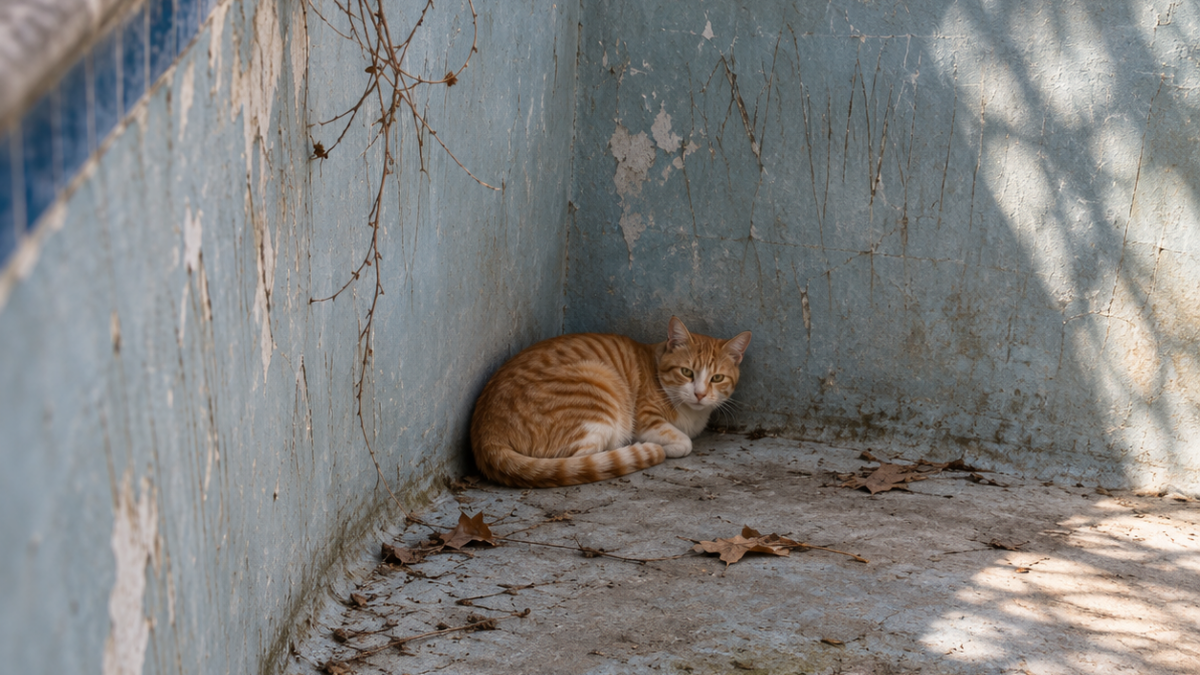
PART 2
The veterinarian’s name was Dr. Maya Patel.
She had the calm voice of someone who could tell you bad news without making it sound hopeless, and I immediately trusted her more than most people I had known for years.
She asked whether I knew anything about the cat.
“Nothing.”
“Owner nearby?”
“No idea.”
“Collar?”
“None.”
“Microchip?”
“We haven’t checked yet.”
A technician scanned her while I stood beside the examination table.
Once behind the shoulders.
Nothing.
Along the back.
Nothing.
Chest.
Sides.
Still nothing.
“No chip,” the technician said.
Dr. Patel looked at the cat.
“Then we’ll treat her as a stray for now.”
The little gray cat was lying on a towel, eyes half closed.
“What happens to her?”
“We stabilize her tonight. Fluids, wound cleaning, bloodwork, pain management. Then we’ll coordinate with rescue.”
I looked at her ruined claws.
“Will those grow back?”
“Some should.”
“Some?”
“Two are damaged very deeply. We’ll have to see.”
That bothered me more than I expected.
Those claws told the story.
She had used them until she almost had none left.
The bloodwork was better than Dr. Patel feared.
Kidney values elevated from dehydration but not catastrophic.
Electrolytes off.
Body temperature high but coming down.
No severe organ failure.
“She’s lucky.”
I looked at the cat.
“Doesn’t look lucky.”
Dr. Patel gave me a tired smile.
“Alive is a useful starting point.”
Fair.
She also said something I remembered later.
“Cats conserve energy better than people realize. At some point she probably stopped trying to escape because continuing would have killed her faster.”
I thought about the walls.
The deepest scratches.
Then weaker scratches.
Then nothing.
“She gave up?”
“No.”
Dr. Patel shook her head.
“Don’t confuse conserving energy with giving up.”
I looked at the cat again.
She had found water.
Found shade.
Stopped wasting strength on walls she couldn’t climb.
Maybe she had simply changed strategies.
Survive.
Wait.
The local rescue that agreed to take responsibility for her was called Desert Haven.
Their foster coordinator, Elena Ruiz, arrived around eight that night.
Elena was in her fifties, wore faded jeans and sneakers, and carried three times more equipment than seemed necessary.
She examined the cat’s paperwork.
Then looked at me.
“You found her?”
“Yes.”
“Good thing you showed up.”
“I was scheduled.”
“Still counts.”
I didn’t think so.
Not yet.
Elena asked:
“Name?”
“Mine?”
“The cat.”
“She doesn’t have one.”
“Can’t keep writing ‘gray female cat found in pool.’”
I looked toward the treatment room.
“Rainy.”
Elena raised an eyebrow.
“Why?”
“The puddle.”
She understood instantly.
“Rainy.”
The name stuck.
I went home that night, but I didn’t sleep much.
Every time I closed my eyes, I saw scratches.
I had cleaned thousands of pools.
Found frogs.
Lizards.
Snakes.
Once a rabbit.
Usually there was water.
Animals could swim to the steps.
Empty pools were different.
People assumed drained meant safe.
It didn’t.
An empty pool could become a concrete pit with no grip, no water, and nowhere to hide.
I knew that professionally.
I had never seen what four days inside one looked like.
The next morning, I returned to the property.
The pool was exactly as I had left it.
Empty.
Silent.
The scratches looked worse in daylight.
I walked into the deep end and stood where Rainy had been lying.
From below, the walls felt higher.
Six feet doesn’t sound like much until you’re looking up at smooth vertical plaster with no ladder beside you.
The temporary ladder I had used was at the shallow end, but the repair crew had set plastic sheeting and equipment across the transition between the deep hopper and shallow section. A cat could technically climb the slope, but the dusty plaster was so slick that even my boots slid.
Rainy had tried.
There were scratch marks on that slope too.
She had almost reached halfway.
Then slipped.
Again.
Again.
Again.
I followed the scratches like a map.
Wall.
Corner.
Slope.
Another wall.
Drain.
Shade.
It felt uncomfortably intimate.
Like reading someone’s last thoughts.
The homeowner, Alicia Bennett, called while I was standing in the pool.
“Evan?”
“Yeah.”
“We just got an alert from the vet clinic through the message you left.”
“I’m sorry to bother you on vacation.”
“No, forget that. Is the cat alive?”
“Yes.”
“Oh, thank God.”
Her husband, Mark, was apparently beside her.
I could hear him asking questions.
Alicia said:
“We had no idea.”
“I know.”
“The gate was locked.”
“It was locked when I arrived.”
“So how did she get in?”
“That’s what I was wondering.”
Silence.
Then Mark took the phone.
“The repair company was there Monday.”
I stopped.
“Monday?”
“Yes.”
“They told me the next visit was next week.”
“They came back to measure the crack and remove some equipment.”
Monday.
I had found Rainy Wednesday.
Dr. Patel believed she had been trapped four or five days.
That meant Rainy was probably already in the pool Monday.
“Mark.”
“What?”
“Do you have security cameras?”
Pause.
“Yes.”
“Do any cover the backyard?”
Another pause.
“One under the patio.”
“Can you see the pool?”
“Most of it.”
My stomach tightened.
“Check Monday.”
Twenty minutes later, Mark called back.
His voice sounded different.
“Evan.”
“Yeah?”
“You need to see this.”
He emailed me three video clips.
I watched the first on my phone while standing beside the pool.
Timestamp:
Monday, 7:48 a.m.
A white work truck entered through the side gate.
Two men walked into the backyard.
One was young.
Early twenties, maybe.
The other older.
Forties.
Company logo on shirts:
Sun Crest Pool Restoration.
The younger worker carried a tool case toward the deep end.
Then stopped.
He looked down.
Even on grainy video, I could see his body change.
He called the older man.
The older man walked over.
Both looked into the pool.
For twenty-three seconds.
Twenty-three.
I know because I counted.
Then the younger man pointed.
The older one waved a hand.
They walked away.
The cat was not visible from the camera angle because she was below the edge.
But there was no question what they were looking at.
Second clip.
8:03.
The younger worker returned alone.
He carried the temporary ladder toward the deep end.
My heart jumped.
He began positioning it.
The older worker appeared.
They argued.
No audio.
The older man pulled the ladder away.
Pointed toward the truck.
The younger worker hesitated.
Then carried the ladder out of frame.
Third clip.
8:17.
Both men left.
Gate closed.
Rainy remained in the pool.
I sat down on the coping.
For a while, I couldn’t move.
The first thing I felt was rage.
The second was doubt.
Maybe they thought she could escape.
Maybe they called someone.
Maybe animal control never came.
Maybe there was an explanation.
I wanted there to be one.
Because the alternative was ugly.
I called Alicia.
“Do you know who the workers were?”
“Mark is checking.”
The company invoice listed:
Crew Lead: Brent Kessler
Technician: Noah Briggs
I wrote the names down.
Then Alicia said:
“There’s more.”
“What?”
“They emailed Mark a completion form Monday.”
“So?”
“Listen to the checklist.”
She read:
Work area inspected. Pool shell clear. No animals, debris, or hazards present. Gate secured upon departure.
I stared at the wall full of scratches.
“No animals.”
“That’s what it says.”
“Who signed?”
“Brent Kessler.”
Now I was angry again.
I called my boss.
Not because this involved our company directly.
Because I wanted someone rational to tell me what not to do.
My boss, Dennis, listened silently.
Then said:
“Do not call Brent.”
“Why?”
“Because you’re angry.”
“Yes.”
“Do not post anything.”
“I wasn’t going to.”
“You absolutely were thinking about it.”
Maybe.
“Send me the video.”
I did.
Ten minutes later he called back.
“That’s bad.”
“Yeah.”
“Give it to the homeowners and animal control. Let them handle it.”
“You think they’ll do anything?”
“I think you making threats over the phone will make it harder.”
“I wasn’t going to threaten him.”
“You’ve worked for me nine years.”
Fair.
Animal control officer Dana Walsh met me at the property that afternoon.
She watched the clips twice.
Then asked:
“Do we know the cat was definitely in the pool at this time?”
“Not visually.”
“Any marks visible from camera?”
“No.”
“Could they have been looking at something else?”
Technically.
Yes.
I hated technically.
Then Dana zoomed the footage.
The younger worker pointed repeatedly toward the exact shaded corner where I found Rainy.
Then mimed something with his hand.
The older man shook his head.
The ladder.
Dana nodded.
“Interesting.”
“Interesting?”
“That’s the word I use before evidence.”
I liked her a little more.
She contacted Sun Crest.
Their operations manager said Brent and Noah would be interviewed.
Brent called me before anybody else did.
My phone rang at 6:12 p.m.
Unknown number.
“Evan Carter?”
“Yeah.”
“This is Brent Kessler.”
I stood.
“How did you get my number?”
“Client gave it to our office.”
That irritated me.
“What do you want?”
“I hear you found a cat.”
“You saw her first.”
Silence.
Then:
“I don’t know what you’re talking about.”
“I have video.”
Another silence.
“You don’t know what we saw.”
“Then tell me.”
“Debris.”
“You put a ladder toward debris?”
Pause.
“That pool is an active job site.”
“So?”
“We’re not allowed to modify site access without approval.”
“You could call animal control.”
“We were busy.”
There it was.
Not proof.
But something.
“You knew there was a cat.”
“I didn’t say that.”
“You didn’t have to.”
His tone hardened.
“Stay in your lane, pool boy.”
I almost laughed.
“Pool boy?”
“Your job is chlorine.”
“My job was apparently noticing the animal you left in a hole.”
He hung up.
Not smart.
For either of us.
But there it was.
That night Elena sent me a picture of Rainy.
She was at the foster house now.
Tiny gray body on a clean blanket.
Bandages around two paws.
Bowl of wet food beside her.
Caption:
She ate half. No vomiting. Still scared.
I stared at it.
Brent’s voice still in my head.
We were busy.
Rainy had been wearing her claws to blood.
They were busy.
I wanted revenge.
I’ll admit it.
Not justice.
Not policy.
I wanted that man standing inside the pool, staring up at six feet of smooth concrete while everyone told him they had somewhere else to be.
That feeling lasted maybe an hour.
Then I realized it was useless.
Pain doesn’t become smaller when you distribute it.
I wanted something better.
I wanted him never to make that decision again.
The next morning, Noah Briggs called.
His voice was young.
Nervous.
“Is this Evan?”
“Yes.”
“I work for Sun Crest.”
“I know.”
Silence.
Then:
“I’m the guy in the video.”
I sat down.
“What happened?”
He breathed out.
“I saw her.”
There it was.
No maybe.
No debris.
A cat.
“How bad?”
“When we got there?”
“Yeah.”
“She was moving.”
“Trying to climb?”
“Yes.”
My throat tightened.
“What did you do?”
“I told Brent.”
“And?”
“He said leave her.”
“Why?”
Noah was quiet.
“We were already late.”
I closed my eyes.
“I went for the ladder.”
“I saw.”
“He told me not to.”
“Why?”
“Said if we put equipment in the pool and the cat got hurt, company could be liable.”
I almost couldn’t process that.
“So he was afraid helping might create liability.”
“Yes.”
“What did he think leaving her would create?”
“He said it would get out.”
“How?”
“I told him the walls were too smooth.”
“Then?”
“He said, ‘Cats climb.’”
I looked toward my kitchen wall.
For some reason, I could see the scratches anyway.
“What did you do?”
“I carried the ladder back.”
Honest.
Ugly.
Important.
“Did you call anyone?”
“No.”
“Why?”
“I thought Brent would.”
“Did he say he would?”
“No.”
“Then why?”
Noah’s voice cracked.
“I don’t know.”
I did.
Authority.
Convenience.
Cowardice.
Same ingredients most preventable suffering uses.
Noah continued.
“There are texts.”
“What texts?”
He had messaged Brent later that afternoon.
Noah: We should call about that cat.
Brent: Drop it.
Noah: It can’t get out.
Brent: Not our animal, not our problem.
Noah: At least tell owner.
Brent: Already did paperwork. Stop creating problems.
There was another message Tuesday morning.
Noah: What if it’s still there?
Brent: Then whoever services next can deal with it.
I was whoever serviced next.
Wednesday.
Two days later.
Noah said:
“I should’ve called.”
“Yes.”
He didn’t defend himself.
“I know.”
That mattered.
“Why are you telling me?”
“Because Brent told me this morning to delete the texts.”
My whole body went still.
“What?”
“He said company lawyers would take my phone if I made it worse.”
“Did you delete them?”
“No.”
“Screenshot everything.”
“Already did.”
“Send copies to animal control.”
“I will.”
Then he whispered:
“I keep thinking about her down there.”
I understood.
“You should.”
Silence.
“But use it.”
“What?”
“Feeling terrible doesn’t help Rainy.”
“Rainy?”
“That’s what the rescue named her.”
Noah was quiet.
Then:
“Is she alive?”
“Yes.”
He started crying.
Actually crying.
“She’s alive?”
“Yes.”
“I thought…”
He stopped.
“You thought she died?”
“Yeah.”
“No.”
I looked at the picture Elena sent.
“She’s fighting.”
Dana received Noah’s statement that afternoon.
Sun Crest suddenly became much more cooperative.
Their owner, Scott Harlan, called Alicia and Mark personally.
Apologized.
Suspended Brent.
Contacted their insurance company.
Offered to pay Rainy’s veterinary bills.
Alicia told him the rescue had already received donations.
Scott said:
“Then we’ll reimburse the rescue.”
That was the correct answer.
Then Brent made another mistake.
He showed up at my company yard.
It was Friday morning.
I was loading chlorine tablets when a white pickup stopped outside.
Brent got out.
Same man from the video.
Broad shoulders.
Sunglasses.
Sun Crest shirt.
Dennis stepped from the office.
“Can I help you?”
Brent pointed at me.
“I need two minutes.”
Dennis looked at me.
I shrugged.
He stayed nearby.
Brent walked over.
“You talk to Noah?”
“Yes.”
His jaw tightened.
“That kid’s trying to save his job.”
“Maybe.”
“He’s lying.”
“About what?”
“The cat.”
“You didn’t see her?”
“I saw something moving.”
“Interesting.”
He hated my tone.
“You people are turning this into some animal-cruelty circus.”
“You left a cat in an empty pool.”
“I didn’t put it there.”
“No.”
“That matters.”
“Yes.”
I nodded.
“It does.”
He relaxed slightly.
Then I finished.
“You just knew it couldn’t get out and left anyway.”
His face changed.
“You have no idea what our schedule was.”
Dennis muttered:
“Don’t say that.”
Brent looked at him.
“What?”
Dennis pointed toward the camera above the warehouse door.
Brent followed his finger.
Security camera.
Audio.
Recording.
Brent laughed nervously.
“I don’t care.”
Then he looked at me.
“It was a feral cat.”
“How do you know?”
“Looked feral.”
“So?”
“So what was I supposed to do, lose half a morning?”
I didn’t answer.
He kept talking.
People do that when they should stop.
“We had six jobs. I’ve got crews, clients, deadlines. You think we stop every time a lizard or cat falls into a pool?”
I said:
“A lizard takes thirty seconds.”
“That’s not the point.”
“No.”
I looked at him.
“The point is you decided your schedule was worth more than whether something died.”
His face reddened.
“It’s a cat.”
There.
The sentence.
I knew it would matter.
Dennis knew too.
Brent realized too late.
He left three minutes later.
Dennis stared after the truck.
“You attract problems.”
“I clean pools.”
“Apparently badly.”
Sun Crest terminated Brent the following week.
Not because of one sentence alone.
The internal review found more.
He had falsified the Monday checklist.
He had instructed Noah to delete messages.
He had violated company emergency procedures requiring workers to report animals or people trapped on active job sites.
And this wasn’t his first complaint.
Six months earlier, another technician reported finding a rabbit trapped in an empty spa.
Brent told him to “let nature work it out.”
That technician rescued the rabbit anyway.
No formal discipline had happened.
This time, there was video.
Texts.
A cat with destroyed claws.
The difference between rumor and accountability is often documentation.
Rainy had left hers on the walls.
Dana’s investigation continued.
I learned something important.
Animal cruelty law isn’t always as simple as people think.
Brent did not own Rainy.
He didn’t trap her.
He didn’t throw her into the pool.
But knowingly leaving an animal confined without water when you have immediate ability to provide aid or notify authorities can still create legal consequences depending on facts and jurisdiction.
The prosecutor reviewed everything.
Video.
Messages.
Veterinary report.
Weather records.
The false inspection form.
Noah’s statement.
My photo.
Especially my photo.
Dr. Patel explained why.
The scratches showed prolonged confinement.
The puddle showed limited access to water.
The cat’s physical condition matched days of dehydration.
And because the photograph was timestamped before anyone disturbed the pool, it preserved the scene.
I had taken it without thinking.
One picture.
Suddenly evidence.
Rainy recovered slowly.
I visited Elena’s house every few days.
The first time, Rainy hid under a chair.
Fair.
I sat on the floor.
Didn’t reach.
Elena brought coffee.
“You look ridiculous.”
“Good.”
“You don’t need to visit.”
“I know.”
That was why I did.
Rainy watched me from beneath the chair.
Her front paws were wrapped.
One ear peeled slightly from sunburn.
Her nose had a tiny pink patch.
She looked smaller indoors.
At the pool, desperation had made her seem bigger somehow.
Elena said:
“She hates the bathtub.”
“Understandable.”
“Also sinks.”
“Any smooth surface?”
“Tile is okay.”
That interested me.
Trauma isn’t logical in the human sense.
It associates.
Shape.
Sound.
Texture.
Depth.
Rainy avoided anything that felt like a place she couldn’t escape.
We never forced it.
After two weeks, she walked toward me.
Not close.
Four feet.
Then stopped.
I put my hand on the floor.
She sniffed.
Retreated.
Week three, she touched one finger.
Week four, she let me scratch under her chin once.
Elena smiled.
“You’re done.”
“What?”
“That cat has you.”
“No.”
“She absolutely does.”
“I work fifteen pools a day.”
“So?”
“I don’t need a cat.”
“No one needs a cat.”
Rainy walked over and sat on my boot.
Elena laughed.
“Especially not you.”
I didn’t adopt her then.
I’m not completely impulsive.
I waited another six days.
Rainy came home with me at the end of August.
My house was small.
Single story.
No pool.
Important.
I bought one bed.
She ignored it.
Bought a scratching post.
She scratched the cardboard box it came in.
Bought three bowls.
She drank from a coffee mug on the nightstand.
Cats are excellent at mocking preparation.
The first night, she slept under my couch.
The second too.
Third night, she climbed onto the foot of my bed.
I pretended not to notice.
By week two, she slept against my leg.
Apparently four or five days trapped in a hole had not damaged her ability to occupy an unreasonable amount of mattress.
Her claws became part of our routine.
Dr. Patel monitored them.
Most regrew.
One front claw came back distorted.
Another never fully returned.
The exposed tissue healed, but that toe remained sensitive.
Her paw pads recovered.
She developed a strange habit of flexing her paws against soft blankets.
Not scratching.
Just pressing.
I wondered whether she enjoyed feeling something that gave beneath her claws instead of rejecting them.
Maybe I was projecting.
Humans love turning animal habits into poetry.
Still.
I bought softer blankets.
Alicia and Mark returned from vacation early.
They came to my house to meet Rainy.
Alicia cried almost immediately.
“I’m so sorry.”
Rainy hid.
“You didn’t do it.”
“It was our pool.”
“You were gone.”
“We hired the company.”
“Yes.”
Mark sat down.
“I keep thinking if you hadn’t been scheduled Wednesday…”
I knew.
“Don’t.”
“But—”
“Don’t build alternate funerals in your head.”
He looked at me.
“That’s specific.”
“I’ve been doing it too.”
Ten minutes later, Rainy came out.
She sniffed Alicia’s shoe.
Then disappeared again.
Enough.
Mark asked what they could do.
“About what?”
“The pool.”
“Finish it.”
“No.”
He looked serious.
“I mean to make sure this never happens again.”
That became bigger than I expected.
First, he asked Sun Crest to install a permanent wildlife escape ramp during any future drainage.
Then he added a small gate mesh so cats and rabbits couldn’t slip through easily.
He installed a motion camera covering the pool.
He created a simple rule for the house:
If pool drained, ladder stays in.
Unless active workers require removal, in which case the shell must be checked before leaving.
Alicia printed it and taped it inside the equipment cabinet.
I laughed.
“Little dramatic.”
She pointed at Rainy’s picture.
“So was that.”
Fair.
Sun Crest adopted a company-wide protocol too.
Scott, the owner, invited me to review it.
I almost declined.
Then thought about Rainy.
The policy was simple:
Any animal discovered in a drained pool stops work.
Provide an exit if safe.
If not safe, call animal control or rescue immediately.
Photograph the cleared pool before departure.
Document gate closure.
No technician leaves a trapped animal.
No supervisor may override that.
I read it.
“Should’ve existed already.”
Scott nodded.
“Yes.”
I liked him for not making excuses.
Then he said:
“We’re buying portable escape ramps for every crew.”
“Good.”
“Your rescue recommended a model.”
“Desert Haven?”
“Yes.”
I smiled.
Rainy’s story was already becoming infrastructure.
That mattered more than social media.
The prosecutor eventually filed charges against Brent related to animal neglect and evidence interference tied to his attempt to have Noah delete messages.
The exact legal language mattered less to me than what followed.
Brent’s lawyer tried to reduce everything to unfortunate judgment.
Which, technically, it was.
Most cruelty does not require someone waking up excited to cause pain.
Sometimes it is just indifference given authority.
That was harder to explain publicly.
People wanted a monster.
Brent wasn’t one.
He was a man who looked into a pool, saw an animal trapped, and decided he was too busy.
That was enough.
Before court, Noah came to my house.
He asked if he could meet Rainy.
I said yes.
He stood in my living room like someone entering a church.
Rainy watched from the windowsill.
Noah looked older than he had in the video.
Guilt does that.
“She looks good.”
“She is.”
“Can I touch her?”
“If she lets you.”
He sat.
Rainy did not approach.
Ten minutes.
Twenty.
He started talking.
Not to her.
To me.
“I keep replaying it.”
“I know.”
“I had the ladder in my hands.”
“Yes.”
“I could’ve put it down.”
“Yes.”
He looked at me.
“You’re not going to tell me it wasn’t my fault?”
“No.”
He swallowed.
“Thanks.”
“Brent made the decision.”
“I followed it.”
“Yes.”
He stared at the floor.
“I thought I’d get fired.”
“That’s real.”
“Doesn’t feel like enough.”
“It isn’t.”
He nodded.
Then:
“What do I do with that?”
That was the right question.
I looked toward Rainy.
“Next time, don’t carry the ladder away.”
His face tightened.
“That simple?”
“No.”
“But that clear.”
Rainy jumped down.
Walked toward him.
Stopped two feet away.
Noah didn’t move.
She sniffed his jeans.
Then walked past.
He laughed through tears.
“I’ll take it.”
So would I.
Noah kept working for Sun Crest.
Some people online wanted him fired too.
Scott asked my opinion.
I said:
“Not my company.”
He pushed.
“What do you think?”
I thought about the ladder.
“I think people who admit cowardice and change are more useful than people who hide it.”
Noah stayed.
Six months later, he rescued a desert tortoise trapped in an unfinished pool and waited forty minutes for wildlife services.
His supervisor complained about the delay.
Noah sent Scott a picture of the new policy.
That story made me smile.
Guilt had become behavior.
Useful.
Brent did not change as quickly.
At the hearing, his attorney argued that he reasonably believed the cat could escape.
Then the prosecutor showed the video of Noah bringing the ladder.
“Why would your technician attempt to provide a ladder if both of you believed the cat could simply climb out?”
No good answer.
Then the text:
It can’t get out.
Brent’s reply:
Not our animal, not our problem.
Hard to reinterpret.
My photograph appeared on a large screen.
Rainy in the corner.
Walls covered in scratches.
Tiny puddle.
The courtroom went quiet.
The prosecutor asked Dr. Patel:
“Doctor, based on the condition of the animal and these marks, can you determine whether she was actively trying to escape?”
“Yes.”
“For how long?”
“I cannot identify exact hours from scratches, but the injuries to her paws and claws are consistent with repeated attempts over a prolonged period.”
“Could she have climbed out without assistance?”
“Not reasonably, given her condition, the surface, and the pool configuration.”
“What likely kept her alive?”
“Shade and access to a small amount of water.”
The puddle.
Again.
One cup.
Maybe less.
Rain three days earlier.
Chance.
I testified too.
The defense asked:
“You are not an animal behavior expert.”
“No.”
“You are not a veterinarian.”
“No.”
“You cannot say with certainty the cat would have died had you arrived Thursday instead of Wednesday.”
“No.”
The attorney seemed satisfied.
Then:
“So when you say this was life or death, that is speculation.”
I thought about Rainy’s body in my hand.
Almost weightless.
“I can say she was severely dehydrated, injured, and unable to escape.”
“Please answer the question.”
“I did.”
The judge looked at him.
He moved on.
Then he asked:
“You took a photograph before helping her?”
“Yes.”
“Why?”
“I don’t know.”
“Could someone interpret that as prioritizing a dramatic image over immediate rescue?”
That made me angry.
I looked at him.
“It took four seconds.”
“Still—”
“And then I climbed down.”
The judge stopped the argument before it became stupid.
Later, outside, Dana said:
“You did fine.”
“I wanted to throw him in a pool.”
“That would’ve hurt your testimony.”
“Probably.”
Brent eventually accepted a plea rather than continue contesting the strongest counts.
He received probation, fines, community service, and restrictions related to animal-care work during the probationary period.
He was ordered to reimburse part of Rainy’s veterinary costs through restitution.
People online called it weak.
Maybe.
I didn’t need him in prison for years.
I needed consequences attached to the sentence:
Not our problem.
Now it was his problem.
Financially.
Professionally.
Legally.
That mattered.
The most satisfying part came later.
The restitution money did not go to me.
I didn’t want it.
Desert Haven used it to buy emergency pool escape ramps, collapsible water bowls, heat-response kits, and microchip scanners for volunteers.
Brent’s money bought ladders.
When Elena told me that, I laughed.
“What?”
“Nothing.”
“Say it.”
“He made Noah take the ladder away.”
She smiled.
“And now?”
“Now he bought twenty.”
That was revenge I could understand.
Not suffering.
Correction.
Rainy had her own problems after adoption.
For months, she panicked whenever she found herself in a room with the door closed.
Bathroom especially.
If I closed the bathroom door while she was inside, she launched herself at it.
So I stopped.
Easy.
She hated the sound of metal ladders scraping concrete.
That one took longer.
My work equipment lived in the garage.
If she heard me moving a ladder, she hid.
Eventually I began pairing the sound with food.
Ladder moves.
Treat.
Ladder moves.
Treat.
Months.
One day she heard the scrape, lifted her head, then went back to sleep.
I nearly cried over a cat ignoring a ladder.
Healing is weird.
She also had a strange relationship with water.
She loved drinking.
Obsessively at first.
Every bowl had to be full.
If one dropped below halfway, she stood beside it and stared at me.
I bought a fountain.
Then another.
One in the kitchen.
One bedroom.
One hallway.
Friends asked why I owned more cat water stations than furniture.
I said:
“She had a bad week.”
Understatement.
Eventually her anxiety around water softened.
But I never let a bowl go empty.
Some habits are mine now.
The picture of the scratches spread online after the case became public.
I hadn’t posted it.
The homeowners released it through Desert Haven with permission because they wanted people to understand the danger of empty pools.
Millions of views.
Messages from pool companies across the Southwest.
Nevada.
California.
New Mexico.
Texas.
People sent photos of wildlife ramps.
Homeowners started asking contractors what they did if animals fell in.
One repair company printed Rainy’s photograph inside employee training manuals.
I found that out from a guy at a supply warehouse.
He said:
“You’re pool-cat guy.”
I hated the phrase.
Still do.
Our own company changed too.
Dennis created a ten-second rule.
Before any service technician leaves a drained pool:
Look down.
Every corner.
Drain.
Steps.
Behind equipment.
Ten seconds.
He printed it on work orders:
EMPTY POOL? LOOK DOWN BEFORE YOU LEAVE.
One of our technicians complained.
“This is obvious.”
Dennis answered:
“So was helping the cat.”
No complaints after that.
Over the next two years, our crews found nine animals in empty pools.
Three rabbits.
Two cats.
One baby javelina.
Two tortoises.
A very angry roadrunner.
All got out.
I kept a list.
Not because Rainy personally saved them.
That would be sentimental nonsense.
But her story changed a procedure.
Procedures changed outcomes.
That is how one rescue becomes more than one rescue.
Alicia and Mark eventually finished the pool.
New plaster covered most of the scratches.
Before resurfacing, Alicia asked me to photograph every wall carefully.
Then she saved one small piece of the old plaster that had already broken loose near the repair area.
It had three claw marks.
She framed it.
Not in the house.
Near the pool equipment room.
Beneath it:
LOOK DOWN.
When I first saw it, I laughed.
Then didn’t.
They also installed two wildlife ramps that floated at the edges whenever the pool was full.
“Overkill?” Mark asked.
“No.”
“Thought you’d say that.”
During drained maintenance, a removable staircase stayed in the deep end unless workers were physically repairing that area.
It cost almost nothing.
That bothered me.
So much suffering had been preventable with something cheap.
But that is true of many things.
Rainy became famous locally.
She did not care.
The rescue held a fundraiser where someone printed her face on a banner.
Rainy attended for eleven minutes.
Then escaped into a back office and slept on printer paper.
Perfect.
I carried her home.
She complained the whole drive.
The cat who survived five days at the bottom of an empty pool now considered twenty minutes in a carrier a violation of civil rights.
That felt healthy.
Noah visited occasionally.
Not often.
He eventually became a crew lead.
The first thing he did was put emergency animal instructions in every truck.
One of his workers called him after finding a cat in an empty fountain.
Noah left a client meeting to help.
When he told me, I said:
“You trying to balance the universe?”
“No.”
“Good.”
He smiled.
“I just don’t want to carry another ladder away.”
That was enough.
Brent disappeared from my life for almost three years.
Then I received a letter.
Actual paper.
No return name.
I recognized it by the second paragraph.
He wrote:
I still think people made me into something worse than I was.
Bad start.
Then:
But I also know I looked down and saw an animal that needed help, and the only thing I thought about was time.
Better.
He said he had taken another construction job after probation.
Not pools.
He had started volunteering community-service hours at a municipal shelter because the court required it.
He hated the first month.
Then a dog changed him.
Of course.
A senior pit bull nobody wanted.
He wrote:
I don’t expect that to matter to you. I’m telling you because I finally understand why the sentence “not my problem” sounds different now. Sometimes the fact that something isn’t yours is exactly why nobody else may be coming.
I read that twice.
He ended:
I’m sorry I left her there.
No excuses after that.
I didn’t reply.
Not because I rejected the apology.
Because I didn’t know what response belonged to me.
Rainy couldn’t read it.
The court was done.
If Brent truly changed, the evidence would be how he lived afterward.
That was enough.
Rainy turned five.
Then six.
Then seven.
We didn’t know her exact age when found, so birthdays were guesses.
I chose July 12.
Not the day I found her.
A week later.
A random day.
I didn’t want the worst day claiming her calendar.
On birthdays, she got tuna.
She ignored birthday toys.
She became obsessed with cardboard.
At eight, she discovered she could open the pantry.
At nine, arthritis began in one front paw—the one with the damaged claw.
Dr. Patel said:
“Old injury probably contributes.”
I hated hearing that.
The pool had followed her years later.
But medication helped.
Soft steps to the bed.
Warm pads.
No heroics.
I got older too.
Pool routes went from eighteen stops to twelve.
Then ten.
My back began arguing with chlorine buckets.
Dennis retired.
I bought part of the company with another technician.
Never expected that.
One of my first decisions as co-owner was requiring every truck to carry an emergency animal kit.
Gloves.
Towel.
Water.
Collapsible bowl.
Small carrier.
Wildlife ramp.
One employee asked:
“How often do we use this?”
“Hopefully almost never.”
“Then why?”
I looked at the wall.
Rainy’s photo hung in the office.
“That’s why.”
He never asked again.
Rainy started coming to the office sometimes.
Bad idea.
She sat on invoices.
Slept on keyboards.
One afternoon she walked across a laptop and sent an unfinished estimate to a client.
The client replied:
Looks like your cat approved the quote.
I raised the price.
Kidding.
Mostly.
At eleven, Rainy developed kidney disease.
Mild.
Manageable.
Dr. Patel was still her veterinarian.
She looked at the old chart.
“Hard to believe.”
“What?”
“That pool cat is eleven.”
“She has a name.”
“I named half my staff after her story.”
“Still.”
Dr. Patel smiled.
“She’s done well.”
Rainy was sitting on the exam table attempting to bite the thermometer.
“Define well.”
Kidney disease meant more water.
Of course.
If any cat was going to demand hydration management, it would be Rainy.
I put bowls everywhere again.
Not because she was anxious now.
Because she needed them.
Some circles close without meaning to.
I kept the smallest bowl beside my bed.
Every night she drank from it.
Then climbed onto the blanket.
Flexed her paws.
Slept.
Years after the rescue, Alicia sold the house.
Before moving, she called.
“Can you come by?”
I went.
The pool looked beautiful.
Blue water.
Clean tile.
Shade sail over one side.
Wildlife ramps floating quietly.
Alicia stood beside the deep end.
“I hate leaving this.”
“The pool?”
“No.”
She pointed toward the equipment room.
The framed plaster.
LOOK DOWN.
She had arranged for the new owners to keep it.
They knew the story.
The new owner, a young father named Daniel, said:
“My kids already call it the cat pool.”
“Better than pool-cat guy.”
He looked confused.
“Long story.”
Daniel asked whether Rainy could visit.
Absolutely not.
I was not bringing an elderly cat back to the scene of her trauma for human symbolism.
He understood.
Instead, I showed him a recent photo.
Rainy asleep on a blanket.
No scratches.
No pool.
No drama.
He smiled.
“She looks spoiled.”
“Correct.”
That was the only reunion the place needed.
One afternoon, a local high-school class asked me to speak about animal safety.
I almost said no.
Public speaking is worse than cleaning algae in August.
Then I agreed.
I showed the photo.
Students got quiet.
One boy asked:
“Why didn’t the workers help?”
That was the whole story in one question.
I said:
“Because they thought someone else could.”
“But they were right there.”
“Yes.”
“So that’s stupid.”
“Yes.”
He looked confused that I agreed.
Then a girl asked:
“Would you have helped if you saw her Monday?”
I wanted to say obviously.
But Noah was probably a decent person too.
So I answered:
“I hope so.”
That was more honest.
We all like to imagine our courage before it costs us anything.
The real test comes when helping means being late, disobeying someone, losing money, getting dirty, or making a phone call you don’t want to make.
Noah failed once.
Then changed.
That mattered.
Rainy’s final years were quiet.
That is the gift.
Stories become famous because something terrible happens.
Happy endings become invisible because nothing happens.
Breakfast.
Sun patch.
Nap.
Dinner.
Window.
Another nap.
Every once in a while she caught a moth and behaved like a lion.
That was life.
Ordinary.
Wonderful.
When she was thirteen, her kidney disease progressed.
Subcutaneous fluids.
Prescription food she hated.
Medication.
She tolerated treatment because chicken followed.
Dr. Patel said:
“She still has good quality.”
That phrase became important.
I didn’t want to keep Rainy alive just because losing her would hurt me.
She had fought enough for one lifetime.
If the day came when staying became another wall she had to claw against, I wanted to recognize it.
It came two years later.
Rainy was probably fifteen.
Maybe sixteen.
We never knew exactly.
She stopped eating breakfast.
Then dinner.
Drank.
But less.
She walked to the water bowl and seemed to forget why she went there.
I called Dr. Patel.
Bloodwork.
Kidney failure.
Advanced.
There were hospital options.
IV fluids.
Several days.
Maybe temporary improvement.
I asked:
“Would she hate it?”
Dr. Patel knew Rainy.
“Yes.”
That answered more than prognosis.
“What if we don’t?”
“Days. Maybe a week or two with comfort care.”
I looked at Rainy.
She was sitting on my jacket.
Of course.
“Then home.”
Dr. Patel nodded.
“Home.”
For six days, Rainy ate whatever she wanted.
Mostly chicken.
A little tuna.
One bite of bacon she had spent fifteen years trying to steal.
I opened windows in the morning.
Kept the house cool.
Placed water beside every resting spot.
She drank tiny amounts.
No scarcity.
Never again.
No puddle she had to ration.
No concrete walls.
No looking up.
Noah came one evening.
He was in his thirties by then.
Married.
Two kids.
He sat beside Rainy.
She sniffed his hand.
Allowed one touch.
He laughed.
“Finally.”
I said:
“Took you long enough.”
He looked at her damaged front claw.
“Does that still bother her?”
“Sometimes.”
His eyes filled.
“I’m sorry.”
I knew he wasn’t talking to me.
Rainy leaned against his fingers.
Maybe coincidence.
Maybe warmth.
Enough.
Noah whispered:
“I should’ve put the ladder down.”
I said:
“You put a lot of ladders down afterward.”
He looked at me.
“Does that balance it?”
“No.”
He nodded.
“Okay.”
Then I added:
“But it matters.”
That was the truth.
We don’t erase failures.
We build something after them.
Alicia and Mark visited too.
Elena.
Dana.
Dennis.
Dr. Patel came last.
Rainy had accumulated people.
That surprised me.
A stray cat nobody knew at the bottom of a pool became connected to half my life.
Animals do that without paperwork.
The final morning was bright.
Of course.
Arizona sun pouring through the windows.
The same kind of light that had turned an empty pool into a furnace years earlier.
My house was cool.
Blinds half closed.
Rainy lay on the soft blanket beside me.
Her front paw rested in my palm.
The damaged claw was still there.
Crooked.
Small.
Proof.
Dr. Patel arrived with her bag.
Rainy lifted her head once.
Then relaxed.
I asked:
“Do you remember the first day?”
Dr. Patel smiled sadly.
“I remember you looking worse than the cat.”
“Impossible.”
“You were crying in chlorine-stained shorts.”
“Professional uniform.”
Elena laughed from across the room.
I hadn’t realized how badly I needed that laugh.
Before the sedative, I brought out the photograph.
The original.
Printed years earlier.
Rainy at the bottom of the empty pool.
Tiny.
Alone.
Scratches everywhere.
Puddle near the drain.
I had kept it in a drawer because hanging it felt wrong.
I looked at the photo.
Then at Rainy.
“You know what I hate about this?”
Obviously she didn’t answer.
“You’re looking up.”
In the photo, her head was barely raised.
Eyes toward me.
The person at the edge.
Waiting.
“I spent years wondering what would’ve happened if I’d been ten minutes later.”
Elena said softly:
“Don’t.”
“I know.”
I put the photo face down.
Rainy’s eyes stayed on me.
“You waited long enough.”
My throat tightened.
“No more waiting.”
Dr. Patel gave the sedative.
Rainy relaxed.
Her paws stopped tensing.
I placed a water bowl beside the blanket.
Not because she needed it.
Because I did.
Full.
To the top.
I stroked her head.
“You’ve got water.”
One breath.
“Shade.”
Another.
“No walls.”
Another.
“You don’t have to climb anything.”
Dr. Patel’s eyes filled.
I leaned closer.
“You don’t have to wait for someone to look down.”
Rainy’s breathing slowed.
“I’m already here.”
The final medication went in.
She exhaled.
Softly.
Then nothing.
For a long time, I sat with my hand beneath her paw.
The same paws that had scratched every wall until blood marked the plaster.
Now relaxed.
No effort.
No fight.
That was the thing I wanted for her in the end.
Not one more act of survival.
Rest.
I had her cremated.
The urn is simple.
No dramatic statue.
No pool shape.
Just gray ceramic.
The engraving says:
RAINY
SHE KEPT TRYING UNTIL HELP LOOKED DOWN.
Underneath:
AFTER THAT, SHE NEVER HAD TO WAIT ALONE.
Elena cried when she saw it.
Then complained it was sentimental.
I reminded her she named a rescue Chihuahua “Sir Waffles.”
Argument over.
The original photograph is now in our company office.
Not framed beautifully.
Pinned beside the safety checklist.
Employees see it every morning.
Under it:
EMPTY POOL? LOOK DOWN.
That is Rainy’s real memorial.
Not her suffering.
The changed behavior that came after.
Sun Crest still uses the rescue protocol.
Scott eventually sold the company to Noah and another manager.
Yes.
Noah.
The young worker who carried the ladder away became part owner years later.
First thing he did after signing the papers?
He added one sentence to every technician’s work agreement:
Any employee may stop a job without penalty to rescue or report a trapped animal or person.
No supervisor approval required.
He sent me a picture.
I replied:
Took you long enough.
He sent back:
I know.
Brent’s letter stayed in my desk for years.
After Rainy died, I read it again.
Then I finally wrote him back.
Only three sentences.
She lived a long life. Most of her claws grew back. I hope the person you are now never walks away from what the person you were saw in that pool.
I mailed it.
No need for more.
A month later, a card arrived.
Inside:
He won’t.
I chose to believe him.
Not because forgiveness was owed.
Because changed behavior is the only apology that lasts.
The little puddle became strangely important to me over the years.
Maybe because it was so small.
No heroic rescue.
No miracle spring.
Rain fell for twenty minutes during a summer storm.
Water collected near a drain.
Nobody planned it.
Nobody knew.
Rainy drank from it.
A cup of dirty water bought time.
Sometimes survival is not one giant thing.
It is shade arriving at four.
A puddle lasting another day.
A worker being scheduled Wednesday.
A phone camera taking one picture.
A veterinarian being open.
A rescue having one foster space left.
Small things stacked together until they become a life.
I used to think my job was about keeping water clean.
That sounds stupid now.
Pools are mostly water, chemistry, plumbing, surfaces.
But after Rainy, I noticed something different.
Any hole can become a trap.
Any routine stop can become the most important visit of your week.
And being the person who notices is a responsibility you don’t get to schedule.
Years after Rainy’s rescue, I trained a new technician named Marcus.
Nineteen.
Fast.
Smart.
Too confident.
I showed him the photograph.
He said:
“That really happened?”
“Yes.”
“How long was she down there?”
“Four or five days.”
He stared at the scratches.
“Why didn’t she just stop?”
“She did.”
He looked confused.
“What?”
“Eventually.”
I pointed toward the shaded corner.
“She stopped wasting energy.”
“Isn’t that giving up?”
“No.”
I remembered Dr. Patel.
“Sometimes surviving means knowing when not to keep throwing yourself at the wall.”
Marcus looked at the photo again.
That became one of the best lessons Rainy ever gave me.
Persistence is beautiful.
But survival isn’t always endless effort.
She clawed until she couldn’t.
Then found water.
Found shade.
Waited.
Both choices kept her alive.
Fight.
Then conserve.
Humans praise only the first because it looks brave.
The second may be just as important.
The pool where I found her still exists.
I service it occasionally because our company kept the account.
Different owners now.
Same deep end.
Every time I enter the yard, I look down first.
Always.
Even when the pool is full.
Habit.
Sometimes sunlight hits the water in a way that makes the bottom hard to see.
I wait.
Look again.
Then start work.
Ten seconds.
Rainy taught me the value of ten seconds.
The scratches are gone now.
New plaster.
Years of use.
Nothing remains physically.
At first, that bothered me.
Then I realized the walls did their job.
They told us what happened.
The photograph kept it.
They didn’t need to stay scarred forever.
Neither did Rainy.
Her claws regrew.
Her paws healed.
Her fear softened.
She slept.
A scar can be evidence without becoming identity.
People online still share the photograph sometimes.
Usually with exaggerated captions.
CAT SURVIVES TWO WEEKS IN POOL.
Wrong.
POOL MAN FINDS CAT MINUTES FROM DEATH.
Maybe, but nobody knows.
CAT SAVED BY ONE DROP OF WATER.
Dramatic.
Not accurate.
The truth is enough.
Four or five days.
Arizona July.
Hundreds of scratches.
One small puddle.
One strip of shade.
One scheduled pool cleaner.
One cat alive.
You don’t need to inflate suffering to make people care.
If the truth isn’t enough, the problem is not the story.
The part that matters most is what happened Monday.
Not Wednesday.
Wednesday was easy.
By the time I saw Rainy, there was no decision.
Of course I climbed down.
Anyone would like to believe they would.
Monday is harder.
Noah saw her.
Wanted to help.
Authority told him no.
He carried the ladder away.
That is where most moral failures live.
Not in dramatic evil.
In the moment between seeing and acting.
When someone says:
Not your problem.
We’re late.
Someone else will handle it.
Don’t make trouble.
Rainy’s story changed Noah because he had to live with that moment.
It changed me because I realized I could easily have been him.
If Rainy had been aggressive when I climbed down, would I still have helped?
I hope so.
If she had bitten me?
If I had been behind schedule?
If my boss had told me not to?
If I risked losing a client?
Questions are cheap after the fact.
So I built procedures instead.
Procedures matter because we are not always our best selves.
A rule can carry us through the moments when courage becomes inconvenient.
Stop work.
Call.
Provide exit.
Document.
Do not leave.
Simple.
Rainy earned that rule with her claws.
Nobody gets to ignore it now.
The revenge part of her story is the piece strangers love most.
Brent got fired.
He faced charges.
He paid restitution.
His words followed him.
The company changed.
Fine.
But if you ask me what revenge actually looked like, I’ll show you a different picture.
Rainy at twelve years old.
Asleep on her back across my bed.
Front paws loose.
Belly exposed.
Water fountain running in the hallway.
Every door open.
She could leave any room.
She didn’t need to.
That was revenge against the pool.
Against indifference.
Against every smooth wall that told her effort wasn’t enough.
She got a life where nothing trapped her.
Once, when Rainy was about nine, I accidentally shut the laundry-room door while she was inside.
Years earlier, she would have panicked.
That day I realized ten minutes later.
Opened the door.
Rainy was asleep in a basket of clean towels.
She looked at me like I was rude for waking her.
I sat on the floor and laughed until my eyes watered.
That might have been the moment I knew she had truly healed.
The door had closed.
She believed it would open again.
Think about how enormous that is for an animal whose survival once depended on someone finally appearing at the top of a wall.
I’ve cleaned pools for more than twenty years now.
I’ve looked down into thousands.
Blue water.
Green water.
Empty shells.
Cracked plaster.
Toys.
Leaves.
Storm debris.
Dead mice.
Live snakes.
Nothing has ever looked back at me the way Rainy did.
Half-open eyes.
Too exhausted to ask.
The walls did the asking for her.
Hundreds of marks saying:
I tried here.
And here.
And here.
And here.
No one came.
So I tried again.
Until she couldn’t.
Then she waited.
That is why I never call her lucky without qualification.
Yes, she was lucky the rain came.
Lucky shade crossed the pool.
Lucky her kidneys held.
Lucky my schedule placed me there.
But luck is a cruel word when it makes survival sound easy.
Rainy did work too.
She fought.
Adapted.
Found water.
Saved energy.
Stayed alive long enough for luck to matter.
That deserves something more than luck.
Maybe resilience.
Maybe instinct.
Maybe simply life refusing to surrender quietly.
On my last visit to the pool before I retired from daily service routes, I stood at the deep end alone.
The pool was full.
Sunlight moved across the water.
I could see the bottom clearly.
No cat.
No scratches.
No puddle.
Nothing.
For a moment, I missed the evidence.
Then I understood that was the point.
The danger had been corrected.
The story had moved elsewhere.
Into policies.
People.
Ladders.
Water bowls.
Rainy’s long ordinary life.
I knelt and touched the coping.
“Okay.”
No one was there to hear me.
“Good.”
Then I left.
I still have one damaged claw clipping Dr. Patel saved from Rainy’s first treatment.
That sounds weird.
It is.
She put it in a tiny specimen envelope because the nail had broken loose during wound cleaning.
Years later she tried giving it to me as a joke.
I kept it.
Not displayed.
In a drawer.
Sometimes I find it while looking for something else.
Tiny.
Brownish.
Almost nothing.
That claw once tried to climb a six-foot wall.
Again and again until it broke.
I think about how much effort can exist in something so small.
Then I close the drawer.
Rainy did not become a symbol to herself.
That matters.
She never knew about policies.
Court.
Viral photographs.
Fundraisers.
She didn’t know Noah changed careers.
Didn’t know Brent wrote an apology.
Didn’t know escape ramps carried her name inside a rescue inventory spreadsheet.
She knew:
Food.
Water.
Warm blanket.
Open door.
My hand.
Sunlight through glass instead of directly on concrete.
Maybe that’s healthier.
Legacy is our problem.
Animals just live.
And Rainy lived.
That is the sentence I care about most.
Not barely.
Not only after rescue.
She lived long enough to become demanding.
Old.
Slow.
Expensive.
Opinionated.
She developed kidney disease and arthritis and a preference for chicken over prescription food.
She scratched my couch.
Knocked water onto tax papers.
Woke me at four in the morning because a moth existed.
She became inconvenient in every ordinary way an animal becomes inconvenient when they belong to you.
And nobody looked at that inconvenience and decided she was not our problem.
That was the promise her life deserved.
If I could speak to the person I was before that Wednesday, I would tell him one thing.
You are not just cleaning pools.
You are entering spaces other people trust you to notice.
Look.
That is all.
Look down.
Look twice.
Listen.
Because sometimes the thing that changes your life is not standing in front of you.
Sometimes it is six feet below.
Too weak to make a sound.
Waiting.
And if I could speak to Rainy during those four or five days, I know exactly what I would say.
Not:
Keep fighting.
She already had.
Not:
Be brave.
She didn’t need a speech.
I would say:
Save your strength.
Stay in the shade.
Drink what you can.
Someone is coming.
Not Monday.
That still hurts.
Not Tuesday.
But Wednesday.
Someone is going to look over the edge.
Someone is going to see the scratches.
Someone is going to climb down.
And once that happens, little girl, you will never have to claw your way out of anything alone again.
Because Rainy spent days looking up at an empty sky, waiting for a face to appear above the concrete.
Eventually, mine did.
And for the rest of her life, whenever she looked up—
someone was there.








