PART 2: I Loaded My Rifle When HOA Surrounded My Mountain Property Then Three FBI Helicopters Landed
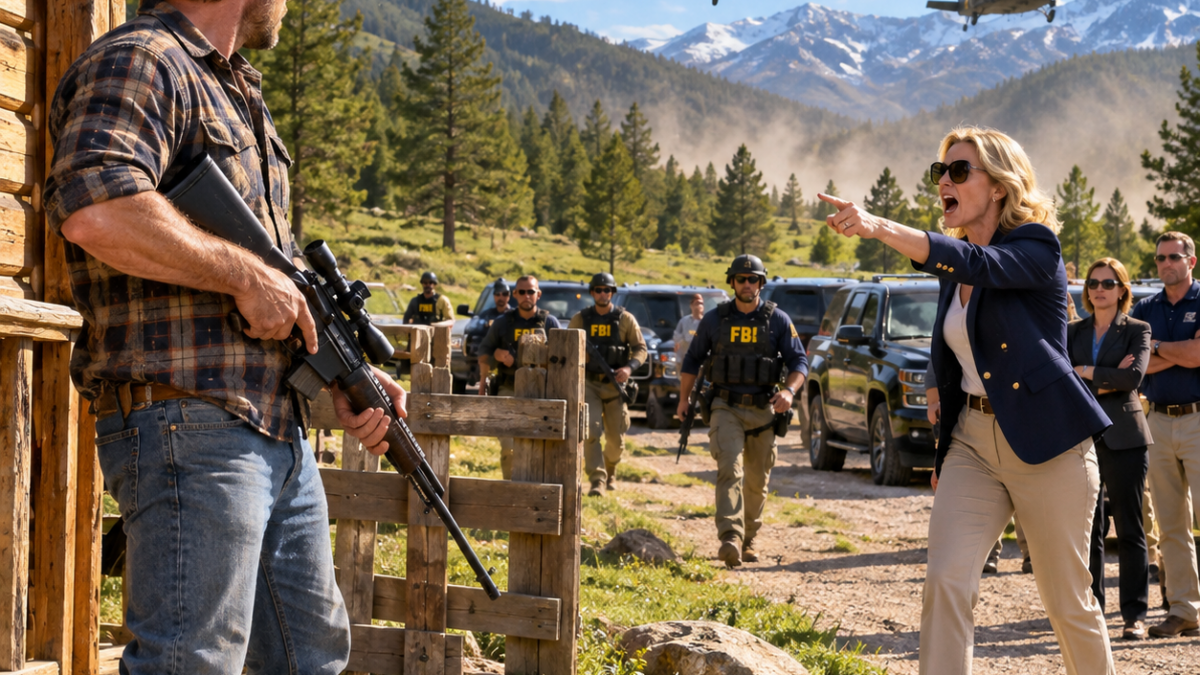
PART 2
The first helicopter crossed the ridge so low that its rotor wash ripped dead leaves from the hillside and sent them spiraling across the gravel road.
Nobody moved.
Not Karen.
Not Frank.
Not the demolition crew.
Not the deputy.
Not me.
Even the bulldozer operator lifted both hands away from his controls.
The aircraft banked toward the open common field below Oak Ridge Estates, followed by two more dark helicopters moving in tight formation.
Karen’s mouth opened.
For once, nothing came out.
The deputy shaded his eyes.
“What the hell?”
The lead helicopter settled onto the grass.
The second landed farther down the slope.
The third hovered long enough to shake every pine branch along the road before dropping into another clearing.
Doors opened.
Agents came out fast.
Not movie fast.
Not wild, dramatic, shouting-with-guns fast.
Professional fast.
Controlled.
Purposeful.
The kind of movement that told you the plan had been rehearsed before anyone on that mountain knew there was a plan.
Large yellow letters stood out on several jackets.
FBI.
Karen finally found her voice.
“This is ridiculous.”
Nobody listened.
A gray-haired man wearing body armor beneath a dark windbreaker walked toward the sheriff’s deputy.
They spoke for less than twenty seconds.
The deputy pointed toward Karen.
Then Frank.
Then two of the private security vehicles.
Then me.
The federal agent looked up the hill.
Our eyes met.
His attention went immediately to the Winchester resting across my knees.
He didn’t panic.
He didn’t reach for a weapon.
He simply raised one hand.
“Sir.”
“I hear you.”
“Keep your hands where I can see them.”
“They’re visible.”
“Is that rifle loaded?”
“One cartridge.”
Karen suddenly lunged toward the conversation.
“See? I told you! He threatened us. He’s dangerous.”
The sheriff’s deputy cut her off.
“He has not threatened anybody in my presence.”
Karen stared at him.
The deputy continued.
“He has remained seated. The weapon has remained pointed toward the ground. I instructed both sides not to move.”
The federal agent nodded once.
Then he looked at me.
“Mr. Henderson?”
“Yes.”
“For everybody’s safety, unload the weapon and place it on the ground away from you.”
I did exactly that.
Slowly.
No sudden movement.
I opened the action.
The cartridge dropped into my palm.
I set it on the grass and laid the Winchester several feet to my right.
The agent watched until my hands were empty.
“Thank you.”
Then he turned his back on me.
That was the moment Karen understood.
They hadn’t come for me.
Her whole posture changed.
The outrage stayed on her face, but something colder appeared underneath it.
Fear.
The gray-haired agent approached her.
“Karen Brewster?”
She straightened.
“Yes. I’m Karen Brewster. I’m president of Oak Ridge Estates, and I need you to remove that man immediately. He has been terrorizing this community for months.”
The agent pulled out his credentials.
“I’m Special Agent Daniel Mercer.”
Karen glanced at the badge and then toward the helicopters.
“You’ve made a mistake.”
“No, ma’am.”
“This is a civil dispute.”
“We’re not here about a civil dispute.”
Frank took one step backward.
Two agents noticed.
Mercer unfolded a document.
“We have federal search warrants for the Oak Ridge Estates association office, your residence, premises associated with Community Enforcement Solutions, and several vehicles and storage locations connected to those entities.”
Karen’s face lost its color.
Frank stopped moving.
Somewhere behind them, one of the demolition workers whispered, “Jesus.”
Karen laughed.
It was a thin, brittle sound.
“You can’t just—”
Mercer continued.
“We also have an arrest warrant for you.”
That laugh disappeared.
For several seconds, the only sound on the mountain was the fading thump of helicopter blades.
Then Karen pointed at me.
“This is him.”
Mercer didn’t look.
“He’s doing this.”
Still nothing.
“He has been harassing me. He built an illegal structure. He refuses lawful orders. He threatened my security officers. Ask them.”
The men in beige uniforms suddenly became interested in their boots.
Karen turned toward the gathered homeowners.
“Tell them.”
Mr. Abernathy stood beside his mailbox.
He looked smaller than ever.
Thin shoulders.
Gray cardigan.
Hands trembling.
But he didn’t look away.
Sarah stood next to him in hospital scrubs under a jacket, having apparently come straight from work.
Mrs. Rodriguez had one arm around her daughter.
Not one person answered Karen.
Mercer finished reading from the warrant.
“Mrs. Brewster, you are being taken into custody on charges related to conspiracy to commit mail fraud and wire fraud.”
Frank whispered her name.
“Karen.”
She turned.
That single word passed between them like an alarm.
Agents moved toward Frank.
“Frank Brewster?”
He raised both hands.
“What is this?”
“Keep your hands visible.”
“I own a security company. That’s legal.”
“Hands visible, sir.”
Frank obeyed.
He looked toward the private security cars as though calculating something.
Mercer noticed.
“So did the agents standing beside them.
Within moments, Frank was separated from Karen.
Another team moved toward the security vehicles.
Karen’s voice rose.
“You don’t understand HOA accounting. We hire vendors. My husband provides legitimate services. Board members are allowed to operate businesses.”
Mercer’s expression didn’t change.
“You can discuss that with your attorney.”
“This community needs security.”
Mr. Abernathy finally spoke.
“No, Karen.”
Everybody turned toward him.
His voice shook badly.
“We needed protection from you.”
Karen stared at him.
For years, she had reduced him to apologizing over a bird feeder.
Now he had said six words in front of federal agents and fifty neighbors.
She looked almost more shocked by that than by the warrant.
Then Gerald arrived.
Gerald Pike was the third member of Karen’s three-person board.
For years, meeting minutes showed the same rhythm.
Karen made a motion.
Gerald seconded it.
Carol Watkins voted yes.
Motion carried.
Again.
Again.
Again.
Gerald had apparently been driving toward the scene when he saw the helicopters.
Instead of pulling in, he stopped a hundred yards down the road.
Then he reversed.
An unmarked SUV blocked him.
Sarah gave a short laugh.
Gerald stepped out with his hands raised.
“What’s happening?”
One of the homeowners shouted, “Looks like accountability.”
Mercer immediately turned.
“Everybody stay calm.”
That mattered.
Because the mood could have turned ugly.
People who have been humiliated for years sometimes mistake another person’s humiliation for justice.
I had made that mistake in my head plenty of times.
Imagined Karen exposed.
Imagined her crying.
Imagined the whole neighborhood laughing.
But seeing it happen was different.
The cuffs didn’t make me happy.
They made the situation real.
This wasn’t an HOA meeting anymore.
These were federal criminal charges.
Families were about to be broken apart.
Businesses might disappear.
People could go to prison.
There would be lawyers, hearings, restitution fights, reputations destroyed.
That didn’t mean Karen was a victim.
It meant consequences were larger than fantasies.
Mercer motioned toward me.
“Mr. Henderson, stay where you are for a minute.”
“Okay.”
Two agents approached the demolition contractor.
He was a broad man in his fifties with a weathered baseball cap and a reflective vest.
He looked sick.
“We were hired for a legal removal,” he said immediately.
“Who hired you?”
“Community Enforcement Solutions.”
“Who specifically?”
He pointed toward Frank.
“Mr. Brewster.”
“Did you verify the court authorization?”
The contractor swallowed.
“He gave us documents.”
“What documents?”
“An abatement order.”
The sheriff’s deputy picked up the paper Karen had dropped.
“This isn’t a court order.”
The contractor stared at it.
Karen shouted from beside the FBI vehicle.
“It doesn’t need to be! The HOA covenants authorize self-help remedies.”
Mercer turned toward her.
“Mrs. Brewster, stop discussing the matter.”
She went silent.
The contractor removed his cap.
Then he looked up the slope toward Marcus’s memorial.
“What is that?”
I answered.
“A memorial.”
“For who?”
“Sergeant Marcus Thorne.”
He looked at the bulldozer.
Then back at the memorial.
Nobody needed to explain why his face changed.
“We weren’t told.”
“I figured.”
“We’re loading the machine.”
“Please do.”
He hesitated.
“I’m sorry.”
I believed him.
Not because an apology erased anything.
Because contractors get lied to, too.
He had been told he was performing lawful work authorized by a property association.
From his point of view, I might have been the unreasonable resident refusing to comply.
Karen’s genius had always been her ability to make a lie look administrative.
She put it on letterhead.
Added an article number.
Included a deadline.
Used phrases like enforcement action and community standards.
People tend to obey documents that look official.
I had almost learned that the hard way.
Mercer finally walked up my trail.
He stopped at my split-rail fence.
He didn’t step over it.
For months, everyone associated with Karen had treated my boundary as something they could reinterpret.
Mercer treated it like what it was.
A line.
“Mr. Henderson?”
“Yes.”
“Daniel Mercer.”
He extended his hand across the fence.
I shook it.
“You know James Callahan?”
“Unfortunately.”
For the first time, Mercer smiled.
“That sounds about right.”
“You came because of our file?”
“Your attorney’s submission became part of an existing financial investigation.”
I frowned.
“Existing?”
“I can’t discuss details of an active case.”
“That wasn’t an answer.”
“No.”
He looked toward Karen.
“But I can say concerns had already been raised about several businesses connected to transactions involving this association. Your materials helped clarify relationships and document a pattern.”
I thought about the weeks of silence after Callahan sent the binders.
“You already knew about them.”
“We knew enough to keep looking.”
“And today?”
“Today was planned before we learned Mrs. Brewster intended to conduct this demolition.”
I looked toward the three helicopters.
“Bad timing.”
“For her.”
That was when Karen saw us talking.
“Jack!”
Every agent near her turned.
Mercer started to move.
I raised one hand.
“It’s okay.”
Karen leaned around the open door of the SUV.
“You did this!”
Her face had become blotchy.
Her yellow hard hat was gone.
Someone had removed it before putting her in the vehicle, and without that ridiculous symbol of authority she looked strangely ordinary.
Tired.
Middle-aged.
Frightened.
Still furious.
But ordinary.
I looked at her.
“No, Karen.”
She waited.
“You did.”
The agents placed her inside the SUV.
The door closed.
I didn’t feel victorious.
I felt empty.
That surprised me.
For six months, Karen had occupied space in my head every day.
The mailbox.
The fines.
The annexation.
The public meeting.
The threats.
The memorial.
I had imagined defeating her as though that moment would restore some part of me that had been missing since Marcus died.
Instead, when the door closed, the mountain simply became quiet.
By ten-thirty, the helicopters were gone.
The federal teams remained.
Agents drove toward the HOA clubhouse.
Others executed warrants at Karen and Frank’s house.
Community Enforcement Solutions’ vehicles were inventoried and eventually taken away.
The bulldozer went back onto the flatbed.
The demolition crew left.
The sheriff’s deputy walked up to me before leaving.
His name was Deputy Evan Morales.
He looked about thirty.
Maybe younger.
“You okay?”
“Yeah.”
He nodded toward the Winchester.
“Can I give you some unsolicited advice?”
“You’re going to anyway.”
“Next time you think an HOA is coming to tear something down, don’t be sitting beside it with a loaded rifle.”
I almost smiled.
“Fair.”
“You were calm. I saw that.”
He glanced downhill.
“But all it takes is one frightened person misreading one movement.”
“I know.”
He studied me.
“Do you?”
That irritated me.
Which meant I probably needed to hear it.
“I do now.”
He nodded.
“Good.”
Then he looked at Marcus’s memorial.
“Army?”
“Rangers.”
“Your friend?”
“Best one I had.”
Morales removed his sunglasses.
“I’m sorry.”
“Thanks.”
He started down the trail.
Then stopped.
“For what it’s worth, the memorial looks good.”
That simple sentence hit me harder than it should have.
Because Karen had spent months calling it ugly.
Illegal.
Unsightly.
An affront to architectural consistency.
Morales just saw what it was.
A memorial.
After everybody left, I sat beside the stones.
My hands began shaking.
Not much at first.
Then enough that I couldn’t hold my coffee.
Adrenaline waits until danger passes before sending the bill.
I put the cup down.
Mr. Abernathy appeared carrying another one.
He lowered himself carefully onto a flat rock.
“I put sugar in it.”
“I drink it black.”
“I know.”
I looked at him.
“Why did you put sugar in it?”
“Today seemed like a sugar day.”
I took it.
We sat without speaking.
Below us, Oak Ridge Estates looked impossibly peaceful.
Curving roads.
Uniform roofs.
Neat lawns.
A clubhouse.
The kind of place people drive through and assume nothing terrible happens because nothing looks messy enough.
George Abernathy stared at Marcus’s plaque.
“He was your friend?”
“Brother, basically.”
“My Eleanor was mine.”
I knew he meant his wife.
He rubbed his hands together.
“Forty-three years.”
“That’s a long marriage.”
“Not when it ends.”
I looked at him.
George watched the valley.
“Karen knew what the bird feeder meant.”
I thought he meant she knew it belonged to Eleanor.
He shook his head.
“No. I mean she really knew.”
“How?”
“Eleanor served on the landscaping committee when Karen first moved in. Before Karen got power.”
George almost smiled.
“They used to drink coffee together.”
That surprised me.
“Karen knew Eleanor?”
“Came to our house dozens of times. Eleanor gave her jars of peach preserves every summer.”
His fingers closed around his cup.
“That’s what made the fines hurt.”
I had always assumed Karen simply didn’t care about people’s sentimental attachments.
George was telling me something worse.
Sometimes she knew.
“What happened?”
“Two years after Eleanor died, I started reviewing the association finances.”
I looked at him.
“You’re an accountant?”
“Retired.”
“You never mentioned that.”
“You never asked.”
Fair enough.
George continued.
“The landscaping expenses didn’t make sense. Neither did security. I asked Gerald for vendor bids.”
“And?”
“Never received them.”
“What did Karen say?”
“She said the board had authority to negotiate contracts without homeowner interference.”
He took a drink.
“I requested records.”
I almost laughed.
“So that’s where you learned to hate certified mail.”
George smiled faintly.
“Next month, I got my first violation.”
“The bird feeder.”
“First the feeder. Then a crack in my driveway. Then my trash cans. Then faded trim. Then an oil stain they claimed was visible from the road.”
He looked embarrassed.
“I stopped asking questions.”
“You were being punished.”
“I was afraid.”
He said it so quietly I almost missed it.
“I had just lost Eleanor. The house was paid off, but I live on retirement and Social Security. Then letters started talking about liens.”
He swallowed.
“I kept thinking, what if I lose the house she loved because I’m too stubborn to take down a bird feeder?”
There was no self-pity in his voice.
That made it worse.
“You weren’t weak.”
George looked at me.
“You were isolated.”
He considered that.
Then nodded.
“Karen was good at that.”
She was.
That had been the foundation of her power.
Not rules.
Isolation.
Every homeowner believed their problem was private.
Their fine.
Their violation.
Their embarrassment.
Their financial stress.
Their failure.
Once we compared papers, the whole structure changed.
A bird feeder here.
A swing set there.
A nurse’s parked car.
A mailbox.
A memorial.
Different rules.
Same method.
That Monday, Callahan’s office looked like a disaster relief center.
Word about the arrests had spread.
People brought documents.
Boxes.
Folders.
Envelopes.
One woman arrived with a rolling suitcase full of HOA records.
Callahan stood in the doorway staring at the crowd.
Then he looked at me.
“You did this.”
“I did not.”
“You absolutely did.”
“I filed a records request.”
“In this country, that’s how revolutions start.”
He taped a paper sign to his conference-room door.
OAK RIDGE DOCUMENT REVIEW.
For two weeks, volunteers scanned everything.
Callahan recruited two younger attorneys from his firm and three law students.
Sarah came after shifts at the hospital.
Mrs. Rodriguez created a spreadsheet.
George became indispensable.
Give a retired accountant financial records and moral outrage, and you discover a level of energy normally seen only in caffeinated teenagers.
We learned more about the association than Karen probably wanted anyone to know.
Not everything was criminal.
That mattered.
Some expenses were legitimate.
Road repairs cost real money.
Insurance had risen.
Stormwater maintenance was expensive.
The clubhouse roof actually needed replacement.
One of the dangers after corruption is exposed is assuming every dollar is stolen.
Callahan wouldn’t allow it.
“If you want truth,” he told us, “you don’t get to keep only the facts that make your enemies look evil.”
So we separated what was suspicious from what was simply costly.
The landscaping contract remained troubling.
Green Pastures LLC charged far above comparable vendors.
Gerald was connected to the company.
Board minutes contained no meaningful competitive bidding.
Community Enforcement Solutions was worse.
Frank Brewster’s company had been paid substantial monthly fees for security and violation-enforcement services.
Several payments had increased without clear board discussion.
Some invoices used vague descriptions like community risk mitigation.
Others billed large sums for “special enforcement deployments” that appeared to correspond to weekends when Karen’s security people posted violation notices.
But the financial picture was broader than I understood.
According to court filings that became public later, federal investigators believed money had moved through multiple related businesses.
Some companies performed work.
Others appeared to exist mostly on paper.
There were payments for consulting.
Administrative coordination.
Emergency planning.
Vendor acquisition.
Terms vague enough to hide almost anything.
The federal case would take months.
Oak Ridge had a more immediate problem.
Its board had essentially collapsed.
Karen was detained pending initial proceedings.
Frank wasn’t technically a board member, but his company had handled much of the enforcement.
Gerald was under investigation.
Carol Watkins resigned.
Her resignation letter was one paragraph.
She claimed she had relied on Karen’s representations and had not understood the financial arrangements she voted to approve.
People were furious.
At the first community meeting after the arrests, someone called Carol a thief.
Another person called her a coward.
Callahan leaned toward me.
“Watch this.”
“What?”
“People deciding guilt by volume.”
He stood.
“Everybody.”
Nobody heard him.
He whistled sharply.
The room went quiet.
“This is why courts exist.”
A man near the front crossed his arms.
“She signed everything.”
“Then evidence will show that.”
“She let Karen do it.”
“Maybe.”
“Maybe?”
Callahan’s voice stayed calm.
“Yes. Maybe. Because we don’t know everything.”
That angered people.
I understood why.
They had spent years being denied certainty.
Now certainty felt like revenge they had earned.
Callahan wouldn’t give it to them.
“If you replace Karen’s rule by accusation with your own rule by accusation,” he said, “you haven’t learned anything.”
Nobody applauded.
Good advice rarely gets applause when people need it most.
A county judge appointed Theodore Bell as temporary receiver for Oak Ridge Estates.
Ted was sixty-eight, wore inexpensive gray suits, and possessed the patient expression of a man who had spent decades in municipal government listening to citizens explain why their drainage ditch represented the collapse of democracy.
His first meeting was packed.
He stood in front of the clubhouse with one legal pad.
No podium.
No PowerPoint.
No dramatic speech.
“My job is simple,” he said.
Someone laughed.
Ted looked at him.
“Not easy. Simple.”
The laughter stopped.
“I will preserve records, pay legitimate obligations, suspend questionable collection activity, review vendor contracts, and prepare this association for lawful governance.”
A hand went up.
“What happens to fines?”
“Discretionary enforcement collections are temporarily suspended.”
Applause exploded.
Ted waited.
Then raised one finger.
“Your private roads still require maintenance.”
The applause softened.
“Your drainage system still requires inspection.”
Silence.
“Your common-area insurance is still due.”
A few groans.
“And the clubhouse roof is leaking.”
Ted looked around.
“That is what an HOA exists to manage. Shared obligations.”
Sarah called out, “Not sidewalk chalk?”
“No.”
“Bird feeders?”
“No.”
“Cars parked outside after night shifts?”
“Depends on the governing documents, local law, and whether somebody is blocking an emergency route.”
People laughed.
Ted didn’t.
“I’m serious.”
That was why I liked him.
He wasn’t there to destroy rules.
He was there to separate necessary governance from personal domination.
Then George raised his hand.
“What about Jack’s property?”
Every head turned toward me.
I was standing in the back.
Ted opened a folder.
“My preliminary title review indicates Mr. Henderson’s parcel was never validly annexed into Oak Ridge Estates.”
The room stirred.
“The original declaration requires approval by two-thirds of the membership before annexation. I have found no record of such approval.”
I felt my jaw tighten.
I already knew that.
But hearing it from an independent administrator was different.
Ted continued.
“Pending completion of title review, this association will cease asserting jurisdiction over Mr. Henderson’s property.”
George started clapping.
Then Sarah.
Then Mrs. Rodriguez.
Soon half the room was on its feet.
I hated every second.
Not because I wasn’t grateful.
Because Marcus would have enjoyed it.
I could almost hear him whispering beside me.
Look at you, Jack. King of HOA paperwork.
After the meeting, Ted stopped me near the door.
“You don’t like attention.”
“Observant.”
“You’re also still angry.”
“Very.”
“That can become addictive.”
I looked at him.
He nodded toward the meeting room.
“You won.”
“Not yet.”
“Your memorial is standing.”
“Yes.”
“They no longer claim jurisdiction.”
“Pending final review.”
“The people who threatened you are facing criminal prosecution.”
“Yes.”
He studied me.
“Some men don’t know what to do when the fight ends.”
I knew exactly what he meant.
For fifteen years in the military, danger had given structure to my life.
Then Marcus died.
Then I came home.
Civilian life had felt soft around the edges.
Too many options.
Too much silence.
No mission.
No briefing.
No one telling me what mattered at six in the morning.
The mountain had been my answer.
Then Karen arrived and gave me another enemy.
Another mission.
Something to research.
Defend.
Outmaneuver.
Wake up angry about.
That was dangerous in a way Karen could never understand.
“I’ll figure it out,” I said.
Ted nodded.
“Make sure you do.”
Winter came early that year.
Snow settled on the upper ridge.
The mountain turned quiet.
Federal court moved at federal-court speed.
Slowly.
Initial hearings.
Discovery disputes.
Motions.
Status conferences.
Nothing like television.
No dramatic confession under bright lights.
No instant justice.
Mostly paper.
Stacks of it.
Reality loves paper.
The indictment eventually became public.
Federal prosecutors alleged that Karen, Frank, Gerald, and associated business entities had participated in a scheme involving undisclosed related-party contracts, inflated invoices, electronic transfers, and fraudulent use of association funds.
The amount attributed to questionable or fraudulent transactions was substantial.
Rumors in Oak Ridge inflated it further.
Someone claimed it was two million dollars.
Another person swore the FBI had found cash buried behind Karen’s garage.
Neither story was true.
That became another lesson.
People who have been lied to often become hungry for bigger lies as long as those lies punish the right person.
Callahan fought that constantly.
“Facts are enough,” he told us.
One afternoon, George and I were in my kitchen when Callahan arrived with a copy of a filing.
George read slowly.
Then again.
His finger stopped on a paragraph discussing increasing enforcement revenue during periods of financial stress.
His face changed.
“So the fines…”
Callahan sat down.
“Careful.”
“They needed money.”
“The filing alleges aggressive fine collection helped cover shortfalls.”
“Shortfalls created by money going to those companies.”
“In part, allegedly.”
George took off his glasses.
“Eleanor’s bird feeder paid for Frank’s security company.”
“We cannot say that.”
“It all went into the same accounts.”
“We still cannot say that specific fine paid a specific invoice.”
George’s voice broke.
“I paid every one.”
Nobody spoke.
He stared toward the window.
“I paid them because I thought if I followed the rules, they would leave me alone.”
I knew what he meant.
The shame wasn’t about money.
It was about obedience.
He had mistaken compliance for safety.
Karen had encouraged that mistake.
Callahan leaned toward him.
“George.”
He didn’t look up.
“You were dealing with an institution you had every reason to believe was operating lawfully.”
“I’m an accountant.”
“You’re also a widower who was threatened with a lien.”
“I should have known better.”
“No.”
Callahan’s voice hardened.
“That is how people like this protect themselves. They make decent people blame themselves for trusting systems that are supposed to deserve trust.”
George wiped his glasses with his shirt.
“I hate that you make sense.”
“It’s my only marketable skill.”
George laughed once.
Small.
But it mattered.
A week later, George came up my driveway carrying the bird feeder.
He held it like something fragile.
“I need a ladder.”
“For what?”
“Eleanor.”
I didn’t ask another question.
We drove down to his house.
The cherry tree beside his porch had lost most of its leaves.
The feeder was handmade cedar, weathered silver along the edges.
“You built this?”
“Twenty-two years ago.”
“You told me it had been there five.”
“That’s how long Karen had been complaining about it.”
He ran one finger along the roof.
“Eleanor found the design in a gardening magazine. Said store-bought feeders were ugly.”
“Sounds opinionated.”
“She was.”
“You miss that?”
“Every day.”
I climbed the ladder.
George directed me from below.
“Left.”
I moved it.
“Too far.”
I moved it back.
“Higher.”
“George.”
“What?”
“You want to climb up here?”
“No. My knees are seventy-nine years old.”
“Then choose.”
He stared.
“Two inches left.”
I moved it.
“Perfect.”
I climbed down.
We stood on the lawn.
Nothing happened.
George folded his arms.
“You scared away every bird in the county.”
“Give them time.”
A finch landed less than three minutes later.
George froze.
Another bird joined it.
His face collapsed.
Not loudly.
No dramatic sob.
Just a man looking at a piece of wood his wife loved.
He sat on the porch step.
I turned away and pretended to adjust the ladder.
Some grief deserves privacy even when somebody is standing ten feet away.
After a while, he said, “She would’ve liked you.”
“Eleanor?”
“Yes.”
“She had poor judgment. She married you.”
George laughed so hard the finches flew away.
That laugh was worth more to me than watching Karen get arrested.
By spring, Oak Ridge had changed.
Not into paradise.
That would have been unrealistic.
Once people stopped fearing Karen, they discovered they could annoy one another perfectly well without her.
One neighbor wanted the HOA dissolved.
Another wanted stricter rules about short-term rentals.
Parents wanted basketball hoops.
Retirees worried about speeding teenagers.
A man named Douglas insisted garbage cans would destroy property values if visible for more than six hours.
Sarah told him, “Then don’t look at them.”
Douglas complained to Ted.
Ted listened.
Then said, “You are describing a visual preference, not an emergency.”
The meetings were loud.
Sometimes rude.
But they were open.
Minutes were published.
Financial statements were posted online.
Vendor contracts were available for review.
Homeowners could appeal fines to people who hadn’t issued them.
Ted required competitive bids for major contracts.
The first time three landscaping bids appeared on the association website, George printed them and brought them to my house.
“Look.”
I looked.
“What am I looking at?”
“Three bids.”
“Yes.”
“Three!”
“You’re easily entertained.”
“You have no appreciation for transparency.”
He carried those bids around like baseball cards.
The new security arrangement was even simpler.
Oak Ridge terminated Community Enforcement Solutions.
Instead of private guards patrolling for violations, the association installed better lighting near common areas and contracted with an ordinary security company only for clubhouse events and emergencies.
Nobody needed tactical beige uniforms to investigate trash cans.
The Rodriguez family kept their swing set.
Sarah kept working nights.
George kept his bird feeder.
And I started doing something I hadn’t done in months.
Nothing.
At first, it felt wrong.
I would wake at five-thirty automatically.
Make coffee.
Sit at the kitchen table.
Then realize there was no new certified letter.
No fines to log.
No financial statements to review.
No Karen strategy to anticipate.
I kept checking the mailbox anyway.
Then the road.
Then the camera feeds.
One morning, I caught myself standing at the window because a delivery van had slowed near my driveway.
The driver was looking for an address.
That was all.
I watched him leave.
Then I looked around my cabin.
My dining table was still covered in folders.
KAREN—FINANCES.
ANNEXATION.
HARASSMENT.
SECURITY CONTRACT.
ABERNATHY.
RODRIGUEZ.
SARAH.
For months, those files had been my life.
I packed them into boxes.
That took three days.
Not because there were so many.
Because every time I picked one up, I remembered the fight.
Anger is heavy, but purpose can hide the weight.
Without the purpose, I could feel it.
I called Callahan.
“I think Ted was right.”
“That must be painful.”
“I’m serious.”
“So am I.”
“I don’t know what to do now.”
There was a pause.
Then Callahan said, “Come to the VFW Thursday.”
“No.”
“Good conversation.”
“No.”
“Food.”
“Still no.”
“Free beer.”
“What time?”
He laughed.
Thursday night, I walked into the post and immediately regretted it.
Too many people.
Too much noise.
A television over the bar.
Pool balls cracking.
Old men arguing about baseball.
Younger veterans pretending not to listen.
Callahan waved from a corner table.
Beside him sat Bull Riley, my old platoon sergeant.
I stopped.
Bull grinned.
“Mountain hermit.”
“You look terrible.”
“You always were sentimental.”
We hugged.
Hard.
Bull had been the first person I called when Karen threatened the memorial.
He was also the one who taught me to fight paperwork with paperwork.
“You came all this way?”
“Callahan said you were turning into a socially maladjusted forest creature.”
“I was already one.”
“Fair.”
We sat.
For an hour, nobody mentioned Karen.
That was Callahan’s plan.
I realized it halfway through.
They talked about Bull’s daughter going to college.
A former platoon medic opening a gym.
A sergeant we knew getting married for the third time.
Baseball.
Food.
Anything ordinary.
Then Bull asked about Marcus.
Not the memorial.
Marcus.
“Still dreaming about him?”
“Sometimes.”
“The valley?”
“Sometimes.”
Bull nodded.
“You ever tell anybody what happened?”
“Everybody knows.”
“That wasn’t my question.”
I looked at him.
Bull’s face was serious.
“Everybody knows he died. Do they know what happened to you?”
I hated him for asking.
“No.”
Callahan said nothing.
The room seemed louder.
Marcus and I had been in Afghanistan together.
People summarized his death with language designed to fit reports.
Killed during combat operations.
Enemy fire.
Casualty.
Words that remove everything human.
They don’t tell you about a person complaining that morning because instant coffee tasted like burned dirt.
They don’t tell you he had a letter from his sister folded in his chest pocket.
They don’t tell you he had promised to teach his niece how to fish.
They don’t tell you how quickly a voice you have heard for years can disappear from the world.
“I should’ve gotten to him sooner,” I said.
Bull shook his head.
“You couldn’t.”
“I was thirty yards away.”
“You were pinned down.”
“Still.”
“Jack.”
“I heard him.”
Bull leaned forward.
“So did I.”
That stopped me.
He rarely talked about that day.
“I gave the order to hold your position.”
I knew.
“I know.”
“You’ve spent years blaming yourself for following my order.”
I looked away.
He continued.
“If you had moved, there’s a good chance we would’ve lost you too.”
“You don’t know that.”
“No.”
His voice softened.
“Neither do you.”
The VFW seemed to disappear.
I was back there.
Dust.
Heat.
Noise.
Marcus shouting.
Me unable to move.
Later, when we finally reached him, he was alive long enough to grab my sleeve.
His last clear words weren’t heroic.
He didn’t say tell my family I love them.
He didn’t say avenge me.
He said, “Don’t let this be the last thing.”
I never knew exactly what he meant.
Maybe he didn’t either.
People dying young don’t always produce perfect final lines.
But I carried that sentence home.
Then I built a life almost entirely around the fact that he was gone.
Bull tapped the table.
“You built that memorial because you loved him.”
“Yes.”
“But you moved to that mountain because you were hiding.”
I looked at him.
“Careful.”
“Still scary.”
He took a drink.
“You won the HOA war. Congratulations. Now stop using it as an excuse not to fight the real one.”
I wanted to punch him.
Instead, I finished my beer.
That night, I drove home slowly.
At the memorial, I turned on a flashlight.
Marcus’s plaque reflected the beam.
Don’t let this be the last thing.
For the first time, I wondered whether preserving his memory and preserving my grief had become the same thing.
They shouldn’t have been.
A few weeks later, I started volunteering twice a month with a veterans outdoor program.
Nothing dramatic.
Mostly taking younger veterans hiking and teaching basic land navigation.
The first group annoyed me.
One guy talked too much.
Another brought brand-new boots and developed blisters within three miles.
A third called every hill a mountain.
I nearly quit.
Then one of them, a former Marine named Luis, stayed behind after the hike.
“Can I ask you something?”
“Sure.”
“Does the noise ever stop?”
I knew exactly what he meant.
“No.”
His face fell.
“It changes.”
He waited.
“You stop hearing all of it at once.”
That wasn’t wisdom.
It was simply true.
He nodded.
We sat on a trailhead bench.
Twenty minutes later, he told me about a friend he lost.
I listened.
That was all.
Sometimes listening is enough to keep a person connected to the world for one more day.
The federal case continued.
By summer, prosecutors and defense attorneys were discussing plea agreements.
Frank’s lawyer moved first.
Gerald followed.
Karen resisted longer.
People in Oak Ridge wanted a trial.
They wanted every document projected on a screen.
Every lie explained.
Every homeowner vindicated.
George especially.
“I want twelve people to hear what she did.”
Callahan shook his head.
“What you want is acknowledgment.”
“I want justice.”
“They’re not always the same.”
George frowned.
“Whose side are you on?”
“The law’s.”
“That is an incredibly annoying answer.”
“Occupational hazard.”
Eventually, all three defendants entered pleas.
Karen pleaded guilty to conspiracy involving wire fraud and misuse of association funds.
Frank admitted his role in undisclosed payments tied to his company.
Gerald accepted responsibility for participating in transactions involving the landscaping business and false or misleading vendor arrangements.
The plea agreements did not prove every accusation residents had ever made.
That distinction mattered.
Callahan reminded everyone constantly.
Some homeowners wanted to add every rude letter, every selective fine, every insult into the criminal case.
The prosecutors didn’t.
They were building charges they could prove beyond a reasonable doubt.
At Karen’s sentencing, I almost stayed home.
Callahan called the night before.
“Be there.”
“I’m not speaking.”
“Fine.”
“I don’t need closure.”
“Nobody who says that is ever telling the truth.”
“I hate lawyers.”
“I’ll save you a seat.”
The federal courthouse smelled like polished stone and old paper.
Karen entered wearing a dark navy suit.
No floral mumu.
No clipboard.
No gold oak leaf.
Her hair had gray at the roots.
For the first time, I saw her without the armor she built from authority.
She looked older.
Smaller.
That didn’t erase anything.
It just made the story less satisfying in the way reality often is.
Monsters are easier to hate.
People force you to confront choices.
Karen had made hers repeatedly.
Victim impact statements came before sentencing.
Sarah went first.
She stood at the podium in a simple black dress.
“I work in an emergency room,” she said.
Karen watched.
“I have held pressure on wounds while families screamed. I have told parents we were doing everything we could. I have worked nights when I barely remembered driving home.”
Sarah’s voice remained steady.
“Then I would reach my street and feel my stomach tighten because I didn’t know whether another violation notice would be on my door.”
Karen looked down.
“You made home feel like another emergency.”
The courtroom went quiet.
Sarah returned to her seat.
Mrs. Rodriguez went next.
She spoke about the swing set.
“My daughter was eight.”
Karen closed her eyes briefly.
“She heard us arguing about your lien threat.”
Mrs. Rodriguez paused.
“For months she thought her birthday present might make us lose our house.”
Frank stared at the table.
“I want you to understand something. Children hear more than adults think.”
She stepped away.
Then George’s name was called.
His hands shook so badly he dropped one sheet of paper.
He picked it up.
Then folded it.
Then decided not to use it.
“My wife’s name was Eleanor.”
Karen looked up.
“We were married forty-three years.”
George swallowed.
“You knew her.”
Karen’s expression changed.
“You sat at our kitchen table.”
No movement in the courtroom.
“She gave you peach preserves.”
Karen’s attorney whispered something to her.
George continued.
“You knew the bird feeder was hers.”
His voice broke.
“You knew.”
Karen looked down.
“That’s the part I couldn’t understand. If you had been a stranger, maybe I could tell myself you didn’t know what it meant.”
George gripped the podium.
“But you knew.”
He breathed slowly.
“When I questioned the financial reports, the fines started.”
The judge watched him.
“I paid every one because I was afraid you would put a lien on the house Eleanor and I spent our lives paying for.”
His voice steadied.
“I am not here because of a bird feeder.”
He looked directly at Karen.
“I’m here because you learned what people loved and used it to make them obedient.”
Silence.
George nodded once.
“That’s all.”
He returned to his seat.
I put a hand on his shoulder.
Then the clerk called my name.
I stared at Callahan.
“You said I didn’t have to speak.”
“You don’t.”
I stood anyway.
At the podium, Karen and I looked at each other.
I had imagined that moment for months.
Thought I would tell her exactly what I thought of her.
Thought I would describe every night I sat awake waiting for the next attack.
Thought I would make her understand Marcus.
But anger felt too small.
“My friend’s name was Sergeant Marcus Thorne.”
Karen remained still.
“He died before he got to build the life we talked about.”
My throat tightened.
“The memorial on my mountain is not valuable in any financial sense. The stones came from my land. The wood was reclaimed. The plaque probably cost less than some of the fines you sent.”
A few people shifted.
“But it mattered to me.”
I looked at Karen.
“You never asked why.”
Her eyes moved toward the table.
“You never walked up the hill and asked who Marcus was.”
I pointed gently toward George.
“You didn’t ask why his feeder mattered.”
Toward Sarah.
“You didn’t ask why a nurse’s car might be outside overnight.”
Toward the Rodriguez family.
“You didn’t ask what a swing set meant to a child.”
My hands were trembling now.
I let them.
“For years, you turned people into violations.”
The judge watched me closely.
“That’s the damage I hope this community never repeats.”
I stepped away.
No speech about revenge.
No grand victory.
Nothing about helicopters.
Because in that courtroom, those helicopters felt almost irrelevant.
Karen’s attorney spoke.
Then prosecutors.
Then Karen herself.
That surprised everyone.
She stood.
Her voice was quieter than I had ever heard it.
“I made decisions I believed were necessary to protect the association.”
A few homeowners shifted angrily.
The judge raised one hand.
Karen continued.
“Over time, I convinced myself that opposition meant people were attacking the community.”
She looked toward us.
“I stopped separating the community from myself.”
That sentence stayed with me.
“I justified things I should not have justified.”
She paused.
“I hurt people.”
George stared at the floor.
“I cannot undo that.”
She returned to her chair.
Was it sincere?
I still don’t know.
Maybe partly.
Maybe entirely.
Maybe not at all.
People want perfect answers about remorse.
Human beings rarely provide them.
The judge imposed prison terms, restitution obligations, and supervised-release conditions based on the federal guidelines and each defendant’s role.
Karen received the longest sentence.
Frank and Gerald received shorter terms.
There was no cheering.
Outside the courthouse, reporters waited.
I avoided them.
George didn’t.
One asked, “Mr. Abernathy, do you feel justice was served?”
George looked uncomfortable.
Then said, “Ask me again when the neighborhood is healthy.”
That quote made the local paper.
I cut it out and framed it for him.
He called me an idiot.
By autumn, Ted Bell announced that Oak Ridge was ready for new board elections.
George refused to run.
For two weeks.
Sarah wore him down.
Then Mrs. Rodriguez.
Then me.
His campaign flyer was simple.
GEORGE ABERNATHY FOR BOARD
OPEN BOOKS.
CLEAR RULES.
NO NONSENSE.
He stared at the flyer in my kitchen.
“I look eighty.”
“You’re seventy-nine.”
“That is not helpful.”
“You wanted honesty in government.”
He won.
Not unanimously.
That pleased him.
“A unanimous election means somebody is scared,” he said.
His first proposal required competitive bids and full disclosure for vendor contracts above a set threshold.
His second established an independent appeals process for fines.
His third required written warnings and reasonable cure periods before most penalties.
Douglas opposed the third.
“What if somebody paints their house purple?”
George stared.
“Then we survive purple paint for thirty days while following due process.”
“It would destroy visual harmony.”
“Douglas, we survived federal arrests and three helicopters. We can survive lavender siding.”
The room erupted.
Even Douglas smiled.
The measure passed.
George’s fourth proposal surprised me.
He wanted the association to adopt a homeowner bill of rights.
Not a grand legal document.
One page.
Homeowners had the right to notice.
To inspect records.
To appeal enforcement decisions.
To attend board meetings except legitimate closed sessions.
To receive clear explanations of fees.
To know when board members had financial interests in vendors.
At the bottom, George added one sentence.
Rules shall be applied to protect the community, not to punish disagreement.
I read it twice.
“You wrote that?”
“Yes.”
“Not bad.”
“That’s high praise from you.”
The new board approved it.
My property remained permanently outside Oak Ridge.
The title company recorded corrective documents.
Ted sent me a certified copy.
One page.
Plain paper.
No embossed oak leaf.
I framed it.
Callahan laughed when he saw it.
“You framed a legal release?”
“It’s beautiful.”
“You need hobbies.”
“I have land.”
“That is not a hobby.”
“Tell that to ten acres of fence.”
The memorial changed too.
Not physically.
Emotionally.
George asked if Oak Ridge could hold a small Veterans Day gathering there.
My first answer was no.
He waited.
I hated when he did that.
“What?”
“You heard me.”
“I don’t want fifty people up there.”
“Twelve.”
“No speeches.”
“Fine.”
“No microphones.”
“Fine.”
“No politicians.”
“I wasn’t inviting any.”
“No signs.”
“Jack.”
“What?”
“You’re turning into Karen.”
I stared at him.
“That was low.”
“Effective.”
I agreed.
Twelve people came.
George.
Sarah.
The Rodriguez family.
Callahan.
Bull.
Deputy Morales.
Several veterans from the VFW.
Agent Mercer stopped by quietly in jeans and a jacket.
No helicopters.
Mrs. Rodriguez brought coffee.
Sarah brought folding chairs.
George brought two small flags.
Nobody gave a speech.
We stood around Marcus’s memorial while wind moved through the pines.
Then the Rodriguez daughter, Lily, stepped forward.
She was nine now.
She placed a painted stone beside the brass plaque.
Blue mountain.
Green grass.
Two small cabins.
Two stick figures.
I stared.
“What’s this?”
She shrugged.
“Your friend needed his house.”
I couldn’t speak.
Marcus and I had planned two cabins.
One for him.
One for me.
I had told the story at the Rodriguez dinner months earlier.
I had forgotten Lily was listening.
Children hear more than adults think.
I turned toward the valley until my face felt normal again.
When I looked back, Lily was standing beside her mother.
“Can it stay?”
“Yes.”
“Forever?”
“As long as the mountain lets it.”
She smiled.
That painted rock stayed.
Rain faded it.
Snow chipped one corner.
Every year, I considered sealing it with varnish.
Every year, I decided not to.
Some things are beautiful because time touches them.
A year after the raid, Oak Ridge held its first real block party in years.
George ordered me to attend.
“As HOA president, I am officially requiring your presence.”
“You have no jurisdiction over my property.”
He stared.
“Damn.”
I went anyway.
The neighborhood looked different.
Not radically.
It hadn’t become an anarchist commune.
People still mowed lawns.
Most homes still looked tidy.
But there was color.
A red mailbox.
A blue front door.
A basketball hoop.
Children drawing chalk planets across a driveway.
The world had not ended.
Property values had not collapsed because a child drew Saturn near a curb.
The Rodriguez swing set remained.
George’s feeder hung from the cherry tree.
Sarah parked her car legally without worrying whether a private patrol would photograph it at midnight.
The HOA still sent notices occasionally.
One homeowner left construction debris in a shared drainage easement.
Another parked an RV across a sidewalk for weeks.
A third ignored repeated warnings about a dangerous dead tree near a common path.
Rules existed.
Consequences existed.
But now people could challenge them.
That was the difference.
At the cookout, Douglas handed me a burger.
“We still disagree about standards.”
“I know.”
“I think you’re too anti-HOA.”
“I’m not in your HOA.”
“That’s not the point.”
“It’s a pretty important point.”
He laughed.
“I’m saying some rules are necessary.”
“I agree.”
He looked surprised.
“What?”
“Shared communities require shared rules.”
“You agree?”
“Yes.”
He pointed across the yard.
“George! Henderson agrees with me!”
I grabbed his arm.
“Don’t ruin my reputation.”
For the first time, I understood something Karen never had.
Disagreement isn’t disloyalty.
A healthy community is noisy.
People argue.
Compromise.
Vote.
Lose.
Try again.
Power that requires silence is not healthy power.
Late in the afternoon, I escaped the party.
Callahan followed.
“You always leave before dessert?”
“Yes.”
“There’s pie.”
“I have pie at home.”
“No, you don’t.”
“That’s not the point.”
He reached into his car.
“I brought you something.”
He handed me a cardboard tube.
Inside was a copy of the first certified letter I had sent Karen requesting HOA records.
Across the bottom, Callahan had written:
THE MOST EXPENSIVE LETTER KAREN BREWSTER EVER IGNORED.
I laughed.
“You’re an idiot.”
“I framed one for my office.”
“You need better clients.”
“I desperately do.”
His smile faded.
“You know what everybody gets wrong about this story?”
“What?”
“They think the helicopters saved you.”
I looked toward the ridge.
“They were dramatic.”
“Sure.”
“But?”
“They came at the end.”
I knew.
The helicopters came after George saved his violation notices.
After Sarah handed me her letters.
After the Rodriguez family signed affidavits.
After Bull taught me how to request records.
After I spent nights reading minutes.
After Callahan organized evidence.
After someone at an agency opened our package instead of ignoring it.
After residents stopped believing they were alone.
The dramatic moment depended on hundreds of quiet ones.
Callahan nodded toward my house.
“You still have the Winchester?”
“Yes.”
“Still load it when somebody annoys you?”
“No.”
“Good.”
“It was one cartridge.”
“It only takes one.”
Deputy Morales had said almost the same thing.
I looked at Callahan.
“I’ve thought about that morning.”
“And?”
“I was legal.”
“That wasn’t the question.”
“I know.”
He waited.
“I was also angry.”
“Yes.”
“If Frank had crossed the fence…”
“You don’t know what you would’ve done.”
“No.”
“Exactly.”
I hated how simple he made things.
The rifle had felt like a boundary.
A statement.
My land.
My memorial.
No farther.
But loaded weapons don’t understand symbolism.
People assign symbolism.
Weapons create consequences.
I could have protected the memorial with cameras, witnesses, legal documents, the sheriff, and distance.
I had chosen to add one more variable because some part of me wanted Karen to understand that I would not be moved.
Maybe I needed to understand something too.
Strength isn’t always displaying what you could do.
Sometimes strength is removing the thing that could turn a stupid situation irreversible.
The Winchester stayed locked inside after that.
Unloaded.
I still cleaned it.
Still valued it.
It had belonged to my grandfather.
But I stopped pretending it had saved Marcus’s memorial.
Paper saved the memorial.
People saved it.
Procedure saved it.
Evidence saved it.
And, ultimately, the fact that enough people chose not to look away.
Two years after the raid, Bull came to the mountain.
We built a second bench beside Marcus’s memorial.
Not a second cabin.
I wasn’t ready for that.
But a bench.
Bull handed me a drill.
“Marcus would complain about the angle.”
“Marcus complained about oxygen.”
“True.”
We worked until sunset.
Then sat.
Bull looked at Lily’s faded painted rock.
“What’s that?”
“His house.”
Bull listened while I explained.
When I finished, he looked away.
“Damn kids.”
“Yeah.”
We opened beers.
Bull placed one beside Marcus’s plaque.
“You think about that day?”
“Which?”
“You know.”
I did.
“Less.”
“Good.”
“Not gone.”
“Never will be.”
We watched the valley.
After a while, I said, “His last words bother me.”
“Don’t let this be the last thing?”
“You remember?”
“I remember everything about that day.”
“What do you think he meant?”
Bull took his time.
“Maybe nothing specific.”
“That’s helpful.”
“He was dying, Jack.”
“I know.”
“People act like dying men become philosophers.”
I smiled faintly.
“Marcus was never a philosopher.”
“Marcus once tried to heat canned chili using a vehicle exhaust manifold.”
“He said it worked.”
“It tasted like diesel.”
We laughed.
Then Bull grew serious.
“Maybe he meant don’t let that firefight be the last thing you remember about him.”
That landed somewhere deep.
Because it had become exactly that.
For years, Marcus’s life had collapsed into his death.
The memorial was beautiful.
But even the memorial was built around the day he died.
Not the years he lived.
The bad jokes.
The chili.
The letters from his sister.
The dream about cabins.
The time he spent three hours helping a young private repair a watch because the kid couldn’t afford a new one.
The night he danced badly at Bull’s wedding.
The Thanksgiving he called my mother because I had forgotten.
A man is more than the worst thing that happens to him.
So are the people who survive him.
That winter, I added something to the memorial.
Not another plaque.
A metal ammunition box, sealed against weather.
Inside, I placed copies of photographs and short stories about Marcus.
Visitors could read them.
The first page said:
SERGEANT MARCUS THORNE LIVED BEFORE HE DIED.
That mattered to me.
People began leaving notes.
Veterans.
Neighbors.
Children.
One note simply read:
Thank you for making this place about a life.
I kept that one.
George remained HOA president for two terms.
Then he stepped down voluntarily.
“That’s how democracy is supposed to work,” he said.
Sarah succeeded him.
Her first board meeting lasted forty-seven minutes.
George was offended.
“We used to take three hours.”
“You enjoyed hearing yourself speak.”
“That is an outrageous accusation.”
“Motion to adjourn.”
“Seconded.”
Sarah banged the gavel.
George complained all the way to the parking lot.
His bird feeder stayed.
The cherry tree eventually died.
That was harder than anyone expected.
George called me.
“We need to cut it down.”
I brought a saw.
We stood beside the trunk.
He touched the bark.
“Eleanor planted this the year we moved in.”
“We can wait.”
“No.”
“You sure?”
“No.”
That was honest.
We cut it.
Slowly.
I saved a section of the wood.
Months later, I made George another bird feeder from it.
Not perfect.
Marcus had been better with wood than I was.
When I gave it to George, he stared at it for a long time.
“This is from the tree.”
“Yes.”
He ran his hand along the side.
“You didn’t have to.”
“I know.”
We hung it on a younger maple.
Finches found it within an hour.
George lived another four years in that house.
When he died, Sarah called me before sunrise.
I sat on the edge of my bed holding the phone.
“How?”
“Heart. Peaceful, his daughter said.”
I looked toward the mountain.
George had children, though they lived out of state.
His daughter arrived that afternoon.
At the funeral, she hugged me.
“You’re Jack.”
“Yes.”
“He talked about you constantly.”
“That sounds exhausting.”
She laughed through tears.
“He said you saved his house.”
“No.”
“He said you’d say that.”
I looked at George’s casket.
“He saved himself.”
After the service, his daughter asked whether I wanted anything from the house.
“No.”
“He left you something.”
It was the bird feeder.
The second one.
Made from Eleanor’s cherry tree.
His daughter handed it to me.
“He wrote your name underneath.”
I turned it over.
In George’s shaky handwriting:
FOR JACK.
PUT THIS SOMEWHERE KAREN WOULD HATE.
I laughed in a funeral-home parking lot until I cried.
I hung it beside my cabin.
No committee approval.
Years passed.
People stopped talking about the helicopters.
New families moved into Oak Ridge who had never met Karen.
To them, the story sounded ridiculous.
Three federal helicopters?
An HOA demolition convoy?
A rifle?
A memorial?
A criminal case?
The older residents would point toward my mountain.
“Ask Jack.”
Most didn’t.
I preferred that.
Stories become legends when repeated too many times.
Legends simplify.
Karen becomes a monster.
I become a hero.
The FBI becomes cavalry.
Reality was messier.
Karen was a woman who discovered that power worked and kept using it until power became identity.
I was a grieving veteran who nearly let anger make a dangerous morning worse.
George was frightened and brave at the same time.
Sarah was exhausted and still stood up.
The Rodriguez family wanted nothing more revolutionary than to let their daughter keep a swing set.
Callahan was a lawyer who understood that boring evidence could accomplish what shouting could not.
Deputy Morales was a young officer who prevented a civil dispute from becoming a tragedy.
Mercer was a federal agent doing a job much larger than our neighborhood.
Nobody fit neatly into a legend.
That made the truth better.
One spring morning, more than five years after the raid, I woke before sunrise.
I made coffee.
Walked outside.
George’s feeder hung from the porch beam.
A finch sat on it.
For a second, I thought about waking him to tell him.
Then remembered.
Grief is strange like that.
It doesn’t leave.
It changes addresses.
I carried my coffee up to Marcus’s memorial.
Lily’s painted stone was almost colorless now.
The two stick figures remained faintly visible.
I sat on the bench Bull and I built.
The valley brightened slowly.
Roofs emerged between trees.
Oak Ridge Estates looked ordinary.
That was the victory.
Not dramatic.
Ordinary.
People went to work.
Children waited for school buses.
Trash trucks came on Tuesdays.
The board argued about drainage.
Someone forgot to mow.
Someone complained.
Someone else disagreed.
Nobody sent private security to intimidate them.
Nobody tried to annex my land.
Nobody threatened Marcus’s memorial.
I opened the weatherproof box and pulled out an old photograph.
Marcus and me.
Both younger.
Both dirty.
Both laughing.
I barely recognized the man I had been.
I used to think surviving meant refusing to be broken.
Now I think survival is stranger.
Parts of you break.
You build differently around them.
Sometimes poorly.
Sometimes beautifully.
Sometimes with help you never wanted.
I put the photo back.
“Morning, brother.”
Wind moved through the grass.
No answer.
There never was.
That was okay.
I didn’t need one anymore.
I thought about Karen occasionally.
After prison, she moved away.
That was all I knew.
I never searched her name.
Never looked for social media.
Never asked Callahan.
She had occupied enough of my life.
The point of winning wasn’t to keep your enemy forever.
It was to get your life back.
I stood.
From the porch below, I could see George’s feeder.
From the memorial, Oak Ridge.
From Oak Ridge, if anyone looked carefully enough, they could see the small structure Karen once wanted destroyed.
It remained unpainted.
Still not taupe.
Marcus would have appreciated that.
I walked down the trail.
The Winchester remained locked in the cabin.
The old files were boxed in the attic.
The certified letters had yellowed.
The cameras were gone.
The fence had weathered.
The mountain had continued doing what mountains do.
Ignoring human importance.
Before going inside, I stopped beside George’s feeder.
A finch landed.
Then another.
I smiled.
For years, I had believed peace meant being left alone.
Marcus and I had dreamed about two cabins in the wilderness because we imagined freedom as distance.
No bosses.
No neighbors.
No committees.
No one telling us what color something should be.
But Marcus had always been better with people than I was.
Maybe if he had lived, he would have understood sooner.
Home isn’t just the place nobody can take from you.
Home is the place where you know who will come up the driveway when something goes wrong.
George with coffee.
Sarah still wearing scrubs.
The Rodriguez family standing together.
Bull with bad advice and worse jokes.
Callahan carrying legal pads.
A deputy telling everyone to stop before somebody makes a mistake.
A child leaving a painted stone for a man she never met.
That was what Karen never understood.
She thought community meant control.
Uniform mailboxes.
Approved colors.
Perfect lawns.
Silence.
But community isn’t uniformity.
It is people choosing to stand near one another without owning one another.
Rules can help that.
Fear cannot.
I went inside.
Closed the door.
Not because I was hiding.
Not because I expected somebody to come through it.
Just because the morning air was cold.
That may sound like a small distinction.
It wasn’t.
For the first time since I came home from war, I no longer needed every ordinary thing to mean something dangerous.
A vehicle slowing near the driveway could simply be lost.
A knock could be a neighbor.
A letter could be a bill.
A helicopter could be a helicopter.
Silence could be silence.
My home was still mine.
Marcus’s name was still on the mountain.
George’s feeder still held seed.
And down below, Oak Ridge Estates was imperfect, argumentative, occasionally irritating, and free of the fear that had once held it together.
That was enough.
More than enough.
I poured fresh coffee.
Opened the window.
And listened to the finches.








