PART 2: I Jumped Into a Freezing River to Save a Drowning Cat—But What Happened After I Pulled Her Out Made Me Cry
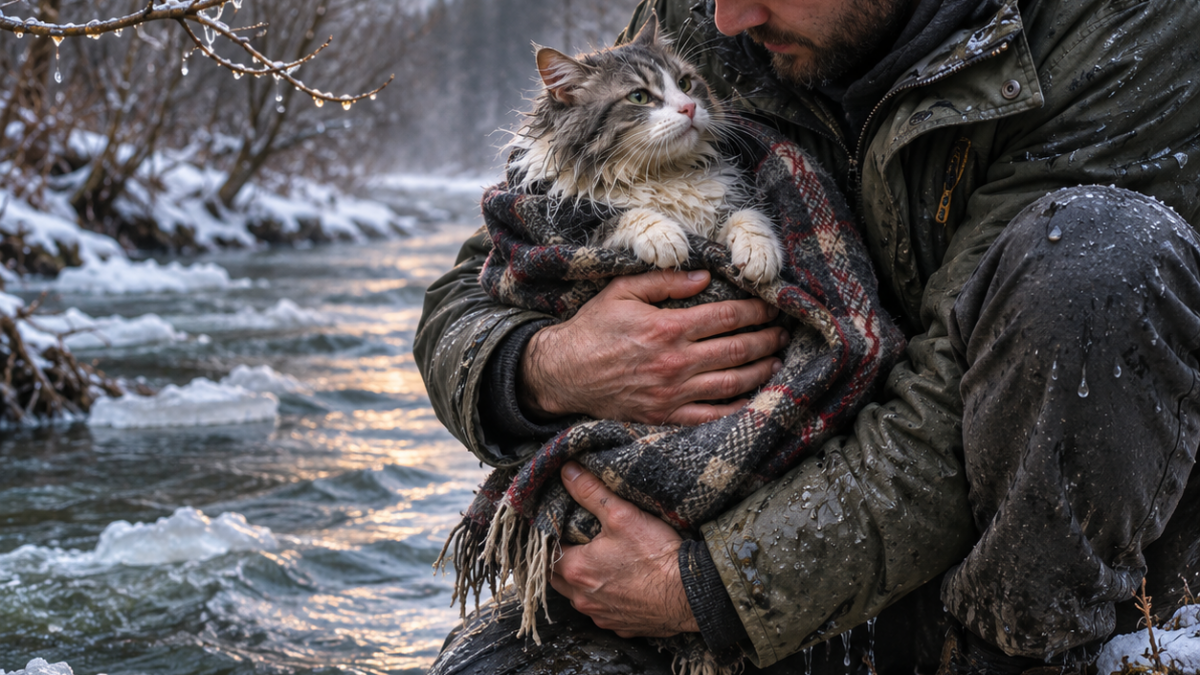
PART 2
I had no idea where she had come from.
No idea where her kittens might be.
For all I knew, they could be somewhere outside in the cold, waiting for a mother who might never return.
I pressed the accelerator as soon as the light changed.
The staff was waiting when I reached the clinic.
A technician came out with a carrier and warm blankets.
“What happened?”
“River.”
She looked at the cat and her face changed immediately.
“Let’s get her inside.”
I followed them into an examination room.
A veterinarian named Dr. Parker arrived less than a minute later.
She listened to the cat’s heart, checked her temperature, gums, eyes, and abdomen.
“She’s severely hypothermic,” she said. “But she’s alive, and that’s the important part.”
“Can you save her?”
“We’re going to try.”
She examined the cat’s belly.
Then she looked at me.
“You were right.”
“She has kittens?”
“Almost certainly. She’s lactating.”
My stomach tightened.
“How old?”
“The kittens?”
“Yeah.”
“Could be anywhere from a few days to several weeks. We’d need more information.”
I stared at the little orange cat.
“Then they’re out there.”
Dr. Parker nodded.
“If she was separated from them recently, yes.”
“How long can kittens survive without her?”
“That depends on age, temperature, shelter, and whether anyone else is caring for them.”
I didn’t like that answer.
“Hours?”
“It could be.”
I looked toward the window.
The light outside was already fading.
Dr. Parker saw my expression.
“You can’t go searching blindly in the dark.”
“I found her near the old river trail.”
“That doesn’t mean the kittens are there.”
“She didn’t fall out of the sky.”
“No, but she could have traveled. Someone may have dumped her. She may belong to a nearby house. She may have been swept downstream.”
That word stayed with me.
Dumped.
I looked at the cat again.
She had been found near the center of the river.
There were no houses close to that section.
Only woods, an abandoned pumping station, and an old maintenance road.
“How does a cat get into the middle of a river?”
Dr. Parker didn’t answer immediately.
“Sometimes accidents happen.”
“And sometimes?”
Her eyes met mine.
“Sometimes people do terrible things.”
The cat remained at the clinic overnight.
I went home, changed out of my wet clothes, drank half a cup of coffee without tasting it, and sat at my kitchen table thinking about kittens I had never seen.
At 7:10 the next morning, the clinic called.
“She made it through the night,” Dr. Parker told me.
I stood so quickly my chair scraped across the floor.
“She’s okay?”
“Not out of danger, but much stronger. Her temperature is normal. She’s eating a little.”
I closed my eyes.
“Thank God.”
“There is something else.”
“What?”
“She has a microchip.”
That surprised me.
“So she belongs to someone?”
“Possibly. We’re checking the registration.”
“Can you tell me her name?”
“According to the chip database, her name is Maple.”
Maple.
For some reason, hearing that she had a name made everything feel different.
She wasn’t just a stray cat who had ended up in bad luck.
Somebody had once named her.
Somebody had cared enough to have her chipped.
“Who’s the owner?”
“We’re still trying to reach the registered number. It’s an older registration.”
“Can I come see her?”
“Yes.”
I was at the clinic twenty minutes later.
Maple was sitting inside a heated recovery enclosure.
She still looked tired, but the difference from the day before was incredible.
When I walked into the room, her head lifted.
“Hey.”
Her ears moved forward.
I crouched.
“You remember me?”
She stood.
Slowly.
Then she walked toward the front of the enclosure.
The technician opened it.
Maple stepped out, pressed her forehead against my hand, and began to purr.
I laughed.
Then, unexpectedly, my eyes filled.
“You almost died yesterday.”
She pushed harder against my palm.
The technician smiled.
“I think she knows.”
Maple’s purr grew louder.
Then she started pacing.
Back and forth.
She went toward the door.
Returned.
Went toward the door again.
“What is she doing?”
The technician watched.
“She’s restless.”
Maple meowed.
Not weakly this time.
Loudly.
Urgently.
She went to the door and scratched.
Then turned toward me.
“Her kittens,” I said.
The technician didn’t reply.
I looked at Dr. Parker when she entered.
“She wants out.”
“She needs more observation.”
“She wants to go somewhere.”
“Most cats want to leave the hospital.”
“No. Look at her.”
Maple scratched at the door again.
Then she came to me and meowed.
I crouched.
“Are you trying to tell me something?”
She hurried back toward the door.
Dr. Parker sighed.
“We can’t let a recovering cat wander around outside.”
“Then let me take her in a carrier.”
She looked at me.
“You want to use her to search?”
“I want to see whether she recognizes the area where I found her.”
Dr. Parker hesitated.
“If we do this, she stays in the carrier unless we’re in a controlled area. You keep her warm. If she shows signs of weakness, you bring her straight back.”
“Deal.”
An hour later I was standing beside the river again.
The weather was even colder.
Maple was in a secure carrier on the passenger seat.
The moment I parked near the trail, she began meowing.
My pulse jumped.
“You know this place.”
I carried her toward the spot where I had found her.
When we reached the bank, she became frantic.
She turned around inside the carrier, pushing her nose against the door.
“Easy.”
I walked upstream.
Nothing.
She became quieter.
I turned around and walked downstream.
Immediately she started calling again.
“Okay.”
I followed the trail.
Maple kept reacting whenever we moved in one particular direction.
Eventually the trail split.
One path continued beside the river.
The other climbed toward the abandoned pumping station.
Maple scratched at the carrier door.
I looked uphill.
“You came from there?”
The old station had been closed for years.
Most people avoided it.
The access road was half covered in weeds, and the building itself was surrounded by rusted fencing.
I started climbing.
The farther we went, the louder Maple became.
Then I heard something else.
I stopped.
Maple stopped too.
There it was.
A tiny sound.
I set the carrier down.
“Hello?”
Another squeak came from somewhere near the building.
My heart began pounding.
I followed it around the side.
Behind a pile of rotting boards was a narrow opening beneath an old concrete platform.
I crouched.
At first, all I could see was darkness.
Then two small eyes reflected the light from my phone.
“Oh my God.”
A kitten.
I moved the boards carefully.
The kitten backed deeper into the gap.
Then another tiny face appeared.
And another.
Three kittens.
All orange and white.
All alive.
Maple went wild inside the carrier.
She threw herself against the door and cried.
“Okay, okay.”
I moved the carrier as close as possible and opened it only after blocking the surrounding space with boards so she couldn’t escape toward the river.
Maple rushed into the opening.
The kittens exploded with sound.
I sat there on the freezing ground listening to them cry and nurse.
And I cried too.
Not because I was sad.
Because suddenly I understood.
Maple had not simply been fighting to survive in that river.
Somewhere nearby, three tiny lives had been waiting for her.
Whatever had happened to her, whatever had put her in that water, she had still been trying to get back.
After several minutes, Maple crawled out.
She looked at me.
Then went back inside.
A moment later she appeared with a kitten gently held in her mouth.
She placed it near my knee.
I stared at her.
“Are you serious?”
She turned around.
She brought me the second kitten.
Then the third.
One by one.
When the last kitten was beside me, Maple sat down and looked directly at my face.
I don’t know what animals understand about us.
I don’t know whether she understood that I had saved her.
But in that moment, it felt as if she trusted me with the most precious things she had.
I covered my face with one hand.
“You’re going to make me cry again.”
Maple touched her nose to my wrist.
That should have been the end of it.
A rescue.
A mother reunited with her kittens.
A happy ending.
But while I was gathering the blankets around them, I noticed something beneath the wooden boards.
A pet carrier.
Old.
Cracked.
The door had been tied shut with wire.
My stomach went cold.
I pulled it into the light.
Inside was a dirty towel.
A plastic food dish.
And a strip of blue tape with something written on it.
MAPLE – #47.
I stared at it.
Number forty-seven?
I looked around.
Behind the pumping station were several more carriers.
Some broken.
Some stacked together.
There were empty food bags, medicine bottles, and cardboard boxes.
This wasn’t random trash.
Somebody had been keeping animals here.
I called Dr. Parker.
“I found the kittens.”
“Alive?”
“All three.”
“That’s wonderful.”
“But there’s something else.”
I told her about the carriers.
About the wire.
About the number on the tape.
There was a long silence.
“Don’t touch anything else,” she said.
“Why?”
“Call animal control.”
“You think someone dumped her?”
“I think you may have found evidence of something larger.”
Animal control arrived with a county deputy forty-five minutes later.
The officer, Lisa Grant, examined the area carefully.
She photographed the carriers.
The medicine bottles.
The bowls.
Then she looked at the carrier marked with Maple’s name.
“Where exactly did you find the cat?”
I pointed toward the river.
“Down there.”
“Could she have escaped from this carrier?”
“The door was wired shut.”
Lisa nodded.
“That was my thought too.”
The deputy, a man named Harris, walked around the building.
“There’s tire tracks behind the fence.”
“Fresh?” Lisa asked.
“Recent.”
My hands tightened.
“So somebody brought her here.”
“Maybe.”
“And threw her into the river?”
Deputy Harris looked at me.
“We don’t know that yet.”
“She didn’t wire herself inside a carrier.”
“No.”
“Her kittens were under the building.”
“I see that.”
I felt anger rising through me.
“If someone did this—”
“We investigate,” he said calmly. “That’s what happens next.”
It wasn’t enough for me.
Maybe it should have been.
But I kept seeing Maple’s paws slipping from that wood.
I kept remembering how cold her body had felt against mine.
Someone may have stood safely on that bank and watched her disappear.
The thought made me sick.
Lisa scanned Maple’s microchip.
Then she frowned.
“The registration says her owner is Margaret Bell.”
“That’s what the vet found.”
“You know her?”
“No.”
“I do.”
Something in her voice changed.
“Is that bad?”
Lisa looked at the deputy.
“Margaret Bell died eight months ago.”
Everything went quiet.
“What happened to Maple?”
“That,” Lisa said, “is a very good question.”
We learned the answer slowly.
Margaret Bell had been seventy-eight when she died.
She had lived alone with Maple for six years.
After her death, her niece had contacted an organization called Second Chance Haven, a small private rescue operated by a man named Dale Mercer.
Dale promised to find Maple a safe home.
Margaret’s niece had even donated three hundred dollars toward Maple’s care.
The rescue had sent her one photograph two weeks later.
Maple supposedly sitting in a new family’s living room.
After that, the niece believed the adoption was complete.
Except the photograph wasn’t Maple.
When Lisa showed it to me, even I could see the differences.
Wrong markings.
Wrong face.
Wrong tail.
“Why would he fake an adoption?” I asked.
Lisa’s jaw tightened.
“We’re going to find out.”
Second Chance Haven had been investigated once before.
Not for cruelty.
For paperwork problems.
Animals coming in without proper records.
Donation money that couldn’t be clearly accounted for.
Complaints from volunteers who said too many animals disappeared.
Nothing had ever been proven.
Until Maple.
The abandoned pumping station was technically on land leased to a storage company.
That company had rented one section of the property to Dale Mercer for “temporary supply storage.”
Lisa looked at me.
“This connects him to the site.”
“So arrest him.”
“We still need evidence he harmed Maple.”
“What more do you need?”
“We need evidence that holds up in court.”
I hated hearing that.
But she was right.
Anger feels simple.
Justice rarely is.
Maple and her kittens returned to the veterinary clinic.
I visited every day.
Within a week, the kittens were stronger.
We named them Rusty, Penny, and Scout.
Maple gained weight.
Her fur became soft again.
She followed me whenever I entered the room.
Dr. Parker started laughing about it.
“I think you’ve been adopted.”
“By which one?”
“All four.”
I wasn’t complaining.
But while Maple healed, the investigation grew.
And what officers found was worse than I expected.
Second Chance Haven had taken in more than a hundred animals over two years.
Some were legitimately adopted.
Many weren’t.
People paid surrender fees.
Donors paid medical costs.
Families were told animals had found homes.
But there were missing records everywhere.
Lisa contacted former volunteers.
One woman named Rebecca agreed to meet us at the animal control office.
She looked nervous from the moment she sat down.
“I should’ve said something earlier,” she told us.
Lisa spoke gently.
“Tell us now.”
Rebecca clasped her hands together.
“Dale always had too many animals. At first I thought he was overwhelmed. Then I noticed that certain animals disappeared overnight.”
“What kind?” Lisa asked.
“Older cats. Sick dogs. Animals that needed expensive treatment.”
“Where did he say they went?”
“Foster homes.”
“Did you see paperwork?”
“No.”
“Did you ask?”
Rebecca nodded.
“He got angry.”
I leaned forward.
“What did he say?”
“That I was a volunteer and should stay in my lane.”
She swallowed.
“Then one night I saw him loading carriers into his van.”
“How many?”
“Five or six.”
“Where was he going?”
“He said he had an emergency foster placement.”
“Did you believe him?”
“At the time, I wanted to.”
Her eyes filled.
“I don’t anymore.”
Lisa showed her a photograph of the carrier marked MAPLE – #47.
Rebecca covered her mouth.
“You recognize it?”
She nodded.
“That numbering system was his.”
My skin crawled.
“What did the number mean?”
“Intake number.”
“Forty-seven.”
“Yes.”
“So Maple was definitely in his rescue?”
“Yes.”
“Did you see her?”
Rebecca stared at the photograph for several seconds.
Then she whispered, “I think so.”
She remembered an orange cat arriving after her elderly owner died.
Dale complained that she was pregnant.
That detail stunned everyone.
“Pregnant?” I asked.
Rebecca nodded.
“He said nobody wanted an adult cat with kittens on the way.”
Maple must have given birth while in his care.
“What happened to the kittens?”
“I never saw them.”
I felt the anger again.
He had taken money to protect her.
Then, when she became inconvenient, he had moved her somewhere nobody would look.
The investigation expanded.
Police obtained warrants.
Financial records showed thousands of dollars in donations that never went toward animal care.
More former volunteers came forward.
Then another discovery changed everything.
Behind a warehouse Dale rented outside town, investigators found twenty-one animals living in filthy cages.
Dogs.
Cats.
Two rabbits.
All in poor condition.
Some had microchips registered to families who believed they had been adopted months earlier.
Dale Mercer was arrested.
But even then, he denied everything.
He claimed former volunteers were lying.
He claimed Maple had escaped.
He claimed somebody else had used his carriers.
He claimed he had never been near the river.
Then investigators found something in his van.
A roll of blue tape.
The same type used on Maple’s carrier.
Wire.
The same gauge used to secure the carrier door.
And mud from the old pumping station.
Still, the strongest evidence came from somewhere unexpected.
A trail camera.
A man who hunted on private land near the river had installed it months earlier.
The camera faced a maintenance road.
Its memory card contained a photograph taken at 4:18 a.m. on the day I found Maple.
Dale’s van.
Driving toward the pumping station.
At 4:46 a.m., the same van was photographed leaving.
When Lisa called me, I sat in silence.
“So that’s it?”
“It’s strong evidence.”
“He was there.”
“Yes.”
“With Maple.”
“We still can’t see what’s inside the van.”
“But we know.”
She paused.
“We know enough to keep building the case.”
I walked into the clinic that evening carrying a small bag of treats.
Maple was curled around her kittens.
I sat beside them.
“You know what I hate?”
She opened one eye.
“That he probably thought nobody would ever know.”
Maple began to purr.
“He thought you were just another animal.”
I touched her head.
“He didn’t know how stubborn you were.”
Her tail moved.
“And he definitely didn’t know how stubborn I am.”
The case went public two days later.
News stations ran photographs of the seized animals.
Second Chance Haven’s website disappeared.
People who had donated money started contacting investigators.
Families began searching adoption records.
One woman learned that the dog she had surrendered after her husband’s death had never been adopted as she had been told.
The dog was among those found in Dale’s warehouse.
She cried when they were reunited.
Another family found their missing cat alive.
Not every story ended that way.
That was the hardest part.
Some animals could not be accounted for.
No one knew exactly what had happened to them.
Dale’s attorney continued insisting there was no proof he had intentionally harmed any animal.
Then Rebecca called Lisa again.
She remembered something.
A text message.
Months earlier, Dale had written to her after an argument about veterinary expenses.
Rebecca had never deleted the conversation.
The message said:
“We can’t keep wasting money on animals nobody wants. Sometimes you have to make hard choices.”
Another message, sent later, said:
“Take the old ones off the list. I’ll handle them.”
Those words were enough to make me feel cold all over again.
But investigators found something even worse on Dale’s computer.
A spreadsheet.
Animals listed by number.
Name.
Age.
Condition.
Donation received.
Adoption fee received.
And a final column labeled “Disposition.”
Some said ADOPTED.
Some said TRANSFERRED.
Others had one letter.
R.
Maple was number forty-seven.
Her entry read:
47 – MAPLE – FEMALE CAT – PREGNANT – $300 DONATION – R.
“What does R mean?” I asked Lisa.
“We believe it means removed.”
My jaw tightened.
“Removed where?”
“We’re still investigating.”
I already knew where Maple had been removed to.
A freezing river.
Dale remained in jail while awaiting trial because investigators also found evidence of financial fraud.
His supporters claimed the story had been exaggerated.
Some called him a misunderstood rescuer.
One man even told a local reporter that Dale had “saved more animals than his critics ever would.”
I watched that interview once.
Only once.
Then I turned it off.
Because I had held Maple when her heartbeat was fading.
I had seen the wire on her carrier.
I had found her kittens shivering under concrete.
People could say whatever they wanted.
The truth had been cold and wet and barely alive in my arms.
Three weeks after the rescue, Dr. Parker called me into her office.
“The kittens are doing well.”
I smiled.
“So is Maple.”
“She is.”
There was something in her expression.
“What?”
“The legal hold has been lifted.”
I knew what that meant.
The animals could be adopted.
“All four?”
“All four.”
I looked through the window.
Maple was lying beside Scout while Rusty attacked Penny’s tail.
“I’m taking them.”
Dr. Parker laughed.
“I thought you might say that.”
“All of them.”
“You understand kittens are chaos.”
“I’ve met them.”
“Four cats are expensive.”
“I know.”
“You were planning this before I called, weren’t you?”
“I bought a cat tree yesterday.”
She shook her head.
“Hopeless.”
The first night they came home, I expected disaster.
I got it.
Rusty climbed my curtains.
Penny knocked over a plant.
Scout disappeared for twenty minutes and was eventually found sleeping inside an empty laundry basket.
Maple walked through every room twice.
She inspected the windows.
The doors.
The kitchen.
Finally she jumped onto the couch beside me.
I touched her back.
“Good enough?”
She curled into my side.
The kittens piled around us.
For the first time since the river, I felt something close to peace.
But the story wasn’t over.
Not yet.
Dale eventually made bail.
That infuriated a lot of people.
He returned to his house and told reporters he would prove everyone wrong.
A week later, I found an envelope in my mailbox.
No return address.
Inside was a printed photograph.
Me standing outside Cedar Ridge Animal Hospital.
Across my face someone had drawn a black X.
Underneath were four words.
MIND YOUR OWN BUSINESS.
I stared at it for a long time.
Then I called Lisa.
She arrived twenty minutes later.
“Don’t touch anything else.”
“I already touched the envelope.”
“That’s okay.”
She photographed it and placed it in an evidence bag.
“You think Dale sent it?”
“I think we don’t assume anything.”
“He knows who I am.”
“Your name appeared in news reports.”
“That’s comforting.”
Lisa looked at me.
“This is serious.”
“I know.”
“If you see his vehicle near your property, call us. Don’t approach him.”
“I wasn’t planning to.”
She gave me a look.
“What?”
“You jumped into a freezing river.”
“That was different.”
“You climbed into an abandoned pumping station.”
“Also different.”
“You’ve called my office eighteen times.”
“That was completely justified.”
She almost smiled.
“Just don’t do anything stupid.”
For the next few days, nothing happened.
Then I noticed a dark van parked across from my house.
It stayed for five minutes.
Then left.
The next night, it returned.
I couldn’t see the driver.
I called the sheriff’s department.
By the time a patrol car arrived, the van was gone.
Two days later, someone opened my backyard gate.
I knew I had latched it.
Maple and the kittens were indoor cats, so they were safe.
Still, I installed cameras around the house.
I didn’t tell many people.
I didn’t want fear to control me.
But anger was easier to manage than fear.
Every time I looked at Maple, I remembered why I had gotten involved.
I wasn’t going to disappear because someone wanted me quiet.
The trial was scheduled for early spring.
Prosecutors planned to use my testimony about Maple’s condition and where I found her.
Dale’s attorney tried to exclude parts of it.
He claimed I was emotionally biased.
He was right about one thing.
I was emotional.
Anyone who could see what happened to those animals and feel nothing scared me far more than anger ever could.
One night, about two weeks before the trial, my security camera sent an alert.
Motion detected.
2:13 a.m.
I opened the app.
A person in a hood stood near my side gate.
My heart started pounding.
I called 911.
Then I watched the screen.
The person moved toward the backyard.
Something metallic flashed in his hand.
Bolt cutters.
I looked toward the living room.
Maple was awake.
Her body had gone stiff.
“Stay here.”
I locked the interior door leading to the garage.
The kittens gathered behind the couch.
The person cut the padlock on my gate.
Then another camera caught his face for half a second.
Dale.
I felt ice move through my chest.
He entered the backyard.
I stayed inside.
That decision mattered.
A year earlier, I might have walked outside.
I might have confronted him.
But Lisa’s voice was in my head.
Don’t do anything stupid.
I stayed behind the locked door and kept the dispatcher on the phone.
“He’s in my yard.”
“Officers are on the way.”
“He has bolt cutters.”
“Stay inside. Do not confront him.”
Then Dale moved toward the small shed beside my garage.
The shed held gardening tools.
Nothing important.
He tried the door.
Locked.
He looked toward the house.
Then he saw one of the cameras.
He froze.
For a moment he stared directly into it.
Then he pulled his hood lower.
Too late.
Blue lights appeared at the end of the street.
Dale ran.
He made it over my back fence.
He did not make it much farther.
A deputy caught him two houses away.
When officers searched him, they found bolt cutters, a screwdriver, work gloves, and something that made my stomach twist.
A small bag of dry cat food mixed with crushed tablets.
The tablets were later identified as a veterinary sedative.
I stared at Lisa when she told me.
“He came for my cats?”
“We can’t prove exactly what he intended.”
“He brought drugged food.”
“Yes.”
“He cut my lock.”
“Yes.”
“And he’s still going to say this is all a misunderstanding?”
“He can say whatever he wants.”
For the first time since I met her, Lisa smiled without holding it back.
“But this time, he can say it from a jail cell.”
Dale’s bail was revoked.
The attempted intimidation became part of a separate criminal case.
And that was the moment everything changed.
He had spent months claiming that other people were framing him.
Now there was video of him cutting into the yard of a witness at two in the morning.
His face.
His tools.
The drugged food.
No explanation could make that look innocent.
At trial, I saw him for the first time.
He was smaller than I expected.
That surprised me.
In my mind he had become something huge.
A monster.
But he was just a man in a gray suit sitting beside his attorney.
Ordinary.
That somehow made it worse.
The prosecutor asked me to describe the day I found Maple.
I told the jury about the wind.
The freezing water.
Her paws slipping.
The way her body felt when I pulled her free.
I told them about realizing she had kittens.
Then the prosecutor showed a photograph of the river.
“Mr. Reynolds, did Maple appear capable of swimming safely in those conditions?”
“No.”
“Did she appear to be voluntarily in the water?”
“No.”
“How close was she to death?”
I looked at Dr. Parker sitting behind the prosecutor.
“Very.”
Dale’s attorney stood for cross-examination.
“You are not a veterinarian, correct?”
“No.”
“You cannot determine exactly how long Maple was in the river.”
“No.”
“You cannot say you personally saw my client place her there.”
“No.”
“So your belief that he did is speculation.”
I looked at Dale.
Then back at the attorney.
“My belief comes from the carrier with her name on it, the wire holding it shut, the trail camera showing his van entering the property, his records marking her as removed, and the fact that she was nearly dead in the river below the place he rented.”
The attorney frowned.
“That wasn’t my question.”
“No. I didn’t personally see him throw her in.”
“Thank you.”
He started to turn away.
I added, “I only saw what he left behind.”
The prosecutor didn’t smile.
But several jurors looked directly at Dale.
Rebecca testified.
Margaret Bell’s niece testified.
Dr. Parker testified.
Lisa testified.
Financial investigators testified.
Then the prosecution showed the photograph of Dale’s van entering the river property.
They showed his spreadsheet.
They showed the threatening photograph mailed to me.
Finally, they played the video from my backyard.
Dale’s face appeared on the courtroom monitor.
He looked directly into my camera.
The jury watched him cut my lock.
Watched him walk toward my house carrying tools.
Watched him run when police lights appeared.
The room was completely silent.
His defense collapsed after that.
Not dramatically.
There was no shouting.
No confession.
No movie-style breakdown.
Just evidence.
Piece by piece.
Lie by lie.
Until there was nowhere left for him to hide.
The jury deliberated for less than four hours.
Guilty on multiple animal cruelty charges.
Guilty on fraud-related charges.
Guilty on witness intimidation.
Guilty on attempted burglary.
There were additional counts involving the conditions of the animals found in his warehouse.
When the verdicts were read, Dale stared straight ahead.
I expected to feel triumphant.
I didn’t.
Mostly, I felt tired.
Then I thought about Maple.
I thought about that broken piece of wood in the river.
And I realized something.
Justice doesn’t always feel like victory.
Sometimes it feels like finally being able to put down something heavy you’ve been carrying for too long.
At sentencing, several people were allowed to speak.
Margaret’s niece went first.
She brought a photograph of her aunt holding Maple.
“My aunt trusted this man,” she said. “She believed that after she died, the cat she loved would be safe.”
Her voice broke.
“He took money from our family to protect Maple. Then he treated her life like garbage.”
Dale looked down.
She continued.
“My aunt couldn’t be here to speak for her. So I will.”
Rebecca spoke next.
Then the woman who had been reunited with her dog.
Then Lisa read a statement summarizing the animals recovered from Dale’s properties.
When it was my turn, I walked to the front.
I had written something.
I didn’t read it.
I looked at the judge.
“When I found Maple, she was hanging onto a piece of wood in freezing water. I thought the hardest part would be pulling her out.”
I paused.
“I was wrong.”
The courtroom was silent.
“The hardest part was learning that another human being may have decided her life wasn’t worth the trouble.”
I looked toward Dale.
“She had three kittens waiting for her. They were cold, hungry, and alive. She fought to stay alive because they needed her.”
My throat tightened.
“I don’t know what she understood while she was in that river. But I know she didn’t give up.”
I turned back to the judge.
“And because she didn’t give up, we found the place where she had been kept. Because we found that place, investigators found other animals. Families got answers. Animals got treatment. People came forward.”
I took a breath.
“So the cat he apparently considered disposable became the reason everything was exposed.”
That was the closest thing to revenge I ever wanted.
Not violence.
Not suffering.
Truth.
Dale had tried to erase Maple.
Instead, Maple erased his lies.
The judge sentenced him to several years in prison, followed by probation.
He was permanently prohibited from operating an animal rescue and faced long-term restrictions on owning animals.
His property was seized to help cover restitution and care costs.
Second Chance Haven was dissolved.
The sign disappeared.
The website stayed gone.
The animals he had neglected were transferred to legitimate rescues.
Most eventually found homes.
A few stayed with the foster families who helped them recover.
And Maple?
Maple became queen of my house.
There is no other way to say it.
Rusty grew into an enormous orange cat who believed every cardboard box belonged to him.
Penny became a professional thief who could remove food from a plate without making a sound.
Scout followed me everywhere.
But Maple was different.
She slept beside my pillow.
Every morning, she waited outside the bathroom door.
Whenever I sat at the kitchen table, she jumped onto the chair beside me.
She hated water.
Not surprisingly.
Even the sound of the bathtub filling made her leave the room.
I never forced her near it.
Some memories don’t need to be challenged.
They just need to be respected.
About six months after the trial, Margaret’s niece, Emily, visited.
She brought an old photo album.
Maple was asleep on the couch when Emily opened it.
There were dozens of pictures of Margaret.
And Maple.
Maple on a windowsill.
Maple wearing a ridiculous Christmas bow.
Maple sitting beside Margaret at breakfast.
Maple asleep across her lap.
Emily touched one photograph.
“My aunt loved her more than almost anything.”
I smiled.
“I can see that.”
“She worried constantly about what would happen to Maple if she died first.”
My chest tightened.
“She thought she had planned everything.”
“She did what she could.”
Emily looked at Maple.
“I felt guilty for a long time.”
“You didn’t know.”
“I should have checked.”
“You were grieving.”
“I still should have checked.”
I didn’t argue.
Sometimes people need time before they can forgive themselves.
Maple woke.
She looked at Emily.
Then slowly stood.
Emily froze.
“Do you think she remembers me?”
“I don’t know.”
Emily crouched.
“Hi, Maple.”
Maple watched her for several seconds.
Then she jumped down.
She walked across the room.
And pressed her head against Emily’s hand.
Emily burst into tears.
“Oh, sweetheart.”
Maple climbed into her lap.
I looked away for a moment because I felt my own eyes burning.
After a while, Emily laughed through her tears.
“My aunt used to say Maple always knew who needed comforting.”
“I believe it.”
Emily stayed for almost three hours.
Before leaving, she handed me the photo album.
“I want you to have this.”
“I can’t take that.”
“You should.”
“It belongs to your family.”
“So does Maple’s story.”
She smiled.
“And you’re part of it now.”
I kept the album.
There is one photograph I framed.
Margaret is sitting in a garden chair.
Maple is in her lap.
Both are looking toward the camera.
Margaret is smiling.
Maple looks completely unimpressed.
That photo sits beside another one.
Me on my couch.
Maple in my lap.
Rusty, Penny, and Scout piled around us.
Sometimes I look at those two photographs and think about all the things that had to happen for our lives to intersect.
A woman had to love a cat.
A dishonest man had to betray that trust.
A storm had to raise the river.
I had to choose that particular trail on that particular afternoon.
I had to hear one tiny cry over the sound of rushing water.
Had I walked twenty yards farther before she cried, I might never have heard her.
Had I gone home five minutes earlier, she might have slipped beneath the surface.
There are things I don’t like thinking about.
So I focus on what did happen.
I heard her.
I saw her.
I went into the water.
And she lived.
The following fall, almost exactly one year after I found Maple, I returned to the river.
Not because I wanted to relive what happened.
I think I needed to see the place again when it wasn’t an emergency.
The day was cold but sunny.
The river was lower.
Calmer.
I stood on the bank near the spot where I had thrown down my jacket.
For a moment, I could see everything again.
Maple in the water.
Her head disappearing.
My hands shaking.
Then I looked upstream toward the abandoned pumping station.
It had changed.
After the criminal investigation, the county had taken control of the property.
A local nonprofit raised money to clean it up.
The old building was eventually converted into a small wildlife and animal rescue education center.
I didn’t know that would happen when the case began.
Neither did Lisa.
But the community wanted the place to mean something different.
The first time I saw the new sign, I laughed.
MAPLE HOUSE.
Underneath:
EVERY LIFE DESERVES A CHANCE.
I argued against the name.
I lost.
On opening day, Dr. Parker stood beside me.
“You realize none of this would’ve happened without you.”
“Without Maple.”
“You went into the river.”
“She was the one surviving it.”
Lisa joined us.
“You’re both impossible.”
A small crowd gathered near the entrance.
Children walked through rooms that once held dirty carriers.
Now those rooms contained educational displays about responsible pet ownership, microchipping, fostering, and reporting animal abuse.
One wall showed photographs of animals rescued during the investigation.
Another displayed pictures of their new homes.
In the center was a photograph of Maple.
Not the heartbreaking one from the day she was rescued.
I refused to use that.
Instead, it showed her lying in sunlight with her three grown kittens around her.
Healthy.
Safe.
Home.
I stood in front of that picture for a long time.
An older man beside me read the description.
“That’s the river cat?”
“Yeah.”
“You know her?”
I smiled.
“She owns my house.”
He laughed.
“Sounds about right.”
That evening I went home and found Maple waiting at the door.
She was older now.
Softer.
Confident.
She walked past me as if I had been gone for three weeks instead of three hours.
“Nice to see you too.”
Rusty appeared behind her.
Then Penny.
Scout came running from the hallway.
I sat down on the floor.
All four cats gathered around me.
I thought about the phrase people kept using.
I saved Maple.
For a long time, I accepted it.
But I’m not sure it was completely true.
Yes, I pulled her from the river.
Yes, I carried her to my truck.
Yes, I helped find her kittens.
But Maple did something too.
Before that day, my life had become small.
I worked.
I came home.
I ate dinner.
I watched television.
I slept.
Then repeated it.
I didn’t think I was unhappy.
Maybe I wasn’t.
But I had stopped feeling connected to much of anything.
Maple changed that.
She made me care about something so strongly that fear became secondary.
She introduced me to people I never would have known.
Dr. Parker became a close friend.
Lisa still sends me photographs whenever she sees an orange cat doing something stupid.
Emily visits twice a year.
I volunteer at Maple House most Saturdays.
And my home?
My home isn’t quiet anymore.
Something is always falling over.
Someone is always stealing my chair.
There is cat hair on clothes I haven’t even worn yet.
I haven’t eaten a meal without being watched by at least two suspicious faces in over a year.
And I wouldn’t trade it.
One winter night, snow began falling outside.
I sat by the window with a cup of coffee.
Maple climbed onto my lap.
The kittens—though they weren’t kittens anymore—were sleeping nearby.
She settled against me and started purring.
I ran my fingers through the fur behind her ears.
“You know something?”
Her eyes remained closed.
“You caused a lot of trouble.”
Her tail tapped my leg.
“Nearly froze me to death.”
Another tap.
“Got me involved in a criminal investigation.”
She opened one eye.
“Cost me a fortune in cat food.”
She closed it again.
I smiled.
“Worth it.”
Her purring grew louder.
Outside, snow covered the yard.
For just a second, the sound reminded me of the river.
Cold.
Dark.
Rushing.
I looked down at her.
Warm.
Safe.
Alive.
And suddenly I remembered the first second I touched her in the water.
Her body had been freezing.
Her paws barely moved.
I had honestly believed she might die in my arms before I reached shore.
Now she was asleep in my lap, surrounded by the three babies she had fought so hard to return to.
The man who tried to make her disappear had lost everything he built on cruelty and lies.
The abandoned place where animals once suffered now helped save them.
Families who had been deceived finally knew the truth.
And one tiny orange cat who had been reduced to a number on a piece of blue tape had a building named after her.
If that’s not justice, I don’t know what is.
I leaned down and whispered into her fur.
“You won, Maple.”
Her ear twitched.
I laughed softly.
“You really did.”
A few minutes later, Scout climbed into my lap too.
Then Penny.
Rusty tried, realized there wasn’t enough room, and simply sat on my foot.
I stayed there until my coffee went cold.
I didn’t move them.
I didn’t want to.
Because sometimes a happy ending isn’t loud.
Sometimes nobody cheers.
Sometimes there isn’t a dramatic final moment.
Sometimes it’s just a warm house on a freezing night.
A rescued animal sleeping without fear.
A family created in a way nobody expected.
And the quiet understanding that one terrible act failed to become the final chapter.
Someone tried to throw Maple away.
Someone believed the river would erase what he had done.
Instead, the river carried her to me.
And Maple did what she had already proven she was better at than anyone I had ever met.
She survived.
Then she went home to her babies.
Then she helped expose the man who betrayed her.
And finally, after everything she had endured, she learned that no one was ever going to throw her away again.
Neither were her kittens.
Not while I was alive.
I looked down at the four orange bodies crowded around me.
Maple opened her eyes.
For a moment, she stared directly into mine.
Then she reached one paw forward and rested it against my chest.
Exactly over my heart.
Maybe it meant nothing.
Maybe she was simply getting comfortable.
But I remembered that freezing afternoon beside the river.
I remembered reaching for her as her paws slipped away.
Back then, I had promised a terrified animal who couldn’t understand my words:
“I’m coming.”
Now, more than a year later, I placed my hand gently over her paw.
“I’ve got you.”
Maple closed her eyes.
And this time, I knew there was nowhere she needed to run.
No freezing current.
No locked carrier.
No dark building.
No person deciding whether she was worth saving.
She was home.
So were her babies.
And so, in a way I hadn’t understood until that moment, was I.








