PART 2: I Inherited the 1,000 Acres Beneath 450 HOA Homes—Then Their President Tried to Force Me Out
PART 2
For the first few minutes, I did nothing.
I simply sat in Henry’s chair with the lease open in front of me and listened to the old wall clock tick.
The study smelled exactly the way it had when I was a child—paper, cedar shelves, stale coffee, and the faint trace of pipe tobacco even though my grandfather had stopped smoking twenty years earlier.
Outside the window, Copper Ridge looked peaceful.
Streetlights.
Pool lights.
Cars pulling into garages.
Families eating dinner behind kitchen windows.
Four hundred fifty homes.
Around twelve hundred people.
All living on land I had just discovered was still legally tied to my family.
I looked down again at Section 12.
Material breach.
Unauthorized construction.
Interference with the landlord’s adjacent property rights.
Ninety days.
My first thought embarrassed me afterward.
*I could destroy her.*
It came fast and hot.
Constance Blackwell had threatened me on the same day I was still sorting my grandfather’s funeral clothes.
Her security men had fined me three thousand dollars for parking in my own driveway.
She thought I was a grieving outsider.
An inconvenience.
Someone who could be frightened, isolated, and bought cheaply.
And for perhaps thirty seconds, I imagined sending her a termination letter the next morning and watching her realize that every street, every clubhouse meeting, every polished threat she had issued had happened on ground she did not own.
Then I looked outside again.
A little girl was riding a scooter under a streetlight.
A man across from her was pulling two trash cans toward the curb.
A woman stepped from a garage carrying grocery bags.
Those people had not called me.
They had not threatened me.
They had not written the citation.
Most of them probably had no idea the lease existed.
Whatever power Henry had left me, using it blindly would make me exactly the kind of person I hated dealing with in my own legal work—someone so focused on being technically right that they stopped caring who got crushed by the result.
I closed the lease.
Then opened the folder marked **PAYMENTS RECEIVED**.
My grandfather had organized every year separately.
1985.
1986.
1987.
Bank deposits.
Tax statements.
Annual adjustment calculations.
When the original developer went bankrupt in 2005, the payments changed names but not purpose.
Copper Ridge Estates Homeowners Association.
One hundred fifty thousand dollars a year at the original base, then adjusted under the lease terms.
I had never known.
Not once.
Henry paid for my college.
Helped me through law school when my scholarships did not cover everything.
Never complained about money.
Never said where some of it came from.
He had simply told me:
“Build your own life, Nora. Don’t sit around waiting for mine.”
Now I understood why he could say that.
He had been sitting on one of the strangest property arrangements I had ever seen.
And he had told me nothing.
I slept maybe three hours.
At sunrise, I made coffee and walked outside.
The desert was still cool.
That would not last.
By noon the heat would flatten everything.
I crossed to the old mailbox at the county road and found Dolores Vega already there.
She lived half a mile south in an adobe house that predated Copper Ridge.
Seventy-two years old.
Five feet tall on a generous day.
Silver hair always tied into a neat bun.
She had known my grandfather almost as long as I had.
“Nora.”
She hugged me.
Not one of those careful funeral hugs.
A real one.
“You look terrible.”
“Thank you.”
“You’re welcome.”
She looked at the rental truck.
“Security already bothering you?”
I held up the citation.
Her face changed.
“How much?”
“Three thousand.”
She laughed once.
There was no humor in it.
“Of course.”
“What does that mean?”
Dolores looked toward Copper Ridge.
“You have time for coffee?”
Twenty minutes later, I was sitting in her kitchen.
She poured from an old metal pot and pushed a mug toward me.
“They came after me in 2012.”
“Who?”
“Constance.”
“For what?”
“My fence.”
She raised two fingers.
“Two inches.”
“You’re kidding.”
“No.”
“Then wind chimes. Then weeds. Then a complaint that my house damaged neighborhood values.”
“You’re not in Copper Ridge either.”
“That never stopped them.”
Her husband had died the year before it began.
She had been alone.
Grieving.
Trying to survive on a fixed income.
Then Constance Blackwell appeared at her door with what she called a generous solution.
An offer for the house.
Forty percent below market.
“What did you tell her?”
Dolores smiled.
“I told her to go to hell.”
I smiled for the first time since the funeral.
“In English?”
“No. Spanish.”
“Why?”
“So she would have to work for it.”
Then Dolores stopped smiling.
“But others sold.”
She began naming families.
The Hendersons.
The Nakamuras.
Mrs. Patterson.
Names I vaguely remembered from childhood.
Twelve families in five years.
Same pattern.
Citations.
Complaints.
Letters.
Neighbors suddenly becoming unfriendly.
Community emails warning about problem properties.
Fines that kept growing.
Then an offer.
Usually low.
Eventually the homeowner gave in.
“Who bought them?”
Dolores looked at me.
“Blackwell Properties LLC.”
I put down my coffee.
“Constance?”
“Her husband, Warren. Company is registered to him.”
“How many?”
“Eight that I know of.”
I felt the first cold edge of professional anger replace the emotional kind.
That was familiar territory.
Patterns.
Documents.
Beneficial ownership.
Timelines.
“Do you have records?”
“Some.”
She disappeared into another room and came back with a box.
Not Henry-level organization.
But enough.
Copies of notices.
Property advertisements.
Old community emails.
Printouts showing purchases.
I started spreading them across the table.
“When did the first citation usually arrive?”
Dolores understood immediately what I was doing.
“Within weeks.”
“Of what?”
“Usually refusing something.”
“What kind of something?”
“Selling. Giving access. Removing a fence. Signing an easement. Depends.”
“And then?”
“Pressure.”
“How long before sale?”
“Six months. A year. Sometimes longer.”
I wrote dates.
Names.
Addresses.
Purchase prices.
“Did Henry know?”
Dolores became quiet.
“That’s the strange part.”
“What?”
“They never touched him.”
“Never?”
“Not once.”
She looked toward the west.
“I always wondered why Constance treated your grandfather differently.”
“How?”
“Careful.”
The word landed.
“Afraid?”
“Maybe.”
I thought about the lease.
The payments.
Section 12.
I asked:
“Did you know Copper Ridge pays Henry rent?”
Dolores stared.
“What?”
“For the land.”
“What land?”
“All of it.”
I explained.
1985.
Fifty years.
Approximately one thousand acres.
Development rights.
Annual payment.
HOA assumption after 2005.
Dolores did not interrupt once.
When I finished, she slowly set down her cup.
“You’re telling me those houses are on Whitfield land.”
“Yes.”
“The clubhouse?”
“Yes.”
“The pool?”
“Yes.”
“The streets?”
“Yes.”
Her eyes widened.
“My God.”
“Residents own their improvements and leasehold interests. The ground itself stayed with the Whitfield trust.”
“Do they know?”
“I don’t think so.”
“How do you not know whether you own the ground under your house?”
“You sign fifty pages at closing.”
“That is not an answer.”
“No. It’s an explanation.”
Dolores sat back.
“Constance has been threatening people for years while paying your grandfather rent.”
“Apparently.”
“How much?”
“One hundred fifty thousand a year as the base amount, adjusted under the lease.”
“For how long?”
“Since 1985.”
She did rough math.
“That’s millions.”
“Yes.”
“And residents don’t know?”
“The lease should have been disclosed in purchase documents. Whether anyone explained it is another question.”
Dolores looked toward Copper Ridge.
Then at me.
“What happens when the lease ends?”
“2035.”
“That’s ten years.”
“Yes.”
“And then?”
I hesitated.
“Potentially, the rights change dramatically.”
Her eyes narrowed.
“Nora.”
“Under the agreement, improvements can revert with the underlying land when the lease ends. Chad will need to confirm exactly how it works.”
“Who’s Chad?”
“I don’t know yet.”
She laughed.
“You sound like a lawyer.”
“I am a lawyer.”
“That explains your personality.”
I smiled.
Then I told her about Section 12.
Her expression went still.
“You could end it now.”
“In theory.”
“And take the land back.”
“Yes.”
“Houses too?”
“Possibly, depending on the lease and applicable law.”
She looked out the window.
“Constance has no idea.”
“I don’t think she understands what I found.”
Dolores turned back.
“What are you going to do?”
That was the question.
I had power.
For the first time since coming home, maybe more power than anyone in Copper Ridge.
But power was not a plan.
“I’m going to find out exactly what they’ve been doing.”
“And then?”
“I’ll decide.”
She reached across the table and squeezed my hand.
“Henry always said you were the one who would set things right.”
I stared at her.
“He said that?”
“More than once.”
“When?”
“Whenever I asked why he didn’t fight Constance harder.”
“What did he say?”
“He said, ‘Some battles aren’t mine to finish.’”
My throat tightened.
Henry had known.
Maybe not every detail.
But enough.
That afternoon, I found Chad Cooper.
A colleague in Portland gave me his name.
“He handles the property cases that make normal real-estate lawyers start drinking at lunch.”
That sounded promising.
His office was on the fourteenth floor of a Phoenix tower.
I arrived with two banker’s boxes.
He looked at them.
“Bad day?”
“Interesting inheritance.”
He spent the first hour reading.
Almost no conversation.
That impressed me.
Most lawyers love hearing themselves explain the facts before they know them.
Chad read.
Ground lease.
Assignments.
Payment records.
Trust documents.
Survey.
My citation.
Copies of Constance’s correspondence.
Finally, he leaned back.
“Do you understand what you have?”
“I’m getting there.”
“I’ve practiced real-estate law twenty-three years.”
He tapped the lease.
“I’ve seen ground leases for shopping centers, apartments, commercial developments. Entire communities happen, but this is unusual.”
“Is it valid?”
“On its face? Very.”
“Who owns the land?”
“The trust, now controlled according to your grandfather’s estate documents.”
“Meaning me.”
“Meaning you have the ownership interest Henry had.”
“And Copper Ridge?”
“Leasehold rights.”
He pulled up a standard purchase form used in earlier sales.
“Residents bought structures and leasehold interests. Disclosure appears in the documents.”
“Where?”
He scrolled.
“Page forty-seven.”
I stared.
“Of course.”
“Most people skim.”
“Real-estate agents should explain it.”
“They should explain many things.”
“What happens in 2035?”
He looked at me.
“If the lease reaches expiration without extension, the reversion language becomes very important.”
“Buildings?”
“Potentially revert under the agreement.”
“Roads?”
“Yes.”
“Community center?”
“Yes.”
“Utilities?”
“Yes.”
I rubbed my forehead.
“Twelve hundred people.”
“I know.”
“Henry knew.”
“Yes.”
“He never told me.”
“That part I cannot explain.”
I showed him Section 12.
Chad read it twice.
Then reached for a yellow legal pad.
“This is where things become serious.”
“Material breach.”
“Yes.”
I told him about the citation.
Constance’s threat.
Dolores.
The families pressured into selling.
Blackwell Properties.
He did not react emotionally.
He started cross-referencing clauses.
Section 4.2.
No construction beyond approved development footprint.
Satellite imagery showed the community center had expanded twice beyond the original plan.
Section 6.1.
Management and governance changes required notice to the landowner.
No evidence the HOA ever formally notified Henry after assuming the lease in 2005.
Section 8.3.
Commercial use restrictions.
The community center was reportedly rented for weddings, corporate events, and private parties.
Section 11.
Quiet enjoyment and noninterference.
Then Section 12.
Termination.
Chad put down his pen.
“Any one of these could start a fight over material breach.”
“All together?”
“Much stronger.”
“Can I terminate?”
“You may have the contractual right to initiate termination procedures.”
“How quickly?”
“Ninety days under the clause.”
“And twelve hundred people lose their homes?”
He paused.
“Legally, it is more complicated than that sentence. Practically, the consequences would be enormous.”
“That isn’t what I want.”
“Good.”
I looked at him.
“Why good?”
“Because the client who walks in asking how fast they can destroy twelve hundred innocent people is usually the client I don’t want.”
I almost laughed.
“What are my options?”
He held up one finger.
“Terminate based on breach.”
“Too destructive.”
“Two: renegotiate now.”
“With Constance?”
“Yes.”
“No.”
“Three: do nothing. Collect rent until 2035.”
“Also no.”
He nodded.
“You’re going to suggest four.”
“I want transparency.”
“How?”
“Build the record. Every violation. Every harassment case. Every dollar.”
“And?”
“Show the residents.”
Chad’s expression changed.
“You want to go around the board.”
“I want to go through the people whose money the board is spending.”
“That invites retaliation.”
“She fined me three thousand dollars three days after a funeral.”
“Fair point.”
“She thinks I’m weak.”
“That can be useful.”
“I want her to keep thinking that.”
Chad sat back.
“You are not going to send a termination notice yet.”
“No.”
“You are not going to threaten residents.”
“No.”
“You are not going to claim you own their homes.”
“Not unless the documents support it.”
“Good.”
“What will you do?”
“Prepare everything.”
“Certified copies?”
“Yes.”
“Survey comparison?”
“Yes.”
“Lease breaches?”
“Yes.”
“Financial records if available?”
“Yes.”
He tapped the box.
“And you document every contact from Constance from this moment forward.”
I stood.
“Let her underestimate me.”
Chad almost smiled.
“Lawyers are very unattractive when they enjoy this part.”
“I’ll survive.”
The first community email went out four days later.
Dolores forwarded it.
Subject:
**CONCERNING NEIGHBOR ACTIVITY — COMMUNITY ALERT**
No name.
No direct accusation.
Just enough.
A recently arrived individual on adjacent property had demonstrated disregard for community standards.
Confrontational attitude.
Potential impact on safety.
Potential impact on values.
Residents encouraged to report suspicious behavior.
I read it twice.
Then printed it.
Evidence folder.
The citations escalated.
Fence paint.
Vegetation.
Truck parking.
Aesthetic violations.
Pest conditions.
Within two weeks, the fines exceeded eight thousand dollars.
My property was not even part of the HOA.
I filed every notice.
Photographed the alleged condition.
Recorded dates.
Made copies.
The online forum got uglier.
Elena Martinez, a young mother inside Copper Ridge, began forwarding screenshots through Dolores.
I had never met her.
Apparently she had her own history with the board after being fined because her children drew sidewalk chalk flowers in front of their house.
Anonymous accounts called my property dangerous.
One claimed I was running an illegal business.
Another said I was trying to lower nearby values.
A third demanded the HOA take “whatever legal action is necessary.”
I wanted to answer.
Chad told me not to.
“They want you in the argument.”
“They’re lying.”
“I know.”
“People believe them.”
“I know.”
“I hate this.”
“That’s the point.”
He waited.
“If you react emotionally, Constance controls the frame. Stay boring.”
“I’m very bad at boring.”
“Become excellent.”
I tried.
Then Warren Blackwell appeared.
White Mercedes SUV.
Clean enough to look ridiculous in desert dust.
He stepped out holding an envelope.
Tall.
Silver hair.
Expensive shoes.
“You’re Nora.”
“Ms. Whitfield.”
He smiled.
“So formal.”
I almost laughed.
Apparently the Blackwells shared a script.
“We got off badly.”
“You and I haven’t met.”
“My wife can be… passionate.”
“That’s one word.”
“But I’m a businessman.”
He held up the envelope.
“I prefer solutions.”
“I’m not taking that.”
“You haven’t heard the number.”
“I assume it’s insulting.”
“Four hundred twenty thousand. Cash. Thirty-day closing.”
I stared at him.
“For the house.”
“For the property.”
“My grandfather had it appraised at seven-fifty two years ago.”
“Market conditions change.”
“Forty-four percent below appraisal?”
He shrugged.
“Compliance problems affect value.”
“You mean the citations your wife invented?”
His smile tightened.
“Be careful.”
“About?”
“Accusations.”
I stepped closer to the gate.
“Eight of the families pressured out along this road sold to Blackwell Properties LLC.”
His eyes changed.
Only slightly.
“You’ve been talking to Dolores.”
“I’ve been reading records.”
“She has had a grudge against Constance for years.”
“Property records don’t have grudges.”
He lowered the envelope.
“You’re making this harder than it needs to be.”
“Why do you need this house?”
“We don’t need it.”
“Then stop trying to buy it.”
“You’re sitting beside a premium master-planned community with a deteriorating property.”
“Interesting word.”
“What?”
“Sitting.”
He looked at me.
I continued.
“You said the house won’t be worth the land it’s sitting on.”
His jaw tightened.
“So?”
“You know about the land.”
He said nothing.
“You and Constance know exactly whose ground Copper Ridge occupies.”
“We know there are legacy arrangements.”
“Legacy?”
“That is how the board treats them.”
“You pay one hundred fifty thousand dollars a year under a ground lease.”
Warren’s face lost some color.
“You found Henry’s files.”
It was not a question.
That was the first confirmation I had that the Blackwells understood what I had inherited.
He changed strategy immediately.
“You don’t understand what you’re holding.”
“Try me.”
“The lease is old.”
“Still active.”
“Potentially defective.”
“Your HOA has paid it for twenty years.”
“That doesn’t mean every provision survives scrutiny.”
“Then why keep paying?”
His mouth tightened.
“Because litigation is expensive.”
I smiled.
“So is harassment.”
He stepped closer.
“Constance doesn’t lose.”
“There’s a first time for everything.”
“She has friends on the planning commission. Zoning. County offices. You don’t live here anymore, Nora.”
“I do this week.”
“You’ll go back to Portland.”
“Maybe.”
“And when you do, that house will still be here.”
“So will the lease.”
He stared at me.
Then left.
I called Chad immediately.
“He knows.”
“About the lease?”
“Yes.”
“Good.”
“Good?”
“Now they cannot credibly claim surprise later.”
“I want a formal breach notice prepared.”
“Sent?”
“Not yet.”
“Nora.”
“I want it ready.”
He sighed.
“You enjoy keeping arrows in the quiver.”
“I’m environmental counsel. We prefer administrative records.”
“Even worse.”
Three days later, security delivered an emergency meeting notice.
Agenda:
**AUTHORIZATION OF LEGAL ACTION AGAINST NON-COMPLIANT ADJACENT PROPERTY OWNER FOR DAMAGE TO COMMUNITY VALUES.**
I stared at it.
They wanted residents to approve suing me.
Dolores called that night.
“They’ll pack the room.”
“I know.”
“They’ll make you look crazy.”
“I know.”
“They have loyal people who will clap at everything.”
“I know.”
“Nora, I’ve watched them do this.”
I was quiet.
Then I told her something I had told no resident yet.
“Dolores, the community center is on Whitfield land.”
Silence.
“All of it?”
“Yes.”
“The parking lot?”
“Yes.”
“The streets?”
“Yes.”
“The house where Constance lives?”
“Yes.”
She began laughing.
Not because it was funny.
Because after fifteen years of watching Constance intimidate people, the scale of the irony was too much.
“She’s going to hold a meeting to authorize a lawsuit against you while standing on your family’s land.”
“Yes.”
“They have no idea.”
“No.”
“What are you going to do?”
“Tell them.”
Saturday afternoon, more than seventy cars filled the community-center lot.
The temperature was over one hundred degrees.
I parked outside the subdivision entrance and walked in carrying my laptop and a folder Chad had assembled.
The hall held around one hundred eighty people.
Constance sat at the center of the board table.
Warren sat in the front row.
He saw me.
Whispered to someone.
Constance called the meeting to order.
She moved through preliminaries quickly.
Then:
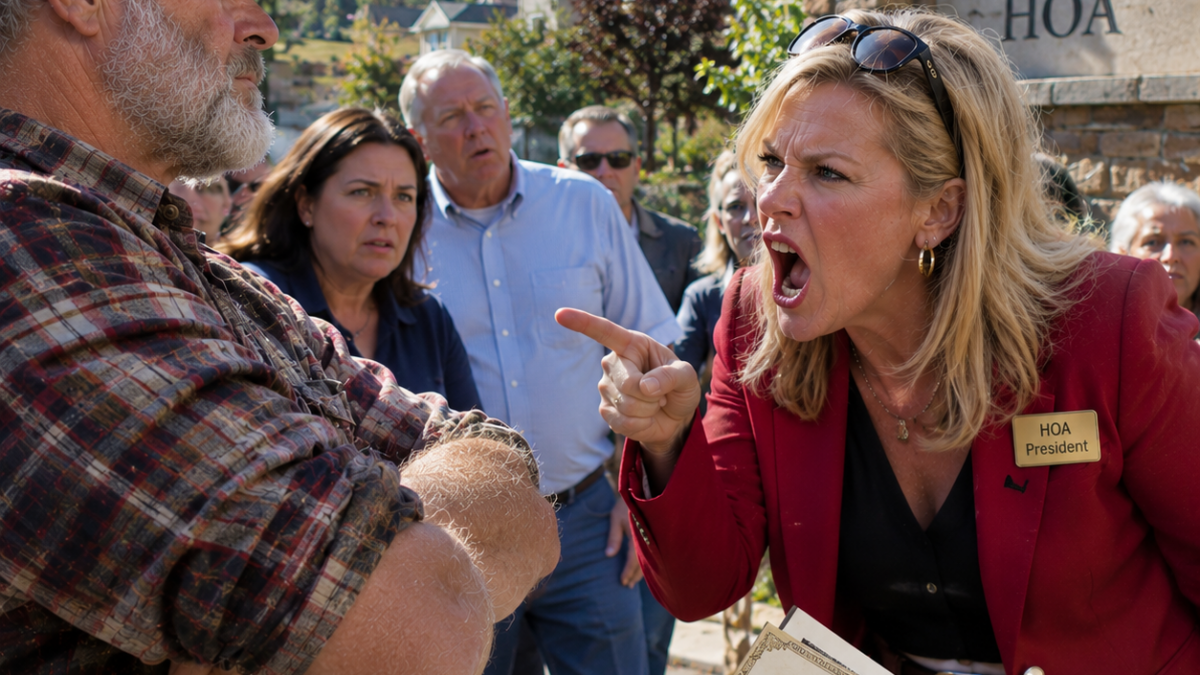
“As many of you know, Copper Ridge has faced an ongoing challenge from an adjacent property owner whose hostility and disregard for our community standards threaten property values and community safety.”
People looked toward me.
A few whispered.
“Our legal counsel recommends action.”
She paused.
“The board proposes a two-hundred-dollar special assessment per household to fund litigation.”
Murmurs.
Some positive.
Some annoyed.
Four hundred fifty homes.
Ninety thousand dollars.
To sue me.
I raised my hand.
“Point of order.”
Constance looked irritated.
“This is a members-only meeting.”
“As an affected party, I am requesting an opportunity to address allegations concerning my property rights.”
“You aren’t a resident.”
“I need two minutes.”
“No.”
A man near the aisle called:
“Let her talk.”
Another:
“She’s the one we’re suing.”
Constance looked toward Warren.
He gave a subtle nod.
She smiled tightly.
“Two minutes.”
I walked to the front.
Connected my laptop.
My hands were colder than I expected.
Not from fear exactly.
From adrenaline.
I looked at the room.
These people had been told I was their enemy.
My job was not to make them like me.
It was to make them question the person who needed them angry.
“My name is Nora Whitfield.”
No one spoke.
“My grandfather owned this land before Copper Ridge existed.”
Constance shifted.
“Three weeks ago, he died.”
The room softened slightly.
“I inherited his property.”
I clicked.
The 1985 ground lease filled the screen.
“This is a fifty-year ground lease between the Whitfield family and the original developer of Copper Ridge Estates.”
Voices began.
I kept going.
“It allowed construction of homes, roads, and community facilities on approximately one thousand acres of Whitfield land.”
Next slide.
County survey.
Red boundary.
Copper Ridge inside it.
“The land was never sold.”
Someone shouted:
“That’s impossible.”
I expected it.
“You own your structures and leasehold interests. The underlying land remains subject to this agreement.”
A woman stood.
“I have a deed.”
“Yes.”
“So you’re saying you own my house?”
“No.”
That mattered.
“I’m saying the legal interest in the ground beneath the community is governed by a separate lease. You should review your closing documents.”
Chad had drilled that sentence into me.
Do not exaggerate.
Do not scare people beyond what the documents support.
Another man asked:
“When does it expire?”
“2035.”
The room exploded.
Constance stood.
“This is deliberately misleading.”
I clicked again.
Payment records.
“The HOA has paid annual ground rent to the Whitfield trust since taking over the original developer’s lease obligations in 2005.”
People turned toward the board.
A man near the center yelled:
“How much?”
“One hundred fifty thousand dollars annually under the base arrangement, adjusted according to the agreement.”
He stared at Constance.
“I’ve lived here twelve years. Why have I never heard this?”
Constance grabbed the microphone.
“It is a legacy land arrangement that does not affect your practical ownership.”
A woman shouted:
“Then why hide it?”
“We didn’t hide anything.”
I clicked to the next slide.
Lease violations.
Unauthorized expansion.
Commercial rental of facilities.
Management changes without required notice.
Interference with adjacent Whitfield property rights.
I read Section 12.
Then said:
“These documented violations may give the landowner grounds to begin termination proceedings with ninety days’ written notice.”
The room went silent.
Even Constance stopped moving.
I looked at the residents.
“I am not here because I want twelve hundred people to lose their homes.”
Somebody whispered:
“Then what do you want?”
“Truth.”
I looked at Constance.
“Transparency.”
Then Warren.
“Accountability.”
A man called:
“Can you really terminate?”
“I have counsel reviewing that question. The contract contains a termination mechanism. I have not invoked it.”
That distinction mattered too.
Constance pointed at me.
“She is threatening you.”
“No.”
I turned toward the audience.
“If I wanted to threaten you, I would not have come here first.”
I pulled certified copies from my folder.
“County records. Lease. Survey. Payments. You do not have to believe me. Verify them.”
People stood.
Moved toward the front.
Questions came from everywhere.
“Why did the HOA pay rent without telling us?”
“Does my lender know?”
“What happens in 2035?”
“Why did you cite her property if it isn’t part of Copper Ridge?”
That last one hit Constance hardest.
She tried to call for order.
Nobody listened.
Warren grabbed her arm.
They left through a side door.
Dozens of residents watched them go.
I stayed almost an hour answering questions.
My voice was nearly gone when the room finally emptied.
Dolores found me outside.
“You did it.”
“No.”
“Yes.”
“This is the beginning.”
She smiled.
“That’s still more than anyone else managed.”
I leaned against my car.
“I don’t want them afraid of me.”
“They’re afraid of what they didn’t know.”
“Same effect.”
“Not the same cause.”
She took my hand.
“Henry knew what he was doing.”
“I’m not sure I do.”
“You don’t need to know everything tonight.”
I drove home through Copper Ridge.
For the first time, people stood outside houses watching me pass.
Not hostile.
Not friendly.
Uncertain.
I understood that feeling.
Forty-eight hours later, Constance retaliated.
An emergency closed session.
No public notice.
No agenda.
Four-to-one vote to challenge the lease.
The only dissenter was Patricia Okonkwo, a board member who asked why the residents had never been told about the ground arrangement.
By the next morning, Patricia was removed for what the board called “conduct unbecoming a community representative.”
That afternoon, a process server came to my door.
Forty-seven pages.
Copper Ridge HOA seeking a declaratory judgment that the ground lease was invalid.
Fraudulent misrepresentation.
Procedural defects.
Challenges to Henry’s authority.
I called Chad.
He came to the house.
Read the complaint at Henry’s kitchen table.
“This is aggressive.”
“Is it good?”
“Some arguments are creative.”
“That is lawyer language.”
“Yes.”
“Translation?”
“Most of it is weak.”
“Most?”
“Nora.”
“I hate you.”
“You pay me to hate me.”
He put down the complaint.
“They are trying to create uncertainty.”
“Why?”
“Because uncertainty buys leverage.”
“Against a recorded lease they have paid for twenty years?”
“Litigation does not require good odds to become expensive.”
He was right.
That evening, I found an envelope in the mailbox.
No return address.
Inside:
**LEAVE WHILE YOU STILL CAN. THIS IS YOUR ONLY WARNING.**
My stomach tightened.
I photographed it.
Bagged it.
Called the sheriff.
Deputy Martinez came.
He was calm.
Professional.
“Any idea who sent it?”
“Yes.”
“Proof?”
“No.”
He nodded.
“We document.”
That word again.
Document.
The answer to everything slow and ugly.
At 2:14 the next morning, a motion alert woke me.
I opened the camera feed.
A hooded figure stood near the eastern boundary.
Bolt cutters.
Three sections of fence.
Cut.
Enough space for a vehicle.
The face never showed clearly.
I called the sheriff.
Deputy Martinez returned.
Photographed everything.
“Could be kids.”
“You don’t believe that.”
He looked at the clean cuts.
“No.”
At 1:30 that afternoon, county code enforcement arrived.
Anonymous complaint.
Unsecured property creating a hazard.
The inspector, Reeves, walked the damaged section.
“How long has the fence been open?”
I handed him the sheriff’s report.
“Twelve hours.”
He read it.
“Someone cut it?”
“Yes.”
He looked uncomfortable.
“The complaint came in this morning.”
“What time?”
He checked.
“Seven fifteen.”
Less than five hours after the damage.
I stared at him.
He sighed.
“I’m still required to document.”
“How long do I have?”
“Thirty days.”
He drove away.
I called Chad from Henry’s study.
“They’re creating records.”
“Yes.”
“Fence damage, then complaint.”
“Yes.”
“Why?”
“To support the story that your property is poorly maintained, unsafe, disruptive.”
“They cut it.”
“We know.”
“I can’t prove who.”
“Not yet.”
“What now?”
“Now we stop waiting.”
He sent formal notice.
Section 11.2.
Interference with peaceful enjoyment.
Harassment.
Threats.
Vandalism.
Thirty days to cure ongoing breaches or face formal termination proceedings.
Then he filed a complaint with the state attorney general’s office alleging possible consumer and financial issues tied to lease nondisclosure and HOA conduct.
That changed the scale.
An official inquiry meant records.
Financials.
Contracts.
Accounts.
Potential subpoena power.
Constance had spent years controlling what residents knew.
Now people outside her boardroom could start asking questions.
That night, Dolores brought tamales.
We sat on the porch.
Copper Ridge lights came on below.
“You could still end it.”
“The lease?”
“Yes.”
“I know.”
“Sometimes I wish you would.”
I looked at her.
She sighed.
“I know that’s ugly.”
“No.”
“It is.”
“You watched people get driven out.”
“Twelve families.”
“I know.”
“Mrs. Patterson cried in my kitchen before she sold.”
Dolores looked toward the subdivision.
“I want Constance to lose everything.”
“So do I sometimes.”
She looked surprised.
“You do?”
“I’m human.”
“Could have fooled me.”
I smiled.
Then looked down.
“But there are twelve hundred people.”
“Yes.”
“Children.”
“Yes.”
“Retired couples.”
“Yes.”
“People who saved thirty years for those houses.”
Dolores nodded.
“I’m not burning all of them to punish two people.”
She was quiet.
Then:
“That’s why Henry waited.”
“You keep saying that.”
“Because I believe it.”
“For me?”
“For someone.”
“What if I’m not what he expected?”
Dolores turned toward me.
“He raised you.”
That hit harder than I expected.
The annual HOA meeting was scheduled for the following Saturday.
Mandatory notices.
Board elections.
Budget votes.
Open meeting.
Constance could not quietly remove it from the calendar.
Chad spent the week assembling our presentation.
The AG inquiry had opened doors.
Financial records.
Vendor payments.
Property purchases.
Contractor names.
Accounts.
What we found was worse than I expected.
Copper Ridge collected around $1.8 million a year in fees.
Around $150,000 went toward the ground lease arrangement.
Roughly $400,000 covered recognizable maintenance and operating expenses.
Then there was the rest.
Payments routed through administrative accounts.
Contractors with almost no verifiable business presence.
Repeated charges with vague descriptions.
Consulting.
Community improvement.
Compliance services.
One company had a mailing address that traced back to a box.
Another listed a phone number that did not work.
Blackwell Properties LLC appeared repeatedly in property records.
Eight homes.
All bought after their owners experienced aggressive HOA enforcement.
Chad placed the timeline across Henry’s dining table.
“Look.”
Citation.
Complaint.
Fine.
Special assessment.
Community email.
Offer.
Sale.
Blackwell purchase.
Again.
And again.
And again.
I felt sick.
“This isn’t governance.”
“No.”
“It’s acquisition.”
“That is one interpretation the records support.”
“They terrorized people until they sold.”
“We can show the pattern. Let investigators characterize the crime.”
I hated how careful he was.
I needed him to be careful.
The hardest document came from Mrs. Patterson’s file.
She was dead now.
Her daughter had kept some papers.
The HOA had fined her repeatedly for exterior conditions after her husband’s death.
Then Warren’s company bought the house far below later appraised value.
I called the daughter.
She lived in Nevada.
When I explained why, she became quiet.
“My mother thought she failed.”
My throat tightened.
“What do you mean?”
“She thought Dad had left her the house and she couldn’t keep it.”
“She was being pressured.”
“I told her to fight.”
The daughter’s voice broke.
“She said she was too tired.”
I closed my eyes.
“I’m sorry.”
“She moved into assisted living after that.”
“How long?”
“Eleven months.”
Then she died.
After the call, I sat in Henry’s study alone.
That was the night the case stopped being primarily about Constance threatening me.
I had survived her first month because I had legal training.
Money enough to hire Chad.
A grandfather who kept records.
Dolores.
Cameras.
Contacts.
Mrs. Patterson had been grieving and alone.
Exactly the kind of person the Blackwells understood how to exhaust.
I looked at Henry’s photograph on the shelf.
“You knew.”
I said it out loud.
“You knew this was happening.”
The thought made me angry with him.
That surprised me.
He had the lease.
He had the termination right.
He had money.
Why had he not stopped them?
Why did he wait until death and leave it to me?
I searched his study until midnight.
Not because I expected a confession.
Because grief makes people unreasonable.
Near one in the morning, I found a notebook.
Mostly ranch notes.
Water-line repairs.
Property taxes.
Names.
Then one page dated two years earlier.
**C.B. continues pressure campaign on Vega and Patterson properties. Lease termination would harm hundreds who are not responsible. Need another path. Nora would understand balance better than I do.**
I sat down.
Read it again.
Then again.
He had written my name.
I covered my mouth with one hand.
For three weeks I had wondered why Henry left me this without explanation.
He had not left no explanation.
He had left one sentence in a working notebook because he never expected death to arrive when it did.
**Nora would understand balance better than I do.**
I cried then.
Not politely.
Not the quiet tears I had managed at the funeral.
I put my forehead against his desk and cried until my chest hurt.
All the anger at him collapsed into something heavier.
Trust.
He had trusted me with power he did not know how to use without hurting innocent people.
That was not a gift.
It was a burden.
But it was mine.
Saturday’s annual meeting drew more than two hundred residents.
The community center was packed.
People stood against walls.
Others crowded into the hallway.
Constance stood at the podium.
Perfect blouse.
Perfect hair.
Perfect expression.
But I noticed her hands.
She kept gripping the edge of the lectern.
A county representative sat in the back.
Chad had notified the relevant office connected to the state inquiry that financial issues might be discussed.
Constance moved through business quickly.
Budget.
Landscaping.
Pool repairs.
Committee reports.
Then board elections.
I raised my hand.
Her eyes closed for half a second.
“Ms. Whitfield.”
“I request time to address matters affecting the membership.”
“We’ve already heard your presentation.”
A man near the front stood.
“I haven’t heard the financial one.”
Another voice:
“Let her speak.”
Then another.
“Five minutes.”
Constance looked toward the county representative.
Then Warren.
She was trapped.
“Five minutes.”
I walked forward.
Connected the laptop.
The first slide appeared.
**COPPER RIDGE ESTATES — FINANCIAL REVIEW**
The room shifted.
“Three weeks ago, I showed you the ground lease.”
No one spoke.
“Today I’m going to show you where some of your money has been going.”
First slide.
Annual fee revenue.
Approximately $1.8 million.
Lease payment.
Maintenance.
Operations.
Then unexplained or inadequately supported expenditures.
People began murmuring.
I clicked.
Vendor names.
Payment totals.
Missing documentation.
A man called:
“I own a landscaping company. Who is Desert Community Compliance Group?”
“No verifiable operational information appears in the records we reviewed.”
Constance interrupted.
“These documents are incomplete.”
“Then provide complete ones.”
She stopped.
Next slide.
Blackwell Properties LLC.
Eight homes.
Dates.
Purchase prices.
Enforcement timelines.
I read the names.
Not every detail.
Enough.
“Each of these homeowners experienced escalating citations or community pressure before selling below later market indicators.”
Warren stood.
“This is defamatory.”
I looked at him.
“Property records are public.”
“You are implying criminal conduct.”
“I’m showing a timeline.”
Next slide.
Mrs. Patterson.
Citation history.
Sale.
Blackwell purchase.
A woman in the second row covered her mouth.
“I knew her.”
I continued.
“The Blackwells have used their positions to acquire properties from owners who were under sustained HOA pressure.”
Constance grabbed the microphone.
“I have dedicated fourteen years to this community.”
A resident shouted:
“Where’s the money?”
Another:
“Why didn’t you tell us about the lease?”
Another:
“Who owns these contractor companies?”
Constance’s face reddened.
“Enough.”
Nobody stopped.
Warren moved toward the side exit.
The county representative stood.
“Mr. Blackwell, I’d recommend you remain available. We have questions regarding documents provided to the state.”
He stopped.
Constance looked around the room.
Her composure cracked.
“You have no idea what I inherited when I took over this board.”
Nobody answered.
“Unpaid bills. Broken systems. Residents who complained about everything.”
Her voice rose.
“I built this community.”
That sentence changed the room.
Not because it was legally meaningful.
Because everyone heard what she believed.
“I made this place valuable.”
She pointed toward me.
“And now this outsider walks in with her grandfather’s papers and thinks she can destroy everything I created.”
Silence.
Two hundred twenty people.
No movement.
Then Elena Martinez stood.
I recognized her from the screenshots.
“I’ve lived here nine years.”
Constance looked at her.
“My children were fined for sidewalk chalk.”
A few people laughed nervously.
Elena did not.
“You told us rules were rules.”
She looked around.
“I move for an immediate vote of no confidence in the current board leadership and a full independent audit.”
Someone seconded before she sat.
Constance gripped the microphone.
“You cannot hijack an annual meeting.”
Patricia Okonkwo stood from near the wall.
“You removed me for asking about the lease.”
Constance stared.
Patricia continued.
“I second the motion too.”
The room erupted.
Formal procedures took time.
Arguments.
Calls to counsel.
Verification of voting rights.
Constance tried everything.
Delay.
Adjournment.
Questioning whether the motion was in order.
Residents refused to leave.
Finally the ballots were counted.
One hundred ninety-eight votes supporting no confidence.
Twelve against.
The rest abstained or were not validly cast.
Constance stood behind the podium.
Frozen.
Fourteen years of authority gone in less time than one of her speeches.
Warren tried to leave again.
By then, a deputy had arrived in connection with questions arising from the ongoing investigation and reports tied to the property harassment.
He was not dragged away in handcuffs.
Reality was not that theatrical.
But he was stopped long enough to be told investigators wanted to speak with him.
For the first time since meeting him at my gate, Warren looked old.
Not powerful.
Not polished.
Just tired.
I felt no satisfaction.
That surprised me.
I had imagined that moment.
Constance losing the room.
Warren losing the smile.
People demanding answers.
Instead, I thought about Mrs. Patterson.
The Hendersons.
The Nakamuras.
People who should have been there.
The state investigation lasted months.
That part was slower.
Less cinematic.
More important.
Records were subpoenaed.
Accounts reviewed.
Vendor relationships examined.
Former board members interviewed.
Property transactions traced.
The anonymous threat letter was analyzed.
According to investigators, evidence linked it to equipment associated with the HOA office.
My camera footage documented the fence cutting, though the person in the video was not clear enough for me to identify.
Financial reviews found falsified invoices and unauthorized transfers.
The state’s findings supported fraud and fiduciary-breach allegations.
Constance eventually faced criminal and civil consequences.
Probation.
Restitution.
Community service.
A permanent ban from HOA governance roles in Arizona.
Warren faced his own penalties and financial consequences.
Neither punishment satisfied everyone.
Dolores thought Constance should have gone to prison.
“She stole years from people.”
“I know.”
“Probation?”
“I know.”
“That’s nothing.”
“One hundred eighty thousand dollars restitution isn’t nothing.”
“She’ll survive.”
“Yes.”
Dolores looked angry.
“So that’s it?”
“No.”
The Blackwells were required to divest the improperly acquired properties.
That mattered more to me.
The eight homes bought through the pressure pattern were sold under corrective arrangements.
Money flowed back toward former owners or heirs according to settlements.
The Hendersons used their recovery to buy a home in New Mexico near their grandchildren.
Mrs. Patterson’s daughter received compensation representing the difference between what her mother had been pressured to accept and the property’s fairer value.
When she called me, she cried.
“So Mom wasn’t stupid.”
“No.”
“She blamed herself.”
“I know.”
“I wish I could tell her.”
I looked at Henry’s notebook.
“I know that feeling too.”
The Copper Ridge lease was the final problem.
And the biggest.
I could have insisted on termination.
Legally, Chad believed we had a serious case.
Politically, residents were terrified.
Emotionally, I was exhausted.
The new interim board asked to meet.
Dolores came.
Elena.
Patricia.
Several residents.
Chad sat beside me.
We met in the same community center Constance had used as a stage.
Only now every financial document was on the table.
No closed doors.
Patricia began.
“We need stability.”
“I know.”
“People can’t sell homes while buyers are afraid of 2035.”
“I know.”
“Lenders are asking questions.”
“I know.”
Elena said:
“We want an extension.”
“How long?”
“Long enough that families can plan.”
Chad looked at me.
I had already thought about it.
“Twenty-five years.”
The room went quiet.
Dolores smiled.
Elena said:
“Beyond 2035?”
“Yes.”
“At what rent?”
“Same annual base arrangement, adjusted under the existing structure.”
Patricia stared.
“You could demand much more.”
“Yes.”
“Why aren’t you?”
“Because twelve hundred people are not responsible for Constance.”
Chad added:
“There will be conditions.”
I opened the draft.
Full financial transparency.
Annual independent audits.
Resident approval of major expenditures.
Mandatory disclosure of the ground lease to current and future homeowners.
Limits on commercial use.
Strict construction approval.
Formal notice of management changes.
Protection for neighboring properties.
Clear enforcement procedures.
No board could use HOA authority to pressure an adjacent owner into selling.
Elena read the last clause twice.
“That one is personal.”
“Yes.”
She smiled.
The residents voted.
Ninety-four percent approved the extension.
That vote mattered more to me than Constance’s removal.
For the first time, Copper Ridge residents understood what they were voting for.
They knew the land arrangement.
They knew the cost.
They knew the expiration.
They knew the protections.
No hidden page forty-seven.
No “legacy matter.”
No quiet payment nobody could explain.
Informed consent.
That was what Henry had been unable to force under the old structure.
Now we had it.
The new board included Dolores.
That was possibly the funniest outcome of the whole affair.
She called me after her first meeting.
“I hate you.”
“What happened?”
“Four hours.”
“Of what?”
“Budget review.”
“You wanted transparency.”
“I did not realize transparency had this many spreadsheets.”
“You’re welcome.”
Elena joined too.
Patricia was reinstated.
The first thing they did was commission an independent audit.
The second was to eliminate unnecessary or questionable contracts.
Monthly fees dropped about twenty percent.
Residents nearly threw a party.
Dolores called me again.
“Apparently not stealing money makes things cheaper.”
“Revolutionary.”
“Don’t get sarcastic with your landlord.”
I laughed.
“You live outside the lease.”
“Then don’t get sarcastic with an elder.”
“Better.”
The community center created another debate.
Residents wanted to rename it.
I hated every suggestion.
Copper Ridge Civic Hall.
Desert Vista Center.
Henry Whitfield Hall.
Then someone proposed:
**Whitfield Community Center.**
I refused at first.
“No.”
Elena frowned.
“Why?”
“Too much.”
“Your family owns the ground.”
“That doesn’t mean I need my name on the wall.”
Dolores folded her arms.
“Henry spent sixty years keeping this place stable.”
“He also hated attention.”
“He’s dead.”
“Thank you, Dolores.”
“You’re welcome.”
The membership voted anyway.
I lost.
The sign went up.
**WHITFIELD COMMUNITY CENTER**
The first time I saw it, I sat in my truck and cried.
Not because of the name.
Because I could picture Henry’s reaction.
He would have complained about the font.
Then secretly driven past it every week.
Six months after the trial and settlement work, I opened the old western gate.
It had separated the Whitfield home parcel from Copper Ridge for as long as I remembered.
For decades, the fence represented distance.
Henry on one side.
The subdivision on the other.
Then the HOA turned that distance into suspicion.
So we built something simple.
A walking trail.
No commercial development.
No grand entrance.
Just a path through the desert connecting the properties.
On dedication morning, nearly one hundred residents came.
Children ran ahead.
Parents carried water bottles.
Older couples walked slowly.
Dolores wore a wide hat and complained about the heat every six minutes.
“You chose Arizona.”
“I was born here.”
“Still counts.”
Elena’s kids drew chalk arrows near the trail entrance.
I looked at them.
She noticed.
“Problem?”
“No.”
“Against community standards?”
“Definitely.”
She smiled.
For the first time, nobody was going to fine them.
I walked to the hill above Copper Ridge at sunset.
Four hundred fifty homes spread below me.
Around twelve hundred people.
All on land Henry had held for decades.
From up there, the houses looked smaller.
So did the arguments.
Dolores joined me.
She stood beside me without speaking.
After a while, I said:
“I was angry with him.”
“Henry?”
“Yes.”
“For leaving this to you?”
“For not fixing it himself.”
She nodded.
“You found the notebook.”
I turned.
“How did you know?”
“He told me he kept notes.”
“You knew?”
“Not what he wrote.”
I looked toward the subdivision.
“He said I’d understand balance better than he did.”
Dolores smiled.
“He was right.”
“I almost terminated the lease.”
“But you didn’t.”
“I wanted to.”
“But you didn’t.”
I watched families walking the new trail.
“What if Constance had pushed harder?”
“She did.”
“What if I’d lost my temper?”
“You didn’t.”
“What if the evidence hadn’t come through?”
“But it did.”
I sighed.
“You’re irritating.”
“I’m seventy-two. I earned it.”
The sun dropped lower.
Orange across the desert.
Copper Ridge lights began appearing.
Exactly like the night I first found the lease.
Only now they looked different.
Not like property.
Not like leverage.
Homes.
That was the word I had been trying not to forget.
A ground lease could call them improvements.
A title report could call them leasehold interests.
A lawsuit could call them disputed assets.
The people inside called them home.
That mattered.
Constance had treated power as permission to frighten people.
Warren had treated information as something to exploit.
The HOA had treated rules like weapons.
I had inherited enough power to answer them with something even bigger.
I could have made everyone afraid of me.
For a little while, part of me wanted to.
Instead, I forced the facts into the open.
That turned out to be more destructive to the Blackwells than anything I could have done secretly.
Their own records removed them.
Their own transactions exposed them.
Their own threats created the evidence.
Their own residents voted them out.
I did not have to become Constance to defeat Constance.
Months later, I returned to Portland for the first time since Henry died.
Only temporarily.
I still had clients.
An apartment.
A life.
But something had changed.
For fifteen years, Arizona was where I came from.
Oregon was home.
Now the distinction felt less certain.
I found myself checking trail-camera notifications from Henry’s property.
Calling Dolores.
Reading Copper Ridge board minutes.
Answering Elena’s questions about environmental landscaping rules.
Chad called one afternoon.
“You realize you’ve become unpaid counsel for an HOA.”
“Don’t say that.”
“It’s true.”
“I will block your number.”
“You need me.”
“I hate that too.”
Eventually I negotiated a remote arrangement with my firm.
Part Portland.
Part Arizona.
Then more Arizona.
I moved back into Henry’s house permanently the following year.
Not because of the land value.
Not because Copper Ridge needed me.
Because I finally understood the promise I made Henry when he told me to return when it mattered.
He had not meant his funeral.
At least I don’t think he had.
He meant the ranch.
The trust.
The people living on it.
The responsibility.
One evening, nearly two years after Constance’s first phone call, I found the original $3,000 parking citation in my evidence box.
I laughed.
Then I carried it to the new board meeting.
Dolores looked at it.
“What is that?”
“The beginning.”
She read it.
“Three thousand dollars?”
“Yes.”
“For your truck?”
“In my driveway.”
She started laughing.
Elena took it.
Patricia read it.
Soon the whole table was laughing.
Not because what happened had been funny.
Because the threat that once felt enormous had become absurd in hindsight.
Dolores wiped tears from her eyes.
“Frame it.”
“No.”
“Yes.”
“Absolutely not.”
They framed it.
It hangs in a back hallway of the Whitfield Community Center now.
Under it, a small plaque reads:
**PLEASE VERIFY JURISDICTION BEFORE ISSUING FINES.**
I pretended to hate it.
I don’t.
The Blackwells disappeared from Copper Ridge life.
Their old house eventually sold.
A young family moved in.
The first time I met them, the father looked embarrassed.
“We heard who lived here before.”
“That wasn’t you.”
“No.”
“Then don’t apologize for it.”
They planted two mesquite trees in the front yard.
No one fined them.
Mrs. Patterson’s former house was bought by a teacher and her wife.
The Henderson property became home to a family with three kids and an enormous dog.
Life moved forward.
That mattered too.
Justice cannot only be about dragging old wrongs into the light.
At some point, people need room to build something after.
On the fifth anniversary of Henry’s death, I walked the trail alone before sunrise.
The air was cool.
The sky barely gray.
I reached the hill above Copper Ridge and sat on a rock.
Below me were the rooftops.
The clubhouse.
The pool.
The streets.
The community center bearing my family’s name.
Somewhere down there, twelve hundred people were waking up.
Coffee makers.
Alarm clocks.
Children getting ready for school.
Dogs scratching at doors.
Ordinary life.
Henry had owned the land.
Constance believed she owned the people.
Those were never the same thing.
I finally understood why my grandfather had waited.
He could have terminated the lease years earlier.
He had enough breaches.
Enough leverage.
But Henry was a rancher.
He thought in seasons.
Not moments.
He knew that sometimes the fastest answer is the wrong one.
He had held the power without using it until someone could separate the guilty from everyone standing around them.
I had spent my career in environmental law thinking stewardship meant protecting landscapes.
Water.
Habitat.
Public land.
Species.
Henry taught me a harder version.
Sometimes stewardship means protecting people from the power that comes with owning the ground beneath them.
I still owned that ground.
The lease still existed.
The residents still paid under it.
But now every household could read the agreement online.
Every annual payment appeared in the budget.
Every audit was public.
Every board member had term limits.
Major expenditures went to residents.
Construction changes required proper review.
The community finally knew where it stood.
Literally.
Dolores found me on the hill around seven.
She carried two coffees.
“You’re getting predictable.”
“You brought coffee.”
“I’m allowed.”
She handed me one.
We watched the sun rise.
After a while she asked:
“Do you ever wish you’d taken everything?”
“What?”
“The houses.”
“The roads.”
“The whole thing.”
“No.”
“Never?”
I thought about the first night.
Section 12.
That flash of anger.
The fantasy of sending ninety-day notice and watching Constance panic.
“For about thirty seconds.”
Dolores smiled.
“I knew it.”
“You would have.”
“I might have terminated just to watch her face.”
“And destroyed twelve hundred people.”
“I said *might*.”
I laughed.
She looked toward Copper Ridge.
“Henry would be proud.”
My throat tightened the same way it always did when she said that.
“You don’t know that.”
“I knew him longer than you did.”
“That is technically impossible.”
“I knew him as an adult longer.”
“Unfair advantage.”
“He talked about you constantly.”
I looked at her.
“What did he say?”
“That you were stubborn.”
“Accurate.”
“That you argued too much.”
“Also accurate.”
“That you would come back.”
I looked down at the coffee.
“He knew?”
“He hoped.”
The sun broke over the mountains.
Copper Ridge turned gold.
The trail below us caught the light.
Families would start using it soon.
Joggers.
Kids.
Old couples.
People moving back and forth across a boundary that used to represent fear.
Dolores stood.
“Come on.”
“Where?”
“Board meeting.”
“No.”
“You promised.”
“I promised to review the lease report.”
“At the board meeting.”
“I regret everything.”
She started walking.
I stayed seated for another few seconds.
Then looked at the subdivision.
One thousand acres.
An inheritance I had first mistaken for a weapon.
Henry had left me something much harder to use well.
Responsibility.
I stood and followed Dolores down the trail.
[END OF STORY]








