PART 2: I Inherited My Uncle’s Snowboard Resort—Then the HOA KAREN Called 911 to Take It for Her Son, Not Knowing I Was the Sheriff
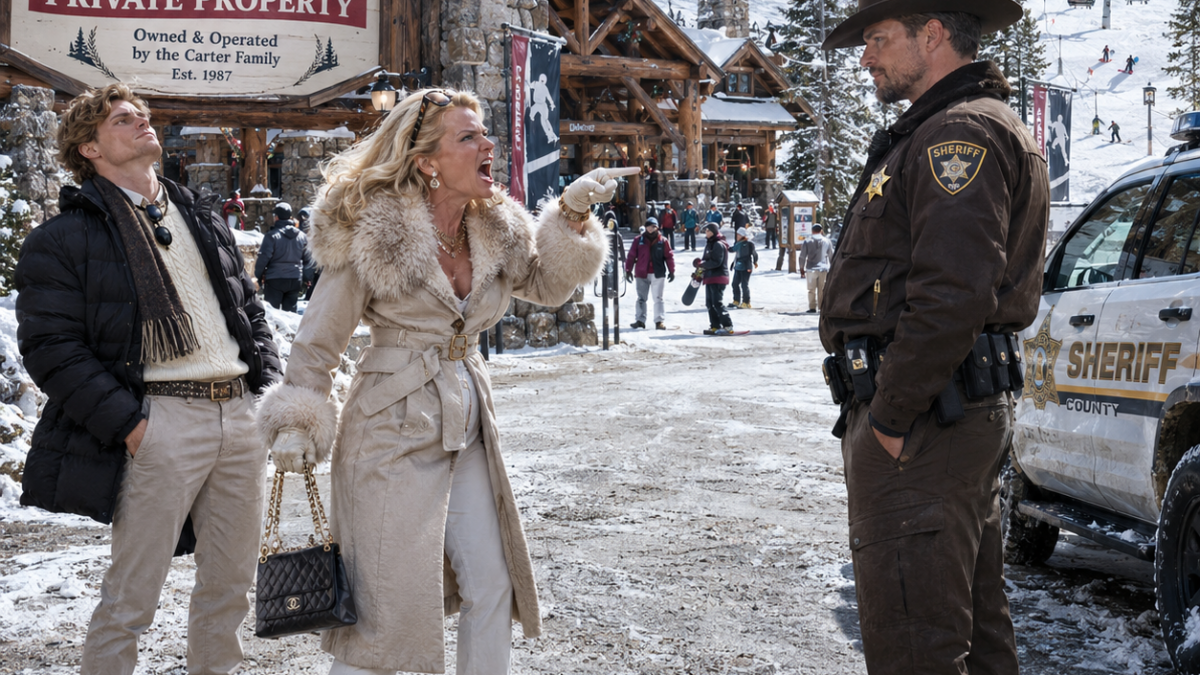
PART 2
Pinerest Peak wasn’t supposed to become mine.
Not really.
If you’d asked me ten years earlier whether I would ever own a snowboard resort in the Colorado mountains, I would have laughed.
My life had gone in a completely different direction.
Law enforcement.
Patrol.
Investigations.
A campaign I nearly refused to run.
Then the election.
Then the badge.
Ray had stayed on the mountain.
I had stayed away.
That was the part I hated admitting.
Fifteen years had passed since Pinerest Peak truly felt like home.
The first summer I came there, I was twelve.
My father had just died.
He was a police officer in Houston.
A routine traffic stop turned into gunfire.
One moment he was working.
The next, he wasn’t coming home.
After the funeral, my mother barely functioned.
People kept telling me I had Dad’s eyes.
Apparently, she saw them too.
Every time she looked at me, she cried.
So she sent me to Colorado.
To her brother Ray.
I barely knew him.
He lived alone in a cabin attached to a small snowboard resort he’d built from almost nothing.
The place barely made money.
The lodge smelled like coffee, cedar, and wet gloves.
The lifts were old.
The rental gear never matched.
There were handwritten signs everywhere.
I hated it.
I hated the cold.
I hated Ray’s silence.
I hated my mother for sending me away.
I hated my father for dying.
Mostly, I hated myself for being alive when he wasn’t.
Ray never tried to talk me out of any of it.
On my fourth morning there, he put a snowboard in front of me.
“I don’t want to.”
“I didn’t ask.”
“I’m not doing it.”
“Then stand here all day.”
I crossed my arms.
He waited.
Ray could wait longer than anyone I’d ever met.
Eventually, stubbornness beat grief.
I put the board on.
He pushed me toward the slope.
I fell almost immediately.
He didn’t laugh.
I tried again.
Fell.
Again.
Fell harder.
By the tenth attempt, I was screaming at him.
“This is stupid!”
Ray shrugged.
“Then quit.”
“I don’t quit.”
“Good.”
Hours later, I made it from the top of the beginner slope to the bottom without falling.
Ray was waiting.
I expected him to celebrate.
He just nodded.
“Mountains don’t care about money, Emma.”
I stared at him.
“Mountains don’t care who your father was either.”
That hurt.
He knew it.
Then he continued.
“They only care whether you’re brave enough to try again after you fall.”
I remembered those words the morning after Andrea’s visit.
I walked through the lodge alone.
Ray’s lodge.
My lodge now, technically.
The walls held thirty years of photographs.
Children wearing oversized helmets.
Families eating chili from paper bowls.
Teenagers standing beside Ray with awkward smiles.
Kids who could never have afforded a mountain vacation anywhere else.
Ray charged people who could pay.
He quietly waived fees for people who couldn’t.
He never advertised that.
He hated being praised.
Inside his office, I found a cardboard box.
**LETTERS**
Hundreds.
Thank-you notes.
Christmas cards.
Photographs.
A single mother from Denver had written one that stopped me.
Her son had been suicidal.
She couldn’t afford therapy and couldn’t afford a vacation.
A school counselor connected them with Ray’s youth program.
The boy spent one summer at Pinerest Peak.
Snowboarding.
Working in the lodge.
Helping younger kids.
According to his mother, that summer gave him a reason to stay alive.
I had to put the letter down.
My hands were shaking.
Underneath it was another envelope.
My name.
I opened it.
Ray’s handwriting.
**Emma,**
**You’re the only person I know who understands that this place isn’t about real estate.**
I stopped.
Then continued.
**It’s about second chances.**
**Don’t ever sell it to people who only see dollar signs.**
**Keep it alive.**
**Love, Uncle Ray.**
I pressed the note against my chest.
For the first time since his death, I cried.
Not politely.
Not quietly.
I sat on the floor of his office and cried like I was twelve again.
Pinerest Peak was valued at roughly $4.5 million.
To Andrea Murphy, that was the story.
Land.
Buildings.
Access roads.
Ski lifts.
Development potential.
To Ray, it was where broken people learned how to get back up.
A knock came from the lodge entrance.
I wiped my face and opened the door.
An elderly woman stood there holding a casserole dish.
“I’m Helen Kowalski.”
I recognized the name.
Ray’s neighbor.
Twenty-three years.
“You must be Emma.”
“Come in.”
She set the casserole on the counter.
Then looked at me carefully.
“I heard Andrea came by.”
“How?”
Helen gave me a tired smile.
“Nothing happens in Alpine Vista without Andrea making sure everyone hears her version first.”
“She says Ray promised to sell Pinerest Peak to Brandon.”
Helen laughed.
Not because it was funny.
Because it was absurd.
“She’s been trying to buy this place for five years.”
“Ray refused?”
“Every single time.”
“She admitted she made his life difficult.”
Helen’s face changed.
“Oh, honey.”
She sat down.
“What?”
“You don’t know.”
Then she told me.
The Hendersons.
Retired couple.
They had challenged Andrea over repeated HOA fines.
Their savings disappeared into legal fees.
Eventually they sold and moved to Arizona.
Then the Chens.
Beautiful home.
Dream retirement.
Andrea buried them in violations until they sold nearly forty percent below market value.
Then the Torres family.
Young parents.
Three children.
They argued with Andrea over a fence.
Someone filed a complaint with Child Protective Services.
The complaint turned out to be baseless.
But the humiliation broke them.
They sold.
Left town.
Three families.
Three homes.
All acquired cheaply by people or entities connected to Andrea.
I felt sick.
“And Ray?”
“Five years of complaints.”
Helen’s eyes filled.
“Noise violations. Building inspections. Parking complaints. Letters. Fines. Lawyers.”
“Why didn’t he tell me?”
“You know why.”
Yes.
I did.
Because Ray protected people.
Even when protecting them hurt him.
Helen squeezed my hand.
“Your uncle didn’t give up.”
I stared at the floor.
“I wasn’t here.”
“He never blamed you.”
“I do.”
“That’s different.”
I looked at her.
She stood.
“Don’t let guilt make you reckless, Emma.”
I almost smiled.
“You sound like him.”
“Someone had to.”
At the door, she turned.
“Andrea thinks everyone eventually gets tired.”
“I don’t.”
Helen nodded.
“I know.”
The next morning, my attorney confirmed what I already suspected.
Ray’s will was airtight.
No agreement to sell Pinerest Peak.
No option contract.
No promise to Brandon.
No pending transfer.
Andrea’s papers were meaningless at best.
Fraudulent at worst.
That should have ended it.
It didn’t.
Three days later, the first HOA violation arrived.
A nervous man in an Alpine Vista polo delivered it personally.
He avoided eye contact.
I opened the envelope.
Pinerest Peak’s entrance sign used an unauthorized font.
I read the sentence twice.
Fine:
$500.
Payment due within twenty-four hours.
The sign had stood for twenty-eight years.
Same lettering.
Same wood.
Same mountain logo.
No previous complaint.
I photographed everything.
Envelope.
Notice.
Timestamp.
Sign.
Then filed it.
Two days later, violation number two.
Parking spaces allegedly two inches narrower than HOA regulations allowed.
Fine:
$750.
Twenty-four-hour payment demand.
I measured them.
County code compliant.
No issue.
Then violation three.
Wrong exterior paint color.
$1,000.
Three notices.
One week.
$2,250.
I sat at Ray’s kitchen table with the Alpine Vista bylaws.
Forty-seven pages.
By midnight, I had two sections highlighted.
Section Twelve:
No violation notice could be issued without majority board authorization.
Section Fifteen:
Non-emergency violations required a minimum thirty-day response period.
Andrea had followed neither rule.
She wasn’t enforcing HOA standards.
She was manufacturing debt.
Manufacturing fear.
Manufacturing leverage.
I called Christian.
“Still digging?”
“You have no idea.”
“Give me something.”
“Not over the phone.”
“That good?”
“That bad.”
Before we could meet, Andrea made her next move.
At eleven o’clock Tuesday night, a notice slid under the cabin door.
**EMERGENCY HOA MEETING**
Forty-eight hours’ notice.
Sole agenda item:
A resolution declaring Pinerest Peak Resort a public nuisance and demanding immediate sale or cessation of operations.
I read it twice.
Then I laughed.
For days, I had resisted using my office visibly.
I wanted a clean separation.
Emma the heir.
Emma the sheriff.
But Andrea had escalated from private intimidation to formal institutional abuse.
She wanted public theater.
Fine.
I could do public.
Thursday evening, thirty-two homeowners packed the Alpine Vista community center.
Andrea stood behind the podium in a cream blazer and pearls.
She had a slideshow.
Of course she did.
Pictures of the resort.
Charts claiming noise problems.
Graphs supposedly showing falling property values.
Traffic projections.
Environmental concerns.
I recognized three photographs that were years old.
One showed a packed parking lot during a charity event Ray had hosted.
Andrea presented it as proof of “chronic overcrowding.”
“This resort,” she said, “represents an ongoing threat to the quality of life we have worked so hard to protect.”
Nobody challenged her.
That bothered me.
Some residents looked uncomfortable.
Others stared at their hands.
They weren’t convinced.
They were afraid.
Twelve years under one person can train a room into silence.
Andrea clicked the next slide.
“I therefore move that this association formally declare Pinerest Peak a public nuisance and demand either immediate sale to an approved buyer or closure.”
That was when I stood.
Full uniform.
Badge polished.
Duty belt.
Hair pulled back.
The room turned.
Whispers spread.
Andrea looked annoyed at first.
Then she recognized me.
Her face lost color.
I walked into the aisle.
“I’m Sheriff Emma Dawson.”
Silence.
“I’m also the legal owner of Pinerest Peak Resort.”
Someone gasped.
Andrea gripped the podium.
“You—”
“Every violation notice your office has sent me has been issued without the board approval required under your own bylaws.”
I held up copies.
“The response deadlines are also inconsistent with those bylaws.”
Andrea tried to speak.
I continued.
“An HOA is not a government. It has limited contractual authority, and that authority depends on following its own governing documents.”
Several board members looked toward Andrea.
That was important.
They hadn’t known.
“Any attempt tonight to use knowingly unauthorized enforcement actions as leverage against my property will be documented.”
Andrea’s eyes flashed.
“Are you threatening this board?”
“No.”
I looked directly at her.
“I’m informing it.”
Then I sat down.
For the first time, Andrea’s control of the room cracked.
People whispered.
One board member asked to see the violation approvals.
Another said he hadn’t voted on anything involving Pinerest Peak.
Andrea smiled too quickly.
“I’m sure Sheriff Dawson is simply confused about procedure.”
“I’m not.”
“We can discuss this privately.”
“No need.”
I left before she could recover.
Outside, my phone buzzed.
Christian.
**Background work complete. You need to see this.**
I texted:
**Tomorrow morning.**
Then drove home.
I knew Andrea wouldn’t stop.
People who build power through intimidation rarely retreat when challenged.
They escalate.
At 2:03 the next morning, dispatch called.
“Sheriff Dawson, we have an anonymous report of an armed female at Pinerest Peak.”
I sat upright.
“What exactly did the caller say?”
“Female suspect, possibly intoxicated, waving a handgun, threatening neighbors.”
My blood turned cold.
“Who’s responding?”
“Deputy Hill. Four minutes out.”
“Tell him I am at the location and unarmed.”
I pulled on sweatpants and walked downstairs.
Christian arrived with his cruiser lights off.
He stepped out cautiously, hand near his holster.
Protocol.
When he saw me standing on the porch alone, he exhaled.
“Boss.”
“Come inside.”
He entered.
“What happened?”
“Someone swatted me.”
His expression hardened.
A false armed-suspect report is not a prank.
Officers arrive expecting violence.
People die during swatting incidents.
Whoever made that call had tried to turn my own department into a weapon.
Christian pulled the dispatch recording.
Female voice.
Panicked.
Too panicked.
Like someone acting.
The caller claimed to be watching me wave a firearm outside.
We checked security footage.
Nothing.
No neighbor.
No cars.
No person anywhere near the cabin.
Then Christian traced the originating number.
He stared at the screen.
“You’re kidding.”
“Who?”
He turned it toward me.
Brandon Murphy.
Andrea’s son.
The man who supposedly needed Pinerest Peak.
I stared at the name.
Christian leaned back.
“We move now.”
“Maybe.”
“Boss.”
“We’ve got the call.”
“We’ve got a phone registered to Brandon.”
“And footage proving the report false.”
“Yes.”
“Then arrest him.”
I walked to the window.
Fresh snow reflected moonlight across the mountain.
“Andrea has money.”
“So?”
“Connections.”
“So?”
“Lawyers.”
Christian folded his arms.
“You think she’ll distance herself.”
“I know she will.”
“Brandon acted alone.”
“Exactly.”
“Panicked son protecting his mother.”
“Exactly.”
He understood.
“You want the pattern.”
“I want everything.”
Christian looked unhappy.
“Waiting creates risk.”
“I know.”
“If they escalate again—”
“Then we act.”
“How far are you willing to let them go?”
That was the question.
I thought about Ray.
About Andrea.
About the false 911 call.
“Not far.”
We documented everything.
Then I sent formal notice to District Attorney Robert Quinn and contacted the FBI field office in Denver regarding the possibility of a coordinated hoax and extortion scheme.
By four in the morning, the file had begun.
At five, I sat alone beside Ray’s photograph.
“I hope I’m doing this right.”
Obviously, he didn’t answer.
But I remembered his voice anyway.
Don’t rush downhill just because you’re scared of falling.
The next two weeks changed the case.
I served a lawful subpoena on the HOA for records connected to the harassment investigation.
The county attorney reviewed everything first.
I wanted no shortcuts.
No procedural mistake Andrea’s lawyers could later exploit.
The request covered five years of meeting minutes, violation notices, board approvals, enforcement correspondence, and selected property-related records.
The board cooperated.
Mostly because by then several members were terrified of Andrea.
Banker boxes arrived at my office.
Christian and I spent two days cross-referencing violations.
Forty-seven notices in three years.
I checked each against meeting minutes.
No board authorization.
Not one.
Then Christian noticed something.
“Boss.”
“What?”
“Look at the addresses.”
I did.
The Henderson property.
Eleven violations.
Eventually sold.
The Chens.
Nine violations.
Two lawsuits.
Sold.
Torres family.
Repeated complaints.
Sold.
Different addresses.
Same pattern.
I pulled property records.
One company appeared repeatedly.
**Mountain Vista LLC.**
Christian searched the registration.
Then looked at me.
“You want to guess?”
“Andrea.”
“Andrea.”
Managing member:
Andrea Murphy.
We spread the documents across my office.
Violation.
Pressure.
Legal expense.
Lowball sale.
Mountain Vista acquisition.
Violations disappear.
Repeat.
Twelve families over three years.
Christian leaned back.
“She isn’t running an HOA.”
“No.”
“She’s running an acquisition scheme.”
I looked at the evidence.
“And Ray wouldn’t sell.”
“Pinerest Peak is worth more than all these properties combined.”
“Four and a half million.”
Christian whistled.
“Why Brandon?”
That question led us into the money.
The FBI assigned Special Agent Maria Santos.
She arrived with a forensic accountant and the emotional warmth of a winter storm.
I liked her immediately.
She reviewed the preliminary records.
“You’re too close to this.”
“I know.”
“So from this point forward, federal evidence stays with us.”
“Agreed.”
“You don’t interview Andrea.”
“Agreed.”
“You don’t interview Brandon.”
“Agreed.”
“You don’t make charging decisions.”
“Gladly.”
Santos raised an eyebrow.
“Most sheriffs hate giving up control.”
“My uncle hated ego.”
“Smart man.”
“He was.”
Federal financial subpoenas started answering the question.
Brandon Murphy was twenty-nine.
Expensive car.
Expensive clothes.
Travel.
Private clubs.
Perfect social media life.
Also:
$2.3 million in online gambling debt linked to an operation based in Costa Rica.
I stared at the figure.
“Two point three?”
Santos nodded.
“He lost control years ago.”
The forensic accountant continued.
Private loans.
Credit cards.
Cash advances.
Collections.
Threats.
Six months earlier, pressure intensified.
That was approximately when Andrea began pushing Ray harder to sell Pinerest Peak.
Then Andrea’s finances surfaced.
Second mortgage.
Overextended credit.
Property taxes three months behind.
Large transfers connected to Brandon.
The queen of Alpine Vista was nearly broke.
Her son’s addiction was consuming both of them.
Pinerest Peak wasn’t merely an investment.
It was their escape route.
Sell a $4.5 million resort.
Clear the gambling debt.
Restore Andrea’s finances.
Preserve the illusion.
There was just one problem.
Ray Dawson had said no.
And then he died.
Andrea saw me as opportunity.
A grieving niece.
New to the area.
Maybe unfamiliar with the property.
Someone she could intimidate before probate even settled.
She never expected the grieving niece to be the sheriff.
Witnesses came next.
Helen signed first.
Five years of watching Andrea harass Ray.
Threatening letters.
Repeated complaints.
Inspectors.
Pressure.
Then the Hendersons returned from Arizona.
They sat across from Agent Santos and described how their retirement savings had disappeared into legal bills.
Mr. Henderson cried.
Not loudly.
Just one tear down his cheek while his wife held his hand.
“We built that house ourselves,” he said.
“Andrea made us feel like criminals for living in it.”
The Chens produced emails.
The Torres family produced the child-welfare complaint and the final report clearing them.
Six families.
Then eight.
Then twelve.
Every story slightly different.
Every pattern nearly identical.
Resistance.
Violation.
Pressure.
Isolation.
Sale.
Acquisition.
Then the digital team recovered messages between Andrea and Brandon.
One exchange was sent two days before the swatting call.
Andrea:
**She won’t sell. We need to scare her out.**
Brandon:
**I have an idea. Trust me.**
Location data placed Brandon’s phone half a mile from Pinerest Peak at 1:53 a.m. on the night of the call.
The same phone contacted dispatch minutes later.
Christian read the report twice.
“There’s our conspiracy.”
“Maybe.”
He stared at me.
“Boss.”
“I’m not saying it isn’t.”
“Then what?”
“We still don’t know how much Andrea knew about the call.”
“She told him to scare you.”
“Not necessarily this way.”
Christian sighed.
“You’d make a miserable defense attorney.”
“Thank you.”
Then DA Quinn called.
“The state case is strong.”
“How strong?”
“Harassment. Fraud. False reporting conspiracy if Brandon talks.”
“And federal?”
“The U.S. Attorney wants wire fraud and extortion.”
I sat back.
“Grand jury?”
“Next week.”
Then Quinn said something I didn’t expect.
“They want a coordinated arrest.”
“When?”
“Monthly HOA meeting.”
I was silent.
Quinn continued.
“Andrea used that room to intimidate victims for years.”
“That doesn’t mean we turn an arrest into theater.”
“Agreed.”
“So why there?”
“Predictable location. Controlled environment. Multiple exits we can cover. Minimal risk of weapons. And yes, it demonstrates institutional accountability.”
I thought about it.
“Only if Judge Foster approves the warrant and location.”
“Already discussing it.”
Three days before the scheduled meeting, Andrea’s public campaign began.
Anonymous social media accounts appeared.
**CORRUPT SHERIFF TARGETS HOA PRESIDENT**
**QUESTIONS ABOUT DAWSON’S CONFLICT OF INTEREST**
**WHO POLICES THE SHERIFF?**
Fabricated screenshots circulated showing messages I had never sent.
A petition demanded my removal.
Two hundred signatures appeared overnight.
Many accounts had been created within the same hour.
Then local reporter Jake Brown called.
“Sheriff Dawson?”
“Speaking.”
“I’ve received documents alleging you’re using your office to pressure Andrea Murphy into transferring assets.”
I smiled.
Not because it was funny.
Because Andrea had made another mistake.
“Are you running the story?”
“Not without speaking to you.”
“Good.”
“Your response?”
“I don’t comment on active investigations.”
“That’s not much.”
“You don’t need my comment.”
“What do I need?”
“Public records.”
He went quiet.
I continued.
“Pull Alpine Vista violation notices. Property transfers connected to Mountain Vista LLC. Court records involving former residents. HOA meeting minutes.”
“You’re saying the documents I received are false?”
“I’m saying you’re a journalist.”
Another silence.
Then:
“Fair enough.”
Jake called again twenty-four hours later.
His voice sounded different.
“I nearly published garbage.”
“Good thing you didn’t.”
“There’s a pattern here.”
“There’s an active investigation.”
“I understand.”
“Then report only what you can verify.”
“Andrea won’t answer my questions.”
“That’s her decision.”
“She hung up.”
I almost laughed.
Andrea had tried to recruit the press.
Instead, she had given a reporter directions toward her own paper trail.
But the real collapse came from Brandon.
Wednesday evening.
6:14 p.m.
Quinn called.
“Sit down.”
“I am sitting.”
“Brandon Murphy is in my office.”
I stopped breathing for a second.
“With counsel?”
“Yes.”
“What does he want?”
“Cooperation.”
I looked through the office window toward the mountains.
“How much?”
“Everything.”
Texts.
Emails.
Financial discussions.
Harassment plans.
Conversations about Ray.
And recordings.
My grip tightened around the phone.
“Recordings?”
“Andrea instructing him about the pressure campaign.”
“The 911 call?”
“He’s prepared to testify she knew about it.”
I closed my eyes.
Ray’s face appeared in my mind.
All those years.
All those battles.
“Does Andrea know?”
“No.”
“Where does she think Brandon is?”
“Bankruptcy lawyer.”
Despite everything, Quinn laughed.
“She’s going to have a difficult evening tomorrow.”
I didn’t laugh.
The next morning, Judge Maryanne Foster signed the warrants.
Andrea Patricia Murphy.
Brandon Thomas Murphy.
State charges.
Federal charges pending and coordinated.
I handed the paperwork to Christian.
He read it.
Then looked at me.
“Finally.”
“Don’t enjoy it too much.”
He smiled.
“No promises.”
“I’m serious.”
“So am I.”
I leaned forward.
“This has to be clean.”
“It will be.”
“No speeches.”
“Right.”
“No humiliation.”
“Right.”
“No unnecessary force.”
“Obviously.”
“Every camera in that room will be recording.”
Christian’s smile faded.
“I know.”
“If we make this personal, we give Andrea exactly the story she wants.”
He nodded.
“Justice.”
“Procedure.”
“Evidence.”
“Exactly.”
That evening, I sat alone in Ray’s cabin.
His photograph still rested above the mantle.
The funeral flowers were gone.
Helen had replaced them with wildflowers.
I held Ray’s handwritten note again.
**Don’t ever sell it to people who only see dollar signs.**
“Tomorrow,” I whispered.
“I finish it.”
Then I corrected myself.
“No.”
I looked at his picture.
“We finish it.”
Thursday came cold and clear.
By six fifteen, I was standing in front of the bathroom mirror adjusting my uniform.
Not because it needed adjustment.
Because my hands needed something to do.
The community center meeting began at seven.
Christian parked near the side exit.
Deputy Martinez covered the rear.
Agent Santos waited outside with federal personnel.
We had medical support nearby.
No drama.
No gaps.
I parked where Andrea wouldn’t see my cruiser immediately.
At seven exactly, I walked toward the building.
People outside stopped talking.
Some recognized me.
Others recognized the uniform.
Nobody asked questions.
Inside, Andrea was speaking.
Of course she was.
The community center was packed.
Standing room only.
Andrea stood at the podium.
A presentation behind her showed property-value charts.
“…and therefore,” she said, “we have a responsibility to address disruptive properties that continue to damage our neighborhood standards.”
She clicked the remote.
Pinerest Peak appeared on the screen.
Uncle Ray’s mountain.
“This resort has generated traffic, noise, and repeated noncompliance for years.”
My boots touched the linoleum.
One step.
Then another.
People noticed.
The room gradually quieted.
Andrea didn’t.
She continued.
“Tonight, I propose a final resolution—”
She looked up.
Saw me.
Stopped.
Then saw Christian.
Martinez.
The uniform.
The badge.
Her face changed.
“Sheriff Dawson.”
I stopped ten feet from the podium.
“This is a private HOA meeting.”
My voice stayed level.
“Andrea Patricia Murphy.”
The room went completely silent.
“I have a warrant for your arrest.”
Someone gasped.
Andrea gripped the podium.
“This is absurd.”
I removed the warrant.
“You are being arrested on multiple state charges related to false reporting, criminal harassment, fraud, attempted extortion, and conspiracy. Federal charges are being coordinated separately.”
Her eyes moved around the room.
Searching for help.
For board members.
For loyal residents.
For anyone.
Nobody moved.
“This is retaliation.”
“No.”
“You can’t arrest me because I challenged your property.”
“That’s not why you’re under arrest.”
She pointed at me.
“Everyone here saw you threaten me!”
A man near the front said quietly, “No, we didn’t.”
Andrea stared at him.
That small sentence hurt her more than anything I could have said.
Then the side door opened.
Brandon entered.
DA Quinn walked beside him.
Andrea’s face changed again.
Confusion.
Then fear.
“Brandon?”
He didn’t look at her.
“What are you doing?”
Nothing.
“Brandon.”
He finally raised his eyes.
“I’m sorry.”
Andrea shook her head.
“No.”
“I couldn’t do it.”
“Do what?”
“Go to prison for you.”
The room seemed to inhale together.
Andrea whispered:
“No.”
Brandon looked exhausted.
Not defeated.
Emptied.
“I told them everything.”
Andrea stared.
“Everything?”
“The properties.”
“Stop.”
“The fines.”
“Brandon.”
“The texts.”
“Stop talking.”
“The 911 call.”
Her mouth opened.
No sound came.
Brandon looked at the floor.
“I’m done.”
Quinn stepped forward.
“Mr. Murphy is cooperating with investigators pursuant to an agreement that requires full and truthful testimony.”
Andrea backed away.
The podium stopped her.
I approached.
“You have the right to remain silent.”
She looked at me.
“You ruined my family.”
“No.”
Her face twisted.
“You did.”
I gently took her wrist.
“No, Andrea.”
The first cuff closed.
“You made choices.”
The second cuff clicked.
“Now they have consequences.”
She was shaking.
“I built this community.”
I said nothing.
“I protected these people!”
Still nothing.
“Tell her!”
She looked toward the residents.
“Tell her what I did for you!”
Nobody answered.
Then Helen stood.
Andrea saw her.
Helen’s voice was quiet.
“You made us afraid.”
Andrea stared.
Helen continued.
“For years.”
That was all.
Andrea’s shoulders collapsed.
The walk from the podium to the door wasn’t long.
Maybe forty-seven steps.
I remember because I counted them.
Not intentionally.
My mind just did.
Andrea stumbled once in her heels.
I steadied her.
She looked surprised.
“You think you’re better than me.”
“No.”
“Then let go of me.”
“I can’t.”
“I hate you.”
“That’s your right.”
Outside, Agent Santos waited.
I transferred custody.
Andrea turned before entering the vehicle.
Mascara streaked beneath one eye.
“You’ve destroyed everything.”
I met her gaze.
“No.”
Then I said the only thing that needed saying.
“You did that yourself.”
The vehicle pulled away.
Behind me, the community center doors opened.
People spilled into the parking lot.
Some crying.
Some talking.
Some simply standing in shock.
Helen found me.
She took my hands.
“Emma.”
Her eyes were red.
“I watched her destroy people for twelve years.”
I squeezed her fingers.
“I know.”
“No, you don’t.”
Her voice broke.
“I thought she would never fall.”
She laughed through tears.
“I thought she’d die behind that podium telling everyone what color their fence had to be.”
I smiled.
“She almost did.”
Helen looked at me.
“Ray would be proud.”
That sentence hit harder than I expected.
I looked away.
“He should’ve seen it.”
“He knew you.”
“That’s not the same.”
“No.”
Helen waited.
Then said:
“But it’s something.”
Christian approached after she left.
“Brandon’s being processed.”
“Deal?”
“Contingent on full cooperation.”
“The families?”
“Quinn’s office is contacting all twelve.”
“Hendersons?”
“Yes.”
“Chens?”
“Yes.”
“Torres?”
“Yes.”
I nodded.
Christian smiled.
“We did it.”
I looked toward the mountain.
“No.”
He frowned.
“What?”
“We stopped her.”
“Difference?”
“Big one.”
Justice isn’t complete when the villain gets handcuffed.
That part is dramatic.
Easy to understand.
The harder part comes afterward.
Who gets their money back?
Who gets their home back?
Who rebuilds trust?
Who apologizes?
Who heals?
Three months of litigation followed.
Andrea’s attorneys attacked everything.
Conflict of interest.
Vindictive sheriff.
Improper investigation.
Entrapment.
Selective enforcement.
They argued that my inheritance gave me motive.
They argued my badge gave me power.
They argued I had combined both.
But that was exactly why Agent Santos and the FBI had taken control of the federal evidence.
Every key search.
Every financial record.
Every major interview.
Independent.
Documented.
Reviewable.
My personal connection was disclosed from the beginning.
The judge rejected the major defense motions.
Then the case went to a federal jury.
I sat in the third row in civilian clothes.
No uniform.
No badge visible.
Just Emma.
Ray’s niece.
Helen sat beside me.
Christian sat behind us.
The Hendersons came.
The Chens.
The Torres family.
Twelve households represented in one courtroom.
The jury deliberated four hours.
When they returned, my stomach twisted.
The foreperson stood.
“Guilty.”
Count one.
Guilty.
Count two.
Guilty.
Again.
Again.
Again.
Andrea didn’t move.
The sentence came later.
Four years in federal prison for the conspiracy and wire-fraud-related conduct.
Supervised release afterward.
State consequences running alongside the federal punishment.
Restitution:
$847,000.
Twelve families.
Permanent ban from serving on an HOA board in Colorado.
Andrea sat at the defense table staring forward.
The woman who once told me she was the law now listened while actual law determined what would happen to her.
She didn’t cry.
That was almost worse.
She simply looked empty.
Brandon received significantly more lenient treatment because of his cooperation.
No prison.
Supervised probation.
Mandatory gambling-addiction treatment.
Community service.
And the judge ordered that part of his service be completed with organizations helping families harmed by predatory housing practices.
When the judge announced that condition, Christian leaned toward me.
“That’s brutal.”
I whispered back:
“It’s educational.”
Whether Brandon changed, I couldn’t know.
But for the first time in years, he would have to stand near people whose lives looked like the ones his mother’s scheme had damaged.
Alpine Vista changed too.
Helen Kowalski became interim HOA president.
She fought the nomination.
Lost.
At her first meeting, she proposed a complete rewrite of enforcement rules.
No president could issue violations alone.
Independent review for disputed notices.
Longer response periods.
Full written documentation.
Transparent financial reporting.
Conflict-of-interest disclosures.
Residents approved everything.
The strangest part was watching people learn how to speak again.
At the first meeting after Andrea’s conviction, a man disagreed with Helen over a landscaping contract.
He raised his hand.
Helen listened.
He explained his concern.
She answered.
He disagreed.
Nobody threatened him.
Nobody fined him.
Nobody inspected his property the next morning.
Afterward, he came to me.
“That felt weird.”
“What?”
“Disagreeing.”
I understood exactly what he meant.
Fear becomes habit.
So does freedom.
You have to practice both.
The families Andrea pushed out began receiving restitution.
The Hendersons used part of theirs to buy their former property back.
The current owners had purchased it without knowing its history and agreed to cooperate.
Mrs. Henderson cried when she walked through her old front door.
Mr. Henderson stood in the driveway for nearly ten minutes without speaking.
The Chens decided not to return permanently.
They bought a smaller home closer to their grandchildren.
But they came to the first Alpine Vista summer barbecue under Helen.
Mr. Chen shook my hand.
“Good neighborhood now.”
I smiled.
“Getting there.”
The Torres family returned temporarily while rebuilding their credit.
Their youngest daughter, Sofia, signed up for Pinerest Peak’s youth snowboarding program.
When I saw her application, I stared at the surname.
Torres.
I called Helen.
“Is this the same family?”
“Yes.”
“Does she know?”
“Know what?”
“Who owns the resort.”
Helen laughed.
“Emma, she’s eleven.”
Fair point.
Sofia arrived on a Saturday morning wearing borrowed boots and an oversized helmet.
She fell seven times before lunch.
After the eighth fall, she sat in the snow and shouted:
“I hate snowboarding!”
I nearly laughed.
Instead, I walked over.
“Want to quit?”
“Yes!”
“Okay.”
She looked suspicious.
“Okay?”
“Sure.”
“You’re not going to make me keep trying?”
“No.”
She stared up at me.
“What if I want to try one more time?”
“Then do that.”
She stood.
Tried again.
Made it halfway down the beginner slope.
Fell.
Got up.
By late afternoon, she reached the bottom without falling.
I was waiting.
For half a second, I almost hugged her.
Instead, I nodded.
“Not bad.”
She rolled her eyes.
“That’s all?”
“Mountains don’t care about praise.”
“What does that even mean?”
I smiled.
“Ask me when you’re older.”
I had become Ray.
That realization hurt and healed me at the same time.
Pinerest Peak survived.
More than survived.
Andrea’s civil liability coverage and settlements recovered some of the losses associated with her campaign.
I invested part of the money in the lodge.
New safety equipment.
Repairs.
Accessible facilities.
Better rental gear.
I doubled Ray’s youth scholarships.
Then we partnered with county veteran services to provide free lessons and mountain programs for former service members struggling with reintegration.
I hired a full-time manager named Lucas Grant.
He had worked ski operations for twenty years and understood immediately that the resort’s mission came before luxury expansion.
On his first day, he asked:
“What’s your five-year goal?”
“Keep Ray’s program alive.”
“Financial goal?”
“Don’t go bankrupt.”
He laughed.
“I’m serious.”
“I know.”
“And no luxury condos.”
“Understood.”
“No private club.”
“Understood.”
“No $900 bottle-service lounge.”
“Wasn’t planning one.”
“Good.”
He looked around the lodge.
“Anything else?”
I pointed toward the wall of letters.
“Read those.”
“All of them?”
“Eventually.”
“Why?”
“Because that’s the business model.”
We replaced the entrance sign.
The old one had finally begun splitting.
The new sign was carved from local pine.
It read:
**PINEREST PEAK**
**WHERE EVERY KID GETS A CHANCE**
**EST. 1994**
**RAY DAWSON, FOUNDER**
The morning it went up, Helen stood beside me.
“He’d hate seeing his name that big.”
“That’s why I made it big.”
She smiled.
“Petty.”
“Absolutely.”
One year after Andrea’s arrest, I stood near the top of the main slope watching teenagers in the youth program.
Fresh snow.
Clear sky.
That impossible Colorado blue Ray loved.
Christian struggled up beside me on a rental board.
He bent over, breathing hard.
“Boss.”
“What?”
“I have news.”
“If it’s about Andrea, I’m off duty.”
“Her appeal.”
I looked at him.
“Denied.”
I waited.
“Final?”
“Final.”
I nodded.
“Good.”
Christian stared.
“That’s it?”
“What do you want?”
“I don’t know. A victory dance?”
“On a snowboard?”
“Fair.”
Below us, a fourteen-year-old girl fell spectacularly.
Snow exploded around her.
Christian winced.
“Ouch.”
She sat up.
Then started laughing.
Got back on the board.
Tried again.
Christian watched.
“Ray taught you here?”
“Right around that spot.”
“You were good?”
“No.”
“Really?”
“I was terrible.”
He grinned.
“That makes me feel better.”
“It shouldn’t.”
The girl fell again.
Got up faster.
Christian shook his head.
“I transferred to Summit County because I thought it would be quiet.”
“Bad career planning.”
“Ski patrol calls. Lost hikers. Drunk tourists.”
“And instead?”
“Federal conspiracy.”
“Mountains are unpredictable.”
He looked down at Pinerest Peak.
“You’re staying?”
“What do you mean?”
“The resort.”
“Of course.”
“You could sell now.”
I looked at him.
“Never.”
That evening, I returned to Ray’s cabin.
The same kitchen.
Same table.
Same front door Andrea had pushed through.
A year earlier, she had stood there demanding a signature.
Now she was in prison.
The resort was safe.
The victims were being compensated.
Alpine Vista was changing.
And still, something in me remained unresolved.
Guilt.
Fifteen years.
Birthday calls instead of visits.
Christmas cards instead of time.
Every year, Ray said he understood.
Every year, I believed him because believing him was convenient.
I sat in front of his photograph.
“I’m sorry.”
The room stayed quiet.
“I should’ve come home.”
Nothing.
“I should’ve known.”
I laughed softly.
“You’d hate this conversation.”
Ray hated self-pity.
He considered it a form of narcissism.
I could almost hear him:
What are you going to do with tomorrow, Emma?
That was always his answer.
Not:
Why did you fail yesterday?
Tomorrow.
What are you going to do with tomorrow?
I poured coffee.
Raised the mug toward his photograph.
“We did it.”
Then I shook my head.
“No.”
“You did it.”
He had built Pinerest Peak.
He had protected it for decades.
He had refused Andrea.
He had endured her.
He had left the evidence.
The letters.
The mission.
The values.
All I did was arrive for the last part of the fight.
But maybe that’s what inheritance really is.
Not receiving what someone owned.
Receiving what they cared enough to protect.
The next winter, Helen called me during an HOA meeting.
I was on patrol.
“Emergency.”
I sat straighter.
“What happened?”
“Someone painted their fence.”
I waited.
“That’s the emergency?”
“Wrong shade.”
I started laughing.
Helen sounded offended.
“Don’t laugh.”
“I’m sorry.”
“The architectural committee says it’s technically noncompliant.”
“What are you going to do?”
“Send them a polite letter.”
“Thirty-day response?”
“Sixty.”
“Board approval?”
“Unanimous.”
“Independent review?”
“Already done.”
I smiled.
“Then you’re terrifying.”
“I learned from the best.”
“Andrea?”
“Absolutely not.”
We both laughed.
That tiny conversation meant more to me than most of the courtroom victory.
Rules still existed.
HOAs still existed.
People still argued.
But rules were no longer weapons held by one person.
That was the difference.
Months later, I met the Hendersons at their repurchased home.
Mrs. Henderson was planting flowers along the front walkway.
Her husband was repairing a loose railing.
“Need help?” I asked.
Mr. Henderson looked at me.
“You’re sheriff.”
“So?”
He handed me a screwdriver.
Two hours later, we sat on the porch drinking lemonade.
Mrs. Henderson looked toward the house.
“I used to dream about this place.”
“Coming back?”
“No.”
She smiled sadly.
“Leaving.”
I didn’t know what to say.
“For years, I told myself if we could just escape Andrea, everything would be okay.”
She looked at the flowers.
“But when we left, I felt like she’d taken something from us.”
“The house.”
“More.”
Her husband reached for her hand.
“My confidence.”
That word stayed with me.
Andrea’s scheme wasn’t only financial.
It taught people not to trust themselves.
Not to question.
Not to resist.
Not to believe they were entitled to fairness.
Money could be repaid.
Confidence took longer.
“You’re back,” I said.
Mrs. Henderson nodded.
“We’re back.”
That was enough.
Brandon completed treatment.
I heard about it indirectly.
He never contacted me.
I preferred it that way.
His probation officer later told Agent Santos that he had completed hundreds of community-service hours and had begun speaking in gambling-recovery groups.
Maybe he changed.
Maybe he didn’t.
Consequences don’t guarantee transformation.
They only create an opportunity.
Andrea was different.
Her appeals failed.
Her board ban remained.
Her reputation collapsed.
The criminal case became public record.
People occasionally asked whether I felt sorry for her.
The answer was complicated.
I didn’t enjoy imagining anyone in prison.
But I didn’t confuse compassion with absence of accountability.
Andrea had choices.
Many of them.
She could have accepted Ray’s no.
She could have helped Brandon seek treatment.
She could have sold her own home.
Declared bankruptcy.
Admitted financial trouble.
Asked for help.
She could have done almost anything except systematically destroy other families.
Instead, she turned fear into a business model.
That was hers.
Not mine.
One spring morning, I found another box in Ray’s office.
Old program applications.
Most were unremarkable.
Then I found mine.
Age twelve.
Emergency contact:
My mother.
Experience level:
None.
Reason for attending:
Someone had written by hand:
**Needs somewhere safe to be for the summer.**
I knew the handwriting.
My mother’s.
Under it, in Ray’s writing:
**We’ll take care of her.**
I sat down.
For years, I thought Ray had taught me snowboarding because he didn’t know what else to do with an angry child.
I was wrong.
He knew exactly what he was doing.
Pinerest Peak had always been a place for people who needed somewhere safe to land.
I was one of them.
That changed how I understood the inheritance.
The resort wasn’t something Ray gave me because I was family.
He gave it to me because I had been one of the kids the place was built for.
And because he believed I would keep the door open for the next one.
That summer, I expanded the scholarship fund again.
Lucas objected.
“We need reserve money.”
“How much?”
He named a figure.
“We have double that.”
“Because winter was good.”
“So?”
“So winter can be bad.”
“Fine. Split the difference.”
He stared.
“Do you negotiate every budget like this?”
“Yes.”
“You’re exhausting.”
“I inherited it.”
We split the difference.
The following winter, Pinerest Peak hosted more scholarship kids than any previous season.
At the end of the program, we held a small ceremony in the lodge.
Nothing fancy.
Pizza.
Hot chocolate.
Certificates.
One boy named Marcus stayed after everyone left.
Sixteen.
Quiet.
He had barely spoken all season.
He stood near Ray’s photograph.
“Was that him?”
“My uncle.”
“He started this?”
“Yes.”
“Why?”
I considered the question.
“Because he thought mountains gave people a fair chance.”
Marcus frowned.
“How?”
“They don’t care where you came from.”
He looked toward the slope outside.
“Or whether you’re rich.”
“No.”
“Or messed up.”
I smiled.
“Especially that.”
Marcus nodded.
Then said:
“I was going to drop out of school.”
I didn’t move.
“Before this.”
He looked embarrassed.
“Everything sucked.”
“You don’t have to explain.”
“I kind of want to.”
So I listened.
Family trouble.
Grades.
Anger.
A counselor.
The program.
Nothing magically fixed.
But he was staying in school.
He wanted to become an EMT.
Maybe ski patrol.
When he finished, I looked at Ray’s photograph.
For one ridiculous second, I had to blink hard.
Marcus noticed.
“You okay?”
“Mountain air.”
“We’re inside.”
“Go home, Marcus.”
He laughed.
After he left, I stood alone in the lodge.
That was the moment I understood why selling Pinerest Peak would never be possible.
Not because Andrea wanted it.
Not because Ray told me not to.
Because now I knew what he had known.
The value couldn’t be measured in acreage.
Or lifts.
Or appraisals.
Or development rights.
The resort had saved pieces of people.
Including me.
Two years after Andrea first walked into my cabin, Alpine Vista invited me to speak at an HOA ethics workshop.
I refused.
Helen called.
“You’re coming.”
“No.”
“Why?”
“Because I hate HOA meetings.”
“That’s why you’re perfect.”
“I have actual crimes.”
“This will prevent crimes.”
“You sound like a campaign advertisement.”
“Seven o’clock.”
She hung up.
I went.
The room was full.
Different board now.
Different culture.
I didn’t give them a speech about Andrea.
I talked about power.
Small power especially.
The kind people dismiss.
Permission to approve paint.
Authority to issue fines.
Control over meeting agendas.
Access to mailing lists.
Ability to create inconvenience.
None of those things seem dramatic.
But repeated against one person, they can become coercion.
I told them:
“The danger isn’t having rules.”
People listened.
“The danger is convincing yourself that because you’re enforcing rules, everything you do must therefore be right.”
Helen sat in the front row smiling.
“Good leaders should be able to explain their authority.”
I continued.
“And good residents should be allowed to question it without becoming targets.”
Afterward, an older man approached me.
“I supported Andrea.”
I recognized him.
He had been at the meeting where I revealed I was sheriff.
“I voted with her almost every time.”
I nodded.
“I didn’t know.”
“I believe you.”
He looked surprised.
“That’s it?”
“What do you want me to say?”
“That I should’ve known.”
“Should you?”
He thought.
“Probably.”
“Then remember that.”
He nodded.
“I will.”
That was enough.
I stopped needing apologies long before people stopped giving them.
Maybe that’s what healing looks like.
Not forgetting.
Not excusing.
Just reaching the point where your peace no longer depends on somebody else feeling guilty enough.
I still think about Andrea sometimes.
Usually when someone jokingly calls me “the law.”
I hate the phrase now.
Because Andrea’s worst mistake wasn’t saying it.
It was believing it.
No sheriff is the law.
No HOA president is the law.
No prosecutor.
No judge.
No board member.
Authority doesn’t belong to the person holding it.
It belongs to the system that limits it.
That is what Andrea never understood.
She thought twelve years in power meant the community belonged to her.
She thought silence meant consent.
She thought fear meant respect.
She thought Ray’s age meant weakness.
She thought grief made me vulnerable.
And most dangerously, she believed the rules were tools she could point only outward.
But rules point both ways.
Records remain.
Signatures remain.
Messages remain.
Bank transfers remain.
911 recordings remain.
People remember.
Eventually, fear fades enough for someone to speak.
And once the first person does, the next one becomes easier.
Helen spoke.
The Hendersons came back.
The Chens opened their files.
The Torres family handed over the report.
Brandon broke.
The board cooperated.
The FBI followed the money.
The jury listened.
Andrea built her power one frightened person at a time.
She lost it the same way.
One person at a time stopped being afraid.
Three years after Ray died, I stood at the top of Pinerest Peak on the anniversary of his funeral.
I hadn’t planned a ceremony.
Ray would have hated that.
I just rode the lift up before opening.
Fresh snow covered the slope.
The valley below was still dark.
I carried his old snowboard.
The same model he used when I was a teenager.
Terrible by modern standards.
Heavy.
Scratched.
Perfect.
I strapped in.
For a moment, I was twelve again.
Angry.
Lost.
A girl who thought falling meant failure.
Then I heard Ray’s voice in memory.
Try again.
I pushed off.
The first run was ugly.
My sheriff schedule didn’t exactly allow daily training.
Halfway down, I caught an edge.
Went down hard.
Snow filled my collar.
I lay there laughing.
Then stood.
At the bottom, Lucas was waiting.
“You know we have newer boards.”
“This one has history.”
“It also has no edges.”
“History.”
“You’re impossible.”
“Inherited.”
Helen arrived later carrying coffee.
She handed me a cup.
“To Ray.”
I raised it.
“To Ray.”
We stood beside the new sign.
Families began arriving.
Kids dragging boards.
Parents carrying bags.
Staff unlocking doors.
The resort waking up.
Helen looked around.
“You kept your promise.”
I thought about that.
“No.”
“What?”
“I’m still keeping it.”
She smiled.
“Fair.”
Because that’s the thing about legacy.
You don’t protect it once.
You protect it every day.
In every decision.
Every temptation.
Every budget.
Every time somebody offers you enough money to forget why something mattered.
I could sell Pinerest Peak tomorrow for more than Ray ever imagined.
Developers still call.
Luxury hotel groups.
Private equity.
One offered almost seven million.
I listened politely.
Then said no.
The man sounded shocked.
“Can I ask why?”
“Sure.”
“Why?”
I looked through my office window at a group of kids tumbling down the beginner slope.
“Because you only told me what the land is worth.”
He waited.
“And?”
“You never asked what the place is worth.”
He didn’t understand.
That was fine.
Ray would have.
Sometimes I imagine what would have happened if Andrea had simply accepted his answer.
No harassment.
No fake violations.
No acquisition scheme.
No 911 call.
No prison.
Brandon might have faced his gambling problem earlier.
Families might still be living in their homes.
Ray’s final years might have been peaceful.
Andrea might still be president.
That’s the tragedy beneath all the drama.
None of it had to happen.
Greed doesn’t always begin with wanting everything.
Sometimes it begins with refusing to accept one word.
No.
Ray said no.
Andrea believed his no was negotiable.
Then punishable.
Then irrelevant.
That was the beginning.
Everything afterward was just escalation.
My father used to tell me criminals usually aren’t caught because police become brilliant overnight.
They’re caught because criminals repeat themselves.
Andrea repeated herself.
Every family received the same pattern.
Every resistance triggered the same weapon.
Every transfer followed the same trail.
By the time she targeted me, she wasn’t cautious anymore.
Why would she be?
It had worked for twelve years.
Success had made her careless.
Carelessness made her visible.
Visibility made the pattern obvious.
And once the pattern became evidence, her power disappeared.
People still tell the story differently.
Some residents say I “took down” Andrea.
Christian says she took herself down and I simply filed the paperwork.
Helen says Ray did it from beyond the grave.
Agent Santos says accountants did most of the real work.
She’s probably right.
My version is simpler.
Andrea finally targeted someone she couldn’t isolate.
That was the difference.
I had a department.
A lawyer.
Federal resources.
Witnesses.
Money to defend myself.
Ray had been largely alone.
So had the Hendersons.
The Chens.
The Torres family.
That’s what bothered me most.
Justice shouldn’t depend on whether the victim happens to be sheriff.
That became one of the reasons I started pushing our county to improve outreach for elder fraud, property intimidation, and civil disputes that could conceal criminal patterns.
Deputy Wells from a neighboring jurisdiction once called me about an elderly rancher receiving suspicious HOA notices.
Before Andrea, someone might have called it civil.
After Andrea, people asked more questions.
Sometimes that’s the only good you can extract from something ugly.
Learn.
Remember.
Make repetition harder.
One snowy evening, I found Ray’s old flannel shirt—the one I’d been wearing when Andrea entered the cabin.
It was folded in a drawer.
I held it up.
The elbows were worn.
One button missing.
I wore it downstairs.
Helen happened to be visiting.
She stared.
“Oh, no.”
“What?”
“Ray wore that thing for twenty years.”
“It’s comfortable.”
“It’s a biohazard.”
“It has been washed.”
“I don’t believe you.”
I laughed.
We sat by the fire.
For a while, neither of us spoke.
Then Helen asked:
“Do you miss him less?”
I considered the question.
“No.”
“Me neither.”
“But it hurts differently.”
She nodded.
“That’s grief.”
The fire cracked.
Outside, snow covered the porch where Andrea’s SUV had once parked.
“Do you think he knew I’d come back?”
“Of course.”
“How?”
Helen looked offended.
“Because Ray was unbearably confident about you.”
I smiled.
“He never said that.”
“He wasn’t an idiot. Telling you would have ruined it.”
“True.”
“He knew you’d come.”
“After he died.”
“He would’ve preferred sooner.”
That hurt.
Helen saw it.
“But he knew.”
I looked at Ray’s photograph.
“I wish I’d given him more time.”
“We all wish we gave people more time after they’re gone.”
She touched my arm.
“Give the living people some.”
That sentence changed how I handled the resort more than any business advice.
I stopped treating Pinerest Peak as a debt I owed Ray.
A debt keeps you looking backward.
I began treating it as a gift.
Gifts are meant to be used.
So I used it.
Kids came.
Veterans came.
Families came.
Some paid full price.
Some paid nothing.
We made enough.
Not enormous profits.
Enough.
Ray would have approved.
On the fifth anniversary of my election, a reporter asked what case had changed me most as sheriff.
I could have named homicide cases.
Missing-person investigations.
Domestic violence.
Fentanyl trafficking.
Instead, I thought about Andrea.
Not because it was the most serious case.
Because it was personal enough to teach me something dangerous about myself.
I had wanted revenge.
There were moments I absolutely wanted it.
When I learned what she did to Ray.
When the fake violations came.
When Brandon called 911.
When I pictured officers arriving at my cabin expecting an armed suspect.
I wanted Andrea afraid.
I wanted her embarrassed.
I wanted her to lose everything.
And that scared me.
Because I had power.
Real power.
A badge.
Deputies.
Authority.
If I had used that anger carelessly, Andrea’s accusation about a corrupt sheriff could have become partly true.
So the most important decision I made wasn’t arresting her.
It was handing pieces of the case away.
County attorney.
DA.
FBI.
Federal prosecutors.
Judge.
Jury.
Independent people.
Limits.
Checks.
The exact things Andrea had spent years avoiding inside the HOA.
That was the difference between accountability and revenge.
Revenge asks:
How much can I hurt you?
Justice asks:
What can I prove?
Andrea’s own system had no meaningful limits.
Mine did.
Those limits protected me as much as they protected her.
That lesson stayed with me.
And maybe that is the real ending.
Not Andrea in prison.
Not Brandon on probation.
Not the $847,000.
Not the new bylaws.
Not even Pinerest Peak.
The ending is me standing in the same cabin years later, understanding something I didn’t understand the morning she walked through my door.
Andrea said:
**I am the law.**
She was wrong.
I am not the law either.
I’m only someone temporarily entrusted with part of it.
Just like I’m temporarily entrusted with Ray’s mountain.
Someday I won’t be sheriff.
Someday Pinerest Peak won’t be mine.
Someday another person will stand in the lodge and decide what comes next.
My job is to leave both things better than I found them.
That winter, after closing, I walked alone to the bottom of the beginner slope.
The lights were shutting down one section at a time.
Snow fell softly.
A few footprints remained from the day’s lessons.
Near the fence, somebody had built a crooked snowman wearing an old rental helmet.
I smiled.
Then looked up the mountain.
When I was twelve, it looked enormous.
Impossible.
Now I knew every turn.
Every lift tower.
Every maintenance road.
Every place Ray used to stand with his arms crossed while I complained.
I could almost see him.
“You still fall?” he’d ask.
“Sometimes.”
“Good.”
“Good?”
“Means you’re still trying.”
That was Ray.
No speeches.
No grand philosophy.
Just five words that stayed with you thirty years.
I walked back toward the lodge.
The new sign stood beside the entrance.
**WHERE EVERY KID GETS A CHANCE.**
Through the windows, I could see Ray’s photograph.
I stopped outside.
One year earlier, I had stood in the HOA parking lot after Andrea’s arrest and thought justice meant the fight was finished.
I know better now.
Stopping someone like Andrea is only half the work.
The other half is building something that makes another Andrea harder to create.
It is teaching people that disagreement isn’t disloyalty.
Questions aren’t attacks.
Rules apply to leaders too.
“No” is a complete answer.
And power borrowed from a community must eventually be returned to that community intact.
Alpine Vista learned that lesson painfully.
So did I.
I unlocked my truck.
Then heard laughter behind me.
A group of teenagers from the evening program were still waiting for their parents.
One of them shouted:
“Sheriff Dawson!”
I turned.
“What?”
“Race you tomorrow!”
“You’ll lose.”
“No chance!”
I smiled.
“We’ll see.”
As I drove up toward the cabin, the resort disappeared gradually in my mirror.
Lights.
Lodge.
Sign.
Mountain.
Home.
That word took me years to say without feeling guilty.
Home.
Not because I inherited it.
Because I finally returned to it.
Andrea believed Pinerest Peak was worth $4.5 million.
Maybe seven now.
Maybe more someday.
She thought Brandon’s debt made the mountain a solution.
She thought Ray’s death created an opportunity.
She thought my grief made me weak.
She thought twelve years of frightening people meant nobody could touch her.
She was wrong about all of it.
The most important thing she misunderstood was Ray.
He had looked like an old man alone on a mountain.
But every child he helped remembered him.
Every neighbor who watched him fight remembered him.
Every letter he saved preserved another piece of what he built.
And when Andrea finally forced the question—
What was Pinerest Peak really worth?
—the answer had nothing to do with money.
It was worth the boy who decided to stay alive.
The veterans who learned to trust their bodies again.
The Torres girl who fell eight times and stood up nine.
The angry twelve-year-old daughter of a dead police officer who arrived believing her life was over and discovered that falling was not the same as failing.
That girl became sheriff.
That girl inherited the mountain.
And when someone tried to take it, she finally understood what Uncle Ray had been teaching her all along.
You don’t protect something because it’s valuable.
It becomes valuable because people keep choosing to protect it.
That night, I entered the cabin and placed my badge on the kitchen table.
Same table.
Same spot Andrea had dropped her fake contract years earlier.
I made coffee.
Hung Ray’s flannel over a chair.
Then raised my mug toward his photograph.
“The resort’s safe.”
Silence.
“The kids are good.”
Wind touched the windows.
“Helen is terrifying the HOA.”
I smiled.
“And I’m home.”
For a moment, the mountain outside was completely still.
No sirens.
No lawyers.
No threats.
No Andrea.
Just snow.
Trees.
Darkness.
Peace.
I finished my coffee.
Turned off the kitchen light.
And as I walked upstairs, I thought about the woman who had once entered that house believing she could take a mountain simply because she had spent twelve years convincing everyone else that resistance was useless.
She lost her money.
Her title.
Her freedom.
Her control.
But that was never the part that mattered most.
The families came back.
The records were opened.
The HOA changed.
The resort survived.
Ray’s name remained above the door.
And every winter morning, children still stood at the top of the beginner slope terrified of falling.
Then they tried anyway.
That was the legacy Andrea could never understand.
And that was why she was never going to own Pinerest Peak.
Not for $4.5 million.
Not for forty-five million.
Not for anything.
Because Uncle Ray had built something money could buy on paper but could never truly possess.
He built a place where people learned to stand up again.
I was one of them.
And now it was my turn to make sure there would always be another.








