PART 2: I Inherited My Grandpa’s 900-Acre Lake Ranch—Then I Found Karen’s $2 Million Mansion Built 247 Feet Inside My Land
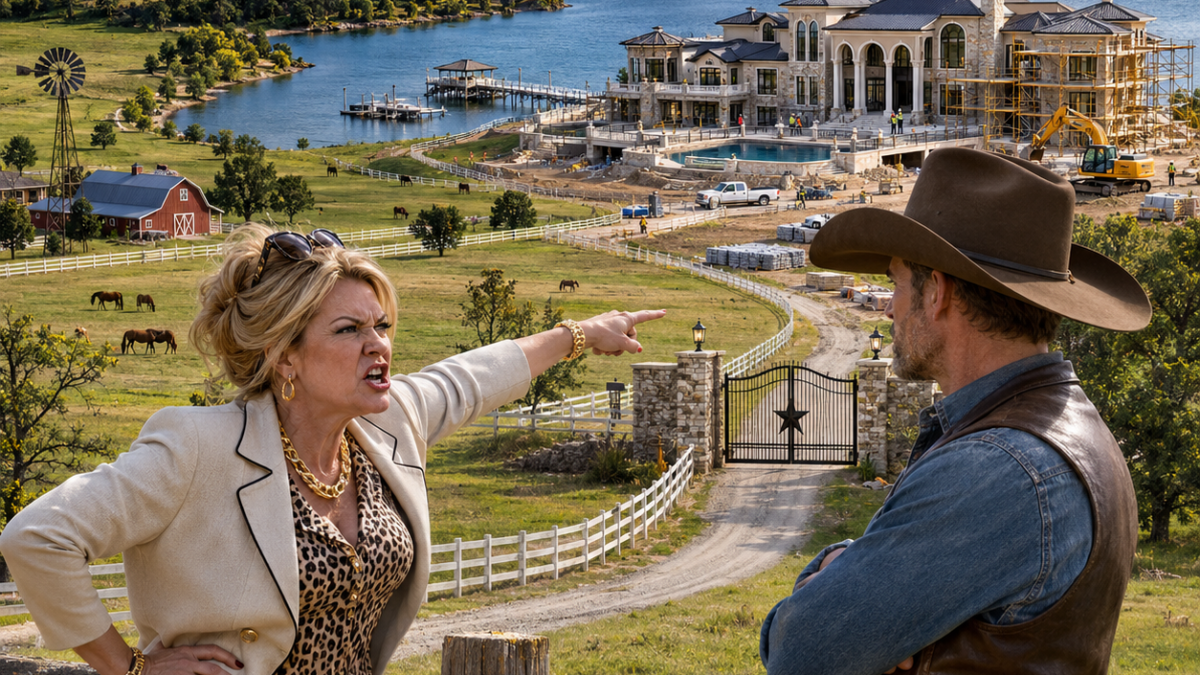
PART 2
I read those three sentences until the words stopped feeling like handwriting and started feeling like my grandfather’s voice.
Keep the land.
Don’t trust them.
They will come for it.
I sat on the edge of the motel bed with the letter in one hand and a property survey in the other.
The survey was dated 1987.
Harold had written notes along the boundary lines in blue ink.
Old fence.
Creek marker.
Granite post.
Lake edge.
Cottonwood stump.
I smiled despite myself.
He had always been like that.
He trusted official records.
But he trusted his own eyes more.
I spread the map across the comforter.
Then I opened satellite imagery on my laptop.
The mansion was clearly visible.
I found the coordinates.
Compared them to the survey.
Checked again.
Then again.
The result made my throat tighten.
Marie’s mansion was not sitting near some disputed boundary.
It was not six feet over the line.
Not twenty.
Not fifty.
The center of the structure was approximately 247 feet inside my grandfather’s property.
I leaned back.
“Grandpa…”
Someone had not accidentally crossed a property line.
Someone had deliberately moved onto his land.
The next morning I called Harold’s estate attorney before his office officially opened.
He answered on the fourth ring.
“José?”
“Did Grandpa sell any portion of the lakefront property?”
There was a pause.
“No.”
“Are you certain?”
“Yes.”
“Any easement?”
“No.”
“Lease?”
“No.”
“Option agreement?”
“José, what happened?”
I told him.
Not every detail.
Enough.
When I finished, he was silent.
Then he said:
“There’s something I should have told you.”
My grip tightened around the phone.
“What?”
“About three years ago, someone attempted to file an amendment in the county property records.”
“What kind of amendment?”
“A transfer.”
My heart started pounding.
“From Grandpa?”
“That was the claim.”
“To Marie Hargrove?”
“I don’t remember the transferee without checking.”
“Why wasn’t it filed?”
“The clerk rejected it.”
“Why?”
“Signature inconsistency.”
I stood.
“What happened next?”
“The clerk received pressure to process it anyway.”
“From who?”
“I don’t know.”
“You’re his lawyer.”
“I know.”
“Then how do you not know?”
“Because Harold refused to pursue it.”
That stopped me.
“What?”
“He said he had handled it.”
“How?”
“He never explained.”
I rubbed my forehead.
“Who was the clerk?”
Another silence.
“Margaret Pearson.”
“Can I speak to her?”
“She no longer works there.”
“Retired?”
“Officially.”
“What does that mean?”
“She was forced out about two months later.”
I looked at the motel wall.
“Why?”
“Budget cuts, according to the county.”
“And unofficially?”
“I never had enough evidence to say.”
His voice became quieter.
“José, your grandfather distrusted some powerful people.”
“Marie mentioned her ex-husband was county commissioner.”
“Yes.”
“You know him?”
“Everyone knows Richard Dawson.”
I sat down again.
“What am I walking into?”
The attorney exhaled.
“I honestly don’t know.”
Then he added:
“But Harold clearly thought you might have to finish something he couldn’t.”
That afternoon, I drove to the county recorder’s office.
It was inside an old government building with beige walls, fluorescent lights, and framed photographs of elected officials going back fifty years.
I approached the counter.
“I need the original property record for Harold Phillips.”
The clerk typed.
Frowned.
Typed again.
“How old is the property?”
“Original purchase was 1952.”
“That’ll be archived.”
“Can I get it today?”
She shook her head.
“Older files take time.”
“How much?”
“Four to six weeks.”
“Four to six weeks?”
“You can submit a formal request.”
I stared at her.
“I’m the legal heir.”
“That doesn’t change archive processing time.”
I was about to ask for a supervisor when the door opened.
Marie Hargrove walked in.
A man in a gray suit followed her.
The clerk’s entire face changed.
“Mrs. Hargrove.”
“Good morning, Linda.”
“How can I help you?”
“I need certified copies of my lake property file.”
“Of course.”
No request form.
No waiting period.
No four to six weeks.
Five minutes later, the clerk handed Marie a stack of certified documents.
Marie glanced at me.
For half a second, our eyes met.
She smiled.
Not broadly.
Just enough.
She wanted me to understand.
Rules existed.
Just not for everyone.
I left without saying anything.
From the parking lot, I called the sheriff’s office.
Then code enforcement.
Then the county planning department.
Property dispute.
Civil matter.
Six to eight weeks.
Formal request.
Pending review.
Call back later.
Each answer was slightly different.
The message was identical.
Go away.
That afternoon I called attorneys.
The first lawyer listened until I said the name Hargrove.
Then he suddenly discovered a conflict of interest.
The second was too busy.
The third told me he did not handle “that category of dispute.”
“What category is that?”
He hesitated.
“Complex local property matters.”
The fourth never returned my call.
The fifth said:
“You should consider selling whatever interest you believe you have.”
“Believe?”
“I’m not commenting on the merits.”
“But you think I should sell?”
“I think sometimes litigation costs more than land is worth.”
“My grandfather left me nine hundred acres.”
The lawyer went quiet.
Then he said:
“I wish you luck.”
Click.
That evening, someone slid an envelope under my motel door.
I heard the paper scrape.
By the time I reached the hallway, no one was there.
Inside was a cease-and-desist letter.
The letterhead read:
DEREK HARGROVE
ATTORNEY AT LAW
It accused me of harassment.
Defamation.
Interference with property rights.
It threatened litigation seeking more than five hundred thousand dollars in damages.
At first, I felt the fear they intended me to feel.
Then something made me curious.
The wording was strange.
Aggressive.
But not legally precise.
I searched Derek Hargrove online.
Twenty seconds later, I laughed.
Derek was not an attorney.
He was a real estate agent.
Marie’s brother-in-law.
The letterhead was fake.
I photographed every page.
Saved the envelope.
Recorded when it arrived.
Then I called Nathan—no, not yet.
At that point I did not know Nathan.
I called myself stupid for almost believing it.
That was when I understood something important.
Marie’s greatest weapon was not the county.
It was perception.
Make herself appear connected.
Make her documents appear official.
Make her threats appear legal.
Make me appear unstable.
If she could control appearances long enough, maybe reality would stop mattering.
The next morning proved it.
At 8:17, someone knocked on my motel door.
A sheriff’s deputy stood outside.
“Mr. Phillips?”
“Yes.”
“We received a welfare concern.”
“A what?”
“Someone reported that you might be emotionally distressed.”
I stared.
“Who?”
“Anonymous.”
“Of course.”
He watched me carefully.
“Are you having thoughts of harming yourself?”
“No.”
“Anyone else?”
“No.”
“Have you been feeling unusually angry?”
I almost laughed.
Instead, I said:
“My grandfather died three weeks ago, and I discovered someone built a mansion on land he left me. So yes, I’m upset.”
The deputy’s eyes sharpened.
“Mrs. Hargrove again?”
“You know her.”
“I know of her.”
“Apparently everyone does.”
His expression hardened slightly.
“Mr. Phillips, making accusations against respected community members can create problems.”
There it was.
Not a threat.
Not officially.
But close enough.
I kept my voice calm.
“I’m not accusing anyone of anything I cannot document.”
He studied me.
Then nodded.
“Good.”
He left.
I closed the door.
Sat down.
And stayed there for a long time.
They were constructing a version of me.
The unstable outsider.
City guy.
Greedy grandson.
Harasser.
Troublemaker.
All they needed was one angry confrontation.
One bad phone call.
One threatening email.
One moment caught on video.
Then Marie could point at it and say:
See?
I told you.
So I stopped giving them moments.
That afternoon I went to a diner at the edge of town.
It had cracked red vinyl booths and a counter older than I was.
The waitress poured coffee.
“You Harold Phillips’s grandson?”
I looked up.
“How did you know?”
“You look like him around the eyes.”
I smiled.
“He came here?”
“Three mornings a week for about thirty years.”
That sounded right.
She walked away.
An older woman at the counter turned.
Silver hair.
Reading glasses hanging from a chain.
Sharp eyes.
“You’re José Phillips.”
It was not a question.
“Yes.”
She carried her coffee to my booth and sat down.
“Margaret Pearson.”
My body went still.
“The county clerk?”
“Former.”
I looked toward the door.
Margaret noticed.
“Good instinct.”
“What happened three years ago?”
She took a sip.
“Your grandfather never sold that property.”
“I know.”
“Do you?”
“I have the deed.”
“Marie has one too.”
“So I keep hearing.”
Margaret leaned closer.
“Someone brought transfer documents into my office.”
“Who?”
“I never saw Marie.”
“Then who?”
“A courier.”
“What was wrong with them?”
“The signature.”
“You knew Grandpa’s signature?”
“Forty years of tax filings.”
She tapped the table.
“You learn how people sign.”
“What did you do?”
“Rejected it.”
“What happened?”
“A phone call.”
“From?”
“The commissioner’s office.”
“Richard Dawson?”
She did not answer directly.
“They told me the transaction had been approved.”
“By whom?”
“They wouldn’t say.”
“What did you do?”
“I refused again.”
Her fingers tightened around the mug.
“Two months later, my job disappeared.”
“Budget cuts.”
Her smile was bitter.
“That was the story.”
I lowered my voice.
“Do you have proof?”
She reached into her purse.
Pulled out an envelope.
Inside were photocopies.
Permit applications.
Routing sheets.
Approval stamps.
One document had a number circled in red.
“What am I looking at?”
“Construction permit.”
“For the mansion?”
“Yes.”
“It was approved?”
“In seventy-two hours.”
“How long should it take?”
“Six to eight weeks.”
I studied the number.
Margaret pointed.
“Prefix is wrong.”
“What does that mean?”
“Permit numbers follow a sequence.”
“This one doesn’t?”
“It doesn’t exist anywhere else that year.”
I looked at her.
“Someone created it manually?”
“That would be my guess.”
“Why keep copies?”
“Because your grandfather told me to.”
That stopped me.
“What?”
“Harold came to see me after I lost my job.”
“What did he say?”
“He apologized.”
“For what?”
“For dragging me into it.”
Her eyes softened.
“I told him the same thing I’m telling you.”
“What?”
“People like Marie survive because everyone thinks surviving them requires silence.”
She stood.
“They made mistakes, José.”
I looked at the envelope.
“How many?”
“Enough.”
She walked toward the door.
Then stopped.
“Your grandfather knew you’d come.”
“Come where?”
“Back.”
Before I could ask what she meant, she left.
The next morning, I checked out of the motel.
Marie probably heard within hours.
Let her.
I drove back to Austin.
Then I disappeared from her life.
For three days, I made no calls.
No complaints.
No social-media posts.
No visits.
No threats.
I went to work.
I attended engineering meetings.
Reviewed code.
Fixed bugs.
Answered email.
And every night I turned my kitchen table into an evidence board.
My grandfather’s survey.
Margaret’s permits.
Tax records.
Satellite photographs.
The disputed deed.
The first thing I needed was a survey nobody in Marie’s county could influence.
Every local surveyor had refused.
So I called neighboring counties.
Eventually I found Bradley Walker.
Retired civil engineer.
Private survey work.
No connection to Marie.
I explained the situation.
He was quiet.
Then said:
“I’ve seen boundary disputes.”
“This isn’t a boundary dispute.”
“No?”
“The house is almost two hundred fifty feet inside.”
He whistled softly.
“Send me the legal description.”
A week later, Bradley called.
“I have good news.”
“Finally.”
“Depends how you define good.”
I stood from my desk.
“What did you find?”
“The mansion is 247 feet inside your line.”
I closed my eyes.
“Confirmed?”
“Survey-grade.”
“What else?”
“I found two original markers.”
“Where?”
“A drainage ditch.”
My eyes opened.
“They were removed?”
“Looks like it.”
“Can you prove they’re Grandpa’s?”
“Coordinates match the 1987 survey.”
I sat slowly.
“So somebody moved the markers before construction.”
“That would be consistent with what I found.”
“Put everything in writing.”
“I already am.”
“Photos.”
“Yes.”
“GPS.”
“Yes.”
“Overlay.”
“Yes.”
“Chain of custody.”
Bradley laughed.
“You planning to sue the state of Texas?”
“I’m starting to think I might have to.”
Meanwhile, I filed public-record requests.
Planning office.
County commission.
Permit department.
Texas land records.
State archives.
Every request by certified mail.
Every receipt saved.
Every response dated.
Every refusal preserved.
I stopped asking people to help me.
I started creating documents showing whether they helped me.
That distinction changed everything.
The permit records arrived first.
Margaret had been right.
Marie’s permit number did not match the county’s sequence.
Then I found the contractor.
Hargrove Development LLC.
Owner: Craig Hargrove.
Marie’s brother-in-law.
The same family behind the fake legal letter.
Then came the planning officer.
Diane Mercer.
She had approved the permit.
Her employment history showed that before joining the county, she worked for a Houston real-estate company tied to Hargrove interests.
I stared at my screen.
“Of course you did.”
But the most interesting part of the permit was the ownership verification.
It required identifying information from the landowner.
The number entered for Harold was almost correct.
Almost.
The final two digits were wrong.
I knew because Harold’s tax records contained the correct information.
Someone had copied enough to look convincing.
But not enough to be right.
Then the timeline broke everything open.
Marie claimed the property was transferred in 2019.
My grandfather’s medical records said something very different.
Harold spent most of that year hospitalized.
Congestive heart failure.
Physical therapy.
Medication.
Repeated admissions.
The disputed deed was supposedly signed March 15.
I found the hospital record for that date.
He had suffered a cardiac episode.
He was sedated.
He needed help signing medical forms.
Yet according to Marie’s story, on that same day he somehow executed a major land transfer.
I stared at the forged signature.
Then at a legitimate one.
They looked similar.
Too similar.
So I hired a forensic document examiner.
Her report arrived two days later.
“Mr. Phillips?”
“Yes.”
“I completed my analysis.”
“And?”
“The signature is not authentic.”
I felt my shoulders drop.
“How certain?”
“Very.”
“Why?”
“Pen pressure.”
She continued.
“Natural signatures have rhythm. This one has hesitation marks.”
“So somebody copied it?”
“More than copied.”
“What do you mean?”
“I detected microscopic graphite residue beneath the ink.”
I sat forward.
“Pencil?”
“Correct.”
“They traced it.”
“That is my opinion.”
“Can you testify to that?”
“Yes.”
I looked toward my grandfather’s framed photograph on the shelf.
“What does that mean legally?”
“I’m not an attorney.”
“I know.”
“But from an examination standpoint?”
She paused.
“It means someone did not accidentally sign the wrong name.”
I swallowed.
“They intentionally manufactured a signature.”
“Yes.”
That night, for the first time, I believed I could win.
Then I realized winning the land and proving Marie knowingly stole it were two different things.
The deed was forged.
But Marie could say she relied on someone else.
The contractor was family.
He could say he followed paperwork.
The planning officer could claim she was misled.
The commissioner could deny involvement.
Everyone could sacrifice one person.
Blame a clerk.
Blame a contractor.
Blame a dead man.
And Marie could walk away saying she too had been deceived.
I needed an attorney outside the county.
I eventually found Nathan Cross in Houston.
Real-estate litigation.
No ties to Marie.
No ties to Richard Dawson.
His firm had a reputation for taking difficult property cases.
I emailed him a summary.
He called two hours later.
“Is all of this real?”
“Unfortunately.”
“The survey?”
“Certified.”
“Signature report?”
“Certified examiner.”
“Hospital records?”
“Estate file.”
“Permit?”
“Official county response.”
He went silent.
“Nathan?”
“I’m thinking.”
“That good or bad?”
“This is one of the cleanest property-fraud foundations I’ve seen.”
“Then we file.”
“Not yet.”
I stared at the phone.
“Why does everyone keep telling me not yet?”
“Because you have proof of fraud.”
“Yes.”
“You do not yet have enough direct proof of Marie’s knowledge.”
“She lives in the house.”
“That proves benefit.”
“She claimed ownership.”
“Possession.”
“She threatened me.”
“Pressure.”
I rubbed my face.
“What do you need?”
“Something she cannot blame on someone else.”
“Like?”
“Email.”
“Text.”
“Recorded statement.”
“Instructions.”
Nathan paused.
“Something showing Marie knew the ownership story was false and participated anyway.”
I leaned back.
“And how do we get that?”
“We stop trying to scare her.”
“What?”
“Right now she believes she scared you.”
“She did for about twelve hours.”
“Good.”
“That’s good?”
“If she thinks you gave up, she becomes careless.”
Nathan started filing regulatory complaints.
The fake legal letter went to appropriate authorities.
Permit irregularities were documented.
Potential professional misconduct was reported.
Each complaint created another official trail.
Then my public-record requests began producing emails.
Most were useless.
Routine messages.
Meeting notices.
Scheduling.
Then, buried inside one release, I found a CC address.
Personal account.
Marie Hargrove.
The message was from two weeks before her construction permit was officially issued.
Marie wrote:
**Just push it through quickly. I’ll handle Richard if there are any questions.**
I read it five times.
Then called Nathan.
“Check your email.”
He opened it.
Silence.
“Tell me I’m reading this right.”
“You are.”
“She knew.”
“She was coordinating before the permit.”
“She mentions Richard.”
“Yes.”
“Her ex-husband.”
“Yes.”
I stood.
“So now we file.”
“Almost.”
I laughed.
“You enjoy saying that?”
“A little.”
“Nathan.”
“José, the email is strong.”
“Strong?”
“It is direct evidence.”
“Then what are we waiting for?”
“Her.”
I stared out my apartment window.
“What does that mean?”
“People who survive on influence often believe talking is their greatest weapon.”
“So?”
“Give her somewhere official to talk.”
The opportunity appeared in old commission minutes.
A county land-use meeting was scheduled three weeks later.
Public comment.
Property issues.
Nathan had another reason to wait.
He had found meeting minutes from October 2018.
Months before the forged deed.
During that meeting, a resident asked about potential development near Harold Phillips’s lake property.
The commissioner publicly stated that Harold’s land remained privately owned and unavailable for development.
Attendance sheet:
Marie Hargrove.
She had been sitting in the room.
She heard the land was not hers.
Before the forged deed.
Before the permit.
Before construction.
“She can still claim circumstances changed later,” I said.
“Yes.”
Nathan replied.
“So we let her tell the world what supposedly changed.”
I understood.
“You want her on record.”
“Yes.”
“And then?”
“Then we show the documents.”
I thought about Harold.
Fifty years holding that property.
One stubborn old man standing between money and a lake.
Three weeks felt like nothing.
“I can wait.”
“Good.”
Nathan’s voice became serious.
“Because when we move, we move once.”
For the next two weeks, I vanished again.
Marie interpreted silence as surrender.
Then surrender was not enough.
She wanted humiliation.
A former neighbor of Grandpa’s sent me a screenshot.
Marie had posted my photograph in a community group for lakefront owners.
The caption said I was harassing longtime residents.
That I was making false ownership claims.
That I was motivated by greed.
That residents should report sightings of me.
Comments multiplied.
Scammer.
Fraud.
Predator.
Outsider.
Someone claimed I had a history of frivolous lawsuits.
I had never filed a lawsuit in my life.
Another claimed I had been “casing” lake properties.
I had visited one property.
Mine.
Nathan told me not to respond.
Then a hardware store where Grandpa had shopped for decades refused to serve me.
A young employee whispered:
“It isn’t personal.”
“It feels personal.”
She glanced toward the owner.
“Mrs. Hargrove knows everyone.”
“And?”
“You know.”
“No. I don’t.”
Her voice dropped.
“People don’t want trouble.”
I left without buying anything.
On the drive back to the motel, I finally understood how my grandfather must have felt.
Not scared of losing land.
Scared of being surrounded by people who knew something was wrong but preferred quiet.
Then the harassment became stranger.
Child Protective Services called my apartment in Austin.
An anonymous complaint claimed children under my care were being neglected.
“I don’t have children.”
There was a pause.
The caseworker sighed.
“I suspected this might be retaliatory.”
“You’ve seen this?”
“Weaponized reports happen.”
“Can you close it?”
“Once we document that no children reside with you.”
“Will this remain on file?”
“The intake will.”
I closed my eyes.
Exactly what Marie wanted.
A paper trail.
Not truth.
Paper.
Two nights later, someone spray-painted GO HOME across the side of my truck.
The motel camera that should have covered the parking lot happened to be pointed away.
I photographed the damage.
Filed a report.
Called Nathan.
He asked:
“You okay?”
“No.”
“You angry?”
“Yes.”
“Good.”
I almost hung up.
Then he said:
“Anger means you understand what she’s doing.”
“What am I supposed to do with it?”
“Document it.”
“That’s your answer for everything.”
“Right now, yes.”
I looked at the red paint dripping down my truck.
“She wants me to explode.”
“Yes.”
“I’m close.”
“I know.”
“How?”
“Because she would not be escalating if she thought you were irrelevant.”
I breathed slowly.
“What does that mean?”
“She’s afraid.”
Marie did not look afraid.
Her social media showed charity events.
Dinner parties.
Lake sunsets.
Champagne.
Then came the video that changed everything.
She hosted a fundraiser at the mansion.
Afterward she posted a video tour.
Grand foyer.
Marble staircase.
Custom kitchen.
Imported stone.
Infinity pool.
Private dock.
She bragged about the construction.
About the dream.
About how long she had wanted the house.
I watched because Nathan told me never to ignore statements.
Four minutes into the video, Marie walked past a wall of framed documents.
One caught my attention.
I paused.
Zoomed.
Construction permit.
The same strange permit number.
But beneath the number was a description.
**ACCESSORY STRUCTURE — 400 SQ. FT.**
I stared.
Then looked at Bradley’s report.
Marie’s mansion measured roughly eight thousand square feet.
Twenty times the permitted size.
She had framed the evidence.
Put it on her wall.
Then broadcast it herself.
I called Nathan.
“I’m sending you a timestamp.”
He watched.
Silence.
Then:
“You’re kidding.”
“No.”
“She framed it?”
“Yes.”
“That may be the most arrogant thing I’ve ever seen.”
“Keep watching.”
In the comments, someone asked:
“When did you first dream of building there?”
Marie replied:
**We’ve been planning this home for more than ten years. It just took a while to make it happen.**
Ten years.
The deed was supposedly six years old.
Her own words placed the plan years before she claimed to own the land.
Nathan exhaled.
“She keeps solving our case.”
Five days before the commission meeting, our package was complete.
Certified survey.
Original boundary records.
Recovered markers.
Forged deed.
Document examiner.
Hospital records.
Permit discrepancy.
County email.
Planning officer connection.
2018 meeting minutes.
Marie’s public video.
Marie’s public comment.
Harassment documentation.
Everything.
The night before the meeting, I sat in another motel room outside the county.
Nathan’s binder lay unopened on the desk.
I knew every page.
What scared me was no longer losing.
It was what winning would do.
Marie had lived in that house for years.
Whatever she had done to obtain the land, the mansion was real.
Someone had spent money building it.
People had worked on it.
Furniture filled it.
Photographs hung on the walls.
Lives can grow around lies.
That does not make the lie true.
But it makes exposing it messy.
I thought about Grandpa’s three sentences.
Keep the land.
Don’t trust them.
They will come for it.
I wondered if he wanted me to destroy Marie.
No.
That did not sound like Harold.
Then I remembered something he told me after I lost a fight in high school.
I had been angry because the other kid started it.
Grandpa listened.
Then said:
“If being wronged gives you permission to become stupid, everybody will eventually be stupid.”
At sixteen, I hated that answer.
At thirty-four, sitting beside a binder thick enough to ruin careers, I understood.
I set my alarm.
Six a.m.
The next evening, the county commission chamber was standing room only.
A regional television camera stood near the front.
The red recording light was on.
Reporters filled one side.
Residents packed the other.
Marie sat in the front row.
Cream blazer.
Pearl earrings.
Hair perfect.
Real attorney beside her this time.
Richard Dawson sat three rows behind.
He looked older than photographs from his commissioner days.
But he still carried himself like a man accustomed to rooms changing when he entered them.
Routine business lasted forty minutes.
Nobody cared.
Everyone was waiting.
Finally:
“Land-use review and public comment.”
Marie stood before the chairman finished speaking.
Of course she did.
She walked toward the podium.
Calm.
Smiling.
The room belonged to her.
Or she believed it did.
“Thank you, Commissioners.”
Her voice was polished.
“I’m here tonight because my family and I have endured weeks of harassment by an individual making fraudulent claims against property I lawfully purchased.”
She looked toward me.
“An outsider.”
A few people shifted.
“This individual has attempted to undermine my reputation, threaten my property rights, and create division in a community where my family has lived and served for decades.”
She spoke about Richard’s public service.
Her charitable work.
The house.
The permits.
The deed.
Her attorneys.
Her reputation.
Six minutes.
Not one hesitation.
“I purchased this property legally.”
That sentence mattered.
Nathan wrote it down.
“I built my home under permits issued through proper county channels.”
Another sentence.
“I had no reason at any point to question the legitimacy of the transaction.”
Nathan wrote again.
Marie concluded by asking the commission to condemn the “campaign of defamation.”
She returned to her seat.
People clapped.
Not everyone.
Enough.
The chairman looked over the room.
“Anyone else?”
I raised my hand.
Walking toward the podium felt strangely quiet.
I could hear my shoes.
A cough.
The camera motor.
Paper moving.
Marie’s eyes followed me.
I placed the binder down.
“My name is José Phillips.”
I looked toward the commissioners.
“Harold Phillips was my grandfather.”
The room remained still.
“He owned approximately nine hundred acres on this lake for more than fifty years.”
I opened the binder.
“He did not sell the parcel occupied by Mrs. Hargrove’s residence.”
Marie shook her head.
I continued.
“I’m not asking you to believe me.”
That got attention.
“I’m asking you to review documents.”
First slide.
Survey overlay.
“Independent certified survey.”
Red line.
House footprint.
“The residence is 247 feet inside the legal boundary of the Phillips property.”
Murmurs.
Second slide.
Grandpa’s 1987 survey.
Original coordinates.
Photographs of recovered markers.
“The historical markers matched the original survey and were found discarded in a drainage ditch away from their documented positions.”
Third slide.
Construction permit.
“Mrs. Hargrove stated a few minutes ago that her home was constructed under proper permits.”
I highlighted the description.
“County records show the permit associated with this structure authorizes an accessory building of four hundred square feet.”
I clicked.
Image of the mansion.
“The actual residence is approximately eight thousand square feet.”
Someone behind me whispered.
Fourth slide.
Forged deed.
“Forensic examination concluded Harold Phillips’s signature was traced.”
I displayed the examiner’s findings.
“Hesitation marks.”
“Abnormal stroke pattern.”
“Graphite beneath the ink.”
Marie’s attorney leaned toward her.
Fifth slide.
Hospital record.
“The deed is dated March 15, 2019.”
Next document.
“On March 15, Harold Phillips was hospitalized following a cardiac episode and was medically sedated.”
The room went silent.
“He required assistance signing medical paperwork during that period.”
I looked toward Marie.
She no longer smiled.
Sixth slide.
Email.
Marie Hargrove to Diane Mercer.
**Just push it through quickly. I’ll handle Richard if there are any questions.**
I let the words remain on screen.
“This email was released by the county in response to a public-record request.”
Richard Dawson shifted in his chair.
The chairman leaned forward.
I continued.
“Mrs. Hargrove’s attorney may argue that she was misled.”
Marie whispered something angrily.
“So I also reviewed commission records from October 2018.”
Attendance sheet.
Marie Hargrove.
Meeting transcript.
“The commission publicly stated that the Phillips lake property remained privately owned and unavailable for development.”
I looked toward the room.
“Mrs. Hargrove attended that meeting.”
Marie’s attorney had stopped whispering.
He was staring straight ahead.
Then the last exhibit.
The fundraiser video.
Marie appeared on the screen.
Smiling.
Walking through the mansion.
The camera passed the framed permit.
I paused.
Zoomed.
Four hundred square feet.
“This was posted publicly by Mrs. Hargrove five days ago.”
I changed to the comment screenshot.
Question:
When did you first decide to build here?
Marie:
**We’ve been planning this dream home for over ten years.**
I turned toward the commissioners.
“The deed she relies on is approximately six years old.”
I closed the binder.
“I’m not asking this commission to decide criminal liability tonight.”
Marie’s attorney looked relieved for half a second.
“I am asking that the record reflect what these documents show.”
I paused.
“A nine-hundred-acre ranch remained titled to Harold Phillips.”
“A deed appeared carrying a signature that a forensic examiner identified as traced.”
“A construction permit was processed unusually fast.”
“The permit authorized a structure twenty times smaller than what was actually built.”
“The applicant coordinated with a county planning employee before approval.”
“Original survey markers were removed.”
“And the person claiming to be an innocent purchaser publicly admitted she had been planning the project years before the alleged purchase.”
I stepped back.
“That is all.”
Silence.
Three seconds.
Maybe four.
Then Marie stood.
“This is ridiculous!”
Her lawyer grabbed her wrist.
“Marie.”
“No.”
She pulled away.
“That permit is exactly what we applied for.”
The chairman spoke.
“Mrs. Hargrove, you’ll have an opportunity through counsel—”
“Everyone knows how things work around here!”
The room changed.
Her attorney went pale.
Marie kept going.
“You have to know people.”
“Mrs. Hargrove—”
“I’ve lived here thirty years.”
She pointed toward me.
“He shows up from Austin and suddenly everyone acts like he owns the world.”
I stayed still.
“That land was supposed to be mine!”
Richard Dawson looked at her.
His face changed.
Marie did not see.
“Harold promised Richard.”
Her attorney stood.
“Stop talking.”
“Richard told me it was handled!”
Silence.
True silence.
The kind a room produces when everyone understands they have just heard something that cannot be taken back.
Marie realized it too.
Her mouth opened.
Nothing came out.
The commission chairman looked toward Richard.
Then Marie.
“Mrs. Hargrove, are you stating that former Commissioner Dawson participated in arranging this land transaction?”
Her attorney stepped forward.
“My client will not be making further statements.”
The chairman looked at the screen behind him.
“Are you also stating that you were aware the permit did not correspond to the actual size of the residence?”
“Again, my client declines to answer.”
Marie’s breathing was heavy.
A reporter typed so quickly I could hear the keyboard.
The chairman turned toward his fellow commissioners.
“This commission will refer tonight’s materials and statements to the district attorney for immediate review.”
Marie closed her eyes.
“We will also request an independent audit of relevant permits issued during the period in question.”
Richard stood.
He moved toward the side exit.
“And the permit irregularities will be referred to state authorities.”
Richard disappeared through the door.
Then the chairman looked directly at Marie.
“I strongly suggest that you follow your attorney’s advice.”
Meeting adjourned.
Chaos exploded.
Reporters stood.
Residents shouted questions.
People turned toward one another.
The same community that had called me a scammer was suddenly asking who had approved Marie’s permit.
Marie’s attorney pulled her toward the exit.
She passed within three feet of me.
Stopped.
“You think you won?”
Nathan stepped closer.
I remained silent.
Marie’s eyes were wet with rage.
“That land should’ve been mine.”
Camera operators moved.
Her attorney whispered:
“Marie, please.”
“Harold owed us.”
I did not answer.
Her lawyer pulled her away.
Nathan watched her disappear.
“You did good.”
“I barely spoke compared to her.”
“That was the idea.”
Six weeks later, prosecutors filed charges.
The criminal process did not produce the dramatic overnight punishment people imagine.
There were hearings.
Attorneys.
Negotiations.
Delays.
Marie eventually entered no-contest pleas related to forgery, filing false documents, and fraud.
She received five years of probation.
A fifty-thousand-dollar fine.
Two hundred hours of community service.
She avoided prison.
At first, that bothered me.
I told Nathan.
“She gets probation?”
“She gets a felony record.”
“She stole land.”
“And the civil case remains.”
“She tried to destroy my reputation.”
“I know.”
“She weaponized county offices.”
“I know.”
“It doesn’t feel like enough.”
Nathan looked at me.
“You want punishment or your land?”
“Both.”
“Fair.”
He smiled slightly.
“But the law separates those questions.”
Richard Dawson’s situation became worse.
State investigators uncovered emails showing pressure on county employees.
Former workers came forward.
Other property owners complained.
The pattern grew.
He resigned from civic boards.
Retained criminal counsel.
Began cooperating with investigators.
Diane Mercer lost her job.
Two other employees were terminated.
The county revised its permit process.
Multiple signatures became mandatory for certain approvals.
External auditors identified fourteen additional cases for review.
Margaret called me after the news broke.
“You did it.”
“No.”
“Yes.”
“You gave me the permit.”
“You listened.”
“So did Grandpa.”
She was quiet.
“He would’ve been proud.”
That almost ended the conversation for me.
My throat closed.
“Thank you.”
“You going to keep the land?”
“Yes.”
“Good.”
The civil case concluded four months later.
The judge’s ruling was direct.
Title belonged to me.
Marie’s mansion encroached on my property.
The deed she relied upon was invalid.
Then came the remedy.
Marie had two choices.
Purchase the occupied portion of the property.
Fair market value.
Plus a thirty-percent penalty.
Approximately 1.2 million dollars.
Or remove every unauthorized structure within 180 days.
House.
Pool.
Dock.
Associated improvements.
Her attorney asked for time.
Granted.
Marie chose demolition.
I found out through Nathan.
“She chose what?”
“Demolition.”
“Why?”
“She can’t finance the purchase.”
I stared at him.
“You’re telling me she built an eight-thousand-square-foot mansion and can’t buy the land under it?”
“Legal fees are expensive.”
I sat back.
“What about damages?”
“You were awarded one hundred fifty thousand dollars.”
“For what?”
“Legal costs, property damage, documented harassment.”
I felt no excitement.
Nathan noticed.
“You okay?”
“I thought this would feel better.”
“Winning?”
“Yeah.”
He closed the file.
“Winning property litigation usually means getting close to where you should have been before someone harmed you.”
“That’s depressing.”
“It’s accurate.”
Marie’s attorney requested a payment schedule for the damages.
I agreed.
Nathan looked surprised.
“You’re not objecting?”
“No.”
“She spent months trying to ruin you.”
“I know.”
“You can demand more aggressive enforcement.”
“I know.”
“Why not?”
I thought about Harold.
“Because the judgment already says what it needs to say.”
Nathan nodded.
I also gave Marie the entire 180 days.
No emergency demolition.
No press tour.
No interviews.
When reporters called, I told them one thing:
“My grandfather left me the property. I wanted the title respected.”
Some people wanted anger.
They wanted me to say Marie deserved to lose her home.
They wanted revenge packaged into a quote.
I refused.
Not because I felt sorry for her.
Some nights I still remembered the deputy standing in my motel room asking whether I was unstable.
I remembered GO HOME across my truck.
The fake CPS complaint.
The hardware store.
The people who looked away.
I had anger.
Plenty.
But Grandpa had not held nine hundred acres for fifty years because he wanted a weapon.
He treated land like responsibility.
Take care of it.
Know its boundaries.
Do not waste it.
Do not sell out of fear.
Do not use ownership to become cruel.
The demolition happened in late spring.
I was not there.
A neighbor sent photographs.
Excavator tearing into the roof.
Windows removed.
Stone walls collapsing.
Pool filled.
Dock pulled from the lake.
For three days, trucks carried debris away.
I looked at the first photo.
Then deleted the rest without opening them.
People thought that surprised me.
“Don’t you want to see it come down?”
No.
I had already seen enough destruction.
By summer, grass covered the slope.
Native seed.
Wildflowers.
The lake looked wider without the mansion looming above it.
In October, almost a year after the commission meeting, I drove back alone.
No gate.
No security camera.
No warning sign.
I turned onto Grandpa’s road without stopping.
The old farmhouse was still there.
Roof sagging.
Porch leaning slightly.
Barn paint faded.
I drove past it toward the lake.
Parked where Marie’s mansion once stood.
The air was cool.
A heron stood in the shallows.
Wind moved through the live oaks.
I carried two things.
The framed 1987 survey.
And a brass boundary marker.
Bradley had given me the exact GPS coordinates.
I walked to the spot.
The soil was softer than I expected.
I drove the marker down with a mallet.
Once.
Twice.
Again.
Until it stood firm.
The brass caught the morning sunlight.
I wiped the dirt away with my thumb.
“Stay there this time.”
I laughed at myself.
Then I sat near the water.
Three weeks earlier, Grandpa’s attorney had shipped the last boxes from Harold’s farmhouse.
Old family photographs.
Fishing gear.
Receipts.
Letters.
One envelope had my name on it.
I almost missed it.
José.
Grandpa’s handwriting.
The letter was dated August 2015.
Years before his death.
Years before the mansion.
I opened it beside the lake.
José,
If you’re reading this, I’m gone.
They’ve been circling for years waiting for me to get weak.
The Hargroves. The Dawsons. All of them.
They think because I’m old and alone, they can take what’s mine.
They’re wrong.
I’ve kept every document.
Every survey.
Every deed.
The truth is in the paperwork, and the paperwork doesn’t lie.
Don’t let them scare you.
Don’t let them make you angry.
Just find the evidence and let it speak.
The land will be yours.
Keep it safe.
I’m proud of you already.
Grandpa Harold.
I stopped reading.
For a long time I could not look at the page.
My grandfather had known.
Not every detail.
Not Marie’s mansion.
Not the fake permit.
Not the forged signature.
But he knew people were waiting.
And he had done the only thing he could.
He prepared.
He preserved the truth.
Then trusted me to find it.
I folded the letter carefully.
The lake shimmered.
Somewhere far from there, Marie Hargrove was living under probation.
Richard Dawson was answering questions from investigators.
County officials were reviewing files that had gone untouched for years.
None of that felt as important as the small brass marker beside me.
That marker meant something simple.
A line existed.
Someone crossed it.
The truth put it back.
I drove toward the farmhouse.
The screen door creaked when I opened it.
The place smelled like dust and old wood.
Grandpa’s chair still sat beside the window.
For years, I had treated the ranch like a memory.
A place from childhood.
Something old that belonged to an older generation.
Now it was mine.
That realization frightened me more than Marie ever had.
Nine hundred acres is not a trophy.
It is fences.
Taxes.
Water.
Roads.
Trees.
Erosion.
Buildings.
Responsibility.
I walked through the kitchen.
The faucet leaked.
The porch needed work.
The barn roof was failing.
I laughed.
“Thanks, Grandpa.”
For the next several months, I spent weekends fixing the property.
Not transforming it.
Fixing it.
I replaced broken fence sections.
Patched the farmhouse roof.
Painted the barn.
Cleared fallen cedar from old roads.
I hired local workers.
Some had avoided me during the dispute.
One afternoon, the hardware-store owner drove out.
I recognized him immediately.
He stood beside his truck.
Hat in his hands.
“José.”
I waited.
“I owe you an apology.”
“You wouldn’t sell me lumber.”
He looked embarrassed.
“No.”
“Why?”
“You know why.”
“I want to hear you say it.”
He swallowed.
“I was afraid of Marie.”
I nodded.
“She couldn’t legally shut your business down.”
“No.”
“She couldn’t arrest you.”
“No.”
“She couldn’t take your land.”
“No.”
“But you were afraid.”
“Yes.”
I looked toward the barn.
He continued.
“A lot of us were.”
“That’s how she got away with it.”
“I know.”
There was nothing else to say.
Then he held out a receipt.
“What’s that?”
“Materials.”
“For?”
“Your porch.”
“I didn’t order anything.”
“I did.”
I looked at him.
“You don’t owe me lumber.”
“I know.”
“Then why?”
“Because I’d like to start behaving like the man I should’ve been the first time you came into my store.”
I took the receipt.
We rebuilt the porch together.
That did not erase what happened.
It did something better.
It changed what happened next.
Margaret visited one Saturday.
She stood near the new boundary marker.
“You put it back.”
“Deeper this time.”
She laughed.
“Harold would approve.”
“He told me paperwork doesn’t lie.”
Margaret looked toward the lake.
“He told me that too.”
I handed her a copy of Grandpa’s letter.
She read it.
Her eyes watered.
“He knew.”
“Yes.”
“He was scared.”
That surprised me.
“Grandpa?”
“Of course.”
“He never acted scared.”
“Bravery isn’t the absence of fear.”
She folded the copy.
“It’s deciding what fear doesn’t get to choose.”
That evening, after Margaret left, I sat on Grandpa’s repaired porch.
I thought about Marie.
For months she had occupied too much of my mind.
At first she was the woman who stole my land.
Then the woman controlling the county.
Then the person I needed to defeat.
Eventually she became something smaller.
A person who had mistaken access for ownership.
Influence for truth.
Fear for respect.
She had spent years building a mansion.
But the real structure protecting her had been invisible.
Favors.
Silence.
Relationships.
Assumptions.
People saying:
That’s just how things work here.
That structure collapsed faster than the house.
Not because I was powerful.
Because documents were.
Because Margaret kept copies.
Because Bradley found markers.
Because a forensic examiner looked closely.
Because Nathan knew when not to rush.
Because government emails could be requested.
Because cameras recorded meetings.
Because eventually Marie spoke one sentence too many.
Richard told me it was handled.
That was the moment everyone remembered.
But it was not the moment she lost.
She lost years earlier.
She lost when she decided nobody would ever look closely.
The final change I made to Grandpa’s property was small.
Near the lake, where he taught me to fish, I built a simple wooden bench.
No memorial plaque.
No dramatic message.
Just a small brass plate.
It read:
**HAROLD PHILLIPS**
**1952 — HOME**
That was enough.
One year after Marie’s mansion came down, I drove to the ranch before sunrise.
Fog floated over the lake.
I carried Grandpa’s old fishing tackle box.
Inside, half the lures were rusted.
The line on his favorite reel had gone brittle.
I spent twenty minutes replacing it.
Then I walked to the dock.
Not Marie’s dock.
Grandpa’s.
The old wooden one on the opposite side of the lake.
The boards creaked.
I sat exactly where I used to sit as a boy.
For the first time in years, I remembered the day he taught me to cast.
I was eight.
Impatient.
Every throw went wrong.
Line tangled in branches.
Hook caught my shirt.
Once I almost hit Grandpa in the face.
He never yelled.
Finally I threw the rod down.
“I can’t do it.”
Grandpa picked it up.
Sat beside me.
“You’re trying to force it.”
“I’m trying to make it go far.”
“That isn’t the same thing.”
He put the rod back in my hand.
“Slow down.”
I rolled my eyes.
He laughed.
“Every young man thinks strength means moving faster.”
He showed me again.
“You let the rod do the work.”
That morning, decades later, I cast.
The lure landed gently beyond the reeds.
I smiled.
“Finally got it.”
The sun climbed.
The lake turned gold.
Behind me stood nine hundred acres that developers still wanted.
I had received offers after the lawsuit.
Big offers.
Some were absurd.
One company offered enough money that I stared at the number for several minutes.
I declined.
Not because land can never be sold.
Grandpa was not against money.
He was against being pressured into surrendering something you still valued.
There was a difference.
I started exploring conservation options.
Limited ranching.
Habitat restoration.
A family trust so nobody could quietly alter ownership again.
Nathan helped with the legal structure.
Bradley updated every survey.
Digital copies were stored in multiple places.
Physical copies went into a bank box.
I even sent one copy to Margaret.
She laughed when it arrived.
“What am I supposed to do with this?”
“Be difficult.”
“I’m already excellent at that.”
Months later, Marie made one final appearance in my life.
Not in person.
Her attorney sent a letter.
She wanted to settle part of the remaining payment obligation early.
In exchange, she requested that I provide a written statement saying I did not believe she posed a continuing threat to the community.
Nathan called.
“You don’t have to respond.”
“What would the statement do?”
“It might help her in future proceedings.”
“Is it accurate?”
“What?”
“That I don’t believe she poses a continuing threat.”
Nathan paused.
“That’s your opinion.”
I thought about it.
Marie had lost the mansion.
Lost the land claim.
Lost her influence.
Lost her clean record.
The county had changed procedures.
People were watching now.
Maybe she was not dangerous anymore.
But that did not mean I owed her a certificate of redemption.
I dictated one sentence.
“My position remains that the court’s judgment and probation terms should speak for themselves.”
Nathan chuckled.
“That’s very Harold.”
“No.”
I looked toward the lake.
“I think I finally understand Harold.”
That winter, I spent Christmas at the ranch.
My mother came.
Two cousins.
Margaret stopped by.
Bradley brought his wife.
Even the hardware-store owner came for dinner.
We ate in Grandpa’s farmhouse.
The roof did not leak.
The porch stood straight.
A fire burned in the living room.
After dinner, my mother found the framed 1987 survey hanging on the wall.
“You framed this?”
“Yes.”
“Why?”
“Because it saved the ranch.”
She looked at Grandpa’s handwriting.
“No.”
“What?”
“He saved the ranch.”
I nodded.
She touched the frame.
“He just needed you to finish.”
Later that night I walked outside alone.
Cold wind crossed the fields.
The lake reflected the moon.
No mansion.
No floodlights.
No pool.
No security cameras.
No iron gate.
Only darkness.
Trees.
Water.
Home.
I had spent almost a year believing the satisfying ending would be Marie losing.
Her courtroom defeat.
Her fine.
Her probation.
Her mansion demolished.
I was wrong.
Those were consequences.
Necessary ones.
But they were not the ending.
The ending was the porch being repaired.
The boundary marker standing where Grandpa put it.
Margaret being believed after years of silence.
A county being forced to examine what it had ignored.
Neighbors learning that fear was not neutrality.
And me finally understanding why Harold refused to sell.
He did not love land because dirt mattered more than people.
He loved it because keeping something sometimes means refusing to let powerful people decide that your attachment to it is inconvenient.
Marie had believed wealth made ownership.
Richard believed connections made truth.
The county employees believed authority made questions disappear.
Grandpa believed something simpler.
A deed matters.
A boundary matters.
A promise matters.
Evidence matters.
And eventually, truth matters—if somebody is stubborn enough to keep it alive.
I walked down to the brass marker.
Moonlight reflected from its surface.
I crouched beside it.
The inscription was simple.
PHILLIPS PROPERTY.
I brushed dead grass away.
For a moment, I imagined Grandpa standing beside me.
Old boots.
Work shirt.
Hands in his pockets.
He would not have given some emotional speech.
That was not Harold.
He probably would have looked at the restored boundary.
Nodded once.
Then asked why the north fence still needed repair.
I laughed.
“You were impossible, old man.”
Wind moved through the grass.
I stood.
Then I said the words I had wanted to say since the first night in that motel.
“I kept it.”
My voice disappeared across the field.
“I didn’t let them take it.”
I looked toward the lake.
“And I didn’t become them to get it back.”
That mattered most.
Marie believed revenge meant destruction.
For a while, I had believed that too.
But watching a mansion turn into rubble had taught me something.
Destroying what your enemy built is not necessarily victory.
Sometimes victory is simply refusing to surrender what they tried to take.
The law punished Marie.
The courts restored my property.
Investigators dealt with Richard.
Auditors dealt with the county.
Those consequences belonged to them.
My responsibility was different.
Keep the land.
Take care of it.
Tell the truth.
That was enough.
The following spring, wildflowers covered the slope where Marie’s infinity pool once sat.
Bluebonnets.
Indian paintbrush.
Black-eyed Susans near the water.
You could not see the house anymore.
Even if you knew exactly where it had stood, nature had already begun erasing the outline.
One morning I brought Margaret down to the lake.
She stopped on the slope.
“This was the living room?”
“Roughly.”
“And the pool?”
I pointed.
“There.”
She stared.
“Hard to believe.”
“That’s what I like about it.”
“What?”
“That the land doesn’t care.”
Margaret smiled.
“No?”
“No.”
I looked across the lake.
“Marie thought she could put enough stone and glass here to make the lie permanent.”
I kicked lightly at the grass.
“The ground outlasted her.”
Margaret nodded.
“Harold would like that.”
We sat on the bench.
After a while she asked:
“Do you hate her?”
I considered the question.
“No.”
“You sure?”
“I hated what she did.”
“That’s different?”
“It has to be.”
Margaret looked at me.
“Why?”
“Because if I keep hating her, she still owns something.”
Margaret smiled.
“You have finally become annoying enough to sound like your grandfather.”
“Best compliment I’ve gotten all year.”
We sat until noon.
Then I drove her home.
That evening I stopped at the county road.
Not because anything blocked me.
Because I remembered the first day.
The iron gate.
Private Property.
Trespassers Will Be Prosecuted.
Marie standing behind a deputy.
Smiling.
I could still see it clearly.
But now the road was open.
I turned onto it.
No keypad.
No camera.
No warning.
Just gravel crunching beneath my tires.
I drove toward the farmhouse.
The sun was setting behind the hills.
For years Grandpa had been the person waiting at the end of that road.
That still hurt.
Maybe it always would.
But grief had changed.
At first, inheriting the ranch felt like receiving nine hundred acres of responsibility from a dead man.
Now it felt like a conversation we were still having.
Every repaired fence.
Every preserved document.
Every evening beside the lake.
Another answer.
I parked beside the farmhouse.
The screen door creaked.
I had fixed almost everything except that.
People kept telling me to replace it.
I never did.
Grandpa’s door had made that sound my entire life.
Some things were allowed to remain imperfect.
I climbed the porch.
Turned back once.
The lake shimmered beyond the trees.
No mansion.
No security gate.
No woman telling me I did not belong.
Just the ranch Harold Phillips had protected for fifty years.
And for the first time since the day I inherited it, I understood that I had not spent the past year fighting to take something from Marie Hargrove.
I had been fighting to return something to the person it belonged to.
Me.
My family.
And whatever generation came after us.
Marie had built an eight-thousand-square-foot monument to the belief that enough money, influence, and confidence could turn a lie into property.
In the end, the house lasted only a few years.
Grandpa’s paperwork lasted longer.
His survey lasted longer.
His truth lasted longer.
And so did the land.
I opened the screen door.
Before stepping inside, I looked once more toward the lake.
“You were right, Grandpa.”
The porch boards creaked beneath my boots.
“The paperwork didn’t lie.”
Then I went inside.
I was home.








