PART 2: I Inherited My Grandfather’s 180-Acre Ranch—Then the HOA Claimed 60 Acres Were Theirs
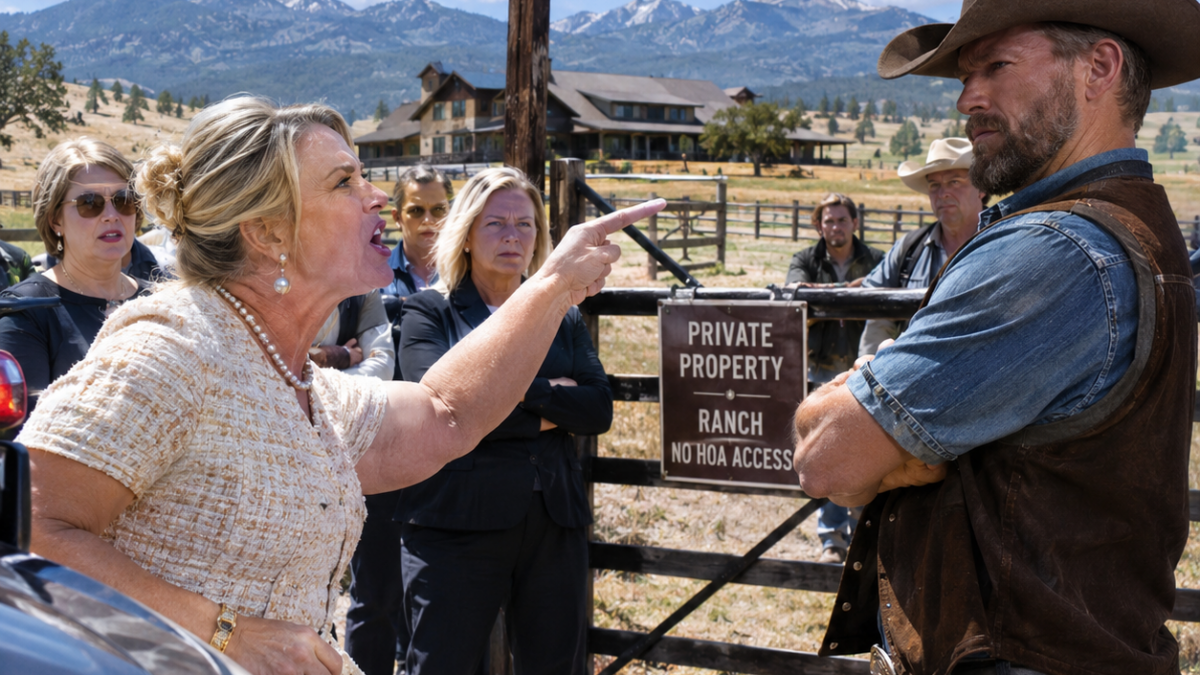
PART 2
The mower had stopped.
The eastern pasture was quiet again.
But the silence felt wrong.
Not peaceful.
Occupied.
I walked through the farmhouse turning on lights Walter had probably turned off for the last time.
Everything smelled exactly as I remembered.
Coffee.
Old wood.
Leather.
Dust.
His coat still hung beside the back door.
There was a half-finished crossword on the kitchen table.
A chipped blue mug sat upside down beside the sink.
For one irrational second, I expected to hear his boots coming down the hallway.
Then I remembered why I was there.
I sat at his kitchen table and read the will again.
There was no ambiguity.
The ranch passed to me in its entirety.
No reference to an HOA.
No recreational easement.
No donated acreage.
No shared-use agreement.
Nothing.
At about nine that night, I went to the garage.
Walter kept a gray metal filing cabinet against the far wall.
When I was a kid, he treated that cabinet like a bank vault.
Taxes.
Insurance.
Deeds.
Receipts.
Cattle records.
Every important piece of paper in his life went into a labeled folder.
I opened the first drawer.
Then the second.
The third contained a folder marked in his handwriting:
PROPERTY
Inside were survey maps, title documents, tax assessments, old photographs of fence lines, and a notebook page dated three years earlier.
I recognized Walter’s writing immediately.
Shakier than when I was young.
But precise.
I read it standing under the yellow garage light.
Margaret Price asked to buy the east section. I refused. She mentioned an existing agreement. I told her I never signed anything. She said it didn’t matter, that the paperwork was already filed. She’s been using my land for years without permission. They’re trying to steal what’s mine.
I read it again.
Then a third time.
The garage seemed to shrink around me.
I sat on an overturned bucket.
Walter knew.
He had known for years.
He hadn’t donated the property.
He hadn’t joined anything.
He hadn’t signed anything.
And Margaret had apparently told him the paperwork existed whether he agreed or not.
I thought about her expression that afternoon.
Calm.
Practiced.
Confident.
That wasn’t the confidence of someone surprised by an inheritance dispute.
It was the confidence of someone who believed the dispute had already been won.
I stayed in the garage until nearly midnight.
The guilt came first.
Three years.
I hadn’t visited in three years.
Walter had been fighting this alone while I was sitting in conference rooms discussing quarterly projections and complaining about airline delays.
Why hadn’t he called me?
Then I knew.
Because he was Walter.
He had spent his entire life protecting me.
When my parents died, he never once made me feel like a burden.
He never told me about money problems.
Never told me when his hip hurt.
Never told me how lonely the house became after I left for college.
If he thought this land dispute would drag me away from the life I’d built, he would have carried it until it killed him.
Maybe he had.
That thought hurt more than I wanted to admit.
The county recorder’s office opened at eight the next morning.
I was in the parking lot at 7:45.
The clerk who helped me looked old enough to have personally filed half the county.
I gave her the parcel information.
“I need every recorded agreement involving Walter Callahan’s property.”
She disappeared into a back room.
Twenty minutes later, she returned with a manila folder.
One document.
A community land-use agreement dated twelve years earlier.
It was exactly what Margaret had shown me.
The agreement claimed Walter had designated approximately sixty acres of his eastern property as permanent shared recreational land for Sunset Valley HOA.
I skipped to the bottom.
There was his name.
Walter Callahan.
Signed in blue ink.
I stared.
Something was wrong.
Then I understood.
Walter had suffered a minor stroke four years before his death.
His handwriting changed afterward.
The signature on the agreement was smooth.
Strong.
Confident.
The Walter of twelve years ago could have written like that.
So at first, nothing seemed unusual.
But I had spent enough years as a financial analyst reviewing contracts, signature cards, and historical records to know one thing:
Forgery isn’t always copying how someone writes now.
Sometimes it’s copying how people remember they used to write.
I pulled out my phone and opened the photographs I’d taken of older family documents.
Then I called the estate lawyer.
“Send me scans of everything Walter signed around the date of that HOA agreement.”
There was a pause.
“Why?”
“I’ll explain later.”
An hour afterward, the scans hit my inbox.
Tax documents.
A loan satisfaction.
An agricultural lease.
All from the same year.
I put them side by side.
The signature on the HOA agreement wasn’t just cleaner.
The capital W was different.
Walter always hooked the final stroke upward.
The agreement didn’t.
His double L leaned slightly right.
The agreement’s stood straight.
The name looked like Walter Callahan.
But it didn’t move like him.
I ordered a certified copy.
When I returned to the ranch, I found a white pickup blocking the driveway.
A man leaned against the hood.
Forties.
Broad shoulders.
Contractor’s vest.
SHAW CONSTRUCTION stitched across the back.
He straightened when I stopped.
“Mr. Callahan.”
I got out.
“And you are?”
“Derek Shaw. Vice president of Sunset Valley HOA.”
I looked at the truck.
“You’re blocking my house.”
He ignored that and handed me an envelope.
“Mrs. Patterson saw you driving toward the county seat this morning. We thought we’d save you some confusion when you came back.”
That sentence bothered me.
“Mrs. Patterson saw me?”
“Small community.”
I opened the envelope.
Three violation notices.
Unauthorized parking.
Moving boxes visible from the road.
Unauthorized occupancy of a structure inside a shared-use area.
Total fines:
Five hundred dollars.
I looked at him.
“You’re fining me for living in the house I inherited?”
“You’re occupying a structure inside disputed community land.”
“The farmhouse isn’t even on the sixty acres.”
He shrugged.
“Boundary interpretation is complicated.”
“No. Survey maps are complicated. Boundaries aren’t.”
His smile vanished.
“Pay the fines within thirty days.”
I stepped closer.
“Move your truck.”
For a moment, neither of us moved.
Then Derek slowly pushed himself away from the hood.
“Your grandfather made life harder than it needed to be.”
My hands curled.
“What does that mean?”
“It means older people sometimes get attached to things.”
“This ranch?”
“Land changes, Mr. Callahan. Communities grow. People make compromises.”
“My grandfather didn’t.”
Derek looked at me for several seconds.
“Maybe that’s why he spent his last years angry and alone.”
The words landed exactly where he intended them to.
I wanted to hit him.
I didn’t.
Instead, I stepped back and looked at the white pickup.
Company logo.
Dent on the right bumper.
Partial plate.
I stored it all automatically.
Then I met his eyes.
“Move the truck.”
This time, he did.
That evening, I saw the elderly man from the picnic walking along County Road 12.
I recognized him immediately.
The frightened one.
I walked out toward him.
He slowed.
“You’re Walter’s grandson.”
“Owen.”
“Edgar Quinn.”
The name clicked.
Walter had mentioned Edgar in letters for years.
Best friend.
Retired rancher.
Fishing partner.
Occasional poker cheat.
I extended my hand.
“You knew my grandfather.”
“Forty-three years.”
His voice cracked slightly on the number.
“I’m sorry I didn’t come to the funeral.”
“Why didn’t you?”
He glanced toward the road.
Not toward me.
Toward the road.
Like he was checking whether someone was watching.
“I didn’t think it was wise.”
That told me everything.
“Edgar.”
He swallowed.
“Your grandfather never signed that agreement.”
I didn’t answer.
“He told me. Many times.”
“Then why didn’t you say anything yesterday?”
His face tightened.
“Because I’m a coward.”
“I didn’t say that.”
“You didn’t have to.”
He looked toward the pasture.
“Margaret showed up years ago telling Walter the papers had already been filed. Said fighting it would cost more than the land. He fought anyway.”
“How?”
“Letters. County offices. Lawyers when he could afford them. Complaints.”
“And nothing happened?”
“Margaret has friends.”
“What kind of friends?”
“County people. Contractors. Business owners. People who like Sunset Valley money.”
Edgar lowered his voice.
“Your grandfather wasn’t the first.”
That changed everything.
He told me about the Henderson family.
Forty acres next to Sunset Valley.
Complaints.
Fines.
Legal threats.
Eventually they sold below market just to escape.
Then the Morales family.
Their equipment was vandalized.
Their barn spray-painted.
They moved to New Mexico.
Then the Dawsons.
An elderly couple.
Legal letters.
Anonymous calls.
Night after night.
Eventually they signed papers they didn’t understand.
Edgar rubbed his face.
“Margaret and Derek expand that development one scared family at a time.”
“You’re saying they steal property.”
“I’m saying I’ve watched land move from old people into companies connected to Derek Shaw.”
“Why hasn’t anyone stopped them?”
Edgar laughed without humor.
“Because everyone thinks they’re the first victim.”
He looked at me.
“That’s how people like Margaret survive. Isolation.”
That night, I went through Walter’s files again.
At the bottom of the property folder, I found a sealed envelope.
Addressed to a law firm in Austin.
Eighteen months old.
Walter had written the letter but never mailed it.
I opened it.
He described the forged agreement.
The harassment.
The HOA crews entering his land.
The threats.
He asked whether the firm could help him challenge the filing.
The final paragraph made my throat close.
I’m seventy-six years old. I don’t know how long I can keep fighting these people. I have a grandson in Denver. I don’t want to drag him into this unless I have to.
I put the letter down.
For several minutes, I couldn’t move.
I had spent three years believing Walter was fine because he told me he was fine.
He had spent those same three years protecting me from this.
I looked around his kitchen.
The chair where he ate alone.
The phone he could have used to call me.
The desk where he wrote letters he never mailed.
My anger changed shape.
It stopped being hot.
It became focused.
I opened my laptop.
I found the number for Miranda Vance, a property attorney in Austin with a reputation for taking ugly land disputes personally.
It was late.
I expected voicemail.
She answered.
“Vance.”
“My name is Owen Callahan.”
“What can I do for you?”
“I inherited a ranch.”
“Congratulations.”
“An HOA claims sixty acres belong to them.”
“That’s less congratulatory.”
“They have an agreement my grandfather said he never signed.”
Silence.
I continued.
“They’ve been using the property for twelve years. I’ve found records suggesting they pressured other elderly owners to sell. I’ve been threatened. Fined. Watched. And I think the agreement is forged.”
Her tone changed completely.
“Start from the beginning.”
So I did.
Three days later, Miranda arrived at the ranch.
She drove a black SUV and wore the expression of someone permanently unimpressed by intimidation.
She spent an hour reading Walter’s files.
She said almost nothing.
She made notes.
Turned pages.
Compared dates.
Read the unmailed letter twice.
Finally she looked up.
“This isn’t an HOA dispute.”
“What is it?”
“Potential fraud. Forgery. Possibly elder exploitation.”
She tapped the land-use agreement.
“And if this connects to the other owners you mentioned, possibly a pattern.”
“Can we prove it?”
“We’re going to find out.”
We spent the next two days in records.
Miranda knew where paperwork hid.
County transfers.
Corporate filings.
Lien releases.
Business registrations.
Tax records.
Four neighboring properties had similar “community-use agreements.”
All four owners had been older.
All had lived alone or nearly alone.
Henderson.
Morales.
Dawson.
And Helen Cross.
Helen’s property caught Miranda’s attention.
Sixty-three acres.
Transferred eight years ago.
Sold less than two years later.
Buyer:
A company with ties to Derek Shaw.
Miranda leaned back.
“This is not coincidence.”
I pulled records for the other properties.
Three had eventually sold at forty to sixty percent below market value.
Two buyers were shell entities controlled by Derek.
The third went to a development company that later awarded Shaw Construction more than two million dollars in contracts.
There it was.
Margaret controlled the pressure.
Derek controlled the money.
And Walter’s ranch was the largest prize left.
One hundred eighty acres near an expanding residential development.
Worth millions if subdivided.
I felt sick.
Not because I was surprised anymore.
Because I was beginning to understand how long Walter had stood in their way.
We located Helen Cross in San Marcos.
Sixty-eight years old.
Small apartment.
Chain on the door.
She studied me for nearly thirty seconds before letting me speak.
“I don’t talk about Dry Creek.”
“My grandfather was Walter Callahan.”
Her eyes changed.
“You should go.”
“Please.”
“I said I don’t talk about it.”
“They did it to him too.”
She stopped.
I told her about the forged agreement.
Margaret.
Derek.
The other properties.
When I finished, Helen’s hand was still on the door.
“What happens when you lose?”
The question caught me off guard.
“What?”
“When they bury you in legal bills. When somebody breaks your windows. When your phone rings at three in the morning. When no deputy believes you. When your neighbors stop speaking to you.”
She opened the door slightly wider.
“What happens to me when Margaret wins?”
I wanted to promise she wouldn’t.
But Walter taught me not to promise outcomes you don’t control.
So I said something else.
“If you help us, you won’t be standing alone.”
Helen stared at me.
Then unlocked the chain.
Inside, she told us what happened.
The fines came first.
Then accusations that her fences violated community standards.
Then claims that part of her land had been designated for shared access.
Then vandalism.
Then a lawyer’s letter threatening litigation she couldn’t afford.
Finally an offer arrived.
Two hundred thousand dollars.
Her property was worth roughly double.
“I knew it was wrong,” she whispered. “But I was tired.”
She looked embarrassed.
That angered me more than anything Margaret had done.
Helen thought survival was shameful.
It wasn’t.
“They counted on you being tired,” I said.
Her eyes filled.
“I sold.”
“You survived.”
“I abandoned my land.”
“You survived.”
She looked down.
I asked whether she would testify.
Her hands started shaking.
“They’ll come after me.”
Miranda leaned forward.
“Helen, we’re going to ask a court for protections. We’re going to document everything. And if they retaliate, we’ll add it.”
Helen looked at me.
“Eight years.”
“What?”
“I’ve waited eight years for someone to ask what really happened.”
She nodded once.
“I’ll testify.”
The handwriting expert was George Lawson, a former FBI forensic examiner.
Ten days after he received our samples, he sent his report.
Seven markers.
Seven independent reasons the signature on the community-use agreement did not match Walter’s authentic writing.
Forgery.
Not maybe.
Not suspicious.
Forgery.
Miranda filed suit that afternoon.
Defendants:
Margaret Price.
Derek Shaw.
Sunset Valley HOA.
Three corporate entities.
Claims included fraud, forgery, conspiracy, and unjust enrichment.
By the next morning, Dry Creek knew.
Small towns don’t need news outlets.
They have gas stations.
Hardware stores.
Church parking lots.
And people who suddenly stop talking when you walk into a room.
Two days later, I opened my front door.
A dead coyote was lying on the porch.
Its throat had been cut.
A note was pinned to the fur.
LAST CHANCE.
For a few seconds, I couldn’t breathe.
Then training—not police training, just the analytical discipline Walter drilled into me—took over.
Don’t touch.
Photograph.
Document.
Call.
Deputy Wells arrived.
He had been one of the deputies at the ranch my first day.
He stared at the coyote longer than he needed to.
“This is getting ugly.”
“It was ugly before I arrived.”
He looked toward the road.
Then lowered his voice.
“Mrs. Price has friends.”
“You told me.”
“I’m telling you again.”
“Why?”
“Because I don’t want to write a report about your body.”
I stared at him.
“Are you warning me or threatening me?”
His face changed.
“Warning.”
“Then do your job.”
He flinched.
“I am.”
“No. You’re documenting what happens after they do theirs.”
He looked away.
I regretted the cruelty almost immediately.
Wells wasn’t Margaret.
He was afraid.
That didn’t excuse weakness.
But it explained it.
Two weeks later, Judge Patricia Coleman issued a temporary restraining order.
No HOA employees.
No residents.
No maintenance crews.
No recreational use.
No access to Callahan property without my written permission.
Miranda had the order posted beside Margaret’s community garden sign.
An hour later, Margaret arrived.
I watched from the farmhouse.
She got out of her vehicle.
Read the notice.
Tore it down.
Crumpled it.
Threw it into the dirt.
Then drove away.
I called Miranda.
“She tore the posted order down.”
There was a pause.
Then Miranda said, “Please tell me you recorded it.”
“The security camera did.”
I could hear the smile in her voice.
“Wonderful.”
“Wonderful?”
“Judges have personalities, Owen.”
“And?”
“Judge Coleman doesn’t like having court orders torn off fences.”
Margaret’s response came the next morning.
Emergency HOA notices.
Special meeting.
“LEGAL THREATS AGAINST OUR COMMUNITY.”
I was again described as an outsider.
A wealthy Denver professional.
A man using expensive lawyers to steal community land.
It was clever.
She wasn’t arguing ownership.
She was arguing identity.
Them versus me.
Neighbors versus outsider.
Community versus rich heir.
Facts became secondary.
Fear was easier to sell.
Nearly eighty residents attended.
Margaret raised more than twelve thousand dollars for a “community legal defense fund.”
Then the surveillance intensified.
Vehicles rolled past the ranch late at night.
Headlights swept through my windows.
Rumors spread that I planned to bulldoze the garden and build luxury condominiums.
Someone claimed I had threatened to evict elderly residents.
Someone else claimed developers from Denver had already toured the property.
None of it was true.
Miranda sent cease-and-desist notices.
They ignored them.
But every ignored letter became another entry in the record.
Then came the roadblock.
I was returning from town just before dark.
A white pickup sat across County Road 12.
Headlights off.
Three men stood beside it.
Bandanas covered their faces.
Baseball bats rested on shoulders.
I stopped twenty feet away.
One man walked toward my truck.
“Denver boy.”
I kept my hands on the steering wheel.
“This is your final warning.”
He had a slight limp.
I noticed that.
Another man stood near the pickup.
Silver watch.
Black face.
I noticed that too.
“Sell the land,” the first man said.
I looked at the truck in my side mirror.
Partial plate.
Company fleet sticker had been scraped from the rear quarter panel, but not completely.
“Leave Dry Creek.”
I said nothing.
The man tapped the bat against his boot.
“Next time we won’t talk.”
My heart was pounding hard enough to make my vision pulse.
I wanted to reverse.
I wanted to accelerate.
I wanted to do anything except sit there.
Instead I said, “I hear you.”
That seemed to satisfy him.
They drove away.
Only after their truck disappeared did my hands begin shaking.
I sat in the road for nearly five minutes.
Then I called Deputy Wells.
The next morning I gave him every detail.
Plate.
Limp.
Watch.
Truck.
Timing.
He wrote slowly.
“Without identification—”
“Don’t.”
He stopped.
“I know what you’re going to say.”
“Owen—”
“They covered their faces. That’s why you investigate.”
His shoulders dropped.
Then he said quietly, “Some fights aren’t worth dying for.”
I stood.
“My grandfather died believing nobody would help him.”
Wells looked at the desk.
“I’m not going to prove him right.”
That evening, I came close to leaving.
I won’t pretend otherwise.
Courage sounds cleaner in hindsight.
In the moment, courage mostly feels like fear you’re refusing to obey.
I sat in Walter’s kitchen.
The window that had been broken earlier was still patched.
The property file sat on the table.
The dead coyote report.
The threat note.
Photographs.
Legal filings.
I imagined driving back to Denver.
Selling the ranch.
Taking the money.
Returning to my clean apartment.
My secure office.
My predictable life.
No gray sedan.
No baseball bats.
No dead animals.
Then I saw Walter’s unmailed letter.
I read the last line again.
I don’t want to drag my grandson into this unless I have to.
He hadn’t dragged me.
He had tried to save me.
There is a difference.
And that was exactly why I couldn’t leave.
Edgar came to the ranch the following Sunday.
He brought beer.
He also brought a confession.
We sat on the porch until sunset.
Finally he said, “There’s something else.”
I looked at him.
“How bad?”
“Bad.”
He stared at his bottle.
“Margaret leased Walter’s land.”
I sat forward.
“What?”
“A farming company out of Austin has been using part of the eastern acreage.”
“I know somebody was farming sections.”
“They pay for it.”
“To who?”
Edgar’s jaw tightened.
“The HOA.”
I went still.
“How much?”
“Fifteen thousand a year.”
“How long?”
“At least ten years.”
I calculated automatically.
One hundred fifty thousand dollars.
“Did Walter know?”
“Not until about three years ago. He intercepted a payment notice.”
“Where’s the money?”
Edgar shook his head.
“Ask Margaret.”
Miranda amended the lawsuit.
The farming company cooperated immediately once they realized the land hadn’t legally belonged to the HOA.
They produced ten years of agreements.
Payments totaled one hundred forty-seven thousand dollars.
All authorized by Margaret.
All deposited into an account she controlled.
None distributed to Walter.
None documented as community improvement spending.
Miranda requested a forensic audit.
Margaret’s lawyers fought it.
Judge Coleman ordered it anyway.
By then, Margaret’s public image had started to crack.
Court filings were public.
Someone sent them to a local news site.
The story changed overnight.
I was no longer merely the Denver heir fighting a garden.
Now people were reading words like:
FORGED SIGNATURE
UNDISCLOSED RENTAL INCOME
ELDERLY LANDOWNERS
SHELL COMPANIES
At the grocery store, a woman who had refused to look at me the previous week gave me a small nod.
At the gas station, a man asked quietly, “Is it true about the rent money?”
“I can’t discuss the case.”
He nodded.
But his face told me he had already decided something.
Edgar reported that Sunset Valley meetings were shrinking.
Residents stopped contributing to Margaret’s legal fund.
Margaret and Derek were seen arguing outside the community center.
Pressure does strange things to partnerships built on mutual benefit.
When everything works, conspirators call each other friends.
When the walls move inward, they start calculating who can save themselves first.
Margaret announced a town hall.
“Transparency.”
“Open discussion.”
“A chance to correct misinformation.”
Miranda read the notice.
“She’s losing control.”
“Then why give her a microphone?”
“Because people who are losing control often say things people with control would never say.”
The community center held about sixty people comfortably.
More than a hundred came.
Miranda sat beside me.
Helen Cross sat two rows behind.
Edgar stood along the wall.
Deputy Wells stayed near the rear door.
Margaret walked to the podium.
She looked composed again.
Silver hair perfect.
Voice warm.
Derek sat in the front row.
“Everything I have done,” Margaret began, “I have done for this community.”
There it was.
The sentence people use when they want intention to erase conduct.
She talked about gardens.
Shared spaces.
Community pride.
Volunteer hours.
Her sacrifices.
How difficult leadership was.
How painful it had been to watch outsiders attack Sunset Valley.
She never mentioned the audit.
Never mentioned the rent.
Never mentioned Helen.
Never mentioned Walter’s letter.
When she finished, her supporters applauded.
The rest of the room barely moved.
I stood.
“Mrs. Price.”
She looked at me.
“I’d like to respond.”
“This is an HOA meeting. You are not a member.”
Miranda stood beside me.
“Your bylaws incorporate Robert’s Rules. Mr. Callahan has a direct material interest in the subject under discussion. Denying him an opportunity to address allegations regarding his property will be noted in pending litigation.”
Margaret stared at her.
Then at Derek.
He shrugged.
“Five minutes,” Margaret said.
I walked to the front.
My legs felt steady.
My heart didn’t.
I placed George Lawson’s handwriting report on the podium.
“This document was prepared by a former FBI forensic handwriting examiner.”
People leaned forward.
“He identified seven distinct differences between my grandfather’s authentic handwriting and the signature on the agreement your HOA claims he signed.”
Margaret interrupted.
“That report is disputed.”
I placed another document down.
“This is the lease agreement between Sunset Valley HOA and an Austin farming operation.”
Silence.
“It covers Callahan property.”
I looked around the room.
“Over ten years, the company paid approximately one hundred forty-seven thousand dollars for access.”
Someone whispered, “What?”
I continued.
“Not one dollar was paid to Walter Callahan.”
Margaret stepped toward the microphone.
“Those funds were used for community purposes.”
Miranda’s head lifted.
I turned.
“Then show us the accounting.”
Margaret stopped.
“The matter is subject to litigation.”
“Then let’s discuss something simpler.”
I placed the transfer records on the table.
“Four other elderly landowners had similar agreements.”
Derek shifted.
“Three sold shortly afterward for significantly below market value.”
Someone in the audience stood.
“Who bought?”
I answered.
“Two properties went to companies controlled by Derek Shaw.”
Derek’s face changed.
“That’s defamatory.”
“It’s from county records.”
Another voice:
“What about the third?”
“A developer that later awarded Shaw Construction more than two million dollars in contracts.”
The room erupted in murmurs.
Margaret hit the microphone.
“Enough.”
Then Helen stood.
I turned.
Her hands were shaking.
Her voice wasn’t.
“My name is Helen Cross.”
The room quieted.
“I owned sixty-three acres outside Dry Creek.”
Margaret’s face drained.
Helen continued.
“I did not sign a community-use agreement.”
Nobody moved.
“They told me the paperwork had already been filed. They told me I’d lose everything if I fought.”
Her voice cracked.
“They vandalized my property.”
A woman covered her mouth.
Helen looked directly at Margaret.
“I sold for two hundred thousand dollars because I was afraid.”
Margaret gripped the podium.
Helen’s eyes filled with tears.
“My land was worth twice that.”
A man in the back shouted, “Open the books.”
Another voice:
“Where did the rent money go?”
Then another:
“Why didn’t we know about any of this?”
Questions multiplied.
Margaret’s face changed.
Not into guilt.
Into fury.
“You have no idea what I’ve done for this community!”
The room quieted again.
She pointed toward residents.
“You all sit there and complain while people like me do the work!”
Derek rose.
“Margaret.”
She ignored him.
“Who dealt with the county? Me. Who fought developers? Me. Who built the recreation program? Me.”
“Margaret,” Derek repeated.
Her voice rose.
“That money paid for what needed to be paid!”
Miranda leaned slightly toward me.
Margaret continued.
“And if some signatures weren’t perfect—”
Derek froze.
The room did too.
Margaret realized too late.
She tried to recover.
“If procedures weren’t followed exactly, that doesn’t change the fact that the land benefits everyone.”
Nobody spoke.
Not one sound.
Derek stepped backward.
Deputy Wells pulled out his notebook.
Margaret looked around.
Faces that had trusted her for years now looked horrified.
She swallowed.
“That isn’t what I meant.”
Helen whispered, “Yes, it is.”
Margaret grabbed the microphone.
“This meeting is adjourned.”
Nobody moved.
For fourteen years, Margaret Price had controlled that room by controlling when people could speak.
That night, the room stopped obeying.
Residents surrounded board members.
Demanded records.
Demanded resignations.
Demanded audits.
Derek moved toward the exit.
Edgar stepped into the aisle.
He didn’t touch him.
He only said, “Running won’t help.”
Derek stopped.
For a second, the two men stared at each other.
Then Derek looked away.
Miranda leaned close to me.
“We have witnesses.”
“To what?”
“Her statement about the signatures.”
I looked toward Wells.
He was still writing.
Miranda continued.
“And the deputy heard it.”
Seventy-two hours later, the district attorney opened a formal investigation.
HOA accounts were frozen.
An independent auditor was appointed.
Margaret hired a criminal attorney from Houston.
Derek hired a different one.
They stopped appearing together.
Three weeks later, the audit arrived.
Forty-seven pages.
Two hundred eighty thousand dollars transferred out of HOA-controlled accounts over twelve years.
Some into Margaret’s personal accounts.
Some into accounts tied to Derek’s construction company.
Rental money.
Fines.
Donations.
Maintenance funds.
Legal-defense contributions.
Residents read the report in stunned silence.
The board held an emergency meeting.
Margaret was removed unanimously.
Derek resigned before they could vote.
Edgar Quinn became interim president.
His first public statement was an apology.
Not a lawyer’s apology.
Not “mistakes were made.”
A real one.
“Sunset Valley failed Walter Callahan.”
He paused.
“We failed Helen Cross, the Hendersons, the Morales family, the Dawsons, and other owners who were treated as obstacles instead of neighbors.”
Then he said something that mattered more to me.
“We will stop hiding records.”
All HOA financial documents were opened to members.
The system that had protected Margaret began exposing her.
The arrests came on a Tuesday.
I didn’t watch Margaret get handcuffed.
I heard about it afterward.
Six in the morning.
Neighbors watching from porches.
Derek was arrested at a construction site an hour later.
Document fraud.
Embezzlement.
Elder exploitation.
Conspiracy.
Multiple theft-related counts.
Then investigators came back to the roadside threat.
The white pickup.
I had remembered part of the plate.
That mattered.
Records connected the vehicle to Shaw Construction.
Derek had reported it stolen two days before the ambush.
It had been “recovered” three days afterward.
Convenient.
Too convenient.
Phone records placed Derek’s nephew near County Road 12 that evening.
Investigators questioned him.
He broke.
Derek had ordered the intimidation.
The nephew identified the other men.
The watch.
The limp.
The baseball bats.
The threats.
Everything that had been designed to make me feel powerless became evidence.
Additional charges followed.
Threatening.
Witness intimidation.
Conspiracy.
The man who handed me five hundred dollars in HOA fines during my first week on the ranch was now looking at prison.
But the moment that surprised me most came afterward.
People started apologizing.
Not all at once.
Slowly.
Awkwardly.
A woman came to my porch.
I recognized her from one of the online community groups.
She had called me a con artist.
Now she was crying.
“Margaret told us you were going to force elderly people from their homes.”
I said nothing.
“I believed her.”
“I know.”
“I helped spread it.”
“I know.”
She wiped her face.
“I’m sorry.”
I believed her.
The hardware store owner came next.
He brought whiskey.
He tried to apologize three times before getting through it.
“I’m not asking you to forgive me.”
“I know.”
“I should’ve treated you better.”
“Yes.”
He looked surprised.
I smiled slightly.
“You’re allowed to say it.”
He laughed once.
Then almost cried.
Miranda asked whether I wanted to sue the community.
Legally, there were options.
The HOA could face civil liability.
Individual residents who participated in harassment might be named.
I could seek damages for vandalism, defamation, emotional distress, trespass, and more.
“How far do you want to take this?” Miranda asked.
We were sitting at Walter’s kitchen table.
The same table where I had considered leaving.
“Margaret and Derek.”
“Definitely.”
“Helen?”
“We’re seeking recovery for her.”
“Hendersons?”
“Yes.”
“Dawsons?”
“Their children are involved.”
I nodded.
“What about the HOA?”
Miranda watched me carefully.
“That’s your decision.”
I thought about the woman crying on my porch.
The hardware store owner.
The residents who had donated twelve thousand dollars because they believed their community was being stolen.
They had been manipulated.
Some had also been cruel.
Both things could be true.
“If I sue everyone, what happens?”
“Years of litigation.”
“Financially?”
“The HOA’s insurance may cover some. Dues could rise. Assessments are possible.”
“Meaning retirees and families pay.”
“Potentially.”
“Margaret stole from them too.”
“Yes.”
I looked out the window.
Walter had fought to keep his land.
Not to destroy everyone who lived nearby.
“Full damages from Margaret and Derek.”
Miranda nodded.
“And the community?”
“No.”
“You’re certain?”
“Yes.”
She closed her notebook.
“Why?”
“Because revenge has bad math.”
That made her smile.
“Spoken like an analyst.”
“I don’t want to spend five years making frightened people poorer.”
She studied me.
“Your grandfather would approve.”
I looked at Walter’s chair.
“I hope so.”
Edgar visited three nights later.
He brought bourbon.
We sat on the porch while the sun dropped behind the pasture.
“I heard what you decided.”
“News travels.”
“In this town? Faster than electricity.”
He poured two glasses.
“Most people would take everything they could.”
“I already have what I came for.”
He looked toward the fields.
“The ranch.”
“Yes.”
He raised his glass.
“To Walter.”
I raised mine.
“To Walter.”
We drank.
Then Edgar said, “He chose well.”
“What?”
“Leaving it to you.”
That almost broke me.
I looked toward the creek so Edgar wouldn’t see my face.
“He shouldn’t have had to fight alone.”
“No.”
“I should’ve been here.”
Edgar waited.
Then he said, “Owen.”
I looked at him.
“Don’t turn loving him into another weapon against yourself.”
I didn’t answer.
“He knew you loved him.”
“He wrote a letter asking for help and never mailed it.”
“He didn’t mail it because he loved you.”
“That doesn’t make me feel better.”
“It’s not supposed to.”
He took another drink.
“It’s supposed to make you understand him.”
The sentencing hearings happened six months after I arrived.
The courthouse was packed.
Helen sat beside me.
The Henderson family came back to Dry Creek.
The Dawson children attended for parents who had died believing they’d failed.
Margaret entered wearing an orange jumpsuit.
I barely recognized her.
The confidence was gone.
The polished HOA-president posture.
The silver-haired woman who had waved away my grandfather’s will as though she owned the ground beneath us.
Gone.
Judge Coleman read the sentence.
Four years in state prison.
Six years supervised probation afterward.
One hundred fifty thousand dollars in fines.
Three hundred twenty thousand dollars in restitution.
Permanent prohibition from serving on an HOA board in Texas.
Helen squeezed my hand.
Margaret didn’t look back.
Derek followed.
Three years in state prison.
Five years probation.
Seventy-five thousand dollars in fines.
One hundred eighty thousand dollars in restitution.
His contractor’s license permanently revoked.
When the bailiffs turned him toward the side door, Derek looked at the gallery.
Not at me.
At the neighbors.
People who hired him.
Trusted him.
Defended him.
He saw something there.
Whatever it was, he looked away immediately.
Some sentences are delivered by judges.
Others are delivered without words.
Two weeks later, the civil case ended.
Judge Coleman voided the fraudulent land-use agreements.
The sixty acres became legally and unquestionably part of the Callahan ranch again.
Helen received compensation.
The Henderson family received damages.
The Dawson children accepted a settlement tied to their parents’ losses.
No outcome could give everyone back the years they’d lost.
No check could erase fear.
No court order could return the homes people had been pressured to sell.
Justice doesn’t rewind time.
At best, it forces the future to stop repeating the past.
Sunset Valley rewrote its bylaws.
Independent legal review for land agreements.
Quarterly financial disclosures.
Term limits.
Stricter conflict-of-interest rules.
Open accounting.
Edgar remained president for eight months.
Then he stepped down.
“I’m seventy-eight,” he told me. “I have spent enough of my life sitting in rooms listening to people argue about parking.”
He helped elect a younger board.
Then returned to fishing.
I spent that summer repairing the ranch.
Fences.
Barn roof.
Irrigation.
Walter had left a list taped inside the workshop.
Half the jobs were years overdue.
One morning, the hardware store owner pulled into my driveway with his two sons.
The back of their truck was loaded with lumber.
“What’s this?”
“Barn roof.”
“I didn’t order anything.”
“No.”
“You expect me to pay?”
He shook his head.
“We owe you.”
“You don’t.”
He looked past me toward the barn.
“We owed Walter.”
That silenced me.
They worked for three days.
On the last evening, the owner stood beside his truck.
“We should’ve helped him.”
I looked at the repaired roof.
“Then help the next person.”
He nodded.
That was enough.
By August, I had almost finished probate.
The estate attorney reminded me there were boxes in the attic that needed inventory.
I’d avoided them.
Old photographs.
Receipts.
Clothes.
The physical leftovers of a life.
One Thursday afternoon, I climbed the attic ladder.
Dust floated through the sunlight.
I worked slowly.
Photo albums.
Tax receipts from the seventies.
My mother’s school pictures.
A tiny baseball glove that had been mine.
Then I found an envelope.
My name was written across the front.
OWEN
Walter’s handwriting.
The postmark had been purchased three months before his death.
The envelope was stamped.
Never mailed.
I sat on the attic floor.
My hands were shaking before I even opened it.
The letter was two pages.
He began with ordinary things.
Weather.
A fox near the creek.
A fence post that needed replacing.
He told me not to feel guilty for being busy.
Then I reached the final paragraphs.
I had to stop reading.
Then start again.
I know you’ll come here someday, probably after I’m gone.
My throat tightened.
I know you’ll find the mess I’ve left behind. I’m sorry for that. I tried to fix it, but I ran out of time.
I pressed my hand against my mouth.
If you’re reading this, it means you’ve decided to stay and fight. I knew you would. You’re stubborn like me.
I laughed once through tears.
Then I read the line that changed everything.
Just remember that winning isn’t the only thing that matters. How you win matters too.
I closed my eyes.
All those months.
The anger.
The threats.
The temptation to hurt everyone who had hurt Walter.
The decision not to sue the entire community.
I read on.
Don’t let them turn you into something you’re not. Keep the land. Keep your integrity. And when it’s over, try to forgive the people who didn’t know any better.
I had to put the letter down.
For a long time, I sat among dusty boxes and cried like I hadn’t cried at Walter’s funeral.
Because suddenly he wasn’t gone.
He was talking to me.
Not warning me about Margaret.
Not giving legal instructions.
Not telling me where to find another document.
He was still raising me.
Even after death.
I folded the letter carefully.
Put it in my shirt pocket.
Then climbed down.
I walked through the house.
Out the back door.
Across the yard.
Toward the eastern pasture.
The HOA sign was gone.
The garden plots had been removed.
The grass had grown over the disturbed soil.
I followed the fence toward the pond.
Late summer sunlight turned the water gold.
A hawk circled above the field.
The ranch was quiet.
Really quiet.
Not the fearful silence from my first night.
Peace.
I stood where Margaret had first blocked my path.
I remembered the clipboard.
Her dismissive smile.
“Your grandfather was cooperative.”
“His memory wasn’t what it used to be.”
I almost laughed.
Walter had remembered everything.
Every acre.
Every fence.
Every injustice.
And somehow, even while losing strength, he had remembered one more thing.
Me.
I pulled the letter from my pocket.
Read the final paragraph again.
For months, I had believed the ranch was my inheritance.
One hundred eighty acres.
A farmhouse.
Barns.
Water rights.
Land worth millions.
I was wrong.
Those were assets.
The inheritance was the decision Walter had placed in my hands.
What kind of man would I become once I had enough reason to hate someone?
That had been the real fight.
Margaret lost her position.
Lost her reputation.
Lost her freedom.
Derek lost his business.
His license.
His freedom.
Their scheme collapsed.
The land returned.
The victims were compensated.
By every ordinary measure, I had won.
But Walter’s letter forced me to ask whether I had won without becoming cruel.
That question mattered more.
I stayed at the ranch.
At first I told myself it was temporary.
I could work remotely several days a week.
Travel when necessary.
Maintain my Denver apartment.
But every time I returned to the city, I missed the silence.
The real silence.
The creek at sunrise.
The sound of rain on the barn roof.
The way the stars looked without city lights.
Eventually, I gave up the apartment.
My coworkers thought I’d lost my mind.
Maybe I had.
I turned one of the upstairs bedrooms into an office.
Fiber internet came far enough down County Road 12 that I could spend mornings reviewing financial models and afternoons repairing fences.
Walter would have found that hilarious.
“Fourteen years in finance,” I imagined him saying, “and you finally learned how to use a post driver.”
Edgar came over often.
Sometimes we fished.
Sometimes we sat without talking.
Helen visited once in the fall.
She stood beside the pond.
“I forgot what open land smelled like.”
I didn’t know what to say.
She looked toward the eastern pasture.
“Do you hate her?”
“Margaret?”
“Yes.”
I thought for a moment.
“No.”
Helen studied me.
“I did.”
“Did?”
“For years.”
“What changed?”
She looked at the water.
“Prison didn’t give me my land back.”
“No.”
“Money didn’t give me eight years back.”
“No.”
She smiled sadly.
“So I decided she had already taken enough.”
Walter would have liked Helen.
A year after everything ended, Sunset Valley invited me to a community meeting.
I almost declined.
Edgar insisted.
“You’re going.”
“I’m not a member.”
“Neither am I anymore.”
“Then why are you ordering me?”
“Because I’m older.”
That was his favorite argument.
I went.
The community center looked different.
Same walls.
Same folding chairs.
Different atmosphere.
Financial reports were printed on a table by the entrance.
Board minutes available.
Property maps displayed openly.
The new president, a woman named Lisa Moreno, started the meeting by reviewing expenditures.
Actual numbers.
Actual invoices.
Questions were invited.
One man asked why landscaping expenses had increased.
Lisa pulled up the contract.
Nobody attacked him for asking.
Nobody called him disloyal.
Nobody told him the details were too complicated.
That simple interaction affected me more than I expected.
Afterward, Lisa approached.
“I wanted you to see this.”
She handed me a folder.
Inside was a newly adopted policy.
No HOA officer could negotiate a land transaction with a non-member property owner without independent counsel and a recorded board vote.
“Edgar helped draft it.”
“Of course he did.”
She smiled.
“We can’t undo what happened.”
“No.”
“But we can make it harder to happen again.”
I handed the folder back.
“That’s enough.”
She shook her head.
“People here still feel ashamed.”
“They shouldn’t.”
“Some of them treated you terribly.”
“Some did.”
“Why aren’t you angry?”
I thought about Walter’s letter.
“Because anger did its job.”
She looked confused.
“It got me through the fight. I don’t need it anymore.”
That evening, I drove home slowly.
Sunset Valley’s entrance sign passed in my mirror.
For the first time, I didn’t feel anything when I saw it.
No anger.
No suspicion.
No urge to prove something.
Just a neighborhood.
People trying to do better than the people before them.
That was when I knew the fight was actually over.
Not when Margaret was arrested.
Not when the judge sentenced her.
Not when the deed was corrected.
When I could drive past without carrying her with me.
Years from now, someone will probably buy one of those Sunset Valley houses without knowing any of this happened.
They’ll complain about dues.
Argue about landscaping.
Maybe get annoyed because the board sends too many emails.
They may never know that a woman once controlled the association so completely that elderly landowners were convinced they had no choice but to surrender what belonged to them.
That’s fine.
Not every scar needs a monument.
Sometimes the best evidence that something healed is that ordinary life returns.
My ranch became ordinary again too.
Cattle returned to the eastern pasture.
I restored Walter’s old fishing dock.
The barn got a new roof.
One spring morning, I found a family of ducks nesting beside the pond.
For almost two weeks, I avoided that side of the water so I wouldn’t disturb them.
Then I realized how absurdly protective I’d become.
Walter had been the same way.
He once rerouted an entire fence because a meadowlark had built a nest near a post hole.
“You don’t own everything just because it’s on your land,” he told me.
At twelve, I thought that sounded ridiculous.
At thirty-seven, I finally understood.
Ownership comes with limits.
Stewardship.
Responsibility.
The right to keep others from taking what is yours doesn’t mean the right to treat everything as though only your desires matter.
That was Margaret’s failure.
She had started by telling herself she was building a community.
Maybe she even believed it in the beginning.
A garden.
A recreation area.
Shared spaces.
Better property values.
But somewhere along the way, “I know what’s best” became “I have the right.”
Then “I have the right” became “the rules don’t apply.”
And eventually, other people’s property became something she believed she could redistribute because she wanted it.
Power rarely announces the exact moment it becomes corruption.
It happens one rationalization at a time.
Derek’s path was simpler.
Money.
Land.
Development.
Contracts.
He saw fear as leverage.
Margaret saw bureaucracy as leverage.
Together they found elderly people with limited resources and convinced them resistance was too expensive.
That was their real weapon.
Not forged signatures.
Not fines.
Not shell companies.
Exhaustion.
They made people tired.
Tired people stop fighting.
Walter nearly did.
Helen did.
The Hendersons did.
Not because they were weak.
Because people are human.
That realization became part of how I managed the ranch.
Whenever a neighboring owner needed access because a bridge washed out, I put agreements in writing.
Clear terms.
Clear dates.
No ambiguity.
When Sunset Valley asked one year to use part of my access road during road repairs, I agreed—with a written temporary license reviewed by both attorneys.
Lisa laughed when she saw how detailed it was.
“Twenty-three pages for six weeks of road access?”
“I have trust issues.”
“Fair.”
The difference was consent.
That’s all Walter had wanted.
To be asked.
To be able to say no.
To have no mean something.
One winter evening, I found Edgar sitting beside the pond alone.
“You planning to steal my fish?”
“Your fish are too smart.”
“They learned from Walter.”
Edgar smiled.
We watched the water.
Then he said, “I still think about what I didn’t do.”
“What?”
“Help him.”
I sighed.
“Edgar.”
“I knew more than I admitted.”
“You were afraid.”
“That’s an explanation.”
“Yes.”
“Not an excuse.”
“No.”
He looked at me.
“You forgave me too easily.”
I picked up a stone and threw it into the pond.
“Maybe.”
He waited.
Then I said, “Would making you miserable help Walter?”
“No.”
“Would it help me?”
“No.”
“Then what’s the point?”
Edgar laughed softly.
“Your grandfather would hate how reasonable you’ve become.”
“I blame him.”
“He’d deny responsibility.”
We sat there until dark.
Before leaving, Edgar stopped beside my truck.
“Owen.”
“Yeah?”
“Thank you.”
“For what?”
“For giving the rest of us a chance to stop being afraid.”
He drove away before I could answer.
That stayed with me.
People like Margaret don’t control communities alone.
Fear completes the structure.
One person is intimidated.
Then another.
Then everyone learns from watching what happens to the first person.
Soon nobody needs to be threatened directly.
They threaten themselves.
They think:
Don’t ask.
Don’t object.
Don’t become a target.
That is how a board president can become something far larger than a board president.
That is also why the night Helen stood up mattered so much.
One frightened person spoke.
Then another.
Then another.
People often imagine courage is contagious because courageous people inspire others.
Sometimes courage is contagious for a simpler reason.
Seeing someone survive speaking tells everyone else they might survive too.
Helen understood that.
Walter never got to see it.
But he started it.
His notes.
His records.
His refusal.
His stubborn insistence that the land was his even when everyone told him resistance was pointless.
He left behind the evidence.
I only carried it the final distance.
That distinction became important to me.
Whenever someone said I “saved” the ranch, I corrected them.
Walter saved it.
I finished the paperwork.
In late summer, almost two years after his death, I replaced the old sign at the ranch entrance.
The original wooden board had rotted.
I could have put anything there.
CALLAHAN RANCH.
PRIVATE PROPERTY.
NO TRESPASSING.
Instead, I had a simple cedar sign made.
CALLAHAN RANCH — EST. 1952
Nothing else.
Edgar helped me mount it.
He stepped back.
“Needs something.”
“What?”
“‘HOA PRESIDENTS WILL BE PROSECUTED.'”
I laughed.
“Too subtle.”
“‘COMMUNITY GARDEN CLOSED PERMANENTLY.'”
“Absolutely not.”
He grinned.
“It was worth trying.”
We finished just before sunset.
I stood beside the road looking at the sign.
My great-grandfather had bought the first acreage in 1952.
Walter expanded it.
My mother grew up there.
I grew up there.
For twelve years, people had tried to convince Walter that pieces of it no longer belonged to him.
Now the title was clear.
The fraudulent agreement void.
Every acre recorded correctly.
I should have felt possessive.
Instead, I felt responsible.
Land outlives people.
Walter understood that.
I was beginning to.
One day, the ranch would belong to someone else.
I didn’t know who.
Maybe children I hadn’t had yet.
Maybe family.
Maybe a conservation trust.
Maybe someone I would never meet.
But while it was mine, my job was simple.
Keep it intact.
Keep the records clean.
Don’t let fear make decisions.
Don’t let anger make me cruel.
And never confuse winning with becoming the person who hurt me.
Walter had managed to put all of that into two pages.
The smartest inheritance I received wasn’t worth a dollar on an appraisal.
I still keep his letter in my wallet.
It’s worn now.
The fold lines have softened.
I made a copy because Miranda told me carrying the original around was “an act of archival violence.”
The original stays locked in the filing cabinet.
Walter’s filing cabinet.
I still call it that.
Some things don’t need new names.
Every once in a while, when work becomes difficult or some dispute makes me want to react instead of think, I pull out the copy.
One sentence always stops me.
How you win matters too.
That is the line Margaret never understood.
She believed the result justified the method.
If land became community property, who cared how the signature got there?
If Sunset Valley grew, who cared who was pressured?
If money funded something she considered important, who cared where it came from?
If an old rancher stood in the way, who cared how exhausted he became?
Walter understood something she didn’t.
A victory built by destroying other people’s rights isn’t victory.
It’s theft with better branding.
And revenge built by becoming cruel isn’t justice either.
That’s why I never regretted refusing to destroy the entire Sunset Valley community.
Could I have made their lives miserable?
Probably.
Could I have forced assessments?
Dragged residents into depositions?
Named everyone who posted a lie about me?
Maybe.
But those people had already spent years inside Margaret’s version of reality.
Some were guilty of cowardice.
Some of cruelty.
Most were guilty of believing the wrong person.
Walter’s final request wasn’t that I excuse them.
It was harder than that.
Forgive the ones who didn’t know better.
So I did.
Not instantly.
Not perfectly.
Forgiveness isn’t forgetting.
It isn’t pretending nothing happened.
It isn’t giving someone access to hurt you again.
Sometimes forgiveness is simply deciding that a person who harmed you no longer gets free rent inside your head.
Margaret no longer lives inside mine.
When I think of her now, I don’t picture handcuffs.
I picture that first afternoon.
Silver hair.
Clipboard.
Standing in my grandfather’s field and telling me his mind had failed.
She thought insulting Walter’s memory would weaken me.
Instead, it gave me the first reason to question everything she said.
I suppose that’s the final irony.
If she’d been polite, if she’d shown me the agreement and said, “I understand this is complicated. Let’s have attorneys review it,” maybe I would have moved slowly.
Maybe weeks would have passed.
Instead, she mocked Walter.
She suggested he had forgotten.
And I knew immediately she didn’t know the man whose name she had forged.
That arrogance destroyed her.
Not me.
Not Miranda.
Not even the audit.
Arrogance.
The belief that everyone else was too stupid, too afraid, too poor, too old, or too busy to check.
Walter checked.
Edgar remembered.
Helen spoke.
Miranda dug.
I followed the money.
Wells finally wrote things down.
Residents demanded records.
The district attorney investigated.
The judge ruled.
No single hero.
No magical moment.
Just enough people finally refusing to look away.
That was how the system corrected itself.
Slowly.
Painfully.
Imperfectly.
But it did.
And on quiet evenings, when the sunset turns the pond orange and the fields go still, I sometimes imagine Walter sitting beside me.
He would probably ask whether I fixed the north fence.
I haven’t.
He’d complain.
I’d tell him I’ll do it next weekend.
He’d say I said that last weekend.
Then maybe, if I were lucky, he’d look across the ranch and nod once.
Walter wasn’t a man who wasted words on praise.
One nod would be enough.
Because the ranch is still here.
The pond is still ours.
The eastern pasture belongs to the Callahan property.
The forged agreement is dead.
The people who built their power by frightening the vulnerable finally learned what happens when their victims stop standing alone.
And I learned something I wish I had understood before Walter died.
Inheritance isn’t always what someone leaves in your name.
Sometimes it’s the fight they couldn’t finish.
Sometimes it’s the truth they kept safe long enough for you to find it.
And sometimes, if you’re fortunate, it’s a final message from the person who raised you, reminding you that the land may be worth millions—
but the kind of man you choose to become while protecting it is worth more.
I came to Dry Creek believing I had inherited 180 acres.
Margaret Price tried to convince me sixty of them belonged to everyone.
Derek Shaw tried to scare me into selling the rest.
They forged documents.
Took rent.
Threatened families.
Used shell companies.
Weaponized an HOA.
And for years, it worked.
Until one stubborn old rancher left behind enough paper for his grandson to follow.
They thought Walter was alone.
They thought I would be too.
They were wrong.
The land stayed.
Their empire didn’t.
And on the eastern pasture where that green “community property” sign once stood, there is nothing now except grass moving in the wind.
Exactly the way Walter wanted it.
Exactly the way he left it to me.
And exactly the way I intend to leave it for whoever comes next.








