PART 2: I Inherited 9,300 Acres on Christmas—Then I Found the HOA Selling $500 Hunting Passes on My Land
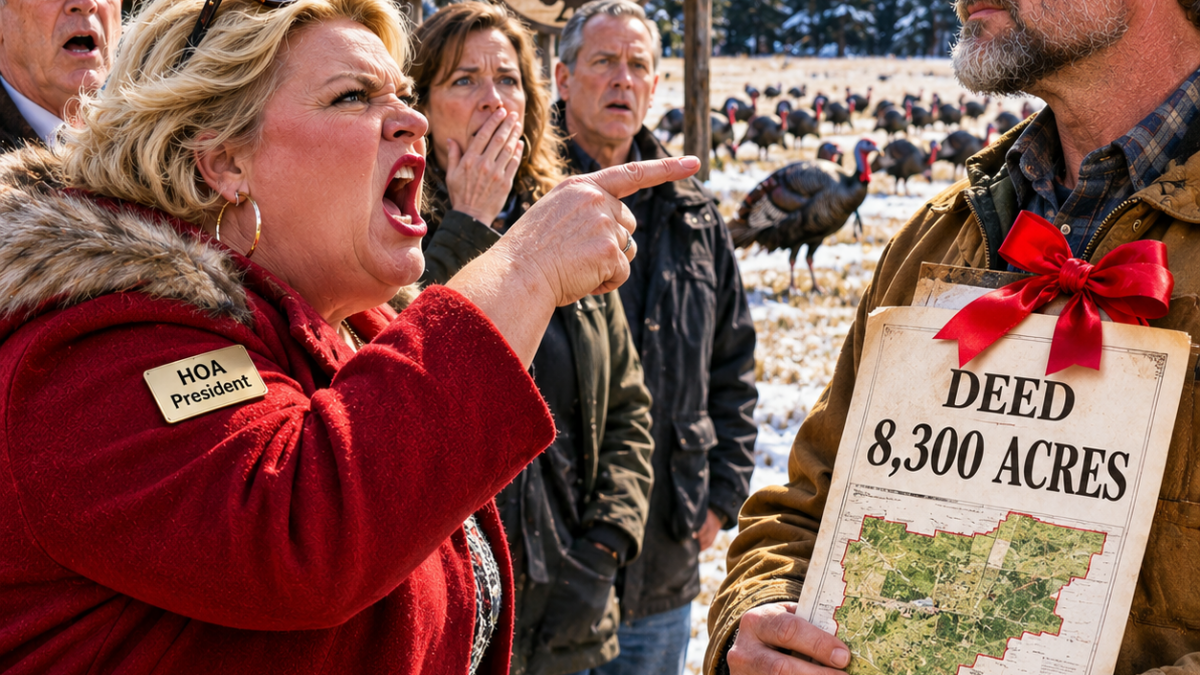
PART 2
Marlo recovered quickly.
People like her usually do.
Confidence becomes a habit.
If you wear it long enough, you stop noticing when the facts underneath it have disappeared.
She lifted one gloved hand toward the clearing.
“Mr. Ror, I understand this looks unusual if nobody explained the arrangement.”
“Then explain it.”
She opened a folder.
Inside were maps.
Maintenance logs.
Invoices.
Photographs of road grading.
Receipts for signs.
Volunteer schedules.
Everything except the one document that mattered.
Permission.
She handed me a laminated map with hunting areas shaded orange.
“This association has maintained the southern access for years.”
I looked at it.
“So?”
“We plow.”
“So?”
“We control traffic.”
“So?”
“We prevent trespassing.”
“You’re selling access.”
“Yes.”
“To land you don’t own.”
Her smile cooled.
“We’ve earned the right to manage it.”
That sentence told me exactly what kind of problem I had.
“Earned.”
“Yes.”
“By doing maintenance nobody asked you to do?”
“That’s an unfair characterization.”
“How many passes did you sell?”
She glanced toward the hunters.
Then back at me.
“Enough that maintenance on this property shouldn’t be a concern for you anymore.”
I waited.
She added:
“Think of it as a welcome gift from the community.”
A gift.
They sold my property to strangers and offered me the privilege of not paying for their operation.
I looked at Brock.
He looked less confident now.
“How long have you hunted here?”
“This is year six.”
Marlo’s eyes moved toward him.
Just for a second.
Six years.
I returned the map.
Marlo stepped closer.
“I’ll be honest with you.”
“Please.”
“Out here, the association is how things get done.”
Her voice became lower.
“Road plowing. County questions. Variances. Complaints.”
I listened.
“If you intend to live peacefully beside North Valley Estates, I wouldn’t turn a small misunderstanding into a war.”
There it was.
Not legal authority.
Influence.
Fear.
Social pressure.
I had dealt with enough land disputes to know what she expected next.
Anger.
Threats.
A shouting match in front of armed hunters.
Then she could tell everyone the unstable new owner had arrived to destroy a beloved Christmas tradition.
So I didn’t give her that.
I looked at the pass in Brock’s hand.
Then at Marlo.
“Fine.”
Her shoulders relaxed.
She smiled.
“Good.”
I turned.
Walked back to my truck.
Behind me, conversation resumed.
From their perspective, the new owner had arrived, complained, been educated, and backed down.
I drove far enough down the lane that the clearing disappeared.
Then parked.
A flock of turkeys crossed in front of me.
Slowly.
No panic.
No rush.
I watched until the last one slipped into the timber.
Then I called Calder.
He answered on the second ring.
“Everett.”
“I have a question.”
“Go ahead.”
“If an HOA has been collecting money tied to my land for years, can I force them to show me the records?”
Calder did not answer immediately.
When he did, his voice had changed.
“How many years?”
“Possibly six.”
“How much?”
“Five hundred per hunter.”
“How many hunters?”
“I don’t know yet.”
Another pause.
“What exactly are they selling?”
“Hunting access.”
“To your parcel?”
“Yes.”
“Do they claim an easement?”
“They claim they’ve earned the right.”
Calder exhaled.
“That is not an easement.”
“I know.”
“Did you confront them?”
“No.”
“Good.”
I looked toward the snow-covered ridge.
“What do I do?”
“Count first.”
“Meaning?”
“Don’t tell them what you suspect until you know the size of it.”
That was why I liked Calder.
He understood that information becomes weaker when you announce you’re looking for it.
“Formal demand?”
“Yes.”
“Records?”
“Everything.”
He began listing.
Pass buyers.
Season totals.
Bank deposits.
Contracts.
Outfitter agreements.
Maintenance invoices.
Legal basis.
I wrote notes on the back of an old fuel receipt.
Then Calder said:
“And Everett?”
“Yes?”
“Don’t destroy signs.”
“I wasn’t planning to.”
“Don’t cut locks.”
“I haven’t seen any.”
“Don’t touch cameras.”
“What cameras?”
“If there are cameras.”
“Why do you assume there are cameras?”
“Because people who create unauthorized systems usually document their own control.”
I looked back toward the gate.
“That is depressingly logical.”
“Call me tomorrow.”
I drove north.
The farmhouse sat on a ridge overlooking two valleys.
Old.
Weathered.
Stone chimney.
White clapboard.
Thaddius’s truck was still beside the barn.
Snow covered the windshield.
For a second, I expected the kitchen door to open and the old man to step out angry that somebody had parked wrong.
Instead, silence.
I unlocked the door.
The house smelled like wood smoke, dust, and something faintly medicinal.
His boots still sat beside the mudroom.
Coffee cup near the sink.
A coat hanging by the door.
Death had interrupted the place rather than emptied it.
I stood in the kitchen.
“Nine years.”
I said it aloud.
No answer.
I should have called.
That thought sat heavier than the land.
Nine thousand three hundred acres cannot make up for one conversation you never had.
The next morning, I heard an engine.
A battered green pickup pulled beside the porch.
A man got out.
Late fifties.
Lean.
Canvas coat.
Thermos.
He approached cautiously.
“Everett?”
“Yes.”
“Silas Boon.”
The name was familiar from old family conversations.
“You worked for Thaddius.”
“Twenty-two years.”
He glanced toward the house.
“Nobody told me whether I still had a job.”
“That’s because I didn’t know you existed until thirty seconds ago.”
Silas nodded.
“Fair.”
“Why are you here?”
“Land doesn’t know the owner died.”
That answer told me enough.
“Coffee?”
“Your uncle made terrible coffee.”
“So do I.”
“Then yes.”
We sat at the kitchen table.
Silas unrolled a survey map.
Used coffee mugs to hold down the corners.
I showed him Marlo’s hunting map.
His expression hardened.
“They’re still doing it.”
“You knew?”
“I reported it.”
“To Thaddius?”
“Every year.”
“What did he do?”
“Called her.”
“And?”
Silas laughed without humor.
“She’d bring pie.”
“What?”
“Marlo.”
He leaned back.
“Your uncle would tell her no. She’d say she understood. Sometimes she’d bring Christmas pie.”
“And then?”
“Next December, same trucks.”
“How long?”
“At least six seasons.”
“Why didn’t Thaddius stop them?”
Silas looked toward the window.
“He was sick.”
That landed.
“How sick?”
“Worse than he told people.”
I stared down.
Silas continued.
“Last two winters, some days he couldn’t make it to the south gate.”
“Why didn’t you close it?”
“They put their own locks on some roads.”
I looked up.
“What?”
“Not the main south gate.”
“Interior gates.”
“They said it was for hunting safety.”
“They locked you out?”
“Three sections.”
I pushed my chair back.
Silas held up a hand.
“Don’t go tearing things down yet.”
“You sound like Calder.”
“Then he must be smarter than he looks.”
I almost smiled.
Silas pointed to the old easement on the survey.
“Here.”
The language was cramped.
We read it together.
Passage.
Ingress.
Egress.
Access to county road.
Nothing more.
No hunting.
No commercial operation.
No management rights.
No authority to issue permits.
“They’ve turned a passage easement into a business.”
“Yes.”
“On my land.”
“Yes.”
Silas pointed toward the south meadow.
“And that’s the worst place they could’ve chosen.”
“Why?”
“Turkeys.”
He stood.
“Come on.”
We drove through the property.
The size of it was difficult to process.
Eleven miles of road.
Stone walls.
Old pasture.
Creeks running black under ice.
Timber so dense the sunlight turned green beneath it.
At one point Silas stopped the truck.
Hundreds of turkey tracks covered the snow.
“They winter here.”
“All of them?”
“Birds come down from ridges miles away.”
“Why here?”
“Food.”
He pointed toward the mature oaks.
“Acorns.”
Then toward a sheltered creek bottom.
“Water.”
“Wind break.”
“And nobody pressured them.”
“Until now.”
Silas nodded.
“Thaddius banned commercial hunting forty years ago.”
“Why?”
Silas looked at me.
“Your uncle used to say a flock like that takes fifty years to build and one bad season to break.”
I looked toward the tracks.
Suddenly the $500 passes bothered me less than the guns.
Money can be repaid.
Habitat can be damaged in a week.
We reached the south gate.
Then started documenting.
Association trail camera.
Photograph.
Orange hunting-zone paint.
Photograph.
Registration station.
Photograph.
Cash box bolted beneath it.
Photograph.
Another gate.
HOA padlock.
Photograph.
Another camera.
Another registration station.
Then Silas turned onto a narrow trail.
“What’s that?”
Through the trees stood a steel shipping container.
Window cut into the side.
Hand-painted sign:
HUNTING OFFICE
I stared.
“They built an office?”
Silas shook his head.
“Dropped it here three years ago.”
“On Thaddius’s land.”
“Yep.”
“Did he know?”
“He knew.”
“Did he approve it?”
“Not once.”
Inside were old forms.
Maps.
Sign-in sheets.
A small desk.
Empty permit sleeves.
A heater.
This was not casual trespassing.
It was infrastructure.
They had created an unauthorized commercial hunting operation.
We kept driving.
Near the farmhouse, Silas suddenly said:
“Stop.”
I did.
He pointed.
A camera mounted on a high pole.
Green HOA logo.
The lens pointed directly toward Thaddius’s front door.
Not a trail.
Not a gate.
The house.
I felt something inside me go cold.
“They were watching him?”
Silas stared.
“Looks that way.”
I did not climb the pole.
Did not damage the camera.
I took photographs.
Wide angle.
Close-up.
Lens direction.
Distance to house.
GPS location.
Then sent everything to Calder.
His reply came fifteen minutes later.
DO NOT TOUCH ANYTHING.
Then he called.
“I’m sending a preservation notice.”
“To the HOA?”
“Yes.”
“For what?”
“Video.”
“Financial records.”
“Emails.”
“Pass records.”
“Everything.”
He paused.
“And I’m checking the old conservation files.”
“Why?”
“Because Thaddius hated paperwork but never trusted verbal agreements.”
That afternoon, the formal demand went out.
Two pages.
No anger.
No accusations.
Just records.
Every hunter.
Every pass.
Every season.
Every dollar.
Every account.
Every organizer.
Every contract.
Every claimed legal authority.
Fourteen days.
Calder Wynn representing Everett Ror, owner of record, 9,300 acres.
Marlo called within an hour.
“Merry Christmas, Everett.”
“It’s the twenty-sixth.”
“The season.”
Her tone was artificially cheerful.
“I received your attorney’s letter.”
“I assumed.”
“You’re making this much more complicated than it needs to be.”
“No.”
“I’m reading records.”
“We have residents who have participated in this tradition for years.”
“That doesn’t answer how many passes you sold.”
“This is not about money.”
“How many?”
“The association has influence in this county, Everett.”
I leaned against the farmhouse window.
Outside, Silas crossed the ridge.
Beyond him, turkeys moved through falling snow.
Marlo continued.
“Road permits.”
“Variance questions.”
“Utility matters.”
“I would hate for a new landowner to discover that being a difficult neighbor can make every future project unpleasant.”
I listened until she stopped.
Then:
“How many passes?”
Silence.
I could hear Christmas music playing behind her.
“Marlo?”
Click.
She hung up.
The next day, I received an HOA violation notice.
I read the first paragraph.
Then laughed.
Silas poured coffee.
“What?”
I slid the letter across the table.
He read.
Then laughed too.
The HOA accused me of:
Obstructing lawful hunting activities.
Creating a security disturbance.
Violating community land-use standards.
Threatening traditional access rights.
Silas looked up.
“You don’t belong to their HOA.”
“No.”
“They don’t own your land.”
“No.”
“They’re fining you?”
“Apparently.”
“For stopping them from selling your hunting rights?”
“That appears to be the theory.”
Silas shook his head.
“Thaddius would frame that.”
My laughter faded.
The letter was ridiculous.
But the purpose was not.
It was intimidation.
Official seal.
Bold title.
Legal-sounding words.
A message:
We still control the story.
I called Calder.
“Don’t answer it.”
“That was my instinct.”
“No email.”
“Fine.”
“No angry letter.”
“You’re ruining my fun.”
“Let documents talk.”
So we went to the county recorder.
Six hours.
Deeds.
Plats.
Association filings.
Survey maps.
Old development documents.
Then we found it.
North Valley Estates incorporation map.
Recorded nearly thirty years earlier.
HOA boundary line ended exactly at the Ror fence.
My land was shaded gray.
The label was unmistakable.
EXCLUDED PROPERTY
I stared at it.
Marlo had access to these records.
Her board had access.
Anyone could find them.
She knew.
That made everything worse.
This was no confusion created by old surveys.
No overlapping legal descriptions.
The boundary was clean.
I photographed every page.
Then Calder called.
“I found something.”
“What?”
“Conservation agreement.”
“Recorded?”
“Yes.”
“How old?”
“Eighteen years.”
“What does it say?”
He read slowly.
Preserve forest in natural condition.
Protect wintering wild turkey population.
No commercial hunting operation.
Maintain native wildlife habitat.
I sat very still.
“Runs with the land?”
“Yes.”
“So it binds me.”
“Yes.”
“And Thaddius.”
“Yes.”
“And it existed during all six hunt seasons.”
“Yes.”
Then Calder said:
“There’s more.”
“What?”
“When it was signed, the county required certified notice to adjacent associations.”
My grip tightened around the phone.
“Did the HOA receive it?”
“I’m looking at the receipt.”
“Signed?”
“Former board secretary.”
“So it was in their records.”
“Yes.”
“Marlo inherited those records.”
“Yes.”
I closed my eyes.
Now she could not plausibly claim she had no idea the property was protected.
At least the association had been formally notified.
Silas found another piece.
A feed-store clerk named Nora recognized Thaddius’s name when I stopped for supplies.
“You’re his nephew.”
“Great-nephew.”
She disappeared behind the counter.
Returned with a folded glossy flyer.
PREMIUM CHRISTMAS TURKEY HUNT — $500
Green HOA seal.
My property map.
Orange zones.
Calendar.
South gate parking.
Reservation number.
“Where did you get this?”
“They leave a stack every December.”
“How long?”
“Years.”
I photographed it.
Then she said:
“Your uncle hated those things.”
“He knew?”
“He tore one in half right here once.”
My chest tightened.
“You knew him?”
“Everybody knew Thaddius.”
She smiled sadly.
“He was stubborn.”
“I’ve heard.”
“He was right more often than was convenient.”
That sounded like family.
Brock Harland came to the farmhouse two days later.
Hat in hand.
No rifle.
No hunting clothes.
Just a man who looked embarrassed.
“I owe you something.”
“What?”
“Information.”
I let him inside.
He placed a folder on the table.
Receipts.
Six seasons.
Eighteen passes this year for his group.
Similar numbers in previous years.
“You kept all this?”
“Taxes.”
He pointed.
“Group business.”
“Did you ever ask who owned the hunting rights?”
“First year.”
“What did Marlo say?”
“That the HOA managed the land.”
“Anything else?”
“She said the association had full authority.”
“Exact words?”
“Pretty close.”
He looked down.
“I believed her.”
“I know.”
“No.”
He looked at me.
“I want you to understand.”
“I checked.”
“I asked.”
“She had the office.”
“Seal.”
“Maps.”
“Registration.”
“Everything looked legitimate.”
I nodded.
“That’s why I’m not blaming the hunters.”
His shoulders dropped slightly.
Then he said:
“You’re not?”
“You paid someone who claimed to have authority.”
“You still came onto my land.”
“That’s true.”
“But if someone sold me a ticket to a stadium, I wouldn’t assume I stole the seat.”
Brock exhaled.
“Fair.”
He pushed the receipt folder toward me.
“Use these.”
I did.
Calder obtained a court order compelling financial records.
The bank packet arrived December twenty-ninth.
I opened it at the farmhouse.
Silas sat across from me.
Calder joined by phone.
The account had been opened seven years earlier.
Most months?
Almost nothing.
December?
Deposits.
Again.
Again.
Again.
Round multiples of $500.
Memo:
HUNT PASS
Page after page.
We built a spreadsheet.
First season.
Around one hundred passes.
Then more.
Then more.
By the latest season, over four hundred.
At five hundred dollars each.
Hundreds of thousands over six winters.
Much more than my rough estimate.
Silas stared at the total.
“Where’d it go?”
Calder spoke through the phone.
“That is the next question.”
He had already pulled HOA budgets.
They showed only a small line item:
Seasonal Recreation Income
A fraction of the real deposits.
I sat back.
I could feel anger trying to outrun evidence.
That was dangerous.
So I said:
“We don’t accuse anybody yet.”
Silas looked at me.
“They hid money.”
“We know the published budgets don’t match deposits.”
“That’s hiding.”
“Maybe.”
Calder said:
“Everett is right.”
Silas glared at the phone.
“I don’t like lawyers.”
“Healthy instinct.”
Calder replied.
“We establish the numbers first.”
Marlo made her next move on December thirtieth.
Annual HOA holiday meeting.
Special agenda:
THREATS TO COMMUNITY TRADITIONS
She meant me.
Calder asked if I wanted to attend.
“Yes.”
Silas said:
“I’m coming.”
Brock came too.
The clubhouse looked like Christmas had exploded inside.
Garland.
Lights.
Tree.
Cookies.
Cider.
More than one hundred residents.
Hunters.
Volunteers.
Board members.
I sat in the back.
Heavy accordion folder under my arm.
Marlo stood behind the podium wearing a red sweater and pearls.
She was good.
Really good.
She never began with money.
Never mentioned my deed.
Never mentioned the conservation agreement.
She talked about families.
Tradition.
Friendship.
Children learning outdoor skills.
Volunteer road maintenance.
Safety.
Community stewardship.
Then she said:
“A newcomer has arrived.”
Several people turned toward me.
“He wants to erase something neighbors have built together for years.”
Murmurs.
A woman named Odessa Crane stood.
“I’ve volunteered at registration five seasons.”
She held up her clipboard.
“We’ve always done this properly.”
A man called out:
“We paid for legal permits.”
Another:
“They had the HOA seal.”
Then:
“You can’t cancel tradition overnight.”
I sat still.
Marlo continued.
She was building exactly the story Calder predicted.
Not property rights.
Community versus outsider.
If I stood up angry, she won.
Eventually she asked for public comments.
I rose.
Walked down the center aisle.
No rush.
No microphone.
I placed the folder on the long table beside her podium.
Then opened it.
The room quieted.
First document.
County plat.
Ror property shaded gray.
EXCLUDED PROPERTY
I turned it toward the room.
“This is the recorded HOA boundary.”
Second.
Association incorporation filing.
Same boundary.
Third.
Passage easement.
Highlighted.
“Passage only.”
I read the relevant language.
“No hunting rights.”
“No commercial use.”
“No permit authority.”
Fourth.
Conservation agreement.
I held up the certified receipt.
“This was delivered to the association eighteen years ago.”
A board member leaned forward.
“What agreement?”
I looked toward Marlo.
Then back at him.
“The agreement protecting the wintering turkey habitat.”
Murmurs.
I read.
No commercial hunting.
Wildlife habitat protection.
Fifth.
Feed-store flyer.
Green HOA seal.
Five hundred dollars.
Sixth.
Brock’s passes.
Receipts.
Six years.
Seventh.
Bank deposit summary.
Eight.
Published HOA budgets.
Then I stopped.
The room was silent.
I looked across the residents.
“Every person who paid five hundred dollars paid for a right the seller did not own.”
Someone shifted.
Marlo gripped the podium.
“The HOA has managed that property for years.”
“That isn’t ownership.”
“We maintained the roads.”
“That isn’t ownership.”
“We controlled hunting.”
“You sold hunting.”
“For community benefit.”
“On land outside the HOA.”
“Paperwork doesn’t erase what everyone here knows.”
I looked at her.
“Show me.”
“What?”
“The clause.”
Silence.
“Show me the deed.”
Nothing.
“Show me the hunting-rights agreement.”
Nothing.
“Show me the commercial-use authority.”
Her face tightened.
“The details are in our records.”
“I’ve read the records.”
“All of them.”
“It isn’t there.”
For the first time, Marlo lost the room slightly.
Not completely.
But people were no longer watching me.
They were watching her.
Brock stared at his own receipt on the table.
The expression on his face hurt to see.
Not anger yet.
Betrayal.
Odessa’s clipboard slid off her lap.
She didn’t pick it up.
Marlo stepped away from the podium.
“If you keep going down this road, I will sue you.”
Calder shifted beside me.
I did not look at him.
“Go ahead.”
Marlo’s eyes narrowed.
Then the clubhouse door opened.
Cold wind rushed through.
Snow swirled across the floor.
A man in a county parka stepped inside.
Tall.
Mid-fifties.
Binder under one arm.
“Evening.”
He stamped snow from his boots.
“Dorian Pike.”
“County Land Use and Code Enforcement.”
Marlo looked toward him.
He walked to the front.
“I understand this is where I’ll find the people responsible for the Christmas turkey hunt.”
Nobody laughed.
Dorian placed his binder beside my documents.
“I’m not here for Mr. Ror.”
He looked at me.
“Or the HOA.”
Then toward everyone.
“I’m here for the records.”
He opened the binder.
“Records don’t take sides.”
Then he began.
County review found no HOA authority to grant hunting access across the 9,300-acre Ror parcel.
The easement permitted passage only.
Multiple signs appeared to have been placed on private land.
Multiple cameras.
Structures.
Commercial activity.
Fee collection raised further questions.
State wildlife compliance would require separate review.
The conservation agreement would be examined.
Marlo interrupted.
“These hunts were run by individual members.”
Dorian looked at her.
“Who signed the outfitter contracts?”
No answer.
“Who received the money?”
Silence.
“Who issued the passes?”
Marlo’s face hardened.
“These were volunteer activities.”
Brock stood.
He walked to the front.
Placed his receipt folder beside Dorian’s binder.
“Marlo Voss sold us access.”
She turned toward him.
“Brock—”
“I asked you.”
His voice shook slightly.
“The first year.”
“You told me the HOA controlled the land.”
Another hunter stood.
Placed passes on the table.
Then another.
A woman from the back:
“I bought two as Christmas gifts.”
She walked forward.
Another receipt.
Another check.
Another permit.
The pile grew.
The room shifted.
What had been community tradition ten minutes earlier now looked like evidence.
Marlo watched each document land.
I almost felt sorry for her.
Then I remembered the camera pointed at Thaddius’s front door.
I stepped forward.
“I don’t want a war with this neighborhood.”
People looked at me.
“Most of you are my neighbors now.”
I pointed toward the receipts.
“I don’t need anybody humiliated.”
Then toward the county plat.
“I need one thing.”
“Respect the boundary.”
Brock nodded.
A few residents did too.
“I don’t care whether you like me.”
“I don’t care whether you agree with Thaddius’s conservation decision.”
“But you cannot sell rights to land you do not own.”
Dorian turned a red-tabbed section in his binder.
“There is one more subject.”
He looked toward Calder.
Calder nodded.
“Money.”
The meeting changed again.
Not just property.
Finances.
The financial review took days.
County conference room.
Cold coffee.
Spreadsheets.
Statements.
Registration logs.
Pass numbers.
Bank deposits.
Hollis Grant from county finance joined Dorian.
She spoke very little.
Her spreadsheets did most of the talking.
Season one.
Roughly one hundred passes.
Then growth.
More hunters.
More dates.
More groups.
More money.
By the newest season?
More than four hundred passes.
At $500 each.
Six years.
Hundreds of thousands.
The published HOA budgets showed nowhere near that total.
Marlo arrived with an attorney.
She looked different without the clubhouse podium.
Less powerful.
Still defiant.
She explained that revenue had gone to:
Road maintenance.
Volunteer stipends.
Administrative expenses.
Her own management time.
Equipment.
Security.
Some bookkeeping mistakes.
Hollis compared receipts.
Maintenance expenses existed.
So did volunteer expenses.
But the gap remained enormous.
People kept looking toward me.
Waiting for me to say:
She stole it.
I didn’t.
Because I did not know that yet.
I knew money came in.
I knew budgets didn’t fully show it.
I knew expenses did not obviously explain the difference.
Anything beyond that belonged to auditors and investigators.
My job was the land.
So on the fourth day, Calder handed out my proposal.
I read it aloud.
“All hunting signs removed within seven days.”
Marlo stared.
“All registration stations removed.”
“Every HOA camera on Ror property removed.”
“All HOA padlocks removed.”
“All keys returned.”
“The shipping container removed.”
“All commercial hunting activity ended permanently.”
“Complete disclosure of pass revenue.”
“No future commercial activity without written permission from the landowner.”
I placed the paper down.
“That’s it.”
Marlo looked almost confused.
“No damages?”
“Not today.”
“No demand for the hunting revenue?”
“That accounting is still being reviewed.”
“You expect us to accept this?”
“I expect you to stop using my land.”
“The board will never agree.”
“That’s the board’s choice.”
She stood.
“You think you won.”
“No.”
I stayed seated.
“I’m protecting my land.”
She stared at me.
Then walked out.
Silas was waiting in the hallway.
He watched her leave.
Then looked at me.
“She isn’t done.”
“No.”
He was right.
January third.
Before dawn.
Engines woke me.
I stepped onto the porch.
Cold so sharp it hurt my teeth.
Headlights moved through the valley.
One.
Five.
Ten.
Twenty trucks.
Maybe more.
All headed toward the south gate.
Silas arrived minutes later.
“What the hell?”
“Somebody told them the hunt was still on.”
We drove south.
Confusion everywhere.
Some hunters had received cancellation notices.
Others had received new messages after midnight.
Those messages claimed:
County clearance obtained. Hunt proceeding as scheduled.
Some received nothing.
They simply showed up because their passes listed January third.
Many honestly believed they were legal.
That mattered.
You do not confront confused armed men in the woods if you can avoid it.
So I didn’t.
I parked at the gate.
Called Dorian.
Sheriff.
State wildlife officer.
Then waited.
Every arriving truck got the same explanation.
“This property is privately owned.”
“The HOA does not have hunting authority.”
“The conservation agreement prohibits commercial hunting.”
“Officials are coming.”
Some people were angry.
One man shouted:
“I paid five hundred dollars!”
“I know.”
“Then somebody owes me a hunt.”
“Somebody may owe you five hundred dollars.”
“That is different.”
“Yes.”
“But the birds aren’t the ones who owe it.”
He stared.
Then got back into his truck.
Brock arrived around ten.
No hunting gear.
He stepped into the parking area.
Several hunters recognized him.
One called out:
“They say our passes are invalid.”
Brock answered loudly.
“They are.”
People turned.
“Marlo told us the HOA owned the hunting rights.”
He pointed toward me.
“She told me for six years.”
“It wasn’t true.”
A man argued:
“But we paid.”
“So did I.”
Brock held up his hands.
“That doesn’t make the land ours.”
That helped.
People began casing rifles.
Engines stayed running for heat.
Then Marlo’s white SUV arrived too fast.
It slid slightly in the snow.
Stopped.
She climbed out.
No gloves.
Coat open.
Face red.
Odessa sat in the passenger seat.
Marlo walked straight toward me.
“You are ruining Christmas for this entire community.”
“It’s January third.”
“You know what I mean.”
“No.”
“You’re destroying something families have done for years.”
I looked beyond her.
South meadow.
Snow.
Tree line.
Movement.
A turkey stepped out.
Then another.
Then dozens.
Then hundreds.
No shots had been fired that morning.
The flock moved into the open.
Bronze bodies against white snow.
Every hunter nearby became quiet.
Marlo followed my gaze.
I spoke softly.
“No.”
“I’m giving this place its peace back.”
For once, she had no reply.
Dorian arrived.
Then the sheriff’s deputy.
Then the wildlife officer.
They spoke with Marlo.
Privately at first.
Then Dorian walked her back toward her SUV.
He was polite.
“You do not have owner permission to remain on this property.”
She stared at him.
“This is still under investigation.”
“Yes.”
“Then you cannot simply take his side.”
“I’m not.”
Dorian looked toward the deeded boundary.
“I’m enforcing current property access.”
Marlo got into the SUV.
Odessa stared forward.
They drove away.
That afternoon became work.
Not revenge.
Work.
Brock stayed.
So did several hunters.
Silas organized everyone.
County staff documented evidence.
The large $500 hunting sign came down.
Then trail cameras.
Each tagged.
Each bagged.
Including the one facing my farmhouse.
Cash boxes unbolted.
Registration stations dismantled.
Orange markers removed where appropriate.
Interior padlocks cut under documented supervision.
The steel “hunting office” sealed for later removal.
By sunset, the south gate looked like a gate again.
No green HOA seal.
No permit board.
No price.
No trucks.
I walked into the meadow alone.
Snow gathered on my shoulders.
The creek moved beneath ice.
Far away, turkeys settled into trees.
For the first time since inheriting the land, I could imagine silence becoming normal.
My phone rang.
Calder.
“What now?”
“We found something.”
“I don’t like when you say that.”
“You’ll want this.”
“Where?”
“My office.”
I drove to town.
Night.
Snow.
Calder waited above the dark hardware store.
Radiator knocking.
Four pages on his desk.
Typed decades earlier.
An appendix to the conservation papers.
Never separately recorded.
Signed by Thaddius.
It stated that whoever inherited the land was to keep it whole.
No subdivision.
No commercial hunting ground.
No development that would drive the wintering turkeys from the valley.
Then, beneath his signature, one handwritten sentence.
I chose the one who would understand.
I read it.
Again.
Again.
For a long time, I could not speak.
Calder did not interrupt.
Eventually I said:
“He didn’t talk to me for nine years.”
“No.”
“Why me?”
Calder folded his hands.
“Maybe because he knew what you did for a living.”
“I managed other people’s land.”
“Yes.”
“I wasn’t family to him anymore.”
“That may not have been how he saw it.”
I stared at Thaddius’s handwriting.
I thought about every Christmas I could have called.
Every birthday.
Every time I drove within fifty miles of the county and told myself:
Next time.
“He should have told me.”
“Maybe.”
“I would have come.”
“Would you?”
That hurt.
Because I didn’t know.
Calder leaned back.
“Everett, inheritances are strange.”
“People think they’re about what the dead give us.”
“Sometimes they’re about what they ask us to carry.”
I looked at the page.
Thaddius had not left me a windfall.
He had left me a responsibility.
The land had survived four generations.
Now it had reached me.
Money could have changed my life.
Selling pieces could have made me rich.
A resort company called before January ended.
Then a developer.
Then another.
All wanted pieces.
Luxury cabins.
Hunting lodge.
Private resort.
Mountain homes.
I said no.
Every time.
Calder helped create a private conservation foundation.
Not to give away the property.
To protect its purpose.
Silas became official land manager.
Salary.
Benefits.
Keys to every gate.
The day I gave him the ring of keys, he stared at them.
“Every gate?”
“Every gate.”
“No HOA copies?”
“No.”
He smiled.
“Thaddius would like that.”
We repaired roads.
Rebuilt stone walls.
Removed damaged fencing.
Mapped habitat.
University researchers came under controlled access.
They studied the turkey population.
Roosting behavior.
Winter feeding.
Migration.
Habitat pressure.
Brock volunteered.
First morning, he arrived wearing binoculars.
No rifle.
Silas stared at him.
“You know which end to look through?”
Brock laughed.
“I deserve that.”
They eventually became friends.
The financial matter continued without me controlling it.
Auditors worked.
County officials worked.
Other authorities reviewed the findings.
Marlo resigned before spring.
The new HOA board accepted every one of my land-access terms.
Full accounting.
No hunting.
No commercial use.
Removal of structures.
Respect for the passage easement.
Odessa cooperated with investigators.
Some residents apologized.
Some didn’t.
That was fine.
I didn’t need unanimous affection.
I needed the gate to mean what the deed said.
One afternoon in April, a North Valley resident named Margaret knocked on the farmhouse door.
She was maybe seventy.
Carried a pie.
I almost laughed.
“What kind?”
“Apple.”
“Is this an HOA negotiation?”
She looked confused.
Then I explained.
She laughed.
“No.”
“I came to apologize.”
“For what?”
“My husband and I bought passes for our sons.”
“You didn’t know.”
“We should have asked.”
“Most people trusted the HOA.”
“That’s the problem.”
She looked toward the valley.
“We stopped asking.”
That stayed with me.
Organizations aren’t dangerous because they have rules.
They become dangerous when people stop asking who gave them authority.
The first Christmas after the fight, snow came early.
Soft.
Steady.
Almost exactly like the day Calder called.
Silas and I walked below the north ridge before sunrise.
Thermos coffee.
No rifles.
No vehicles.
The meadow was white.
Forest dark.
We waited.
Nothing.
Then one turkey stepped out.
Then another.
Another.
Twenty.
Fifty.
A hundred.
The line kept coming.
Bronze feathers caught the gray morning light.
Hundreds spread across the snow.
Silas whispered:
“More than last year.”
“You sure?”
“I count them every winter.”
“I know.”
We stood quietly.
Then Silas said:
“The old man would’ve been happy.”
I looked toward the birds.
“I hope so.”
He drank from his thermos.
“So what are you doing with all nine thousand three hundred acres?”
I smiled.
He knew the answer.
“Keeping it whole.”
On the drive back, we passed the south gate.
The giant vinyl hunting sign was gone.
In its place stood a simple wooden sign.
Silas had painted it by hand.
PRIVATE LAND
WILDLIFE PRESERVE
Beyond it:
No trucks.
No hunters.
No cash boxes.
No cameras.
No orange zones.
The snow lay smooth.
The turkeys moved slowly between trees.
That should have been the ending.
But land changes people slowly.
It changed me too.
At first, I treated 9,300 acres like something I had to defend from everyone.
That instinct made sense.
Look what happened the first day I owned it.
But Thaddius had not protected the valley by shutting out every human being.
He had protected it by deciding which uses were compatible with the land.
The passage easement stayed open.
Neighbors could reach the county road exactly as intended.
Researchers came.
School groups eventually visited a small educational area near the northern barn.
Not during sensitive winter periods.
Not anywhere near roost zones.
Everything controlled.
Everything respectful.
One December, Brock asked:
“Would you ever allow hunting again?”
I looked at him.
“Commercial?”
“No.”
“Turkey?”
“No.”
“Anything?”
“Maybe habitat-management hunting elsewhere someday if biologists recommend it.”
He nodded.
“That’s fair.”
“You disappointed?”
“No.”
He looked toward the flock.
“I came here six years thinking I was buying a turkey.”
He smiled.
“Turns out I paid five hundred dollars for a very expensive lesson about title records.”
I laughed.
He had become one of the preserve’s best volunteers.
The irony wasn’t lost on either of us.
The HOA changed too.
New board.
Less theater.
They removed the green hunting seal from community materials.
Published corrected financial statements.
Held meetings explaining the property boundaries.
One year, they asked whether I would speak.
I nearly said no.
Then Margaret called.
“The new people need to hear it from you.”
So I went.
Same clubhouse.
Same garland.
Same tree.
Different atmosphere.
I stood where Marlo had once stood.
No accordion folder this time.
No confrontation.
I told them:
“I don’t hate this neighborhood.”
People listened.
“I never did.”
“I inherited land you had been told belonged partly to you.”
“That wasn’t your fault.”
“But once the truth was available, everybody had a choice.”
I looked around.
“Some people defended the old story because it was convenient.”
“Others changed.”
“That matters.”
A teenager raised his hand.
“Why don’t you sell some of it?”
“Some what?”
“Land.”
“There’s nine thousand acres.”
“A lot of money.”
The room laughed.
I looked at him.
“Because once it’s split, I can’t put it back together.”
He thought.
Then nodded.
That was the heart of it.
Some things are valuable because you can sell them.
Others are valuable because you refuse to.
Years passed.
Thaddius’s farmhouse became mine.
Not completely.
His marks remained.
Knife scratches on the kitchen counter.
An old nail beside the mudroom where he hung his hat.
Pencil lines inside a closet showing somebody’s childhood height.
I never painted over those.
The camera pole near the house came down.
Silas cut it.
Then paused.
“Keep this?”
“Why?”
“Reminder.”
I looked at the rusted metal.
“No.”
“Scrap it.”
“I don’t want the ugliest chapter owning permanent space here.”
He nodded.
We hauled it away.
That became important to me.
Protecting history does not mean preserving every wound.
One Christmas Eve, several years later, I found an envelope in the mailbox.
No return address.
Inside:
A handwritten letter.
Marlo.
I almost put it away unread.
Then I sat by the stove.
She wrote that she had spent years telling herself the hunt existed before she became president.
That everybody participated.
That residents wanted it.
That the roads needed maintenance.
That the revenue helped.
All technically true in pieces.
None of it answered the real question.
She wrote:
I eventually understood that I kept searching for reasons we should have been allowed to do it instead of admitting we had never been given permission.
I stopped.
Then continued.
She apologized for threatening me.
For the violation notice.
For continuing a system she knew Thaddius opposed.
She did not discuss the money in detail.
She said those matters had been handled through the proper process.
She ended:
I hope the birds are still there.
I folded the letter.
Walked outside.
Snow on the valley.
The birds were still there.
More than before, according to Silas’s counts.
Did I forgive her?
Eventually.
Not because consequences disappeared.
Not because what she did became acceptable.
Because anger had finished its job.
Anger protected the boundary.
After that, it had nothing useful left to do.
I placed her letter in Thaddius’s old desk.
Beside the appendix.
Two pieces of paper.
One represented a promise.
One represented regret.
Both belonged to the story.
The preserve became known quietly.
Not as a tourist attraction.
I resisted that.
Too much attention would destroy exactly what we were protecting.
But biologists knew.
County planners knew.
Conservation groups knew.
One winter, researchers counted an extraordinary flock.
Silas and I stood beside them.
The lead biologist lowered her binoculars.
“This is rare.”
“How rare?”
“To have this many birds consistently using one wintering area?”
She looked across the meadow.
“Rare enough that losing it would matter regionally.”
I thought about the $500 signs.
The rifles.
The orange zones.
“One bad season to break.”
“What?”
“Something Thaddius used to say.”
She nodded.
“He was right.”
That made me strangely emotional.
For years I had regretted not calling him.
I still did.
That regret never vanished.
But now, each time the flock returned, it felt like a conversation continuing without words.
Maybe that was sentimental.
I didn’t care.
Christmas mornings became my favorite.
Not because of presents.
Not because of traditions.
Because that was the day I first saw the valley.
Every Christmas before dawn, I walked to the meadow.
Sometimes Silas came.
Sometimes Brock.
Sometimes nobody.
The snow changed.
The flock changed.
But the quiet stayed.
One year, Silas didn’t come.
His arthritis had worsened.
I drove to his house afterward.
He sat in his kitchen.
“Well?”
“They came.”
“How many?”
“More than last year.”
“You counting or guessing?”
“Research team counting.”
“Good.”
He smiled.
“Thaddius would be pleased.”
“You say that every year.”
“Still true.”
He looked toward the window.
“You know he worried.”
“About what?”
“Who’d get the land.”
I stopped.
“He talked about me?”
Silas nodded.
“More than you think.”
“What did he say?”
“That you understood boundaries.”
I laughed.
“That sounds flattering for a land manager.”
“It was.”
Silas leaned back.
“He said you spent your life telling other people where their property ended.”
“He figured maybe you’d respect where your responsibility started.”
That sentence hit harder than the inheritance.
I looked away.
“Why didn’t you tell me earlier?”
“Didn’t know you needed it.”
“I did.”
Silas shrugged.
“Know it now.”
After he died two winters later, we planted a small stand of native oaks near the north meadow.
Not a memorial plaque.
Silas would have hated a plaque.
Just trees.
Brock helped.
So did several North Valley residents.
Margaret brought pie.
Still apple.
I stood looking at the saplings.
Thaddius.
Silas.
Four generations.
People leave.
Land remains.
That does not make land more important than people.
It makes land a place where memory can keep working.
The HOA hunting money became a subject I stopped discussing publicly.
People asked.
“How much?”
“Where did it go?”
“What happened to Marlo?”
My answer stayed simple.
Auditors reviewed it.
Authorities handled what fell under their jurisdiction.
The new board corrected the association’s records.
My land was restored.
That was enough.
Because the story was never strongest when it became about punishment.
The satisfying part was what remained after punishment was no longer interesting.
The gates.
Mine again.
The cameras.
Gone.
The hunting office.
Gone.
The commercial passes.
Gone forever.
The turkeys.
Still there.
That was the scoreboard I cared about.
One Christmas, a boy from the neighborhood visited with his father.
Maybe ten years old.
We stood behind a screened observation blind.
He watched hundreds of turkeys cross the snow.
He whispered:
“My dad says people used to hunt them here.”
“Yes.”
“Why’d you stop it?”
“I didn’t stop hunting everywhere.”
“Why here?”
I pointed toward the birds.
“This is where they survive winter.”
He watched.
“Do they know?”
“What?”
“That you saved them?”
I smiled.
“No.”
“Then why do it?”
That question was so pure it stopped me.
I thought about Thaddius.
Silas.
The appendix.
Then answered:
“Because something doesn’t have to know your name to be worth protecting.”
The boy nodded like that made complete sense.
Children sometimes understand stewardship faster than adults.
By then, my life had changed completely.
I had arrived expecting to sign papers and go home.
Instead, the valley became home.
I sold my rented house.
Moved fully into the farmhouse.
Repaired the porch.
Restored the barn.
Kept Thaddius’s desk.
Every morning I woke to weather instead of traffic.
Some days were difficult.
Broken culverts.
Storm damage.
Disease in the timber.
Fence repair.
Conservation is not standing around admiring scenery.
It is work.
Expensive work.
Unromantic work.
But I loved it.
Even the problems felt honest.
A fallen tree doesn’t pretend it owns your property.
A washed-out road does not threaten you with an HOA violation.
Nature is difficult without being petty.
I appreciated that.
North Valley eventually became a decent neighbor.
Not perfect.
There were arguments over snowplowing.
One resident complained about preserve signage.
Another wanted permission to ride ATVs through habitat.
I said no.
They survived.
The new board never threatened me.
They asked.
Sometimes I agreed.
Sometimes not.
That simple change—asking—made almost everything possible.
One winter, heavy snow blocked their passage easement.
I sent our tractor.
Cleared it.
The board president called.
“We’ll reimburse you.”
“Not necessary.”
“But it took fuel.”
“You’re neighbors.”
He paused.
“That didn’t work out very well for you last time.”
I looked toward the south meadow.
“It’s working better now.”
That was the revenge I eventually preferred.
Not making the neighborhood suffer.
Making Marlo’s entire philosophy obsolete.
She believed cooperation required control.
It didn’t.
Respect was enough.
In my office, I kept one original hunting pass.
Not as a trophy.
Evidence was no longer needed.
I kept it beside Thaddius’s handwritten appendix.
One card said:
$500 CHRISTMAS TURKEY HUNT
The other said:
I chose the one who would understand.
They represented two ways to look at land.
One asked:
How much can we extract?
The other asked:
What must survive us?
I knew which question I wanted attached to my name.
Years later, Calder retired.
On his last day, he drove out.
We sat on the farmhouse porch.
He had aged.
So had I.
He looked across the valley.
“Still no developers?”
“Still no.”
“No resort?”
“No.”
“No subdivision?”
“No.”
“You know what this is worth?”
“Yes.”
“Does that ever bother you?”
“The money?”
“Yes.”
I thought.
“No.”
He laughed.
“You’re a strange man.”
“You gave me the will.”
“I did.”
He became quiet.
“Thaddius was worried you’d refuse.”
“The inheritance?”
“Yes.”
“Why?”
“He knew nine years was a long time.”
I stared at him.
“He thought I’d be angry?”
“He thought you might think the land was guilt.”
I had never considered that.
“What did you tell him?”
“That if he wanted you to understand, he should call you.”
Calder smiled sadly.
“He told me you were both too stubborn.”
That sounded true.
I looked toward the meadow.
“I wish he had.”
“I know.”
Calder rested his hands on the porch railing.
“But you came.”
“Too late.”
“For him.”
He nodded.
“Not for this.”
The valley spread beneath us.
That helped.
Not enough to erase regret.
Nothing does that.
But enough to make regret useful.
That Christmas, I decided to open one old room in the farmhouse as a small archive.
Not public every day.
By appointment.
Thaddius’s maps.
Historic photographs.
Conservation papers.
Turkey counts.
Family records.
Old farm equipment catalogs.
And one section explaining the unauthorized Christmas hunt.
No sensational display.
No photograph of Marlo.
No ridicule.
Just documents.
Why?
Because systems fail when memory becomes vague.
Someone fifty years later might look at an old trail and say:
“We’ve always hunted here.”
No.
Now there would be records.
The truth would not depend on somebody remembering.
That was one lesson Marlo taught me.
She used repetition to make something false feel traditional.
I used documentation to keep tradition from replacing history.
On the tenth Christmas after I inherited the property, I woke before dawn.
My hair had more gray.
The farmhouse floor creaked in places I still hadn’t fixed.
I poured coffee.
Put on Thaddius’s old canvas coat.
It fit badly.
I wore it anyway.
Outside, snow fell.
Soft.
Steady.
Exactly like that first Christmas.
I drove to the south gate.
Stopped.
The wooden preserve sign was weathered now.
I ran a glove across the letters.
PRIVATE LAND — WILDLIFE PRESERVE
Then I walked into the meadow.
No engines.
No rifles.
No $500 passes.
No HOA cameras.
No voices.
I heard the creek.
Wind.
Then movement.
The flock emerged.
First one.
Then five.
Then fifty.
Then hundreds.
They spread across the snow.
Unhurried.
Unafraid.
I stood still.
I remembered the first sign.
CHRISTMAS TURKEY HUNT
I remembered Marlo’s smile.
“We’ve earned the right to manage it.”
I remembered being told not to turn a small thing into a war.
She had been wrong about two things.
First, it was never small.
Second, I had never wanted war.
I wanted the boundary respected.
That was all.
But when somebody builds a business on the assumption that you will not defend your own boundary, merely standing still can feel like an attack.
The HOA sold hundreds of passes.
I sold none.
They created hunting zones.
I erased them.
They installed locks.
I took back the keys.
They installed cameras.
We removed them.
They turned wildlife habitat into revenue.
I turned it back into habitat.
They called that losing tradition.
I called it returning something to where it belonged.
A flock of turkeys moved past the creek.
Sunrise began breaking through the clouds.
Gold against gray.
I could see Thaddius’s old farmhouse on the ridge.
Smoke rising from the chimney.
My home now.
I took the appendix from my coat pocket.
I carried a copy every Christmas.
At the bottom:
I chose the one who would understand.
For years, I wondered whether I deserved that sentence.
Maybe I still do.
But stewardship isn’t a prize you deserve once.
It’s a decision you keep making.
Every year.
Every season.
Every time someone offers you easy money for something that should remain intact.
Every time convenience asks you to weaken a boundary.
Every time power whispers that nobody will notice.
I folded the paper.
Put it away.
Then started walking home.
At the gate, a truck was waiting.
Brock.
He lowered the window.
“Merry Christmas.”
“Merry Christmas.”
“Count good?”
“Very.”
He smiled.
“Need help tomorrow?”
“With?”
“North fence.”
“How do you know it needs work?”
“Silas taught me to look.”
That made me laugh.
“Eight o’clock.”
“I’ll bring coffee.”
“Bring good coffee.”
“No promises.”
He drove away.
I closed the gate.
Not locked.
Just closed.
The passage easement remained open where it was supposed to.
The preserve remained protected where it was supposed to.
A boundary does not have to be hostile.
It simply has to be understood.
That morning, I returned to the farmhouse.
Made breakfast.
Turned on the old record player.
One of Thaddius’s Christmas albums crackled through the kitchen.
Bad brass.
Too much choir.
Exactly the kind of thing he would have played.
I poured another cup.
Looked through the window.
Turkeys dotted the distant white meadow.
Ten years earlier, I believed I had inherited 9,300 acres.
I was wrong.
Acreage was the least important part.
I inherited unfinished responsibility.
I inherited a mistake that had been allowed to continue because the man fighting it became too sick to keep standing at the gate.
I inherited birds that had no idea paperwork existed.
I inherited stone walls built by people whose names I would never know.
I inherited Thaddius’s stubbornness.
His silence.
His regret, maybe.
And his trust.
Marlo once told me I would regret turning a small disagreement into a war.
She was wrong.
I never regretted one document.
One demand.
One photograph.
One meeting.
One gate restored.
What I would have regretted was silence.
Because if I had smiled that first Christmas and let the hunt continue, the next year there would have been more passes.
More trucks.
More pressure.
More money.
Then maybe someone would say:
“We’ve done this for seven years.”
Then ten.
Then twenty.
Eventually false authority becomes family memory.
I stopped it while the truth could still be proven.
That was enough.
The investigators and auditors handled the money.
The county handled land-use violations.
The wildlife officials handled hunting compliance.
The HOA replaced its leadership.
Marlo faced the consequences that belonged to her actions.
I never needed to invent any additional punishment.
Reality was sufficient.
That may be the most important lesson the entire thing taught me.
The best revenge is often not what you do to someone.
It is what happens when you finally stop protecting them from the truth.
I didn’t destroy Marlo.
I stopped letting her use my land.
I asked for records.
I showed maps.
I protected the flock.
Everything else followed.
And the outcome that satisfied me most was not watching her leave the presidency.
It was watching hundreds of wild turkeys walk through fresh Christmas snow without a single gunshot echoing off the ridges.
That was the victory.
That was the inheritance.
And every Christmas morning, when the valley turns white and the first bronze shapes step out from beneath the trees, I understand exactly why Thaddius chose me.
He didn’t leave me 9,300 acres so I could own them.
He left them to me so somebody would stand at the gate when the land needed protecting.
And as long as I’m here, that gate will remain exactly where it belongs.
The road will stay open for neighbors who have a lawful right to cross.
The forest will remain forest.
The meadows will remain whole.
The creeks will keep running.
And the turkeys will keep coming home for Christmas.








