PART 2: I Inherited 3,000 Acres of Timberland—The HOA Clear-Cut Half of It, Then One Filing Sent Us to Federal Court
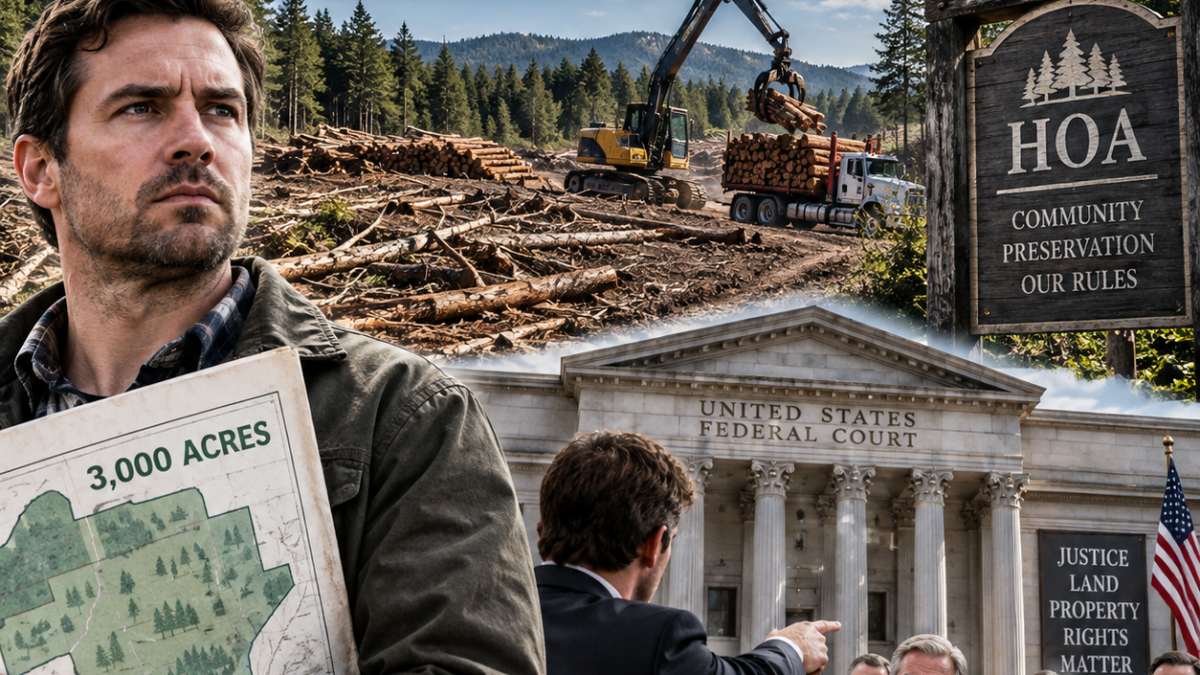
PART 2
The document was only four pages long.
I read the first page twice because my mind kept rejecting what my eyes were seeing.
AMENDMENT TO DECLARATION OF COVENANTS, CONDITIONS, AND RESTRICTIONS.
Oak Ridge Estates Homeowners Association.
Recorded May 17, 2011.
The legal description attached to the amendment was unmistakable. It followed the boundaries of my grandfather’s property almost exactly—3,000 acres of timberland running west from the subdivision to the ridgeline.
According to the document, those acres had been “incorporated into the association’s jurisdiction for purposes of community safety, environmental stewardship, aesthetic continuity, and future common-use planning.”
I turned to the final page.
There was Karen Miller’s signature.
Below it was a notarization.
But there was no signature from my grandfather.
No deed transfer.
No consent.
No annexation agreement.
No county planning approval.
Nothing showing that the man who actually owned the land had agreed to any of it.
I looked through the glass partition at the clerk.
“Is this everything attached to the filing?”
She checked the computer.
“Yes, sir.”
“There’s no owner authorization?”
“Not in this record.”
“Was there supposed to be?”
She hesitated.
“I can tell you what was recorded. I can’t give you legal advice.”
Fair enough.
I photographed every page, paid for certified copies, and went back to the last page.
The notary was Brenda Pruitt.
The name meant nothing to me then.
It would.
I drove home with the amendment lying on the passenger seat like something contaminated.
Sarah was waiting on the porch.
She had taken Lily into town that morning so our daughter wouldn’t see the logging equipment. By the time they came back, the machines were gone, but there was no hiding the damage. From the farmhouse, you could see one of the exposed slopes through what used to be solid woods.
Sarah watched me climb out of the truck.
“What did you find?”
I handed her the papers.
She read silently.
Then she looked at me.
“Tom never signed this.”
“No.”
“Could they have done it without him?”
“I don’t know yet.”
She stared toward the ridge.
My grandfather had loved Sarah. He used to tease that she was the only person in the family who could beat him at gin rummy without cheating.
She touched the corner of the document.
“Jack, this was seven years before he died.”
“I know.”
“So this wasn’t something Karen decided last month.”
That thought had already been bothering me.
If the amendment was fraudulent, then someone had laid the groundwork years before the logging.
Which meant the so-called emergency firebreak might never have been about fire.
My phone rang.
It was Dale Stewart.
Dale was sixty-eight, a certified forester and timber appraiser who had known my grandfather since before I was old enough to carry a pocketknife. He asked whether I was home.
“Just got back.”
“I’m ten minutes out.”
When Dale’s truck rolled up the driveway, he barely said hello.
He looked past me toward the clear-cut.
His face changed.
“Oh, Tom,” he whispered.
Then he removed his cap.
For a full minute, neither of us spoke.
Dale finally put his hat back on.
“Show me.”
We spent the rest of the day walking the destruction.
It was worse than I had understood from the truck.
The loggers had not performed anything resembling a conventional firebreak.
They had pushed deep into the property in a rough semicircle, targeting mature stands where the best timber grew. Some slopes had been stripped nearly bare while younger, lower-value trees nearby were untouched.
Dale stopped beside an enormous white-oak stump.
He measured it, wrote something in his field book, then crouched.
“Veneer quality,” he said.
“How old?”
He traced the rings with one finger.
“Old enough that your grandfather probably considered this tree mature when you were still a kid.”
He looked around.
“They high-graded it.”
I knew enough forestry to understand the term.
They had taken the most valuable trees.
Not the trees that posed the greatest fire risk.
Not the trees closest to the subdivision.
The trees worth the most money.
Dale pointed toward several remaining pines.
“If this were genuinely about creating a defensive firebreak, they wouldn’t leave fuel like that while hauling out premium oak and cherry.”
“So they came shopping.”
“That’s what it looks like.”
We kept moving.
White oak.
Red oak.
Black cherry.
Yellow poplar.
Sugar maple.
Hickory.
Some of the trunks had been so large that the stump surfaces looked like tabletops embedded in the earth.
The machinery had torn deep ruts into hillsides and pushed debris into a creek my grandfather and I used to follow during deer season.
The water was brown now.
Branches clogged the channel.
Oil containers and plastic bottles lay in the mud.
Dale photographed everything.
So did I.
That evening, I loaded my GPS data into a mapping program.
The clear-cut area covered roughly 1,538 acres.
More than half the timberland.
I sat at my grandfather’s oak desk until after midnight, surrounded by maps and photographs.
Sarah eventually came downstairs.
“You coming to bed?”
“Soon.”
She knew I was lying.
She stood behind me and rested her hands on my shoulders.
On the monitor was an aerial image of the property with the damaged area outlined in red.
“Jack.”
I looked up.
“You can’t fix this tonight.”
“I know.”
“You’ve been staring at it for three hours.”
“I know.”
She pulled out the chair beside mine.
For a while we sat without talking.
Then she said, “What are you afraid of?”
The question caught me off guard.
“Afraid?”
“You get quieter when you’re scared.”
“I’m not scared of Karen Miller.”
“I didn’t ask if you were scared of Karen.”
I looked back at the screen.
Finally, I said, “I’m scared I failed him.”
Sarah squeezed my hand.
“You were at a medical appointment. You didn’t abandon the property.”
“I let those men walk it.”
“You let two people perform what you were told was a safety inspection.”
“I should’ve checked.”
“You can punish yourself later if you still feel like it. Right now, figure out what actually happened.”
That was Sarah.
No speech.
No empty reassurance.
Just the next useful thing.
The next morning, the surveyor arrived.
His name was Eric Lawson, and when I explained what we needed, he nodded.
“Boundary verification first,” he said. “Then we map the disturbance.”
“How long?”
“If the old monuments are still good, a few days in the field. Longer for a final certified plat.”
“Do it.”
My second call was to Dale.
He had stayed up almost as late as I had.
“I’ve got a preliminary number,” he said.
“What kind of number?”
“The kind you should sit down for.”
I sat.
“Depending on final cruise data and grade, I’m putting stumpage value somewhere between three and a half and four million dollars.”
I said nothing.
“Jack?”
“I’m here.”
“That’s raw timber value. It doesn’t include restoration, erosion work, stream remediation, lost future growth, or damage to the residual stand.”
I looked out the window at my daughter’s bicycle leaning against the porch rail.
Four million dollars.
Karen had stood in front of me and talked about tennis courts.
“Put everything in writing,” I said.
“I already started.”
That afternoon, I submitted a written demand to the HOA management office for the bylaws, amendments, board minutes, financial records relating to the logging, the purported fire-safety assessment, bids, contracts, and all communications regarding my property.
The receptionist read the list.
“You want all of this?”
“Yes.”
“Records requests go through Ms. Miller.”
“Of course they do.”
She looked uncomfortable.
“How long does she have to respond?”
“You’ll receive whatever the association is obligated to provide.”
“That wasn’t my question.”
She lowered her voice.
“I just work here, Mr. Henderson.”
I softened my tone.
“I understand.”
Then I slid the request across the counter.
“Stamp my copy received, please.”
She did.
Three days passed.
Nothing.
Five days.
Nothing.
On the seventh day, Eric Lawson called.
“Your survey is clean.”
“How clean?”
“There’s no overlap.”
I drove to his office.
He spread the preliminary plat across a drafting table.
My grandfather’s parcel had been surveyed in 1952 and updated several times since. Oak Ridge Estates had been platted in 2008.
The boundary between the properties was clear.
The subdivision ended where my land began.
Not one inch of the 3,000 acres appeared inside the original HOA declaration.
Eric overlaid the logging GPS data.
A huge section of my property turned red.
“There’s your disturbance,” he said.
I stared at it.
“And there’s no legitimate boundary question?”
“Not from the recorded plats I’ve reviewed.”
“What about the 2011 amendment?”
“I saw it.”
“And?”
Eric tapped the paper.
“It doesn’t change the surveyed ownership boundary. Whether it gave the HOA some enforceable covenant authority is a legal question, but it didn’t make them owners of your trees.”
That distinction mattered.
I left his office and made the call I had been putting off.
I needed a lawyer.
Not somebody who handled closings and divorces in the county courthouse.
I wanted someone comfortable with property litigation, corporate records, injunctions, and defendants who would rather bury a problem than admit one.
A retired Marine I knew put me in touch with Maria Sanchez.
Maria had spent years as an Army JAG officer before entering private practice. Her firm handled property disputes, business fraud, veterans’ matters, and complex civil litigation.
I met her the next morning.
She listened for almost forty minutes without interrupting me.
When I finished, the conference table between us held Eric’s survey, Dale’s preliminary appraisal, the certified 2011 amendment, photographs, GPS maps, the logging work order, and my unanswered records demand.
Maria picked up the amendment first.
“Your grandfather owned the property in 2011?”
“Yes.”
“He never signed anything with the HOA?”
“Not that anyone in my family knows.”
“Did he pay dues?”
“No.”
“Attend meetings?”
“He wouldn’t even drive through the subdivision unless the county road was blocked.”
That earned the smallest smile.
Then she looked at the notary line.
“Do you know Brenda Pruitt?”
“No.”
Maria wrote the name down.
She opened Eric’s survey next.
“This is good.”
“Good enough?”
“For a beginning.”
I didn’t like the qualifier.
“What am I missing?”
“A lawsuit isn’t a movie, Jack. You don’t walk into court, slam a map on the table, and watch the bad guy confess.”
“I know.”
“Do you?”
Her eyes stayed on mine.
“They’re going to say they believed they had authority. They may claim your grandfather consented informally. They may produce legal opinions. They may blame the logging company. The logging company may blame the HOA. Their insurer may reserve rights. Records may disappear unless we move quickly.”
“So what do we do?”
“Preserve everything. Stop further entry. Identify every defendant. Trace every dollar.”
She tapped Dale’s appraisal.
“And we make sure this number survives cross-examination.”
I liked her immediately.
Maria sent preservation letters that afternoon to the HOA, its management company, every known board member, and the logging contractor.
Two days later, we filed suit in state court.
The initial claims were straightforward: trespass, conversion, statutory timber damages, property damage, and related claims against the HOA and the parties responsible for authorizing the cut.
Maria also sought immediate injunctive relief prohibiting any further entry onto my land.
The sheriff served the papers.
Karen’s response arrived faster than her response to my records request.
I received a certified letter from the HOA.
NOTICE OF ARCHITECTURAL VIOLATION.
My mailbox did not comply with Oak Ridge Estates’ approved “rustic streetscape standards.”
I laughed when I read it.
Sarah did not.
“This is intimidation.”
“It’s a mailbox letter.”
“No. It’s her telling us she can still reach the house.”
That changed the way I saw it.
I forwarded the notice to Maria.
Her reply contained four words.
Do not respond directly.
Three days later, another violation arrived.
Roadside vegetation exceeded permitted height.
Then another.
Nonconforming split-rail fence.
Then one claiming the flagpole beside my porch had never been approved by the architectural committee.
That one made me stare at the paper for a long time.
My grandfather had installed the pole.
The flag had flown there before Oak Ridge Estates existed.
Maria called.
“She’s building us a retaliation file.”
“She thinks she’s building fines.”
“Let her.”
The harassment did not stay on paper.
Karen began parking across the road from our driveway.
Sometimes for twenty minutes.
Sometimes for more than an hour.
Two men from the architectural committee walked the property line carrying clipboards.
One stepped across the boundary to measure my fence.
That evening, my neighbor Ben Carter came over.
Ben lived inside Oak Ridge Estates and worked in network security.
“I heard what happened,” he said.
“News travels.”
“Karen makes sure it does.”
He looked toward the road.
“You have cameras?”
“Two.”
“You need six.”
By the weekend, we had eight.
Every approach to the farmhouse was covered.
Driveway.
Barn.
Mailbox.
Rear access road.
Property-line gates.
Footage uploaded automatically to off-site storage.
“Overkill?” I asked.
Ben shook his head.
“With someone like Karen? Documentation.”
I was beginning to hear that word everywhere.
Document.
Preserve.
Record.
Photograph.
The more emotional the situation became, the more important boring evidence became.
Then Mary and George Gable knocked on our door.
They lived on the Oak Ridge side of the boundary.
Mary was in her seventies, barely five feet tall, and carried three thick binders against her chest.
“I believe these belong in your war room,” she said.
I invited them in.
Mary had documented Karen for ten years.
Violation letters.
Meeting notices.
Emails.
Photographs.
Copies of budgets.
Newsletters.
Board minutes.
Handwritten notes from nearly every annual meeting.
George looked at the binders and sighed.
“I told her nobody keeps paperwork that long.”
Mary gave him a look.
“And yet here we are.”
We spread everything across the dining-room table.
The stories were small compared with mine, but the pattern was unmistakable.
A family fined because their children’s cedar playset was not the approved type of wood.
An elderly widow warned over flowers that supposedly violated a landscaping palette.
A homeowner threatened with a lien over a basketball hoop.
Fines for garage doors left open.
Fines for decorative objects visible from the street.
Selective enforcement against residents who challenged the board.
Then Mary opened a binder labeled BEAUTIFICATION.
Inside were years of expenditures.
Gazebo improvements.
Landscape consulting.
Clubhouse furniture.
Pool upgrades.
Tennis resurfacing.
Several projects appeared to benefit the small section of the neighborhood where Karen and her closest allies lived.
“Why didn’t anyone vote her out?” I asked.
George gave a tired laugh.
“People tried.”
Mary answered more directly.
“She controlled proxies. She controlled the meetings. Most people just wanted to come home from work and live their lives. Karen had more time than everyone else and enjoyed conflict more than everyone else.”
That sentence stayed with me.
Enjoying conflict was its own kind of power.
Mary pulled out one more document.
A newsletter from six years earlier.
Karen had written a paragraph celebrating what she called the HOA’s “long-term stewardship relationship with adjacent woodland.”
My stomach tightened.
Six years.
Long before the current firebreak.
“Can Maria have copies of all this?”
Mary smiled.
“I brought the binders for her.”
Within two weeks, several residents agreed to provide sworn statements about the HOA’s enforcement practices.
Maria was careful.
“This does not automatically make every petty fine part of your timber case,” she told us during a meeting at my farmhouse. “But retaliation, credibility, board practices, and financial controls may all become relevant depending on what discovery shows.”
Mary nodded as though she had been waiting a decade to hear a lawyer say that.
Karen, meanwhile, escalated.
The envelope arrived on a Friday.
Inside was a notice claiming the HOA had recorded a $10,000 lien against my property for accumulated fines and administrative charges.
I read it twice.
Then I drove straight to Maria’s office.
She scanned the document.
Her face became very still.
“They actually recorded it.”
“That bad?”
“For them? Potentially.”
She pulled the survey file from a cabinet.
“They know ownership and HOA jurisdiction are disputed in active litigation. They know we’ve challenged the 2011 amendment. And while that case is pending, they’ve used that same disputed authority to encumber your title.”
“What happens now?”
“We ask the judge to remove it.”
The emergency hearing was held the following week.
It was the first time I saw Karen after our driveway confrontation.
She entered with the HOA’s attorney and two board members.
She did not look at me.
Maria presented the 1952 property description, the 2008 subdivision plat, the disputed 2011 amendment, our pending claims, the violation notices, and excerpts from my security cameras.
The courtroom screen showed Karen’s SUV parked opposite my driveway.
Then the architectural committee members measuring my fence.
Then Karen herself walking to my mailbox before sunrise and attaching an orange violation sticker.
The judge looked over his glasses.
“Ms. Miller personally did that?”
The HOA attorney stood.
“My client was acting in her capacity as association president.”
“That was not my question.”
A pause.
“Yes, Your Honor.”
The judge turned to the lien.
“Counsel, identify for me the recorded instrument establishing that Mr. Henderson’s parcel is unquestionably subject to your association.”
The attorney cited the 2011 amendment.
Maria stood.
“Your Honor, that document is one of the central subjects of our fraud allegations. The owner never signed it. There is no annexation agreement from the landowner, and the underlying subdivision plat does not include the property.”
The judge looked at the HOA attorney again.
“And while that issue is before this court, your client recorded a lien based on fines generated after the litigation began?”
The attorney tried to explain.
The judge stopped him.
“I understand the sequence.”
He ordered the lien released pending the merits of the case and prohibited the HOA from recording new enforcement liens against my parcel without further court approval.
He also imposed monetary sanctions tied to the improper filing and warned both the board and its counsel about retaliatory conduct.
Outside the courtroom, Karen finally looked at me.
“You think you’re helping those people?” she said.
I stopped.
Maria touched my arm.
Don’t engage.
Karen kept going.
“You’re going to bankrupt their association. Every family in Oak Ridge will pay for what you’re doing.”
I turned toward her.
“For what I’m doing?”
Her lawyer stepped between us.
“Karen.”
But she wasn’t listening.
“You could have handled this privately.”
“You cut 1,538 acres of my land.”
“It was approved.”
“By you.”
“By the board.”
“Then you should have no trouble proving it.”
Her face flushed.
Maria opened the courthouse door.
“Jack.”
I walked away.
The next phase was discovery.
That was where the case stopped being about Karen’s personality and started becoming about numbers.
Maria demanded board minutes, bank statements, invoices, contracts, correspondence, insurance records, bids, environmental assessments, and everything connected to the logging.
The HOA objected.
Maria moved to compel.
The judge ordered substantial production.
Weeks later, two dozen boxes arrived.
George Gable nearly smiled when he saw them.
“I haven’t had this much fun since I retired.”
Sarah looked at the boxes stacked in our basement.
“You and I have very different definitions of fun.”
We turned the basement into a temporary document room.
Maria’s paralegals created an index.
Ben scanned.
Mary cross-referenced dates against her binders.
George followed transactions.
I learned quickly that fraud rarely announces itself with a page labeled FRAUD.
It hides in boring places.
A payment that does not match an invoice.
A contract approved before a recorded board vote.
A company address that matches somebody’s relative.
A bank transfer appearing three days after a sale.
The first major discrepancy was the price.
Appalachian Timber Resources had paid the HOA $200,000 for timber rights.
George stared at the figure.
“That can’t be right.”
“It’s right,” I said.
“No. I mean economically.”
He pulled Dale’s appraisal closer.
“Dale says the removed timber was worth approximately four million at market. The HOA accepted two hundred thousand?”
“Apparently.”
“That’s five percent.”
Sarah, standing at the basement stairs, said, “Maybe Karen was incompetent.”
George shook his head.
“Incompetence usually loses money randomly. This looks specific.”
Then we found something else.
The board minutes did not contain any genuine competitive-bid process.
There were references to “multiple industry consultations,” but no competing written bids.
No solicitations.
No rejection letters.
No comparison sheets.
Nothing.
Maria subpoenaed additional records.
That was when the name Martin Pruitt surfaced.
Appalachian Timber Resources had been incorporated less than a year before the logging.
Its registered agent and principal officer was Martin Pruitt.
I stared at the name.
“Pruitt.”
Maria nodded.
“Same last name as the notary.”
“Brenda Pruitt.”
“Exactly.”
Her investigator confirmed the relationship.
Brenda Pruitt was Karen Miller’s younger sister.
Martin Pruitt was Brenda’s husband.
Karen’s brother-in-law controlled the company that had received the bargain-price timber contract.
My chair scraped backward.
“So her sister notarizes the annexation document.”
“Yes.”
“And her sister’s husband later gets the logging contract.”
“Yes.”
“Tell me that’s enough.”
Maria did not celebrate.
“Enough for what?”
“To prove it.”
“It proves a relationship. It proves a conflict that should have been disclosed. It does not yet prove where the money went.”
“Then find the money.”
She looked at me.
“That’s exactly what we’re going to do.”
The next subpoenas were harder.
Appalachian Timber fought them.
Karen’s attorney fought them.
Maria had to establish why the company’s financial records were relevant rather than simply demand everything.
The court ultimately permitted targeted discovery.
What came back changed the case.
Appalachian Timber Resources had sold the harvested timber onward for approximately $3.8 million.
That number was close enough to Dale’s valuation to make my stomach turn.
The company had paid only $200,000 to the HOA.
Where had the remaining money gone?
Some covered logging expenses.
Some went to ordinary company accounts.
But one transfer mattered more than all the others.
$1.5 million.
From Appalachian Timber Resources.
To an investment account jointly held by Karen and her husband, Robert Miller.
I was standing behind George when he found it.
He stopped breathing for a second.
Then he tapped the page.
“Jack.”
I leaned over.
“What?”
“Look at the destination account.”
I did.
I read Karen’s name.
Then I sat down.
All the rage I expected to feel never arrived.
Instead I felt strangely empty.
For months, a part of me had wondered whether there was some explanation I had not considered.
A catastrophically stupid board decision.
A mistaken boundary.
A bad lawyer.
An overzealous fire-safety project.
Something.
But a million and a half dollars had traveled from the company that bought my trees into Karen Miller’s account.
Maria arrived forty minutes later.
George had laid the relevant statements in sequence.
She read them without speaking.
Then she called one of her associates.
“I want every date mapped against the contract, cutting dates, downstream timber sale, and board disbursements.”
She hung up.
I said, “Now?”
“Now we have a money trail.”
“How bad is it?”
“For Karen? Very.”
“Federal?”
“Potentially.”
She pointed to the records.
“If interstate wires were used as part of a fraud scheme, you may be looking at federal wire-fraud issues. Money laundering depends on facts we still need to establish. Civil RICO has technical requirements, and I’m not putting it in a complaint just because it sounds dramatic.”
“Can we go to the FBI?”
“We can provide evidence to federal authorities. They decide whether there is a criminal case.”
“And federal court?”
“If the facts support federal civil claims, yes.”
That night, I walked alone to the edge of the clear-cut.
The moon was bright enough to show the exposed slope.
I sat on one of the biggest stumps.
My grandfather had once told me that men who wanted easy money always underestimated how expensive shortcuts eventually became.
At the time, he had been talking about a contractor who built a barn roof wrong.
Now I wondered what he would have said about Karen.
Lily found me there.
I heard Sarah calling behind her.
“Dad?”
“What are you doing out here?”
“Mom said dinner’s getting cold.”
I stood.
Lily looked around.
“Are the trees going to grow back?”
The question hurt more than any courtroom argument had.
“Some will.”
“When?”
“A long time.”
“How long?”
I looked at the stump beside us.
“For trees like this? Longer than I’ll be alive.”
She frowned.
“That’s not fair.”
“No.”
“Can we plant them anyway?”
I looked at her.
“Yeah.”
“When?”
“When we can do it right.”
She slipped her hand into mine.
“Grandpa would want that.”
I had spent months thinking about recovering value, proving ownership, and making Karen answer for what she had done.
My ten-year-old daughter reduced the whole thing to the only question that would matter after every lawyer went home.
What do you put back?
The next morning, Maria called.
“We’re filing in federal court.”
The new complaint did not abandon the state-law timber claims. It built on them.
Maria’s team alleged a coordinated scheme involving the fraudulent property filing, the related-party timber contract, interstate financial transactions, and diversion of proceeds. The defendants fought jurisdiction, challenged the racketeering allegations, attacked standing, and argued that what we described as fraud was simply aggressive HOA governance followed by a legitimate timber sale.
For several weeks, nothing felt certain.
That was the part people rarely include when they tell stories about taking someone to court.
There was no single dramatic filing that instantly crushed the other side.
There were motions.
Deadlines.
Conferences.
Arguments about evidence.
Invoices from lawyers.
Nights when Sarah and I whispered in the kitchen after Lily went to bed about how much of our savings we were willing to risk.
One night Sarah asked, “If they offer enough money to restore the land but Karen never admits anything, do you settle?”
I took too long to answer.
“That’s what I thought,” she said.
“What?”
“You don’t know whether you want justice or surrender.”
“I want accountability.”
“That’s not an answer.”
I leaned against the counter.
“She took Grandpa’s land.”
“She took trees.”
“She tried to take the land with paperwork.”
“Yes. And I’m angry too. But you have to know what winning means before this destroys you.”
Her words bothered me because they were true.
I had begun treating every day like a campaign.
Every conversation became evidence.
Every car near the driveway became surveillance.
Every envelope made my jaw tighten.
I was home, but part of me was still fighting.
The next day I called Maria.
“What does winning look like?”
“That’s your question?”
“Yes.”
She was quiet.
“Legally? Compensation sufficient to restore what can be restored. Confirmation that the HOA has no authority over your land. Removal of fraudulent encumbrances. Accountability for the people who profited. Protection for the residents who joined us.”
“And Karen?”
“If criminal laws were violated, prosecutors handle that. Not us.”
That distinction mattered.
I stopped thinking about destroying Karen.
I started thinking about proving the case.
The federal filing changed the behavior of almost everyone except Karen.
The HOA’s insurer appointed separate coverage counsel.
The other board members hired lawyers.
No one wanted to share Karen’s lifeboat anymore.
Two board members—David Harris and Linda Cho—eventually agreed to sworn interviews and later depositions.
Both told similar stories.
Karen had presented the firebreak as legally approved.
She controlled communications with counsel.
She claimed environmental consultants supported the plan.
She told board members the adjacent timber fell within HOA authority under the 2011 amendment.
“Did you ever read that amendment?” Maria asked Harris.
“No.”
“Did you verify the landowner consented?”
“No.”
“Did you see competing timber bids?”
“No.”
“Did you know Appalachian Timber was controlled by Ms. Miller’s brother-in-law?”
Harris stared at the table.
“No.”
“Would you have voted for the transaction if you had?”
“No.”
Linda Cho’s testimony was even more damaging.
She produced emails from Karen.
One read:
DO NOT CONTACT HENDERSON DIRECTLY. LEGAL STATUS OF THE PARCEL HAS ALREADY BEEN RESOLVED.
Another:
ATR HAS GIVEN US THE CLEANEST PATH. WE DO NOT NEED TO COMPLICATE THIS WITH ADDITIONAL BIDS.
Maria slid the printed email toward me afterward.
“ATR.”
“Appalachian Timber Resources.”
“Yes.”
Karen had been steering the board toward her brother-in-law’s company while telling everyone the land question was settled.
Still, Karen insisted publicly that she had done nothing wrong.
The next Oak Ridge newsletter accused an “outside landowner” of threatening the financial survival of the community.
My name was not printed.
It did not need to be.
Mary brought the newsletter to our house.
“She’s telling residents their dues are going to triple because of you.”
I read it.
“Are they?”
“Possibly,” George admitted. “Depending on insurance and reserves.”
That bothered me.
I did not want a retired couple or a young family paying for Karen’s fraud.
Maria understood.
“That’s why we trace responsible parties and available coverage,” she said. “A settlement does not have to mean every innocent homeowner gets a catastrophic assessment.”
“Can you guarantee that?”
“No.”
I appreciated the answer even though I hated it.
Then came Karen’s deposition.
We met in a downtown court-reporting office on a cold Tuesday morning.
Karen arrived with a new attorney named Peterson.
The first thing I noticed was how tired she looked.
Not defeated.
Not yet.
Just tired.
She sat across from Maria.
A videographer checked the camera.
The court reporter administered the oath.
Maria began with harmless questions.
Name.
Address.
Role in Oak Ridge Estates.
Years as president.
Board responsibilities.
Karen answered crisply.
Then Maria placed the 2011 amendment in front of her.
“Ms. Miller, do you recognize this?”
“Yes.”
“What is it?”
“An amendment to the association declaration.”
“Who prepared it?”
“I don’t remember.”
“Your signature appears here?”
“Yes.”
“Did Thomas Henderson sign it?”
“It didn’t require his signature.”
Maria looked up.
“That wasn’t my question. Did he sign it?”
“No.”
“Did he authorize you in writing to subject his 3,000-acre parcel to HOA control?”
“Not in writing.”
“Did he authorize you orally?”
Karen hesitated.
“I understood that the association had authority.”
“From whom?”
“Counsel.”
“Name the attorney.”
Peterson shifted.
Karen named the HOA’s former counsel.
Maria placed another transcript on the table.
“That attorney testified last week that he advised the HOA it had no right to enter the Henderson property without owner consent. Is he lying?”
Karen’s jaw tightened.
“He may not remember every conversation.”
“Do you?”
“I remember the legal advice as I understood it.”
Maria did not argue.
She moved on.
“Who notarized the amendment?”
“My sister.”
“Brenda Pruitt?”
“Yes.”
“Who is Martin Pruitt?”
“My brother-in-law.”
“Brenda’s husband?”
“Yes.”
Maria placed Appalachian Timber Resources’ incorporation record on the table.
“Martin Pruitt is the principal of this company?”
“Yes.”
“Did you disclose that family relationship to the full board before Appalachian Timber received the contract?”
“I believe everyone knew.”
“Show me where it appears in the minutes.”
“I don’t prepare the minutes.”
“Did you disclose it?”
“I don’t remember.”
Maria placed the timber contract beside the incorporation record.
“Did you solicit competing written bids?”
“The board considered alternatives.”
“Name one company that submitted a competing written bid.”
Karen’s eyes moved toward Peterson.
“I don’t recall.”
“One.”
“I said I don’t recall.”
Maria nodded.
Then came the bank statements.
I watched Karen’s face change before Maria said a word.
“Appalachian Timber Resources received approximately $3.8 million from the sale of timber harvested from Mr. Henderson’s property. Correct?”
“I’m not their accountant.”
“Three days later, $1.5 million was transferred to an investment account held jointly by you and your husband.”
Peterson leaned toward Karen.
Maria waited.
The room became quiet except for the court reporter’s keys.
“Ms. Miller,” Maria continued, “what was the purpose of the $1.5 million payment?”
Peterson whispered to her.
Karen stared at the statement.
Then she said, “On advice of counsel, I invoke my Fifth Amendment privilege.”
No one moved.
Maria asked another narrowly framed question.
Karen invoked the Fifth again.
And again.
In a criminal case, silence cannot simply be treated as guilt.
A civil case is different in important ways, and Maria later explained that the court could sometimes permit adverse inferences when a party invokes the Fifth, depending on the circumstances and other evidence.
But sitting there, I did not need a legal lecture to understand that Karen’s strategy had changed.
She had spent months insisting she could explain everything.
Now, when confronted with the money transfer, she would not explain anything.
The insurer’s lawyer wrote furiously.
Maria closed the binder.
“We’ll reserve the right to continue the deposition if necessary.”
Karen stood before the videographer had fully shut down the camera.
She grabbed her purse.
I stayed seated.
At the door, she stopped.
For the first time all day, she looked directly at me.
“This didn’t have to happen,” she said.
Peterson quietly told her to leave.
I answered anyway.
“You’re right.”
Her face tightened.
“You could have left my land alone.”
She walked out.
The deposition changed Oak Ridge Estates almost overnight.
Insurance counsel increased pressure on the remaining board members to cooperate.
Harris and Cho resigned.
The other two soon followed.
Residents demanded a special meeting.
Mary called me the night before.
“You’re coming.”
“I’m not a member.”
“You don’t need to vote.”
“Then why do you want me there?”
“Because for ten years people in that room have been told they were alone.”
The clubhouse was packed.
I sat in the back beside Sarah.
Mary and George sat near the aisle.
Ben stood against the wall.
The same pool partially funded with timber proceeds was visible through the windows.
Karen arrived ten minutes late.
A murmur went through the room.
She walked toward the front as though she still owned it.
The interim meeting chair tried to establish order.
Karen asked to speak.
He reluctantly gave her the microphone.
“I understand emotions are high,” she began, “but much of what has been circulated about me is inaccurate, incomplete, or deliberately misleading.”
A woman near the front stood.
Her name was Erin Walsh. Her husband was active-duty Army, and the HOA had spent months threatening them over their cedar playset.
“Inaccurate?” Erin said. “Did your brother-in-law get the logging contract?”
The chair asked her to sit down.
She did not.
Karen gripped the microphone.
“This is active litigation.”
“Did he?”
“I’m not going to discuss privileged matters.”
Someone else shouted, “What about the money?”
Another voice: “Why did you lien Jack’s property?”
Another: “Why are we paying attorneys to defend this?”
The room began to unravel.
Then Mary stood.
She did not shout.
She carried one of her binders to the front.
“I have ten years of records.”
The room slowly quieted.
Mary placed the binder on the table.
“Ten years of fines, threats, meeting notes, selective enforcement, unexplained spending, and residents asking questions they were told they had no right to ask.”
Karen stared at her.
“You’ve always had a personal vendetta against me.”
“No,” Mary said. “I had a filing cabinet.”
A few people laughed.
Mary did not.
“You fined Alice Brennan after her husband died because she planted flowers you said weren’t approved. You threatened the Morales family over a basketball hoop. You told the Walshes to replace a perfectly safe playset because the wood was wrong. And all that time, you expected everyone to believe rules were sacred.”
She touched the binder.
“But rules only mattered when they gave you power.”
Karen reached for the microphone.
Mary stepped away.
“You can argue with me. You can’t argue with ten years of your own letters.”
That broke something in the room.
Resident after resident stood.
Some were angry.
Some were embarrassed that they had remained silent.
Some admitted they had voted with Karen because challenging her seemed harder than paying another fifty-dollar fine.
One older man said quietly, “I helped elect you six times. I’m ashamed of that now.”
Karen tried to answer.
No one listened.
Finally she put down the microphone and walked out.
There were no cheers.
That surprised me.
Mostly there was exhausted silence.
People were not watching a villain in a movie get defeated.
They were realizing how long they had allowed one person to dominate their community.
The interim board formed that night.
Its first actions were practical.
Independent counsel.
Independent accounting review.
Full cooperation with litigation.
No retaliatory enforcement.
Review of disputed fines and liens.
Open financial reporting.
Mary declined a board seat.
“I’ve already done my public service,” she said.
George laughed.
“She means she wants to supervise from the audience.”
The civil case continued.
Then, on a Monday morning several weeks later, two dark government vehicles came up my driveway.
Sarah saw them first.
“Jack.”
I stepped onto the porch.
A man and a woman got out.
The man showed credentials.
“Mr. Henderson? Special Agent Collins, FBI. This is Special Agent Reeves.”
My pulse quickened.
“We’d like to speak with you about materials your counsel provided to the United States Attorney’s Office.”
I invited them inside.
They stayed nearly three hours.
They did not tell me everything they knew.
They asked instead.
When had I first learned of the 2011 amendment?
Who had shown me the logging authorization?
Did I personally speak with Karen before filing suit?
Did anyone request money from me?
What did the HOA claim the timber proceeds were for?
When did we obtain the financial records?
Had originals been preserved?
Maria joined by phone for part of the interview.
We provided copies of the documents through proper channels.
Before leaving, Agent Reeves paused at the porch.
“You understand this investigation is separate from your civil case.”
“Yes.”
“And we can’t promise charges.”
“I understand.”
She nodded.
“That’s important.”
After they left, Sarah closed the door.
“So now what?”
“We keep doing exactly what Maria says.”
She smiled faintly.
“Look at you. Finally learning.”
The federal investigation took months.
Civil litigation continued in parallel.
Karen disappeared from HOA meetings.
Her house remained immaculate, but the blinds were usually shut.
Robert Miller, her husband, was rarely seen.
Martin and Brenda Pruitt retained separate lawyers.
Appalachian Timber stopped operating.
The atmosphere around Oak Ridge changed.
People who had once avoided us began waving when they drove past.
That should have felt good.
Sometimes it did.
Other times, I resented them.
Where had all these people been when Karen sent inspectors across my property?
Where had they been when my grandfather was alive and she recorded that amendment?
One evening, I said as much to George.
We were repairing a section of fence damaged by the logging equipment.
He hammered a staple into a post.
“You want the honest answer?”
“Yes.”
“We were afraid of inconvenience.”
I looked at him.
“That’s it?”
“For most of us, yes. Not prison. Not violence. Not losing our homes tomorrow. We were afraid meetings would get ugly. Afraid of lawyers. Afraid our neighbors wouldn’t like us. Afraid a fifty-dollar fine would become five hundred.”
He pulled another staple from his pocket.
“People tolerate a lot of wrong when resisting it looks inconvenient.”
“That doesn’t make it right.”
“No.”
He drove in the staple.
“But it makes it human.”
I thought about that for a long time.
The criminal indictment came in early spring.
Karen Miller and Martin Pruitt were charged in federal court with conspiracy and fraud-related offenses arising from the timber transaction and movement of proceeds.
The charging document described a scheme disturbingly close to what Maria’s team had reconstructed.
The 2011 amendment.
The use of related parties.
The timber contract.
The downstream sale.
The transfer to Karen and Robert’s investment account.
I read the indictment at my grandfather’s desk.
There was no triumph.
Mostly I felt tired.
Sarah stood beside me.
“You okay?”
“I spent months wanting somebody official to say we weren’t crazy.”
“And now they did.”
“Yeah.”
“How does it feel?”
I looked toward the woods.
“Quieter than I expected.”
The indictment changed the civil negotiations immediately.
No defendant wanted a federal civil trial unfolding beside a criminal prosecution.
Insurers wanted certainty.
The new HOA board wanted to protect innocent homeowners.
Appalachian Timber’s remaining assets were frozen or tied up.
Karen’s personal exposure grew.
Maria sat across from Sarah and me with a settlement proposal.
“Fourteen and a half million dollars in total civil value,” she said.
I stared at her.
“Paid by whom?”
“Multiple sources. Insurance coverage for covered claims, association reserves, corporate defendants, and individual contributions. The structure is complicated.”
“And the homeowners?”
“The current proposal avoids a catastrophic special assessment.”
That was one of my conditions.
I had no interest in destroying families who had nothing to do with stealing my timber.
Maria continued.
“The settlement recognizes approximately four million in timber value, substantial statutory damages, restoration costs, fees and costs where recoverable, and resolution of the associated retaliation claims.”
Sarah asked, “What about the land?”
“Court-recognized declaration that Jack’s parcel is not subject to Oak Ridge Estates. The 2011 amendment will be formally invalidated as to his property. All HOA liens and violation records against the parcel disappear.”
I asked the last question.
“Can Karen ever claim authority over it again?”
“No.”
Sarah looked at me.
It was the first time in more than a year that I felt the fight loosen its grip on my chest.
We accepted the settlement.
But one thing mattered more to me than the number.
Restoration.
Dale became the lead forester on a project that would outlive all of us.
We stabilized eroded slopes.
Cleared logging debris from waterways.
Repaired stream crossings.
Controlled invasive species that had already begun exploiting disturbed soil.
Some damaged areas needed temporary cover crops before hardwoods could return.
Dale designed mixed-species planting based on soil, elevation, moisture, and what had grown there before.
“No plantation rows,” I told him.
He nodded.
“Tom would haunt both of us.”
The first planting season began while the criminal case was still pending.
Lily was eleven by then.
She remembered her promise.
“When do I get my tree?”
Dale handed her a white-oak sapling.
“Right now.”
We invited some of the Oak Ridge residents.
I expected twenty people.
More than a hundred came.
The Walsh family brought shovels.
Alice Brennan—the widow who had once been fined for her flowers—brought coffee and sandwiches.
Ben organized volunteers.
George complained loudly that retirement was supposed to involve less manual labor.
Mary told him to dig.
Even members of the new HOA board came.
No speeches.
No banners.
Just people kneeling in dirt.
Lily chose a spot near the enormous stump where I had sat months earlier.
“Here.”
“You sure?”
“Yes.”
“Why?”
She pointed at the old stump.
“So the new one can see what it’s replacing.”
I almost corrected her.
Then I decided not to.
We dug together.
The sapling looked impossibly small.
A thin stem.
A handful of leaves.
Roots barely filling the hole.
I remembered the giant oak that had stood there.
I remembered Dale saying trees like that had been alive before my grandfather was born.
I remembered Karen calling them a community asset.
This little tree would not become that giant in my lifetime.
That was precisely why planting it mattered.
Months later, Karen entered a guilty plea in federal court to charges tied to the fraud conspiracy and laundering of proceeds.
Martin Pruitt also reached a plea agreement.
The government pursued restitution and forfeiture against proceeds traceable to the scheme.
I attended Karen’s sentencing.
Not because Maria needed me there.
Not because I wanted to see her suffer.
I went because I had been present at the beginning.
I wanted to be present at the end.
Karen stood before the judge in a plain dark suit.
She looked smaller than I remembered.
Her attorney spoke about her age, community ties, lack of prior convictions, and acceptance of responsibility.
The prosecutor spoke about planning, abuse of trust, financial harm, and environmental destruction.
Several victims submitted statements.
I kept mine short.
When I was given the opportunity to speak, I stood.
“My grandfather protected that land for most of his life. The trees that were taken can be priced, and this court has numbers for those. What cannot be priced is time. Some of those trees took more than a century to become what they were. My daughter’s grandchildren may be old before the forest looks the same again.”
I looked at Karen.
“This was never a disagreement about an HOA rule. You knew the land wasn’t yours. You created paperwork to claim authority you didn’t have, directed a company connected to your family to take the timber, and money from that transaction reached your household.”
I paused.
“I don’t need revenge from this court. I need the record to be clear about what happened.”
Then I sat down.
The judge sentenced Karen to seven years in federal prison, followed by supervised release, and imposed restitution and forfeiture obligations consistent with the criminal judgment.
Martin received his own sentence under his plea agreement.
Robert was not treated as automatically guilty simply because he was Karen’s husband; investigators dealt with him according to the evidence they had.
Brenda, the notary, faced separate scrutiny over the 2011 filing and surrendered her notary commission while related proceedings were resolved.
The former HOA board members who had not shared in the scheme escaped the worst consequences, but not all consequences. Their resignations remained permanent, and the civil settlement documented failures of oversight that had allowed Karen to operate with almost no meaningful challenge.
Oak Ridge Estates itself survived.
That mattered.
The residents rewrote major parts of their governance rules.
Financial transactions over specified thresholds required independent review.
Related-party contracts had to be disclosed.
Board records became easier for members to inspect.
No president could dominate proxy voting the way Karen had.
Enforcement decisions required written standards and an appeal process.
The new board even asked Mary to join a transparency committee.
She refused.
Then she attended every meeting anyway.
A year after the first saplings went into the ground, I walked the property with Dale.
The land still looked wounded.
There was no pretending otherwise.
Young trees stood inside protective tubes.
Grasses covered slopes that had once been mud.
The creek ran clearer.
Deer tracks had returned near one of the restored crossings.
Dale stopped beside a cluster of white-oak seedlings.
“Survival rate’s good.”
“How good?”
“Better than I expected.”
“That sounds dangerously optimistic coming from you.”
“I’m old. I’m allowed one optimistic statement a year.”
I laughed.
He looked across the hillside.
“You know you’re never going to see this forest mature.”
“I know.”
“Your daughter might not either.”
“I know.”
He glanced at me.
“You okay with that?”
For the first time, I could answer without anger.
“Yes.”
That evening, Lily and I walked to the first oak we had planted.
It had grown maybe eighteen inches.
To anyone else, it would have looked insignificant.
To us, it was the most important tree on 3,000 acres.
She crouched and pulled weeds from around the base.
“Do you think Grandpa would know which one this is?”
I smiled.
“He’d probably complain we planted it two feet too far uphill.”
She laughed.
Then she stood and brushed dirt from her hands.
The old stump beside us had begun to soften around the edges. Moss was growing across one side.
New life beside old damage.
For almost two years, I had measured progress in filings, hearings, subpoenas, bank statements, depositions, settlements, indictments, and judgments.
Standing there with Lily, none of those things felt like the final measure anymore.
Karen had tried to turn a forest into money.
The courts could return money.
They could invalidate documents.
They could punish fraud.
They could establish who owned the land.
But they could not manufacture a hundred-year-old oak.
Only time could do that.
Lily touched one of the new leaves.
I heard my grandfather’s voice as clearly as if he were walking behind us.
The money is never the point.
Time is the point.
This land remembers.
I looked across the scarred hillside, where hundreds of young trees were catching the last light of evening.
For the first time since the chainsaws stopped, I believed the land would remember something besides what had been taken from it.
I knew something was terribly wrong before I even reached my farmhouse, because the sound coming from my grandfather’s woods wasn’t wind or construction—it was dozens of chainsaws tearing through trees that had been standing there for more than a century.
By the time I reached the ridge, nearly half of my 3,000-acre inheritance had been turned into mud, stumps, and logging roads, and the crew foreman calmly handed me a work order signed by the president of an HOA my property had never belonged to.
But the part that would eventually drag all of us into federal court wasn’t what Karen Miller had done with my trees—it was what I discovered when I started following the paperwork and asking where the money had gone.
My grandfather, Thomas Henderson, bought the land in the 1950s after twenty years in the Army. He never treated those woods like a bank account.
When I was a kid, he would run his hand over the bark of an old oak and tell me, “Jack, anybody can count the dollars in timber. The harder thing to understand is the time inside it.”
When he died, he left all 3,000 acres to me.
I had recently retired from the Marines after twenty-two years, and my wife Sarah, our daughter Lily, and I moved into his old farmhouse. Oak Ridge Estates bordered our eastern property line, but our land had never been part of the subdivision.
At least that was what every deed and survey said.
The day I found the logging operation, I drove directly to the home of HOA president Karen Miller.
She opened the door before I finished knocking.
“You need to explain something to me,” I said.
Karen crossed her arms.
“If this is about the forestry work, Mr. Henderson, everything was authorized.”
“You mean the men cutting down my trees?”
“They’re creating a community firebreak.”
“On my property.”
“Your property falls under Oak Ridge jurisdiction.”
I stared at her.
“No, it doesn’t.”
She smiled like I was a difficult child.
“Section Fourteen, Subsection C permits management of undeveloped adjacent parcels for community safety and aesthetic improvement.”
“Adjacent doesn’t mean owned.”
“The legal issue was settled years ago.”
“What legal issue?”
“The annexation.”
My anger suddenly went cold.
“What annexation?”
Karen’s expression changed slightly.
Only for a second.
“Check the county records.”
“What year?”
“2011.”
My grandfather owned the land in 2011.
And I knew one thing with absolute certainty.
Thomas Henderson would never voluntarily put his woods under an HOA.
The next morning, I went to the county records office.
The clerk pulled the document.
An amendment filed in 2011 claimed Oak Ridge Estates had incorporated my grandfather’s 3,000 acres into its jurisdiction.
Karen’s signature was on it.
My grandfather’s wasn’t.
There was no deed transfer.
No consent agreement.
No approval bearing his signature.
The document had been notarized by a woman named Brenda Pruitt.
I photographed everything.
Then I called a surveyor and Dale Stewart, the forester who had worked with my grandfather for thirty years.
Dale nearly cried when he saw the damage.
“They didn’t build a firebreak,” he said.
He pointed at several valuable stumps.
“They high-graded the forest.”
“What does that mean?”
“They took the best.”
White oak.
Black cherry.
Sugar maple.
Yellow poplar.
Trees valuable enough for high-end furniture and veneer had been removed while less valuable timber remained untouched.
Dale spent two days measuring stumps and documenting species.
His preliminary valuation nearly made me sick.
“Three and a half to four million dollars,” he said.
“For the timber?”
“Just the timber.”
The survey was equally clear.
The original Oak Ridge subdivision plat stopped exactly at my boundary.
No overlap.
No ambiguity.
That was when I hired Maria Sanchez, a former Army JAG officer who had built a civilian practice around complex property disputes and institutional misconduct.
She studied the evidence for nearly an hour.
Then she tapped the 2011 amendment.
“This is where we start.”
“Can they annex property without the owner signing?”
“Not simply by writing an amendment and recording it.”
“So Karen stole my land on paper.”
“She tried to establish authority over it.”
Maria paused.
“Now we find out why.”
We sued the HOA, Karen, and the parties involved in the logging.
Karen responded by sending me violation notices.
My grandfather’s mailbox was supposedly noncompliant.
Then my fence.
Then the grass beside the county road.
Then the flagpole on my porch.
When I ignored them, the HOA recorded a $10,000 lien against my property.
Maria almost laughed when I brought her the notice.
“She actually did this while we’re litigating whether she has jurisdiction?”
“Yes.”
“Good.”
“Good?”
“She just created evidence of retaliation.”
At an emergency hearing, Maria showed the judge the surveys, the disputed annexation, and security footage of Karen personally placing violation stickers on my mailbox.
The judge ordered the lien removed and warned the HOA against further retaliatory action.
Karen left the courtroom furious.
But by then, the real damage to her case was happening somewhere else.
In discovery, Maria obtained the HOA’s financial records.
My retired-accountant neighbor, George Gable, helped us review them.
One number stood out immediately.
The logging company, Appalachian Timber Resources, had paid the HOA only $200,000 for timber rights worth close to $4 million.
George stared at the contract.
“That makes no financial sense.”
Unless, of course, the point had never been to benefit the HOA.
Maria investigated Appalachian Timber.
The company had been formed shortly before the logging.
Its principal officer was Martin Pruitt.
I recognized the last name.
“Pruitt,” I said. “Like Brenda Pruitt?”
Maria nodded.
“Brenda is Karen’s sister.”
“And Martin?”
“Karen’s brother-in-law.”
The room went silent.
The woman who notarized the questionable annexation was Karen’s sister.
The man whose company obtained my timber for pennies on the dollar was Karen’s brother-in-law.
Still, Maria told me relationships weren’t enough.
“We need the money.”
Targeted subpoenas eventually gave us exactly that.
Appalachian Timber sold the harvested wood downstream for approximately $3.8 million.
Then we found a transfer.
$1.5 million.
From the logging company.
Into an investment account held jointly by Karen and her husband.
I read Karen’s name three times.
“That’s it,” I said.
Maria remained careful.
“That’s a major piece of evidence.”
“Federal?”
“Potentially. Interstate financial transactions connected to a fraud scheme can create federal exposure.”
We amended the litigation and provided evidence to federal authorities.
Soon, the FBI was asking questions.
Karen’s own board began abandoning her.
Two members testified they had never known about her family connection to Appalachian Timber. They said Karen had presented the logging as a legally approved fire-safety project.
Then came Karen’s deposition.
Maria placed the financial statement in front of her.
“Ms. Miller, Appalachian Timber Resources received approximately $3.8 million from timber harvested on Mr. Henderson’s land. Correct?”
Karen glanced at her attorney.
Maria continued.
“Shortly afterward, $1.5 million was transferred into an investment account belonging to you and your husband. What was that payment for?”
Karen’s confidence disappeared.
Her lawyer whispered something.
Then Karen said quietly, “I invoke my Fifth Amendment privilege.”
The room became completely still.
For months she had told everyone she could explain what happened.
Now she refused to explain the money.
The federal investigation continued independently.
Eventually Karen and Martin Pruitt were charged in connection with the fraud scheme and movement of proceeds.
The civil case settled for millions from multiple defendants, insurers, corporate assets, and responsible individuals. Most importantly to me, the settlement formally recognized that my property had never belonged to Oak Ridge Estates.
The 2011 claim over my land was eliminated.
The HOA’s liens disappeared.
And restoration began.
Dale helped design a long-term reforestation plan.
One spring morning, Lily walked into the damaged area carrying a tiny white-oak sapling.
“Where should we put it?”
I pointed toward one of the enormous old stumps.
She shook her head.
“Right beside this one.”
“Why?”
“So we remember what used to be here.”
We dug the hole together.
The sapling looked almost ridiculous beside the remains of the old oak.
It might take a century to replace what had been stolen.
I would never see it fully grown.
Neither might Lily.
But as I pressed the soil around its roots, I remembered what my grandfather had told me all those years ago.
The money was never the point.
Time was.
Karen had turned old trees into quick cash.
The courts could return money.
They could cancel fraudulent documents.
They could impose sentences and restitution.
But they couldn’t replace a hundred years.
Only time could do that.
Lily stood, wiped the dirt from her hands, and looked across the young trees beginning to cover the scarred hillside.
“Grandpa would like this,” she said.
I looked at that tiny oak catching the afternoon light.
“Yeah,” I told her. “I think he would.”
And for the first time since I had heard those chainsaws in my grandfather’s woods, the land no longer looked like something that had been destroyed.
It looked like something beginning again.
[END OF STORY]








