PART 2: I Heard One Faint Meow From an Abandoned Freezer—What I Found Inside Still Haunts Me
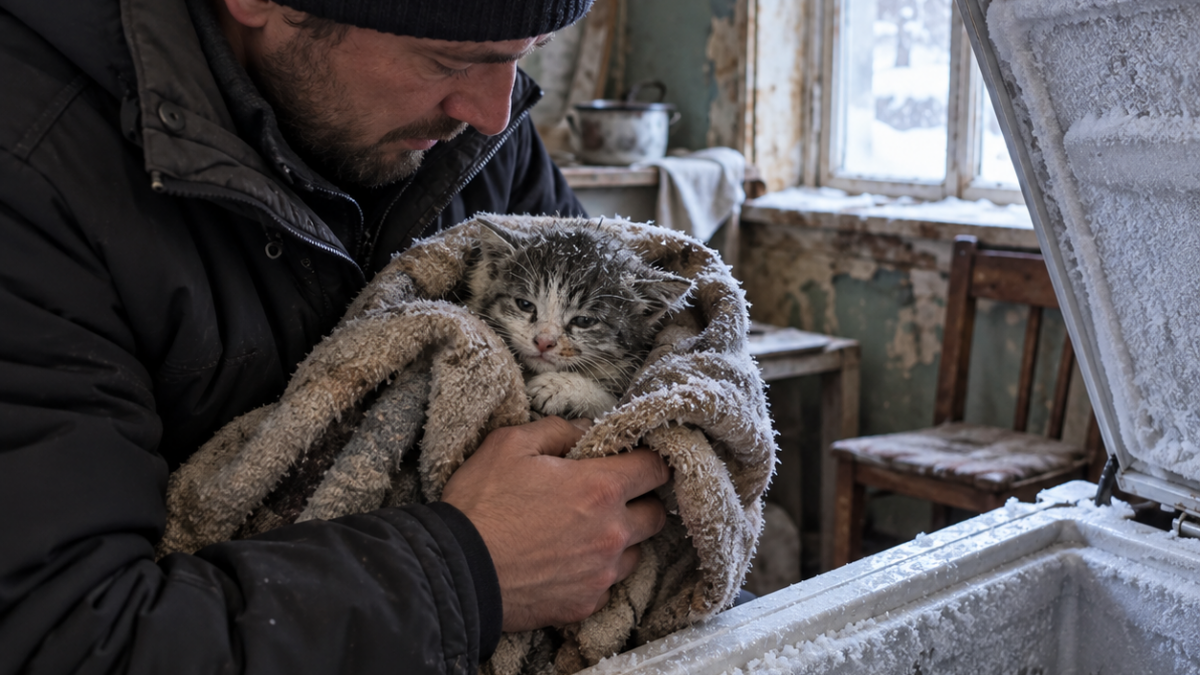
PART 2
The first thing I noticed was the dust.
It sounds insignificant, but when you are trying to understand how something happened, insignificant details suddenly become important.
Dust covered most of the freezer lid.
Not fresh snow.
Not dirt tracked in from my boots.
Old gray dust that had settled there over months.
But along one edge, near the handle, there were smears.
Someone had touched it.
Recently enough that the clean streaks remained visible.
I stood in the freezing kitchen staring at them.
Maybe I had made them the day before.
I checked.
My gloves had left marks near the center.
These were farther to the side.
Finger-shaped.
Bare-hand marks.
I stepped back.
“Okay.”
My own voice sounded strange inside the empty house.
I opened the lid again.
The smell still lingered faintly.
Old fabric.
Dust.
Cat.
The blankets inside were not part of the freezer’s original contents.
I knew that.
They were cheap synthetic blankets, dirty and torn.
One had been folded.
Not randomly dropped.
Folded.
Someone had put bedding inside.
That could mean kindness.
Maybe someone had discovered the freezer open and turned it into a shelter for a stray cat.
That was the explanation I wanted.
Then why had the lid been almost closed?
I lowered it slowly.
The hinges were heavy.
The chest freezer was old.
Once the lid passed a certain point, gravity pulled it down.
I stopped it with my hand.
If Frost had climbed inside for warmth and the lid somehow shifted, it could have fallen.
Possible.
But how?
The freezer stood flat against the wall.
Nothing overhead could have dropped onto it.
No branch.
No shelf.
No animal large enough to push the lid from outside.
I opened it again and examined the inner rim.
Scratches.
Lots of them.
Some old.
Some brighter.
Fresh enough that the plastic had not dulled.
My chest tightened.
Frost had tried to get out.
I photographed everything.
Then I called the veterinarian.
“How is he?”
“Stable.”
That word had never sounded so beautiful.
“Did he eat?”
“Not yet normally. We’re going slowly.”
“Can I see him?”
“Yes.”
“I’ll be there.”
I almost left.
Then something near the kitchen doorway caught my attention.
Small pieces of dry cat food.
Three or four.
Scattered near the wall.
I crouched.
There was another piece farther down the hallway.
Then one near the back door.
A trail?
Maybe.
Or food that had been dropped from an old bag.
I followed it anyway.
The back door had a gap beneath it large enough for a small animal to squeeze through.
Outside, paw prints had disappeared beneath fresh snow.
I stood there trying to build the story.
A stray cat finds the abandoned house.
Gets inside through the damaged door.
Someone has previously placed blankets in the freezer.
Perhaps locals knew he sheltered there.
Perhaps food had been left.
He climbs inside.
The lid closes accidentally.
Simple.
Horrible.
But accidental.
Then I found the plastic bowl.
It was behind a cabinet.
Empty.
A water bowl beside it.
Frozen solid.
Now the house no longer looked completely abandoned.
Somebody had been feeding a cat there.
Not regularly enough to keep him healthy.
But somebody knew he existed.
That changed everything.
I started calling neighbors.
There were only a handful of occupied houses nearby in winter.
Most were vacation homes like ours.
The first man I reached said he had seen “a gray cat” around.
Frost was not truly gray, but dirt and malnutrition had changed his coat so much that I understood the description.
“How long?”
“Couple months, maybe.”
“Did anyone feed him?”
“An older woman from the corner house sometimes did.”
I called her.
Her name was Elena.
The moment I described the cat, she gasped.
“You found him?”
“Yes.”
“Alive?”
“Barely.”
She began crying.
“I thought he disappeared.”
“When did you last see him?”
“Maybe twelve days ago.”
My stomach dropped.
“Twelve?”
“Yes.”
“What did you call him?”
“I didn’t have a name. I just said ‘boy.’”
“Did you feed him inside the abandoned house?”
“Sometimes.”
“Did you put blankets in the freezer?”
Silence.
Then, “What freezer?”
That answer stopped me.
“You never used it as a bed for him?”
“No.”
“I left food near the back door. Sometimes inside when it was open.”
I stared at the blankets.
“So somebody else did.”
“Maybe.”
“Did you ever see anyone around the house?”
Elena hesitated.
“One man.”
“What man?”
“I don’t know his name.”
She described a middle-aged man who occasionally used the lane behind the properties.
He might have been collecting scrap.
Might have been checking vacant houses.
Might have had nothing to do with Frost.
She had seen him once near our back porch.
“When?”
“Two weeks ago? Around then.”
“Did you talk to him?”
“No.”
“Did he see the cat?”
“I don’t know.”
That was not evidence.
I reminded myself repeatedly.
Suspicion is not proof.
I could not turn an unknown stranger into a villain simply because I wanted someone to blame.
I photographed the bowls, blankets, freezer, scratches, back door, and food pieces.
Then I contacted local animal welfare authorities.
They agreed to document the site but warned me immediately.
Unless there was clear evidence somebody intentionally shut Frost inside, proving cruelty would be difficult.
I understood.
I hated it.
But I understood.
Then I drove to the clinic.
Frost was in a heated recovery enclosure.
He looked almost exactly as he had the day before.
Still painfully thin.
Still exhausted.
But his eyes opened when I spoke.
“Hey.”
One ear moved.
I smiled.
“You’re getting good at that.”
The veterinarian came beside me.
“He took a little food.”
“How little?”
She showed me.
A measured amount.
Carefully controlled.
“Why so little? He’s starving.”
“Exactly why.”
She explained that severely malnourished animals cannot simply be given unlimited food immediately.
His body needed gradual refeeding.
Electrolytes.
Monitoring.
Small portions.
His liver and kidneys were already under stress.
“If we move too fast, we can create new problems.”
I looked at Frost.
“Everything with you is complicated.”
His eyes closed.
The veterinarian smiled.
“Cats specialize in that.”
The next twenty-four hours became a cycle of numbers.
Temperature.
Blood glucose.
Hydration.
Weight.
Electrolytes.
Respiration.
Heart rate.
Frost’s temperature rose slowly.
That was good.
Too rapid a rise could cause complications.
His body needed time.
I had never understood how dangerous cold could remain even after an animal was brought indoors.
The veterinarian explained that profound hypothermia affects the heart, circulation, metabolism, and organ function.
Simply wrapping him in something hot would not solve it.
So the clinic warmed him gradually.
Controlled.
Patient.
Everything I did not feel.
I wanted him fixed.
Immediately.
I wanted him eating.
Walking.
Purring.
I wanted the story to skip the frightening part.
Biology did not care.
On the second night, the clinic called.
I answered before the first ring finished.
“What happened?”
“He vomited.”
My stomach clenched.
“Is that serious?”
“It can be. We’re watching him.”
“Can I come?”
“You can, but he needs rest.”
I went anyway.
Of course I did.
Frost lay curled beneath a blanket.
His eyes opened when I sat nearby.
“You’re causing trouble.”
He blinked.
“You understand I have not slept?”
Another blink.
“I blame you.”
His head moved toward my hand.
Barely.
I placed one finger near his nose.
He sniffed.
Then came the purr.
Still weak.
Still uneven.
But louder than the night before.
I laughed.
The technician smiled.
“He does that when people sit with him.”
“Really?”
“Not everybody.”
I chose to believe that meant something.
Probably too early.
Still.
I stayed.
Sometime around two in the morning, Frost ate a tiny portion without assistance.
The technician wrote it down.
I wanted to photograph the bowl.
She laughed.
“You rescue people are all the same.”
“I’m not rescue people.”
“You are now.”
I looked at Frost.
Maybe she was right.
The vomiting did not continue.
His bloodwork remained concerning but not worse.
By day three, he could hold his head up for longer.
Day four, he tried sitting.
The first attempt failed.
His front legs slipped.
I reached toward him.
The veterinarian stopped me.
“Let him try.”
Frost gathered his paws.
Pushed.
Sat.
Crooked.
Shaking.
For perhaps six seconds.
Then lowered himself.
I stared.
“That counts.”
“It counts.”
I called Elena.
“He sat up.”
She began crying.
“You think I’m joking?”
“No.”
“He sat for six seconds.”
“That’s wonderful.”
We were celebrating six seconds.
I understood how strange that sounded.
I did not care.
Elena visited the next day.
Frost heard her voice before she entered the room.
His ears lifted.
She stepped inside.
“Boy?”
His head turned.
For the first time since I had found him, Frost tried to stand immediately.
He failed.
Elena covered her mouth.
“He knows me.”
“Yes.”
She crouched.
“I’m sorry.”
Frost watched her.
“I should have looked harder.”
I placed a hand on her shoulder.
“You thought he moved on.”
“I stopped seeing him and assumed he found somewhere warmer.”
None of us had imagined an old freezer.
Why would we?
Elena extended her hand.
Frost sniffed.
Then rubbed his cheek weakly against her fingers.
She cried harder.
“I fed him for months.”
“How long?”
“Since late fall.”
“What was he like?”
“Skittish.”
“Did he let you touch him?”
“Eventually.”
“Was he already thin?”
“Yes, but not like this.”
She described him waiting near the back door.
Never entering fully at first.
Then during colder weather, stepping into the kitchen to eat.
Once she had found him asleep under a chair.
“Did you ever see the freezer open?”
“I think so.”
“Blankets?”
“No.”
That remained the mystery.
Someone had placed them.
Who?
Animal welfare officers returned to the house with me.
They looked at everything.
One officer studied the freezer.
“You said the lid was slightly open?”
“Yes.”
“How much?”
I showed him approximately.
“Enough for air?”
“Some.”
“Enough for the cat to escape?”
“No.”
He inspected the hinges.
“It could potentially fall shut if left in the wrong position.”
“By itself?”
“Possibly.”
“You sound unconvinced.”
“I’m saying possible, not probable.”
He looked at the blankets.
“Could someone have made this as a shelter?”
“Yes.”
“Then accidentally closed the lid?”
“Yes.”
“Or intentionally?”
He met my eyes.
“Yes.”
No certainty.
We checked for fingerprints, but the house had too much old contamination and too many people had used the freezer over the years.
The newer marks did not give us anything useful.
No camera covered the property.
No witness had seen someone close the lid.
No clear signs of forced entry because the back door itself was damaged.
The case stalled immediately.
I hated that.
People like clean stories.
Someone evil.
Someone caught.
Punishment.
Justice.
Real life often gives you a wounded animal and no explanation.
Frost did not care.
He had more immediate concerns.
Food.
Warmth.
Staying alive.
So I tried to follow his priorities.
By day five, he was eating small meals more eagerly.
His body temperature held without as much external warming.
The IV support decreased gradually.
He groomed one paw.
That might have been my favorite milestone.
The veterinarian noticed.
“He feels well enough to care how he looks.”
I laughed.
“That is deeply cat.”
“Exactly.”
The coat was filthy.
Matted.
Some areas stained from whatever he had lain in.
But bathing him aggressively was out of the question while he remained fragile.
We used warm damp cloths.
Short sessions.
Very gentle.
Frost hated them.
Excellent.
A cat expressing disapproval has energy.
He slapped the cloth once.
Weakly.
I celebrated.
“You attacked me.”
Frost stared.
“Do it again.”
He did not.
Still.
I wrote Elena:
HE HIT ME.
She replied:
GOOD.
That was our emotional state.
Assault by cat = progress.
At one week, Frost stood.
Not just sat.
Stood.
His legs trembled.
Back arched.
Ribs visible beneath his coat.
He looked as if a strong breeze could knock him down.
But he stood.
I was visiting.
The veterinarian had placed a small food dish several feet away.
Frost smelled it.
Pushed up.
One paw.
Then another.
His back legs straightened.
I held my breath.
“Come on.”
One step.
Pause.
Second.
Then he collapsed.
I moved.
The veterinarian stopped me.
“Give him a second.”
Frost stayed down.
Then pushed up again.
Third step.
He reached the food.
Ate.
I laughed.
“Motivation.”
The veterinarian smiled.
“Food is honest motivation.”
The next day, four steps.
Then six.
Some days fewer.
Some days he seemed exhausted after almost nothing.
Recovery was not a straight line.
I learned that quickly.
One morning, he refused breakfast.
Instant panic.
The clinic ran bloodwork.
No catastrophic change.
He simply felt unwell.
Maybe nausea.
Medication adjusted.
By afternoon, he ate.
I realized how fragile my confidence was.
One good day and I imagined home.
One bad meal and I imagined death.
The veterinarian finally told me:
“You cannot ride every hour with him emotionally.”
“What does that mean?”
“It means healing fluctuates.”
“I know.”
“You say that. Then you panic every time he sleeps longer.”
I looked at Frost.
“I found him nearly dead.”
“I know.”
“So yes. I panic.”
She softened.
“Fair.”
That was the first time I admitted something else.
“I think I’m keeping him.”
She smiled.
“You think?”
“If he survives.”
“He’s starting to look very interested in surviving.”
Frost opened one eye.
I corrected myself.
“When he survives.”
The veterinarian nodded.
“Better.”
Naming him happened that evening.
Until then, the clinic chart listed him as FOUND CAT.
Elena called him Boy.
I called him Buddy.
None felt right.
Snow had begun falling again outside the clinic.
I stood near the window.
Frost sat inside his heated enclosure.
Warm.
Safe.
Separated from winter by glass.
The contrast made the name obvious.
“Frost.”
The technician looked over.
“What?”
“His name.”
She smiled.
“Frost?”
“Too obvious?”
“Maybe.”
Frost meowed.
Weak but clear.
I looked at him.
“He approves.”
So Frost became Frost.
Not because cold defined him.
Because it did not finish him.
That mattered to me.
Week two brought real movement.
Frost walked across the treatment room.
Slowly.
His back legs remained weak.
But he made it from one blanket to another.
Then he turned around.
The turning was harder.
He wobbled.
Corrected.
Returned.
That day I brought a soft cat bed.
He sniffed it.
Stepped around it.
Lay on the clinic towel instead.
I felt personally insulted.
“I bought that.”
Frost ignored me.
The nurse laughed.
“Welcome to cat ownership.”
I brought another bed.
Same response.
A cardboard box appeared.
Frost climbed into it.
Of course.
Thirty-dollar bed rejected.
Free box approved.
That was the first moment I stopped seeing him primarily as a patient.
He was a cat.
Specific.
Stubborn.
Opinionated.
His personality was emerging from beneath starvation.
He liked boxes.
Hated damp cloths.
Preferred fish-based food.
Disliked sudden noises.
Loved Elena.
Tolerated me.
At least that is what I claimed.
Then came the freezer response.
The clinic had a small refrigerator with a freezer compartment in the staff area.
Frost was walking on a harness nearby for rehabilitation.
Someone opened the freezer.
The hinge made a hollow plastic creak.
Frost froze.
His pupils widened.
Body dropped low.
Then he tried to run.
Not toward me.
Away.
His legs slipped.
I caught him gently with the harness.
“Frost.”
He struggled.
The technician shut the freezer door.
Frost hid beneath a chair.
I sat on the floor.
“Okay.”
No response.
“Okay, buddy.”
He remained hidden almost twenty minutes.
That changed how we understood the experience.
Whatever happened inside that old chest freezer had frightened him deeply.
The sound.
The enclosed space.
The lid.
Maybe memory.
Maybe association.
We did not force exposure.
No dramatic desensitization.
He had enough to deal with.
Later, at home, we would learn Frost disliked closed cabinets too.
If a door clicked shut beside him, he left the room.
That behavior persisted.
It did not prove deliberate cruelty.
Trauma does not tell us the perpetrator.
Only that the experience mattered.
The investigation produced one new lead around that time.
A local scrap collector named Victor admitted he had entered the vacation property approximately two weeks before I found Frost.
Elena’s description matched him.
Animal welfare officers interviewed him.
Victor said he had been looking for discarded metal near several vacant properties.
He admitted seeing the cat.
“Was he inside?”
“Near the house.”
“Did you feed him?”
“No.”
“Did you enter?”
“Kitchen only.”
“Did you open the freezer?”
He denied it.
“Did you put blankets inside?”
“No.”
No evidence contradicted him.
He had trespassed.
That became a separate matter with the property owners.
But nothing tied him to Frost’s confinement.
I wanted it to.
That is ugly but true.
I wanted certainty.
A name.
A face.
Someone to blame.
The investigator told me something I needed to hear.
“Wanting an answer doesn’t make a weak answer stronger.”
I knew.
Still hated it.
Victor may have been guilty of nothing beyond trespassing.
Or more.
We did not know.
So we stopped saying we knew.
That became important.
Frost’s story would not become an excuse to accuse someone without proof.
Justice requires restraint too.
Meanwhile, one strange detail emerged from the house.
The blankets inside the freezer had come from an upstairs bedroom.
I recognized the pattern after going through old family photographs.
That meant somebody with access to the house, or somebody who had entered it, had moved them downstairs.
Could Frost have dragged them?
Impossible.
Could Elena?
She said no.
Could a previous family member have placed them years earlier for storage?
Maybe.
One relative vaguely remembered cleaning the upstairs room and throwing old bedding “somewhere in the kitchen.”
That may have solved it.
Maybe the blankets were not cat bedding at all.
Maybe they had simply been stored in the freezer because the appliance was unused.
A less dramatic explanation.
Often the true one.
Then the accident theory grew stronger.
Frost enters an open chest freezer containing old blankets because it feels insulated from wind.
He sleeps.
The heavy lid, already partly unstable, slips downward.
It does not close completely.
Enough air remains.
Not enough space to climb out.
He scratches.
Calls.
Waits.
Days pass.
That was horrifying enough.
No villain required.
And perhaps more likely.
The latch rumor from the first inspection also changed.
When I first told friends the lid seemed “closed from inside,” I had been speaking emotionally.
After examining it properly, I realized chest freezer lids do not function like a room door with an inside lock.
There was no evidence Frost had been deliberately latched in.
The lid had simply become too heavy for a weak cat to push upward.
That distinction mattered.
I refused to turn uncertainty into a more viral story.
Frost had nearly died.
Truth was already powerful.
He did not need fictional cruelty added.
By the third week, his weight had increased enough that I could feel the difference when I lifted him.
Still thin.
But no longer frighteningly weightless.
The clinic scale became our scoreboard.
A little gain.
Then more.
One day, no gain.
I frowned.
The nurse laughed.
“You’re doing it again.”
“What?”
“Staring at the scale like it owes you money.”
“He needs weight.”
“He’s gaining overall.”
“Today he didn’t.”
“Today is one day.”
Frost meowed from the carrier.
“He agrees with me.”
“No. He wants lunch.”
Also true.
His fur began changing.
Once cleaned and nourished, color and texture returned.
The rough coat softened.
He groomed regularly.
Eyes brighter.
Ears warm.
That detail affected me every time.
Warm ears.
The first day, they had felt frozen.
Now I touched one and smiled.
Frost slapped my hand.
“Privacy.”
Another slap.
“Fine.”
Progress.
Then came his first jump.
Not planned.
Not approved.
The veterinarian had cleared him for gentle movement, not furniture acrobatics.
Frost was in the clinic room.
A chair stood beside him.
He looked at the seat.
I saw the calculation.
“No.”
He crouched.
“No.”
He jumped.
Barely.
Front paws reached.
Back legs scrambled.
He made it.
I caught him only after he was on the chair.
The technician burst out laughing.
“What part of no did you misunderstand?”
Frost sat proudly.
“He’s a cat,” she said.
“I know that now.”
A month after rescue, Frost came home with me.
I had spent days preparing.
Warm room.
Multiple beds.
Litter boxes.
Food station.
Water fountain.
Boxes.
No open appliances.
No access to basement.
Cabinet latches on lower doors, which my sister mocked until I explained why.
I even removed an old trunk from the bedroom because the lid made a similar sound to the freezer.
Possibly excessive.
I did not care.
The drive from clinic to home terrified me more than Frost.
“What if he hates it?”
The nurse laughed.
“He’s a cat. He will hate parts of it.”
“What if he hides?”
“He probably will.”
“What if he doesn’t eat?”
“Call us if it becomes concerning.”
“What if—”
She handed me the carrier.
“Andrei.”
“What?”
“Take your cat home.”
My cat.
The words stopped me.
Frost stared through the carrier door.
“Ready?”
He meowed.
Probably not.
Neither was I.
At home, I opened the carrier inside one quiet room.
Frost remained inside.
Five minutes.
Ten.
I sat on the floor.
No reaching.
Eventually, one paw emerged.
Then his head.
He sniffed.
Stepped out.
Moved immediately behind a chair.
Expected.
I left food.
Water.
Litter.
Sat quietly.
After nearly an hour, Frost emerged again.
He explored the perimeter of the room.
Walls first.
Corners.
Under furniture.
Avoiding the center.
He found the cardboard box.
Climbed inside.
Of course.
That night, I slept on the sofa nearby.
At three in the morning, a sound woke me.
Scratching.
I jumped up.
Frost was using the litter box.
I laughed at myself.
“Great.”
He stared.
“Carry on.”
By morning, half the food was gone.
That felt like a miracle.
The second day, he explored the hallway.
Third, living room.
Fourth, bedroom.
Kitchen came last.
He reached the doorway and stopped.
The refrigerator hummed.
Frost stiffened.
I crouched.
“You don’t have to.”
He turned away.
Good.
Choice.
Later, I moved his food farther from the kitchen so he had no reason to enter.
Weeks passed before he tried.
The first time he did, the refrigerator compressor clicked.
Frost jumped.
Ran.
I did not follow immediately.
He hid under the bed.
Later, he came out on his own.
Trauma needs space.
Not every fear should be challenged immediately.
Some fears can simply be accommodated.
I learned that from him.
The freezer compartment became permanently off limits.
I put a childproof latch on it.
Ridiculous for a man living alone with a cat.
Necessary to my peace of mind.
Frost’s favorite spot became the radiator beneath the living room window.
He stretched beside it.
Closed his eyes.
Warmth on one side.
Sunlight on the other.
The first time I saw him sleeping there, fully relaxed, something in me broke open.
I took a photograph.
Then another.
Then stopped.
Some moments should be lived without a camera.
I sat nearby.
Frost opened one eye.
“Cold enough for you?”
He ignored me.
Eventually, he got up.
Walked over.
Climbed onto the sofa.
Not my lap.
Beside me.
Progress.
Two days later, half on my leg.
Week later, full lap.
He circled three times.
Settled.
I froze.
His head rested against my hand.
Then the purr started.
Strong.
Steady.
Nothing like the broken vibration from the hospital.
I looked down.
“You really did it.”
Frost’s eyes closed.
I barely moved for an hour.
My leg went numb.
Worth it.
Elena visited.
Frost heard her voice and ran to the hallway.
She cried before seeing him.
When he appeared, she dropped to her knees.
“Boy.”
Frost rubbed against her.
I smiled.
“His name is Frost now.”
She looked at me.
“Frost?”
“I know.”
“Very original.”
“Thank you.”
Frost climbed into her lap.
Traitor.
She laughed through tears.
“He looks completely different.”
“He feels completely different too.”
We compared photographs.
The first day.
Now.
Her hand covered her mouth.
“I thought he was dead.”
“So did I.”
“Do you still think someone put him in there?”
I hesitated.
“I don’t know.”
She appreciated the honesty.
“Maybe accident?”
“Maybe.”
“Does that make it easier?”
I looked at Frost.
“No.”
It really did not.
Accidents can be just as cruel in outcome.
But they require a different lesson.
Secure abandoned structures.
Do not leave dangerous containers open.
Check before closing storage spaces.
If animals shelter nearby, make safe alternatives.
Truth determines prevention.
Blame satisfies anger.
Understanding prevents repetition.
So I returned to the vacation house one final time before winter ended.
I removed the freezer.
Not alone.
Two friends helped.
We loaded it onto a truck.
The lid had bothered me every time I imagined Frost inside.
I considered smashing it.
Dramatic.
Pointless.
Instead, we took it for proper disposal.
Before hauling it away, I photographed the kitchen empty.
No freezer.
No trap.
The house would later be renovated or sold.
I did not care which.
I cared that no animal would hide in that chest again.
That was my version of revenge against the object.
Make it impossible for history to repeat.
We also repaired the back door.
Then placed a weatherproof outdoor cat shelter near Elena’s property for any strays in the area.
Insulated.
Two exits.
Never a heavy lid.
Elena maintained food responsibly and worked with a local trap-neuter-return group.
One winter shelter became three.
Other neighbors joined.
The place where Frost nearly died became a small monitored cat station.
That felt more meaningful than anger.
The animal welfare investigation officially closed without evidence of intentional confinement.
At first, I felt cheated.
No villain.
No punishment.
No dramatic courtroom ending.
Then I looked at Frost sleeping on my radiator.
His stomach full.
Body warm.
What exactly was I missing?
Someone paying?
Maybe.
But Frost had what mattered.
Life.
If a person had intentionally trapped him, I would have wanted accountability.
Without proof, inventing guilt would not help him.
So I stopped chasing a face.
The true enemy became neglect of abandoned properties, unsafe shelter, winter exposure, starvation, and indifference.
Those I could fight.
Frost became healthier each month.
His coat thickened.
He gained muscle.
His movements changed from cautious to fluid.
He ran at night.
This was alarming at first.
At two in the morning, thunder through the hallway.
I jumped up.
Frost streaked past.
Around chair.
Under table.
Back.
“What are you doing?”
Another lap.
Zoomies.
I sat down laughing.
The cat who could not stand inside a freezer was now waking me by sprinting through my apartment.
That was revenge.
Cold stole his movement.
Warmth returned it with interest.
He discovered toys late.
The first was a feather wand.
I moved it gently.
Frost watched.
No reaction.
Again.
One paw lifted.
Strike.
Feather moved.
He froze.
Then attacked.
Within minutes, predator.
I laughed.
“You’ve been hiding this?”
He leaped.
Missed.
Recovered.
Again.
The first full play session lasted five minutes.
Then he slept for two hours.
Next day, seven.
Soon, fifteen.
I stopped timing.
That was another milestone.
When you stop measuring recovery because ordinary life has taken over.
One month after adoption, I realized I had not weighed Frost in a week.
Panic.
Then thought:
He eats.
Grooms.
Plays.
Sleeps.
Vet checks good.
The scale no longer ruled us.
Excellent.
We still attended follow-ups.
Bloodwork normalized gradually.
Kidney values improved.
No major lasting frostbite injury despite the cold ears and paws.
That felt miraculous.
The veterinarian warned that extreme hypothermia can cause tissue damage.
We had escaped much of it.
Frost kept all toes.
All ear tissue, though one tip remained slightly irregular.
I loved that ear.
The tiny uneven tip became part of his face.
He also developed an odd ritual.
Every evening around nine, Frost walked through each room.
Bedroom.
Hallway.
Living room.
Kitchen doorway.
Back.
Then jumped onto the sofa.
I called it inspection.
Maybe normal cat behavior.
Maybe checking exits.
Maybe habit from survival.
No need to turn everything into trauma.
That was another lesson.
Rescued animals are still animals.
Not every behavior is a wound.
Sometimes a cat walks around because cats are weird.
Frost helped me stop overinterpreting him.
If he stared at a wall?
Maybe ghost.
Probably bug.
If he slept in a box?
Not symbolic.
Box comfortable.
If he avoided freezer?
Yes, history likely mattered.
Nuance.
Years began passing.
That surprised me.
At first, Frost’s life divided into days since rescue.
Day three.
Week one.
Month two.
Then eventually:
Tuesday.
Spring.
Birthday.
Winter again.
Ordinary time.
The first winter terrified me.
When snow began, Frost sat at the window.
He watched flakes.
I watched him.
“Does this bother you?”
He flicked his tail.
Not useful.
I kept indoor temperature warmer than necessary.
My heating bill became ridiculous.
Worth it.
One evening, I opened the front door briefly to collect a package.
Cold air entered.
Frost approached.
Stopped.
Sniffed.
Then backed away.
I closed the door.
No forcing.
He returned to the radiator.
Good choice.
Later that winter, he became curious about snow from behind glass.
Paw against window.
Chasing flakes visually.
Safe.
Warm.
That image mattered.
Winter no longer touched him directly unless he chose proximity.
His first adoption anniversary arrived.
Elena brought a ridiculous cat toy shaped like a snowman.
“Very funny,” I said.
Frost attacked it immediately.
She laughed.
“He approves.”
We cooked dinner.
Frost stole a piece of chicken.
Normal celebration.
I looked at the photographs from the freezer and almost could not connect the animals.
Same eyes.
That was the only thing.
The body had changed completely.
Healthy weight.
Dense fur.
Confidence.
I decided not to post the worst photo that day.
Instead, I posted one of Frost on the radiator.
Because survival should not always be marketed through suffering.
Sometimes the after deserves the whole frame.
The abandoned house was eventually purchased by a young couple.
I told them what had happened.
They were horrified.
The old freezer already gone.
They repaired everything.
Sealed dangerous gaps.
Built proper storage.
More importantly, they agreed to let Elena keep one insulated cat shelter near the edge of the property.
I visited once after renovation.
The kitchen looked unrecognizable.
Bright walls.
New cabinets.
Modern appliances.
I stood where the freezer had been.
Nothing.
Good.
Frost never returned.
I would not have taken him anyway.
Some people suggested closure.
“Maybe bring him to see the place.”
No.
Animals do not need our cinematic closure.
Frost had moved on.
Why ask him to revisit fear for our emotional satisfaction?
His home was with me.
That was closure enough.
At around age three or four—his exact age remained uncertain—Frost developed confidence with visitors.
Not instantly.
He inspected.
Kept distance.
Then chose.
He loved Elena.
Liked my sister.
Tolerated my brother.
Hated one friend’s loud boots.
Fair.
He had standards.
One winter evening, that friend opened my freezer to get ice without thinking.
The lid sound was different from the old chest freezer, but Frost heard it.
He disappeared.
I snapped.
“Close that.”
My friend did.
“I’m sorry.”
“It’s okay.”
Frost hid for almost an hour.
My friend felt terrible.
“Should I leave?”
“No. Just ignore him.”
Eventually, Frost emerged.
Sat across the room.
Watched.
The friend tossed no treats.
Called no name.
Good.
Later, Frost approached.
Sniffed his boot.
Walked away.
That was enough.
A few visits later, they became friends.
Fear did not vanish.
Trust grew around it.
That is how healing often works.
You do not delete the bad association.
You create enough safe associations nearby that life stays large.
At five years with me, Frost became a mentor by accident.
I fostered a young injured cat for a rescue.
Temporary.
I swore temporary.
Her name was Poppy.
Frost hated the idea.
Hissed at the closed door.
Walked away dramatically.
Gradual introduction.
Scent swapping.
Barrier.
Short meetings.
Poppy adored him.
Frost did not consent to this admiration.
She followed him.
He moved away.
She followed.
Eventually, he gave up.
One morning, I found them sleeping on opposite ends of the sofa.
Week later, closer.
Month later, Poppy’s head on Frost’s back.
I took a photo.
“Traitor.”
Frost opened one eye.
Poppy later found a permanent home.
When she left, Frost searched her room.
That surprised me.
Maybe he missed her.
Maybe just checking territory.
Either way, I fostered again months later.
Then again.
Frost became the old survivor who taught frightened newcomers that my house was safe.
Not intentionally.
He simply existed calmly.
A new cat saw him eat.
Sleep.
Use litter.
Approach me.
Safety can be demonstrated.
That became part of his legacy while he was still alive.
Elena eventually joined a formal community cat group.
The insulated shelters expanded to neighboring properties.
The program included spay/neuter and veterinary care.
One particularly cold winter, volunteers checked every station twice a day.
No cat disappeared into unsafe abandoned structures.
That mattered to me.
Frost’s near-death had produced prevention.
If we needed revenge, there it was.
The cold house had once hidden suffering.
Now the neighborhood actively looked.
Nothing alone.
No silent freezer.
People checked.
Years later, I received a message from the animal welfare officer who had investigated.
He sent a photo of a newly installed outdoor cat shelter in another district.
Caption:
THOUGHT OF FROST.
I smiled.
Impact spreads strangely.
One cat.
One freezer.
Then people start asking how winter shelter should actually be designed.
Two exits to prevent trapping.
Insulation.
Dry bedding appropriate for outdoor cats.
No dangerous lids.
Regular monitoring.
Frost never knew any of this.
He cared about dinner.
Good.
Animals do not need to carry symbolic responsibility for the humans they change.
At seven years, Frost slowed slightly.
Not old yet.
Just less ridiculous.
Fewer midnight sprints.
More strategic naps.
His favorite place remained the radiator.
I replaced it during renovation.
Panic.
Would he reject the new one?
He inspected.
Sat.
Approved.
Crisis avoided.
He also became more affectionate with age.
Lap every evening.
Sometimes chest.
Heavy.
I complained.
Never moved him.
One night, he climbed onto me and purred.
I remembered the hospital.
First purr.
Tiny.
Trembling.
Almost inaudible.
Now my entire rib cage vibrated.
I smiled.
“Show-off.”
He kneaded my sweater.
Claws included.
“Painful show-off.”
Still did not move.
At eight or nine years, Frost developed dental disease.
Routine aging.
Nothing connected to the freezer.
The veterinarian recommended cleaning and extraction of one bad tooth.
I panicked far more than medically justified.
Anesthesia.
Hospital.
Monitors.
Old fear returned.
The veterinarian recognized it.
“This is not the first night.”
“I know.”
“He is healthy enough.”
“I know.”
“Then breathe.”
I hated being told to breathe.
Still.
Procedure went well.
Frost returned home groggy.
He walked out of carrier.
Ate later.
Normal.
That experience taught me something about caregiver trauma.
Frost had healed enough to treat veterinary care as temporary annoyance.
I still carried the first emergency in my body.
Every clinic call raised my heart rate.
Eventually, I had to learn healing too.
He was not always almost dying.
That sentence helped.
Frost is not always almost dying.
He is a cat with a dental appointment.
A cat with a vaccination.
A cat with mild arthritis.
Normal.
I repeated it.
At ten years with me, Frost’s muzzle—not exactly muzzle, cats age more subtly—began showing senior changes.
His coat remained thick but less glossy.
Jumps became measured.
He sometimes looked at the sofa before climbing.
I added steps.
He ignored them initially.
Of course.
Later, used them secretly.
Pride.
His annual bloodwork showed early kidney changes.
Common in older cats.
Manageable.
Diet adjusted.
Hydration encouraged.
Water fountain upgraded.
Frost disapproved of new food.
Strongly.
We worked with the vet to find something he accepted.
Age required negotiation.
I remembered his starving body.
The irony of a cat rejecting expensive prescription food was almost beautiful.
“You once ate whatever you could find.”
Frost walked away from the bowl.
“Now look at you.”
He waited.
I added approved topper.
He ate.
Spoiled.
Perfect.
Elena visited less as she aged too.
But every time, Frost recognized her.
Even years later.
Voice.
Smell.
He came.
She always cried a little.
“You remember me?”
Frost rubbed against her legs.
I said, “He remembers food sources.”
She laughed.
“That counts.”
On one visit, she brought the old plastic bowl from the abandoned house.
“I found this in storage.”
I stared.
The same style.
Maybe not exact? She insisted it was.
I did not want it.
“Throw it away.”
“Really?”
“Yes.”
No shrine.
No relic.
Frost had better bowls now.
Ceramic.
Clean.
Full.
We discarded the old one.
That felt right.
People sometimes preserve trauma objects because humans love symbols.
Frost did not need them.
At eleven or twelve, arthritis became clear.
Jumping decreased.
We added ramps.
He hated one.
Accepted another.
He stopped sleeping on top of the tall bookshelf.
I missed seeing him there.
Then reminded myself:
He was getting old.
Old.
The cat I found nearly frozen had lived long enough for age to become the danger.
That was an extraordinary privilege.
One winter, snow fell overnight.
I woke and found Frost at the window.
He sat watching.
No fear.
No hiding.
Just interest.
I stood behind him.
“Remember?”
He looked at me.
Of course I had no idea what he remembered.
Maybe animals do not revisit experiences as stories the way we do.
I placed a hand on his back.
Warm.
Inside.
He stayed at the window for twenty minutes.
Then went to breakfast.
That was enough.
Around year twelve, I stopped fostering because Frost deserved quieter retirement.
The last foster, a little orange male named Milo, adored him.
When Milo left, Frost searched briefly.
Then slept for six hours.
Retirement accepted.
My house became calm.
Frost’s schedule:
Breakfast.
Window.
Sleep.
Lunch request denied.
Sleep.
Evening lap.
Dinner.
Inspection.
Bed.
He had become beautifully predictable.
At some point, I realized we had recreated the thing he had lacked before rescue.
Predictability.
Safe repetition.
The freezer had been uncertainty made physical.
Would the lid open?
Would anyone come?
Would food arrive?
Would warmth return?
My home gave answers.
Yes.
Yes.
Yes.
Yes.
That may be what trauma recovery is at its most basic.
Replacing unpredictable danger with predictable care.
Frost’s kidneys worsened slowly.
Medication.
Fluids later.
More checkups.
He tolerated home fluids better than expected.
Maybe because he trusted me.
Maybe because he was too old to argue.
Still slapped me occasionally.
Reassuring.
At thirteen years with me, Elena died.
Her daughter called.
I sat with the news for a long time.
Elena had been the first person to feed Frost consistently outside.
Not enough to save him alone.
But enough to keep him connected to human kindness before rescue.
I looked at Frost.
“You lost someone.”
He slept.
A week later, Elena’s daughter visited.
She brought a small photograph.
Elena sitting on her porch years earlier.
Frost in the background near the steps.
Before the freezer.
Thin but standing.
Alive.
I had never seen it.
I cried.
“That may be the earliest photo we have.”
“She loved him.”
“I know.”
Her daughter touched Frost gently.
He sniffed her hand.
Different scent.
Maybe familiar family resemblance means nothing to cats.
He accepted her anyway.
We kept the photo.
Not because suffering.
Because connection.
By then, Frost slept more.
He still purred when I sat.
Still demanded food.
Still used litter reliably.
Still watched birds.
Quality of life good.
Then one autumn, he started losing weight.
Not dramatic.
At first.
The scale returned.
I hated scales by then.
Bloodwork showed kidney disease progression.
Thyroid checked.
Other causes considered.
We adjusted treatment.
Weight stabilized for a while.
Then declined again.
I asked the veterinarian the question people always ask.
“How much time?”
She hated it.
“I don’t know.”
“Months?”
“Maybe.”
“Year?”
“Possible.”
“What should I watch?”
She gave me the list.
Appetite.
Hydration.
Mobility.
Grooming.
Interaction.
Comfort.
Litter habits.
Good days.
Bad days.
I started a calendar.
Green for good.
Yellow for mixed.
Red for bad.
Mostly green at first.
Then more yellow.
I hated every red square.
Frost did not know the calendar existed.
Good.
One evening, he jumped onto my lap.
Badly.
Back legs slipped.
I caught him.
He hissed at me as though I caused gravity.
“Sorry.”
He settled.
Purred.
I touched the irregular ear tip.
Warm.
Still warm.
That remained my private measurement.
Warm ears meant home.
His final winter was mild.
Thank God.
Snow came only twice.
Frost watched from the window.
On the second snowfall, I placed a thick blanket on his radiator bed.
He climbed up with the ramp.
Curled.
Slept.
I photographed him.
The image became my favorite later.
Snow outside.
Frost inside.
No drama.
No medical equipment.
Just a senior cat asleep in warmth.
That was the whole victory.
Spring arrived.
Kidney disease progressed.
He had good mornings.
Hard evenings.
Some nausea.
Medication helped.
Then helped less.
I learned to distinguish “can treat” from “should treat.”
The same lesson every long rescue story eventually teaches.
At the beginning, you fight for every hour because an entire life might be ahead.
At the end, you protect comfort because the life has been lived.
Frost had received years I could not imagine when I opened that freezer.
That changed the meaning of letting go.
Not giving up.
Completing care.
One morning, Frost refused breakfast.
Rare.
I tried the favorite food.
No.
Tuna water.
No.
He drank a little.
Then went to the radiator.
I called the clinic.
We went in.
Bloodwork worse.
Dehydration despite support.
Kidneys failing.
Hospitalization could perhaps stabilize him temporarily.
Maybe days.
Maybe weeks.
The veterinarian looked at me.
“He hates being here now.”
Frost had become more anxious in clinics with age.
I knew.
“What would you do?”
She paused.
“If he were mine, I would ask whether more hospital time is for him or for me.”
That hurt.
Because I knew the answer.
I wanted him.
More days.
More lap.
More purr.
But he was tired.
We took him home.
Comfort medication.
Favorite room.
Warmth.
One final day.
I did not make it ceremonial.
Frost would have hated ceremony.
I sat on the sofa.
He climbed halfway, stopped.
I lifted him gently.
He tolerated it.
Placed him on my lap.
He circled once.
Could not manage three anymore.
Settled.
His head rested against my hand.
Purr.
Faint.
Not as faint as the hospital first night.
But softer than adulthood.
I cried.
“Still here.”
The phrase came back.
That first purr had sounded like:
I’m still here.
Now he was saying it one last time.
I called Elena’s daughter.
She came briefly.
Frost accepted one stroke.
My sister came.
The veterinarian scheduled a home visit for evening.
I kept the house warm.
Too warm.
Did not care.
Outside, cold rain started.
I looked at the window.
Then at Frost.
“You’re never cold again.”
His eyes closed.
The veterinarian arrived quietly.
Frost remained on my lap.
She examined gently.
No surprises.
We talked.
I signed papers with shaking hands.
Then waited.
No rush.
The final injection would come only when I said.
I looked around my house.
Radiator.
Boxes.
Ramps.
Cat tree.
Water fountain.
All the ordinary evidence of his life.
I remembered the abandoned kitchen.
Old freezer.
Dust.
Snow.
One faint meow.
“Another thirty seconds,” I said.
The veterinarian looked at me.
“What?”
“If I had left thirty seconds earlier…”
She understood.
“But you didn’t.”
That was true.
Frost shifted.
His paw touched my wrist.
I placed my finger under it.
“Ready, buddy?”
No one can answer that question for us.
The sedative went first.
His body softened.
No fear.
I stroked his head.
The irregular ear.
The cheek.
The thick coat that had once hung over bones.
I whispered:
“You were found.”
That was all.
Not saved.
Not rescued.
Found.
Because so much of his life came from that accident.
A sound I almost ignored.
A freezer I almost closed.
A house I almost left.
Found.
The final medication followed.
Frost’s breathing slowed.
One breath.
Another.
Pause.
One last.
Stillness.
His body remained warm in my lap.
I stayed there.
Long after the veterinarian said he was gone.
For years, I had checked his side to make sure he was breathing.
At red lights.
Hospital.
First nights home.
Now I did it once more out of habit.
Nothing.
I cried harder than I expected.
The veterinarian waited.
No rush.
When I finally looked toward the kitchen, the freezer door in my apartment was closed with the childproof latch I had never removed.
I almost laughed.
Frost had changed the architecture of my life.
Tiny things.
Latches.
Warm rooms.
Boxes everywhere.
Automatic suspicion of chest freezers.
I would miss all of it.
We had Frost cremated.
No elaborate urn.
Simple.
I placed it beside Elena’s photograph for a while.
Then later moved it to a shelf near the window he loved.
People asked whether I regretted naming him Frost.
Because it tied him to the worst moment.
I did not.
The name changed meaning.
At first, frost meant cold.
Danger.
Winter.
Later, Frost meant him.
Stubborn.
Warm.
Heavy on my lap.
A cat who hated wet cloths.
Loved boxes.
Despised freezers.
Mentored foster kittens reluctantly.
Lived long enough to become old.
Language had been reclaimed.
That satisfied me.
Years after his rescue, I still received messages from people who had heard fragments of the story.
“Was he deliberately locked inside?”
The answer remained:
We never proved that.
Maybe accident.
Maybe human action.
Unknown.
I always said that clearly.
Because a good story does not need certainty where none exists.
Frost’s suffering was real enough.
People sometimes wanted a villain so badly they tried to invent one for me.
“The scrap collector did it.”
No evidence.
“The owner abandoned him.”
The house had no active owner living there.
“The neighbor knew.”
No.
Elena fed him.
Truth matters especially when emotion is strong.
If Frost taught me anything, it was to pay attention to what is actually in front of you.
One cat.
Cold.
Trapped.
Alive.
Help that.
Then ask questions.
Not the other way around.
The more lasting consequence of his story was practical.
The local cat group began checking abandoned buildings before deep winter.
Property owners were encouraged to secure broken doors and dangerous containers.
Outdoor shelters were designed with two exits and lightweight openings.
People stopped using old appliances as makeshift animal shelters.
Several old freezers were removed from vacant properties.
That was not dramatic justice.
It was useful.
No more Frosts.
That became the goal.
The young couple who bought the vacation house eventually sent me a photograph.
Their back yard in winter.
One insulated cat shelter near the fence.
A healthy feral cat sitting outside it.
Caption:
THIS ONE USES THE SAFE HOUSE.
I smiled.
The old kitchen trap was gone.
In its place, attention.
That is the kind of revenge I believe in now.
Not pain returned.
Danger removed.
Years after Frost died, I fostered again.
I told myself one cat.
Temporary.
Of course.
A black kitten named Ash arrived.
Healthy mostly.
Just frightened.
The first night, he hid in a box.
I placed food nearby.
Did not reach.
Sat.
Waited.
After an hour, a faint meow.
My entire body reacted.
For one second, I was back in the abandoned house.
Wind.
Dust.
Freezer.
Then I looked at Ash.
Warm room.
Open box.
Food.
Safe.
Different.
I smiled.
“Yeah. I heard you.”
That sentence carried fourteen years.
Maybe more.
I had heard Frost once.
After that, I listened differently forever.
That is how animals stay with us.
Not ghosts.
Habits.
Attention.
The way you check a lid.
The way you hear a quiet sound.
The way you leave one more bowl of water.
The way you inspect an abandoned shed before locking it.
Frost changed the threshold for what I noticed.
A faint meow became impossible to ignore.
One day, a volunteer asked me which moment in Frost’s story mattered most.
Opening the freezer?
First purr?
First steps?
Adoption?
I thought about it.
Then answered:
“The moment I almost left.”
She frowned.
“Why?”
“Because nothing happened.”
Exactly.
I had my hand near the door.
No dramatic sign.
No person shouting.
No obvious animal visible.
Just a sound almost too quiet to register.
That is how close rescue can be.
Not always a heroic decision.
Sometimes a pause.
Did I hear something?
Check.
That was it.
Check.
Frost’s entire future existed on the other side of that choice.
The radiator.
Elena’s visits.
Foster kittens.
Old age.
All hidden inside one faint sound.
That humbles me.
We like believing important moments announce themselves.
They often do not.
They whisper.
Frost whispered.
I listened.
Everything afterward came from that.
I still pass the renovated vacation house sometimes.
Usually in summer.
Green yard.
Windows clean.
No snow.
Once I stopped near the road.
The old kitchen window was open.
Curtains moving.
A normal house.
The young owners’ child was playing outside.
The safe cat shelter remained near the fence.
I thought about going in.
Did not.
No need.
That place had stopped belonging to Frost’s story.
His real story had moved home with me years earlier.
That house was only where I found him.
Not where he lived.
The distinction matters.
When I remember Frost now, I do not picture the freezer first.
I picture the sofa.
He is stretched across my legs.
Too heavy.
Purring.
I need to stand.
He refuses.
I stay.
That is the memory.
Weight.
Warmth.
Annoyance.
The exact opposite of the first day.
When I lifted him from the freezer, I was terrified by how little he weighed.
Years later, I complained because he made my legs numb.
That is a transformation you can feel physically.
From almost nothing.
To inconveniently alive.
People ask whether he ever stopped fearing enclosed spaces.
Not completely.
Closed cabinets still made him cautious.
Freezer sounds remained bad.
He never climbed inside boxes with lids.
But he loved open cardboard boxes.
That distinction always made me smile.
He did not stop liking shelter.
He stopped trusting anything that could trap him.
Fair.
I never tried to change that.
Some fears are reasonable after experience.
Healing does not mean making an animal behave as though nothing happened.
It means giving them enough control that fear does not dominate everything.
Frost had control.
Doors open.
Boxes open.
Windows safe.
If something made him uneasy, he left.
That was his freedom.
The first time he heard a freezer door years later and ran, I was sad.
The last time, when he was old, he simply lifted his head from the sofa, watched me close it, and went back to sleep.
I noticed.
Did not celebrate aloud.
But inside, I did.
Maybe age had dulled the association.
Maybe trust in the home outweighed it.
Maybe he was simply tired.
Whatever the reason, the sound no longer controlled him completely.
That was enough.
The mystery of how he entered the freezer remained unresolved.
People dislike unresolved endings.
I used to.
Now I think life contains them naturally.
Who closed the lid?
Did anyone?
How long was he inside?
How had he survived?
Why were blankets there?
We had partial answers.
Not complete.
The ending did not require them.
Frost did not wait for truth about the past before accepting comfort in the present.
Humans could learn from that.
We should still seek truth.
Still investigate.
Still hold people accountable when evidence supports it.
But when certainty never comes, we do not have to let uncertainty poison the life that remains.
Frost had dinner.
That mattered more to him than my unanswered questions.
Frost had a radiator.
A lap.
Years.
He won.
If I had to describe the revenge in one image, it would be this:
The old unplugged freezer being carried out of the house.
Its lid tied shut for transport.
Empty.
No cat inside.
No possibility of trapping another.
And miles away, Frost asleep in my bed with his paws stretched across my pillow as if he paid the mortgage.
That is revenge I can support.
Danger gone.
Victim thriving.
No one else hurt.
A life made larger.
I have one final photograph of Frost that most people never see.
He was old.
Gray around the face.
Sleeping beside a window during winter.
Snow outside.
Warm light inside.
His body turned away from the weather.
Completely relaxed.
There is no dramatic rescue visible.
No freezer.
No medical tubes.
No before-and-after collage.
Just an old cat.
That is why it is my favorite.
The whole purpose of rescuing Frost was not to keep him looking rescued forever.
It was to make rescue eventually irrelevant.
He became my cat.
The annoying one.
The stubborn one.
The box thief.
The lap occupier.
The mentor who pretended not to care about foster kittens.
The senior who demanded expensive food and then rejected it.
That ordinary identity was the victory.
His worst day did not become his permanent name.
Even though I called him Frost.
Funny how that worked.
The word remained.
The meaning changed.
And if I could go back to that abandoned kitchen, to the exact second before I lifted the freezer lid, I would tell myself one thing.
Do not be afraid of what you are about to find.
Be afraid of how close you came to not finding him.
Because behind that lid was not only a dying cat.
There were years.
A home.
A name.
A radiator.
A woman named Elena crying when he recognized her.
Kittens who would sleep against him.
A man who would learn how to listen differently.
An old cat watching snow from the safe side of glass.
All of it was inside that freezer with him.
Invisible.
Waiting.
And that is why, even after all these years, whenever I hear the faintest meow somewhere I cannot immediately see the animal, I stop.
I listen again.
Because once, in a house everyone thought was empty, a sound barely louder than the wind carried an entire lifetime inside it.
And thankfully, that time, I heard it.








