PART 2: I Heard a Cry Beneath the Snow—Then I Found a Starving Mother Dog Shielding Six Puppies With Her Body
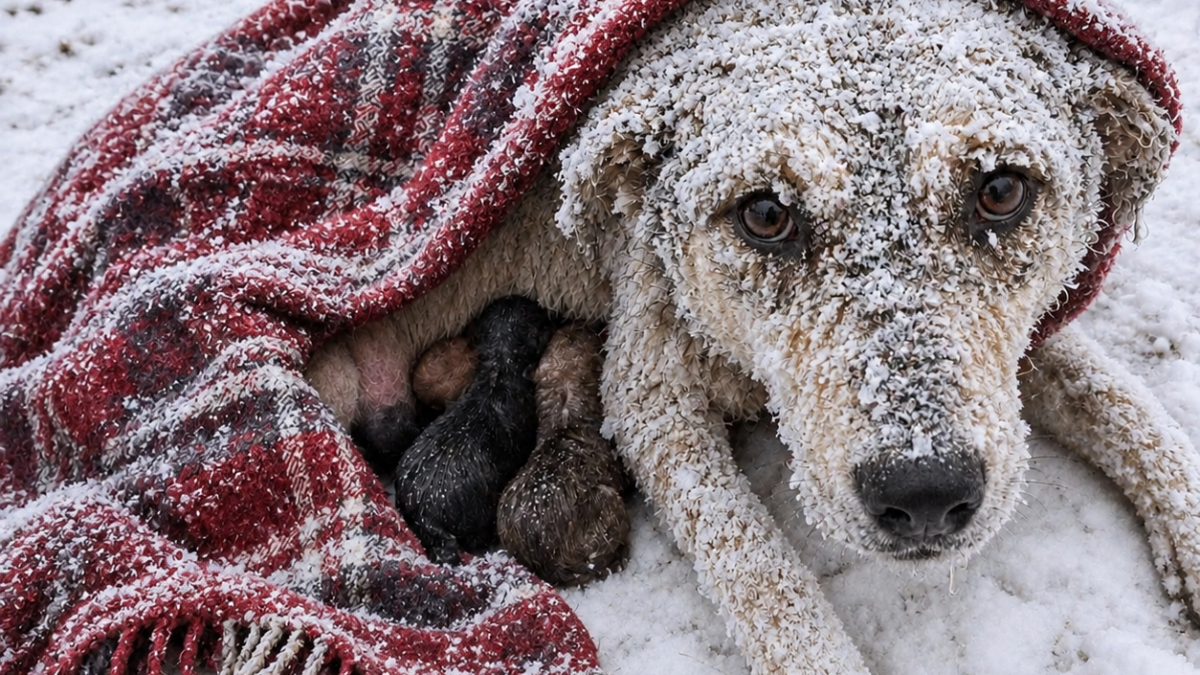
PART 2
I stood completely still.
The dog’s growl became deeper.
Not loud.
Not reckless.
It was the sound of an exhausted animal that had almost nothing left but was still willing to spend it if she had to.
I narrowed my eyes toward the slope behind us.
Snow twisted through the air in sheets. For a few seconds, I saw nothing but gray.
Then a shape moved between the rocks.
My heart jumped.
“Hey!”
No answer.
The shape appeared again.
Low.
Fast.
Then I understood.
A fox.
Probably drawn by the smell of the puppies.
The mother dog struggled in my arms.
“Easy.”
She tried to twist around despite barely being able to hold her head up.
“Easy. I’ve got them.”
The fox stopped about thirty yards uphill.
Thin.
Winter coat darkened by snow.
It stared at us.
I shouted and kicked snow in its direction.
“Go!”
It hesitated.
Then disappeared between the rocks.
The dog remained tense for almost a full minute.
Only when the fox was gone did she let her head drop back onto my shoulder.
I looked at her.
“You were ready to fight that?”
Her eyes closed.
“Of course you were.”
I should have known.
Everything about her said the same thing.
She had already chosen what mattered.
The puppies first.
Herself last.
—
The temperature kept falling.
By ten thirty, my fingers were beginning to go numb even inside my gloves.
I had given up the heavier spare pair to insulate the puppies.
The dog’s body against mine helped a little, but she wasn’t producing much heat anymore.
That frightened me.
Living bodies fight cold.
The dying sometimes stop.
I kept talking to her because silence felt dangerous.
“You need a name.”
She didn’t react.
“Can’t keep calling you ‘dog.’”
Wind hit us sideways.
I nearly lost my footing.
“All right. Maybe naming you before we survive is arrogant.”
I took three more steps.
“Still doing it.”
A stand of aspens had been visible from my campsite the previous afternoon.
Aspen.
It was obvious.
“Congratulations. You’re Aspen.”
One ear moved.
“That counts.”
I smiled despite myself.
“Aspen it is.”
—
The puppies were my biggest concern.
I could occasionally feel movement through the backpack.
That was good.
But the smallest one—the third puppy I had picked up—had barely moved.
I found a shallow overhang where the wind was weaker and lowered Aspen carefully onto my folded shell jacket.
She tried immediately to crawl toward the pack.
“I know.”
I opened it.
Six tiny bodies.
Five squirmed.
One barely did.
I put the smallest puppy inside my shirt against my skin.
Cold shock hit my chest.
“Come on.”
Aspen watched me.
Her head barely lifted.
“I need you to trust me.”
The puppy gave a weak twitch.
I rubbed gently.
Not hard.
Slow warmth.
Slow stimulation.
I had done enough wilderness first aid to know sudden heating could be dangerous.
But puppies weren’t mountaineers.
I was improvising.
“Come on, little guy.”
Aspen whined.
I looked at her.
“I’m trying.”
The puppy’s mouth opened.
A tiny squeak came out.
It might have been the smallest sound I had ever been grateful to hear.
Aspen’s tail moved once against the snow.
I laughed.
“Yeah.”
I tucked the puppy deeper against my chest.
“That’s what I thought.”
—
We started again.
The GPS battery hit twenty-two percent.
Then eighteen.
My campsite was still more than two miles away.
Under normal conditions, nothing.
That day, it might as well have been another country.
My left knee began to ache.
Then my lower back.
Aspen felt heavier with every step even though I knew that was impossible.
What had changed was me.
Fatigue compounds weight.
The mountain doesn’t care how noble your reason is.
Physics remains physics.
I began counting steps.
Fifty.
Stop.
Breathe.
Fifty.
Stop.
Check Aspen.
Check puppies.
Repeat.
At some point, I stopped thinking about the summit.
That seemed absurd now.
Hours earlier, I had been climbing toward a point on a map because standing at the top of something made me feel briefly less hollow.
Now the summit meant nothing.
Everything important was going down.
—
The first real disaster happened just after noon.
My right boot punched through a thin snow crust into space.
I dropped hard.
Aspen slipped from my arms.
I twisted desperately to keep from landing on her or crushing the backpack.
My knee slammed rock.
Pain exploded up my leg.
For several seconds, I saw white.
Not snow.
Pain.
I lay on my side breathing through my teeth.
Aspen was two feet away.
She tried to crawl toward me.
“No.”
I forced myself up.
“Stay.”
My knee held.
Barely.
I inspected it.
No obvious instability.
Probably bruised.
Maybe worse.
Didn’t matter.
There are moments when injury becomes a future problem.
This was one.
I picked Aspen up.
She licked my chin.
I almost laughed.
“You’re checking on me?”
Her tongue touched me again.
“Lady, you are in no position.”
But something about it changed my breathing.
Pain remained.
Panic eased.
—
By one thirty, the GPS died.
I stared at the black screen.
Of course.
I knew the slope.
I knew roughly where camp lay.
I had a compass.
My paper map was somewhere back up the mountain beneath several inches of snow because I had dumped it while making room for the puppies.
That decision now looked less heroic.
I had made tradeoffs too fast.
Another lesson mountains teach brutally.
Good intentions don’t replace preparation.
I checked the compass and terrain.
Downhill.
Southwest.
Eventually I should hit the tree line and then the drainage near camp.
Should.
I hated that word.
—
Aspen began shivering again.
Then stopped.
I knew enough medicine to understand that stopping could be worse.
“Stay with me.”
Her eyes remained closed.
“Aspen.”
Nothing.
I shook her gently.
Her eyelid moved.
“Good.”
I pushed forward faster.
Too fast.
My knee protested.
I ignored it.
“Stay with me.”
I don’t know how many times I said it.
Maybe a hundred.
Eventually it stopped being for her.
Stay with me.
For years, that sentence had existed somewhere in my life without being spoken.
My younger brother Liam died when I was thirty-one.
Avalanche.
Not with me.
That detail mattered because I had spent three years convincing myself it shouldn’t.
He had asked me to climb with him that weekend.
I had said no.
We had argued two days earlier over something stupid—money our father left, mostly—and I told him I was tired of being responsible for every reckless thing he did.
So Liam went with two other climbers.
A slab released above them.
One survived.
Liam didn’t.
Afterward, everyone said the same thing.
You couldn’t have known.
It wasn’t your fault.
I understood the logic.
Grief does not respect logic.
Mountains became punishment disguised as therapy.
I climbed alone because being careful by myself felt like rewriting the ending.
Control the route.
Control the weather.
Control the risk.
Pretend control had ever existed.
Then Aspen came along carrying six lives she could not control either.
She simply refused to stop protecting them.
—
I reached the trees at almost three.
Relief hit so hard I nearly cried.
Wind weakened beneath the pines.
Snow remained deep, but landmarks returned.
I recognized a split trunk.
Then a rock shelf.
Camp was less than half a mile.
I shouted.
“Hello!”
Nothing.
Again.
“HELLO!”
No answer.
Of course.
I had been alone.
That had been the point.
Then from somewhere below came another voice.
“Gareth?”
I stopped.
“Yeah!”
“Gareth!”
A man appeared between the trees.
Red jacket.
Gray beard.
I knew him.
Cal Levin, a backcountry guide who had camped lower in the drainage the previous night with two clients.
He came toward me fast.
“What happened?”
Then he saw Aspen.
“What the hell?”
“Puppies.”
“What?”
“In the pack.”
His face changed.
“How many?”
“Six.”
Cal immediately took my backpack.
“No.”
“Give it.”
“I can—”
“Gareth.”
I let him.
The sudden loss of weight almost made me fall.
He grabbed my arm.
“Camp?”
“Half mile.”
“My group packed out early. Weather.”
“Smart.”
“You?”
I looked at Aspen.
“Changed plans.”
Cal stared.
Then smiled once.
“Obviously.”
—
At camp, we turned one tent into an emergency shelter.
Cal had a propane heater designed for vented vestibule use.
We warmed the space carefully.
Aspen lay on insulated pads.
The puppies went against warm water bottles wrapped in socks and towels.
Cal used his satellite communicator to call rescue.
The weather prevented a helicopter.
Ground team estimated three hours.
“Road?”
“Forest service access is bad.”
“We can drive?”
“If the truck starts.”
It did.
Barely.
We loaded Aspen and puppies into Cal’s vehicle.
The road down took two hours.
Every rut felt violent.
Aspen barely moved.
I sat beside her.
One hand on her chest.
Counting breaths.
The smallest puppy was inside my jacket again.
At one point Cal looked at me through the mirror.
“You okay?”
“No.”
“Good answer.”
—
We reached the veterinary emergency clinic shortly after six.
The staff moved fast.
That is both comforting and terrifying.
Aspen disappeared through swinging doors.
So did the puppies.
Then suddenly I had nothing in my arms.
That was when my whole body started shaking.
Adrenaline leaves without permission.
I sat on the floor against a wall.
Cal handed me water.
“You look worse than the dog.”
“Thanks.”
“Drink.”
I did.
A nurse came out twenty minutes later.
“Are you the owner?”
“No.”
“Finder?”
“Yes.”
“Name?”
“Gareth Cole.”
“Okay, Mr. Cole. The mother is severely hypothermic, dehydrated, malnourished, and anemic.”
“Alive?”
“Yes.”
That was the only word I needed.
“The puppies?”
“All alive.”
I closed my eyes.
“One is very weak.”
“The smallest?”
“Yes.”
“Can you save him?”
“We’re trying.”
I nodded.
“What else?”
The nurse hesitated.
“We found injuries on the mother.”
“What kind?”
“Old scars. New abrasions. There’s also evidence she’s had multiple litters.”
I looked through the swinging doors.
“Was she dumped?”
“We don’t know.”
Then the nurse said:
“She has a microchip.”
I stared.
“You scanned her?”
“Yes.”
“Registered?”
“We’re checking.”
A story had just opened beneath the story.
—
I drove home after midnight.
Cal took me.
My knee had swollen badly enough that the emergency physician down the street made me wear a brace.
I barely noticed.
The house felt unbearable.
Quiet.
I had always wanted quiet.
That night I hated it.
At two seventeen in the morning, the veterinary clinic called.
I answered instantly.
“Aspen?”
“You named her?”
“Temporarily.”
The veterinarian laughed softly.
“She’s stable.”
I sat up.
“The puppies?”
“Five stable. The smallest is critical but responding.”
I put my face in my hand.
“Okay.”
“There’s more.”
“What?”
“We traced the chip.”
I waited.
“The registered name is not Aspen.”
“What is it?”
“Sadie.”
I repeated it.
“Sadie.”
“Owner listed as Ridge Hollow Working Dogs.”
The name meant nothing to me.
“Phone number?”
“Disconnected.”
“Address?”
“Property about forty miles from the mountain.”
My tired brain took a second.
“Working dogs?”
“Yes.”
“Breeder?”
“Looks like it.”
My stomach tightened.
“Can you tell how old the chip registration is?”
“Six years.”
“And she’s what, maybe seven?”
“Approximately.”
I looked toward the dark window.
Sadie.
Not Aspen.
Someone had known her before the mountain.
Maybe loved her.
Maybe not.
I said:
“Don’t release her to anybody without checking first.”
The veterinarian paused.
“Animal control is already involved.”
That made me feel better.
It also told me I was not imagining the warning signs.
—
The next morning, I went back.
Sadie looked terrible.
But alive.
IV line.
Blankets.
One eye open.
When I approached, her head lifted.
Her tail moved.
I laughed before I could stop myself.
“Hey.”
I sat beside the kennel.
“So apparently your name is Sadie.”
Her tail moved again.
“Do you like that?”
No reaction.
“Aspen?”
Tail.
I stared.
“Coincidence.”
I tried again.
“Sadie.”
Nothing.
“Aspen.”
Tail.
I smiled.
“Fine.”
Aspen.
Whatever somebody else had called her, she had chosen differently with me.
Probably because tone matters more than syllables.
Still.
Aspen.
—
The puppies were in incubators.
Five looked surprisingly strong.
The sixth—the tiny male—had a feeding tube.
The veterinarian, Dr. Elena Ruiz, stood beside me.
“He’s not out of danger.”
“But?”
“But he made it through the night.”
“What do you call him?”
“We don’t.”
“Why?”
“We try not to name critical neonates.”
“That sounds emotionally cowardly.”
She laughed.
“You want to name him?”
I looked at the tiny puppy.
“Six.”
“Six?”
“He was the sixth one I picked up.”
“That’s terrible.”
“Fine. Finn.”
“Better.”
Finn it was.
The others eventually became Maple, Juniper, Scout, Clover, and Bear.
I told myself naming them was practical.
Nobody believed me.
—
Animal control officer Tessa Morgan arrived that afternoon.
She was direct.
I liked her immediately.
“You found the dog on Mount Ellery?”
“East slope.”
“Approximate elevation?”
“Ten thousand eight hundred.”
“With newborn puppies?”
“Yes.”
“Any tracks?”
“Storm erased everything.”
“Objects?”
“Nothing I brought.”
“Collar?”
“No.”
“Rope?”
“No.”
She opened a folder.
“Ridge Hollow Working Dogs belonged to a man named Caleb Voss.”
“Belonged?”
“Business license lapsed seven months ago.”
“Why?”
“Financial problems.”
“Any cruelty complaints?”
Tessa looked at me.
“Two.”
My jaw tightened.
“Outcomes?”
“One unsubstantiated. One closed after he moved animals before inspection.”
“Where is he now?”
“Still owns the property.”
“What kind of dogs?”
“Mostly Labs, shepherds, mixed working breeds.”
“Breeding?”
“Among other things.”
“Can he claim Aspen?”
“Sadie.”
“Aspen.”
Tessa smiled slightly.
“Legally, microchip registration could support ownership, but it isn’t the only evidence.”
“If he abandoned her?”
“Then he has bigger problems.”
I looked through the glass at Aspen.
“She almost died.”
“I know.”
“So did six puppies.”
“I know.”
“Find out.”
Tessa nodded.
“That’s my job.”
—
By the third day, Aspen could stand.
Barely.
She tried anyway because the puppies were brought near her.
The moment she heard them squeak, everything changed.
Weakness remained.
Purpose overrode it.
She crawled toward them.
Dr. Ruiz allowed supervised nursing.
Aspen lay on her side.
Six puppies pressed against her.
Finn was too weak to nurse normally, so we supplemented him.
Still, Aspen kept licking him.
Again and again.
As though refusing to accept that the smallest might be lost.
I watched her and thought about Liam.
Different species.
Different grief.
Same impossible instinct.
If I just keep trying, maybe loss will change its mind.
—
Ridge Hollow’s old social-media pages gave us the first clue.
Aspen—Sadie—appeared in photos.
Younger.
Healthy.
Both ears clean.
Coat shining.
Captions called her:
**Ridge Hollow’s Sadie Mae**
Then:
**Strong maternal line. Excellent temperament.**
Then photos of litters.
One.
Two.
Three.
Four.
By six years old, she had produced at least four documented litters.
Maybe five.
The final post featuring her was eight months earlier.
Caption:
**Last litter for Sadie. Time for this girl to earn a quieter life.**
I stared at it.
Quieter life.
Three months later, business license gone.
Seven months later, I found her half frozen on a mountain with newborn puppies.
Something didn’t add up.
If this was supposed to be her last litter eight months earlier, where did these six puppies come from?
—
Tessa found the answer.
Not quickly.
But she found it.
A former employee named Nina Park had worked at Ridge Hollow until five months before I found Aspen.
Nina agreed to meet.
We sat in a diner.
She looked nervous from the beginning.
“You’re the climber?”
“Yes.”
“The one who found Sadie.”
“Aspen.”
Nina smiled faintly.
“Of course you renamed her.”
“Was she treated well?”
That erased the smile.
“At first.”
“What changed?”
“Money.”
Simple answer.
Usually the truest.
Caleb Voss had started with legitimate training.
Detection dogs.
Search dogs.
Hunting retrievers.
Then breeding became profitable.
More litters.
Cheaper care.
Less staff.
When clients disappeared, Voss bred anyway.
Puppies became inventory.
Females became production.
“What happened to Aspen?”
“Sadie was one of his best mothers.”
The phrase made my skin crawl.
“Did she want to breed?”
Nina looked at me like I was asking whether a machine wanted to run.
“She was a dog.”
“That’s not an answer.”
“No.”
She looked down.
“She didn’t choose any of it.”
I waited.
“The last planned litter was rough. She needed veterinary care afterward.”
“Did she get it?”
“Minimal.”
“Then these puppies?”
Nina’s face tightened.
“Accidental breeding.”
“With what dog?”
“One of the males escaped a run.”
“When?”
“About two months before I quit.”
“Voss knew?”
“Yes.”
“And?”
“He was furious.”
“At the dog?”
“At the cost.”
Aspen was older.
Thin.
Not recovering.
Another litter meant food.
Vet care.
Time.
Nina said Voss talked about “getting rid of the problem.”
“Did he mean Aspen?”
“Yes.”
“And puppies?”
“If she carried them.”
I leaned forward.
“How did she end up on the mountain?”
“I don’t know.”
That answer sounded real.
Then Nina added:
“But he owned a hunting cabin near Mount Ellery.”
Everything inside me went cold.
“Where?”
“East side.”
—
Tessa confirmed it.
Voss leased an old cabin near a closed forest road approximately four miles from where I found Aspen.
Suddenly the mountain wasn’t random.
He hadn’t driven her hundreds of miles.
He had taken her to a place he already used.
The storm had simply made it lethal.
Investigators searched the cabin area after the weather cleared.
They found a broken plastic crate.
Dog hair.
A torn feed bag from the brand Ridge Hollow purchased in bulk.
Two metal bowls.
And tracks beneath fresh snowpack near the shed.
More importantly, they found a length of blue nylon tether tied behind the cabin.
Hair caught in it.
DNA testing later matched Aspen.
She had been tied there.
At some point, she broke free.
Then walked into the storm.
Pregnant or newly delivered?
We weren’t sure.
The puppies appeared less than two weeks old.
Nina believed Aspen was still pregnant when Voss took her to the cabin.
That meant she likely gave birth alone.
In freezing weather.
Then moved them.
One by one, maybe.
Or found the rocky hollow after delivery.
The thought made me sick.
—
Voss denied everything.
Of course.
He said Aspen escaped months earlier.
Claimed the cabin evidence was old.
Claimed Nina was bitter over unpaid wages.
Claimed he had no idea she had another litter.
The microchip was proof of ownership, he said.
Which created a strange legal position.
He wanted to deny responsibility for where she was found while asserting she belonged to him.
Then Aspen’s rescue photos went viral.
I hadn’t intended that.
Cal posted one photograph—me carrying Aspen through the trees.
Someone shared it.
Then another.
Within days, thousands of people knew the story.
Mother dog in snow.
Six puppies.
Climber rescue.
That brought attention.
Attention brought witnesses.
And witnesses brought Voss trouble.
—
The first was a former client.
Rachel Dunn.
She had bought a Labrador puppy from Ridge Hollow two years earlier.
The puppy arrived with parasites and severe ear infections.
Voss refused reimbursement.
She saved messages.
One caught Tessa’s attention:
**Females don’t matter once they stop producing. That’s business.**
Voss claimed he was speaking generally.
Then another former employee came forward.
Marcus Hill.
He had driven Voss to the mountain cabin three weeks before I found Aspen.
“Was Sadie with you?”
“Yes.”
My stomach tightened.
“Pregnant?”
“Yes.”
“Why?”
“Caleb said she was being moved.”
“Where?”
“He didn’t say.”
“Did she stay at the cabin?”
Marcus looked away.
“Yes.”
“Food?”
“A bag.”
“Water?”
“Bucket.”
“Shelter?”
“Cabin porch.”
“Was she tied?”
“Yes.”
“For how long?”
“I don’t know.”
“Why didn’t you stop it?”
His jaw worked.
“I needed my paycheck.”
I hated the answer.
I understood it.
Both can be true.
“Did Voss know she was close to giving birth?”
“Yes.”
“What did he say?”
Marcus’s face tightened.
“He said if she made it, she made it.”
Silence.
“And if she didn’t?”
“He shrugged.”
I clenched my hands beneath the table.
Tessa asked:
“Exact words.”
Marcus closed his eyes.
“Nature takes care of expensive problems.”
There it was.
Not an accident.
Not escape.
A decision dressed as inevitability.
—
Aspen and the puppies came into foster care with me.
That was not the plan.
I had no plan.
Dr. Ruiz asked whether I could take them for forty-eight hours because the shelter’s neonatal room was full.
I said yes.
Forty-eight hours became a week.
Then two.
Then everyone stopped pretending.
My house changed immediately.
Silence died.
Puppies squeaked at all hours.
Aspen followed me from room to room.
Laundry tripled.
Sleep vanished.
I stepped on pee pads.
Finn learned how to climb out of every enclosure.
Bear barked at his own reflection.
Scout discovered shoes.
Maple slept upside down.
Juniper screamed whenever dinner took more than three seconds.
Clover seemed personally offended by closed doors.
I complained constantly.
I loved every second.
—
Aspen remained wary.
Not of me.
Of vehicles.
Chains.
Men in heavy work jackets.
The sound of a diesel truck made her flatten herself.
We worked with a behavior specialist.
Slow exposure.
Choice.
No forcing.
She improved.
One afternoon, Cal visited.
Aspen saw his red jacket.
Froze.
Cal stopped outside the gate.
“What do I do?”
“Sit.”
“In snow?”
“You’re a mountain guide.”
He sat.
For twenty minutes he ignored her.
Eventually Aspen approached.
Sniffed his boot.
Then his hand.
Cal looked at me.
“Can I?”
“Wait.”
Aspen moved closer.
Touched his fingers.
Cal smiled.
“Okay.”
That was how trust returned.
Not in dramatic leaps.
In inches.
—
Voss found my address.
I still don’t know how.
One evening, a note appeared beneath my windshield wiper.
**THAT DOG IS MINE. YOU’RE MAKING A MISTAKE.**
No signature.
Didn’t need one.
I called Tessa.
Security cameras went up the next day.
Voss denied involvement.
Then a pickup drove past my house three nights in a row.
Same truck model registered to him.
Never stopped.
Just slow enough to be noticed.
Aspen noticed.
Every time she heard the diesel, she shook.
That turned my anger into something colder.
He had already abandoned her.
Now he wanted her afraid in the only safe place she had.
No.
—
The fourth night, the truck stopped.
I saw it through the window.
Aspen immediately moved behind me.
Not barking.
Trembling.
I called 911.
Then my doorbell rang.
Caleb Voss stood outside.
Tall.
Forties.
Heavy beard.
Dark jacket.
The porch camera recorded everything.
I did not open the door.
“What do you want?”
“My dog.”
“She’s under protective hold.”
“She’s mine.”
“No.”
“You scanned the chip. You know.”
“I know the chip proves you registered her.”
“That means ownership.”
“Not after abandonment.”
His face hardened.
“You don’t know what happened.”
“I know she was tied at your cabin.”
Silence.
Tiny.
But there.
“That’s old evidence.”
“DNA isn’t old.”
“You’re a climber, not a cop.”
“No.”
I looked at Aspen behind me.
“I’m the guy who found what you left.”
That landed.
Voss stepped closer to the glass.
“You think you’re some hero?”
“No.”
“Then stop acting like one.”
“I’m not.”
I heard sirens in the distance.
“I just didn’t walk away.”
His expression changed.
He heard them too.
“You ruined my business.”
“No.”
I said it calmly.
“You did that before I ever got there.”
He left before police arrived.
Not fast enough to avoid being identified on video.
The court issued a protective order soon after.
That mattered.
Not because paper stops everyone.
Because consequences had begun.
—
The puppies grew.
People applied.
Hundreds.
We screened carefully.
No impulse adoptions.
No using the rescue story for social-media clout.
No breeding.
No backyard chains.
I became unbearable.
Dr. Ruiz told me so.
“You know we do this professionally.”
“I know.”
“You are checking fence measurements.”
“Yes.”
“You asked one family for photographs of their mudroom.”
“Doors matter.”
“You’re insane.”
“Possibly.”
All six found homes.
I cried every time.
Aspen watched every departure.
That terrified me.
Would she collapse?
Search?
Refuse food?
But something remarkable happened.
She seemed to understand the difference.
Her puppies left warm.
Held.
Safe.
No storm.
No rope.
No panic.
The adopters returned for visits during transition.
Aspen sniffed them.
Licked faces.
Then settled beside me.
The last puppy to leave was Finn.
The one who almost died.
His adopter was Dr. Ruiz.
Of course.
She claimed it was medically practical.
Nobody believed her.
When Finn left, Aspen stood at the door for ten minutes.
I sat beside her.
“I know.”
She looked at me.
Then walked away.
That was it.
No starvation.
No desperate search.
She had learned something.
Leaving could be safe.
—
The criminal case took months.
Search warrants at Ridge Hollow found twelve dogs.
Some healthy.
Some not.
Two females were underweight.
One had untreated mammary infection.
Another had a broken tooth and chain scars.
Records showed repeated breeding.
Financial documents showed declining income.
Messages showed Voss discussing “cutting dead weight.”
The phrase appeared beside the names of older females.
Aspen’s old registered name appeared in one message:
**Sadie’s done. Not putting another vet bill into her.**
Another:
**Cabin. Let weather decide.**
That message ended the argument.
Voss’s lawyer tried to claim metaphor.
Nobody believed it.
—
He was charged with multiple counts of animal cruelty and abandonment, plus licensing and record violations related to the kennel.
The defense attacked Nina.
Marcus.
Me.
They said viral attention had contaminated everyone.
That money from donations motivated the shelter.
That Voss had merely placed Aspen temporarily at a familiar cabin.
Then prosecutors showed the rope.
DNA.
Weather forecast from that night.
The message.
**Let weather decide.**
Silence.
Even remembering it now makes my hands cold.
The mountain had not almost killed Aspen by accident.
Someone had chosen the mountain because it could do the killing for him.
That was the part I could not forgive.
Maybe still can’t.
—
At trial, Nina testified.
She cried.
The defense asked why she waited.
She said:
“Because I was a coward.”
The lawyer looked almost pleased.
Then Nina added:
“And I got tired of using that as an excuse.”
That changed the room.
Marcus testified next.
He admitted driving Aspen to the cabin.
Admitted tying her.
Admitted leaving food.
Admitted knowing birth was near.
The defense asked:
“So Mr. Voss did provide food and shelter.”
Marcus laughed once.
“Three days of food for a pregnant dog in winter.”
The attorney frowned.
“And a cabin.”
“She was tied outside.”
Silence.
“Why?”
Marcus looked toward Voss.
“Because Caleb didn’t want her inside.”
—
I testified after lunch.
The prosecutor asked me to describe the rescue.
I tried to keep it factual.
Weather.
Location.
Condition.
Puppies.
Hypothermia.
Then she asked:
“What did Aspen do when you approached?”
“She looked at me.”
“What did you understand?”
Objection.
Speculation.
Sustained.
Good.
Courts don’t need poetry.
They need facts.
So I gave facts.
She could not stand.
Her fur was frozen.
Her body covered the puppies.
Her back faced the storm.
Their body temperatures were higher than hers.
That last fact came from the veterinary team.
Aspen had literally spent her own heat.
That mattered more than anything I could say.
—
Voss’s attorney asked:
“You had no personal knowledge of what happened before you arrived.”
“Correct.”
“You didn’t see my client on the mountain.”
“No.”
“You didn’t see him tie the dog.”
“No.”
“You didn’t see him abandon her.”
“No.”
“So your anger toward him is based on what others told you.”
“And his messages.”
“Only answer my question.”
“Yes.”
He continued.
“You’ve benefited financially from this story.”
“No.”
“Your social-media following increased.”
“I don’t earn from it.”
“You received donations.”
“The rescue received donations.”
“You became publicly known as a hero.”
I looked at him.
“I was cold, lost, and one bad step from needing rescue myself.”
The judge watched me.
“I don’t recommend it as a branding strategy.”
Several jurors smiled.
The attorney did not.
—
The strongest witness was Dr. Ruiz.
Calm.
Clinical.
She explained Aspen’s condition.
Severe calorie deficit.
Anemia.
Old reproductive strain.
Fresh abrasions.
Frost injury.
Recent birth.
She explained the puppies’ temperature.
Then the prosecutor asked:
“Doctor, based on your examination, how long could Aspen and the puppies have survived where they were found?”
“Impossible to say precisely.”
“Hours? Days?”
“In those conditions, with that degree of maternal hypothermia?”
She paused.
“Hours were more likely than days.”
My stomach tightened even though I knew.
“Could the mother’s position over the litter have prolonged their survival?”
“Yes.”
“How?”
“By blocking wind and transferring body heat.”
“So her own hypothermia was partly worsened by protecting them?”
“Yes.”
The courtroom became very quiet.
That was Aspen’s testimony.
Her body had already said everything.
—
Voss testified.
Against advice, probably.
Men like him often believe control extends to juries.
He said he loved dogs.
Said the kennel had financial problems.
Said Aspen was difficult after pregnancy.
Said the cabin was intended as temporary holding.
The prosecutor asked:
“Why outside?”
“Fresh air.”
“During a snowstorm?”
“I didn’t know how bad it would get.”
She showed the weather alert sent to his phone.
Winter storm warning.
Acknowledged.
He shifted.
Then the message.
**Cabin. Let weather decide.**
“What did you mean?”
“Whether she could handle outdoor conditions.”
“Why should weather decide whether a dog lives?”
“That’s not what I meant.”
“What did you mean?”
“I was frustrated.”
“Frustrated dogs cost money?”
Objection.
Sustained.
She changed direction.
“Did you return to check her?”
“No.”
“Send an employee?”
“No.”
“Call anyone?”
“No.”
“How long until you realized she was gone?”
“Days.”
“Did you search?”
“No.”
“Report her missing?”
“No.”
“Call animal control?”
“No.”
“Why?”
He hesitated.
Wrong moment to hesitate.
“Because I assumed she was dead.”
The prosecutor let the silence sit.
Then:
“And that outcome was acceptable to you?”
His lawyer objected.
But again, too late.
Everyone heard the answer he didn’t give.
—
The jury deliberated seven hours.
I waited with Tessa, Dr. Ruiz, Nina, Marcus, Cal, and several rescue volunteers.
I hated that room.
Coffee too weak.
Chairs too hard.
Everyone checking phones.
Eventually the bailiff called us back.
Guilty on the major cruelty and abandonment counts.
Additional guilty findings on kennel violations.
Not every charge.
Enough.
Nina cried.
Marcus stared at the floor.
Tessa exhaled slowly.
I felt almost nothing.
That surprised me.
I had imagined satisfaction.
Instead I pictured Aspen asleep on my couch.
Safe.
That mattered more.
—
At sentencing, several former employees spoke.
Then rescue staff.
Then I was allowed a statement.
I almost declined.
I am glad I didn’t.
I stood.
Voss looked at me.
I said:
“When I found Aspen, I believed the storm was the thing trying to kill her.”
My voice stayed steady.
“Later I learned the storm was only where somebody placed her.”
Silence.
“I used to think strength meant reaching summits.”
I looked at the judge.
“That dog changed my definition.”
Then I looked at Voss.
“She used her body to keep six puppies alive after someone decided her life wasn’t worth another vet bill.”
His jaw tightened.
“I don’t want revenge against Mr. Voss.”
That wasn’t entirely true.
But the next part was.
“I want him never to have the power to make that decision for another animal.”
I sat down.
That was enough.
—
Voss received jail time, probation afterward, fines, restitution, and a long-term prohibition on owning, breeding, selling, training, or operating a commercial animal facility under the court’s orders.
His kennel closed permanently.
The dogs seized from Ridge Hollow were rehomed.
The property eventually sold.
Some people said the sentence was too harsh.
Others said too light.
I stopped caring.
The important line was simple:
No more dogs.
That was the consequence I wanted.
Not suffering.
Removal of power.
—
Aspen stayed with me.
There was never really another outcome.
I pretended to consider adoption applications.
Dr. Ruiz watched me delete one after another.
“You’re keeping her.”
“I’m evaluating.”
“You rejected a retired couple with ten acres.”
“They have geese.”
“Aspen likes geese.”
“Exactly.”
She stared.
“You’re keeping her.”
I sighed.
“Yes.”
Aspen was asleep under my desk.
Tail moved.
Dr. Ruiz smiled.
“Thought so.”
—
Life with Aspen changed me in ways I resisted.
I stopped climbing alone.
That was first.
Cal refused to let me.
“Buddy system.”
“I’m thirty-four.”
“And stupid.”
“Thanks.”
“Anytime.”
Eventually I admitted I didn’t want solitude the same way anymore.
Mountains remained.
But punishment faded.
I visited Liam’s grave for the first time in almost two years.
Aspen came.
She sat beside me.
I told Liam about her.
The storm.
The puppies.
The court.
Then I told him the thing I had never said out loud.
“I thought if I kept doing hard things alone, eventually I’d deserve to stop feeling guilty.”
Wind moved through the grass.
Aspen leaned against me.
“It didn’t work.”
Of course there was no answer.
But for once, I didn’t need one.
I sat there until sunset.
Then went home.
Home.
That word had become real again.
—
The puppies stayed in our lives.
Finn grew into a huge, ridiculous dog who still believed he fit in Dr. Ruiz’s lap.
Maple lived with a school counselor.
Juniper with a family who had three boys and no intact furniture.
Scout became a certified search-and-rescue dog.
That one felt almost too perfect.
Clover lived with an older woman who called her “my furry dictator.”
Bear went to Cal.
Yes.
The mountain guide who claimed he traveled too much.
Bear spent half his life in a truck and loved it.
Twice a year, we held reunions.
Aspen greeted every puppy.
No panic when they left.
No desperate searching.
She understood.
Or maybe she simply trusted.
That was enough.
—
Scout’s career became part of the story’s strange circle.
At three years old, he helped locate a missing hiker during a spring storm.
Not on Mount Ellery.
Another range.
The hiker survived.
Cal called me.
“You realize your mountain dog’s kid now rescues people.”
“I know.”
“Annoyingly poetic.”
“Yes.”
Aspen was sleeping in sunlight.
I scratched her head.
“You started something.”
She opened one eye.
Then went back to sleep.
Dogs are unimpressed by legacy.
Probably healthy.
—
The rescue established a fund after the case.
Not in my name.
I refused.
The **Aspen Maternal Rescue Fund** paid for emergency care for pregnant dogs, nursing mothers, neonatal puppies, and animals recovered from severe weather.
We added heated transport crates.
Neonatal kits.
Emergency formula.
Portable scanners.
One winter, a shelter eighty miles away used the fund to save a mother hound and eight puppies found beneath an abandoned trailer.
Dr. Ruiz sent me the photo.
Caption:
**Aspen’s fault.**
I replied:
**Good.**
—
Years passed.
Aspen aged.
Her muzzle whitened.
One back knee developed arthritis.
Her hearing faded slightly.
She became afraid of fewer things.
Diesel trucks eventually stopped mattering.
Ropes never fully stopped.
If a blue leash appeared, she avoided it.
So we used red.
Simple.
Healing doesn’t require conquering every trigger.
Sometimes you just stop insisting the scar prove it’s gone.
—
At forty, I returned to Mount Ellery with Aspen.
Not in winter.
Late summer.
Clear skies.
We took the lower trail.
Slow.
She was older.
So was I.
We reached the rocky hollow where I found her.
Grass had grown around the stones.
No snow.
No wind.
Nothing dramatic.
Aspen stopped.
Sniffed.
Walked into the hollow.
I held my breath.
She circled once.
Then came back out.
That was it.
No trembling.
No collapse.
No cinematic recognition.
She simply left.
I laughed.
“You really don’t care.”
She looked at me.
Then pulled toward the trail.
Fine.
We kept walking.
Maybe closure is mostly a human hobby.
—
Later that year, Nina visited.
She had moved away after the trial.
Started working at a legitimate boarding facility.
She asked before coming.
I said yes.
When Aspen saw her, she paused.
Nina froze.
“Does she remember me?”
“I don’t know.”
Aspen approached.
Sniffed her.
Nina started crying.
“I’m sorry.”
Aspen sat.
Nina covered her face.
“I should’ve stopped him.”
I didn’t interrupt.
Eventually she looked at me.
“Do you hate me?”
“No.”
“Why?”
“Because you testified.”
“That doesn’t erase it.”
“No.”
“Then why?”
I looked at Aspen.
“Because if everyone who fails once becomes permanently useless, none of us improve.”
Nina cried harder.
Aspen put her head on Nina’s knee.
That was enough.
—
Marcus visited too.
Harder.
He had physically driven Aspen to the cabin.
I didn’t want to see him.
Tessa told me I didn’t have to.
Months passed.
Then he sent a letter.
No excuses.
No request for forgiveness.
Just:
**I tied her there. I left. I live with that. I am sorry.**
I kept it.
Eventually, I met him.
Public park.
Aspen not present.
He told me Voss had threatened to fire him.
I said:
“So?”
He looked down.
“I know.”
“You had choices.”
“I know.”
“She didn’t.”
“I know.”
That was the conversation.
Not satisfying.
Real.
Marcus later volunteered with a winter animal-response program.
Maybe guilt pushed him.
Maybe growth.
Doesn’t matter.
Useful action is better than endless shame.
—
The last person from the old Ridge Hollow operation to contact us was Caleb Voss.
Years after release.
Through an attorney.
He requested permission to send a written apology.
I almost said no.
Then curiosity won.
The letter was short.
He wrote that prison gave him time to think.
That losing the business made him realize he had begun measuring living things only by cost.
That he remembered Aspen as a good dog.
That he was sorry.
I read it once.
Then put it away.
People asked whether I forgave him.
I still don’t know.
Forgiveness is treated like a moral finish line.
Maybe it isn’t.
I didn’t need him punished forever.
I also didn’t need his apology to make the past acceptable.
Aspen was asleep beside my chair.
That was enough.
—
Aspen lived to almost fifteen.
That still amazes me.
A dog who nearly froze to death while nursing six puppies on a mountain somehow gave me almost a decade afterward.
Her final year was slow.
Short walks.
Medication.
Soft food.
Sun patches.
She loved lying near the front window.
Every afternoon around four, she moved there.
Routine.
One spring, she stopped.
She stayed on her bed.
I knew.
Dr. Ruiz came.
Same veterinarian.
Older now.
Finn had died the previous year from cancer.
That hit Aspen harder than the others.
Maybe because he had always been the weakest.
Maybe I imagined that.
We gathered the surviving puppies who could travel.
Maple.
Juniper.
Scout.
Clover.
Bear.
Five gray-faced dogs.
Adults.
Old themselves.
They came into the yard one by one.
Aspen lifted her head.
Her tail moved.
Scout lay beside her.
Clover licked her ear.
Bear sat at her back.
For an hour, the yard looked like a photograph of time folding inward.
Mother.
Children.
Years.
No snow.
No fear.
Just sun.
—
That evening, everyone left.
Aspen was tired.
I carried her inside.
The same way I had carried her down the mountain.
Only now she was heavier.
Healthy weight.
Old age.
Life.
I laid her on the couch.
She looked at me.
I laughed.
“You remember that first day?”
Of course she didn’t understand the sentence.
Maybe she understood my voice.
“You weighed nothing.”
Her tail moved.
“You were terrifying.”
Another movement.
“I thought you were going to die.”
Her eyes stayed on me.
I sat on the floor.
“You know what’s funny?”
I touched her paw.
“I thought I was saving you.”
My throat tightened.
“That was arrogant.”
Aspen exhaled.
“You made me come back.”
To people.
To Liam’s memory.
To home.
To risk that wasn’t punishment.
To love that could be lost and still be worth having.
I leaned closer.
“I’m not going to make you fight again.”
Dr. Ruiz arrived after dark.
Cal came too.
No ceremony.
Just us.
Aspen’s breathing had become shallow.
Pain medication wasn’t enough anymore.
We knew.
I placed one of my old red climbing scarves beneath her head.
The same kind I had used to wrap the first puppy years earlier.
Dr. Ruiz noticed.
“Sentimental.”
“Shut up.”
She smiled through tears.
—
Before the first injection, I whispered:
“You kept them alive.”
Aspen’s eyes moved.
“All six.”
A breath.
“You did that.”
Another.
“And then you stayed long enough to ruin my quiet life.”
Cal laughed softly.
Aspen’s tail moved once.
I put my forehead against hers.
“I don’t know where dogs go.”
My voice broke.
“But if Finn’s there, he probably still needs his mother.”
Dr. Ruiz looked away.
I kept talking.
“And if Liam is anywhere near him, tell him I finally stopped being an idiot.”
Cal said:
“Only partially.”
I laughed and cried at the same time.
The sedative entered.
Aspen relaxed.
No shaking.
No wind.
No cold.
Warm house.
People she knew.
I held her the way I had on the mountain.
Chest to chest.
Her head beneath my chin.
“You don’t have to protect anybody now.”
Her breathing slowed.
“I’ve got them.”
Another breath.
“I’ve got you.”
Then the final medication.
Aspen exhaled.
And was still.
—
For a long time, I did not move.
Cal sat beside me.
Dr. Ruiz touched my shoulder.
I kept holding Aspen.
Years earlier, she had been too light in my arms.
That night, even after death, she felt full.
Not physically.
Full of everything that happened after the hollow in the rocks.
Six puppies.
Courtrooms.
Mud.
Vet bills.
Reunions.
Walks.
Trust.
Years.
A life nobody intended her to have.
That was the revenge.
Not Voss going to jail.
Not Ridge Hollow closing.
Not people knowing his name.
Aspen lived.
That was the consequence he could never undo.
—
We buried her ashes near an aspen tree behind my house.
Not because I believe ashes need a place.
Because I did.
The marker reads:
**ASPEN**
**SHE USED HER BODY AS A SHELTER
UNTIL SHE FOUND ONE OF HER OWN.**
Below that:
**MOTHER OF SIX.
RESCUER OF ONE.**
Cal complained.
“Rescuer of one?”
“Me.”
“Self-important.”
“Leave.”
He laughed.
Then cried.
—
Years later, the Aspen Maternal Rescue Fund still operates.
Scout’s old search-and-rescue team still tells his story.
Dr. Ruiz keeps a photo of Finn as a puppy on her desk.
Cal keeps Bear’s collar hanging from the mirror in his truck.
Nina sends a donation every winter.
Marcus does too.
I still climb.
Never to escape now.
At least not in the same way.
Sometimes solitude is peaceful.
Sometimes it is avoidance.
I finally learned the difference.
—
I returned to Mount Ellery alone on the tenth anniversary of the rescue.
Clear winter day.
No storm.
I brought no dog.
No puppies.
Just a small metal tag.
At the rocky hollow, I fixed it to a stone.
Nothing dramatic.
No names of Voss.
No court case.
No mention of cruelty.
Just:
**HERE, A MOTHER REFUSED TO LET THE COLD DECIDE.**
That was the story that mattered.
Not the man who abandoned her.
Not the mountain that almost killed her.
The choice she made anyway.
Protect.
Stay.
Fight.
—
People sometimes ask how six newborn puppies survived that storm.
The technical answer is simple.
Their mother blocked wind.
Transferred heat.
Kept them together.
Found a natural shelter.
The emotional answer is harder.
She spent herself.
That’s what I saw.
She did not have enough food.
Enough warmth.
Enough strength.
So she gave them what remained.
Her body.
There is something almost unbearable about that kind of love because it exposes how weak most of our excuses are.
—
I used to think strength looked like endurance.
Carry more.
Climb higher.
Need less.
Feel less.
Aspen ruined that definition.
Strength can look like protecting something while shaking.
Accepting help when you cannot stand.
Trusting a stranger because your children need him.
Coming home.
Letting fear loosen slowly.
Sleeping without listening for the next danger.
Growing old.
Strength can look ordinary after survival.
Maybe especially then.
—
The moment I remember most is not the trial.
Not the rescue vehicle.
Not even Aspen’s last day.
It is the first time she looked at me beneath those rocks.
Snow on her back.
Six puppies under her chest.
One eye barely open.
No strength left to fight.
And still—
she had moved her body between me and them.
Even then.
I could almost hear the question in her face.
Are you here to hurt them?
Or help?
I knelt.
She watched.
Then let me touch the first puppy.
That was the beginning.
Not because I saved her.
Because she trusted me just enough to let me try.
—
If I had ignored the cry, I don’t know how long they would have survived.
Dr. Ruiz said maybe hours.
I try not to think about that.
Instead I think about the sound itself.
Faint.
Almost swallowed by wind.
Easy to dismiss.
I had been turning around.
Another five minutes and I might have been too far away.
People like to call that fate.
Maybe.
I think it was attention.
The world is full of quiet things asking not to be passed by.
Most don’t sound dramatic.
A dog under rocks.
A person who stops calling.
A friend who says he’s fine too quickly.
A brother asking you to climb.
I missed some.
I heard one.
That one changed everything.
—
For years after Liam died, I believed the biggest mistake of my life was not going with him.
Maybe it was.
Maybe it wasn’t.
You can destroy yourself trying to rank regret.
Aspen taught me something else.
You don’t honor the dead by refusing to live.
You don’t prove love by carrying pain forever.
You don’t make yourself safer by becoming alone.
And you cannot reverse one moment by endlessly punishing every moment that follows.
All you can do is respond to what is in front of you now.
That day, it was six puppies and a mother in the snow.
So I responded.
That became enough.
—
The last photograph I have of Aspen was taken three weeks before she died.
She is lying beneath the tree in my backyard.
Sunlight across her gray muzzle.
Eyes half closed.
No tension in her body.
No puppies beneath her.
No rope.
No snow.
Just rest.
For a long time, I thought the most beautiful image of Aspen would always be the rescue photograph people shared online.
Me carrying her.
Snow everywhere.
Her head against my chest.
Now I hate that picture a little.
Not because it isn’t powerful.
Because it shows survival at its most dramatic.
People mistake drama for meaning.
The backyard photograph means more.
Nothing is happening.
That is the victory.
She got old enough for nothing to happen.
She had boring afternoons.
She slept through rain.
She ignored trucks.
She snored.
She stole food.
She became ordinary.
A dog someone had once left for the weather to decide became a dog whose biggest problem was whether I would share my sandwich.
That is what rescue is supposed to become.
Ordinary life.
—
Cal once asked me whether I considered myself a hero.
I told him no.
He said:
“You carried a dog down a mountain.”
“I also got lost.”
“You saved six puppies.”
“I dumped half my gear.”
“You risked your life.”
“That part was stupid.”
He laughed.
Then asked:
“What would you call it?”
I thought about Aspen.
“Showing up.”
That’s all.
Heroism is too large a word.
It makes ordinary decency sound rare or impossible.
Aspen needed someone to hear her.
I happened to be there.
Then dozens of other people showed up.
Cal.
Dr. Ruiz.
Tessa.
Nina.
Marcus eventually.
Adopters.
Rescue workers.
Witnesses.
Jurors.
People who donated.
No single person carried the entire story.
Even Aspen couldn’t.
That was the lesson.
—
The mountain did not save me.
Aspen did not magically heal me.
I dislike stories that work that way.
Healing is slower.
Messier.
Some mornings I still think of Liam and feel the old guilt.
Some winters I stand beneath an avalanche slope and remember the phone call.
Some nights I dream of Aspen beneath the rocks and wake with my heart racing.
The difference is that I no longer mistake pain for instruction.
Pain says something mattered.
It does not always tell you what to do next.
That part is up to us.
—
Aspen’s story is usually told as:
A climber heard a cry.
Found a mother dog.
Saved six puppies.
Beautiful.
True.
Incomplete.
The real story is what happened after the rescue.
A dog learned humans could return.
A man learned loneliness was not the same as safety.
Six puppies grew into lives.
A breeder lost the right to treat animals as inventory.
Employees who had stayed silent learned speaking late was still better than never.
A shelter changed.
A fund formed.
A search dog saved a hiker.
An old mother slept in sunlight.
That is the story.
The mountain was only the first page.
—
And if you ask me what the most satisfying part was—the revenge, the conviction, the kennel closing—I will tell you something much quieter.
Years after the trial, I was making coffee one winter morning.
Snow had fallen overnight.
Not a storm.
Just a few inches.
I opened the back door.
Aspen stood on the threshold.
For the first year after I rescued her, she hated snow.
Would freeze.
Refuse to step onto it.
That morning, she looked outside.
Sniffed.
Then walked into the yard.
Slowly.
She stood beneath the aspen tree.
Snow around her paws.
No trembling.
No panic.
She lowered her nose.
Sniffed the ground.
Then rolled onto her back.
Right there in the snow.
I laughed so hard I spilled coffee on the porch.
Aspen kicked all four legs in the air like an idiot.
Snow flew everywhere.
Then she stood, shook herself, and looked at me.
Tail wagging.
That was revenge.
The thing meant to kill her had become something she could play in.
Caleb Voss had once left her to let winter decide whether she deserved to live.
Years later, winter came to her own backyard.
Aspen walked into it by choice.
And came back inside when she was ready.
No chains.
No fear.
No one deciding for her.
That is the ending I keep.
Not the courtroom.
Not the sentence.
The snow.
The dog.
The open door behind her.
And the absolute certainty that this time, when Aspen turned around—
home was still there.








