PART 2: I Found the Shelter’s Happiest Dog Broken in a Subway Station—Then I Learned Who Had Left Him There
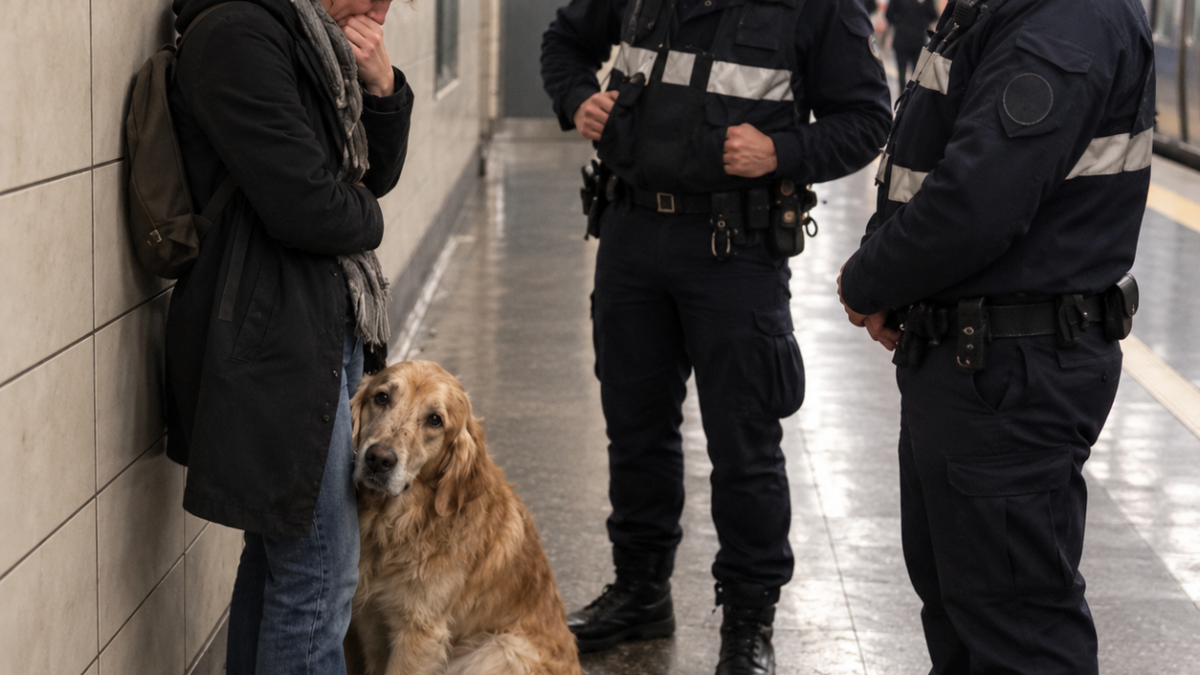
PART 2
I didn’t wait for an answer from anyone.
I slipped one arm beneath Max’s chest and the other under his hindquarters.
He had once weighed close to seventy pounds.
I remembered because he used to plant himself in front of the kennel door whenever I needed to clean his run, forcing me to negotiate with him using tennis balls.
Now he felt frighteningly light.
When I lifted him, he didn’t struggle.
He simply pressed his face into the side of my neck.
The older security officer walked beside me.
“My name’s Ray,” he said. “My partner and I have been trying to figure out what to do with him.”
“You called animal control?”
“Twice.”
“And?”
“The first time he disappeared when they came. The second time they couldn’t get close enough. One guy said he’d probably been living outdoors long enough to know how to hide.”
Ray looked at Max.
“We didn’t want somebody chasing him onto the tracks.”
I nodded.
“You did the right thing.”
“I don’t feel like we did.”
“You fed him.”
“When he let us.”
“That may be why he’s still alive.”
Ray looked relieved by that.
His younger partner brought me a cardboard box containing several unopened cans of dog food, a plastic water bowl, and an old blue blanket.
“We kept these behind the security desk,” he explained.
I nearly cried again.
Not everybody had forgotten Max.
Maybe the world hadn’t completely failed him.
Outside the station, I set Max gently in the back seat of my car.
The moment I tried to step away, even just to close the door, his head shot up.
His eyes widened.
“No,” I said quickly. “No, Max. I’m coming with you.”
I climbed into the back seat beside him.
Ray stood outside.
“Need me to call somebody?”
“I know exactly where we’re going.”
The county shelter was eleven miles away.
I called before leaving.
A woman answered on the third ring.
“County Animal Services.”
I knew the voice.
“Denise?”
There was a pause.
“Yes?”
“It’s Emily Carter.”
Another pause.
Then warmth.
“Emily? My God. How are you?”
“I found Max.”
Silence.
“What?”
“Max. Golden retriever. Left ear scar. Black mark by his muzzle. Kennel forty-two when I worked there.”
“I remember Max.”
“I found him in Central Station.”
The silence on the other end changed.
“Bring him here.”
“We’re coming.”
When I hung up, Max was watching me.
His tail moved once against the seat.
Just once.
But I saw it.
“I know,” I whispered. “You remember her too, don’t you?”
The shelter looked almost exactly as I remembered.
Same squat brick building.
Same illuminated blue sign.
Same fenced exercise yards behind it.
I had imagined returning hundreds of times.
Usually I pictured visiting on some quiet afternoon, bringing coffee for the staff, pretending I hadn’t missed the place.
Instead, I arrived after nine at night carrying a dog I had once believed was safe.
Denise met us inside the intake room.
She was in her late fifties now, with more silver in her hair, but she still wore the same green shelter jacket.
When she saw Max, she stopped walking.
Her hand flew to her mouth.
“No.”
Max lifted his head.
“Max?”
His tail moved.
Denise dropped to her knees.
“Oh, sweetheart.”
Max walked toward her.
Slowly.
Weakly.
But without hesitation.
Then he rested his head against her shoulder.
Denise closed her eyes.
“He remembers.”
“Of course he remembers.”
She looked up at me, already crying.
“What happened?”
“I don’t know.”
We were about to find out.
Dr. Patel, the shelter veterinarian, examined him immediately.
Dehydration.
Malnutrition.
Inflamed paw pads.
A skin infection under several mats.
An old untreated sprain in his right hind leg.
Nothing immediately fatal.
But the words that stayed with me were the ones Dr. Patel said after listening to Max’s heart.
“He’s been surviving, Emily. Not living. There’s a difference.”
I sat beside Max while fluids ran beneath the skin at his shoulders.
His eyes never left me.
“If I go to the bathroom, is he going to panic?”
Dr. Patel gave me a sad look.
“Probably.”
So I stayed.
Denise returned carrying a thick folder.
“I found his adoption record.”
My stomach tightened.
“Who?”
She sat opposite me.
“Daniel and Melissa Whitmore.”
The names meant nothing.
“They adopted him seven months after you left.”
“Did you do a home check?”
“Yes.”
“References?”
“Yes.”
“Veterinary history?”
“They’d owned a Labrador before. Records checked out.”
“Follow-up?”
“Thirty-day call was good. Ninety-day email was good.”
“What happened after that?”
Denise opened the folder.
“That’s what bothers me.”
She turned several pages toward me.
Their application showed a suburban address twenty minutes outside the city.
Fenced yard.
Two adults.
One teenage daughter.
No other pets.
Both employed.
Homeowner approval.
Everything looked ideal.
There was even a picture attached to a follow-up email.
Max lying on a red rug beside a Christmas tree.
Healthy.
Clean.
Smiling.
My throat tightened.
“When was that taken?”
“December eighteenth. Last year.”
“And when did they move?”
“We don’t know yet.”
Denise typed something into the shelter database.
Then she frowned.
“What?”
“Their phone numbers are disconnected.”
“Email?”
“Let me try.”
She sent a message.
It bounced back almost immediately.
Address unavailable.
I looked at Max.
“How does a family pass every check and then just vanish?”
Denise didn’t answer.
The next morning, we began looking.
The first thing we found was a change-of-address record connected to the Whitmores.
They had sold their house in February.
Max had been found near Central Station in June.
Four months.
That left a gap.
Where had he been?
I drove to their former address.
A young couple lived there now.
The man who answered the door listened politely while I explained.
“Yes,” he said. “We bought from the Whitmores.”
“Did you ever see a golden retriever?”
His expression tightened.
“My wife did.”
He called her.
She came to the door holding a baby.
“When we first viewed the house, there was a golden retriever in the backyard,” she said. “Friendly dog.”
“What happened to him?”
“I don’t know. When we closed, he wasn’t there.”
“Did the sellers say anything?”
“They said their daughter had taken him.”
That gave me hope for about thirty seconds.
Then the woman added something.
“But there was a dog bed in the garage after they moved out.”
I stared at her.
“What?”
“And a metal food bowl.”
“Was there food?”
“No.”
“Water?”
“The bowl was dry.”
Her husband looked uncomfortable.
“We thought they were just things they didn’t want.”
“When did you move in?”
“March fourth.”
“Was the dog there?”
“No.”
I thanked them and returned to my car.
My hands were shaking.
The Whitmores had told the buyers their daughter took Max.
Maybe that was true.
Maybe the daughter had him for a while.
Maybe something happened afterward.
I wanted desperately to believe that.
But the shelter adoption agreement contained one very clear clause.
If an adopter could no longer keep the animal, the animal was to be returned to the shelter.
No questions asked.
No fee.
No penalty.
They could have brought Max back.
They had known that.
They had signed their names beneath it.
I requested a copy.
Then I called Denise.
“We need to find the daughter.”
Her name was Sophie Whitmore.
She was nineteen.
Public records showed she had enrolled in college in another state the previous fall.
So she had not taken Max when her parents moved.
Another lie.
The next break came from an unexpected place.
Ray called.
“We found something on the station cameras.”
I drove there immediately.
Security footage was automatically overwritten after ninety days, but because Max had become a familiar presence, Ray had asked a supervisor to preserve several clips.
One was dated June 14.
At 2:17 in the morning, Max walked down the stairs into the station.
Alone.
He was thinner than in the Christmas photograph but far healthier than when I found him.
He walked through the empty concourse.
Stopped at the sound of a train.
Then wandered toward the corner where he would later spend almost three months.
“He came in alone,” I said.
Ray nodded.
“We checked earlier footage.”
Another clip showed Max walking along Madison Street at 1:42 a.m.
Another camera caught him near Franklin Avenue forty minutes before that.
We traced him backward through the city.
It took days.
Traffic cameras.
Store security systems.
A parking garage.
A twenty-four-hour gas station.
Every clip gave us another piece of his journey.
Then we found the one that made my stomach turn.
June 11.
6:08 p.m.
A storage facility on West Briar Road.
A dark SUV stopped near the rear gate.
Someone opened the passenger-side door.
Max jumped out.
The SUV drove away.
Max chased it.
The video had no sound.
That somehow made it worse.
I watched him run behind that vehicle until the camera could no longer see him.
Then, thirty-seven seconds later, Max came back into frame.
Alone.
He stood in the road staring in the direction the SUV had gone.
He waited.
Five minutes.
Ten.
Twenty.
The recording was sped up.
Max barely moved.
At 7:31, he finally lay down.
At 9:12, he stood again.
At 11:46, he was still there.
At 3:10 the next morning, he curled against the gate.
By sunrise, he was still waiting.
I couldn’t speak.
Ray paused the video.
“You okay?”
“No.”
Neither of us pretended otherwise.
The license plate was blurred by distance.
But the storage facility had another camera.
That one caught enough.
The plate was registered to Daniel Whitmore.
I sat back.
There are moments when anger arrives hot.
Explosive.
Immediate.
This wasn’t like that.
This anger was cold.
It settled into me slowly.
Deliberately.
Daniel Whitmore had not lost Max.
Max had not slipped through a gate.
He had not wandered away during a move.
Daniel had driven him across the city, opened the door, and left.
And Max had chased him.
The same dog who trusted people so completely that he had once rolled onto his back for anyone who approached his kennel had chased the car of the man abandoning him.
Then he had waited.
That night I stayed at the shelter.
Technically, Max was in medical quarantine.
Technically, former employees weren’t supposed to sleep beside recovery kennels.
Denise gave me a blanket anyway.
I lay on the concrete floor outside his run with my hand between the bars.
At 2:00 a.m., Max was still awake.
“So that’s what happened,” I whispered.
His eyes opened.
“You waited for him.”
He moved closer and rested his chin over my fingers.
“I’m sorry.”
His tail tapped once.
“You shouldn’t forgive us so easily.”
Another tap.
I cried quietly.
The next morning, Denise reported the abandonment to animal control.
The video changed everything.
Animal abandonment was not merely a violation of the shelter contract. Under county law, intentionally leaving a domesticated animal without reasonable provision for care could result in criminal charges.
An investigator named Carlos Mendoza came to interview us.
He watched the footage twice.
Then he requested the original files.
“You know these cases are sometimes difficult,” he said.
“Why?”
“People claim the animal escaped. They say they tried to rehome it. They deny being the person in the video.”
“The plate is his.”
“I know.”
“He left Max.”
“I know.”
“So what happens?”
“We document everything.”
“That sounds like a polite way of saying nothing happens.”
Mendoza studied me.
“I’ve been doing this eleven years. I don’t like people dumping animals any more than you do.”
“Then do something.”
“I intend to.”
He closed his notebook.
“But if you want the case to survive, we do it correctly.”
That sentence cooled me down.
Not emotionally.
Strategically.
If Max was going to get justice, anger wasn’t enough.
Evidence was.
So we built evidence.
The buyers of the Whitmores’ house gave statements.
The storage facility provided certified footage.
The shelter provided the adoption agreement.
The microchip registration proved Max had remained legally registered to Daniel and Melissa.
The security staff at the subway documented Max’s condition.
Dr. Patel photographed his weight loss, skin infection, paw injuries, and dehydration.
Then Mendoza located the Whitmores.
They had moved thirty-eight miles away.
Not across the country.
Not into some emergency shelter.
Not into a situation where keeping a dog had become impossible overnight.
They had moved into a newly constructed townhouse development.
The development allowed dogs.
That detail mattered to me more than it probably should have.
There had been no landlord ban.
No medical emergency.
No eviction.
They simply had not wanted Max anymore.
Mendoza contacted them.
Daniel claimed Max had run away during their move.
Mendoza did not tell him about the video.
Not immediately.
Daniel gave a written statement.
That became his first serious mistake.
He wrote that Max disappeared from their old neighborhood in late February.
But we had photographs showing Max at a boarding kennel in April.
The kennel record listed Daniel as the owner.
Then Melissa gave a different account.
She said they had temporarily placed Max with “a friend” in May and believed he later escaped.
She refused to identify the friend.
Another contradiction.
Mendoza called me.
“They’re lying.”
“I know.”
“We need them committed to their versions before we show them the footage.”
“So you’re letting them talk.”
“Exactly.”
I began to understand.
Justice, when done properly, sometimes looked like patience.
Max, meanwhile, was beginning to improve.
After six days, he had gained almost three pounds.
He ate only if I sat nearby.
He still startled whenever a door slammed.
If someone picked up a set of car keys, his head snapped toward the sound.
And if I disappeared from view, even for twenty seconds, he stood.
Watching.
Waiting.
I stopped pretending that finding him had magically healed him.
Love mattered.
But trauma had changed his body.
His habits.
His expectations.
Dr. Patel explained it gently.
“He learned that people can disappear.”
“How do I teach him they won’t?”
“You don’t teach it once.”
She scratched Max beneath his chin.
“You prove it every day.”
That became my promise.
Every day.
When Max was cleared medically, I applied to foster him.
I had expected my history with the shelter to make the process automatic.
It didn’t.
Denise apologized.
“You know why.”
“I know.”
“We cannot ignore procedure because we love you.”
“I know.”
“You need a home inspection.”
“I’ll be there.”
“References.”
“Take ten.”
“Proof your landlord allows dogs.”
“I own the condo.”
“Work schedule?”
“I can work from home three days a week.”
She smiled.
“You came prepared.”
“I’m not losing him because I forgot paperwork.”
The foster committee approved me.
I brought Max home on a rainy Saturday.
The first thing he did inside my apartment was stand beside the front door.
He didn’t explore.
He didn’t sniff the kitchen.
He didn’t inspect the dog bed I had bought.
He simply stood facing the door.
Waiting.
I knelt beside him.
“This is home.”
He looked at me.
“I know you don’t believe me yet.”
His ears lowered.
“That’s okay.”
I sat on the floor.
“You don’t have to.”
Eventually he lay beside me.
That first night, I put his bed beside mine.
He refused it.
Instead he lay across the bedroom doorway.
Every time I moved, his eyes opened.
Around 4:30 a.m., I woke and found him staring at me.
I reached down.
“I’m still here.”
His eyes closed.
At sunrise, he finally slept.
For almost seven hours.
The next weeks were a lesson in patience.
I learned that Max hated the sound of luggage wheels.
The first time a neighbor rolled a suitcase down the hallway, Max ran into the bathroom and wedged himself behind the toilet.
I found him shaking.
I sat on the tile floor.
“Nobody’s moving.”
He wouldn’t come out.
“Nobody is leaving you.”
Twenty minutes later, he crawled forward.
I didn’t pull him.
I waited.
Eventually he put his head against my knee.
The sight of cardboard moving boxes frightened him too.
So I removed every storage box from my closet.
Car doors made him freeze.
Dark SUVs were worst.
Whenever one passed during a walk, his entire body went rigid.
That told me he remembered.
Dogs don’t understand betrayal the way humans explain it.
But Max remembered the shape of the vehicle.
The sound of doors.
The feeling of being left behind.
I hated Daniel Whitmore for teaching him that.
One afternoon Mendoza called.
“We confronted them with the footage.”
I stopped typing.
“And?”
“Daniel changed his story.”
“To what?”
“He claims they intended to leave Max with someone at the storage facility.”
“Who?”
“He can’t provide a name.”
“Of course.”
“Melissa says she thought Daniel was taking Max to a rescue.”
I laughed once.
There was no humor in it.
“Did she ask which rescue?”
“No.”
“Did she follow up?”
“She says she assumed Max had been placed.”
“For three months?”
“Emily.”
“What?”
“I’m not defending them.”
I closed my eyes.
“Sorry.”
“They’re being charged.”
I stopped breathing for a second.
“Both?”
“Daniel with animal abandonment and making a false statement during the investigation. Melissa with animal abandonment based on evidence she knew Max was being left and failed to make reasonable provisions for him.”
“What happens now?”
“They’ll receive summonses. The court handles the rest.”
“Can they own another animal?”
“If convicted, the prosecutor is requesting a prohibition period.”
“How long?”
“Up to five years under the applicable ordinance. Possibly longer through probation conditions.”
Five years didn’t feel long enough.
But it was something.
I looked down at Max.
He was asleep beside my desk.
His paws twitched.
I wondered what he was dreaming about.
The shelter yard?
Tennis balls?
The road behind Daniel’s SUV?
“Thank you,” I said.
“Don’t thank me yet.”
“Why?”
“They hired an attorney.”
Of course they did.
Two weeks later, I received a call from an unfamiliar number.
I almost ignored it.
“Emily Carter?”
“Yes.”
“This is Richard Hale. I represent Daniel and Melissa Whitmore.”
My spine stiffened.
“How did you get my number?”
“It was included in discovery materials connected to your witness statement.”
“What do you want?”
“I’d like to clarify several issues.”
“Talk to the prosecutor.”
“This does not have to become adversarial.”
“It became adversarial when your client abandoned my dog.”
There was a pause.
“Legally, he is not your dog.”
My hand tightened around the phone.
“He will be.”
“That remains to be determined.”
I said nothing.
Hale continued.
“My clients are deeply distressed by the situation. They maintain that there has been a misunderstanding.”
“A misunderstanding?”
“They believed Max would be cared for.”
“By the storage units?”
“Ms. Carter—”
“I watched the video.”
Silence.
“I watched Max chase Daniel’s SUV.”
“Videos can lack context.”
“What context makes that acceptable?”
“I’m asking you not to make assumptions.”
“I don’t need assumptions.”
I ended the call.
My hands shook for ten minutes afterward.
Then something worse happened.
The Whitmores filed a claim demanding Max back.
I thought Denise was joking when she told me.
“They what?”
“They’re asserting that they never surrendered ownership.”
“They abandoned him!”
“I know.”
“They left him beside a storage facility!”
“I know.”
“They lied to investigators!”
“I know.”
“Then why are we even discussing this?”
“Because legally, until the abandonment case is resolved or they sign a surrender, the ownership question has to be documented.”
I stared at her.
“No.”
“Emily.”
“No. Absolutely not.”
“They are not taking him from your apartment tomorrow.”
“Or ever.”
“We will fight it.”
“What if they win?”
Denise hesitated.
That terrified me more than anything she could have said.
That night Max followed me from room to room while I made phone calls.
A nonprofit animal-law clinic agreed to advise the shelter.
The county attorney joined the discussion.
The adoption contract contained the provision we needed.
Any adopter who intentionally abandoned an adopted animal was deemed to have materially breached the agreement, and the shelter retained a contractual right to reclaim the animal.
Daniel had signed directly below that clause.
His own signature became our shield.
The next hearing was scheduled for a Tuesday morning.
I sat in the courthouse hallway with Max’s old blue shelter collar in my purse.
Max himself remained with a trusted foster volunteer because I refused to expose him to the stress.
Daniel and Melissa arrived with their attorney.
It was the first time I saw them in person.
Daniel looked exactly like the kind of man you would pass in a grocery store without noticing.
Mid-forties.
Clean haircut.
Navy jacket.
Wedding ring.
Melissa wore a cream-colored sweater and carried a leather purse.
Neither looked cruel.
That unsettled me.
We expect cruelty to look obvious.
Often it doesn’t.
Daniel glanced at me.
Then away.
Melissa stared at the floor.
Their attorney approached.
“Ms. Carter.”
I didn’t answer.
“We are prepared to resolve the ownership issue.”
“How?”
“My clients will relinquish any claim to Max.”
Relief hit me.
Then suspicion.
“What do they want?”
“Nothing.”
I looked at him.
“People who want nothing don’t file claims.”
Hale lowered his voice.
“They do not want extended litigation over ownership.”
“Because the contract makes them look worse.”
His expression barely changed.
“I’m simply informing you of their position.”
“Good.”
I turned away.
Then Melissa spoke.
“Is he okay?”
I froze.
It was the first thing either Whitmore had said directly to me.
I looked at her.
She had tears in her eyes.
For one irrational moment, I wanted to believe them.
I wanted some explanation that would make what happened less ugly.
Maybe Daniel had lied to her.
Maybe she had been manipulated.
Maybe she had spent months wondering where Max was.
Then I remembered the investigator’s report.
She knew he was gone.
She had never called the shelter.
Never contacted animal control.
Never checked the microchip.
Never searched.
“Now you want to know?”
Her face tightened.
“I loved him.”
“No.”
“I did.”
“No. You enjoyed him when he was convenient.”
Daniel stepped forward.
“That’s enough.”
I looked at him.
He was taller than I expected.
“You’re right.”
I reached into my purse.
I pulled out a printed still image from the storage facility footage.
Max running behind Daniel’s SUV.
I held it where he could see.
“This was enough.”
Daniel’s face lost color.
“You don’t know what was happening.”
“I know Max did.”
His attorney stepped between us.
“We’re done.”
I nodded.
“Yes.”
We were.
They signed the surrender that morning.
At 11:43 a.m., Max legally returned to the custody of the shelter.
At 11:51, I submitted my adoption application.
I thought the hardest part was over.
It wasn’t.
Three days later, someone posted my name online.
A local neighborhood social-media group had picked up the case.
Someone described me as “a former shelter employee trying to steal a family’s dog.”
The post spread quickly.
People who knew nothing about Max began arguing.
Some called the Whitmores monsters.
Others accused the shelter of overreach.
Then Daniel posted his own statement.
He said his family had faced “an impossible relocation crisis.”
He said Max was “temporarily placed in what we believed was a safe situation.”
He said the abandonment allegation was “a distortion.”
He said he was being publicly persecuted.
He did not mention the storage facility.
He did not mention the video.
He did not mention Max chasing his SUV.
I wanted to answer.
I wrote a response.
Deleted it.
Wrote another.
Deleted that too.
Then I looked at Max sleeping on my living-room rug.
He didn’t need an online war.
He needed peace.
So I said nothing.
The prosecutor did.
When the case became public enough to generate questions, the county released a short factual statement confirming that charges had been filed based on video evidence and investigative findings.
No insults.
No accusations beyond the charges.
Just facts.
Daniel removed his post the next day.
But the real turning point came from Sophie.
Their daughter.
She contacted Mendoza.
She wanted to give a statement.
I met her only once.
She was nineteen, with dark hair tied in a loose ponytail and the exhausted face of someone who had not slept.
We sat in a courthouse conference room with the investigator present.
“I didn’t know they were going to leave him,” she said.
I believed her almost immediately.
Not because I wanted to.
Because she brought proof.
Text messages.
Dozens of them.
Months earlier, when Daniel and Melissa decided to move, Sophie had begged them to return Max to the shelter if they didn’t want him.
Daniel refused.
He wrote that returning Max would “make us look irresponsible.”
Sophie offered to take him after moving into pet-friendly student housing.
Daniel told her Max was too expensive.
She offered to pay.
Then one day her mother texted:
**Dad found a solution for Max. Don’t worry about it.**
Sophie repeatedly asked what the solution was.
No answer.
A week later Daniel wrote:
**He’s somewhere he’ll be fine. Drop it.**
Sophie assumed they had rehomed him.
When she later saw the news story, she recognized Max immediately.
“I called my mom,” Sophie told us.
“What did she say?” Mendoza asked.
Sophie swallowed.
“She cried.”
“And your father?”
“He told me not to get involved.”
She looked at me.
“I’m sorry.”
“You didn’t do it.”
“I should have checked.”
“You were away at school.”
“I should have checked anyway.”
I understood that guilt.
It sounded too much like mine.
“I left the shelter before Max was adopted,” I told her. “For months after I found him, I told myself that if I’d stayed, maybe I would have known.”
“Would you?”
“No.”
She looked down.
“Then maybe neither of us gets to claim responsibility for what someone else chose.”
Her eyes filled.
“Can I see him someday?”
I didn’t answer immediately.
Max was not a symbol.
He was not a prop for forgiveness.
His comfort mattered more than anyone’s guilt.
“Maybe,” I said. “When he’s ready.”
She nodded.
“That’s fair.”
Sophie’s messages destroyed the last believable version of her parents’ story.
Daniel had refused to return Max because he didn’t want to look irresponsible.
So instead, he abandoned him.
The irony would have been funny if Max had not paid for it.
The court date came in November.
By then, Max had been living with me for nearly three months.
He had gained sixteen pounds.
His coat had grown soft again.
The skin infection was gone.
He no longer flinched at every door.
But some wounds remained.
He still hated suitcases.
He still watched me whenever I put on shoes.
And every morning when I woke, he was positioned where he could see both me and the bedroom door.
The abandonment case did not become a dramatic jury trial.
Real justice rarely looks like television.
Daniel eventually entered a plea under an agreement.
Melissa accepted responsibility for failing to ensure Max received proper care and for not reporting his abandonment.
The court imposed fines, restitution for Max’s veterinary expenses, community service, probation, and a prohibition against owning or adopting animals during the probation period.
Daniel also had to reimburse the shelter for part of the investigation and medical treatment.
Was it enough?
No punishment could return the months Max had spent waiting.
But something happened at sentencing that mattered to me.
The judge had the storage footage.
Before imposing sentence, she described exactly what it showed.
A dog exiting a vehicle.
A vehicle leaving.
A dog chasing.
A dog returning.
A dog waiting for hours.
Daniel sat completely still.
Then the judge said something I never forgot.
“An animal’s trust does not make abandonment less serious. It makes the betrayal easier to commit.”
The courtroom was silent.
I did not smile.
I did not feel victorious.
I thought I would.
For months, I had imagined Daniel being forced to understand what he had done.
But sitting there, I realized that revenge was too small for what I wanted.
I didn’t want Daniel to suffer.
I wanted Max never to suffer again.
That was different.
Outside the courthouse, Sophie approached me.
“Thank you.”
“For what?”
“For finding him.”
“I almost didn’t.”
“But you did.”
She looked at the courthouse doors.
“My dad is angry at me.”
“I’m sorry.”
“I’m not.”
There was steel in her voice.
“He told me family should protect family.”
She gave a sad laugh.
“I told him Max thought he was family too.”
Then she walked away.
I thought about that sentence for days.
Max thought he was family too.
The shelter approved my adoption four days later.
Denise called me while I was standing in a grocery-store aisle.
“Emily?”
“Yes?”
“Congratulations.”
My knees almost weakened.
“You mean…”
“He’s yours.”
I covered my mouth.
A woman selecting cereal beside me stared.
I didn’t care.
“Say it again.”
Denise laughed through tears.
“Max is officially yours.”
I sat down on the bottom shelf of the aisle.
“Emily?”
“I’m here.”
“Are you crying in public?”
“Yes.”
“Good.”
When I got home, Max met me at the door.
His tail wagged hard enough to hit the wall.
I dropped my grocery bag.
“You’re mine.”
He sneezed.
“No, you don’t understand.”
I knelt.
“You’re mine.”
He walked forward and rested his forehead against my chest.
Maybe he understood more than I thought.
That evening, I replaced the old temporary foster tag on his collar.
The new tag read:
**MAX CARTER**
My phone number was underneath.
On the back I had engraved four words.
**I will come back.**
The first months of permanent life together were not perfect.
That mattered.
I don’t want to pretend love erased what happened.
Healing came in small moments.
The first time Max stayed asleep when I took out the trash.
The first time he watched me leave through the front door without barking.
The first time I returned and found him still lying on the couch instead of waiting rigidly against the door.
The first time he brought me a tennis ball.
That one broke me.
It happened on a Sunday morning.
I was making coffee when I heard something drop behind me.
A faded yellow ball rolled across the kitchen floor.
I turned.
Max stood there.
Tail moving.
Ball.
Me.
Ball.
Me.
The invitation was unmistakable.
“You want to play?”
His body began to wiggle.
Not just his tail.
His entire body.
Exactly like the old Max.
I grabbed the ball and ran into the hallway.
He followed.
I tossed it gently.
He raced after it.
Actually raced.
His paws slipped on the wood.
He grabbed the ball.
Turned.
And ran back.
I was laughing before I realized I was crying.
“Again?”
Max dropped the ball.
We played for twenty-three minutes.
Then he collapsed dramatically onto the rug, panting.
I sat beside him.
“There you are.”
He rolled onto his back.
For the first time since finding him, he looked completely unafraid.
A month later, I invited Sophie to visit.
I had debated it for weeks.
Dr. Patel advised me to keep the meeting quiet and give Max control over the interaction.
Sophie arrived carrying nothing.
No treats.
No toys.
“I didn’t want to bribe him,” she explained.
That told me she understood.
She sat on the floor.
Max stood across the room.
His ears lifted.
Sophie began crying before he moved.
“Hi, Max.”
He stared.
She didn’t reach for him.
“It’s me.”
Max took one step.
Then another.
He sniffed her hands.
Sophie’s shoulders shook.
“I’m sorry.”
Max moved closer.
Then he placed his head against her chest.
She wrapped her arms around him and sobbed.
I turned away to give them privacy.
Later she showed me photographs from the months when Max had lived with her family.
Max sleeping upside down on a couch.
Max wearing a ridiculous birthday hat.
Max beside Sophie on the back porch.
Max carrying a shoe.
For a while, he had been loved there.
That made the ending more complicated.
People want clean stories.
Good people.
Bad people.
Heroes.
Villains.
But the truth was uglier.
The Whitmores had not spent every day abusing Max.
They had once loved him.
Then loving him became inconvenient.
And instead of doing the responsible thing, they chose the easier thing.
That frightened me more than obvious cruelty.
Because terrible decisions are sometimes made by ordinary people who tell themselves they have a good reason.
Months passed.
Winter arrived.
Max discovered snow again.
The first storm left five inches across the park.
I expected him to hate it.
Instead, the moment his paws touched fresh snow, something ancient awakened.
He plunged his entire head into a drift.
Came up covered in white powder.
Sneezed.
Then began running in circles.
A little boy nearby laughed.
“Mom! Look at that dog!”
I laughed too.
Max sprinted toward me.
At the last second, he failed to stop.
Seventy restored pounds of golden retriever crashed into my knees.
I landed in the snow.
He climbed onto me.
“Traitor.”
He licked my face.
“You could at least pretend to feel sorry.”
He did not.
That night, he slept with his paws in the air.
I took a picture.
Then another.
I compared it with the photograph Denise had found in his old adoption file.
Same dog.
Different home.
Different ending.
The shelter asked whether I would speak at a training session for new volunteers.
At first I said no.
I had left that world because it hurt too much.
Then Denise said, “You don’t have to come back permanently. Just tell them about Max.”
So I went.
Max came with me.
The moment we entered the lobby, he recognized the building.
His tail began wagging.
Denise crouched.
“There’s my boy.”
He greeted her.
Then Dr. Patel.
Then two kennel attendants.
Finally, he looked toward the hallway that led to the runs.
For a second, I worried.
Then he pulled toward it.
We walked back.
Kennel forty-two was occupied by a frightened hound mix.
The dog stood at the rear, trembling.
Max approached the gate.
He lay down.
Just lay there.
The hound slowly came forward.
Nose to bars.
Max remained still.
Ten minutes later, the hound’s tail moved.
I remembered what I had told volunteers years earlier.
“Max is good at teaching scared dogs that people aren’t always terrible.”
Apparently he still was.
The shelter director watched from behind me.
“Have you ever thought about bringing him in as a comfort dog?”
I looked at Max.
He looked back.
And that was how we began visiting twice a month.
Not every dog liked him.
Max respected that.
But nervous dogs often relaxed near him.
He had a gift for waiting.
Maybe because nobody understood waiting better.
The most unexpected change happened in me.
I had spent two years running from the shelter because grief had swallowed the good parts of the work.
Max reminded me those good parts still existed.
I didn’t quit my office job.
I needed the stability.
But I began volunteering again on Saturdays.
One Saturday became two.
Then the shelter asked me to help with adoption follow-ups.
That interested me.
Maybe because of Max.
We created a stronger system.
Thirty-day calls.
Ninety-day calls.
Six-month check-ins.
Easy surrender appointments with no shaming.
A hotline specifically for adopters in crisis.
We added language to the adoption conversation:
If life changes, call us.
If you lose your job, call us.
If you move, call us.
If the dog develops behavioral problems, call us.
If you regret adopting, call us.
Returning an animal is not the worst thing you can do.
Abandoning one is.
We also improved microchip follow-ups and flagged households with abandonment convictions so they could not quietly adopt through partner organizations during prohibition periods.
The system wasn’t perfect.
No system is.
But Max’s story changed how we worked.
A year after I found him, I returned to Central Station.
I almost didn’t bring Max.
I worried the place would frighten him.
Dr. Patel suggested approaching gradually.
So we started outside.
Max sniffed the sidewalk.
No panic.
We entered the upper level.
He hesitated.
I stopped.
“You choose.”
He looked up at me.
Then continued.
Down one corridor.
Past the ticket machines.
Toward the concrete pillar.
The corner was empty.
Ray was working.
When he saw us, his entire face lit up.
“No way.”
Max recognized him.
He walked directly over.
Ray knelt.
“Well, look at you.”
Max leaned against him.
“You got fat.”
I laughed.
“He got healthy.”
“Healthy dogs are allowed to be a little fat.”
“He’s not fat.”
Ray looked at Max.
“Your mom’s defensive.”
Mom.
The word caught me by surprise.
I didn’t correct him.
We walked to the corner where Max had lived.
He sniffed the wall.
Then the floor.
His tail stopped moving.
I watched carefully.
He did not curl up.
He did not sit.
He simply looked at me.
I took a tennis ball from my coat pocket.
His ears lifted.
“You ready?”
I rolled it gently across the empty corridor.
Max chased it.
Right through the place where he had once waited to disappear.
He grabbed the ball.
Turned.
And ran back to me.
People passing nearby smiled.
They saw a happy golden retriever playing with his owner.
They didn’t know.
Maybe they didn’t need to.
Not every scar has to be explained to strangers.
Ray took a picture of us.
Max beside me.
My hand on his chest.
That subway corner behind us.
When I saw the photograph later, I realized something.
The old picture of Max waiting alone had once felt like the entire story.
It wasn’t.
It was one chapter.
A terrible one.
But not the final one.
Three months after that visit, Sophie called.
“My father wants to write you a letter.”
I went silent.
“You don’t have to read it.”
“Why?”
“He says he wants to apologize.”
“To me?”
“To you. The shelter. Max.”
I thought about it overnight.
Then I said yes.
The letter arrived through Sophie.
Four pages.
Daniel did not ask forgiveness.
That surprised me.
He admitted that when the family decided to move, Max had become “another problem to solve.”
He wrote that he convinced himself leaving Max near a commercial area was different from abandoning him in the wilderness.
He assumed someone would take him.
He admitted that he refused to return Max to the shelter because he was ashamed.
He didn’t want staff members to judge him.
So he chose an action infinitely worse than being judged.
Then he wrote:
**When I watched the video in court, I saw him chasing my car. I had never seen that part before. I had driven away without looking in the mirror.**
That sentence stopped me.
I read it twice.
**I drove away without looking in the mirror.**
That was the entire tragedy.
Not only literally.
He had chosen not to look.
At Max.
At the consequences.
At himself.
Daniel ended the letter by saying he understood if I hated him.
I didn’t answer for several weeks.
Then I wrote one sentence.
**Max is safe, but being sorry does not restore the months he lost; let what you did change what you do next.**
Nothing more.
I didn’t forgive him.
I didn’t need revenge anymore either.
Max had already won the only thing that mattered.
A life.
A real one.
Two years after I found him, my apartment looked completely different.
Dog bed in the bedroom.
Dog bed in the office.
Dog bed in the living room.
Half my freezer contained homemade dog-food toppers.
Tennis balls appeared under every piece of furniture.
Golden fur covered everything I owned.
And Max had developed one habit that still made me emotional.
Every evening around 6:10, he positioned himself near the front door.
That was usually when I finished work.
At first, I thought he was anxious.
Then one evening I was late leaving my office.
I walked into the living room at 6:25.
Max was asleep beside the door.
He wasn’t waiting because he feared abandonment.
He was waiting because he expected me.
There is a difference between frightened waiting and trusting waiting.
I had learned to recognize both.
On the third anniversary of the day I found him, Denise gave me a small envelope.
Inside was a photograph from my old shelter days.
I had forgotten it existed.
I was sitting on the grass in the exercise yard.
Max was younger.
His coat shone.
His tongue hung sideways from his mouth.
One paw rested across my leg.
On the back, someone had written:
**Emily + Max — some dogs choose their people early.**
I stared at it for a long time.
Maybe Max had chosen me before I understood.
Maybe life had simply taken us apart for a while.
That evening I framed the picture.
Beside it, I placed the photograph from Central Station.
Not the one where he looked abandoned.
The new one.
Healthy Max.
Tennis ball in his mouth.
Me beside him.
The corner behind us.
Two pictures.
Same dog.
Same woman.
A lifetime between them.
People sometimes ask me whether I believe everything happens for a reason.
I don’t.
I think that idea can be cruel.
Max did not need to be abandoned so I could learn something.
He did not need three months in a subway station so our reunion would feel meaningful.
Some terrible things happen because people make terrible choices.
That’s all.
But I do believe what happens afterward matters.
Someone abandons a dog.
Another person leaves food.
A security officer saves camera footage.
A veterinarian stays late.
A shelter worker searches old records.
An investigator refuses to accept convenient lies.
A daughter tells the truth about her parents.
A frightened dog decides to trust one more human.
And a woman walking home from work notices a familiar scar on a dirty golden ear.
That is how lives change.
Not because suffering was necessary.
Because compassion answered it.
Max is older now.
White fur has begun spreading across his muzzle.
He moves more slowly in the mornings.
After long walks, his right hind leg sometimes stiffens where the old injury never healed perfectly.
But he still carries tennis balls everywhere.
He still waits outside the bathroom.
He still believes every person arriving at my home came specifically to visit him.
And every night, before I turn off the bedroom light, I tell him the same thing.
“I’ll be here when you wake up.”
Most nights, Max is already asleep before I finish.
He believes me now.
That might be the greatest gift anyone has ever given me.
Not that I saved his life.
But that after everything people had done to him, he eventually trusted me enough to stop checking whether I was still there.
Sometimes I remember the dog I saw in that subway station.
Head lowered.
Coat dirty.
Body folded against cold concrete.
Hundreds of shoes passing within feet of him.
Waiting for someone who was never coming back.
Then I look at the dog asleep beside my bed.
Clean.
Warm.
Safe.
His collar resting against his chest.
**MAX CARTER.**
And on the back:
**I will come back.**
The Whitmores once drove away without looking in the mirror.
I spent years making sure Max never had to watch another person disappear.
That was my revenge.
Not ruining their lives.
Not humiliating them.
Not making them feel everything he had felt.
My revenge was giving the dog they treated as disposable a life so full of love that abandonment stopped being the most important thing that had ever happened to him.
The happiest dog in the shelter had been lost for a while.
But he came back.
Not to the shelter.
Not to the people who had abandoned him.
He came back to himself.
And somehow, while I was helping him find his way there, so did I.
Max is my dog.
My friend.
My family.
My heart.
And this time, when he closes his eyes, he doesn’t have to wonder whether someone will still be beside him when he opens them.
I will.
Always.
Three years after the night I found Max curled against that subway wall, people still sometimes asked me the same question.
“Do you think he remembers?”
They meant the abandonment.
The storage facility.
The SUV.
The three months underground beneath fluorescent lights and the thunder of trains.
They meant the nights he waited for footsteps that never stopped beside him.
The food he would only eat after people walked away.
The way he had folded himself into one concrete corner as if becoming smaller might make the world less dangerous.
I never knew exactly how to answer.
Dogs do not tell their stories the way we do.
They do not sit across from us and say, This is the moment that broke me.
They tell us differently.
For a long time, Max told me through the way his body went rigid whenever a dark SUV slowed beside the sidewalk.
He told me when I picked up a suitcase and found him trembling in the bathroom.
He told me every time I touched my keys and his eyes followed my hands.
And most painfully, he told me through the front door.
For nearly a year, every time I left home, Max watched.
Even after he stopped barking.
Even after he stopped pacing.
Even after he learned I always returned.
He watched.
If I walked downstairs to check the mail, he stood in the hallway.
If I took out the trash, he waited beside the door.
If I went to the grocery store for twenty minutes, I would return and find him in exactly the same place.
Waiting.
Not sleeping.
Not playing.
Just waiting.
Sometimes I would kneel and bury my face in his neck.
“I came back,” I whispered.
His tail would move.
“I told you I would.”
He believed me enough to be happy.
He just did not believe me enough to stop watching.
Until one Tuesday evening in late October.
I had been working from home all afternoon. Rain tapped steadily against the windows, and Max had spent most of the day sleeping beneath my desk.
At six, I decided to walk two blocks to the pharmacy.
I grabbed my jacket.
My wallet.
My keys.
Max opened one eye.
“Stay home,” I told him.
His ears moved.
“I’ll be right back.”
He lifted his head.
For years, those words had been my promise.
I’ll be right back.
I walked toward the door.
Normally, Max followed.
That evening, he didn’t.
I turned.
He was still lying beneath the desk.
“Max?”
His tail tapped once against the carpet.
I waited.
He lowered his head.
Then he closed his eyes.
I stood there with my hand on the doorknob, unable to move.
It sounds ridiculous.
A dog going back to sleep.
That was all.
But I understood immediately.
For the first time since I had found him, Max was not coming to the door to make sure I left correctly.
He wasn’t preparing himself for abandonment.
He wasn’t counting the seconds until I returned.
He was simply tired.
Because somewhere along the way, he had finally learned that doors could close without love disappearing behind them.
I started crying before I reached the elevator.
The woman from apartment 4B stepped out carrying groceries.
“Emily? Are you okay?”
I laughed through the tears.
“Yes.”
She looked confused.
“I’m really, really okay.”
I bought my medicine.
I walked slowly home.
When I opened the apartment door twenty minutes later, Max was standing in the hallway stretching.
Not panicked.
Not frantic.
Just sleepy.
He yawned.
Then he walked toward me carrying a tennis ball.
I dropped to my knees.
“There you are.”
He pushed the ball into my lap.
That ordinary moment meant more to me than the adoption certificate.
More than the court decision.
More than Daniel Whitmore’s apology letter.
Max had stopped waiting for people to leave.
He had begun expecting them to return.
That was healing.
Not forgetting.
Trusting anyway.
His story continued quietly after that.
No dramatic rescues.
No courtrooms.
No investigators.
Just life.
And after everything he had survived, ordinary life felt almost sacred.
Max developed a morning routine.
At 6:12 every day, regardless of weekends, weather, or my desire to sleep, he placed one enormous paw on the edge of my mattress.
If I ignored him, he sighed loudly.
If I continued ignoring him, he put his nose against my cheek.
And if that failed, he sneezed directly into my face.
“You were homeless once,” I reminded him one morning. “You could show a little gratitude.”
His tail wagged.
“You could let me sleep until seven.”
He sneezed again.
Max had opinions.
Strong ones.
Breakfast should be early.
Rain did not excuse missed walks.
Carrots were insulting unless peanut butter was involved.
The couch technically belonged to me, but only because paperwork had not yet caught up with reality.
And every tennis ball in the world belonged to Max.
He had rediscovered joy.
Not the careful happiness he showed during the first months.
Real joy.
Loud joy.
Messy joy.
The kind that involved muddy paws on clean floors and golden fur on black pants.
He chased squirrels with absolutely no chance of catching them.
He barked at delivery trucks as if protecting national security.
He learned exactly which neighbors carried treats.
He figured out that Mrs. Donovan in 3A could be manipulated with sad eyes.
Within six months, she was buying biscuits specifically for him.
“You’re ruining him,” I told her.
“He deserves to be ruined.”
I could not argue.
The shelter remained part of our lives.
Twice a month, Max and I visited.
His job was unofficial.
There was no certificate.
No special vest.
He simply sat beside frightened dogs.
Sometimes that was enough.
One afternoon, a skinny shepherd mix named Daisy arrived after being found beneath an abandoned porch.
She had been so frightened that nobody could touch her.
For four days, she stayed pressed against the back of her kennel.
She wouldn’t take treats from anyone.
Denise called me.
“Bring Max.”
We came after closing.
I sat outside Daisy’s kennel.
Max lay beside me.
We did nothing.
Five minutes.
Ten.
Twenty.
Daisy watched.
Max yawned.
Thirty minutes later, Daisy stood.
She approached the bars.
Max stayed still.
Their noses touched.
She pulled back.
Then returned.
The next day, Daisy allowed a staff member to clip a leash onto her collar.
A month later, she was adopted by a retired couple who lived outside town.
When they came to take her home, Daisy passed Max in the lobby.
She stopped.
Touched her nose to his cheek.
Then followed her new family out the door.
I looked down at him.
“You know what you did?”
Max wagged.
Maybe he did.
Maybe he didn’t.
But watching him comfort frightened dogs changed the meaning of his past.
His suffering never became “worth it.”
I refused to think that way.
Pain does not become necessary simply because something good comes afterward.
But Max had turned what he knew into gentleness.
He understood fear.
So he did not rush it.
He understood waiting.
So he knew how to stay.
That became his gift.
Sophie visited several more times.
At first, those visits were emotional.
She apologized too much.
Every time, I told her the same thing.
“You didn’t abandon him.”
“I should have known.”
“You asked questions.”
“I should have asked more.”
“Sophie.”
She looked at me.
“You were nineteen.”
“So?”
“So you cannot spend your life carrying a decision your father made.”
Max usually ended these conversations by placing a paw on her leg.
The last time she apologized, he climbed onto the couch between us and immediately fell asleep.
Sophie laughed through tears.
“I think he’s tired of hearing it.”
“I think so too.”
Eventually, her visits became normal.
She brought coffee.
We walked Max in the park.
She told me about college.
About a man she was dating.
About her first apartment.
One Saturday, she asked me something unexpected.
“Do you think I should ever get another dog?”
I considered the question carefully.
“Yes.”
She blinked.
“You do?”
“When you’re ready.”
“I thought maybe I didn’t deserve one.”
“That’s your father’s mistake talking.”
She looked down at Max.
“How do I know I won’t fail?”
“You don’t.”
“That’s comforting.”
I smiled.
“You make a commitment. Then when life gets hard, you ask for help instead of pretending the responsibility disappeared.”
A year later, Sophie adopted an adult mixed-breed dog named Oliver.
Not from our shelter.
From a rescue near her graduate school.
Before adopting him, she sent me seventeen messages.
What food should I buy?
Is this crate too small?
Should I take three days off work?
What if he doesn’t like me?
When she sent the first photograph, Oliver was asleep upside down on her bed.
I showed it to Max.
“She did okay.”
Max sniffed my phone.
Then walked away.
He was difficult to impress.
Daniel never contacted me again.
His letter remained in a folder inside my desk.
For a long time, I thought about throwing it away.
Then one day, I realized I almost never thought about him anymore.
That surprised me.
For months after finding Max, Daniel occupied too much space in my head.
I imagined what I would say if I saw him.
I replayed the storage footage.
I pictured Max chasing the SUV.
Every time, rage returned.
I believed justice would mean Daniel eventually feeling what Max felt.
Abandoned.
Afraid.
Alone.
But time changed my understanding.
Punishment belonged to the court.
Healing belonged to us.
If I built Max’s future around hating Daniel, then Daniel would remain part of our home forever.
I did not want that.
So I kept the letter, not because I forgave everything, but because it no longer controlled me.
One evening, I opened the folder.
Read the line again.
I drove away without looking in the mirror.
Then I closed it.
Max was asleep beside me.
I scratched his ear.
The scar was still there.
Small.
Almost hidden beneath soft golden fur.
“Some people don’t look back,” I whispered.
Max opened one eye.
“I do.”
His tail moved.
By the time Max turned eleven, his muzzle had become almost entirely white.
His veterinarian began using phrases I didn’t like.
Senior diet.
Joint supplements.
Arthritis.
Monitor his weight.
Shorter walks.
I knew this day would come.
Knowing did not make it easier.
He slowed down.
Stairs became difficult.
I bought a ramp for the car.
At first, Max refused to use it.
Apparently accepting help offended his dignity.
So I sat on the ramp with treats.
He stared at me.
“Don’t make this difficult.”
He stared.
“You cannot jump into the car anymore.”
He stared.
“Your hips hurt.”
Max turned away.
I sighed.
“Fine.”
I placed a piece of chicken halfway up the ramp.
His dignity lasted nine seconds.
After that, the ramp became acceptable.
Our park walks grew shorter.
But more interesting.
Young Max had wanted to cover distance.
Old Max wanted to inspect every tree.
Every patch of grass.
Every mailbox.
A twenty-minute walk could take forty-five.
At first, I tried to hurry him.
Then I stopped.
He had spent three months waiting for his life to begin again.
If he wanted seven minutes to smell one bush, he had earned seven minutes.
So I waited.
One spring afternoon, we returned to Central Station for what became our final visit there.
I did not know it would be the last.
Ray had retired the previous year.
A new security officer worked near the entrance.
She did not know Max.
To her, he was simply an old golden retriever moving slowly beside a woman.
We walked to the familiar corner.
Max stopped.
He sniffed.
Then sat.
Years earlier, seeing him sit there would have terrified me.
This time, he looked peaceful.
People passed.
Shoes.
Suitcases.
Voices.
Announcements.
Trains.
Max watched them.
Then he looked at me.
I sat beside him on the floor.
“Remember this place?”
He leaned against my shoulder.
“I do.”
I took the tennis ball from my bag.
The same kind I had carried for years.
I rolled it a few feet.
Max watched it.
For a second, I thought he was too tired.
Then he stood.
Walked slowly toward it.
Picked it up.
And carried it back.
Not running anymore.
But returning.
Always returning.
I hugged him.
A young man passing by smiled.
“Beautiful dog.”
“Yeah.”
I buried my face in Max’s fur.
“He really is.”
That night, Max slept beside my bed.
Sometime around two in the morning, I woke and heard him breathing.
Slow.
Steady.
I reached down.
My fingertips touched his head.
His tail tapped the floor.
Once.
That tiny sound transported me back to the subway station.
The first tail movement.
The first sign that somewhere inside that broken dog, Max was still there.
I lay awake listening to him breathe.
And I understood something I had resisted for years.
I could not promise Max forever.
Nobody can.
I had engraved I will come back on his tag because I wanted him to know abandonment would never happen again.
But someday one of us would leave first.
That was the terrible bargain hidden inside loving anything.
You cannot protect someone from every goodbye.
You can only make sure they never mistake goodbye for abandonment.
So the next morning, while Max slept in the sunlight, I sat beside him.
“I made you a promise,” I said.
His eyes opened.
“I said I would always come back.”
He sighed.
“But I think maybe the real promise was different.”
His head rested on my knee.
“I think it was that you would never be alone again.”
Max closed his eyes.
“And you won’t.”
The years we got were not enough.
They never would have been.
But they were full.
Full of tennis balls.
Snowstorms.
Vet bills.
Muddy paws.
Shelter visits.
Car rides.
Sophie.
Daisy.
Mrs. Donovan’s illegal biscuit operation.
Early mornings.
Late nights.
Ordinary Tuesdays.
And thousands of moments nobody photographed because we thought there would always be another one.
Max had once lived in a subway station where strangers stepped around him.
In the final years of his life, nobody who entered my home could ignore him.
He made sure of that.
He greeted everyone.
He demanded affection.
He stole couch space.
He placed his head on knees as if every human had been sent specifically to scratch behind his ears.
The happiest dog from the shelter had returned completely.
Not because his past disappeared.
Because it stopped defining him.
When people hear Max’s story, they often focus on the night I found him.
The recognition.
The crying.
The abandonment.
The court case.
But that was never the most important part.
The most important part came afterward.
The thousands of mornings when nothing terrible happened.
The doors that opened again.
The meals that arrived on time.
The hands that never hit him.
The car rides that always ended with us together.
The suitcase that eventually became nothing more than luggage.
The dark SUVs that became ordinary cars.
The front door that stopped meaning someone might disappear.
That was how Max healed.
Not in one miraculous moment.
In repetition.
Safety repeated until it became expectation.
Love repeated until it became ordinary.
And maybe that is the greatest kind of love.
Not the kind that arrives dramatically when the whole world is watching.
The kind that keeps showing up after nobody is watching anymore.
Sometimes I still look at the photograph taken in Central Station after Max recovered.
His tennis ball is in his mouth.
His coat is bright.
I’m kneeling beside him.
Behind us is the corner where he waited.
You would never know from his face what happened there.
He looks proud.
Happy.
Home.
And beside that photograph is the older one from the shelter yard.
Young Max.
Young me.
His paw across my leg.
The words on the back still make me smile.
Some dogs choose their people early.
Maybe that was true.
Maybe Max chose me years before I understood what we would become.
Or maybe we simply found each other twice.
Once when I worked at the shelter.
And once when both of us needed a reason to believe that leaving did not always mean losing.
I still have his original blue collar.
I still have the adoption papers.
I still have the court records.
But the thing I treasure most is the metal tag.
The front says:
MAX CARTER
My phone number beneath it.
The back says:
I WILL COME BACK.
Four words I once engraved for a frightened dog.
Four words that eventually became something larger.
A promise between us.
A definition of home.
A reminder that love is not proven by saying you will stay forever.
Forever is impossible.
Love is proven every time you leave and choose to return.
Every time someone depends on you and you show up.
Every time responsibility becomes inconvenient and you do not walk away.
Every time an animal looks toward the door and discovers that this time, someone is actually coming back.
Daniel Whitmore once opened a car door and drove away.
Max chased him until he couldn’t.
For a long time, I thought the most satisfying ending would be watching Daniel punished.
It wasn’t.
The most satisfying ending was watching Max stop chasing anyone.
Watching him sleep when I left.
Watching him trust the sound of my key in the lock.
Watching him become the dog he had been before someone taught him that love could disappear without warning.
That was the ending I wanted.
Not revenge built from suffering.
Revenge built from joy.
The man who abandoned Max reduced him to a frightened dog waiting beside a road.
I got to watch him become Max again.
That was enough.
More than enough.
Because in the end, Max did not spend his life as the dog somebody threw away.
He spent it as the dog everybody at the shelter knew.
The dog frightened animals trusted.
The dog Sophie never stopped loving.
The dog neighbors carried treats for.
The dog who stole my couch.
My sleep.
My food.
My heart.
He became my family.
And when I think about that subway station now, I no longer see the night as the moment I rescued Max.
I see it as the night he gave both of us another chance.
He had waited three months for someone to come back.
I was simply the person who finally did.
And after that night, I spent every day proving to him that this time, he would never have to wait alone again.








