PART 2: I Found the HOA karen Living in My Abandoned Mountain House — So I Blocked the Only Way Out
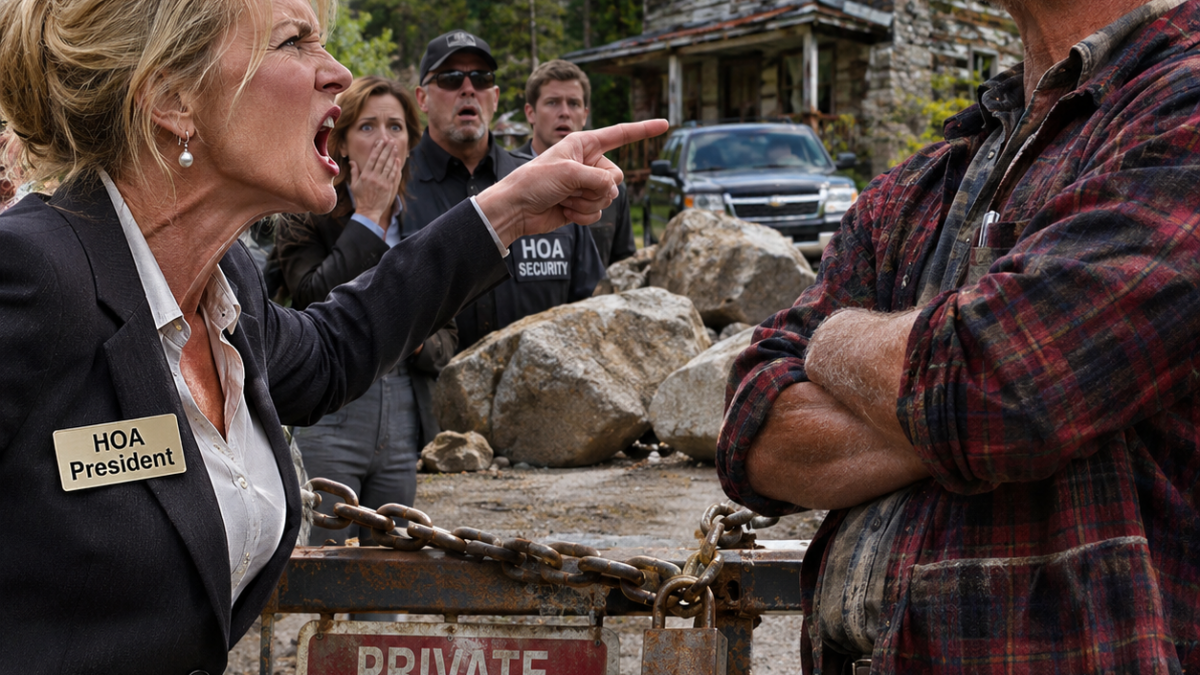
PART 2
I did not turn around.
That was harder than it sounds.
For several minutes I sat at the bottom of that mountain road with both hands locked around the steering wheel, imagining Donald inside my parents’ house.
My father’s fireplace.
My mother’s kitchen.
The bedroom at the end of the upstairs hall where my parents had slept.
I imagined that silver-haired stranger closing curtains my mother had never chosen, eating from plates that did not belong there, maybe sleeping in the same room where my father spent his final Christmas.
Everything in me wanted to drive back.
Call the sheriff from the porch.
Demand the keys.
Force the issue.
But anger was not data.
And Donald had already shown me he understood procedure.
Or at least understood how to make something look procedural.
That mattered.
So I drove home.
Sunday morning, I opened my laptop at the kitchen table in Denver.
Coffee beside me.
Legal pad.
Fourteen months of guilt.
I searched my email for “Eagle Ridge.”
Twenty-three messages appeared.
I sat back.
I remembered some of them.
Landscaping violation.
Unapproved exterior condition.
Inspection request.
Assessment notice.
I had treated them like junk mail.
That was my first mistake.
The earliest message came eighteen months earlier.
**VIOLATION NOTICE — UNMAINTAINED LANDSCAPING**
The property photographs were missing.
No inspection report attached.
Just a demand that I remedy “visible deterioration.”
I clicked the next.
**SECOND NOTICE — FAILURE TO REMEDY.**
Then another.
**UNAPPROVED EXTERIOR MODIFICATION.**
Another.
**FAILURE TO RESPOND TO INSPECTION REQUEST.**
Another.
**DELINQUENT COMMUNITY ASSESSMENT.**
I stopped.
I had paid my regular HOA assessments automatically.
At least I thought I had.
I checked my bank statements.
The association dues had cleared.
Every quarter.
On time.
The “delinquent assessment” in Donald’s email was something else entirely—a special charge I had never approved and could find no explanation for.
Then I reached the final email.
Fourteen months earlier.
**EMERGENCY PRESERVATION ACTION — SECTION 7.4.2**
That was the bylaw Donald quoted at the door.
I downloaded the HOA governing documents and opened Section 7.4.2.
It did allow limited action on a property deemed abandoned.
But Donald had left out the important part.
Before the association could act, it required written notice.
Certified mail.
A sixty-day cure period.
A formal board hearing.
A recorded vote.
Four steps.
Four separate places where my name should have appeared.
I found none.
I logged into USPS Informed Delivery and searched every scanned piece of mail from Eagle Ridge over the past two years.
Regular letters.
Newsletters.
Invoices.
Not one certified letter.
Not one.
I leaned back.
Maybe Donald had mailed them to the cabin.
That would still be suspicious, but at least it would explain why I missed them.
So I checked my county tax records.
The latest tax statement listed my Denver address.
The prior year did not.
It listed the cabin.
I stared at the screen.
Someone had changed the mailing address on file.
I had not.
Monday morning, I called the county recorder.
A clerk named Susan answered.
“I’m checking title status on a property I own.”
She pulled up the parcel.
“No liens.”
“No HOA foreclosure?”
“No.”
“No transfer?”
“No.”
“No recorded interest granted to Eagle Ridge Estates?”
“Nothing I’m seeing.”
“My name is still the owner?”
“Yes, Mr. Howard.”
I exhaled.
Then asked:
“Can you tell me who has been paying the property tax?”
There was a pause.
“Payments have been current.”
“From what account?”
“I can’t give you banking information, but the payments were not submitted through the same method used three years ago.”
I opened my own bank account.
My tax autopay had failed sixteen months earlier after an old routing change.
I had never noticed.
The county had not become delinquent because someone else stepped in.
For eighteen months, someone had been paying taxes on my house.
I wrote that down.
Then utilities.
Electricity had been transferred.
Propane deliveries.
Internet.
Possibly insurance.
Someone had spent a year and a half building a paper trail that made them look responsible.
At first, that frightened me.
Then I realized something.
Colorado adverse-possession law was not going to hand Donald my house after eighteen months.
He did not need ownership yet.
He needed a story.
The owner disappeared.
The HOA intervened.
Donald preserved the property.
Donald paid the bills.
Donald prevented deterioration.
Donald acted in good faith.
That was the defense he was building.
Not legal title.
Plausible innocence.
I knew what that meant because I saw it in data all the time.
Bad actors rarely fabricate one giant lie.
They create dozens of small facts that make their preferred story look inevitable.
Donald had not taken my house with one document.
He had built an ecosystem around it.
Emails.
Bills.
Payments.
Mailing addresses.
HOA notices.
Property-management labels.
All pointing toward the same conclusion.
Daniel Howard had abandoned this place.
Donald Mendoza had saved it.
The problem was that the details did not line up.
I made a spreadsheet.
Column one: date.
Column two: Donald’s alleged violation.
Column three: procedure required under the CC&Rs.
Column four: evidence that procedure was followed.
Column five: outcome.
The fourth column was nearly empty.
That was the pattern.
Donald produced enough paperwork to intimidate.
Not enough to survive scrutiny.
I searched county records for every property in Eagle Ridge Estates.
Sixty-seven homes.
Twelve had mailing addresses outside the community.
Vacation homes.
Investment homes.
Inherited homes.
Owners who might go months without visiting.
Owners like me.
Then I searched public complaints.
Most were ordinary HOA warfare.
Fence colors.
Roof materials.
Holiday lights.
Noise.
Then one name appeared repeatedly.
Stephanie Patel.
Former Eagle Ridge board member.
Two years earlier, she filed a complaint alleging governance and financial irregularities.
Dismissed.
Insufficient documentation.
I circled her name.
By Monday night, I knew three things.
No certified notices existed.
My tax mailing address had been changed.
Someone other than me had been paying expenses on my house for eighteen months.
Donald thought these facts protected him.
I thought they proved he knew exactly what he was doing.
Tuesday evening, I met Stephanie at a coffee shop in Colorado Springs.
She was in her early sixties with silver-streaked hair and reading glasses she kept pushing higher on her nose.
When I called her the day before, I had barely finished introducing myself before she said:
“It’s about Donald, isn’t it?”
Now she sat across from me with a thick manila folder.
She pushed it across the table.
“I kept everything.”
I opened it.
Meeting minutes.
Financial summaries.
Handwritten notes.
Copies of emails.
“You were on the board?”
“Three years.”
“What happened?”
“I asked where the money went.”
Simple.
The reserve fund had held about forty-seven thousand dollars.
Special assessments had been collected for road repairs and common-area maintenance.
Stephanie could not match several expenditures to actual invoices or completed work.
She raised the issue during a board meeting.
Donald thanked her for being diligent.
Two months later, residents supposedly complained that Stephanie was hostile and disruptive.
The board voted to remove her.
“Were you at the meeting?”
“I wasn’t notified.”
“Convenient.”
“Very.”
She filed a complaint.
The county asked for proof.
She had pieces.
Nothing decisive.
“Donald understands fragmentation,” she said. “Everything is just small enough by itself.”
That sentence made me like her immediately.
I showed her my spreadsheet.
Twelve absentee owners.
Five had been hit with serious enforcement in three years.
Among fifty-five resident owners?
Stephanie checked her records.
Two.
I wrote the ratio down.
Five out of twelve.
Two out of fifty-five.
Almost half the absentee properties.
Less than four percent of the resident properties.
Could absentee owners neglect homes more often?
Sure.
But that much?
I did not believe it.
Neither did Stephanie.
She pulled out another page.
“Look at this.”
Chapter 7 bankruptcy.
Donald Mendoza.
Seven years earlier.
More than three hundred thousand dollars in personal debt.
Primary residence underwater.
“Two years after this, he runs for HOA president,” Stephanie said.
I looked at the filing.
“Bankruptcy isn’t evidence of corruption.”
“I know.”
“What happened afterward?”
“New truck.”
She flipped a page.
“Travel.”
Another.
“His wife posting photographs from a mountain cabin.”
I looked up.
“Which cabin?”
“She never named it.”
My stomach tightened.
Stephanie slid another property record toward me.
Owner:
**Eleanor Vance.**
Seventy-eight.
Primary mailing address: Florida.
“Eleanor’s property was declared abandoned two years ago.”
“Same bylaw?”
“Same section.”
“What happened?”
“HOA took control.”
She showed me a resolution authorizing access.
Date:
March 15.
Then she showed me her meeting log.
The March board meeting occurred March 22.
I looked from one document to the other.
“The vote predates the meeting.”
“Yes.”
“Backdated?”
“Looks that way.”
“What happened to Eleanor?”
“She died last spring.”
“And the cabin?”
“Her family came to settle the estate and found tenants there.”
I stared at her.
“Tenants?”
“They hired an attorney.”
“What happened?”
“Months of fighting. They eventually settled.”
“Who were the tenants?”
“People connected to HOA management. I never got a complete answer.”
I closed the folder.
This was not just my house.
Eleanor Vance had been a test.
Maybe there were others.
Donald had found a weakness in the system.
Absentee owner.
Missed notices.
Internal HOA procedure controlled by the same people issuing the notices.
No one checking dates closely.
No one comparing addresses.
No one asking why the association president was personally benefiting.
He did not have to steal houses legally.
He only had to make ownership expensive enough to defend that people gave up.
Stephanie reached across the table and touched my arm.
“Be careful.”
“I plan to be.”
“No. I mean really careful.”
Her eyes were serious.
“Donald has people loyal to him.”
“On the board?”
“Definitely.”
“County?”
“Maybe.”
“That’s vague.”
“Because I don’t know.”
She paused.
“When I started asking questions, Donald knew about my complaint before the county responded to me.”
That stayed with me.
On the drive back to Denver, I thought about Eleanor.
The backdated vote.
Donald’s bankruptcy.
The missing reserve money.
My cabin.
Then I thought about the road.
Dad’s road.
One lane.
No public right-of-way.
No HOA designation.
Private.
I pulled into a turnout and opened the recorded survey again.
The access strip ran entirely within my deed.
Donald had been entering and leaving my home by crossing land where even the HOA did not claim an easement.
I finally called an attorney.
Judith Watson.
Real-estate litigation.
HOA disputes.
Early fifties.
Sharp eyes.
No patience for drama.
I spent an hour explaining everything.
She wrote continuously.
When I finished, she set down her pen.
“You have grounds for civil claims.”
“Trespass?”
“Yes.”
“Conversion of belongings?”
“Potentially.”
“Fraud?”
“Depending on what documents were fabricated.”
“Criminal?”
“Possibly. Law enforcement decides that, not us.”
I liked her immediately.
She continued.
“There are two basic strategies.”
“Go.”
“Call the sheriff now. Demand removal. File suit immediately.”
“That sounds attractive.”
“It also gives Donald notice before we know where your belongings went, who changed your mailing address, who paid the taxes, what happened in Eleanor’s case, and whether the board documents are genuine.”
I hated that.
“Second?”
“Build the file.”
“For how long?”
“Weeks.”
“He’s sleeping in my house.”
“I know.”
“My parents’ house.”
“I know.”
“And you want me to wait.”
“I want you to win.”
That shut me up.
I told her about the road.
Her pen stopped.
“Show me.”
I opened the survey.
She studied it.
“This is entirely within your parcel?”
“Yes.”
“No common-area designation?”
“No.”
“No recorded HOA easement?”
“County says none.”
Judith looked at me.
“That gives us another clean issue.”
“Meaning?”
“You can control access to your own private road, subject to any legitimate easements of record.”
“He has none.”
“Then post notice.”
“Gate?”
“Potentially.”
“Can I lock it?”
“If properly located and no lawful easement requires access through it, yes.”
The phrase that mattered was not *trap him.*
Judith never said that.
She said:
“Control your road.”
That distinction mattered.
I was not going to imprison Donald.
He could leave.
He could stop trespassing.
He could explain himself to law enforcement.
What he could not do was continue treating my private road like his driveway.
I hired a Colorado Springs gate company.
Steel frame.
Electronic lock.
Solar camera.
Cloud recording.
Installation scheduled for the following Saturday.
Seven days.
In the meantime, Judith told me:
“No public accusations.”
“Fine.”
“No confronting Donald.”
“Fine.”
“No posting online.”
“Fine.”
“No trying to recover possessions yourself.”
I frowned.
“Daniel.”
“Fine.”
Saturday morning, I returned to Eagle Ridge but parked well away from the house.
I walked through the tree line.
The Camry was there.
Smoke rose from my chimney.
I photographed the license plate.
The mailbox.
MENDOZA.
The property-management lockbox.
I zoomed through a window.
Not enough to invade private areas.
Just enough to document visible occupancy.
A woman—Donald’s wife, Diana—moved through the living room.
I photographed the exterior utility meters.
Then the road.
Date stamped.
Location stamped.
I did not approach.
That restraint felt unnatural.
But every photograph was better than another argument.
The next week became the most boring revenge imaginable.
Documents.
Hundreds of them.
County records.
HOA minutes.
Email headers.
Tax-address history.
Financial payments.
Stephanie’s notes.
Eleanor Vance’s resolution.
I requested records.
Cross-referenced dates.
Compared language.
Judith had an investigator confirm several witness statements.
Former residents described similar enforcement.
Absentee owners receiving escalating notices.
Some properties entered without clear authorization.
Others threatened with “emergency maintenance.”
By Friday, I had one hundred twenty-seven documents.
Forty-three photographs.
Multiple videos.
Fifteen witness statements.
Donald had once had bureaucracy on his side.
Now I had a better version of it.
Saturday morning, the gate contractors arrived.
They anchored steel posts beside the road.
Mounted the gate.
Installed an electronic lock.
Solar-powered camera.
Then a sign:
**PRIVATE ROAD**
**NO TRESPASSING**
**PROPERTY UNDER VIDEO SURVEILLANCE**
**UNAUTHORIZED ENTRY WILL BE REPORTED**
The crew finished before noon.
The foreman handed me the electronic controls.
“Want it locked?”
“Not yet.”
He looked surprised.
I wanted Donald to see it before access changed.
Not because I wanted to scare him.
Because I wanted no argument later that the barrier appeared without warning.
Forty-eight hours later, Donald emailed me.
Subject:
**UNAUTHORIZED STRUCTURE — IMMEDIATE ACTION REQUIRED**
He claimed the gate stood on Eagle Ridge common area.
Remove it within seventy-two hours.
Fine: $150 per day.
I actually laughed.
Then I sent the email to Judith.
Her response came five minutes later.
**Perfect.**
I called.
“Perfect?”
“He has now committed his position to writing.”
“He thinks he owns my road.”
“Or wants you to think he does.”
I replied carefully.
Recorded deed.
Book 47.
Page 312.
County survey attached.
Private property.
No common-area designation.
No HOA authority.
Future correspondence through counsel.
No insults.
No accusations.
Facts.
Two days later, another letter.
Regular mail.
The gate violated “community aesthetics.”
Still no certified service.
I added it to the file.
Day five, the camera triggered.
Donald’s Camry stopped at the gate.
He got out.
Walked toward the sign.
Read it.
Took out his phone.
Photographed it.
Then looked directly at the camera.
For two seconds, he simply stared.
He knew I was watching.
He did not touch the gate.
He drove away.
That night, Diana posted on the Eagle Ridge message board.
Stephanie forwarded it.
**Some people think property ownership places them above community standards. Sad to see what our neighborhood is becoming.**
I did nothing.
No reply.
No argument.
That was difficult.
A few comments supported her.
Others asked why Donald was living in a home titled to someone else.
That was new.
Questions.
Donald’s greatest advantage had always been that people accepted his version before checking.
Now they were checking.
Judith reviewed the completed file Sunday.
“We’re ready.”
“Finally.”
“Three fronts.”
She held up one finger.
“Sheriff. Criminal complaint based on documented unauthorized occupancy and related evidence.”
Second.
“Civil suit—trespass, conversion, fraud theories, fiduciary issues where applicable.”
Third.
“Colorado Division of Real Estate and relevant HOA oversight complaints.”
“He’ll know after the first one.”
“Yes.”
“No more surprise.”
“No.”
I thought about that.
The quiet phase was ending.
That night, I nearly ruined it.
I was alone in Denver.
Exhausted.
Angry.
I wrote a long post explaining everything.
Donald in my house.
My parents’ missing belongings.
The fake abandoned-property process.
Eleanor.
The money.
I hovered over **POST**.
I wanted people to tell me I was right.
That is embarrassing to admit.
After weeks of behaving rationally, I wanted strangers to validate my anger.
Then I heard Judith’s voice in my head.
Anything public becomes evidence.
I deleted it.
Monday morning, she contacted the sheriff’s office.
Wednesday.
10:30 a.m.
El Paso County substation.
Before the meeting, I drove to the mountain gate at sunrise.
I opened it.
Drove through.
Then closed and locked it behind me.
For the first time since the whole thing started, access to my property depended on my permission.
At 8:47, my phone alerted.
Donald’s Camry.
He stopped.
Got out.
Tried the gate.
Locked.
Looked at the camera.
Then made a phone call.
His gestures were sharp.
Shoulders tight.
Four minutes.
Then he sat in the car for fifteen more.
Eventually, he turned around.
At 10:30, Judith and I sat across from Deputy Raymond Ortiz.
Mid-forties.
Quiet.
Methodical.
He did not react dramatically to anything.
That was reassuring.
Judith walked him through the file.
Deed.
Survey.
No transfer.
No foreclosure.
No lien.
No valid recorded interest.
HOA procedure.
No certified notices.
No hearing record.
Tax-address alteration.
Third-party tax payments.
Occupancy footage.
Lockbox.
Stephanie’s records.
Eleanor Vance’s backdated resolution.
Ortiz took notes.
When Judith finished, he looked at me.
“You personally told Mr. Mendoza you owned the home?”
“Yes.”
“What did he say?”
“That the HOA declared it abandoned.”
“Did you authorize him to remain?”
“No.”
“Have you ever leased the house to him?”
“No.”
“Given him keys?”
“No.”
“Signed any property-management agreement?”
“No.”
He closed his notebook.
“I want to speak with him.”
We drove up together.
My car.
Judith’s.
Ortiz’s cruiser.
The gate opened from my phone.
We proceeded up the dirt road.
I remember how strange that felt.
I had driven it hundreds of times with my father.
As a child in snow.
As a teenager learning to drive.
After my mother died.
After Dad died.
But that morning, seeing a sheriff’s cruiser in my mirror made the road feel like evidence.
We reached the house.
The Camry was gone from the driveway.
But the camera showed Donald had returned earlier by some means after leaving his car elsewhere.
Ortiz knocked.
Thirty seconds.
Door opened.
Donald wore pressed slacks and a button-down shirt.
Like he expected a meeting.
His eyes moved to me.
Then Judith.
Then the deputy.
“Officer.”
“Donald Mendoza?”
“Yes.”
“Deputy Raymond Ortiz, El Paso County Sheriff’s Office. I’m investigating a complaint concerning this property.”
Donald nodded.
“I assume this is Mr. Howard’s latest escalation.”
Ortiz did not answer the bait.
“What legal right do you have to occupy this residence?”
“The HOA declared it abandoned under Section 7.4.2.”
“Do you have a deed?”
“No.”
“Lease?”
“No.”
“Court order?”
“The association has internal authority.”
“That wasn’t my question.”
Donald’s jaw tightened.
“The owner failed to maintain the property.”
Ortiz looked at me.
Then back at him.
“The owner is standing here.”
“He abandoned it.”
“Did he transfer ownership?”
“No, but—”
“Did he authorize you to live here?”
Donald paused.
“We undertook preservation.”
“Living here?”
“We needed an on-site presence.”
“Where is the board resolution authorizing you personally to move into the residence?”
Donald said nothing.
Diana appeared behind him.
She looked frightened.
Donald tried again.
“This is a civil HOA matter.”
Ortiz spoke calmly.
“There is no recorded HOA ownership interest. No foreclosure. No recorded lien giving possession. Mr. Howard expressly denies permission for you to be here.”
Donald looked at Judith.
“You’re advising him?”
“Yes.”
“This is completely unnecessary.”
Judith said:
“Then show Deputy Ortiz the document authorizing your occupancy.”
Donald’s expression changed.
For the first time since I met him, he had no prepared line.
Ortiz asked him to step outside.
Donald did.
A few minutes later, based on the evidence presented and what Ortiz established at the property, Donald was placed under arrest for criminal trespass while additional allegations were investigated.
Diana gasped.
Donald went pale.
He did not resist.
He looked at me while Ortiz secured his wrists.
Not rage.
Disbelief.
Like reality had broken a rule.
For years, Donald had been the person who decided when procedures mattered.
Who got notices.
Who got hearings.
What counted as abandoned.
Who belonged.
Now someone outside his system was applying rules he did not control.
I said nothing.
There was nothing worth saying.
Ortiz drove away with him.
Diana was allowed time to collect personal necessities under supervision and arrange to leave.
I stood on the porch.
My porch.
The door was open.
Judith stood beside me.
“You all right?”
“No.”
“Expected.”
I stepped inside.
The smell hit first.
Different detergent.
Different food.
Different people.
My childhood home smelled like strangers.
The family photographs were gone.
My father’s books were missing.
My mother’s ceramic bowl from the entry table was gone.
The old rug had disappeared.
Some furniture remained.
Most didn’t.
In the living room, I found one thing I recognized.
Dad’s leather chair.
Moved beside another wall.
There was a coffee stain on one arm.
I ran my fingers across it.
That was when the anger finally cracked.
Not in front of Donald.
Not when he was arrested.
Alone beside my father’s chair.
I sat down.
Put my face in my hands.
And cried.
Judith quietly went outside.
I appreciated that.
By evening, Eagle Ridge knew.
Stephanie called.
“The message board is exploding.”
“I can imagine.”
“Diana posted that Donald was falsely arrested.”
“Also predictable.”
“People aren’t buying it.”
“Why?”
“Because now they’re asking the obvious question.”
“What was Donald doing in Daniel Howard’s house?”
That question spread faster than any accusation I could have posted myself.
Then another.
Where had my belongings gone?
Then another.
What happened to Eleanor Vance’s cabin?
Then:
Where was the reserve fund?
Three days later, homeowners collected enough signatures to force an emergency HOA meeting.
I attended.
Sat in the back.
Donald was out pending the case.
He sat in the front row with Diana.
No HOA polo.
No podium.
No authority in his posture.
The interim officer opened the floor.
Donald stood.
“I acted in good faith.”
A woman interrupted.
“You acted in good faith by living in his house rent-free?”
Donald’s face tightened.
“The property required preservation.”
“Then why were your clothes there?”
Another resident:
“Where is the forty-seven thousand dollars in the reserve account?”
“That is unrelated.”
“Not anymore.”
Questions came from every direction.
Meeting notices.
Fines.
Vendor payments.
Eleanor.
My cabin.
Donald tried to answer.
Every answer produced another question.
Then came three motions.
Remove Donald Mendoza from the HOA board.
Unanimous.
Authorize an independent financial audit.
Unanimous.
Fully cooperate with law enforcement.
Unanimous.
When the final vote was announced, Donald stood.
Diana followed.
They walked out.
No one stopped them.
Stephanie came to me afterward.
“You did it.”
“No.”
She looked at the empty doorway.
“They did.”
I nodded toward the homeowners.
“I just gave them a reason to look.”
She smiled sadly.
“That’s what I tried to do.”
“You gave me the evidence.”
“I didn’t have the road.”
“What?”
I looked toward the mountain.
“The road was the seam.”
She understood.
Without it, Donald could have continued arguing over HOA authority inside the house while the dispute dragged through court.
The private access issue gave us a clean boundary.
No public road.
No common area.
No recorded right.
He had overlooked the simplest part of the entire property.
Legal processes moved slower after that.
The dramatic moment was over.
The work was not.
The District Attorney’s Office reviewed the evidence.
Judith kept me informed.
Charges tied to trespass, property loss, fraud allegations, and falsified HOA documentation were evaluated.
Eleanor Vance’s case became relevant because investigators now had a reason to revisit the old board records.
Then the financial audit came back.
Stephanie had been right.
The reserve fund was short by approximately $47,000.
Twenty-three thousand dollars had been paid to a maintenance company owned by Donald’s brother.
No competitive bidding.
Little supporting documentation.
Meeting minutes had been altered to support expenditures that had not been properly approved.
The new Eagle Ridge board filed its own civil action.
That changed everything.
Donald was no longer fighting one absentee homeowner.
He was fighting the community whose authority he had used as cover.
Three months after his arrest, his attorney approached Judith about a plea agreement.
When she called me, I was sitting in my office at work.
“Donald wants to negotiate.”
“For the criminal case?”
“Yes.”
“What does he offer?”
“He would plead to reduced charges including trespass and fraud. Other counts would be dismissed.”
“Prison?”
“No.”
I leaned back.
“No?”
“Probation. Community service. Restitution.”
My hand tightened around the phone.
“He lived in my house for eighteen months.”
“I know.”
“He did this to Eleanor.”
“I know.”
“He took my parents’ things.”
“I know.”
“And he goes home?”
“Daniel.”
I closed my eyes.
“I wanted him to go to prison.”
“I know.”
“I know that sounds ugly.”
“It sounds human.”
I was quiet.
Judith continued.
“Trials are uncertain. Some charges depend on proving intent beyond a reasonable doubt. The plea gives us an admission. Restitution. A conviction. No years of delay.”
“It doesn’t feel like enough.”
“It may never feel like enough.”
That was the most honest answer she could have given me.
Donald eventually pleaded guilty to reduced charges.
He received eighteen months of supervised probation, two hundred hours of community service, and restitution obligations.
Diana pleaded to a lesser accessory-related offense and received a fine and probation.
No prison.
I hated that for a while.
Then Judith said:
“Look at everything he lost.”
Board position.
Community status.
Control.
Reputation.
The ability to hide behind HOA procedure.
His name was now attached publicly to what he had done.
For someone like Donald, status was not decoration.
It was identity.
He had spent years standing behind meeting tables while everyone else had to ask permission.
Now people searched his name and found court records.
The civil case followed.
Judith’s damages spreadsheet looked like something I might have built myself.
Lost or damaged property.
Fair-market rental value for eighteen months.
Legal costs.
Travel expenses.
Gate installation.
Security equipment.
Other recoverable losses.
Emotional damages claims where supportable.
The settlement offer came before the case reached trial.
$127,000.
I stared at the number.
“Would you take it?”
Judith shrugged.
“My client decides.”
“Would you advise it?”
“Yes.”
“One condition.”
She sighed before I even spoke.
“What?”
“Written apology.”
Her eyebrows rose.
“Public?”
“HOA website.”
“For how long?”
“Twelve months.”
“That is unusual.”
“So was finding him in my parents’ kitchen.”
“They may reject it.”
“Then they reject it.”
They accepted.
A week later, Eagle Ridge’s website displayed a formal statement signed by Donald and Diana Mendoza acknowledging their unauthorized occupancy and apologizing to me.
I read it once.
Expected satisfaction.
Felt almost nothing.
Judith had warned me.
Forced apologies rarely heal the thing they describe.
But the statement was not for my emotions.
It was a record.
Donald had spent years building paperwork that supported his version of reality.
Now one document existed that he could never reinterpret.
The Eagle Ridge lawsuit settled later.
The Mendozas agreed to repay missing reserve funds over time.
Donald’s brother’s company was barred from future contracts.
The HOA adopted term limits.
Annual independent audits.
Recorded votes for major enforcement actions.
Meeting minutes posted promptly.
Homeowner-rights information for new residents.
Stephanie called after the reforms passed.
“You know what they asked me?”
“What?”
“To come back to the board.”
“Are you?”
“No.”
I laughed.
“Why?”
“I spent three years trying to escape those people.”
“Fair.”
“They asked you too.”
“Twice.”
“And?”
“No.”
“You’d be good at it.”
“That is not a compliment.”
She laughed.
The truth was simpler.
I had not fought Donald so I could replace Donald.
Power had not been the thing I wanted.
My house was.
The cabin took four months to restore.
That was the part nobody saw.
No sheriff.
No dramatic meeting.
No legal victory.
Just boxes.
Paint.
Contractors.
Receipts.
Grief.
A lot of grief.
Some of my parents’ belongings were gone permanently.
Sold.
Donated.
Discarded.
Donald’s records were incomplete.
Dad’s old ski rack disappeared.
My mother’s dining chairs were gone.
Several boxes of photographs vanished.
You cannot put a settlement value on objects that matter because of who touched them.
I tried anyway.
Insurance lists.
Replacement estimates.
Then one afternoon I stopped.
A photograph of my mother’s chair was not my mother’s chair.
A replacement ski rack was not Dad’s.
Some losses did not need substitutes.
They needed acknowledgment.
I kept what survived.
Dad’s leather chair.
The old brass fireplace tools.
A wooden clock from the upstairs hallway.
A box of Christmas ornaments someone had pushed into the back of the storage shed.
The family photographs I still had in Denver went back onto the mantel.
I renovated the kitchen.
White cabinets.
My mother had wanted white cabinets for years.
Dad always said the old wood was “perfectly good.”
Mom would answer:
“So are you. I still buy you new shirts.”
I smiled the entire day the cabinets were installed.
For the first time since reclaiming the cabin, I remembered my parents there without also picturing Donald.
That felt like progress.
A year after the arrest, late-afternoon sunlight poured through the living-room windows.
The furniture was different.
The walls had fresh paint.
Dad’s chair sat beside the fireplace again.
Above it were photographs.
My parents on their wedding day.
Me learning to ski.
The three of us on the back deck.
Our last Christmas together before Mom became ill.
The house would never feel exactly the way it had when I was a child.
I finally stopped trying to make it.
Homes change because people do.
The goal was not to restore every object.
It was to be able to walk inside without feeling like Donald still occupied the memory.
Stephanie came up for a barbecue that September.
Two other Eagle Ridge homeowners joined us.
We sat on the deck looking across the mountains.
The new HOA president was a retired teacher named Michael Reyes.
He had instituted term limits.
Financial statements were online.
Minutes posted within forty-eight hours.
Annual audits.
Stephanie raised her glass.
“You know what irritates me?”
“What?”
“I spent two years collecting evidence.”
“You helped.”
“I filed complaints.”
“I know.”
“Nothing happened.”
“I know.”
“Then you show up and three months later Donald is gone.”
I shook my head.
“You did the work.”
“I didn’t have your gate.”
I looked toward the dirt road.
“No.”
“That was the difference.”
“Part of it.”
“No, Daniel. Without that road, he would’ve turned the house into a procedural fight for another year.”
She was probably right.
I had found the thing Donald had not bothered to manipulate.
He focused on the house.
The emails.
The HOA bylaws.
The taxes.
The appearance of occupancy.
He controlled all the complicated things.
He ignored one simple fact.
Every trip to my cabin required crossing my private land.
That road had existed before Eagle Ridge.
Before Donald.
Before the HOA.
My father built the cabin around that privacy.
“One road means one choice.”
Come in or stay out.
Donald had chosen to come in without permission for eighteen months.
The gate simply made that choice visible.
I left it standing.
At first, I thought I would remove it when the case ended.
It was expensive.
Industrial.
More security than my parents ever needed.
Then I changed my mind.
Not because I expected another Donald.
Because every time I drove up, I opened the gate myself.
That small action mattered.
My property.
My permission.
My choice.
One fall morning, I arrived before sunrise.
The gate camera recognized my car.
I unlocked it from my phone.
Drove through.
Stopped on the other side.
For a second I remembered the first Saturday.
MENDOZA covering HOWARD on the mailbox.
Smoke from my chimney.
Donald opening my door.
“Can I help you? This is private property.”
I looked toward the cabin.
Lights off.
Windows clear.
My name back on the mailbox.
Then I laughed.
He had been right about one thing.
It was private property.
He had simply forgotten whose.
I closed the gate behind me.
[END OF STORY]








