PART 2: I FOUND AN OLD DOG WAITING IN AN ABANDONED IDAHO CABIN—THEN I LEARNED WHO HAD LEFT HIM THERE
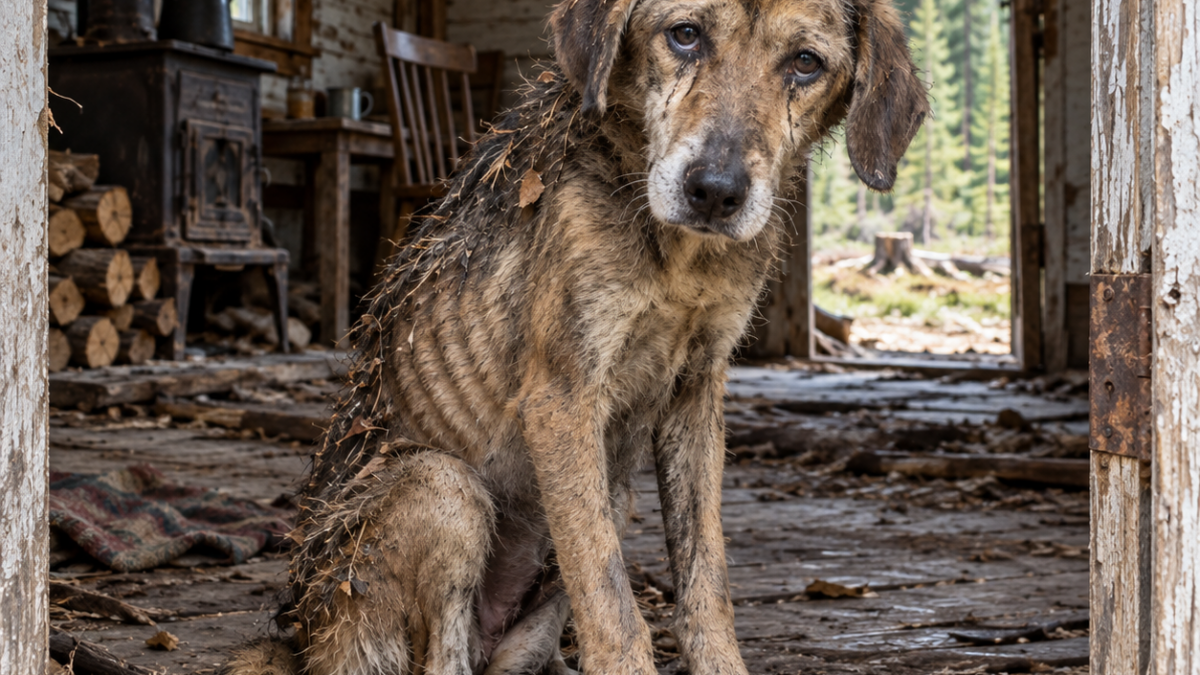
PART 2
I folded the papers carefully and carried them outside.
Jenna was sitting in the back of the rescue van with the old dog between her knees. He had been wrapped in two fleece blankets, and she was offering him small amounts of water every few minutes.
She looked up.
“What did you find?”
I didn’t answer immediately.
I held out the paperwork.
She read the name.
Then she looked at me.
“No.”
“That’s what it says.”
The documents were old enough to be stained around the edges but new enough to matter.
A veterinary invoice from only seven months earlier listed the dog as **Boone**, an eleven-year-old shepherd mix.
There was a vaccination certificate.
Medication instructions for arthritis.
And a handwritten note from a veterinary office reminding the owner that Boone needed follow-up bloodwork.
The owner’s name was printed clearly beneath the address.
**Carl Whitmore.**
Jenna recognized it too.
Everybody in our county knew the Whitmore name.
Carl owned a construction company on the edge of town. His advertisements were painted across work trucks, fencing around building sites, and the scoreboard at the high school football field.
He sponsored youth baseball.
He donated gravel for church parking lots.
His company had built several expensive vacation homes around the lake.
If these papers were legitimate, the man whose face appeared in local business advertisements had once owned the starving dog trembling beneath our blankets.
I looked at Boone.
His eyes were closed now.
“Let’s not decide anything yet,” Jenna said quietly.
She was right.
Working in rescue teaches you how dangerous assumptions can be.
Dogs get stolen.
They escape.
Families surrender animals to people who later abandon them.
Records can be outdated.
A name on a veterinary invoice was not proof of what had happened inside that cabin.
So we did the only thing that mattered first.
We took Boone to the clinic.
Dr. Melissa Hart had worked with our rescue for years.
When she saw him, her expression changed immediately.
“How old?”
“Paperwork says eleven.”
She touched the loose skin along his neck.
“Maybe twelve now.”
Boone weighed thirty-eight pounds.
For a dog whose healthy weight should have been close to sixty-five.
His nails were badly overgrown.
His hips were arthritic.
Several teeth were broken or infected.
The fur beneath his belly was matted with dirt.
He had a skin infection, dehydration, and anemia.
But what frightened us most was his temperature.
Too low.
Dr. Hart wrapped him in heated blankets and started fluids.
“We’ll feed him slowly,” she said. “Very slowly. His body’s been deprived too long.”
“Is he going to make it?”
She didn’t answer for a second.
“That depends on what the next forty-eight hours look like.”
I hated those words.
In rescue, sometimes you bring an animal through the door and immediately know hope has arrived in time.
Other times hope arrives late and has to fight for every minute.
Boone slept through most of that afternoon.
Whenever someone opened the treatment-room door, however, his eyes snapped open.
He watched.
Waited.
Measured footsteps.
When the person remained in the room, he relaxed again.
Dr. Hart noticed it too.
“He’s monitoring exits.”
“What does that mean?”
“It means being left may frighten him more than people do.”
That sentence stayed with me.
I went home after midnight, but I couldn’t sleep.
Every time I closed my eyes, I saw Boone standing at the cabin doorway, sunlight across his face.
At 2:17 a.m., I finally got up and searched the address printed on the veterinary invoice.
Carl Whitmore lived fifteen miles outside town in a large cedar-sided house overlooking pastureland.
Not near the cabin.
Not even close.
The abandoned cabin belonged to an old parcel that county records showed had been purchased years ago by Whitmore Timber Holdings.
Carl’s company.
My stomach tightened.
I printed everything I could legally access.
Property records.
Business filings.
Parcel maps.
Then I stopped myself.
I wasn’t law enforcement.
I wasn’t an investigator.
And Boone needed me to be useful, not reckless.
The next morning, I contacted county animal control.
Officer Rachel Kim arrived at the veterinary clinic just after nine.
She photographed Boone.
Photographed the papers.
Photographed his collar.
Then she scanned him for a microchip.
The scanner beeped.
All three of us looked at one another.
Boone was chipped.
Rachel called the registry.
The registered owner was Carl Whitmore.
There was no reported missing-dog notice.
No transfer.
No stolen-animal report.
No update.
Rachel’s face became very still.
“I’m going to ask him some questions.”
“Can I come?”
“No.”
I must have looked disappointed because she added, “Daniel, I know you care about him. That’s exactly why you shouldn’t.”
She was right again.
So I waited.
Waiting turned out to be harder than walking into the cabin.
By noon, Boone had eaten several spoonfuls of prescription food.
By evening, he could stand for nearly thirty seconds without collapsing.
The next morning, I arrived carrying a clean blue blanket.
Boone opened his eyes when he heard my footsteps.
His tail didn’t move.
Not yet.
But his ears lifted.
“Hey, old man.”
I sat beside him.
He lowered his head onto my shoe.
That was all.
But I stayed there almost an hour because moving felt like breaking a promise.
Rachel called that afternoon.
“Whitmore says he gave the dog away.”
“To who?”
“He won’t give me a full name.”
“What does that mean?”
“He claims an employee knew somebody with land who wanted an outdoor dog.”
“Boone can barely walk.”
“He says Boone was healthier then.”
“What employee?”
“I can’t discuss every detail yet.”
I clenched my jaw.
“Is he denying the cabin?”
There was a pause.
“He admits owning it.”
I looked through the glass wall into Boone’s treatment room.
“So his dog somehow ends up starving inside his cabin?”
“I noticed that too.”
Rachel’s tone told me she was not satisfied.
Neither was I.
Two days later, Boone’s bloodwork improved slightly.
Dr. Hart let us move him into a quieter kennel at the rescue facility, where volunteers could sit with him for longer periods.
We gave him a large orthopedic bed.
The first time I guided him toward it, he stopped several feet away.
He stared at the cushion as though it were something dangerous.
I tapped the corner.
“For you.”
He sniffed.
Placed one paw onto it.
Pulled it back.
Then tried again.
Eventually he stepped completely onto the bed.
His legs folded beneath him.
He sank into the cushion.
And he made a sound I had never heard from him before.
A sigh.
A deep, long breath that seemed to empty years from his body.
Jenna stood in the doorway.
“That’s his.”
“Yeah.”
“Don’t let anyone take it away.”
“No one will.”
I meant the bed.
But I think she heard something else.
During the next week, Boone slept more than he stayed awake.
His meals were small.
Four a day.
Then five.
We added medication for arthritis and antibiotics for his skin.
One afternoon, while I sat reading paperwork beside him, I felt something touch my wrist.
Boone’s nose.
He nudged my hand.
I scratched beneath his chin.
His eyes closed.
That became our routine.
I would arrive around seven each morning.
Boone would lift his head.
I would sit beside him.
He would pretend for perhaps thirty seconds that he didn’t care.
Then he would push his nose beneath my palm.
By the second week, he had gained three pounds.
By the third, nearly six.
And then came the moment every volunteer remembers.
I entered the kennel with breakfast.
“Morning, Boone.”
His tail moved.
Once.
A tiny sweep against the blanket.
I stopped.
“Did you just—”
It moved again.
I shouted, “Jenna!”
She ran down the hall.
“What happened?”
I pointed.
“He wagged.”
She stared at me.
“You yelled like somebody was dying.”
“He wagged!”
Boone looked between us.
Then, perhaps because we looked ridiculous, his tail moved again.
Jenna started laughing.
Then crying.
I wasn’t doing much better.
That little tail wag became more important to us than any dramatic rescue.
Getting Boone out of the cabin had saved his body.
That tiny movement told us something inside him had begun to return too.
But while Boone healed, Rachel’s investigation continued.
And Carl Whitmore’s story began changing.
First, he said he had given Boone to an employee.
Then he said the employee had arranged the transfer.
Then he claimed Boone had run away before the transfer occurred.
Rachel asked why he hadn’t reported Boone missing.
Carl said he assumed the dog had been taken by someone.
She asked why Boone’s veterinary records and collar were underneath a floorboard in a cabin owned by his company.
Carl said he had no idea.
Then Rachel learned something else.
A neighbor named Everett Sloan lived on property bordering the old timber parcel.
When she showed him Boone’s photograph, Everett recognized him immediately.
“I’ve seen that dog,” he said.
“Where?”
“With Whitmore.”
“When?”
“Springtime.”
He remembered because Carl had driven to the cabin with Boone in the passenger seat of his pickup.
Everett had been repairing a fence line at the time.
He watched Carl unload several things.
A bag.
A water container.
The dog.
Carl stayed less than an hour.
Then his truck came back down the trail.
Without Boone.
Everett hadn’t thought much about it initially.
The Whitmores owned the property.
Perhaps Boone was staying with somebody using the cabin.
Maybe there was a caretaker.
A hunter.
A worker.
But several weeks later, Everett passed the access trail again and saw no vehicles.
By then summer fires had forced him away from the area for several weeks.
When he returned, he didn’t see Boone.
He assumed the dog had gone home.
Except Boone hadn’t.
Rachel asked the question that mattered.
“Would you put that in writing?”
Everett did.
When Rachel told me, I sat in my truck outside the rescue center for a long time.
I kept imagining the drive.
Boone sitting beside Carl.
Maybe looking out the window.
Maybe excited because he thought they were going somewhere together.
Carl turning down the logging road.
Opening the cabin.
Leaving food and water.
Then walking back to his truck.
I wondered whether Boone followed him outside.
Whether Carl ordered him back.
Whether the old dog watched the truck disappear between the trees.
I wondered how long he waited before realizing nobody was returning.
That thought made me angrier than anything else.
Starvation is physical.
Abandonment is something different.
Dogs do not understand property disputes, financial inconvenience, aging, or why somebody decides they no longer fit into a life.
They only understand that the person who has always come back suddenly doesn’t.
I wanted to confront Carl.
I imagined parking outside his office and asking him how a person could leave an eleven-year-old dog in an isolated cabin.
Instead, I went inside Boone’s kennel.
He was asleep.
I sat beside him until the anger settled enough for me to think clearly.
Justice done badly can become another kind of selfishness.
Boone didn’t need me arrested for punching his former owner.
He needed me there at seven the next morning.
So I kept showing up.
The investigation moved slowly.
Carl hired an attorney.
His attorney claimed Everett had misunderstood what he had witnessed.
According to their new explanation, Carl had taken Boone to the cabin only temporarily because workers were supposed to begin clearing the property. One of those workers had supposedly agreed to bring Boone home later.
No worker could be identified.
No messages were produced.
No veterinary transfer had been made.
No one had contacted the microchip registry.
Rachel requested access to security footage from Carl’s construction yard.
Most footage from months earlier had already been overwritten.
But company fuel records still existed.
So did GPS data from several business vehicles.
Carl’s truck had traveled to the cabin property on May 12.
It returned the same afternoon.
The truck did not return for more than four months.
Boone had apparently been left there before summer.
I stared at the dates when Rachel showed me.
“Four months?”
“At least.”
“How does a dog survive four months?”
“We don’t know exactly when he became trapped inside. Someone may have left supplies.”
“Someone?”
“I’m not ruling anything out.”
That bothered me.
If Carl had abandoned him, why had Boone survived?
The cabin contained an old metal bucket that could collect rain leaking through the roof.
There were torn food bags.
Mouse droppings.
Evidence that Boone had eaten things no dog should ever need to eat.
But four months was a long time.
That question remained unanswered until we found Leonard Pike.
Leonard was seventy-six and lived in a trailer eight miles from the cabin.
He had once worked for Carl’s father when Whitmore Timber still operated as a logging business.
Rachel located him after reviewing names connected to the property.
When she showed him Boone’s photograph, his face changed.
“Is he alive?”
Those were his first words.
Rachel later told me she knew immediately that Leonard had seen him.
Leonard confessed that during the summer, he had occasionally brought Boone food.
He had discovered him inside the cabin in June.
“Why didn’t you call anyone?” Rachel asked.
Leonard lowered his eyes.
He was ashamed.
Carl had told him Boone was staying there temporarily as a guard dog.
Leonard knew that sounded wrong, particularly considering Boone’s age.
But Carl was his former employer’s son, and Leonard had depended on occasional maintenance work from the company.
He feared losing that income.
So he told himself Boone wasn’t abandoned.
He left dry food.
Filled the water bucket.
Returned every few days when he could.
Then Leonard became ill.
He was hospitalized for pneumonia.
For nearly six weeks, he couldn’t return.
When he eventually recovered enough to drive, early snow had begun in the higher country.
He assumed Carl had finally taken Boone away.
He was wrong.
Hearing that story complicated my anger.
Part of me wanted to blame Leonard.
Another part understood how fear makes people accept explanations they know are wrong.
He had failed Boone.
He knew it.
But without the food he left, Boone might not have survived long enough for me to find him.
Leonard asked whether he could visit.
I hesitated.
Then agreed.
He arrived carrying a bag of soft treats.
When Boone saw him, something remarkable happened.
His ears rose.
He struggled to his feet.
Leonard covered his mouth.
“Hey, old fella.”
Boone walked toward him.
Slowly.
Painfully.
But without fear.
Leonard knelt.
Boone pressed his head against the old man’s chest.
Leonard began sobbing.
“I should’ve taken you,” he whispered. “I should’ve just taken you.”
Boone licked his hand.
There are moments when dogs offer forgiveness more quickly than people deserve.
Watching that can be beautiful.
It can also hurt.
Leonard eventually became one of the strongest witnesses in the case.
He handed Rachel several text messages from Carl.
One changed everything.
Leonard had written in June:
**That old shepherd still up at cabin?**
Carl answered:
**Yeah. Leave food if you’re going by. He’s fine there.**
Leonard replied:
**Shouldn’t he be home? Gets hot up there.**
Carl wrote:
**He’s old, Len. Don’t make this into a thing.**
The message was short.
Eight words mattered most.
**Don’t make this into a thing.**
Carl had known.
Whatever excuse his attorney created later, Carl knew Boone remained at the cabin.
The case was referred to the county prosecutor.
Charges related to animal abandonment and neglect were considered under Idaho law based on the evidence investigators had collected.
I won’t pretend the legal process moved dramatically.
Real justice rarely happens the way it does on television.
There was no immediate courtroom showdown.
No judge pounding a gavel while an entire town cheered.
There were interviews.
Reports.
Photographs.
Veterinary statements.
Attorneys.
Continuances.
Arguments over what could be proven.
Weeks became months.
Boone continued healing while the humans argued about his past.
And something strange happened during that time.
Carl came to see him.
I was at the rescue center on a cold Thursday afternoon when a black pickup pulled into the lot.
I recognized the company logo immediately.
Whitmore Construction.
Carl stepped out.
He was around fifty, tall, broad-shouldered, wearing expensive boots and a quilted vest.
I met him before he reached the door.
“You Daniel?”
“Yes.”
“I want to see my dog.”
Every muscle in my body tightened.
“He’s under protective custody.”
“He’s registered to me.”
“So maybe you should talk to animal control.”
His jaw shifted.
“I already have.”
“Then you know the answer.”
He looked through the front window.
“I’m not here to cause trouble.”
I almost laughed.
Instead, I said, “What are you here for?”
“To see him.”
“Why now?”
His eyes hardened.
“That’s none of your business.”
“Boone became my business when I carried him out of your cabin.”
For several seconds, neither of us spoke.
Then Carl said something I had not expected.
“You think you know everything.”
“I know what thirty-eight pounds looks like on a sixty-five-pound dog.”
“You weren’t there.”
“Boone was.”
His face reddened.
He took a step toward me.
“I loved that dog.”
The words hit me harder than anger would have.
Because maybe, once, he had.
People like to imagine cruelty always comes from monsters.
That makes cruelty easier to understand.
But sometimes cruelty comes from ordinary people making selfish decisions repeatedly until another living thing suffers the consequences.
“You loved him?” I asked.
Carl looked away.
“He was my dad’s dog.”
That changed the conversation.
Carl’s father, Richard Whitmore, had died two years earlier.
Boone had belonged to him.
After Richard’s death, Carl took the dog.
“At first he was fine,” Carl said. “Then he started having accidents in the house. Couldn’t climb stairs. My wife didn’t want him inside.”
“So you left him in a cabin?”
“I didn’t leave him to die.”
“What did you think would happen?”
“I told people to check on him.”
“You told one seventy-six-year-old man to leave food when he happened to pass.”
“He had shelter.”
I looked at him.
“Shelter?”
“You found him inside, didn’t you?”
“That wasn’t a home.”
Carl’s voice dropped.
“You have any idea what my life looked like then? My dad had died. Business was falling apart. My mother needed care. My wife was threatening to leave. Boone kept destroying things. Every day there was something.”
“And Boone caused all of it?”
“I didn’t say that.”
“You punished him like he did.”
That landed.
His eyes shifted away.
For the first time, I saw something other than defensiveness.
Shame.
Maybe only for a second.
Then it disappeared.
“I want to see him.”
I should have refused.
Instead, I called Rachel.
She gave permission under supervision.
When Carl entered Boone’s room, the old dog was asleep on his blue bed.
Carl stopped.
Boone smelled him before he opened his eyes.
His head lifted.
For a moment, nobody moved.
Then Boone stood.
Carl whispered, “Hey, boy.”
I watched closely.
I expected fear.
Maybe excitement.
Boone did neither.
He simply stared at Carl.
Carl crouched.
“Come here.”
Boone remained where he was.
Carl held out his hand.
“You remember me.”
Boone took one slow step.
He sniffed Carl’s fingers.
Then he turned around.
He walked past him.
Straight to me.
Boone pressed his shoulder against my leg and sat.
The room became completely silent.
Carl stayed crouched with his hand still extended.
I didn’t smile.
I didn’t say anything triumphant.
There was nothing to celebrate in that moment.
An old dog had simply chosen where he felt safe.
Carl stood.
His eyes were wet.
He looked at Boone.
Then at me.
“I guess that’s that.”
I said nothing.
He left less than a minute later.
That was the last time Boone ever saw him.
The case eventually ended with Carl accepting a plea agreement.
The final penalties weren’t as spectacular as angry people online probably would have wanted.
He paid veterinary restitution.
He paid fines.
He was placed under restrictions regarding animal ownership for a court-determined period.
Part of the agreement required him to relinquish every legal claim to Boone permanently.
For me, that last piece mattered most.
The morning the paperwork became final, Rachel came to the rescue carrying a folder.
“Congratulations,” she said.
“For what?”
“He’s legally clear.”
I looked toward Boone.
“Meaning?”
“Meaning the rescue owns him now.”
Jenna smiled from behind the desk.
Then she looked at me.
I immediately understood what they had arranged.
“No.”
Rachel raised an eyebrow.
“No?”
“You two planned this.”
“Planned what?”
Jenna couldn’t keep a straight face.
“You fill out foster paperwork faster if you’re emotionally compromised.”
“I already foster him.”
Rachel opened the folder.
“Temporary foster.”
I looked at Boone.
By then he weighed fifty-eight pounds.
His coat had regained a rich mixture of brown, black, and gray.
His hips still bothered him.
His muzzle was white.
One ear leaned slightly sideways.
And every morning when I entered, that tail now thumped against the bed before I even spoke.
“What happens if I don’t sign?” I asked.
Jenna said, “Then we list him for adoption.”
I stared at her.
She lasted three seconds before laughing.
“You should see your face.”
“That’s cruel.”
“Sign.”
I took the pen.
I had fostered dozens of dogs.
That was what volunteers were supposed to do.
Help them recover.
Prepare them.
Then let them go to someone else.
You tell yourself you cannot keep every animal.
Because you can’t.
But Boone was already different.
I had become the person he searched for when doors opened.
And somewhere along the way, he had become the reason I checked the clock at work because I wanted to get home.
I signed.
**Daniel Mercer — Adopter.**
Jenna took the paperwork.
“Official.”
I crouched beside Boone.
“You hear that?”
He sniffed my jacket.
“You’re stuck with me.”
His tail thumped.
That evening I drove him home.
My house sat on three wooded acres outside town.
Nothing fancy.
One story, which was important for Boone’s hips.
A covered porch.
A fireplace.
Big windows facing the trees.
I had prepared a bed beside the hearth.
Boone ignored it.
Instead, he walked slowly through every room.
Kitchen.
Living room.
Hallway.
Bedroom.
Back to the kitchen.
Then he found the back door and stared through the glass.
I opened it.
He stepped onto the porch.
Cold air moved through his coat.
The sun had nearly disappeared behind the pines.
For a second, seeing him framed by trees pulled me straight back to the abandoned cabin.
I wondered whether Boone remembered it too.
He stood still.
Then looked over his shoulder at me.
“I’m here.”
His tail moved.
He walked into the yard.
That first evening, Boone didn’t understand that the house belonged to him too.
When I ate dinner, he stayed near the doorway.
When I walked into the bedroom, he followed but stopped at the threshold.
At bedtime, he returned to the living room.
I put his blue bed beside the fireplace.
“There.”
He circled three times and lowered himself onto it.
I turned off the lamp.
He immediately raised his head.
I turned it back on.
His ears relaxed.
That night, I slept on the couch.
Around 2:00 a.m., I woke because something was pressing against my hand.
Boone.
He had left his bed and was standing beside me.
I scratched his neck.
“Still here.”
He lowered himself onto the rug.
For several weeks, that became our nighttime ritual.
Boone would wake.
Check the room.
Find me.
Then sleep again.
Abandonment teaches an animal to verify love.
It takes time before they believe love will still be there in the morning.
As winter settled over Idaho, Boone discovered things he had apparently forgotten.
Carpet.
Warm air vents.
Scrambled eggs.
Snow falling outside a window while he remained safely inside.
He discovered that the refrigerator opening usually meant opportunity.
He discovered the sound of my truck turning into the driveway.
He discovered that squirrels were apparently a personal insult.
His body continued strengthening.
We walked to the mailbox at first.
Then halfway down the driveway.
Then along a trail behind the house.
I never pushed him.
Some days his hips hurt.
On those mornings, we’d sit together on the porch.
He would watch the trees.
I would drink coffee.
No one needed anything from either of us.
People sometimes imagine rescued dogs spend every day overflowing with gratitude.
That’s not how it works.
Boone wasn’t grateful.
He was simply living.
That was the gift.
He stole half a sandwich off the coffee table once.
He rolled in mud immediately after an expensive grooming appointment.
He learned to stand directly behind me while I cooked until I nearly tripped over him.
He barked at the vacuum cleaner.
He snored loudly enough to interrupt movies.
Those ordinary annoyances meant more to me than dramatic moments ever could.
A dog who had once sat motionless in a cabin now had opinions.
He had preferences.
He had routines.
He had a life.
One February morning, Leonard Pike visited.
He stood awkwardly on my porch holding a small cardboard box.
“I brought something.”
Inside was an old photograph.
Richard Whitmore, Carl’s father, was sitting on the tailgate of a truck.
Beside him was a much younger Boone.
No white muzzle.
Strong legs.
Bright eyes.
On the back, someone had written:
**Boone — first snow, 2015.**
“He loved that dog,” Leonard said.
I looked at the photograph.
“Richard?”
“More than most people.”
“Then how did it end like this?”
Leonard took off his cap.
“Richard got sick fast. Cancer. Six months from diagnosis to funeral.”
Boone walked onto the porch.
Leonard bent slowly and scratched him.
“Boone stayed beside his bed through all of it.”
That explained something I had wondered about.
Boone’s patience beside sick or tired people.
His habit of lying near chairs rather than demanding attention.
Maybe he had spent months quietly keeping Richard company.
“Carl promised his dad he’d take him,” Leonard continued.
“And he did.”
“For a while.”
Leonard looked ashamed.
“Richard’s last week, I was at the hospital. Carl told him, ‘Don’t worry about Boone. I’ll take care of him.’”
I felt anger return.
But it was different now.
Colder.
A broken promise to a dying father.
A broken promise to the dog who had sat beside him.
Leonard looked at Boone.
“Maybe that’s why Carl couldn’t put him down.”
“What do you mean?”
“Boone got old. Expensive. Messy. Carl couldn’t bring himself to euthanize his dad’s dog. Couldn’t keep him either.”
“So he hid him.”
“Maybe he convinced himself somebody would feed him and Boone could live out there.”
“That doesn’t make it better.”
“No.”
Leonard looked at me.
“It might make it understandable.”
“Understanding isn’t the same as forgiving.”
“No.”
We sat quietly.
Eventually Boone laid his head on Leonard’s boot.
The old man smiled sadly.
“You don’t hold much against people, do you?”
Boone closed his eyes.
I sometimes think animals survive because they don’t replay betrayal the way we do.
Humans build rooms inside ourselves and keep returning to them.
Boone had spent months inside an actual room where he had been abandoned.
Yet once he was free, he seemed less interested in remembering the door that closed than in following the doors that opened.
I began learning from him.
Carl’s public reputation suffered after the court records became available.
I didn’t organize protests.
I didn’t contact his customers.
I didn’t post his address.
I didn’t need to.
Facts have their own weight.
People read the filings.
Local contractors talked.
Several community organizations quietly removed Whitmore Construction from sponsorship partnerships.
A church board returned a planned donation.
Carl’s name disappeared from the high school scoreboard the following season when the advertising agreement expired and wasn’t renewed.
Some people called that revenge.
I didn’t.
Revenge would have required Boone’s suffering to become something I enjoyed using against another person.
I couldn’t do that.
What happened was accountability.
Carl had spent years building a reputation around reliability.
Then people learned how he treated a dependent animal when caring for that animal became inconvenient.
They made their own decisions.
The part that mattered to me happened privately.
Carl paid Boone’s medical expenses under the court agreement.
Every dollar.
Dental surgery.
Bloodwork.
Medication.
Rehabilitation.
The treatment he had avoided became the treatment he was legally required to fund.
When the final reimbursement check arrived, Jenna held it up.
“There’s your revenge.”
I shook my head.
“No.”
“What would you call it?”
I looked at Boone sleeping beside my desk.
“A late vet bill.”
She laughed.
But I meant it.
The money didn’t erase the cabin.
Nothing could.
Justice is not a time machine.
It cannot return an animal’s lost months.
It cannot make fear unhappen.
What it can do is draw a line.
It can say: this mattered.
This life mattered.
This suffering was not invisible.
By spring, Boone had gained almost all the weight Dr. Hart wanted.
His coat shone.
He still took arthritis medication every morning wrapped inside a piece of cheese.
He knew the trick.
He simply approved of the payment arrangement.
One Saturday, I drove him toward the mountains.
Not to the cabin.
I had avoided that road completely.
Instead, we went to a quiet meadow near a lake.
Boone walked slowly through tall grass.
The wind moved across the water.
I unclipped his leash in a fenced area.
He looked at me.
“Go ahead.”
He stood there.
Freedom can be confusing after you’ve learned that distance from a person means danger.
I walked away several steps.
“Come on.”
Boone followed.
I moved farther.
He followed again.
Then something extraordinary happened.
He trotted.
Only six or seven steps.
An old, uneven, slightly ridiculous trot.
But a trot.
I laughed out loud.
Boone stopped and looked offended.
“Sorry.”
His tail wagged.
Then he trotted again.
That afternoon, I took the photograph Leonard had given me out of my wallet.
Young Boone beside Richard.
I looked at the dog in the picture.
Then at the old dog standing in sunlight near the lake.
A life is not only its worst chapter.
That may be the most important thing rescue teaches.
Boone had once been loved.
Then neglected.
Then abandoned.
Then rescued.
Then loved again.
None of those chapters erased the others.
They simply became part of the same story.
Summer came.
Boone slowed in hot weather, so we walked early.
Every morning around six, he’d stand beside my bed and stare until I woke.
No barking.
No whining.
Just staring.
I would open one eye.
“Seriously?”
Tail wag.
“Six o’clock?”
Tail wag.
“You’re retired.”
Bigger wag.
So we walked.
Sometimes Leonard joined us.
Sometimes Jenna brought one of the shelter dogs.
Boone became unexpectedly useful with frightened rescues.
Dogs that panicked around humans often relaxed near him.
He never crowded them.
Never challenged them.
He simply existed nearby.
A young shepherd named Daisy arrived after being found beneath a highway overpass.
For two days, nobody could persuade her to leave the back corner of her kennel.
We placed Boone outside the gate.
He laid down.
Daisy watched him.
An hour later, she crawled forward.
The next day, they walked together.
“You’ve got yourself a job,” Jenna told Boone.
He sneezed.
“Excellent attitude.”
We began bringing him to the rescue center twice a week.
Staff jokingly called him Grandpa Boone.
New volunteers heard his story.
Some cried.
Others became angry.
But I always told them the same thing.
“Don’t make the cabin the most important thing about him.”
Because it wasn’t.
The cabin was where we found him.
It wasn’t who he was.
Boone was the dog who waited beside Richard’s hospital bed.
The dog who forgave Leonard.
The dog who taught Daisy how to leave a kennel.
The dog who stole sandwiches.
The dog who demanded walks at six in the morning.
The dog who leaned against my leg whenever strangers entered a room.
The dog who had survived.
Nearly a year after I first found him, Rachel called.
“I’ve got something weird.”
“What?”
“The Whitmore cabin.”
My stomach tightened.
“What about it?”
“Carl’s selling that parcel.”
“Okay.”
“The buyer wants the cabin demolished.”
I didn’t know why she was telling me.
Then she said, “Leonard asked if you wanted anything from it before they tear it down.”
My first instinct was no.
Let the place disappear.
Let snow and machinery erase it.
But that evening I found myself thinking about Boone’s collar beneath the floorboard.
The photograph.
Those records.
Something bothered me.
Why had they been hidden?
Carl denied placing them there.
Leonard denied it too.
I believed Leonard.
Maybe somebody else had put them beneath the floor.
Maybe Richard had once stored Boone’s records there during hunting trips.
Maybe it didn’t matter.
Still, two days later, I drove back.
Boone stayed home with Jenna.
I wasn’t taking him there.
The cabin looked smaller than I remembered.
Sunlight entered through the broken window.
Dust hung in the air.
The blue-gray boards had warped more through winter.
I stood where I had first seen Boone.
For a moment, the memory was so vivid I could almost see him again.
Thin body.
Dirty coat.
Those exhausted eyes.
Everett Sloan, the neighboring landowner, met me there.
“Place is coming down Monday.”
“Probably for the best.”
He nodded.
We searched.
There wasn’t much worth keeping.
Then Everett moved an old stack of firewood beside the stove.
Behind it was a narrow gap in the wall.
Inside lay a metal tin.
My pulse quickened.
We opened it.
Photographs.
Dozens.
Richard Whitmore and Boone.
Boone as a puppy.
Boone riding in a truck.
Boone beside a campfire.
Boone in front of this same cabin when the windows were intact and smoke rose from the chimney.
One photograph showed Richard sitting on the porch, Boone asleep across his boots.
On the back Richard had written:
**Best company I’ve ever had up here.**
I sat on the old floor.
Suddenly the cabin became something else.
It had not always been a prison.
Once, it had been Boone’s happy place.
Maybe that was why Carl left him there.
The realization did not excuse him.
But it explained the cruelty in a more painful way.
Carl had not selected a random abandoned building.
He had taken Boone to the last place the dog had shared with Richard.
Perhaps Carl had convinced himself Boone would be happy there.
Perhaps he thought memories could replace care.
Perhaps he needed to believe abandoning someone in a familiar place wasn’t abandonment.
Humans are very good at changing words until we can live with ourselves.
Boone had paid for that lie.
At the bottom of the tin was a folded piece of paper.
Richard’s handwriting.
It appeared to be an unfinished letter.
Only half a page.
**Carl—**
**If you find this someday, remember Boone is getting older. He won’t always be easy. Neither was I. He stayed anyway.**
That was all.
No signature.
No dramatic final sentence.
Maybe Richard had been interrupted.
Maybe he intended to finish it later.
He never did.
I stared at those words for a long time.
**He won’t always be easy. Neither was I. He stayed anyway.**
Everett read over my shoulder.
“Hell.”
“Yeah.”
“What are you going to do with it?”
I didn’t know.
Legally, the contents belonged to the property owner unless released.
After some discussion through Rachel and the attorneys, Carl agreed that I could keep copies of the photographs.
But he asked for the letter.
I gave it to him.
A week later, an envelope arrived at the rescue.
No return address.
Inside was a cashier’s check for five thousand dollars.
Payable to the rescue organization.
There was no apology.
No explanation.
Only a note.
**For senior dogs.**
I recognized Carl’s handwriting from documents.
Jenna asked whether we should accept it.
We discussed it with the board.
Eventually we did.
The money created a small medical fund for elderly dogs whose owners surrendered them because they could no longer afford treatment.
We named it after Richard.
Not Carl.
And not Boone.
The **Richard Whitmore Senior Care Fund**.
Because Richard had understood something his son forgot.
Old age does not cancel loyalty.
For months, I wondered whether Carl’s donation meant he had changed.
I eventually decided it wasn’t my question to answer.
One good act does not erase a terrible one.
One terrible act does not necessarily make change impossible.
I wasn’t responsible for Carl’s redemption.
I was responsible for Boone.
And Boone had already moved on.
The second winter after his rescue arrived early.
Boone was thirteen by our best estimate.
His arthritis worsened.
The walks became shorter.
Then shorter again.
Dr. Hart adjusted his medication.
I placed rubber-backed rugs across the hardwood floor so he wouldn’t slip.
Built a small ramp over the porch steps.
Moved his bed closer to the fireplace.
One evening, snow began falling heavily outside.
Boone lay in front of the fire while I read.
I noticed him watching the window.
“You want out?”
His ears lifted.
I helped him stand and opened the back door.
Snow covered the yard.
He stepped onto the porch.
Cold air entered the house.
For several minutes, Boone simply watched flakes falling beneath the porch light.
Then he walked carefully into the snow.
I followed.
He lowered his nose.
Sniffed.
Took several steps.
Then he did something I hadn’t seen in months.
He pushed his muzzle into the snow.
When he raised his head, white powder covered his nose.
I laughed.
His tail wagged.
For a moment, he looked younger.
Not physically.
Something in his eyes.
I remembered the old photograph.
**Boone — first snow, 2015.**
Maybe dogs remember differently than we do.
Maybe smell brings back entire worlds.
I imagined Richard standing beside him somewhere years earlier.
“Good memories too, huh?” I whispered.
Boone looked at me.
We went inside.
That night he slept beside the fire.
The following spring, his health began declining more quickly.
Not dramatically.
That’s almost harder.
A little less appetite.
A little more sleeping.
Difficulty standing.
One morning he left half his breakfast untouched.
For Boone, that was practically a medical emergency.
Dr. Hart examined him.
Bloodwork.
Ultrasound.
Then she asked me to sit.
I knew before she spoke.
A mass near his spleen.
Likely cancer.
At his age, surgery might buy time.
It might also take the time he had left.
“What would you do?” I asked.
Veterinarians hate that question.
Because they know we’re asking them to make the decision our hearts don’t want to make.
Melissa looked at Boone.
“I’d ask what you’re trying to give him.”
“More time.”
“For you or him?”
That hurt.
I understood why she asked.
Boone had already spent enough of his life enduring things because humans wanted something.
He would not spend the end of it doing that for me.
We chose comfort care.
Medication.
Good food.
Slow mornings.
No unnecessary procedures.
I stopped taking extra shifts.
Boone and I spent more time outside.
He slept on the porch while I worked in the yard.
We drove to the lake again.
He couldn’t trot anymore.
He could barely walk ten minutes.
So I brought a folding blanket and we sat beside the water.
People sometimes say dogs don’t know they are dying.
I don’t know whether that’s true.
Boone seemed to know something was changing.
He stayed closer.
At night he began sleeping beside my bed instead of the fireplace.
If I moved to another room, he followed even when standing was difficult.
“I’m coming back,” I told him.
But he followed anyway.
I understood.
Some fears remain after healing.
They simply become quieter.
One August evening, Leonard visited.
He had aged too.
He sat on the floor beside Boone.
“Remember me?”
Boone lifted his head.
Tail thump.
Leonard smiled.
“That’ll do.”
He fed Boone small pieces of chicken.
Before leaving, Leonard pressed his forehead against Boone’s.
“I am sorry, old friend.”
Boone licked his nose.
Leonard laughed through tears.
“He keeps forgiving me.”
“Maybe stop asking him to.”
Leonard looked at me.
I said, “Maybe believe him.”
He nodded.
That was the last time they saw each other.
Three weeks later, Boone stopped eating.
Not even cheese.
I knew.
I called Dr. Hart.
She offered to come to the house.
I spent that morning beside Boone on the porch.
The Idaho forest stretched around us.
Birds moved through the pines.
The day was warm but not hot.
Boone’s head rested on my thigh.
I had kept the photograph of him with Richard beside the cabin.
I placed it on the small table nearby.
“You had two homes,” I told him.
His eyes moved toward me.
“Maybe more.”
I scratched behind his ear.
“You had Richard.”
Tail barely moved.
“You had Leonard bringing you food when he was scared to do the right thing.”
Another small breath.
“You had the whole rescue crew.”
His eyes closed.
“And you had me.”
My voice broke.
I waited.
“I hope that was enough.”
Boone raised his head.
It took effort.
Then he pressed his nose against my hand.
The same gesture he had made during his first week at the rescue.
I laughed and cried at the same time.
“Okay.”
Melissa arrived around four.
She sat with us for nearly an hour before doing anything.
No hurry.
No sterile room.
No fear.
Boone ate one final piece of roast beef from her hand.
Apparently cheese was beneath him, but roast beef remained negotiable.
“Typical,” I said.
Melissa smiled.
When the time came, Boone was lying on his blue bed.
The same one he had received at the shelter.
I had kept it all those years despite replacing the foam several times.
His head rested in my lap.
My hand was against his shoulder.
The room was warm.
The fireplace wasn’t lit because it was summer, but sunlight entered through the window and fell across his gray muzzle.
I whispered the words I had repeated hundreds of times since bringing him home.
“I’m here.”
His breathing slowed.
“I’m still here.”
One more breath.
Then quiet.
I don’t know how long I sat there afterward.
Long enough for the sunlight to move across the floor.
Long enough for Melissa to leave the room and give me privacy.
I had rescued animals for years.
I knew this part.
Knowing does not make it easier.
The house felt impossibly large without Boone.
No nails clicking across the floor.
No body behind me in the kitchen.
No stare at six every morning.
For weeks, I woke before dawn automatically.
Sometimes I thought I heard him moving in the hallway.
Grief is strange that way.
The mind keeps expecting the shape of someone who isn’t there.
I had Boone cremated.
Part of his ashes were buried beneath a pine tree behind my house.
The rest went somewhere I hadn’t expected.
Several months earlier, the old cabin had been demolished.
But Everett had saved one weathered board from the porch.
He brought it to me after Boone died.
“Thought you might want this.”
I almost refused.
Then I saw the nail holes near one end.
The photograph of Richard and Boone showed the same board beneath their feet.
So I kept it.
A local carpenter made it into a small wooden box.
Inside, I placed several of Boone’s photographs, his old collar, a copy of Richard’s note, and a portion of his ashes.
Not because I wanted Boone remembered as the dog from the abandoned cabin.
But because that piece of wood had witnessed both parts of his life.
Years earlier, it had held Richard’s boots while Boone slept beside him.
Later, it stood outside while Boone waited alone.
Wood does not choose what happens upon it.
Neither do dogs.
People choose.
That is why our choices matter.
The rescue’s senior fund continued growing.
Carl’s anonymous donation eventually became public because of accounting requirements, but nobody made a spectacle of it.
He never contacted me again.
Years later, I heard he had adopted no other dogs.
I don’t know whether that came from remorse, legal restrictions, or simply lack of interest.
I don’t need to know.
The closest thing I ever received to an apology came through Leonard.
Carl had visited his father’s grave on the anniversary of Richard’s death.
Leonard happened to be there.
They spoke briefly.
Before leaving, Carl apparently said:
“I should’ve brought him home.”
Leonard asked, “Boone?”
Carl nodded.
That was all.
When Leonard told me, I didn’t feel satisfaction.
Just sadness.
Because three words can contain an entire ruined decision.
**Brought him home.**
That’s what Boone had needed.
Not money.
Not a cabin.
Not occasional food.
Not excuses.
Home.
Fortunately, he eventually got one.
After Boone died, I told myself I wouldn’t adopt another senior dog.
The pain was too sharp.
I would foster.
Help.
Transport.
But not adopt.
Six months later, the rescue called me.
Jenna said, “We have a problem.”
“What kind?”
“Twelve-year-old hound.”
“No.”
“Daniel—”
“No.”
“Owner died.”
“Absolutely not.”
“Won’t eat.”
“Jenna.”
“Stares at the door.”
I closed my eyes.
“That is emotional manipulation.”
“Yes.”
“I’m hanging up.”
“He’s gray.”
“Goodbye.”
“His name is Otis.”
I hung up.
Twenty minutes later, I was driving toward the rescue.
Otis became mine three weeks after that.
Boone would have approved.
At least that’s what I tell myself.
The Richard Whitmore Senior Care Fund eventually helped dozens of elderly animals receive medical treatment.
Some returned to their families after owners got temporary financial help.
Others entered foster care.
Several were adopted.
Every time an elderly dog arrived frightened and confused, volunteers told new staff about Boone.
Not the dramatic version.
Not merely the starving dog discovered in an abandoned cabin.
They told them about the important part.
How slowly he learned that a door opening could mean somebody was coming back.
How one tail wag stopped an entire room.
How he helped frightened dogs trust.
How he spent winter nights beside a fireplace.
How he learned to steal sandwiches.
How he got impatient when breakfast was late.
How he lived long enough for ordinary life to become ordinary again.
Years after Boone’s rescue, I returned to the property where the cabin once stood.
Everett had invited me.
The new owner had cleaned the land but left most of the pines untouched.
Wild grass covered the place where the cabin had been.
There was no broken window.
No sagging roof.
No dark doorway.
Just sunlight.
I walked to approximately where the wood stove once stood.
For a moment, I could see everything again.
Boone lifting his head.
Those tired eyes.
That first bowl of water.
His shaking legs.
The hesitation at the doorway.
Then the first step into sunlight.
I used to believe that was the moment I saved him.
I don’t anymore.
Rescue isn’t a single moment.
Opening a door is easy.
The hard part comes afterward.
Returning the next morning.
And the morning after that.
Giving medication.
Cleaning accidents.
Paying bills.
Changing routines.
Becoming patient when an old body becomes inconvenient.
Staying.
That’s the promise Carl failed to keep.
It’s the promise Richard understood.
And it’s the promise Boone taught me.
I stood in that empty clearing until wind began moving through the pines.
Then I turned toward my truck.
Otis was waiting inside.
Old.
Gray.
Impatient.
He barked the second he saw me.
“I know.”
Another bark.
“You’ve been waiting six minutes.”
He barked again.
I opened the door.
He leaned against me.
For just a second, I thought about Boone.
Not as I found him.
Not thin.
Not dirty.
Not waiting inside darkness.
I remembered him on that snowy night outside my house, white powder covering his nose while his tail moved beneath the porch light.
I remembered him trotting through tall grass.
I remembered him asleep beside the fireplace.
Safe enough to dream.
That is the Boone I choose to carry with me.
People sometimes ask whether rescuing an elderly animal is worth it when you know you may only have a few years together.
I understand the question.
But it assumes the value of love should be measured by how long we get to keep it.
Boone taught me otherwise.
He spent months waiting inside an abandoned cabin because somebody decided his remaining years weren’t worth the inconvenience.
Then a group of strangers decided those same years mattered.
We couldn’t restore his youth.
We couldn’t erase his hunger.
We couldn’t make him forget every lonely night.
But we could make sure loneliness wasn’t the final thing he knew.
In the end, Boone didn’t die in that cabin.
He didn’t disappear anonymously into an Idaho winter.
He died at home.
On his own bed.
With sunlight on his face.
With my hand resting against his shoulder.
And with someone telling him the words he had needed to hear from the moment I first saw those frightened eyes in the darkness.
“I’m here.”
“I’m still here.”
For Boone, that was the promise that changed everything.
And for the rest of my life, it will remain the promise I never forget.
The first morning after Boone died, I woke at 5:57.
For nearly two years, I had complained about how early he woke me.
Six o’clock meant Boone standing beside the bed, staring at me until I opened my eyes.
He never barked.
He never scratched.
He simply waited.
That morning, I opened my eyes automatically and looked toward the doorway.
Nothing was there.
No gray muzzle.
No slow wagging tail.
No soft click of old nails against the hardwood floor.
The silence hurt more than I expected.
I sat on the edge of the bed for several minutes before walking into the kitchen.
Boone’s water bowl was still beside the refrigerator.
His arthritis medicine was still on the counter.
A half-open bag of treats sat beside the coffee maker.
I reached for the bag without thinking.
Then I stopped.
For the first time, I understood how completely another life can become woven into your routine.
Boone had started as a rescue.
Somewhere along the way, he became the shape of my days.
I didn’t move his bed.
Not for weeks.
The blue fabric had faded badly, and one corner had been repaired twice where he liked to scratch before lying down.
Every evening, I found myself looking toward it.
Sometimes I could almost see him there.
Head resting between his paws.
Eyes half closed.
Safe.
That word mattered more than anything.
Safe.
When I first found Boone in the cabin, I thought saving him meant getting him out.
I had been wrong.
Getting him out was only the beginning.
Saving him meant returning the next morning.
And the next.
It meant sitting beside him when he was too frightened to sleep deeply.
It meant learning which food he would eat.
Which touch he trusted.
Which noises made him lift his head.
It meant understanding that every time I left a room, some part of him wondered whether I was coming back.
For months, Boone followed me everywhere.
Bathroom.
Garage.
Kitchen.
Back porch.
At first, I thought it was affection.
Later, I realized it was verification.
He needed to see that leaving was temporary.
So I started saying the same thing whenever I stepped outside.
“I’m coming back.”
It sounded ridiculous.
But Boone always watched me.
And I always came back.
Over time, something changed.
He stopped following me to the mailbox.
Then he stopped getting up every time I entered the garage.
Eventually, he could stay asleep when I left a room.
That may have been one of the greatest signs of healing I ever witnessed.
He trusted the return.
A month after his death, Leonard came to visit.
He carried a small wooden frame.
Inside was the photograph of Richard sitting on the cabin porch with young Boone stretched across his boots.
“I had another copy made,” Leonard said.
I stared at it.
Boone looked powerful in the photograph.
Young.
Muscular.
Almost impossible to connect with the thin old dog I had first seen in the darkness.
Leonard sat beside me.
“For a long time,” he said, “I hated myself for not taking him out of there.”
I didn’t answer.
“I kept telling myself Carl would come back.”
He looked down.
“I knew better.”
“Yes.”
He nodded.
“I know.”
There was no point lying to him.
Leonard had made a mistake.
A terrible one.
But he had also left food.
Carried water.
Returned when he could.
And when the investigation began, he told the truth even though it embarrassed him.
Boone had forgiven him long before I did.
Maybe that was another thing the old dog taught me.
Accountability and mercy can exist in the same room.
“You helped keep him alive,” I finally said.
Leonard’s eyes filled.
“I should’ve done more.”
“Probably.”
He looked at me.
“But Boone got home.”
Leonard nodded.
“Yes.”
“He got home.”
That was the part I chose to remember.
Not Carl’s excuses.
Not the courtroom.
Not the fines.
Not the anger.
Justice mattered.
But revenge had never been the real ending Boone deserved.
The satisfying ending was much quieter.
It was an old dog asleep beside a fireplace without wondering whether food would come tomorrow.
It was his name spoken every morning.
It was clean water.
Medication.
Warm blankets.
A porch beneath falling snow.
A human who came back.
People later told me Carl’s business never completely recovered from the publicity surrounding the case.
Some longtime clients stopped using his company.
Community groups distanced themselves.
People who had once admired him began asking difficult questions.
I won’t pretend I felt sorry for him.
But I also never celebrated his losses.
His punishment wasn’t Boone’s reward.
Boone didn’t understand contracts or reputation.
He understood hands.
Doors.
Bowls.
Voices.
Presence.
And in the final years of his life, those things were dependable.
That was enough.
Six months later, Jenna called me from the rescue.
“Don’t hang up,” she said immediately.
“That’s an alarming way to start a conversation.”
“We have a senior dog.”
“No.”
“Daniel.”
“No.”
“Twelve-year-old hound.”
“Still no.”
“Owner died.”
I closed my eyes.
“He hasn’t eaten much in two days,” she continued. “He sits facing the entrance.”
“That is manipulative.”
“Completely.”
“I mean you.”
“I know.”
I hung up.
Then I stood in my kitchen staring at Boone’s old leash hanging beside the back door.
Twenty minutes later, I was driving toward the shelter.
The hound’s name was Otis.
Gray face.
Long ears.
Cloudy eyes.
He looked at me once, then returned his attention to the door.
I sat several feet away.
I didn’t call him.
Didn’t touch him.
Just sat.
After ten minutes, one ear shifted toward me.
After twenty, he sniffed the air.
After thirty-five, he stood.
He walked over slowly and placed his head against my knee.
I laughed.
“You’re not Boone.”
His tail moved once.
“That’s probably a good thing.”
Three weeks later, Otis came home with me.
I kept Boone’s blue bed beside the fireplace.
At first, Otis wouldn’t lie on it.
Then one cold night, he circled twice and lowered himself onto the cushion.
I stood in the hallway watching him.
For one painful second, grief returned so sharply I had to look away.
Then Otis sighed.
A deep, comfortable sigh.
The same sound Boone had made years earlier when he first discovered a soft bed.
I smiled.
“Okay,” I whispered.
Life had not replaced Boone.
Nothing could.
It had simply made room beside his memory.
Years later, when people asked me about the old dog from the abandoned cabin, they usually wanted to hear about the rescue.
They wanted the dramatic moment.
The dark doorway.
The trembling body.
The hidden papers.
The investigation.
But I always told them that wasn’t the most important part.
The most important part happened afterward.
Boone got old in a house where somebody wanted him.
He made messes.
He needed expensive medicine.
He slowed down.
He became inconvenient sometimes.
And nobody abandoned him.
That was the promise.
That was the victory.
When Boone’s body finally failed, he wasn’t staring at a cabin door waiting for footsteps that would never return.
He was lying on the bed he knew.
Inside the home he knew.
With my hand resting on his shoulder.
The last words he heard were the words I had spent years proving.
“I’m here.”
“I’m still here.”
And when I think of Boone now, I don’t see that starving dog in the darkness anymore.
I see him standing in fresh snow beneath the porch light.
Gray muzzle covered in white powder.
Tail moving slowly.
Eyes calm.
Home behind him.
Someone beside him.
Nothing left to wait for.








