PART 2: I Found a Starving Kitten Shivering in the Rain—Then I Learned Who Had Left Her There
PART 2
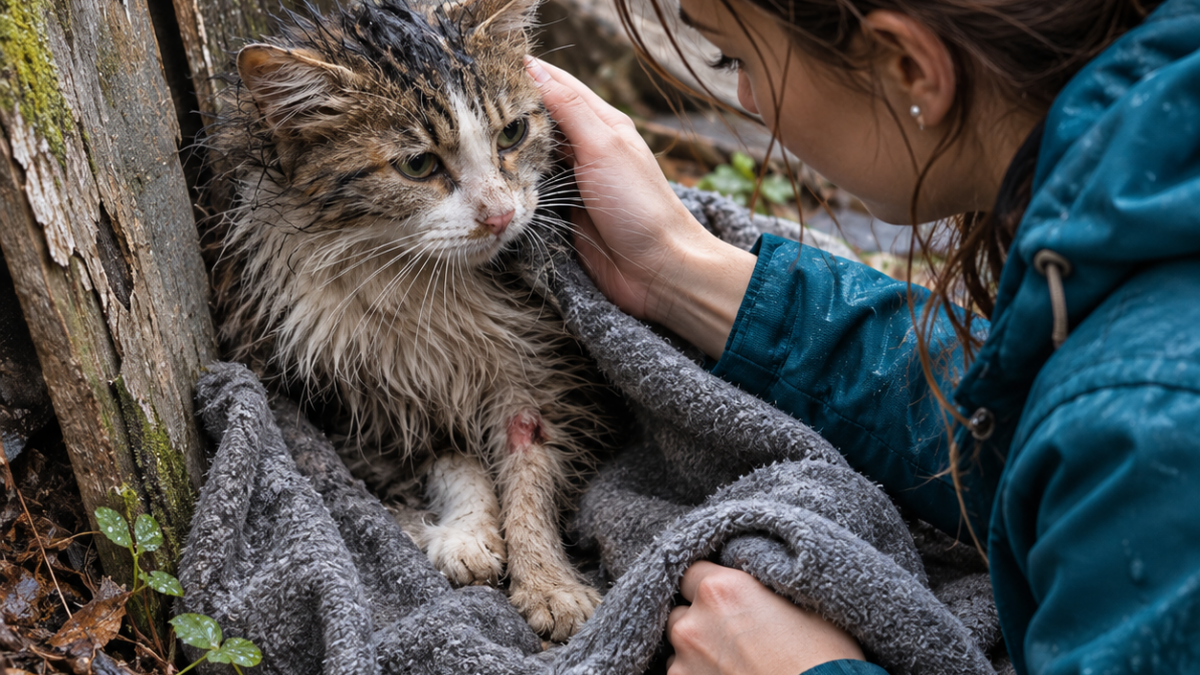
I was terrified that even the smallest movement would frighten her.
Her paw weighed almost nothing against my finger.
Yet somehow, that tiny touch felt heavier than anything I had carried in years.
“Okay,” I whispered. “I understand.”
I slid my other hand beneath my jacket.
She tensed immediately.
“Easy.”
I moved slowly enough that she could watch everything I was doing.
Then I wrapped the jacket around her.
She didn’t fight me.
That frightened me almost more than if she had.
Healthy frightened cats usually resisted.
They scratched.
They twisted.
They ran.
This kitten simply collapsed against my chest.
I could feel her trembling through my sweater.
“You’re coming with me.”
I carried her home through the rain.
Every few steps, I looked down to make sure she was still breathing.
By the time I reached my apartment, my clothes were drenched and my arms were aching from holding her so carefully.
I placed her in a laundry basket lined with towels and turned on the small heater in my bathroom.
Then I called the nearest emergency veterinary clinic.
The receptionist asked me several questions.
Was she conscious?
Yes.
Breathing normally?
I thought so.
Any active bleeding?
No.
Could she stand?
“Barely.”
There was a pause.
“Bring her in.”
Twenty minutes later, I was sitting in an exam room while a veterinarian named Dr. Hannah Reed examined the kitten.
Hannah had the calm, efficient manner of someone who had seen every possible version of heartbreak and had learned how to function through it.
She checked the kitten’s temperature.
Her gums.
Her eyes.
Her paw.
Then she carefully parted the fur around her neck.
Hannah’s expression changed.
“What?” I asked.
She didn’t answer immediately.
She traced the mark gently without actually touching the rawest skin.
“This isn’t from a normal collar rubbing.”
My stomach tightened.
“What is it?”
“It’s a pressure injury.”
I stared at her.
“Meaning?”
Hannah looked at me.
“Something was around her neck for a significant amount of time. Too tight.”
I felt sick.
“Like a rope?”
“Possibly. A cord. A very narrow collar. Something similar.”
She examined the injured paw next.
“This wound isn’t fresh either.”
“Can you fix it?”
“We can treat it. I don’t think she’ll lose the leg.”
I didn’t realize how badly I had feared that possibility until she said it.
I exhaled.
“But she’s severely underweight,” Hannah continued. “Dehydrated. She has fleas. There are signs she’s been outside for a while.”
“How long?”
“Hard to know.”
I looked down at the kitten.
She was watching me.
Not Hannah.
Me.
Whenever Hannah moved an instrument close, the kitten followed my face with her eyes.
I put my hand beside her.
Immediately, she touched one paw to my knuckle.
Hannah stopped.
For the first time that night, the veterinarian smiled.
“Well,” she said quietly, “apparently you’ve been selected.”
I laughed once through my tears.
“I don’t think she had many options.”
“Cats usually believe they have options.”
That made me laugh again.
Hannah scanned her for a microchip.
The machine beeped.
We both looked at each other.
“She has one,” Hannah said.
My heart jumped.
“So she has an owner?”
“Maybe.”
The word bothered me.
Maybe.
Hannah entered the number into the database.
We waited.
A few moments later, information appeared.
The chip had been registered by a local rescue organization called Haven Street Animal Aid.
I knew the name.
Almost everyone in town did.
Haven Street had a large social-media presence. Their posts appeared constantly in local groups: sick kittens, abandoned puppies, dramatic rescues, donation drives.
The woman who ran it was named Vanessa Crane.
I had never met her.
But I had seen her face online.
She was always holding an injured animal while looking sadly into a camera.
People loved her.
“I know that rescue,” I said.
“So do I.”
Something in Hannah’s voice made me look up.
“You don’t sound impressed.”
She hesitated.
“I’m trying not to make assumptions.”
“That’s not an answer.”
“No,” she admitted. “It’s not.”
She turned the monitor slightly away.
“I’ve treated animals connected to them before.”
“And?”
“Marina, right now we know one thing. This kitten needs treatment. We don’t know how she got where you found her.”
I understood what she was saying.
Don’t jump to conclusions.
So I tried not to.
Hannah called the number associated with the microchip.
No answer.
She left a message explaining that an animal registered through the rescue had been found and asking them to contact the clinic.
Then we focused on the kitten.
Hannah estimated she was between seven and nine months old.
Too young to have already experienced whatever had made her so afraid.
They cleaned the wound on her paw.
Treated her parasites.
Gave her fluids.
Ran bloodwork.
At one point, a technician needed to lift her away from me.
The kitten panicked.
Not aggressively.
She simply threw herself toward my chest and made a sound that I can still hear if I think about it too long.
It wasn’t quite a meow.
It was a plea.
I held her against me.
“I’m here.”
The technician looked away.
Hannah cleared her throat.
“We’ll work around you.”
So they did.
When the examination was finished, Hannah asked whether I could keep the kitten temporarily.
“Yes.”
I answered before she finished the question.
She smiled.
“I thought you might say that.”
I paid the bill, bought the medication they prescribed, and took the kitten home.
On the drive back, she stayed wrapped in my jacket inside a carrier.
At every red light, I looked at her.
At the third light, she began to purr.
So quietly I almost missed it.
That night, I slept on the bathroom floor beside her.
I named her Hope.
Not because I wanted something poetic.
Because at three in the morning, when I woke and found her curled against my hand, that was exactly what she felt like.
Hope.
The Call
The next morning, my phone rang at 7:12.
I was asleep on the bathroom floor.
Hope was tucked beside my ribs beneath a towel.
I answered without checking the number.
“Hello?”
A woman’s voice responded immediately.
“Are you the person who found my cat?”
I sat up.
Hope stirred.
“Who is this?”
“Vanessa Crane. Haven Street Animal Aid.”
Suddenly I was fully awake.
“Yes. I found a kitten last night.”
“Gray and white?”
“Yes.”
“Injured front paw?”
I paused.
“Yes.”
Vanessa exhaled dramatically.
“Oh, thank God.”
Her relief sounded convincing.
Maybe too convincing.
“We have been looking everywhere for her.”
I looked at Hope.
She was watching me.
“What happened to her?”
“She’s a rescue.”
“I know.”
“She escaped from a foster.”
“When?”
There was a tiny pause.
“About a week ago.”
Something didn’t fit.
Dr. Reed had said Hope’s condition suggested she’d been struggling longer than a few days.
“Which foster?”
“I’m sorry?”
“Where did she escape from?”
Vanessa’s voice changed.
Only slightly.
But I noticed.
“Why does that matter?”
“Because I found her behind the abandoned building on Mercer Street.”
Silence.
Then Vanessa laughed lightly.
“Cats travel.”
“That building is almost three miles from the nearest residential area.”
“Well, scared animals do strange things.”
I looked down at Hope’s neck.
“What was around her neck?”
Another silence.
“I don’t understand.”
“She has a pressure wound.”
“Oh, that.”
My fingers tightened around the phone.
That.
Not What wound?
Not Is she okay?
That.
Vanessa continued quickly.
“She had a medical collar for a skin condition. She probably irritated herself scratching.”
I remembered Hannah’s face.
“That isn’t what the vet thinks.”
Vanessa’s tone cooled.
“Which vet?”
“Dr. Reed.”
This time, the silence lasted longer.
Then Vanessa said, “I need you to bring the cat back.”
Something inside me became very still.
“She isn’t medically stable enough to go anywhere.”
“She’s legally under my rescue.”
“Then you can coordinate with the clinic.”
“I’d prefer to pick her up directly.”
“No.”
The word came out before I planned it.
Vanessa stopped talking.
I could hear faint traffic on her end of the call.
“Excuse me?”
“I said no. Until the vet tells me she’s stable, she stays here.”
“You don’t have the authority to make that decision.”
“Then call Dr. Reed.”
“I am telling you—”
“And I’m telling you she’s terrified.”
Vanessa’s patience disappeared.
“Marina, you found an animal that belongs to my organization. I appreciate that you helped, but this isn’t your cat.”
Hope shifted beside me.
I lowered my voice.
“Then you should have no problem providing her medical records and foster information to the clinic.”
Vanessa hung up.
I stared at the phone.
Hope blinked at me.
“Yeah,” I said. “I didn’t like that either.”
Thirty minutes later, Hannah called.
“Vanessa contacted me.”
“I assumed she would.”
“She wants custody transferred immediately.”
“And?”
“I told her I need medical records first.”
My stomach tightened.
“What did she say?”
“She said they’re unavailable.”
“Why?”
“Computer problem.”
I nearly laughed.
“Of course.”
“Marina.”
Something in Hannah’s voice frightened me.
“What?”
“I want you to photograph Hope.”
“I already have.”
“Photograph everything. Her neck. Paw. Body condition. Take wide shots and close-ups. Don’t edit them. Don’t delete the originals.”
“Why?”
“Because if this becomes a dispute, dates matter.”
I sat quietly.
“Hannah, do you think Vanessa did this?”
“I don’t know.”
“But?”
“But I’ve learned not to ignore inconsistencies involving animals that can’t explain what happened to them.”
That sentence stayed with me.
Animals that can’t explain what happened.
Hope couldn’t tell us.
So we would have to listen to everything else.
The Photograph
Over the next three days, Hope improved.
Slowly.
At first, she ate only if I sat several feet away.
If I stood too quickly, she hid behind the toilet.
If something metallic clinked, she flattened herself against the floor.
The strangest reaction happened when I picked up my phone charger.
The thin white cord slipped from my desk.
Hope saw it.
She screamed.
Not hissed.
Not meowed.
Screamed.
Then she ran beneath the bed and refused to come out for nearly an hour.
I sat on the floor talking softly until I finally saw two frightened eyes reflecting back at me.
I didn’t touch another loose cord around her after that.
On the fourth day, I was sorting through the pictures I had taken at the abandoned building.
Most were useless.
Dark.
Rain on the lens.
My flashlight had created harsh white patches across the wet boards.
Then I reached the final photograph.
I zoomed in.
Hope was visible in the corner.
So was something else.
Behind her, partly hidden under a collapsed piece of cardboard, was a red strap.
I hadn’t noticed it that night.
I stared at the photograph.
Then I remembered the pressure mark around her neck.
I drove back to the building.
The rain had stopped.
I brought gloves.
The red strap was still there.
It wasn’t a normal pet collar.
It was a thin nylon tether.
One end had been cut.
The other end was attached to a small metal clip.
There were gray hairs caught in the buckle.
My stomach turned.
I didn’t touch it.
Instead, I called Hannah.
Then animal control.
An officer named Daniel Ruiz met me there forty minutes later.
He photographed the strap before collecting it.
“Could belong to anything,” he warned me.
“I know.”
“You said the kitten has an injury around her neck?”
“Yes.”
“Documented by a veterinarian?”
“Yes.”
He wrote something down.
“Any idea who left her?”
“Not yet.”
He looked toward the abandoned building.
“Security cameras?”
I laughed.
“Here?”
“Not on the building. Around it.”
I turned.
Across the street stood a small auto-repair shop.
There was a camera above the garage.
My heart started pounding.
The owner, Mr. Alvarez, was inside.
When we explained what had happened, he frowned.
“My camera points mostly at the front lot.”
“Does it catch the street?” Daniel asked.
“A little.”
“How long do you keep footage?”
“Thirty days.”
I almost stopped breathing.
We had found Hope four nights earlier.
Mr. Alvarez pulled up the recordings.
It took nearly an hour.
We didn’t know exactly when Hope had arrived.
We started with the previous week.
Nothing.
Then nine days before I found her, at 11:43 p.m., a white SUV pulled onto the shoulder near the abandoned building.
It stopped.
A person got out.
The camera was too far away to show a face clearly.
But the figure opened the rear passenger door.
Removed something.
Walked toward the abandoned lot.
Returned approximately three minutes later carrying nothing.
Then drove away.
Daniel leaned closer.
“Can we see the plate?”
Mr. Alvarez enlarged the image.
The resolution was terrible.
But several characters were visible.
And on the rear window was a large circular decal.
Even blurred, I recognized it.
A blue paw print.
The Haven Street Animal Aid logo.
My hands went cold.
“No,” I whispered.
Daniel looked at me.
“You recognize it?”
I nodded.
The man copied the footage immediately.
“Don’t post anything online,” he told me.
“I wasn’t planning to.”
“Good.”
I wanted to believe there was another explanation.
Maybe someone from Haven Street had been searching for Hope.
Maybe the person had stopped for some unrelated reason.
Maybe.
Then Daniel checked the partial plate.
The SUV was registered to Vanessa Crane.
Vanessa Comes to My Door
The following evening, someone knocked on my apartment door.
I looked through the peephole.
Vanessa.
I had only seen her in photographs, but there was no mistaking her.
She was in her late thirties, professionally dressed, with perfect hair and a raincoat that probably cost more than my monthly grocery budget.
A younger man stood behind her.
I didn’t open the door.
“Marina?” she called.
I remained silent.
“I know you’re home.”
Hope was under my sofa.
She had hidden the moment the knocking started.
Vanessa knocked again.
“We need to discuss the cat.”
I unlocked the inner latch but kept the security chain fastened.
I opened the door two inches.
“What are you doing here?”
Her smile appeared instantly.
Warm.
Public.
The same expression she used in photographs while holding rescued puppies.
“I think we’ve gotten off on the wrong foot.”
“You shouldn’t be at my home.”
“I tried calling.”
“I stopped answering after you demanded the kitten without providing records.”
She looked past me.
“Is she here?”
“Yes.”
“Good. We brought a carrier.”
The younger man lifted one.
Hope made a tiny noise from beneath the sofa.
Vanessa heard it.
Her expression changed for half a second.
Not affection.
Annoyance.
“I’d like my cat back.”
“She isn’t your cat.”
“She belongs to Haven Street.”
“Then show me the intake paperwork.”
“Marina, please don’t make this difficult.”
“Show me the paperwork.”
Her smile disappeared.
“You don’t understand how rescue organizations operate.”
“Then explain it.”
“We place animals in temporary fosters. Records move around. Volunteers make mistakes.”
“And sometimes cats end up tied behind abandoned buildings?”
The hallway went silent.
Vanessa stared at me.
The younger man looked at her.
I watched every trace of warmth drain from her face.
“What did you say?”
“I think you heard me.”
“You need to be very careful about making accusations.”
“I didn’t accuse you of anything.”
“Yes, you did.”
“No. I said where I found her.”
Vanessa stepped closer.
The chain stopped the door.
“You have no idea what you’re involving yourself in.”
That sentence sounded so different from everything she’d said before that even the man behind her looked uncomfortable.
I kept my voice calm.
“Then leave.”
“She is legally my property.”
“Call animal control.”
Vanessa’s jaw tightened.
“You think because you found one injured cat you understand animal rescue?”
“No.”
“Do you know how many animals I’ve saved?”
“No.”
“Hundreds.”
I looked toward the living room.
Hope hadn’t moved.
Then I looked back at Vanessa.
“How many did you lose?”
Her eyes sharpened.
“Excuse me?”
“How many animals disappeared from your fosters?”
Vanessa stepped back.
For the first time, she looked worried.
Not angry.
Worried.
“Who have you been talking to?”
That was all I needed to hear.
I closed the door.
She slammed her palm against it.
“Marina!”
I locked the deadbolt.
Her voice came through the wood.
“If you damage my reputation with some ridiculous story, I will sue you.”
I didn’t answer.
“Do you understand?”
Still nothing.
Then she said something quietly.
Something much worse.
“You don’t know what happens to animals people don’t want.”
My entire body went cold.
A few seconds later, I heard footsteps moving away.
I waited until I heard the elevator doors close.
Then I called Daniel.
The First Lie Falls Apart
The investigation moved slowly.
Painfully slowly.
That was the first thing I learned about wanting justice.
Real life doesn’t move like a movie.
Nobody storms through a door five minutes after discovering evidence.
People make reports.
Records are requested.
Statements are collected.
Lawyers become involved.
Dates matter.
Signatures matter.
Tiny inconsistencies matter.
And sometimes the person you are certain is responsible continues smiling publicly while everyone else waits.
Vanessa posted online the morning after she came to my apartment.
I almost dropped my phone when I saw it.
There was a photograph of Hope.
Not the Hope I had found.
A younger Hope.
Healthy.
Bright-eyed.
Sitting on a blue blanket.
The caption said:
MISSING RESCUE CAT.
Vanessa claimed Hope—whose rescue name had apparently been Daisy—had escaped from a volunteer foster home eleven days earlier.
The post said Haven Street had been “searching tirelessly.”
Eleven days.
The security footage showed Vanessa’s SUV outside the abandoned building nine days before I found Hope.
Two days after Vanessa claimed she had escaped.
Comments flooded the post.
People offered help.
People praised Vanessa.
One woman wrote, “You never give up on your babies.”
I felt physically sick.
Then I saw another comment.
It appeared briefly.
A woman named Rachel Myers wrote:
That’s not true. Daisy was never at my house. Stop using my name.
I took a screenshot.
Thirty seconds later, the comment disappeared.
Then Rachel’s entire profile vanished from the thread.
I searched for her.
Found her.
And sent one message.
Hi. My name is Marina. I think I found Daisy. Would you be willing to talk?
Rachel called me ten minutes later.
She was crying before I finished introducing myself.
“Oh my God,” she said. “She’s alive?”
“Yes.”
“She’s alive?”
“Yes.”
Rachel began sobbing.
I sat on my kitchen floor.
Hope was eating near the window.
“What happened?” I asked.
Rachel took several breaths.
“I fostered for Vanessa for eight months.”
“Did you foster Hope?”
“No.”
“Vanessa says you did.”
“I know. She sent me a message this morning telling me what to say if anyone asked.”
I closed my eyes.
“What did she tell you?”
“That Daisy escaped from my apartment.”
“Did she?”
“No.”
“Did Daisy ever live with you?”
“Not once.”
I felt anger rising so quickly that my hands started shaking.
“Why would Vanessa lie?”
Rachel became quiet.
“Because Daisy wasn’t the first.”
I stopped breathing.
“What do you mean?”
“There were animals that disappeared.”
“How many?”
“I don’t know.”
She sniffed.
“At first, Vanessa always had explanations. One got adopted privately. One transferred to another rescue. One became too sick and died at a clinic. But sometimes there weren’t records.”
“Did you ask?”
“Yes.”
“What happened?”
“She told me I was being dramatic.”
Rachel hesitated.
“Then I found something.”
“What?”
“A spreadsheet.”
My heart began pounding.
“Haven Street tracked donations, foster placements, medical expenses, all of it. I had access because I helped with bookkeeping.”
“And?”
“There were animals listed as receiving expensive veterinary treatment. Thousands of dollars.”
“That sounds normal for rescue.”
“It would be.”
Her voice hardened.
“If the clinics had actually treated them.”
I said nothing.
Rachel continued.
“I called one hospital because Vanessa listed a surgery for a dog I had fostered. I wanted post-op instructions.”
“And?”
“They had never seen the dog.”
I felt cold.
“What happened to him?”
“I don’t know.”
The silence between us became unbearable.
Finally, Rachel said, “When I confronted Vanessa, she removed my access and told everyone I was unstable.”
“Do you still have the spreadsheet?”
A pause.
“Yes.”
Hope Begins to Trust
While everything around Haven Street became uglier, Hope slowly changed.
The first time she played, I nearly cried.
It was a ridiculous little thing.
A paper ball.
I tossed it across the living-room floor without thinking.
Hope’s head turned.
Her eyes followed it.
For several seconds, she didn’t move.
Then her back end wiggled.
Once.
Twice.
She pounced.
She missed completely and slid into the leg of a chair.
I laughed.
Hope froze.
My heart sank.
Then she looked at me.
And ran after the ball again.
That was the beginning.
Every day, another tiny part of her returned.
She learned the sound of the refrigerator.
She discovered sunlight.
She learned that blankets could be slept on instead of hidden beneath.
She began waiting outside the bathroom while I showered.
She still hated cords.
Still panicked if someone knocked loudly.
Still crouched whenever a stranger raised a hand too quickly.
But she was healing.
One evening, Hannah came to check her.
Hope surprised us both by walking directly toward her.
Hannah sat on the floor.
“Look at you.”
Hope smelled her fingers.
Then she sat beside my leg.
Hannah smiled.
“She’s gaining weight.”
“How much?”
“Almost a pound since you found her.”
I grinned.
“Is that good?”
“For her? Very.”
Hannah examined her neck.
The raw line had begun to disappear beneath new fur.
Her paw was healing too.
Then Hannah’s expression softened.
“You’re keeping her, aren’t you?”
I looked at Hope.
“I don’t know if I’m legally allowed.”
“I didn’t ask legally.”
Hope looked up at me.
“Yes,” I said.
Hannah laughed.
“Thought so.”
Then her face became serious.
“Animal control requested records from Haven Street.”
“And?”
“Vanessa provided some.”
“Some?”
“Daisy’s file says she was transferred between three fosters in six weeks.”
“Rachel says she never had her.”
“I know.”
“There are other names?”
“One foster moved out of state.”
“And the third?”
Hannah looked at me.
“Doesn’t exist.”
“What?”
“The address is vacant.”
I stared at her.
“An abandoned place?”
“No. An empty apartment.”
My chest tightened.
“So Vanessa invented a foster.”
“That’s what investigators are trying to determine.”
Hope climbed onto my lap.
I stroked the side of her face.
“What happens now?”
Hannah sighed.
“We keep documenting.”
I hated that answer.
But she was right.
So that was what we did.
The Box Behind the Shed
Three days later, Daniel called me.
“We found something near where you located the kitten.”
“What?”
“Can you come identify the exact spot again?”
I drove over after work.
The abandoned building looked different in daylight.
Smaller.
Less mysterious.
Somehow uglier.
Daniel and another animal-control officer were waiting.
Mr. Alvarez stood across the street watching.
I showed them where Hope had been.
Daniel pointed behind the collapsed shed.
“There’s a drainage ditch.”
I hadn’t noticed it that night.
It was hidden by weeds.
Inside were pieces of trash.
Plastic bags.
A broken carrier door.
And a weather-damaged cardboard box.
Daniel had already opened it.
Inside were veterinary labels.
Medication bottles.
Several microchip registration envelopes.
A stack of Haven Street intake forms.
My skin prickled.
“Why would these be here?”
“We’re trying to answer that.”
One of the forms had a photograph attached.
A black kitten.
Another showed a small brown dog.
Another, an orange cat.
I couldn’t stop looking at them.
“Were these animals dumped too?”
“We don’t know.”
Daniel’s voice was firm.
“Don’t assume the worst.”
But his face told me he was thinking the same thing.
Then I noticed a familiar name.
Daisy.
Hope.
Her form was near the bottom.
Intake date: six months earlier.
Condition: healthy.
Vaccinated.
No major medical issues.
There was a note written later.
Behavioral concerns. Difficult placement.
I laughed bitterly.
“Behavioral concerns?”
Daniel looked at me.
“The cat I found was terrified because somebody had hurt her.”
“I know.”
“She isn’t aggressive.”
“I know.”
Hope’s file had another handwritten note.
Three words.
Remove from roster.
No adoption date.
No transfer information.
No clinic.
Nothing.
Just remove from roster.
Daniel took the form from me.
His expression had changed.
He no longer looked like someone investigating a suspicious animal-abandonment complaint.
He looked like someone beginning to understand a pattern.
The Woman Who Almost Took Hope Home
The biggest break came from someone none of us expected.
Her name was Emily Park.
She contacted me after seeing Vanessa’s missing-cat post.
Her message was only one sentence.
I almost adopted that kitten.
I called her immediately.
Emily explained that she had visited Haven Street two months earlier.
Technically, Haven Street didn’t have a public shelter. Vanessa worked through fosters and kept several animals at a converted property behind her home.
Emily had applied to adopt a gray-and-white kitten named Daisy.
“Was she healthy?” I asked.
“Yes.”
“Friendly?”
Emily laughed softly.
“Very. She climbed onto my purse.”
My throat tightened.
That sounded like the cat Hope might have been before fear changed her.
“Why didn’t you adopt her?”
“I tried.”
“What happened?”
“Vanessa told me someone else had been approved before me.”
“Did that person adopt her?”
“I assumed so.”
Emily paused.
“Until Vanessa messaged me a week later asking for money for Daisy’s emergency surgery.”
My stomach dropped.
“What surgery?”
“She said Daisy had fallen from a balcony at her new foster placement and broken her leg.”
Hope’s injured paw.
My heart started pounding.
“How much did she ask for?”
“Three thousand dollars.”
“Did you donate?”
“Five hundred.”
“Do you have the message?”
“Yes.”
“Did she send veterinary records?”
“No. She posted a photograph.”
“Of Hope?”
“No.”
That surprised me.
“What do you mean?”
“The picture showed only a cat’s leg in a bandage. You couldn’t see the face.”
Emily sent me screenshots.
The fundraising post had collected nearly $8,000.
The caption described Daisy as “fighting for her life after a tragic fall.”
Yet Hope’s official intake paperwork contained no surgery record.
And Hannah had examined her injury.
It wasn’t a surgically repaired fracture.
It was an untreated wound.
I forwarded everything to Daniel.
The investigation expanded beyond animal control.
A fraud investigator became involved.
Then local police.
Vanessa’s perfect rescue story was beginning to crack.
The Threat
Two nights later, my car window was smashed.
Nothing was stolen.
My wallet wasn’t inside.
There were no valuables.
The glove box hadn’t been touched.
Only one thing had been left on the driver’s seat.
A red nylon strap.
I stood beside the car staring at it.
Then I called police.
This time, I didn’t need to explain why it frightened me.
Daniel arrived with another officer.
“Do not touch it,” he said.
“I haven’t.”
He photographed everything.
“Did anyone threaten you?”
“Vanessa came to my apartment.”
“Anyone else?”
“No.”
“Messages?”
“Not directly.”
He looked at the strap.
“This is intimidation.”
“You think she did it?”
“I think someone wants you to believe they’re watching you.”
I wrapped my arms around myself.
For the first time since finding Hope, I considered stopping.
Not because I doubted what we were doing.
Because I lived alone.
Because Hope depended on me.
Because courage sounds beautiful until somebody leaves a threat inside your broken car.
That night, I stayed at Hannah’s house.
Hope slept beside me in the guest room.
At 2:00 a.m., I was still awake.
I whispered into the darkness, “Maybe I should let someone else handle this.”
Hope lifted her head.
She walked across the blanket.
Then she pressed her face beneath my chin.
I started crying.
“This isn’t some movie,” I told her. “I can’t fight everybody.”
She purred.
I laughed through my tears.
“You’re not helping.”
Hope placed her paw over my wrist.
The same way she had touched my finger in the rain.
And suddenly I remembered exactly why I couldn’t walk away.
Someone had counted on her being helpless.
Someone had counted on her having no voice.
Someone had counted on nobody caring enough to ask questions.
I didn’t need to become reckless.
I didn’t need to become a hero.
I simply needed to keep telling the truth.
The Former Volunteer
Rachel eventually agreed to meet investigators.
She brought everything.
Screenshots.
Bank records she had access to.
Copies of old spreadsheets.
Messages.
Names of former volunteers.
One message became especially important.
It was from Vanessa.
Rachel had asked about an older cat that had vanished from the rescue roster.
Vanessa replied:
Stop wasting resources on animals nobody is going to adopt.
Rachel had responded:
What does that mean? Where is he?
Vanessa:
Handled. Move on.
That word chilled me.
Handled.
Investigators began contacting former Haven Street volunteers.
Once one person spoke, others followed.
A man named Chris said Vanessa occasionally ordered him to transport animals late at night.
“Where?”
“Different places.”
“What places?”
“Industrial areas. Empty lots.”
“Why?”
“She said they were being transferred.”
“Did anyone meet you?”
Chris looked down.
“No.”
“What did you do with the animals?”
His voice cracked.
“She told me to leave carriers.”
My stomach turned.
“Did you?”
“Twice.”
He started crying.
“I thought somebody was coming. She told me another volunteer would collect them.”
“Did they?”
“I don’t know.”
Daniel asked, “Why didn’t you check?”
Chris wiped his face.
“Because I wanted to believe her.”
That answer made me angrier than anything.
Not because Chris was innocent.
He wasn’t.
He had abandoned animals because someone told him to.
But I understood the mechanism now.
Vanessa rarely did everything herself.
She created stories.
Transfers.
Medical emergencies.
Lost animals.
Private adoptions.
Then she surrounded herself with people who wanted desperately to believe they were helping.
And she used that belief.
The House
The warrant was executed on a Tuesday morning.
I wasn’t there.
I learned what happened afterward.
Police and animal-control officers searched Vanessa’s property and a detached building behind her house.
They found eleven animals.
Seven cats.
Four dogs.
Some were healthy.
Others were not.
One dog had an untreated skin infection.
Two cats were severely underweight.
Several animals were housed in cages far smaller than appropriate.
There were stacks of donated food.
Unopened.
Boxes of medication.
Expired.
And shelves filled with supplies people had donated after watching Haven Street’s emotional online campaigns.
Investigators also seized computers and financial records.
Vanessa was not arrested that morning.
That frustrated everyone.
But Daniel explained it to me.
“We’re building something that doesn’t fall apart.”
So we waited.
Then the financial records began talking.
Haven Street had raised money repeatedly for treatments that could not be verified.
Some animals supposedly receiving surgery had never entered the hospitals named in fundraising posts.
Several photographs were reused.
One injured dog appeared under three different names in three separate campaigns.
Thousands of donated dollars had been transferred into Vanessa’s personal accounts.
There were payments for luxury clothing.
A vacation.
Car payments.
Restaurant bills.
And Hope—Daisy—had been used in at least two fundraising campaigns.
One for surgery she never received.
Another for medication she never needed.
When the donations slowed, she disappeared from the rescue roster.
And nine days before I found her, Vanessa’s SUV appeared at the abandoned building.
Vanessa’s Explanation
Vanessa was eventually interviewed.
Her lawyer was present.
She denied abandoning Hope.
She said several volunteers used her vehicle.
Investigators asked which volunteer had it that night.
She couldn’t remember.
She denied knowing about the red tether.
She denied instructing anyone to abandon animals.
She said Chris misunderstood her.
She claimed Rachel had stolen confidential financial records because she was “obsessed” with destroying Haven Street.
Then investigators showed Vanessa the fundraising campaign for Hope’s supposed surgery.
Vanessa said a volunteer wrote it.
They showed her that the donation account belonged to her.
She said that was standard.
They showed her messages she had personally sent to Emily asking for money.
Vanessa said she was confused.
Then they showed her the veterinary records.
No surgery.
No emergency clinic.
No fractured leg.
Vanessa stopped answering questions.
Her lawyer ended the interview.
For a few weeks, she continued posting online.
At first, she claimed Haven Street was being targeted by “malicious former volunteers.”
Then she posted a long statement saying successful women are often punished for being “strong.”
Then she said animal control had misunderstood routine rescue conditions.
Then she asked for donations for legal expenses.
That final fundraiser lasted six hours before the payment platform suspended it.
Hope Sees Vanessa Again
I had hoped Hope would never see Vanessa again.
I was wrong.
Several months after I found her, there was a preliminary court hearing connected to the animal-neglect charges.
Hope obviously wasn’t going to court.
But that morning, I had taken her to Hannah’s clinic for a routine checkup.
When I arrived, Vanessa was in the lobby.
I stopped so suddenly the carrier bumped my leg.
Vanessa turned.
Her face changed when she saw me.
Then she saw the carrier.
Hope was visible through the mesh.
For one second, nobody moved.
Vanessa smiled.
“Daisy.”
Hope’s body went rigid.
I felt it through the handle.
Vanessa took one step toward us.
Hope screamed.
The entire waiting room turned.
She threw herself against the back of the carrier, claws gripping the towel beneath her.
I immediately lifted the carrier against my chest.
“Don’t come closer.”
Vanessa stopped.
Her lawyer, who was apparently with her for some unrelated document exchange, touched her arm.
“Vanessa.”
But she kept looking at Hope.
“She’s always been dramatic.”
Something inside me snapped.
Not loudly.
Not violently.
But completely.
I looked Vanessa directly in the eyes.
“No.”
The room went silent.
“She isn’t dramatic.”
Vanessa rolled her eyes.
“She remembers you.”
That wiped the expression from her face.
I continued.
“She remembers your voice.”
“That’s ridiculous.”
“Maybe.”
I held the carrier tighter.
“But when I found her, she was so weak she could barely lift her head. She had a wound around her neck. She had an injured paw. She was hiding in freezing rain behind a building your car visited nine days earlier.”
“Marina,” her lawyer warned.
I ignored him.
“You know the difference between you and her?”
Vanessa stared at me.
“She survived what you expected nobody to discover.”
Vanessa laughed once.
“Prove it.”
I smiled.
Not because anything was funny.
Because for the first time, I understood that she still believed this was just my word against hers.
“You should probably ask your lawyer what discovery means.”
Her face changed.
I walked away.
That moment wasn’t justice.
But it was the first time I saw fear in Vanessa’s eyes.
And I won’t pretend I felt guilty for it.
The Missing Animals
Investigators were able to account for several animals that had disappeared from Haven Street’s records.
Some had actually been adopted.
Some had been transferred legitimately.
Three were found alive with people who had assumed the paperwork had simply been lost.
But not every story ended well.
Two animals were never found.
Another had been picked up months earlier by a municipal shelter in a neighboring county after being discovered beside a highway.
He had eventually been adopted.
When Rachel heard that, she cried for nearly an hour.
“There was a happy ending,” I told her.
“No,” she said. “There was a lucky ending.”
She was right.
Hope’s story was lucky too.
If I had been wearing headphones that night, I wouldn’t have heard her.
If the rain had been harder, maybe her voice wouldn’t have carried.
If I had decided I was too tired…
I stopped letting myself finish that thought.
The Trial
Nearly a year after I found Hope, Vanessa accepted a plea agreement on several charges while continuing to deny others.
I had mixed feelings.
Part of me wanted a trial.
I wanted every photograph projected onto a courtroom wall.
I wanted her to sit there while people described the animals that had vanished.
I wanted her lies dismantled one by one.
But prosecutors explained the agreement.
She would plead guilty to animal-cruelty-related charges and financial fraud counts supported by the strongest evidence.
She would be prohibited from operating an animal rescue or possessing more than a limited number of animals during probation.
Restitution would be ordered.
The remaining animals had already been transferred to legitimate rescues.
Her organization would dissolve.
Her fundraising accounts were frozen.
And the plea would become part of the public record.
She could no longer hide behind inspirational posts.
I attended the sentencing.
So did Rachel.
Emily came too.
Hannah sat beside me.
Vanessa entered wearing a dark suit.
She didn’t look at us.
Her attorney spoke first.
He described her as an overwhelmed rescue operator who had made “serious errors in judgment.”
Rachel’s hand tightened around mine.
Errors in judgment.
I thought about Hope pressed against wet boards.
I thought about the mark around her neck.
I thought about a red tether in the mud.
The prosecutor stood.
She didn’t yell.
She didn’t need to.
She described the pattern.
Money solicited under false claims.
Animals missing from official records.
Fabricated foster placements.
Abandonment.
Neglect.
She spoke about the people who donated believing they were paying for surgeries.
Then she spoke about Hope.
“Daisy, now known as Hope, was found severely underweight in an abandoned area after the defendant’s registered vehicle was recorded at that location.”
Vanessa finally looked at me.
I held her gaze.
The prosecutor continued.
“The animal survived because a passerby heard her crying.”
My vision blurred.
Hannah touched my arm.
The judge eventually asked whether Vanessa wished to speak.
She stood.
For the first time, she sounded smaller than she had on the phone.
“I dedicated years of my life to saving animals.”
Nobody moved.
“I made mistakes because I had too many cases and not enough help.”
Rachel whispered, “Unbelievable.”
Vanessa continued.
“People are judging everything I did based on a few unfortunate situations.”
The judge interrupted.
“A few?”
Vanessa stopped.
The judge looked down at the file.
“I’ve reviewed the photographs.”
Silence.
“I’ve reviewed the financial records.”
Vanessa stared forward.
“I’ve reviewed communications in which concerns about missing animals were dismissed.”
Her attorney shifted.
The judge’s voice remained calm.
“You repeatedly used the language of compassion to solicit public trust while your conduct contradicted that image.”
Vanessa’s face tightened.
The sentence included restitution, probation, community-service obligations unrelated to animal care, restrictions on animal ownership and rescue activity, and penalties related to the fraud.
Some people later told me it wasn’t enough.
Maybe it wasn’t.
No sentence could return every animal’s lost time.
No punishment could erase fear from Hope’s memory.
But something important happened when the court record became public.
People finally knew.
The woman who had built her reputation on rescuing voiceless animals could no longer control the story.
The animals had evidence now.
The Last Attempt
I thought sentencing would end it.
Vanessa tried one final time to hurt us.
Two weeks later, a social-media account appeared accusing me of stealing Hope and manufacturing allegations against Haven Street.
The account used photographs taken from my public profile.
It claimed I had “targeted a respected rescuer for attention.”
People sent me screenshots.
My first instinct was fury.
I wanted to answer every accusation.
Hannah stopped me.
“Don’t.”
“But people are believing it.”
“Some people believe anything.”
“She is lying.”
“And you have court records.”
That sentence changed everything.
I didn’t post an emotional response.
I posted one statement.
Nothing more.
I wrote that anyone concerned about the case could review the publicly available court documents and official animal-control findings.
Then I linked nothing personal.
Added no insults.
Made no accusations beyond what had already been established.
The fake account disappeared three days later.
Vanessa had spent years surviving by controlling emotion.
She knew exactly how to make people angry, sad, guilty or frightened enough to stop asking questions.
The best revenge turned out to be refusing to play that game.
Facts were much quieter.
And much harder to intimidate.
Hope’s First Snow
Winter arrived.
Hope had never seen snow from inside a warm home.
At least, I assumed she hadn’t.
The first time flakes appeared outside my apartment window, she sat on the sill for almost an hour.
She kept tapping the glass.
I filmed her trying to catch them.
She had gained enough weight that nobody would have recognized the kitten from the abandoned building.
Her coat was thick and soft now.
The scar around her neck was almost invisible.
Her paw had healed with only a slight stiffness that appeared when the weather was cold.
She still hated electrical cords.
I bought covers for every cable in the apartment.
She still hid when strangers entered.
But she recovered faster.
And every night, without exception, she slept touching me.
Sometimes beside my feet.
Sometimes against my shoulder.
Sometimes directly on my chest, making breathing unnecessarily difficult.
I never moved her.
One snowy evening, Rachel visited.
She hadn’t seen Hope in several months.
When Hope first saw her, she hid.
Rachel sat on the floor.
“That’s okay,” she said softly. “You don’t owe me anything.”
Ten minutes passed.
Hope emerged.
She walked cautiously toward Rachel.
Then smelled her hand.
Rachel’s eyes filled with tears.
“I should’ve asked more questions.”
I sat beside her.
“You did ask.”
“Not enough.”
“You were lied to.”
“I still helped her.”
Rachel looked at Hope.
“I kept telling myself rescue was messy. Records got lost. People became overwhelmed. I wanted to believe the explanation that hurt the least.”
Hope stepped closer.
Rachel didn’t move.
Then Hope put one paw on her knee.
Rachel covered her mouth.
“Oh.”
Hope climbed into her lap.
Rachel broke down.
Not dramatic sobbing.
Quiet tears.
She stroked Hope’s back with shaking fingers.
“I’m sorry.”
Hope purred.
That was all.
No judgment.
No memory we could understand.
Just a frightened animal who had somehow learned that not every human hand meant pain.
One Year Later
On the anniversary of the night I found Hope, I went back to the abandoned building.
I almost didn’t.
Part of me felt it was morbid.
Another part needed to see the place again.
The building had been fenced off for demolition.
The old shed was gone.
The pile of boards had been removed.
Grass had begun growing around the drainage ditch.
I stood where I thought I had first heard her cry.
For several minutes, I listened.
Nothing.
Just traffic in the distance.
I remembered the cold.
The rain.
The pathetic glow of my dying phone flashlight.
And those eyes watching me from the darkness.
I had believed I was rescuing a kitten.
I understand now that rescue is rarely one moment.
It wasn’t lifting her out of the rain.
It was taking her to the veterinarian.
Giving medicine when she fought me.
Sitting quietly when she hid.
Documenting wounds.
Answering questions.
Refusing intimidation.
Waiting through an investigation that felt impossibly slow.
Learning that justice and healing both happen in inches.
Before leaving, I placed nothing there.
No flowers.
No sign.
No memorial.
That place didn’t deserve to own any part of Hope’s story.
So I went home.
The moment I opened my apartment door, Hope came running.
Not walking.
Running.
Her tail stood straight in the air.
She yelled at me with the loud, demanding voice she had apparently been saving during all those months when she barely made a sound.
“Yes, yes,” I laughed. “I know. I abandoned you for forty minutes.”
She followed me into the kitchen.
I opened her dinner.
She screamed again.
“Absolutely tragic.”
She ate half the bowl, then left it to follow me into the living room.
That was normal.
Hope hated being separated from me more than she loved finishing dinner.
I sat on the couch.
She jumped beside me.
Then she did something she hadn’t done in months.
She placed one paw over my finger.
Exactly the way she had that first night.
I stopped breathing.
Maybe it was coincidence.
Probably.
But suddenly I was back in the rain.
Back beside the abandoned shed.
Back with a tiny creature who believed the world had finished with her.
I whispered, “Do you remember?”
Hope blinked.
Then she pressed her forehead against my hand.
My eyes filled with tears.
“I remember.”
What Happened After Haven Street
Haven Street Animal Aid never reopened.
Its social-media pages eventually disappeared.
The remaining donated supplies were transferred through legal channels to other rescues.
Several volunteers joined legitimate organizations after undergoing additional training.
Rachel became one of them.
She refused to handle money.
Instead, she specialized in foster coordination and insisted that every animal movement be documented.
“Annoyingly documented,” she liked to say.
Emily adopted a senior cat from the municipal shelter.
She named him Walter.
He hated everyone except her.
She considered that perfect.
Hannah continued being Hannah.
Calm.
Practical.
Impossible to impress.
She pretended Hope was just another patient even though she kept Hope’s first recovery photograph pinned inside her office cabinet.
I discovered it accidentally.
“You sentimental fraud,” I told her.
She shut the cabinet.
“Patient confidentiality.”
“That isn’t what that means.”
“Leave my clinic.”
Hope received a tiny bandana after every checkup.
She hated all of them.
I kept every one.
As for me, I didn’t start a rescue.
People assumed I would.
I didn’t want to.
But I began volunteering twice a month with animal control’s foster-support program.
Mostly paperwork.
Transport.
Supply deliveries.
Boring things.
Important things.
I had learned that the boring parts often save lives.
Accurate records save lives.
Follow-up calls save lives.
Checking addresses saves lives.
Asking why a medical invoice doesn’t exist saves lives.
Compassion matters.
But compassion without accountability can be exploited by people who know exactly what kindness looks like from the outside.
The Girl in the Yellow Coat
Almost two years after I found Hope, something happened that finally gave the story the ending I didn’t know it needed.
I was volunteering at a legitimate adoption event.
Hope was at home.
I was helping organize paperwork when a little girl in a yellow coat walked through the room holding her father’s hand.
She couldn’t have been older than eight.
She stopped in front of a cage containing a terrified black kitten.
The kitten was pressed into the back corner.
People had passed him all morning.
He wasn’t playful.
He didn’t reach through the bars.
He wasn’t “showing well,” as people sometimes say.
The little girl crouched.
Her father said, “Sweetheart, there are friendlier ones.”
She shook her head.
Then she sat on the floor.
She didn’t reach into the cage.
She simply waited.
I felt something tighten in my chest.
Five minutes passed.
Then ten.
The kitten moved forward.
One inch.
The girl’s father looked at me.
“Is she allowed to sit there?”
I smiled.
“As long as she’d like.”
Eventually, the kitten reached the front of the cage.
The girl extended one finger through the bars.
He smelled it.
Then rested his forehead against her fingertip.
I had to turn away.
Suddenly I was standing in cold rain again.
Palm open.
Waiting.
The father asked me, “Are you okay?”
I laughed and wiped my eyes.
“Yes.”
He looked confused.
I looked at the little girl.
“Actually, I’m great.”
They adopted that kitten.
Before leaving, the girl asked me whether frightened animals ever stopped being scared.
I thought about Hope.
I thought about the first night.
The cords.
The hiding.
The screaming.
Then I thought about her now, sprawled across my bed every morning as though she paid the rent.
“Sometimes they remember,” I told her.
The girl’s face fell slightly.
I smiled.
“But they learn something new too.”
“What?”
“That the bad thing wasn’t the whole world.”
She looked at her new kitten.
Then hugged the carrier carefully.
The Real Revenge
For a long time, people asked whether I felt satisfied by what happened to Vanessa.
I never knew how to answer.
Did I enjoy watching her lies collapse?
Yes.
Did I feel relief when she lost the ability to operate a rescue?
Absolutely.
Did part of me feel something sharp and almost triumphant when the woman who had threatened me finally stood in a courtroom unable to delete comments, block witnesses or rewrite records?
Yes.
I’m not going to pretend otherwise.
But that wasn’t the part that stayed with me.
The real revenge was Hope getting fat.
The real revenge was Hope stealing chicken from my plate.
The real revenge was replacing the memory of a tight tether with a soft bed.
It was watching a cat who once flattened herself whenever someone raised a hand eventually climb into visitors’ laps and demand attention.
It was seeing people who had trusted the wrong person become wiser without becoming cruel.
Vanessa had treated unwanted animals as disposable.
So the greatest answer to everything she had done was simple.
They weren’t disposable.
They mattered.
Their records mattered.
Their pain mattered.
Their lives mattered.
And Hope was alive to prove it.
Five Years Later
Hope is beside me while I write this.
She’s older now.
Rounder.
Extremely opinionated.
Her favorite place is the back of my couch, where she can watch both the window and the kitchen.
The scar around her neck disappeared beneath her fur years ago.
If you didn’t know where to look, you would never find it.
Her paw bothers her occasionally.
On cold mornings, she walks with a slight limp for the first few minutes after waking.
Then she remembers breakfast exists and miraculously recovers.
She still sleeps touching me.
That never changed.
Sometimes I wake in the middle of the night and find her paw resting across my wrist.
Every time it happens, I think of the rain.
I think of that abandoned building.
I think of how close I came to walking past.
People sometimes describe rescue stories as if one person saves another living thing.
I don’t think that’s quite right.
Hope didn’t become some magical creature who fixed every problem in my life.
I still have bad days.
I still get angry.
I still make mistakes.
But she changed the way I understand helplessness.
Before her, I believed helpless meant weak.
Now I know better.
Hope was helpless when I found her.
But she had survived hunger.
Cold.
Pain.
Abandonment.
Fear.
She had survived someone treating her life like it didn’t matter.
And after all of that, when one human hand reached toward her without hurting her, she still found enough courage to move forward.
One inch.
Then another.
Then one tiny paw over my finger.
That wasn’t weakness.
That may have been the bravest thing I’ve ever witnessed.
A few minutes ago, Hope woke from a nap and climbed onto my desk.
She walked directly across my keyboard because personal boundaries remain a concept she firmly rejects.
Then she sat in front of the screen.
I pushed her gently aside.
She returned.
I moved her again.
She slapped my pen onto the floor.
“Really?”
She stared at me.
I laughed.
Then she climbed into my lap.
Her purr filled the quiet room.
Outside, rain had begun tapping against the windows.
For a second, I felt the old ache in my chest.
Hope looked toward the sound.
Years ago, rain meant cold boards.
Hunger.
Darkness.
Waiting for somebody who might never come.
Tonight, she stretched across my lap.
Warm.
Safe.
Home.
I ran my fingers gently through the fur around her neck.
She closed her eyes.
There was a time when she couldn’t stand to be touched there.
Now she leaned into my hand.
“You won,” I whispered.
Hope opened one eye.
Of course, she didn’t understand.
Maybe I hadn’t said it correctly.
So I tried again.
“They didn’t get to decide how your story ended.”
Her purring grew louder.
And that, more than the investigation, the courtroom, the sentence, the ruined reputation or the money Vanessa was ordered to repay, was the ending I had wanted.
Someone had left Hope behind believing she would disappear quietly.
She didn’t.
Someone had believed her suffering would never be discovered.
It was.
Someone had believed no one would care enough to look closer.
We did.
And someone had treated her as though her life was worth less than the money they could collect using her photograph.
They were wrong.
Hope survived.
She healed.
She learned to trust again.
And every single day she spent warm, loved and completely certain that she belonged somewhere became a quiet answer to the person who had once thrown her away.
That night in the rain, I thought I was carrying a dying kitten home.
I didn’t know I was carrying the one witness Vanessa had never expected to survive.
But Hope never needed to speak.
Her wounds told us where to look.
The records told us what had happened.
The people who finally found the courage to speak told the rest.
And when all the lies were stripped away, the truth was simpler than any dramatic rescue story Vanessa had ever posted online.
A frightened kitten had been abandoned.
One person stopped.
Then another person believed her.
Then another asked a question.
Then another refused to stay silent.
That was enough to bring an entire lie down.
Hope shifted in my lap and placed her paw over my hand.
I smiled.
Five years later, she still does that.
And every single time, I remember the frightened little kitten beneath the broken boards.
I remember the rain running down my face.
I remember extending my hand and telling her she didn’t have to trust me.
She did anyway.
Maybe that’s why her story still makes me cry.
Not because of what someone did to her.
But because, after everything humans had taught her about cruelty, she somehow found the courage to give one of us another chance.
And this time, I made sure we deserved it.
THE END








