PART 2: I Found a Starving Kitten Hiding Behind an Abandoned Building—Then She Did One Thing That Made Me Realize Someone Had Broken Her Trust Long Before I Arrived
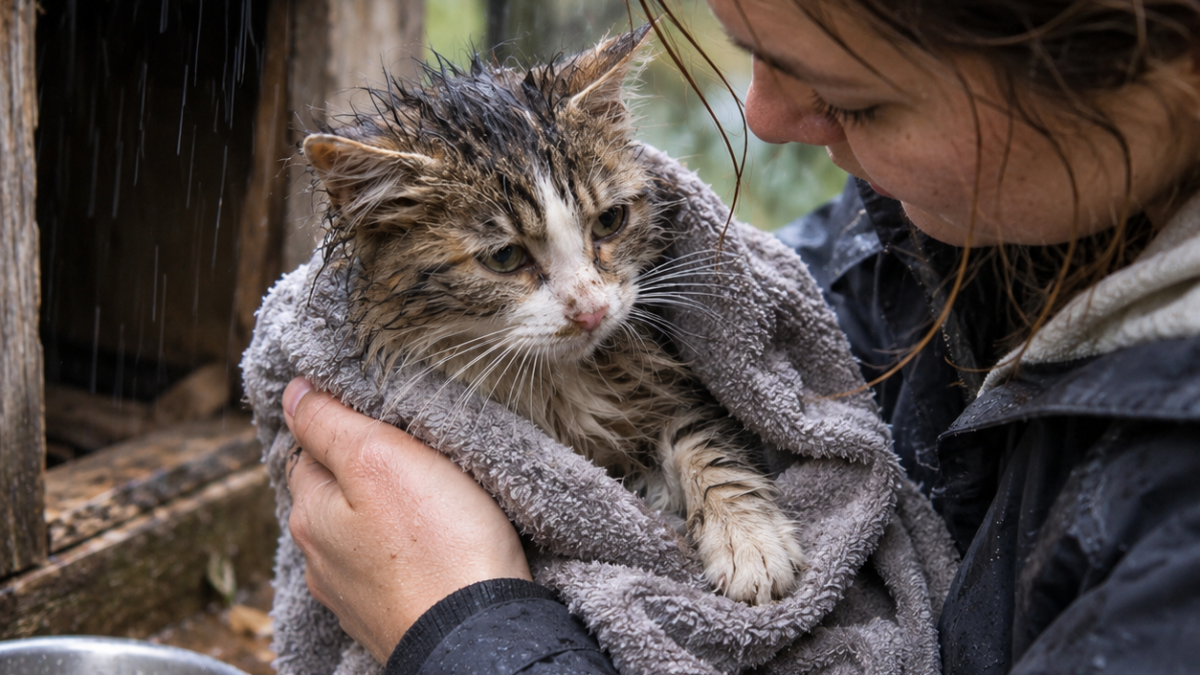
The tiny kitten was so weak that I could see every rib beneath her rain-soaked fur, yet when I reached toward her, she didn’t hiss or scratch—she simply flattened her ears, squeezed her eyes shut, and waited as though she had already learned that a human hand reaching for her could only mean pain.
I had stopped beside that abandoned building because I heard one faint meow beneath the sound of the November rain, but when my flashlight found the old wound on her front paw, the deep collar-shaped mark around her neck, and those exhausted eyes still trying to decide whether I was dangerous, I knew I wasn’t looking at an ordinary stray who had simply gotten lost.
And when that trembling little cat finally did something no one standing there expected, I realized the hardest part would not be getting her out of the cold—it would be discovering what had happened to her before that night, and whether she would ever believe that being rescued did not mean she was about to be hurt again.
It was already getting dark when I left work that evening.
Cold rain had been falling for most of the afternoon, and the sidewalks were nearly empty because everyone sensible had already hurried home.
I was walking past an abandoned building I had passed dozens of times before when I heard something.
At first, I thought it was a rusty door moving in the wind.
Then I heard it again.
A meow.
So faint I almost convinced myself I had imagined it.
I stopped.
“Hello?”
Nothing.
Then—
Another tiny cry.
It came from behind a pile of old boards beside a half-collapsed storage shed.
I turned on my phone flashlight and moved closer.
The beam swept across wet cardboard, broken wood, weeds, and finally two frightened eyes.
I froze.
A kitten was wedged into the corner.
She was small—far too small to look that exhausted.
Her fur might once have been soft gray and white, but now it was dirty, tangled, and soaked against her body.
Her ribs showed clearly.
One front paw was swollen around an old wound.
And beneath the wet fur around her neck was a deep irritated line that looked frighteningly like the mark of a collar that had once been much too tight.
But none of that affected me as much as her face.
She wasn’t angry.
She wasn’t feral.
She looked tired.
Deeply, completely tired.
I crouched several feet away.
“Hey, little girl.”
Her ears flattened.
“What are you doing out here?”
She tried to move backward.
There was nowhere to go.
Her body pressed against the cold wall.
I slowly extended one hand.
She recoiled immediately.
Not aggressively.
She simply squeezed her eyes shut.
That broke something inside me.
She didn’t try to defend herself.
She prepared herself.
There is a terrible difference.
I pulled my hand back.
“Okay. I won’t touch you.”
Rain ran down my face and into my collar.
I removed my jacket and spread it on the ground between us.
For several minutes, we stayed like that.
Me on one side.
Her on the other.
Neither moving.
Then I placed my hand palm-up on the jacket.
“You decide.”
The kitten opened her eyes.
She stared at my hand for what felt like forever.
Her entire body trembled.
One paw moved.
Then stopped.
Another tiny step.
She leaned forward and sniffed my fingers.
I didn’t move.
She sniffed again.
And then something happened that I still cannot describe without feeling that night all over again.
Instead of pulling away, the kitten lowered her head into my open palm.
Not for food.
Not because I had grabbed her.
She simply let the weight of her face rest against my hand.
Then she closed her eyes.
A tiny sound came from her chest.
A purr.
Weak.
Broken.
Almost silent.
But unmistakable.
I felt tears mix with the rain on my face.
“Okay,” I whispered. “I’ve got you.”
Her body went limp when I wrapped the jacket around her.
Not because she was relaxed.
Because she had almost nothing left.
I carried her against my chest while dialing the emergency veterinary clinic.
As I hurried toward my car, the kitten pushed her nose deeper into the fabric.
And for the first time that night, she stopped trembling.
I thought that meant she finally understood she was safe.
I had no idea that before the night was over, we would discover something that would turn one simple rescue into a fight for her life—and eventually expose the person who had hoped no one would ever ask where she came from.
PART 2
I drove faster than I should have.
Every few seconds, I looked toward the passenger seat.
The kitten was wrapped inside my coat in a small cardboard carrier the clinic had told me to improvise until I arrived. I had placed a towel beneath her and left the top partially open so I could see her face.
At first, her eyes followed me whenever I moved.
Then they began closing.
“Hey.”
No reaction.
My chest tightened.
“Hey, little girl.”
One ear twitched.
“That’s better.”
I kept talking.
I don’t even remember what I said.
I told her we were almost there.
I told her she was not allowed to die in my car.
I told her I didn’t know anything about cats and this was therefore a terrible time for her to become my responsibility.
Anything to keep my own fear from becoming louder than the rain.
When I pulled into the veterinary clinic, a technician was already waiting near the entrance.
I barely had the car door open before he reached me.
“Is that her?”
“Yes.”
“How long has she been like this?”
“I don’t know. I just found her.”
He took the carrier.
The kitten opened her eyes.
When his hands moved toward her, she tried to shrink beneath my jacket.
“Easy,” he said.
“She’s terrified of hands,” I warned.
He slowed immediately.
That small gesture mattered to me.
He did not say she had to get used to it.
He did not grab her.
He moved more carefully.
Together, we brought her inside.
The examination room was warm.
Too bright.
Too clean.
The kitten looked almost unreal beneath the fluorescent lights.
Outside, dirt and darkness had hidden how thin she was.
Inside, there was nowhere for reality to hide.
The veterinarian introduced herself as Dr. Harris.
She took one look at the kitten and became serious.
“We need to stabilize her first.”
“What’s wrong?”
“Several things.”
She began examining her.
Dehydration.
Severe underweight condition.
The injured paw.
Skin irritation.
Fleas.
The wound around her neck.
Her body temperature was lower than it should have been.
“When did she last eat?” Dr. Harris asked.
“I have no idea.”
“Drink?”
“I don’t know.”
“Was there food near her?”
“No.”
“Water?”
“No.”
Dr. Harris looked at me.
“Where exactly did you find her?”
I gave her the location.
She wrote it down.
Then the kitten suddenly tried to stand.
Her front legs trembled.
She took half a step.
Collapsed.
I moved instinctively.
Her whole body tightened when my hand came near.
I stopped.
“It’s me.”
She looked up.
Her eyes softened slightly.
I let her sniff my fingers.
Only then did I touch her.
Dr. Harris noticed.
“She trusts you.”
“I’ve known her twenty minutes.”
“Sometimes frightened animals make decisions faster than humans.”
I looked at the tiny cat.
“That seems like a dangerous habit.”
Dr. Harris gave a sad smile.
“In her case, maybe.”
They started fluids.
Cleaned the paw.
Treated the parasites.
The neck concerned Dr. Harris.
She parted the fur carefully.
The mark circled almost the entire throat.
“This wasn’t made by something she brushed against.”
“A collar?”
“That would be my first guess.”
“Too tight?”
“For too long.”
My stomach turned.
“Could she have grown while wearing it?”
“Yes.”
I imagined a kitten growing while a collar remained fixed around her neck, tightening week after week.
I hated the image.
“Can you tell how long she was outside?”
“No.”
“Days?”
“Possibly.”
“Weeks?”
“Possibly.”
That answer was worse.
They took blood.
Then X-rays because of the front paw and the way she was carrying her body.
I waited in a plastic chair outside.
Ten minutes.
Twenty.
Thirty.
Every time the treatment room opened, I stood.
Every time, somebody told me to sit back down.
Finally Dr. Harris came out holding a tablet.
“She’s lucky.”
I stared at her.
“She doesn’t look lucky.”
“No.”
Dr. Harris sat beside me.
“But she doesn’t appear to have major internal injuries.”
I exhaled.
“The paw?”
“An older fracture.”
My relief vanished.
“Broken?”
“Healing badly.”
“How old?”
“Not from today.”
I looked toward the treatment room.
“Was she hit by a car?”
“Maybe.”
That maybe again.
“What else causes it?”
“Falls. Accidents. Being caught somewhere. Trauma.”
She did not say abuse.
I appreciated that.
We didn’t know.
Not yet.
“Can you fix it?”
“I think we can improve it significantly, but first she needs strength.”
“Will she walk normally?”
“Probably.”
There was that word.
Probably.
I nodded.
“What happens now?”
“We keep her overnight.”
“Okay.”
“You can go home.”
I looked at her.
“I can?”
Dr. Harris smiled.
“Yes.”
I glanced toward the door.
“I don’t think I can.”
So I stayed another hour.
They eventually moved the kitten into a quiet recovery enclosure with warm bedding.
She was exhausted.
I sat outside.
At some point, she opened her eyes.
I put my fingers near the bars.
She crawled forward.
Slowly.
Then touched her forehead against them.
I whispered, “You need a name.”
Her eyes closed.
“What about Rain?”
Nothing.
“Because apparently I have no imagination.”
One ear moved.
“No?”
I thought about the way her eyes had looked in the flashlight.
Pale, almost silver.
“Luna?”
Her head lifted.
I smiled.
“Fine. Luna.”
That was the first decision we made together.
The next morning, Dr. Harris called me at 6:18.
I answered on the first ring.
“What happened?”
“Good morning to you too.”
“Is she okay?”
“She ate.”
I sat upright.
“How much?”
“Not much.”
“But she ate?”
“Yes.”
My eyes filled.
Over food.
I was crying over a cat eating breakfast.
“Can I come?”
“You were going to regardless.”
“Yes.”
“Then yes.”
When I arrived, Luna was awake.
The moment I entered the room, her ears lifted.
I stopped.
“Do you remember me?”
Her tail moved slightly across the blanket.
I approached.
She did not close her eyes.
That alone felt enormous.
I put my hand down.
Luna sniffed.
Then pushed her head under my palm.
Dr. Harris stood behind me.
“There.”
“What?”
“That.”
“What about it?”
“That’s why I told you she trusts you.”
I stroked Luna’s head.
“Maybe she has poor judgment.”
Dr. Harris laughed.
“Possible.”
For the next several days, my life rearranged itself around a cat who technically did not belong to me.
I went to work.
Left work.
Visited Luna.
Went home.
Repeated.
Every day, she grew slightly stronger.
At first she ate only if the room was quiet.
Then if one person stayed.
Then she began eating while I sat beside her.
She still flinched at sudden movement.
She especially hated anything coming toward her neck.
If someone touched the collar area without warning, panic flashed across her face.
So we stopped touching there unless necessary.
Trust first.
Treatment second whenever possible.
The clinic staff began calling her “Marina’s cat.”
I corrected them.
“She is not my cat.”
Dr. Harris ignored me.
One technician asked, “Who’s paying for her treatment?”
I stared.
“I am.”
“And who visits twice a day?”
“I do.”
“And whose jacket is currently in her kennel because she won’t sleep without it?”
I looked toward my coat.
“That proves nothing.”
He nodded solemnly.
“Absolutely nothing.”
I disliked everyone there.
Luna adored them.
Mostly.
A week after I found her, she stood without collapsing.
We had been doing gentle exercises.
Nothing dramatic.
A few supported movements.
Weight shifting.
Short attempts.
That morning, I placed a small dish of chicken several feet away.
“Come on.”
Luna stared at it.
Then at me.
“You’re a cat. You’re supposed to be motivated by food.”
Her front paw moved.
Then the injured one.
A tiny limp.
She took one step.
Another.
Her legs trembled.
“Easy.”
Third step.
She stopped.
Dr. Harris watched from the doorway.
I held my breath.
Luna took another.
Then another.
Five steps.
She reached the chicken.
I started crying.
Again.
Luna ate as if nothing historic had happened.
Dr. Harris leaned against the door.
“You know she’s going to manipulate you for the rest of her life.”
“I am not adopting her.”
“Of course.”
“I mean it.”
“Sure.”
I glared.
Luna ate another piece of chicken.
Traitor.
The medical improvement was encouraging.
The unanswered questions were not.
Where had she come from?
The collar mark suggested she had belonged to somebody.
She was not feral.
She understood litter boxes almost immediately.
She knew what food bags sounded like.
And despite her fear, she sought human contact once she felt safe.
Someone had lived with this cat.
Someone had known her.
I filed reports with the appropriate local services.
The clinic checked for a microchip.
Nothing.
We posted found notices without revealing every identifying detail.
If an owner came forward, we wanted proof.
Days passed.
Nobody called.
Then, eleven days after the rescue, I received a message from a woman named Elena.
**I think I know this cat.**
My stomach dropped.
I called immediately.
“Why?”
“I saw your post.”
“That doesn’t answer me.”
“She looks like a kitten that belonged to a couple who used to live near that abandoned building.”
My grip tightened around the phone.
“Used to?”
“They moved.”
“When?”
“A few weeks ago.”
“What was the kitten called?”
Elena hesitated.
“Misty.”
I was standing outside Luna’s recovery room.
I looked through the glass.
“Describe her.”
“Gray and white.”
“Anything specific?”
“A white line under the chin.”
I looked.
Luna had one.
“What else?”
“One front paw was lighter than the other.”
Correct.
I swallowed.
“Do you have photographs?”
“Yes.”
She sent them.
The first image loaded.
My stomach turned.
Luna.
Healthy.
Smaller.
Sitting on the back of a couch.
A red collar around her neck.
In the next photo, she was beside a young woman.
In another, a man was holding her.
She didn’t look afraid.
Her fur was clean.
Her body healthy.
Her eyes bright.
“That’s her,” I whispered.
Elena was silent.
“How do you know these people?”
“They lived in the building next to mine.”
“What happened?”
“I don’t know everything.”
“Tell me what you do know.”
The couple had been named Eric and Dana.
They rented a small apartment.
They had Luna—Misty—for several months.
At first, Elena said, everything seemed normal.
Then arguments became frequent.
Neighbors heard shouting.
Eric left and returned repeatedly.
Eventually Dana moved away.
“What about the cat?”
“I thought she took her.”
“Did she?”
“I don’t know.”
“Did Eric stay?”
“For a while.”
“Then?”
“He disappeared too.”
“When?”
“About three weeks before you found the kitten.”
I sat down.
“Did you ever see Luna outside?”
“Once.”
“When?”
“A few days before Eric left.”
“What condition?”
Elena became quiet.
“Elena.”
“She looked thinner.”
“Anything else?”
“She didn’t come toward me.”
“What does that mean?”
“She always used to.”
The room felt colder.
“Did you see injuries?”
“No.”
“Did you see anyone hurt her?”
“No.”
That mattered.
I would not invent what we didn’t know.
But I had enough to start asking questions.
I forwarded the photographs and information to the people handling the report.
Then I did something I was not proud of.
I searched Eric’s public social media.
Photographs.
Cars.
Friends.
Old posts.
A picture of Luna appeared four months earlier.
She was sitting on his shoulder.
The caption read:
**This psycho owns the house now.**
I stared at the image.
She looked loved.
That complicated my anger.
We want villains to be simple.
They rarely are.
Someone can stroke an animal one month and fail that animal terribly the next.
Affection is not the same thing as responsibility.
The investigation moved slowly.
Meanwhile Luna improved quickly.
Two weeks after rescue, she began playing.
Her first toy was a crumpled paper ball.
I had bought three expensive cat toys.
She ignored all of them.
Then I dropped a receipt.
Luna attacked it.
I stared.
“Seriously?”
She batted it across the floor.
“You have no taste.”
Dr. Harris walked in.
“She’s a cat.”
“I spent thirty dollars.”
“That was your mistake.”
Within days, Luna was chasing paper balls from one side of the recovery room to the other.
She still limped.
But she ran.
The first time she jumped onto a low cushion, everybody celebrated.
Luna became frightened by the applause.
We apologized.
The biggest breakthrough came at night.
One of the clinic cameras showed her sleeping.
Really sleeping.
Not curled tightly with her ears alert.
Stretched out.
Belly partly exposed.
Paws loose.
Dr. Harris showed me the video.
“She feels safe.”
I watched twice.
Then three times.
“How can you tell?”
“A frightened cat does not usually sleep like that unless she believes she can afford not to be ready.”
Afford not to be ready.
I thought about how exhausting fear must be.
Always listening.
Always preparing.
Always expecting the next bad thing.
Luna had finally allowed herself to be unconscious.
That felt like victory.
Then Eric called.
I knew his voice only from the name he gave me.
“My cat is with you.”
My entire body tightened.
“What cat?”
“Misty.”
I looked at Luna.
She was sitting on the windowsill.
“You believe Luna is yours?”
“Her name is Misty.”
“Can you prove ownership?”
“I have pictures.”
“So do I.”
Silence.
“Listen, I’ve been trying to find her.”
My anger rose.
“For how long?”
“A while.”
“Where?”
“What do you mean?”
“Where have you been looking?”
He hesitated.
“Online.”
“Which posts?”
Another hesitation.
I waited.
He changed direction.
“I want her back.”
I closed my eyes.
“You will have to go through the proper process.”
“She’s my cat.”
“That will need to be established.”
“Why are you making this complicated?”
I nearly laughed.
“Because I found her starving beside an abandoned building.”
“That wasn’t my fault.”
“What happened?”
“She got out.”
“When?”
“Before I moved.”
“Exactly when?”
“I don’t remember.”
“How did her collar become tight enough to leave a wound?”
Silence.
“Eric?”
“It wasn’t like that.”
“What was it like?”
“She grew.”
“That is generally what kittens do.”
“I meant to replace it.”
“But you didn’t.”
“I had other things happening.”
I stared through the glass.
Luna licked one paw.
“Her front leg was injured.”
“She fell.”
My heart jumped.
“From where?”
“A cabinet.”
“When?”
“Months ago.”
“Did you take her to a veterinarian?”
Another silence.
“No.”
“Why?”
“She seemed okay.”
“She had a fracture.”
“I didn’t know.”
“That’s because you didn’t take her.”
His voice hardened.
“Are you accusing me of something?”
“I am asking questions.”
“You people always make everything dramatic.”
I felt my hand tighten around the phone.
“You have a kitten found emaciated, dehydrated, injured, wearing evidence of a collar left too tight, and you think asking how she got there is dramatic?”
“I said she escaped.”
“And then?”
“I looked.”
“For how long?”
He didn’t answer.
Then he said:
“I’m coming tomorrow.”
“No.”
“What?”
“Do not arrive unannounced.”
“You can’t stop me seeing my cat.”
“Actually, while the ownership and welfare issue is being reviewed, yes, access can be controlled.”
He swore.
I ended the call.
My hands were shaking.
Luna looked toward me.
I entered the room.
She jumped down carefully.
Walked toward me.
Then sat on my shoe.
“Your old person called.”
She blinked.
“He wants you back.”
Luna began washing her paw.
“Good discussion.”
The next day, Eric came anyway.
Of course he did.
I was speaking to Dr. Harris when the receptionist called.
“Marina.”
Her tone told me immediately.
“He’s here.”
We did not bring Luna out.
Eric stood in reception.
Late twenties.
Well dressed.
Agitated.
He looked nothing like the monster my anger had tried to build.
Again, ordinary.
“What are you doing here?” I asked.
“I want to see her.”
“You were told not to come.”
“I’m not stealing her.”
“No one said you were.”
“You’re treating me like some criminal.”
“We’re treating this as an animal welfare case.”
His face tightened.
“I lost my apartment.”
“That isn’t Luna’s fault.”
“My girlfriend left.”
“Also not Luna’s fault.”
“I had nowhere to go.”
“What happened to her?”
“She ran out while I was moving.”
“That’s your story.”
“It’s the truth.”
“Then why didn’t you report her missing locally?”
“I told people.”
“Who?”
“A few neighbors.”
Elena later said he had not told her.
I didn’t know that at the time.
Eric stepped closer.
“Can I just see her?”
“No.”
“Why?”
I answered plainly.
“Because we don’t know whether seeing you would help her.”
That hurt him.
I saw it.
“You think she’s scared of me?”
“I don’t know.”
“She loved me.”
“Maybe.”
His eyes flashed.
“Maybe?”
“Loving someone before doesn’t automatically mean the relationship remained safe.”
He looked away.
For a moment, anger disappeared.
Something else surfaced.
Shame.
Then he said:
“I never hit her.”
“I didn’t say you did.”
“I never did.”
“Okay.”
“The leg was an accident.”
“Okay.”
“The collar…”
He stopped.
I waited.
“I didn’t notice.”
There it was.
Not cruelty with a dramatic confession.
Neglect.
Failure.
Not noticing.
People underestimate how destructive “I didn’t notice” can become when a living creature depends on you.
Eric rubbed his face.
“I was falling apart.”
I believed him.
That didn’t undo anything.
“I’m sorry.”
“To me?”
He looked toward the hallway.
“No.”
For the first time, I felt something other than anger.
“Then prove that.”
“How?”
“Cooperate.”
He did.
Not immediately.
Not perfectly.
But he did.
He gave a statement.
Provided older veterinary information.
Admitted Luna had injured her paw and he had never sought treatment because he was short on money.
Admitted the collar had been left on too long.
Admitted that while moving out, he had allowed Luna outside during repeated trips and she disappeared.
What he could not explain was why he had not searched properly afterward.
“I thought she’d find food.”
I stared at him.
“She was a kitten.”
“I know.”
“Now you know.”
He looked down.
Investigators and animal welfare officials handled what happened next.
There was no cinematic arrest.
No screaming courtroom.
Real consequences are often much quieter.
The medical evidence was documented.
Eric’s admissions mattered.
The neglect mattered.
The failure to obtain treatment mattered.
The abandonment question was reviewed.
Ultimately, he was not allowed simply to collect Luna and walk away as though nothing had happened.
He faced financial penalties and responsibility for part of her veterinary costs.
More importantly, Luna remained under protective placement while her future was determined.
Eric protested initially.
Then something changed.
He came to one supervised meeting.
A barrier separated them.
Dr. Harris was present.
So was I.
Luna entered the room.
She explored.
Then Eric appeared.
“Misty.”
Luna froze.
My heart stopped.
Her ears moved forward.
She knew the name.
Eric crouched.
“Hey, baby.”
For several seconds, Luna stared.
Then she walked toward the barrier.
Eric’s eyes filled.
“There you are.”
Luna sniffed the air.
He put his fingers against the mesh.
She came closer.
My stomach twisted.
This was the part people simplify.
They expect abused or neglected animals to hate.
Animals do not organize pain for our emotional convenience.
Luna remembered him.
Maybe she remembered good things too.
She sniffed his fingers.
Eric began crying.
“I’m sorry.”
Luna stayed there.
Then Eric moved his hand toward her neck.
Just an instinct.
Maybe to stroke her.
Luna dropped instantly.
Her body flattened.
Eyes closed.
The exact posture from the night I found her.
Eric jerked his hand back.
“Oh God.”
I didn’t speak.
Luna crawled backward.
She came to me.
Pressed herself against my legs.
Eric covered his face.
Nobody needed to explain what had happened.
Whether that reflex came specifically from him, from rough restraint, from the collar, from pain—we could not know.
But Eric saw the result of the world Luna had lived in.
“I did that?” he whispered.
I answered carefully.
“We don’t know exactly what caused every fear.”
He looked at me.
“But I didn’t protect her from it.”
No.
He hadn’t.
Eric sat on the floor.
For a long time, he simply watched Luna.
Eventually she relaxed.
She did not approach again.
The meeting ended.
Outside, Eric said:
“I shouldn’t get her back.”
I hadn’t expected that.
“What?”
He wiped his face.
“I came here ready to fight you.”
I said nothing.
“I kept telling myself you stole my cat.”
He laughed bitterly.
“Because that was easier.”
“Easier than what?”
“Admitting I failed her.”
That sentence stayed with me.
He signed paperwork relinquishing his claim.
There were still consequences related to the neglect.
Relinquishing Luna did not erase them.
But it ended the fight over her future.
Before leaving, he asked one question.
“Will she be adopted?”
“Yes.”
“You already have someone?”
I looked at Luna through the window.
“She has options.”
Eric followed my gaze.
Then looked at me.
“You.”
I laughed once.
“No.”
He almost smiled.
“You’re a terrible liar.”
“I am not adopting that cat.”
“Sure.”
I hated that Dr. Harris had apparently infected everybody.
Luna officially entered foster care two weeks later.
With me.
Temporarily.
Very temporarily.
I bought a litter box.
Temporary.
A scratching post.
Temporary.
A cat tree taller than my kitchen table.
An investment error.
The first night, Luna stayed beneath my couch.
I did not pull her out.
At midnight, I left food nearby.
At two, I heard eating.
At five, I woke to something touching my hand.
Luna was standing beside the couch.
She sniffed my fingers.
Then walked away.
“Good talk.”
The second night, she slept on the couch.
The third, near my feet.
By the end of the week, she had decided my bed belonged to her.
I disagreed.
She ignored me.
That became our relationship.
But home revealed fears the clinic had hidden.
Luna hated keys jingling near the front door.
She panicked when I carried cardboard boxes.
She became terrified if I closed a room while she was inside.
The first time it happened accidentally, she threw herself against the door.
I opened it immediately.
“Luna!”
She shot past me.
Under the table.
Her body shook.
I sat on the floor.
“I’m sorry.”
I did not reach for her.
“I didn’t know.”
Twenty minutes passed.
Then Luna came out.
Slowly.
She sniffed me.
I held still.
She climbed into my lap.
That was the first time.
Not beside me.
On me.
Her entire body curled against my stomach.
Then the purring began.
Loud this time.
Not the broken whisper from the rain.
A full, ridiculous motor.
I laughed while crying.
“You know this is supposed to be temporary.”
Luna kneaded my shirt.
“Ow.”
Purr.
“You have claws.”
Purr.
“This is abuse.”
Purr.
I stopped pretending two weeks later.
I called Dr. Harris.
“I have a problem.”
“Luna destroyed something?”
“No.”
“Stopped eating?”
“No.”
“Limp worse?”
“No.”
“Then what?”
I sighed.
“I need adoption paperwork.”
There was silence.
Then:
“I’m sorry, I couldn’t hear you.”
“You heard me.”
“Say it again.”
“I hate you.”
“Are you adopting Luna?”
“Yes.”
Laughter exploded through the phone.
I hung up.
She called back.
I declined.
She sent three celebration emojis.
I considered changing veterinarians.
I didn’t.
The adoption became official on a rainy Tuesday.
Of course it rained.
I signed the papers.
Luna sat inside her carrier.
When we reached home, I opened the door.
She stepped out.
Looked around.
Then walked straight to the couch.
Her couch.
Her house.
Apparently the paperwork had merely informed me of what she already knew.
For months, life became wonderfully ordinary.
That was what I wanted for her.
Not to remain “the abused rescue cat.”
Not to have every conversation begin with wounds.
Luna was funny.
Stubborn.
Unreasonably interested in shoelaces.
She loved chicken but hated tuna.
No one understood that.
She slept inside laundry baskets.
Knocked pens from tables.
Attacked my feet beneath blankets.
At 4:37 every morning, she became convinced breakfast should happen immediately.
“Absolutely not.”
Meow.
“It’s four in the morning.”
Meow.
“You have food.”
Meow.
“I saved your life.”
Meow.
“No gratitude.”
She jumped onto my chest.
We negotiated.
She usually won.
Her injured paw healed as well as the veterinarian had hoped.
A slight stiffness remained.
On cold mornings, she sometimes favored it.
But she ran.
Jumped.
Climbed.
The kitten who could barely crawl away from my hand began launching herself onto the refrigerator simply because she could.
The collar mark slowly faded.
Her fur grew over most of it.
I could still feel the ridge beneath my fingers.
Sometimes while she slept, I touched it gently.
Not to remember Eric.
To remember distance.
The distance between who she had been and who she became.
Eric completed the requirements imposed after the case.
He paid what he owed.
I heard through the official process that he began counseling.
Months later, I received a letter.
Not to me.
To Luna.
I almost threw it away.
Instead I opened it.
It said:
**I am sorry I made my problems your problems. You deserved food, care, treatment, and safety even when I was falling apart. I kept telling myself that because I loved you, I could not have neglected you. I understand now that both things can be true. I hope the person who has you now does better than I did.**
I read it twice.
Then I looked at Luna.
She was sitting inside a grocery bag.
“You have mail.”
She attacked the bag handle.
“I’ll summarize.”
I kept the letter.
Not because Eric deserved space in our home.
Because accountability without excuses is rare.
And because revenge had stopped mattering to me.
At first, I had wanted whoever caused Luna’s suffering to hurt.
I wanted outrage.
Punishment.
A moment where somebody paid.
But Luna taught me something uncomfortable.
Her healing did not require anybody else’s destruction.
Consequences mattered because they protected animals.
Responsibility mattered.
Truth mattered.
But what Luna needed most had nothing to do with Eric.
She needed Tuesday breakfast.
Wednesday safety.
Thursday play.
Friday sleep.
Saturday sun.
Hundreds and then thousands of ordinary moments proving the past had ended.
That became the real revenge.
She became happy.
A year after I found her, I walked past the abandoned building again.
Luna was not with me.
I would never bring her there just for symbolism.
She didn’t need the place.
I did.
The boards had been removed.
The cardboard was gone.
Someone had fenced part of the property.
Rain darkened the pavement.
I stood in the exact place where I had heard that first meow.
For a moment, I could almost see her.
Tiny.
Wet.
Eyes closed beneath my approaching hand.
My phone buzzed.
A notification from the camera inside my apartment.
Motion detected.
I opened it.
Luna was on the kitchen counter.
She was not allowed on the kitchen counter.
She was staring directly into the camera.
Then she knocked my mug onto the floor.
I laughed so suddenly a man walking past stared at me.
“There she is.”
That was Luna now.
Not waiting beneath boards.
Committing crimes in a heated apartment.
Perfect.
When I got home, I held up the broken mug.
“Explain yourself.”
Luna walked past me.
“No remorse?”
Tail up.
“You’re lucky you’re cute.”
She jumped onto the couch.
I sat beside her.
Within seconds, she climbed into my lap.
That was her apology.
Or her victory celebration.
Probably the second.
Two years passed.
Then three.
Luna became the cat everyone claimed not to like until they met her.
My father, who said cats were “aloof,” began bringing treats in his coat pocket.
My neighbor complained about seeing Luna in my window and then bought her a Christmas toy.
Dr. Harris remained unbearably smug about predicting the adoption.
At every annual examination:
“So, still temporary?”
“Examine the cat.”
Luna became useful at the clinic too, unexpectedly.
I occasionally fostered frightened kittens.
Not many.
One at a time.
The first was an orange kitten named Milo who had been found beneath a car.
He hid inside a carrier.
Wouldn’t eat if I watched.
Wouldn’t play.
The similarities made me nervous.
I kept Milo in a separate room initially.
Luna knew he was there.
She sat outside the door.
Not scratching.
Not meowing.
Just sitting.
After veterinary clearance and slow introductions, I let them see each other through a barrier.
Milo hid.
Luna lay down.
Waited.
Twenty minutes.
Thirty.
Milo eventually emerged.
Luna did not approach.
He came to her.
Sniffed.
She blinked slowly.
Then looked away.
The next day, Milo came closer.
Within a week, he was following her.
I watched Luna walk through my hallway with a tiny orange kitten trailing behind and felt something inside me twist.
She had once needed another living creature to prove the world was safe.
Now she was doing it for someone else.
“You know what you’re doing, don’t you?”
Luna ignored me.
Of course.
Milo was adopted by a young couple.
The day he left, I worried Luna would search for him.
She did.
For approximately six minutes.
Then she ate his leftover food.
Emotional resilience.
Years accumulated.
Luna’s face matured.
The kitten look disappeared.
Her body filled out.
Her coat became soft and thick.
Nobody could count her ribs anymore.
Sometimes I looked at old photographs and struggled to believe they showed the same cat.
One image always stopped me.
The first clinic photograph.
Luna wrapped in my jacket.
Eyes enormous.
Body skeletal.
Beside it, I kept another photograph.
Luna at five years old.
Lying on her back in a patch of sunlight.
Belly exposed.
One paw hanging over the couch.
Completely unconscious.
If I had to explain rescue with two pictures, those would be enough.
Fear.
Then rest.
People often asked whether Eric ever saw her again.
Once.
Only once.
Years later.
It happened by accident.
I had brought Luna to a charity vaccination event organized by Dr. Harris.
Eric was volunteering with a community organization helping with setup.
I did not know he would be there.
He saw the carrier.
Then me.
His face changed.
“Is that…”
I could have walked away.
Instead, I looked at Luna.
She was calm.
Older.
Confident.
I opened the carrier door but left it entirely up to her.
Eric crouched several feet away.
“Hi.”
Luna looked at him.
No panic.
No flattened ears.
No closed eyes.
She simply looked.
Eric’s face tightened.
“Misty.”
Her ear moved.
I hated that the old name still reached her.
But memory is not ownership.
Luna stepped out.
She sniffed the grass.
Eric remained still.
She looked at him again.
Then walked past him.
Straight to me.
She rubbed her body against my leg.
Tail high.
Eric swallowed.
“She looks good.”
“She is.”
“Happy?”
“Yes.”
He nodded.
“That’s good.”
Luna sat on my shoe.
That old habit.
I looked down and smiled.
Eric noticed.
“I used to think the worst punishment was losing her.”
I didn’t respond.
He continued.
“It isn’t.”
“What is?”
“Knowing she became happier without me.”
That was a brutal sentence.
But I understood it.
He looked at Luna.
“I deserved that.”
I shook my head.
“This isn’t about what you deserve.”
He looked at me.
“It’s about what she deserved.”
He nodded.
“Yes.”
Then he left.
Luna watched him for perhaps two seconds.
A bird landed nearby.
She became infinitely more interested in the bird.
That was the justice I never could have invented.
The person who once controlled her world had become less interesting than a sparrow.
Luna lived a long life.
Long enough for the memory of finding her to become something that belonged to another version of me.
Long enough that new clinic employees knew her only as “Marina’s spoiled cat.”
Long enough to see me move apartments.
She hated moving.
I planned everything around her.
Same blanket.
Same bed.
Same food.
I moved her last and unpacked her room first.
The first night, Luna inspected every corner.
Then climbed into bed beside me.
“No trauma?”
She licked one paw.
“Good discussion.”
She adapted faster than I did.
At eight, she developed arthritis in the previously injured leg.
We managed it.
At ten, early kidney disease appeared.
Managed that too.
At twelve, she stopped jumping onto the refrigerator.
I pretended to celebrate.
Truthfully, I missed hearing her land where she was forbidden.
At thirteen, she slept more.
Her gray fur made age difficult to see, but I could feel it in her movement.
Slower.
More deliberate.
One winter evening, rain began tapping against my windows.
Luna was curled beside me.
I thought about that first night.
“Do you remember rain?”
Her eyes stayed closed.
“Probably not.”
I scratched her chin.
“You hated me.”
One eye opened.
“Fine. You tolerated me.”
Purr.
“You drooled on my jacket.”
Purr.
“I still have that jacket.”
Her paw stretched across my wrist.
I had kept it.
Of course I had.
It was old.
Worn.
There was a tiny pulled thread where Luna’s claws had caught it the night I carried her to the car.
Thirteen years.
One thread.
A whole life attached to it.
When Luna was fourteen, her kidneys worsened.
Medication helped.
Special food helped.
Fluids eventually became part of our routine.
She tolerated them because I bribed her shamelessly.
Chicken.
Warm blankets.
Sunlight.
Whatever she wanted.
Her world became smaller.
Bedroom.
Couch.
Window.
My lap.
But small did not mean unhappy.
She still purred.
Still yelled at breakfast.
Still attempted to steal chicken.
Still slapped my hand if I stopped scratching her too soon.
Then one morning, she did not eat.
Not even chicken.
I knew.
Knowing did not make it easier.
Dr. Harris had retired by then, but when I called her, she answered.
“Bring her in.”
Her voice was older.
So was mine.
The clinic had changed.
Different paint.
Different receptionist.
Same examination room.
Dr. Harris came in wearing ordinary clothes.
She looked at Luna.
“Oh, sweetheart.”
Luna lifted her head.
Dr. Harris touched her gently.
No fear.
No recoil.
The kitten who once closed her eyes when hands approached now leaned into an old veterinarian’s fingers.
Bloodwork confirmed what we expected.
Her kidneys were failing badly.
We could hospitalize.
Try aggressive treatment.
Maybe buy some time.
“How much good time?” I asked.
Dr. Harris looked at me.
That was the question.
Not time.
Good time.
“Maybe a little.”
I cried before she finished.
Luna sat between us looking offended by the emotional incompetence of humans.
I brought her home.
For four days, she surprised us.
She ate small amounts.
Sat in sunlight.
Slept on my chest one night.
Then Sunday morning came.
Luna tried to stand.
Her legs gave way.
I caught her.
This time, she did not panic when my hands closed around her.
She simply looked at me.
I knew.
“No.”
The word came out before I could stop it.
Luna blinked.
“No, no, no.”
Fourteen years was suddenly nothing.
I wanted one more.
One more breakfast.
One more broken mug.
One more morning complaint.
One more night.
Love becomes unreasonable near the end.
It starts demanding things time cannot give.
I called Dr. Harris.
She came to my apartment that afternoon.
She had promised years earlier that when the time came, Luna would not need to be frightened inside a clinic.
Rain had begun outside.
Of course.
The universe has no subtlety.
I placed the old jacket on the couch.
The same jacket.
Luna sniffed it.
Then lay down.
Dr. Harris saw it.
“You kept that?”
“Yes.”
“Fourteen years?”
“Don’t judge me.”
She smiled through tears.
“I wouldn’t dare.”
Luna rested with her head in my hand.
Exactly like the first night.
Palm up.
Face lowered into it.
But everything else was different.
That night she had been wet.
Cold.
Starving.
Terrified.
Now she was warm.
Her belly was full enough.
Her favorite blanket covered her.
My hand did not make her close her eyes in fear.
She closed them because she trusted me enough to sleep.
Dr. Harris prepared the medication.
I bent close.
“Hey, little girl.”
One ear moved.
I laughed softly.
“That’s what I called you the first time.”
Her breathing was slow.
“You did pretty well.”
My voice broke.
“You were supposed to be temporary.”
Dr. Harris laughed quietly behind me.
Luna purred.
Weak.
But there.
I started crying.
“There it is.”
The same sound.
The same impossible little purr.
The first night, it had been barely audible against the rain.
Now it filled the quiet room.
I put my forehead against hers.
“You never have to be afraid again.”
The first medication made her sleepy.
Her body relaxed.
One paw rested over my wrist.
I whispered:
“No cold buildings.”
Breath.
“No tight collars.”
Breath.
“No hiding.”
Another breath.
“No waiting for somebody to notice you.”
My tears fell into her fur.
“You were noticed.”
Dr. Harris gave the final medication.
Luna exhaled.
The purring stopped.
Her paw remained on my wrist.
I stayed there.
I don’t know how long.
The rain continued outside.
Fourteen years earlier, I had heard one tiny meow inside weather exactly like that.
That sound had stopped me.
Changed my direction.
Changed my life.
People later told me I saved Luna.
I never liked that sentence.
Yes, I picked her up.
I drove her to the clinic.
I paid bills.
Signed papers.
Fed her.
But rescue is rarely one-sided.
Before Luna, I had spent years believing I was independent because I needed nobody.
Luna taught me the difference between independence and isolation.
She gave me routines.
People.
A reason to learn veterinary medicine I never intended to learn.
A reason to foster.
A reason to notice frightened animals instead of assuming someone else would.
She changed Eric too, although he never became part of her life again.
His failure had consequences.
He had to face what neglect looked like when it survived him.
He had to understand that affection without responsibility was not enough.
But his punishment was never Luna’s greatest victory.
Her greatest victory was becoming ordinary.
That is what people misunderstand.
They think the dramatic ending to a rescue story is justice.
An arrest.
A fine.
A confrontation.
Sometimes those matter.
But for Luna, justice looked like a warm windowsill.
A full bowl she did not have to defend.
A cardboard box used for playing instead of hiding.
Hands she ran toward instead of shrinking from.
Fourteen birthdays.
A gray muzzle.
Arthritis.
Getting old.
There is no revenge more complete than an animal once left to disappear being loved long enough to become elderly.
Months after Luna died, I finally walked past the abandoned building again.
Most of it had been demolished.
The old storage shed was gone.
The pile of boards was gone.
Nothing remained of the place where I had found her.
I stood there in the rain.
I expected to feel sad.
I didn’t.
Not exactly.
Because that location had become so small compared with Luna’s life.
One wet corner.
One terrible evening.
Fourteen years.
The place had lost.
That was the truth.
It had not defined her.
Eric had not defined her.
The collar scar had not defined her.
Fear had not defined her.
Luna had become bigger than everything that happened before I found her.
I walked home.
My apartment was painfully quiet.
Her bed still sat beside the radiator.
Her bowl was still in the cabinet because I had not been able to move it.
On my shelf sat the old jacket.
I touched the torn thread.
And I remembered the exact moment she lowered her tiny face into my open palm.
At the time, I thought she was asking me for help.
Maybe she was.
But now I think she was doing something much harder.
She was taking one last risk on a human being.
After everything she had learned.
After every reason she had to retreat.
She moved forward.
One paw.
Then another.
And trusted me.
That is the part of Luna’s story I carry with me.
Not how afraid she was.
How brave she was while afraid.
Several months later, the clinic called.
Not Dr. Harris.
A younger veterinarian.
“There’s a kitten here.”
I closed my eyes.
“No.”
She laughed nervously.
“I haven’t asked anything.”
“I know where this is going.”
“She was found under a staircase.”
“No.”
“She’s terrified.”
“No.”
“She won’t eat when anyone is in the room.”
I stared at Luna’s empty bed.
“Absolutely not.”
An hour later, I was at the clinic.
The kitten was black.
Tiny.
Hiding behind a towel.
I sat on the floor.
Did not reach.
Did not call.
Just waited.
Twenty minutes passed.
Then one small nose appeared.
I put my hand palm-up on the floor.
The kitten stared.
I smiled through tears.
“You decide.”
She took one step.
And somewhere inside that moment, Luna’s story continued.
Not because another cat replaced her.
Nothing could.
But because love, once taught, does not disappear when the teacher does.
It moves.
From one frightened creature to another.
From one open hand to the next.
That is why I no longer tell people Luna was the kitten I rescued behind an abandoned building.
That description is too small.
Luna was the kitten who survived long enough to stop being defined by survival.
She became a spoiled house cat.
A terrible alarm clock.
A destroyer of mugs.
A foster-kitten mentor.
A thirteen-pound dictator with questionable taste in food.
She became old.
She became loved.
She became home.
And the thing she did that first rainy night—the thing that brought me to tears—turned out to be the same thing she did at the very end.
She placed her head in my hand.
The first time, she was asking whether she could trust me.
The last time, she already knew.
That was the difference fourteen years made.
And that was the ending the frightened kitten behind those wet boards deserved.
The first few months after Luna officially became mine were quieter than everything that had come before, but in some ways, they taught me more about what had happened to her than the investigation ever did.
At the clinic, we had measured progress in obvious things.
Weight gained.
Wounds closed.
A fracture healing.
The first jump.
The first full meal.
At home, progress was measured in details nobody else would have noticed.
The first time Luna drank from her water bowl while I stood beside her.
The first time I carried a grocery bag into the kitchen and she didn’t run.
The first time I closed the front door and she stayed in the hallway instead of disappearing beneath the couch.
Tiny things.
But with Luna, tiny things were enormous.
Every morning before work, I sat at the kitchen table with coffee while she ate breakfast.
At first, she kept glancing at me between bites.
Chew.
Look up.
Chew.
Look up again.
As though she needed to make sure I hadn’t changed my mind.
One morning I finally said, “It’s yours.”
Luna stopped eating.
Her ears moved toward me.
“The food.”
I pointed at the bowl.
“I’m not taking it.”
She stared.
“You don’t have to finish quickly.”
Nothing.
“You don’t have to hide it.”
Still nothing.
“I’m pretty sure you don’t understand a word I’m saying.”
She lowered her head and ate.
But slowly.
For the first time.
I sat there with my coffee growing cold because I was afraid that even moving might disturb whatever was happening.
That became one of my favorite memories.
Not dramatic.
No one else was there.
Just a cat learning she could take her time.
I had not realized until Luna came home how many ordinary household sounds frightened her.
The click of a belt buckle.
Keys falling onto a table.
A broom handle hitting a wall.
The metallic snap of a window latch.
The first time I accidentally dropped a cooking pan, Luna vanished so quickly I didn’t even see where she went.
I found her beneath the bed.
Her body was pressed flat to the floor.
“Luna?”
Nothing.
I sat several feet away.
“I dropped a pan.”
Her pupils were huge.
“That’s all.”
I wanted to reach for her.
I didn’t.
We had already learned that lesson.
Love does not always mean touching.
Sometimes love means staying on the other side of the room because that is where the frightened animal needs you to be.
So I sat.
Five minutes.
Ten.
My back began hurting.
“You know, I’m going to need a chiropractor because of you.”
One ear moved.
“That was a joke.”
Nothing.
“Not a very good one.”
Another few minutes passed.
Then Luna crawled forward.
She did not come all the way.
Halfway.
Stopped.
I placed my hand palm-up.
The same way I had on the first night.
She sniffed my fingers.
Then walked past me as though the entire incident had been my embarrassment rather than hers.
I laughed.
“Fine.”
She jumped onto the bed.
“Apparently we’ve recovered.”
Those moments taught me something uncomfortable.
Healing did not erase reflexes.
Luna could know she was safe and still panic.
She could trust me and still react to a sound before her mind had time to understand it.
For a while, I mistook those reactions for setbacks.
Then Dr. Harris corrected me.
“She isn’t going backward.”
We were sitting in an examination room during one of Luna’s follow-up visits.
Luna had just hidden behind my arm after a metal tray fell in the hallway.
“It feels like it.”
“No.”
Dr. Harris stroked Luna’s back slowly.
“Think about what happened.”
“She panicked.”
“Yes.”
“And now she’s hiding.”
“With you.”
I looked down.
Luna had pressed her face against my elbow.
Dr. Harris smiled.
“Before, fear told her to get away from every person in the room.”
She tapped my sleeve.
“Now fear tells her to come to you.”
I had never thought about it that way.
“She still got scared.”
“She may always get scared.”
Dr. Harris shrugged.
“The goal isn’t to create a cat who never feels fear.”
“What is the goal?”
“A cat who knows what to do with it.”
I carried that sentence home with me.
Apparently Luna did too.
Over the following months, her fear became less like a prison and more like weather.
It came.
Sometimes suddenly.
But it passed.
And every time it passed, Luna discovered that everything she loved was still there.
The food bowl.
Her bed.
The window.
My voice.
Me.
Then, one Thursday evening, I made a mistake.
A serious one.
I had come home exhausted.
It had been a long day, and a maintenance worker was scheduled to repair a loose window in my bedroom.
I normally put Luna in the living room when strangers came inside.
That evening, I forgot.
The worker arrived carrying a toolbox and a folding ladder.
The moment the ladder opened with a metallic snap, Luna shot down the hallway.
“Luna!”
I saw her run toward the kitchen.
I assumed she had gone beneath the table.
I was wrong.
The maintenance worker opened the balcony door for less than thirty seconds while adjusting the window frame.
I didn’t notice.
Neither did he.
Ten minutes later, I went looking for Luna.
“Luna?”
Nothing.
I checked beneath the table.
Empty.
Bedroom.
Empty.
Bathroom.
Closet.
Nothing.
My heartbeat began speeding up.
“Luna.”
I shook the treat bag.
No sound.
The worker looked toward me.
“Cat missing?”
“She’s here somewhere.”
I checked every room again.
Nothing.
Then I saw the balcony door.
Open.
Only a few inches.
My entire body went cold.
“Did you open that?”
“Just for a minute.”
I ran.
The balcony was empty.
My apartment was on the second floor.
Not high enough to guarantee injury.
High enough to terrify me.
I looked over the railing.
“Luna!”
Nothing.
I ran downstairs.
No coat.
No keys.
Just my phone.
Rain had started.
Of course it had.
For one second, I was back beside the abandoned building.
Wet pavement.
Dark corners.
A tiny sound beneath the rain.
No.
Not again.
I searched beneath parked cars.
Behind garbage bins.
In bushes.
“Luna!”
Neighbors came outside.
Someone asked what happened.
“My cat got out.”
“What does she look like?”
“Gray and white. Small. She may hide if you approach.”
“How long?”
“I don’t know. Ten minutes. Maybe fifteen.”
Fifteen minutes.
It felt like fifteen days.
I called the clinic.
Mia answered.
“She’s gone.”
“What?”
“Luna got outside.”
“Where?”
I gave the address.
“We’re coming.”
“You don’t have to—”
She hung up.
Within half an hour, there were six people searching.
Dr. Harris arrived wearing slippers inside rain boots.
I stared at her.
“You came from home?”
“Obviously.”
“You didn’t change?”
“Marina.”
“Right.”
We searched quietly because shouting could frighten Luna farther away.
I placed food near the building.
Her carrier.
Her blanket.
My old jacket.
The jacket.
The one from the night I found her.
Dr. Harris saw it.
“Good.”
I sat beside the entrance.
“What if she keeps running?”
“She probably isn’t running.”
“What if she’s hurt?”
“We don’t know that.”
“What if she went into the street?”
“Stop.”
I looked at her.
“You’re doing the thing.”
“What thing?”
“Living every possible tragedy before you know which one exists.”
I hated when she was right.
Two hours passed.
No Luna.
Rain soaked through my sweater.
My guilt became almost unbearable.
She had trusted me.
I had promised safety.
Then one careless open door and she was gone.
“I did exactly what he did.”
Dr. Harris turned sharply.
“What?”
“Eric.”
“No.”
“I let her get out.”
“That does not make you Eric.”
“He said she got out while he was moving.”
“Yes.”
“And now she got out while somebody was working in my apartment.”
“Marina.”
“I should’ve been more careful.”
“Yes.”
The word hit me.
I looked at her.
Dr. Harris didn’t soften it.
“You should have.”
My throat tightened.
“But making a mistake is not the same as abandoning responsibility afterward.”
I stared at the road.
“What if I don’t find her?”
“Then we keep looking.”
“For how long?”
“As long as necessary.”
She sat beside me.
“That is the difference.”
The rain eased after midnight.
People gradually spread farther into the neighborhood.
I remained near the apartment.
At 12:46 a.m., I heard something.
Scratch.
I stood.
“Luna?”
Silence.
Then another sound.
From beneath the stairs leading to the basement storage room.
I crouched.
Phone flashlight.
Two eyes reflected back.
My knees nearly gave out.
“Luna.”
She was pressed behind a stack of old paint cans.
Soaked.
Terrified.
But alive.
I wanted to grab her.
Instead, I stopped.
We had been here before.
Not this place.
This choice.
I lowered myself to the concrete.
“Hey, little girl.”
Her ears flattened.
“I know.”
My voice broke.
“I messed up.”
Luna stayed where she was.
I put the old jacket on the floor.
Then my hand.
Palm-up.
“You decide.”
For almost a minute, nothing happened.
Then Luna crawled forward.
One step.
Another.
She sniffed the jacket.
Then my hand.
And suddenly she rushed into me.
Not cautiously.
Not testing.
She climbed straight against my chest and buried her face beneath my chin.
I wrapped both arms around her.
“I’m sorry.”
She was shaking.
“I’m so sorry.”
The others heard me crying and came running.
Dr. Harris stopped them before they got too close.
“Give them space.”
Luna’s claws dug into my sweater.
I didn’t care.
She pressed harder.
And then she purred.
I laughed through my tears.
“You are unbelievable.”
That night changed something between us.
I had always thought trust meant never failing someone.
Luna taught me otherwise.
Trust also means what you do after failure.
I made sure that balcony door could never be opened accidentally again.
I installed a second screen.
I changed how I handled workers entering the apartment.
I put a small sign near the front door:
CAT INSIDE. CHECK BEFORE OPENING.
Mia laughed when she saw it.
“You’ve become one of those people.”
“What people?”
“Cat people.”
“I have one cat.”
“You have three emergency carriers.”
“One is for the car.”
“Why does your cat have a travel bag?”
“Leave my house.”
Luna sat on the sofa watching us.
Mia pointed.
“She agrees with me.”
“She absolutely does not.”
Life became normal again.
Then came another surprise.
A letter from Eric arrived through the welfare office.
This was before the longer apology I eventually kept.
This first letter was much shorter.
He wanted to know how Luna was doing.
I almost didn’t answer.
For two days, the paper sat on my kitchen counter.
Every time I passed it, I became angry.
Why should he get updates?
He had failed her.
He had lost the right.
Then I wondered whether refusing him information helped Luna in any way.
It didn’t.
So I wrote three sentences.
She is safe.
Her leg has healed well, and she is gaining confidence.
She has been adopted.
I did not say by whom.
I mailed it.
Three weeks later, another envelope arrived.
Inside was only one sentence.
Thank you for giving her what I should have.
I folded it.
Put it away.
Not forgiveness.
Not friendship.
Closure, perhaps.
But Luna’s real life continued elsewhere.
She became obsessed with the window in my bedroom.
Every morning, birds gathered on the roof opposite us.
Luna sat on the sill making little clicking sounds with her jaw.
“You understand the glass is stopping you?”
Click.
“You’re not hunting anything.”
Click.
“That bird weighs half of what you do.”
Tail twitch.
One morning, a pigeon landed directly outside.
Luna launched herself against the glass.
The pigeon barely moved.
I laughed so hard I spilled coffee.
Luna turned toward me with an expression of absolute betrayal.
“I’m sorry.”
She jumped down.
“I am.”
She walked away.
“Luna.”
Nothing.
“Don’t be dramatic.”
She refused to look at me for twenty minutes.
That was when I knew we had reached a new stage.
A terrified animal worries about survival.
A safe animal has time to hold grudges.
I considered it progress.
Then came Christmas.
I had never decorated much.
A small tree.
A few lights.
That was enough.
Luna believed the tree had been installed specifically for her destruction.
She climbed it within eleven minutes.
The entire thing tilted.
I caught it.
“Luna!”
Her face appeared between branches.
“What are you doing?”
She slapped an ornament.
It hit the floor.
“Absolutely not.”
Another ornament fell.
I removed her.
She returned.
I removed her again.
She returned from a different direction.
Eventually, I moved every breakable ornament to the top third of the tree.
Luna stared upward.
Calculating.
“No.”
She looked at me.
“I know that face.”
The next morning, three ornaments were on the floor.
I never figured out how she reached them.
Dr. Harris gave Luna a tiny knitted holiday scarf.
Luna hated it.
I took one photograph.
The expression on her face suggested she was planning my murder.
I sent it to Mia.
She replied:
Worth it.
Maybe that was what I loved most about Luna’s recovery.
Her personality emerged.
At the beginning, fear had been so large that it covered everything else.
Once fear became smaller, Luna appeared.
Not the victim.
The cat.
Impatient.
Funny.
Possessive.
Curious.
Extremely judgmental.
People who met her later sometimes said:
“She doesn’t seem traumatized.”
I never knew whether to laugh or become angry.
What did they expect trauma to look like?
Did they expect her to spend the rest of her life trembling in a corner so humans could recognize how badly she had suffered?
Healing made some people uncomfortable because it erased the visible proof they wanted.
Luna owed nobody permanent brokenness.
She was allowed to become difficult.
She was allowed to become spoiled.
She was allowed to become boring.
One afternoon, a woman at the clinic recognized her from an old rescue post.
“Oh my God. Is that the abandoned kitten?”
I looked down.
Luna was attempting to climb into my handbag.
“Yes.”
“She looks completely different.”
“She is.”
The woman crouched.
“Poor baby.”
Luna walked away from her.
The woman looked disappointed.
“Does she not like people?”
“She likes people.”
Luna jumped onto Dr. Harris’s chair.
“She just has opinions.”
I liked that answer better.
Another year passed.
Then I received a call about a cat found near the same abandoned building.
For one horrible second, I thought history was repeating itself.
It wasn’t.
This cat was healthy.
Clearly lost.
A neighbor had seen a collar.
I went anyway.
We scanned a microchip.
Found the owner.
The cat had escaped two streets away.
The owner arrived crying.
The moment the cat heard his voice, she ran toward him.
No hesitation.
He dropped to his knees.
“You idiot.”
The cat climbed into his arms.
I stood nearby watching.
It should have made me happy.
It did.
But it also hurt.
Because that was what should have happened for Luna.
She should have been missed.
Searched for.
Wanted.
Someone should have been walking those streets calling her name.
I went home quieter than usual.
Luna was asleep on the sofa.
I sat beside her.
She woke.
Immediately head-butted my hand.
“You know what’s unfair?”
Purr.
“You should have had someone looking for you.”
Purr.
“You should never have needed me.”
Luna climbed onto my lap.
That stopped me.
Maybe it was unfair.
But there was no useful life inside the sentence should have.
Should have been cared for.
Should have been protected.
Should have been treated.
All true.
But Luna did not live in what should have happened.
She lived in what happened next.
I wrapped my arms around her.
“I’m glad I found you.”
She bit my sleeve.
Gently.
“Very touching.”
Then came Milo.
The orange foster kitten.
I had agreed to foster him for one week.
That was the agreement.
Seven days.
Milo stayed three months.
He had been found beneath a car after someone heard crying near the engine.
Physically, he was healthy.
Emotionally, he was frightened.
He hid beneath the guest-room dresser.
Wouldn’t come out if I was there.
I used the same routine Luna had taught me.
Food.
Distance.
Silence.
Time.
But the real breakthrough came from Luna.
The first night she was allowed near the closed guest-room door, she lay outside it.
Milo cried.
Luna listened.
Then she made one small sound.
Not a meow.
A chirp.
Milo stopped crying.
Luna remained.
The next night, same thing.
By the time we began supervised introductions, Milo already seemed to understand that the gray cat outside the door was not dangerous.
Luna entered.
Milo disappeared beneath the dresser.
Luna ignored him.
She inspected the room.
Smelled the blanket.
Ate one piece of his food because she had no respect for boundaries.
Then lay down.
Milo watched.
Ten minutes.
Twenty.
Eventually, one orange paw appeared.
Then a face.
Luna closed her eyes.
Milo stepped forward.
When he reached her, he sniffed her nose.
Luna gave him one slow lick across the forehead.
I covered my mouth.
There was no dramatic music.
No one else saw it.
But I remembered Luna’s face resting inside my palm in the rain.
And now she was the safe creature someone else approached.
For the following weeks, Milo followed her everywhere.
Kitchen.
Hallway.
Window.
Litter box, unfortunately.
Luna endured him with the exhausted patience of someone who had never agreed to motherhood.
Milo attacked her tail.
She moved it.
He attacked again.
She looked at me.
“Not my problem.”
Milo pounced.
Luna gently pinned him with one paw.
He froze.
I laughed.
“Good parenting.”
Luna released him.
Milo immediately attacked again.
“He’s not bright.”
Eventually Milo was adopted by a young couple named Daniel and June.
They visited twice.
Luna inspected them personally.
Daniel held out his hand.
Luna sniffed.
Then walked away.
June sat quietly.
Five minutes later, Luna jumped beside her.
I stared.
June smiled nervously.
“Is that good?”
“Apparently you passed.”
Milo left on a Saturday morning.
I expected the goodbye to hurt.
It did.
I also expected Luna to search for him.
She checked his room.
Walked into the hallway.
Then sat beside me.
That evening, she slept on his blanket.
Only once.
The next day, she returned to her own bed.
I wondered whether animals understand something we struggle with.
Love does not always mean keeping.
Sometimes love means preparing someone to leave safely.
Milo sent photographs.
Technically his humans sent them.
He grew into an enormous orange cat with no understanding of personal space.
Every Christmas, a card arrived.
Luna always sniffed it.
I told myself she remembered.
Maybe she did.
Maybe not.
But I remembered for both of us.
The years that followed were filled with small events like that.
Not every moment deserved a story.
That was what made them precious.
A Tuesday when Luna fell asleep in a laundry basket.
A Sunday when she stole chicken directly from my plate.
A morning when she followed me from room to room because I was sick.
I had the flu.
Fever.
Chills.
I spent almost two days in bed.
Luna refused to leave.
She slept beside my hip.
When I moved, she lifted her head.
When I coughed, she stared at me.
At one point, I woke to find her paw resting on my wrist.
“Are you monitoring my pulse?”
No response.
“You are not medically qualified.”
Purr.
Dr. Harris called.
“How are you?”
“Dying.”
“Do you have a fever?”
“Yes.”
“Drinking fluids?”
“Yes.”
“Luna behaving?”
I looked at the cat.
“She thinks she’s a nurse.”
Dr. Harris laughed.
“She learned from us.”
“That explains the poor boundaries.”
When I recovered, Luna returned to ignoring me at least fifty percent of the day.
I considered that healthy.
One evening, years after the rescue, I found the original photographs again.
I had stored them inside a folder.
The old building.
Wet boards.
Luna in the clinic.
Her ribs.
The wound around her neck.
I sat at the kitchen table.
Luna was asleep nearby.
I compared the kitten in the photographs with the cat in front of me.
It was difficult to reconcile them.
Then Luna woke.
She stretched.
Jumped onto the table.
Stepped directly on the photographs.
“Excuse me.”
She sat.
On the picture showing her worst condition.
I tried to slide it out.
She put one paw down.
“Seriously?”
Luna stared at me.
I laughed.
“All right.”
I stopped trying.
There was something almost perfect about it.
The past beneath her.
Luna sitting on top of it.
Alive.
Heavy.
Healthy.
Annoying.
Present.
That was where I wanted her.
Not trapped forever inside the worst photograph ever taken of her.
On top of it.
Beyond it.
I scratched beneath her chin.
“You won.”
Her eyes closed.
I don’t think Luna knew what I meant.
She didn’t need to.
Maybe victory is another human word animals can live without.
Luna had never needed revenge.
She had never needed Eric to suffer.
She had never needed the abandoned building torn down.
She needed the next meal.
The next safe night.
The next gentle hand.
The next morning where the door opened and the person she trusted was still there.
Day after day, those ordinary things did what anger could not.
They built a life.
And somewhere along the way, I stopped seeing Luna as a cat I had rescued.
She was simply Luna.
The creature who woke me too early.
Stole my chair.
Judged my cooking.
Sat on clean laundry.
Comforted frightened foster kittens.
Waited by the bathroom door as if I might disappear through a secret tunnel.
And every now and then, usually when rain struck the windows at night, she would climb into my lap, turn in a slow circle, and place her head directly inside my palm.
Every time she did, I remembered that first night.
The cold.
The boards.
The shaking body.
My hand on the wet jacket.
Her decision to move toward me.
At first, I thought that moment had been the beginning of her trusting me.
Years later, I understood it differently.
Trust did not begin once.
Luna chose it again and again.
After the dropped pan.
After the open balcony door.
After every veterinarian visit.
After every frightening noise.
After every new person.
After every small reminder that the world had once been dangerous.
And every time she chose to come back, the past became a little smaller.
Not erased.
Smaller.
Until one day, without either of us noticing exactly when it happened, the frightened kitten beneath those wet boards became only one part of a much larger story.
And the largest part was simply this:
She came home.
Then she stayed.








