PART 2: I Found a Purple-Dyed Dog Dying in a Box in an Empty Field—Two Nights Later, She Opened Her Eyes
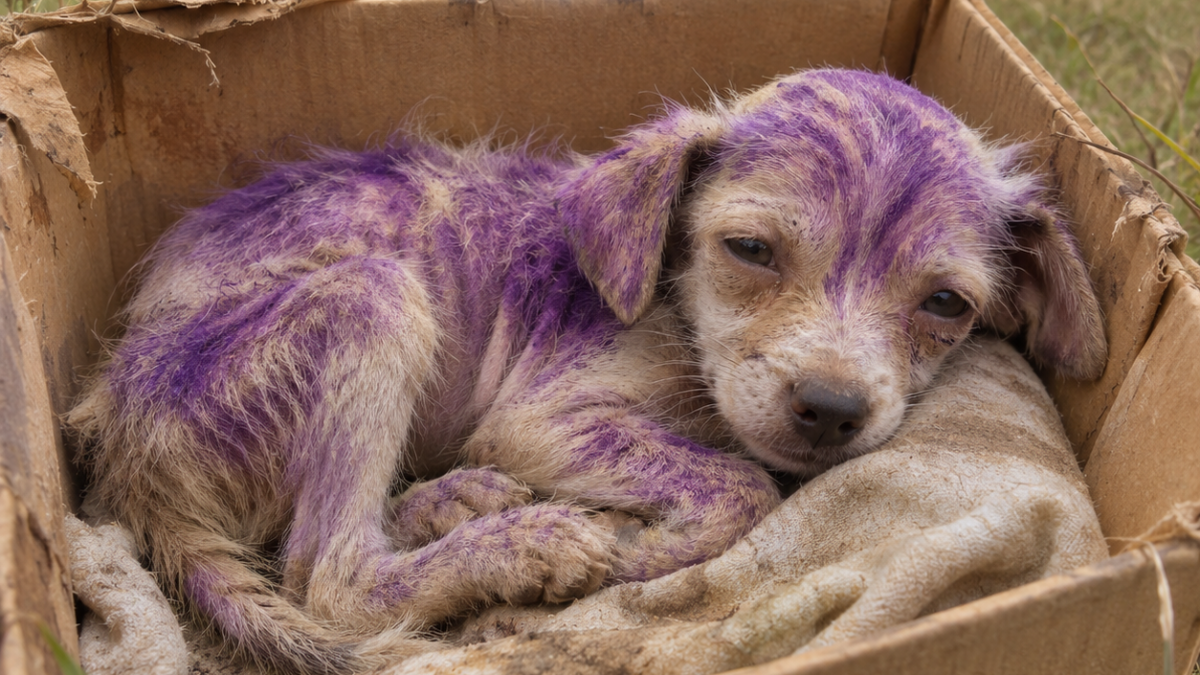
PART 2
The first medical update came less than an hour later.
The veterinarian walked toward us with the expression I had learned to fear from years of rescue work.
Calm.
Controlled.
Too careful.
I stood immediately.
“How bad?”
She glanced at her notes.
“Junie is extremely dehydrated.”
I nodded.
“We expected that.”
“She is also severely anemic.”
My stomach tightened.
“How severe?”
“Enough that we’re concerned.”
I waited.
There was more.
I could see it.
“What else?”
The veterinarian inhaled slowly.
“Her kidney values are very poor.”
For a moment, I wasn’t sure I understood.
“Poor as in dehydration?”
“Dehydration can affect kidney values, yes.”
“But?”
“But right now, her kidneys are not functioning the way we’d want them to.”
I looked through the treatment-room window.
Junie was almost completely hidden beneath warming blankets.
“Are they failing?”
The veterinarian didn’t answer immediately.
That silence answered first.
“We’re worried about kidney failure.”
My friend beside me whispered, “Oh God.”
I kept staring through the glass.
“Can you fix it?”
“We can support her. Warm her slowly. Give IV fluids. Treat the parasite load carefully. Monitor her bloodwork. Correct what we can.”
“That wasn’t my question.”
The veterinarian met my eyes.
I hated myself for sounding sharp, but fear had taken over.
“Can you save her?”
“We’re going to try.”
I had heard those words before.
People think “we’re going to try” sounds hopeful.
Sometimes it does.
In emergency medicine, it can also mean:
I cannot promise you she will survive the night.
I swallowed.
“What are her chances?”
“I don’t want to assign a number.”
“Why?”
“Because she’s extremely compromised.”
That word stayed with me.
Compromised.
Junie had been reduced to the edge of what her body could endure.
Cold.
Dehydrated.
Anemic.
Parasites.
Kidneys struggling.
Emaciated.
And underneath all of it, a question none of us could answer.
How long had she been in that box?
We didn’t know.
Maybe hours.
Maybe longer.
There was no way to ask her.
The only witness was the dog fighting not to die.
The veterinarian continued.
“We need to stabilize her temperature first. Her body is under tremendous stress.”
“Can we stay?”
“Yes. As long as you don’t interfere with treatment.”
“We won’t.”
So we stayed.
That first evening, I sat in a plastic chair outside Junie’s treatment area and watched strangers become the most important people in the world to me.
A technician adjusted fluids.
Another checked her temperature.
Someone gently cleaned around the worst areas of her body.
They moved slowly because everything about Junie looked breakable.
I kept thinking about the box.
The size of it.
How cramped she had been.
How she hadn’t even had enough room to stretch properly.
Every time the hospital door opened, I imagined that field.
Every time I closed my eyes, I saw purple fur.
My friend eventually handed me a cup of coffee.
“You need this.”
“I don’t want it.”
“You haven’t eaten.”
“Neither has she.”
“That’s not the same thing.”
“It feels like it.”
She sat beside me.
For several minutes, neither of us spoke.
Then she said, “Do you think someone dyed her?”
I looked at her.
“Obviously.”
“I mean intentionally. Recently.”
“I don’t know.”
“Why would anybody do that?”
I shook my head.
That question was dangerous.
Why.
In rescue, why can destroy you.
Why starve a dog?
Why leave one outside?
Why let parasites eat away at an animal?
Why dye her fur purple, then leave her in a box?
There are questions that have no answer good enough to justify what happened.
“I don’t know,” I said.
“And I don’t want to guess.”
She nodded.
That became important.
We knew Junie had suffered.
We knew how we found her.
We knew what the veterinarians documented.
But we did not know everything that happened before.
Anger likes to fill empty spaces with certainty.
I refused.
Junie deserved truth, not a dramatic lie.
Hours passed.
The hospital became quieter.
Junie didn’t.
Not exactly.
She barely moved.
But the monitor told us her heart was still beating.
I found myself watching the numbers obsessively.
A technician noticed.
“You should try not to stare at the monitor.”
“How?”
She smiled sadly.
“That’s the hard part.”
“What should I watch?”
“Her.”
So I did.
Her chest rose.
Fell.
Rose.
Fell.
Every breath became a small victory.
Around midnight, Junie’s temperature finally began climbing toward a safer range.
“That’s good?” I asked.
“Yes.”
“Good good?”
The technician smiled.
“It’s progress.”
Progress.
Another word I held onto.
Not safe.
Not recovered.
Progress.
That was enough.
For an hour.
Then Junie’s blood pressure dropped.
The staff moved quickly.
I stood in the hallway, helpless.
“What happened?”
“Her body is unstable.”
“Is she crashing?”
“We’re addressing it.”
I hated medical language because it sounded too clean.
Unstable.
Addressing.
Compromised.
Behind those words was a dog whose body was trying to shut down.
I pressed both palms together.
“Come on, Junie.”
No one told me to be quiet.
“Come on.”
They adjusted her treatment.
Eventually, the frantic movement slowed.
A technician came out.
“She responded.”
I exhaled.
“I thought we lost her.”
“Not yet.”
Not yet.
Another dangerous phrase.
But I took it.
At two in the morning, my friend fell asleep in the chair.
I stayed awake.
I don’t remember deciding to.
I just couldn’t close my eyes.
Junie had spent too long alone.
I knew she couldn’t understand that I was sitting twenty feet away.
But I needed someone to be there.
At one point, a technician allowed me close for a few minutes.
“Don’t touch the IV line.”
“I won’t.”
I sat beside the cage.
Junie’s eyes were still closed.
“Hey.”
Nothing.
“It’s me.”
Nothing.
I touched one finger gently to the blanket near her paw.
“You don’t know me.”
Her breathing continued.
“And I don’t know you.”
I stared at her purple-stained fur.
“But we’re going to figure this out.”
I felt stupid talking to an unconscious dog.
Then again, the entire situation was beyond normal logic.
“You were in the wrong box, Junie.”
Her ear twitched.
Maybe coincidence.
I kept talking.
“That wasn’t where your story was supposed to stop.”
No response.
“I don’t know who put you there.”
My throat tightened.
“I don’t know if they thought nobody would find you.”
I leaned closer.
“But somebody did.”
That was all I could give her.
Somebody did.
By sunrise, Junie was still alive.
The veterinarian repeated bloodwork.
The kidney numbers were still bad.
Her anemia remained serious.
But her temperature had improved.
Her hydration had begun to respond.
She was still critical.
That word returned again and again.
Critical.
Critical.
Critical.
I went home for two hours only because the staff practically ordered me to.
“She’s being watched continuously,” the veterinarian said.
“I know.”
“You need sleep.”
“I’ll sleep later.”
“You won’t help her by collapsing.”
That was fair.
I left.
My house felt offensively normal.
Sunlight through the window.
Clean water from the faucet.
A refrigerator full of food.
Blankets on the couch.
Warmth.
I thought of Junie curled in that box and felt angry at every comfortable thing I owned.
Then I stopped myself.
Comfort wasn’t the enemy.
Comfort was what I wanted for her.
I showered.
Changed clothes.
Tried to sleep.
Couldn’t.
My phone sat beside my head.
Every vibration made my heart jump.
No call.
That was good.
In emergency rescue, sometimes no call is good.
It means nobody needs to tell you something terrible.
I returned before noon.
Junie looked almost the same.
That disappointed me more than it should have.
I had somehow expected a miracle overnight.
The veterinarian noticed my face.
“Recovery from this level of illness is not going to be fast.”
“I know.”
“She survived the night.”
“I know.”
“That matters.”
I nodded.
But fear doesn’t disappear because someone explains the timeline.
I sat beside Junie again.
“Second day.”
Her eyes were closed.
“You made it to the second day.”
A nurse brought food for her, but Junie wasn’t ready to eat normally.
They continued supportive care.
The parasite treatment had to be handled cautiously because her body was so weak.
Even killing parasites too aggressively could create additional stress.
Everything had become a balancing act.
Treat one problem without overwhelming another organ.
Give enough fluids without creating new complications.
Warm her without shocking her body.
Nourish her without demanding too much from a system that had been starved.
I had always imagined rescue as removing an animal from danger.
Junie taught me that sometimes the real rescue begins afterward.
Finding her had taken minutes.
Saving her would require days of careful decisions.
That afternoon, one of the technicians came to me.
“She moved her head.”
I stood.
“What?”
“When I adjusted her blanket.”
“Is that good?”
“Yes.”
“Can I see?”
The technician smiled.
“You’re already looking through the glass.”
“I mean closer.”
A few minutes later, they let me sit beside her again.
“Junie?”
Her head remained still.
“I’m told you’re showing off now.”
Nothing.
“You moved your head for somebody else?”
I waited.
Then her nose shifted.
Barely.
My heart jumped.
“Hey.”
Her eyelids fluttered.
I froze.
“Junie?”
Nothing happened.
I leaned closer.
“Come on.”
Her eyelids moved again.
Then one eye opened.
Not fully.
Just a narrow sliver.
But it opened.
I stopped breathing.
“Oh my God.”
The technician turned.
“What?”
“She opened her eye.”
The technician stepped closer.
Junie’s eye closed again.
“I saw it.”
“I believe you.”
“No, you don’t understand.”
My voice broke.
“She looked at me.”
The technician smiled.
“I understand.”
I reached toward Junie but stopped before touching her.
“Hi.”
Her eye opened again.
This time slightly wider.
Clouded with exhaustion.
Confused.
Alive.
I cried immediately.
There was no dignity in it.
I covered my mouth and started crying like somebody had given me back something I hadn’t realized I’d already lost.
My friend came into the room.
“What happened?”
“She opened her eyes.”
“What?”
“Look.”
Junie opened them again.
My friend started crying too.
Two adults standing beside an emergency cage crying because a sick dog looked at us.
It sounds small.
It wasn’t.
For almost twenty-four hours, Junie had existed mostly through numbers.
Temperature.
Blood pressure.
Kidney values.
Red blood cell counts.
Fluid rates.
Now there was a dog looking back.
Weakly.
But looking.
“Hi, baby,” my friend whispered.
Junie’s eyes closed.
“That’s okay.”
I wiped my face.
“You don’t have to do anything else today.”
It became our anchor.
Whenever fear returned, we said it.
She opened her eyes.
When the kidney numbers still looked frightening—
She opened her eyes.
When anemia remained severe—
She opened her eyes.
When she refused food—
She opened her eyes.
When a technician warned us she could still decline—
She opened her eyes.
It didn’t mean she was safe.
It meant she was still fighting.
The second night was harder emotionally than the first.
On the first night, I had been numb.
On the second, I had hope.
Hope is wonderful.
Hope is also terrifying.
Once you begin imagining an animal surviving, the possibility of losing them becomes sharper.
I had started imagining Junie outside the hospital.
Sleeping on a bed.
Eating from a bowl.
Walking in the sun.
I hated myself for imagining too much.
What if her kidneys failed completely?
What if the anemia became impossible to manage?
What if she didn’t survive?
A veterinarian spoke with us that evening.
“We need to be realistic.”
My stomach turned.
“About what?”
“She’s improving in some areas.”
“But.”
“But she’s not out of danger.”
I nodded.
“Her kidney function remains a serious concern. Her anemia remains significant. Her body has been through extreme stress.”
“Could she still die?”
“Yes.”
The word hurt.
At least she didn’t soften it.
I preferred the truth.
“What do we do?”
“Continue exactly what we’re doing.”
“Wait?”
“Support her.”
I hated waiting.
Waiting felt passive.
But it wasn’t.
The staff worked constantly.
Junie received care constantly.
Our job was to not confuse our need to do something dramatic with what Junie’s body actually needed.
So we waited.
That night, I sat beside her for another hour.
Her eyes opened occasionally.
Sometimes I thought she was looking at me.
Sometimes she was probably just looking toward movement.
I talked anyway.
“You know what’s going to happen if you survive?”
Her ear moved.
“You’re going to be spoiled.”
Nothing.
“Ridiculously.”
Her nose shifted.
“I’m serious.”
My friend leaned against the wall.
“She already knows.”
“You think?”
“Look at her.”
Junie opened one eye.
I smiled.
“She’s negotiating.”
“For what?”
“Premium toys.”
“Obviously.”
We laughed quietly.
It was the first time laughter entered Junie’s story.
That mattered too.
By morning, some of her bloodwork had stabilized.
Not normal.
Stable.
I had learned to respect the difference.
The veterinarian explained every number.
I understood about half of it.
“What I need you to hear,” she finally said, “is that she’s not getting worse right now.”
I nodded.
“That’s good.”
“Yes.”
“Can I say she’s improving?”
“Cautiously.”
“I’m saying it.”
She smiled.
“Cautiously.”
Junie began licking a small amount of food.
We celebrated as though she’d eaten an entire steak.
“She ate!”
“Two bites,” the technician corrected.
“Two important bites.”
“Fair.”
Later that day, Junie lifted her head on her own.
Then held it there.
Her neck trembled from effort.
I wanted to help.
The technician stopped me.
“Let her.”
“She looks exhausted.”
“She is.”
“Then shouldn’t we—”
“She needs to begin using her body again.”
Junie lowered her head.
I exhaled.
“That was enough.”
The technician nodded.
“Exactly.”
Tiny victories.
That became the language of recovery.
Not dramatic miracles.
Small things.
Eyes opening.
Head lifting.
Food licked from a spoon.
Temperature holding.
Blood pressure improving.
One good lab result.
One less frightening lab result.
A little more awareness.
Then, on the third day, Junie did something none of us expected that morning.
She tried to stand.
I was there when it happened.
A technician had opened her enclosure to change bedding.
Junie shifted.
Then placed one paw underneath herself.
“Wait.”
The technician froze.
Junie’s back legs trembled.
She pushed.
Her body rose perhaps two inches.
Then collapsed.
I gasped.
“Did she just—”
“Yep.”
Junie tried again.
“Should we stop her?”
“No.”
The technician positioned her hands near Junie’s body, ready to catch her.
“Come on, girl.”
Junie pushed.
Front legs first.
Then back.
For one unbelievable second, she was standing.
Her legs shook violently.
Her head hung low.
But she was up.
“Junie!”
She immediately collapsed onto the blanket.
I covered my mouth.
“Oh my God.”
The technician rubbed her side.
“Good girl.”
Junie lay still.
Exhausted.
I cried again.
Apparently this dog had turned me into someone who cried every six hours.
“You stood.”
Junie blinked.
“You actually stood.”
My friend laughed behind me.
“Now she’ll be running the hospital tomorrow.”
“Don’t say that.”
We weren’t there yet.
Standing was hard.
Walking was harder.
Her muscles had wasted away.
Her body was weak.
Balance was difficult.
Every movement cost energy she barely had.
The doctors reminded us repeatedly that recovery would not be straight.
“She may have good hours and bad hours.”
“How bad?”
“Some dogs improve and then decline.”
“Don’t say that.”
“I need you to understand.”
I did.
That didn’t mean I wanted to hear it.
Junie tried standing several more times that day.
Most attempts ended quickly.
On one, she took a step.
One.
Her paw moved forward.
Her body followed.
Then she sank down.
“One step,” I whispered.
The technician nodded.
“One step.”
That evening, I sat beside her.
“Okay.”
Junie looked toward me.
“Here’s the deal.”
Her eyes stayed open.
“You don’t have to run.”
One ear twitched.
“You don’t even have to walk tomorrow.”
I leaned closer.
“You just keep choosing one more thing.”
She blinked.
“One more breath.”
Blink.
“One more bite.”
Blink.
“One more step.”
Her head lowered.
“And we’ll keep doing the rest.”
For the first time, Junie seemed less like a patient and more like a personality beginning to emerge.
She disliked certain medications.
Strongly.
When a technician approached with one syringe, Junie turned her head away.
The technician laughed.
“Excuse me.”
Junie refused to look.
“Now you have opinions?”
Junie turned farther.
I smiled.
“That’s my girl.”
The technician gave me a look.
“Do not encourage her.”
“I absolutely encourage her.”
The stronger Junie’s preferences became, the happier I was.
On the fourth day, she growled softly when someone tried to adjust her blanket.
The technician looked delighted.
“Did you just growl at me?”
Junie stared.
“Rude.”
I laughed.
“Best sound I’ve heard all week.”
The next step was getting her moving more consistently.
A rehabilitation technician helped her stand.
Junie hated the support sling at first.
Her expression clearly said she considered it humiliating.
“Sorry,” I told her.
She looked at me.
“You need it.”
She looked away.
“Don’t be dramatic.”
My friend burst out laughing.
“You’re telling the purple dog we found dying in a box not to be dramatic?”
“Good point.”
Junie’s first real walk was perhaps six feet.
It took forever.
Front paw.
Pause.
Back paw.
Tremble.
Stop.
Breathe.
Again.
She stumbled twice.
Each time, someone supported her.
When she reached the end of the short hallway, we were cheering.
Not loudly.
This was still a hospital.
But enough.
“Good girl.”
Junie stood there looking exhausted.
Then turned around as if she planned to walk back by herself.
“Okay, overachiever.”
The technician lifted her.
“You’re done.”
Junie looked offended.
That was when I realized we had crossed an invisible line.
I wasn’t constantly asking whether she would die anymore.
I was beginning to ask what she would become.
The kidney values slowly improved.
Her hydration normalized.
The parasite burden was treated.
Her anemia began responding.
No single day produced a miracle.
But together, the days began changing her.
She filled out slightly.
Her eyes looked brighter.
Her posture changed.
The purple fur remained, but beneath it, Junie was returning.
Or maybe emerging for the first time.
Because none of us knew what she had been like before.
The staff began discovering her personality.
Sweet.
That was the first word everyone used.
Then playful.
That one surprised us.
The first time someone offered Junie a toy, she simply stared at it.
It was a soft little stuffed animal.
The technician placed it near her.
Junie sniffed.
Nothing.
“Maybe she doesn’t know what toys are,” I said.
The thought hurt.
“Give her time.”
The toy stayed beside her bed.
Later that afternoon, I came back from getting coffee.
The stuffed animal was on the other side of the enclosure.
“Did somebody move it?”
The technician smiled.
“No.”
“Junie?”
Junie looked innocent.
“You moved that?”
Nothing.
The technician whispered, “Watch.”
She placed the toy closer.
Junie stared.
Then slowly opened her mouth.
She grabbed it.
My heart almost exploded.
“Look at you.”
Junie held the toy weakly between her teeth.
The technician tugged it gently.
Junie’s grip tightened.
“Oh!”
A tiny game of tug began.
Not much.
Three seconds.
Maybe four.
Then Junie released it, exhausted.
But the entire room felt different afterward.
She had played.
A dog found dying in a box had chosen to spend energy on something completely unnecessary for survival.
Play.
That felt like health returning in a language no blood test could measure.
Soon the staff started bringing her different toys.
A small rope.
A squeaky stuffed animal.
A soft ball.
Junie liked stuffed toys best.
Especially ones she could hold between her paws.
One nurse began calling them “Junie’s babies.”
“She’s building a collection,” I said.
“She deserves one.”
Junie agreed.
By the end of the week, she had several.
That was how the hospital staff fell in love with her.
Not all at once.
Piece by piece.
The nurse who had cleaned her on the first night now brought treats in her pocket.
The technician who helped with fluids sat beside Junie during breaks.
The receptionist came back just to say hello.
One veterinarian who had been careful not to promise survival now smiled whenever she entered Junie’s room.
“She looks different,” I told her.
“She is different.”
“Do you think she’s going to make it?”
The veterinarian paused.
That old fear returned.
Then she smiled.
“I think she has a very good chance.”
I closed my eyes.
A very good chance.
Not “we’ll try.”
Not “she’s critical.”
A very good chance.
I turned toward Junie.
“You hear that?”
Junie was chewing a toy.
“Clearly overwhelmed.”
The veterinarian laughed.
Her recovery accelerated after that.
Walking remained difficult, but she improved every day.
At first, someone stayed beside her with a support sling.
Then she only needed light help.
Then, one morning, Junie stood without anyone touching her.
Four paws.
Shaky but independent.
She looked around.
The technician held her breath.
“Come here.”
Junie stepped.
One.
Two.
Three.
Slow.
Uneven.
But hers.
She walked toward the technician.
When she reached her, she leaned against the woman’s leg.
The technician crouched and hugged her.
“You did it.”
Junie wagged her tail.
Just once.
I had not seen that before.
“Did she—”
“Yes.”
“Her tail.”
“I saw it.”
Junie wagged again.
That tiny tail movement broke something open inside me.
For days, her body had communicated suffering.
Shivering.
Collapsing.
Weakness.
Now it had produced joy.
A wag.
The room erupted in smiles.
Someone said, “Do it again.”
Junie didn’t.
Typical.
We laughed.
Within a few more days, Junie started expecting attention.
If someone passed her enclosure without stopping, she followed them with her eyes.
One nurse discovered that if she ignored Junie intentionally, Junie would make a tiny noise.
Not a bark.
Almost a complaint.
“Did you need something?”
Junie wagged.
“She has trained you,” I said.
The nurse looked offended.
“No.”
Junie made the noise again.
The nurse immediately went over.
I pointed.
“Trained.”
“Be quiet.”
Junie’s health improved enough that we began discussing discharge.
That word frightened me almost as much as it excited me.
“Is she ready?”
“Soon.”
“What if her kidneys worsen again?”
“We’ll monitor.”
“What about the anemia?”
“Improving.”
“What if she stops eating?”
“You’ll call.”
“What if—”
The veterinarian raised a hand.
“You are going to have to let her leave the hospital eventually.”
“I know.”
“She can’t live here forever.”
One technician walked by and said, “She can live with me.”
Another shouted from the hallway, “No, me.”
Junie had options.
That was the beautiful part.
The dog nobody had wanted enough to protect now had an entire hospital debating who loved her most.
But someone had already stepped forward.
A woman named Claire had been following Junie’s recovery through the rescue organization.
She had asked about her almost from the beginning.
Not because Junie was cute.
At that point, Junie looked like a dog who had barely survived a disaster.
Claire didn’t care.
She wanted to know what Junie would need.
What follow-up care might look like.
Whether her kidneys could have long-term problems.
Whether she would need a special diet.
How to help her regain strength safely.
Those questions mattered to me.
People sometimes fall in love with rescue stories.
They fall in love with the dramatic before-and-after.
But adoption isn’t loving a story.
It’s loving the animal who remains after the story stops being dramatic.
Claire understood that.
The first time she met Junie, I watched carefully.
I couldn’t help it.
Junie had fought too hard.
Nobody was getting near her without me silently evaluating every movement.
Claire entered the room slowly.
She didn’t rush toward Junie.
She sat on the floor.
“Hi, baby.”
Junie stared.
Claire held out her hand but didn’t move it closer.
“You don’t know me.”
Junie sniffed the air.
“That’s okay.”
I liked her immediately.
Junie took one slow step.
Then another.
Claire stayed still.
Junie reached her.
Sniffed her fingers.
Then backed away.
Claire smiled.
“Fair.”
No grabbing.
No forced affection.
No performance.
A few minutes later, Junie returned.
This time she stayed.
Claire scratched gently beneath her chin.
Junie’s eye softened.
I glanced at the technician.
The technician raised her eyebrows.
Good sign.
Then Claire pulled something from a bag.
A small stuffed doll.
Junie’s head lifted.
“Oh,” I said.
Claire smiled.
“I heard she likes these.”
Junie walked directly toward it.
The betrayal was immediate.
“Seriously?”
Everyone laughed.
Claire handed her the doll.
Junie grabbed it.
Within thirty seconds, she was sitting beside Claire holding the toy.
“I’ve been replaced.”
The technician patted my shoulder.
“Painful.”
Claire looked at me.
“She’s incredible.”
“You should’ve seen her the first day.”
Her smile faded.
“I saw the pictures.”
I looked at Junie.
“I still can’t believe it’s the same dog.”
Claire’s hand rested beside her.
“Maybe she isn’t.”
I looked at her.
“What do you mean?”
“Maybe that version of her ended in the field.”
I understood.
Not literally.
We couldn’t erase what happened.
But Junie had become something the box never predicted.
Alive.
Curious.
Playful.
Loved.
The discharge day arrived sooner than I expected.
The veterinarian entered with paperwork.
“She’s ready.”
My chest tightened.
“Ready ready?”
“She can leave.”
“Are you sure?”
“Yes.”
“Completely?”
The veterinarian laughed.
“No living creature comes with a guarantee.”
I hated that answer because it was true.
“She’ll need follow-up bloodwork.”
“I know.”
“Nutrition plan.”
“Yes.”
“Slow activity.”
“Absolutely.”
“Monitor appetite, urination, energy.”
“I have the list.”
“You’ve memorized it, haven’t you?”
“Possibly.”
Junie sat nearby with one of her stuffed animals.
The hospital staff began appearing one by one.
That was when I realized how many people had cared for her.
Technicians.
Nurses.
Reception staff.
Doctors.
People from different shifts.
Some had only spent an hour with her.
Others had watched her for days.
They all came.
One woman knelt beside Junie.
“You scared us.”
Junie wagged.
Another scratched her ear.
“You better not come back here unless it’s for a checkup.”
Junie leaned into her.
Someone brought a final toy.
Junie grabbed it immediately.
“She’s leaving with more luggage than I have.”
Claire laughed.
“I brought a bag.”
Of course she did.
I watched everyone say goodbye.
The same people who had once stood over Junie trying to keep her alive were now standing around her trying not to cry.
The veterinarian who first warned us about kidney failure crouched beside her.
“You were not supposed to make this difficult.”
Junie licked her hand.
The veterinarian looked away quickly.
“I have something in my eye.”
I smiled.
“Sure.”
Claire attached Junie’s new leash.
Junie looked confused.
Then toward the door.
For a second, I remembered the box.
The field.
The stretcher.
The treatment-room doors.
The monitor.
The phrase “kidney failure.”
The two long nights.
And now Junie was walking out.
Not carried.
Walking.
Her legs were still thin.
Her steps weren’t perfect.
But every step belonged to her.
When the hospital doors opened, sunlight hit her purple-stained coat.
Junie stopped.
Claire crouched.
“Take your time.”
Junie sniffed the air.
Then walked forward.
One step.
Two.
Three.
The staff watched from behind us.
I heard somebody crying.
I was crying too.
I didn’t bother hiding it.
Junie reached the car.
Claire lifted her gently.
A soft blanket was waiting in the back seat.
Several toys were already there.
Of course.
Claire looked at me.
“Do you want to say goodbye?”
I shook my head.
“Not goodbye.”
I leaned into the car.
Junie looked at me.
I touched her cheek.
“You were supposed to disappear in that field.”
She blinked.
“That was the plan somebody made for you.”
My voice shook.
“But it didn’t work.”
Junie’s nose touched my fingers.
I smiled.
“Go home.”
Claire closed the door.
The car pulled away.
I stood in the hospital parking lot long after it disappeared.
My friend came beside me.
“You okay?”
“No.”
She waited.
Then I laughed.
“Yes.”
Both were true.
The first night in Claire’s house, Junie didn’t understand the bed.
Claire sent me a picture.
A beautiful dog bed sat beside the couch.
Junie was asleep on the floor next to it.
The caption read:
“She doesn’t trust the luxury yet.”
I smiled.
“Give her time,” I replied.
The next morning came another photo.
Junie was halfway inside the bed.
Only her back legs remained on the floor.
Later that day:
Fully inside.
By the end of the week, the bed belonged to her.
So did the couch.
And one particular blanket.
Claire learned quickly that Junie loved softness.
Maybe because she had known so little of it.
Blankets.
Pillows.
Stuffed animals.
If something was soft, Junie wanted it.
Claire started buying toys.
Too many toys.
I warned her.
“You’re creating a monster.”
“Impossible.”
“Give it a month.”
Junie had dolls.
Stuffed bears.
Soft squeaky animals.
A ridiculous pink rabbit almost as large as she was.
She dragged that rabbit through the house constantly.
Claire sent videos.
Junie would grab one ear and walk backward because the toy was too large to carry normally.
Sometimes she tripped over it.
Then got angry at the rabbit.
The dog who had once lacked enough strength to stand was now fighting a stuffed rabbit over hallway ownership.
That was revenge.
Not violence.
Not punishment.
Revenge against every moment that told Junie she was unwanted.
Every toy was revenge.
Every meal was revenge.
Every soft blanket was revenge.
Every veterinary checkup showing improvement was revenge.
Every night she slept warm was revenge.
Every morning she woke up expecting love was revenge.
Whoever had left her in that box had made a decision.
They had decided Junie could be discarded.
Her entire life afterward became evidence that they had been wrong.
Her recovery wasn’t perfect.
There were setbacks.
A few weeks after adoption, Junie’s appetite dropped.
Claire called immediately.
“She didn’t finish breakfast.”
“How much did she leave?”
“Half.”
“Any vomiting?”
“No.”
“Energy?”
“Lower.”
“Call the vet.”
“I already did.”
That answer made me smile despite the worry.
Claire wasn’t taking chances.
Bloodwork showed Junie’s kidneys still needed monitoring, but there wasn’t the catastrophic decline we feared.
Her veterinarian adjusted the plan.
Within a day, she was eating again.
Claire sent a picture of an empty bowl.
Caption:
“Apparently she heard everyone was worried.”
I replied:
“Tell her never to do that again.”
Junie did not listen.
Dogs rarely respect emotional agreements.
But over time, the frightening episodes became less frequent.
Her bloodwork improved.
Her anemia resolved.
Her weight increased.
Slowly.
Carefully.
Her coat changed too.
The purple began growing out.
Natural fur replaced the dyed sections.
At first, Claire joked that Junie was “changing costumes.”
Then one day she sent me a photograph and I stared at it for a long time.
The purple was almost gone.
That image affected me more than I expected.
The color had become linked in my mind to the worst day of Junie’s life.
Seeing it disappear felt symbolic.
Not because purple itself was bad.
But because that coat had been part of the dog we found in the box.
Now healthy fur was growing through.
New.
Untouched.
I texted Claire.
“She looks like herself.”
Claire replied:
“I think she’s figuring out who that is.”
She was.
Junie became playful in ways the hospital staff never got to fully see.
She loved carrying toys from room to room.
She had a habit of bringing Claire a doll whenever Claire sat down.
Not throwing it.
Not always asking to play.
Just presenting it.
Claire would say, “Thank you.”
Junie would place it in her lap.
Sometimes three toys.
Sometimes five.
One evening, Claire sent a photo of herself buried under stuffed animals.
Junie sat proudly beside her.
Caption:
“I have been chosen as the toy storage facility.”
I laughed so hard I had tears in my eyes.
That was Junie’s new problem.
Too many toys.
What a beautiful problem.
She discovered sunlight.
Every afternoon, a bright rectangle crossed Claire’s living-room floor.
Junie found it.
Then claimed it.
She would lie there until the sun moved.
Then she moved with it.
Claire bought an expensive orthopedic bed.
Junie still preferred the sun.
“Of course,” I said.
“She has standards.”
Junie also developed an obsession with socks.
Not shoes.
Only socks.
Claire would do laundry.
A sock disappeared.
Then another.
Eventually, she found Junie’s collection beneath the bed.
Seven socks.
None matched.
Claire sent me the evidence.
I replied:
“She is building an emergency fund.”
“For what?”
“Socks.”
Junie began sleeping beside Claire’s bed.
Then at the foot of the bed.
Then on the bed.
Eventually, the inevitable happened.
Claire sent a message at 2:13 a.m.
“She has taken my pillow.”
I wrote back the next morning.
“Congratulations. You officially live with Junie now.”
“No, Junie lives with Junie. I apparently rent.”
Exactly.
That was the transformation I wanted.
Not simply healthy.
Secure.
A dog truly feels safe when she begins believing the world belongs to her.
Junie learned she could make choices.
Where to sleep.
Which toy to carry.
Whether she wanted attention.
Which blanket she preferred.
Those choices sound small.
To an animal who once had no control, they are enormous.
Claire never forced her.
If Junie walked away, she let her go.
If Junie wanted affection, she gave it.
If Junie was scared, Claire stayed nearby without overwhelming her.
Trust built slowly.
Then suddenly.
One evening, there was thunder.
Junie panicked.
She ran through the house looking for somewhere to hide.
Claire sat on the floor.
She didn’t chase.
“It’s okay.”
Junie paced.
Thunder again.
Junie stopped.
Looked at Claire.
Then crossed the room.
She climbed directly into Claire’s lap.
Claire wrapped one arm loosely around her.
“I’m here.”
Junie shook.
Then gradually relaxed.
Claire told me about it the next day.
“She chose me.”
I knew exactly what she meant.
“That’s bigger than adoption paperwork.”
“I know.”
Because Junie had begun believing that when something frightened her, a human could mean safety instead of danger.
We couldn’t know what happened before the field.
We couldn’t diagnose every fear.
But every time Junie chose trust, something old lost power.
Months later, I visited.
I hadn’t seen her in person since shortly after adoption.
Claire opened the door.
“Prepare yourself.”
“For what?”
“She has opinions now.”
“I heard.”
Junie came around the corner.
I stopped.
She looked—
Healthy.
That was the first word.
Not recovered.
Not improved.
Healthy.
She had gained weight.
Her coat was glossy.
The purple was nearly gone.
Her eyes were bright.
Her body had shape instead of sharp bones.
For one second, I genuinely struggled to connect her to the animal in the box.
“Junie?”
Her ears lifted.
I crouched.
“Hey.”
She hesitated.
Then approached.
Sniffed my hands.
I didn’t know whether she remembered me.
Maybe she remembered scent.
Maybe not.
That was okay.
I didn’t need gratitude.
Then she leaned her shoulder against my leg.
My eyes filled.
“Oh.”
Claire smiled.
“She likes you.”
I scratched Junie’s neck.
“You’re heavy.”
That sentence almost broke me.
Heavy.
Junie was heavy enough to feel substantial under my hand.
The first time I lifted her, I had been afraid her body might break.
Now she pushed against me with strength.
“You’re supposed to be fragile,” I whispered.
Junie wagged.
Claire laughed.
“Don’t tell her that.”
Junie ran toward the living room.
Actually ran.
I stood.
“She can run.”
“Oh, she can run.”
Junie returned with the giant pink rabbit.
She shoved it against my knee.
I stared.
“Is this for me?”
Claire nodded.
“Throw it.”
“It weighs almost as much as she did when we found her.”
Junie barked.
I froze.
That was the first time I’d heard her bark.
Loud.
Clear.
Demanding.
I started laughing.
“Okay!”
I threw the rabbit badly.
Junie chased it.
She slipped slightly on the floor, recovered, grabbed the toy, and came back.
“Again?”
Bark.
Claire crossed her arms.
“See? Opinions.”
We played until Junie got tired.
Then she climbed onto the couch.
Claire covered her with a blanket.
Junie immediately curled beneath it.
I watched.
The contrast was almost cruel.
Blanket now.
Box then.
Warm now.
Freezing then.
Healthy now.
Failing kidneys then.
Running now.
Unable to stand then.
Spoiled now.
Abandoned then.
I sat beside her.
“I wish the people at the hospital could see this.”
Claire smiled.
“They have.”
“What?”
“I send pictures.”
“Of course you do.”
“All the time.”
“Good.”
One week later, Claire brought Junie back to visit the hospital.
I came too.
The receptionist saw her first.
“No.”
She stood.
“That’s Junie?”
Junie wagged.
The woman covered her mouth.
“Oh my God.”
Within minutes, half the staff had appeared.
Everyone wanted to touch her.
Everyone had a memory.
“I gave her fluids the first night.”
“I helped with her temperature.”
“She tried to bite my syringe.”
“She stole my heart.”
Junie accepted the attention like a celebrity.
Someone brought a toy.
Of course.
Another brought treats.
Claire looked at me.
“They’re making my job worse.”
I nodded.
“They created this.”
The veterinarian who had first treated Junie came out last.
She stopped several feet away.
Her expression changed completely.
“Wow.”
Junie walked toward her.
The veterinarian crouched.
“You’re not supposed to look this good.”
Junie licked her chin.
Everyone laughed.
The veterinarian held Junie’s face gently.
“I remember when you couldn’t lift your head.”
Junie tried to reach the treat in her pocket.
The veterinarian laughed.
“Never mind. Clearly she’s moved on.”
That was exactly what I wanted.
Junie had moved on.
Not in the human sense of forgetting.
We had no idea what she remembered.
But her life was no longer organized around suffering.
She wasn’t defined by the box.
She was defined by what came after.
That realization helped me with my own anger.
For months, I had been furious.
I thought about the person who left Junie.
I imagined them placing that box in the field.
Walking away.
Driving away.
Going back to an ordinary day while Junie lay dying.
The image made me sick.
I wanted them to know she survived.
Part of me wanted to put her before them and say:
Look.
Look at what you nearly destroyed.
Look at the dog you decided didn’t matter.
Look at the life you tried to throw away.
But we never knew exactly who was responsible.
And even if we had, Junie’s recovery didn’t need their acknowledgment to be real.
That became the lesson.
Revenge doesn’t always require the person who caused harm to witness the result.
Sometimes the result exists whether they see it or not.
Junie lived.
That was enough.
The box failed.
The field failed.
The cold failed.
The dehydration failed.
The parasites failed.
The anemia failed.
The kidney crisis failed.
Everything that tried to reduce Junie to a tragic ending failed.
She won.
Not by hurting anyone.
By waking up.
By standing.
By taking one step.
Then another.
By playing.
By leaving the hospital.
By going home.
By stealing socks.
By claiming pillows.
By collecting dolls.
By becoming loved enough that people worried when she left half a bowl of breakfast.
That was an extraordinary reversal.
At first, nobody knew whether Junie would survive until morning.
Later, Claire worried Junie might be gaining too much weight because she loved treats.
I laughed when she told me.
“What?”
“Nothing.”
“She’s getting chunky.”
“Do you remember when we wanted her to gain an ounce?”
“I know.”
“Now we’re discussing diet treats.”
Claire laughed.
“Progress.”
Yes.
Progress can become ridiculous.
And that’s beautiful.
Junie eventually reached a healthy weight.
Her kidney values remained something to watch, but she continued doing well.
Regular bloodwork became routine.
At each visit, Claire held her breath.
I did too whenever she sent results.
“Still good.”
Two words.
Every time, relief.
Junie’s coat eventually returned completely to its natural color.
The purple disappeared.
One day, Claire placed an old rescue photograph beside a new one.
The difference was so extreme that someone unfamiliar with the story might have assumed they were different dogs.
In the first image, Junie was collapsed.
Thin.
Purple.
Eyes dull.
In the second, she was sitting upright on a couch wearing an expression of complete confidence with three stuffed animals around her.
Claire wrote to me:
“Which one is the real Junie?”
I stared at the question.
Then replied:
“Both. But only one got to choose her life.”
The first Junie was survival.
The second was living.
Both deserved respect.
I never wanted people to look at her original photo only for shock.
There was dignity in that dog too.
Even when she was sick.
Even when she was helpless.
She wasn’t valuable because she later became beautiful.
She was worth saving in the box.
She was worth saving when her fur looked terrible.
She was worth saving when worms covered her.
She was worth saving when her kidneys were failing.
She was worth saving before anyone knew she would become playful and sweet.
That matters.
Rescue stories sometimes accidentally teach the wrong lesson.
People celebrate transformation so strongly that it can sound like the animal became worthy only after healing.
No.
Junie was always worthy.
The transformation simply allowed us to see everything suffering had hidden.
Her playfulness.
Her affection.
Her stubbornness.
Her obsession with stuffed animals.
Her dramatic dislike of rain.
Her love of lying in sunlight.
Her habit of carrying toys to Claire.
Her little bark when ignored.
All of that had been inside the dog in the box.
Sickness had buried it.
Care uncovered it.
One summer afternoon, Claire invited me over.
Junie was outside in the yard.
The moment I entered, she ran toward me.
This time there was no hesitation.
She remembered.
Or perhaps we had simply become friends.
Either was enough.
She crashed into my legs.
“Hi!”
Tail wagging.
Fast.
Strong.
I crouched.
“You’re going to knock me over.”
Junie licked my face.
“Okay. I missed you too.”
Claire walked out carrying lemonade.
“She’s been waiting.”
“For me?”
“For literally anybody who might throw her ball.”
“Less touching.”
We sat outside.
Junie chased toys.
Then rested in the grass.
For a moment, the image triggered the old memory.
Grass.
Field.
Box.
Cold body.
I looked away.
Claire noticed.
“You okay?”
“Yeah.”
Junie rolled onto her back.
She looked ridiculous.
I smiled.
“It’s just strange seeing her lying in grass.”
Claire understood immediately.
“She chooses this grass.”
I looked at her.
That sentence was perfect.
She chooses this grass.
The field had been something done to Junie.
This yard was hers.
She could walk inside whenever she wanted.
Water waited.
A bed waited.
Claire waited.
Junie lay in the grass because the sun felt good.
That difference was everything.
“She chooses this grass,” I repeated.
Junie sneezed.
We laughed.
Later, I watched her carry a doll into the house.
I thought about the cramped cardboard box.
Once, Junie had fit inside something small because her body had been starved down.
Now she filled rooms with herself.
Not physically.
Emotionally.
You always knew where Junie was.
A toy squeaked.
A tail hit furniture.
A bark came from the kitchen.
A doll appeared mysteriously in your lap.
She occupied space proudly.
I loved that most.
Abandonment sends a message:
You don’t belong.
Junie’s entire adult life answered:
Actually, I do.
I belong on this couch.
I belong on this bed.
I belong in this yard.
I belong beside this woman.
I belong in photographs.
I belong at veterinary appointments.
I belong in someone’s plans.
I belong in someone’s heart.
I belong.
That was her revenge.
One anniversary of her rescue, Claire bought Junie a mountain of toys.
I objected.
“She has enough.”
Claire looked at me seriously.
“That concept does not apply to Junie.”
Junie was standing among the bags.
“She’s spoiled.”
“Yes.”
“You admit it?”
“Proudly.”
They opened the toys one by one.
A stuffed duck.
A small bear.
A ridiculous doll with long legs.
A squeaky heart.
Junie went straight for the doll.
Of course.
She carried it away.
Claire smiled.
“Worth it.”
I watched Junie disappear into the hallway.
“Do you ever think about the box?”
“All the time.”
“How?”
Claire paused.
“Not the way I used to.”
“What changed?”
“At first, I looked at her and thought, How could someone do that?”
I nodded.
“Now?”
“Now I look at her and think, They didn’t get the final word.”
I felt my throat tighten.
Exactly.
They didn’t get the final word.
The person who left Junie had made a statement with their actions.
You are disposable.
The rescue answered.
No.
The hospital answered.
No.
Claire answered.
No.
Junie answered the loudest.
No.
Every year she lived was another refusal.
As time passed, the rescue organization continued receiving animals.
Some survived.
Some didn’t.
That is the part of rescue people don’t always want to discuss.
There isn’t always a Junie ending.
Sometimes you arrive too late.
Sometimes the body cannot recover.
Sometimes every treatment is correct and the animal still dies.
Those losses stay with you.
Junie became one of the stories we carried on hard days.
When a new case came in and hope seemed ridiculous, someone would say:
“Remember Junie.”
Not as a guarantee.
Never that.
Junie’s survival didn’t promise another animal would survive.
But it reminded us that appearances cannot decide effort.
A dog can look nearly gone and still open her eyes.
She can stand.
She can play.
She can go home.
Trying matters.
One night, we received another emergency call.
A dog in terrible condition.
Different story.
Different circumstances.
As we drove, my friend looked at me.
“You’re thinking about her.”
“Junie?”
“Yeah.”
“Always.”
“Do you think that’s good?”
I looked out the window.
“Yes.”
Because Junie had changed what I believed a hopeless animal looked like.
Sometimes hopeless looks like purple fur in a cardboard box.
And sometimes hopeless opens her eyes the next day.
That doesn’t mean we ignore reality.
It means we don’t confuse terrible condition with no value.
Junie taught that better than any lecture could.
Years later, Claire sent me a picture on a quiet morning.
Junie was asleep beneath a blanket.
Only her head visible.
A doll rested beside her.
The caption:
“She refuses to get up because it’s raining.”
I laughed.
Then stared.
The room looked warm.
A lamp glowed nearby.
Rain streaked the window.
Junie looked deeply comfortable.
No tension in her body.
No fear.
I remembered how cold she had been in my arms.
That was always the contrast that affected me most.
Cold to warm.
The simplest things can become sacred when you’ve seen an animal almost lose them.
Warmth.
Water.
Food.
Sleep.
Safety.
A hand that doesn’t hurt.
A voice that means comfort.
Junie had all of them.
And she knew it.
That was important.
At first, being safe and knowing you’re safe are different things.
A rescued animal can live in a perfect home while their body still expects danger.
Over time, Junie stopped expecting it.
She slept deeply.
She played loudly.
She protested when meals were late.
She turned her back on Claire without concern.
She left toys in different rooms because she knew they’d still be there later.
She stopped behaving as though everything good could disappear.
That was the final stage of her transformation.
Trust in tomorrow.
I visited again during the winter.
Junie wore a little coat outside.
Not purple.
Claire had deliberately avoided purple clothing for years.
I noticed.
“Still no purple?”
Claire smiled.
“I know it’s silly.”
“No.”
“One day maybe.”
“Doesn’t matter.”
Junie didn’t care about colors.
People do.
Maybe we attach meaning because we need symbols.
For me, purple still meant a sick dog in a box.
Then one spring, Claire sent a photo.
Junie was wearing a purple bandana.
I stared.
Then called her.
“You did it.”
Claire laughed.
“I knew you’d notice.”
“What changed?”
“Nothing.”
“What do you mean?”
“That’s why.”
I didn’t understand.
Claire continued.
“Purple doesn’t belong to the field anymore.”
I went quiet.
In the picture, Junie sat in sunlight wearing the bandana.
Healthy.
Confident.
Beautiful.
Purple.
The color hadn’t changed.
The meaning had.
That may have been the most satisfying act of revenge yet.
Something once associated with cruelty had become just a color again.
Junie took it back without knowing she was taking anything back.
I saved the picture.
For a long time, it was my favorite.
Not because she looked perfect.
Because she looked free.
Years before, somebody had dyed her fur and left her in a box.
Now she wore purple because her mom thought the bandana looked cute.
Same color.
Different world.
That is what healing can do.
It doesn’t always erase the symbol.
Sometimes it changes who owns it.
Junie owned purple now.
Junie owned soft beds.
Junie owned fields when she chose to run through them.
Junie owned cardboard boxes too, strangely enough.
That surprised us.
Claire ordered something online.
The empty shipping box sat on the floor.
Junie climbed inside.
Claire panicked.
“Junie!”
Junie looked up.
Claire froze.
She almost pulled her out.
Then stopped.
Junie circled.
Lay down.
And fell asleep.
Claire sent me a picture with the message:
“I don’t know how to feel.”
I called her.
“Is she scared?”
“No.”
“Trying to escape?”
“No.”
“Then let her sleep.”
“But the box.”
“I know.”
It hurt to say.
But Junie wasn’t thinking like us.
To her, this box was different.
Open.
Warm.
Inside a home.
She could leave whenever she wanted.
Maybe boxes didn’t belong to the past either.
Junie woke twenty minutes later, stepped out, and went to get a toy.
That was it.
No trauma.
No dramatic moment.
Just a dog using a cardboard box because dogs like stupid things.
Claire laughed afterward.
“I spent twenty minutes having an emotional crisis while she took a nap.”
“That’s rescue parenting.”
Junie reclaimed that too.
Purple.
Grass.
Boxes.
Nothing belonged exclusively to the worst day anymore.
I thought that was beautiful.
Eventually, Junie’s rescue anniversary became less sad.
At first, we treated it almost like a solemn day.
Messages.
Old photos.
Remembering how close we came to losing her.
Later, it became closer to a birthday.
Treats.
Toys.
Trips.
Claire called it “Junie Day.”
One year, she brought Junie to a pet-friendly store and told her to pick a toy.
This was a mistake.
Junie chose an enormous stuffed animal.
Claire tried to redirect.
“What about this little one?”
Junie ignored it.
“This is cute.”
Junie grabbed the enormous toy.
“Junie.”
The dog dragged it toward the register.
A stranger started laughing.
Claire gave up.
She bought it.
The stuffed animal barely fit in the car.
When I saw the photo, I wrote:
“You created this problem.”
Claire replied:
“Worth it.”
Always.
That enormous toy became Junie’s favorite for months.
She slept against it.
Dragged it into different rooms.
Used it as a pillow.
Sometimes Claire found herself sitting on the floor because Junie and the toy occupied the couch.
From cardboard box to couch landlord.
Perfect.
Junie’s health remained stable.
She aged.
The white around her muzzle became more obvious.
That scared me in a new way.
Rescue creates a strange contradiction.
You spend so long begging an animal to survive that growing old feels both beautiful and unfair.
The first time Claire sent a photo where Junie looked noticeably older, I stared.
“She has gray hair.”
Claire answered:
“Don’t tell her.”
I smiled.
Then cried.
Junie had lived long enough to age.
Think about that.
The dog whose kidneys were failing.
The dog whose body was covered in worms.
The dog who couldn’t stand.
She had lived long enough for time to leave marks on her face.
Aging was another victory.
One veterinary visit, the doctor called Junie a “senior.”
Claire objected.
“She is a baby.”
The veterinarian laughed.
“She is medically not a baby.”
Junie sat between them.
“She disagrees.”
Junie barked.
The doctor nodded.
“Strong argument.”
I loved hearing that story.
A senior.
What an incredible thing to become.
At her age, Junie slowed down.
The long runs became shorter walks.
She still loved toys but carried them less often.
She slept more.
Claire bought stairs to help her onto the bed.
Junie ignored them for three days.
Then began using them when nobody watched.
Pride.
Some things don’t change.
Her kidney function required closer monitoring as she aged, which brought old fear back.
Every test made us nervous.
But now we weren’t fighting to steal one more night from death.
We were managing the ordinary challenges of an older dog who had already been given years we once feared she’d never see.
That distinction brought peace.
One day, Claire sent me a voice message.
She was crying.
I called immediately.
“What happened?”
“Nothing terrible.”
“You’re crying.”
“I found her first hospital picture.”
I went quiet.
“I haven’t looked at it in years.”
“Do you want me to come over?”
“No. She’s sleeping beside me.”
Claire breathed.
“I forgot how bad it was.”
“I didn’t.”
“I think I did.”
“That might be good.”
She sniffed.
“She’s so normal now.”
I smiled.
“That was always the goal.”
Normal.
Not inspirational every day.
Not symbolic every day.
Not a miracle every day.
Just a dog.
Loved.
Spoiled.
Sometimes annoying.
That is what rescue should give an animal when possible.
A chance to become ordinary.
Junie had become ordinary in the most extraordinary way.
Then Claire said something I’ll never forget.
“I used to think I saved her.”
I waited.
“Now I think we just helped her get to the life that was already hers.”
I closed my eyes.
“Yes.”
Junie didn’t owe us her happiness.
We hadn’t manufactured her worth.
We had removed barriers between Junie and the life she deserved.
That perspective mattered.
Years passed.
The hospital changed staff.
Some of the original technicians moved away.
But Junie’s story stayed.
Her before-and-after photographs hung in the rescue office.
New volunteers asked about the purple dog.
We told them.
Not to shock them.
To teach them.
This is what critical can look like.
This is what two nights can change.
This is why you warm slowly.
Why you monitor.
Why you don’t force an animal beyond its strength.
Why you celebrate a bite of food.
Why standing matters.
Why play matters.
Why the right adopter matters.
Why the story doesn’t end at discharge.
Most importantly:
Why you don’t decide that a life is too broken to deserve effort just because healing will be difficult.
Junie became proof.
Not proof that every dog survives.
Proof that care creates possibilities.
One evening, long after Junie had become part of all our lives, Claire invited the original hospital team members who were still nearby to her house.
A small reunion.
Junie wandered among them.
One technician sat on the floor.
“Remember me?”
Junie sniffed.
“She’s pretending not to.”
Another laughed.
“She remembers the injections.”
“Fair.”
Claire showed old photographs.
Everyone groaned at how sick Junie had been.
Then Junie walked into the room carrying a doll.
A nurse started crying.
“No.”
“What?”
“She had that toy at the hospital.”
Not the exact one.
A similar doll.
But close enough.
The nurse covered her mouth.
“That was the first thing she played with.”
Junie dropped the doll.
The nurse picked it up.
“You remember toys, don’t you?”
Junie tugged.
And suddenly two people were playing with a dog who once spent days barely strong enough to lift her head.
Everyone laughed.
That room held the entire story.
Hospital staff.
Rescuers.
Adopter.
Junie.
No box.
No field.
No panic.
Just people laughing while an older dog played tug.
That felt like the ending.
But life doesn’t have one perfect ending.
It has many.
Junie leaving the hospital was an ending.
Her first night in Claire’s home was another.
The purple growing out was another.
The first healthy bloodwork was another.
The first time she ran was another.
The first time she wore purple again.
The first time she slept in a cardboard box by choice.
The first gray hairs.
Each moment closed a small door on the past.
I sometimes wondered what I would say if I could speak to whoever left her.
For years, I thought I’d be angry.
I imagined yelling.
Showing medical records.
Describing every worm.
Every frightening blood result.
Every moment we thought Junie might die.
Eventually, my imagined speech changed.
If I ever had the chance, I think I would say only this:
You were wrong.
That’s all.
You were wrong about what her life was worth.
Wrong about whether anyone would care.
Wrong about whether she would be forgotten.
Wrong if you believed that box would become her ending.
You were wrong.
Then I would walk away.
Because Junie’s happiness never needed their permission.
No apology could make the field unhappen.
No explanation could restore what she suffered.
And no punishment could improve the years she already had with Claire.
The only revenge that truly mattered had already happened.
Junie became loved.
Completely.
There is no harsher defeat for cruelty than discovering it failed to define the life it tried to destroy.
Junie did not become cruel.
She became sweet.
She did not become empty.
She became playful.
She did not spend her life trapped by that box.
She slept in open spaces.
She ran across yards.
She filled homes.
She trusted.
That was the victory.
One afternoon, I visited Claire and found Junie asleep in her favorite spot.
A blanket.
Two dolls beside her.
Sunlight on her face.
I sat on the floor.
“Hey, old lady.”
One eye opened.
Tail tap.
“You remember me?”
Another tap.
Claire brought coffee.
“She was waiting for you.”
“She was sleeping.”
“She waits horizontally now.”
“Relatable.”
We laughed.
Junie lifted her head.
I moved closer.
Her muzzle was gray.
Her body slower.
But her eyes still had that soft alertness that first appeared in the hospital.
I scratched beneath her chin.
“Do you know how much trouble you caused?”
Tail tap.
“Two nights of absolute terror.”
Claire smiled.
“And many years of expensive toys.”
“Terrible financial decision.”
Junie nudged my hand.
I kept scratching.
The room was quiet.
Warm.
Outside, wind moved through the trees.
I thought of the deserted field.
Then I looked at Junie.
For the first time, the memory didn’t hurt.
Not sharply.
It existed.
But it no longer controlled the story.
Maybe that’s what healing looked like for us too.
Not forgetting.
Not pretending.
Just allowing the ending to grow larger than the beginning.
Junie shifted closer.
Her head rested against my knee.
Claire took a picture.
I didn’t know until later.
When she sent it, I stared.
My hand on Junie’s back.
Junie asleep against me.
Nothing dramatic.
But I remembered the first time my hand touched her.
Cold.
Fragile.
Barely responsive.
Now warm.
Safe.
Old enough to have gray hair.
I saved that photograph beside the first one.
I never deleted the box picture.
I used to wonder why.
Now I know.
The first picture matters because suffering should not be erased.
Junie’s beginning was real.
But I never look at it alone anymore.
I always look at the second.
Then another.
Then another.
Junie playing.
Junie sleeping.
Junie wearing purple.
Junie holding her giant rabbit.
Junie in the sun.
Junie old.
The sequence matters.
No single photograph gets the final word.
That is the whole story.
A box does not get the final word.
An emergency room does not get the final word.
A terrible lab result does not get the final word.
A moment when everyone is afraid does not get the final word.
Sometimes the next page is an eye opening.
Sometimes it’s a trembling dog standing for one second.
Sometimes it’s a first step.
Sometimes it’s a toy between her teeth.
Sometimes it’s a woman kneeling on the floor saying, “Hi, baby.”
Sometimes it’s an entire hospital gathering at a door to say goodbye.
And sometimes it’s an old dog sleeping under a blanket while a pile of dolls waits beside her.
That was Junie’s revenge.
Not rage.
Not violence.
Not becoming what hurt her.
Living.
Living so completely that the box became almost unbelievable.
Being loved so consistently that abandonment no longer made sense to her body.
Having so much warmth that cold became only something outside the window.
Having so many toys that nobody could count them.
Having a mother who worried when she skipped half a meal.
Having people celebrate her birthdays.
Having veterinarians call her a senior.
Having enough tomorrows to become ordinary.
That is how Junie won.
One night, Claire sent me a final picture before bed.
Junie had tucked herself under a blanket.
Her favorite doll rested beneath one paw.
The message said:
“She refused to sleep until I brought this one.”
I smiled.
Of course she did.
I wrote back:
“Give her whatever she wants.”
Claire replied:
“You created this.”
Maybe.
Or maybe Junie created all of us.
She taught us how little it takes to begin changing a life.
One person notices a box.
One hand reaches inside.
One car drives to a hospital.
One veterinarian says, “We’re going to try.”
One dog opens her eyes.
One more night.
One more step.
One toy.
One home.
One life.
That night, before I went to sleep, I thought again about the field.
If I could go back to that moment, I wouldn’t tell myself Junie would survive.
I didn’t know that.
I wouldn’t tell myself she would become healthy.
I couldn’t promise it.
I wouldn’t tell myself there was a happy ending waiting.
That would have been dishonest.
I would tell myself only this:
Pick her up.
That’s all.
Pick her up.
Warm her.
Get her help.
Give her the chance.
Because sometimes a chance is enough for a dog to do the rest.
Junie did.
She took that chance with a body that had almost nothing left.
She opened her eyes.
She stood.
She walked.
She played.
She trusted.
She went home.
And from then on, nobody got to decide that she was disposable again.
Not the person who left her.
Not the field.
Not the box.
Not her illness.
Not her past.
Junie had the final word.
And if you asked me what that final word looked like, I wouldn’t point to a hospital chart or a rescue photo.
I would point to Claire’s living room.
To the sunlight.
To the soft blanket.
To the ridiculous pile of dolls.
To the dog sleeping in the middle of all of it without fear.
That was the answer.
That was justice.
That was revenge.
That was home.
And after everything Junie had survived, home was more than enough.








