PART 2: I Found a Paralyzed Kitten Dragging Himself Beside a Busy Road—Eleven Months Later, I Realized He Had Chosen Me Too
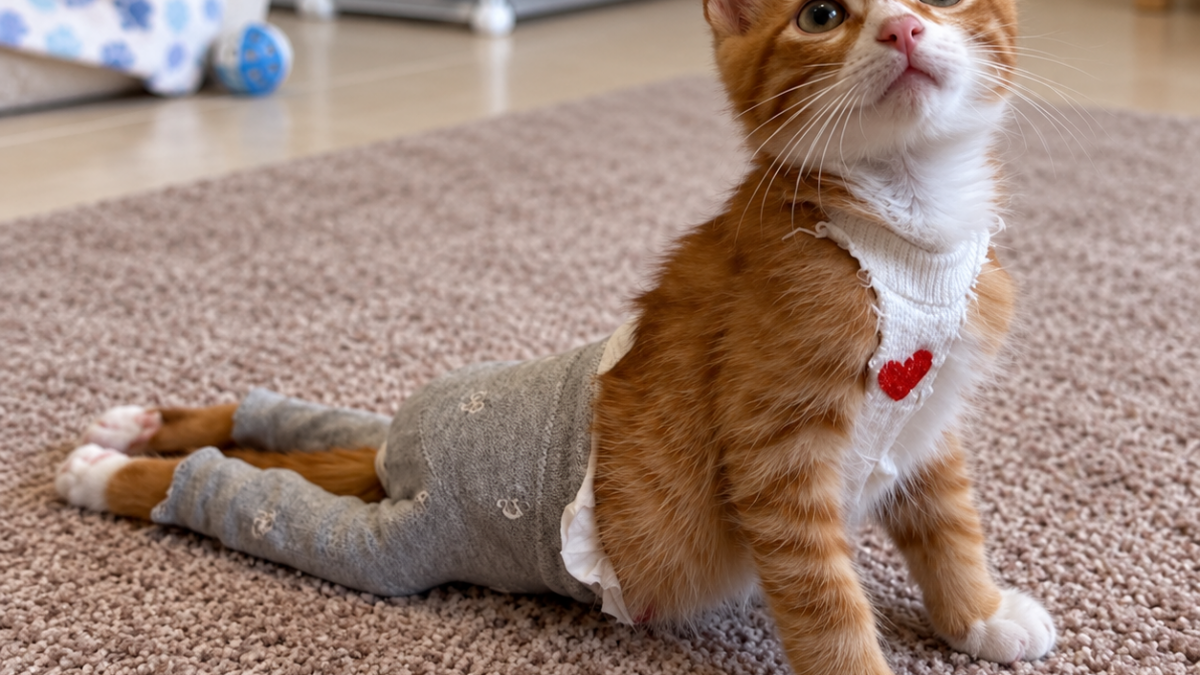
PART 2
The veterinarian watched for several seconds before looking at me.
“He’s doing part of it himself.”
I stared at her.
“Are you sure?”
“Yes.”
I looked down at Wasim.
He was completely unaware that anything extraordinary had happened. His front paws were planted against the towel, and his attention had shifted toward the smell of food coming from another part of the clinic.
“How much?”
“Not enough yet. You’ll still have to help him.”
“But there’s some control?”
“There appears to be.”
I felt my eyes fill before I could stop them.
It sounds like such a strange thing to celebrate.
A kitten urinating.
But when you have spent weeks manually helping a tiny animal perform something his body should have been able to do naturally, a small return of function feels enormous.
I crouched beside Wasim.
“You did something.”
He looked at me.
I laughed through the tears.
“You have absolutely no idea why I’m happy, do you?”
He reached toward my hand.
I gave him a little scratch beneath the chin.
That evening I wrote the change down.
Not because anyone had asked me to.
I had started keeping notes during his recovery.
Medication times.
Bladder care.
How stiff his legs felt.
Whether he had eaten well.
Whether he had an accident.
Anything unusual.
At the top of that day’s page, I wrote:
PARTIAL CONTROL.
Then I underlined it twice.
I went home thinking about the roadside.
The dust in his fur.
The vehicles rushing past.
His front legs shaking from dragging himself.
I had spent so many nights asking myself whether the massages, injections, supplements, cleaning, and constant attention were changing anything.
Now Wasim had given me an answer.
Not a miracle.
Not a cure.
But an answer.
Something inside his body was still communicating.
The following morning I expected another improvement.
That was my first mistake.
Nothing dramatic happened.
His bladder still required assistance.
His hind legs still trailed when he moved.
He still needed his little diaper because accidents remained unpredictable.
When I massaged his back legs, they felt just as stiff as before.
I remember feeling disappointed.
Then immediately guilty for feeling disappointed.
Wasim had not promised me progress every day.
His nervous system was not working according to my schedule.
The veterinarian must have noticed my face.
“Don’t measure him hour by hour.”
“I’m trying not to.”
“You’re doing it.”
I smiled weakly.
“Yes.”
She crouched beside Wasim.
“Neurological recovery can be inconsistent. Some function can return. Some may not. Sometimes you get improvement, then a plateau.”
“So we just keep going?”
“We keep doing what is appropriate for him, and we watch the kitten in front of us.”
The kitten in front of us.
That became important.
Because if I looked only at the kitten I wanted Wasim to become, every day could feel like failure.
If I looked at the kitten actually lying beside me, I saw something very different.
He was eating.
He was growing.
He was alert.
He was beginning to trust.
And now his bladder control was showing a small improvement.
That was enough for that day.
So we kept going.
Every morning began almost the same way.
I greeted him before touching him.
“Good morning, Wasim.”
His ears would turn.
Then those large eyes would find me.
I cleaned him.
Changed his diaper when he needed it.
Checked his skin carefully because constant contact with urine or friction from dragging could quickly cause irritation.
Then we dealt with his bladder.
At first, he hated the process.
He did not understand why I had to hold and press his abdomen.
His little paws would tense.
Sometimes he tried to pull away.
I spoke to him the entire time.
“I know.”
“Almost finished.”
“You’re okay.”
Eventually he stopped fighting.
Not because it became pleasant.
Because he learned what came afterward.
Relief.
Food.
A clean towel.
My hand rubbing beneath his chin.
Then massage.
I would sit with his back legs across my lap and work slowly.
His legs had become stiff because the muscles and joints were not being used normally.
I warmed them first.
Gentle rubbing.
Then careful flexion.
Never forcing.
His paws were so tiny.
Sometimes I held one between my fingers and wondered whether he could feel anything.
“Can you feel this?”
No answer.
Of course.
“I wish you could tell me.”
He usually responded by trying to bite the corner of the towel.
“That isn’t an answer.”
Bite.
“You are impossible.”
Bite.
I laughed.
That was another thing that changed.
In the beginning, I had looked at Wasim and felt almost nothing but sadness.
Then Wasim developed a personality large enough to crowd the sadness out.
He was gentle, yes.
But he was also stubborn.
Curious.
Very interested in food.
And deeply offended by delays.
He learned the sound of meal preparation before he learned almost anything else.
The moment he heard a bowl being moved, his head came up.
“You were asleep.”
He stared.
“How did you hear that?”
He pulled himself toward me.
Front paw.
Front paw.
Drag.
Front paw.
Front paw.
Drag.
His upper body became stronger because it had to.
Every journey was an exercise.
He could cross a surprising distance when dinner was involved.
When he ate, I used the soft harness around his hips to help him remain in a more natural position.
At first, he leaned almost entirely into the support.
Later, I noticed that he sometimes held himself for a fraction of a second before settling back.
Tiny changes.
Everything with Wasim happened in fractions.
One afternoon, several weeks after the first improvement in bladder function, I was massaging his right hind leg.
I pressed gently along the paw.
Something moved.
I stopped.
Wasim continued licking his front paw.
I touched the back paw again.
Nothing.
My heart sank.
Maybe I had imagined it.
I repositioned my fingers.
Pressed lightly.
The paw twitched.
I froze.
“Wasim.”
He looked at me.
I pressed again.
Another tiny movement.
Not much.
A toe.
Maybe part of the paw.
But it was there.
I called another caregiver over.
“Watch.”
I touched him.
Nothing.
Of course.
Wasim stared at us.
“Please do the thing.”
Nothing.
My coworker laughed.
“He knows you want something.”
“He absolutely does.”
I waited.
Massaged again.
Then the paw twitched beneath my fingers.
She saw it.
Her expression changed.
“That was him.”
“I know.”
“You felt it?”
“I felt it.”
I kissed the top of Wasim’s head before remembering he was not particularly interested in being celebrated.
He looked annoyed.
I laughed.
“Sorry.”
That evening, I added another note.
RIGHT BACK PAW RESPONSE.
I stared at those words for a long time.
Wasim had been found pulling himself beside a road because his hind legs would not work.
Now one tiny paw had answered my hand.
It might never become a step.
I understood that.
But it was something.
Over the following weeks, the responses became slightly easier to reproduce.
Touch.
Twitch.
Massage.
Small contraction.
Sometimes nothing.
Sometimes something.
His left leg eventually showed response too, although less consistently.
We continued the B12 injections.
Joint support.
Medication as directed.
Bladder management.
Massage.
Nutrition.
Warmth.
Cleanliness.
Routine.
That last one became more important than I expected.
Wasim liked knowing what happened next.
Feed.
Clean.
Massage.
Rest.
Play.
Sleep.
He had come from a roadside where every passing second carried danger.
Routine taught him the opposite.
Tomorrow would look familiar.
Hands would return.
Food would appear.
His bedding would be clean.
Pain or pressure would be noticed.
I would still be there.
Trust grew inside repetition.
One morning, I walked into the room and found Wasim already awake.
The instant he heard my voice, he began pulling himself toward me.
“Wasim.”
He moved faster.
Front paws working.
Back legs following.
I crouched.
He reached me and immediately pushed his head against my hand.
I stopped breathing for a second.
In the beginning, he had stiffened when hands approached.
Now he was seeking mine.
That transformation mattered more to me than the paw twitch.
People often asked me whether I believed he would walk.
I never knew how to answer.
“I hope so.”
That was usually what I said.
But privately, the question began bothering me.
Why was walking the measurement everyone used?
Would Wasim’s life be less meaningful if he never walked normally?
Would all the affection, curiosity, trust, playfulness, and comfort matter less because his back legs remained weak?
I understood why people asked.
I asked it too.
Of course I wanted him to walk.
I wanted him to run.
I wanted him to climb.
I wanted every door open to him.
But I slowly realized something uncomfortable.
Sometimes when we rescue an animal with a disability, we become so obsessed with changing the body that we forget to ask whether the animal is already learning to love his life.
Wasim was.
He began playing with toys.
At first, I chose things he could reach easily.
A soft ball.
A cloth mouse.
A piece of ribbon moved carefully near his front paws.
He attacked all of them.
His back legs might not have worked normally, but nobody had informed his front half that he was disabled.
He grabbed.
Bit.
Batted.
Held toys against his chest.
Once he caught the ribbon and refused to release it.
“Wasim.”
He pulled.
“That belongs to me.”
Pull.
“You cannot win this.”
He wrapped both paws around it.
I surrendered.
“Apparently you can.”
His confidence grew.
And the more confident he became, the more he purred.
The first purr came during a warm towel massage.
I thought I was imagining it.
I had wrapped him after cleaning him, and his small body was resting against my lap.
I began rubbing around his shoulders.
A vibration started beneath my hand.
I stopped.
The vibration stopped.
I scratched his cheek.
It returned.
“Are you purring?”
His eyes narrowed peacefully.
I laughed.
“After everything I do to you?”
Purr.
That sound made the room feel different.
A purr does not always mean happiness. I knew that.
Cats can purr in many situations.
But over time, Wasim began purring in specific moments.
Warm towel.
Gentle massage.
Chin scratch.
Settling against me after feeding.
Eventually, sometimes just when I picked him up.
He had learned what my arms meant.
Safety.
I wish I could say every development afterward was positive.
It wasn’t.
There were difficult weeks.
His legs sometimes became more rigid.
His bladder function fluctuated.
One day he would empty more by himself.
The next he needed significantly more help.
We dealt with skin irritation.
Diaper changes.
Laundry.
Accidents.
There were days when I questioned whether I was doing enough.
And days when I questioned whether I could keep doing everything forever.
That thought carried shame.
Wasim depended on me.
How could I be tired?
But caregiving is tiring even when it is done with love.
Maybe especially then.
Love makes you pay attention to everything.
One evening, after an accident required me to clean Wasim, his bedding, the floor, and then Wasim again, I sat beside him completely exhausted.
He was wrapped in a fresh towel.
He looked comfortable.
I was not.
“You are a lot of work.”
Wasim blinked.
“I hope you know that.”
He stretched one front paw toward my wrist.
I put my hand beside him.
He rested his paw on it.
I laughed quietly.
“That is manipulative.”
His paw remained there.
I leaned back against the wall.
“I’m not leaving.”
The words came out before I really thought about them.
Wasim closed his eyes.
I repeated them.
“I’m not leaving.”
At the time, I meant that night.
I did not yet realize I had made a larger promise.
The wheelchair idea came later.
As Wasim grew stronger in his front body but continued struggling with his back legs, I wondered whether wheels could give him more freedom.
I had seen disabled animals use mobility carts beautifully.
They could explore.
Move quickly.
Build confidence.
Maybe this would be Wasim’s answer.
I was excited.
Probably too excited.
We fitted him carefully.
The moment the equipment supported him, his entire body changed.
He stiffened.
His eyes widened.
“Easy.”
He tried to turn.
The wheels moved unexpectedly.
Wasim panicked.
He cried.
I stopped immediately.
“It’s okay.”
I lifted him out.
His paws grabbed my shirt.
I held him against me.
“You’re okay.”
His heart hammered.
I felt terrible.
I had imagined him moving across the room freely.
Instead, I had frightened him.
Someone suggested trying again.
Slowly.
With treats.
Maybe later.
I agreed in theory.
But when I looked at Wasim pressed against me, I realized something.
The wheelchair existed to help him.
He did not exist to succeed with the wheelchair.
Those are different things.
If a treatment or device terrified him, we needed to consider his emotional comfort as well as our hopes.
So we stopped.
We let Wasim move his way.
Maybe we would revisit mobility aids later.
Maybe not.
There was no deadline.
For months, Wasim had adapted to the body he had.
We could meet him there.
His favorite method of travel remained the same.
Front paws.
Pull.
Drag.
Pause.
Pull.
But his technique improved.
We created a safe indoor space with surfaces that protected his skin and gave his front paws traction.
Low bedding.
Easy access to food and water.
No dangerous edges.
Nothing he could become trapped beneath.
Wasim explored everything.
When I moved an object, he investigated.
When I brought something new into the room, he stared until I placed him close enough to sniff.
A cardboard box became an obsession.
The first box had a low side so he could pull himself inside.
He disappeared into it and refused to come out.
“Wasim.”
Two eyes looked over the edge.
“You cannot live in there.”
He lowered himself.
I laughed.
“Fine.”
The box remained.
Eventually it became one of his sleeping places.
A disabled kitten does not know he is supposed to inspire sadness.
Wasim wanted the same things other young cats wanted.
Food.
Warmth.
Play.
Comfort.
Security.
A place to hide inside a cardboard box.
He simply needed a little help reaching some of them.
Month after month, his body changed.
He gained weight.
His shoulders became strong.
His coat improved.
His face lost the frightened, exhausted look of the roadside kitten.
And his hind legs continued giving us small signs.
During massage, muscles contracted.
One paw responded.
Then the other.
When supported upright after meals, he occasionally pressed down with a hind leg.
Not enough to carry his weight.
But enough to feel.
“You’re pushing.”
I would say it softly, afraid that celebrating too loudly might somehow interrupt him.
“Good.”
Then he would collapse against the harness.
“That’s okay.”
Every attempt counted.
His bladder control also improved.
At first, I had done almost everything manually.
Then Wasim began emptying a little by himself.
Later, more.
Not perfectly.
Not reliably enough to stop monitoring.
But the direction was encouraging.
There were accidents.
Many.
He continued using a diaper when appropriate.
The diaper itself became a recurring argument.
He hated certain ones.
I have no scientific explanation for this.
Same size.
Similar material.
Different pattern.
Wasim had opinions.
One day, I put on a diaper he apparently considered unacceptable.
He immediately began twisting.
“Stop.”
Twist.
“Wasim.”
Twist.
“You need that.”
He turned and bit the edge.
“No.”
Bite.
“Absolutely not.”
Within minutes, he had partially escaped.
I stared.
“How?”
He looked pleased with himself.
I changed it.
He settled.
“You are ridiculous.”
Purr.
By the sixth month, the kitten who once tensed at touch could barely get enough affection.
He rubbed his face against my fingers.
Reached toward me when I walked past.
Purred through massages.
Sometimes, after bladder care and cleaning, I wrapped him in a warm towel and held him for a few minutes.
Those became my favorite moments.
Nothing medical.
Nothing to measure.
Just Wasim.
His small head tucked beneath my chin.
His breathing slowing.
His paws relaxing.
Sometimes I thought about all the humans he had watched from beside that road.
Did anyone see him before I did?
Had cars passed for hours?
Days?
Had he been abandoned there?
Had he been born nearby?
I never learned the answer.
For a long time, I wanted one.
I wanted someone to blame.
Someone to explain why a two-month-old kitten with paralyzed legs had been alone beside traffic.
But Wasim could not tell me.
And searching for anger did nothing for him.
So I stopped giving the unknown part of his past so much power.
I knew what happened after the roadside.
That mattered more.
Month seven brought a moment I will never forget.
I had just finished feeding him.
He wore the support harness while eating because it helped position his hips.
Usually, when I loosened the support, his rear body lowered immediately.
That day, I loosened it.
Wasim stayed up.
I kept my hands close without touching him.
One second.
Two.
Three.
His hind legs trembled.
Four.
Then he leaned sideways and I caught him.
My heart was pounding.
“Wasim.”
He looked toward the bowl.
Of course.
“You just held yourself up.”
The bowl interested him more.
I laughed.
“You have no appreciation for milestones.”
I tried again later.
Nothing.
The following day, he held himself for two seconds.
A week later, slightly longer.
That became another new skill.
Not standing normally.
Not walking.
Holding.
Supporting.
Participating.
People often want dramatic before-and-after stories.
Paralyzed.
Then walking.
Starving.
Then healthy.
Afraid.
Then perfectly trusting.
Real recovery rarely respects those clean lines.
Wasim existed in the middle.
Better bladder control but not complete.
Some sensation but not normal sensation.
Some hind-leg movement but not functional walking.
Happy but still requiring daily care.
Independent in some ways and totally dependent in others.
His life did not fit a simple miracle story.
It was better than that.
It was real.
By month eight, I began thinking about his future more seriously.
For most of his recovery, I had treated him as a rescue case under my care.
That wording gave me emotional protection.
I was his caregiver.
I was helping him.
One day, eventually, perhaps another family would adopt him.
That was what rescue was supposed to lead to.
A permanent home.
I had not admitted the obvious problem.
Wasim already believed he had one.
When I entered, he looked for me.
When someone unfamiliar handled him, he watched until I returned.
If I sat down, he pulled himself toward me.
He knew my voice.
My hands.
My routine.
He knew exactly how to tuck his head against my arm when I carried him.
I told myself that attachment was normal.
Then someone asked:
“Are you going to put him up for adoption?”
I answered too slowly.
“I don’t know yet.”
“You’ve had him for months.”
“I know.”
“He needs special care.”
“I know.”
“Not everyone will be able to manage the bladder expression and diapers.”
“I know.”
“And he trusts you.”
“I know.”
They smiled.
“You keep saying that.”
“Because I know.”
That evening, I sat with Wasim.
He was chewing a toy mouse.
“You’re causing problems.”
He continued chewing.
“I was supposed to rescue you.”
Chew.
“Then find you a home.”
Chew.
“You were not supposed to become my entire daily schedule.”
He dropped the toy.
Looked at me.
Then dragged himself into my lap.
I laughed.
“That is unfair.”
He curled against me.
I stroked his head.
The truth sat between us.
I loved him.
Not as a rescue case.
Not temporarily.
I loved the ridiculous diaper arguments.
The purring during massage.
The stubborn front-paw determination.
The way he stared at his food bowl as if nobody had fed him in years.
The way he had learned to trust my hands.
I loved all of it.
But loving him and officially adopting him felt like two different decisions.
Adoption meant forever.
If Wasim never gained more function, forever still meant bladder care.
Cleaning.
Monitoring.
Medical checks.
Massage.
Potential complications.
Planning around his needs.
Could I promise that?
I wanted to.
Wanting and being capable are different.
So I forced myself to think practically.
Could I afford his ongoing care?
Could my home remain safe for him?
What if his mobility worsened?
What if he developed urinary complications?
Could I find veterinary support when needed?
What happened when I traveled?
What happened if I became ill?
Love deserved planning.
So I planned.
Backup caregiver.
Medical instructions.
Emergency numbers.
Supplies.
Savings.
A safe permanent indoor environment.
The more questions I answered, the more the decision became obvious.
I was already arranging my life around Wasim.
The paperwork would merely admit it.
But I waited.
Part of me wanted one more sign.
I didn’t know what sign.
Maybe another movement.
Maybe more bladder control.
Maybe proof that he would improve enough to make the future easier.
Then I realized what I was doing.
I was making my commitment dependent on recovery.
That felt wrong.
Wasim did not need to earn permanency with better legs.
He had already done enough.
He had survived.
He had trusted me.
That was enough.
Around his eleventh month after rescue, the veterinarian examined him again.
His condition was dramatically different from the roadside kitten, though he remained disabled.
She checked responses in his hind legs.
There was sensation.
Movement.
Some muscle activity.
His joints were more manageable because of the constant care.
His bladder function had improved.
“He’s partly controlling it himself now,” she said.
“I know.”
“You’re still helping?”
“When he needs it.”
“Good.”
I looked at Wasim.
“So this is probably where we are?”
She paused.
“He may continue changing. I would never say his body is finished adapting. But I think you should plan for him to remain a special-needs cat.”
I nodded.
For once, the sentence did not frighten me.
A year earlier, hearing that might have felt like defeat.
Now I looked at Wasim cleaning his front paw on the examination table.
Special needs.
Okay.
He had special needs.
He also had a ridiculous obsession with cardboard.
He purred during diaper changes.
He hated the wheelchair.
He loved warm towels.
He had partial bladder control.
He could move his hind legs a little.
He could hold himself upright for moments.
He could cross a room faster than anyone expected if food was involved.
And he knew exactly who I was.
I lifted him.
“Come on.”
The veterinarian smiled.
“He’s very attached to you.”
I pressed my face against his head.
“So I’ve noticed.”
That afternoon, I stopped thinking about finding Wasim a family.
I began making it official that he already had one.
There was no dramatic adoption ceremony.
No crowd.
No music.
Just paperwork.
Signatures.
A decision that had emotionally happened months earlier.
When I finished, I looked at Wasim.
He was sleeping.
“Congratulations.”
Nothing.
“You’ve been adopted.”
One ear twitched.
“By me.”
Still sleeping.
“I thought you’d be more excited.”
He opened his eyes.
Then stretched one paw toward me.
I put my fingers near him.
He hooked the paw around them.
That was enough.
The roadside kitten was mine.
More importantly, I was his.
The first night after I officially adopted him, absolutely nothing changed.
That was what made it beautiful.
Same medication.
Same routine.
Same diaper.
Same bladder check.
Same massage.
Same food.
Same cardboard box.
Same warm towel.
Wasim did not know a legal status had changed.
He only knew the person who had been there yesterday was there again.
Maybe that is what adoption means to an animal.
Not paperwork.
Repetition.
You stayed yesterday.
You stayed today.
Eventually, they trust you will stay tomorrow.
One year after his rescue, I thought I would celebrate the anniversary with sadness.
Instead, I found myself laughing most of the day.
Wasim woke me earlier than necessary.
He had an accident immediately after I changed his bedding.
He tried to escape a diaper.
He stole a small cloth from beside me.
Then he dragged himself halfway across the room because he heard food.
“This is your anniversary behavior?”
He looked at me.
“One year ago, you were helpless beside a road.”
He reached for the food.
“And now you’re rude.”
He grabbed the edge of the bowl.
I laughed.
“Progress.”
Later that morning, I carried him to a sunny place in his safe indoor area.
He settled on a soft mat.
The sunlight caught his fur.
For a few minutes, he simply watched the room.
I sat beside him.
His hind legs rested behind him.
They were still weak.
That had not changed enough to give him normal mobility.
But when I touched one paw, it responded.
A small movement.
I remembered the first twitch beneath my fingers.
The way I had frozen.
The way hope had exploded inside something so tiny.
Now the movement was familiar.
I smiled anyway.
“You remember when you scared me with that?”
Wasim began purring.
I massaged his legs.
He relaxed.
There was no hospital urgency in the room anymore.
No fear that one missed bladder expression might become a crisis because I did not understand his body yet.
No question about where he would live.
We had learned each other.
The greatest improvement in Wasim was not something a veterinarian could measure.
The kitten I found had watched hands with fear.
The cat beside me closed his eyes when my hands touched him.
That was the miracle.
Trust.
Sometimes visitors saw Wasim and became sad.
“Oh, poor baby.”
I understood the reaction.
His gait looked unusual.
His back legs dragged.
The diaper made his disability obvious.
But then Wasim usually ruined the tragedy.
He would attack a toy.
Demand food.
Pull himself toward the visitor.
Or steal something.
One day, a friend left a lightweight scarf hanging from a chair.
Wasim discovered it.
By the time we noticed, he had dragged half of it into his cardboard box.
“Wasim!”
He froze.
My friend laughed.
“Is he stealing my scarf?”
“Yes.”
“Why?”
“Because apparently disability has led him to crime.”
She knelt.
Wasim pulled the scarf farther.
We laughed until our stomachs hurt.
My friend finally said, “He really doesn’t feel sorry for himself, does he?”
No.
He did not.
That lesson took me much longer to learn than it took him.
Humans look at disability and imagine every missing ability at once.
Wasim looked at whatever was directly in front of him.
Can I reach that toy?
Can I get to the food?
Can I pull myself into the box?
Is that lap available?
Can I escape this diaper?
His life existed in possibilities.
Not comparisons.
I tried to learn from him.
We continued physical care without turning every session into a test.
Massage remained important.
So did maintaining flexibility.
Sometimes Wasim tolerated it beautifully.
Sometimes he decided my fingers were toys.
“Stop biting.”
Gentle bite.
“That is my hand.”
Another bite.
“You know that.”
Purr.
He was impossible.
His bladder management also became less demanding over time because of the partial control he regained, though I never stopped monitoring closely.
Some days he handled much more himself.
Other days he needed assistance.
We did not treat a good day as proof that the problem was gone.
That mattered.
With neurological conditions, inconsistency can create dangerous assumptions.
I learned to check.
Not guess.
Watch.
Not assume.
Wasim deserved care based on reality, not optimism.
That was one of the quiet differences between loving an animal and romanticizing a rescue.
Love pays attention to the unpleasant parts too.
Urine.
Cleaning.
Medication.
Skin checks.
Accidents.
Vet bills.
Wasim’s story was not only warm towels and purring.
It was also getting up when I was tired because his body needed help.
It was planning my day around his care.
It was learning technical things I never expected to know.
It was worrying about infections.
Watching fluid intake.
Noticing changes in urine.
Checking his hind legs.
Protecting his skin from friction.
Love became practical.
And practical love kept him safe.
Months after adoption, I tried placing Wasim near a low window where he could watch birds safely.
His front paws went onto the padded ledge.
I supported his rear body.
Outside, a bird hopped along the ground.
Wasim became completely still.
The bird moved.
His head followed.
Another bird landed.
His tail twitched.
I laughed.
“Of course you want them.”
He leaned forward.
“Absolutely not.”
His front paw slapped lightly against the window.
The bird flew away.
Wasim stared after it.
For a kitten who had once existed beside traffic, the quiet view through a safe window felt enormous.
Cars still passed outside our world.
Roads still existed.
Danger still existed.
But Wasim would never sleep beside one again.
At night, he had soft bedding.
If he cried, someone heard him.
If he was hungry, food came.
If his bladder caused discomfort, I noticed.
If his skin became irritated, I treated it.
He did not have to solve survival alone anymore.
One evening I found him sleeping so deeply that I became frightened for a second.
I touched him.
“Wasim?”
Nothing.
My heart jumped.
Then he stretched.
Opened one eye.
Looked irritated.
I exhaled.
“You scared me.”
He went back to sleep.
I watched him.
Deep sleep is trust.
Animals who feel unsafe rarely surrender completely to it.
Wasim did.
His body became loose.
His front paws curled.
His breathing slowed.
Sometimes he slept on his side with his vulnerable belly partly exposed.
That image always brought me back to the roadside.
The tiny kitten who had been surrounded by noise and vehicles could now sleep without listening for danger.
Wasim’s revenge against that first life was not walking.
It was peace.
It was becoming difficult.
Demanding.
Playful.
Annoyed by diaper changes.
Picky about sleeping spots.
It was being ordinary enough to have preferences.
People like dramatic revenge stories.
Someone hurts an animal.
Then that person receives punishment.
But I never knew exactly how Wasim ended up on the road.
There was no villain for me to confront.
No courtroom.
No owner to expose.
For a long time that bothered me.
Then I understood I did not need one.
Wasim’s victory did not require another person’s suffering.
The world had once treated him like something that could be left beside traffic.
We answered by treating him like someone whose comfort mattered every day.
That was enough.
The road said disposable.
His life said permanent.
The road gave him danger.
His home gave him routine.
The road forced him to drag himself because nobody was there to help.
Now when he struggled, hands appeared.
That was his justice.
The first Ramadan after his rescue carried memories I had not expected.
I remembered how small he had been just before the previous one.
How frightened.
How uncertain everything had felt.
Now he was older.
Still disabled.
Still Wasim.
But home.
I sat with him one evening after his care routine.
“You made it a whole year.”
He purred.
“A year ago I didn’t know if your bladder would ever work better.”
Purr.
“I didn’t know if your paws would move.”
Purr.
“I didn’t know if you’d ever trust me.”
He pushed his head into my hand.
I smiled.
“That one worked out.”
Maybe the rest did too.
Not perfectly.
But enough.
At eleven months, we had seen sensation return.
Movement.
Improved bladder control.
A stronger body.
At twelve months, the biggest change was harder to photograph.
Wasim expected me.
When I left the room, he sometimes watched the doorway.
When I returned, he moved toward me.
That expectation frightened me at first.
Responsibility always carries fear.
What if I failed him?
Then I realized that fear was part of what kept me careful.
Commitment is not confidence that nothing will go wrong.
It is deciding you will respond when it does.
We had already done that for a year.
One morning, Wasim’s bladder function suddenly seemed worse.
My old panic returned instantly.
I called the veterinarian.
We went in.
Testing.
Examination.
I sat beside him feeling as helpless as I had during the first weeks.
“What if he’s losing function?”
“Let’s not assume.”
I hated waiting.
Wasim did not.
He was more interested in a loose corner of paper on the examination table.
Eventually, we learned there was irritation that required treatment and closer monitoring, but no evidence that all neurological progress had suddenly disappeared.
I nearly collapsed from relief.
At home, while giving him the prescribed care, I realized recovery had not made me immune to fear.
It had simply taught me what to do with it.
Observe.
Call.
Treat.
Continue.
That was life with Wasim.
Not certainty.
Response.
And somehow, that was enough.
Another year began.
Wasim became better at navigating his home.
He learned routes.
Bed to food.
Food to my chair.
Chair to favorite box.
Favorite box to sunny mat.
He did not need a wheelchair to understand his world.
He mapped it with his front paws.
Sometimes he moved quickly enough that new visitors were shocked.
“He can really move.”
“Yes.”
“He looks fast.”
“Food is usually involved.”
Wasim would prove the point moments later.
One afternoon, I opened a treat container.
From another room came the familiar sound.
Scrape.
Pull.
Scrape.
Pull.
Then he appeared.
“You were asleep.”
He stared at the container.
“You have supernatural hearing.”
He moved closer.
I gave him one.
Then another.
“Don’t tell the vet.”
He ate them and leaned against my leg.
I sat down.
He climbed as far onto my lap as he could.
I lifted his rear body gently.
He settled.
There had been a time when I had imagined adoption meant finding someone perfect for him.
Eventually I realized perfect was not a person who knew everything.
Perfect was someone willing to keep learning.
I had made mistakes.
I had tried a wheelchair before he was emotionally ready.
I had worried too much about milestones.
I had sometimes measured him against other cats.
I had occasionally become frustrated when care felt endless.
None of that meant I did not love him.
It meant I was human.
Wasim did not need perfection.
He needed consistency.
So I kept showing up.
Morning.
Evening.
Good day.
Bad day.
Progress.
Setback.
Purr.
Accident.
Massage.
Meal.
Sleep.
Again.
Again.
Again.
That repetition became our relationship.
Years from now, I knew his needs might change.
Maybe bladder function would improve further.
Maybe it would not.
Maybe his back legs would gain more movement.
Maybe the progress would plateau exactly where it was.
I had stopped bargaining with the future.
The first months taught me hope.
The later months taught me acceptance.
Hope says, “Maybe tomorrow will be better.”
Acceptance says, “And if tomorrow looks like today, I will still love you.”
Wasim needed both.
So did I.
On the anniversary of finding him, I returned near the road.
Not with Wasim.
I would never bring him back into that danger.
I went alone.
Traffic moved past.
Engines.
Horns.
Dust.
The edge of the road looked ordinary.
That was what disturbed me.
Places where lives change do not always look important.
There was no marker.
Nothing saying:
A two-month-old kitten once dragged himself here because his hind legs would not work.
Nothing saying:
Someone stopped.
Nothing saying:
He lived.
I stood there for several minutes.
Then I imagined his tiny body again.
Front paws.
Drag.
Look up.
Front paws.
Drag.
Look up.
How many times had he done it before I arrived?
I would never know.
I whispered, “You’re not here anymore.”
A truck passed.
Wind pushed dust across the shoulder.
“You’re home.”
Then I left.
When I walked inside later, Wasim heard me.
His head came up.
He started toward me.
Same movement.
Front paws pulling.
Back legs trailing, but no longer entirely silent.
His right paw shifted.
His left responded slightly.
His tail moved.
I knelt.
He reached me.
I lifted him.
“There you are.”
He pushed his head against my chin.
I carried him away from the door.
That was the ending I wanted.
Not Wasim running.
Not some impossible miracle.
Me walking through a door.
Wasim recognizing me.
And both of us knowing where he belonged.
One night, I sat beside him while rain hit the windows.
Wasim had always been strangely interested in the sound.
He lifted his head whenever rain became heavy.
I wondered whether he remembered being outside.
Maybe.
Maybe not.
I had learned not to invent trauma where Wasim could not tell me there was one.
But I knew what he did now.
He listened.
Then relaxed.
Rain was outside.
Wasim was inside.
I placed a warm blanket over part of his body.
He began purring.
“You know what?”
His eyes closed.
“I used to think I saved you because I picked you up from the road.”
Purr.
“That wasn’t the rescue.”
I stroked his cheek.
“The rescue was everything after.”
The first bladder expression.
The first meal.
The injections.
The massage.
The diaper changes.
The first paw twitch.
The first partial urination.
The first time he held himself upright.
The failed wheelchair.
The cardboard box.
The purring.
The decision to adopt.
All of it.
Picking him up had taken seconds.
Keeping him safe took a life.
That was the promise.
Months later, someone asked me the question I had heard many times.
“Would you still have adopted Wasim if you knew from the beginning his legs might never fully recover?”
I looked at him.
He was sprawled on his mat, attacking a toy with both front paws.
“Yes.”
The answer came so quickly it surprised even me.
“Even with all the bladder care?”
“Yes.”
“The diapers?”
“Yes.”
“The expenses?”
I laughed.
“I would prefer fewer of those.”
They smiled.
“But yes?”
I looked back at Wasim.
“Yes.”
Because by then I understood something.
If you reduce an animal to the work required to care for him, every special-needs pet sounds impossible.
But care is not the entire relationship.
There are hours between medications.
There is laughter between cleanups.
There are purrs between appointments.
There are ordinary mornings.
Naps.
Sunlight.
Stolen scarves.
Cardboard boxes.
A warm body settling into your lap.
Wasim was not a medical schedule with fur.
He was family.
One afternoon, I moved his favorite box because I was cleaning.
Wasim woke.
Looked at the empty space.
Looked at me.
“Temporary.”
He stared.
“I’m cleaning.”
He pulled himself toward the missing box location.
“Wasim.”
He looked around.
I swear he looked offended.
I finished as quickly as possible and returned the box.
He climbed inside immediately.
I crouched.
“Happy?”
Two eyes stared over the edge.
“Good.”
I left him alone.
That ridiculous interaction stayed with me because it represented how far we had come.
The roadside kitten had needed survival.
The adult Wasim complained about furniture placement.
That is recovery.
Not necessarily a body becoming perfect.
A life becoming safe enough for small problems to matter.
Eventually, I stopped telling his story by starting with paralysis when people came to know him personally.
I introduced him as Wasim.
If they saw the diaper or unusual movement and asked, I explained.
But disability did not need to be his first sentence forever.
He liked warm towels.
He liked food too much.
He loved chin scratches.
He tolerated leg massage.
He hated mobility equipment.
He liked boxes.
He purred loudly when comfortable.
He trusted slowly but completely.
He happened to have paralyzed hind legs.
That was Wasim.
Not tragedy.
A cat.
And maybe that was the final lesson.
On the road, his body made him vulnerable.
At home, his body became simply one part of the care we shared.
The first time he slept pressed against my side for an entire afternoon, I barely moved.
I did not want to disturb him.
Eventually my leg went numb.
I whispered, “You know I have things to do.”
Purr.
“I need to stand.”
Purr.
“You are emotionally manipulating me.”
Purr.
I stayed.
There are worse ways to lose an afternoon.
Toward evening, Wasim woke.
He stretched.
His front legs extended.
Then something happened behind him.
Both hind legs moved slightly.
Not coordinated.
Not enough to stand.
But clearly.
I watched.
Months earlier, I would have screamed for someone to come see.
I might have grabbed my phone.
Recorded.
Tested him again.
This time I smiled.
“That’s good.”
I did not ask him to repeat it.
He did not need to prove anything.
We had reached a point where a movement could simply be a movement.
Not a promise.
Not a miracle.
Just Wasim’s body doing what it could.
That freedom belonged to him too.
When he was found, everyone wanted to know whether he would ever walk.
A year later, I wanted different answers.
Was he comfortable?
Yes.
Was he loved?
Yes.
Did he trust?
Yes.
Could he play?
Absolutely.
Was his pain managed?
Yes.
Did he enjoy food?
Far too much.
Did he have a safe home?
Forever.
Those were better questions.
I still hope his neurological function continues improving.
I would celebrate every new movement.
Every extra bit of bladder control.
Every stronger push.
Hope never disappeared.
It simply learned its place.
Hope was no longer the condition for happiness.
Wasim was allowed to be happy now.
Exactly as he was.
One morning, sunlight came through the window and stretched across the floor.
Wasim noticed.
He began moving toward it.
Pull.
Drag.
Pull.
Drag.
His right back paw shifted slightly.
Then his left.
He reached the light.
Stopped.
Lowered himself onto his side.
Within minutes, he was asleep.
I watched from across the room.
There was something so peaceful about him that I felt tears forming.
Not sad tears.
Not even happy tears exactly.
The kind that come when your body understands something your mind has been trying to learn for a long time.
This little creature had once been two months old beside a busy street with no way to get himself to safety.
Now he could choose a patch of sunlight.
That choice seemed ordinary.
It was not.
Nothing about ordinary life is ordinary after you have seen how easily it can be taken away.
I walked over quietly.
Wasim opened one eye.
“Go back to sleep.”
He did.
I sat nearby.
One year after the rescue, his life was not what most people would call perfect.
His legs remained weak.
He still needed diapers.
Bladder care still required attention.
There were veterinary visits.
Massage.
Supplements.
Monitoring.
And uncertainty.
But perfection had never been the goal.
Safety was.
Comfort was.
Dignity was.
Love was.
Wasim had all four.
I thought again about the moment I first knelt beside him.
The front paws trembling.
The dust.
His fast breathing.
Those eyes.
He had looked at me because looking was almost all he could do.
I reached down then without knowing what would happen.
Now, whenever I reached toward him, there was no tension.
Wasim leaned in.
He expected the hand.
That was how I knew we had made it.
Not because he could walk.
Because he no longer wondered whether the person approaching him was dangerous.
He knew.
Food.
Relief.
Massage.
A clean diaper.
A warm towel.
A scratch beneath the chin.
Home.
Sometimes love becomes a language made entirely of repeated actions.
Wasim had learned ours.
And I had learned his.
A paw reaching.
A certain meow.
The way he positioned his body when his bladder felt uncomfortable.
The look he gave me when he wanted food.
The head push asking for affection.
The purr that meant he had finally relaxed.
We did not need much else.
Years may change him again.
There may come a day when his medical needs become harder.
There may be setbacks.
There may be progress I cannot currently imagine.
Whatever comes, I know where he will face it.
Not beside a road.
Not alone.
Not wondering whether somebody will notice.
With me.
That is the promise I finally understood I had made when I signed the adoption papers.
I did not promise to make him walk.
I promised to stay.
Those are not the same thing.
One depends on biology.
The other depends on love.
I could not control the first.
I could give him the second.
So when people ask me for Wasim’s happy ending, I do not show them a video of him suddenly running across the floor.
There is no such video.
I show them something quieter.
Wasim asleep in his favorite box.
Wasim purring inside a warm towel.
Wasim attacking a toy.
Wasim pulling himself toward breakfast.
Wasim looking up when he hears my voice.
Wasim reaching for my hand.
Those are his endings.
Hundreds of them.
Every ordinary day.
And every morning, when he wakes and begins moving through his safe little world, I still hear that familiar rhythm.
Front paws.
Pull.
Back legs follow.
Pause.
Look up.
Then forward again.
Only now there are no speeding cars beside him.
No dust in his fur.
No road disappearing in either direction.
When Wasim looks up, he sees home.
And when he reaches for me, he never has to wonder whether my hands will leave him behind again.
They won’t.
Not today.
Not tomorrow.
Not as long as he needs them.
The two-month-old kitten I lifted from the roadside had spent his first chapter dragging himself toward survival.
The cat he became no longer has to.
Now he moves toward food.
Toward toys.
Toward sunlight.
Toward me.
He may never travel through the world the way other cats do.
But he does not need to.
Because the most important distance Wasim ever crossed was never measured in steps.
It was the distance between fear and trust.
Between a roadside and a home.
Between being rescued by someone…
and becoming someone’s family.
And that is where Wasim’s story finally became complete.
And once Wasim became family, something inside me changed too.
For months, I had thought of every day in terms of what his body might regain. I watched his hind paws for movement, checked how much bladder control he had, measured how long he could hold himself upright, and quietly compared each week with the one before it. But after the adoption became permanent, I stopped waking up wondering whether that would be the day Wasim finally became more like other cats.
Instead, I woke up wondering what kind of trouble he would get into before breakfast.
That change felt small, but it meant everything.
One morning, I found him halfway inside a laundry basket I had left on the floor. His front half had disappeared beneath a towel while his back legs remained outside, and he was pulling with everything he had.
“Wasim.”
The movement stopped.
Two eyes appeared from beneath the towel.
“What exactly are you doing?”
He resumed pulling.
I reached down and lifted the towel.
Underneath it was one of his favorite toy mice.
Of course.
“You nearly buried yourself for this?”
He grabbed the toy between his front paws.
I laughed.
“All right. Apparently it was an emergency.”
Moments like that became my new milestones.
Not medical milestones.
Life milestones.
Wasim discovering places he was not supposed to be.
Wasim deciding one blanket was better than another.
Wasim hearing the refrigerator open from across the room and appearing with suspicious speed.
Wasim reaching toward me when he wanted to be held.
The first year of his life had taught me to notice every physical improvement. The years that followed taught me to notice something else.
Belonging.
He belonged so completely that even his care stopped feeling unusual.
The diaper supplies had a permanent place.
His medications lived beside ordinary household things.
The towels used for massage were folded with everything else.
Visitors learned where not to step because Wasim could appear silently beside their feet.
My schedule naturally included bladder checks and massage.
No one announced these things anymore.
They were simply part of having Wasim.
One evening, after finishing his routine, I placed him on a clean blanket beside me.
His hind legs were relaxed.
I touched one paw gently.
It moved.
A small response.
I smiled.
“Still there.”
Wasim stretched and began grooming his front leg.
There had been a time when I would have cried over that movement.
Now it was familiar enough to make me smile instead.
That did not mean I cared less.
It meant fear no longer owned every good thing.
I could enjoy him without constantly worrying the happiness might disappear.
That was freedom for me too.
The first time Wasim became sick after adoption, however, all of that confidence vanished instantly.
He seemed unusually quiet one morning.
He did not come toward his breakfast with his usual enthusiasm.
That alone frightened me.
“Wasim?”
He lifted his head but did not move.
I touched his ears.
Checked his body.
Watched his breathing.
My mind immediately returned to every warning I had ever received about urinary problems in cats with neurological issues.
Within hours, we were at the clinic.
I sat beside him while the veterinarian examined him.
Wasim watched me.
I realized my hand was shaking.
“He’s uncomfortable,” she said, “but you noticed early.”
Those words mattered.
Early.
Because I knew him now.
I knew how quickly he usually moved toward food.
I knew the shape of his normal posture.
I knew the look in his eyes when something felt wrong.
The tests showed an infection that required treatment, but it had not progressed into the catastrophe I had imagined.
We went home with medication and instructions.
That night I barely slept.
Wasim did.
He was curled against a folded towel, breathing peacefully.
I sat nearby and thought about how different fear felt now.
In the beginning, fear had come from not knowing what to do.
Now fear existed alongside knowledge.
I could notice.
Call.
Treat.
Adapt.
I could not protect Wasim from every problem.
But he would never face one unnoticed again.
Several days later, his appetite returned.
I opened his food.
From across the room came the familiar sound.
Pull.
Slide.
Pull.
Slide.
Then Wasim appeared around the corner.
I laughed so suddenly that he stopped and stared at me.
“There you are.”
He continued toward the bowl.
I crouched and scratched his head.
“I missed you being annoying.”
He immediately tried to push his face into the food before I had finished setting it down.
“Yes. Definitely back to normal.”
That evening he slept deeply, full and comfortable.
I understood then that his happy ending was not the absence of difficult days.
It was knowing difficult days would be met by people who cared.
That became even clearer as Wasim grew older.
His shoulders became broader from years of relying so heavily on his front legs.
His movements became efficient.
He knew exactly how to turn on soft surfaces, how to pull himself onto low cushions, and how to shift when he wanted a better view.
Sometimes visitors watched him and instinctively moved to help.
“Wait,” I would say gently.
Wasim would continue.
Pull.
Turn.
Push.
Then settle exactly where he intended.
“He can do that?”
“Yes.”
I had learned another important lesson.
Helping Wasim did not mean doing everything for him.
He deserved independence wherever it was safe.
If he could reach the blanket himself, I let him.
If he could pull into his box, I waited.
If he needed help, I stepped in.
There is dignity in being allowed to try.
That mattered especially because so much of his care required physical assistance.
Bladder management.
Cleaning.
Massage.
Diaper changes.
Things he could not choose.
Whenever there was something he could control, I wanted it to remain his.
One afternoon, I rearranged part of his indoor space.
I moved his favorite cardboard box about six feet.
Wasim noticed immediately.
He dragged himself to the old location.
Stopped.
Looked at me.
Then looked at the empty floor.
“I moved it.”
He stared.
“It’s over there.”
He looked in the direction I pointed.
Then back at me.
His expression was so clearly offended that I started laughing.
“You are going to survive this.”
He slowly moved toward the box.
When he reached it, he climbed inside and turned his back toward me.
I laughed harder.
“Fine. Be angry.”
That evening, he eventually crawled into my lap anyway.
Apparently I was forgiven.
Those absurd little moments became part of the love story.
Because Wasim was not inspirational every second.
Sometimes he was irritating.
Sometimes stubborn.
Sometimes messy.
Sometimes he woke me too early.
Sometimes he created more laundry than seemed physically possible for one cat.
Sometimes I was exhausted.
And that was good.
It meant our relationship was real.
Love that exists only in rescue photographs is easy.
Real love has routines.
Frustration.
Expense.
Fatigue.
Humor.
Forgiveness.
The decision to show up again after a long day.
One night, after a particularly exhausting week, I sat beside Wasim and admitted something I would once have felt guilty saying.
“I’m tired.”
He looked at me.
“Really tired.”
I had spent the day working, then returned to cleaning, medication, and an appointment.
“I wish you could do some of this yourself.”
Wasim leaned forward and rubbed his face against my wrist.
I laughed weakly.
“That’s not helping.”
He did it again.
I scratched his cheek.
Then I realized something.
I could be tired and still love him.
I could wish the care were easier without wishing Wasim were different.
Those feelings could exist together.
Caregiving did not need to look heroic.
It needed to continue.
So I rested when I could.
Asked for help when necessary.
Prepared backup instructions.
Made sure another trusted person knew Wasim’s routine.
Because love that depends on one exhausted person doing everything alone is fragile.
I wanted Wasim’s safety to be stronger than that.
Over time, he became more secure with the people I trusted too.
At first, if someone else handled him, Wasim watched the door until I returned.
Later, he accepted care from familiar hands.
He never loved everyone equally.
I was secretly pleased about that.
But his world expanded.
That mattered.
Then came an afternoon that brought the entire story back to me.
I had opened a window slightly so Wasim could smell the air safely through the screen.
Traffic was audible in the distance.
A truck passed.
Wasim’s ears moved.
For a moment, I remembered the road.
Two months old.
Dusty.
Paralyzed.
Cars rushing past.
Front paws trembling.
I wondered whether Wasim remembered any of it.
I hoped he didn’t.
He looked toward the sound.
Then turned away.
He reached for a toy.
Just like that.
The road had no claim on him anymore.
I sat beside him.
“You know something?”
He grabbed the toy.
“I used to think I had to make your life extraordinary because your beginning was so terrible.”
He bit the toy mouse.
“But maybe this is better.”
Sunlight warmed the floor.
His food bowl was nearby.
A clean blanket was behind him.
Nothing dramatic was happening.
“That’s what I wanted for you.”
Ordinary safety.
I think people underestimate how beautiful ordinary life can be after danger.
A predictable meal.
A familiar voice.
A quiet afternoon.
Sleeping without fear.
Being annoyed because someone moved your box.
These things do not make dramatic headlines.
But they are what Wasim had been denied when I first saw him.
And they were exactly what I wanted him to have forever.
As another year passed, his physical condition remained largely stable.
There were still moments of hind-leg movement.
Still partial bladder control.
Still days when he needed more help than others.
We celebrated any new improvement, but we no longer waited for one to make his life valid.
I remember someone asking me again, “Do you think he will ever fully walk?”
I looked toward Wasim.
He was lying in a patch of sunlight with his front paws around a toy.
“I don’t know.”
“Does that make you sad?”
I thought about it.
“Sometimes.”
That was true.
“I still wish everything could be easier for him.”
Then I smiled.
“But I’m not waiting for walking to call this a happy ending.”
The person looked at him.
Wasim stretched.
His right hind paw moved slightly.
Then he went back to sleep.
That was Wasim.
Always giving me just enough to remember hope without letting hope define him.
The most beautiful change came quietly.
There was a time when Wasim followed me with his eyes because he feared I might disappear.
Eventually, he stopped.
At first, I did not understand what that meant.
I would walk out of the room and return to find him sleeping.
He was no longer watching the doorway.
No longer listening for every movement.
No longer checking constantly that I was there.
He trusted I would come back.
That realization brought tears to my eyes.
Trust had become so complete that he could stop proving it.
One night, I stood in the doorway watching him sleep.
His body was relaxed.
One hind leg extended awkwardly behind him.
His favorite toy rested near his front paw.
I remembered the promise I had once whispered during an exhausting night.
I’m not leaving.
At the time, Wasim could not have understood those words.
He understood them now in the only way that mattered.
Through evidence.
Hundreds of mornings.
Hundreds of meals.
Hundreds of diaper changes.
Warm towels.
Vet visits.
Medicine.
Massages.
Quiet nights.
Hands returning.
Again.
Again.
Again.
Promises become believable when they repeat.
That was how Wasim learned forever.
Not through the adoption paper.
Through ordinary days.
And maybe that is why, when I think about the ending of his story now, I no longer imagine one final scene.
There is no final miracle.
There is a collection.
Wasim sleeping while rain falls outside.
Wasim reaching toward my hand.
Wasim becoming furious because breakfast is late.
Wasim dragging a stolen cloth into his box.
Wasim relaxing during massage.
Wasim looking at me from across the room and deciding to come closer.
Pull.
Slide.
Push.
Pause.
Then forward again.
Every movement still carries a faint echo of the tiny kitten beside the road.
But that kitten is no longer struggling toward survival.
He is moving through a life that belongs to him.
And when he finally reaches me, I bend down the same way I did on the day we met.
Only now there is no fear in his eyes.
I hold out my hand.
Wasim leans into it before I even touch him.
Then he purrs.
That sound is the ending.
Not because the story is over.
Because it tells me everything I once needed to know.
He is safe.
He knows he is safe.
And he knows exactly where home is.








