PART 2: I Found a Mother Dog Chained to a Tree With 3 Newborns—Then Two Starving Dogs Stepped Out to Protect Her
PART 2
I stayed in that clearing for nearly two hours.
Thirty-eight years in the woods had taught me that when an animal is frightened, patience can do what force never will.
So I waited.
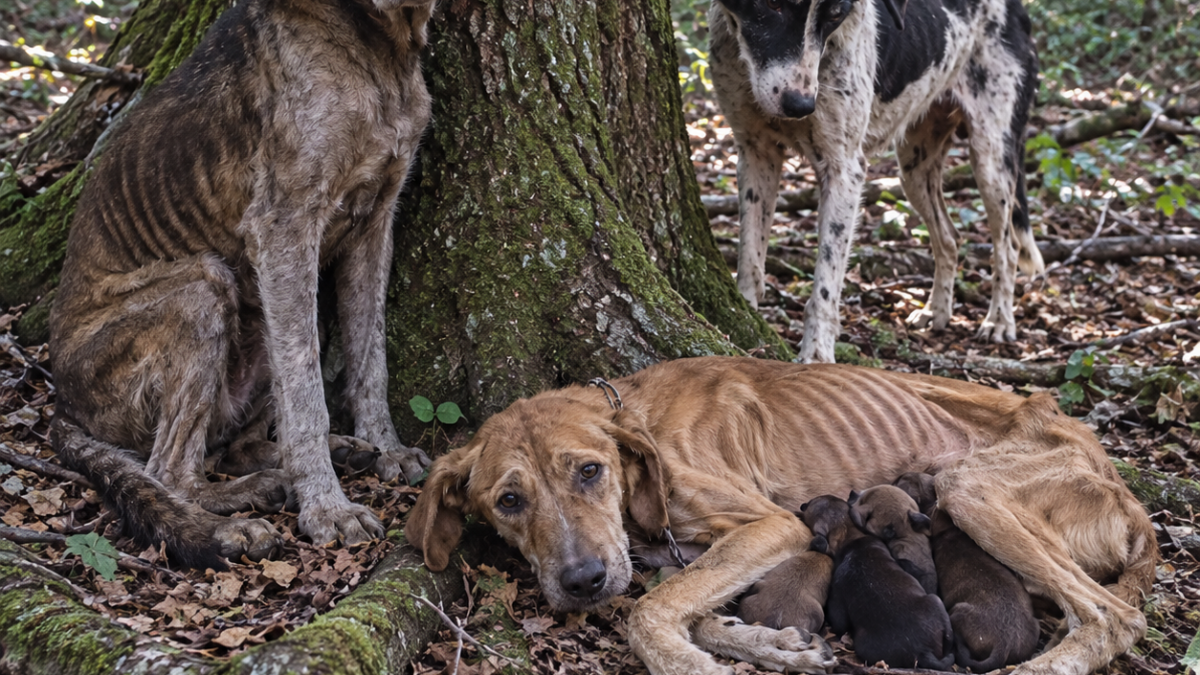
The large gray dog stood between me and the oak tree.
His entire body remained tense.
I started calling him Bailey in my head because he reminded me of an old farm dog my father had owned when I was a boy.
The smaller black-and-white dog became Pepper.
I had no idea what their real names were.
Maybe they had never had names.
But sometimes giving an animal a name is the first way your mind stops seeing it as a problem and starts seeing it as somebody.
The mother remained under the oak.
I would eventually call her Rosie.
At that moment, though, she was simply a mother who had somehow kept three newborn puppies alive while chained to a tree.
I poured water into the bottom of a plastic food container.
Pepper approached first.
He sniffed it.
I expected him to drink.
Instead, he looked at Rosie.
Then at me.
Then he backed away.
Rosie tried to stand.
Her front legs shook.
The chain scraped against the tree.
She made it two steps before her hindquarters nearly collapsed.
“Easy, girl.”
Bailey immediately looked at me.
“I’m not moving.”
Rosie lowered her head to the water.
She drank for almost a full minute.
Too quickly.
I slid the container away slightly.
She stared at me.
“I know you want more.”
I had seen severely dehydrated animals make themselves sick by drinking too fast.
“Slow.”
I gave her another little bit a few minutes later.
This time she drank more carefully.
Pepper finally ate.
Then Bailey.
Neither took much.
Every few bites, they looked toward Rosie.
That was when I began noticing details I had missed.
Bailey’s paws were raw.
Pepper had burrs tangled in his coat.
Both dogs had lost weight.
Yet neither was chained.
They could have left.
They had chosen not to.
I looked around the clearing more carefully.
There were tracks everywhere.
Dog tracks.
Human boot prints.
An old tire impression near the edge of the abandoned service trail.
A torn feed sack beneath some brush.
And, ten feet from Rosie, an empty plastic water jug with the label ripped off.
That interested me.
Not because litter in the forest was unusual.
Because the jug looked relatively new.
Rosie had not been abandoned months ago.
Someone had been here recently.
Maybe more than once.
I took photographs.
The chain.
The collar.
The puppies.
The tire marks.
The jug.
The boot impressions.
Then I saw something half buried beneath wet leaves.
A piece of bright orange plastic.
I pulled on gloves before touching it.
It was part of a broken ratchet strap.
Stamped into the metal buckle was the name of a local equipment rental company.
I photographed that too.
I did not yet know whether it mattered.
Experience had taught me not to decide what evidence meant before gathering it.
The forest preserves things people believe it destroys.
Mud records tires.
Bark records wire.
Branches break in the direction someone passed.
Trash carries fingerprints.
People lie.
Ground usually doesn’t.
At some point, Rosie shifted.
One puppy squeaked.
She immediately curled her body more tightly around them.
“You’re a good mother,” I whispered.
Her eyes stayed on me.
“I’m going to get you out.”
Bailey’s ears lifted.
Maybe it was my tone.
Maybe just coincidence.
I looked at all five dogs.
“I promise.”
Eventually, I had to leave.
That was harder than I expected.
I could not simply cut Rosie loose and march three frightened dogs and three newborn puppies two miles through the forest.
Her physical condition was too poor.
The puppies needed warmth.
Bailey and Pepper still did not trust me enough to allow close handling.
I needed help.
I rose slowly.
Pepper barked.
Bailey stood.
Rosie lifted her head.
“I’m coming back.”
I pointed toward myself, then toward the trail.
“Back.”
Of course they could not understand the language.
But they understood departure.
All abandoned animals do.
Rosie’s eyes changed.
Something inside me twisted.
“I know.”
I lowered myself again.
For another ten minutes, I simply sat there.
Then I stood one more time.
“I am coming back.”
Bailey watched me retreat.
Pepper followed me about fifteen yards down the trail.
Not close enough to touch.
Just close enough to make sure I left.
When I finally disappeared behind the trees, I heard one bark behind me.
Low.
Not angry.
Almost questioning.
I walked faster.
The moment I reached radio range, I called dispatch.
“This is Hale.”
“Go ahead, Thomas.”
“I need animal rescue assistance in Sector North-Seven.”
There was a pause.
“Wildlife?”
“Domestic dogs.”
“How many?”
I looked back toward the trail.
“Six.”
“Six?”
“Three adults. Three newborns. One adult is chained to a tree and severely malnourished.”
The dispatcher’s voice changed immediately.
“Copy. Do you need law enforcement?”
“Yes.”
Another pause.
“Intentional cruelty?”
“I don’t know yet.”
I looked at the photographs on my phone.
“But somebody put that chain there.”
By the next morning, I was back.
This time I was accompanied by two county shelter employees, Lena Ortiz and Marcus Bell.
Both had worked difficult rescue cases.
Before we entered the clearing, I stopped them.
“Let me go first.”
Marcus nodded.
“Protective?”
“Very.”
“Mother?”
“Two males.”
Lena looked surprised.
“They stayed with her?”
“At least that’s what it looks like.”
We moved forward.
Pepper heard us first.
His barking started from the brush.
Bailey appeared seconds later.
He saw me.
Then he saw Lena and Marcus.
His body stiffened.
I crouched.
“Bailey.”
Lena whispered, “That his name?”
“It is now.”
Bailey stared.
I slowly removed my hat.
Same clothes.
Same voice.
Same smell.
Whatever dogs use to remember us, he found it.
His tail moved once.
Marcus smiled.
“That’s something.”
“Stay back.”
I stepped closer.
Rosie was exactly where I had left her.
The puppies were alive.
All three.
The relief nearly knocked the breath from me.
“Hey, girl.”
Rosie watched me approach.
I knelt just beyond the end of her chain.
Yesterday, she had cried when I extended my hand.
Today, I placed that hand on the ground.
She stared at it.
Then slowly rose.
One step.
Two.
Her nose touched my fingers.
I did not move.
She sniffed.
Then she did something I still remember more clearly than almost any moment of my career.
She lowered her head into my palm.
Not much.
Just the weight of her forehead against my hand.
But it meant everything.
I stroked her gently.
“That’s it.”
Her eyes closed.
Behind me, Lena whispered, “She chose you.”
“No.”
I looked at Bailey and Pepper.
“She chose to try one more human.”
There is a difference.
Marcus used bolt cutters on the chain.
The metal was old but thick.
When the jaws snapped through it, the sound rang through the clearing.
Rosie jumped.
Bailey barked.
Pepper rushed forward.
I held my hand against Rosie’s chest.
“Easy.”
Marcus backed away.
The chain fell.
For a second, Rosie seemed not to understand.
She stood.
Looked at the tree.
Then walked forward.
Three steps.
The broken chain dragged behind her.
Marcus removed the collar.
Now nothing connected her to the oak.
Nothing.
“Go ahead,” I whispered.
She could have run.
Instead she turned.
Went directly back to the puppies.
And lay down beside them.
Lena wiped her eyes.
“She’s not leaving without them.”
“No.”
We placed the three puppies into a padded transport crate lined with warm blankets.
Rosie panicked when Marcus lifted the first puppy.
Bailey barked so loudly the puppy began squealing.
I stayed beside Rosie.
“They’re okay.”
She strained toward the crate.
“We’re taking them too.”
When all three puppies were inside, Rosie followed the crate voluntarily.
Bailey and Pepper followed Rosie.
That told me everything about their hierarchy.
The puppies were Rosie’s world.
Rosie was theirs.
We transported all six together.
At the county shelter, Dr. Rebecca Sloan examined Rosie first.
Her expression grew more serious with every minute.
“How bad?” I asked.
“Severe malnutrition. Dehydration. Skin infection. Collar wound. Fleas. Probably intestinal parasites.”
“Will she make it?”
Rebecca looked at Rosie nursing her puppies.
“She has already survived the hardest part.”
“What about milk?”
“She’s producing some, but not enough. We’ll supplement the puppies.”
Bailey was underweight but otherwise surprisingly healthy.
Pepper had an infected cut between two toes and signs of having survived on poor nutrition for weeks.
None of the three adults had microchips.
No collars except Rosie’s.
No identification.
That made finding the owner harder.
Not impossible.
I had something more useful than a name.
I had a place.
And people always leave something behind.
That afternoon, I returned to the clearing with Deputy Aaron Cole, our county’s lead officer on environmental crimes.
Aaron had known me for twenty years.
He looked at the oak.
Then the chain.
Then the shallow depression in the dirt where Rosie had lain.
“You think whoever did this came back?”
“Possibly.”
“Why?”
I pointed toward the torn feed sack.
“Dogs didn’t carry a fifty-pound feed bag out here.”
Aaron crouched.
“You think somebody fed them?”
“Maybe not regularly.”
“Then why chain her?”
“That’s what I want to know.”
We widened the search.
Thirty yards north of the clearing, we found the remains of an illegal camp.
Beer cans.
Food wrappers.
A burned fire pit.
Lengths of rope.
A cheap plastic tarp.
And another dog chain.
No dog attached.
Aaron held it up.
“Well.”
My stomach tightened.
We kept searching.
Farther downhill, Bailey’s tracks appeared repeatedly along a narrow game trail.
Pepper’s too.
The tracks led toward a drainage ditch, then west.
We followed.
Half a mile later, we reached an old logging road.
There were fresher tire tracks there.
Pickup truck.
Wide rear tires.
One tread had a distinctive missing block.
I photographed it.
Aaron smiled faintly.
“Now you’re enjoying yourself.”
“No.”
“You always get that face when you find a trail.”
“What face?”
“That ‘some idiot thinks he’s smarter than dirt’ face.”
I stood.
“Dirt has better memory than most witnesses.”
At the edge of the logging road, I found a crushed aluminum can.
Local discount beer brand.
Then another.
Then a receipt.
Most of the printing had blurred.
But one part remained readable.
**MILLER FARM & FEED**
And beneath it, a date.
Nine days earlier.
Aaron slipped it into an evidence bag.
“Getting interesting.”
The next break came from a child.
Her name was Lily Warren.
Nine years old.
Her family lived on a small property near the southern edge of the forest.
Her mother had contacted the ranger office two weeks earlier because Lily insisted she had heard dogs crying at night.
The report had been vague.
No location.
No visual confirmation.
But after we rescued Rosie, dispatch connected the calls.
I visited the family.
Lily sat at the kitchen table drawing horses.
Her mother looked embarrassed.
“I honestly thought she was hearing coyotes.”
Lily frowned.
“They weren’t coyotes.”
“I know that now.”
I sat across from her.
“Lily, can you tell me exactly what you heard?”
“Dogs.”
“How many?”
“I don’t know.”
“Where?”
She pointed toward the woods.
“Past the old fence.”
“Did you ever see anyone?”
She hesitated.
Her mother looked at her.
“Tell Ranger Thomas.”
Lily put down her pencil.
“One time I saw a truck.”
My posture changed.
“What kind?”
“Black.”
“Big?”
She nodded.
“Pickup?”
Another nod.
“Anything special about it?”
Lily thought.
“There was a white toolbox behind the window.”
“Good.”
She added, “And one red light was broken.”
Aaron and I looked at each other.
“Which light?” I asked.
“The back one. On the left.”
That was useful.
Very useful.
“Did you see the driver?”
“A man.”
“What did he look like?”
“Brown hat. Beard.”
“Anything else?”
“He was angry.”
“How do you know?”
“He yelled.”
“At you?”
“No. At a dog.”
My stomach tightened.
“What did he say?”
Lily looked uncomfortable.
Her mother touched her shoulder.
“It’s okay.”
Lily whispered, “He said, ‘Stay there, you useless thing.’”
For several seconds, nobody spoke.
“Did you see the dog?”
“Gray.”
Rosie.
“Was she pregnant?”
Lily nodded slowly.
“She was big.”
“When was this?”
“Before my school field trip.”
Her mother checked a calendar.
“Twelve days ago.”
That meant Rosie may have been chained there before giving birth.
My hands curled beneath the table.
“Lily, you did exactly the right thing by telling your mom.”
She looked worried.
“Are the puppies okay?”
“Yes.”
“All of them?”
“Yes.”
Her face brightened.
“And their mom?”
“She’s safe.”
“What about the other two?”
“Safe too.”
Lily smiled.
Then she asked something that stayed with me.
“Is the man going to come get them?”
“No.”
I answered before Aaron could.
“No, sweetheart. He’s not.”
Now we had a vehicle description.
Black pickup.
White toolbox.
Left taillight damaged.
Bearded man.
The equipment rental buckle became useful next.
The rental company had issued that particular model of ratchet strap as part of a utility trailer package.
They kept customer records.
The owner gave us a list of renters from the previous month.
Twenty-seven names.
Aaron cross-referenced those names with pickup registrations.
Four owned black trucks.
Two had white toolboxes.
One had received a citation six weeks earlier for a broken left taillight.
His name was Wade Mercer.
Forty-three.
Lived fourteen miles away.
Worked odd construction jobs.
Had previous citations for illegal dumping.
And three years earlier, animal control had warned him about dogs running loose on his property.
Not proof.
But enough to look closer.
We drove past his property legally from the public road.
Black pickup in the driveway.
White toolbox.
Left taillight newer than the right.
Recently replaced.
My jaw tightened.
Behind the house stood several outdoor kennels.
Two were empty.
One contained a brown hound.
Aaron called animal control.
“We need a welfare check.”
Wade Mercer answered the door.
I recognized the brown hat immediately.
Lily had described it perfectly.
He looked at Aaron’s badge.
“What’s this about?”
“Dogs.”
Wade’s expression changed for less than a second.
“Don’t have a problem with my dogs.”
“You own a gray female?”
“No.”
“Black-and-white male?”
“No.”
“Large gray male?”
“No.”
Aaron nodded toward the kennels.
“How many dogs do you own?”
“One.”
“Always?”
“Pretty much.”
“Ever own a pregnant female?”
“No.”
I watched him.
People reveal things with speed.
Wade answered that one too quickly.
Aaron continued.
“Have you been inside North Ridge Preserve recently?”
“No.”
“Never?”
“No reason to.”
“You rent a utility trailer from Barker Equipment?”
Wade looked at me.
Then back at Aaron.
“Sometimes.”
“When was the last time?”
“Don’t remember.”
Aaron took out a notebook.
“You mind if we look at your truck?”
“Why?”
“Routine.”
Wade’s jaw tightened.
“You got a warrant?”
“No.”
“Then no.”
That was his right.
Aaron nodded.
“All right.”
We left.
Wade smiled as we walked away.
It irritated me more than it should have.
“You think that’s him?” Aaron asked when we reached our vehicle.
“Yes.”
“Feelings aren’t evidence.”
“I know.”
“Good.”
“But look under his rear bumper.”
Aaron glanced.
Mud packed in the tread.
One rear tire had a missing tread block.
Exactly like the track.
Aaron exhaled.
“Now we’re getting somewhere.”
A warrant followed.
The tire impression matched.
So did mud samples containing the unusual reddish clay found only along that abandoned logging spur.
Inside the truck bed investigators found dog hair.
Gray.
Black.
White.
Forensic testing would take time, but we already had more.
The rental strap.
The receipt.
The tire marks.
Lily’s witness statement.
And then they searched Wade’s shed.
Inside was a box of veterinary paperwork.
That gave us the names.
Rosie had once been called Ruby.
Bailey had been called Duke.
Pepper had been called Patch.
All three belonged to Wade.
He had purchased Rosie from a backyard breeder two years earlier.
Bailey was older.
Pepper younger.
The records showed vaccinations that had stopped more than a year ago.
There were also handwritten breeding notes.
Rosie had produced at least one earlier litter.
I stared at the paper.
“You think he was breeding her?”
Aaron nodded.
“Looks like it.”
“Why abandon her pregnant?”
We found the answer in text messages extracted from Wade’s phone after another warrant.
He had been trying to sell puppies.
Rosie’s previous litter had brought less money than he expected.
The current pregnancy had apparently been accidental.
Wade complained to a friend:
**Not wasting more food on that gray mutt.**
Another message:
**Dumping the three problem dogs this weekend.**
The friend replied:
**At shelter?**
Wade answered:
**No paperwork. Woods. They’ll figure it out.**
My hands went cold when I read it.
“They’ll figure it out.”
As though Rosie, pregnant and chained to a tree, had been given a reasonable problem to solve.
As though Bailey and Pepper had simply been inconvenient tools.
As though six living animals were trash.
Then came the message that explained the chain.
Wade wrote:
**Female keeps following truck. Had to tie her this time.**
Aaron read it twice.
“He’d dumped her before.”
“And she followed him home.”
“So he took her farther out.”
“And chained her.”
I stood from the table.
For thirty-eight years, I had dealt with poachers.
Illegal trappers.
People who shot wildlife for fun.
People who poisoned streams.
People who dumped garbage by the truckload.
But something about Rosie’s chain felt more personal.
She had trusted the man.
Followed his truck.
Probably believed he was taking her somewhere.
And when she kept coming back, he had solved that loyalty by chaining her to a tree.
Bailey and Pepper had apparently been dumped loose.
They could have wandered toward town.
Could have followed another trail.
Could have found farms, roads, people.
Instead, they found Rosie.
And stayed.
We reconstructed what likely happened.
Wade drove the three dogs into the preserve through an illegal access road.
He chained Rosie to the oak because she had followed him during an earlier abandonment attempt.
Bailey and Pepper were released.
Wade drove away.
The two males stayed near Rosie.
At some point Rosie gave birth.
Bailey and Pepper began ranging farther for food and water.
Pepper may have carried scraps from nearby trash.
Bailey’s tracks showed repeated trips to the drainage ditch.
We believed he had been drinking there and returning.
Whether they actually brought water to Rosie, we could not prove.
But we did prove that they stayed.
Day after day.
Night after night.
Through rain.
Through cold.
Through hunger.
They stayed.
When Wade was arrested, I expected to feel satisfied.
I didn’t.
I felt quiet.
Aaron called me at 6:17 one morning.
“We picked him up.”
“What did he say?”
“Claims he thought the dogs would survive.”
“He chained a pregnant dog.”
“He says the chain was temporary.”
“For what?”
“He doesn’t have a good answer.”
“What happens now?”
“Animal cruelty charges. Abandonment. Illegal vehicle entry into protected land. Dumping violations. Evidence tampering may be added.”
“Evidence tampering?”
“Remember the torn labels?”
“Yes.”
“He admitted removing identification from some of the containers.”
I closed my eyes.
“So he knew.”
“He knew enough to hide his connection.”
That mattered.
Wade had not made one careless decision.
He had taken steps to make sure nobody could trace those dogs back to him.
The court process lasted months.
During that time, I visited the shelter every Saturday.
Rosie recovered slowly.
The first week, she could barely stand for long.
By week three, she walked the length of the recovery yard.
By week five, her ribs no longer looked sharp beneath her coat.
Her puppies grew quickly.
The smallest one, a black-and-white female, was almost identical to Pepper.
My granddaughter Emily fell in love with her from photographs before ever meeting her.
Emily was five.
When she visited the shelter for the first time, I warned her.
“Stay beside me.”
“I will.”
“Don’t put your fingers through any kennels.”
“I know.”
“Don’t run.”
“Grandpa.”
“What?”
“You tell me this every time we see dogs.”
“Because you forget every time.”
“I only forget a little.”
Rosie saw me from across the recovery room.
Her tail began wagging immediately.
Emily stopped.
“Is that her?”
“That’s Rosie.”
Rosie approached the gate.
Emily crouched.
I put a hand on her shoulder.
“Slow.”
Rosie sniffed Emily’s fingers.
Then licked them.
Emily’s face lit up.
“She likes me.”
“She likes almost everybody now.”
“Did she like you?”
“Not at first.”
Emily looked horrified.
“Why?”
“Because somebody taught her people could be dangerous.”
Emily thought about that.
Then she whispered to Rosie, “Grandpa isn’t dangerous.”
I swallowed hard.
“No.”
Rosie leaned against the gate.
“He’s mostly annoying.”
I looked down.
“Excuse me?”
Emily giggled.
Behind Rosie, the puppies stumbled over one another.
The black-and-white female came directly toward us.
She pressed her nose to the fence.
Emily froze.
The puppy stared at her.
Emily stared back.
“Grandpa.”
“Yes?”
“This one is looking at me.”
“I can see that.”
“Why?”
“Maybe she thinks you look funny.”
Emily frowned.
“Grandpa.”
I laughed.
The puppy pawed at the gate.
That was the beginning.
But before any adoptions could happen, the criminal case had to reach a point where legal ownership of the animals transferred permanently.
Wade fought it.
Not because he loved them.
Because he did not want to lose property.
That distinction made me angrier than almost anything else.
His attorney argued that he had temporarily placed the dogs in the forest intending to return.
The prosecutor responded with Wade’s own messages.
**Dumping the three problem dogs this weekend.**
Then the photograph of Rosie’s chain was shown.
Then Lily testified.
I attended the hearing.
Wade sat at the defense table in a clean shirt.
No brown hat.
No beard now.
He looked smaller indoors.
Lily was nervous.
Her mother sat behind her.
The prosecutor kept the questions simple.
“Did you see a truck near the forest?”
“Yes.”
“What color?”
“Black.”
“Did you see a man?”
“Yes.”
“Did you hear him say anything?”
Lily looked toward Wade.
He looked away.
“He yelled at the gray dog.”
“What did he say?”
Her voice was quiet.
“Stay there, you useless thing.”
The courtroom became completely still.
Wade’s attorney tried to suggest that Lily could have mistaken someone else for his client.
Then the prosecutor presented the truck records.
Tire match.
Rental strap.
Phone location data.
Texts.
Veterinary records.
Dog hair.
The defense changed strategy.
They argued Wade had been overwhelmed.
Financially stressed.
Unable to care for multiple animals.
That part may even have been true.
But the prosecutor asked one question.
“Was the county shelter charging surrender fees at that time?”
The shelter director answered.
“No.”
“Could Mr. Mercer have surrendered all three dogs without payment?”
“Yes.”
“Would you have accepted a pregnant dog?”
“Yes.”
“Would he have faced punishment simply for surrendering them?”
“No.”
That destroyed the excuse.
He had options.
He chose the woods.
At sentencing, Wade finally spoke.
“I made a mistake.”
I felt something inside me harden.
A mistake is forgetting a gate.
A mistake is feeding the wrong medication once.
Driving a pregnant dog into the forest, chaining her to a tree, releasing two other dogs, removing identifying labels, and leaving was not a momentary mistake.
It was a sequence of choices.
The judge appeared to understand that.
She looked at Wade.
“You had repeated opportunities to choose differently.”
He stared at the table.
“You could have contacted animal control.”
Silence.
“You could have surrendered the dogs.”
Silence.
“You could have contacted a rescue organization.”
Silence.
“You could have asked for help.”
Still nothing.
“Instead, you transported three animals to remote public land and secured a pregnant female in a manner that prevented her from obtaining food, water, or shelter.”
The judge paused.
“The fact that she survived does not reduce the seriousness of your conduct.”
Wade received jail time, probation, fines, restitution for veterinary care, and a long prohibition against owning, breeding, selling, or possessing animals.
His illegal breeding equipment was seized.
The remaining hound from his property was legally surrendered and later adopted.
He was also ordered to perform environmental cleanup service after release.
Was that revenge?
Maybe some people would call it that.
But the moment that satisfied me did not happen in the courtroom.
It happened three weeks later.
The county granted the shelter permanent custody of Rosie, Bailey, Pepper, and the puppies.
For the first time, Wade had no legal claim to them.
Rosie was free in every sense.
Not only from the chain.
From him.
The shelter wanted Bailey, Pepper, and Rosie adopted together if possible.
Finding one home willing to take three adult dogs was difficult.
Finding one able to manage a bonded trio with trauma histories was harder.
Weeks passed.
Applications came.
Most wanted Rosie alone.
One family wanted Bailey.
Another wanted Pepper because he was smaller.
Each time Denise refused.
“They stayed together when it mattered,” she told me.
“We’re not splitting them now unless behavior tells us they want that.”
It didn’t.
Bailey slept beside Rosie.
Pepper followed Bailey.
Rosie relaxed only when both were nearby.
Then a couple named Mark and Allison Greene arrived.
They owned a twelve-acre property outside town.
Fenced.
No livestock.
No other dogs.
Mark was retired from the fire department.
Allison worked from home.
They had recently lost two senior rescue dogs within the same year.
“We don’t want puppies,” Allison said.
Denise looked surprised.
“Most people ask for puppies first.”
Mark glanced at Rosie, Bailey, and Pepper through the glass.
“We’re too old for puppy nonsense.”
Allison smiled.
“You’re too old.”
“You are three months younger than me.”
“Those three,” Allison said.
Denise became serious.
“They need to stay together.”
“That’s why we’re interested.”
“All three?”
“All three.”
Mark looked at Bailey.
“I know what it’s like when your crew becomes your family.”
That sentence decided something in me.
I attended their first meeting.
Bailey approached Mark first.
Of course he did.
Two older males silently evaluating each other.
Mark crouched.
“Hey, partner.”
Bailey sniffed him.
Mark did not reach.
Good.
Pepper circled behind Allison.
She sat on the grass.
Rosie stayed near me.
Mark looked at her.
“She attached to you.”
“Yeah.”
“You taking her?”
I had asked myself that question every week.
I loved Rosie.
But I worked long hours.
I lived in a smaller house near the ranger station.
Taking Rosie while separating her from Bailey and Pepper would have been for me, not her.
“No.”
Mark nodded.
“That can’t be easy.”
“It isn’t.”
Rosie leaned against my leg.
“But loving something means giving it what it needs, not what makes you feel better.”
Allison’s eyes filled.
“We can bring them back to visit.”
I smiled.
“You may regret saying that.”
They didn’t.
The Greenes were approved.
Adoption day nearly broke me.
Pepper climbed into their SUV first.
Bailey followed.
Rosie stayed beside me.
Allison waited by the open door.
No leash pulling.
No pressure.
I knelt.
Rosie placed her head in my lap the way she had after the chain was cut.
“You remember that tree?”
Her tail moved.
“I do.”
I touched the faint scar around her neck.
“You don’t belong to that place anymore.”
Rosie looked toward Bailey.
Then back at me.
“They’re waiting.”
Pepper barked from the vehicle.
I laughed through tears.
“He’s impatient.”
Rosie licked my chin.
“Go.”
She stood.
Walked toward the SUV.
Halfway there, she turned.
For one terrible second, I thought she might come back.
Instead, she simply looked at me.
I lifted one hand.
“I’ll see you again.”
Rosie climbed inside.
Mark closed the door.
As their vehicle pulled away, I cried harder than I had cried at my father’s funeral.
Denise stood beside me.
“You okay?”
“No.”
“She got a good home.”
“I know.”
“That’s the point.”
“I know.”
Knowing does not stop grief.
It just gives grief somewhere meaningful to go.
That left the puppies.
All three were healthy now.
The smallest black-and-white female had become the boldest.
Emily visited every week.
The puppy recognized her.
Every time Emily entered the puppy room, she came running.
Eventually Emily named her Maple.
“Why Maple?” I asked.
“Because I like maple syrup.”
“That is possibly the worst naming system I’ve ever heard.”
“It’s a perfect name.”
My daughter, Claire, gave me a look.
“You know where this is going, Dad.”
“I do.”
“You’re going to say no.”
“I am.”
Emily hugged Maple.
“You hear that, Maple? Grandpa doesn’t love us.”
“Emotional blackmail at five years old. Impressive.”
Claire laughed.
The truth was that I had already completed the application.
I had already scheduled the home inspection.
Already bought a crate.
Already argued with myself for three nights.
Maple was not going to live solely with Emily.
She would live in my house, where Emily spent several days each week while Claire worked.
It was practical.
At least that was what I told myself.
Adoption approval came on a Friday.
I picked Emily up from kindergarten.
“Where are we going?” she asked.
“Errand.”
“Store?”
“No.”
“Park?”
“No.”
“Can I have ice cream?”
“No.”
“You’re not fun today.”
We arrived at the shelter.
Emily gasped.
“Maple!”
She ran toward the lobby, then remembered my rule and slowed dramatically.
“I’m not running.”
“I noticed.”
Denise came out holding a folder.
Maple came behind her on a leash.
Emily dropped to her knees.
Maple launched herself into the child’s arms.
That was all the reveal we needed.
Emily looked at me.
“Why does Maple have a leash?”
“Because she’s leaving.”
Emily’s smile disappeared.
“Someone adopted her?”
“Yes.”
Her eyes filled instantly.
I let it go for three seconds.
Then handed her the adoption folder.
She looked at it.
Couldn’t read most of it.
Then saw our last name.
“Grandpa?”
“Yeah.”
“Is she ours?”
I nodded.
Emily screamed.
Maple barked.
Denise cried.
I pretended something had gotten into my eye.
That first night, Maple slept beside Emily on a blanket in my living room.
I sat in my chair watching them.
The puppy who had begun life beneath a chained mother in an illegal forest camp was sleeping on her back with all four paws in the air.
No chain.
No hunger.
No cold ground.
No reason to be afraid.
Emily’s hand rested against Maple’s side.
I thought about Rosie.
Bailey.
Pepper.
I thought about what family really meant.
Wade had owned those dogs.
Legally.
On paper.
But he had never understood the difference between ownership and loyalty.
Bailey and Pepper understood it.
They had no contract.
No legal responsibility.
No human language.
They simply saw Rosie unable to leave.
And stayed.
That fact changed me.
I had spent thirty-eight years believing my job was about protecting forests.
Protecting land from fires.
Protecting wildlife from poachers.
Protecting visitors from bad decisions.
After Rosie, I understood something else.
A forest is not just trees.
It is what happens beneath them.
What people hide there.
What animals endure there.
What remains after everyone else leaves.
I continued investigating the clearing even after the court case ended.
Not because I needed more evidence.
Because I wanted to understand.
Bailey and Pepper’s tracks told a story.
One route went repeatedly toward the drainage ditch.
Another went toward a campground trash area nearly a mile away.
A store owner later remembered seeing a black-and-white dog near his dumpster.
He had thrown Pepper pieces of chicken twice.
Pepper had taken them and run.
The man assumed Pepper was eating somewhere nearby.
Maybe he was.
Maybe he was carrying some back to Rosie.
We would never know every detail.
But we knew enough.
Those dogs had survived by forming a system.
Bailey guarded.
Pepper searched.
Rosie protected the puppies.
Nobody assigned those roles.
Nobody trained them.
Family formed because survival required it.
Six months after their adoption, I visited the Greenes.
The moment my truck entered their driveway, three dogs appeared behind the fence.
Pepper recognized the vehicle first.
He began barking.
Bailey ran toward the gate.
Rosie came last.
Then she saw me.
She froze.
For one second, neither of us moved.
Then Rosie ran.
I had never seen her run like that.
Mark opened the gate.
“Brace yourself.”
I barely had time.
Rosie hit me in the chest with both front paws.
I went backward onto the grass.
“Rosie!”
She covered my face with kisses.
Bailey pushed in from one side.
Pepper climbed over my legs.
Mark stood laughing.
“Thought you trained dogs.”
“I’m a ranger.”
“Could’ve fooled me.”
Rosie finally settled beside me.
She looked completely different.
Healthy weight.
Bright coat.
Clear eyes.
The scar remained around her neck, but you had to know where to look.
Allison came outside.
“She sleeps in our bedroom.”
Mark sighed.
“On my side.”
“You snore.”
“So does Rosie.”
Rosie wagged.
I looked around.
Twelve acres.
Trees.
Grass.
Open sky.
No chain.
“This suits them.”
Allison sat beside me.
“Bailey patrols the fence every evening.”
“Of course.”
“Pepper steals socks.”
“Also believable.”
“And Rosie?”
Allison smiled.
“Rosie runs the house.”
Exactly as she should.
They had built a shaded shelter in the yard even though all three dogs lived indoors.
There were beds.
Toys.
Water bowls.
A small kiddie pool Pepper apparently loved.
Bailey hated it.
Rosie tolerated it.
I stayed for dinner.
Before leaving, I stood at the gate.
Rosie came beside me.
Years earlier, walking away from that forest clearing had been one of the hardest things I had ever done because I feared she would believe I had abandoned her.
Now I was leaving again.
This time Rosie watched calmly.
She did not panic.
Did not follow the gate.
Did not cry.
She knew where she belonged.
I rubbed her ears.
“See you next time.”
Then I drove away.
In my mirror, Rosie stayed beside Mark and Allison.
That image gave me more satisfaction than Wade Mercer’s sentence ever could.
A year passed.
Maple grew into a medium-sized black-and-white dog with Pepper’s markings and Rosie’s eyes.
Emily insisted Maple understood English.
“Sit,” Emily said.
Maple sat.
“See?”
“That’s training.”
“Maple, Grandpa smells funny.”
Maple tilted her head.
Emily pointed triumphantly.
“See?”
I sighed.
“She understands lies too.”
The two became inseparable.
When Emily read books, Maple rested her chin on Emily’s knee.
When Emily cried after scraping her elbow, Maple licked her face.
When a thunderstorm frightened Maple, Emily crawled beneath the table with her.
“It’s okay,” she whispered. “I’m staying.”
I stood in the doorway listening.
I’m staying.
Those words.
Maybe that was the real lesson.
Not rescue.
Staying.
One winter morning, several years after I found Rosie, Bailey died peacefully at the Greenes’ home.
He was very old.
Mark called me.
“We think he was close to fifteen.”
I drove there.
Bailey lay on his favorite blanket near the fireplace.
Rosie rested beside him.
Pepper would not leave the room.
I knelt beside Bailey.
His muzzle was almost completely white.
“You did good, old man.”
His eyes opened briefly.
I placed a hand against his head.
“You stayed.”
That was what I wanted to thank him for.
Not for being brave.
Not for confronting me.
Not for surviving.
For staying when leaving would have been easier.
Mark buried Bailey beneath an oak tree near the edge of the property.
No chain around that tree.
Only a small wooden marker.
It read:
**BAILEY**
**HE STAYED**
Pepper died two years later.
Rosie outlived both of them.
By then, she was old.
Slower.
Her face gray.
But still gentle.
When I visited, she continued placing her head on my knees.
Every time.
The last time I saw Rosie, spring flowers were blooming along the Greenes’ fence.
I sat with her beneath the porch.
She was too weak to walk far.
Maple came with me.
For the first time since she was a newborn, mother and daughter lay beside each other.
Rosie sniffed Maple.
Maple licked her muzzle.
I don’t know whether Rosie understood who she was.
Maybe scent told her.
Maybe not.
But they slept shoulder to shoulder for almost an hour.
Emily sat beside me.
She was older now.
Old enough to understand the entire story.
“Grandpa?”
“Yeah?”
“If Bailey and Pepper hadn’t stayed, would Rosie have died?”
I looked at Rosie.
“Probably.”
“And the puppies?”
“Probably.”
Emily was quiet.
“So Maple is here because they stayed.”
“Yes.”
She leaned against me.
“That means one good thing can keep making more good things.”
I looked at my granddaughter.
Sometimes children say something adults spend decades trying to understand.
“Yes.”
I put my arm around her.
“That’s exactly what it means.”
Rosie died peacefully several weeks later.
The Greenes buried her between Bailey and Pepper.
Three trees.
Three markers.
Bailey’s read:
**HE STAYED**
Pepper’s read:
**HE SHARED**
Rosie’s read:
**SHE SURVIVED**
I stood there with Emily and Maple.
Wind moved through the leaves.
The forest beyond the property looked much like the one where I had first found them.
But nothing felt the same anymore.
People later called me the man who saved Rosie.
I never liked that description.
I cut one chain.
That mattered.
But before I arrived, Bailey and Pepper had already been saving her every day.
The child who told her mother about dogs crying mattered.
The shelter workers mattered.
Dr. Sloan mattered.
Aaron mattered.
The prosecutor mattered.
Mark and Allison mattered.
Emily mattered.
Even the store owner who threw Pepper food without knowing where he carried it mattered.
Rescue is rarely one heroic moment.
Usually, it is a chain of ordinary people deciding not to look away.
A different kind of chain than the one around Rosie’s neck.
One that connects instead of traps.
I eventually retired after forty years with the forest service.
On my final day, I walked the old North-Seven trail one more time.
The abandoned service path was almost completely gone.
Trees had grown across parts of it.
Grass covered the old tire tracks.
The illegal campsite had disappeared beneath seasons of leaves.
But the oak still stood.
Rosie’s oak.
I approached it slowly.
For years, I had avoided returning alone.
That afternoon, I finally did.
The chain scar was still visible around the trunk.
Rust-colored marks had sunk into the bark.
I placed my hand there.
I could still see everything.
Rosie beneath the tree.
Three puppies pressed against her.
Bailey stepping from the brush.
Pepper barking.
The fear.
The hunger.
The refusal to leave.
I sat exactly where I had sat that first afternoon.
For a long time, I listened.
Birds.
Leaves.
Wind.
The forest did not feel heavy anymore.
It felt peaceful.
Then I heard paws on the trail.
Maple came running through the trees.
Emily followed behind her.
“Grandpa!”
I laughed.
“What are you doing here?”
“Mom told me where you went.”
Maple reached me.
She sniffed the oak.
Then the ground.
She had no memory of this place.
She had been too young.
But I remembered for her.
Emily sat beside me.
“Is this the tree?”
“Yes.”
She touched the bark.
“This is where Rosie was?”
“Yes.”
“And Bailey and Pepper?”
“Right over there.”
Emily looked around the clearing.
“It’s smaller than I imagined.”
“Most important places are.”
Maple wandered through the grass.
Sunlight moved through the canopy.
I watched her.
Strong.
Healthy.
Free.
Emily leaned against my shoulder.
“Are you sad?”
“A little.”
“Because of Rosie?”
“Because of everything.”
She nodded as though that made perfect sense.
After a moment, she asked, “Do you hate the man who did it?”
That question surprised me.
For years, I had.
Or thought I did.
I remembered Wade in the courtroom.
His excuses.
His texts.
His choices.
Then I looked at Maple.
“No.”
Emily frowned.
“Why?”
“Because hating him would mean he still gets part of this story.”
I pointed toward Maple.
“She gets the ending.”
Emily smiled.
Maple ran toward us carrying a stick.
A ridiculous branch almost as long as her body.
Emily laughed.
“Drop it!”
Maple did not.
“She learned that from Pepper,” I said.
“She never met Pepper.”
“Some things are genetic.”
“That’s not how genetics works.”
I stared at her.
“When did you become smarter than me?”
“A long time ago.”
We sat beneath Rosie’s oak until the light began changing.
Before leaving, I removed something from my backpack.
The final section of chain investigators had returned after the case ended.
I had kept it for years.
Emily stared at it.
“Is that hers?”
“Yes.”
“Why did you bring it?”
I had asked myself the same question.
For years, that chain represented what somebody had done to Rosie.
Control.
Neglect.
Cruelty.
Abandonment.
I no longer wanted it.
I placed it inside an evidence-style bag and carried it with me back out of the preserve.
Not because I wanted to leave it there.
Because littering one more piece of metal beneath that tree would only give Wade’s decision another permanent mark on the forest.
At the ranger station, I cut the chain into six small sections.
One for Rosie.
One for Bailey.
One for Pepper.
And one for each puppy.
I kept Maple’s piece.
The others eventually went to the families who adopted her siblings and to the Greenes.
Not as reminders of suffering.
As reminders that chains can be broken.
Mine sits in a wooden box on my desk.
Beside it is a photograph.
Rosie healthy in the Greenes’ yard.
Bailey sitting upright beside her.
Pepper lying in front.
All three looking toward the camera.
The animals Wade Mercer considered disposable.
The animals who became somebody’s family.
That is the closest thing to revenge I ever needed.
He tried to leave them somewhere nobody would find them.
Instead, thousands of people eventually heard what they had survived.
He tried to remove every trace connecting him to them.
Instead, the evidence led directly back to his door.
He treated loyalty like inconvenience.
And the animals he abandoned became living proof that loyalty was stronger than anything he had done.
Most important, his cruelty did not get the final word.
Rosie did.
Bailey did.
Pepper did.
Their puppies did.
Maple did.
My granddaughter did.
I spent forty years protecting a forest.
I thought courage meant walking into fires, facing angry poachers, searching for lost hikers in storms, or standing between danger and someone who could not protect themselves.
Those things require courage.
But Rosie taught me another kind.
Sometimes courage is a starving mother continuing to feed three puppies when her own body has almost nothing left.
Sometimes courage is an old dog standing in front of a stranger because the family behind him cannot run.
Sometimes courage is a smaller dog carrying food to someone else before eating himself.
Sometimes courage is a nine-year-old girl telling an adult, “Something is wrong.”
And sometimes courage is simply deciding to trust again after a human has given you every reason not to.
I am an old man now.
My knees complain when I walk the longer trails.
My ranger uniform hangs in the back of my closet.
Emily is growing faster than I want her to.
Maple sleeps near my chair while I write this.
She has a little gray around her muzzle now.
Sometimes she dreams.
Her paws move.
Her tail taps the floor.
I wonder what she sees.
She cannot remember being born beneath that oak.
She cannot remember her mother’s ribs showing through her coat.
She cannot remember Bailey guarding the clearing.
She cannot remember Pepper carrying food back instead of eating it.
She cannot remember the chain.
That may be the greatest victory of all.
Her life began in cruelty.
But cruelty is not what she remembers.
She remembers Emily.
Warm beds.
Summer grass.
Car rides.
Christmas mornings.
Treats hidden in coat pockets.
Falling asleep beside people who will still be there when she wakes.
That is the ending those dogs deserved.
Not the tree.
Not the chain.
Not the courtroom.
Home.
Family.
Peace.
Years ago, I entered that abandoned trail looking for signs of illegal human activity.
I thought I was doing an ordinary patrol.
Instead, I found six lives tied together by something stronger than rope, stronger than fear, stronger even than hunger.
Rosie could not leave.
Bailey and Pepper could.
They stayed anyway.
I have spent the rest of my life thinking about that.
Because perhaps family is not defined by who owns us.
Or where we were born.
Or even whether we share blood.
Perhaps family is simply the one who stays when leaving would be easier.
Bailey stayed.
Pepper stayed.
Rosie stayed alive for her puppies.
I came back when I promised I would.
And years later, when I sat beneath that oak with Emily and Maple beside me, I finally understood why that day changed my life.
For thirty-eight years, I thought my job was to protect the forest.
But in that clearing, the forest showed me something I had nearly forgotten.
The strongest creatures are not always the ones who can fight.
Sometimes they are the ones who still choose to trust.
The richest lives are not always the easiest ones.
Sometimes they are built after everything has fallen apart.
And freedom is not only the moment a chain hits the ground.
Real freedom is what comes afterward.
The first full meal.
The first safe night.
The first game in the grass.
The first person you trust.
The first home you know you will never be thrown out of.
Rosie got that freedom.
Bailey got it.
Pepper got it.
Their puppies got it.
And every time Maple curls beside my granddaughter and closes her eyes without fear, I know Wade Mercer failed in the most complete way possible.
He tried to make those dogs disappear.
Instead, they became unforgettable.
He tried to abandon them.
They built a family.
He left Rosie chained beneath an oak believing no one would care enough to find her.
He was wrong.
Someone heard.
Someone looked.
Someone stayed.
And the chain broke.
That is how I choose to remember the story.
Not as the day I found an abandoned dog.
As the day five frightened animals showed an old ranger what loyalty actually meant.
And if I could return to that first afternoon and speak to the man sitting beneath the birch tree, afraid that none of those dogs would ever trust him, I would tell him one thing.
Stay.
Just stay.
Because sometimes that is all love asks of us.
And sometimes, staying long enough changes everything.
Years later, when I returned to the old oak with Emily and Maple beside me, the forest looked almost nothing like the place I remembered.
The service trail had nearly vanished.
Young saplings had pushed through the ruts where Wade Mercer’s truck had once passed. Ferns covered the ground where Bailey had stood between me and Rosie. Moss climbed the lower half of the oak.
Nature had been slowly erasing the evidence.
But I hadn’t forgotten any of it.
I could still see Rosie beneath that tree.
Too weak to run.
Too frightened to trust me.
Her three newborn puppies pressed against her belly while a rusty chain pulled tight around her neck.
I could still see Bailey step out of the brush.
Old.
Starving.
Mud dried on his paws.
Standing between me and a mother who could not defend herself.
And I could still see Pepper carrying that first piece of food past his own hungry mouth and placing it in front of Rosie.
Some memories fade around the edges.
That one never did.
Emily was older now.
She no longer needed me to remind her not to run through the woods.
Maple, once small enough to fit against Rosie’s belly, had silver beginning to appear around her muzzle.
She wandered toward the oak and sniffed the roots.
She had no idea that she had been born only a few feet away.
“Is this really where you found them?” Emily asked.
“Right here.”
She touched the bark.
“And Rosie couldn’t leave?”
“No.”
“Because of the chain.”
I nodded.
Emily looked toward Maple.
“But Bailey and Pepper could leave.”
“Yes.”
“And they didn’t.”
“No.”
She was silent for a long time.
That had always been the part people struggled to understand.
Bailey and Pepper had not been trapped.
They had not been tied.
They had not been fenced in.
They were hungry enough to leave.
Scared enough to leave.
Free enough to leave.
They stayed anyway.
Maybe that was why their story affected people so deeply.
It was easy to imagine loyalty when there was no alternative.
Those two dogs had alternatives.
They chose Rosie.
Emily sat beside me beneath the oak.
“Do you still hate Wade?”
I looked at her.
She knew the whole story now.
The illegal breeding.
The abandonment.
The messages.
The court case.
The way Wade had tried to defend himself by saying he was overwhelmed.
For years, I had imagined that question differently.
I thought I would answer yes.
I thought anger would always be part of Rosie’s story.
But sitting there with Maple lying in the grass beside my granddaughter, I realized anger no longer had much space left.
“No,” I said.
Emily frowned.
“Why not?”
“Because hating him doesn’t help Rosie.”
“But what he did was horrible.”
“Yes.”
“And he deserved what happened in court.”
“Yes.”
“Then why don’t you hate him?”
I picked up a fallen acorn.
“Because there’s a difference between wanting someone held responsible and letting them live inside your head forever.”
Emily looked at the oak.
“I don’t think I understand.”
“You will.”
She waited.
I rolled the acorn between my fingers.
“Wade made one decision after another that hurt those dogs. The court made sure those choices had consequences. That mattered.”
I nodded toward Maple.
“But this matters more.”
Maple rolled onto her back in the grass.
Emily smiled.
“What?”
“He tried to make those dogs disappear.”
I looked around the clearing.
“They didn’t.”
That was the truth.
Wade had driven into those woods believing distance would erase responsibility.
He believed leaving Rosie far enough from a road would make her somebody else’s problem.
He believed Bailey and Pepper would wander away.
He believed nobody would know.
Nobody would ask.
Nobody would care.
Instead, a child heard dogs crying.
A mother made a call.
A ranger followed a forgotten trail.
Shelter workers came back with me.
A veterinarian stayed late.
An investigator followed the tire tracks.
A prosecutor read the messages Wade thought nobody else would ever see.
A judge listened.
A family adopted three adult dogs nobody wanted separated.
And years later, one of Rosie’s puppies was lying beneath the same tree with a little girl who had grown up loving her.
That was a kind of justice no courtroom could manufacture.
Wade’s punishment had ended.
The good that followed what he did had not.
Rosie lived for years after the rescue.
Not merely survived.
Lived.
There is a difference.
She discovered couches.
Fresh chicken.
Open fields.
Summer evenings on the Greenes’ porch.
She learned that car rides could end somewhere safe.
She learned that a collar did not always mean restraint.
She learned that when Mark called her name from across the yard, there was no anger in it.
Bailey grew old beneath a roof.
For years he continued patrolling the Greene property every evening as though he had personally been appointed head of security.
Mark used to joke that Bailey retired from protecting Rosie only after death.
Maybe he was right.
Pepper became the troublemaker.
He stole socks.
Hid toys.
Barked at his own reflection in the glass door.
And every meal, according to Allison, he still looked toward Rosie before finishing his bowl.
Some habits become part of who we are.
Maybe feeding her first in the woods had started as survival.
Later, it became love.
When Bailey died, the Greenes buried him beneath an oak on their property.
His marker said:
HE STAYED.
When Pepper died two years later, his marker went beside Bailey’s.
HE SHARED.
Rosie lived long enough to become almost completely gray around the face.
Her marker eventually joined theirs.
SHE SURVIVED.
Three simple sentences.
But together, they told the entire story.
He stayed.
He shared.
She survived.
I had visited those graves many times.
So had Emily.
When she was younger, she once asked why Mark had not written longer messages on the markers.
I told her there was nothing else necessary.
Some lives can be understood in one sentence.
As we sat under Rosie’s old oak that afternoon, Maple suddenly lifted her head.
Her ears moved.
Then she ran into the brush.
“Maple!” Emily called.
We heard leaves crashing.
A moment later, Maple returned carrying a stick so large she could barely keep one end from dragging.
Emily laughed.
“That is not coming home.”
Maple wagged harder.
“No.”
Maple stepped closer.
Emily pointed at her.
“Absolutely not.”
I smiled.
“Good luck.”
“Grandpa, help me.”
“You wanted the dog.”
“You adopted her.”
“For you.”
“That legally makes her your problem.”
I laughed.
Maple dropped the branch at my boots.
Apparently she had chosen sides.
I looked down at her.
“You’re trouble.”
Her tail swept through the leaves.
She had never known hunger.
Never known a chain.
Never slept alone on wet ground.
Never had to decide whether to risk leaving her mother in order to search for food.
Sometimes I wondered if that was the greatest ending we could have given Rosie.
Her daughter had forgotten the forest before she was old enough to remember it.
Trauma had stopped with one generation.
That thought hit me harder than I expected.
I crouched and rubbed Maple’s chest.
“You don’t know how lucky you are.”
Emily looked at me.
“Does she need to?”
I looked up.
“What?”
“Does Maple need to know what happened?”
I thought about it.
“No.”
Emily smiled.
“Then maybe that means Rosie won.”
Children sometimes say the thing adults spend years trying to find language for.
Maybe Rosie had won.
Not because Wade went to jail.
Not because the case made local news.
Not because the shelter received donations afterward.
Rosie won because her puppies grew up believing that hands were for petting them.
Doors opened to let them inside.
Food bowls were refilled.
Cars took them to parks.
Humans came back.
The chain ended with her.
That was enough.
Before we left the clearing, I walked around the oak one last time.
The faint scar from the chain was still visible.
Trees heal differently from animals.
The bark had thickened around the injury instead of erasing it.
I ran my hand across the rough surface.
For years I had thought scars were evidence that healing was incomplete.
Rosie changed that.
A scar does not mean you are still wounded.
Sometimes it means the wound closed.
I had kept part of the original chain after the trial.
For a while, I hated looking at it.
It represented everything I despised about that case.
Neglect.
Cowardice.
The belief that an animal becomes disposable once caring for it becomes inconvenient.
Then, after my retirement, I did something unexpected.
I cut the remaining length into six small pieces.
One for Rosie.
One for Bailey.
One for Pepper.
And one for each puppy.
I gave two pieces to the families who had adopted Maple’s siblings.
The Greenes kept the three belonging to the adults in a wooden box beside their photographs.
Maple’s piece remained on my desk.
Not because I wanted to remember Wade.
Because I wanted to remember what happened after him.
Chains can hold something.
They can also be broken.
Those pieces were no longer connected.
They could never restrain anything again.
Maybe that was symbolism an old ranger had no business caring about.
But I cared.
As Emily and I started down the trail, Maple trotted ahead.
No leash.
No chain.
She stopped every twenty feet to make sure we were following.
Then she would race ahead again.
At one point, she disappeared around a bend.
Emily called her.
“Maple!”
Immediately, Maple came running back.
Emily crouched and opened her arms.
Maple ran directly into them.
I stopped walking.
The scene was so ordinary that Emily didn’t understand why I was staring.
“What?”
“Nothing.”
“What?”
I looked at Maple.
Years earlier, Rosie had followed the only human she knew because she trusted him.
That man punished her loyalty by chaining her to a tree.
Now Rosie’s daughter ran toward a human because she trusted one too.
But this time, the trust was safe.
That was the difference.
That was everything.
We continued down the trail.
Near the ranger station, Emily asked another question.
“Grandpa?”
“Yeah?”
“When you found Rosie, did you know everything would end okay?”
“No.”
“Did you think she might die?”
“Yes.”
“The puppies too?”
“Yes.”
“Were you scared?”
“Very.”
She seemed surprised.
“You didn’t act scared in the story.”
“That’s because people usually tell stories after they know the ending.”
She considered that.
“What did you know then?”
I looked back toward the forest.
“One thing.”
“What?”
“That I wasn’t leaving them there.”
That was all.
I didn’t know whether Rosie would trust me.
I didn’t know whether the puppies would survive.
I didn’t know whether Bailey would bite.
I didn’t know whether Pepper would run.
I didn’t know whether we would ever identify Wade.
I didn’t know whether a judge would care.
I knew only that I had seen something wrong.
And once I saw it, I had a choice.
Walk away.
Or stay.
Bailey and Pepper had already made theirs.
So I made mine.
That is why, when people ask what those dogs taught me, I never say heroism.
I was not a hero.
Neither were the shelter workers.
Neither was Aaron.
Neither was Lily.
We were people who saw something that needed to be done and stayed long enough to do it.
The dogs understood that before we did.
Rosie taught me survival.
Pepper taught me generosity.
Bailey taught me loyalty.
Maple taught me what healing looks like after the people who caused the pain are gone.
And Emily taught me that the final chapter belongs to whoever keeps carrying the good forward.
I spent forty years protecting forests.
I walked thousands of miles of trails.
Fought fires.
Found lost hikers.
Reported poachers.
Helped injured wildlife.
Stopped illegal dumping.
But when I think about my career now, I do not remember the awards.
I remember an old oak.
A rusted chain.
A starving mother.
Three newborn puppies.
And two exhausted dogs who could have walked away but chose not to.
That clearing taught me more about courage than any uniform ever did.
Because courage is not always fighting.
Sometimes courage is sharing food when you are hungry.
Sometimes it is guarding someone weaker than you.
Sometimes it is trusting a hand after another hand betrayed you.
And sometimes courage is nothing more dramatic than staying.
Years after Wade Mercer tried to make six dogs disappear into a forgotten piece of forest, Maple still sleeps beside my granddaughter.
Rosie’s story still gets told.
Bailey’s marker still says HE STAYED.
Pepper’s still says HE SHARED.
Rosie’s still says SHE SURVIVED.
And every time Maple races across an open yard with no chain behind her, I know exactly how the story ended.
Wade abandoned them.
But abandonment did not define them.
Cruelty started the story.
It did not get to finish it.
Love did.
Loyalty did.
Family did.
And in the end, that was the only revenge worth having.
A man tried to leave those dogs where nobody would ever find them.
Instead, they became unforgettable.
He left Rosie chained to a tree.
Her daughter grew up free.
He believed nobody would stay.
We did.
And that changed everything.








