PART 2: I Found a Homeless Man Frozen at an Abandoned Station—Then I Heard Something Moving Beneath His Coat
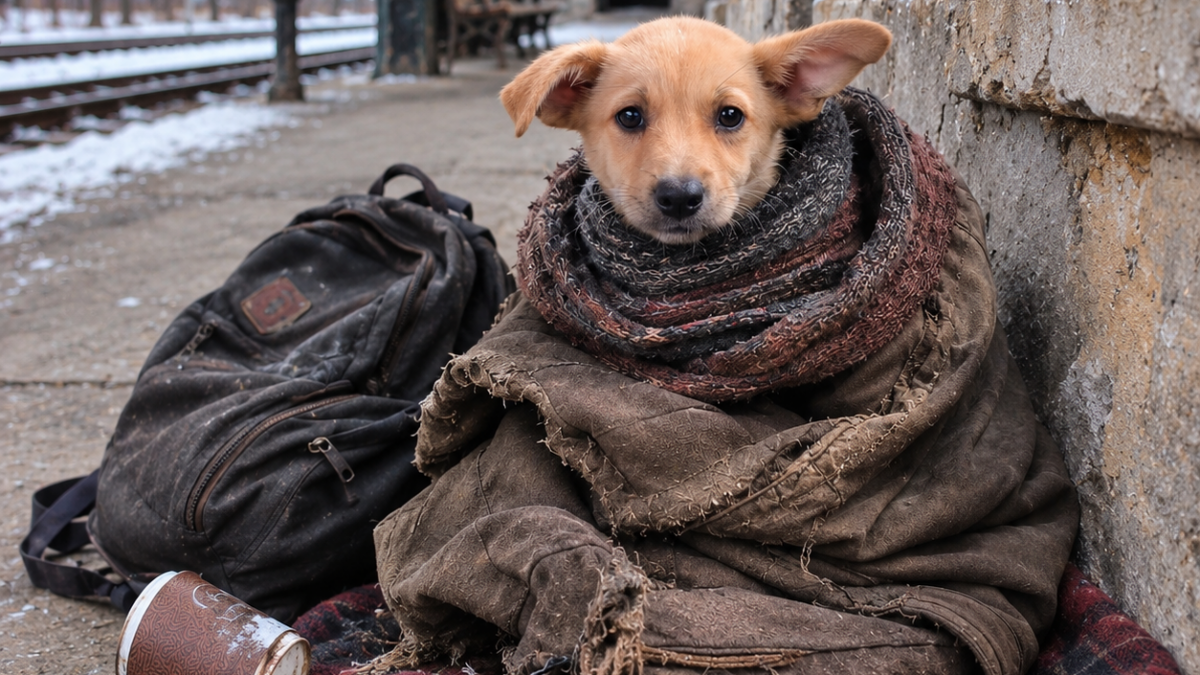
PART 2
The ambulance left first.
Animal control arrived ten minutes later.
By then Daisy had stopped trembling quite so violently, although she still refused to move away from my chest.
A woman named Maria stepped out of the county van carrying a small blanket.
“How old?”
“Maybe three months.”
“Where’d she come from?”
I looked toward the empty bench.
“Under his coat.”
Maria followed my eyes.
Her expression changed.
“That man?”
“Yes.”
“He was keeping her warm?”
“All night, apparently.”
Maria moved more slowly after that.
She held out her hand.
Daisy sniffed it.
Then buried her face against me.
Maria smiled sadly.
“She picked you.”
“No.”
I shook my head.
“She’s terrified.”
“Those things aren’t mutually exclusive.”
I handed Maria the note.
She read it.
Her mouth tightened.
“Henry Carter.”
“You know him?”
“No.”
She looked at Daisy.
“But we will now.”
The puppy needed a veterinarian immediately.
I should have gone home.
My shift had ended.
I had been awake since six the previous evening.
Instead, I followed the animal-control van to Lakeside Veterinary Clinic.
I told myself I was only going because someone needed to explain what happened.
That was not the real reason.
The real reason was simple.
Henry had asked somebody to take care of Daisy.
I had been the somebody who found the note.
That felt like a responsibility.
Dr. Patel examined Daisy while I stood near the wall.
She was underweight.
Dehydrated.
Mildly hypothermic.
She had fleas.
Her paw pads were irritated.
But otherwise, unbelievably, she was healthy.
“She should recover completely,” Dr. Patel said.
I exhaled for what felt like the first time that morning.
“Good.”
“Do we know vaccination history?”
“No.”
“Ownership records?”
“No.”
I showed him Henry’s note.
He read it.
Then handed it back carefully.
“Keep that.”
“I was planning to.”
Daisy received warmed fluids.
Food.
Medication.
A heated blanket.
When the technician placed her in a kennel, she began crying.
Not barking.
Crying.
I stood outside.
“She’ll settle,” the technician said.
Daisy scratched weakly at the gate.
I sat on the floor.
The technician looked at me.
“You don’t have to stay.”
“I know.”
I stayed.
Twenty minutes later, Daisy stopped crying.
She fell asleep with her nose pressed against the kennel door nearest my knee.
That was how our story began.
Not with an adoption.
Not with some dramatic promise.
Just a cold floor and a puppy who did not want the last warm person she knew to disappear.
I went home at almost ten in the morning.
I slept for four hours.
Then I woke thinking about Henry.
The station.
The bench.
The note.
I had placed the old ticket inside a plastic sandwich bag because I was afraid the pencil would smear.
I read it again.
*She deserves warmth.*
That sentence would not leave me alone.
At five that evening, I called the county medical examiner.
I expected bureaucracy.
Instead, a woman named Sandra answered and was surprisingly patient.
“I’m trying to find out what happens to Henry Carter.”
“Are you family?”
“No.”
“Friend?”
“No.”
I realized how strange I sounded.
“I found him.”
There was a pause.
“At the old station?”
“Yes.”
Her voice softened.
“I heard about that.”
“He had a puppy.”
“Yes. The officers mentioned it.”
“I have his note.”
Another pause.
“What are you looking for?”
“I don’t know.”
That was honest.
“Family, I guess.”
“We’re working on identification and notification.”
“Does he have identification?”
“Not much.”
I leaned against my kitchen counter.
“What does that mean?”
“A veterans card that’s several years expired. Library card. No current driver’s license. A few receipts.”
“Veteran?”
“Apparently.”
That word changed the room.
Henry Carter.
Veteran.
Homeless.
Dead on a station bench.
I closed my eyes.
“Can you tell me anything else?”
“Not yet.”
“Will somebody?”
“If next of kin is located.”
“And if they aren’t?”
Sandra sighed.
“Then the county follows procedure.”
Procedure.
I hated how cold the word sounded.
The next morning, I went back to the station.
The bench had been cleaned.
No sign remained that Henry had ever been there.
I stood in front of it longer than necessary.
My supervisor, Mark, eventually found me.
“Heard you had a rough night.”
“Yeah.”
He put his hands into his coat pockets.
“You did what you could.”
I looked at him.
“I didn’t do anything.”
“You called.”
“He was already dead.”
“You saved the dog.”
“Henry saved the dog.”
Mark had no answer.
Neither did I.
That afternoon, I visited Daisy.
She was sitting up.
The moment she saw me, she started wagging her entire back end.
I laughed.
“Look at you.”
She pressed against the kennel door.
Dr. Patel appeared behind me.
“She’s doing much better.”
“When can she leave?”
“Tomorrow, probably.”
“With animal control?”
“Unless they find a foster.”
I looked at Daisy.
That was my first mistake.
Or maybe my first good decision.
“Could I foster her?”
Dr. Patel smiled.
“I was wondering how long that would take.”
“I’m not adopting.”
“I didn’t say you were.”
“I work nights.”
“Dogs sleep.”
“I live alone.”
“Dogs generally approve of that.”
“I have never owned a puppy.”
“Neither had every dog owner before their first puppy.”
I pointed at him.
“You’re not objective.”
“No.”
He smiled.
“But neither are you.”
Daisy came home with me two days later.
Temporary foster.
That was the phrase on the paperwork.
I repeated it constantly.
Temporary foster.
Daisy did not care about legal terminology.
Within twenty-four hours, she had stolen one sock, chewed the corner of a rug, knocked over her water bowl, and learned that the refrigerator contained important things.
She followed me everywhere.
Bathroom.
Kitchen.
Bedroom.
Hallway.
At night, I worked.
My neighbor Mrs. Alvarez—seventy-two, widowed, and delighted to have something new to supervise—watched Daisy.
The first time I picked Daisy up after a shift, Mrs. Alvarez said, “She waited by the window at five.”
“I finish at six.”
“She doesn’t understand labor law.”
Daisy ran to me.
I crouched.
She crashed into my chest.
I thought about Henry.
“You really picked an exhausting one, didn’t you?”
She licked my face.
A week passed.
Then two.
The medical examiner called.
“We found Henry’s sister.”
I sat down.
“She’s alive?”
“Yes. Her name is Margaret Carter. Lives in Ohio.”
“Does she know?”
“We notified her.”
I swallowed.
“How did she take it?”
Sandra hesitated.
“Hard.”
“Can I speak to her?”
“I can’t give you her contact information.”
“Of course.”
“But she asked about the puppy.”
I looked toward Daisy.
She was attacking a cardboard box.
“What did you tell her?”
“That Daisy survived.”
There was a long silence.
“She cried.”
I understood.
“Can you give her my number?”
“Yes.”
Margaret called that evening.
Her voice was older.
Fragile.
“Is this the man who found Henry?”
“Yes.”
“My name is Margaret.”
“I’m sorry.”
I hated how useless those words were.
“Thank you for saying that.”
We were quiet for several seconds.
Then she asked the only question that seemed to matter to her.
“Is Daisy really okay?”
“She’s okay.”
“Really?”
“She destroyed a shoe this morning.”
Margaret laughed.
Then immediately began crying.
“That sounds like her.”
“You knew Daisy?”
“No. Henry wrote me about her.”
That surprised me.
“He wrote you?”
“Occasionally.”
“When was the last time?”
“Three months ago.”
I sat straighter.
“What did he say?”
“That he’d found a puppy.”
“Found?”
“He said someone left her behind a grocery store.”
I looked at Daisy.
“So Daisy wasn’t always his.”
“No.”
Margaret’s voice became softer.
“He said she gave him a reason to wake up.”
That sentence landed hard.
I said nothing.
Margaret continued.
“My brother was not always homeless.”
I looked toward the window.
“I figured there was more.”
“There is always more.”
She told me Henry’s story.
He had served in the Army in his twenties.
Worked construction for years.
Married.
Had a daughter.
Then his wife died from cancer.
His daughter moved west.
Henry began drinking.
Not constantly at first.
Then more.
A back injury ended construction work.
Painkillers followed.
Then debt.
Then eviction.
“He disappeared from us in pieces,” Margaret said.
“What do you mean?”
“First he stopped visiting.”
Her voice cracked.
“Then he stopped answering calls. Then letters became rare. Every time I found him, he was ashamed.”
“Of being homeless?”
“Of needing help.”
I understood that kind of shame.
The kind that convinces people isolation is dignity.
“Did he have benefits?”
“Probably. But he hated paperwork. Hated asking.”
“What about his daughter?”
Margaret went quiet.
“They hadn’t spoken in years.”
“Why?”
“Pain.”
That was all she said.
I did not push.
Before hanging up, Margaret asked if she could see Daisy through video.
Of course.
I turned the camera.
Daisy was lying upside down on my couch, one ear folded over her face.
Margaret laughed.
“Oh, Henry.”
“What?”
“He always loved ridiculous dogs.”
I smiled.
“She’s definitely ridiculous.”
Margaret wiped her eyes.
“Will you keep her?”
“I’m fostering.”
She gave me the silence people give when they know you are lying to yourself.
“Of course.”
Two weeks later, a package arrived.
Inside was a photograph of Henry.
Young.
Military uniform.
Standing beside another soldier.
Healthy.
Straight-backed.
Smiling.
I stared at it for a long time.
The man in the photograph did not look like the man on the bench.
But he was.
That mattered.
Margaret had included a note.
**People will remember how Henry died. Please also remember that he lived.**
I framed the photograph.
Then something happened that pushed Henry’s story beyond my kitchen.
A local reporter learned about Daisy.
Someone in emergency services had mentioned the note.
The reporter called the station.
Mark transferred her to me.
Her name was Allison Grant.
“I’d like to write about what happened.”
“No.”
She sounded surprised.
“Can I ask why?”
“Because Henry isn’t a tragedy people get to consume over breakfast.”
There was silence.
Then she said, “That’s fair.”
I almost hung up.
“But if we tell it carefully,” she continued, “people may understand what killed him.”
“The cold.”
“The cold was the final thing.”
I said nothing.
“How many warming beds does this city have?”
I didn’t know.
“How many people were turned away from shelters during that freeze?”
I still didn’t know.
“How many abandoned buildings are being used because there is nowhere else?”
That question bothered me.
The station.
Henry.
I looked at Daisy.
“What do you want from me?”
“The truth.”
So I agreed.
One interview.
No sensational photographs of Henry’s body.
No “mystery homeless man.”
Use his name.
Mention that he was a veteran.
Mention Daisy.
Mention the note.
Allison agreed.
The story ran on Sunday.
The headline read:
**HENRY CARTER’S LAST NIGHT: THE MAN WHO USED HIS FINAL WARMTH TO SAVE A PUPPY**
I hated seeing it.
Then I read the article.
Allison kept her word.
She included Henry’s military service.
His construction work.
His wife.
His injuries.
His homelessness.
Daisy.
The note.
Then she included something else.
The city had opened an emergency warming center during the freeze.
It had forty beds.
At least sixty-three people had sought entry.
Twenty-three had been turned away after capacity was reached.
Henry’s name was not on the official list.
But several homeless people interviewed by Allison said he had tried to reach another shelter earlier that evening.
That shelter was full.
He walked toward the abandoned station afterward.
Suddenly, the story became bigger.
People were angry.
Some were angry for the right reasons.
Some were just angry because anger feels useful online.
Donations started arriving at the shelter caring for homeless residents.
Then dog food arrived at my house.
A ridiculous amount.
Someone left blankets at the station.
Another person left flowers on Henry’s bench.
Then came candles.
Notes.
Coffee.
One note said:
**FOR HENRY AND DAISY. NO ONE SHOULD FREEZE ALONE.**
The city removed the candles for safety.
More appeared.
Within a week, Henry’s bench had become something like a memorial.
I went there after midnight during one of my shifts.
Snow fell lightly.
I sat down.
Daisy, now vaccinated and cleared for longer walks, sat beside me in a little red coat Mrs. Alvarez had bought her.
“Yes,” I told her.
“You look ridiculous.”
She wagged.
I touched the bench.
“Your friend started something.”
Daisy sniffed the wood.
For a moment, I imagined Henry sitting there.
Not dead.
Just tired.
Daisy inside his coat.
I wanted to ask him why he hadn’t gone somewhere else.
Why he hadn’t called someone.
Why he apologized for not giving enough when he had given everything.
But dead people do not answer.
Sometimes the living have to answer for them.
A week later, the city council announced a review of emergency cold-weather procedures.
That sounded promising.
Then I learned something else.
The station property was scheduled for redevelopment.
A private company called Marlowe Urban Group had been negotiating with the city for months.
They wanted to convert the station and surrounding land into restaurants, offices, and luxury apartments.
Suddenly Henry’s memorial became inconvenient.
The first signs were subtle.
Security notices.
Temporary fencing.
Signs reading:
**NO LOITERING. PRIVATE REDEVELOPMENT AREA.**
Then one morning, all the flowers disappeared.
So did the notes.
So did the blankets people had left for homeless residents.
I called Mark.
“Who removed the memorial?”
“Contractors.”
“Why?”
“Safety.”
“What safety problem did flowers create?”
“Don’t start.”
“I’m already started.”
Mark sighed.
“The redevelopment company requested cleanup.”
“Henry died there.”
“I know.”
“So do they.”
“Yes.”
“And they removed everything.”
“Yes.”
I hung up angry.
The next afternoon, Allison called.
“You hear about the cleanup?”
“Yes.”
“There’s more.”
“What?”
“Marlowe Urban Group pressured the city months ago to increase enforcement against homeless people around the station.”
I sat down.
“What does that mean?”
“Move-along orders. Trespass warnings. Requests for police patrols.”
“That’s not illegal.”
“No.”
“But?”
“They also opposed using the old station as an emergency warming site.”
My hand tightened around the phone.
“When?”
“Before Henry died.”
“Why?”
“They argued it would complicate redevelopment negotiations.”
I closed my eyes.
The station had heat in two rooms.
Not much.
But enough.
I knew because I checked the system every night.
“Could the station have been used?”
“Probably.”
“Who decided not to?”
“That’s what I’m trying to find out.”
Now I was angry in a different way.
Not because a businessman personally killed Henry.
That would have been too simple.
Reality rarely gives you one villain.
Henry died because of cold.
Because shelters were full.
Because he had health problems.
Because shame kept him isolated.
Because systems fail people slowly.
But if someone had blocked a usable warming space because homeless people might make a future development less attractive, that mattered.
Allison investigated.
I helped where I could.
Emails obtained through public-record requests showed meetings between city officials and Marlowe.
One email from a company executive said:
**Activation of the station as a homeless warming facility could create a long-term population-management issue inconsistent with redevelopment objectives.**
I read the sentence three times.
Population-management issue.
Henry.
A population-management issue.
Not a man.
Not a veteran.
Not somebody’s brother.
A problem near expensive future apartments.
The executive’s name was Richard Marlowe.
I searched him online.
Fifty-three.
Tailored suits.
Charity-gala photographs.
Interviews about “revitalizing neglected urban corridors.”
I wanted to hate him immediately.
Then I forced myself to slow down.
Documents mattered.
Evidence mattered.
Not imagination.
Allison found more.
City staff had proposed using the station as an overflow warming center twice.
Both proposals stalled.
One internal memo cited liability.
Another cited staffing.
Another mentioned concerns from the redevelopment partner.
No single email said:
Let people freeze.
Systems protect themselves with language more carefully than that.
But the pattern was ugly.
Then Marlowe made a mistake.
He went on television.
A reporter asked about Henry.
Marlowe expressed sympathy.
Then he said:
“We cannot allow one unfortunate incident to derail a development that will benefit thousands.”
One unfortunate incident.
I was watching from my living room.
Daisy sat beside me.
I turned the television off.
“No.”
The next city-council meeting was packed.
I had never attended one.
I hated public speaking.
Allison told me I should speak.
I told her no.
Margaret Carter called me that afternoon.
“You’re going.”
“How do you know?”
“I read the article.”
“I’m not family.”
“Neither are most of the people making decisions about Henry now.”
That silenced me.
She continued.
“You found him.”
“Yes.”
“You read his last words.”
“Yes.”
“You held Daisy.”
I looked at the puppy asleep near my foot.
“Yes.”
“Then say what you saw.”
So I did.
The council chamber held maybe two hundred people.
More stood outside.
Marlowe representatives sat near the front.
City officials looked exhausted.
When my name was called, my legs felt weak.
I walked to the microphone.
“My name is Daniel Reed.”
That was the first time most people heard it.
Until then, I had been “the station guard.”
“I worked the night Henry Carter died.”
The room quieted.
“I found him the next morning.”
I stopped.
The memory returned too clearly.
His hands.
The coat.
The stillness.
“I need everyone here to understand something.”
I pulled the old ticket from my pocket.
Protected now inside a clear sleeve.
“Henry’s last written words were not about himself.”
I read them.
Slowly.
**If somebody finds this, please take care of Daisy. She is a good girl. She deserves warmth. I’m sorry I couldn’t give her more.**
Nobody moved.
I looked toward the council.
“That man froze to death apologizing because he thought he had not given enough.”
My voice shook.
“He gave his scarf.”
“He gave his coat.”
“He gave the last warmth in his body.”
I looked toward the Marlowe representatives.
“And somehow the rest of us—people with buildings, budgets, offices, heating systems, committees, emails, cars and homes—are still discussing whether warmth is too complicated to provide.”
The room remained silent.
I had planned notes.
I stopped using them.
“The station had heat.”
One official shifted.
“I know because I checked it every night.”
I held up my keys.
“I had access to rooms warmer than the bench where Henry died.”
My throat tightened.
“But I did not know he was there until morning.”
I paused.
“I will live with that.”
Then I looked at everyone else.
“The question is what the rest of you are willing to live with.”
That clip spread online.
I hated that.
It also worked.
Public pressure grew.
The city postponed the redevelopment vote.
Marlowe Urban Group released a statement accusing critics of “misrepresenting complex planning decisions.”
Allison published the emails.
More residents showed up.
Veterans groups joined.
Churches.
Animal rescue organizations.
Teachers.
Former homeless residents.
Then came the strangest coalition I had ever seen.
Dog people and housing advocates.
Daisy became the symbol whether I wanted her to or not.
Someone made a sign:
**HENRY KEPT ONE PUPPY WARM. OUR CITY CAN KEEP PEOPLE WARM.**
That sign appeared everywhere.
The movement gained a name.
Warmth for Henry.
I resisted it at first.
Margaret didn’t.
“He would hate the attention,” she said.
“Then why support it?”
“Because he hated being a burden more.”
She paused.
“If his death can make it easier for somebody else to ask for help, let it.”
The first goal was simple.
Open an emergency warming center whenever temperatures fell below a set threshold.
No waiting until every standard shelter bed filled.
No complicated referral process.
Walk in.
Get warm.
The second goal came from Daisy.
Many homeless residents refused shelters because they could not bring pets.
That was controversial.
Some facilities had legitimate space and allergy concerns.
But the result was predictable.
People chose the street rather than abandon animals that were often their only family.
Henry might have done exactly that.
We would never know.
So Warmth for Henry proposed something new.
A pet-friendly overnight section.
Basic kennels.
Food.
Water.
Vaccination assistance.
Temporary veterinary support.
Marlowe opposed using the station.
They argued redevelopment would bring jobs.
Tax revenue.
Housing.
I understood those arguments.
The city needed those things too.
The issue became bitter.
People began treating compromise as betrayal.
I didn’t want Henry turned into a political weapon.
I wanted something practical.
Heat.
Beds.
A place for animals.
Then Marlowe Urban Group filed a formal complaint against the memorial and public gatherings at the station.
They cited interference with property access.
That was the moment they lost public sympathy almost completely.
The complaint demanded immediate removal of signs and personal items.
One of those items was Henry’s photograph.
Margaret called me furious.
“They want his picture removed?”
“Yes.”
“From the bench where he died?”
“Yes.”
“I am eighty years old.”
I knew that tone already.
“What are you about to do?”
“I’m getting on a plane.”
“Margaret.”
“No.”
“Margaret—”
“My brother spent his last night protecting a puppy because nobody protected him.”
Her voice hardened.
“I am not allowing a real-estate company to erase his face because it hurts their marketing.”
Three days later, Margaret arrived.
Tiny woman.
White hair.
Walking cane.
Terrifying.
Daisy loved her immediately.
Margaret sat on my couch holding Daisy against her chest.
“Oh, Henry.”
She cried quietly.
Daisy licked her chin.
Margaret laughed through the tears.
“You really are trouble.”
The next morning, she went to the station.
News cameras were waiting.
I hated that.
She ignored them.
She carried Henry’s framed military photograph.
At the bench, she placed it down.
A Marlowe security contractor approached.
“Ma’am, you can’t leave personal property here.”
Margaret turned.
“My brother died on this bench.”
The man stopped.
“I’m sorry, but—”
“Are you?”
He looked trapped.
Margaret pointed to the photograph.
“That is Henry Carter.”
Cameras rolled.
“He served this country.”
She pointed toward the station.
“He built houses.”
“He buried a wife.”
“He lost his way.”
“He became poor.”
“He became sick.”
“He became homeless.”
Her voice shook.
“But he did not stop being human.”
Nobody interrupted her.
“And if your company wants to build expensive apartments here, perhaps the people who live in them should know whose memory you asked to throw in the trash.”
That was the end of Marlowe’s public-relations strategy.
Within forty-eight hours, the company withdrew the complaint.
But the larger fight continued.
Then Allison found the document that changed everything.
A facilities assessment commissioned two winters earlier.
It showed that the east waiting hall could be safely reopened seasonally for emergency use with relatively minor repairs.
Cost estimate:
Less than what the city spent on decorative downtown lighting that same year.
Worse for Marlowe, an internal email showed one city official had suggested using private redevelopment funds for the repairs.
A Marlowe executive rejected the idea.
The reason:
**Potential reputational issues associated with establishing a homeless-services identity at the site.**
There it was.
Not safety.
Not engineering.
Image.
They did not want the station associated with homeless people.
The station where Henry froze.
Public reaction was immediate.
Marlowe’s investors began asking questions.
One local partner withdrew.
The city opened an ethics review.
Richard Marlowe appeared before council.
I attended.
He looked different in person.
Less polished.
More tired.
He gave a prepared statement.
He said the company never wanted anyone harmed.
I believed that.
Most harmful decisions are not made by people consciously wanting someone dead.
They are made by people deciding something else matters more.
Profit.
Convenience.
Appearance.
Distance.
Then Marlowe said:
“We regret if our planning recommendations contributed to the perception that vulnerable residents were unwelcome.”
Perception.
Margaret whispered beside me.
“Coward.”
I almost laughed.
Councilwoman Jenkins interrupted him.
“Were they unwelcome?”
Marlowe paused.
“No.”
“Then why did your company oppose a warming center?”
“We had concerns about long-term site use.”
“Meaning?”
“Operational consistency with redevelopment.”
Jenkins leaned forward.
“Mr. Marlowe, a man died there.”
The room went silent.
“Do you understand why people find your language offensive?”
He looked down.
“Yes.”
The redevelopment agreement was eventually canceled.
Not because Henry died.
Not solely.
Because the company had failed to disclose lobbying contacts required under city procedure, because the public relationship had collapsed, and because council decided to reconsider the property’s future.
Marlowe Urban Group lost the project.
Some people called that revenge.
I didn’t.
Revenge would have been wanting Richard Marlowe homeless.
Cold.
Humiliated.
I didn’t want that.
I wanted him to understand that people who have nothing are still people.
Whether he ever truly understood, I do not know.
But he lost the ability to treat Henry’s death as an inconvenient public-relations problem.
That was enough.
The city approved a new plan.
The old station would remain historic.
Part of it would become community space.
The east waiting room would become a permanent winter warming center.
Pet-friendly.
They named it the Carter Warming Room.
Margaret cried when she heard.
“So dramatic,” she said.
“You came here specifically to fight a real-estate company on television.”
“That was different.”
“How?”
“I was angry.”
“Very quietly dramatic.”
She hit my arm with her cane.
Not hard.
Mostly.
Construction took six months.
During that time, Daisy grew.
She went from a trembling puppy small enough to fit inside Henry’s coat to a thirty-five-pound golden mutt with enormous ears, a permanently optimistic expression, and no understanding of personal space.
Temporary foster status lasted twenty-three days.
Then Maria from animal control called.
“You ready to make it official?”
“No.”
“Daniel.”
“I work nights.”
“You have arranged care.”
“I rent.”
“Your landlord signed permission.”
“I’m inexperienced.”
“She sleeps on your bed.”
“That proves poor boundaries.”
Maria laughed.
“Sign the papers.”
I signed.
Daisy Carter-Reed.
The clerk looked at the name.
“Carter?”
I nodded.
“That was Henry’s.”
She smiled.
“Good.”
Margaret approved.
“Henry would complain.”
“Why?”
“He never liked having his name on things.”
“Too late.”
The Carter Warming Room opened the following November.
The first night the temperature dropped below twenty degrees, twenty-six people came.
Eight had dogs.
One had a cat in a backpack.
An older man named Raymond arrived with a beagle named Tilly.
He stood at the entrance.
“Dogs allowed?”
“Yes.”
“Inside?”
“Yes.”
He looked suspicious.
“Free?”
“Yes.”
“You sure?”
“Yes.”
Daisy stood beside me wearing a blue volunteer bandana.
Raymond looked at her.
“That the puppy?”
“Yeah.”
“The one from the old man?”
I nodded.
Raymond removed his hat.
“I knew Henry.”
My chest tightened.
“What?”
“Street name wasn’t anything fancy. Just Henry.”
He smiled sadly.
“Man could fix anything with wire.”
I laughed.
“That sounds useful.”
“Fixed my backpack twice.”
Raymond looked around.
“He would’ve hated this being named after him.”
“That’s what his sister says.”
“Smart woman.”
Raymond bent down.
Daisy sniffed him.
Then leaned into his hand.
His face changed.
“Yeah,” he whispered.
“That’s Henry’s dog.”
Over the first winter, 312 people used the warming room.
Seventy-four animals came through.
Nobody had to choose between a pet and shelter on the coldest nights.
We learned quickly.
Dogs bark.
Cats hate communal spaces.
People need privacy.
Some residents had addiction issues.
Mental illness.
Untreated medical problems.
Conflict happened.
Rules mattered.
Compassion without structure becomes chaos.
Structure without compassion becomes another locked door.
We made mistakes.
Then fixed them.
One night, a young woman named Ashley arrived crying with a terrier wrapped in a towel.
The dog had an infected wound.
She refused to leave him.
Our volunteer veterinarian treated him.
Ashley slept beside the kennel.
Three months later, she returned.
Not for shelter.
To volunteer.
She had entered transitional housing.
Her dog, Milo, was healthy.
She hugged Daisy.
“This place kept me from losing him.”
I thought about Henry.
One life touching another.
Then another.
Then another.
That was when I understood movements rarely begin with speeches.
Sometimes they begin with one person making one impossible choice in private.
Henry chose Daisy over his own warmth.
Nobody watched.
No camera.
No applause.
No expectation anyone would ever know.
That purity mattered to me.
He did not save Daisy to become a symbol.
He saved her because she was cold.
The second winter, Warmth for Henry expanded.
A church opened overflow beds.
A veterinary clinic donated vaccines.
A local hotel agreed to provide emergency rooms for families with children during extreme cold.
Businesses donated meals.
A mobile shower trailer arrived twice a week.
A social worker helped people replace identification cards.
Veterans outreach workers began visiting.
That one mattered most to Margaret.
“If someone had found Henry earlier…”
She never finished.
We both knew.
Maybe he would have accepted help.
Maybe not.
You cannot build a program on certainty about the past.
You build it because the next person deserves another option.
The city eventually found Henry’s daughter.
Her name was Claire.
That reunion happened too late.
She contacted Margaret after seeing a national news story about Daisy and the warming center.
Claire was forty-two.
She had not spoken to Henry in nine years.
She called me before visiting.
“I don’t know if I should come.”
“Why?”
“Because everybody thinks he was some saint.”
I sat quietly.
“I was angry at him.”
“That’s allowed.”
“He missed my wedding.”
“I’m sorry.”
“He borrowed money.”
“Okay.”
“He drank.”
“I know some of that.”
“He promised things.”
Her voice broke.
“Then disappeared.”
I let her talk.
Finally she said, “What if seeing all this makes me hate him more?”
“Then you hate him more.”
She was silent.
“You don’t owe dead people forgiveness because they died.”
I looked at Daisy sleeping beside me.
“But you may want the whole story before you decide what to carry.”
Claire came.
Margaret met her at the airport.
They cried.
Argued.
Cried again.
Family.
At the station, Claire stood before Henry’s bench.
Daisy approached slowly.
Claire knelt.
“Hi.”
Daisy sniffed her face.
Then licked her.
Claire started sobbing.
“I’m sorry.”
I knew she wasn’t speaking only to the dog.
She sat on the floor holding Daisy.
Later, she asked to see the note.
I handed it to her.
Her hands shook.
She read:
*I’m sorry I couldn’t give her more.*
Claire closed her eyes.
“He always apologized after it was too late.”
That sentence hurt.
I said nothing.
Then she added:
“But he still gave her what he had.”
“Yes.”
Claire kept a copy of the note.
The original eventually went into a small display inside the station.
Not as entertainment.
As history.
Beside it was Henry’s photograph.
The young soldier.
Another photograph showed him years later.
Older.
Bearded.
Holding Daisy outside a grocery store.
Someone had found the image after the story spread.
He was smiling.
Underneath, Margaret chose the words:
**HENRY CARTER, 1958–2024**
**A LIFE IS MORE THAN ITS HARDEST CHAPTER.**
That became the message I carried most.
Because public stories flatten people.
Hero.
Victim.
Addict.
Veteran.
Homeless man.
Father.
Brother.
None of those words alone was Henry.
He could fail his daughter and save Daisy.
He could struggle with alcohol and still be generous.
He could make mistakes and still deserve warmth.
He could be difficult and still matter.
Human beings are inconvenient that way.
Daisy became a certified therapy dog when she was three.
That surprised everyone who remembered the half-frozen puppy.
She visited the warming center during winter.
She had a special gift for finding the person sitting alone.
She would walk past five people calling her name and lie beside the one pretending not to need company.
Raymond said she had “Henry radar.”
Maybe.
One January night, I found Daisy curled beside a young man named Marcus.
Twenty-two.
Recently homeless after leaving foster care.
He rarely spoke.
Daisy’s head rested on his boot.
Marcus stared at her.
“She always do this?”
“Yes.”
“Why me?”
“No idea.”
He scratched her ear.
“My mom had a dog.”
I sat nearby.
“What kind?”
“Lab.”
We talked for forty minutes.
Not about homelessness.
Dogs.
Three weeks later, Marcus agreed to meet a housing caseworker.
Six months later, he stopped by the station in a grocery-store uniform.
He brought Daisy a bag of treats.
“I got a room.”
I smiled.
“Good.”
He looked embarrassed.
“Just one room.”
“One warm room counts.”
That phrase became something we said often.
Warmth does not solve everything.
A bed does not cure addiction.
A meal does not fix trauma.
A kennel does not create housing.
But surviving the night creates tomorrow.
Tomorrow creates another chance.
Henry understood survival at the smallest possible scale.
One puppy.
One coat.
One night.
That became our model.
Do what is possible now.
Then build from there.
Richard Marlowe disappeared from my life.
Mostly.
Years later, I received a letter at the station.
No company logo.
Handwritten.
From him.
I almost threw it away.
Instead, I opened it.
He wrote that losing the redevelopment project had nearly destroyed his company.
Investors withdrew.
He sold his interest two years later.
Then his adult son developed an addiction.
For several months, his son lived in his car.
One night during a freeze, somebody convinced him to enter a warming center in another city.
Marlowe wrote:
**I spent years believing homelessness was primarily a problem to be managed. Then it had my son’s face.**
I read that sentence twice.
He apologized.
Not in dramatic language.
He admitted he had pushed against the station warming proposal because he feared it would reduce property value and complicate leasing.
He admitted Henry’s death forced him to confront what that language hid.
At the end, he wrote:
**I do not expect forgiveness. I donated anonymously to the Carter Warming Room last year. I will do so again. I am sorry it took my own family’s suffering for me to understand yours.**
I sat with the letter.
Daisy was asleep under my desk.
Part of me wanted to remain angry.
Anger can become a form of loyalty to the person who was hurt.
As if forgiving anything means saying the harm was acceptable.
It doesn’t.
I never told Margaret she should forgive him.
I never told Claire.
I never wrote back.
But I kept the letter.
Because it proved something.
Henry had changed him too.
Not through revenge.
Through consequence.
Through discomfort.
Through a mirror he could no longer avoid.
I preferred that ending.
Punishment can stop behavior.
Understanding can stop repetition.
Sometimes you need both.
Daisy turned six.
Then seven.
Gray appeared around her muzzle earlier than I wanted.
I was still working nights, although I had become head of site operations after the station reopened.
That sounded impressive.
Mostly it meant more paperwork.
The building changed dramatically.
One side remained museum space.
The Carter Warming Room occupied the east hall.
A small veterinary room sat beside it.
The old ticket counter became an intake desk on severe-weather nights.
And Henry’s bench remained exactly where it had been.
We could have replaced it.
We didn’t.
Every winter, volunteers placed a clean wool blanket across one end.
Not for ceremony.
For whoever needed it.
One December morning, I found an older homeless man asleep on Henry’s bench.
Alive.
Warm.
Daisy lay at his feet.
I approached.
“Sir?”
He woke.
“Sorry.”
“You don’t have to leave.”
He looked confused.
“The warming room is open.”
“I know.”
“Then why are you out here?”
“Needed air.”
Fair.
He looked at the plaque beside the bench.
“This where that guy died?”
“Yes.”
He rubbed his hands.
“Sad.”
“Yeah.”
Then he looked toward the open warming-room door.
“Different now.”
I followed his eyes.
Steam rose from coffee cups.
A volunteer served oatmeal.
A woman brushed snow from her coat.
A German Shepherd slept inside a crate.
Different now.
Those two words meant everything.
I sat beside him.
“Yeah.”
Daisy climbed between us.
“Different now.”
Margaret died when Daisy was eight.
Peacefully.
Her niece called me.
A week earlier, Margaret had mailed Daisy a final package.
Inside was a knitted yellow blanket.
Awful color.
Beautiful.
A note:
**For Daisy, because Henry was right. She always deserved warmth.**
Daisy slept under it for years.
Claire stayed involved with the program.
She became one of its largest private donors, though she hated anyone mentioning it.
She also began speaking publicly about complicated grief.
Not saint-making people after death.
Not reducing them to their worst choices either.
She once stood in the old station and said:
“My father hurt me.”
The room went silent.
“And my father saved Daisy.”
She paused.
“Both are true.”
I admired her more for saying that than any polished tribute could have made me.
Truth is harder than worship.
When Daisy turned ten, Dr. Patel found a heart condition.
Manageable.
For a while.
Medication.
Less strenuous activity.
Regular checks.
She still came to the warming room.
Slower.
Her gift never changed.
She found the loneliest person in the room.
One winter evening, she walked toward a woman named Teresa.
Teresa had lost her apartment after medical debt.
She sat alone clutching a grocery bag containing everything she owned.
Daisy placed her chin on Teresa’s knee.
Teresa whispered, “I don’t have anything for you.”
I heard it from across the room.
Daisy stayed.
Teresa started crying.
“I don’t have anything.”
I walked over.
“You don’t need anything.”
She looked at me.
“For her?”
“For here.”
Teresa wiped her face.
Daisy leaned harder against her.
I thought of Henry.
*I’m sorry I couldn’t give her more.*
How many people apologize for needing?
How many believe they must earn warmth before they deserve it?
That became the final lesson Henry left me.
Dignity is not something people acquire after they become stable.
It is something they need while they are falling apart.
Especially then.
Daisy’s health declined slowly.
By twelve, she no longer visited every cold night.
We picked special ones.
Opening night.
Christmas.
The anniversary of Henry’s death.
People knew her.
Some had first met her years earlier.
They brought treats.
Photographs.
One man showed me a picture of Daisy sitting beside him seven years earlier.
“I was sleeping behind a warehouse then.”
He pointed to himself in the photograph.
Long beard.
Thin.
Then at himself now.
Clean jacket.
Work badge.
“My boss thinks I’m boring.”
I laughed.
“Congratulations.”
“Best thing anybody ever called me.”
Daisy wagged.
He knelt.
“You remember me?”
She licked him.
He cried.
Everyone cried around Daisy.
Apparently that was her second talent.
Her last winter was gentle.
She tired quickly.
Dr. Patel told me what I already knew.
Heart failure was progressing.
“How long?”
“Could be weeks.”
I hated him for saying it.
He had been her veterinarian since the beginning.
He looked older too.
So did I.
“Is she hurting?”
“Not much yet.”
“Tell me when.”
“I will.”
The anniversary of Henry’s death arrived with snow.
The Carter Warming Room was full.
Daisy was weak that morning.
I almost left her home.
Then she stood near the door when I put on my coat.
“You want to go?”
Tail movement.
So we went.
I carried her up the station steps.
The same doors.
The same platform.
The same bench.
Twelve years had passed since I opened Henry’s coat.
I sat down.
Daisy rested beside me beneath Margaret’s ugly yellow blanket.
People came and went.
Nobody bothered us.
At some point, a little girl staying with her mother approached.
“Is that Daisy?”
“Yes.”
“The Daisy?”
I smiled.
“Apparently.”
“Can I pet her?”
“Gently.”
The girl stroked Daisy’s gray head.
“My mom says a man saved her.”
“Yes.”
“What happened to him?”
I looked at Henry’s photograph.
“He died.”
The girl became serious.
“That’s sad.”
“Very.”
“But Daisy lived.”
“Yes.”
She thought about that.
“So he won.”
Children simplify things without always making them wrong.
I looked at Daisy.
“Yes.”
“I think he did.”
That evening, Daisy stopped eating.
The next morning, she struggled to breathe.
Dr. Patel came to my house.
I knew.
I had known for years that this moment would come.
Knowing did nothing.
Daisy lay beneath Margaret’s blanket.
I placed Henry’s old note beside me.
Not because Daisy needed it.
I did.
Dr. Patel sat quietly.
“Daniel?”
I nodded.
“Give me a minute.”
He left us.
I looked at Daisy.
“You know, you caused a lot of trouble.”
Her eyes opened.
“You destroyed three pairs of shoes.”
Tail movement.
“Attacked an entire roll of toilet paper.”
Another tiny movement.
“Made me speak at city council.”
I laughed through tears.
“Unforgivable.”
Her breathing remained shallow.
I touched her face.
“Henry asked me to take care of you.”
My voice broke.
“I spent years wondering whether I did enough.”
I looked at the note.
Then understood how much I had become like him.
Always worried love had not been enough.
“He said you deserved warmth.”
I wrapped Margaret’s blanket closer.
“He was right.”
I leaned down.
“And you gave it back.”
To me.
To Margaret.
To Claire.
To Marcus.
To Teresa.
To Raymond.
To hundreds of people whose names Henry never knew.
I pressed my forehead against Daisy’s.
“You did good.”
Her eyes closed.
“You can go.”
Dr. Patel returned.
Daisy died with my hand over her heart.
Warm.
Safe.
At home.
Everything Henry had wanted for her.
For weeks, I could not walk past the station bench without seeing both of them.
Henry.
Daisy.
Beginning and ending.
One cold.
One warm.
That difference became sacred to me.
A month later, Claire came to visit.
We sat on Henry’s bench.
She carried Daisy’s collar.
“Do you regret any of it?”
I looked at her.
“What?”
“All the attention. The fights. Marlowe. The council. The program.”
“No.”
“Even losing her?”
I smiled sadly.
“That wasn’t the price.”
“What was?”
“There wasn’t one.”
She waited.
“Love isn’t a transaction.”
I looked toward the warming-room doors.
“You don’t measure whether it was worth starting by how much it hurts when it ends.”
Claire nodded.
“My dad would have liked you.”
“I’m not sure.”
“He hated authority.”
“I am technically security.”
“Exactly. He would have enjoyed annoying you.”
We laughed.
The station still operates today.
Not for trains.
Those tracks are mostly dead.
But every winter, people come through those doors.
Some stay one night.
Some return often.
Some disappear and we never know what happened.
Some come back years later with jobs, apartments, children, photographs, or simply better coats.
Not every story ends well.
I refuse to lie about that.
We lose people.
Addiction wins sometimes.
Illness wins.
Violence wins.
Cold still kills people in this country.
We are not heroes because we opened one room.
But one room matters.
One blanket matters.
One kennel matters.
One cup of coffee matters.
One person knowing they can come inside without abandoning the dog beside them matters.
Henry taught us scale.
When you cannot save everyone, save the one you can reach.
That night, he could not solve homelessness.
He could not fix his body.
Could not repair his family.
Could not make the train station into a shelter.
He could do one thing.
Keep Daisy warm.
So he did.
And because he did, Daisy survived.
Because Daisy survived, people asked who Henry was.
Because people asked, they learned how he died.
Because they learned, they looked at the station.
Because they looked, they found the empty heated rooms.
Because they found those rooms, they asked why they were empty.
Because they asked why, officials had to answer.
And because the answers were not good enough, something changed.
People like neat stories.
They say Daisy saved hundreds.
Or Henry did.
The truth is more complicated.
Henry saved Daisy.
Daisy made people notice Henry.
Reporters made people notice the system.
Volunteers built the program.
Residents donated.
Officials changed rules.
Veterinarians helped animals.
Caseworkers helped people.
Margaret gave Henry his name back.
Claire gave him complexity.
Everyone carried a piece.
That is how change usually works.
Not one hero.
Many hands.
But whenever someone asks where it began, I take them to the old wooden bench.
There is a small brass plaque now.
Nothing dramatic.
It reads:
**HENRY CARTER SAT HERE ON HIS FINAL NIGHT.**
**WITH ALMOST NOTHING LEFT TO GIVE, HE GAVE HIS WARMTH TO A PUPPY NAMED DAISY.**
**MAY NO ONE WHO COMES HERE BELIEVE THEY HAVE NOTHING TO OFFER—OR THAT THEY DESERVE NOTHING IN RETURN.**
Beneath it is a small hook.
During winter, a scarf hangs there.
Sometimes two.
Anyone can take one.
Anyone can leave one.
People call it Henry’s Scarf.
I like that better than statues.
Henry would have hated a statue.
On very cold mornings, when my shift ends and the sky turns gray over the old tracks, I still sit there sometimes.
I’m older now.
My knees complain.
My hair is going gray.
The station is louder than it used to be.
Not trains.
People.
Coffee machines.
Dogs barking.
Doors opening.
Life.
I sit on Henry’s bench and remember the morning when this place was silent.
I remember opening a dead man’s coat.
I remember two blue-gray eyes looking up at me.
I remember Henry’s handwriting.
*She deserves warmth.*
For years, I thought that sentence was only about Daisy.
It wasn’t.
Henry deserved warmth too.
He deserved a room.
A bed.
A doctor.
A phone.
A chance to call his sister.
A place where his daughter might eventually find him.
He did not receive those things.
We cannot rewrite that.
But every winter, when those doors open and someone steps inside from the cold carrying everything they own, I think:
This one will.
This one gets the room Henry didn’t.
This dog gets the kennel Daisy didn’t have.
This person gets coffee.
This person gets a blanket.
This person gets another morning.
And maybe that is the only kind of revenge against indifference that has ever satisfied me.
Not making someone else cold.
Making more people warm.
Not destroying the men who once treated homelessness as a problem to hide.
Building something they can no longer ignore.
Not turning Henry into a saint.
Giving him back his humanity.
And not remembering Daisy only as the puppy beneath a dead man’s coat.
Remembering everything she became afterward.
A companion.
A therapy dog.
A bridge between people who thought they had nothing in common.
A reason hundreds of strangers looked twice at someone they once might have walked past.
Henry apologized because he believed he had not given enough.
He was wrong.
With one scarf, one coat, one dying body, and one act of love nobody was supposed to witness, Henry Carter gave more than he ever knew.
He gave Daisy tomorrow.
And somehow, through her, he gave tomorrow to a lot of other people too.
That is why, whenever I think about the coldest morning of my life, I no longer remember the cold first.
I remember warmth.
A little puppy hidden beneath an old coat.
A man who had almost nothing.
And the final thing he chose to give.








