PART 2: I Found a Dog Wandering Blind With a Yellow Metal Bucket Locked Around His Head—Then One Small Sound Made Him Stop Running
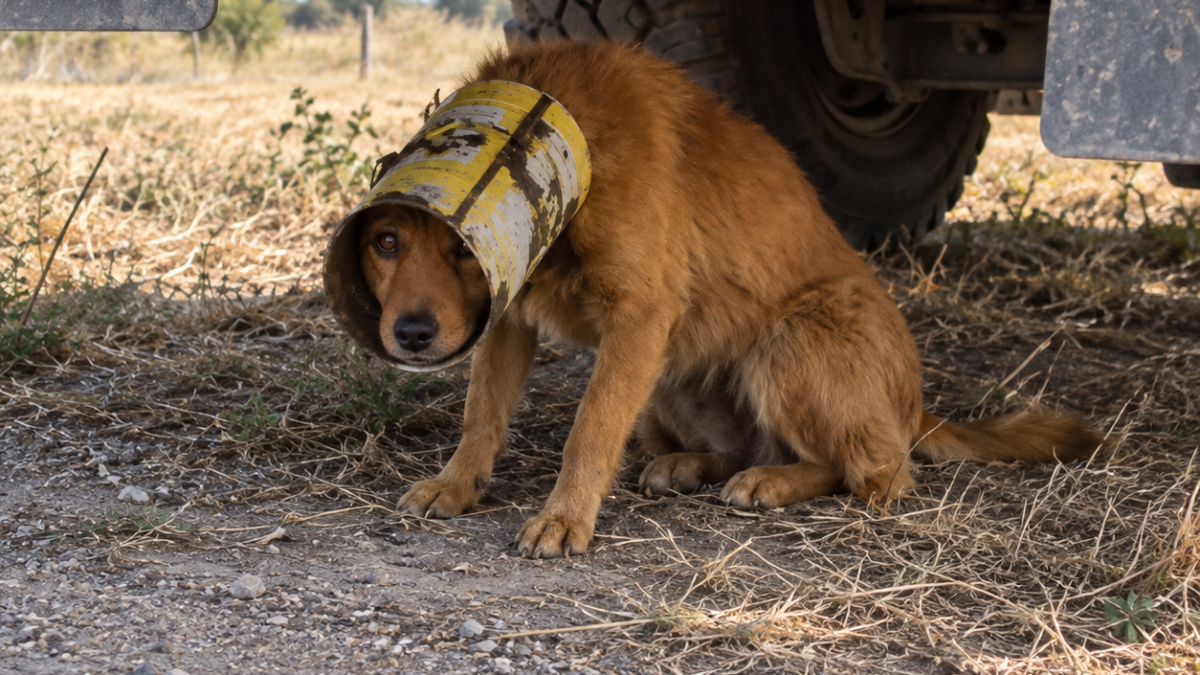
The first time I saw him, he wasn’t running toward safety—he was running blind, slamming into walls with a yellow metal bucket jammed so tightly over his head that he could no longer see the world around him.
Every time somebody tried to approach, the terrified dog bolted again, dragging that heavy piece of metal with him while hunger, thirst, and the raw wound around his neck quietly became more dangerous.
We thought catching him would be the hardest part, but one tiny sound in an empty alley made him stop—and what we discovered after that turned a simple rescue into something none of us were willing to walk away from.
My name is Caleb Morgan, and I had been working with animal rescue for seventeen years when the call came in.
I had seen dogs trapped beneath porches.
Dogs pulled from drainage pipes.
Dogs hit by cars and still trying to crawl home.
But I had never seen anything like the photograph on my phone that Tuesday morning.
It was blurry because whoever took it had been standing far away.
At first, I thought I was looking at a dog carrying something.
Then I zoomed in.
The dog’s head had disappeared completely inside a yellow metal bucket.
Not plastic.
Metal.
The rim had apparently slipped over his head and become lodged behind his ears and around the upper part of his neck.
The bucket hung forward like a terrible helmet.
Our caller was a mechanic named Luis who worked near the old industrial district.
“He’s been around at least three days,” Luis told me. “Maybe longer. We leave water, but he can’t drink. Every time we get close, he takes off.”
“Can he see anything?”
“No.”
“Eat?”
“I don’t think so.”
That changed everything.
A frightened dog can survive outdoors for a while.
A dog who cannot properly eat or drink has a clock running against him.
I reached the alley twenty minutes later with my rescue partner, Megan.
The place was a maze of shuttered warehouses, dumpsters, broken fencing, and narrow service roads.
Luis pointed toward a row of abandoned garages.
“He went behind there.”
We moved quietly.
Then I heard it.
Metal scraping concrete.
Once.
Twice.
Then a hollow clang.
I looked around the corner.
There he was.
A medium-sized tan dog, maybe forty pounds beneath all that dirt.
His body was painfully thin.
His tail stayed tucked beneath him.
And over his entire head was that yellow bucket.
The bottom was dented from hitting walls.
A metal handle bounced against the side every time he moved.
“Oh, God,” Megan whispered.
I crouched.
“Hey, buddy.”
The dog froze.
He couldn’t see me.
But he heard me.
His body tightened.
“Easy.”
One step from me was enough.
He turned and ran.
Blind.
He hit a trash can so hard it tipped over.
The crash frightened him even more.
He bolted across the alley and slammed shoulder-first into a brick wall.
“Stop chasing him!” I shouted.
Everyone froze.
The dog staggered.
Then ran again.
I felt sick watching him.
Every instinct told me to grab him.
Seventeen years had taught me that sometimes grabbing is the worst thing you can do.
Fear had become his only map.
So I sat down.
Right there on the filthy pavement.
Megan stared at me.
“What are you doing?”
“Nothing.”
The dog stood thirty feet away.
Breathing hard.
Listening.
I lowered my voice.
“You don’t know me, buddy.”
His ears were trapped inside the bucket, but his body reacted to every sound.
“I’m not coming any closer.”
Minutes passed.
Then something rattled inside Megan’s rescue bag.
A small rubber squeaky toy.
She accidentally squeezed it while reaching for a leash.
*Squeak.*
The dog stopped breathing for one second.
Then his head turned.
Not randomly.
Directly toward us.
Megan and I looked at each other.
She squeezed it again.
*Squeak.*
The dog’s tail moved.
Barely.
Just once.
But I saw it.
Somewhere beneath the fear, beneath the hunger, beneath the metal covering his face, that sound meant something to him.
Maybe a home.
Maybe a person.
Maybe a life before all this.
I slowly held out my hand.
Megan squeezed the toy one more time.
And for the first time since we arrived, the dog did not run away.
He took one trembling step toward us.
Then another.
And as that yellow bucket scraped across the pavement, I realized we had just been given one chance.
If we lost his trust now, I wasn’t sure he had enough strength left to give it again.
PART 2
I didn’t move.
That was harder than it sounds.
Every part of me wanted to close the distance.
Twenty-five feet.
Maybe twenty.
The dog stood there with his legs spread slightly apart, trying to balance the weight hanging from his head.
Megan kept the rubber toy in her hand.
“Again?” she whispered.
“Not yet.”
The alley had gone strangely quiet.
Even Luis and the two mechanics standing behind him seemed afraid to breathe.
The dog lifted one front paw.
Put it down.
Then took another step.
The bucket scraped.
He stopped.
I could hear his breathing inside the metal.
Fast.
Shallow.
The sound echoed.
I had no idea what it was like inside that thing.
Dark.
Hot.
His own breath bouncing back at him.
Every noise amplified.
Every collision coming without warning.
No horizon.
No faces.
No way to know whether the hands reaching toward him meant help or harm.
“Come on, buddy.”
My voice was barely above a whisper.
“That’s enough. You’ve done enough by yourself.”
His tail remained tucked.
But he took another step.
Megan squeezed the toy very gently.
*Squeak.*
The dog froze again.
Then his tail moved.
One small sweep.
“There it is,” Megan whispered.
I nodded.
That reaction mattered.
This dog knew that sound.
Maybe somebody had once played with him.
Maybe he had belonged to a family.
Maybe before alleys and hunger and metal darkness, he had been somebody’s dog.
I shifted my weight.
He stepped backward.
I stopped instantly.
“No pressure.”
He stood there.
I waited.
Ten seconds.
Twenty.
Then the dog came forward again.
The distance between us dropped to maybe twelve feet.
I could finally see the bucket clearly.
It was an old five-gallon metal pail, the kind used for industrial coatings or roofing compound.
Most of the label had peeled away.
Yellow paint covered the outside.
The rim had bent inward on one side.
That bent section worried me.
It looked as though his head had gone in relatively easily while searching for food.
Then when he tried to pull back, the rim caught behind his ears.
Every desperate attempt to escape probably wedged it tighter.
I could see dried blood where the metal touched his neck.
My stomach turned.
Megan saw it too.
Her expression changed.
“We need him now.”
“I know.”
The problem was that he did not know.
I slowly reached behind me.
Not toward him.
Toward my open rescue bag.
I pulled out a slip lead.
The dog heard the movement.
His body tightened.
I laid the lead on the ground.
Then I put my hands back on my knees.
“You see that?” I murmured even though he couldn’t. “I’m not hiding anything.”
Luis whispered from behind me.
“How are you going to get that bucket off?”
“Not here if we can avoid it.”
“Why?”
“Because we don’t know what the rim is doing to his neck.”
Pulling could tear skin.
Cutting the metal could frighten him into a violent struggle.
And if the bucket had been there long enough, swelling might make removal much harder than it looked.
Our first job was not freeing his head.
It was controlling his body without increasing his panic.
I heard Megan quietly radio the mobile veterinary unit.
“Possible severe dehydration. Foreign object constriction around head and neck. Conscious, ambulatory, extremely fearful.”
The dog heard her voice.
He shifted toward her.
Megan slowly lowered herself onto the ground too.
“Hi, sweetheart.”
His head tilted.
*Squeak.*
Another tail movement.
Megan’s eyes filled.
“He definitely had one.”
“One what?”
“A toy like this.”
Maybe.
Or perhaps the sound simply cut through the darkness differently.
Either way, it was working.
The dog moved closer.
Eight feet.
Then six.
At five feet, he stopped.
I could smell him.
Sweat.
Urine.
Old dirt.
And something metallic from the wound.
His ribs showed clearly now.
He was younger than I first thought.
Maybe three.
Four at most.
His paws were scraped raw.
One shoulder had a fresh abrasion from hitting walls.
“Buddy.”
His body trembled.
I slowly extended my hand toward the pavement.
Not toward his head.
Toward the ground between us.
He sniffed.
At least I believed he did.
There was no way for his nose to reach beyond the bucket, but scents could still travel through whatever small airspace remained.
He stepped forward.
The front edge of the bucket touched my fingers.
I didn’t grab it.
That was the hardest decision I made that day.
One movement and I could have held him.
One mistake and he could have panicked badly enough to hurt himself.
So I let the bucket touch me.
Then I whispered, “You found us.”
The dog stood still.
Megan squeezed the toy.
His tail moved again.
I brought the slip lead forward slowly.
The challenge was getting it around his body without access to his head.
I opened the loop wide.
The dog sensed motion.
He spun.
I dropped the lead.
He stumbled sideways.
The bucket struck the pavement.
He yelped.
Then ran.
“Damn it.”
I jumped up but stopped myself after one step.
The dog crossed the alley.
He hit a chain-link fence.
Turned.
Ran parallel to it.
“Block the street!” I shouted.
Luis and the mechanics moved toward the far opening but kept their distance.
The dog was losing coordination.
That frightened me more than anything.
He had been running on fear and adrenaline.
Now his body was running out of fuel.
He stumbled.
Recovered.
Stumbled again.
Then his back legs folded.
He dropped against the fence.
The bucket struck the ground.
This time he did not rise.
“Megan.”
“I’m with you.”
We approached slowly but no longer had the luxury of waiting.
The dog tried to stand.
His legs shook.
“Easy.”
He growled.
A weak sound.
Fear, not aggression.
“I know.”
I threw a blanket over his body from behind.
He struggled.
Megan controlled his hips.
I slid the slip lead around his chest rather than his neck.
“Got him.”
He twisted violently.
The metal bucket banged against the fence.
“Easy! Easy!”
Luis turned away.
I couldn’t blame him.
The dog made a terrible choking sound.
“Stop!”
We froze.
His body collapsed under the blanket.
Not unconscious.
Exhausted.
Megan’s voice softened.
“Okay, sweetheart. Nobody’s fighting you.”
The mobile vet arrived less than four minutes later.
Dr. Hannah Reed jumped from the vehicle carrying a sedation kit.
She took one look at him.
“We cut it here.”
“You sure?”
“He’s unstable. I don’t want another transport with that constriction.”
She listened through the side of the bucket.
“Respiratory effort elevated.”
“Dehydration?”
“Almost certainly.”
“What do you need?”
“Keep his body still. No pressure on the bucket.”
She administered a sedative into the muscle of his hind leg.
The dog flinched.
I kept one hand under the blanket against his shoulder.
“Almost done.”
His movements slowed.
Then stopped.
His breathing remained shallow but steady.
Hannah examined the rim.
“This is worse than I thought.”
She pointed toward the back.
The bucket wasn’t merely trapped.
The edge had rubbed into the skin behind his ears.
Swelling had closed around part of the metal.
“How long?” I asked.
“At least several days. Possibly a week.”
Megan stared at her.
“A week without drinking?”
“He may have gotten some water somehow. Rain. Puddles entering the bucket. Otherwise he wouldn’t be standing.”
That meant luck had kept him alive.
Luck and whatever stubborn part of him had refused to stop moving.
Hannah used heavy tin snips.
The first cut made a sharp metallic snap.
Even sedated, the dog twitched.
I kept my hand against his body.
“Easy.”
Second cut.
Third.
The metal began to separate.
We peeled one section outward.
Underneath was dirty tan fur.
Then an ear.
I don’t know why seeing that ear nearly broke me.
Maybe because until then he had looked like an emergency.
A shape.
A problem to solve.
An ear made him a dog again.
Hannah cut the opposite side.
We opened the bucket carefully.
Blood had dried along the back of his neck.
His ears were flattened.
The skin underneath was raw.
But the moment the bucket lifted away, I saw his face.
Brown eyes.
Long muzzle.
Black nose.
He blinked against the daylight.
Even under sedation, he squinted.
His eyes had been trapped in darkness for so long that sunlight hurt.
Megan covered them with one hand.
“Give him shade.”
I held up the blanket.
Hannah checked his pupils.
“He can see.”
Those three words hit me harder than I expected.
He can see.
Luis, still standing several yards away, covered his mouth.
The dog opened his eyes again.
This time slowly.
He looked at nothing at first.
Then at Hannah.
Then Megan.
Finally, at me.
I had no idea whether he connected my face with the voice from inside the bucket.
I said quietly, “Hey, buddy.”
His gaze stopped.
His tail tapped the pavement once.
Megan began crying.
“Oh, you remember.”
We loaded him into the veterinary van.
The yellow bucket remained on the pavement.
Bent open.
Blood on the rim.
I stared at it for several seconds.
Luis came beside me.
“You should throw that thing away.”
“No.”
“Why?”
I didn’t know yet.
But something about the faded label bothered me.
The visible fragment showed part of a company logo beneath the yellow paint.
**…RIDGE INDUSTRIAL COATINGS**
I photographed it.
Then I picked up the bucket using gloves and placed it inside an evidence bag.
Luis raised an eyebrow.
“You think somebody did that to him?”
“I don’t know.”
That distinction mattered.
People are quick to invent villains when an injured animal is found.
Sometimes the truth is uglier.
Sometimes it is simpler.
A hungry dog sticks his head into a container.
Nobody notices.
Nobody helps.
That does not necessarily mean somebody trapped him intentionally.
But the bucket came from somewhere.
And I wanted to know where.
At the emergency clinic, we gave him a name.
Not because we knew his real one.
Because paperwork needed something.
Megan suggested “Bucket.”
Hannah glared at her.
“What?”
“That dog has suffered enough.”
“Okay. Not Bucket.”
Luis, who had followed us to the clinic, said, “How about Cooper?”
“Why Cooper?” I asked.
“My grandfather had a dog named Cooper. Same eyes.”
I looked at the dog.
Cooper.
It fit.
So Cooper he became.
His bloodwork was ugly.
Severe dehydration.
Low blood sugar.
Elevated kidney values.
Anemia.
Muscle breakdown.
The wound around his neck was infected.
He had lost significant weight.
His stomach contained almost nothing.
Hannah placed an IV catheter and began fluids slowly.
“Too much too quickly can cause problems,” she explained.
I stood beside the table.
“What are his odds?”
“Better than they were this morning.”
“That isn’t an answer.”
“It’s the honest one.”
She looked at Cooper.
“He survived long enough for you to find him. Now we see what his body can do.”
He remained at the clinic overnight.
I went home.
Technically.
I showered.
Changed clothes.
Sat on my couch.
Then stared at my phone for forty minutes.
At 11:18 p.m., I called Hannah.
“He’s sleeping.”
“Vitals?”
“Improving.”
“Kidneys?”
“We’ll repeat bloodwork tomorrow.”
“Did he eat?”
“Not yet.”
“Drink?”
“A little from a syringe.”
“Did he—”
“Caleb.”
“What?”
“Go to sleep.”
I looked at the dark room.
“I am asleep.”
“You’re talking to me.”
“Sleep talking.”
She hung up.
At 5:37 the next morning, my phone rang.
I answered before the second vibration.
“Hannah?”
“He ate.”
I sat upright.
“What?”
“Half a tablespoon of recovery food.”
“That’s it?”
“For him, that’s a Thanksgiving dinner.”
I smiled for the first time since the rescue.
“When can I see him?”
“You were going to come whether I said yes or no.”
“Correct.”
“Seven.”
I arrived at 6:52.
Cooper was lying inside a recovery kennel.
No bucket.
No metal.
Nothing covering his face.
His neck was shaved and wrapped in a soft bandage.
When I approached, he lifted his head.
Then immediately backed into the far corner.
That hurt.
Not because I expected gratitude.
Because now that he could see, humans frightened him more.
Inside the bucket, voices had been abstractions.
Now we had bodies.
Hands.
Faces.
Movement.
I sat outside the kennel.
“Morning.”
Cooper stared at me.
I put the little squeaky toy on the floor.
His ears lifted.
I squeezed it.
*Squeak.*
His head tilted.
“There you are.”
I rolled it gently inside.
Cooper looked at the toy.
Then at me.
For five minutes he did nothing.
Then he crawled forward.
Sniffed it.
And placed one paw over it.
That became the first photograph I took of Cooper without the bucket.
A terrified, exhausted dog protecting a cheap orange squeaky ball.
I still have that picture.
The next several days were not the miracle people like to imagine after dramatic rescues.
Cooper did not suddenly become playful.
He did not leap into my arms.
He did not understand he had been “saved.”
He was frightened.
Painful.
Suspicious.
And physically depleted.
When clinic workers entered his kennel, he pressed himself against the wall.
He ate only when the room was quiet.
If anyone carried a bucket—even a plastic mop bucket—he shook uncontrollably.
The first time a stainless-steel bowl clanged against the floor, Cooper urinated beneath himself.
Trauma had rewritten his definition of ordinary sounds.
We had to teach him the world again.
Softly.
Slowly.
On day four, his kidney values began improving.
On day six, he ate an entire small meal.
On day eight, Hannah removed the neck bandage.
The wound looked awful but clean.
“You’ll scar,” she told him.
Cooper looked at her.
“So will the rest of us.”
I knew what she meant.
Meanwhile, I started looking into the bucket.
The partial logo belonged to Greenridge Industrial Supply, a company that distributed roofing sealants and coatings across the county.
That did not mean Greenridge had anything to do with Cooper.
Thousands of their containers existed.
But the batch code stamped beneath the handle was still readable.
I called the manufacturer.
They traced that batch to a shipment delivered six months earlier to three customers.
One was a large roofing contractor.
One was a municipal maintenance facility.
The third was a company called Harlan Salvage & Recycling.
That name caught my attention.
Harlan Salvage operated less than a mile from the alley where Cooper had been spotted.
I drove past the property.
Mountains of scrap rose behind a rusted fence.
Old appliances.
Car parts.
Construction debris.
And dozens of discarded metal containers.
Yellow ones included.
I did not assume anything.
I called county environmental enforcement.
“Could be coincidence,” Officer Dana Briggs told me.
“Probably is.”
“But?”
“But Cooper spent days blind because that bucket was somewhere accessible with food residue or something inside it.”
Dana looked at the photograph.
“What was originally in it?”
“Roof coating.”
“That wouldn’t attract a dog.”
“Exactly.”
We sent a swab from inside the bucket for testing.
The residue contained grease.
Old meat fat.
And traces of what appeared to be cooked food.
Somebody had reused an industrial bucket for food waste.
Still not a crime by itself.
But it explained why Cooper put his head inside.
Hunger.
The next clue came from Luis.
He called me five days later.
“You need to see this.”
“What?”
“I remembered something.”
Luis’s shop had an exterior security camera facing the alley.
The system automatically erased footage after thirty days.
We checked.
Cooper first appeared on camera nine days before we rescued him.
He already had the bucket over his head.
That established a minimum.
Nine days.
I felt physically sick.
Nine days in darkness.
But Luis had more.
“If we go backward, there’s another camera at a tire warehouse.”
We traced Cooper’s route.
Camera by camera.
The images were often terrible.
A tan blur.
A flash of yellow metal.
But the trail moved steadily west.
Toward Harlan Salvage.
Dana obtained footage from a convenience store.
At 3:14 a.m., ten days before the rescue, Cooper appeared without the bucket.
Thin, but not emaciated.
He walked along the road toward the salvage property.
At 4:02, a different camera showed him entering through a gap in Harlan’s rear fence.
At 5:11, the same camera showed him coming back out.
With the yellow bucket over his head.
Megan watched beside me.
“So that’s where it happened.”
“Looks like it.”
Dana crossed her arms.
“Still an accident.”
“Yes.”
Then she clicked another file.
“Watch.”
The next camera belonged to a warehouse across the street.
At 5:16, Cooper stumbled near Harlan’s main gate.
A pickup entered.
The driver stopped.
A man got out.
Cooper backed away blindly.
The man approached.
For one second, I thought we were about to watch somebody help him.
Instead, the man waved his arms.
Cooper ran.
The man chased him out of the driveway.
Then returned to his truck.
Megan stared at the screen.
“He saw him.”
“Yes.”
“He knew.”
Dana rewound it.
The footage had no audio.
We could not know what the man said.
Could not know whether he understood how badly Cooper was trapped.
But he had been close enough to see.
Close enough to help.
He chose not to.
I felt anger rising.
Dana noticed.
“Stay careful.”
“I am.”
“No, you’re angry.”
“I can be both.”
“Good. Because bad facts don’t need exaggeration.”
She was right.
That became the rule for everything that followed.
No exaggeration.
Just facts.
The man in the video was identified as Harlan Salvage’s operations manager, Rick Danner.
Dana interviewed him.
He remembered the dog.
“Stray,” he said.
“Why didn’t you call animal control?”
“Didn’t think it was my problem.”
“His head was stuck in a metal container.”
“I figured he’d get it off.”
“How?”
Rick shrugged.
“That wasn’t my job.”
That sentence eventually became public.
But not because I leaked it.
Because it appeared in the environmental and animal-welfare case report.
Investigators inspected the salvage yard.
What they found went beyond Cooper.
Open food waste was being dumped with commercial trash.
Industrial containers were stored without lids.
Sharp scrap lay accessible through broken fencing.
Used coating buckets were being reused for kitchen waste from a nearby subcontractor’s cafeteria.
The fence breach where Cooper entered had reportedly existed for months.
Employees had complained about stray animals getting inside.
Management had done nothing.
One worker gave investigators a statement.
“We chased dogs out all the time.”
Another said something worse.
“That yellow bucket dog came back twice after Rick chased him. We thought it was funny because he kept bumping into things.”
I had to read that sentence twice.
Funny.
A dog blind with fear.
Funny.
A starving animal smashing his face into walls.
Funny.
For several minutes, I could not speak.
Megan sat across from me.
“You okay?”
“No.”
“Good.”
I looked at her.
“What?”
“If you said yes, I’d worry about you.”
The investigation did not prove anyone deliberately put the bucket over Cooper’s head.
I want that clear.
Nobody trapped him intentionally.
Nobody forced his head inside.
Cooper was hungry.
He found food waste in a discarded industrial bucket.
He pushed his head in.
The damaged rim caught behind his ears.
That was the accident.
Everything afterward involved choices.
Employees saw him.
At least three.
One filmed him briefly on a phone.
Another chased him away.
Nobody called for help.
That was harder for me to accept than the accident itself.
Because accidents happen.
Indifference is a decision.
County enforcement cited Harlan Salvage for multiple waste-storage and fencing violations.
Animal control referred the failure-to-report circumstances for review under local cruelty and neglect statutes.
The prosecutor did not pursue the most serious charge because proving legal custody of a stray dog was complicated.
I disliked that.
Dana explained it patiently.
“You want a charge that feels right.”
“I want accountability.”
“So do I. Accountability that survives court.”
The company was fined heavily.
Ordered to clean the property.
Required to install secure fencing.
Required to keep food waste in animal-proof containers.
Environmental permits were reviewed.
And the municipality suspended Harlan from bidding on certain county contracts until compliance was verified.
That hit them where indifference often hurts people most.
Money.
Rick Danner received separate citations connected to obstruction during the investigation and unsafe waste practices.
But none of that felt satisfying while Cooper was still afraid to walk through a doorway.
Justice on paper is one thing.
Healing is another.
Three weeks after the rescue, Cooper came to our rehabilitation center.
His neck wound was closing.
He had gained seven pounds.
His eyes were healthy.
The first day, we opened his kennel into a small fenced yard.
Cooper stood at the threshold.
Sunlight touched the floor.
He backed away.
I sat outside.
“You wanted out of that bucket so badly.”
He stared at me.
“Now you’re afraid of open sky.”
That was trauma.
Freedom itself had become unfamiliar.
I brought the orange squeaky toy.
*Squeak.*
His ears lifted.
I set it in the sunlight.
Cooper looked at it.
Looked at me.
Then stepped forward.
One paw outside.
Then another.
His body emerged.
He squinted toward the sky.
For the first time since I had known him, Cooper stood outdoors without anything blocking his face.
No bucket.
No fence between us.
No clinic walls.
Just sky.
He looked up.
And stayed that way for several seconds.
I wondered whether dogs understand the beauty of seeing something after darkness.
Maybe he was just following a bird.
Maybe the warmth felt good.
I didn’t care.
He was looking.
That was enough.
Then Cooper lowered his head.
Saw me.
And walked over.
Not all the way.
He stopped two feet away.
I held my hand out.
He sniffed it.
Then touched my fingers with his nose.
The first voluntary contact.
I did not pet him.
I let him leave.
That restraint was rewarded the next day.
He came closer.
Two days later, he let me touch his shoulder.
A week later, his neck.
The first time my hand went near his ears, he flinched so hard that I immediately withdrew.
“Okay.”
He looked at me.
“We don’t need to do that today.”
Eventually he learned something important.
My hands listened when he said no.
Trust grew from that.
Not obedience.
Choice.
By the second month, Cooper had gained fifteen pounds.
His coat changed from dirty beige to warm honey-tan.
He had a white patch on his chest we had barely noticed beneath the grime.
He loved chicken.
Hated carrots.
Refused to walk over metal grates.
And had developed an intense hatred of anything yellow and cylindrical.
We worked on that slowly.
First, a yellow plastic cup across the room.
Reward.
Then closer.
Reward.
Then a small plastic bucket.
Not over his head.
Never near his head.
Simply existing.
Cooper learned he could look at it and walk away.
The day he voluntarily approached a yellow bucket lying sideways on the floor, every staff member pretended not to stare.
He sniffed it.
Backed away.
Returned.
Then lifted one hind leg and urinated on it.
Megan burst out laughing.
“I think therapy’s complete.”
I laughed so hard I had to sit down.
Cooper looked extremely pleased with himself.
That photograph also exists.
We did not post it.
Probably for the best.
The bigger challenge was adoption.
People knew Cooper’s story.
Once local news reported the case, applications flooded in.
Everybody wanted the “bucket dog.”
I hated that nickname.
He wasn’t the bucket dog.
He was Cooper.
A dog who happened to survive a bucket.
There was a difference.
Some applications were sincere.
Others wanted a social-media story.
One applicant asked whether Cooper “still looked traumatized enough for people to recognize him.”
I ended that interview immediately.
Another wanted to tour television studios with him.
No.
A third family seemed wonderful until their six-year-old boy ran toward Cooper screaming with excitement.
Cooper hid behind me.
The parents laughed.
“He’ll get used to kids.”
Maybe.
But Cooper had spent enough of his life being forced to adapt to whatever humans decided.
I wanted a home willing to adapt to him.
Then came an application from a woman named Nora Ellis.
Fifty-eight.
Widowed.
Worked part-time from home doing bookkeeping.
Fenced yard.
No children in the household.
One elderly cat who ignored dogs.
Her application contained no mention of Cooper’s news story.
Under “Why are you interested in this dog?” she wrote:
**He looks like a dog who needs somebody patient. I have time.**
That got my attention.
At the meeting, Nora did something nearly every other applicant failed to do.
Nothing.
She entered the room.
Sat in a chair.
Didn’t call Cooper.
Didn’t reach.
Didn’t squeal.
Didn’t say, “Come here, baby.”
She simply spoke to me.
“How long does he usually take?”
“To do what?”
“Decide whether someone is safe.”
I smiled.
“That’s the right question.”
Cooper stood across the room.
Nora ignored him.
Ten minutes.
He moved closer.
Fifteen.
He sniffed her shoe.
She kept talking to me.
Twenty-three minutes into the meeting, Cooper sat beside her chair.
Nora looked down.
Still didn’t touch him.
“Now?”
I shook my head.
“Let him ask.”
Five minutes later, Cooper rested his chin on her knee.
Nora’s eyes filled.
“Now?”
“Yes.”
She touched one finger to the side of his neck.
Cooper closed his eyes.
I knew before the paperwork was finished.
This was his person.
But life likes to complicate the moments we think are settled.
Two days before Cooper’s scheduled adoption, Nora called.
Her voice was shaking.
“My sister had a stroke.”
“I’m sorry.”
“She lives three states away.”
“Go.”
“I may be gone several weeks.”
“Go.”
“What happens to Cooper?”
“He waits.”
Silence.
“I don’t want you to think I’m backing out.”
“I don’t.”
“I promised myself if I adopted again, I wouldn’t make an animal fit around my emergencies.”
“Nora.”
“Yes?”
“Go take care of your sister.”
Another pause.
“Will you tell him?”
I looked through the office window.
Cooper was asleep beneath Megan’s desk.
“Every day.”
Nora left.
Weeks passed.
Cooper continued improving.
Applications kept coming.
We stopped processing them.
Some staff questioned that.
“What if she’s gone months?”
“Then she’s gone months.”
“What if she changes her mind?”
“Then we deal with that.”
“Are we holding a dog for someone who isn’t here?”
I looked at Cooper.
“No.”
“We’re waiting for the first person who didn’t expect him to perform gratitude.”
Nora called every few days.
She never asked us to put Cooper on camera.
Never asked whether he missed her.
She asked:
“Is he eating?”
“Any setbacks?”
“Is the neck scar bothering him?”
“Still afraid of buckets?”
Normal questions.
Responsible questions.
Her sister survived.
Six weeks later, Nora came home.
She did not tell us exactly when she would arrive at the center.
She wanted to see whether Cooper remembered naturally.
I was in the yard with him when the gate opened.
Nora stepped through.
Cooper looked.
His body froze.
Nora stopped.
For half a second, nothing happened.
Then Cooper ran.
Not away.
Toward her.
I had never seen him run toward a person.
He hit Nora hard enough that she stumbled backward.
She dropped to her knees.
Cooper pressed his entire body against her.
His tail whipped from side to side.
He licked her chin.
Her cheeks.
Her hands.
Nora cried.
“I came back.”
Those words broke me.
Because that was what Cooper needed more than food.
More than medication.
More than a fenced yard.
Proof that departure did not always mean abandonment.
Nora adopted him that afternoon.
Before they left, I handed her the orange squeaky toy.
She squeezed it.
*Squeak.*
Cooper’s ears lifted.
“That thing saved his life,” she said.
“Maybe.”
“No maybe.”
I shook my head.
“The toy got his attention.”
I crouched beside Cooper.
“He saved the rest.”
Nora clipped the leash onto his harness.
Cooper looked back at me.
I rubbed his chest.
“No buckets.”
His tail moved.
“Good food.”
Another wag.
“Soft bed.”
Nora said, “Two soft beds.”
“Completely unnecessary.”
“Three, then.”
I looked at Cooper.
“You found a dangerous woman.”
He walked out beside her.
For several months, Nora sent photographs.
Cooper asleep upside down on a couch.
Cooper discovering snow.
Cooper standing suspiciously beside a yellow flowerpot.
Cooper sharing Nora’s bed despite her original claim that dogs would not be allowed upstairs.
Then came my favorite.
Nora had placed a yellow plastic bucket on the far side of her garden.
Not as therapy.
She had simply been using it for weeds and forgotten it there.
Cooper stood six feet away.
Looking at it.
Then in the next photograph, he was lying in the grass with his back toward the bucket.
Sleeping.
That was healing.
Not destroying every reminder.
Not erasing the past.
Being safe enough to stop watching it.
Meanwhile, Harlan Salvage’s case reached its final stage.
The company appealed several county penalties.
The hearing was public.
I testified.
So did Dana.
Luis.
And one former employee.
Rick Danner sat at the opposite table.
His attorney argued that Cooper had been a stray and that the company could not reasonably be expected to rescue every animal entering private industrial property.
Nobody argued they had to rescue every animal.
The county attorney asked Rick one question.
“When you approached this particular dog, was his head visibly trapped inside a metal container?”
“Yes.”
“Could the dog see?”
“I don’t know.”
“Could you see its eyes?”
“No.”
“Could you see its face?”
“No.”
“Did it collide with objects while moving?”
Rick shifted.
“Yes.”
“What did you do?”
“I got it off the property.”
“Did you call animal control?”
“No.”
“Police?”
“No.”
“A rescue organization?”
“No.”
“Did you provide water?”
“No.”
“Did you remove the bucket?”
“No.”
“What did you do?”
Silence.
The attorney waited.
Rick finally said, “I chased it away.”
No dramatic music played.
No crowd gasped.
Real accountability is quieter.
The hearing officer upheld the penalties.
Harlan Salvage’s suspended county contracts remained suspended until a full compliance inspection.
The company eventually spent far more repairing the property and correcting violations than it would have cost to make one phone call.
Rick lost his management position several months later.
I did not celebrate that.
I did not need his life destroyed.
I needed people who saw suffering to understand that “not my problem” does not always free them from responsibility.
The most satisfying moment came later.
Harlan’s ownership changed.
The new operator installed proper fencing.
Covered containers.
Locked waste bins.
And a sign near the employee entrance.
It read:
**INJURED OR TRAPPED ANIMAL ON PROPERTY? DO NOT CHASE. CALL COUNTY ANIMAL SERVICES.**
Dana sent me a photograph.
I stared at it for a long time.
Then forwarded it to Nora.
She replied with a picture of Cooper sleeping beneath a blanket.
**He approves.**
A year after his rescue, Nora invited our team to Cooper’s “bucket-free anniversary.”
Her words.
Not mine.
She had invited Hannah.
Megan.
Luis.
Dana.
Even the mechanic who first noticed Cooper.
I arrived expecting six people.
There were twenty-four.
Nora had cooked enough food for fifty.
A banner hung over her patio.
It did not show Cooper in the bucket.
That mattered to me.
It simply said:
**ONE YEAR HOME**
Cooper moved through the guests greeting people carefully.
He was still cautious with strangers.
But he no longer hid.
When Luis arrived, Cooper sniffed him for several seconds.
Luis crouched.
“You probably don’t remember me.”
Cooper licked his hand.
Luis immediately started crying.
“Well, great.”
He wiped his face.
“I came here planning to be tough.”
Megan laughed.
“You’re a mechanic. Nobody expected that.”
Nora had placed the old orange squeaky toy on a shelf inside a shadow box.
Beneath it was a small metal plaque.
**THE SOUND THAT MADE HIM STOP RUNNING**
I stared at it.
“You kept that thing?”
“Of course.”
“You know it smells terrible.”
“It’s history.”
“It’s disgusting history.”
Nora smiled.
“That too.”
Cooper came beside me.
I knelt.
The scar around his neck remained.
A thin pale line hidden beneath fur.
I ran my fingers near it.
He no longer flinched.
“Look at you.”
His tail moved.
“You got fat.”
Nora shouted from across the patio.
“He is not fat!”
I laughed.
“Healthy!”
“Better.”
The dog who had once been unable to eat now had somebody defending his weight.
I considered that progress.
Later, as the sun went down, Nora brought out something I had not expected.
A yellow metal bucket.
My entire body tightened.
“What are you doing?”
“Trust me.”
Cooper saw it.
Stopped.
Everyone went quiet.
The bucket was new.
Clean.
The rim removed.
The bottom cut out entirely so nothing could become trapped.
Nora had turned it into a planter.
Sunflowers grew from it.
Bright yellow petals.
Green leaves.
Life where fear had once been.
She placed it on the far side of the patio.
Cooper watched.
Then looked at Nora.
She did not call him.
Did not lure him.
Did not force him near.
After a minute, he walked toward it.
Slowly.
He sniffed one sunflower.
Then the metal.
My throat tightened.
Cooper lifted his leg.
“Nora—”
Too late.
Everyone exploded laughing.
Nora put both hands on her hips.
“Cooper!”
He trotted back toward us looking deeply satisfied.
Luis nearly fell out of his chair.
I laughed until my eyes watered.
“Apparently he had unfinished business.”
Nora pointed toward the planter.
“That cost me forty dollars.”
Megan wiped tears from her face.
“Worth every penny.”
Maybe that was revenge.
Not cruelty returned with cruelty.
Not pain answered with pain.
A dog once trapped by a yellow metal bucket now choosing exactly what that object meant to him.
Nothing.
Less than nothing.
Something he could walk toward.
Sniff.
Dismiss.
And apparently urinate on.
Two years passed.
Then three.
Cooper became Nora’s shadow.
He slept outside her home office.
Waited by the bathroom door.
Insisted on joining every car ride.
Discovered that drive-through workers sometimes hand out dog treats.
Learned the exact sound of a cheese wrapper from three rooms away.
And developed a habit of carrying the old squeaky toy whenever visitors arrived.
The toy barely squeaked anymore.
More air than sound.
But Cooper loved it.
One winter, Nora slipped on ice and fractured her ankle.
She spent six weeks moving around with crutches.
Cooper hated the crutches.
At first.
Then something changed.
Instead of hiding, he began walking beside her.
Slowly.
Matching her pace.
At night, he slept beside the injured leg.
Nora told me, “I think he believes I’m the one being rehabilitated now.”
“Maybe you are.”
“He watches me constantly.”
“Annoying, isn’t it?”
She laughed.
“I suppose I earned it.”
Years after finding Cooper, I sometimes returned to the old industrial alley.
Luis’s repair shop was still there.
The abandoned garages were renovated eventually.
The broken fencing disappeared.
The pavement where Cooper collapsed had been resurfaced.
Nothing physically marked the rescue site.
I preferred it that way.
Cooper’s worst moment did not need a monument.
His life afterward was the monument.
One afternoon, I stopped at Luis’s shop.
He was underneath a truck.
“You’re getting too old for that,” I called.
His voice came from beneath the vehicle.
“You’re getting too old to give advice nobody asked for.”
“Fair.”
He rolled out.
“How’s Cooper?”
“Still spoiled.”
“Good.”
We stood outside drinking bad coffee.
Luis looked toward the alley.
“I still think about seeing him.”
“So do I.”
“I almost didn’t call.”
I looked at him.
“What?”
“I thought animal control would never catch him.”
“So?”
“I thought maybe somebody else had already called.”
That sentence stayed with me.
Maybe somebody else.
The four most dangerous words in rescue.
Maybe somebody else will notice.
Maybe somebody else will stop.
Maybe somebody else will call.
Maybe somebody else will care.
“But you did,” I said.
Luis nodded.
“Yeah.”
“That’s why he’s alive.”
He looked uncomfortable.
“I didn’t rescue him.”
“No.”
I pointed toward the alley.
“You just refused to be the person who walked past.”
That matters more often than people understand.
Cooper grew older.
The tan around his muzzle began turning white.
He developed arthritis in his hips.
His wild bursts around Nora’s backyard became slower circles.
He still hated metal clanging.
Some memories never disappeared completely.
But fear stopped controlling his decisions.
That was enough.
On the seventh anniversary of the rescue, Nora called me.
Her voice was different.
I knew before she said anything.
“Caleb.”
“What happened?”
“Cooper collapsed this morning.”
I stood.
“Where are you?”
“Emergency clinic.”
“I’m coming.”
Hannah was still practicing.
She met me in the hallway.
Her hair had more gray now.
So did mine.
“How bad?”
She looked toward the examination room.
“His heart.”
My stomach dropped.
Cooper had developed an aggressive cardiac tumor.
There had been no obvious warning.
One day he was old but happy.
The next, fluid had collected around his heart.
Surgery was unlikely to give him meaningful time.
Nora sat on the floor beside him.
Cooper’s head rested on her lap.
The orange squeaky toy was beside his paw.
He looked at me.
His tail moved once.
Exactly once.
Seven years disappeared.
I was back in the alley.
A yellow metal bucket touching my fingertips.
A frightened dog deciding whether to take another step.
I knelt.
“Hey, buddy.”
His eyes softened.
Nora was crying.
“I’m not ready.”
Nobody ever is.
I sat beside her.
“You gave him seven years.”
“It feels like seven minutes.”
“I know.”
“He trusts me.”
“Yes.”
“What if he thinks I’m leaving him?”
That question broke something inside me.
I put my hand over hers.
“He won’t.”
“How do you know?”
“Because this time he isn’t alone.”
Cooper’s breathing was becoming harder.
Hannah gave him medication for pain and anxiety.
The room became quiet.
Nora held his face.
“You don’t have to be afraid.”
Cooper looked at her.
The dog who had once spent days trapped inside darkness now had nothing covering his eyes.
The last thing he saw was his person.
The last thing he felt was her hand.
The last words he heard were:
“I’m right here.”
When Cooper died, his body relaxed against her.
Nora bent over him and cried.
I cried too.
So did Hannah.
There are animals you rescue.
Then there are animals who become landmarks in your life.
Everything becomes before them or after them.
Cooper was one of those.
A week later, Nora called.
“I want you to come over.”
I found her in the garden.
The sunflower bucket sat near the fence.
Weathered now.
Rust beginning along the bottom.
The flowers were gone for the season.
Nora held the orange squeaky toy.
“I don’t know what to do with this.”
“Keep it.”
“Looking at it hurts.”
“It will.”
“Does that stop?”
“No.”
She laughed through tears.
“You’re terrible at comforting people.”
“I work with dogs.”
“Fair.”
We sat on the patio.
After a while she asked, “Do you think he remembered the bucket until the end?”
I looked at the old planter.
“Probably.”
Her face fell.
“But I don’t think that was what he thought about most.”
“How could you know?”
“Because look at his life.”
I gestured toward the yard.
His worn path beside the fence.
The scratches on the back door.
The blanket still visible through the living-room window.
The box of toys.
The three ridiculous orthopedic beds.
“He had seven years of new memories.”
Nora looked down.
“The bucket was maybe nine days.”
“At least.”
“And us?”
“Thousands.”
That was Cooper’s victory.
His worst days were dramatic.
That is why people remembered them.
But his best days were ordinary.
Breakfast.
Walks.
Sleeping in sunlight.
Waiting for Nora to finish work.
Cheese.
Snow.
Car rides.
Visitors.
A squeaky toy.
Seven years in which nothing terrible happened.
Thousands of safe mornings overwhelming nine days of darkness.
People often believe healing means forgetting.
It doesn’t.
Healing means the painful memory becomes one memory among many.
It loses the right to define everything else.
Nora eventually planted sunflowers in the yellow bucket again.
Every spring.
She never replaced the rusted metal.
Even when the paint began peeling.
Every year, the flowers rose above it.
That image became the ending of Cooper’s story for me.
A container that once represented darkness holding something that turned toward the sun.
Years later, I spoke to a group of new rescue volunteers.
Someone asked me the case I remembered most.
I told them about Cooper.
Not every detail.
Just enough.
One volunteer said, “You must have hated the people who ignored him.”
For a long time, I had.
I thought about Rick Danner.
The workers laughing.
The company owner fighting the citations.
Then I thought about Nora.
Luis.
Megan.
Hannah.
Dana.
All the people who had done the opposite.
“No,” I said finally.
“Why?”
“Because anger is useful at the beginning.”
They looked at me.
“It makes you move. It makes you demand answers. It makes you refuse to accept something wrong.”
I paused.
“But anger is a terrible place to build a home.”
That was something Cooper taught me.
We held people accountable.
The company paid.
Its practices changed.
The dangerous property was cleaned.
Employees received procedures for reporting injured animals.
A sign went up.
Those things mattered.
But punishment was never the best part.
The best part was Cooper lying asleep while Nora walked past a yellow bucket without him even opening his eyes.
The best part was his tail when she returned after six weeks away.
The best part was watching him learn that people could leave and still come back.
The best part was seven years.
When I think of him now, I rarely picture the alley.
I picture a backyard.
Late summer.
Cooper lying on warm grass.
Gray around the muzzle.
The ridiculous orange toy between his paws.
A yellow bucket full of sunflowers behind him.
Nora sitting on the porch reading.
Nothing happening.
Nobody rushing.
Nobody rescuing anyone.
No danger.
No cameras.
No fear.
Just an old dog safe enough to fall asleep.
That was the ending.
The world once became completely dark for Cooper because he was hungry enough to put his head somewhere dangerous.
For days, he ran from anyone who tried to help.
He had learned that survival meant movement.
Keep running.
Keep searching.
Keep escaping.
Then one day, in a dirty industrial alley, he heard a small squeak.
He stopped.
He listened.
He took one step toward a voice he did not know.
Then another.
People sometimes call that moment my rescue of Cooper.
I see it differently.
I did not rescue him when I removed the bucket.
The veterinarians did not rescue him when they healed his neck.
Nora did not rescue him when she adopted him.
Those things mattered.
But the first act belonged to Cooper.
He was terrified.
He had every reason to run.
And still, somehow, he chose to stop.
He chose to listen.
He chose to walk toward us.
He gave people one more chance.
Everything good that followed began with that choice.
A frightened dog had spent days unable to see the world.
When the bucket finally came off, the world had not magically become kind.
Some people had ignored him.
Some had laughed.
Some had chosen convenience over compassion.
But there were others.
A mechanic who made a phone call.
A rescuer who sat on filthy pavement.
A woman holding a squeaky toy.
A veterinarian who cut metal away from swollen skin.
An investigator who kept asking questions.
And finally, a quiet widow who sat in a chair and waited for a frightened dog to decide whether he wanted to come closer.
That was the world Cooper eventually learned to see.
Not perfect.
But worth trusting again.
The yellow metal bucket had once taken away his sight.
It did not get to take away the rest of his life.
The people who ignored him once believed he was somebody else’s problem.
In the end, their indifference cost them contracts, money, jobs, and the comfort of pretending their choices had no consequences.
But Cooper’s real revenge was much simpler.
He survived them.
He healed.
He found a woman who came back.
He slept in a warm house.
He grew old.
He became difficult about vegetables.
He stole pillows.
He demanded cheese.
He peed on the yellow bucket.
And he lived long enough for the darkness that once surrounded him to become only a tiny piece of a much larger story.
That is the ending I choose to remember.
Not a dog trapped inside metal.
A dog standing in sunlight.
Not a frightened animal running blindly down an alley.
An old dog sleeping safely in his yard.
Not a bucket.
Sunflowers.
And whenever someone asks me whether one small act can really change an animal’s life, I think of the sound that stopped Cooper that morning.
*Squeak.*
One tiny sound.
One frightened pause.
One trembling step forward.
Sometimes that is all hope looks like at first.
And sometimes, if someone is patient enough to stay where they are and wait for it, that one step becomes an entire life.
Years after Cooper died, people still remembered him as the dog with the yellow bucket.
I understood why.
That image was impossible to forget.
A thin tan dog wandering blindly through an industrial alley, his entire head trapped inside dented yellow metal, bumping into walls and dumpsters because he could no longer see where he was going.
But whenever somebody called him “the bucket dog,” something inside me resisted.
Because Cooper was so much more than the worst thing that ever happened to him.
The bucket had been on his head for perhaps nine or ten terrible days.
Nora had given him seven years.
Seven years of mornings.
Seven years of dinners.
Seven years of walks, blankets, car rides, toys, naps, snow, thunderstorms, cheese wrappers, veterinary appointments, muddy paws, scratched doors, and sleeping wherever he wanted despite Nora’s original rule that dogs were not allowed on the furniture.
The bucket was only days.
Love was thousands of days.
That was the part I wanted people to remember.
After Cooper died, Nora left his bed beside her desk for nearly four months.
She knew he wasn’t coming back.
She simply couldn’t move it.
Sometimes grief makes intelligent people do things they know make no sense.
She continued stepping around the bed when she entered her office.
Continued looking down before pushing her chair backward.
Once, she even whispered, “Move your tail,” before remembering there was no tail there anymore.
She called me afterward.
“I think I’m losing my mind.”
“You’re grieving.”
“I talked to an empty dog bed.”
“I’ve talked to worse.”
She laughed softly.
“You really are terrible at this.”
“I warned you.”
Then she became quiet.
“I miss the sounds.”
“What sounds?”
“All of them.”
She listed them.
The click of Cooper’s nails on the hallway floor.
The thump when he dropped onto his bed.
The sigh he made whenever Nora refused to share food.
The little grunt he gave when turning around three times before lying down.
The squeak of that ridiculous orange toy.
“I even miss him barking at the delivery guy.”
“You used to complain about that every week.”
“I was an idiot.”
“No. You were living with a dog.”
She laughed again.
That was how grief changed.
At first, every memory hurt.
Later, some memories made her smile before they made her cry.
Then one spring afternoon, almost eight months after Cooper died, Nora called me.
“I did something.”
“That sounds dangerous.”
“I moved the bed.”
I didn’t joke.
“How was it?”
“Awful.”
She paused.
“And okay.”
She had washed the cover.
Folded it.
Placed it inside a wooden chest with Cooper’s harness, his collar, several photographs, and the orange squeaky toy.
She kept his tag in a smaller box beside her bed.
On one side was his name.
COOPER.
On the other was Nora’s phone number.
“He never needed that number,” she told me.
“Because he never ran away?”
“Because he knew where home was.”
That sentence stayed with me.
For most of his life before us, Cooper had survived by moving.
He wandered.
Scavenged.
Ran from strangers.
Ran from hands.
Ran even when he couldn’t see.
Then he found Nora.
And stopped running.
Maybe home is simply the place where an animal no longer feels the need to escape.
The yellow bucket planter remained in Nora’s garden.
Every spring she planted sunflowers inside it.
The metal grew more rusted each year.
The yellow paint peeled away.
But the flowers returned.
Tall stems.
Bright heads.
Always turning toward the sun.
The symbolism was almost embarrassingly obvious.
I teased Nora about it.
“You know this is very dramatic.”
“You’re the one who gets emotional every time you look at it.”
“I have allergies.”
“To sunflowers?”
“Severe.”
She rolled her eyes.
But I did get emotional.
Because the first time I had seen a yellow bucket around Cooper, it had taken the world away from him.
Now that same shape held something alive.
Something growing toward light.
One summer, Nora invited Luis, Megan, Hannah, Dana, and me over for dinner.
We had all grown older.
Luis’s hair had turned almost completely white.
Megan had become director of the rescue organization.
Dana had retired from county enforcement.
Dr. Hannah Reed still practiced veterinary medicine, although she claimed every year would be her last.
We sat on Nora’s patio near the sunflower bucket.
For a while, nobody mentioned Cooper.
We talked about work.
Families.
Retirement.
Back pain.
Bad knees.
Then Luis looked across the yard.
“You know, I almost didn’t call.”
We had heard him say that before.
But this time his voice sounded different.
“What stopped you?” Megan asked.
Luis shrugged.
“I kept telling myself somebody else probably had.”
Nobody spoke.
He looked embarrassed.
“I’d seen him twice before I called. Both times he ran. I thought maybe animal control already knew.”
Dana nodded slowly.
“That happens a lot.”
“I still feel bad.”
“Don’t,” I said.
Luis looked at me.
“You eventually called.”
“Eventually.”
“And Cooper got seven years because eventually happened before too late.”
He stared at the table.
“I wish I’d called the first day.”
“So do I.”
He looked surprised by my answer.
I continued.
“But guilt is only useful if it changes what you do next.”
Luis nodded.
“I call now.”
“For what?”
“Everything.”
Megan laughed.
“He does.”
Luis pointed at her.
“There was a raccoon behind the shop.”
“It was sleeping.”
“I didn’t know that.”
“There was also a pigeon.”
“It looked injured.”
“It was eating.”
Luis shrugged.
“I’m not taking chances.”
We laughed.
That was another part of Cooper’s legacy.
One frightened dog had changed the behavior of people who survived him.
Luis no longer assumed somebody else would call.
Harlan Salvage no longer left food waste in open containers.
Employees were trained to report distressed animals.
Megan changed intake procedures for extreme fear cases.
Hannah began keeping quiet toys in emergency rooms because Cooper had taught us that familiar sounds sometimes reached frightened animals when hands could not.
And Nora?
Nora began fostering senior dogs.
Not immediately.
For more than a year after Cooper died, she insisted she could never do it again.
“No more dogs,” she told me.
“I understand.”
“I mean it.”
“I know.”
“I cannot lose another one.”
“Okay.”
Then one December afternoon she sent me a photograph.
An elderly beagle was sleeping on Cooper’s old bed.
The caption said:
This is temporary.
I called her immediately.
“You liar.”
“He needed somewhere for three nights.”
“Of course.”
“He’s twelve.”
“Terrible.”
“He has arthritis.”
“Tragic.”
“He snores.”
“Send him back immediately.”
Nora sighed.
“He’s staying until adoption.”
He never left.
His name was Walter.
Walter had almost no resemblance to Cooper.
Short legs.
Long ears.
A stomach shaped like a loaf of bread.
He loved strangers and feared absolutely nothing except the vacuum cleaner.
The first time I visited, Walter walked directly over, sat on my shoe, and demanded attention.
Nora looked offended.
“Cooper made me work for six months.”
“Walter has lower standards.”
Walter barked.
“See?”
Nora fostered four more dogs after Walter.
Then six.
Then I stopped counting.
She never tried to replace Cooper.
That mattered.
You cannot replace a dog any more than you can replace a person.
But grief leaves space.
Eventually, if you allow it, that space can become room for someone else.
Several years after Cooper’s death, the rescue center renovated its rehabilitation wing.
Megan called me.
“I need you here Saturday.”
“Why?”
“You’ll see.”
When I arrived, staff members were gathered near a small fenced courtyard.
Mounted beside the entrance was a bronze plaque.
I read it twice.
THE COOPER COURTYARD
FOR DOGS LEARNING THAT THE WORLD CAN BE SAFE AGAIN
I couldn’t speak.
Megan stood beside me.
“You hate it?”
“No.”
“You look angry.”
“I’m trying not to cry in front of employees.”
“They already know you cry.”
“Who told them?”
“Everyone.”
The courtyard had quiet surfaces.
No metal gates that slammed.
Shade.
Grass.
Low platforms.
Soft toys.
Places where frightened dogs could hide without becoming unreachable.
And painted near the far wall was one small sunflower.
Nothing else about the old bucket.
No photograph of Cooper trapped.
No image of his suffering.
Just the flower.
I appreciated that more than Megan knew.
“Why not use the rescue picture?” someone asked during the opening ceremony.
Megan answered before I could.
“Because that was what happened to him.”
She pointed toward the yard.
“This is who he became.”
That was exactly right.
We had learned something from Cooper that I carried into every rescue afterward.
People are fascinated by the moment of rescue.
The dramatic before-and-after.
The chain being cut.
The bucket coming off.
The dog being carried from the road.
But rescue is not the moment suffering stops.
Rescue is what happens after.
The first meal eaten without fear.
The first night of uninterrupted sleep.
The first time the animal chooses to approach instead of being approached.
The first time a raised hand means affection instead of danger.
The first ordinary day.
That is where rescue becomes recovery.
And recovery can take months.
Sometimes years.
Cooper taught us not to rush it.
He had spent days running blind because every nearby sound felt dangerous.
If we had forced affection on him because we believed he should be grateful, we might have become another frightening thing he had to survive.
Instead, we learned to wait.
Nora especially.
She never demanded love from him.
She gave him room until love became his idea.
That was why he chose her.
Years later, I found myself telling new volunteers about their first meeting.
I described Nora sitting in the chair.
Cooper moving closer inch by inch.
The moment he rested his chin on her knee.
One young volunteer asked me, “How did she know not to touch him?”
“She asked.”
“Asked Cooper?”
“In a way.”
The volunteer looked confused.
“She watched his body. She waited until he leaned in.”
“That’s asking?”
“That’s listening.”
Animals speak constantly.
People simply prefer words.
One of the last photographs Nora ever sent me of Cooper was taken only three weeks before his death.
I keep it on my desk.
He is lying on the back porch in afternoon sunlight.
His muzzle is almost completely white.
His eyes are half closed.
Behind him sits the yellow bucket full of sunflowers.
You can see the scar on his neck if you know where to look.
But you have to look carefully.
The scar is not the first thing you notice.
The first thing you notice is how relaxed he looks.
That photograph represents his entire life to me.
The wound remained.
Peace became larger.
That is what healing really is.
Not making the scar disappear.
Making the scar smaller than everything around it.
I sometimes wonder what would have happened if Luis had not made the call.
I try not to stay with that thought very long.
The answer is obvious.
Cooper’s body was already failing.
Dehydration.
Infection.
Kidney stress.
He might have survived another day.
Maybe two.
Maybe not.
That squeaky toy mattered because timing mattered.
But there is another part people forget.
Before the squeak, before Megan, before me, Cooper had kept himself alive.
He had walked through darkness.
Found tiny amounts of water somehow.
Avoided traffic.
Survived collisions.
Kept moving while pain worsened.
We gave him help.
He gave us the chance.
Whenever someone called me a hero for that rescue, I corrected them.
Heroes make good headlines.
Rescue is usually less glamorous.
It is Luis noticing.
Megan sitting on dirty pavement.
Hannah cutting metal carefully.
Dana reading reports.
Nora waiting twenty-eight minutes before touching a dog.
A hundred ordinary decisions.
That is what saved Cooper.
Not one extraordinary person.
A chain of ordinary people who each refused to become the next person who looked away.
The men at Harlan Salvage had seen him too.
That difference mattered.
They saw suffering and decided it belonged to someone else.
Luis saw the same thing and picked up a phone.
One decision.
That was the distance between indifference and rescue.
For years, I thought justice meant what happened at the hearing.
The citations.
The fines.
The lost contracts.
Rick losing his management position.
The required cleanup.
Those consequences were deserved.
They told people that ignoring obvious suffering was not something you could always dismiss with “not my responsibility.”
But Cooper taught me that punishment was only one form of justice.
There was another.
A quieter one.
Rick Danner had chased Cooper away like garbage.
Nora welcomed him into her bed.
Workers had laughed when he crashed into things.
Children later sent him handmade Christmas cards.
A company yard had treated him like an inconvenience.
A rescue courtyard eventually carried his name.
A yellow bucket had once meant darkness.
Then it held sunflowers.
That was the justice I remembered.
Not destruction.
Transformation.
Something ugly happened.
People answered by creating something better.
One afternoon after Cooper’s courtyard opened, a new dog arrived.
A black shepherd mix named Luna.
She had spent months living beneath an abandoned house and would not allow anyone within ten feet.
Staff brought her into Cooper’s courtyard.
She immediately hid behind a low platform.
Nobody chased her.
Nobody dragged her out.
A volunteer sat twenty feet away reading a book.
For almost forty minutes, nothing happened.
Then Luna came out.
One step.
Stopped.
Another.
The volunteer continued reading.
When Luna finally lay down in the sunlight, Megan sent me a picture.
She wrote:
Cooper is still working.
I stared at that message for a long time.
Maybe that was what legacy meant.
Not being remembered.
Continuing to change something after you are gone.
Cooper never knew his name was on a courtyard.
He never knew employees were trained differently because of him.
Never knew strangers told his story.
Never knew Harlan Salvage changed its practices.
Dogs do not need monuments.
They need lives.
He got his.
That was enough.
On the tenth anniversary of the rescue, Nora, Megan, Luis, Hannah, Dana, and I met at the courtyard.
Nobody planned a ceremony.
We were too old for ceremonies.
Nora brought sunflower seeds.
We planted them along the back fence.
Luis complained about his knees.
Dana told him he complained about everything.
Hannah said she had officially retired.
Nobody believed her.
Megan brought out the shadow box containing the original orange squeaky toy.
The rubber had hardened.
The squeaker no longer worked.
I held it.
“So this is the famous hero.”
Luis laughed.
“Try it.”
I squeezed.
Nothing.
Again.
Only a soft puff of air.
For some reason that nearly broke me.
Once, that tiny toy had made one sound.
Cooper stopped running.
Everything changed.
Now the sound was gone.
Cooper was gone.
But the consequences of that moment remained everywhere around us.
Nora touched the shadow box.
“I used to think this saved him.”
“So did I,” Megan said.
I shook my head.
“What?”
Nora looked at me.
“It gave him a reason to stop.”
“That’s all.”
I looked across the courtyard.
“Cooper did the brave part.”
He had to decide whether to take one more chance on humans.
After hunger.
After fear.
After people chasing him.
After darkness.
He did.
That first trembling step toward us was the most courageous thing I ever saw him do.
Not because he understood we were rescuers.
He didn’t.
He stepped forward without knowing the ending.
That is what courage looks like.
We stayed until sunset.
Before leaving, Nora scattered the final sunflower seeds along the fence.
The following summer, Megan sent me another photograph.
The flowers had grown taller than the sign.
Bright yellow.
Facing the morning light.
A frightened shepherd mix was asleep in their shade.
I printed the picture.
Placed it beside Cooper’s final photograph.
Two dogs.
Different stories.
Same sunlight.
I’m older now.
I no longer crawl through alleys very well.
My knees would probably refuse even if I tried.
But when people ask me which rescue changed me most, the answer remains Cooper.
Not because his case was the worst.
Sadly, it wasn’t.
Not because his recovery was miraculous.
It was slow, imperfect, and sometimes frustrating.
Cooper changed me because he taught me how little separates despair from hope.
Sometimes the distance is enormous.
Sometimes it is one phone call.
One person sitting down instead of chasing.
One squeak from a cheap toy.
One frightened step.
One woman willing to wait.
People want life-changing moments to look important when they happen.
Usually they don’t.
They are small.
Easy to miss.
Cooper’s entire future began with a sound that lasted less than a second.
Squeak.
He stopped.
That was all.
He could have run.
Instead, he listened.
Then he stepped toward us.
Seven years later, an old dog died with his head resting in the lap of a woman who loved him.
Between those two moments was an entire life.
That is how I choose to tell Cooper’s story now.
I do not begin with the bucket anymore.
I begin with the step.
Because the bucket represents what happened to him.
The step represents who he was.
A dog who had every reason to distrust the world and still gave it one more chance.
And I no longer end with his death.
I end with the sunflowers.
Every spring they return.
They rise from that old yellow metal container and turn toward the light.
People who never knew Cooper probably see only flowers.
I see a dog who once could not see anything at all.
I see Nora whispering, “I came back.”
I see Cooper sleeping while a yellow bucket sits forgotten behind him.
I see frightened dogs learning to trust inside a courtyard bearing his name.
I see all the ordinary days that became larger than nine terrible ones.
That was Cooper’s revenge on everything that had hurt him.
He did not become cruel.
He did not remain afraid.
He did not spend the rest of his life running.
He survived long enough to discover that hands could be gentle.
That doors could open toward home.
That people could leave and return.
That metal could become nothing more than a garden planter.
That darkness was not permanent.
A yellow bucket once covered Cooper’s entire world.
But it never became his whole story.
His whole story was sunlight.
Home.
Trust.
A ridiculous squeaky toy.
A woman who waited.
And thousands of peaceful days that eventually made the darkness small.
That is what I remember.
Not the dog who was trapped.
The dog who stopped running.
The dog who looked at the world again.
And decided it was still worth walking toward.








