PART 2: I Found a Dog Dragging a Fawn Through Wildfire Smoke—Then He Refused to Leave My Side
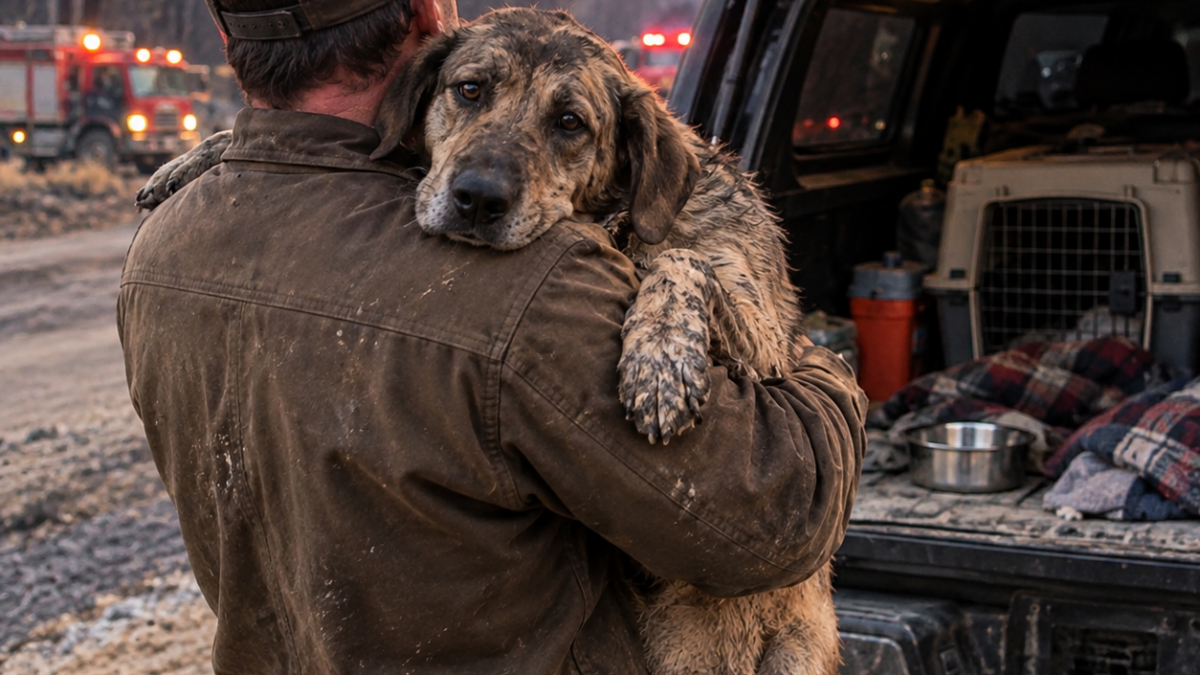
PART 2
I kept one hand against the dog’s chest and looked over my shoulder.
“Daniel.”
He was kneeling beside the fawn while one of the wildlife volunteers examined its legs.
“What?”
“I think I’m stuck.”
Daniel glanced toward me.
The dog still had both paws hooked around my jacket.
Despite everything happening around us—the engines, shouted instructions, radios, people moving rescued animals into vehicles—he refused to release me.
Daniel smiled for the first time all afternoon.
“Well, Jack, I’d say you’ve been chosen.”
“By a dog covered in ash.”
“Could’ve been worse.”
The dog tightened his grip when I shifted.
I looked down.
“Okay. Message received.”
I sat beside him on the blanket.
Only then did he settle.
He lowered his chest against my thigh but kept his head raised toward the fawn.
That was when I noticed something that made the entire rescue even more remarkable.
He wasn’t watching the people.
He wasn’t watching the trucks.
He was watching that little deer.
Every time the fawn moved, the dog’s ears lifted.
Every time someone stepped between them, he raised his head higher.
His body might have been exhausted, but his attention remained fixed on the animal he had dragged out of the smoke.
Daniel saw it too.
“He won’t rest until he knows it’s okay.”
A woman named Dr. Laura Bennett was volunteering with the wildlife team. She came over after examining the fawn.
“The deer is dehydrated and has some superficial burns,” she said. “Nothing appears broken.”
I looked down at the dog.
“What about the leg?”
“Bruised. Probably from being dragged, but honestly, being dragged may be the reason it’s alive.”
The dog’s ears moved when Laura spoke.
She crouched near him.
“Can I look at you too, hero?”
He leaned harder against me.
Laura stopped.
“All right. I’ll take that as a no.”
“He’s not aggressive.”
“I know.”
She pointed at the way his paw was resting across my boot.
“He just has an attorney.”
Daniel laughed.
I scratched behind the dog’s ear.
The fur there was stiff with ash.
“What do we do?”
“With him?”
“Yeah.”
“We need to get both animals away from the fire zone first.”
Laura looked toward the fawn.
“There’s a temporary animal treatment center set up at the fairgrounds. Wildlife on one side, domestic animals on the other. We can evaluate him there.”
“Can they stay close?”
She looked at me.
“You think that matters?”
I glanced down at him.
“Yes.”
Laura studied the dog for several seconds.
“Then we’ll keep them where they can see each other until we know more.”
When the wildlife team lifted the fawn into a padded transport crate, the dog immediately tried to stand.
His front legs trembled.
He made it halfway up before collapsing.
“Easy,” I said.
He struggled again.
“Buddy, stop.”
His eyes followed the crate.
I finally understood.
“He thinks we’re taking it away.”
Daniel crouched on the opposite side.
“We’re not leaving it, big guy.”
The dog tried once more.
This time I slid one arm beneath his chest and another around his hindquarters.
He was heavier than I expected, maybe sixty pounds, but he had almost nothing left.
I lifted him.
His head rose over my shoulder.
He watched the fawn being loaded.
“All right,” I whispered. “We’re following.”
I carried him toward my truck.
The dog kept twisting his neck.
“Still there,” I told him.
The fawn’s transport vehicle pulled out first.
I placed the dog on the blankets in my truck bed.
He attempted to stand again.
“No.”
I climbed in beside him.
Daniel stared at me.
“You realize you have a passenger cab, right?”
“He won’t lie down.”
“I think he will if you sit with him.”
“So who drives?”
Daniel held out his hand.
“Keys.”
I tossed them to him.
“You scratch it, you buy it.”
“It’s covered in ash and deer hair.”
“Still my truck.”
Daniel climbed into the driver’s seat.
I stayed in the back with the dog.
As soon as the truck moved, he crawled until his body was pressed against my leg.
I placed a hand across his ribs.
His breathing felt rough.
Every few seconds, his head lifted toward the road ahead.
I wondered whether he could smell the fawn in the vehicle in front of us.
“Still there,” I repeated.
I had no idea why I kept saying it.
Maybe I needed to hear it too.
The fairgrounds looked like organized chaos.
Livestock trailers lined one side of the parking area.
Volunteers moved between rows of temporary pens.
People searched lists for missing pets.
Veterinarians worked beneath pop-up canopies.
Dogs barked from crates.
Horses called from trailers.
A woman stood crying beside a rescued orange cat while a teenager tried to clean soot from its fur.
Fire does strange things to a community.
It strips away whatever people thought mattered that morning and replaces it with very simple questions.
Is everyone alive?
Where is my family?
Where is my dog?
Do you have water?
Can I help?
Daniel parked near the medical tents.
When I tried to get out of the truck bed, the dog struggled upright.
“Don’t even think about it.”
He tried anyway.
I lifted him again.
“You are terrible at following instructions.”
Daniel opened the gate.
“Maybe he’s used to being the rescuer.”
“Then he’s officially off duty.”
We carried him into the domestic-animal section.
Laura had arranged a spot near the wildlife tent.
A folding divider separated the two areas, but from where we placed the dog, he could see the fawn through the open side.
The moment he saw it, he stopped struggling.
He lowered himself onto the blanket.
“That did it,” Laura said.
I sat beside him while another veterinarian examined him.
No collar.
No tags.
No obvious microchip could be checked until they had cleaned him.
His paws had minor burns.
His eyes were irritated.
His lungs had likely taken in smoke.
He was dehydrated and exhausted but astonishingly free of major injury.
“What about his teeth?” I asked.
The veterinarian looked confused.
“What about them?”
“He dragged the deer by the leg.”
She opened his mouth carefully.
“Some irritation along the gums, probably from dirt and fur. Nothing serious.”
She stepped back.
“He’s lucky.”
I looked toward the fawn.
“Maybe they both are.”
The dog rested for nearly an hour.
He drank small amounts of water.
He refused food.
Whenever I stood, his head rose.
If I took more than a few steps away, he attempted to follow.
Finally, Laura handed me a folding chair.
“You might as well surrender.”
“To what?”
“That dog.”
“I have a job.”
“So does he. Apparently his job is following you.”
I sat.
The dog immediately lowered his head against my boot.
Daniel pulled up another chair.
“You have a dog at home?”
“No.”
“Ever had one?”
“When I was a kid.”
“What happened?”
“Old age.”
Daniel nodded.
“You ever want another?”
“Not particularly.”
The dog opened one eye.
Daniel noticed.
“I think he heard you.”
“I’m not adopting a random dog because he grabbed my jacket.”
“Of course not.”
Daniel leaned back.
“You’re going to adopt him because you climbed into a truck bed instead of sitting in your own cab.”
“I was keeping him calm.”
“Sure.”
I ignored him.
For the next several hours, the situation at the fairgrounds changed constantly.
More animals arrived.
Some were reunited with owners almost immediately.
Others were photographed and documented.
Lists were posted.
Volunteers searched for microchips.
By evening, the wind shifted enough that officials believed the fire crews were finally gaining ground.
But there were still evacuation orders across several communities.
Nobody knew where the dog had come from.
He could have belonged to someone whose house had been evacuated.
He could have wandered miles.
He might have lived near the forest.
He might even have been lost before the fire started.
We cleaned enough soot from his neck to check for old collar marks.
There were none.
A scanner showed no microchip.
I should have felt relieved that he seemed physically stable.
Instead, I found myself wondering who might be searching for him.
Somewhere there could be a family staring at a missing-pet list, terrified that their dog had died in the fire.
That thought made me uncomfortable.
I had known him only a few hours, and already part of me didn’t want anyone to claim him.
I hated myself a little for that.
At sunset, the fawn finally stood.
The entire wildlife tent seemed to notice.
It wobbled.
One front leg nearly folded.
Laura reached forward but stopped herself.
The fawn corrected its balance.
The dog beside me lifted his head.
He rose onto his elbows.
The fawn took one step.
Then another.
The dog’s tail moved.
Once.
I stared.
“Daniel.”
“I saw it.”
The fawn walked unsteadily toward the side of its enclosure closest to us.
The dog pushed himself upright.
He took one step.
I supported him beneath the chest.
The two animals were separated by fencing and several feet of space.
Still, they stretched their noses toward each other.
The fawn sniffed.
The dog did the same.
Then the fawn made a tiny movement forward.
The dog’s tail moved again.
Laura stood beside me.
“I wish we knew how they found each other.”
“So do I.”
“Could’ve been minutes before you saw them.”
“Could’ve been longer.”
She looked at the dog’s exhausted body.
“Considering his condition, I’d guess longer.”
That thought stayed with me.
How long had he been pulling that fawn?
Fifty yards?
A hundred?
Half a mile?
Had he found it lying in smoke?
Had he tried nudging it first?
Had he barked?
Had he waited for its mother?
We would never know.
What we knew was what we had seen.
He could move.
The fawn couldn’t.
So he had tried to move it.
That was enough.
As darkness fell, volunteers began organizing overnight shifts.
I stood.
The dog stood too.
“No.”
He leaned against my leg.
Laura watched us.
“You should go home.”
“I know.”
“So should he.”
I looked at her.
“What?”
“We don’t have enough indoor kennel space, and he’s stable. If you’re willing to foster him overnight, that frees space for animals who need closer monitoring.”
Daniel made a sound that was suspiciously close to a laugh.
I pointed at him.
“Not one word.”
“I didn’t say anything.”
I looked at Laura.
“Just overnight?”
“Until we find his owner or a foster placement.”
“That sounds different.”
“It is.”
The dog pressed against my leg.
Laura smiled.
“You can say no.”
That was the problem.
I looked down.
He looked up.
“No,” I said quietly.
Daniel raised his eyebrows.
I sighed.
“No, I apparently cannot.”
I filled out temporary foster paperwork.
Before leaving, I walked the dog toward the wildlife tent.
The fawn was lying down again.
The dog stopped.
He stared at it.
The little deer lifted its head.
They remained like that for several seconds.
Then the dog looked at me.
“Come on.”
He hesitated.
The fawn remained calm.
Finally, the dog turned.
He followed me.
It was the first time he willingly walked away from the deer.
I don’t know why that affected me so much.
Maybe because it felt as though he had decided his job was finished.
Daniel drove his own vehicle back.
I put the dog in the passenger seat of my truck.
At first, he stood with all four paws on the floorboard.
Then he climbed awkwardly onto the seat.
Within two miles, his head was against my arm.
“Personal space,” I told him.
He ignored me.
My house sat on a few acres about fifteen minutes outside town.
Nothing fancy.
A single-story place with an old detached garage, a workshop and more lawn than any single man needed.
The dog stepped out of the truck and froze.
No smoke.
No sirens.
No people running.
Crickets had started in the field.
A sprinkler clicked somewhere behind the house.
For almost a minute, he simply listened.
Then he looked at me.
“Yeah.”
I opened the door.
“This is considerably less exciting.”
He followed me inside.
I didn’t own dog food.
I made scrambled eggs without seasoning and added some plain chicken I had in the refrigerator.
He ate slowly.
Then drank.
Afterward, he stood in the center of the kitchen.
I had put blankets beside the back door.
“Bed.”
He looked at me.
I pointed.
“That’s yours.”
He walked to the blankets.
Sniffed them.
Then followed me into the living room.
“No.”
He sat.
“You’re not sleeping on the couch.”
He stared.
“Don’t start.”
Five minutes later, I moved the blankets beside the couch.
He lay down immediately.
“This is temporary.”
His eyes closed.
“Very temporary.”
His tail tapped the floor once.
That first night, I woke around 2:00 a.m.
Something was touching my hand.
I opened my eyes.
The dog stood beside the couch.
One paw rested gently against my wrist.
“What?”
His tail moved.
“You need outside?”
He stared.
I stood.
He followed me to the back door.
Outside, he didn’t immediately relieve himself.
Instead, he walked into the yard.
Stopped.
Looked toward the dark tree line behind my property.
For several seconds, his body became rigid.
Then a breeze moved through.
He sniffed the air.
No smoke.
I realized he might be checking.
Checking for danger.
Checking for the deer.
Checking for whatever he had left behind.
I approached slowly.
“You’re okay.”
His ears shifted toward me.
I touched his shoulder.
“Nothing’s burning here.”
He leaned against my leg.
We stood there under the stars until his body relaxed.
Then he finally did what dogs normally do at two in the morning.
When we went inside, he didn’t return to the blankets.
He followed me to my bedroom door.
I looked down.
“No.”
He sat.
“No.”
His head tilted.
“You’re manipulative.”
I put the blankets on the floor beside the bed.
He curled up.
Within seconds, he was asleep.
I lay down.
“Temporary.”
I’m fairly certain he heard me.
I’m equally certain he didn’t believe me.
The next morning, he woke before I did.
Again, his paw touched my hand.
I opened my eyes.
He stood beside the bed.
“You really do that?”
Tail wag.
I sat up.
He backed away.
For the first time, I saw him in clear morning light.
We had removed most of the ash, but his coat still looked dirty.
He had brown eyes.
One ear folded slightly at the tip.
His chest was lighter than his back.
He was younger than I had thought.
Maybe three.
Four at most.
“Who are you?”
His tail wagged harder.
“That wasn’t rhetorical. I’d actually like an answer.”
Nothing.
I made coffee.
He followed me into the kitchen.
I went to the bathroom.
He waited outside.
I walked toward the garage.
He followed.
If I stopped suddenly, he nearly walked into me.
By 8:00 a.m., I understood Daniel’s prediction.
The dog had attached himself to me.
Completely.
We returned to the fairgrounds for another examination.
The fawn was stronger.
When the dog entered the wildlife section, its entire posture changed.
Tail up.
Head high.
Laura smiled.
“Well, look who’s back.”
The fawn stood behind the enclosure fencing.
The dog approached.
They touched noses through the gap.
I watched silently.
There are moments you know no photograph will ever explain properly.
That was one.
Two animals that should have had nothing to do with each other.
One predator by instinct.
One prey animal by instinct.
Yet something had happened inside that smoke that had made those categories meaningless.
There had simply been one animal that could move and another that couldn’t.
Laura came beside me.
“The fawn’s doing well.”
“When can it be released?”
“Not yet.”
“Why?”
“We need to make sure there are no respiratory complications. It also needs to regain strength.”
The dog lay down beside the fence.
The fawn remained on the other side.
“How long?”
“Maybe a couple of weeks.”
I nodded.
“What about him?”
“No owner has contacted us.”
The domestic-animal coordinator had checked every missing-pet report in the evacuation zone.
Nothing matched exactly.
Several people came to look.
None recognized him.
His photograph went online.
We waited.
Day two became day three.
Day three became day five.
Each morning, I brought him to the fairgrounds.
Partly because I was volunteering.
Mostly because he expected it.
He would visit the fawn first.
Then follow me everywhere.
On the fourth day, Daniel asked, “So what are we calling him?”
“We’re not.”
“He needs a name.”
“He probably has one.”
“Then until we find it.”
“Dog.”
Daniel looked offended.
“You dragged him out of a wildfire and you’re calling him Dog?”
“Worked for centuries.”
“He saved a deer.”
“All right. Hero.”
The dog ignored us.
“See?” I said. “He doesn’t care.”
Daniel shook his head.
“You have no imagination.”
That afternoon I was sitting beside the truck while the dog slept in the shade.
Sunlight came through the smoke haze in pale streaks.
For days everything had been gray.
But one narrow beam landed across the dog’s back.
I watched it for a while.
Then the word came to me.
Ray.
Daniel returned carrying bottled water.
I said, “Ray.”
The dog’s head lifted.
Daniel stopped.
“What?”
“Ray.”
The dog stood.
Daniel grinned.
“He answered.”
“That proves nothing.”
“You have a name.”
I looked at the dog.
“Ray?”
His tail moved.
Daniel handed me the water.
“Case closed.”
I scratched Ray’s neck.
“Because you showed up like a ray of light in the ugliest place I’d seen in years.”
Daniel looked at me strangely.
“What?”
“That was sentimental.”
“I can take it back.”
“No. I’m just documenting the moment.”
“Get away from me.”
Ray leaned into my knee.
From that day, he was Ray.
The name spread through the volunteer camp immediately.
“Ray’s here.”
“Ray visited the fawn.”
“Ray finally ate.”
“Ray stole somebody’s sandwich.”
That last one was accurate.
My sandwich.
He showed no remorse.
As the fire came under control, families began returning to their homes.
Some found houses standing.
Others found foundations and chimneys.
Volunteers shifted from emergency rescue to cleanup and reunification.
Ray’s photograph continued circulating.
Nobody claimed him.
Part of me worried.
Another part felt guilty for being relieved.
I called the shelters in neighboring counties.
Nothing.
I checked lost-dog pages at night.
Nothing.
Two weeks after the rescue, Laura told me the fawn was ready for the next stage.
“What next stage?”
“Soft release.”
The area where we found it had burned heavily, so wildlife officials had identified a safer section of habitat bordering the fire zone.
They believed the fawn was old enough to return to the wild, especially because deer had already been observed nearby.
“When?”
“Saturday morning.”
I looked at Ray.
He was lying beneath a folding table.
“Can he come?”
Laura hesitated.
“He stays leashed.”
“Obviously.”
“And he doesn’t chase.”
“He won’t.”
“You sound very confident for someone who met him two weeks ago.”
“He dragged the thing through a wildfire.”
“Fair argument.”
Saturday dawned cool and clear.
The smoke was mostly gone.
For the first time since the fire, the mountains were visible.
I drove Ray to the release area.
He sat in the passenger seat.
By then, he had learned trucks were good things.
He also knew the center console sometimes contained snacks.
He investigated it at every stoplight.
“No.”
Nose deeper into console.
“Ray.”
He withdrew his head slowly.
“You have absolutely no respect for me.”
Tail wag.
Several wildlife staff members were waiting near the trail.
The fawn arrived in a covered transport crate.
Ray immediately recognized the scent.
He pulled once against the leash.
“Easy.”
His ears went forward.
The crate was carried toward a clearing.
We stayed thirty feet back.
Laura opened the door.
For several seconds, nothing happened.
Then the fawn’s nose appeared.
Its head.
Front legs.
It stepped into sunlight.
Ray stopped moving.
The young deer stood at the edge of the clearing.
It looked toward the trees.
Then toward us.
Then it ran.
Not far.
Twenty yards.
Stopped.
Looked back.
Ray gave a soft sound.
Almost a whine.
The fawn remained still.
I placed my hand on Ray’s shoulder.
“That’s where it belongs.”
The deer turned.
It disappeared between the trees.
Ray stared at the place where it had vanished.
Nobody spoke.
Several seconds passed.
Then he looked at me.
There was no dramatic understanding in his face.
He was a dog.
I knew that.
But I also knew what I had seen.
He walked toward me and pressed his side against my leg.
I knelt.
“You did it.”
He licked my chin.
“Yeah, yeah.”
I wrapped an arm around his neck.
“You got him out.”
Laura smiled behind us.
“You know, technically we don’t know if it was male or female.”
“You had two weeks.”
“Wildlife medicine is complicated.”
“I’m calling it him.”
“Very scientific.”
Ray looked back toward the woods once more.
Then he walked with me toward the truck.
He didn’t pull back.
He didn’t whine.
He climbed into the passenger seat.
I shut the door.
Laura stopped me before I got in.
“What are you doing about his placement?”
I knew exactly what she meant.
The mandatory stray-hold period had ended.
No owner had appeared.
Ray had been medically cleared.
He was eligible for adoption.
“I’m fostering him.”
“Still?”
“For now.”
Laura smiled.
“Jack.”
“What?”
“You’ve bought him food.”
“Animals need food.”
“A bed.”
“He needed somewhere to sleep.”
“A collar with his name engraved on it.”
“That’s identification.”
“You changed your work schedule so he isn’t alone too long.”
I stared at her.
“Daniel talks too much.”
She laughed.
“Just admit it.”
I looked through the window.
Ray was watching me from the passenger seat.
His nose left a mark on the glass.
“I’m thinking about it.”
“You already decided.”
“No.”
“Okay.”
She walked away.
I opened the driver’s door.
Ray moved halfway onto my seat before I could sit.
“Move.”
He moved six inches.
“That’s not moving.”
Eventually I got behind the wheel.
On the way home, I kept thinking about Laura’s question.
Was I keeping him?
My practical mind created a list.
Dogs cost money.
Dogs need time.
I worked long days.
I occasionally traveled for jobs.
Ray had some separation anxiety.
He needed training.
He needed structure.
All valid arguments.
Then we reached my house.
I opened the door.
Ray jumped out.
He ran across the yard.
Not because he was escaping.
Because he could.
He reached the fence, turned and raced back.
He stopped directly in front of me.
Tail wagging.
Waiting.
I looked at the house.
Then at him.
“Come on.”
Inside, I removed his temporary foster paperwork from the kitchen counter.
I stared at it.
Then I called the shelter coordinator.
“This is Jack Miller.”
“I know who you are.”
“I want to finish Ray’s paperwork.”
A pause.
“Adoption?”
I looked down.
Ray sat at my feet.
“Yes.”
“Finally.”
“Did everyone know except me?”
“Pretty much.”
I signed the documents two days later.
That evening I put them on the kitchen table.
Ray sniffed the paper.
“That says you live here now.”
He looked at me.
“No more temporary.”
Tail wag.
“I’m serious.”
He stepped forward.
Placed both paws against my chest.
And hugged me the way he had hugged me the first day.
I laughed.
“Okay.”
I wrapped my arms around him.
“You stay.”
After that, Ray began changing.
Not immediately.
Trauma doesn’t disappear because paperwork changes.
For the first month, if I closed a door between us, he became anxious.
If I left for work, he waited at the front window.
My neighbor, Helen, checked on him at lunchtime.
She reported that he spent the first few days walking from the window to the door.
Then back.
Then forward again.
“He thinks you aren’t coming back,” she told me.
That hurt.
So I created routines.
Before leaving, I touched his head.
“Work.”
When I returned, I said, “Home.”
Same words.
Same order.
Every day.
Eventually, he learned.
Work meant I left.
Home meant I returned.
He stopped waiting at the window all day.
He discovered the couch.
This violated every rule I had established.
I gave up fighting it within a week.
He discovered tennis balls.
He didn’t understand fetch at first.
I threw the ball.
He ran after it.
Picked it up.
Then lay down twenty feet away.
“Bring it here.”
Blank stare.
“Ray.”
Nothing.
I walked over.
He ran away with it.
“Oh, so this is the game.”
That became our game.
He discovered sprinklers and hated them.
He discovered bacon and loved it with religious intensity.
He discovered mirrors and spent an entire afternoon suspicious of the other dog in my hallway.
He discovered my bed.
That battle lasted longer.
I lost.
But the strangest thing about Ray was how he reacted to injured animals.
One afternoon, months after the fire, I found him standing beside the fence.
A small bird was on the ground.
Probably stunned after flying into a window.
Ray wasn’t touching it.
He wasn’t barking.
He just stood there.
When I approached, he looked at me, then at the bird.
“You found another one?”
Tail wag.
I placed the bird in a box.
An hour later, it flew away.
Ray watched it leave.
I shook my head.
“You have a problem.”
Another time, Helen’s elderly beagle wandered through a gate that had been left open.
Ray found him nearly half a mile away.
I only realized something was wrong because Ray kept barking at me and running toward the road.
I followed.
There was the beagle.
Ray had apparently appointed himself neighborhood rescue coordinator.
Daniel heard the story.
“Of course he did.”
“This isn’t normal.”
“It is for Ray.”
The fire zone began recovering.
Rain came.
Green shoots appeared beneath blackened trunks.
Wildflowers returned.
Wildlife cameras showed deer moving through the area again.
A year after the fire, Daniel suggested we hike back to the place where we had found Ray.
I wasn’t sure.
“What if it bothers him?”
“He’s a dog, Jack.”
“Dogs can remember.”
“I know.”
Daniel looked at Ray sleeping beneath my desk.
“I’m saying maybe you’re the one who isn’t ready.”
He had a point.
The fire had become part of my life too.
Certain smells brought it back.
Burning leaves.
A smoky barbecue.
Even some sunsets.
I would remember the gray forest.
Ray’s exhausted face.
That fawn dragging behind him.
Eventually I agreed.
We returned on a cool morning in early fall.
The difference was astonishing.
The ground had changed.
Green ferns covered places that had been black.
Young trees stood among burned trunks.
Birds moved through the branches.
Ray stepped from the truck.
He froze.
His nose lifted.
For perhaps ten seconds, he did nothing.
Then he walked forward.
No fear.
No hesitation.
Daniel and I followed.
We found the approximate place where I first saw him.
A burned tree still stood there.
Its trunk was black on one side.
New growth surrounded it.
I touched the bark.
“This was it.”
Daniel looked around.
“Pretty sure.”
Ray sniffed the ground.
I tried to imagine the scene again.
Smoke.
Heat.
The fawn.
The dog taking one painful step after another.
Daniel crossed his arms.
“How far do you think he pulled it?”
“No idea.”
“We were pretty deep.”
“I know.”
Ray walked ahead.
Suddenly he stopped.
His ears went forward.
Daniel whispered, “What?”
Between the trees, three deer stood perhaps seventy yards away.
A doe.
Another adult.
And a younger deer.
Ray stared.
The deer stared back.
For one ridiculous second, my heart jumped.
“You think?”
Daniel whispered, “No way to know.”
The younger deer moved.
Ray’s body tensed.
But he didn’t chase.
He simply watched.
Then he turned.
He walked back to me.
He leaned against my leg.
I lowered my hand onto his head.
“Yeah.”
The deer disappeared.
“Let’s go home.”
Ray followed.
On the drive back, he fell asleep with his head against the passenger door.
I kept thinking about something simple.
Two animals had come out of that forest.
One had returned to the wild.
The other had come home with me.
For a while, I thought that was the whole story.
It wasn’t.
The following summer brought another wildfire season.
Nothing as severe near us at first.
But whenever smoke appeared on the horizon, Ray became restless.
He paced.
He checked windows.
The first time it happened, I assumed he needed outside.
Then I noticed his breathing.
Fast.
Shallow.
He wasn’t looking at the door.
He was looking at the sky.
I sat beside him.
“Hey.”
He leaned against me.
“It’s far away.”
He trembled.
I had never seen him tremble since the original fire.
I closed the windows.
Turned on the air conditioning.
Put music on quietly.
Then I sat on the floor.
Ray climbed halfway into my lap.
All sixty-two pounds of him.
“That’s not physically possible.”
He disagreed.
I held him.
Hours later, when the smell of smoke faded, he relaxed.
That was when I realized something I should have understood earlier.
Ray had saved the fawn.
But saving someone does not mean you leave the experience untouched.
Whatever happened in those woods had frightened him too.
He had simply acted despite the fear.
That changed the way I thought about courage.
I had always imagined bravery as absence of fear.
Ray taught me the opposite.
Bravery was knowing exactly how frightened you were and refusing to abandon someone anyway.
For the next year, we worked on his fear of smoke.
Slowly.
Carefully.
My veterinarian referred me to a behavior specialist.
I felt ridiculous at first explaining that my dog had wildfire-related anxiety.
The specialist did not laugh.
“Animals remember traumatic sensory cues,” she explained. “Smell especially.”
We created a plan.
Safe room.
Predictable routines.
Background sound.
Gradual exposure to non-threatening smoky smells only when controlled.
Nothing forced.
Nothing rushed.
Ray improved.
The following fire season, he still noticed smoke.
But instead of pacing until exhaustion, he came to find me.
He would press his nose against my hand.
I would say, “Safe.”
That became another word he understood.
Work.
Home.
Safe.
Three simple words.
Maybe every life could be reduced to those needs.
Purpose.
Belonging.
Security.
Ray had found all three.
So had I, although it took me longer to admit it.
Before Ray, I had lived alone for almost nine years.
Not unhappily.
Just quietly.
My marriage had ended years earlier.
No dramatic betrayal.
No villain.
We had simply become two people heading in different directions.
After the divorce, I built my life around work.
Early mornings.
Long days.
Dinner alone.
Television I barely watched.
Sleep.
Repeat.
Friends invited me places.
I usually declined.
I told myself I liked peace.
Maybe I did.
But peace and emptiness can look very similar if you stop paying attention.
Ray changed the rhythm.
I had to come home.
Not because a house was waiting.
Because he was.
There is a difference.
Every afternoon when my truck entered the driveway, Ray appeared at the front window.
By the time I opened the door, he would be waiting.
Tail moving.
Whole body excited.
Nobody had ever been that happy to see me.
It is difficult to stay emotionally distant from something that celebrates your existence every day.
Daniel noticed before I did.
We were working on rebuilding fencing near one of the burned ranches when he said, “You’re different.”
“That sounds ominous.”
“You’re less miserable.”
“I wasn’t miserable.”
“Okay.”
“I wasn’t.”
“You used to treat conversation like an invoice.”
“What does that mean?”
“Short, necessary and preferably paid.”
I laughed.
“That’s stupid.”
“You’re laughing.”
“So?”
“Exactly.”
I knew he was partly joking.
But he was right.
Ray had reopened something.
I started volunteering regularly with the rescue group.
Not because I wanted another dog.
Ray would have objected to sharing the passenger seat.
But because I remembered that day.
How many people had simply shown up.
Firefighters.
Veterinarians.
Truck owners.
Farmers.
Teenagers filling water bowls.
Retired people washing blankets.
Nobody changed the entire disaster.
Everyone changed one part.
That mattered.
Three years after the wildfire, Daniel and I were called to help during flash flooding.
Ray stayed home.
I refused to bring him into dangerous rescue environments.
When I returned nearly fourteen hours later, soaked and exhausted, he met me at the door.
I sat on the floor.
He sniffed every inch of my wet clothes.
Then he placed both paws around my shoulders.
The same embrace.
I closed my eyes.
“Long day.”
He leaned harder.
“You know something?”
Tail wag.
“That thing you do never gets old.”
As Ray aged, our life became ordinary.
That is not an insult.
Ordinary was the reward.
The drama was over.
No smoke.
No desperate rescue.
No frightened animals.
Just mornings.
Walks.
Truck rides.
Rain against the roof.
Ray sleeping beneath my workbench.
The ordinary life he almost never had.
Sometimes strangers recognized him.
The original rescue photograph had circulated widely in the community.
Someone had captured an image of me carrying Ray while Daniel held the fawn.
Another showed Ray touching noses with the deer at the treatment center.
The local paper eventually ran a story.
DOG SAVES FAWN DURING WILDFIRE.
I hated the attention.
Daniel loved making fun of me.
“Celebrity.”
“Go away.”
Ray, meanwhile, accepted every compliment as though he had personally commissioned the article.
People brought treats.
He became unbearable.
One school invited us to visit after students had collected supplies for the animal shelter.
I almost declined.
Public speaking ranked somewhere between dental surgery and falling off a ladder on my list of enjoyable activities.
But the teacher said something that changed my mind.
“The children have been talking about why the dog didn’t leave the deer.”
So I went.
Ray loved it.
Twenty-four children sat on a classroom rug.
Ray moved between them receiving more affection than any creature reasonably needed.
A boy raised his hand.
“Mr. Miller?”
“Jack is fine.”
“Why did Ray save the deer if dogs chase deer?”
I looked down.
Ray was lying beside a little girl whose hand rested on his back.
“I don’t know.”
The boy looked disappointed.
I continued.
“Nobody knows what Ray was thinking.”
“Maybe they were friends.”
“Maybe.”
A girl said, “Maybe Ray knew the deer was a baby.”
“Maybe.”
Another child asked, “Was he scared?”
That question stopped me.
“I think so.”
“But he still did it?”
“Yes.”
The teacher watched me.
I looked around the room.
“Sometimes being brave doesn’t mean you aren’t afraid. Sometimes it means you’re afraid and you help anyway.”
The room became unusually quiet.
Then a little boy near the back asked, “Did you save Ray?”
I smiled.
“I carried him out.”
“So yes.”
“Partly.”
“Who else saved him?”
“A lot of people.”
“Like who?”
“The firefighters who made the area safe enough for us to enter. Daniel. The veterinarians. Volunteers. Everyone who helped.”
The boy thought.
“Did Ray save you?”
I didn’t answer immediately.
Children have a way of asking questions adults spend years avoiding.
Finally I said, “Yeah.”
The teacher looked surprised.
“How?”
I looked at Ray.
“He gave me somewhere I needed to be.”
I didn’t explain further.
I didn’t need to.
After the visit, Ray fell asleep in the truck.
I sat in the parking lot for a long time before starting the engine.
The boy’s question stayed with me.
Did Ray save me?
Not from a fire.
Not from physical danger.
Something quieter.
Isolation maybe.
A life that had become too small.
A habit of believing I didn’t need anyone.
Ray had dragged a fawn through smoke because he refused to leave it behind.
Then somehow, without trying, he had done something similar to me.
He had grabbed hold.
And pulled.
Year four after the fire, we received unexpected news.
Laura called.
“I have something you might want to see.”
“What?”
“Come by the wildlife office.”
“Is this going to involve me taking home another animal?”
“No.”
“You sound suspicious.”
“Just come.”
I brought Ray.
Laura had photographs spread across a desk.
Trail-camera images.
Deer moving through the recovered burn area.
She tapped one.
A healthy adult doe stood with two younger deer.
“So?”
“We can’t prove anything.”
I leaned closer.
One hind leg had a distinctive pale scar.
My chest tightened.
“The fawn?”
“Possibly.”
“Seriously?”
“The location matches the release zone. Age would match. The scar is consistent with the injury we documented.”
I looked at Ray.
He was sniffing Laura’s trash can.
“Ray.”
He looked up.
“You might have a reunion.”
Laura laughed.
“Let’s not anthropomorphize.”
“You called me here.”
“I thought you’d like knowing the deer probably survived long-term.”
I stared at the photograph.
That mattered more than I expected.
The rescue had never really had an ending in my mind.
We released the fawn.
It disappeared.
That was how wildlife rescue should work.
Still, uncertainty remained.
Now, years later, there was at least a good possibility.
A deer had survived.
Grown.
Maybe had young.
I touched the photograph.
“Can I have a copy?”
“I already printed one.”
I framed it.
It went on the wall beside the original rescue photo.
Ray showed no interest.
He preferred pictures containing food.
Time moved the way it always does.
Quietly at first.
Then suddenly.
Ray’s muzzle began turning white.
His runs became shorter.
He stopped jumping into the truck and waited for me to lift him.
At eight or nine—we never knew his exact age—arthritis appeared in his hips.
Medication helped.
So did a ramp I built beside the porch.
Daniel saw it.
“You built your dog a wheelchair-accessible entrance.”
“Shut up.”
“He owns you.”
“He has arthritis.”
“You installed outdoor lighting for the ramp.”
“He goes out at night.”
“You put carpet on it.”
“He slips.”
Daniel nodded.
“Like I said.”
I looked at Ray sleeping in the sun.
“Worth it.”
Daniel became quiet.
“Yeah.”
By then, nobody teased me about temporary anymore.
Ray had been mine longer than most of the equipment in my business.
He knew the sound of my truck.
My footsteps.
My moods.
If I was angry, he gave me space for ten minutes, then placed his head on my knee.
If I was sick, he refused to leave the bedroom.
If I laughed, his tail moved even when he had no idea why.
During thunderstorms, he slept beneath my desk.
During wildfire smoke, he slept beside me.
One October afternoon, nearly seven years after the rescue, I took Ray back to the forest.
The burn scars had almost disappeared.
Young pines stood taller than me.
Leaves covered the ground.
The place looked alive.
Ray moved slowly.
I kept the leash loose.
We reached the clearing near the release area.
I sat on a fallen log.
Ray lowered himself beside me.
“You remember?”
His ears moved.
“Probably smells different now.”
He rested his chin on my boot.
I looked toward the trees.
For several minutes nothing happened.
Then a deer stepped into the clearing.
Adult.
Alert.
A second followed.
Then a third.
Ray raised his head.
He watched.
He did not attempt to stand.
One of the deer looked toward us.
The distance was too great to identify scars.
I didn’t care.
Maybe it was the same animal.
Maybe its offspring.
Maybe neither.
That wasn’t important anymore.
The forest had survived.
Deer had returned.
Ray was beside me.
That was enough.
“You did good, buddy.”
His tail moved against the leaves.
We remained until the deer disappeared.
Then I helped Ray stand.
“Home?”
His tail moved again.
He knew that word better than any other.
On the way back, I thought about how our story would sound to someone hearing only the dramatic parts.
A wildfire.
A dog rescuing a fawn.
A stranger carrying them out.
An adoption.
People like dramatic endings.
But real life does not stay dramatic.
The most important parts often happen afterward.
Nobody photographed Ray asleep beside my bed.
Nobody wrote articles about me cleaning mud from his paws.
Nobody cared that he stole half a roast from the kitchen counter one Christmas.
Nobody reported the morning he waited outside the bathroom because I had the flu.
Nobody saw me sitting beside him during a smoky summer night saying, “Safe,” until he stopped shaking.
Those were the parts that made him family.
Not the wildfire.
The years after.
Eventually Ray’s body began slowing faster.
His hearing weakened.
Sometimes I called his name twice.
Then three times.
His eyesight became cloudy.
He slept deeply.
I started touching the floor before stepping over him so the vibration would wake him.
One morning, he tried to stand and his back legs failed.
My stomach dropped.
I rushed forward.
“Ray.”
He looked embarrassed.
Dogs can look embarrassed.
I don’t care what anyone says.
“Easy.”
I helped him stand.
He walked after a minute.
But I called the veterinarian.
Dr. Susan Cole had cared for him for years.
She examined his hips and spine.
“Progressive arthritis.”
“I know.”
“And probably some neurological weakness.”
“What do we do?”
“Adjust medication. Reduce stairs. Short walks.”
“He still likes the truck.”
“Then keep taking him.”
“How long?”
She looked at me.
“I don’t know.”
I hated that answer.
She saw it.
“Jack.”
“What?”
“Don’t start grieving him while he’s still here.”
That hit harder than I expected.
“I’m not.”
“You are.”
I looked toward Ray.
He was sleeping beside the examination table.
Susan continued.
“You’ll lose today worrying about some future day you cannot control.”
I nodded.
So I stopped counting.
Or tried to.
We went for truck rides.
Short walks.
I gave him too much chicken.
He slept on the couch without pretending he wasn’t allowed.
Daniel visited more often.
So did Laura.
Helen brought biscuits.
Ray had built a community around himself without ever meaning to.
Then, one spring morning, something happened that I still think about.
I was outside repairing a gate.
Ray lay in the grass nearby.
A young rabbit squeezed beneath the fence.
It stopped maybe fifteen feet from him.
Years earlier, Ray would have stood.
At least investigated.
Now he simply watched.
The rabbit moved closer.
Ray’s ears lifted.
The rabbit froze.
I expected it to run.
Instead, it remained.
For almost a minute, the old dog and the rabbit looked at each other.
Then Ray lowered his head.
The rabbit disappeared into the grass.
I laughed.
“Retired?”
Ray’s tail tapped.
“You’ve rescued enough animals?”
Another tap.
“Fair.”
That summer was mild.
Very little smoke.
I was grateful.
Ray turned gray almost completely around the face.
Sometimes strangers assumed he was much older than he was.
Maybe he was.
We never knew where his first years had gone.
I occasionally wondered about his life before the fire.
Had someone loved him?
Had he been abandoned?
Had he lived on a farm?
Had he chased deer before saving one?
There was no way to know.
For years, part of me resented that missing history.
Then I stopped.
Ray didn’t live backward.
Why should I?
Whatever existed before the smoke had led him to that forest.
Everything after had led him home.
That was enough.
The following year, Daniel and I attended a memorial event marking the anniversary of the wildfire.
A section of the restored forest had been dedicated to volunteers and first responders.
Families came.
Firefighters.
Rescue workers.
People who had lost houses.
People whose houses survived.
Ray came too.
He moved slowly between the crowd.
More people recognized him than me.
“Is that the deer dog?”
Daniel whispered, “Your celebrity is fading.”
“It never existed.”
A woman approached with a teenage daughter.
“You’re Jack?”
“Yes.”
“My daughter did a school project about Ray when she was in fourth grade.”
The girl looked mortified.
“Mom.”
“What? It’s true.”
She knelt beside Ray.
“He’s old now.”
“Yeah.”
She stroked his ears.
“I’m glad he got a good life.”
I swallowed.
“So am I.”
Later, we walked to the edge of the forest.
A plaque honored the rescue effort.
No individual names.
That felt right.
Daniel stood beside me.
“Remember how bad this looked?”
“Yeah.”
“I thought half the mountain was gone.”
“So did I.”
Ray sniffed the grass.
Daniel looked at him.
“And that lunatic was dragging a deer through it.”
I smiled.
“Most stubborn animal I’ve ever met.”
“Second most stubborn.”
I looked at Daniel.
“Don’t.”
He laughed.
We stayed until sunset.
On the drive home, Ray fell asleep against the passenger seat.
I reached over at a stoplight and rested my hand on his shoulder.
“Good day?”
His tail moved without him opening his eyes.
That was Ray.
Always enough energy for one more tail wag.
His final winter arrived quietly.
One morning there was frost across the yard.
Ray stood at the doorway and stared at it.
“You’ve seen frost before.”
He stepped outside.
His paws slipped slightly.
I steadied him.
He sniffed the cold air.
Then slowly walked toward his favorite patch of sunlight.
I put a blanket beneath him.
He slept there for an hour.
I took a photograph.
I didn’t know why.
Later, I realized part of me had begun collecting ordinary moments because I sensed there wouldn’t be many more.
In February, his appetite declined.
We changed food.
Then medication.
Blood tests showed his kidneys were weakening.
Not catastrophic.
Not yet.
Susan spoke carefully.
“We can manage this for a while.”
“How long?”
She gave me the same answer.
“We don’t know.”
This time I accepted it.
Every day became simple.
Did Ray eat?
Yes.
Did he want to go outside?
Yes.
Did he still enjoy the truck?
Absolutely.
Did his tail wag when I came home?
Always.
Then we kept going.
By April, I was lifting him into the truck completely.
He weighed less.
That frightened me.
The feeling brought me back to the wildfire.
Not because Ray had been light then.
Because I remembered carrying something exhausted and vulnerable and wanting desperately to believe strength would return.
It had.
For years.
One afternoon I drove him to the forest for what I suspected would be the last time.
I didn’t tell anyone.
Just Ray and me.
I parked near the trail.
He stood beside the truck.
His legs shook slightly.
“We don’t have to go far.”
We walked maybe a hundred yards.
Very slowly.
Then Ray stopped.
I sat on the ground.
He lowered himself beside me.
The forest was green.
Birds moved above us.
No smoke.
No ash.
I could hear water somewhere downhill.
Ray placed his head on my thigh.
“This is where I met you.”
His eyes remained half closed.
“You looked terrible.”
Tail moved.
“I looked pretty bad too, probably.”
Another movement.
“I thought I was rescuing you.”
I rubbed the white fur around his muzzle.
“For a long time I really believed that.”
Ray breathed slowly.
“But you know the truth?”
His eyes opened.
“You pulled me out too.”
The words felt ridiculous and completely true.
I had not been trapped in a burning forest.
I had been trapped in something quieter.
Habit.
Loneliness.
A life designed so carefully around not needing anyone that there was almost nobody left inside it.
Ray changed that.
Not intentionally.
Dogs don’t make plans like that.
He simply needed me.
And by needing me, he taught me I still wanted to be needed.
I looked toward the trees.
“Maybe that’s what you do.”
His ear moved.
“You find something that’s stuck and you pull.”
I laughed softly.
“Not always gracefully.”
He closed his eyes.
We sat there for nearly an hour.
When it was time to leave, Ray tried to stand.
His legs failed.
I caught him.
“No problem.”
I lifted him.
He rested his head against my shoulder.
Exactly the way he had the first day.
I carried him back to the truck.
Halfway there, I stopped.
For a second, the years disappeared.
Smoke.
Ash.
A dog collapsing against me.
Except now there was sunlight.
Green forest.
Birdsong.
And home waiting.
“Still got you,” I whispered.
Ray licked the side of my neck.
Two weeks later, he stopped eating.
Not completely.
But enough.
Susan came to the house.
I couldn’t bear taking him to the clinic if I didn’t have to.
She examined him on his blanket in the living room.
I stood near the window.
Finally I asked, “Tell me.”
Susan looked at Ray.
Then me.
“His kidneys have worsened.”
“Can we fix it?”
“No.”
“Can we buy time?”
“Maybe.”
“How much?”
“Days. Possibly a few weeks.”
“At what cost to him?”
That was the question that mattered.
Susan remained quiet.
“He’ll have nausea. Weakness. Possibly confusion.”
I looked down.
Ray was watching me.
Not Susan.
Me.
“What would you do?”
“I can’t make that decision for you.”
“I know.”
She sat beside Ray.
“But I can tell you this: he has had a good life. A very good life. You don’t owe him every possible day.”
I understood.
“You owe him good days.”
“Yes.”
After Susan left, I sat beside Ray.
“You make everything difficult.”
His tail moved weakly.
“Of course you wag.”
I placed my forehead against his.
“I’m not ready.”
He breathed.
“I know that isn’t your problem.”
That evening he ate a few pieces of chicken from my hand.
The next morning, he wanted outside.
We sat in the sun.
The following day, he refused food.
Then water.
When I helped him outside, he stumbled twice.
That night, he cried softly while trying to stand.
I knew.
I hated knowing.
I called Susan.
Then Daniel.
Then Laura.
Daniel arrived first.
He walked inside and stopped.
Ray lay on a blanket near the back door.
Daniel knelt.
“Hey, wildfire dog.”
Ray’s tail moved.
Daniel’s face collapsed.
“Oh, come on.”
He wiped his eyes.
“You couldn’t ignore me one time?”
Ray lifted his head.
Daniel leaned forward.
“You remember me, buddy?”
I said, “He remembers everyone with food.”
“Good.”
Daniel sat beside him.
“I brought nothing.”
Ray put his head down.
Daniel laughed through tears.
“Fair enough.”
Laura arrived with the framed trail-camera photograph of the deer.
“I thought it belonged here today.”
I placed it where Ray could see it, although I had no idea whether he understood.
Laura sat beside him.
“You caused a lot of trouble.”
His ears moved.
“You made us rewrite half our wildlife intake procedures because every volunteer wanted to bring dogs into the deer tent afterward.”
I smiled.
“That happened?”
“No.”
“Then why—”
“I’m trying to make you laugh.”
It worked.
For a few minutes, we told stories.
Ray stealing my sandwich.
Ray chasing the tennis ball and refusing to return it.
Ray sitting outside the wildlife tent.
Ray visiting the school.
Ray discovering sprinklers.
The room filled with laughter and grief at the same time.
Helen came over.
She brought the old tennis ball Ray had once left in her yard.
“I kept it.”
“Why?”
“He used to bring it over when you were working.”
I stared at her.
“He visited you?”
“Every afternoon for about three months.”
“You never told me.”
“He liked my biscuits.”
I looked at Ray.
“You had a second family?”
His tail moved.
Traitor.
By late afternoon, Ray became restless.
His breathing changed.
Susan arrived.
I knew what came next.
I asked everyone for a minute.
They went outside.
I sat beside Ray.
For years, whenever something frightened him, I had said one word.
Safe.
During smoke.
Thunder.
Veterinary visits.
Strange nights.
Safe.
I put my hand on his chest.
“Safe.”
His breathing slowed slightly.
“Remember that word?”
His eyes stayed on mine.
“Safe.”
I swallowed.
“You don’t have to do anything else.”
Tail moved.
“No deer.”
I laughed and cried at the same time.
“No lost dogs.”
I rubbed his head.
“No birds.”
Another breath.
“You did enough.”
I opened the door.
Everyone returned.
Daniel sat near Ray’s feet.
Laura beside him.
Helen stood behind me.
Susan prepared the medication.
I lifted Ray’s head into my lap.
He looked up.
The same brown eyes.
Older.
Cloudier.
Still his.
Susan asked, “Ready?”
No.
Absolutely not.
But Ray was.
“Yes.”
She gave the first medication.
His body relaxed.
I kept talking.
“You remember the truck?”
His ear moved.
“You destroyed that passenger seat.”
Daniel whispered, “He really did.”
“You stole six sandwiches.”
“Seven,” Daniel said.
I looked at him.
“When?”
“Long story.”
I laughed.
Ray’s breathing became slow.
I looked down.
“The first time I saw you, you were dragging that deer through smoke.”
My voice broke.
“I thought you were crazy.”
His eyes were almost closed.
“Maybe you were.”
I bent closer.
“But you wouldn’t leave him.”
One breath.
Then another.
“And you never really left me either.”
Susan touched my shoulder.
I knew.
I whispered the last word Ray had heard from me whenever the world felt frightening.
“Safe.”
His body became still.
Nobody moved.
I kept my hand on him.
Outside, wind moved through the trees.
No sirens.
No smoke.
No urgency.
Just quiet.
The kind of quiet Ray had earned.
Daniel eventually placed a hand on my shoulder.
“I’m sorry.”
I nodded.
Words weren’t possible yet.
We buried Ray’s ashes beneath an oak near the back of my property.
I chose a place where he used to lie in the afternoon.
No elaborate monument.
Just a flat stone.
RAY
And beneath his name:
HE NEVER LEFT THEM BEHIND.
Daniel said it was perfect.
For weeks afterward, I kept expecting him.
At the door.
Beside the truck.
Outside the bathroom.
Grief is strange when it involves an animal.
People who understand, understand completely.
Those who don’t sometimes make the mistake of saying, “It was just a dog.”
Nobody ever said that to me twice.
My house sounded wrong without him.
Too much space.
Too little movement.
I still said “Home” sometimes when entering.
Then remembered.
His bed remained beside my couch for months.
I couldn’t move it.
The tennis ball stayed beneath the table.
His collar hung near the door.
One morning, Daniel came over.
He didn’t mention the bed.
He just sat with me on the porch.
Eventually he said, “You going to volunteer this weekend?”
“No.”
“You should.”
“I’m not ready for dogs.”
“Then drive supplies.”
“I said no.”
He nodded.
Ten minutes later he asked again.
I glared at him.
“What part of no is confusing?”
“The part where you’ve been sitting alone in this house for six weeks.”
“I’m fine.”
“You said that before Ray too.”
That hurt because it was true.
I looked toward the oak tree.
“I don’t want another dog.”
“Nobody said another dog.”
“Then what?”
“Show up.”
I almost refused.
Then I remembered the wildfire.
Nobody had asked whether I was ready for my life to change.
I had simply shown up.
So I went.
The shelter needed fencing repaired.
I spent the entire day outside.
I avoided kennels.
Nobody pushed.
At 4:00 p.m., Laura arrived with a cardboard carrier.
“What is that?”
“Injured owl.”
“Why are you telling me?”
“You’re standing in the doorway.”
I moved.
She smiled.
For months, I volunteered without taking animals home.
Then one rainy afternoon, an elderly woman came in carrying a soaked puppy she had found near a drainage ditch.
The puppy was cold.
Thin.
Terrified.
I helped wrap it in towels.
It pressed against my arm.
My entire body remembered Ray.
I nearly stepped away.
Then I stopped.
The puppy hadn’t asked to become part of my grief.
It simply needed warmth.
I sat.
Held it.
Not because I was replacing Ray.
Nothing could.
Love doesn’t work like furniture.
You do not remove one thing and put another in its place.
You make more room.
The puppy eventually went to another family.
I was glad.
I went home alone.
But the house didn’t feel quite as closed.
A year after Ray died, the wildfire rescue group held another anniversary walk through the restored forest.
I almost didn’t attend.
Then Laura called.
“You need to see something.”
“What now?”
“Just come.”
The trail ended near the clearing where the fawn had been released.
A new sign stood there.
Not about Ray specifically.
About the entire rescue effort.
At the bottom was a small photograph.
Ray emerging from the smoke.
The fawn behind him.
I stared.
Daniel stood beside me.
“You knew?”
“Maybe.”
The sign described how community volunteers, firefighters and wildlife teams had rescued dozens of animals during the wildfire.
One sentence mentioned an unidentified stray dog that had been found attempting to pull an injured fawn toward safety.
Nothing sentimental.
Nothing exaggerated.
Just what happened.
I touched the edge of the sign.
Laura said, “Future volunteers will read that.”
I nodded.
A movement caught my eye.
Across the clearing, deer appeared.
Four of them.
One adult stood apart.
I searched its hind leg.
Too far.
No way to know.
For once, I didn’t need to know.
I looked at the photograph on the sign.
Then at the deer.
Then at the forest.
Ray’s story had begun here because he refused to leave another animal behind.
It had ended years later in a quiet house because I refused to leave him alone when he needed me.
That felt complete.
Not fair.
Loss is rarely fair.
But complete.
I drove home that evening in the same truck.
The passenger seat had been replaced, but I could still remember Ray sitting there.
Head out the window.
Nose testing every smell.
Watching me at red lights.
I turned onto my road.
For a moment, I imagined him beside me.
Not as a ghost.
Just memory.
The kind that no longer hurts every time it arrives.
When I reached the house, I parked.
The yard was quiet.
The oak tree moved in the wind.
I walked to Ray’s stone.
I sat on the grass.
“You know something?”
No answer.
“You were terrible at fetch.”
I smiled.
“And boundaries.”
Wind moved through the leaves.
“You also owe me for at least seven sandwiches.”
I rubbed my hand across the stone.
Then my voice became quiet.
“I thought I carried you out.”
That was how I had always described the rescue.
I carried Ray out of the forest.
Technically true.
But incomplete.
Ray had spent the rest of his life teaching me that rescue is rarely one-directional.
You can pull someone toward safety without realizing they are pulling you too.
You can give something a home and discover that home is no longer a building.
It becomes a presence.
A routine.
A warm body beside the couch.
A paw on your hand at two in the morning.
Someone waiting at the door.
Years have passed now.
I still volunteer.
Daniel still reminds everyone that he drove my truck during the original rescue and therefore deserves partial ownership of Ray’s story.
Laura still has the trail-camera photograph in her office.
The forest is almost unrecognizable.
New trees have grown over many of the burned areas.
Deer move freely through the valleys.
The fire survives mostly in photographs and memories.
Sometimes I meet people who know Ray’s story.
They call him a hero.
Maybe he was.
But I don’t think Ray ever thought in those terms.
I think he found something weaker than himself lying in smoke.
And he had a choice.
Leave.
Or stay.
He stayed.
He picked up that little leg.
Pulled.
Stopped.
Breathed.
Pulled again.
That was all.
One decision repeated until somebody came.
Maybe that is what courage usually looks like when nobody is writing stories about it.
Not speeches.
Not medals.
Not applause.
Just refusing to walk away.
I learned that from a dog covered in ash.
I learned something else too.
Saving a life does not always mean keeping it.
Ray saved the fawn, then watched it run back into the forest.
He didn’t follow.
He let it go where it belonged.
Years later, I had to do the same for him.
That was the hardest lesson.
Love sometimes means pulling someone toward life with everything you have.
And sometimes it means recognizing when they have reached the place where you can no longer pull.
You simply stay.
You put your hand beneath their head.
You tell them they are safe.
And you refuse to let them face the final part alone.
That was my turn to become what Ray had been in that forest.
The one who stayed.
I sometimes wonder what would have happened if I had remained beside my truck that afternoon.
If I hadn’t followed Daniel’s voice.
If smoke had hidden Ray for another thirty seconds.
If he had collapsed before I saw him.
There are too many possibilities.
I don’t spend much time with them anymore.
The only version that matters is the one that happened.
A dog appeared in the smoke.
A fawn was dragging behind him.
He refused to abandon it.
I carried them toward safety.
The fawn returned to the forest.
The dog followed me home.
And for years afterward, Ray did something no one saw coming.
He turned a quiet house into a home.
He brought friends back into my life.
He brought me into rescue work.
He made children ask better questions about courage.
He taught me that fear and bravery can exist inside the same body.
He taught me that trust is built in repeated returns.
Work.
Home.
Safe.
He taught me that an ordinary life can be the greatest reward after surviving something terrible.
And he taught me that sometimes the creature you believe you rescued has been holding onto you from the beginning.
I still visit the forest once or twice every year.
There is one place where sunlight cuts through the young trees in late afternoon.
That is where I usually stop.
Sometimes deer cross.
Sometimes nothing appears.
I sit anyway.
I think of smoke.
Ash.
Heavy breathing.
A sandy-colored dog refusing to let go of a fawn’s leg.
Then I remember something much better.
Ray running across my backyard with a tennis ball he had no intention of returning.
Ray stealing chicken.
Ray sleeping with his legs in the air.
Ray leaning against children.
Ray waiting beside my truck.
Ray pressing his paws around my shoulders.
Ray hearing the word “home” and heading toward the door without looking back.
That is the Ray I keep.
Not the frightened animal in the fire.
The dog who survived long enough to become ordinary.
Loved enough to grow old.
Safe enough to sleep deeply.
Wanted enough to be missed forever.
On the last visit I made to the clearing, I stood beneath the trees while evening light moved across the trail.
A deer appeared perhaps fifty yards away.
Then another.
One younger animal stepped from behind them.
For a second, the smallest one looked directly toward me.
I smiled.
“No idea if you know the story.”
The deer remained still.
“Probably better that way.”
It turned.
The group moved deeper into the forest.
I watched until they disappeared.
Then I looked back toward the trail.
There was no dog waiting beside me anymore.
That still hurt.
But hurt was no longer the only thing there.
Gratitude had grown around it.
The way new forest grows around burned trees.
Slowly.
Quietly.
Until one day you realize the blackened ground is green again.
I walked back to my truck.
Opened the driver’s door.
For years, I had automatically looked toward the passenger seat before climbing in.
That habit eventually disappeared.
But that evening, I looked once more.
I could almost picture him there.
One folded ear.
Brown eyes.
Tail beating against the seat.
Ready to go home.
I smiled.
“All right, Ray.”
I started the engine.
“Let’s go.”
And somewhere between that forest and my driveway, I finally understood the ending of our story.
The day of the wildfire, two animals came out of those trees.
One returned to the world it had been born for.
The other became part of mine.
I once believed I gave Ray a home.
That was only half true.
A house was already waiting for me when I found him.
Four walls.
A roof.
A driveway.
A bed.
But Ray taught me the difference between having a house and belonging somewhere.
He filled the silence.
He gave me reasons to return.
He placed his paw on my hand until I learned that being needed was not a burden.
He waited at the door until coming home meant something again.
So when people ask me about the dog who saved a fawn from a wildfire, I tell them the truth.
Yes, I saw him dragging that young deer through the smoke.
Yes, I helped carry them out.
Yes, the fawn survived and returned to the forest.
Yes, Ray came home with me.
But that isn’t the part I remember most.
I remember trying to place him on a blanket after the rescue.
I remember him reaching out.
Hooking his paws around my jacket.
Refusing to let go.
At the time, I thought he was frightened.
Maybe he was.
But after all those years, I like to think there was something else in that moment.
Maybe Ray had spent the entire day refusing to leave someone behind.
And when he finally knew the fawn was safe, he looked at me and decided he didn’t want to be left behind either.
I didn’t leave him.
He didn’t leave me.
Not until he had to.
And even now, when wildfire smoke drifts faintly over the mountains or I see a deer standing beside the road, I think of that stubborn dog taking one exhausted step after another.
I think about how close I came to never knowing him.
Then I remember the simplest truth he ever taught me.
You do not have to save the whole world.
Sometimes you only have to notice the life directly in front of you.
Stay when leaving would be easier.
Help when nobody is watching.
And when someone is too tired to make it alone, take hold and pull them toward safety.
That is what Ray did.
First for the fawn.
Then, in ways I understood only years later, for me.
And maybe that is why, even after all this time, whenever I think about that day, I don’t remember the fire first.
I remember him coming through the smoke.
Still pulling.
Still refusing to quit.
Still making sure no one was left behind.








