PART 2: I Found a Cat Nailed to a Fence When I Was 11—Years Later, She Watched Me Become a Veterinarian
PART 2
For one second, she didn’t move.
Her eyes went from my face to my hands, then to the bundle against my chest.
“What happened?”
“Mom.”
That was all I managed.
She reached for me.
Then the cat moved beneath the jumper.
My mother’s face changed.
“Oh my God.”
“Someone hurt her.”
She pulled the cloth back carefully.
The cat’s front paws were swollen, wet with blood, and badly torn.
My mother inhaled sharply.
“Where did you find her?”
“The fence by Miller’s field.”
“What happened to your hands?”
“I pulled the nails out.”
She looked at me as though she couldn’t decide whether to hug me or yell at me.
“You did what?”
“We have to help her.”
My mother didn’t ask another question.
She grabbed her coat, keys, and a clean towel.
Five minutes later, we were in the car.
I sat in the passenger seat holding the cat.
My hands were wrapped loosely in dish towels because my mother had been too afraid to delay long enough to properly clean them.
The cat’s body was rigid against me.
Every bump in the road made her flinch.
“I’m sorry.”
My mother drove faster.
“Keep talking to her.”
I looked down.
The cat’s face was half hidden beneath my jumper.
“It’s okay.”
Her eyes opened.
“We’re going somewhere safe.”
I had no idea if cats understood words.
I didn’t care.
“I won’t let anybody hurt you.”
My mother glanced toward me.
Her eyes were wet.
“Keep going.”
So I talked.
I told the cat my name.
I told her what school I went to.
I told her I hated math.
I told her my mother made terrible porridge.
“Excuse me?” my mother said.
I nearly laughed.
It was the first moment that morning anything felt even remotely normal.
The cat made a faint sound.
A broken little meow.
“I’m here.”
Her head settled against my chest.
At the veterinary clinic, everything became fast.
A nurse took one look at the cat and called for the veterinarian.
“What happened?”
My mother answered because I couldn’t.
“She was nailed to a fence.”
The nurse froze.
“Nailed?”
“Through the paws.”
Two staff members came immediately.
When they tried to take the cat from me, my arms tightened automatically.
“It’s okay,” the nurse said gently. “We need to help her.”
I looked down.
The cat’s eyes were open again.
I didn’t want to release her.
My mother touched my shoulder.
“Let them.”
So I did.
The moment the cat left my arms, I suddenly became aware of my own hands.
They hurt.
A lot.
Blood had soaked through the towels.
One of the nurses saw.
“What happened to you?”
“I pulled the nails out.”
The room went quiet for half a second.
Then the nurse said:
“Sit down.”
“I want to stay with the cat.”
“You’re going to faint.”
“I’m fine.”
I was not fine.
My legs were shaking.
My mother sat beside me while another nurse cleaned my hands.
The antiseptic burned.
I cried harder from that than I had while pulling the nails.
My palms were cut in several places.
The metal had torn deep grooves across both hands.
One wound near the base of my right thumb needed stitches.
Another across my left palm was deep enough that the nurse told my mother we should go to a hospital once the cat was stable.
I barely listened.
“Is she alive?”
The nurse paused.
“Yes.”
“That’s all I care about.”
My mother squeezed my shoulder.
A veterinarian came out almost forty minutes later.
His name was Dr. Whitaker.
I remember that because years later I would work beside him.
That morning, he seemed impossibly old to me.
He was probably fifty.
He sat down.
“She is alive.”
I exhaled.
“But she’s badly injured.”
“Can you save her paws?”
“We’re going to try.”
He explained.
The left paw had fractured bones.
Both paws had severe puncture wounds.
The right paw had extensive soft-tissue injury.
The wounds were contaminated.
Infection had already begun.
The cat was dangerously dehydrated.
Her body temperature was low.
“How long was she on the fence?” my mother asked.
Dr. Whitaker’s expression hardened.
“Based on the wounds and dehydration, possibly eight to twelve hours.”
I felt sick.
“All night?”
“Possibly.”
Outside.
In November.
Pinned to wood.
Unable to lie down.
Unable to hide.
Unable to reach the ground.
My hands curled into fists.
Pain shot through them.
My mother stopped me.
“Careful.”
“Who would do that?”
Dr. Whitaker didn’t answer.
I asked again.
“Who would do something like that?”
“I don’t know.”
“Will the police find them?”
My mother looked at him.
He looked at her.
Then back at me.
“I hope so.”
That answer wasn’t enough.
At eleven years old, I still believed bad things worked like stories.
Someone did something terrible.
Adults investigated.
The bad person was found.
Punishment happened.
Then justice made the world orderly again.
I didn’t understand yet how often reality refuses to complete that sequence.
Police came to the clinic.
Then officers went to the fence.
The nails were collected.
Photographs taken.
Neighbors questioned.
Farmers interviewed.
Nobody admitted seeing anything.
There were no cameras along the road.
No footprints that could be reliably identified.
No vehicle description.
No witness.
The cat had been found on one of the loneliest stretches between two farming properties.
Someone had chosen the location well.
That realization made my stomach twist.
This wasn’t an animal caught accidentally.
Someone had held her paws.
Someone had placed the nail.
Someone had used a hammer.
Once.
Again.
Again.
Until metal went through flesh and bone and into wood.
Then they had walked away.
For weeks, I expected the police to call.
Every time the phone rang, I looked at my mother.
“Is it them?”
Usually it was a relative.
School.
A neighbor.
The police did call twice.
Questions.
Updates.
Nothing useful.
Eventually, the calls stopped.
No arrest.
No name.
No explanation.
The person who nailed that cat to the fence disappeared into the blank space between what happened and what could be proved.
For years, that bothered me almost as much as the act itself.
But that morning in the clinic, I didn’t know any of that yet.
I only knew the cat was alive.
Dr. Whitaker operated on her left paw.
The fracture needed stabilization.
Both wounds had to be thoroughly cleaned.
Dead and damaged tissue was removed.
Antibiotics.
Pain medication.
Fluids.
Warmth.
Monitoring.
She stayed at the clinic.
I went to the hospital.
My hands were cleaned properly.
Three wounds eventually became scars.
Two across my right palm.
One on my left.
The doctor stitching me asked:
“How did you do this?”
I told him.
He stopped sewing for a second.
“You pulled nails out of a cat?”
I nodded.
“With your hands?”
“I didn’t have anything else.”
He looked toward my mother.
My mother looked exhausted.
Then the doctor said something I remembered for years.
“You were very lucky you didn’t damage a tendon.”
I didn’t feel lucky.
The cat was still in the veterinary clinic.
That evening, I sat at home with both hands bandaged.
My school jumper was gone.
The clinic had kept it because it was wrapped around the cat.
I kept staring at the blood beneath the bandages.
My mother brought soup.
I didn’t eat.
“She’ll need you to eat.”
I looked up.
“What?”
“If you plan to visit her tomorrow, I’m not taking you if you’re fainting.”
That worked.
I ate.
The next afternoon, we returned.
The cat was awake.
Bandages covered both front paws.
She lay inside a kennel on a thick blanket.
Her head lifted when she heard us.
“Hey.”
She stared at me.
I put my bandaged hand near the bars.
She sniffed.
Then, very slowly, she pushed her face toward my fingers.
I started crying.
My mother cried too.
Dr. Whitaker stood behind us.
“She seems to know you.”
“Can she come home?”
“Not yet.”
“Tomorrow?”
“No.”
“Day after?”
He smiled slightly.
“You’re persistent.”
“So is she.”
That became our routine.
School.
Clinic.
Homework.
Clinic.
Every afternoon I visited.
Sometimes she was sleeping.
Sometimes eating.
Sometimes angry about her bandages.
One day she hissed at a nurse.
I smiled.
“Good.”
The nurse stared at me.
“Good?”
“She’s getting rude.”
Dr. Whitaker laughed.
“Rude is usually healthier than nearly dead.”
I stored that sentence.
Years later, I would say similar things to frightened owners.
The cat’s left paw never fully recovered.
The bones healed, but imperfectly.
Several toes remained stiff.
She couldn’t completely extend them.
The right paw healed better, though scar tissue remained.
When the bandages finally came off, she tried to stand.
Her first step was terrible.
She placed one paw down.
Pulled it back.
Tried again.
Her body leaned.
Then she moved forward.
One step.
Another.
A limp.
But walking.
“Look.”
My mother had tears in her eyes.
“She’s walking.”
Dr. Whitaker nodded.
“She’ll probably always limp.”
I didn’t care.
“She can walk.”
“Yes.”
“Then she can come home.”
He laughed.
“Eventually.”
The clinic estimated she was probably around three years old.
No microchip.
No collar.
No missing report that matched her.
No owner came forward.
That created another question.
Where would she go after treatment?
The answer seemed obvious to me.
“Home.”
My mother looked at me.
“We already have a cat.”
“He’ll survive.”
“We have a dog.”
“He likes cats.”
“He chases our cat.”
“Friendly chasing.”
“There is no such category.”
I stared.
She stared back.
Then the injured cat reached through the kennel bars and placed her damaged paw against my bandaged hand.
My mother closed her eyes.
“That’s unfair.”
“What?”
“You know exactly what you’re doing.”
“I didn’t do anything.”
My mother sighed.
The cat came home one week later.
I named her Millie.
I can’t give you a profound reason.
I just liked it.
She became Millie, and within days, it was impossible to imagine her having another name.
Our older cat hated her.
For about four days.
Then he discovered Millie wasn’t interested in competing for windows.
She preferred my bed.
Our dog tried to chase her exactly once.
Millie turned.
Raised one injured paw.
Smacked him across the nose.
The dog reconsidered his values.
From then on, they coexisted peacefully.
Millie limped.
Always.
Cold weather made it worse.
Some mornings, especially in winter, she avoided putting much pressure on the left paw.
I would lift her onto my bed.
She would curl beside me.
The scars on my hands healed faster than hers.
Within months, they turned pink.
Then pale.
But they never completely disappeared.
At first, I hated them.
Children notice things.
“What’s that?”
“Why is your hand cut?”
“Does it hurt?”
I got tired of telling the story.
So sometimes I lied.
“Fence.”
Technically true.
Other times I said:
“Cat.”
That created more questions.
Eventually, everybody at school knew.
For a while, I was “the girl who saved the nailed cat.”
Adults praised me.
Teachers mentioned courage.
Local newspapers wrote a short piece.
I hated it.
Because the person who had done it was still out there.
Everyone wanted the heroic ending.
I didn’t feel heroic.
Heroism would have been stopping it before it happened.
I had only found the aftermath.
At night, I sometimes dreamed about the fence.
Except in the dreams I couldn’t remove the nails.
I pulled.
Nothing.
Millie cried.
I pulled again.
Still nothing.
Sometimes I woke with my hands clenched so tightly the scars hurt.
Then Millie would be beside me.
Alive.
Warm.
Old pain replaced by purring.
That became my way back.
The police case eventually went cold.
I asked my mother repeatedly.
“Any news?”
“No.”
“Did they stop looking?”
“I don’t know.”
“How can they stop?”
“They may not have enough evidence.”
“But someone did it.”
“I know.”
“So someone should pay.”
My mother sat beside me.
“There are things we don’t get answers to.”
“I hate that.”
“I know.”
For a long time, revenge existed in my imagination.
I imagined finding whoever did it.
I imagined confronting them.
I imagined them seeing Millie alive.
Seeing my scars.
I imagined saying something devastating enough to make them understand.
But you can’t punish a person whose name you never learn.
So anger had nowhere to go.
At thirteen, I started volunteering at an animal shelter.
My mother initially said no.
“You’re too young.”
“I can clean.”
“You have school.”
“I can do both.”
“You already have chores.”
“I’ll do those too.”
She stared at me.
“You’re exhausting.”
Millie sat beside me.
“She agrees with me.”
“The cat does not get a vote.”
Millie meowed.
My mother lost.
At the shelter, I cleaned cages.
Washed bowls.
Folded towels.
Sat with frightened cats.
Walked older dogs.
I couldn’t perform medical work.
But I watched.
I asked questions.
Too many questions.
Why is that cat breathing like that?
Why is this dog’s gum color different?
Why are you giving fluids there?
Why does this wound need to stay open?
Why antibiotics for one infection and not another?
One veterinarian finally said:
“Do you ever stop?”
“No.”
“Good.”
His name was Dr. Ames.
He became the first adult, other than Dr. Whitaker, to tell me seriously that veterinary medicine might suit me.
I laughed.
“I don’t like blood.”
He looked at me.
“You pulled nails out of a cat’s paws.”
“That was different.”
“How?”
“I didn’t have time to think.”
He smiled.
“Most emergencies don’t give you time either.”
The idea stayed.
At first, I wanted to be a veterinarian because of Millie in the simplest way a child wants something.
An animal had suffered.
I wanted to know how to fix suffering.
Then I grew older and understood the job wasn’t that simple.
Veterinarians couldn’t save every patient.
Money mattered.
Biology mattered.
Timing mattered.
Sometimes the kindest decision was not more treatment.
Sometimes medicine meant saying:
“I don’t know.”
I still wanted it.
Especially after learning how hard it was.
Millie grew older beside me.
At five, she still played like a younger cat.
Her limp didn’t stop her from racing down the hallway at night.
She would jump onto my bed using more force from her back legs.
Sometimes she misjudged.
I added a small stool.
She refused it for months.
Then secretly began using it when she thought I wasn’t watching.
At seven, arthritis started early in the damaged paw.
Medication helped.
Warm blankets helped.
My lap helped most, according to Millie.
At eight, I began studying seriously for the exams that would determine whether veterinary school was realistic.
My room filled with textbooks.
Biology.
Chemistry.
Anatomy.
Millie sat on all of them.
“Move.”
No.
“You are interfering with your own legacy.”
Purring.
“Do you want me to become a vet or not?”
She slept.
At sixteen, I visited Dr. Whitaker’s clinic for work experience.
He remembered me immediately.
Not because of my face.
My hands.
“You.”
I looked down.
The scars had faded.
“Me.”
“How’s the cat?”
“Mean.”
“Excellent.”
“Old.”
“Also excellent.”
He let me shadow the clinic.
I watched examinations.
Vaccinations.
Dental procedures.
Wound care.
Surgery preparation.
Then one afternoon, an emergency arrived.
A dog had been hit by a car.
Everything changed instantly.
Voices became shorter.
Hands moved faster.
IV access.
Pain relief.
Imaging.
Oxygen.
I stood against the wall, terrified of being in the way.
The dog survived.
Afterward, Dr. Whitaker washed his hands.
“Still want this?”
“Yes.”
“You didn’t look very happy.”
“I wasn’t.”
“Good.”
I frowned.
“Good?”
“If you enjoy the suffering, choose another profession.”
I never forgot that.
At eighteen, I applied to veterinary programs.
The personal statement was the hardest part.
How do you summarize why your life is heading somewhere?
Grades.
Experience.
Skills.
Motivation.
Everything sounded artificial.
Then I looked at my hands.
Three scars.
Still visible.
I started writing.
I wrote about being eleven.
The fence.
The cat.
The nails.
Not because I wanted to impress anyone with bravery.
I wrote about ignorance.
That mattered more.
I wrote:
When I was eleven years old, I pulled two nails out of a cat’s paws with my bare hands. I didn’t know what I was doing. I only knew that an animal was suffering and that I might be able to help.
Then:
I want to spend my life learning how to use my hands properly. I want to understand what I’m doing the next time I encounter an animal in pain.
I stared at the paragraph.
My mother read it.
She cried.
“Don’t.”
“I’m not.”
“You’re literally crying.”
“Allergies.”
“In November?”
“Seasonal.”
Millie sat on the table.
I showed her the application.
“This is your fault.”
She bit the corner.
Typical.
I got an interview.
The admissions panel asked about the cat.
One interviewer, a woman with silver glasses, looked at my hands.
“Would you pull the nails out again?”
That surprised me.
I thought.
“Not the same way.”
“Why?”
“I could have injured the cat more. I could have broken the nails. I could have damaged my hands badly enough that I wasn’t able to carry her.”
“So what would you do now?”
“Stabilize the animal. Get proper tools. Call emergency help if available. Remove the cat from danger with as little additional trauma as possible.”
She nodded.
“Then do you regret what you did?”
“No.”
“Why not?”
“Because she was dying.”
Silence.
“I regret not knowing more.”
The interviewer smiled slightly.
“Good answer.”
I left convinced I’d failed.
I hadn’t.
The acceptance letter came three months later.
My mother screamed.
I screamed.
Millie fled upstairs.
Then returned when she realized food might be involved.
I held the letter against my chest.
“I’m going to veterinary school.”
My mother hugged me.
“I know.”
“No. I’m really going.”
“I know.”
I looked at Millie.
Her face had begun showing age.
White hairs around her mouth.
Slight cloudiness in one eye.
“You have to live long enough to see this through.”
Millie blinked.
Cats refuse contracts.
Veterinary training was harder than anything I had imagined.
The volume alone was brutal.
Anatomy.
Physiology.
Pharmacology.
Pathology.
Microbiology.
Surgery.
Clinical skills.
Species differences.
Diseases I had never heard of.
Diseases I wished I hadn’t.
I learned how much can go wrong inside a body.
That knowledge created a new kind of fear.
Every time Millie sneezed, I mentally diagnosed six diseases.
My mother eventually said:
“Before veterinary school, you were easier.”
“I know too much now.”
“Clearly.”
Millie aged while I studied.
That was the part I resented.
I wanted time to pause while I caught up.
At ten, her damaged paw became increasingly stiff.
At twelve, arthritis affected other joints.
At thirteen, she developed early kidney changes.
I knew what the blood results meant before the veterinarian explained them.
That was the first time education felt like a punishment.
“How bad?”
“Early.”
“Can we manage it?”
“Yes.”
Diet.
Monitoring.
Hydration.
Follow-up testing.
Millie accepted none of this philosophically.
She hated the prescription food.
I tried three brands.
She rejected all three.
My mother called me from home.
“Your patient is on hunger strike.”
“Mix a little of the old food.”
“I did.”
“Warm it.”
“I did.”
“Add water.”
“I did.”
“Then she’s manipulating you.”
“I know.”
Millie eventually ate.
She remained remarkably stable.
When I came home during holidays, she slept beside me as if I had never left.
Sometimes I looked at my hands beside her damaged paw.
Two survivors from one morning.
Different scars.
Same history.
During my clinical rotations, I met animals that brought the fence back.
A dog with burns.
A neglected rabbit.
A cat with an untreated fracture.
A horse with wounds from improper restraint.
Each time, my hands remembered before my mind did.
The scars would tingle.
Not physically, probably.
Memory.
One night, a young cat arrived after becoming caught in wire.
Both front paws were badly injured.
The owner was crying.
“I should’ve found him sooner.”
I examined the cat under supervision.
Calm voice.
Pain control.
Proper tools.
Careful handling.
Everything I had not known at eleven.
After the cat was stabilized, I washed my hands.
The scars looked bright under the surgical light.
For a moment, I had to leave the room.
My supervisor found me in the corridor.
“You okay?”
“Yes.”
“No.”
I laughed weakly.
“No.”
I told her about Millie.
Not the polished admissions version.
The real version.
The screaming.
Blood.
Dreams.
Anger.
She listened.
Then said:
“Trauma doesn’t disappear because you turn it into a career.”
I looked at her.
“That’s encouraging.”
“It isn’t supposed to be.”
She leaned against the wall.
“You need to know why you’re doing this.”
“I do.”
“Do you?”
I thought about it.
Was I trying to save Millie again and again?
Was every injured animal a substitute for the one I couldn’t protect before the fence?
Maybe partly.
Then I said:
“I can’t change what happened to her.”
“No.”
“But I can be useful when the next animal arrives.”
She nodded.
“That’s enough.”
That became my version of revenge.
Usefulness.
The person who nailed Millie to the fence had taught me something they never intended.
Cruelty can create fear.
But if the survivor lives, sometimes the fear becomes knowledge.
Knowledge becomes skill.
Skill becomes another animal going home.
The stranger who hurt one cat had unknowingly helped create a veterinarian.
I hated giving them any role in my future.
So I reframed it.
They did not create me.
Millie did.
Her survival did.
My choice afterward did.
That’s important.
Pain doesn’t deserve credit for what survivors build.
At twenty-six, I entered my final phase of clinical training.
Millie was eighteen.
Ancient by cat standards.
She was almost completely blind.
Her hearing had declined.
Arthritis made walking difficult.
Her kidney disease had progressed but remained manageable.
She had lost weight.
My mother sent photographs.
Each one scared me.
“She looks thinner.”
“She ate breakfast.”
“How much?”
“Most of it.”
“Most isn’t a measurement.”
“Stop being her veterinarian.”
“I am literally becoming a veterinarian.”
“You’re her child.”
That shut me up.
I began traveling home more often.
Every time, I prepared myself for Millie not recognizing me.
Every time, I was wrong.
I’d enter.
She would lift her head.
Sniff.
Then meow.
Same voice.
Older.
Rougher.
But hers.
I’d sit.
Millie would slowly come toward me.
The limp had become a careful shuffle.
I would lift her.
“Still here.”
She purred.
She had kept her side of the deal without ever agreeing to it.
My graduation approached.
I was twenty-seven.
Millie was nineteen.
One month before the ceremony, she stopped eating for almost a day.
I drove home in panic.
The veterinarian examined her.
Kidney values worse.
Arthritis.
Dental disease.
Age.
So much age.
“Will she make it another month?”
The veterinarian looked at me.
“You know I can’t promise that.”
I did know.
I hated it.
“Is she suffering?”
“Not significantly right now.”
“Right now.”
“That’s all we ever have.”
Veterinary medicine had taught me to dislike certainty because biology rarely offers it.
I took Millie home.
That night, she slept on my chest.
I stayed awake.
“One month.”
She purred.
“That’s all I’m asking.”
No response.
“Graduation.”
Purring.
“You started this mess.”
More purring.
“You’re coming.”
My mother had an idea.
“If she’s well enough, I’ll bring her.”
“To graduation?”
“Yes.”
“That’s ridiculous.”
“You pulled nails out of a cat with your hands at eleven.”
“Fair.”
We checked with the university.
After some logistical negotiation and documentation, Millie could attend in a secure carrier, kept with my mother and away from crowds as much as possible.
I told myself we would cancel if Millie became stressed.
Her comfort first.
Always.
Graduation morning arrived.
I woke before my alarm.
For several seconds, I forgot what day it was.
Then I saw the gown hanging from the wardrobe.
I looked at my hands.
Three scars.
Pale.
Almost invisible unless you knew where to look.
I ran my thumb across the longest one.
I suddenly saw the fence again.
Wood.
Metal.
Blood.
Eleven years old.
No idea what I was doing.
Then I looked at the graduation gown.
All those years between.
I cried before breakfast.
My mother called.
“She’s awake.”
“Did she eat?”
“Yes.”
“How much?”
“Enough.”
“Is she comfortable?”
“Yes.”
“Don’t bring her if—”
“I know.”
“Mom.”
“I know.”
The ceremony hall was enormous.
Families.
Students.
Faculty.
Noise.
I searched the audience immediately.
Third row.
My mother.
Carrier on her lap.
I couldn’t see Millie yet.
My heart sank.
Maybe she was sleeping.
Good.
Then the ceremony began.
Names.
Applause.
Speeches.
I barely heard anything.
My hands were sweating.
When my turn approached, I looked toward the third row again.
My mother leaned down.
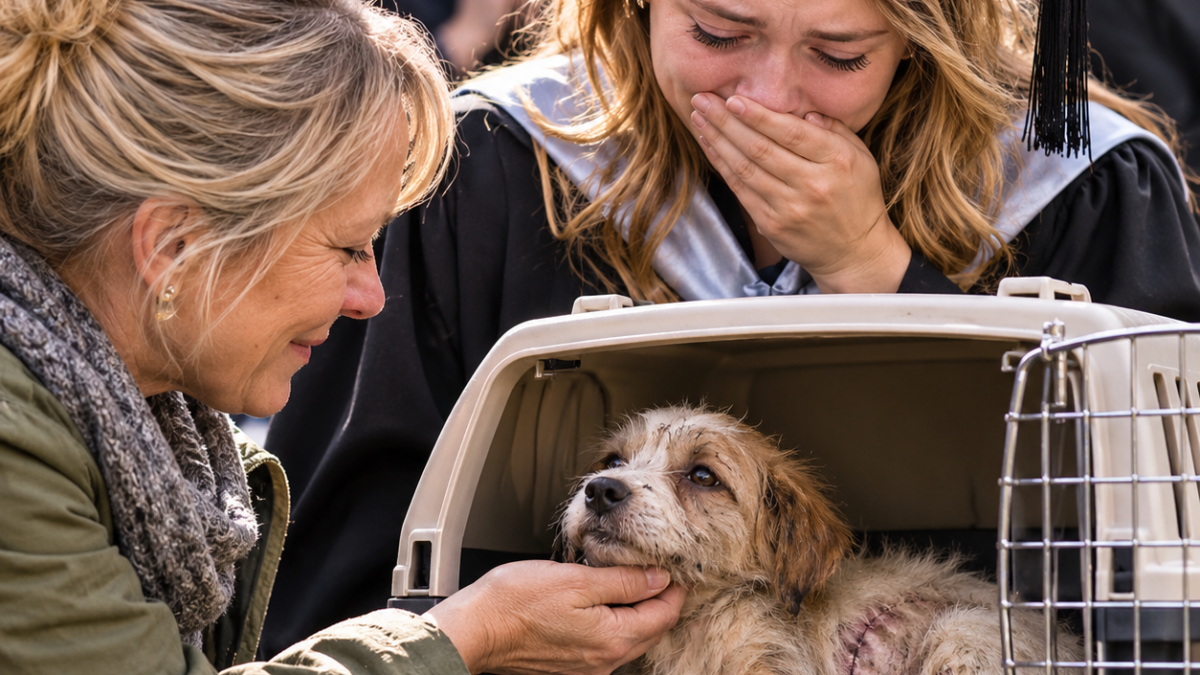
She opened the mesh window slightly.
A tabby-and-white face appeared.
Old.
Thin.
One cloudy eye partly open.
Millie.
My throat closed.
She couldn’t really see the stage.
Not clearly.
Maybe not at all.
But she was there.
The same cat who had hung from a fence while I stood below with no idea how to help.
Alive.
Nineteen years old.
My name was called.
I walked.
Every step felt unreal.
I crossed the stage.
Received my degree.
Shook hands.
Someone said congratulations.
I looked toward my mother.
Millie’s face was still visible.
And for one moment, the entire hall disappeared.
No audience.
No faculty.
No cameras.
Just a fence.
A child.
A cat.
Two nails.
Then years.
Years and years.
I smiled at Millie.
My mother was crying openly.
So was I.
I walked off the stage a veterinarian.
Afterward, a reporter from the university paper approached.
She had heard part of the story.
“Can I ask what inspired you to choose veterinary medicine?”
I had prepared answers for questions like that.
Science.
Animal welfare.
Clinical problem-solving.
None came out.
I lifted my right hand.
Pointed to the scar.
“This.”
The reporter looked.
“What is it?”
“A nail cut my hand when I was eleven.”
I told her about Millie.
Then I said:
“This is what happens when you want to help but don’t know enough about what you’re doing.”
She looked surprised.
Most inspirational stories don’t begin by criticizing the hero.
But that was the truth.
“I wanted to understand. I wanted to know what to do the next time an animal was suffering. I wanted to be faster. Safer. Better.”
The reporter looked toward my mother holding Millie’s carrier.
“And the cat?”
“Still here.”
“After all these years?”
I smiled.
“She had somewhere to be today.”
After the ceremony, I took Millie somewhere quiet.
I opened the carrier.
She didn’t try to leave.
I put my hand inside.
Her nose touched my fingers.
“Doctor.”
I laughed.
“Your fault.”
Millie purred.
I held her carefully against my gown.
Someone took a photograph.
It remains one of the most important photographs of my life.
My degree in one hand.
Millie against my chest.
My scarred palm visible beneath her body.
The cat’s damaged left paw resting against the same hand.
People later called it poetic.
I didn’t.
It was just us.
Four months later, Millie began declining.
Slowly.
Then quickly.
She stopped jumping entirely.
Then stopped walking more than a few feet.
Her appetite faded.
Kidney disease progressed.
I was working as a newly qualified veterinarian by then.
And suddenly all the knowledge I’d wanted as a child became unbearable.
I understood the numbers.
The weight loss.
Dehydration.
Muscle wasting.
Pain.
Quality-of-life scoring.
There was no comforting ignorance left.
My mother called one evening.
“You need to come.”
I knew.
I drove home.
Millie was on my old bed.
Same bedroom.
Different life.
She lifted her head when I entered.
“Hey.”
A weak meow.
I sat beside her.
Her body was tiny again.
Not like the frightened young cat on the fence.
This was age.
Nineteen years and three months.
Almost an entire cat lifetime after the morning someone tried to end it.
I stroked her forehead.
“You made it.”
Purr.
Barely audible.
My mother stood in the doorway.
“She’s waiting for you.”
I looked at her.
“Don’t.”
“I’m serious.”
“Mom.”
“She didn’t settle all day.”
I put my hand against Millie’s side.
Her breathing slowed.
She closed her eyes.
My mother sat beside me.
For hours, I stayed.
No emergency.
No tools.
No panic.
Nothing like the fence.
Just time.
Millie opened her eyes once.
Cloudy.
Mostly blind.
She moved her injured paw.
Placed it against my palm.
Right over one of the scars.
That destroyed me.
“That’s unfair.”
My mother cried.
Millie breathed.
In.
Out.
I whispered:
“I spent sixteen years learning what I should have done differently that morning.”
My voice shook.
“But I think you did okay anyway.”
She purred faintly.
“I wish I knew who did it.”
That anger had never completely left.
Even after all those years.
The investigation remained unsolved.
No name.
No apology.
No punishment.
“Sometimes I still want them to pay.”
My mother touched my shoulder.
Millie slept.
Then I looked at my hands.
The hands that had pulled nails.
The hands that had dissected in anatomy labs.
Placed catheters.
Held surgical instruments.
Closed wounds.
Examined frightened animals.
Comforted owners.
Resuscitated puppies.
Supported dying patients.
Those hands existed partly because of Millie.
Suddenly I understood something.
The person who hurt her had disappeared.
But their cruelty hadn’t won.
They had intended pain.
Maybe death.
Instead, Millie lived nineteen years.
She turned an eleven-year-old child toward veterinary medicine.
Every animal I would save after that became part of the answer.
That was my revenge.
Not violence.
Not finding the person and making them suffer.
Something far more permanent.
They had hurt one animal.
Millie’s life would help me protect thousands.
I leaned close.
“You know what?”
Millie’s ear moved.
“We beat them.”
My mother looked at me.
I smiled through tears.
“They don’t even know it.”
Millie’s breathing became shallower late that night.
I could have taken her to a clinic.
Fluids.
Tests.
Hospitalization.
Maybe bought a little time.
But medicine had taught me something else too.
More treatment isn’t always more love.
Millie wasn’t afraid.
She wasn’t struggling.
She was exhausted.
I assessed her the way I had been trained.
Then stopped being the veterinarian.
I became the eleven-year-old girl again.
Sitting beside the cat.
“I’ve got you.”
Millie rested her head against my arm.
A few minutes after midnight, she took a slow breath.
Then another.
Then no more.
She died on my bed.
At home.
My hand beneath her paw.
No fence.
No freezing cold.
No nails.
No stranger’s cruelty.
Only the room she’d slept in for years.
My mother.
Me.
Warmth.
And quiet.
She was nineteen years and three months old.
I stayed beside her until morning.
I kept expecting her to breathe again.
Grief makes fools of medical knowledge.
I knew exactly what death looked like.
Still checked.
Still waited.
Eventually sunlight entered the room.
It touched her tabby fur.
I thought about the first morning.
Cold November sunlight.
Blood.
Fear.
Then this.
Peace.
I kissed her forehead.
“Thank you.”
People often say rescuers save animals.
That sentence has always felt incomplete to me.
I pulled Millie from a fence.
Yes.
But she pulled an entire life out of me.
Without her, maybe I still would have become a veterinarian.
Maybe not.
There is no parallel life where we can test the question.
All I know is that after Millie, animals stopped being something I simply loved.
They became something I needed to understand.
Understanding became skill.
Skill became profession.
Profession became service.
My first year as a veterinarian was difficult.
Long hours.
Fear of mistakes.
Every newly qualified doctor carries the terrifying knowledge that graduation doesn’t make you omniscient.
I treated skin infections.
Broken bones.
Poisonings.
Respiratory disease.
Dental emergencies.
Pregnancies.
Old age.
Accidents.
Some patients lived.
Some died.
The first patient I lost after qualifying was an elderly dog with advanced heart disease.
I sat in my car afterward and cried.
My supervisor found me.
“First one?”
I nodded.
“Won’t be the last.”
Terrible thing to say.
True.
“Does it get easier?”
“No.”
She paused.
“You get better at carrying it.”
I looked at my scars.
I already knew something about carrying.
Years passed.
The scars became a strange point of connection.
Owners sometimes noticed.
“What happened?”
Usually I said:
“An animal rescue when I was young.”
If they asked more, I told the story.
One nervous child brought in a badly injured kitten.
He saw my hand while I examined her.
“Did a cat scratch you?”
“No.”
“What happened?”
I told him briefly.
He stared.
“Did the cat live?”
“Nineteen years.”
His eyes widened.
“That’s old.”
“Very.”
The kitten he had brought survived too.
Fractured leg.
Surgery.
Six weeks later, she walked normally.
The boy sent me a photograph.
I kept it.
I began keeping many.
Not every patient.
The ones whose stories stayed.
A dog recovered from terrible burns.
A rabbit after emergency abdominal surgery.
A fox cub treated by a wildlife organization.
A senior cat who survived another two years after thyroid treatment.
A puppy with parvovirus who nearly died twice.
A sheepdog after a farm accident.
Each photograph answered the same invisible person.
You tried to teach me that animals could be objects of cruelty.
Millie taught me the opposite.
A life matters because it is a life.
That became my revenge.
Every surgery.
Every wound closed.
Every animal sent home.
Every frightened child who learned kindness instead of violence.
I never found the person who nailed Millie to the fence.
But I spent decades making sure their act did not get the final word.
At one point, years into my career, a reporter revisited Millie’s story.
The old article had resurfaced online.
They asked:
“Do you wish the person responsible had been caught?”
“Of course.”
“What would you say to them now?”
I thought.
There had been a time when I had imagined that moment constantly.
At eleven, I wanted to scream.
At fifteen, I wanted punishment.
At twenty, I wanted an explanation.
Now?
I looked around my clinic.
A Labrador asleep after surgery.
A cat carrier on a chair.
A nurse preparing medication.
A student watching.
Then I said:
“I’d tell them they failed.”
The reporter frowned.
“Failed?”
“They tried to turn one animal’s life into pain.”
I looked at my hands.
“She lived nineteen years.”
I pointed toward the treatment area.
“And I became this.”
That was all.
They failed.
Cruelty often imagines itself powerful.
It is dramatic.
Immediate.
Terrifying.
Kindness is quieter.
But kindness has time.
One child stopping beside a fence.
One mother driving to a clinic.
One veterinarian repairing paws.
One animal surviving.
One student choosing a career.
Then thousands of animals touched by that choice.
Cruelty had a hammer.
Millie had nineteen years.
I know which was stronger.
Later in my career, I helped establish a small animal welfare education program for local schools.
That mattered deeply to me.
We taught children how to approach injured animals safely.
When to get an adult.
How to call for help.
Why not to move certain injuries.
How to recognize neglect.
What to do if they saw cruelty.
The first time I stood in front of a group of eleven-year-olds, I almost couldn’t speak.
Same age.
I looked at their hands.
Small.
Unscarred.
I held up mine.
“These scars happened because I wanted to help an animal but didn’t know the safest way.”
A boy asked:
“Did it hurt?”
“Yes.”
“Would you do it again?”
I smiled.
“I’d still help.”
Then I showed them proper tools.
“But I’d do this part differently.”
That was the point.
Courage without knowledge saved Millie.
Knowledge could make courage safer.
Better.
Faster.
That sentence from my application stayed true my entire career.
I wanted to use my hands properly.
Eventually, I could.
I became known for difficult feline cases.
Probably inevitable.
A clinic full of cats.
Millie would have hated most of them.
She had always considered herself superior to other cats.
I kept her photograph in my office.
The graduation photograph.
Old Millie against my gown.
When owners asked who she was, I told them.
Sometimes during very hard days, I looked at it.
A surgery went badly.
A patient arrived too late.
An owner couldn’t afford treatment.
An abuse case came in.
Those were the hardest.
Cruelty never became normal.
Good.
It shouldn’t.
One winter, police brought in a cat from an active abuse investigation.
Severe paw injuries.
Not nails.
But enough similarity that the room tilted for a second.
I steadied myself.
The officer said:
“Doctor?”
“I’m fine.”
I wasn’t.
Then I looked at the cat.
He didn’t need my memories.
He needed my hands.
So I worked.
Pain relief.
Sedation.
Imaging.
Wound cleaning.
Surgical repair.
Documentation for police.
Everything methodically.
No bare hands around metal.
No eleven-year-old panic.
Knowledge.
Skill.
Speed.
The cat survived.
The offender in that case was identified.
Evidence held.
There were consequences.
When the officer later told me, I expected to feel some old wound close.
It didn’t.
Justice for one case doesn’t retroactively solve another.
But I was grateful.
The officer said:
“You look disappointed.”
“No.”
“Then what?”
I looked at the sleeping cat.
“I wish someone had done this for Millie before I found her.”
The officer nodded.
“Someone did.”
“What?”
“You.”
I almost corrected him.
Eleven-year-old me had barely known anything.
Then I thought about it.
Maybe rescue isn’t about being enough.
Maybe it’s about refusing to do nothing until enough help arrives.
That’s what happened.
I started.
Others continued.
Millie lived.
Years later, I returned to the road where I found her.
I had avoided it for decades.
The fence had been replaced.
New posts.
Different wire.
The farms had changed owners.
The exact piece of wood was gone.
I stood beside the road.
Traffic was still rare.
Wind across fields.
Same cold smell.
My hands were in my coat pockets.
I tried to remember exactly where she’d been.
Maybe that post.
Maybe the next.
Memory changes geography.
I closed my eyes.
For a second, I heard her cry.
Then I opened them.
Nothing.
Just countryside.
I thought about the person responsible.
Perhaps they had been a teenager.
Perhaps an adult.
Perhaps someone drunk.
Someone angry.
Someone who later regretted it.
Someone who never did.
Maybe dead now.
Maybe alive.
I would never know.
That uncertainty no longer controlled me.
I spoke out loud anyway.
“You didn’t win.”
Nobody answered.
Good.
I didn’t need them anymore.
Millie had already answered.
Nineteen years.
A veterinary degree.
A career.
Students I’d trained.
Animals treated.
Children taught.
Owners comforted.
Pain prevented.
That was the scale of the answer.
I took my hands from my pockets.
The scars were faint now.
Age had changed my skin.
The longest scar across my right palm was harder to see.
Still there.
I ran my thumb across it.
For years, I thought those marks belonged to the worst morning of my childhood.
Eventually, they meant something else.
They became proof of a promise.
Not a promise to save every animal.
Impossible.
Not a promise to defeat cruelty.
Also impossible.
A simpler promise.
When suffering is in front of me, I will not look away.
That became enough.
I kept Millie’s ashes in a small wooden box.
Nothing elaborate.
Her old collar rested beside it.
And one object I had almost thrown away years earlier.
A tiny blue piece of fabric.
Cut from my school jumper.
The clinic had returned what remained after treatment.
Most had been ruined by blood.
My mother washed it.
Saved a square.
Years later, she gave it to me.
“You should keep this.”
I laughed.
“Why?”
“You’ll understand later.”
Mothers are annoyingly correct.
I understood.
Blue fabric.
Three scars.
A photograph.
Small objects carrying impossible amounts of time.
When my mother died many years later, I found something in her belongings.
A newspaper clipping.
The original article.
Eleven-year-old girl saves tortured cat.
A photograph of me holding Millie after she was stable enough to come home.
My hands bandaged.
Millie’s paws bandaged.
We both looked terrible.
On the back, my mother had written:
She doesn’t know it yet, but this will become her life.
I sat on the floor and cried.
She had known before I did.
Or maybe she simply hoped.
I framed the clipping.
Not for the waiting room.
For home.
Some stories belong close.
Toward the end of my career, students occasionally asked why I had never specialized in a more lucrative area.
I laughed.
“Ask Millie.”
They knew Millie.
Everyone who trained under me eventually did.
She became clinic mythology.
The cat who made the vet.
I corrected that too.
“She didn’t make me.”
Then what?
“She gave me a question.”
What question?
What would I do if this happened again?
My entire education had been one long answer.
By then, arthritis had begun affecting my own hands.
Sometimes during long procedures, my right palm ached.
Exactly near the old scar.
Age, not memory.
Still, I liked imagining Millie complaining that I was taking too long.
“Almost done.”
A nurse once asked:
“Who are you talking to?”
“No one.”
She looked suspicious.
I smiled.
After retiring from full-time clinical work, I continued helping with animal welfare education and mentoring younger veterinarians.
Stopping completely felt impossible.
Too much of my identity had grown from being useful.
One young veterinarian called me after losing her first critical patient.
“I can’t do this.”
“Yes, you can.”
“I killed him.”
“Did you?”
Silence.
“Did you ignore evidence?”
“No.”
“Make a reckless decision?”
“No.”
“Refuse help?”
“No.”
“Then what happened?”
“He was too sick.”
I closed my eyes.
I remembered all the patients I couldn’t save.
“You will lose animals.”
She cried.
“I don’t want to.”
“Neither do they.”
A terrible answer.
But true.
“Then why keep doing it?”
I looked at Millie’s photograph.
“Because some of them live.”
That was the whole profession.
Some live.
Millie lived.
The cat with the wire injury lived.
The burned dog lived.
The kitten from the police case lived.
Others didn’t.
You carry both.
At the final lecture I gave before fully retiring, I showed students a photograph of my hands.
Not Millie.
Just the scars.
Then her damaged paw.
Then graduation.
I told the whole story.
At the end, one student asked:
“If you could go back to that morning, knowing everything you know now, what would you change?”
I thought about it.
“I’d bring tools.”
They laughed.
Then I continued.
“I’d call help faster. Stabilize her better. Protect myself. Reduce additional tissue damage.”
Silence.
“But I wouldn’t change stopping.”
That was the answer.
I would still stop.
Always.
After the lecture, a student came to me.
“My father thinks veterinary medicine isn’t worth the debt.”
“He’s not entirely wrong.”
She laughed.
“But I want to do shelter medicine.”
“Then understand what that means.”
“I do.”
“No. You don’t.”
Her face fell.
I smiled.
“Neither did I.”
I showed her the scars.
“You learn.”
Years later, she sent me a photograph from a shelter clinic.
A frightened tabby in her arms.
Caption:
Stopped today.
I cried.
Millie’s life kept moving outward.
That is what love does when given enough time.
It spreads beyond the original relationship.
Millie never knew she inspired applications, careers, lectures, welfare programs, rescued animals.
She knew chicken.
Warm beds.
My mother’s lap.
My desk.
My schoolbooks.
My university notes.
My visits home.
Pain medication.
Sunlight.
She knew that when she limped into a room, someone usually made space.
That was enough for her.
Maybe the grand meaning was always mine.
Animals don’t need symbolism.
They need safety.
Food.
Medical care.
Companionship.
Freedom from unnecessary pain.
That simplicity is why I loved the profession.
One last memory returns to me more than any other.
Not the fence.
Not graduation.
Not Millie’s death.
I was fourteen.
Studying at the kitchen table.
Millie was about six.
Rain outside.
No drama.
She jumped onto the chair beside me.
Her injured paw slipped slightly.
She corrected.
Then climbed into my lap.
I kept reading.
Her purr vibrated against my stomach.
After a while, I noticed one of her paws resting over my hand.
Damaged paw.
Scarred hand.
Neither of us in pain.
Just there.
At the time, I barely noticed.
Now I think ordinary peace is what rescue is actually trying to create.
Not dramatic transformations.
Not viral photographs.
Ordinary afternoons where nothing hurts.
That is the victory.
The person who nailed Millie to the fence stole one night from her.
A terrible night.
They didn’t get the next nineteen years.
Those belonged to us.
They didn’t get my future either.
That belonged to the animals I chose to help.
They didn’t get the final word.
Millie did.
Every time she limped toward me.
Every time she slept safely.
Every time she demanded food.
Every time she survived another birthday.
Every time my scarred hand held a surgical instrument instead of a nail.
And every time another animal went home because I knew what to do.
That was our revenge.
Quiet.
Long.
Relentless.
Kindness practiced for decades.
Two nails had been driven through one terrified cat’s paws on a freezing November night.
The person responsible vanished without consequence.
For years, I thought that meant justice had failed.
Maybe legally, it had.
But life created another kind of answer.
The cat lived nineteen years and three months.
The little girl became a veterinarian.
And the three scars the cruelty left on my hands eventually touched thousands of animals with something entirely different.
Care.
If I could speak to my eleven-year-old self now, I’d find her beside that fence.
Blue jumper.
Bloody hands.
Crying.
I’d tell her:
You’re going to get those nails out.
The cat is going to live.
Your hands will heal.
The scars won’t disappear.
Don’t worry.
One day, you’ll be grateful they didn’t.
Because every time you look at them, you’ll remember exactly why you learned to use those hands better.
And one day, many years from now, that same cat will sit in the audience while you walk across a stage.
She’ll be old.
Almost blind.
Arthritic.
Still limping.
Still alive.
You won’t be the helpless girl beside the fence anymore.
You’ll be a veterinarian.
And four months after that, when she finally leaves you, she’ll do it on a warm bed instead of frozen wood.
Your hand will be beneath her paw.
No nails.
No fear.
Just love.
That is how the story ends.
Not with the person who hurt her.
With the person she helped me become.
Two nails.
Three scars.
One frightened cat.
One eleven-year-old girl.
And a lifetime spent proving that the cruelest moment of an animal’s life never has to be the final one.








