PART 2: I Drove Past a Starving Dog Pushing a Cardboard Box—Six Hours Later, I Looked Inside and Couldn’t Forgive Myself
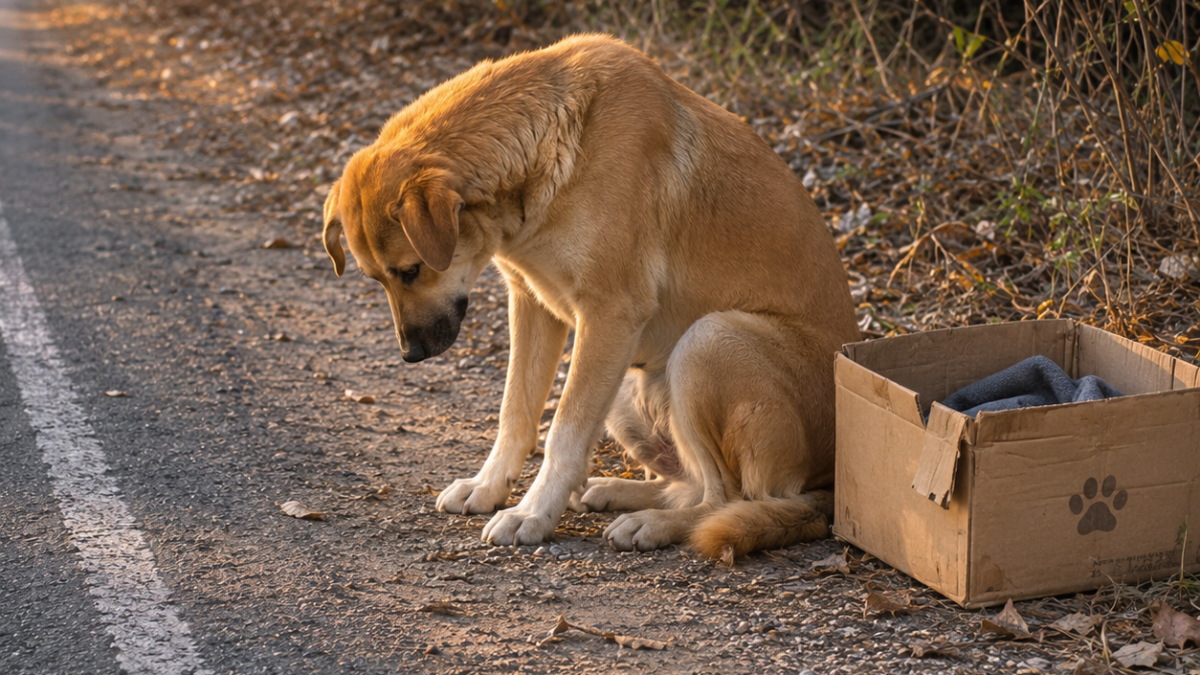
PART 2
Whitfield Veterinary Hospital was a low brick building between a pharmacy and an old tire shop, and I barely had the truck in park before I was out of it.
A young man in blue scrubs and a woman carrying towels came through the side door before I reached the entrance.
“You called about the mother and puppies?”
“Yes.”
The man looked into the truck.
His face immediately became serious.
“Let’s get them inside.”
I lifted the cardboard box.
The mother tried to follow but stumbled as soon as her paws touched the pavement.
The woman caught her.
“Easy, mama.”
The dog didn’t care about herself.
She twisted toward the puppies.
“They’re coming,” I said.
She looked at me.
“I’ve got them.”
Maybe she understood my voice.
Maybe she understood only that I wasn’t walking away with the box.
Either way, she stopped fighting.
The veterinarian introduced himself while we moved.
“Ryan Keller.”
“Will.”
“How long have they been like this?”
“I don’t know.”
“How long have you had them?”
“About twenty minutes.”
He looked at me.
“I saw them this morning.”
The words felt disgusting as they came out.
“At eleven.”
Dr. Keller didn’t respond immediately.
“I thought she was playing with the box.”
He pushed open the examination room door.
“We’ll talk later.”
That was kinder than anything I deserved at that moment.
They placed the mother on a thick blanket on the floor instead of lifting her onto the metal table.
One technician began checking her gums.
Another examined her paws.
Dr. Keller turned toward the puppies.
“Get me four warm towels. Separate weights. Glucose ready.”
The smallest puppy barely reacted when he picked it up.
“Come on, little one.”
He rubbed the puppy’s chest.
Nothing.
My stomach dropped.
“Is it dead?”
“No.”
Dr. Keller’s answer came immediately.
“Not yet.”
Not yet.
Those two words put ice in my veins.
He listened with a stethoscope.
“Weak heart rate.”
A technician hurried back.
They began moving so quickly that I had to step away.
One puppy was placed under supplemental oxygen.
Another was given fluid beneath the skin.
The mother watched everything.
When someone carried the smallest puppy toward the other side of the room, she tried to stand.
Her legs folded.
I caught her shoulders.
“Easy.”
She looked up at me.
“Let them help him.”
I kept one hand against her neck.
“They’re helping.”
The dog was hot.
Too hot.
Her breathing came in short, dry bursts.
Dr. Keller glanced toward us.
“Temperature?”
“104.3.”
“Dehydration?”
“Severe.”
He nodded toward an IV catheter.
“Start fluids slowly.”
I watched a technician shave a small patch on the mother’s leg.
She didn’t resist.
That was almost worse.
An animal that tired doesn’t waste energy fighting.
“What happened to her paws?” I asked.
The technician looked down.
The pads on both front feet had been worn through in places.
Not scratched.
Worn.
Raw tissue showed beneath cracked skin.
“She traveled on these?”
Dr. Keller didn’t look away from the puppy he was treating.
“Apparently.”
I thought about the box scraping over gravel.
Push.
Walk.
Push.
Walk.
All morning.
All afternoon.
Maybe before I ever saw her.
“How far?”
“No way to know.”
I leaned against the wall.
The room seemed suddenly too small.
Dr. Keller looked at me.
“Mr. Graves, go wait outside for a few minutes.”
“I can stay.”
“You can.”
He softened his voice.
“But you’re not helping yourself or them by standing there looking like you’re about to pass out.”
I hadn’t realized I was.
I went into the waiting room.
There was only one other person there, an older woman with silver hair and a cat carrier on her knees.
She looked at me.
Then toward the treatment room.
“You brought somebody in?”
“Five somebodies.”
Her eyes widened slightly.
“A mother and four puppies.”
She smiled.
“Then they’re in good hands.”
I sat down.
That was the beginning of the longest forty minutes of my life.
I counted floor tiles.
Thirty-six visible from my chair.
I read a poster about canine parvovirus.
Then another about feline dental disease.
Then the same parvovirus poster again.
My phone rang twice.
Both work calls.
I ignored them.
Twenty-four hours earlier, that would have been unthinkable.
Now it seemed absurd that I had ever believed someone arguing about an invoice could be urgent.
My name is Will Graves.
I was thirty-eight years old then.
I sold construction materials.
Concrete.
Brick.
Roofing.
Things with weight and measurements and invoices.
Things that didn’t breathe.
My life was organized.
My house was quiet.
My refrigerator contained food for one person.
I woke when I wanted.
Worked late when I wanted.
If I went away for a weekend, I locked the door and left.
I had never owned a dog.
Never owned a cat.
Not even a goldfish.
I thought I liked that life.
Then Dr. Keller walked into the waiting room.
I stood so quickly the chair moved backward.
“How are they?”
He rubbed his hands together.
“The mother is severely dehydrated and malnourished. Her paw pads are badly damaged. She also has abrasions along her chest and muzzle, probably from pushing or dragging the box.”
“And the puppies?”
He paused.
“All four are alive.”
My knees nearly gave out.
“But?”
“Two are stronger. Two are critical.”
I nodded.
“What do they need?”
“Time.”
“Okay.”
“And intensive support.”
“Do it.”
“We will.”
“Whatever it costs.”
Dr. Keller studied me.
“Are they your dogs?”
“No.”
That question hit me strangely.
“Not technically.”
“Do you know who owns them?”
“No.”
“Any collar? Microchip?”
“Nothing.”
He nodded.
“We’ll scan the mother.”
“What happens if there’s no owner?”
“We stabilize them first. That’s the priority.”
“And after?”
He hesitated.
“If no owner is identified, normally we coordinate with the county shelter or a rescue.”
I pictured that cardboard box.
Another hand carrying it away.
The mother watching.
Another separation.
Something in me resisted immediately.
“Can I see them?”
Dr. Keller took me into the back.
The mother lay beneath a blanket.
An IV line ran from her front leg.
The four puppies were inside a heated enclosure beside her.
Two were moving.
One was crawling over another.
The smallest lay almost still, but his chest rose more strongly than before.
“They’re better.”
“A little.”
Dr. Keller crouched.
“The mother had essentially nothing left to give them. No milk. Almost no reserves.”
“How long since she ate?”
“At least two days, I’d guess. Maybe longer.”
I stared at her.
“And she pushed that box.”
Dr. Keller nodded.
“Her front paw pads are worn almost to the tissue.”
“Why would she do that?”
He gave me an expression that made the answer seem obvious.
“Because her puppies were in it.”
I looked at him.
“That simple?”
“To her? Probably.”
The mother opened her eyes.
She saw me.
Her head lifted.
Only an inch.
But her tail moved once against the blanket.
That one movement went straight through me.
I crouched.
“Hey, girl.”
She lowered her head again.
“I’m sorry I didn’t stop the first time.”
Dr. Keller was behind me.
“You did stop.”
“Six hours later.”
“You can’t change that.”
“No.”
I watched the smallest puppy breathe.
“I can change what happens next.”
For the first time, the thought came clearly.
“What if I take them?”
Dr. Keller thought I meant transport.
“Once they’re discharged—”
“No.”
I turned.
“What if I take them?”
He stared.
“All five?”
“Yes.”
“Mr. Graves, have you ever owned a dog?”
“No.”
He actually laughed once.
Not mockingly.
More in disbelief.
“You’re starting with five?”
“I guess.”
“You understand four of them are puppies?”
“I noticed.”
“And puppies become dogs.”
“I assumed that.”
He shook his head.
“You’re serious.”
I looked at the mother.
“Yes.”
Something had already happened inside me.
I couldn’t explain it.
I only knew that I had watched this dog ask the world for help all day.
She had pushed four dying puppies toward people until her paws bled.
I had been one of the people who failed her.
I wasn’t going to be the person who handed her away once she survived.
“I don’t want them split up.”
Dr. Keller’s expression softened.
“Eventually, separating some puppies into good homes isn’t cruel.”
“I know.”
At the time, I didn’t really know.
“But not now.”
“No.”
“Not after this.”
He nodded.
“Not now.”
That evening I drove home alone.
I had expected relief.
Instead, the house felt wrong.
Too quiet.
I stood in the kitchen and looked around.
Where would five dogs sleep?
Where would food go?
Did puppies need special bowls?
How often did they eat?
Did they need shots?
Of course they needed shots.
What kind?
I knew nothing.
I opened my laptop.
For two hours, I read.
Then I called my mother.
She lived three hours away near Austin and had spent at least ten years telling me I had become too comfortable being alone.
She answered on the second ring.
“Will?”
“Mom, I did something.”
Silence.
Those words from me apparently sounded dangerous.
“What kind of something?”
“I adopted a dog.”
Long silence.
“And four puppies.”
An even longer silence.
Then she laughed.
Not politely.
Not gently.
She laughed so hard she had to put the phone down.
“Mom.”
I could still hear her.
“This isn’t funny.”
“Oh, Will.”
“I don’t know why I called you.”
“You have never owned an animal.”
“I know.”
“You complained for a week when a bird built a nest above your porch light.”
“It made a mess.”
“And now you have five dogs?”
“I don’t have them yet.”
“You just said adopted.”
“I said I’m going to.”
She laughed again.
Then her voice softened.
“Tell me what happened.”
So I told her.
Not perfectly.
I stumbled over parts.
The road.
The box.
The puppies.
The bloody paws.
When I finished, my mother was quiet.
“You almost drove past her twice?”
“No.”
I stared at the table.
“Only once.”
“Will.”
“I know.”
“No, sweetheart.”
Her tone changed.
“You stopped the second time.”
“Late.”
“But you stopped.”
I didn’t answer.
“You’ve always been too hard on yourself.”
“Mom, those puppies could’ve died because I was busy.”
“They could’ve died for a hundred reasons before you ever saw them.”
“That doesn’t make it better.”
“No.”
She paused.
“But maybe what you do next can.”
I looked around my empty kitchen.
Five dogs.
What had I done?
Three days later, I returned to Whitfield Veterinary Hospital.
By then, the mother had a name.
Daisy.
I don’t know exactly why.
Dr. Keller asked what name he should put on her temporary medical record, and the word came out.
“Daisy.”
He raised an eyebrow.
“You sure?”
“No.”
He wrote it anyway.
Daisy improved faster than anyone expected.
On the first day, she could barely lift her head.
On the second, she ate half a bowl of soft food.
On the third, she stood when I entered.
Then she wagged her tail.
Slowly.
Once.
Twice.
I felt absurdly proud.
“Look at you.”
Daisy walked toward me with bandaged front paws.
She pressed her forehead against my thigh.
I froze.
Dr. Keller watched from the doorway.
“What?”
“Nothing.”
“You’re smiling.”
“I smile.”
“First time I’ve seen it.”
“I’m paying you. Don’t get sarcastic.”
He laughed.
The puppies improved too.
The smallest nearly died the second night.
I didn’t know until afterward.
Dr. Keller told me when I arrived the next morning.
“He crashed around two.”
“What does that mean?”
“His glucose dropped. Temperature fell. Breathing weakened.”
I looked into the warming enclosure.
A tiny dark puppy was nursing weakly from a bottle.
“But he’s okay?”
“He fought.”
I touched the glass.
“Which one?”
“That one.”
I had not named them yet.
I suddenly understood why.
Names frightened me.
Names meant attachment.
Names meant there would be someone specific to lose.
Dr. Keller seemed to read my expression.
“You can’t protect yourself by not naming them.”
“I wasn’t doing that.”
“You were.”
I sighed.
“Fine.”
I pointed toward the largest puppy, a brown male who had begun pushing the others aside whenever food appeared.
“Oak.”
Dr. Keller nodded.
I pointed at the smallest.
“Ash.”
“Why Ash?”
“He survived being almost burned out.”
“That’s not what ash means.”
“You name him, then.”
He raised both hands.
“Continue.”
The female with a white mark on her chest became Willow.
The last male became Pine.
Tree names.
Strong things.
Things with roots.
I liked that.
Daisy seemed indifferent.
She cared only that all four were beside her.
Every time one puppy was removed for treatment, her eyes followed.
The moment it returned, she counted with her nose.
One.
Two.
Three.
Four.
Then she rested.
That pattern stayed with me.
Daisy trusted Dr. Keller.
She tolerated technicians.
But she never stopped counting.
On the fifth day, Dr. Keller handed me an estimate for continuing care.
I looked at the number.
Then at him.
“That much?”
“You said whatever it costs.”
“I was emotional.”
“You still emotional?”
I looked through the window.
Daisy was cleaning Oak’s ear.
“Yes.”
“Then that’s the number.”
I paid it.
I canceled a weekend trip I’d been planning.
Sold a set of golf clubs I almost never used.
Stopped eating lunch at restaurants for a while.
None of it felt like sacrifice.
That’s the strange part.
Things I had once valued suddenly looked replaceable.
Daisy wasn’t.
The puppies weren’t.
A week after I found them, Dr. Keller said they could come home.
“You sure?”
“No.”
He smiled.
“Comforting.”
“The puppies still need feeding schedules. Daisy needs medication. Her paws should stay protected until the tissue heals.”
I had notes.
Three pages.
My mother had sent me a list that was even longer.
“You’ll need a follow-up in four days.”
“I’ll be here.”
“And Will?”
“What?”
“Sleep now.”
I laughed.
“Why?”
“Because you won’t.”
He was right.
My house changed in one afternoon.
I had bought beds.
Crates.
Bowls.
Towels.
Puppy pads.
Food.
Toys.
A little gate for the kitchen.
I believed I was prepared.
This belief lasted approximately eleven minutes.
Oak peed beside a brand-new puppy pad.
Pine somehow got behind the couch.
Willow screamed because Daisy walked six feet away.
Ash fell asleep inside my shoe.
Daisy investigated every room twice, then returned to the box I’d brought the puppies home in.
She sniffed it.
Her body stiffened.
I saw the memory hit her.
I immediately picked up the box.
“No.”
She looked at me.
“We’re done with that.”
I carried it outside.
For some reason, I couldn’t throw it away.
I put it in the garage.
That night, Daisy slept beside the couch.
The puppies slept pressed against her.
I sat above them and watched.
Tiny breaths.
Little squeaks.
Paws twitching in dreams.
Daisy’s head rested on the carpet.
She looked exhausted.
But peaceful.
My house had never sounded like that.
It had always been quiet.
Controlled.
No surprises.
I had thought quiet meant peace.
I was wrong.
Sometimes quiet means empty.
Without warning, I started crying.
I was thirty-eight years old, sitting alone on my couch, crying over five sleeping dogs.
Daisy opened one eye.
“Don’t judge me.”
Her eye closed.
“Good.”
The weeks that followed were chaos.
Beautiful chaos.
Puppies grow at a speed that feels unfair.
One day Ash could barely climb over Daisy’s front leg.
A week later, he was escaping the kitchen barrier.
Oak became fearless.
Too fearless.
He ran into doors because he expected them to open.
Pine developed an obsession with my socks.
Willow believed every blanket belonged to her.
Ash wanted to be held.
Always.
Daisy became healthier.
Weight returned to her body.
Her coat changed from dusty brown to warm caramel.
The wounds on her paws healed.
She started running.
The first time I saw her sprint across my yard, I stood completely still.
This was the same dog who could barely walk beside that cardboard box.
Now she ran in circles while four puppies chased behind her.
I laughed until I couldn’t breathe.
Daisy stopped.
Looked at me.
Then ran harder.
Maybe she liked the sound.
People began hearing about them.
Dr. Keller had told one volunteer.
The volunteer told a friend.
Someone had seen me pull over that afternoon.
Eventually a small local rescue group called.
“Would you be willing to share Daisy’s story?”
“No.”
The woman paused.
“Okay.”
That surprised me.
“No argument?”
“No. She’s your dog.”
I looked at Daisy.
The phrase did something to me.
**Your dog.**
“Can I ask why?”
“I don’t want people treating her like entertainment.”
“I understand.”
“She went through enough.”
“We’d only use the story to help other abandoned mothers.”
I hesitated.
“What do you mean?”
“People dump pregnant dogs and nursing dogs all the time. Daisy’s story might make someone stop.”
Stop.
That word mattered.
I agreed to one photograph.
No dramatic video.
No staging.
No forcing Daisy near the old box.
Just Daisy with her puppies in my yard.
The rescue posted it with a short description.
Within two days, people had shared it thousands of times.
I hated the attention.
But something useful happened.
Donations came into the rescue.
Food.
Formula.
Medical supplies.
Then a woman called after finding a nursing dog behind an abandoned warehouse.
She said Daisy’s story was why she didn’t keep driving.
That was the first moment I understood our story might be larger than my guilt.
People contacted me wanting puppies.
Dozens.
Then hundreds.
Everyone loved the idea of adopting one of “Daisy’s miracle babies.”
That made me suspicious.
Dogs are not symbols when they chew your furniture at three in the morning.
They are commitments.
I interviewed people.
Badly.
I asked invasive questions.
Do you own or rent?
Do you have a yard?
What happens if you move?
What happens if the puppy gets sick?
How long are you gone each day?
What if he destroys something?
What if she becomes seventy pounds?
What if your marriage ends?
What if you have a baby?
One man laughed.
“Are you adopting out a puppy or approving a mortgage?”
“A puppy.”
“So why all the questions?”
“Because a mortgage doesn’t wonder why you never came back.”
He did not get a puppy.
Dr. Keller told me I was becoming unreasonable.
“You can’t eliminate every risk.”
“I can eliminate idiots.”
“Will.”
“What?”
“Normal people make mistakes.”
“So did I.”
He understood.
That was the problem.
I could not stop thinking about the morning.
Daisy pushing.
Me driving.
Sometimes at night, I dreamed I never returned.
In those dreams, I found the box weeks later.
Empty.
Or I never found it at all.
I woke with my heart pounding and walked downstairs.
Daisy always lifted her head.
I would sit beside her.
“I’m here.”
Maybe I was telling her.
Maybe myself.
Eventually I found a home for Willow.
A young couple named Eric and Melissa had recently lost a thirteen-year-old dog.
They did not want a “replacement.”
That was why I liked them.
They wanted another relationship.
Melissa sat on my kitchen floor for almost two hours before Willow voluntarily climbed into her lap.
Eric didn’t touch her until she approached him.
Before they left, Melissa asked:
“If for any reason it doesn’t work, do you want us to contact you?”
“Yes.”
“Immediately?”
“Yes.”
“You’d take her back?”
“Yes.”
She smiled.
“That tells me everything.”
I almost changed my mind and kept Willow.
Instead, I kissed her head.
Daisy watched.
I worried she would panic when they carried Willow out.
She walked to the window.
Watched the car leave.
Then stood there for several minutes.
My stomach twisted.
“I’m sorry.”
Daisy turned.
Looked at the three puppies behind her.
Then walked back to them.
Dogs understand departure in ways I probably never will.
Ash was harder.
He had nearly died.
I had held him through bottle feedings.
He slept against my chest whenever I sat down.
The woman who eventually adopted him was named Sarah.
She was fifty-six and lived alone.
Her husband had died five years earlier.
When she came to meet Ash, she barely talked to me.
She talked to him.
Not baby talk.
Just quiet conversation.
“My house is too quiet.”
Ash climbed into her lap.
She cried.
I looked away because I was about to.
Sarah visited four times before taking him home.
On the final visit, she brought a new collar.
Blue.
With a metal tag.
ASH.
Her phone number.
Her address.
I touched the tag.
“You’re prepared.”
“I’ve been preparing all month.”
That was when I knew.
Ash went home with her.
For two days, I hated my house.
It contained only three dogs now.
Only.
I laughed at myself.
Months earlier, one dog would have felt like an invasion.
Now three felt incomplete.
But Sarah sent photographs.
Ash asleep on her bed.
Ash in her garden.
Ash sitting beside her while she read.
In every picture, Sarah looked less lonely.
I understood then.
Keeping all five together because I couldn’t bear separation would have been about me.
Daisy had fought to give those puppies a chance at life.
A good home was part of that chance.
I kept Oak.
I kept Pine.
And of course, Daisy.
Three dogs.
That was enough to destroy every remaining illusion that I controlled my house.
Oak grew enormous.
Pine grew clever.
Daisy became the center of everything.
Every morning she woke before my alarm and sat beside the bed.
Never barked.
Just stared.
If I ignored her, Oak joined.
Then Pine.
Try sleeping while three dogs silently judge you.
My mother visited three months after they came home.
The second she walked through the door, Oak jumped on her.
Pine stole the scarf from her purse.
Daisy sniffed her shoes.
My mother looked at me.
“This is your peaceful life?”
“Very.”
A crash came from the kitchen.
I closed my eyes.
She laughed.
That evening, after the dogs settled down, my mother sat beside me on the porch.
Daisy lay at our feet.
“You’re different.”
“I have dog hair on everything.”
“Not what I mean.”
I knew.
Before Daisy, my work filled the space where other things should have been.
I had friends, technically.
People I saw.
People I spoke to.
But I didn’t need anyone.
I had turned independence into a wall.
Daisy didn’t ask permission.
She pushed a cardboard box straight through it.
“I almost didn’t stop.”
My mother sighed.
“You’re still doing this?”
“What?”
“Punishing yourself.”
“I drove past her.”
“And then?”
“You know what happened.”
“No. Say it.”
I looked at her.
“Then I came back.”
“Not for her.”
“No.”
“You were coming home.”
“Yes.”
“And when you saw her?”
“I stopped.”
My mother nodded.
“That is who you are too.”
I looked toward Daisy.
“Maybe.”
Daisy opened one eye.
My mother smiled.
“She seems convinced.”
About six months after the rescue, something happened that pulled me back to that road.
A county worker called.
He had seen the original rescue post and recognized the location.
“There’s something you should see.”
I met him near the mile marker where I had first seen Daisy.
We walked into a field entrance beyond a tree line.
There, half-hidden behind weeds, was a pile of dumped household trash.
Broken chairs.
Plastic bags.
An old mattress.
More cardboard boxes.
My chest tightened.
“What is this?”
“Illegal dumping spot. Been used for a while.”
I saw a bowl.
Cheap plastic.
Then a torn dog-food bag.
My stomach turned.
“Do you think Daisy came from here?”
“No way to know.”
We searched.
Nothing with a name.
No collar.
No paperwork.
But about fifty yards deeper into the tree line, we found something that made me angry in a way I had never felt before.
A short length of chain attached to a stake.
Beside it, flattened grass.
I stared at it.
“Was she tied here?”
“We don’t know.”
“Could she have been?”
“Yes.”
I imagined Daisy pregnant.
Tied.
Then puppies.
Then abandonment.
Maybe somebody placed the puppies in the box.
Maybe Daisy found it.
Maybe she dragged them from somewhere else.
We would never know.
There were no cameras.
No witnesses.
No clean revenge waiting for me.
I wanted a person.
A name.
Someone to blame.
Someone I could confront.
I wanted to ask how they could leave a nursing dog without food.
How they could sleep knowing puppies were dying beside a road.
But reality doesn’t always give you a villain standing conveniently under a spotlight.
Sometimes cruelty leaves no forwarding address.
The county cleaned the dumping area.
Signs went up.
Cameras were installed.
Three months later, someone was fined for dumping furniture there.
It wasn’t Daisy’s former owner.
Probably.
But the place stopped being invisible.
That mattered.
The rescue organization used Daisy’s story to launch a rural abandonment campaign.
Posters went into feed stores.
Gas stations.
Farm supply shops.
Veterinary offices.
A simple photograph of Daisy sat at the top.
Underneath:
**SHE WALKED UNTIL SOMEONE STOPPED.**
Then:
**If you see an abandoned animal, don’t assume someone else will help.**
The first time I saw the poster, I stood in a hardware store staring at it.
A clerk came over.
“You okay?”
“That’s my dog.”
He looked at the photograph.
“No way.”
“Yeah.”
He grinned.
“She famous?”
I thought about Daisy asleep upside down on my couch that morning.
“Unfortunately.”
The campaign led to more calls.
Some were false alarms.
Some were farm dogs doing perfectly fine.
Some were real.
A litter under a bridge.
A hound tied behind an abandoned trailer.
Two puppies in a drainage culvert.
A pregnant dog left at a church.
Every rescue hurt.
Every rescue also felt like a piece of revenge against whoever had abandoned Daisy.
Not revenge with pain.
Better than that.
They had tried to make one dog disappear.
Instead, Daisy made other abandoned dogs harder to ignore.
A year passed.
Then two.
Oak and Pine became full-grown dogs.
Willow visited often because Eric and Melissa lived only forty minutes away.
Ash came during holidays with Sarah.
The first reunion was chaos.
Daisy stood in the yard while all four adult puppies ran toward her.
For one glorious second, I expected a beautiful emotional scene.
Instead, Oak ran into Pine.
Willow stole a ball.
Ash knocked over a water bowl.
Daisy barked at all of them like an exhausted schoolteacher.
I laughed until I cried.
Sarah came beside me.
“She remembers him.”
“Of course.”
Daisy walked to Ash and cleaned his ear.
Ash closed his eyes.
Sarah’s voice softened.
“She saved him.”
“Yes.”
“She saved me too.”
I looked at her.
Sarah watched Ash.
“I didn’t realize how bad the silence had gotten after my husband died.”
She swallowed.
“I was functioning. That’s not the same as living.”
Those words stayed with me.
I understood them too well.
Daisy had not simply entered my life.
She had exposed it.
I had been functioning.
Work.
Home.
Bills.
Sleep.
Repeat.
I called that stability.
Maybe it was.
But Daisy brought disorder.
Responsibility.
Fear.
Attachment.
Loss.
Love.
Real things.
One evening, several years after I found her, Daisy came to sit beside me on the porch.
Oak and Pine were asleep inside.
The sun dropped behind the fields.
Cars occasionally passed on the road in the distance.
Daisy rested her head on my knee.
The scars on her front paw pads had faded but never disappeared completely.
I touched one.
“Do you remember?”
She looked up.
“The box?”
Her ears moved.
I hated the idea that she might.
Some people assume rescue animals should be grateful.
That word has always bothered me.
Daisy owed me nothing.
I was the one who owed her.
She had trusted after people had given her reasons not to.
That was not gratitude.
That was courage.
When Daisy was around seven, she became sick.
Nothing dramatic at first.
Less appetite.
Tired.
I took her to Dr. Keller.
He examined her.
Bloodwork.
Ultrasound.
I sat in the same waiting room where I had waited years earlier.
Same floor tiles.
Different chairs.
Same fear.
Dr. Keller eventually came out.
“She’s okay.”
I exhaled.
“Define okay.”
“Infection. Treatable.”
I sat down.
He smiled.
“You really haven’t changed much.”
“I don’t like this building.”
“You’ve been here hundreds of times.”
“Exactly.”
Daisy recovered.
But that scare changed me.
I understood that the story didn’t end when I rescued her.
Every dog story ends eventually.
That is the cruelty built into loving them.
You almost always outlive them.
So I started paying attention differently.
Not obsessively.
At least, that’s what I told myself.
I took photographs.
Daisy sleeping beneath the kitchen table.
Daisy covered in mud.
Daisy sitting between Oak and Pine.
Daisy glaring at the vacuum.
Daisy stealing a hamburger from Marcus, one of my delivery drivers.
Ordinary things.
Because ordinary things become precious only after they are gone.
The rescue organization eventually asked me to speak at an adoption event.
I refused.
Then they asked again.
I refused.
The third time, Dr. Keller called.
“You’re going.”
“No.”
“Yes.”
“You’re a veterinarian, not my manager.”
“I’ll stop giving Daisy treats.”
“What time?”
The event was held in a county park.
I stood in front of maybe two hundred people.
Daisy sat beside me.
Oak and Pine were home because nobody needed that disaster.
I had prepared a speech.
I abandoned it.
“I saw Daisy twice in one day.”
The crowd quieted.
“The first time, I drove past.”
I heard people shift.
“I want to start there because rescue stories are usually told backward. We like the part where somebody does the right thing. We don’t like talking about the moment before that, when they don’t.”
I looked at Daisy.
“She was pushing four puppies in a box.”
People murmured.
“I decided there was probably a reasonable explanation.”
I paused.
“That phrase can be dangerous.”
I told them about returning six hours later.
About Daisy’s paws.
The clinic.
The smallest puppy almost dying.
Then I said something I had finally learned.
“I cannot undo the first time I saw her.”
Daisy looked toward me.
“But I also don’t have to pretend the second time didn’t matter.”
That sentence released something in me.
For years, I had divided people into good and bad based on moments.
Including myself.
But life is longer than moments.
Mistakes matter.
So does what comes next.
The event raised enough money to expand the rescue’s emergency medical fund.
They named part of it after Daisy.
I objected.
Nobody cared.
Dr. Keller sent me a photograph of the sign.
**DAISY FAMILY EMERGENCY FUND**
I called him.
“You did this.”
“I voted yes.”
“You’re dead to me.”
“You still owe for Pine’s dental cleaning.”
“Unfortunately.”
Daisy aged slowly.
Then all at once.
Her muzzle whitened.
Her hearing softened.
She stopped jumping onto the couch and waited for me to lift her.
Oak and Pine, once puppies she constantly corrected, became protective.
If Daisy stopped during a walk, they stopped.
If she slept, they stayed nearby.
One winter morning, she slipped on the porch steps.
Nothing broke.
But I built a ramp that afternoon.
I had sold construction materials for twenty years.
Finally, a useful skill.
When Daisy first used it, she walked halfway up, stopped, turned around and looked at me.
“What?”
She continued.
I imagined she was judging the craftsmanship.
My mother said I was insane.
She was probably right.
Daisy turned twelve.
Dr. Keller called that “a gift.”
I didn’t like the word.
Gifts can be taken away.
At thirteen, she developed arthritis.
Medication helped.
At fourteen, her kidneys began to weaken.
That was when the real ending started.
Not dramatically.
Endings rarely announce themselves.
Daisy drank more water.
Ate less.
Slept longer.
Dr. Keller adjusted her food.
Added medication.
We got months.
Then more months.
I took every one greedily.
Oak and Pine were old dogs themselves by then.
Willow had died the year before from cancer.
Eric called me after.
I drove to their house.
We buried her beneath an oak tree.
They gave me her collar.
I took it home.
Daisy sniffed it for a long time.
Then lay beside it.
Ash died the following spring.
Sarah called me at 2:00 a.m.
I stayed with her until morning.
One by one, Daisy’s puppies were leaving.
Pine went next.
Heart failure.
Oak lasted another year.
He died at almost thirteen.
That left Daisy.
The mother.
The beginning.
By then she was almost fifteen.
Impossibly old considering where her life had started.
Sometimes I wondered whether she had decided she had already fought too hard to leave early.
On her final summer, Daisy spent most afternoons on the porch.
I sat with her whenever I could.
Work mattered less now.
I had hired people.
Delegated.
Learned that companies survive if you miss a phone call.
That lesson had taken a dog to teach me.
One evening, my mother visited.
She was older too.
She sat beside Daisy.
“You know,” she said, “this dog saved you.”
“I saved her.”
My mother gave me a look.
“You carried her to a veterinarian.”
“Yes.”
“She gave you a life.”
I wanted to argue.
Couldn’t.
Daisy had given me relationships.
The rescue.
Dr. Keller.
Sarah.
Eric.
Melissa.
People I would never have known.
She gave me purpose outside work.
She gave my quiet house a history.
She even gave my mother something to tease me about for fifteen years.
“So we’re even,” I said.
My mother smiled.
“Not even close.”
Daisy’s final decline began in October.
She stopped eating breakfast.
Then dinner.
Dr. Keller came to my house because I couldn’t bring myself to make Daisy spend her final hours in the clinic where her new life had begun.
He sat on my kitchen floor.
Listened to her heart.
Examined her gums.
Then looked at me.
I knew.
“No.”
He didn’t say anything.
“No.”
“Will.”
“I can give her more fluids.”
“You can.”
“Medication.”
“Yes.”
“How long?”
He paused.
“A few days. Maybe.”
I stared at Daisy.
Her head rested between her paws.
Her eyes found mine.
Still the same eyes.
Older.
Cloudier.
But the same question lived somewhere inside them.
**You?**
**Are you going to help me?**
For the first time since the roadside, helping meant letting go.
I hated that.
I sat beside her.
Dr. Keller waited.
“I need a minute.”
“Take all the time you need.”
I rested my forehead against Daisy’s.
“You remember the first day?”
Her breath warmed my hand.
“I was an idiot.”
Her tail moved once.
I laughed through tears.
“Yes. I know. You agree.”
I touched one of her paws.
The old scars were still there.
“You pushed that box all day.”
Daisy closed her eyes.
“Four babies.”
I thought about Oak.
Pine.
Willow.
Ash.
All of them loved.
All of them given years they nearly didn’t have.
“You did it.”
My voice broke.
“You got them there.”
Dr. Keller sat quietly across the room.
“I spent years thinking I was the one who rescued you.”
Daisy opened her eyes again.
“I was wrong.”
I ran my hand down her face.
“You rescued them.”
A pause.
“And then you rescued me.”
Daisy licked my wrist.
Weakly.
Barely.
That destroyed me.
I called my mother.
She came.
Dr. Keller gave Daisy medication so she wouldn’t hurt while we waited.
Sarah came with Ash’s old blue collar.
Eric and Melissa brought Willow’s collar.
I placed Oak’s and Pine’s beside them.
Four collars.
Four puppies.
One mother.
The entire family, in the only way possible now.
Daisy sniffed each collar.
When she reached Ash’s, she paused.
Maybe scent remained.
Maybe memory.
Maybe I imagined it.
I no longer cared.
We spent the afternoon together.
No speeches.
No dramatic music.
Just people who had been changed by one tired brown dog.
Before sunset, I carried Daisy outside.
She had not been light in years.
Now she was.
Too light.
I placed her on a blanket beside the porch.
The road was visible through the trees.
Not the exact road where I found her.
But another country road.
Cars passed occasionally.
Daisy watched.
I wondered what roads meant to her.
Fear?
Hope?
Nothing?
Dr. Keller sat beside us.
“You ready?”
“No.”
He nodded.
“Neither is anyone.”
I looked at Daisy.
But she was ready.
I could see that.
Her body was tired.
Her work was finished.
I held her head.
“I need you to hear this.”
My voice shook.
“I stopped.”
Daisy looked at me.
“Late.”
I swallowed.
“But I stopped.”
Her tail moved against the blanket.
“And I never left again.”
Dr. Keller administered the first medication.
Daisy relaxed.
Her breathing became slower.
I kissed her forehead.
“You don’t have to push anything anymore.”
My mother cried behind me.
“No more roads.”
Another breath.
“No more boxes.”
Another.
“No more being hungry.”
Daisy’s eyes grew heavy.
“You found somebody.”
I pressed my face against hers.
“You found me.”
Her final breath was almost a sigh.
Then she was still.
For a long time, nobody moved.
I kept my hand on her.
Dr. Keller eventually touched my shoulder.
“Will.”
“I know.”
I didn’t want to move.
Because once I stood up, Daisy’s life would become past tense.
I had never understood how violent grammar could be.
She **is**.
Then suddenly:
She **was**.
I buried Daisy on my property beneath a large oak tree.
Beside her went four small plaques.
Oak.
Ash.
Willow.
Pine.
Not their bodies.
Their collars.
A family marker.
The rescue organization wanted a public memorial.
I said no.
Then, just as always, they ignored me halfway.
They created something smaller.
A bench outside the county shelter.
The plaque read:
**DAISY**
**SHE KEPT PUSHING UNTIL SOMEONE STOPPED.**
Below it:
**May we always be the ones who stop.**
I sat on that bench alone the first time I saw it.
I hated it.
Then loved it.
Then hated it again because it made me cry.
Years after Daisy’s death, the emergency fund carrying her name had paid for treatment for hundreds of animals.
Nursing mothers.
Injured strays.
Litters found in dumpsters.
Dogs hit by cars.
Cats suffering infections.
People occasionally sent me photographs.
A dog standing on three legs after surgery.
A litter sleeping in a foster home.
An elderly hound curled beside a family who adopted him.
Every photograph carried a little piece of Daisy.
That became the revenge I never knew I wanted.
I never found the person who abandoned her.
Maybe nobody ever deliberately abandoned her.
Maybe she was born stray.
Maybe someone dumped the puppies.
Maybe the chain in the woods belonged to another dog.
There were questions I never answered.
For years, that bothered me.
I wanted the person responsible to see Daisy’s life.
To understand what they had thrown away.
Then eventually I realized it didn’t matter.
If someone had abandoned her, their punishment was simple.
They lost Daisy.
They lost the dog who would push a box until her paws bled for the lives she loved.
They lost Oak.
Ash.
Willow.
Pine.
They lost mornings with Daisy waiting beside the bed.
They lost the sound of puppies running across a kitchen floor.
They lost fifteen years of loyalty.
I got those things.
Sarah got Ash.
Eric and Melissa got Willow.
My friends got stories.
My mother got a four-legged grandchild she spoiled shamelessly.
The rescue got a symbol that helped save other animals.
Whoever had failed Daisy got nothing.
That was enough.
More than enough.
Today, I am older than the thirty-eight-year-old man who drove down that road believing phone calls and appointments were emergencies.
I still work.
But differently.
I stop.
Not every dog beside a road needs saving.
Some belong to farms.
Some are perfectly happy.
But I check.
I slow down.
I look.
One afternoon, years after Daisy died, I saw a dog standing near a ditch.
Old me might have kept driving.
I stopped.
The dog had a collar.
A phone number.
His name was Charlie.
He had escaped from a farm two miles away.
His owner arrived twenty minutes later crying.
“Thank you for stopping.”
I looked at Charlie.
Then I thought of Daisy.
“Yeah.”
I smiled.
“I learned.”
Sometimes people ask me whether I regret not stopping the first time I saw her.
Of course I do.
I always will.
Regret doesn’t disappear just because a story ends well.
That is not how regret works.
But it changed.
For years, regret said:
**You failed her.**
Now it says:
**Remember.**
Remember how easy it is to assume.
Remember how comfortable it is to believe someone else will help.
Remember that inconvenience can be the beginning of another life.
Remember the dog pushing the cardboard box.
Remember to look twice.
I still have the box.
That surprises people.
After the clinic, I kept it in the garage.
It should have been garbage.
Sun-bleached.
Crushed.
Stained.
One side almost torn away.
Years later, after Daisy died, I took it down from the shelf.
The bottom still had faint scratches.
Marks from puppies.
The outer corner had dark stains where Daisy’s nose and mouth had pushed against it.
I sat on the garage floor holding that piece of cardboard and cried like I had on the first night she slept in my house.
Eventually I cut one small piece from the side.
I framed it beneath a photograph.
In the picture, Daisy is lying in my yard.
Oak and Pine beside her.
Willow climbing over her back.
Ash asleep between her paws.
Everyone alive.
Everyone safe.
Below the photograph is that torn piece of cardboard.
People who visit sometimes think it’s strange.
Maybe it is.
But I need it.
Because a photograph shows the happy ending.
The cardboard remembers the price of reaching it.
On the back of the frame, I wrote one sentence.
**I was late, but I stopped.**
That is Daisy’s story.
And mine.
Not a perfect man rescuing a helpless dog.
Nothing that simple.
It is the story of a dog who refused to surrender before a human finally understood what he was looking at.
Daisy had no guarantee anyone would stop.
She had no guarantee the puppies in that box would survive.
She had no food.
No water.
No safe place.
Her paw pads were splitting against the road.
Her body was empty.
Still she pushed.
A few inches.
Then another.
Then another.
Almost a mile that I saw.
Maybe many more before that.
She could not know there was a veterinary hospital seventeen minutes away.
She could not know Dr. Keller would be waiting.
She could not know Ash would survive the night.
She could not know Willow would sleep beside Eric and Melissa for years.
She could not know Sarah needed Ash as much as Ash needed her.
She could not know Oak and Pine would grow old beside me.
She could not know a rescue fund would carry her name.
She knew only the next push.
That’s what stays with me.
Sometimes you don’t have to know how the story ends.
You only have to keep moving toward help.
And sometimes, when you’re the person passing by, you don’t need to know the whole story either.
You only need to stop long enough to see it.
I didn’t the first time.
That will always hurt.
But life gave me one more pass down that road.
One more look.
One more chance.
At five in the afternoon, the dog I had dismissed that morning was still there.
Still protecting four puppies.
Still hoping.
Still waiting for one person to notice.
This time, I pulled over.
That decision cost me veterinary bills.
Sleep.
Furniture.
Shoes.
Vacations.
Years of worrying.
Four painful goodbyes to puppies who became old dogs.
And finally, the hardest goodbye of all.
It also gave me the fullest years of my life.
So when people tell me I saved Daisy, I correct them.
“No.”
I say it every time.
“Daisy did the hard part.”
She pushed the box.
She kept four tiny hearts beating.
She refused to stop.
All I did was finally become the man she had been looking for all day.
The man who pulled over.
And if Daisy’s life taught me anything, it’s this:
Sometimes the difference between a tragedy and a second chance is not a miracle.
Sometimes it’s a car slowing down.
A door opening.
A person getting out.
And one simple decision:
**This time, I’m not driving past.**








