PART 2: I Drove Five Hours to Adopt a Scarred Retired Military Dog—Then I Learned We Were Wounded in the Same Firefight**
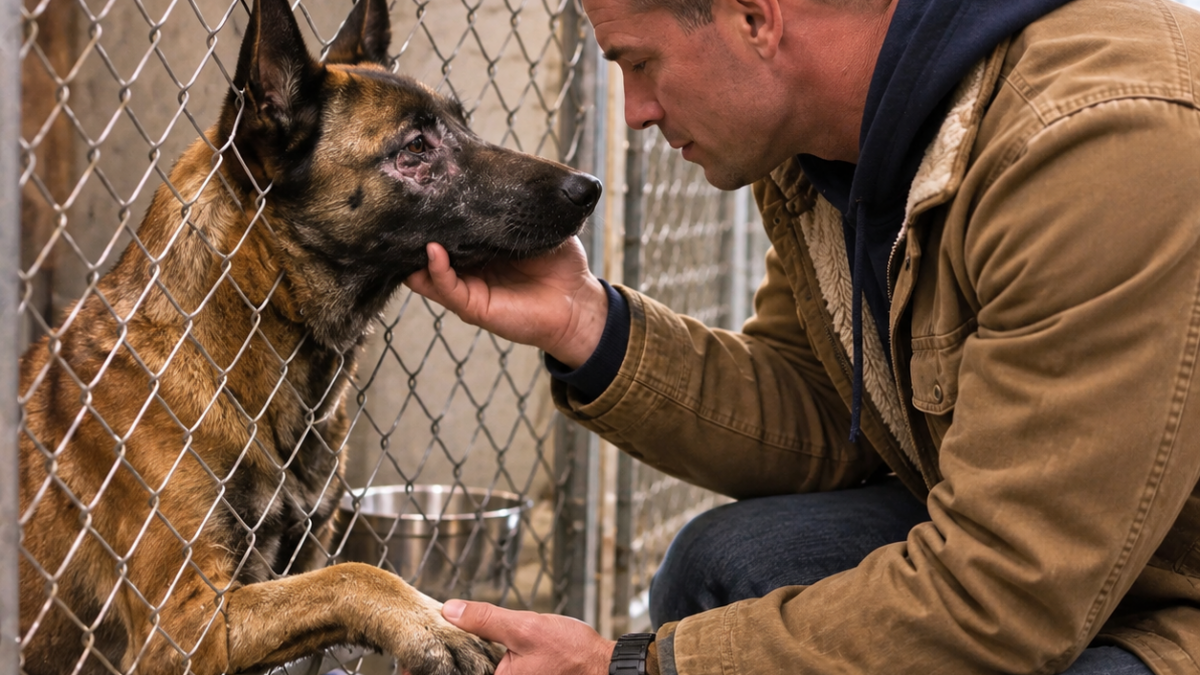
PART 2
The first week with Rex was almost too easy.
That’s what worried me.
He knew every command.
Sit.
Down.
Stay.
Heel.
Come.
Place.
Leave it.
His response was immediate.
Not ninety percent.
Not when he felt like it.
Every time.
I dropped his leash accidentally once.
He didn’t move.
I left food on the counter.
He ignored it.
I opened the front door.
He waited for permission.
Emily watched him one morning.
“This is making me uncomfortable.”
“What?”
“He is better behaved than you.”
“That isn’t difficult.”
“I’m serious.”
She placed a piece of bacon on the edge of her plate.
Rex glanced at it.
Then away.
“See?”
“He’s trained.”
“That’s not what I mean.”
I knew.
There was no curiosity in him.
No spontaneous behavior.
He didn’t sniff the trash.
Didn’t steal socks.
Didn’t shove a ball under furniture.
Didn’t roll on grass.
He performed.
He was perfect.
And perfection is not peace.
At night, he slept beside the bedroom door rather than on the bed we’d bought.
Not because he didn’t like the bed.
The doorway gave him a clear view of the hallway.
If Emily moved, Rex’s eyes opened.
If the refrigerator kicked on, his ears moved.
If a deer crossed near the back fence, he stood before I heard anything.
One night a storm rolled through.
Thunder cracked directly overhead.
Rex was on his feet instantly.
So was I.
Emily sat up.
For half a second, Rex and I were both facing the bedroom window.
Same posture.
Same tension.
She looked at us.
Then slowly lay back down.
“Well,” she said.
“What?”
“I’ve apparently married one of you and adopted the other.”
I laughed.
It helped.
Rex didn’t understand the joke.
But he watched me laugh.
Then lowered himself again.
The first month became a strange mirror.
On walks, Rex scanned tree lines.
So did I.
A helicopter passed overhead.
His head lifted.
Mine too.
Someone fired a rifle on distant private land.
Rex froze.
I felt my chest tighten.
We looked at each other.
I almost said:
“Yeah.”
Instead, I kept walking.
He followed.
Therapists talk about triggers as though they’re switches.
Sometimes they are.
Sometimes they’re echoes.
The original sound is gone.
The body just hasn’t received the message.
I tried giving Rex toys.
He ignored them.
Tennis ball.
Nothing.
Rope.
Nothing.
Rubber chew toy.
He sniffed it and walked away.
Emily said:
“Maybe he doesn’t know what those are for.”
“He’s a dog.”
“He was a working dog.”
“Still a dog.”
“Apparently you forgot how to relax too.”
I looked at her.
She smiled innocently.
“Are we discussing Rex?”
“Absolutely.”
Very funny.
We started simple.
No command.
No expectation.
I would sit outside.
Rex nearby.
No training.
No mission.
That was surprisingly hard.
For both of us.
I felt compelled to *do* something.
Read.
Fix fence.
Cut wood.
Check email.
Rex looked equally confused by idleness.
One afternoon, I sat on the porch for an hour.
Rex remained three feet away.
At 3:42, he finally lay on his side.
Not sphinx position.
Side.
Head down.
Eyes closed.
For maybe three minutes.
I didn’t move.
Emily came through the kitchen.
Saw him.
Started toward us.
I raised one finger.
She stopped.
We both stood there like idiots celebrating a dog taking a nap.
Progress comes in ridiculous forms.
Then came the garage.
It was raining.
Cold October rain.
Emily was reading upstairs.
I decided to organize boxes that had been sitting untouched since our last move.
Most were ordinary.
Old tax forms.
Tools.
College books.
Then I reached the boxes marked:
**USMC**
I almost left them.
There are boxes veterans keep because throwing them away feels wrong and opening them feels worse.
I opened one.
Photographs.
Unit patches.
Letters from Emily.
Old notebooks.
A folded map.
Deployment paperwork.
Rex was lying near the garage entrance.
Or resting.
His eyes still tracked me.
I found photographs I’d forgotten.
Men I’d served with.
Some alive.
Some not.
Bad haircuts.
Dust.
Gear.
Fake smiles.
Real exhaustion.
I turned over one photo.
Kunar.
2011.
My stomach tightened.
I put it aside.
Then another folder slid from the workbench.
Papers scattered.
Rex stood instantly.
His attention locked on one photograph lying face-up on the concrete.
He crossed the garage.
Stopped above it.
Stared.
“What’s wrong?”
He didn’t look at me.
I picked up the photograph.
Twenty-three people.
Mountain valley behind us.
Gear everywhere.
An Army support element had been attached to our operation.
Near the edge stood a handler.
Beside him—
Belgian Malinois.
I stared.
Dark sable.
White patch beneath chin.
Same ear shape.
Similar build.
I looked at Rex.
Back at the photo.
“No.”
My heart began pounding.
“That’s not possible.”
Rex sniffed the photograph.
Then turned his head away.
I sat on a toolbox.
The dog in the picture could have been any Malinois.
That was what I told myself.
They often looked similar.
The white patch could be coincidence.
The markings.
Ear shape.
Everything.
Coincidence.
Still, I started digging.
That is the danger of memory.
Once you crack a door, it wants the whole room.
I found the operation folder.
After-action notes.
Medical evacuation report.
Incident summary.
My hands began shaking before I found the date.
November 17, 2011.
Ambush.
Small valley in Kunar Province.
Convoy movement.
Small-arms fire.
Then secondary explosive.
I stopped.
I knew those words.
Not as text.
As sound.
Dust.
Radio.
Heat.
A pressure wave that stole the air from my lungs.
Someone yelling.
My left side burning.
I remembered lying behind a low rock wall trying to understand why my arm wouldn’t work.
I remembered Doc Harris pressing something against my shoulder.
I remembered asking who else was hit.
I remembered no one answering clearly.
I read farther.
Personnel wounded.
Names.
Mine.
Then:
**MWD K-417 sustained facial trauma from fragmentation. Evacuated with handler.**
I stopped breathing.
K-417.
I looked toward Rex.
He stood near the garage door.
Rain behind him.
Scar visible.
“No.”
I read it again.
**MWD K-417.**
My adoption papers were inside the house.
I ran.
Rex followed.
I opened the folder.
Military Working Dog:
**K-417 / Rex**
My legs felt weak.
Same dog.
Same operation.
Same day.
Same valley.
The injury that had damaged Rex’s face and left eye happened during the same firefight that put shrapnel through my shoulder and chest.
I sat at the kitchen table.
Emily came downstairs.
“What’s wrong?”
I couldn’t answer.
“Michael?”
I pushed the documents toward her.
She read.
Then looked at Rex.
Then me.
“No way.”
I nodded.
“Same day.”
She read again.
“Same operation?”
“Same valley.”
Her face changed.
“Did you know him?”
“I don’t know.”
That was the part that hurt strangely.
I had no clear memory of Rex.
I remembered a dog with the support team.
I remembered seeing Malinois on several operations.
But combat memory doesn’t preserve itself cleanly.
Some images are sharper than photographs.
Others disappear entirely.
“I might have seen him.”
Emily sat.
“Michael.”
“I was there.”
“I know.”
“He was there.”
Rex stood near me.
“I don’t remember.”
“That’s okay.”
“No, it’s—”
I stopped.
What was it?
A failure?
Of course not.
But something about not remembering him made the coincidence feel more impossible.
Emily touched my arm.
“Maybe he doesn’t remember you either.”
I looked at Rex.
“Probably not.”
“Does that matter?”
I didn’t know.
At almost one in the morning, Emily went upstairs.
I stayed.
Documents spread across the table.
Rex eventually approached.
No command.
He stood beside my chair.
Then something happened that he had never done.
He rested his head on my knee.
No training.
No tactical purpose.
No reward.
Just contact.
My throat tightened.
I placed one hand gently on his neck.
Away from the scar.
“Yeah.”
Rex closed his eyes.
I cried.
Not dramatically.
Just enough.
Same valley.
Same explosion.
Two bodies marked by the same seconds.
Then years apart.
Now my kitchen.
What were the odds?
I don’t know.
People later called it fate.
I don’t use that word easily.
Chance is extraordinary enough.
The next day, I called the adoption coordinator.
I explained what I’d found.
There was a long pause.
“You’re sure?”
“I have his ID.”
“K-417?”
“Yes.”
“And your after-action report?”
“Yes.”
Another pause.
“That is… unusual.”
“I need his full service history.”
“We can’t provide everything.”
“I understand.”
“But we may be able to confirm deployment details.”
“Please.”
Several days later, I received a sanitized summary.
Rex had served multiple overseas deployments.
Explosives detection.
Patrol support.
He’d been attached temporarily to the unit supporting our operation in Kunar.
During the ambush, fragmentation struck the left side of his face.
His handler had also been injured.
Rex underwent emergency veterinary care.
He recovered enough to return to limited work later.
But damage to the eye and complications from facial trauma eventually contributed to restrictions.
Years later, age and service wear led to retirement.
I sat with the report.
One line hit me hardest:
**Returned to duty following rehabilitation.**
I looked at Rex.
“So did I.”
He was asleep.
Or pretending to be.
I returned to limited duty after recovery.
Then eventually came home.
Neither of us had simply walked away after that day.
We both went back to work.
That mattered to me.
Maybe too much.
For years I had treated my injury like an interruption.
Something I should have been strong enough to outrun.
Rex’s record framed it differently.
Injury.
Treatment.
Rehabilitation.
Adaptation.
Return.
Retirement.
No shame.
Why had I offered a dog more grace than I’d ever offered myself?
I brought that question to therapy.
My therapist smiled.
Not smugly.
Almost.
“Go ahead.”
“What?”
“Say it.”
“I hate you.”
“That’s not it.”
I sighed.
“I think I’ve been harder on myself than I would be on him.”
“Obviously.”
“Could pretend to think before answering.”
“No.”
I told him about the report.
Same firefight.
Same explosion.
He sat forward.
“How are you handling it?”
“I don’t know.”
“Does it upset you?”
“Yes.”
“Comfort you?”
“Yes.”
“Trigger you?”
“Sometimes.”
“Feel meaningful?”
I hated that one.
“Maybe.”
He nodded.
“You don’t have to decide what it means.”
That was useful.
People are constantly trying to force meaning onto trauma.
Everything happens for a reason.
I don’t believe that.
Some things happen because war is war.
Because explosives detonate.
Because people die.
Because bodies break.
Meaning can come later.
What we build afterward.
That’s different.
Rex didn’t need the explosion to happen in order to become valuable.
Neither did I.
We were valuable before it.
The injury didn’t create us.
Survival simply gave us more life to decide what to do with.
That thought changed something.
Not overnight.
Healing rarely gives you dramatic music.
It sneaks in.
Rex changed too.
Maybe because I changed around him.
I stopped treating his discipline as the goal.
I began rewarding curiosity.
If he broke heel to sniff something harmless, I let him.
If he chose a different spot to sleep, fine.
If he wanted to investigate a cardboard box, I didn’t redirect him.
Tiny freedoms.
He discovered tennis balls accidentally.
Emily tossed one across the yard for a neighbor’s dog who was visiting.
Rex watched.
The ball bounced.
Something switched.
He ran.
The other dog ran.
Rex reached it first.
Stopped over it.
Looked confused.
Emily laughed.
“Get it!”
No response.
The other dog grabbed the ball.
Rex chased him.
Five minutes later, Rex had figured out the game.
Sort of.
He would retrieve the ball.
Then refuse to return it.
“Military precision,” I said.
Emily answered:
“Retirement policy.”
The next week he discovered squirrels.
That was more intense.
Apparently years of explosives training had not prepared him for a gray squirrel insulting him from an oak tree.
He stood beneath it.
Staring.
The squirrel barked.
Rex looked at me.
I shrugged.
“Above my pay grade.”
His tail wagged.
A real wag.
Wide.
Loose.
Nothing tactical.
I laughed.
That became one of my favorite days.
Then came socks.
I found my first missing sock under the dining table.
Rex lay beside it.
“Did you steal this?”
He looked away.
“You’re a military veteran.”
Nothing.
“Decorated working dog.”
Tail movement.
“You have standards.”
He picked up the sock.
Ran.
Emily nearly fell over laughing.
“There he is.”
“What?”
“A dog.”
She was right.
Rex began sleeping more deeply.
Not every night.
But enough.
One morning I woke before him.
That had never happened.
I walked to the doorway.
Rex was on his side.
Paws twitching.
Dreaming.
I watched.
Emily whispered behind me:
“Don’t wake him.”
“I wasn’t going to.”
“You look like you’re going to cry.”
“Allergies.”
“Inside the house?”
“Severe.”
She kissed my shoulder.
The scar.
Not gently because she feared it anymore.
Normally.
That mattered too.
Several months after the discovery, I tried to locate Rex’s former handler.
Not because I wanted to disrupt anyone.
I wanted context.
The adoption coordinator eventually helped pass along my contact information without giving me private information.
A week later, my phone rang.
“Michael Turner?”
“Yes.”
“This is Sergeant Daniel Reyes. I handled K-417.”
I stood.
“Rex.”
“Yeah.”
Long silence.
“You have him?”
“He’s in my kitchen.”
Another pause.
“How is he?”
I looked.
Rex was trying to convince Emily that he had not already eaten breakfast.
“Retired.”
Reyes laughed.
I heard emotion in it.
“Good.”
We talked for almost two hours.
Reyes confirmed everything.
Kunar.
November 17.
The ambush.
He remembered my Marine unit.
Did he remember me?
Not specifically.
I wasn’t offended.
There had been chaos.
I asked about Rex.
Reyes went quiet.
“He saved people that day.”
My chest tightened.
“How?”
Reyes explained carefully.
Before the main blast, Rex had alerted during the movement.
The team had already shifted posture.
Spacing changed.
People were looking harder.
Then the ambush began.
The later explosion still caused casualties.
But the initial alert had increased awareness.
“Are you saying he detected something?”
“Maybe explosive odor. Maybe something else made him alert. We never knew exactly.”
He paused.
“But after the blast, he stayed functional.”
“With his face injured?”
“Yeah.”
Reyes’ voice changed.
“Blood everywhere. Eye damaged. He still tried to work.”
I closed my eyes.
Of course he did.
“So we pulled him.”
“He fought you?”
“Not fought. Tried to go back.”
My hand tightened around the phone.
“Sounds like him.”
Reyes laughed softly.
“Tell me he sleeps on couches now.”
“Not yet.”
“Fix that.”
“Working on it.”
“Tell me he gets steak.”
“Vet says no.”
“Ignore vet.”
“I like our vet.”
“Then modest steak.”
I smiled.
Before we hung up, Reyes asked:
“Can you send me a picture?”
I did.
Rex on the porch.
Scar visible.
Gray beginning around muzzle.
Reyes replied several minutes later:
**He looks home.**
That sentence hit me.
Not healthy.
Not happy.
Home.
A few months later, Reyes visited.
He drove six hours.
When he stepped out of his truck, Rex was on the porch.
The dog froze.
Reyes froze.
I didn’t know what to expect.
Years apart.
New handler.
New home.
Rex walked forward.
Slowly.
Then faster.
Reyes dropped to one knee.
Rex pressed his whole body into him.
Not jumping.
Leaning.
Hard.
Reyes buried his face against Rex’s neck.
No one said anything.
Emily cried.
I pretended I wasn’t.
After several minutes, Reyes laughed.
“You got fat.”
Rex wagged.
“He is not fat,” Emily said.
Reyes looked at her.
“You’re enabling him.”
“Correct.”
We spent the afternoon talking.
Reyes told stories about Rex working.
His obsession with one particular tug toy.
His hatred of a specific transport crate.
The time he stole a sandwich from a lieutenant.
I stared.
“You said he was disciplined.”
Reyes shrugged.
“Selective.”
Rex lay between us.
For the first time, I had a fuller picture.
He had never been only a military working dog.
Even then, there had been personality.
War had not erased it.
Retirement was simply allowing more of it to show.
Reyes eventually asked about me.
My injury.
Recovery.
I told him enough.
Then he said:
“You know, I was in the medevac staging area when they brought you guys through.”
My skin prickled.
“What?”
“I don’t remember names.”
“Of course.”
“But that day.”
He looked at Rex.
“You and he may have been less than fifty yards apart after evacuation.”
I couldn’t speak.
Separated for years.
Maybe not strangers at all.
Not consciously known.
But physically close.
Bloodied.
Being treated.
Same mountain dust still on us.
Then lives split.
Reyes eventually got another assignment.
Rex returned to work.
I returned to recovery.
Years passed.
Then one adoption profile put us back together.
Again, I refuse to call that destiny.
But I understand why people want to.
The first anniversary of Rex coming home, Emily bought him a ridiculous blue birthday hat.
I objected.
“He’s a combat veteran.”
“He’s wearing the hat.”
“He has dignity.”
Rex wore the hat.
For exactly fourteen seconds.
Then ate part of it.
Dignity preserved.
By then, he slept on the couch.
That happened accidentally.
Or so he claimed.
One winter evening, Emily found him with front paws on the cushion.
She patted the seat.
“Up.”
I said:
“Don’t.”
Rex looked at me.
Then her.
Emily patted again.
He climbed up.
Lay rigidly.
Every muscle stiff.
I laughed.
“You look uncomfortable.”
Five minutes later, head down.
Ten minutes.
Asleep.
The next day, he acted like the couch belonged to him.
One week later, I was sitting on the floor because Rex occupied my chair.
Military occupation.
Very effective.
He also began helping me in ways neither of us formally trained.
If I woke from a nightmare, Rex was often awake.
Sometimes at the bedroom door.
Sometimes beside the bed.
He didn’t perform trained interruption.
Didn’t climb on me.
He would simply be there.
Presence.
That became enough.
Once after fireworks from a nearby wedding venue, I found myself standing in the kitchen at midnight.
Breathing too fast.
Angry at myself.
Rex came in.
Sat.
I looked at him.
“You hate them too?”
He blinked.
I sat on the floor.
Rex lay beside me.
No breakthrough.
No revelation.
Five minutes later, breathing normal.
That’s healing sometimes.
Not fixing.
Company.
My therapist noticed.
“Fewer panic episodes?”
“Some.”
“Better recovery?”
“Yes.”
“What’s different?”
“Rex.”
He nodded.
“Be specific.”
I hated clinical questions.
“He doesn’t ask me to explain.”
“Interesting.”
“Emily doesn’t either.”
“Then?”
“I don’t feel like I’m failing in front of him.”
That sentence surprised me.
My therapist waited.
I continued.
“He’s damaged.”
I immediately corrected myself.
“No.”
“Go on.”
“He’s injured.”
“Different.”
“Yeah.”
I looked down.
“He has limitations. Scar. Eye. Sometimes reactions.”
“And?”
“No one thinks that makes him weak.”
My therapist said nothing.
I understood.
“Oh, screw you.”
He smiled.
Therapy.
Worth every dollar.
The idea of therapy-dog work came much later.
Not because I wanted Rex to have another job.
The opposite.
I was protective of retirement.
A veterans’ rehabilitation center near Asheville invited me to speak informally about transitioning after military service.
I almost declined.
Public speaking was not my thing.
The coordinator asked:
“Can Rex come?”
“No.”
Then I thought.
“Maybe.”
We tested the environment carefully.
Rex was older.
Stable.
Comfortable around people.
No signs that the setting overwhelmed him.
The first visit wasn’t formal therapy.
Just Rex beside me.
A group of twelve veterans.
Different wars.
Different ages.
A twenty-six-year-old with a prosthetic leg.
A Vietnam veteran who rarely spoke.
A woman who had served in Iraq and struggled with crowds.
Rex entered.
The room changed.
Everyone looked at him.
One man asked:
“What’s with the eye?”
“Combat injury.”
Silence.
Then:
“Same.”
He pointed at his own eye.
Rex approached him.
Sat.
The man scratched his chest.
I talked about adjustment.
Hypervigilance.
Routine.
Loss of role.
But people kept watching Rex.
Eventually I stopped talking.
The Vietnam veteran, named Howard, reached for Rex.
His hand shook.
Rex stayed.
Howard whispered:
“Good boy.”
First words he’d said all session.
Afterward the coordinator asked:
“Would you consider certification?”
“For Rex?”
“Therapy work.”
“He retired from work.”
“This should never feel like work.”
I appreciated that.
We took it slowly.
Temperament evaluation.
Health clearance.
Training focused not on obedience—Rex had plenty—but on relaxation around unpredictable civilian environments.
Elevators.
Wheelchairs.
Walkers.
People touching him appropriately.
We protected his scarred side.
If he showed stress, we stopped.
No hero narrative.
No forcing a veteran dog to serve again.
The question was:
Did Rex enjoy it?
He did.
Especially rehabilitation centers.
Maybe because they were quiet.
Maybe because people moved slowly.
Maybe because no one expected perfection.
Rex became certified.
Two years after retirement, he had another title.
Therapy dog.
But this work looked nothing like military duty.
No commands barked.
No explosions.
No mission clock.
He walked into rooms.
Chose people.
Lay beside them.
Sometimes that was all.
He had an uncanny habit of approaching the quietest person.
Not always the visibly distressed one.
The one saying nothing.
One afternoon, a Marine veteran named Carlos sat with arms crossed through an entire group session.
Rex walked past everyone.
Stopped in front of Carlos.
Carlos looked down.
“No.”
Rex sat.
“No, dog.”
Rex remained.
Someone laughed.
Carlos didn’t.
Rex lowered himself across Carlos’s boots.
Carlos stared.
Then his arms uncrossed.
His hand came down.
Touched Rex’s head.
He noticed the scar.
“What happened?”
I gave the short version.
“Afghanistan.”
Carlos looked at me.
“You too?”
I nodded.
He rubbed Rex’s neck.
“Figures.”
That was the first day Carlos stayed after group to talk to a counselor.
Did Rex cause that?
I don’t claim that.
People are not magic buttons animals press.
But Rex opened a door.
Sometimes that’s enough.
Another veteran, Leah, had a facial scar from a vehicle accident overseas.
She avoided mirrors.
The first time she met Rex, she stared at his damaged eye.
Then asked:
“Does it bother him?”
“Sometimes.”
“Does he know he looks different?”
I smiled.
“I don’t think he cares.”
Leah touched her own cheek.
“Must be nice.”
Months later, she told me seeing Rex helped her stop interpreting every stranger’s glance as judgment.
Not cured.
Helped.
Important difference.
Rex never knew he was symbolic.
Thank God.
He cared about treats.
Car rides.
Grass.
Squirrels.
One rehabilitation center had a courtyard with rabbits.
That nearly destroyed his professional reputation.
He saw one.
Stared.
I whispered:
“Leave it.”
He looked at me with deep disappointment.
The veterans laughed.
Good.
Heroes are exhausting.
A dog trying not to chase a rabbit is humanizing.
Rex became beloved.
Staff kept a jar of approved treats.
One nurse cheated and gave too many.
I caught her.
“He has joint issues.”
She looked guilty.
Rex looked innocent.
Conspiracy.
At home, he became less vigilant year by year.
He still checked noises.
Still preferred sleeping where he could see a door.
But the urgency softened.
One summer evening, a thunderstorm started.
Huge crack.
I tensed.
Rex lifted his head from the porch.
Looked at the sky.
Then put his head back down.
I stared.
“That’s it?”
Nothing.
“You’re not going to panic?”
He sighed.
Emily came outside.
“What?”
“He ignored thunder.”
She looked at me.
“So did you.”
I hadn’t noticed.
That hit harder than Rex’s reaction.
Somewhere along the way, recovery had happened without announcing itself.
No ceremony.
No certificate.
Just thunder becoming weather again.
The anniversary of the firefight remained hard.
November 17.
I used to pretend dates didn’t matter.
They did.
My body knew before the calendar sometimes.
Sleep worsened.
Shoulder ached.
I became irritable.
After discovering Rex’s history, that date changed.
Not easier.
Different.
Now there were two stories attached.
I would sit with Rex.
Touch my scar.
Look at his.
Not as proof of damage.
Continuity.
We both made it past that valley.
That became enough.
One year, Reyes called on November 17.
“How’s the old man?”
“Sleeping.”
“Good.”
Then silence.
We didn’t say “anniversary.”
No need.
Reyes eventually told me something he had never said before.
“I thought Rex was dead.”
“What?”
“That first hour.”
His voice tightened.
“They took him before I could see the full injury. Somebody told me facial trauma. Blood. I thought…”
He stopped.
“I was injured too.”
I waited.
“When they told me he was stable, I cried harder than when they treated me.”
I looked at Rex.
“Sounds familiar.”
Reyes laughed.
“Yeah.”
We spoke for twenty minutes.
Then he said:
“Tell him I owe him a steak.”
“The vet remains opposed.”
“Terrible veterinarian.”
Reyes visited every year after that.
Rex recognized him.
Less explosive as he aged.
But always recognized.
The three of us developed an odd friendship.
Reyes knew Rex before the scar.
I knew him after.
And somewhere in between, we all understood pieces of one another.
Rex turned eleven.
Gray spread across his muzzle.
His hip joints stiffened.
Long hikes became shorter walks.
Therapy visits decreased.
No one wanted to push him.
His work had always been optional.
One day at the center, Rex stopped halfway down a hallway.
Looked at me.
Then toward the exit.
“Done?”
He walked toward the door.
I told the coordinator:
“That’s retirement number two.”
She nodded.
No argument.
That was his last official therapy visit.
They held no party.
Good.
We brought him back one week later simply to say hello.
No vest.
No schedule.
Rex wandered where he wanted.
Carlos was there.
So was Leah.
Howard had passed the year before.
His widow had sent us a letter saying one of Howard’s last clear memories was “that scarred dog.”
Rex didn’t understand.
I did.
Leah sat on the floor.
Rex put his head in her lap.
She smiled.
“You got old.”
I said:
“So did we.”
She pointed.
“Speak for yourself.”
Rex agreed with her.
After therapy retirement, life became simpler.
Morning walk.
Breakfast.
Nap.
Porch.
Squirrel surveillance.
Dinner.
Evening with us.
He discovered butterflies late in life.
Not chasing.
Watching.
That shocked me.
A dog trained to detect explosives, chase suspects, and operate in combat now sat in grass watching butterflies.
Tell me that isn’t a better ending.
At twelve, Rex’s damaged eye became more troublesome.
The old injury caused irritation.
Our veterinarian monitored it.
Medication.
Comfort.
At one point, removal was discussed if pain became unmanageable.
I hated the idea.
The vet said:
“You’re thinking about appearance.”
“No.”
“Michael.”
I looked away.
Maybe.
The scar and damaged eye had become part of how I recognized him.
Losing it felt like losing history.
Then I corrected myself.
History does not require pain.
If the eye needed removal, we’d do it.
Fortunately, management kept him comfortable.
That lesson stayed.
Scars can symbolize survival.
Pain isn’t sacred.
Never preserve suffering because it means something to you.
Rex’s hips worsened too.
Ramps appeared.
Orthopedic beds multiplied.
Emily joked that the dog owned more mattresses than we did.
True.
Rex still stole socks.
Slower.
But committed.
I once found him carrying one of Emily’s socks down the hallway at age twelve.
“Seriously?”
Tail wag.
“You’re a senior citizen.”
More wagging.
He dropped it.
Then picked it up again.
I laughed.
That sound alone made the whole adoption worth it.
There was a time Rex never took anything without permission.
Now he committed petty theft regularly.
That was freedom.
People often asked me:
“Did you rescue Rex, or did he rescue you?”
I hated the question.
It’s too neat.
Life isn’t a motivational poster.
I didn’t rescue Rex from abuse.
He had handlers who loved him.
A system that cared for him.
He was retired and needed a home.
He didn’t cure me.
Therapy mattered.
Emily mattered.
Time mattered.
Medication during certain periods mattered.
Friends mattered.
Work mattered.
Rex became part of that.
A powerful part.
But saying one dog “saved” me makes it sound like healing arrived with an adoption contract.
It didn’t.
Healing was work.
Rex simply made the work less lonely.
I think I did the same for him.
That’s more honest.
We were two retired nervous systems learning that the mission was over.
One morning when Rex was twelve, I woke before sunrise.
He wasn’t beside the bedroom door.
That had become unusual.
I found him on the porch.
Door had been left open to the screened area.
He sat facing the hills.
Gray muzzle.
Scar visible in dawn light.
I sat beside him.
No command.
He leaned against me.
I touched my shoulder.
Then his neck.
“We’re old.”
Rex sighed.
“Rude.”
Sun came up.
No revelation.
Just morning.
Those were the moments I valued most.
Not the discovery.
Not the therapy visits.
Normality.
Peace is boring.
That’s its beauty.
Then one winter, Rex collapsed in the yard.
Not unconscious.
His rear legs simply failed.
I reached him in seconds.
“Rex.”
He tried to stand.
Couldn’t.
Panic hit me.
Old panic.
Medical urgency.
I carried him to the truck.
Emily called the veterinarian.
Imaging.
Bloodwork.
Exam.
Severe arthritis.
Neurological weakness.
No catastrophic spinal event.
He recovered some strength with treatment.
But the decline had started.
Our veterinarian was honest.
“He’s twelve.”
“I know.”
“Large, athletic working dog.”
“I know.”
“His body has done a lot.”
I hated that phrase because it sounded like preparation.
“How long?”
She looked at me.
“You know better than to ask that.”
I did.
Reyes came to visit.
He sat with Rex on the porch.
Rex no longer jumped up.
Just wagged.
Reyes rubbed the scarred cheek gently.
For years, Rex had allowed him to.
“What do you think?” I asked.
Reyes knew what I meant.
He didn’t answer immediately.
“He looks tired.”
“I know.”
“Still happy?”
“Most days.”
“Eating?”
“Yes.”
“Socks?”
“Occasional.”
Reyes smiled.
“Then he’s still Rex.”
That became our measure.
Still Rex.
Months passed.
Mobility declined.
Therapy visits gone.
Long car rides too uncomfortable.
We brought the world to him instead.
Carlos visited.
Leah visited.
Reyes.
My therapist once came by.
Emily cooked outside.
Neighbors stopped.
Rex accepted attention like an old general receiving diplomats.
One afternoon, a young veteran we’d met at the rehab center brought his daughter.
She was six.
She sat near Rex.
“Why is his eye funny?”
Her father looked embarrassed.
I answered.
“He got hurt when he was working.”
“Did it get better?”
“Mostly.”
She pointed to my shoulder.
“Did you get hurt?”
“Yes.”
“Did you get better?”
I looked at Rex.
“Mostly.”
She considered that.
Then petted him.
“Mostly is good.”
Children.
Disturbingly efficient.
Rex turned thirteen.
I hadn’t expected it.
Neither had the adoption coordinator, probably.
We made him steak.
Veterinarian-approved portion.
Reyes insisted remotely.
Emily put another stupid hat on him.
He tolerated it for six seconds.
Improvement.
Then came the bad week.
He stopped wanting breakfast.
For Rex, who had become extremely interested in civilian food, that mattered.
Bloodwork showed kidney decline.
Liver values changed.
Age layered onto age.
We treated what we could.
He rallied.
Three months.
Good months.
Porch.
Chicken.
Short walks.
One last snow.
Rex loved snow.
That surprised me every winter.
He would push his nose into it.
Roll.
The old military dog who once seemed incapable of nonsense became ridiculous.
His final snow, I filmed him.
Slow roll.
Sneeze.
Tail wag.
Emily said:
“That’s the video.”
“What?”
“The one you keep.”
She was right.
Not combat photo.
Not scar.
Snow.
At thirteen and a half, Rex started waking confused at night.
Standing in the hallway.
Unsure.
I’d call.
“Rex.”
He’d find me.
Settle.
Sometimes I wondered if old memory was blending with new.
No way to know.
I stopped caring what came from war and what came from age.
Labels matter for treatment.
Less for love.
One night I found him standing at the back door at 2:13.
I opened it.
He walked onto the porch.
Sat.
I joined him.
Cold.
Stars.
He leaned into my leg.
“Bad dream?”
No answer.
“Me too.”
We stayed until he wanted inside.
Several weeks later, he refused food.
Chicken too.
That was different.
The veterinarian came to the house.
Rex hated clinics less than most dogs, but I didn’t want his last day in one.
She examined him on his bed.
Kidney failure progressing.
Pain.
Weakness.
Options existed.
Hospitalization.
Fluids.
Maybe days.
Maybe weeks.
I asked the question everyone asks even when they already know.
“What would you do if he were yours?”
She looked at Rex.
Then me.
“I would let him stay home.”
I nodded.
Emily cried silently.
I called Reyes.
He didn’t speak for several seconds.
Then:
“I’m coming.”
He drove overnight.
Arrived the next morning.
Rex was on the porch.
When he heard Reyes’ voice, his head lifted.
Tail moved.
Once.
Reyes dropped beside him.
“You old bastard.”
Rex blinked.
Reyes kissed his head.
No embarrassment.
None needed.
We spent the day together.
No big speeches.
We told stories.
The lieutenant’s sandwich.
The blue hat.
The rabbit incident.
Socks.
The time Rex stole half a hamburger from Carlos during a therapy visit and shattered his “perfect military dog” reputation.
Emily brought small pieces of steak.
Rex ate two.
Refused third.
That told me enough.
Near sunset, the veterinarian returned.
We moved Rex to his favorite spot on the porch.
The hills were turning orange.
Same view he’d watched every evening for years.
Emily sat on his right.
Reyes on left.
I sat in front.
Rex’s damaged eye was partly closed.
Always.
His good eye watched me.
I put my hand on his neck.
For a moment, I thought about the first ride home.
Gas station.
My fingers brushing his scar.
That tiny flinch.
Memory.
Now I touched the same area carefully.
Rex didn’t flinch.
He leaned into my hand.
I broke.
“I’m sorry.”
Emily touched my back.
Reyes asked:
“For what?”
Everything.
Nothing.
The valley.
War.
Not finding him sooner.
Getting old.
I shook my head.
“I don’t know.”
The veterinarian gave the sedative.
Rex relaxed.
Completely.
No doorway to guard.
No perimeter.
No sound to identify.
His head became heavy in my lap.
Reyes placed one hand on his shoulder.
“You did good, K-417.”
I hated the number suddenly.
“Rex.”
Reyes nodded.
“Yeah.”
He corrected himself.
“You did good, Rex.”
Emily whispered:
“Best boy.”
I bent down.
“You can stand down.”
Military phrase.
Maybe cliché.
Didn’t matter.
“You don’t have to watch anything.”
His breathing slowed.
“I’ve got it.”
That sentence surprised me.
For years, Rex had watched.
Doors.
Roads.
Me.
Now I could watch for him.
The veterinarian administered the final medication.
Rex took one breath.
Another.
Then no more.
Sun disappeared behind the hills.
I kept my hand on him.
No one moved.
Eventually Reyes whispered:
“Same valley.”
I looked up.
He meant the scars.
The beginning.
“Same valley.”
Then Emily said:
“Different ending.”
That was the line.
Different ending.
War had written the first chapter of our connection without either of us knowing.
It did not get to write the last.
Rex was cremated.
We kept his ashes in a simple wooden box.
His old identification tag beside it.
No military display.
No dramatic shadow box.
I had some of his awards and service information.
I kept them.
But the photograph beside his ashes was Rex in snow.
On his back.
Legs in the air.
No vest.
No commands.
No war.
Just a dog.
Reyes approved.
“That’s him.”
I asked:
“Which him?”
He smiled.
“All of him.”
The months after Rex were hard.
Not because I fell apart.
I didn’t.
That matters.
Years earlier, losing something could destabilize everything.
This grief was grief.
Painful.
Clean.
I missed the sound of nails on the floor.
The shape beside the door.
My missing socks.
The porch felt wrong.
Emily sat with me.
No fixing.
We had learned.
Veterans from the rehabilitation center sent letters.
Carlos wrote:
**Rex was the first thing in that room I trusted.**
Leah wrote:
**I stopped hiding my scar because your dog never hid his.**
That one destroyed me.
I wrote back:
**Rex didn’t know he was teaching you anything. That’s probably why it worked.**
The center eventually asked whether they could name a small outdoor therapy space after him.
I hesitated.
Then agreed on one condition.
No statue of Rex in military gear.
The coordinator laughed.
“What do you want?”
“A bench.”
“That’s it?”
“Maybe tennis balls.”
So they created a garden space.
**Rex’s Rest**
A bench.
Trees.
A basket of dog toys for visiting therapy animals.
The plaque read:
**For Rex — who served, survived, retired, and learned to rest.**
Perfect.
No hero language.
No war glorification.
Rest.
That’s what he had earned.
I volunteered there occasionally.
Without a dog.
At first, that felt wrong.
Then okay.
I spoke to veterans about transition.
About identity after service.
About the dangerous idea that usefulness equals worth.
Rex taught me that.
For months after retirement, he had behaved as if he needed a mission to justify his place in our home.
I had done the same thing.
Work.
Tasks.
Control.
Achievement.
Always proving I was still useful.
But Rex became most valuable to me after he stopped working.
Lying on the porch.
Stealing socks.
Sleeping.
Existing.
That challenged everything I believed about myself.
One group session, a young veteran said:
“If I’m not doing what I trained for, I don’t know who I am.”
I understood.
I told him about Rex.
How perfect he had been.
How uneasy it made me.
How retirement eventually gave him room to become ridiculous.
The veteran laughed.
“So you’re saying I need to steal socks.”
“Could be therapeutic.”
The counselor glared at me.
Humor.
Also therapeutic.
Years later, I visited the military kennel where I’d adopted Rex.
Different staff.
Same type of concrete runs.
Dogs barking.
Working.
Waiting.
I brought copies of a few photographs.
One of Rex on adoption day.
One playing.
One as a therapy dog.
One in snow.
A young handler looked through them.
“Hard to believe.”
“What?”
“That dog looks… soft.”
I smiled.
“He earned soft.”
The handler nodded.
I donated money to a retirement support fund.
Not because Rex had lacked care.
Because retired working dogs sometimes need expensive medical support, transport, and experienced homes.
I wanted other dogs to get what Rex got.
Not me specifically.
A chance to stop.
That’s the kind of revenge I believe in now.
War marked Rex.
War marked me.
For years, part of me treated those marks as evidence that war still owned something inside us.
It didn’t.
The scars remained.
But ownership changed.
They became ours.
Not the battlefield’s.
Rex used his damaged face to comfort people who were ashamed of their own injuries.
I used the shoulder that had once barely moved to throw tennis balls for him.
That was revenge.
Not on an enemy.
Not on one person.
On the idea that the worst day gets to dictate the rest of your life.
It doesn’t.
Years after Rex died, I still touch my scar sometimes.
Not when trucks backfire.
Rarely now.
Mostly when I remember him.
The long line beneath his eye.
The damaged lid.
How he would tilt his head when Emily said “squirrel.”
How serious he looked while stealing socks.
How the military dog who once scanned every doorway eventually slept upside down on our couch.
That’s the transformation I remember.
Not soldier to pet.
Not broken to fixed.
Neither of us was broken.
We were conditioned for one world and then expected to live in another.
Adaptation takes time.
Rex taught me that retirement is not the absence of purpose.
Sometimes purpose is simply learning that you deserve a life even when nobody needs you to perform.
I wish more veterans heard that.
I wish I’d heard it earlier.
One November 17, years after Rex’s death, Reyes called.
We still spoke.
He said:
“You doing okay?”
“Yeah.”
“Really?”
“Really.”
I looked at the porch.
Rex’s favorite spot empty.
Still meaningful.
Reyes said:
“I used to hate today.”
“Me too.”
“And now?”
I thought.
“Still don’t like it.”
“Same.”
“But I think about Rex.”
Reyes laughed softly.
“Me too.”
I looked toward the hills.
“The day didn’t only take things anymore.”
Long silence.
Then Reyes understood.
“Yeah.”
November 17 had once been a date measured only by damage.
Injury.
Fear.
Careers altered.
Friends wounded.
Now it also contained a thread.
Two survivors.
Years apart.
Then together.
Not because the explosion was good.
Never.
Because survival kept creating possibilities the explosion failed to destroy.
That’s important.
I refuse to romanticize trauma.
The blast wasn’t a gift.
The war didn’t “give me Rex.”
War almost killed both of us.
Chance, paperwork, adoption, and time brought us together later.
We made the meaning.
Not the blast.
Us.
That is the distinction.
One afternoon, a veteran at Rex’s Rest asked:
“Do you think he remembered you from Afghanistan?”
I smiled.
“I have no idea.”
“Wouldn’t that make the story better?”
“No.”
He looked surprised.
“Why?”
“Because he didn’t have to remember me.”
I thought about Rex’s head on my knee that night.
“We met again as who we were then.”
“Then?”
“Not who we were in the valley.”
A wounded Marine.
A wounded dog.
Those were facts.
But by the time we found each other, we were also years of life after that.
Recovery.
A wife.
A house.
A retirement.
Choices.
“He didn’t need to recognize me from war.”
I smiled.
“He learned me at home.”
That mattered more.
I learned him too.
Not K-417.
Rex.
The dog who hated the vacuum.
Loved boiled chicken.
Pretended not to know he couldn’t have socks.
Preferred the left side of the couch.
Didn’t like having his damaged eye touched.
Eventually loved belly rubs.
Hated hot weather.
Loved snow.
Tolerated birthday hats poorly.
Could identify a veteran who needed quiet better than most therapists I’ve met.
That was Rex.
The military record told me where he’d been.
Home taught me who he was.
Sometimes Emily and I still sit on the porch at sunset.
We’ve adopted another dog since.
Not a military dog.
Just a mutt named Charlie who is afraid of cardboard boxes and thinks every visitor has come specifically to see him.
Charlie sleeps in Rex’s old spot sometimes.
That used to bother me.
Then it didn’t.
Love is not preserved by keeping spaces empty forever.
Rex would have understood.
Probably would have stolen Charlie’s food.
The wooden box with Rex’s ashes sits inside.
The snow photograph beside it.
I no longer look at it every day.
That’s okay.
Grief should be allowed to become quiet.
Some evenings, Charlie chases butterflies.
I laugh every time.
Because Rex did that too.
Not at nine.
Not when I first brought him home.
Later.
When the world had become safe enough for something small and pointless to capture his attention.
A butterfly.
Imagine.
A dog trained to detect things designed to kill people spent his final years watching butterflies.
If you want a symbol, use that one.
People remember scars because they’re visible.
Rex’s face.
My shoulder.
But the biggest changes in us left no marks anyone could photograph.
The first night Rex slept deeply.
The first time I heard thunder and didn’t leave the room.
His first stolen sock.
My first crowded restaurant without calculating every exit.
His first therapy visit.
My first conversation about Afghanistan that didn’t leave me shaking.
His first nap with his back toward the door.
My first full November 17 spent thinking of more than the blast.
Those were the victories.
Quiet.
Slow.
Unmarketable.
Real.
I once thought revenge meant taking something back from whoever hurt you.
I don’t anymore.
Sometimes the thing that hurt you has no face.
War.
Illness.
Time.
Loss.
You cannot punish those things.
You can only refuse to let them keep more than they’ve already taken.
The explosion took part of Rex’s vision.
It scarred his face.
It damaged my shoulder.
Changed my career.
Changed sleep.
Changed memory.
It took enough.
It did not get our retirement.
It didn’t get the porch.
It didn’t get the tennis balls.
The therapy center.
The socks.
The snow.
The butterflies.
The years.
Those belonged to us.
That’s the revenge.
The battlefield got one day.
We got everything after.
If I could go back to the first drive home, I would see the moment differently.
Rex staring through the truck window.
Silent.
Disciplined.
Scar beneath his eye.
At the gas station, my fingers brushing that old wound.
His tiny flinch.
I’d still pull my hand away.
Still say:
“Sorry.”
But maybe I’d add:
“I know.”
Not because I would already understand the coincidence.
Because I know now what scars ask from us.
Nothing.
They don’t demand explanation.
They don’t demand strength.
They’re just evidence.
Something happened.
The body survived.
What comes next is still unwritten.
Three weeks later, I discovered our scars began on the same day.
For a while, I thought that was the most unbelievable part of our story.
It wasn’t.
The unbelievable part was what came afterward.
The military dog who didn’t know how to stop working learned to sleep through storms.
The Marine who believed vigilance kept him alive learned that he didn’t have to scan every room.
The dog who flinched when I touched his face eventually slept with that scar against my leg.
The man who hated talking about his past began sitting in rooms with other veterans and saying:
“Yeah. Me too.”
Rex became a therapy dog.
I became more honest.
He got gray.
I got gray.
He slowed down.
So did I.
And when he finally died, he did it on a porch overlooking the North Carolina hills, surrounded by the people who knew him not as a military asset or a number, but as family.
K-417 had served his country.
Rex lived his life.
There is a difference.
And I am grateful I got to know the second one.
Sometimes people still ask me what it felt like when I discovered we’d been wounded in the same firefight.
I usually give them the easy answer.
Shock.
Disbelief.
Emotion.
All true.
The deeper answer took years.
It made me feel less alone inside a memory I had believed belonged only to me.
Somewhere in that chaos, another living thing had been injured too.
He carried his scar.
I carried mine.
Neither knew where the other went.
Yet somehow, years later, we ended up sitting in the same kitchen.
Two survivors.
No mission.
No war.
No need to prove anything.
Just home.
That is why I don’t think of our scars as matching injuries anymore.
I think of them as two lines pointing away from the same terrible place.
His line ended at my house.
Mine ended beside him.
And for a while, we walked the rest of the road together.
That was enough.
More than enough.
The war didn’t get the last word.
Rex did.
And if you could have seen him during his final good summer—gray muzzle, damaged eye, tongue hanging out, lying in the grass while a butterfly moved above his nose—you would never have guessed that once, in another country, he had spent his life searching for bombs.
That’s how I choose to remember him.
Not scanning a valley.
Not bleeding.
Not saluting some heroic image people built around working dogs.
Watching a butterfly.
Completely useless.
Completely safe.
Completely home.








