PART 2: I Demolished the HOA’s $2M Clubhouse on My Own Land—Then Their Lawyer Saw the Lease They Hid
PART 2:
I did not call the HOA that night.
That surprised even me.
Most people imagine discovering a nine-thousand-square-foot clubhouse on their property would cause some kind of emotional explosion.
I felt something.
But it wasn’t excitement.
It was caution.
There are moments in real estate when being right too early can make you stupid.
You see one document.
Think you’ve solved everything.
Then you act.
And six months later, another document appears that changes the entire case.
I had no interest in becoming that guy.
So I kept digging.
First, I ordered certified copies of the lease.
Then the county plat.
Then the deed chain.
Then every easement tied to the property.
Then the subdivision development records.
Then the developer’s filings.
I hired a title company with no connection to me or Silver Ridge to run a full chain of ownership.
And while all of that was happening, I did something even more important.
I waited.
The first person from Silver Ridge to contact me was not their attorney.
It was Marissa Clayborne.
She was president of the HOA.
Late fifties.
Polished.
Confident.
White SUV.
The kind of woman who spoke like every conversation had already been settled before she arrived.
She pulled up to my gate three days after I sent the HOA a formal request for proof of ownership.
She didn’t get out.
Just rolled down the window.
“Mr. Beckett?”
“Yes.”
“Someone should have explained things to you before you bought this property.”
“Such as?”
“The clubhouse belongs to Silver Ridge.”
I held up Audrey’s preliminary survey.
“Not according to this.”
Her expression changed.
Very slightly.
Then her eyes went toward the orange stakes.
She stared at them for several seconds.
“Those stakes won’t be there tomorrow.”
I looked at her.
“Excuse me?”
She rolled up the window.
Then drove away.
No legal explanation.
No deed.
No lease renewal.
Just that sentence.
Those stakes won’t be there tomorrow.
The next morning, every one of them was gone.
Twenty-three bright orange stakes.
Pulled from the ground.
At first, I simply stood there looking at empty holes.
Then I laughed once.
Not because it was funny.
Because Marissa had just told me something without realizing it.
Someone who believes the survey is wrong challenges it.
Someone who fears the survey removes the markers.
I called Audrey.
“Someone pulled your stakes.”
“All of them?”
“Every one.”
Long pause.
“Okay.”
“You sound calm.”
“I charge for re-staking.”
That got a real laugh out of me.
Then she became serious.
“This time we document everything.”
She returned with her crew.
GPS points.
Timestamped photographs.
Video.
Control coordinates.
Every marker position preserved digitally.
I installed two trail cameras on my property.
One aimed at the disputed acreage.
One at the tree line.
I made sure they faced only my land and the common approach.
Two nights later, the cameras caught exactly what Marissa had predicted.
At 2:17 in the morning, two HOA security guards appeared.
Flashlights low.
They walked directly to the new survey stakes.
Pulled them.
One by one.
At one point, one man looked toward the camera but didn’t see it.
The second man carried the stakes into the darkness.
I watched the footage three times.
Then saved it in four places.
A hard drive.
Cloud storage.
My attorney’s folder.
And a USB drive locked in my office safe.
I had spent twenty years in real estate learning one rule:
Never own only one copy of evidence somebody powerful wants gone.
I sent Silver Ridge a formal cease-and-desist notice.
No more removal of markers.
No interference with my access.
No expansion or alteration of the disputed property.
Until they could establish a legal right to the land, I wanted all nonessential use suspended.
Their answer arrived in a thick envelope.
Not a deed.
Not a renewed lease.
An invoice.
$38,400.
I thought I had misread it.
SILVER RIDGE ESTATES
PAST DUE ASSOCIATION OBLIGATIONS.
Six years of supposed HOA dues.
Penalties.
Amenity fees.
Maintenance fees.
Interest.
I called the office.
Marissa answered herself.
“I received your invoice.”
“Good.”
“My property isn’t part of Silver Ridge.”
“You benefit from Silver Ridge amenities.”
“I don’t use your amenities.”
“You own the land beside them.”
“That doesn’t make me a member.”
“You want to argue about property lines?”
Her voice turned cold.
“Fine. We can argue about dues too.”
I leaned back in my chair.
“Marissa, show me one recorded document putting my parcel inside your association.”
Silence.
Then:
“You’ll find this easier if you stop pretending technicalities matter.”
Technicalities.
That word told me everything.
In property law, ownership is a technicality.
So is the expiration date on a lease.
So is a signature.
So is a boundary.
People who benefit from ignoring them love calling them technicalities.
I started reading old HOA meeting minutes.
Most were dull.
Pool maintenance.
Landscaping.
Holiday lights.
Security contracts.
Then I found a meeting from fourteen months earlier.
A board member asked whether the ground lease under the clubhouse had expired.
Marissa’s answer was recorded.
“Legal has already handled the ownership issue.”
That sentence bothered me.
Because nothing had been handled.
No new lease.
No purchase.
No recorded instrument.
No rent payment.
Nothing.
Meaning either Marissa had been badly misinformed…
Or she knew the lease was a problem and wanted the board to stop asking.
A week later, Silver Ridge hosted a wine reception inside the clubhouse.
More than two hundred residents attended.
String lights.
Jazz trio.
Catering.
A giant banner congratulating Marissa on eight years of leadership.
I knew because I could see the lights from my land.
And because residents posted photographs publicly.
Marissa stood at a podium.
In one video, she told the room:
“Outside speculators are attempting to create confusion about property that has always belonged to this community.”
Applause.
People believed her.
Why wouldn’t they?
For fifteen years, they had swum in that pool.
Held birthdays in that banquet room.
Parked in that lot.
Paid dues.
Took yoga classes.
Used the fitness center.
To them, possession felt like ownership.
That’s a dangerous assumption.
The next morning, a new sign appeared at the entrance.
PRIVATE SILVER RIDGE PROPERTY
TRESPASSERS WILL BE PROSECUTED.
The sign stood on my acreage.
I photographed it.
Then I installed my own sign beside it.
PRIVATE PROPERTY
GRAHAM BECKETT
AUTHORIZED ACCESS ONLY.
The next morning, mine was gone.
Trail camera footage showed HOA employees removing it at 3:06 a.m.
I emailed Marissa.
One sentence.
Show me your deed.
Her response didn’t contain one.
Instead, she called an emergency board meeting.
I obtained the materials later.
She asked the board to approve a $75,000 litigation fund.
She claimed I was attempting to steal a $2 million community asset.
The board approved it.
Then I noticed the map.
It was attached to the packet.
The map showed the Silver Ridge boundary nearly 450 feet farther east than the official county plat.
Conveniently, it placed the clubhouse inside HOA property.
I checked the file metadata.
Created eleven days earlier.
Three days after my first ownership notice.
That wasn’t proof of criminal conduct.
But it was enough to make my stomach tighten.
I sent it to Audrey.
She called almost immediately.
“This isn’t the county plat.”
“I know.”
“The instrument number is copied from one.”
“I know.”
“Where did they get this?”
“That’s what I want to know.”
Then the title company finished its report.
Forty-year chain.
Clean.
No transfer to Silver Ridge.
No sale to the developer.
No easement granting permanent clubhouse use.
Lease executed.
Lease expired.
Ninety-day removal period passed.
Section 14 effective.
The structure had become part of the land.
I now had a neutral third party telling me the same thing my own team had found.
So I made Silver Ridge a reasonable offer.
Actually, three.
Option one:
Buy the 5.2 acres at fair market value.
Option two:
Negotiate a new long-term ground lease.
Option three:
Remove the clubhouse, pool, and parking improvements and restore the land.
I even offered to waive back rent if they cooperated in good faith.
Marissa rejected all three.
She didn’t take the offer to a formal board vote.
She called me directly.
“We’re not paying you for land we already own.”
“You don’t own it.”
“That’s your opinion.”
“It’s the county’s title record.”
“You bought acreage beside an established community and now you’re trying to squeeze residents.”
“I offered to waive back rent.”
“Because you know you don’t have a case.”
I almost admired the confidence.
Almost.
At the next board meeting, one director asked:
“Where is the deed?”
According to the minutes, Marissa changed the subject to the holiday decorating contest.
Another board member asked about the old lease.
She called it irrelevant.
That was extraordinary.
The lease was the only reason Silver Ridge had ever been allowed to build there.
Its expiration was not irrelevant.
It was the entire problem.
Then security escalated.
Chains appeared across the access route.
A patrol vehicle parked along the internal road.
I could no longer easily reach the eastern portion of my own property.
Notice one.
Ignored.
Notice two.
Ignored.
Notice three.
Ignored.
Then I learned Silver Ridge was preparing to spend another $480,000 renovating the clubhouse.
Marble flooring.
Sound system.
New pool cover.
Commercial bar.
Interior renovation.
At that point, I stopped assuming incompetence.
Maybe Marissa believed if they put enough new money into the building, no judge would ever force the issue.
Maybe she believed demolition would become politically impossible.
Maybe she simply wanted to create more sunk cost.
Whatever the reason, I contacted the contractor.
I sent the survey.
The lease.
The title findings.
The notice of active ownership dispute.
The contractor withdrew.
He wasn’t interested in pouring half a million dollars into a building on contested land.
Marissa arrived at my property the next day.
Three security guards.
White SUV.
She stayed behind the fence.
“You cost us a contractor.”
“I warned him.”
“You interfered with an HOA contract.”
“I told him who owns the ground.”
“You keep doing this, Graham, and I’ll make sure you spend everything you own defending yourself.”
I stayed calm.
“Have you read the original lease?”
She paused.
Barely.
But I saw it.
“Yes.”
Good.
That mattered.
“Section 14?”
Her eyes narrowed.
“You keep quoting a document that no longer controls anything.”
“Did you tell the board what Section 14 says?”
No answer.
“Did you tell them improvements left after ninety days become property of the landowner?”
Still nothing.
She turned toward the SUV.
“Marissa.”
She stopped.
“You’ve read it.”
She looked back.
“Touch that clubhouse and we will own everything you have.”
Then she drove away.
I made a phone call.
Russell Maddox.
County building department.
I told him I needed a structure on my property inspected.
Russell arrived with two structural engineers.
We spent almost an entire day going through the building.
And the longer they looked, the worse it became.
A 2,000-square-foot covered patio had no proper permit.
A banquet-room expansion rested on a foundation not rated for the additional load.
A load-bearing wall had been removed three years earlier without correct reinforcement.
Pool drainage discharged onto my pasture.
Cracks ran along the southern foundation.
Settlement.
Not immediate collapse.
But significant long-term concern.
Russell stood near the south wall tapping cracked stucco with a small hammer.
“Who approved the last renovation?”
I handed him an internal HOA approval.
He read the signature.
Marissa Clayborne.
He looked at me.
“She authorized construction?”
“According to the record.”
“On land she doesn’t own?”
“According to the title record.”
One engineer estimated more than $600,000 to bring the structure into proper long-term compliance.
That did not include solving the pool drainage issue.
Or unpermitted work.
Or the land problem.
I had a decision to make.
I could keep the clubhouse.
Become responsible for it.
Repair it.
Lease it.
Operate it.
Sell it.
Or remove it.
I thought about all of those options.
Then I thought about the last three months.
Removed markers.
Fake-looking maps.
Security blocking my land.
Threats.
A bogus $38,400 assessment.
A planned $480,000 renovation.
A president who had already admitted reading the lease.
I decided I wanted my land clean.
I applied for a demolition permit.
Hazardous-material inspection.
Utility disconnects.
Engineering review.
Pool draining plan.
Debris-management plan.
Everything done properly.
I hired Dean Hollis.
Commercial demolition contractor.
I’d worked with him before.
He was calm, careful, and allergic to improvisation.
I gave Silver Ridge final written notice.
Twenty-one days.
Any personal or HOA property had to be removed from the clubhouse before October 14.
Tables.
Exercise machines.
Coffee equipment.
Sound system.
Decorations.
Documents.
Anything they wanted.
Marissa responded:
Touch that structure and Silver Ridge will sue you for $2 million.
I saved the message.
October 13.
The HOA still held a meeting inside the clubhouse.
As if nothing had changed.
I waited.
I wasn’t interested in drama.
I wanted the building empty.
After the meeting ended, staff left.
Lights went off.
My cameras showed no one remaining.
Later that night, something else appeared on camera.
Marissa.
Two men.
Flashlights.
Survey line.
The next morning, Audrey found four more stakes gone.
Didn’t matter anymore.
The coordinates were recorded.
The demolition permit was approved.
At 7:05 the next morning, Dean’s crew arrived.
Two excavators.
Loader.
Three trucks.
Safety barriers.
Dust suppression.
Marissa arrived at 7:15.
She stopped her SUV in the road.
Got out.
Started shouting before she reached us.
“You touch that building and I’m calling the police!”
I handed her a copy of the demolition permit.
She didn’t take it.
“That’s our clubhouse!”
“It’s on my land.”
“You know exactly what you’re doing.”
“Yes.”
I said it calmly.
“I do.”
Dean walked over.
“Graham?”
I looked at him.
He nodded toward the excavator.
“Proceed?”
I looked at the clubhouse.
I remembered every offer.
Every notice.
Every missing stake.
Every threat.
Every chance Silver Ridge had been given to buy, lease, or remove the structure voluntarily.
Then I said:
“Proceed.”
The excavator moved forward.
Marissa stepped behind the safety line and raised her phone.
The bucket lifted.
Then came down against the west wall.
Glass broke.
The frame folded inward.
The Silver Ridge emblem tilted.
Then fell.
Marissa screamed:
“You just destroyed two million dollars!”
I looked at her.
“No.”
She stared.
“I demolished my building.”
By then, residents had gathered.
Phones out.
Whispers.
Someone asked:
“Does he really own it?”
Another person:
“I thought we did.”
An older man in a golf cart said:
“I’ve paid dues for eleven years and I’ve never seen the deed.”
That sentence spread.
Maybe not literally.
But you could feel it.
People started realizing they had assumed ownership because the building had always been there.
By noon, half the clubhouse was gone.
By early afternoon, most of it.
The pool was drained and dismantled carefully.
Asphalt removed.
Concrete broken.
The huge Silver Ridge stone sign lifted intact.
I told Dean:
“Don’t destroy anything movable that clearly belongs to them.”
Tables preserved.
Gym equipment stored.
Coffee machine.
Sound system.
Decorations.
Furniture.
Everything tagged.
I did not want one accusation of theft.
Marissa sent a neighborhood-wide email before demolition was even finished.
A stranger had attacked Silver Ridge.
A $2 million community asset destroyed.
Litigation coming.
Justice coming.
Three days later, a black sedan pulled into my driveway.
A man in a gray suit stepped out.
Leather case.
Preston Vale.
Attorney.
He didn’t waste time.
He handed me a formal demand.
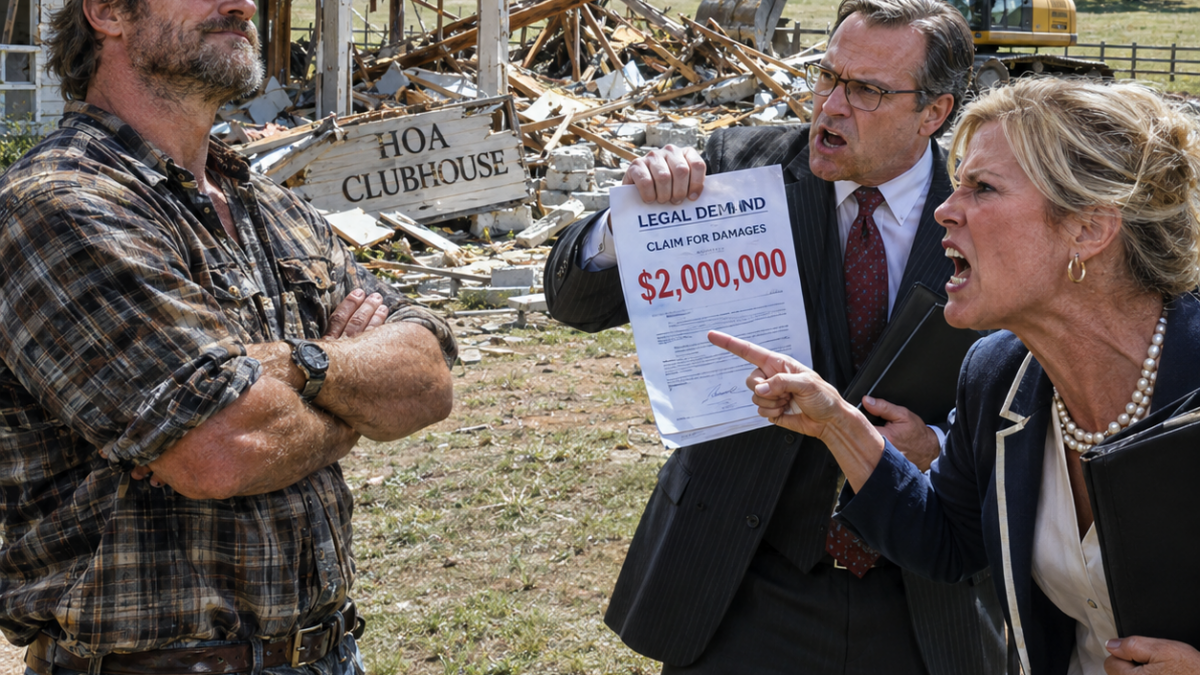
$2,000,000 for clubhouse destruction.
$180,000 operational disruption.
$75,000 initial legal fees.
Punitive damages potentially pushing exposure beyond $3 million.
Payment demanded within ten days.
I read the first page.
Then looked at him.
“Coffee?”
He seemed surprised.
“What?”
“Coffee.”
He clearly expected panic.
Or anger.
Or denial.
Instead, I led him into the kitchen.
He sat.
I poured two mugs.
Then I opened my file cabinet.
“Did Marissa give you the deed?”
“She provided ownership documentation.”
“That wasn’t my question.”
He paused.
“No.”
“Did she show you the original ground lease?”
“She provided relevant lease information.”
Again.
Not the same answer.
I placed a certified copy on the table.
“Read this.”
Preston opened it.
Fifteen-year term.
Expiration.
Ninety-day removal clause.
Then Section 14.
His expression changed.
He went back.
Read it again.
I said:
“Did she ever show you this document?”
No answer.
I slid over my deed.
Audrey’s survey.
The title report.
County plat.
Then the demolition permit.
Structural report.
Three notice letters.
Delivery confirmations.
Trail-camera footage stills.
HOA guards pulling stakes.
Preston’s confidence evaporated piece by piece.
“Where did you obtain the lease?”
“County archive.”
He looked up.
“And?”
“Seller’s title file.”
Public.
Ordinary.
Legitimate.
Easy to verify.
He sat back.
“My client tells me this agreement was superseded.”
“Good.”
I took a sip of coffee.
“Ask her for the replacement.”
He didn’t answer.
I continued.
“If there’s a later lease, deed, easement, or purchase agreement, I’d love to see it.”
He gathered the papers.
At the door, he stopped.
“Are you planning to countersue?”
“That depends on what Marissa does next.”
“The demand still stands.”
“Okay.”
His voice didn’t sound nearly as certain as it had twenty minutes earlier.
That night, instead of calculating how I would pay Silver Ridge, I started calculating what Silver Ridge might owe me.
Unauthorized use of 5.2 acres.
Remediation.
Survey costs.
Legal fees.
Demolition costs.
Drainage repair.
Title clouding.
Trespass.
Potential slander.
It climbed quickly.
Past $1.4 million.
Then Audrey called at 9:36.
“Graham.”
“Yeah?”
“That HOA boundary map.”
“What about it?”
“It’s worse than we thought.”
She had compared it against the official county plat.
Not just visually.
File structure.
Fonts.
Instrument number.
Metadata.
Someone had copied formatting from a real recorded map.
Then redrawn the boundary.
The fake-looking exhibit wasn’t merely wrong.
It appeared deliberately designed to look official.
And the file had been created after my first dispute letter.
I sent everything to my attorney.
At the same time, Preston began demanding records from Marissa.
That became a turning point.
Because lawyers can defend bad facts.
They cannot ethically build arguments around facts their own client refuses to disclose accurately.
Marissa blamed the property-management company.
Claimed the map had existed for years.
Then the HOA email archive surfaced.
One message from Marissa:
Simply clean up the boundary on the clubhouse exhibit before the board sees it.
Another:
Do not circulate the old lease unless legal specifically requests it.
Preston read those emails.
Then he began cross-checking everything Marissa had given him.
Dates.
Attachments.
Server logs.
Versions.
He informed the HOA board he could no longer rely on the disputed map until independently verified.
Marissa demanded they fire him.
The board refused.
I filed a quiet-title action.
I wanted the court to formally confirm ownership.
I also filed counterclaims.
Trespass.
Unauthorized use.
Title interference.
Remediation costs.
I did not try to destroy hundreds of homeowners financially.
Most of them had no idea what Marissa had done.
My claims targeted the association where appropriate and the people directly responsible.
At the next HOA meeting, Marissa again told residents I was trying to steal community land.
Then Warren Bellamy, one of the directors, stood up.
“Did you know the lease expired?”
Marissa said:
“No.”
Warren held up an email.
Subject:
GROUND LEASE EXPIRATION — ACTION REQUIRED.
Sent seventeen months earlier.
Management company to Marissa.
The message warned the lease was about to expire and recommended immediate negotiation.
Marissa’s reply:
We’re not paying another cent for land the community already treats as its own.
The room reportedly went silent.
Warren asked:
“You wrote this?”
“I don’t remember.”
“Your email account.”
“I receive hundreds of messages.”
“You said you didn’t know.”
“I don’t remember every communication.”
A resident asked:
“Why didn’t the board know?”
No answer.
Another asked:
“Why didn’t we renew?”
Nothing.
Another:
“Why didn’t we buy the land?”
Silence.
Insurance had been Marissa’s safety net.
At least in her mind.
She believed if things became expensive, the HOA’s carrier would step in.
Two days later, the carrier sent notice it was reviewing coverage.
Intentional acts.
Concealment.
Potential falsification.
Those exclusions matter.
If conduct is intentional enough, insurance may refuse to pay.
That meant personal exposure became possible.
Preston pushed mediation.
Smart move.
Litigation was becoming radioactive.
We met in a neutral conference center.
Marissa arrived in a tailored blazer carrying a leather portfolio.
She opened with a new demand.
$2.4 million.
I almost laughed.
Preston did not.
I brought two boxes of documents.
Marissa said:
“You destroyed a community asset.”
I answered:
“You could have signed a lease.”
“We didn’t need one.”
I began laying out the timeline.
Lease signed.
Lease expiration.
Ninety-day removal period.
Management warning.
Marissa’s refusal.
My purchase.
Survey.
Ownership notice.
Stakes removed.
Cease-and-desist.
Fake assessment.
Altered map.
Purchase/lease/removal options.
Renovation attempt.
Structural inspection.
Demolition permit.
Final notice.
Demolition.
Every date supported by a record.
Then Marissa made a mistake.
She looked at me and said:
“You think because you’ve bought a little land you’re some kind of title expert?”
I smiled.
“No.”
I waited.
“I spent more than twenty years acquiring industrial properties with boundary, title, lease, access, and environmental problems.”
She stopped smiling.
I continued.
“Over three hundred million dollars in commercial real-estate transactions.”
Preston looked at me differently.
“I’ve spent two decades sitting across from surveyors, title lawyers, engineers, lenders, and owners solving exactly this kind of problem.”
Marissa glanced at Preston.
She had assumed I was a hobby farmer with acreage.
She had never bothered to ask what I’d done before buying it.
Wrong man.
I slid my counterclaim across the table.
$3.18 million.
Marissa laughed.
“You expect me to pay you three million dollars?”
“No.”
I leaned back.
“I expect the court to decide.”
Then I put the original signed lease in front of Preston.
Another provision required the tenant to bear removal costs if improvements weren’t removed when required.
Preston read it.
Then looked at Marissa.
She turned on him.
“You told me he destroyed our property.”
Preston’s expression went flat.
“I told you that based on the documents you provided.”
Silence.
Marissa opened her mouth.
Closed it.
The mediator wrote something down.
No one rescued her.
Mediation failed.
That night, Preston sent a preservation notice to the board.
Emails.
Texts.
Maps.
Minutes.
Lease documents.
Everything.
Marissa demanded his removal again.
Again, the board refused.
Discovery began.
Boxes.
Scans.
Old contracts.
Board packets.
Invoices.
Archived emails.
Then we found the document that explained the whole disaster.
Eighteen months before I ever bought the acreage, the previous owner offered Silver Ridge the 5.2 acres outright.
Price:
$240,000.
Permanent solution.
No lease.
No future boundary dispute.
No risk.
The property manager recommended buying.
The prior attorney recommended buying.
Two board members wanted a vote.
Marissa blocked it.
Her email:
I see no reason to pay $240,000 for land nobody can realistically take away from us.
I read that sentence several times.
That was the entire case.
She knew Silver Ridge didn’t own the dirt.
She simply believed possession was enough.
She gambled nobody would ever challenge the clubhouse.
Then I did.
Instead of admitting the mistake, she doubled down.
Discovery also showed she had used the clubhouse for private events.
Birthday parties.
Holiday gatherings.
A political fundraiser.
One invoice literally said:
PRESIDENT’S PRIVATE RECEPTION.
Preston finally advised the board that the $2 million claim should not continue.
Marissa refused.
Threatened to replace him again.
The board held a vote.
Six to one.
She lost control of the litigation.
Her vote was the only one against.
Then the insurance carrier finalized its review.
No coverage for losses tied to intentional concealment or falsified documents.
The association could potentially pursue Marissa personally.
Her final major defense was an affidavit.
She swore she had never seen the full lease before the demolition.
Then we found an email.
Seven months earlier.
From her account.
To the association accountant.
Attachment:
ORIGINAL GROUND LEASE — FULL EXECUTED COPY.
Message:
Keep this out of the homeowner packet until we decide how to handle it.
During deposition, Preston had to question his own former client’s statements carefully.
“Is this your email address?”
“Yes.”
“Your signature block?”
“Yes.”
“You sent this?”
“I don’t remember.”
“Did you attach the lease?”
“I don’t remember.”
“Did you instruct the accountant not to circulate it?”
“I don’t remember.”
“Why would you tell someone not to distribute a lease you say you never saw?”
No answer.
The deposition paused shortly afterward.
That evening, I told my attorney:
“Marissa didn’t lose the clubhouse when the excavator showed up.”
“When did she lose it?”
“The day she decided nobody would ever check the paperwork.”
The ownership hearing was packed.
Silver Ridge residents filled the gallery.
Most were seeing the actual documents for the first time.
Judge Mallory Pierce began with the simplest possible question.
“Who owns the ground?”
My attorney presented the deed.
Survey.
County plat.
Chain of title.
No transfer.
No permanent easement.
No purchase.
No boundary adjustment.
The judge turned toward Preston.
“Do you dispute the boundary?”
He was honest.
“Not based on the evidence currently before the court.”
Then the lease.
Execution date.
Expiration date.
No extension.
No renewal.
No option exercised.
Section 14.
Judge Pierce read the relevant language.
Then looked at the HOA table.
“Was the structure removed within ninety days?”
“No.”
“Was the lease renewed?”
“No evidence of renewal, Your Honor.”
“Was the property purchased?”
“No.”
The judge paused.
“Then what is the association’s basis for claiming ownership of the improvements after the contractual transfer provision became effective?”
There wasn’t a good answer.
My evidence continued.
Demolition permit.
Structural report.
Notice letters.
Proof of delivery.
Trail-camera video.
Survey-stake removal.
Audrey testified.
Then the altered map.
She explained the shifted boundary.
Copied formatting.
Creation date.
Metadata.
No one was charged with a crime in that civil hearing.
That distinction mattered.
But credibility was gone.
When Judge Pierce ruled, she did it in stages.
First:
I owned the 5.2 acres.
Second:
Silver Ridge held no permanent ownership right.
Third:
The ground lease had expired.
Fourth:
The ninety-day removal period had passed.
Fifth:
Silver Ridge had no legal basis to continue occupying the land after formal demand.
Then the $2 million claim.
Dismissed.
The judge said:
“The association asks this court to compensate it for destruction of property it has failed to establish it owned.”
That sentence traveled through the gallery like electricity.
Residents whispered.
Some looked at Marissa.
Others at the board.
I didn’t smile.
I understood what came next.
Money.
And most homeowners were innocent.
During recess, Silver Ridge proposed settlement.
I could have pursued the entire $3.18 million claim.
Maybe I would have won part.
Maybe more.
Maybe less.
But a giant judgment against the HOA could become special assessments.
Families.
Retirees.
People who had simply trusted their board.
That wasn’t what I wanted.
So I offered different terms.
Boundary permanently confirmed.
My demolition and remediation costs reimbursed.
Survey and legal fees reimbursed.
$38,400 fraudulent assessment canceled.
Independent verification required for future major land decisions.
Marissa’s personal accountability left to Silver Ridge itself.
Direct settlement:
$685,000.
Still painful.
But far below my full claim.
Board vote:
Six to one.
Marissa voted against.
The agreement passed.
Then the forensic audit began.
Independent firm.
No prior relationship with Silver Ridge.
Their findings were brutal.
Marissa had received repeated warnings about lease expiration.
She blocked the $240,000 purchase that could have solved everything.
She authorized renovations on land Silver Ridge didn’t own.
She spent association money fighting me without giving directors complete underlying documents.
She suppressed the lease.
She supported a distorted boundary exhibit.
And by refusing every reasonable option, she turned a $240,000 solvable property issue into a disaster costing far more.
At a special meeting, Warren placed four documents in front of her.
Lease expiration warning.
$240,000 purchase offer.
Email hiding the lease.
$685,000 settlement.
Then he said:
“Every opportunity to prevent this crossed your desk.”
Marissa said nothing.
The board voted to remove her as president.
Then it pursued management liability coverage and reserved claims against her personally for anything the policy would not cover.
Eventually, Marissa signed a private settlement.
$312,000.
Repayment tied to expenditures made without proper board authorization.
Her attorney apparently told her the cost of fighting publicly could exceed the settlement.
A few months later, she sold her home.
No farewell reception.
No champagne.
No banner celebrating leadership.
Just a moving truck.
I didn’t celebrate that either.
By then, I was tired.
Not triumphant.
Tired.
Litigation does that.
People imagine winning a lawsuit feels like standing on a mountain.
Mostly it feels like finally putting down a heavy box you’ve carried too long.
My land became quiet again.
I did not rebuild a clubhouse.
Didn’t put up apartments.
Didn’t create some victory monument.
I restored pasture.
Removed the last foundation sections.
Fixed the drainage that had been emptying into my land for years.
Installed a proper fence on the certified line.
Grass returned.
For a while, residents driving past slowed down.
They looked at the empty field.
Some shook their heads.
Some waved.
Some avoided eye contact.
Eventually, nobody cared anymore.
That was fine with me.
I kept one thing from the clubhouse.
The Silver Ridge stone sign.
Not because I stole it.
I offered it back.
The association declined to spend money moving it.
So I stored it face down in a shed.
A giant slab of polished stone.
Heavy.
Expensive.
Useless.
Sometimes I’d walk past it and think about how much authority people can project onto an object.
When that sign stood at the clubhouse entrance, it meant:
Community property.
Private land.
HOA control.
Residents only.
But when ownership was tested, the stone meant nothing.
It couldn’t replace a deed.
Couldn’t renew a lease.
Couldn’t move a boundary.
It was just a sign.
Months after everything ended, Preston Vale stopped by.
No demand letter.
No leather case.
No professional reason.
Saturday morning.
He parked beside my barn.
I met him outside.
“Didn’t expect to see you again.”
“I was nearby.”
“Sure.”
He smiled.
“Fine. I was curious.”
“About?”
He looked toward the open field.
“I genuinely thought you were about to have a very bad year when I delivered that demand.”
“I know.”
“You didn’t look worried.”
“I was.”
He seemed surprised.
“Really?”
“Of course.”
“You hid it well.”
“Panic doesn’t improve title.”
He laughed.
Then looked at the pasture.
“She really believed possession was enough.”
“Yes.”
“Fifteen years of community use.”
“Yes.”
“Residents treating it as theirs.”
“Yes.”
“Building maintained by HOA money.”
“Yes.”
He shook his head.
“She thought all of that would outweigh the paper.”
I pointed toward the survey stakes.
“That was the mistake.”
“Which one?”
“She assumed using someone else’s land long enough would eventually make the paperwork stop mattering.”
He waited.
“It was the paperwork that allowed them there in the first place.”
Preston nodded.
“Lease giveth.”
“And lease taketh away.”
He laughed.
Then became serious.
“Why didn’t you pursue the full three million?”
“Residents.”
“They benefited from the clubhouse.”
“They didn’t hide the lease.”
“Some board members ignored questions.”
“Then let Silver Ridge decide what to do with them.”
“You’re more forgiving than I expected.”
“No.”
I looked at him.
“I just prefer accurate blame.”
That mattered to me.
Marissa had made a lot of bad decisions.
But she wasn’t every homeowner.
Warren had asked questions.
Other board members had been misled.
Residents paid dues believing the clubhouse belonged to them.
If I’d tried to financially crush the entire neighborhood, I would have become part of the problem.
I wanted my land.
My costs.
My title cleared.
And systems changed.
I got all four.
The next spring, I put cattle on the restored acreage.
The first time they wandered across the old clubhouse footprint, I laughed.
One cow stood almost exactly where Marissa’s podium had been during the wine reception.
Another grazed where the fitness room used to be.
No marble.
No sound system.
No political fundraiser.
Grass.
Sky.
Animals.
Simple.
A Silver Ridge resident named Paul stopped at the fence.
He was the older man who had been sitting in the golf cart during demolition.
“You really put cows there.”
“Apparently.”
He smiled.
“My wife misses the pool.”
“I don’t blame her.”
“She hates driving to the new community center.”
“That’s unfortunate.”
He leaned on the fence.
“I voted for Marissa twice.”
I said nothing.
“She did good things.”
“I’m sure.”
“People act now like she was evil.”
“I don’t.”
He looked surprised.
“You don’t?”
“No.”
“After all that?”
“People don’t have to be evil to cause enormous damage.”
Paul thought about that.
“She was stubborn.”
“So was I.”
“Difference is you were right.”
I smiled.
“That helps.”
He laughed.
Then asked:
“Did she really have the chance to buy the land for $240,000?”
“Yes.”
He shook his head slowly.
“The special assessment from the settlement cost us more than that.”
“I know.”
“That’s hard to swallow.”
“Most expensive word in real estate is later.”
“What?”
“If you can solve a problem cheaply now, waiting usually makes it expensive later.”
He nodded.
“Wish she’d learned that.”
“So does she, probably.”
Over time, Silver Ridge rebuilt its social center elsewhere.
On land it actually owned.
Smaller building.
No pool at first.
Then a modest one several years later.
Before construction, the new board ordered three title reviews.
Two boundary surveys.
Independent counsel.
Residents joked that they had developed a paperwork allergy in reverse.
Every document had to be checked twice.
I considered that a good outcome.
Warren became president for a while.
He invited me to the opening.
I almost declined.
Then he wrote:
This one is definitely on our land.
I laughed and went.
The new clubhouse wasn’t fancy.
One floor.
Community room.
Kitchen.
Small gym.
Windows facing the hills.
Warren met me at the entrance.
“Want to see the deed?”
“Absolutely.”
He pulled out a folder.
He was joking.
Mostly.
I looked anyway.
The land belonged to Silver Ridge.
Clearly.
Cleanly.
No ground lease.
No weird expiration clause.
No neighboring acreage.
I handed it back.
“Congratulations.”
“Best compliment you’ve ever given us.”
Residents were polite.
Some thanked me.
That felt strange.
One woman said:
“You forced us to become a better HOA.”
“I demolished your clubhouse.”
“Yes.”
“Interesting definition of better.”
She laughed.
“Before you, nobody asked questions.”
“That’s not good.”
“We thought questioning the board meant causing trouble.”
“And now?”
“Now somebody asks for an invoice if we buy a new coffee maker.”
“That might be excessive.”
“Maybe.”
She smiled.
“But we sleep better.”
The replacement clubhouse had one framed document near the board office.
Not the old lease.
A governance policy.
All land-related capital projects required independent title verification and board disclosure.
No president could hide supporting documents.
No related-party land transaction without conflict review.
No fabricated “community maps” used as legal evidence.
That one made me laugh.
The strongest revenge isn’t always watching somebody lose.
Sometimes it’s watching the system change so the same trick stops working.
Years passed.
The pasture matured.
Fence posts weathered.
The old driveway faded.
If you hadn’t known the clubhouse existed, you would never guess.
Occasionally, I’d find something in the grass.
A small piece of tile.
Part of a plastic pool fitting.
Once, a bent brass screw.
Physical ghosts.
I kept none of them.
The stone sign was enough.
One rainy afternoon, Audrey stopped by.
She was surveying a neighboring parcel.
We stood near the fence.
“You know what I tell clients about this property?”
“That you charge extra if people remove your stakes?”
She laughed.
“That too.”
“What else?”
“Never assume a structure tells you where a boundary is.”
I nodded.
“Good advice.”
She pointed toward where the clubhouse had stood.
“Most people see a building that size and think the land question must have been solved.”
“Exactly.”
“Like nobody would spend millions on the wrong dirt.”
“People do.”
“Constantly.”
“Because buildings look permanent.”
“And documents look boring.”
She smiled.
“Until the boring document wins.”
That was the story in one sentence.
The most dramatic thing in the entire case was an excavator tearing through a clubhouse wall.
But the thing that actually decided the case was a paragraph written sixteen years earlier.
Section 14.
Black ink.
Ordinary paper.
Probably drafted by some lawyer nobody remembered.
Nobody applauded when it was signed.
No champagne.
No photographs.
Yet years later, that paragraph outweighed a pool, parking lot, stone sign, nine-thousand-square-foot building, eight-year HOA president, $75,000 litigation fund, altered map, security team, and $2 million demand.
That’s why I respect paperwork.
Not because paper is magical.
Because good documents capture agreements before memories become convenient.
Marissa’s memory changed constantly.
The lease was irrelevant.
Then she hadn’t seen it.
Then it was superseded.
Then she couldn’t remember emails.
Then she believed the HOA owned the land anyway.
The document never changed.
Fifteen years.
Ninety days.
Improvements transfer.
Simple.
The title record never changed either.
No deed.
No sale.
No easement.
No renewal.
All the noise in the world couldn’t add a document that didn’t exist.
The $2 million demand became a joke around my office.
Not because lawyers’ letters are funny.
They’re not.
A demand like that can wreck your sleep.
The first night Preston delivered it, I lay awake until nearly three.
I knew the law was on my side.
I still thought:
What if I missed something?
What if a judge interprets Section 14 differently?
What if the HOA produces another contract?
What if the demolition permit isn’t enough?
What if residents become hostile?
What if insurance funds endless litigation?
Confidence and fear can exist together.
That’s something people don’t talk about.
I looked calm because calm was useful.
Not because I felt invincible.
The next morning, I went back through every file.
Again.
Deed.
Lease.
Survey.
Title report.
Notices.
Permit.
Structural report.
Then I felt better.
Evidence is useful medicine for anxiety.
Marissa relied on intimidation.
Big numbers.
$38,400 dues.
$75,000 legal fund.
$480,000 renovation.
$2 million clubhouse.
$3 million exposure.
Her language was always designed to make me think:
This is too expensive to fight.
But money doesn’t change basic ownership.
If someone builds a $10 structure on your land without rights, it’s still on your land.
If they build a $2 million structure, same answer.
Expense creates sympathy.
Not title.
The most important moment of the entire dispute may not have been demolition.
Or court.
Or mediation.
It may have been when Marissa said:
Those stakes won’t be there tomorrow.
Because that told me she wasn’t trying to understand the boundary.
She wanted the boundary hidden.
If she had reacted differently—
Let’s review the survey.
Let’s read the lease.
Let’s meet with counsel.
Let’s negotiate.
The clubhouse might still exist.
Silver Ridge could have bought the land.
For far less than what the disaster cost.
They had already been offered the acreage for $240,000.
Even after I bought it, I offered a purchase.
Lease.
Removal.
Three exits.
Marissa chose none.
Pride has a strange relationship with money.
People will refuse a $240,000 solution because paying feels like admitting weakness.
Then spend millions proving they were never weak.
That was Marissa’s tragedy.
She wanted victory more than resolution.
By the end, she lost both.
Several years after she moved away, I received a letter.
No return address I recognized.
Inside was one page.
Typed.
Unsigned.
But I knew who it was from.
It said:
I still believe Silver Ridge should have had the opportunity to keep what it built. But I understand now that I should have brought the lease to the board when I first learned it had expired.
That was it.
No apology.
No signature.
No admission about maps.
No mention of survey stakes.
No mention of threats.
But the sentence mattered.
I should have brought the lease to the board.
For Marissa, that was probably as close to confession as she could get.
I didn’t respond.
Not because I wanted to punish her.
Because there was nothing left to settle.
The land was restored.
The case closed.
Money paid.
Board changed.
She had left.
Sometimes closure is not another conversation.
Sometimes it’s refusing to restart one.
I placed the letter in the old case file.
Next to Preston’s $2 million demand.
Two pages.
Same dispute.
One arrived when Marissa believed she controlled everything.
The other arrived when she finally understood what one hidden document had cost.
I kept both.
Not as trophies.
As reminders.
The first reminds me not to panic when someone puts a huge number on letterhead.
The second reminds me that people sometimes learn too late.
My business changed after the case.
Not because of publicity.
I never tried to turn it into marketing.
But colleagues heard.
People started calling when they encountered expired ground leases.
Boundary problems.
Buildings on neighboring parcels.
One developer said:
“You’re the guy who bulldozed an HOA clubhouse.”
“I prefer real-estate investor.”
“Less exciting.”
“More accurate.”
He laughed.
Then handed me a file.
I looked at it.
“First question?”
He waited.
“Who owns the dirt?”
We both laughed.
That became my favorite question.
Not because it’s always complicated.
Because people skip it.
They see use.
Control.
Buildings.
Fences.
Signs.
Maintenance.
Taxes.
HOA rules.
And assume ownership sits beneath all of those things.
Sometimes it does.
Sometimes it doesn’t.
Real estate punishes assumptions.
Especially expensive ones.
On the fifth anniversary of the demolition, I walked the pasture before sunrise.
Fog low.
Grass wet.
Cattle near the tree line.
The old clubhouse footprint was almost impossible to see.
Maybe a slight difference in soil.
Nothing else.
I stood where the west wall used to be.
The first wall Dean’s excavator hit.
I could still hear the sound in my memory.
Metal.
Glass.
Concrete.
Marissa screaming.
You destroyed two million dollars.
At the time, I answered:
I demolished my building.
Legally correct.
But years later, I thought about it differently.
The building had never really been the heart of the conflict.
The conflict was over belief.
Silver Ridge believed longstanding use had become ownership.
Marissa believed authority could replace documentation.
Residents believed the board had checked.
The lawyer believed the client had provided the full file.
I believed the papers.
That sounds arrogant.
But papers can be wrong too.
That’s why I hired independent people.
Audrey.
Title company.
County inspectors.
Engineers.
Attorney.
I didn’t want to win because I believed myself.
I wanted to know I was right before doing something irreversible.
Demolition is irreversible.
Once the wall falls, you cannot put the legal uncertainty back in the building.
That’s why I waited.
Notice after notice.
Option after option.
Inspection.
Permit.
Final deadline.
Empty building.
Only then did I say:
Proceed.
People sometimes ask:
“Would you do it again?”
Yes.
But not because demolition felt good.
It didn’t.
Watching a building destroyed is strangely sad.
Even when you’re legally entitled.
That structure contained weddings.
Birthdays.
Retirement parties.
Swim lessons.
Holiday dinners.
Residents had memories there.
Those memories weren’t fraudulent because the land situation was.
I respected that.
That’s why I preserved their belongings.
Why I offered settlement below my full claim.
Why I never blamed ordinary homeowners.
But sentiment cannot require one person to surrender property rights forever.
If Silver Ridge wanted to preserve the clubhouse, it had chances.
Many.
They were rejected.
The consequences were real.
Not cruel.
Real.
One winter evening, Warren called.
“Do you still have the sign?”
“Which sign?”
“You know exactly which sign.”
The stone one.
Silver Ridge Community Club.
“Yeah.”
“The board voted.”
“On what?”
“We want it back.”
That surprised me.
“Why?”
“History display.”
I laughed.
“Seriously?”
“New clubhouse.”
“What are you going to write under it?”
He said:
“Something honest.”
That got my attention.
A week later, a truck came.
They loaded the stone slab.
At the new community center, the sign was mounted horizontally in a courtyard.
Not as an entrance marker.
As an artifact.
A plaque beneath it read:
ORIGINAL SILVER RIDGE COMMUNITY CLUB SIGN
The former clubhouse operated for fifteen years on leased land.
After the lease expired and ownership issues were not resolved, the structure was removed.
This marker is preserved as a reminder that good communities require transparency, documentation, and accountability.
I stared at it.
Warren stood beside me.
“Too much?”
“No.”
“Not enough?”
“About right.”
He smiled.
“Marissa would hate it.”
“Then maybe remove that part from your motivation.”
He laughed.
“You always ruin the fun.”
Residents walked past.
Some read the plaque.
Some didn’t.
Kids sat on the edge eating cookies.
Life moved on.
That felt right.
The old sign once claimed ownership.
Now it taught caution.
Better use.
One young homeowner asked me:
“Are you Graham?”
“Unfortunately.”
“My dad told me about you.”
“That sounds dangerous.”
“He says you destroyed the clubhouse.”
“That’s one version.”
“What version do you prefer?”
I thought about it.
“I enforced the expiration date.”
He laughed.
“That sounds boring.”
“Exactly.”
Because that’s the truth.
The excavator was dramatic.
The expiration date was decisive.
Marissa’s biggest mistake wasn’t underestimating my money.
Or my lawyer.
Or my background.
It was underestimating the power of a deadline she didn’t respect.
Fifteen years ended.
Ninety days passed.
Rights changed.
She kept acting as if time couldn’t change ownership.
But contracts are full of clocks.
Miss the date, and the world on paper becomes different from the world you assumed existed yesterday.
She ignored that.
Then tried to make reality match her assumption.
Remove stakes.
Change maps.
Hide lease.
Threaten.
Sue.
Spend.
None of it could rewind the deadline.
I stood in the new courtyard looking at the old stone sign and realized something.
For years, Marissa had treated every challenge like a personal attack.
Maybe because she couldn’t separate leadership from being right.
That is dangerous.
A healthy leader can say:
I was wrong.
We missed the lease.
Let’s fix it.
An unhealthy leader thinks admitting error will destroy authority.
So the error must be defended.
Then another error protects the first.
Another lie protects the second.
Another expense protects the lie.
Eventually, the cost of admitting the original mistake feels unbearable.
That’s how a $240,000 land issue became a multi-million-dollar crisis.
Not because the first problem was impossible.
Because pride kept making the next solution more expensive.
I learned something too.
Being legally right doesn’t automatically make every aggressive move wise.
I could have sued for the full $3.18 million.
Maybe pushed Silver Ridge into massive assessments.
Maybe forced sales.
Maybe destroyed finances of people who had nothing to do with Marissa’s decisions.
Legally available isn’t always morally necessary.
I took enough to restore what was damaged.
Enough to clear title.
Enough to reimburse costs.
Enough to make the system change.
Then I stopped.
That’s the ending I’m proud of.
Not the clubhouse falling.
The moment I decided winning didn’t require maximizing pain.
People love revenge stories because consequences feel satisfying.
I understand.
When someone threatens you, lies, manipulates records, and tries to use institutional power against you, part of you wants them crushed.
I felt that.
Especially when Marissa said they’d own everything I had.
I imagined the day she would realize she was wrong.
And yes, when Preston sat at my kitchen table reading Section 14, watching his confident face change—
That felt good.
When the judge dismissed the $2 million claim—
That felt very good.
When Marissa lost the presidency—
Also good.
I’m not going to pretend otherwise.
But the best feeling came later.
Standing in pasture.
No calls.
No lawyers.
No threats.
No overnight cameras alerting me to security guards.
Just wind through grass.
That’s the revenge that lasts.
Peace.
Marissa wanted my life consumed by her HOA.
For several months, it was.
Then it wasn’t.
She lost that power.
Years after everything ended, I opened the original file one last time.
Inside:
My deed.
Audrey’s survey.
Ground lease.
Section 14 highlighted.
Trail-camera stills.
$38,400 invoice.
Altered map.
Notice letters.
Demolition permit.
Preston’s demand.
Counterclaim.
Settlement.
Marissa’s unsigned letter.
I ran my hand across the stack.
Then closed the file.
Not because the story didn’t matter.
Because it finally felt finished.
I put it in the archive cabinet.
Outside, cattle moved toward the far pasture.
The 5.2 acres were green.
The boundary stakes stood exactly where Audrey had placed them.
No one removed them anymore.
No guard drove past at night.
No HOA sign claimed the ground.
No white SUV appeared at my gate.
The title was clean.
Sometimes the simplest ending is the strongest.
Marissa once told me that touching the clubhouse would cost me everything I owned.
Her lawyer came to my house demanding more than two million dollars.
Silver Ridge spent months insisting I had destroyed community property.
Then the documents were opened.
The lease read.
The boundary measured.
The emails recovered.
The dates checked.
And the entire story turned around.
I never paid Silver Ridge a dollar.
Their $2 million claim disappeared.
They paid to settle with me.
Marissa lost control of the lawsuit.
Then the presidency.
Then hundreds of thousands of dollars of her own.
And eventually, she left the neighborhood she’d once ruled like a personal kingdom.
All because she looked at a man standing on his own acreage and assumed confidence mattered more than ownership.
It didn’t.
The day the excavator hit that clubhouse, people thought they were watching the beginning of the fight.
They weren’t.
The fight had already been decided years earlier by a document most of them had never read.
Fifteen years.
Ninety days.
Section 14.
By the time Dean’s excavator ever touched that west wall, Silver Ridge’s right to keep the clubhouse there had already expired.
The building wasn’t theirs anymore.
That was the part their lawyer learned too late.
And it was the part Marissa had known all along.








